Overwintering Canna Plants from Container Gardens

19 Comments

Hello Visitors,

As noted yesterday, I am beginning to disassemble, dismantle, and take apart my container gardens and patio pots.

As I do, I will share with you the photos and steps in the event you can not attend my demo on Oct 17th, Saturday.

Yesterday, I took apart one pot of Canna plants. I selected the tall red one, figuring it would be easy to show you what I do.

Canna plants may be kept in the pot and stored inside, but today’s post shows you how to store the rhizomes.

Rhizomes

Rhizomes are the storage organs which are swollen stems under the soil that usually grow horizontally, below the soil about 6-8″ from the top of the soil line in the pot.

Mature rhizomes may be cut into sections to produce more plants, but you don’t need to do that step now. Just remove them from the soil and store them in peat moss.

Other Overwintering Options

Option #2: If you have a nice sun room in your home, you have the option of continuing to grow your Canna in the pot. However, I find if you keep your Canna plants in the same container for several years in a row, they start to get crowded and tend to not bloom or flourish as much.

Option #3: A third option is to leave the Canna plants in the pot and move it to an unheated basement where it remains cool all winter, but not below freezing. The plant will go dormant and may be revived the following spring after spring frost. In this case, however, you will need to watch for insects and water it sparingly so the soil does not go completely dry during the winter.

Canna Rhizome Removal

Tools: Clean pruners, loppers, or if you are not a full time gardener with various garden tools, use a long kitchen knife (like one you would use to cut bread).

When: You may wait until the Canna plants get hit by our fall frost later in October, and many references will say wait until it gets hit by frost. However, I’ve stored rhizomes in fall before frost and all works out fine as well.

Canna Australia in a Tall Red Pot

Canna Australia in a Tall Red Pot

Cleaning: Using sharp, clean tools is important to prevent pests and diseases from being transmitted to your plants or storage organs (rhizomes). It is also a good practice to wear gloves and wash your hands as you work, and wash your pots when you are done dismantling everything.

The Steps

Step One: Cut the stalks at the base, leave a little 5-6″ stub if you want. Most important – make a CLEAN cut. Do not tear, pull, tug or make a jagged like cut – the cleaner cut the better. If the stems are thin, pruners work. If not, I like using loppers for a clean cut. If you use a kitchen knife, remember to make the slice/cut as clean as possible.

Clean Cut at Base
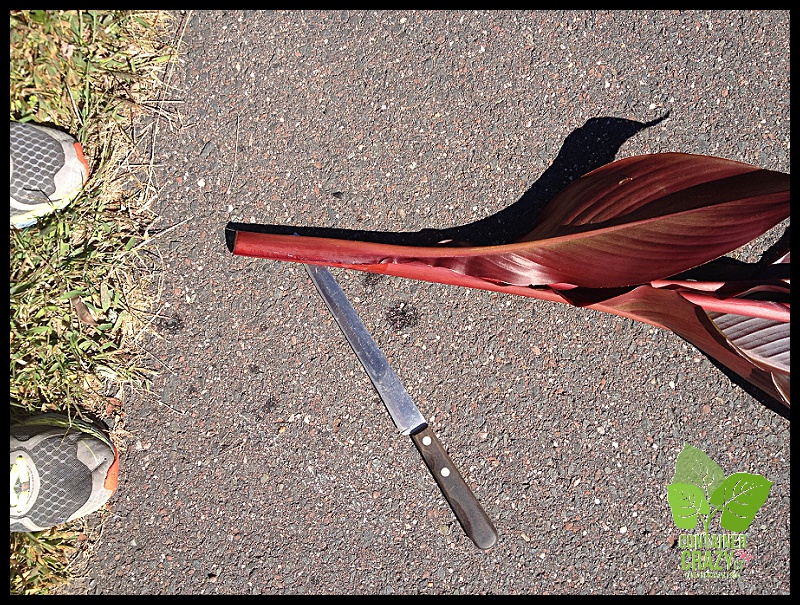
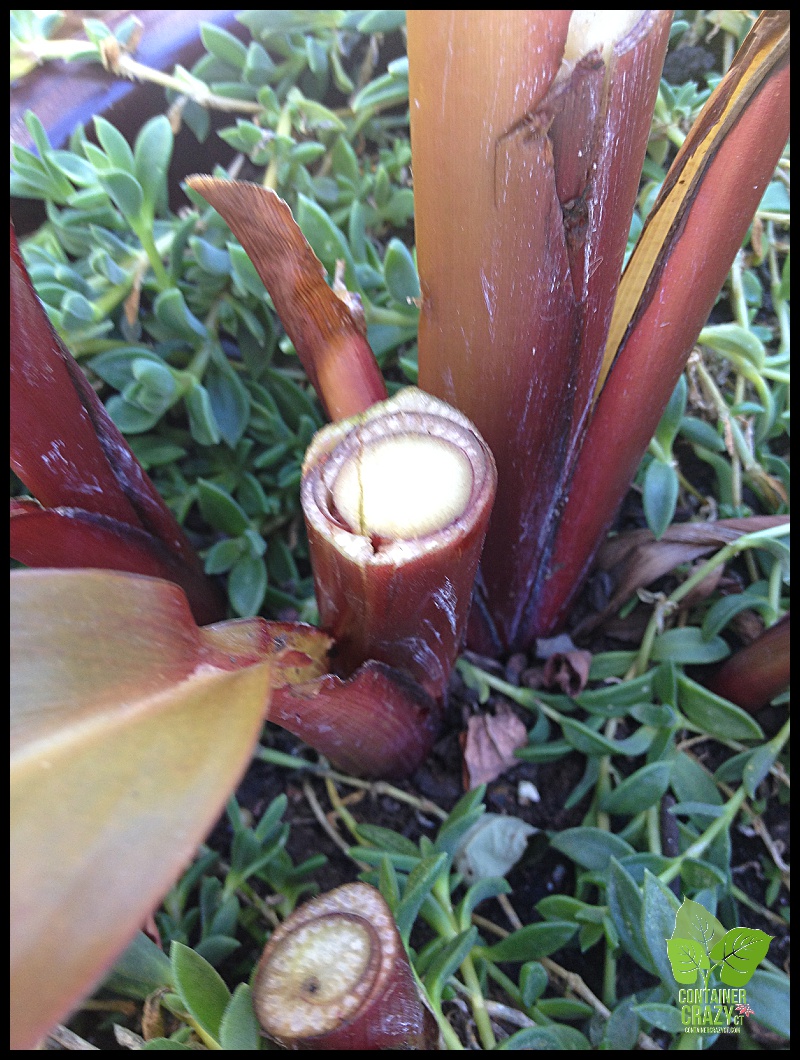
Clean Cut at Base

ContainerGardenTakeDown_0022

ContainerGardenTakeDown_0020

Step Two: Remove other plants in the pot and save as needed or toss. Then remove the root ball. Usually, if the pot does not have a edge on the top rim, it slides out just by turning it over or rolling it on a table (unfortunately, for this red pot, I had to work at removing some soil inside to get it out).
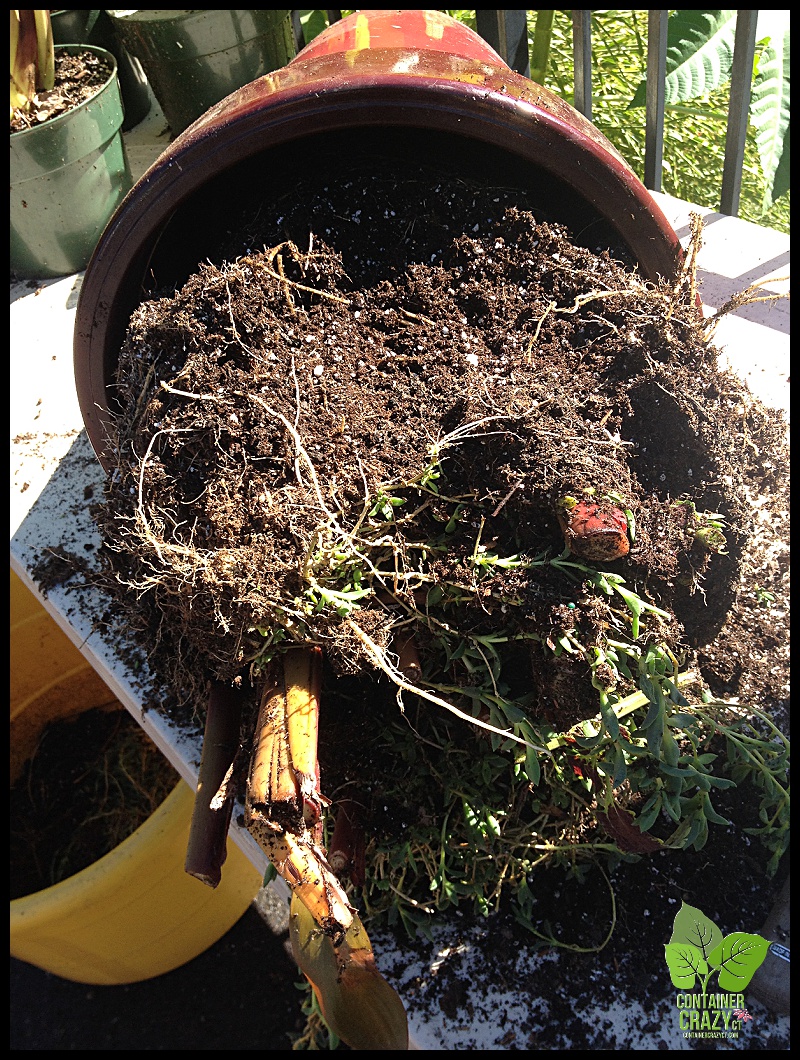
ContainerGardenTakeDown_0024

ContainerGardenTakeDown_0018

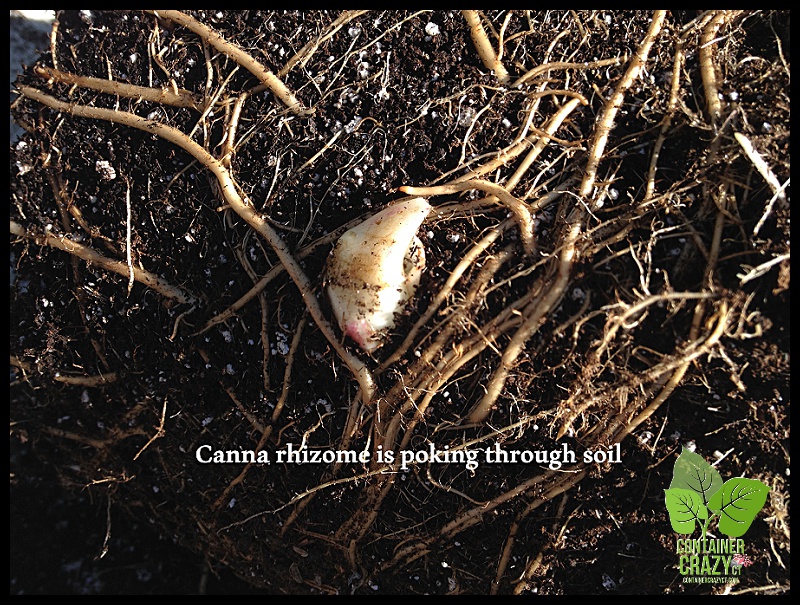
You can see a rhizome poking out of the soil here in this photo above. This can help to locate where they are but you will not always see this in every case.

Step Three: Cut off (slice off) the bottom half of the soil mass. Be careful to not cut the rhizomes which should be about 6-8″ from the top of the soil line.

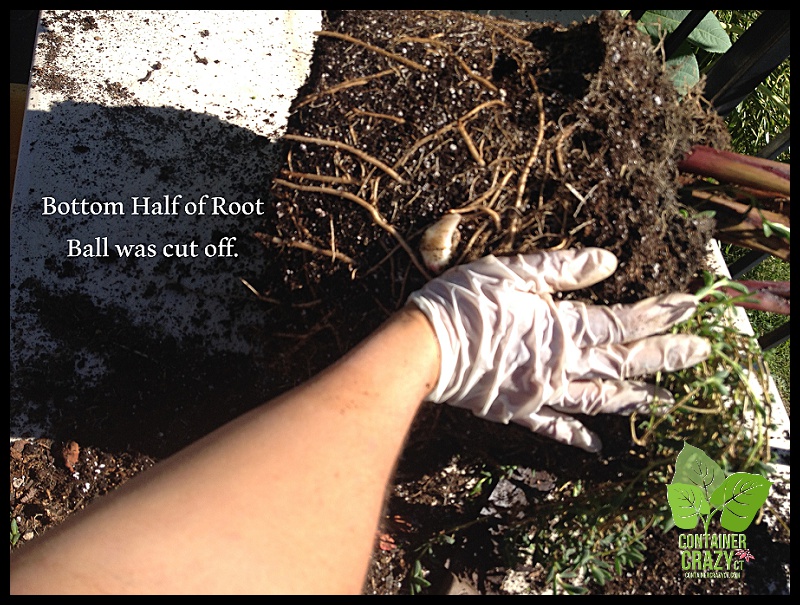
ContainerGardenTakeDown_0016

ContainerGardenTakeDown_0021

Step Four: I placed my hand to show about the distance from the top of the soil to where the rhizomes are in the soil. Start to remove the soil away from the rhizomes using your hands or tools. If you use tools, try to not damage the rhizomes accidentally — but if you do – don’t panic. Rhizomes are often cut into sections for propagation, it won’t kill them if you break one by accident.
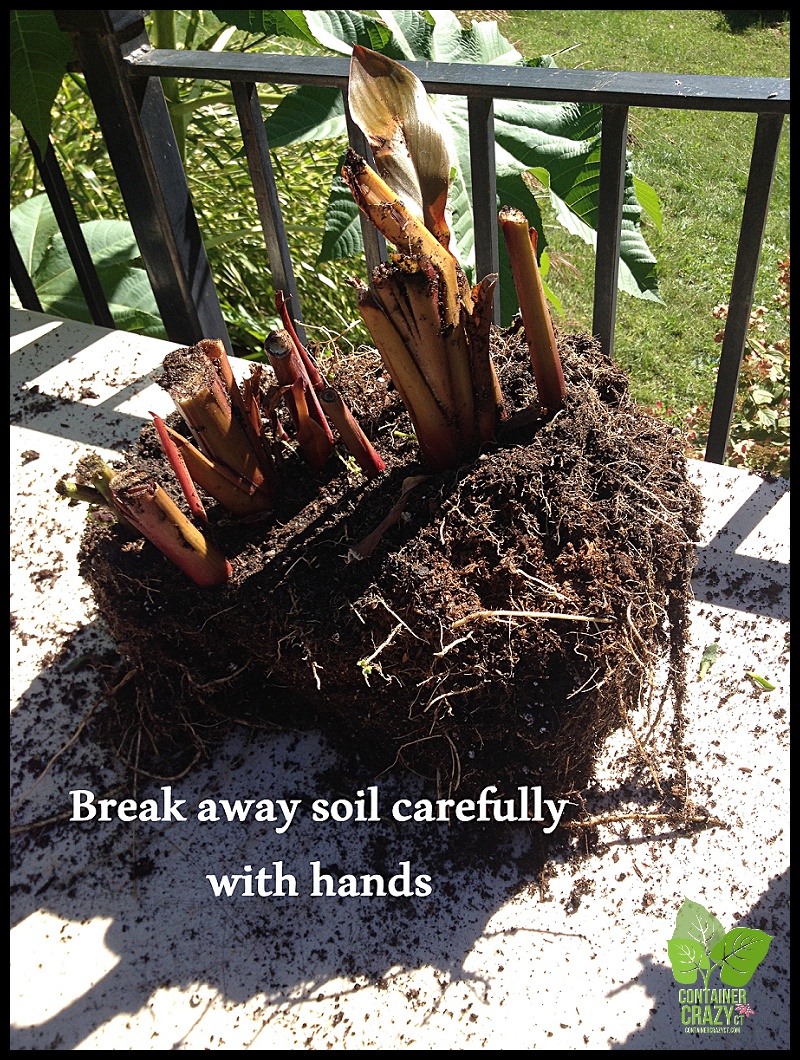
ContainerGardenTakeDown_0017

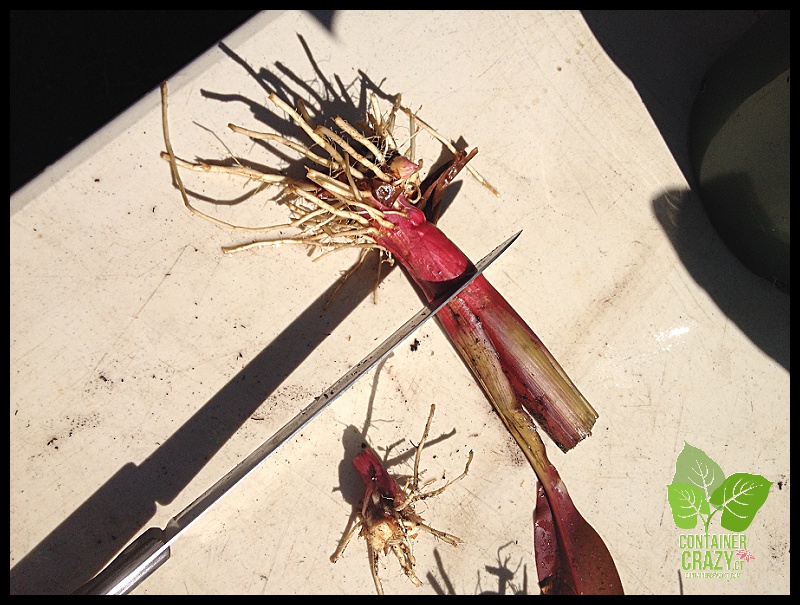
Step Five: Pull the stems a bit apart, they may break away freely, meaning the rhizomes will separate. Take one stem in one hand, and another in the other hand and pull them away from each other, you will see how they break away. Then clean off as much as the soil as you can. You may use a garden hose to wash them off with sprays of water, but I don’t always do this because then the rhizomes get super wet. In this case, I did to show you how they looked.
ContainerGardenTakeDown_0015

Step Six: Trim off the stem stalks. I do this because any fleshy material stored has the potential to rot in the box of peat moss. I even trim the roots if they are super long with sharp pruners. Then let them air dry a bit (couple hours).

The last step is putting them in a container (box) with peat which I will show in tomorrow’s post.

ContainerGardenTakeDown_0023

In this particular case, the rhizomes were on the small side, but that doesn’t matter. Each piece you save is another new plant for next year.

Crocosmia (perennial)

This summer, I put a Croscosmia perennial in a blue pot. The hummingbirds adored this plant’s blooms. It was amazing to see them zip by every day. So, you have choices with perennials too on what to do with them if you grew them in your container gardens and patio pots.

They may be removed now and put into the ground to have in your garden or if you have a garage, some perennials will come back if you store the whole pot with the un-removed plant over the winter in the garage.

You may also bury pots with perennials in the ground, but I don’t like that idea because the pot will get dirty and probably worn out more – but this is an option. This information was noted on the container garden workshop handouts in May as well (for those attendees reading this information).

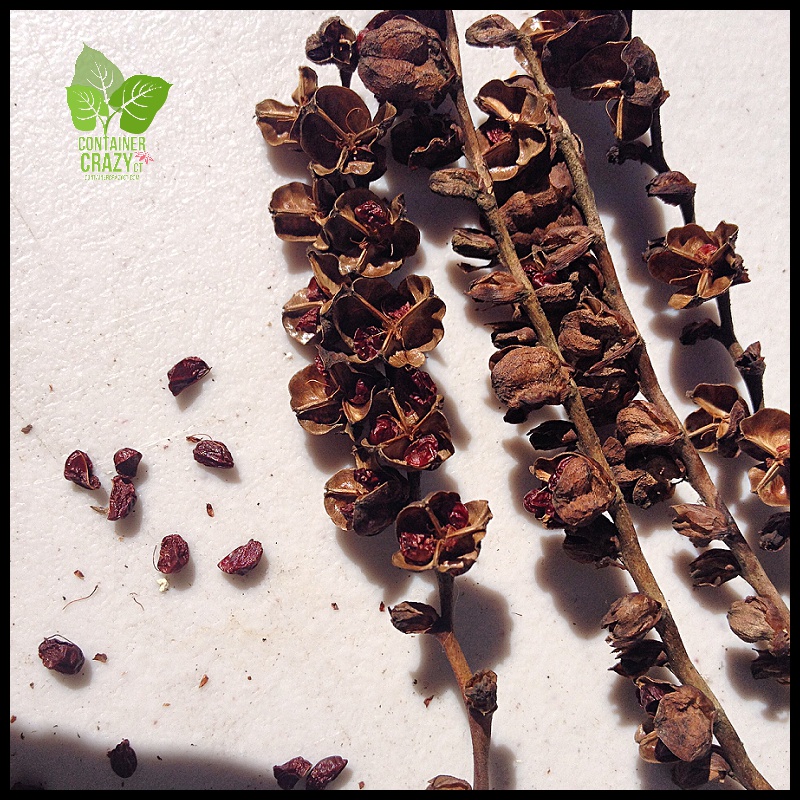
Before I cut back all the foliage from the Crocosmia perennial, which was tattered by the end of the summer, I collected the seeds from this plant for next season. They may be scattered in your garden or stored for next season.

I put seeds in prescription bottles. Its a great way to recycle the bottles and the label is available – with a quick sharpie marker, I write the plant’s name and date, and store the seeds in a cool, dark place until next spring.
ContainerGardenTakeDown_0009

ContainerGardenTakeDown_0012

The seeds are stored in pill bottles as shown above.

ContainerGardenTakeDown_0010

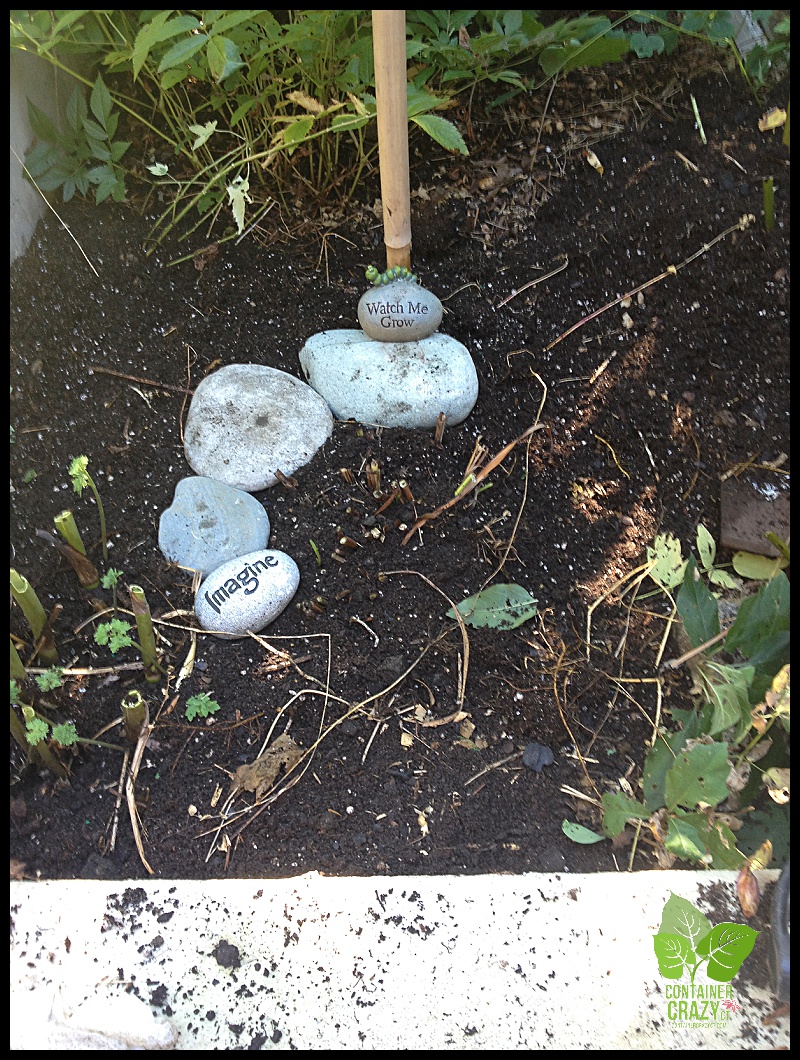
The root ball was removed from the blue pot. I decided to plant it in my big cement planter after doing a bunch of cutting back of the existing perennials in the cement planter, which also has some huge castor beans growing.
ContainerGardenTakeDown_0011

Then I put some stones around the Crocosmia to help me remember I moved it there. Even if I don’t keep it in this spot permanently, it is now saved for next season.

Crocosmia Blooms from a Prior Season

Crocosmia Blooms from a Prior Season

I love my big cement planter because the soil is so healthy and easy to work in, and dig in. Yesterday, I noticed some worm castings in the soil. This is what they look like below. It a sign the little critters in the soil are doing a great job of keeping the soil healthy. Worms increase air and water movement in the soil and help break down organic matter when they eat, leaving these worm castings behind which help the plant’s growth.

Worm Castings in Soil

Worm Castings in Soil

As noted in yesterday’s post, I sometimes put old soil balls/masses from dismantled containers into “big” pots or into gardens as a filler in the base – this is one example. The soil in this big cement planter is from former container gardens, and the worms moved in quickly. The soil is rich now.

ContainerGardenTakeDown_0013

Begonia from Tubers (see yesterday's post!)

Begonia from Tubers (see yesterday’s post!)

By the way, yesterday I wrote about storing tubers from tuberous Begonias. Here’s a photo of the plant from this summer (see above) which I found this morning in my files.

Note: The details about appropriate storing temperature, methods, and specifics by type of plant for overwintering various plants will be covered in the demo session on October 17th. If I were to write all the details here, this would be a very long post – and I’m wordy enough! But this shows you the basics. It is fairly easy to overwinter plants but there are other tips to be learned.

Keep tuned in – more tomorrow…

Cathy Testa
860-977-9473
containercathy@gmail.com
ContainerGardenTakeDown_0025

The Container Garden Take Down Process Begins

5 Comments

Hello Visitors,

I’m posting some misc photos this week of the work I will be doing here and there as I take apart my container garden plants. This is for the friends and workshop attendees who are probably ready to do the same – and I hope the information is helpful to you. As always, ask questions if you have them!

Tuberous Begonia

For the first time, I grew a tuberous begonias from tubers. They were started in early March indoors by placing the tuber’s hollow side up in moist peat. They must be kept warm and carefully watered to not over water or under water (keep moist). Shoots began to form, but it took a while for the plant to kick in and later produce blooms, but it was worth the wait.

Three of the plants were gorgeous and showed off orange flowers shaped like peony flowers (male flowers) and rose shaped flowers (female flowers) on the same plant. The stalks of these types of begonias are very fleshy and one plant leaned over from the weight of the plant by the end of summer, and from the force of the wind during last weekend’s rain storm.

I chopped off the top of the plant using clean pruners, and then tipped over the pot and got the soil base out carefully on a table. It was fairly simple to locate the storage tuber. I will allow it to dry a bit on newspaper then it will be stored over the winter in a cool dark place. These tubers should be checked to make sure they don’t dry out during this process in the winter months.

Tubers of these types of begonias must be dug up before our fall frost hits and dried slowly before storing them in peat moss at about 45 degrees F. Wish me luck – I hope to grow even more of these plants next spring!

Showing Steps of Taking Down a Tuberous Begonia

Showing Steps of Taking Down a Tuberous Begonia

Recycling the Soil

Recycling Soil for a Year or Two

Recycling Soil for a Year or Two

If you have attended my workshops in May on container gardening, you heard me go over the soil-less mixes and what I find has worked well over the years. I’ve also mentioned that reusing soil mix is not recommended, at least not for many, many years – and especially when you keep the mix in the pot with the plant. It just doesn’t retain water well or hold nutrients as nicely when it is worn out – BUT you can use it for a year or two, or put it into a compost pile, or sometimes – I will put it in a huge pot (like my big black pot with my red banana plant – see prior post on that). Putting it into bins like shown above is helpful. I remove all the foliage and make sure none of that it is the soil bin, and I put the cover on, but I also remove the cover from time to time to let it breath as the water condensates. These bins will be moved into my garage or growing room soon to stay over the winter and will be reused next year.

Castor Bean

Castor Bean Seed Pods

Castor Bean Seed Pods cut away from a huge plant!

If you are my neighbor or you drive down my road – you have definitely noticed the crazy size of my Castor Bean plants (Ricinus) at the end of my driveway.

A woman pulled in one day, drove down my long driveway to inquire what the heck was growing there. “She had to know,” she said.

This plant made me laugh every single time I left or returned home. It is massive! I’ll share pictures of it later.

This plant is easy to grow from seed. I got my seeds from Comstock Ferre in Old Wethersfield, CT this year. The plants reached about 12 feet tall at the end of my driveway. I also grew some in the ground in my backyard.

The leaves of this giant would be perfect to make leaf castings for birdbaths! This huge tropical can be impressive and comical, as mine was this season.

Just yesterday, I thought I better chop down one because it is becoming a hazard. It is blocking the view of oncoming cars as we leave our driveway.

As I cut it down with big loppers, my neighbor yelled out, “Cathy, What did you feed that THING?!”

Ironically, I gave it the ‘liquid blue’ only 3 times the entire summer, and it was only to the one growing in the pot. The other two grown by it’s side in the ground did not get watered or fertilized at all.

The potted one got watered daily however. I would fill a bucket in my car with water every time I drove out and stop to pour the bucket of water in the potted castor bean plant.

This plant gets huge stalks, which resemble bamboo. Its odd alien like flowers turn into seed pods with burrs on them, as shown in this one clump I chopped off yesterday. It did compete with other plants in the bed part though – my white lavender plants and bee balm were hurting later in the summer as the castor bean plants took over.

Castor beans do well in full sun – which the mailbox specimens were in most of the day, but they can take part sun too. The only other thing is that bed was filled with compost when it was edged with stone, so that is another reason why the plants probably did very well in the ground there too – good soil base.

And it is a fast grower, so if you decided to give it a try next year – take note of where you place it for it will take up space and compete for nutrients and moisture of other plants in the same bed.

Also, take note – all plant parts are poisonous. It is not overwintered by plant parts – but you may save the seeds to regrow them again next year. Or just see me in May.

Red Banana Plant with Two Coleus

Red banana plant with two types of Coleus

Red banana plant with two types of Coleus (Alabama on right, Icky Fingers? on left)

Okay, so I don’t always instantly remember the cultivar names, but on the right side is Coleus ‘Alabama’, which I love. And on the left side, it looks similar to the cultivar, ‘Icky Fingers’. These plants can be saved by taking tip cuttings and rooting them in water, then potting them up to save a small portion for reuse the following season. Or they may be cut back somewhat, dug up, put in a pot and grown as a houseplant over the winter by a semi-sunny window.

As for the red banana plant, I will be showing how to store what I call the “root base” of these plants at the October 17th session. This banana is a look-alike (not a true banana plant) but who cares, right?! This plant is gorgeous when it grows large especially. The leaves are broad and this cultivar ‘Maurelii’ (red Abyssinian banana) are reddish and lush colored with trunks of red coloring. They are relatives to Musa (true bananas) and I grow, overwinter, and sell these every year, obtaining stock from a local Connecticut grower.

These plants grow tall and large in our warm summers in big pots but must be overwintered since they are not hardy. You can move it indoors (if you have the space somewhere) — And remember, if you do move it indoors as a houseplant – do it before frost. Once it is hit by frost, the leaves turn black and to mush.

Or you can dig up the fleshy root base to store it over the winter in a cool place, just like you do with canna rhizomes. You can even store it in its container, if it didn’t grow too large, in a cool dark place until our spring arrives.

The steps on how I do this will be shown at my informal session on October 17th, Saturday. It is also shown on my blog post, step by step, from last October. I recognize you may want to take apart your’s at home now, so sharing all in advance as well.

Begonia ‘Gryphon’

Begonia 'Gryphon' Zones 9-11 - A Winner!

Begonia ‘Gryphon’ Zones 9-11 – A Winner

This begonia, at the base of this container garden, impressed me this season as a container garden filler. I ordered them from a local CT grower for spring, and sold this plant at my May workshops – and it turned out to be very impressive.

The leaves grew bigger than my hand, and the dark green leaves with little bits of white were showy – and healthy, all season. It was very reliable – and low maintenance. I just loved it.

It is considered a tropical plant – for zones 9-11, but is wonderful in our patio pots in during summer seasons. This type is best saved as a house plant. I will dig it out carefully with soil around its roots, and re-pot it into a nice pot to keep inside this winter. It should be kept by a brightly lit window area; not full harsh sun, but bright area inside the home. Be aware of drafts by windows in winter as well.

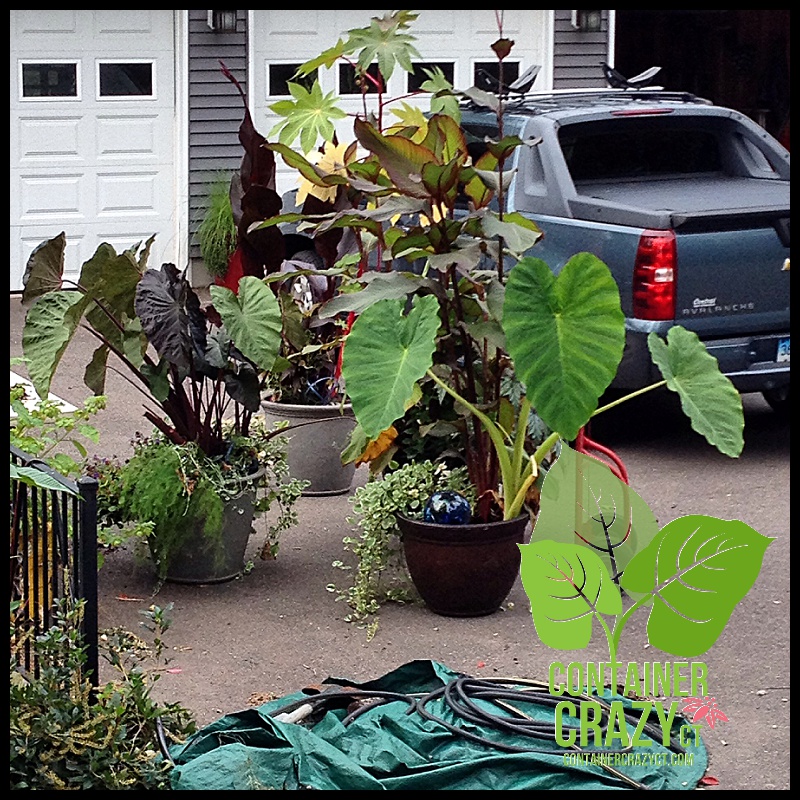
Lining Them Up

Lining them up

Lining them up

Besides moving 3 wheel barrel full loads of compost, which sat on my driveway all summer, I moved the pots which were carried down from my deck last week by my nephew and his friend to be lined up like soldiers. Somehow, they look taller here than they did on the deck all summer. I will decide which to tackle today and which to keep as demo’s for the workshop on the 17th.

Check-in tomorrow to see what gets done this afternoon.

Thanks,

Cathy Testa
containercathy@gmail.com
(860) 977-9473

← Back

Thank you for your response. ✨


What Should I Do with My Container Gardens and Patio Pots right now?

1 Comment

You – like me – probably thought you better move in some of your deck pots as a result of the gusty winds and cooler temperatures hitting us right now.

I decided to spontaneously text my brother and nephew yesterday –> “Want to make a quick $20 bucks? I need some help moving my big pots from the deck.”

He immediately responded with, “How about right now?”

Well, long story short – It was a blessing they happened to be free at that very moment for about 30-40 minutes. They came right over. I quickly got my garden gloves on and moved some debris from an ornamental grass I had left lying on the ground in the way.

As soon as they arrived, Ross and Joe started picking up some of the medium sized pots in their arms and walked them to an indoor location for me.

I was washed over with relief as I watched them walk down my deck stairs with the pots hovering over the shoulders and my big plants bobbin’ over their heads.

When Joe picked up the Agave in my urn, I kept repeating – “BE CAREFUL, it is a weapon and the spines on the tips could take your eyes out.”

When showing Ross one of my prized plants – I pointed out a stem while indicating it is easily damaged. “I really don’t want it to break,” I said. He was super careful.

“Don’t drop the pots hard when you put them down – This can cause the pot to crack especially for pots that are thinner resin pots.” Another statement I was saying quickly because these two young guys were moving fast.

Ross asked several questions along the way. “Wow, what is this purple plant?” he asked.

“That is Persian Shield, and it is called, Strobilanthes,” I replied.

Strobilanthes (Persian Shield) is a purple plant - the color is fading due to cooler temps.

Strobilanthes (Persian Shield) is a purple plant – the color is fading due to cooler temps.

Ross then started taking photos with his phone before he picked up the next pot.

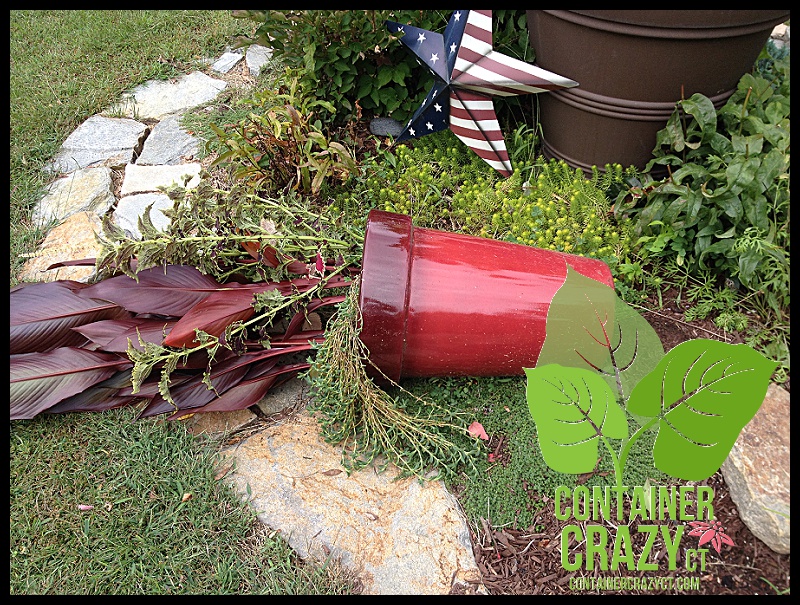
Tall pot toppled over already from gusty winds.

Tall pot toppled over already from gusty winds.

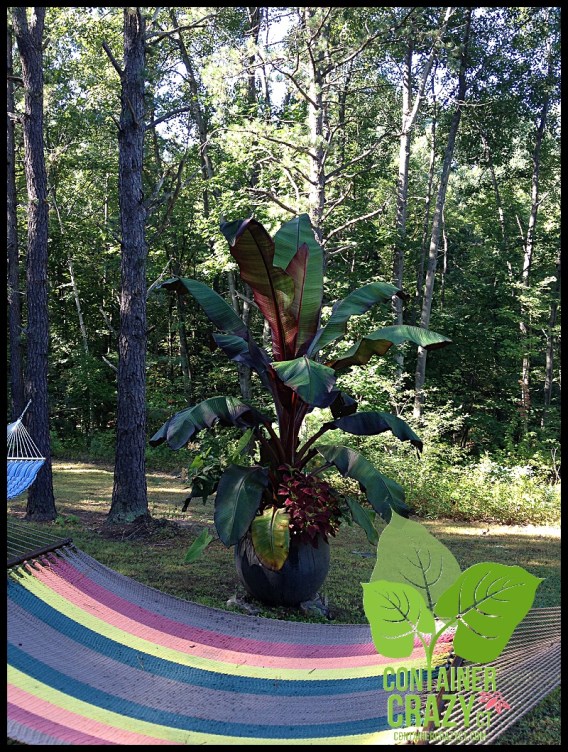
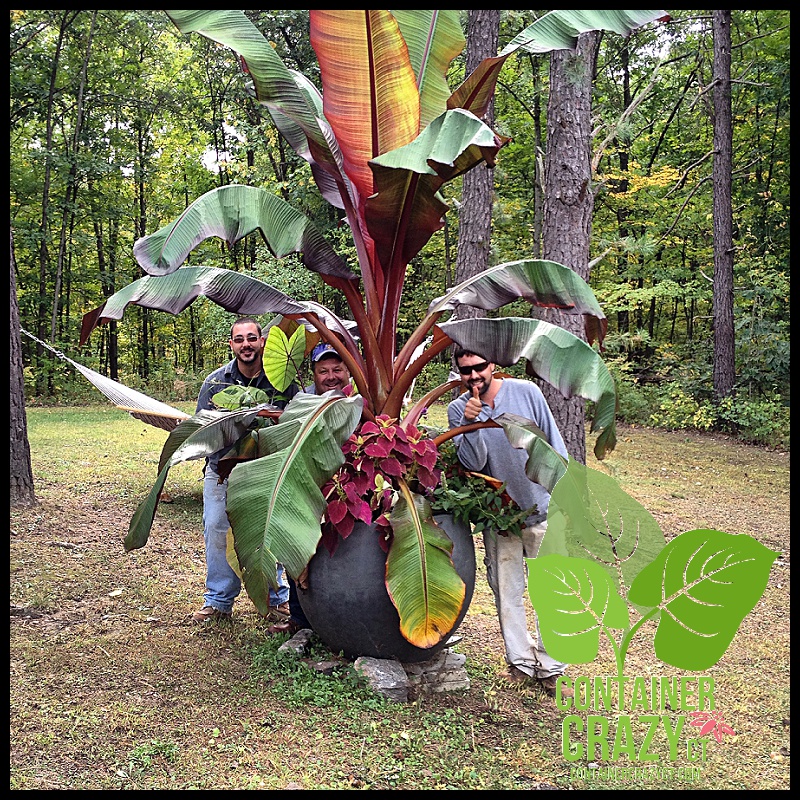
After all was moved into an enclosed growing space or onto my driveway for ease of taking them apart later, the guys wanted to pose by my big red banana plant in the backyard. This plant will be part of my overwintering demo in two weeks (and may be published in a catalog. More on that later.).

What To Do with Your Pots Right Now

Some of your tropical plants in container gardens and patio pots (banana plants, Canna, elephant ears) are still safe out there however. The temperatures are in the 40’s to 50’s degree range, and with the 30-35 mile hour winds, it will feel like we are hovering in the mid to lower 50’s. It will feel cold but we are not getting frost.

The gusty winds will tear leaves of big banana plants probably and the cooler temps will make some of the leaves start to turn yellow. Plus, all the cold rain will cause dampness around your plants. This will make your pots heavier as the soil gets soaked.

Some of your tall pots may fall over from the winds. My tall red pots with towering Canna plants already did – so if you are concerned with breakage of pots or plants, move those to a sheltered location.

Even though, I am offering a session on October 17th to demonstrate how I store the root bases of red banana plants, and how to store Canna rhizomes and elephant ear corms (bulbs), I’m shooting off some tips right now quickly.

Ross and Joe with the Stemmed Plant in Center

Ross and Joe with the Stemmed Plant in Center

Tip # 1:

Get help – if possible. The best part of my 3 amigo’s spontaneously helping me yesterday is they refused payment when they were done. I almost cried. I suggested some cocktail treats – and they responded with, “Yah, let’s go to Broad Brook Brewery soon.” If you can’t get help, use a handtruck to move heavy pots – and take your time. Try not to rush, bend those knees, etc. If a friend is helping you, please remind them to be careful to not rush – this results in hurting your back or straining something when moving heavy pots.

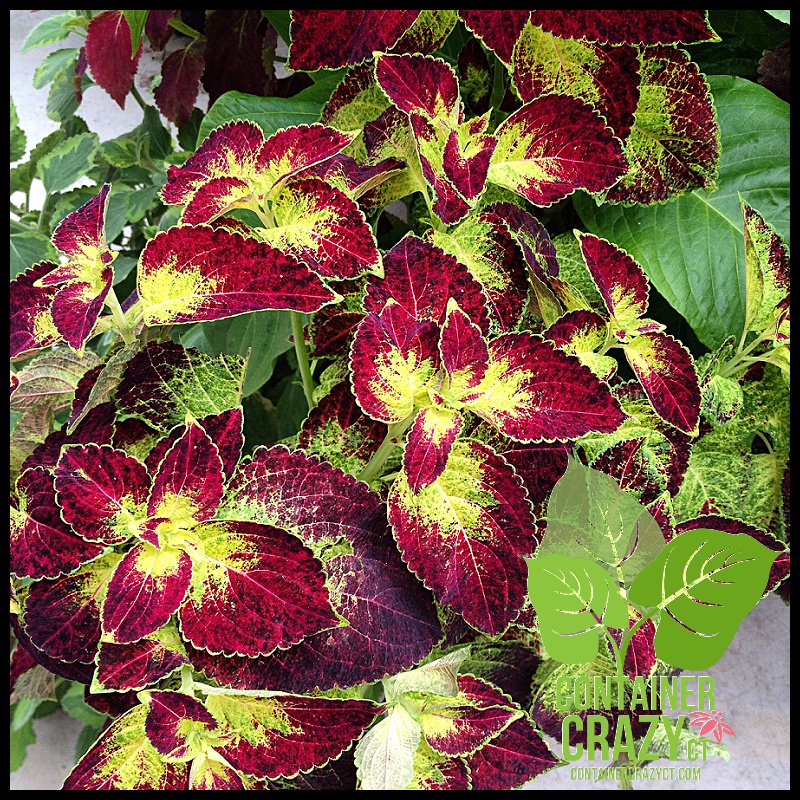
Coleus 'Dipt in Wine' is stunning still, taking cuttings of the tips with stem and leaves will save them.

Coleus ‘Dipt in Wine’ is stunning still, taking cuttings of the tips with stem and leaves will save them if you don’t have a growing location inside.

Tip #2:

Coleus – If you have some in pots, take some tip cuttings and put in water in a cup or vase. This is a way to save a bit of the plant. It will root eventually and you may pot it up in a small house plant pot to keep over the winter.

Agave in Urn - Watch those spines by your head, Joe!!

Agave in Urn – Watch those spines by your head, Joe!!

Tip #3:

For succulents – as I have said in the past, move them inside the house. They will get wet now for sure – and it can rot the tender foliage because the temperatures have dropped down. Get them inside the warmth by a window and let the soil dry out.

By garage, will be taken apart this month at my session.

By garage, will be taken apart this month at my session.

Tip #4:

Move your big pots into a garage if you don’t have time to tend to them right now. They won’t get totally soaked by the rain if you plan to dissemble them later this month.

Alocasia was moved inside, see the leaves turning color - they want to stay warm.

Alocasia was moved inside, see the leaves turning color – they want to stay warm.

Tip #5:

Leave the pots right where they are outside. It is colder out but not a frost situation yet. The plants will change color and look a bit off, but if you are planning to chop the foliage down to remove the underground parts from the soil for storing over the winter, then it is okay if the foliage gets a bit of cold damage. However, if you want to take it in as a house plant, I say do it now.

Fern and Colocasia (Elephant Ear) moved inside.

Fern and Colocasia (Elephant Ear) moved inside.

Reminder: I’m primarily speaking about Canna, Banana plants, and Elephant Ears for this post for those in container gardens in my CT Zone (Broad Brook/East Windsor). The cold temps will signal the plants that dormancy time is coming. If you want to keep any of these as inside house plants – moving them in now is a good time to do so because the foliage will get damaged a bit from the cold and winds. We may see warmer days again, but the plants won’t get as stressed if moved inside. If you want to store the root bases, storage organs, corms, bulbs, or rhizomes, it is okay if the plants get hit by frost later this month. (Angel Trumpet (Brugmansia) plants should not be hit by frost.)

The big red banana plant (Ensete) to be part of demo day.

The big red banana plant (Ensete) to be part of demo day.

That’s all for now. If I think of anything else later, I will add it on. If you have questions about a specific plant, just fill out this contact form below.

← Back

Thank you for your response. ✨

Thank you,

Cathy Testa
860-977-9473
containercathy@gmail.com

Earlier photo of the big red banana plant (Ensete genus)

Earlier photo of the big red banana plant (Ensete)


NEXT UP: How to Overwinter or Store Plants from Your Container Gardens

Leave a comment

In about five weeks or so from today, it will be time to disassemble and clean-up your container gardens and patio pots, which includes overwintering or storing your plants to reuse/regrow the following year.

Smaller Pots

I already started doing some of this work – starting with smaller pots and window boxes that had lettuce and cucumbers growing in them. My first step is removing any tidbits of stems from the soil, pulling it away with my hands. Then I dump the soil on a table and break it up with my hands. The soil gets placed into a big plastic bin because I plan to grow more lettuce, parsley, basil, and kale this fall and winter in my growing room – so I will reuse this soil. I think it is important to break up the soil to revive the air spaces. Big plastic bins work well for these types of pots for me for the soil storage. They are easy to move and keep things tidy. The empty window boxes and small pots get washed a bit by using my garden hose, and if they don’t clean up easily, a bit of soapy water is used. Cleaning is an important step in the process to avoid any disease transmittal and to maintain the life of your containers and window boxes.

Tropical Plants

In October, either before our frost hits plants or immediately after, I put away my Canna and Banana plants (Note: Some tropical plants should not be hit by frost before moving them inside or storing the storage organs or root bases). I plan to demo my process of storing plants from container gardens and patio pots on October 17th and will be offering it as a demo day. Anyone whom wishes to witness the process is welcome to come to my house at 10:30 am. A small attendance fee applies. If for some reason the cold weather arrives earlier however, this may get moved to October 10th – I will keep you posted if you sign up (see the Contact Form below).

Seeing is Believing

Seeing is believing, and seeing is learning. Many friends prefer to see how this process is done to learn it – but you may also read the how to’s in my prior posts. For example, when I stored my red banana plant one year, every step was documented with photos (and yes, this is the same red banana plant I’ve been posting photos of this summer, growing in my big black pot this year). It was a very cold day at the end of October when I documented the process, requiring a thick pull over and warm gloves, but I enjoyed every minute regardless, because it was worth it. This particular plant has been regrown in a container for the past 4 years. It just keeps getting bigger and showier.

STORING MY BIG RED BANANA PLANT POST

Holding an leaf and cut off top of my red banana plant.

Holding an leaf and cut off top of my red banana plant.

Perennials in Pots

This year’s theme for my Container Garden Workshops in May was perennials in pots. So, if you have some in your containers, you may start any time from now until the end of October to start moving them from your pots to your gardens. Transplanting perennials is best done in the spring so they have time to establish, but it will work out fine if done in the fall for many hardy and tougher perennials – I’ve done this many times with container plants – and they survive. There are other ways to overwinter them (leave in the pot and move to a sheltered spot such as your garage, or sink pots into the ground). But you may do this now or up to end of October before the ground starts to get too cold to work in. I’ve moved perennials even in early November with success. More will be discussed on the demo day too.

Base of Canna Roots

Base of removed soil mass from a big pot

Succulents

One thing I have emphasized in my workshops is moving succulents (cacti like plants, Jade plants, Agaves, Aloe, etc.) into the home before it gets too cold during October. Think of days when we start getting some cold rain falls and the nights begin to get cooler. I find when the foliage of cacti like plants or succulents get hit by cold wet rain and the soil stay damp, they start to rot. Sometimes I move them inside before this type of weather pattern begins in the fall. While these plants may still survive a bit of chill before it gets really cold, it leads to trouble. For example, I have a beautiful Jade plant in my red head planter, I plan to move it in soon.

Red Head with Jade

Red Hed with Gem Dangling – Gets Moved Inside before Chills – Photo by Joyful Reflections Photography of Ellington, CT.

Save Your Pots for Winter Decor

Another good tip is pots with soil are handy in the winter if you wish to stuff them with live evergreen cuttings and stem tips as a winter themed decoration on your deck for the holidays. So, empty all the plants, but leave the soil in the pot, store it, and when the “Holiday Kissing Ball and Evergreen Decorations” workshop comes up in early December, you will find this ‘soil filled pot’ handy to insert your green decor. The 2015 dates for these fun holiday workshops are December 5th and 12th. See the link for all the details or click on Nature with Art Class Programs on the blog’s top menu bar.

Barrels in-front of Joe's Fine Wine & Spirits by Cathy T

Evergreens in a big container garden for holiday displays

October Demo Information

If you can’t make the demo day noted above (and see more information below), you also have the option of hiring me by appointment to show you how to disassemble and save your container garden plants. We will work together.

Have Me Do It for You

And the thought occurred to me recently, if you wish to hire me to do it for you – feel free to ask! As I know days are busy and you may have difficulty getting to the task yourself. But book me soon, time is running out fast. An hourly rate applies (see below).

Instagram screen of my big red banana plant

Instagram screen of my big red banana plant above photo.

Storing Tropical Plants Demo/Workshop

Date: Saturday, October 17th, 2015
(Note: If frost arrives early – this date “could get moved” to the weekend prior, October 10th)

Time: 10:30 am to 11:30 am (end time may run over a bit)

Location: 72 Harrington Road, Broad Brook, CT 06016

Cost: $8 per person (pay at session)

In this session, Cathy T will walk her property and demonstrate how to take down tropical plants from various container gardens to show you how to store (over winter) the plants for reuse the following season. You will learn which tools to use, what products to store them in, and misc tips on the how-to’s.

If you wish to see the process to learn the hands-on how to, this session is for you – and especially for attendees of Cathy T’s May Container Garden Workshops.

Plants to Be Demonstrated: Red banana plant (Ensete), Canna, Elephant Ears (Colocasia), and Angel Trumpet (Brugmansia).

A cart filled with tops of summer plants after the summer season is over

A cart filled with tops of summer plants after the summer season is over

Private Appointments:

Available at $25 per hour where I work with you to store your plants from your container gardens. To schedule, email containercathy@gmail.com.

To sign up, complete the form below:

← Back

Thank you for your response. ✨

Watering your Container Gardens and Patio Pots on Very Hot Days

4 Comments

During my Container Garden Workshops, held in May every season, I go over watering tips. It is a science and an art – and folks get a little concerned about how to water. One of the best tips is to stick your finger into the soil a few inches down or up to your knuckle, and if it is moist AND the plants look fine, you are probably okay. If the soil is dry and it’s a very hot summer day, it is time to water.

However, we are now in the month of August, and the soil in your patio pots may be a little harder/firmer, the plants may have consumed the soil mass somewhat, and this month can be one of the hottest points of the season, thus our watering routine becomes a little trickier.

To make your plants last well into autumn, it is important to remember to water appropriately when we experience “very hot days” that are well into the 90’s – such as the past two days we just experienced.

Here are 10 tips for those types of hot days at the end of the season:

Join the Early Birds – Get up early to water, if possible. As soon as it is light enough outside to see (providing you are an early riser like the birds) – water your plants before the sun fully rises. On hot days, like we just had which were up to 90 degrees outside, as soon as the sun was above the tree tops, it got hot quickly. So out I went in my PJs to water. There are so many woods around my property, the neighbors did not get frightened, thankfully. If you are able to do the watering routine early, it will keep you cool, plus watering in the morning is usually best for the plants too. It enables the plants to take up what they need before the soil moisture evaporates as the day warms up.

Skip the Heavy Watering Can – Attach a watering wand to your garden hose and drag it to your container garden locations. It is way easier than using a watering can which requires constant refilling and carrying. Also, while you are at it, if you have any extra watering cans or water bottles, place them near your pots and fill them with water at the same time for the next day’s watering to save a step or water on the fly. Another good choice is installing a rain barrel on your deck or patio to capitalize on rain water harvesting to use for watering your plants. I like to recycle the big cat litter jugs as containers to hold water when I need to water container gardens not reachable by the garden hose. They are large and easily washed out before the first use.

Fill watering cans or recycled jugs and set aside to have next day for watering on the fly

Fill watering cans or recycled jugs and set aside to have next day for watering on the fly

Relocate the Plants to Shade – I actually did this on Tuesday; I moved a couple of my big pots to a shadier location because it was that hot out. It helps with water loss from the soil and the shade will cool the leaves of the plants. Use a hand-truck if you have one to do the moving of the pot in order to avoid injury to yourself. It may be a pain to consider moving your pots, but in my case, it was worth it for one or two.

Use Your Eyes – Look for any plants which are potentially distressed, as in weeping, leaning over, or have leaves which are dropping or wilting. They may be experiencing drought or lack of moisture in the soil. Treat those plants like 911 candidates. When we have high heat like this – go water them first because when moisture in the soil has reached a point where it cannot meet a plant’s need, the plant may die. In these situations, the plants cannot easily recover from their water loss. In the trade, this is known as a ‘permanent wilting point’.

Dip in the Pool – Not the plants but YOU if possible. Okay, perhaps this a luxury because you may not have a pool or the time before heading to work, but if you have a lot of patio pots and container gardens, make sure to take a break to cool yourself off too if you start to sweat profusely out there – I know I did even early on Tuesday morning. Make sure you are hydrated first, or take a break by going inside if you get too hot after visiting all your plants.

Capitalize on Patio Umbrellas – Open a few up if you have them near your patio pots to cast some shade above them. Even the most heat and sun loving plants will appreciate this on hot days like we’ve just had. Especially if it is very sunny out too. While most sun loving plants can take it – if we have a super heat wave, the shade of the umbrellas doesn’t hurt for a day or two.

Snip Off Scorched Leaves – If you have some leaves with dry brown brittle areas, or leaf scorch on the edges, use your “clean” sharp pruners and snip them off. No sense in having a plant expend energy on a bad looking leaf with damage. Plus, around this time of year, August, many plants may look a little tattered anyways, so do some cleanup if you can at the same time as watering.

Water Your Feet – If the sun is so hot, the surface of the deck or paved area where you may have placed some of your patio pots and container gardens is too hot to handle barefoot, water your feet as you walk around – it may not help the plants but it will help you stay cool and feels good. Kind of like your own watering treat!

Direct water to soil, not on foliage of plants

Direct water to soil, not on foliage of plants

Water the Soil, not the Leaves – One of the most important tips is to direct your watering wand or watering can to the soil, not the leaves. Sometimes if the hot sun hits a leaf surface with water droplets sitting upon them, it can magnify the situation and cause brown spots on your leaves from burning/magnification. Also, water sitting on leaves on humid days can lead to fungal problems or diseases. Showering the tops of your plants will not get the moisture penetrated into the soil mass where it is most needed.

Gazing Ball Cracked, Watch Out for Hot Days and Cool Water on Glass Decor

Gazing Ball Cracked, Watch Out for Hot Days and Cool Water on Glass Decor

Watch Out for Glass Décor – A gazing ball cracked in one of my container gardens when the cool water hit the hot glass surface on a very hot day while watering recently, and it, unfortunately, cracked. This was a first for me so maybe a bit of caution there for any glass décor on an extremely hot sunny days in your patio pots and container gardens.

A cart filled with tops of summer plants after the summer season is over

A cart filled with tops of summer plants after the summer season is over

By the way, if the soil is shrinking away from the sides of your pots – you may be under watering in general; the soil is too dry, or if you are watering a pot which has held the plants for several years (as done with many house plants), maybe it is time to re-pot it with new fresh potting mix soil for potted plants.

Old Potting Soil Is Hard to Rewet

Potting mixes cannot hold moisture well after several years and are difficult to get moist (rehydrate) again over time. If you see crust on the top of your soil, this is usually a sign it is time for an updated soil environment for the plants. The soil has become like an unusable sponge that just won’t retain water anymore, it is exhausted. Take the time to repot it – you will be impressed with the results.

Yellowing Leaves on the Bottom of the Plant Can Be From Ovewatering

Conversely, if the bottom leaves of your plants are turning yellow, this can be a sign of over watering. Overwatering is not better, there needs to be a balance. And if your plants are in a shady cool location, they may require less watering routines, such as every other day instead of every day for those in hot sunny locations. And of course, the type of pot can make a difference in rate of evaporation (e.g., clay is very porous and dries out faster, black pots heat up faster in the sun, glazed pots can get hot too, etc.)

Watering Draining From the Bottom for Hanging Baskets

Many references will say to water your pots until the water drains from the bottom, but I don’t agree on this necessarily for really BIG pots (approximately 25” or over in diameter with about a 2 ft. depth or deeper.) Big pots hold a lot of soil mass, it won’t drain from the bottom immediately as you are watering, like you would see with a hanging basket.

When watering your hanging baskets, watering until it drains from the bottom is needed because they dry out fast. For really big pots, you want sufficient moisture but drowning them is not the answer.

Allow the Soil to Dry Somewhat Between Watering – Let it Breathe

Also, another important note is you should allow the soil to dry between watering routines. There needs to be a balance because the plant’s roots need both water and oxygen. If the soil is constantly wet all day long, this can lead to problems, even root rot over time. Think wet feet in sneakers, not a good situation. Good soil mix specifically for container gardens and patio pots helps to provided the balance in the root area from the start of the season, which is one of the “Cathy T’s 5 MUST DO’s for Success“.

Bottom line, there is a ‘yin and yang’ to watering plants, but you will get it sooner or later – and more of this is covered every year in my workshops because it is something of utmost importance to my attendees and the plants in their beautiful container gardens.

As the fall approaches when the days start to cool and are shorter, the watering routine is reduced and eventually subsides. You won’t need to water every day as you have been doing in the summer months. Things will calm down and soon it will be the time to take down your container gardens.

Storing Tropical Plants Demo in October

By the way, my demo day on how to take down plants for winter storage is posted under the “Nature with Art Class Programs” on this blog’s menu bar. It will be held Saturday, October 17th, at 10:30 am to 11:30 am in the Broad Brook section of East Windsor, CT. You may sign up via the links above where you will find the “contact form” or by visiting my business Facebook page. Private sessions at your home are available also. The session is listed under the EVENTS. Just click to sign up.

Thank you,

Cathy Testa
960-977-9473
containercathy@gmail.com

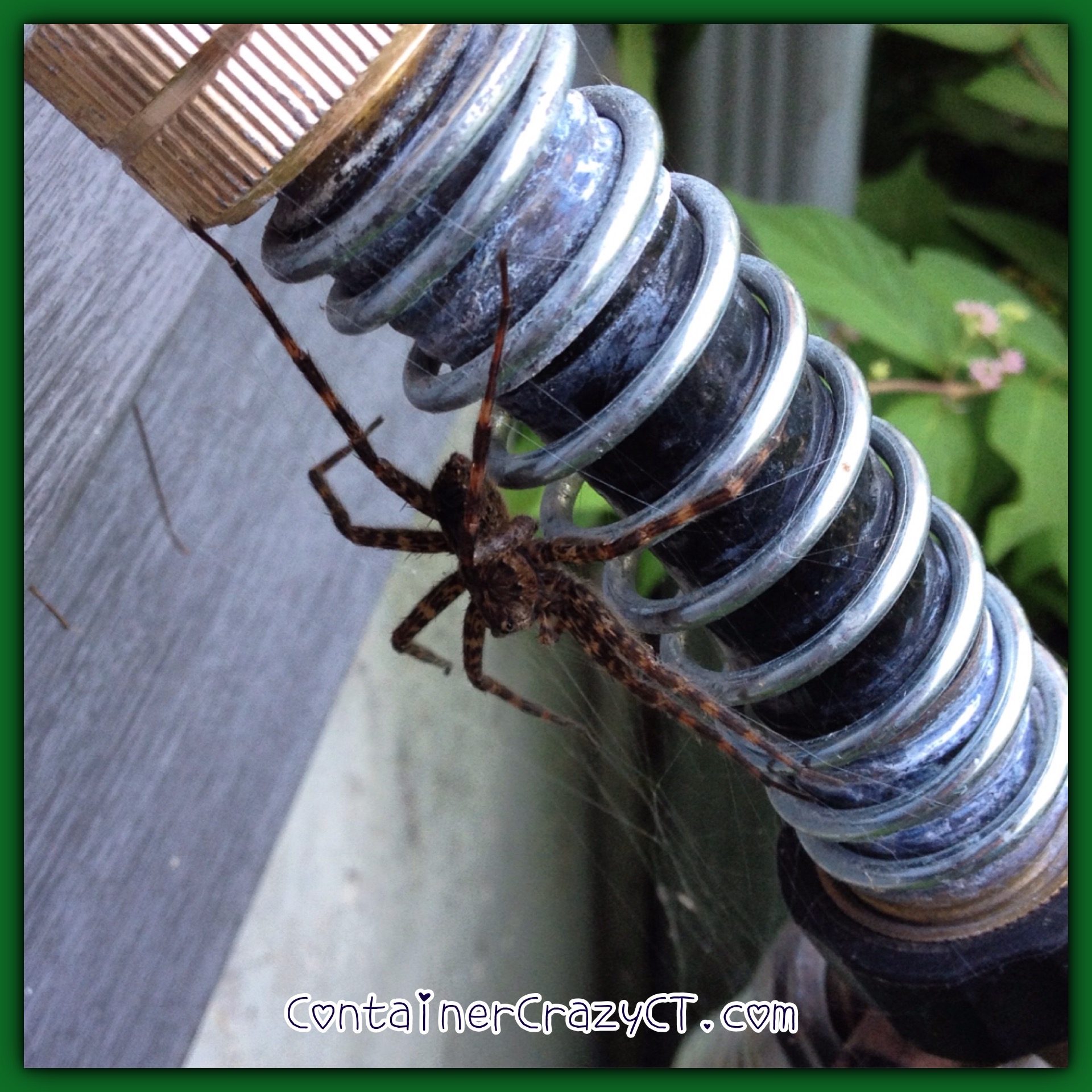
P.S. Watch out for spiders – They seem to be hanging around quite a bit lately!

Spider Hanging Around on Faucet

Spider Hanging Around on Faucet

The End of June Approaching – Random Pics from this Month

Leave a comment

It is almost the end of June. I caught my first summer cold. And, I saw a post yesterday of a black bear sighting in my friend’s backyard – something not often spotted on this side of the river in East Windsor, CT. While my head is achy from the sinus pressure and a rough dry cough annoying, I’m still looking forward to working outside on my plants and preparing for the farmers market on Sunday in East Windsor, which will hopefully proceed despite the predicted rain over the weekend.

So, this morning, I thought I would share some random pics of things from around the yard from the past month. Soon, we will see the Japanese Beetles visiting, and hopefully the days will warm up just a little bit more. While it is nice to have cool nights to sleep by, I wouldn’t mind a little more heat for my plants to grow more. This past month has been a mix of seedlings, container gardening, working around the yard, preparing for markets, and enjoying the cool nights of this year’s season so far.

Petasites slow to start

Petasites slow to start

The Petasites (Butterbur) plant in this face pot is slow to get moving this year. I like putting it up on this birdbath because the roots will escape the base drainage holes, and this shade-loving plant is aggressive – so I don’t want those roots to make it into the ground. It is wonderful in pots however, which I’ve written about on this blog. At first, I wasn’t sure if it would return. The pot was stored in my basement last winter – but here it comes and I hope it grows more soon! This one is variegated.

Nice Trio

Nice Trio

This blue patio pot contains only 3 plants – a short one, medium one, and tall one – pretty simple yet very pretty. The Agastache is a cultivar called ‘Blue Boa’ and I love the intensity of the blue color; it is the tall one next to Monarda ‘Petite Delight’ which is opening up its blooms now (a hot pink color), however, the Agastache started to flop from rain – bummer, because it would looks spectacular next to that hot pink of the Monarda (Bee Balm). I cut back the Agastache blooms which will produce new smaller blooms in a couple weeks. The low plant in the front is a groundcover perennial with white flowers called, Cerastium tomentosum (Snow-in-summer). All 3 are perennial and take sun and dry soils. By the way, did you know Agastache blooms are edible, and cute in salads?!

Mint Root Growth

Mint Root Growth

Mint is super easy to propagate. Just leave a few cuttings in a jar of water, and soon the roots will form. Mint is becoming my favorite herb to have around this year. I feed some to my bunny, she loves it. I put snips in my drinking water – which by the way, I feel helps any upset stomach or acid reflux symptoms. It also alleviates tension headaches just by sniffing it. However, it is aggressive in the gardens, so I find best to put in big pots nearby so it may be used for all these various reasons. Oh, let’s not forget – it is a great cocktail garnish and yummy on icecream.

Mint on year two in this big container - very useful on my deck!

Mint on year two in this big container – very useful on my deck!

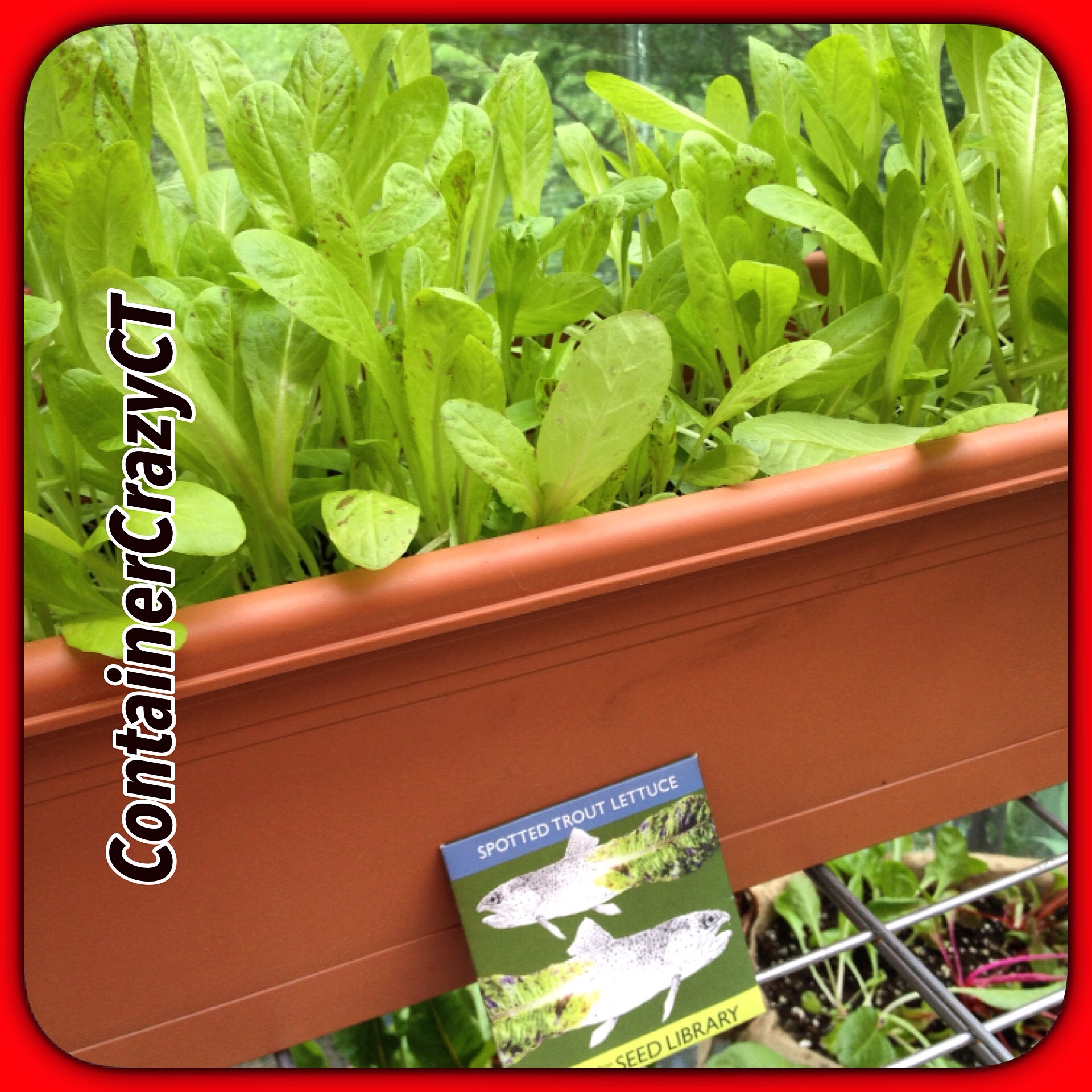
Lettuce in Windso Boxes

Lettuce in Window Boxes

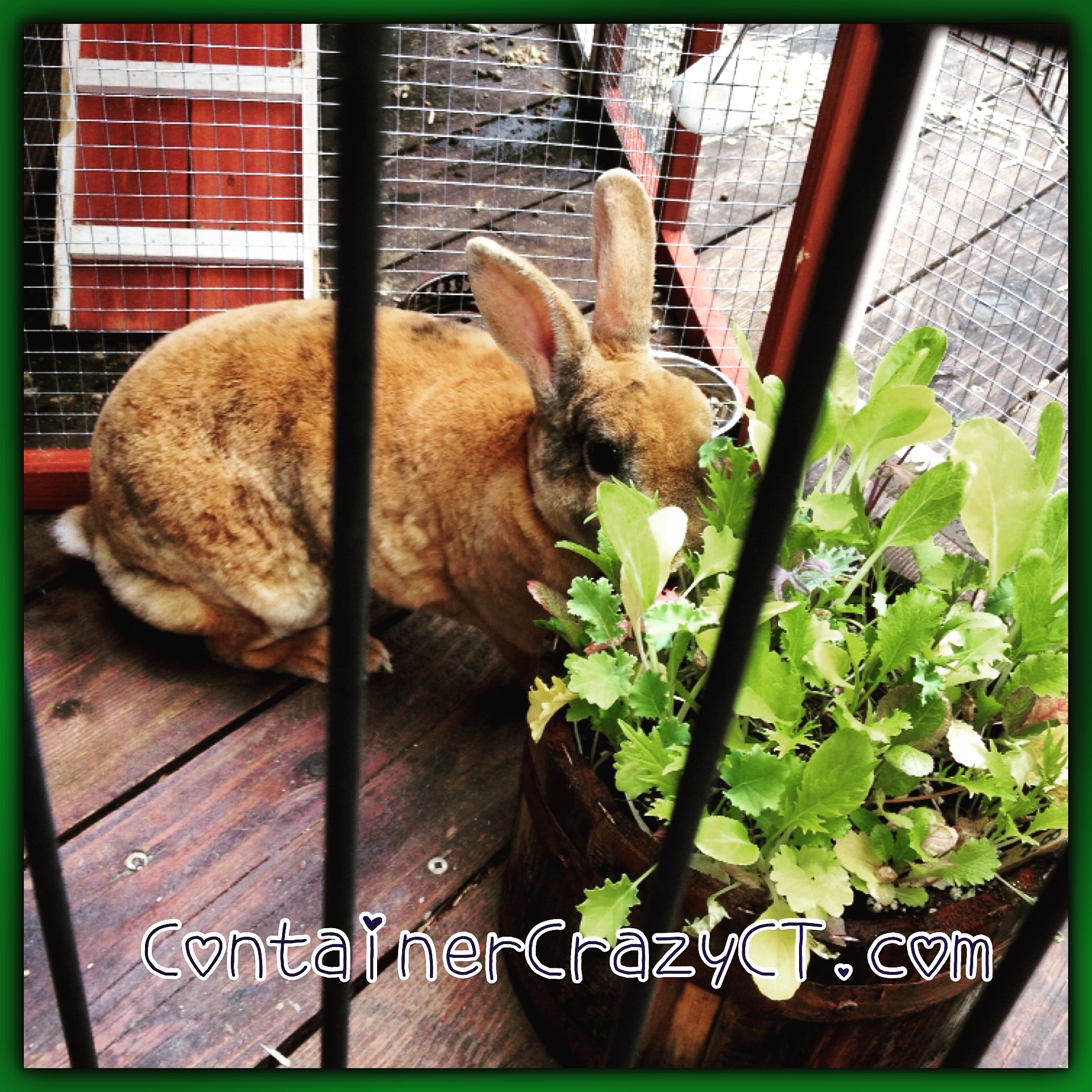
I got started a little later than normal this year with seeds, but been doing lots of mixed lettuces in pots and window boxes. This shows Spotted Trout Lettuce. The seed was purchased at the flower show in Hartford last winter. The Seed Library has artists draw or paint various pics for their seed packets. Here you see the lettuce is coming along nicely, and it was eaten. Every bite reminds me of my Father’s gardens which he still maintains today. His daughter however prefers the container route for gardening – and lettuce is fun to do in pots! I probably will have some of these available this weekend at the market – I even prepare and grow pots of mixed lettuce for my bunny – she is starting to eat better than me! Yup, I put the pots in her rabbit cage area for her to nibble on as she sees fit.

Funny Bunny eating a mix of greens grown from seed.

Funny Bunny eating a mix of greens grown from seed.

Ensete ventricosum 'Maurelii'

Ensete ventricosum ‘Maurelii’

This year, my big red banana plant, which I’ve owned for about three? years now, has been put into my new black pot in the backyard. Every month, I’m going to take a photo of it to show the progress of its growth. This Ethiopian native is great in containers and may be overwintered in our CT zone by storing the root base. I have found the red coloring is intense in this location which is under a group of very tall pine trees and near my hammocks – so I can literally gaze at it when I take a rest in a hammock – yup, I gaze. It takes full sun to part-sun or part shade, and I find sometimes in harsh sun, the leaf edges may burn or the color will be a little off, so I’m happy with it here as the sun rises and hits it – it is amazing even at a distance.

Espoma Seed Starter

Espoma Seed Starter

Espoma has excellent organic products and I tried out their seed starter this year. It works fine, but I have to say my multi-purpose mix rules. The components in this mix (Espoma) helps the moisture to retain in the seed starter trays, but sometimes a bit too much, while my multi-purpose mix dries out better – at least in my opinion. Anyhow, it has been seed experimentation year for me this season. And it is much fun to see the seeds push from the soil – every time, it feels exciting – nature is just like that. One of these days I plan to write a blog topic about various potting mixes but I also go over this in my workshops and talks at farmers markets based on my experience over the years of container gardening.

Lady Bugs are Beneficial

Lady Bugs are Beneficial

One of the fun things I did this year was release lady bugs onto my plants and in my grower room so they could fest on the bad bugs such as aphids which will suck the life out of leaves. Lady bugs are beneficial insects and can help you out but they don’t stick around for ever – would you? After being in this bag for a few days!?! So when I was reading the packet, I set the bag filled with excited lady bugs on my lap – it was like a mini bug massage. Could I do this if it was filled with spiders – Heck No!

Lady Bugs to the Rescue!

Lady Bugs to the Rescue!

Bulbs in Pots

Bulbs in Pots – Just dig them in and get a surprise later!

Sometimes, I will pop seeds or bulbs of summer blooming plants into my container gardens filled with other mixed plants. Gladioulus are a favorite and easy to dig a little hole to put them into, and they are sending up shoots right now, which I will take a photo of later when they get bigger and bloom. Try seeds like Nasturtiums or sunflowers, easy to include and they offer a little surprise later in your flowering pots or container gardens.

Adorable

Adorable Small Red Box with 3 plants

Little pots are fun to do – and I could not resist this cute red one with handles and a gardening quote on the front side. It contains a black pearl Pepper, Tiny Tim Tomatoe, and Sage. It is starting to fill out now – just in time for the market which I plan to bring it – along with some other adorable container gardens prepared.

Workshop Attendees Container Garden at her home.

Workshop Attendees Container Garden at her home – Great Job Maryse!

One of the most rewarding aspects of sharing the passion of growing plants in container gardens and patio pot is when a client or workshop attendee sends me a text to show me how their plants are coming along – and hearing how happy they are! Here are two shots taken of two attendees recently doing that. If you are reading this, and have attended too – please feel free to text me your container picture so we can share the container love here! Look how well her plants are growing in her pot – why? Good soil and good care learned at my workshops!

Photo taken of an Attendees pot after the workshop at her home

Photo taken of an Attendees pot after the workshop at her home – Great Job Kelley!

My Container with Bright Yellows and Purple

My Container with Bright Yellows and Purple

And here’s a photo of one at my home with two varieties of Coreopsis (tickseed) – one hardy (‘Jethro Tulll’) and one not (‘Cha cha cha’) and the annual, Persian Shield (purple foliage) with a gnome which keeps coming back to my container gardens every year. I recently moved this pot because one plant got powdery mildew – so it seemed to need some more air circulations which helps this problem, and I sprayed that with some organic spray, but I hate how powdery mildew will damage foliage. Hopefully, this will look better soon as the other two spiller plants come out to grace the sides of the blue pot.

Pumpkins and Gourds in Pots

Pumpkins and Gourds in Pots

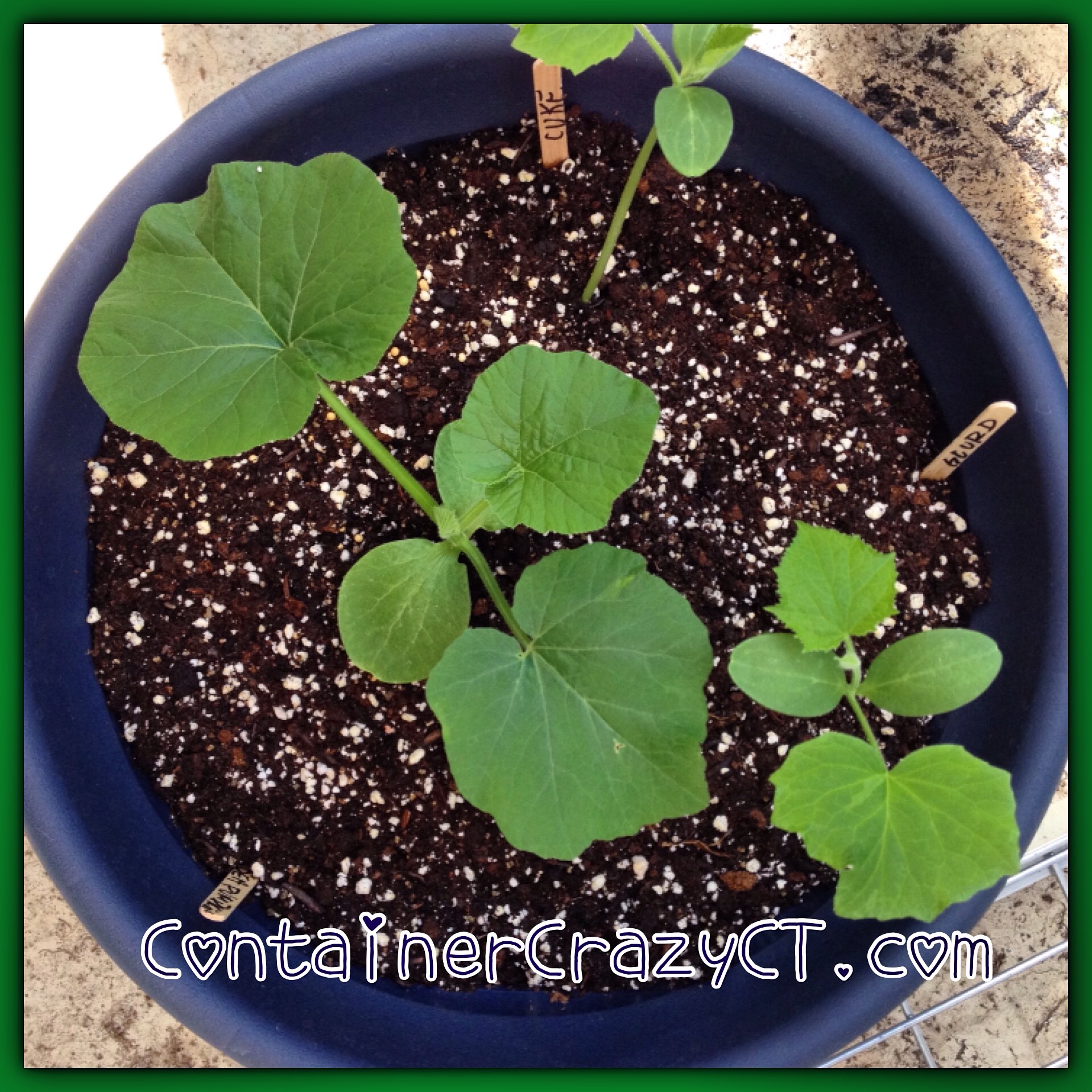
And this is new this year – I’m growing pumpkins and gourds in pots. Last year, I grew a watermelon plant in a pot, put it on my deck, and the vine sprawled around my deck furniture. The bonus was the watermelons were perfect, no blemishes, as it sat on the deck to grow, and it was easy for me to reach down to turn it – and no bugs! The pumpkins and gourds I selected are fun ones (the gourd will have gourds the size of oranges, and the pumpkin is a blue type), which I will share at the market this weekend. It’s a tad bit late, but they may be just fine since our season is late too this year – meaning its been cooler than preferred for many warm loving plants – and some will be fine if planted no later than July 1st or just keep growing in this pot – which is the game plan, as usual!

Container Garden Install at a Hairdressers Shop

Container Garden Install at a Hairdresser’s Shop

Top View

Top View

Digiplexis 'Illumination Flame'

Digiplexis ‘Illumination Flame’

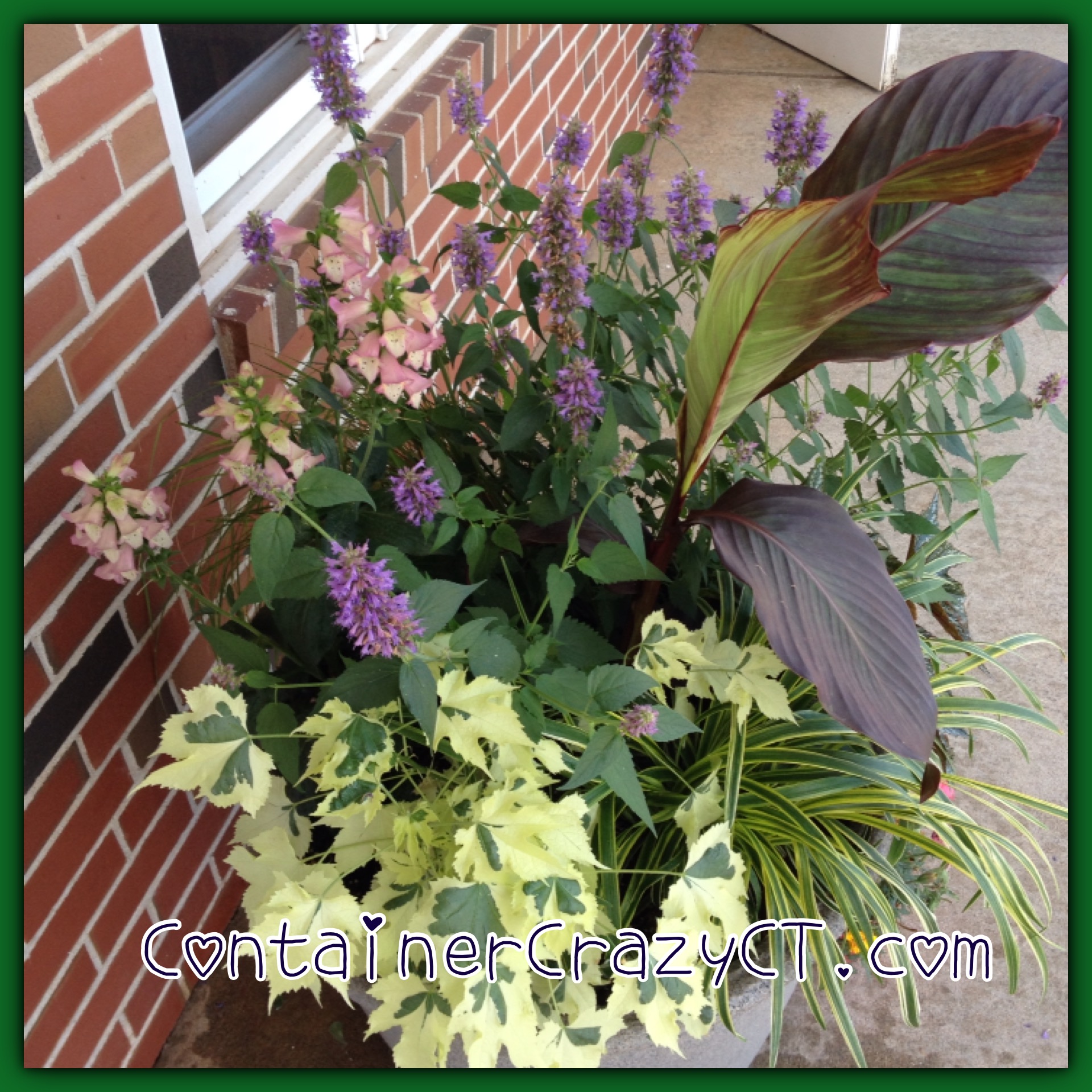
These photos above are of a container garden at a client’s business. She does an excellent job of watering it, and it contains a Canna, Digiplexis ‘Illumination Flame’, a variegated Liriope, Agastache ‘Blue Boa’, and Flowering maple. Just recently I trimmed up the Agastache for her, and also cut off one of the blooms of the Digiplexis, which is a new plant on the scene resembling foxglove, however, this one blooms repeatedly by sending out new shoots all summer. One thing everyone who got one of these from my workshop in May have commented on is the bottom flowers on the tallest stem of the Digiplexis plant start to fall off so I tell them to just snip it off – you will be sure to get more new shoots from this plant once it sets in and gets going.

Hydrangea 'Quick Fire'

Hydrangea ‘Quick Fire’

The baby crib in front of my Hydrangea ‘Quick Fire’ shrub is a recent donation to me from my sister. She said she got it at a tag sale; she likes antiques, and had a huge fern sitting in it at her home. I will find a use for it, but I decided to put it by my beautiful Hydrangea ‘Quick Fire’ shrub which I purchased at The Garden Barn in Vernon a few years ago, just to show the size of my shrub! This shrub is a panicle hydrangea (cone shaped flowers) and its blooms starts white and transitions to soft pink to darker pink blooms by the end of the season. This Hydrangea can take sun – which I can attest to since it faces full sun most of the day, and it sits in clay soil! This season I was late at trimming it back, so I just cut the dry tips off quickly later, but it still looks amazing. I recommend this one if you can find it.

Wild Turkeys Under the Trees

Wild Turkeys Under the Trees

Under a Tree Resting

Under a Dawn Redwood Tree Resting

Although a little blurry, because I was standing on my deck to take these photos, here are my wild turkeys resting in the yard. I just love when they sit down and feel like they can hang in the shade, but if they see me coming, they pop up quickly to walk away, even though I tell them every time, they are safe here with me. On the bottom photo, they were resting under the shade of my Metasequoia glyptostroboides (Dawn Redwood) tree. I planted this tree on my parent’s 50th wedding anniversary and it is doing well ever since which I believe is because it is planted in an area that remains moist and this tree likes moist, deep, well-drained, slightly acid soils. The area slopes here so it is well-drained as well. My sister bought one too on the very same day with me, and planted it in her yard, and it is not doing as well unfortunately – she has dry soil so it is a great example of putting the plant in the right place. The interesting thing about this tree is it looks like an evergreen pine like tree but it is deciduous (looses its needles) in the fall so it is naked in the winter, however, due to its beautiful reddish brown bark which becomes darker with age, it is pretty in the winter months as well. It grows tall too – up to 70′ or more in some cases. I love seeing birds fly up to it and rest on its branches as they travel from their birdhouses and feeders in our yard.

Container Garden at Home

Container Garden at Home

This container garden has a nice perennial called, Ceratostigma plumbaginoides (Plumbago, Leadwort) which is sprawling over the edge on the right side in this photo. A “sprawler” is a term I came up with this year to explain how some plants don’t spill over (spillers), instead they sprawl and gracefully reach out at the edge of the pot. This perennial will bloom blue flowers by late summer; the buds are forming now, and I’m excited because it is a “returner” in this big pot from last season. As I discussed in my workshops this year, Perennials with Power return. This plant likes partial shade or full sun. Here it is in part shade, it gets the eastern morning sun which suits the elephant ear in the center as well. As I mentioned above, I sometimes insert seeds into container gardens and note Nasturtium which you can see here on the left trailing out of the pot too. This container may not have tones of flashy flower colors – but I adore it because it is lush and full – and healthy.

Well, that’s all for now as I nurse my summer cold and write this post – I am hoping I’m fully recovered by Sunday for the East Windsor Farmers Market on Rt 140 at the Trolley Museum where I will be giving a talk at noon – and if it is raining hard, maybe I’ll be in the mini gazebo area – Look for me if you are able to pop in on Sunday, June 28th. The market opens at 11 am, and will have live musical entertainment.

Have a nice Friday everyone – Enjoy your weekend!!

Cathy Testa
http://www.containercrazyct.com
860-977-9473


There’s some cool historic stuff at the Farmers Market in East Windsor, CT

Leave a comment

The East Windsor Farmers’ Market is fairly new but its being held in a place which is not. Located at the Connecticut Trolley Museum, the market tents circle around the front lawn area of the museum grounds. The CT Trolley Museum is a showcase of historical exhibits showing how electric trolleys evolved and visitors enjoy a display of various trolleys in their main building.

Father’s Day is Opening Day

This weekend, Fathers get a free ride on the trolleys in honor of Father’s Day on June 21st. The old trolleys travel down a wooded street starting from the main parking lot area of the grounds for a few miles distance, and many of the trolleys are open-aired which makes for a fun breezy ride while you hear about the trolley museum’s history.

BackTrax Band at the Market

BackTrax Band at the Market

Opening Day Features BackTrax Band

On the opening market day which is this Sunday, June 21st, the BackTrax Band will be playing. Most of the band members are from the East Windsor area and they started playing together in late 1990’s.  They practice in a local family owned barn on a farm in town and move into the bars or venues like the markets to play for anyone interested in enjoying classic rock, country, and oldies.  So while you shop the market and browse the trolley museums features, you will hear some great music.

Great Seats to Eat, Listen, Relax

Great Seats to Eat, Listen, Relax

There are plenty of picnic tables at the market as well, so why not pack a lunch – or better yet – get lunch right there. This year’s market will feature many new foods – homemade pies, veggie samplings, and even some great hot dogs or Thai food. It is a nice place to enjoy some quality time with family and support your local enthusiasts.

Cathy T last year at the market featured succulent plants

Cathy T last year at the market featured succulent plants

Free Container Gardening Talk on June 28th

Another bonus, on the second weekend of the market, which is June 28th, I will be offering a free container gardening talk at noon. Look for me near the picnic tables.

My talk will cover a quick explanation of perennials and tropical plants, along with edibles, which all work in container gardens and why you should use them – These plants offer many benefits. Plus, we will go over the steps for success with container gardening and other tidbits you may not realize which will help or harm your patio pot and container gardens’ overall appearance and health, along with some design techniques and the right soil mix to use to control the growth of your creations.

A great place to walk your dog is at the market!

A great place to walk your dog is at the market!

Lately, I’ve been getting various bug questions about container gardens – there are reasons why some insects maybe showing up in your patio pots from time to time – and ways you can manage them or prevent them from happening again. I will share insight on this as well.

Usually by this time of year, many people have finished potting up their deck pots but this season’s weather has resulted in a somewhat slow start up – Our nights have been cooler and days not as hot for the start of summer – some container plants are slow to get going, thus, this visit is a great chance to get any last minute plants you may want to assemble in time for the July 4th celebrations. I will have various plants available or you may attend just to hear my talk, which I hope you do.

Address of the Trolley Museum is 58 North Road (Rt. 140).

Address of the Trolley Museum is 58 North Road (Rt. 140).

Whatever the reason for your visit to the market – to hear music, gets some fresh locally grown food, take a trolley ride, or hear some tips on container gardening – we hope you, especially those of you local to our town, will come support the market by attending and purchasing locally grown produce from the East Windsor market vendors.

Note: The market hours are 11 am to 2 pm.

Looking forward to see you there.

Cathy Testa
http://www.ContainerCrazyCT.com
860-977-9473
containercathy@gmail.com


The “Don’t Do This” List for when you Plant your Container Gardens and Patio Pots

8 Comments

During my container garden workshops, I’ve seen some things attendees will do as they start to assemble their container gardens and pots. It is not intentional on their part. They are so excited to get started selecting plants and putting them into their container gardens after my talk that they will move quickly and do some little things I try to catch them on before they continue. It reminds me of things they should not be doing because it can harm the plants or make the container look unbalanced.

So, I decided to create this list – and will share it at my future workshops too. Here are the things you should not do as you put together your container gardens and patio pots.

#1) Do not fill the pot to the rim with soil mix.

Filling the pot with soil mix up to the rim of the container will cause the soil to spill out when watering, or the water might roll off the top somewhat. There should be about a 2-3” space from the top of rim to the top of soil line. If the water is not flowing well into the soil, it will not permeate down to reach the plants’ roots, plus it looks a little odd to have the plants sitting at the very top of the pot. Aesthetically, they are better placed a few inches down. Additionally, the base of the plants are somewhat protected if they are not exposed at the very top – reducing things like toppling over due to wind, etc.

#2) Do not press down hard on the soil after you have inserted the plants into the container.

Out of habit or belief the plants should be pressed firmly into the soil, I’ve seen attendees do this at my workshops. They will push down on the soil, sometimes very hard, after they inserted the plant into the pot. This is not a good idea because you are compressing the soil which may reduce the air pockets required for oxygen in the soil to be used by the plant’s roots. Unless the plant is very top heavy or was root bound (thus a little weighty on the bottom), avoid pressing down hard on the top of the soil after planting. If you need to press, do so lightly and gently. You don’t want to smash the roots or crush the base of the plant by pushing down hard onto the soil.

Dont Do Photos for Blog Post3

#3) Do not grab the plant by the leaves and tug it from the starter pot.

When you take the plant out of its growing pot to put it into your container garden, use one hand to place over the soil at the stem base, and the other hand to turn it over carefully so it slides out of the growing pot. Try to not pull or tug at the plant by its leaves or stems. If the plant has been growing in the pot for a while, it may not slide out easily. Squeeze the growing pot a little to loosen it up or roll it gently on a table. Conversely, if the plant has been recently potted up in its growing pot, the soil may fall away from the root ball as you take it out because the roots have not grown into the new soil yet. Be careful to not damage the plant or its root system as you remove it to put in your container garden. If the plant is extremely root bound, and it is impossible to remove it from the starter pot, cut the pot at the bottom about 1” from the base to remove the closed end of the pot, and then push the plant’s root ball and soil through to remove it. A Hori-Hori garden knife or a razor knife works well for the cut.

Dont Do Photos for Blog Post 2

#4) Do not put a plant with circling roots directly into the container garden.

When roots are tightly circling around the root ball, this is referred to as girdling. The plant has been in the growing pot for a while, and the roots have nowhere to go except to encircle the root ball as it hits the sides of the inner pot. Do not put plants with tightly bound girdled roots directly into your container garden without first detangling the roots by hand if possible. If the roots are so tightly bound (really tight like they are hard to pull away or tease apart), you may use a clean sharp knife or pruners to cut them apart by cutting here and there. The roots need to be released, so to speak, to move freely and easily into the new fresh soil of your container garden.

Dont Do Photos for Blog Post

#5) Do not put the plants into bone dry potting mix.

When you container garden, you should lightly moisten the soil mix before you put your plants into your container garden or patio pot. Otherwise, the moisture in the starter pot will be drawn into the dry soil in the container garden thus taking it away from the plant’s roots. If the soil mix is dry, use your watering wand to moisten it – the key is to moisten, though – not to waterlog the soil, or turn it into mush. Just wet it a bit and then take your hands and mix it around lightly so the moisture is distributed. This will help the plants to adjust easily from their growing pot to their new beautiful soil environment.

Dont Do Photos for Blog Post4

#6) Do not put dry plants into the container garden without giving it a drink first.

It is a good habit to water your plants in their growing pots before putting them into your container garden or patio pots – preferably the night before, or the morning of, or at least a ½ to 1 hour before you assemble your container garden if its soil is “bone dry” in the growing pot. Another tip – be sure to water everything in after you finished assembling your container garden – but the key is, again – don’t over water. You want everything to settle into its new environment in a well-balanced slightly moist but not waterlogged state. Do not walk away before doing this final step. And direct the water at the soil line, not on the foliage if possible, with your watering wand or watering can.

#7) Do not put your plants in full harsh sun right away.

If your plants were grown in a greenhouse and not transitioned to the outdoors yet, you need to “harden-off” your plants. This term means to move the plants, or better yet, ‘transition’ the plants into the great outdoor sunlight carefully – otherwise, they may burn. Be sure to harden them off first if grown in a greenhouse by placing them in shade to part shade for a day or two. In many cases, hardening off is not required if the plants you purchased were already outside at the nursery. You will know if your plants were not hardened off first when you see the leaves turn white if you put them directly into sun – as is the case with houseplants or plants you overwintered inside, they must be hardened off first as well when you move them outside.

Dont Do Photos for Blog Post5

And finally, another tip – when I plant my container gardens, I tend to make pockets in the soil mix to insert each plant. In other words, I don’t fill the pot half way with soil (like I’ve seen done), place or position all the plants, and then backfill around the roots. I personally believe the pocket method makes the plants more comfortable and allows the roots to make easy contact with the new soil in the container. But that’s being a little picky perhaps – all I know is this method has worked for me for years.

To see photos of the above “Don’t Do’s”, please visit my Instagram feed or Pinterest boards where I show examples, or better yet, take one of my workshops in the future to learn and see hands-on more tips by ContainerCrazyCT.

Thank you,

Cathy Testa
860-977-9473 (cell)
containercathy@gmail.com

Container Gardening Class at Strong Family Farm in Vernon, CT

Leave a comment

I grew up on a farm consisting of 100 acres of land along the Scantic River in East Windsor, Connecticut – and we had cows, chickens, a horse, rabbits, beautiful cherry trees, apple trees, blueberries, along with days of fishing in ponds, rivers, and even riding a mini-bike. Yup, I would jump on a mini-bike as a young kid, and go “outback” – which is what we called my parent’s property then and still do to this day.

There’s something magical about growing up on farmland. We explored a lot as kids. One time, I found funky shaped clay formations in a crevice where water ran off on a slope. As a child, I remember collecting them and checking them out carefully. Each was soft with round patterns and curvy shapes, formed by the action of rolling waters and clay soil on a hill side.

Flash ahead to my soil science class in my late-30’s and low and behold, our professor showed us a sample of the same thing. He said they are referred to as “clay dogs” and he found it interesting that I knew what they were immediately upon seeing him hand them out in class. He let me keep one of his samples, saying I was a soil scientist at heart. I don’t know about that, but the clay dog he gave me still sits on a shelf in my home office.

Being around nature is so inspiring – especially on a farm. In the summers, as a young kid, I sat on the side of my Dad’s hay baler to make sure the twine did not break as the square bales of hay passed by me when we rolled along in a large field. The sound of the tractor, the wind passing by, or the hot day’s summer heat would lead to more fun after our day’s work – because after we baled the hay – Dad would treat us to ice creams at Dairy Delight in East Windsor (a great ice cream place which still operates today on Route 5).

Sometimes, our trip for ice cream was in the pickup truck – we would stand in the back bed as we traveled down Scantic Road – something I don’t think would be allowed today. The breeze blew off all the hay dust from our bodies as we headed down to Dairy Delight. This is one of my very vivid memories – it was a fun ride for sure, and man, was that ice cream ever good after a hot day of baling hay, especially because it was shared with Dad.

We also swam in the Scantic River from time to time. My parents didn’t have to worry as we played “outback”, and my Mom literally rang a bell to call us for dinner time. We even had a fort and stayed over night in it sometimes. One time, our cows came scratching their backs against the outer walls of the fort and we sat inside quietly laughing – and being a little scared too, but they eventually left and our fun continued at the fort for that night.

Mom and Dad under a Catalpa Tree at the Farm

Mom and Dad under a Catalpa Tree at the Farm

Picking up a blade of grass from the field to put between your fingers and blow to make sounds was a little toy on a farm as I would take the walk outback down to the river. Or collecting walnuts to eat from our big walnut tree was an experience. When you are surrounded with nature, you begin to witness life and the curiosity sets in – at least it did for me. And of course, we had a barn, a barn where we held plays as kids – setting up a stage once – and acting something out as our parents and neighbors endured our little show. The list goes on.

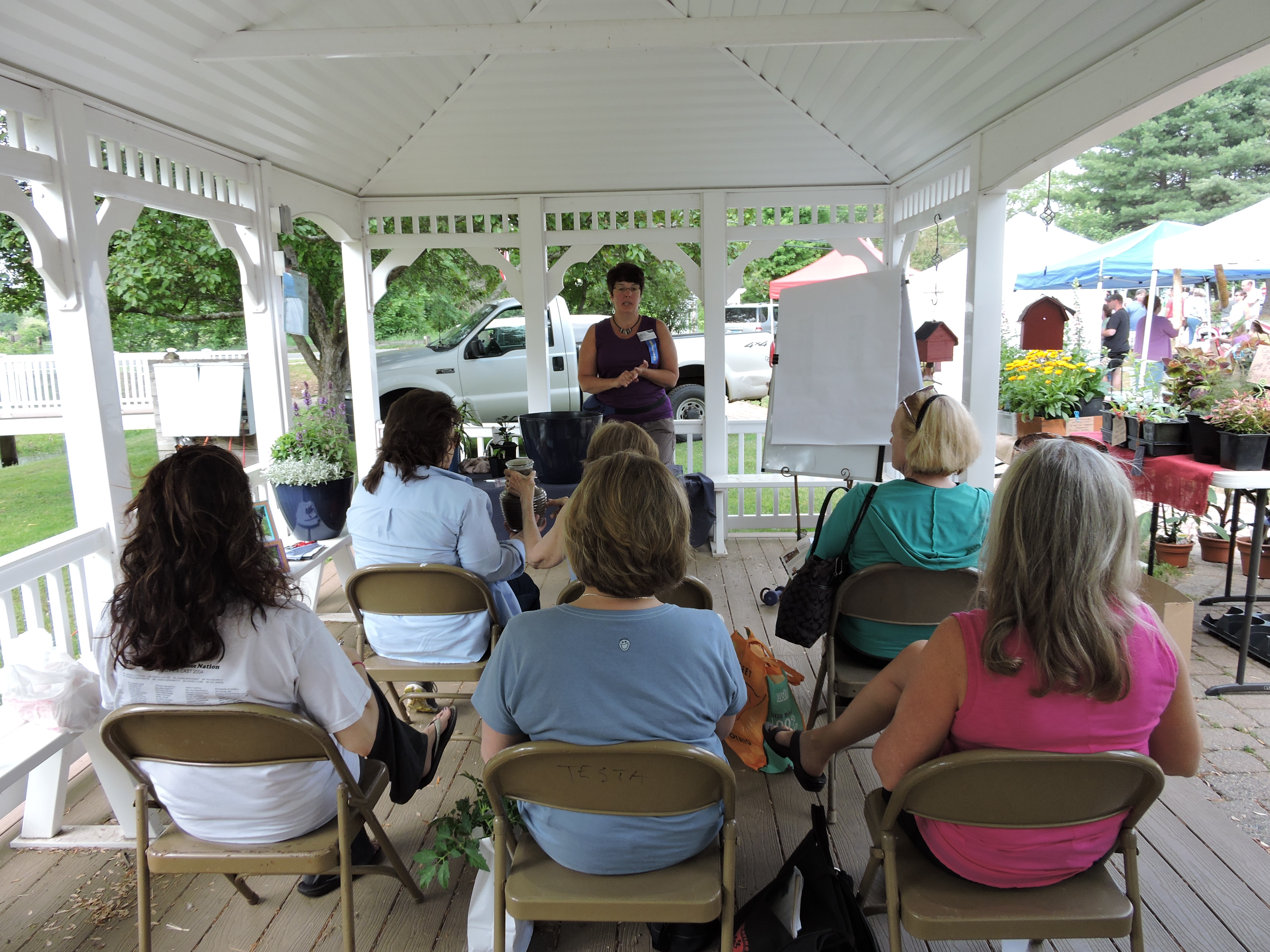
Cathy T teaching a class

Cathy T teaching a class

That is why being asked a second time to talk about Container Gardening at Strong Family Farm feels special to me. Strong’s farm is located in Vernon and it has been standing for 135 years, once comprising more than 50 acres on West Road and Hartford Turnpike. The farm has served as the home and workplace for more than seven generations of Strongs. Just like our family’s farm is serving generations for us too – Today my nieces and nephews enjoy the nature on the farm like we did as kids. It is fun to witness their excitement as Grandpa sits them down on the tractor seat to pretend drive – something my nephew asks for every time they visit my parent’s farm- and he even refers to my Mother as “Chicken Mom” cause he knows when he visits, he gets to go see the chickens before going on the tractor in the big barn.

Located  on 274 West Street, Vernon, CT 06066

Located on 274 West Street, Vernon, CT 06066

Strong Family Farms hosts various activities throughout the year, such as their “Adopt-A-Chick” program offered each spring. For a small fee, participants foster a spring chicken over the course of 10 weeks. During this time, class members help feed and nurture the young chickens. If you don’t have a farm of your own, this place is a way to share a farm experience.

Annual Programs

They also host movies on the farm and have a community garden. In the fall, they have a Annual Scarecrow Contest and Harvest Festival. Check out their website at http://www.StrongFamilyFarm.org for details and dates – it is a great place for kids’ activities and very family oriented.

Container Gardening Workshop

The farm has large yellow barns and this weekend’s Container Gardening Workshop/Class will be held inside the barn – which is a unique experience also, as you look up at the big beams in the ceilings and sit on bails of hay. Even the sun beaming thru cracks in the barn walls reminds me of farm life as a child. Birds fly by in their meadows and old antique farm equipment hangs on the walls, making us feel the presence of the many past years of farming held in this space.

The farm life is so beneficial to your health and well-being, as we know – when you grow your own – you grow your spirit too. So, if you still have patio pots to pot up – come join us – the fee is only $10 for non-members and $5 for members of the farm and it is a fun activity for kids too. There will be various plants available for purchase and you will learn the steps for success and other growing tips.

Date: Saturday, June 6th, 10 am to noon @ Strong Family Farm, 274 West St, Vernon.

Please remember to bring cash or checks, as credit cards are not accepted. Plants to expect: Some large tropical plants (drama to containers), herbs, annuals, and even some houseplants and perennials. All attendees receive documentation and Cathy T tips. We hope to see you there!

← Back

Thank you for your response. ✨

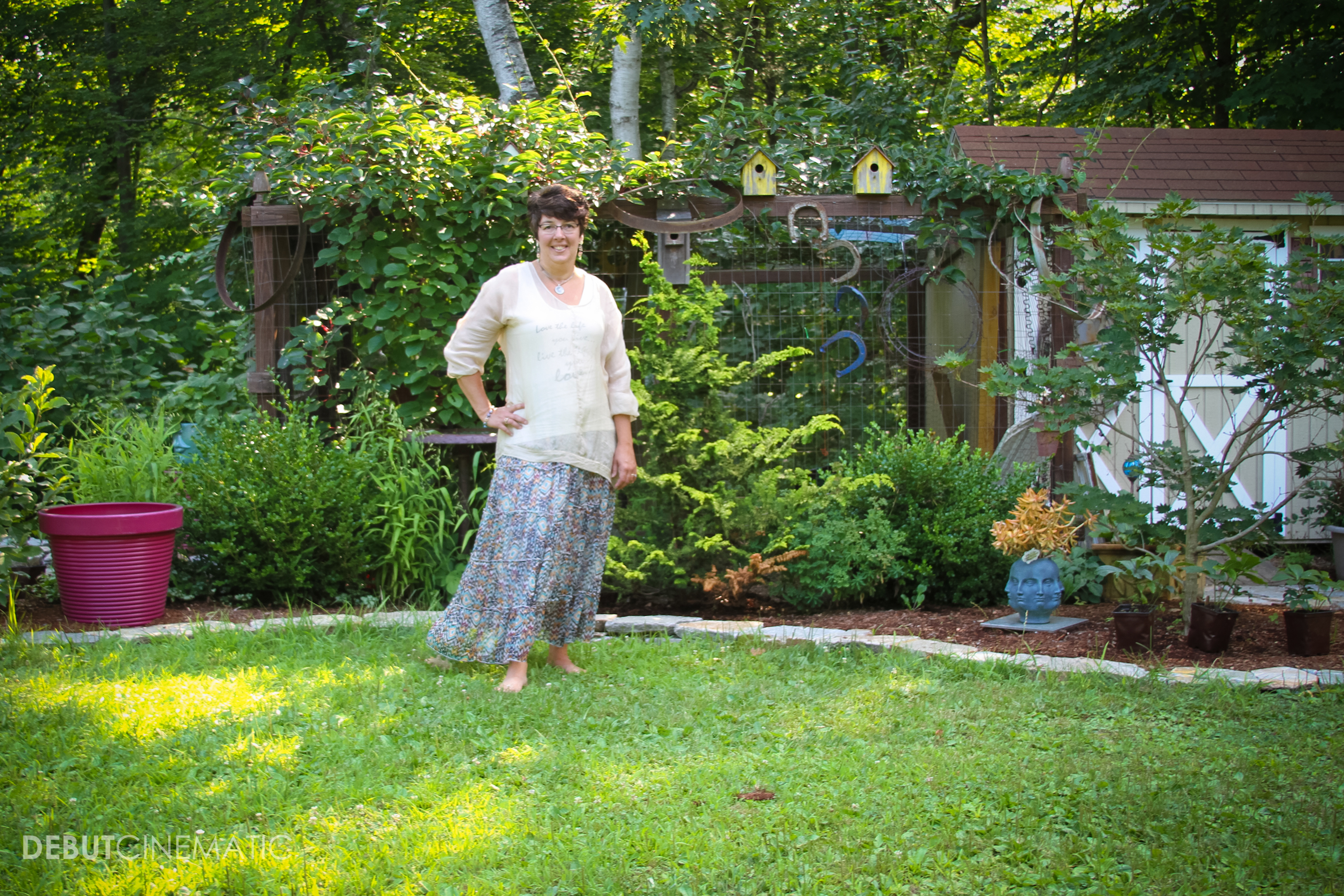
Cathy T in-front of her chicken coop and plants at her home in Broad Brook, CT

Cathy T in-front of her chicken coop and plants at her home in Broad Brook, CT

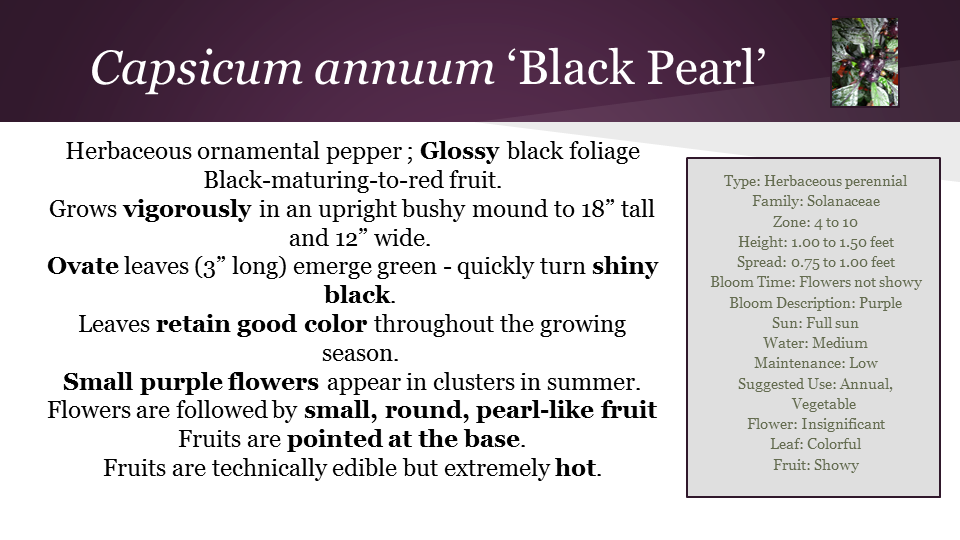
‘Black Pearl’ Pepper – A Little Too Hot to Eat – Great in Containers!

Leave a comment

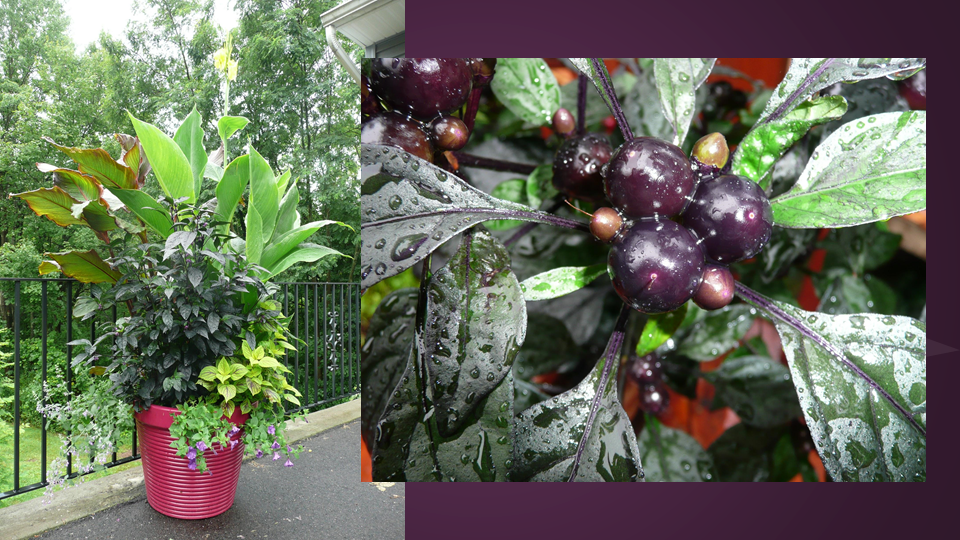
One year, I ordered a stock of this pepper plant with purplish black and dark green foliage from a local Connecticut grower. It grows black pearl-like small peppers which are shiny and pretty. But what attracted me to it more was the foliage’s dark toned colors.

Black Pearl Pepper in a Pot - Great Contrasting Foliage Color

Black Pearl Pepper in a Pot – Great Contrasting Foliage Color

So, I included one in a mixed container garden with some of my Canna plants that year.

Today, mixing edibles with other types of plants is a common trend, but years ago, not too many people would see a pepper plant with a tropical plant in a pot, so it was fun to see people’s reactions.

Black Pearl Pepper Descipt

This pepper starts out with small purple flowers which you may miss if you don’t notice them, and then transitions to developing black peppers which later mature to an intense bright red color. This was a bonus in my book. Not only was the foliage a nice dark contrasting color, the show of the peppers changing color was fun to witness.

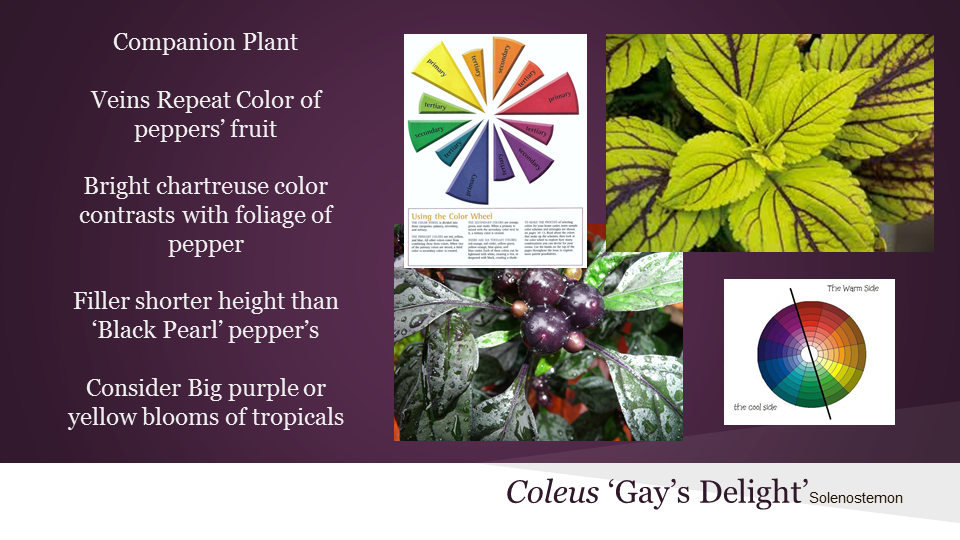
Veins of Coleus 'Gay's Delight' pick up the purple tones of 'Black Pearl' pepper.

Veins of Coleus ‘Gay’s Delight’ pick up the purple tones of ‘Black Pearl’ pepper.

You can easily echo the purple-black foliage by including other plants with similar tones or colors. In this example, you see how Coleus ‘Gay’s Delight’ has veins in the same color. It worked, not only because of the color-echo, but the yellow or chartreuse color of the Coleus is opposite to purple on the color wheel, so it was complementary.

Another way to use this plant is to pot it up with other purples. You can see how well Strobilanthes dyerianus (Persian Shield), shown below on the top right, with its striking silver purple leaves would work with the ‘Black Pearl’ pepper. Even a perennial has the capability to bring it all together with the purples.

Monochromatic

Monochromatic

Tomorrow, I host another Container Garden Workshop and I have some of these plants available for inclusion in the pots which our attendees will be potting up. Along with many perennials and tropical plants which are showy and unique. And this ‘Black Pearl’ pepper fits the bill.

Black Pearl in Pot

By the way, it is also a Proven Winners plant and can take full sun to part sun or part shade. It worked so well with my heat loving Canna plants and never showed any signs of weakness or poor growth – it can take the heat – and because the peppers are very hot to eat, the critters in my yard didn’t dare take a bite.

Benefits of Using Edibles with Ornamental Values

Benefits of Using Edibles with Ornamental Values

My husband, Steve, however did try to eat a pepper from this plant one afternoon. He was quick to spit it out of his mouth – It was too hot to bear. So if you are brave, you may want to try it or use it as an ornamental feature in your patio pots and container gardens.

There are so many benefits to using this plant in container gardens: very long lasting, has a wonderful shape which adds another dimension to your design, it is easy to grow, dark foliage, transitioning colors with the pepper’s change from black to red, and makes a nice filler position in a container garden or patio pot.

IMG_2187

Happy Friday Everyone – and I have a few seats open for Saturday’s class if interested, just e-me, text, or call.
Would love to have you join us.

Cathy Testa
(860) 977-9473
containercathy@gmail.com
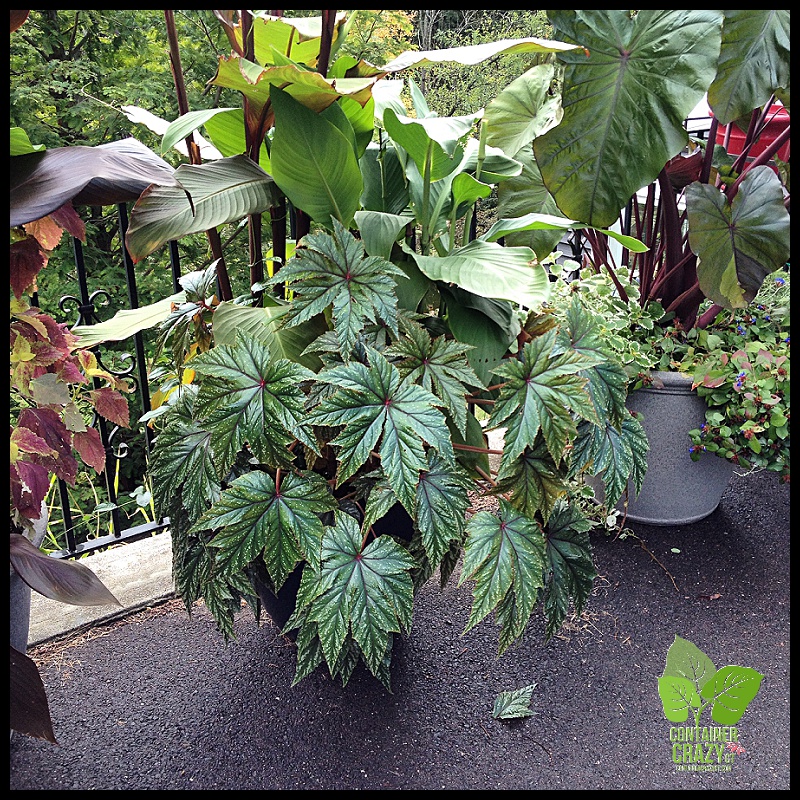
Container Crazy CT