Container Gardening Class at Strong Family Farm in Vernon, CT

Leave a comment

I grew up on a farm consisting of 100 acres of land along the Scantic River in East Windsor, Connecticut – and we had cows, chickens, a horse, rabbits, beautiful cherry trees, apple trees, blueberries, along with days of fishing in ponds, rivers, and even riding a mini-bike. Yup, I would jump on a mini-bike as a young kid, and go “outback” – which is what we called my parent’s property then and still do to this day.

There’s something magical about growing up on farmland. We explored a lot as kids. One time, I found funky shaped clay formations in a crevice where water ran off on a slope. As a child, I remember collecting them and checking them out carefully. Each was soft with round patterns and curvy shapes, formed by the action of rolling waters and clay soil on a hill side.

Flash ahead to my soil science class in my late-30’s and low and behold, our professor showed us a sample of the same thing. He said they are referred to as “clay dogs” and he found it interesting that I knew what they were immediately upon seeing him hand them out in class. He let me keep one of his samples, saying I was a soil scientist at heart. I don’t know about that, but the clay dog he gave me still sits on a shelf in my home office.

Being around nature is so inspiring – especially on a farm. In the summers, as a young kid, I sat on the side of my Dad’s hay baler to make sure the twine did not break as the square bales of hay passed by me when we rolled along in a large field. The sound of the tractor, the wind passing by, or the hot day’s summer heat would lead to more fun after our day’s work – because after we baled the hay – Dad would treat us to ice creams at Dairy Delight in East Windsor (a great ice cream place which still operates today on Route 5).

Sometimes, our trip for ice cream was in the pickup truck – we would stand in the back bed as we traveled down Scantic Road – something I don’t think would be allowed today. The breeze blew off all the hay dust from our bodies as we headed down to Dairy Delight. This is one of my very vivid memories – it was a fun ride for sure, and man, was that ice cream ever good after a hot day of baling hay, especially because it was shared with Dad.

We also swam in the Scantic River from time to time. My parents didn’t have to worry as we played “outback”, and my Mom literally rang a bell to call us for dinner time. We even had a fort and stayed over night in it sometimes. One time, our cows came scratching their backs against the outer walls of the fort and we sat inside quietly laughing – and being a little scared too, but they eventually left and our fun continued at the fort for that night.

Mom and Dad under a Catalpa Tree at the Farm

Mom and Dad under a Catalpa Tree at the Farm

Picking up a blade of grass from the field to put between your fingers and blow to make sounds was a little toy on a farm as I would take the walk outback down to the river. Or collecting walnuts to eat from our big walnut tree was an experience. When you are surrounded with nature, you begin to witness life and the curiosity sets in – at least it did for me. And of course, we had a barn, a barn where we held plays as kids – setting up a stage once – and acting something out as our parents and neighbors endured our little show. The list goes on.

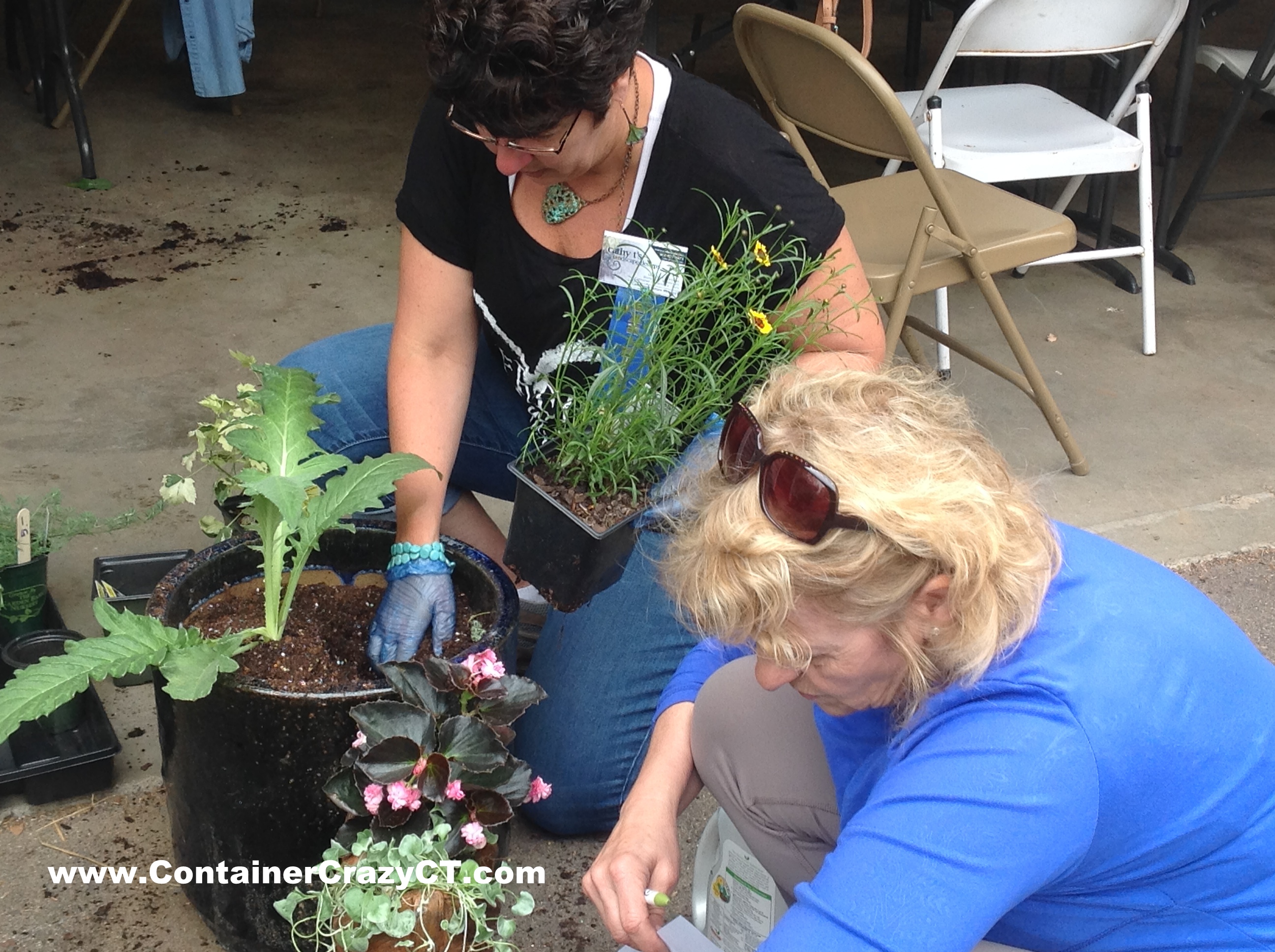
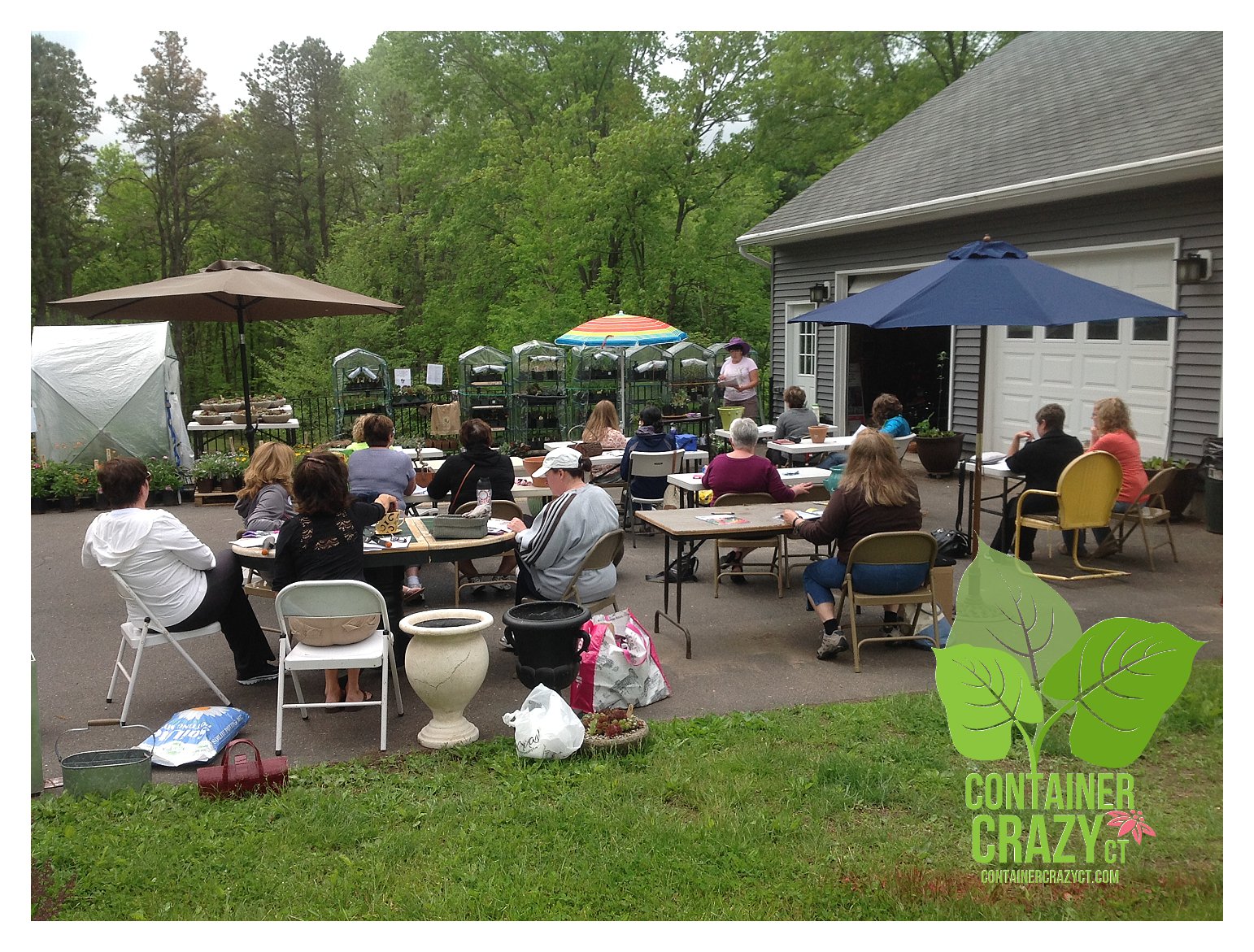
Cathy T teaching a class

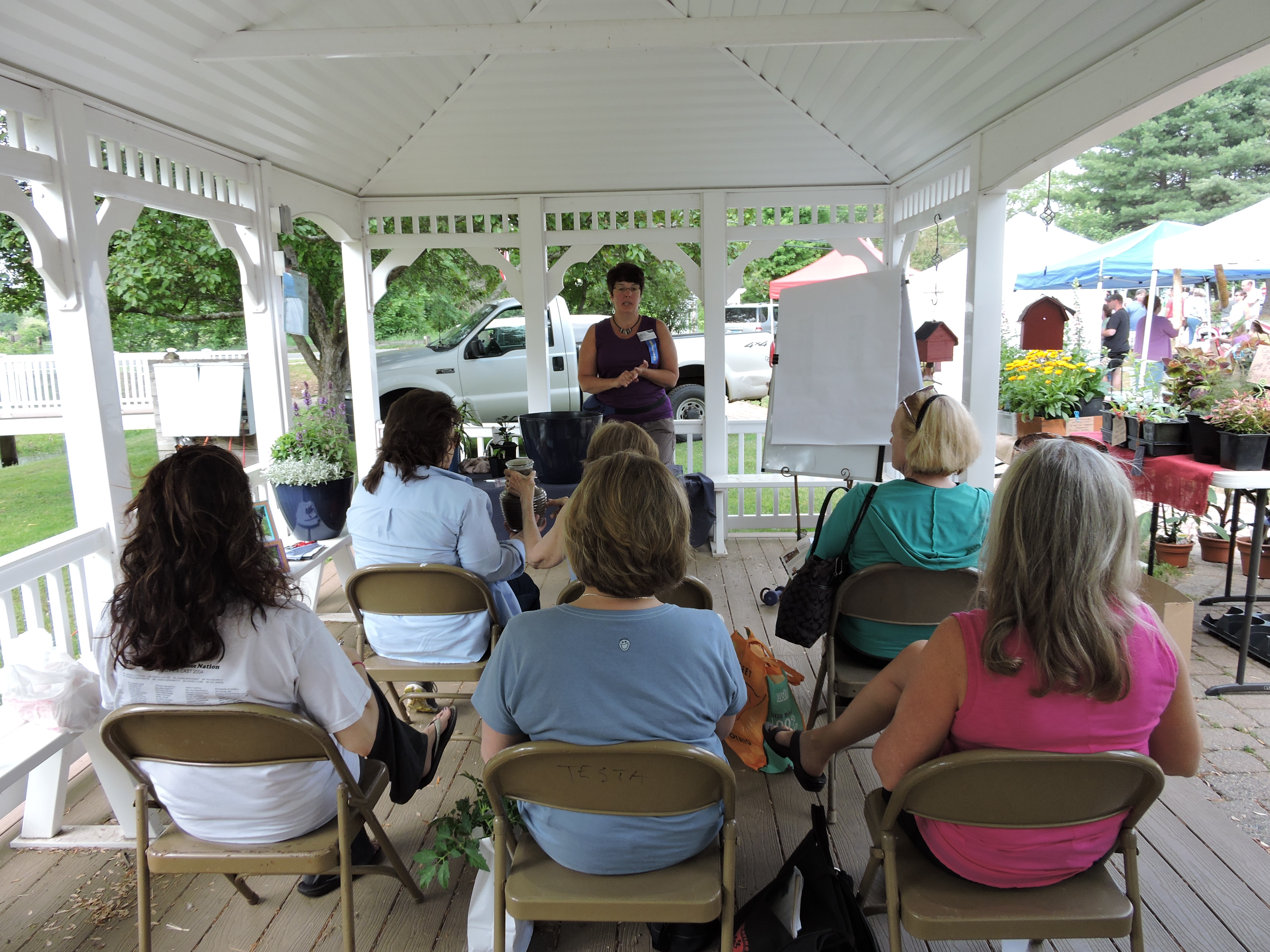
Cathy T teaching a class

That is why being asked a second time to talk about Container Gardening at Strong Family Farm feels special to me. Strong’s farm is located in Vernon and it has been standing for 135 years, once comprising more than 50 acres on West Road and Hartford Turnpike. The farm has served as the home and workplace for more than seven generations of Strongs. Just like our family’s farm is serving generations for us too – Today my nieces and nephews enjoy the nature on the farm like we did as kids. It is fun to witness their excitement as Grandpa sits them down on the tractor seat to pretend drive – something my nephew asks for every time they visit my parent’s farm- and he even refers to my Mother as “Chicken Mom” cause he knows when he visits, he gets to go see the chickens before going on the tractor in the big barn.

Located  on 274 West Street, Vernon, CT 06066

Located on 274 West Street, Vernon, CT 06066

Strong Family Farms hosts various activities throughout the year, such as their “Adopt-A-Chick” program offered each spring. For a small fee, participants foster a spring chicken over the course of 10 weeks. During this time, class members help feed and nurture the young chickens. If you don’t have a farm of your own, this place is a way to share a farm experience.

Annual Programs

They also host movies on the farm and have a community garden. In the fall, they have a Annual Scarecrow Contest and Harvest Festival. Check out their website at http://www.StrongFamilyFarm.org for details and dates – it is a great place for kids’ activities and very family oriented.

Container Gardening Workshop

The farm has large yellow barns and this weekend’s Container Gardening Workshop/Class will be held inside the barn – which is a unique experience also, as you look up at the big beams in the ceilings and sit on bails of hay. Even the sun beaming thru cracks in the barn walls reminds me of farm life as a child. Birds fly by in their meadows and old antique farm equipment hangs on the walls, making us feel the presence of the many past years of farming held in this space.

The farm life is so beneficial to your health and well-being, as we know – when you grow your own – you grow your spirit too. So, if you still have patio pots to pot up – come join us – the fee is only $10 for non-members and $5 for members of the farm and it is a fun activity for kids too. There will be various plants available for purchase and you will learn the steps for success and other growing tips.

Date: Saturday, June 6th, 10 am to noon @ Strong Family Farm, 274 West St, Vernon.

Please remember to bring cash or checks, as credit cards are not accepted. Plants to expect: Some large tropical plants (drama to containers), herbs, annuals, and even some houseplants and perennials. All attendees receive documentation and Cathy T tips. We hope to see you there!

← Back

Thank you for your response. ✨

Warning
Warning
Warning
Warning

Warning.

Cathy T in-front of her chicken coop and plants at her home in Broad Brook, CT

Cathy T in-front of her chicken coop and plants at her home in Broad Brook, CT

‘Black Pearl’ Pepper – A Little Too Hot to Eat – Great in Containers!

Leave a comment

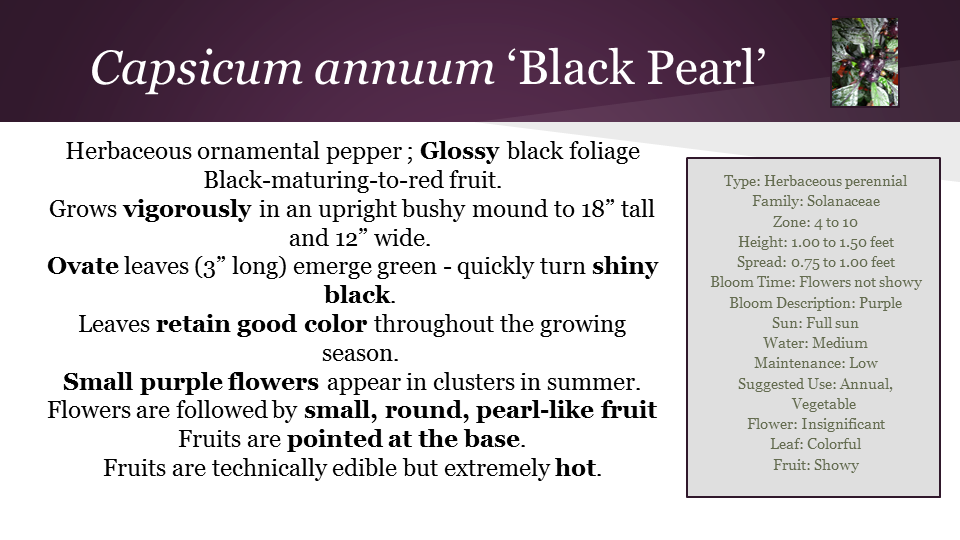
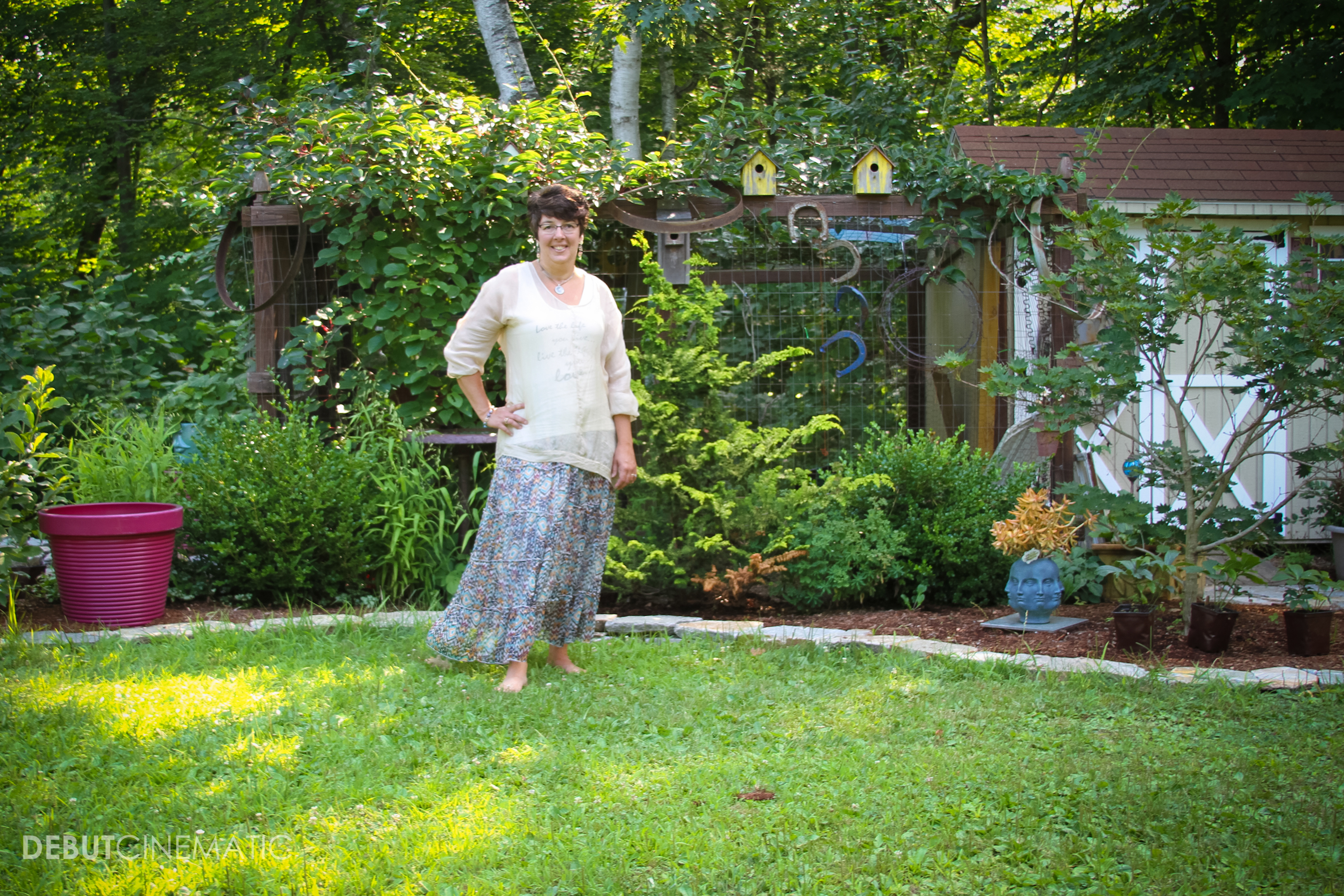
One year, I ordered a stock of this pepper plant with purplish black and dark green foliage from a local Connecticut grower. It grows black pearl-like small peppers which are shiny and pretty. But what attracted me to it more was the foliage’s dark toned colors.

Black Pearl Pepper in a Pot - Great Contrasting Foliage Color

Black Pearl Pepper in a Pot – Great Contrasting Foliage Color

So, I included one in a mixed container garden with some of my Canna plants that year.

Today, mixing edibles with other types of plants is a common trend, but years ago, not too many people would see a pepper plant with a tropical plant in a pot, so it was fun to see people’s reactions.

Black Pearl Pepper Descipt

This pepper starts out with small purple flowers which you may miss if you don’t notice them, and then transitions to developing black peppers which later mature to an intense bright red color. This was a bonus in my book. Not only was the foliage a nice dark contrasting color, the show of the peppers changing color was fun to witness.

Veins of Coleus 'Gay's Delight' pick up the purple tones of 'Black Pearl' pepper.

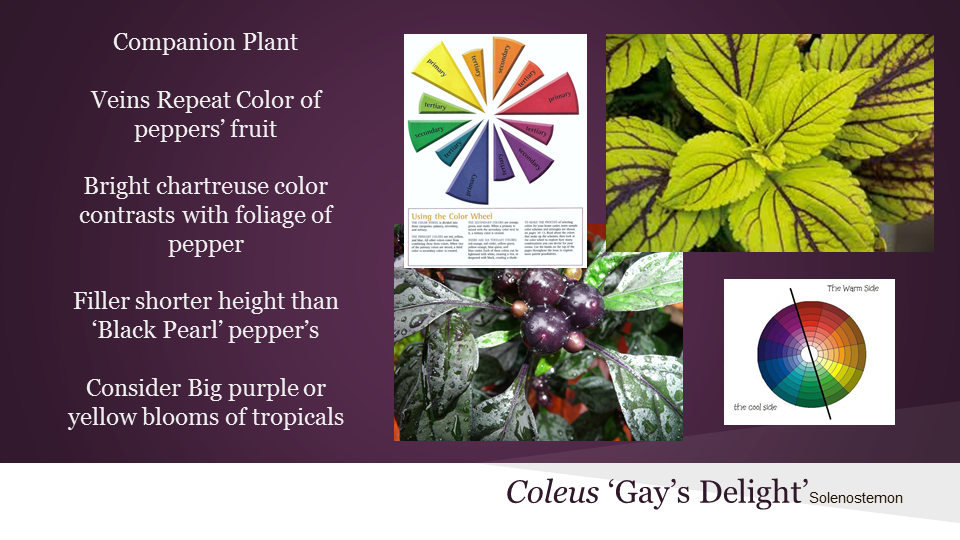
Veins of Coleus ‘Gay’s Delight’ pick up the purple tones of ‘Black Pearl’ pepper.

You can easily echo the purple-black foliage by including other plants with similar tones or colors. In this example, you see how Coleus ‘Gay’s Delight’ has veins in the same color. It worked, not only because of the color-echo, but the yellow or chartreuse color of the Coleus is opposite to purple on the color wheel, so it was complementary.

Another way to use this plant is to pot it up with other purples. You can see how well Strobilanthes dyerianus (Persian Shield), shown below on the top right, with its striking silver purple leaves would work with the ‘Black Pearl’ pepper. Even a perennial has the capability to bring it all together with the purples.

Monochromatic

Monochromatic

Tomorrow, I host another Container Garden Workshop and I have some of these plants available for inclusion in the pots which our attendees will be potting up. Along with many perennials and tropical plants which are showy and unique. And this ‘Black Pearl’ pepper fits the bill.
Black Pearl in Pot

By the way, it is also a Proven Winners plant and can take full sun to part sun or part shade. It worked so well with my heat loving Canna plants and never showed any signs of weakness or poor growth – it can take the heat – and because the peppers are very hot to eat, the critters in my yard didn’t dare take a bite.

Benefits of Using Edibles with Ornamental Values

Benefits of Using Edibles with Ornamental Values

My husband, Steve, however did try to eat a pepper from this plant one afternoon. He was quick to spit it out of his mouth – It was too hot to bear. So if you are brave, you may want to try it or use it as an ornamental feature in your patio pots and container gardens.

There are so many benefits to using this plant in container gardens: very long lasting, has a wonderful shape which adds another dimension to your design, it is easy to grow, dark foliage, transitioning colors with the pepper’s change from black to red, and makes a nice filler position in a container garden or patio pot.

IMG_2187

Happy Friday Everyone – and I have a few seats open for Saturday’s class if interested, just e-me, text, or call.
Would love to have you join us.

Cathy Testa
(860) 977-9473
containercathy@gmail.com

Container Crazy CT

Round Two – Container Garden Workshop in Broad Brook on May 23rd

Leave a comment

During this busy month of gardening preparations, this is a short quick post to first say THANK YOU to the wonderful attendees of Workshop No. 1 on May 16th.

It did not rain, we had tons of fun, it moved so fast, and everyone’s container garden creations with tropical plants, perennials, and annuals are beautiful.

And the second reason for this post is to remind anyone interested in Workshop No.2 on May 23rd.

Hands-On and Fun

Hands-On and Fun

To Register, fill out the Contact Form below
or text at 860-977-9473

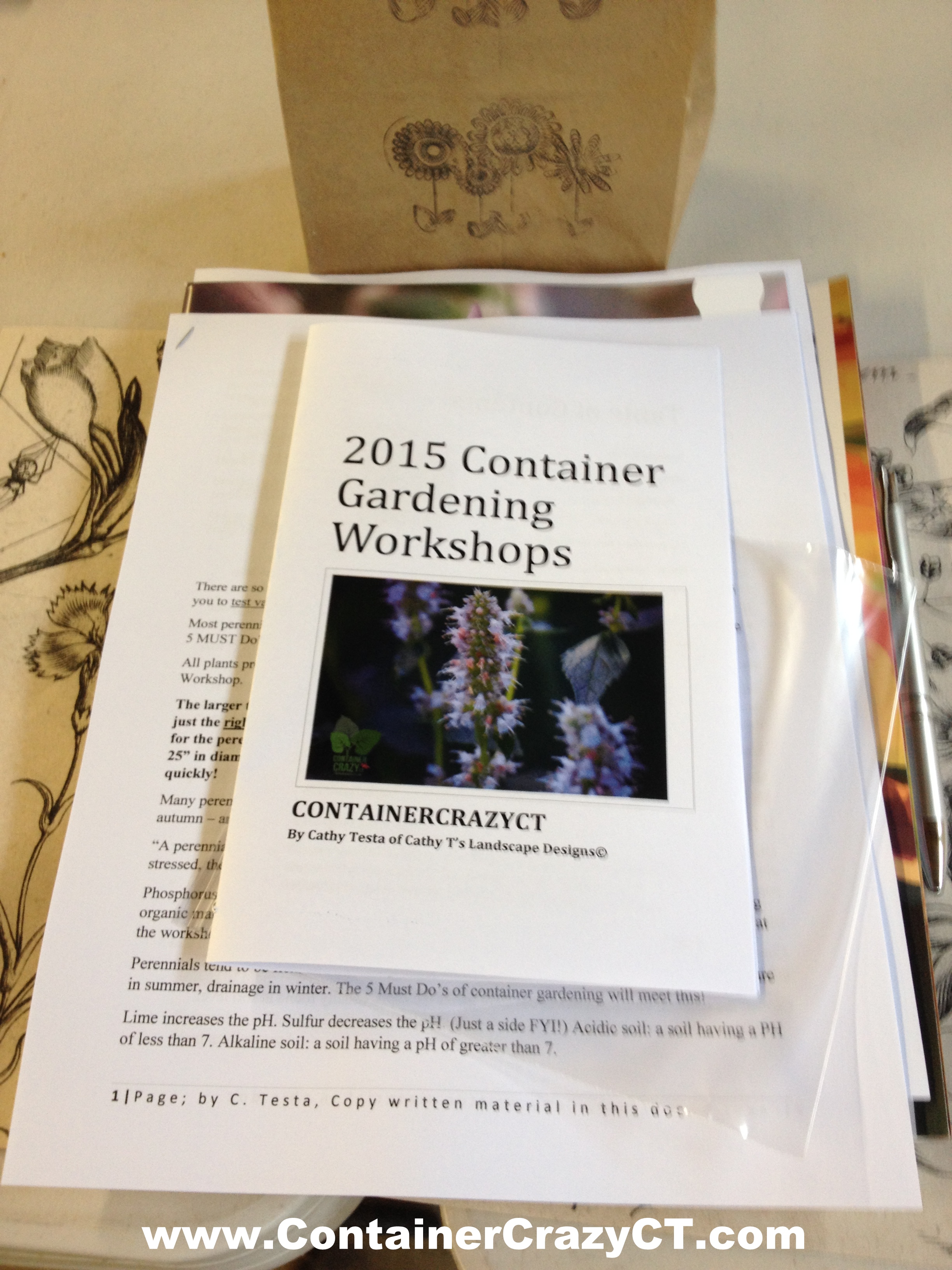
Each Attendees Receives Instructional Booklets and Plant Catalogues

Each Attendees Receives Instructional Booklets and Plant Catalogs – Plus a GIFT bag

It’s DIY, Educational, Plant Filled, and about Potting Passion!

Cathy T shows how to work with color echos in your pots.

Cathy T shows how to work with color echos in your pots.

We Make Big Pots – for Big Statements!

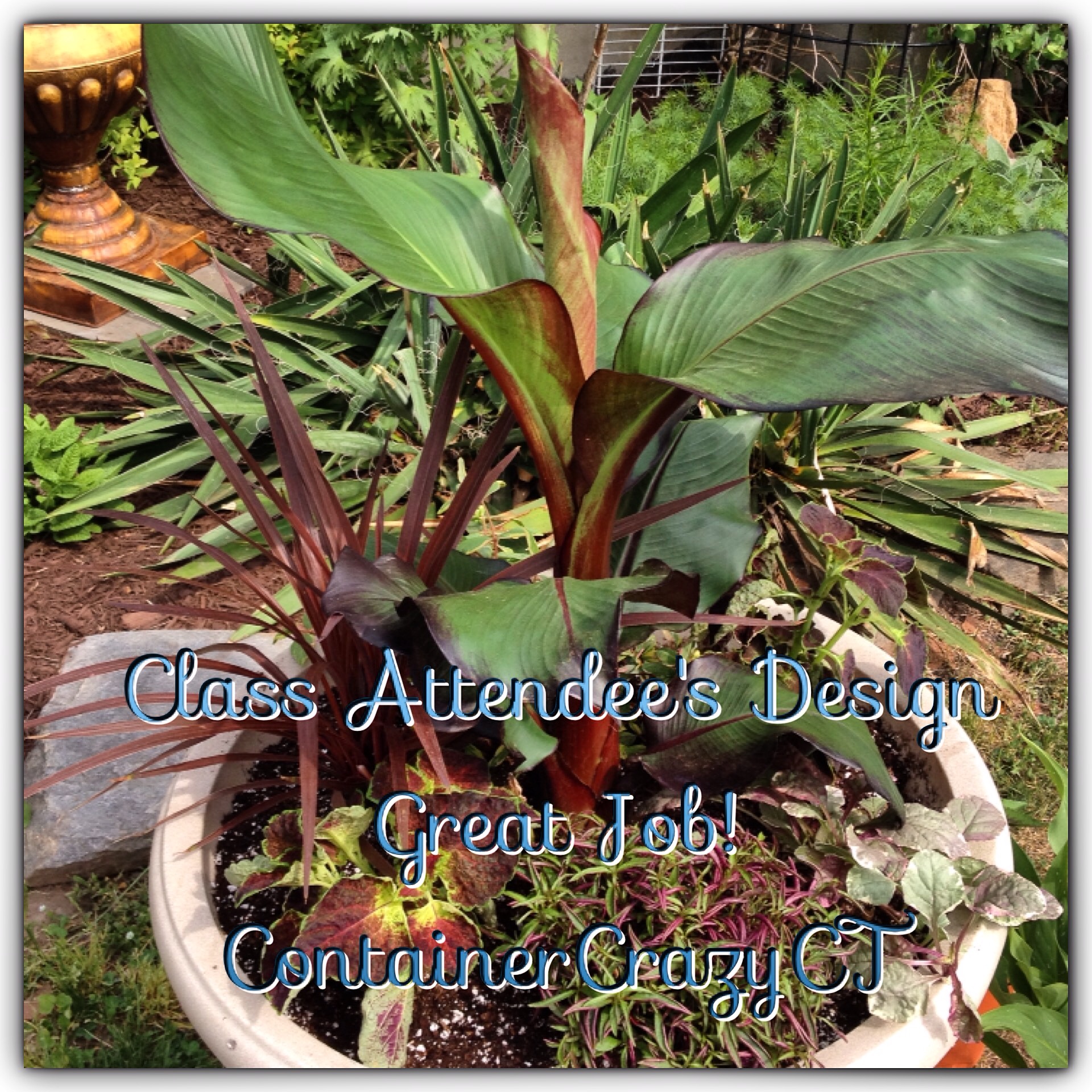
Beautiful Creation by Attendee Donna at last week's class - Love the dark tones and textures!

Beautiful Creation by Attendee, Donna, at last week’s class – Love the dark tones and textures!

Cathy T talks about why Big Pots are important for Container Gardening

Cathy T talks about why Big Pots are important for Container Gardening

Attendees Get into the Zone - The Pot Planting Zone

Attendees Get into the Zone – The Pot Planting Zone

Talk about FOCUS! :)

Talk about FOCUS! 🙂

Awaiting Delivery After Class - So Pretty

Awaiting Delivery After Class – So Pretty

More photos will be posted in the near future – Stay Tuned.  Enjoy your Containers and Patio Pots!

Cathy Testa

Container Crazy CT

← Back

Thank you for your response. ✨

Warning
Warning
Warning
Warning

Warning.

For More Information:

CLASS DESCRIPTION

Powerful Perennials in Container Gardens – An Intro to May’s Hands-On Workshop

7 Comments

The Theme – Powerful Perennials

Perennials, which return year after year in your gardens (or more technically stated, are a plant that normally survives for three or more seasons), are excellent candidates in container gardens and patio pots.

However, they are often overlooked for this use and many people do not understand their amazing benefits in container gardens or know which to select to achieve stunning combinations to make your container gardens look amazing in your outdoor surroundings!

This year’s Container Garden Workshops hosted by Cathy Testa of Container Crazy CT in Broad Brook, CT will focus on perennials which perform beautifully in container gardens and patio pots, and how and why you should use them to your advantage.

Container Garden with Mix of Perennials and Annuals

Container Garden with Mix of Perennials and Annuals Upon Planting!

Burst of “Dynamic” Color Periods

We all love color – and know many annual plants provide constant color in your container gardens, but so do perennials. Many perennials bloom at specific times during the season so they add a dynamic element to your containers. Some are short bloomers for a period of weeks, while other are long lasting for several months – It is a matter of knowing which perform best to maximize their show in your container gardens. Think of perennials as providing a burst of color at the right times to compliment the other mix of plants in your container gardens and patio pots.

Perennial: Agastache 'Blue Fortune' blooms all summer long

Perennial: Agastache ‘Blue Fortune’ blooms all summer long

For example, a blue flowering perennial, called Agastache ‘Blue Fortune’, which also goes by the common name of anise hyssop, has a very long lasting soft blue flowers in summer. The blooms start in July and continue blooming all the way into September. Not only is that long-lasting, if you find the blooms look tired towards the end of the summer, you only have to snip them off from the tall stems of the plant, and guess what? Within two weeks, you will see new fresh buds forming and opening up on your plant in the container garden.

Perennials Don’t Get Exhausted

Perennials don’t peter out as quickly as annuals because most do not profusely bloom during the entire summer which takes lots of energy, and they have reserves from previous year’s growth, unlike annuals, such as a petunias. Petunias, as an example, usually look tired or worn out by the end of August. I’m not saying annuals don’t rock in container gardens because they do and they are a must have – but people often overlook the values and bonuses of using perennials in container gardens and only consider them for the gardens of the ground.

Are Stars in Containers

Some perennials are aggressive spreaders in gardens, but when used in container gardens, they turn into stars. An example is the perennial, Ajuga reptans, also by the common name of bugleweed. You may know this one too. In the spring time, this low growing, ground cover looking perennial spikes up tons of purple flowers in May; they are noticeable.  However, they also have a habit of spreading in lawns – which is a nuisance.  This perennial actually travels from one spot to the next underground – so folks who desire perfect lawns dislike this plant.

Ajuga in a small pot

Ajuga reptans in a small pot packs a lot of punch – Just Adorable!!

In a container garden, however, the spreading issue of Ajuga is eliminated and controlled.  Because it is a tenacious plant, it will return in a container garden for several years however – the problem aspect is now a solution in container gardens and patio pots; it shines during the growing season with various foliage colors and tidy habit serving as an exception filler in container gardens with other mixed arrangements.

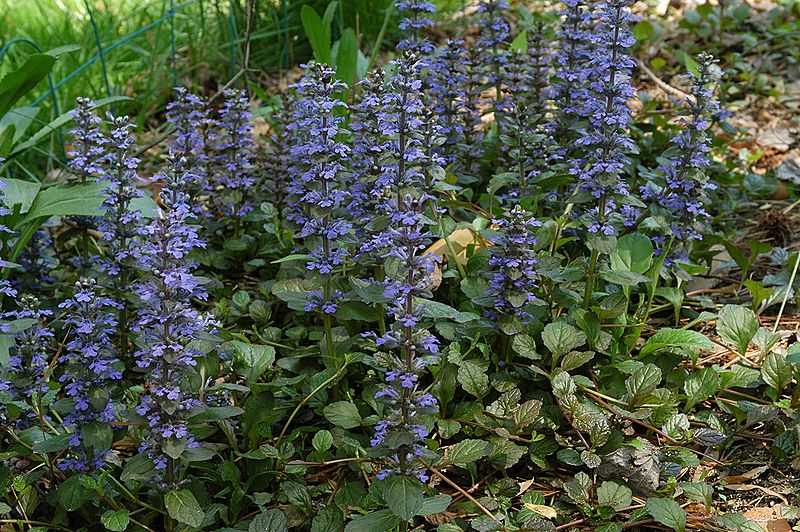
Ajuga reptans

Image: Wikipedia/EnLorax – Ajuga in the ground – shows the blooms, which are so pretty in a container!

Ajuga reptans is just one of the many examples of perennials which can be vigorous or quick spreaders in the ground, but is not a problem in a container. The flush of purple color from its blooms is beautiful in a container especially when combined with other spring colored plants like the soft yellow of daffodils or pinks of tulips. Or it can serve as a very long lasting foliage feature in your container gardens, and this perennial doesn’t get lots of problems.

For this upcoming Container Garden Workshop in May 2015, two cultivars of Ajuga reptans: ‘Burgundy Glow’ and Ajuga ‘Chocolate Chip’ will be available for purchase along with many other wonderful perennial plants. Both of these cultivars I have used in containers and patio pots with wonderful results.

‘Burgundy Glow’ has white, pink and purple variegation on its leaves with 6” spikes of blue flowers in May, and ‘Chocolate Chip’ has intense violet-blue spikes rising 3” above miniature, vibrant, chocolate-hued foliage in May through June. One year, I used ‘Chocolate Chip’ in a little container and it was so pretty, and this one can take shady conditions too.

Ornamental Grasses or Grass-like Perennials

You may not think of ornamental grasses or grass like perennials as container garden plants but two of these which I can name right off the bat are Hakonechloa macra ‘All Gold’ and its counter opposite in regards to color is Liriope muscari ‘Big Blue’.

Hakonechloa macra 'Aureola' on right

Hakonechloa macra ‘Aureola’ on right – Similar to ‘All Gold’ but All Gold  is well – all gold!

Hakonechloa macra ‘All Gold’ is one of many hakon grasses I selected for this workshop because it has stunning gold blades of foliage that grows in graceful clumps and the color is intense and vivid. Take that intense vivid color and put it next to the right color bloom of another perennial – and voila – you have eye magic or eye candy.

Then there’s Lirope muscari ‘Big Blue’, the polar opposite in color compared to the hakon grass – it has a dark green long strap-like leaves – and it is not an ornamental grass but a perennial, so it, like ornamental grasses, it returns year after year and is tough too.

Lily turf is Lirope’s common name, and it can be used to cover lots of turf – because it does spread – so this one fits my “Troublemaker Turned Star” scenarios for container gardens. It is a strong grower which is a problem in landscape situations, but it makes a wonderful low height type thriller with 15-18” long leaves with violet flower spikes in late summer in containers and patio pots! I’ve used Lirope in containers and it comes back every single year – it’s tough! This enables me to reuse it and just add new supporting candidates with it in the pot every season.

Container Garden with Perennials: Heuchera, Hellebore, Bellis, Euphorbia.

Container Garden with Perennials: Heuchera, Hellebore, Bellis perennis, Euphorbia in early Spring!

Other Perennial Benefits

There are other wonderful benefits to using perennials in your pots – Again, they return, as mentioned above, for at least three or more years – so this saves you money; they may be transplanted into your gardens or yard after the summer season is over in the fall, so you will enjoy them for years to come; and they give a dynamic bloom period or show at specific times in your container gardens. This gives your container a living interest because suddenly, in the midst of summer, a burst of a new color opens in the blooms of a perennial in the container, or perhaps it is an early spring bloomer or late bloomer in the fall – either way, it adds a new interest for you to enjoy and view. It is the ta-da of container gardening.

Perennial Purposes

Perennials also serve lots of other wonderful purposes. They have fragrant foliage and flowers, many can be used as a cut flower for your vases, and they attract butterflies and bees – and others have medicinal purposes too.

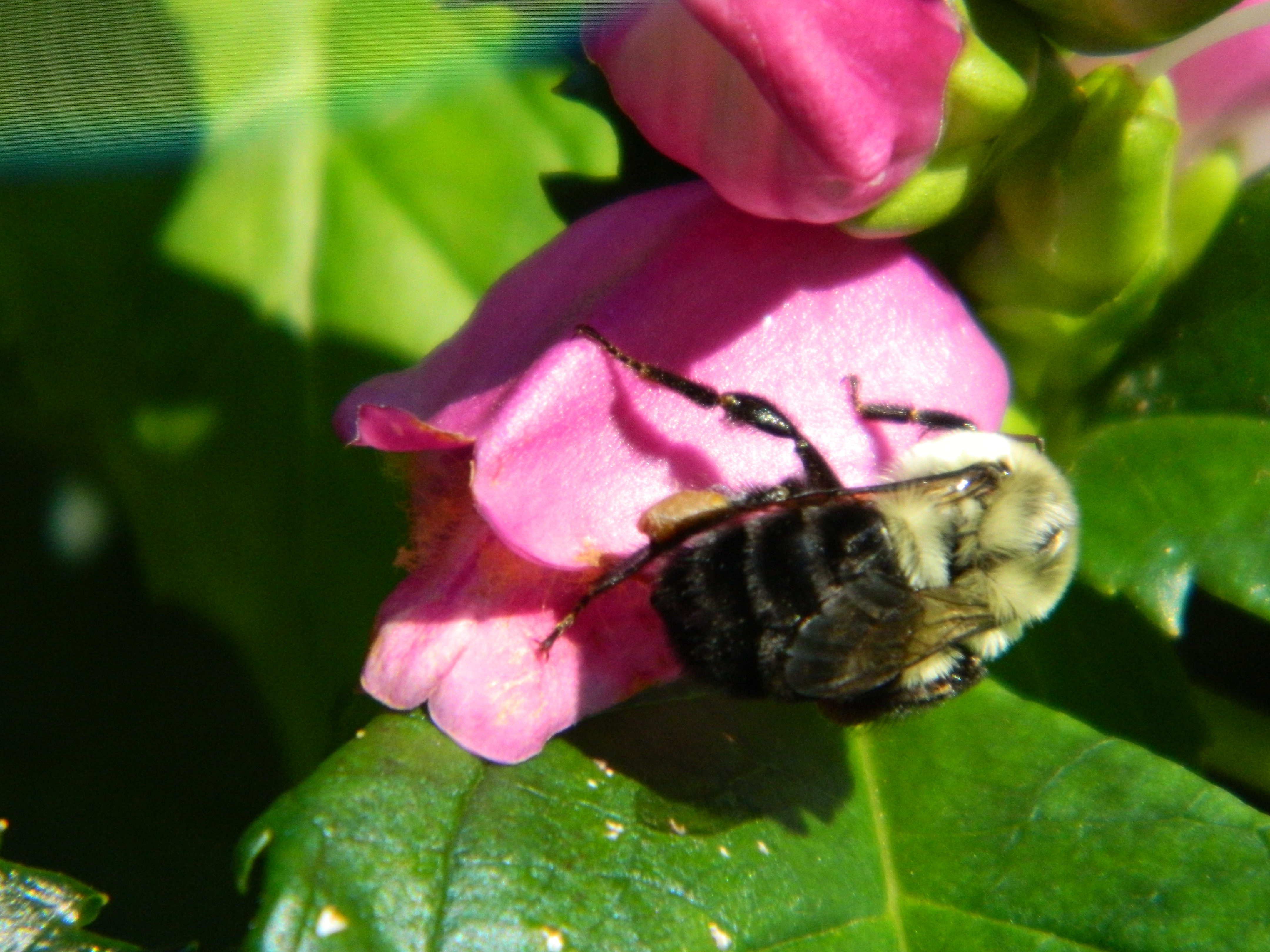
Bee enjoys a Perennial (Turtlehead)

Bee enjoys a perennial (Turtlehead) – A late season bloomer and very showy plant in containers!

There will be varieties for sun and shade available at these two workshops in May 2015. A total of 120 perennial plants have been ordered, 6 each of 23 species. Learning their features and how to use them with other plants in the containers will be part of this workshops offerings.

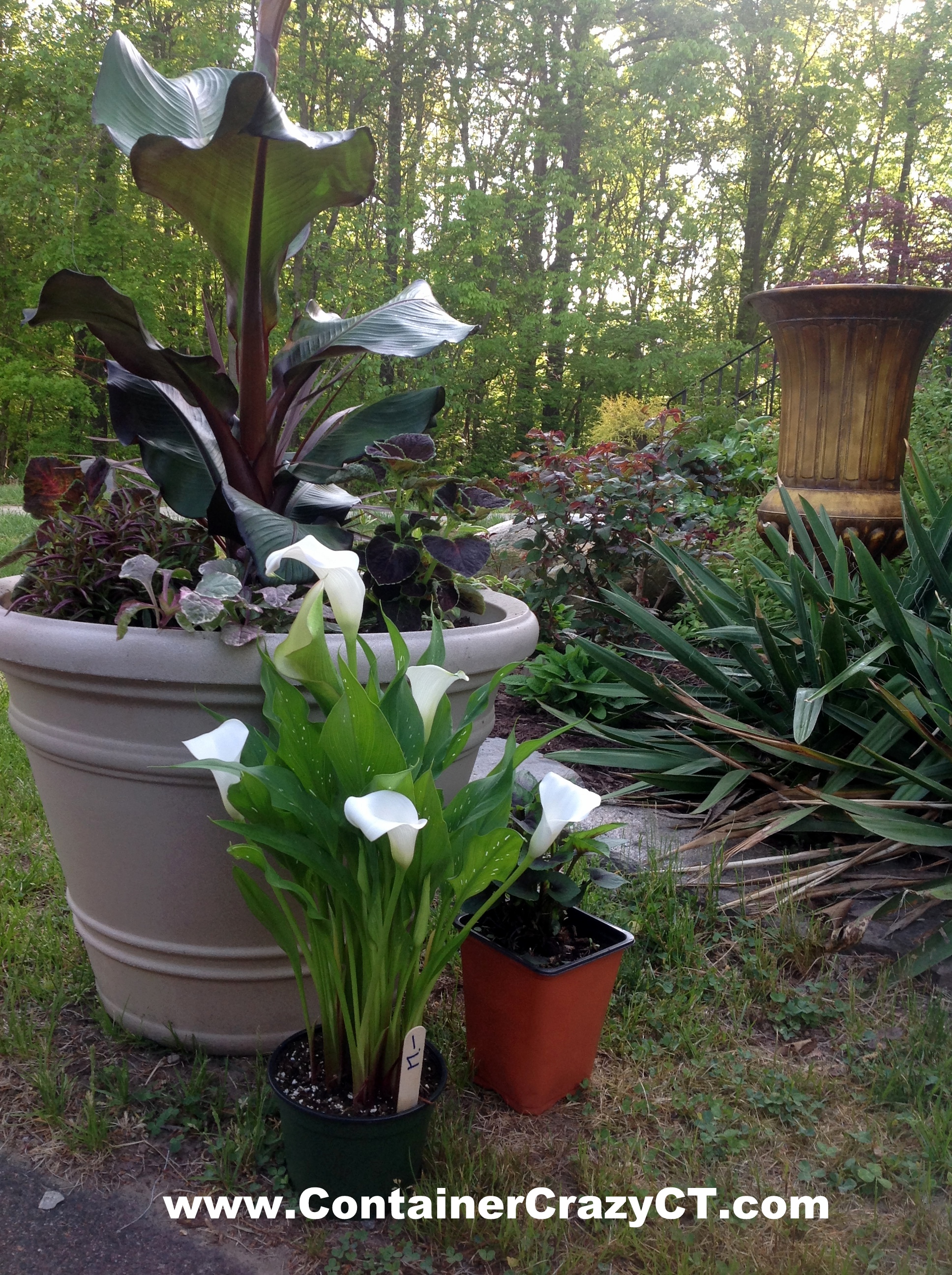
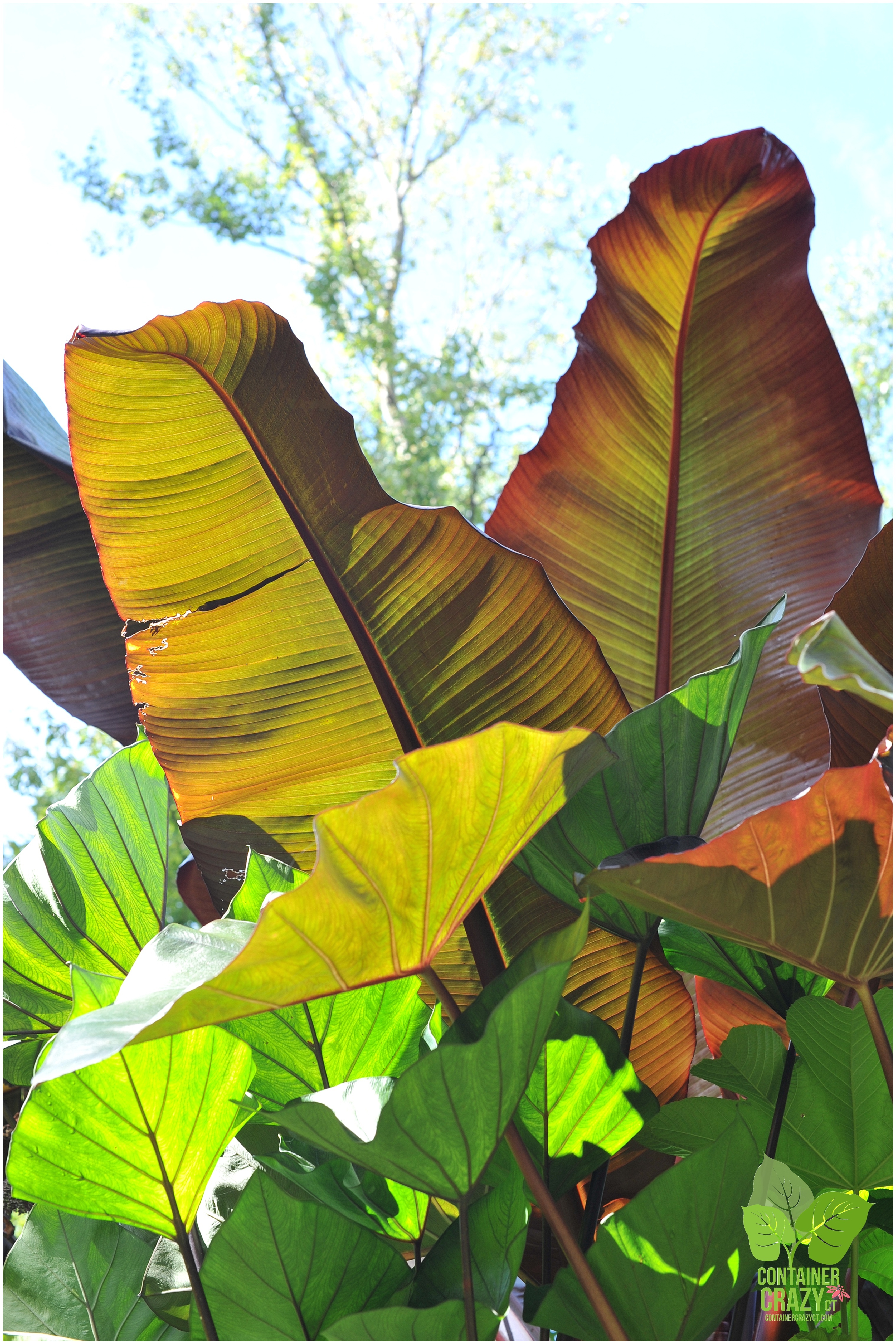
Red Banana Leaves with Various Elephant Ears

Red Banana Leaves with Various Elephant Ears – The Type of Tropical Plants Available at the May Workshops!

Tropical Additions

Tropical plants with large lush foliage features will be part of the Container Garden Workshops this year as well – because they are a passion and, like perennials, they have great benefits – the ability to reuse them year after year when appropriately stored over the winter, their dramatic and showy role due to their ability to grow fast, and adaptability to warm climates, which is what we have here in CT during the summer months. Many tropical will last all the way into October with no signs of stress, giving you a real show until the first frost of fall arrives.

Containers in Sept 2015

Containers in Sept 2015 shows the thriller of Colocasias (Elephant Ears) – Available for Purchase at the Workshops!

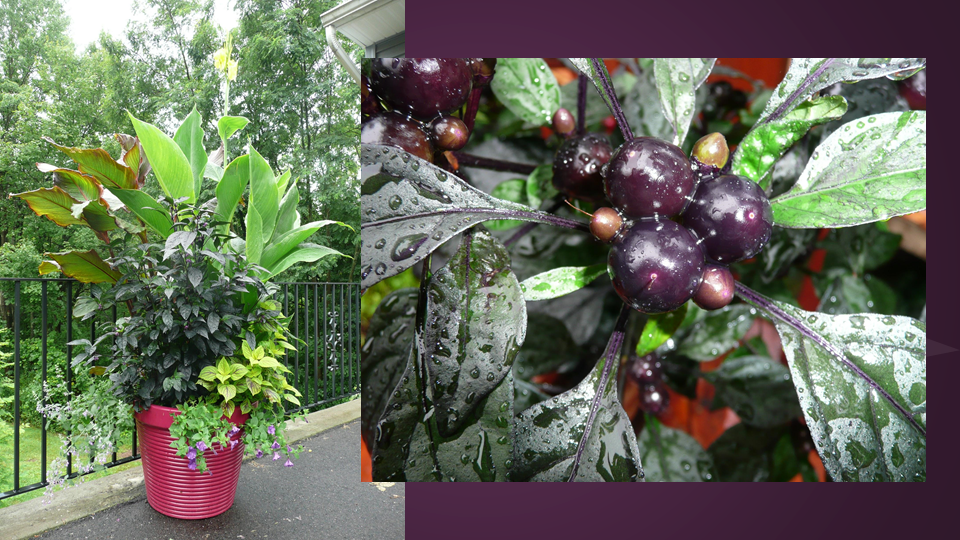
Every year, elephant ears (Colocasia), banana plants (Ensete and Musa), and some other unique tropical plants are offered as part of this workshop. Pairing up a dark toned elephant ear, such as Colocasia ‘Maui Magic’ with a vivid bloom of a perennial has dramatic effects in containers, and in this workshop you will see how it’s done.
A total of 185 tropical plants have been ordered, 8 each of 21 species, and learning their features and how to use them with other plants in the containers will be part of this workshops offerings.

Pinboards – Perennials with Power for Container Gardens

Start visiting my pinboard titled, Perennials with Power for Container Gardens, to get a glimpse of what the featured perennials and tropical plants will be at the Container Garden Workshops scheduled on May 16th and May 23rd, 2015. I will be adding photos up until the workshop dates. This will give you an idea of what will be featured, and some are shown in container gardens and patio pots too.

Two Workshop Date Options

This year, the workshop is being offered on two dates. There are some considerations beyond your calendar’s availability on which date you may want to select. Both sessions will have the same topics and materials available.  More details of what is included in the class is listed on www.ContainerCrazyCT.com, click MAY CLASS (BIG CONTAINER GARDEN) under the Nature with Art Programs menu.

May 16, Saturday – Session No. 1:

The May 16th date is after our typical spring frost date but we won’t know until we hit April. Experts say we are “almost guaranteed” to not get frost from May 10th through September 26th, but after our winter and global changes – do we trust weather guarantees anymore?

This means if you elect to attend session no. 1 on May 16th, your containers may require protection if we get an overnight frost. Frost is not as harsh to perennials, but will affect tropicals. If you are okay with moving your pot or covering it with a light sheet if forcasters say we will get a frosting, then May 16th is for you.

May 23, Saturday – Session No. 2:

The May 23rd date will be safe – however, it is Memorial Day weekend, and schedules tend to be busy – but with that said, nothing is better than placing your newly arranged container garden out on your deck or patio just in time for the festivities.

Registration one of 3 ways:

  1. Visit the Facebook page for Container Crazy CT and click on EVENTS to join.
  2. Complete the Contact Form found at the bottom of the class pages from the top-menu bars of http://www.ContainerCrazyCT.com.
  3. Email containercathy@gmail.com or call (860) 977-9473

Payment:

$15 per person + cost of plants purchased at the class. Payment of class fee of $15 is required by mail one month prior to the class date. Payment is non-refundable for any cancellations one week prior to the class date. Sales tax is applicable on all plant purchases during the class.

Send to: Cathy T’s Landscape Designs, 72 Harrington Road, Broad Brook, CT 06016

For a PDF version of this text: Container Garden Workshops Intro 2015

← Back

Thank you for your response. ✨

Warning
Warning
Warning
Warning

Warning.

Thank you,

Cathy Testa

Cathy Testa is a container garden designer in Broad Brook, CT. Her work has been featured on the television program, CT Style, and in several gardening publications. She offers classes year round where nature is combined with art and is available for container garden installations.

Succulents ContainerCrazyCT_0010For a Calendar of All Events and Workshops, click HERE.


New Page: Container Garden Pot Types

Leave a comment
Photos by Cathy Testa

Photos by Cathy Testa

Do you ever wonder if a particular type of container garden pot is worth the investment or how it helps or harms the growth and habit of your plants?  On this new page, I share my experience based on my use of various pots over the years.  See Container Garden Pot Types listed under the Container Gardens page on the top of this blog.

You will find terra-cotta, wood, concrete, and more listed and posted routinely.  There are so many choices and the options are limitless. Containers are the shoes to your plant’s roots.  And roots remain healthy and strong when growing in the right environment.

Containers and patio pots hold the soil and moisture, but the type of material from which they are manufactured can vary the temperature, water retention levels, and evaporation rate – so knowing a bit about the pots’ impact can help you make decisions on what to use for your plants.  You will want to also consider the size, drainage capability, durability, and overall look of the container or pot you select.

Finding a pot to suit your home’s exterior or interior is also a consideration.  There are many styles, colors, and sizes to choose from.  When you select the type to fit your decor, it results in an even more impressive display for your plant combinations.  It all starts with the pots.

Written by Cathy Testa

New Page: Troublemakers Turned Stars

Leave a comment
Photos by Cathy Testa

Photos by Cathy Testa

We all know everyone has a good and a bad side, and so do plants!  Thus, I’ve added a new sub-menu to my blog called Troublemakers Turned Stars.  Visit this page and my Pinboards to see more images and photos of the plants discussed.  If you have questions, just let me know – I’ll share my plant experience to date with you – or perhaps you have a story to share how the plant caused you some trouble in your gardens or landscape.  But the point of this information is many plants which are troublemakers in the garden have the opposite effect in container gardens and patio pots. They turn into star performers – so why not use them to capitalize on their bad side?  You will be amazed how useful and attractive they become.

PETASITES

Photos by Cathy Testa

Photos by Cathy Testa

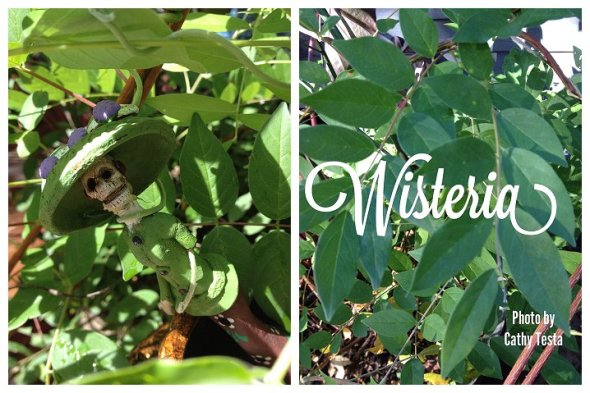
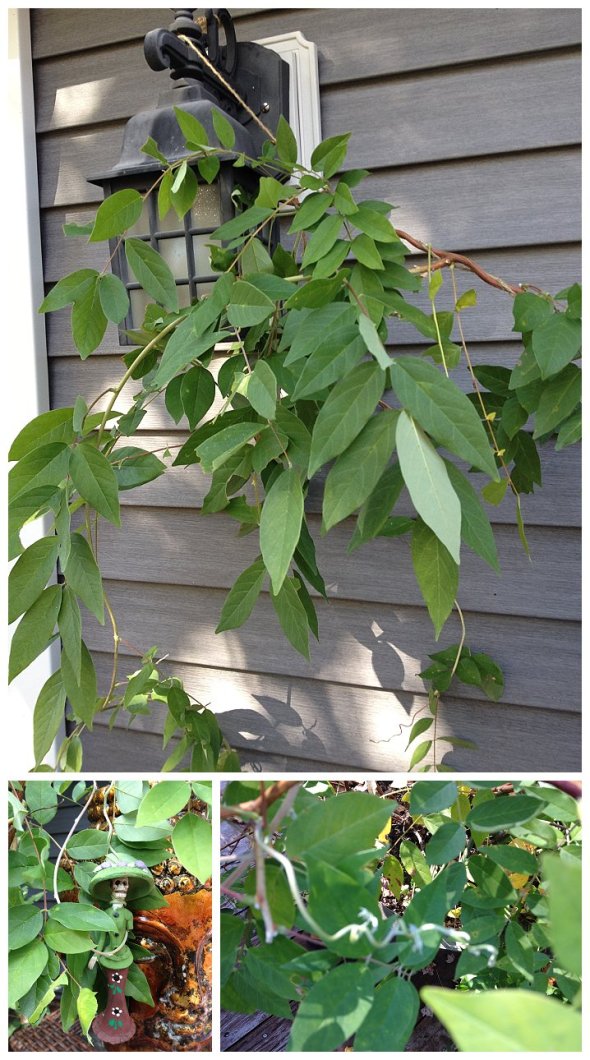
WISTERIA

Photos by Cathy Testa

Photos by Cathy Testa

Photos by Cathy Testa

Photos by Cathy Testa

BAMBOO

Photo by Cathy Testa

Photo by Cathy Testa

See my Page, Troublemakers Turned Stars, to read the details, why the plants are problems or a nuisance in the garden, yet turn into star performers in container gardens and patio pots.  More will be added routinely to keep you ‘posted.’

Written by Cathy Testa

I Wish I Was as Strong as An Ant

3 Comments
Image Courtesy of FreeDigitalPhotos.net/by Sweet Crisis

Image Courtesy of FreeDigitalPhotos.net/by Sweet Crisis

When I take down my container gardens for the season.

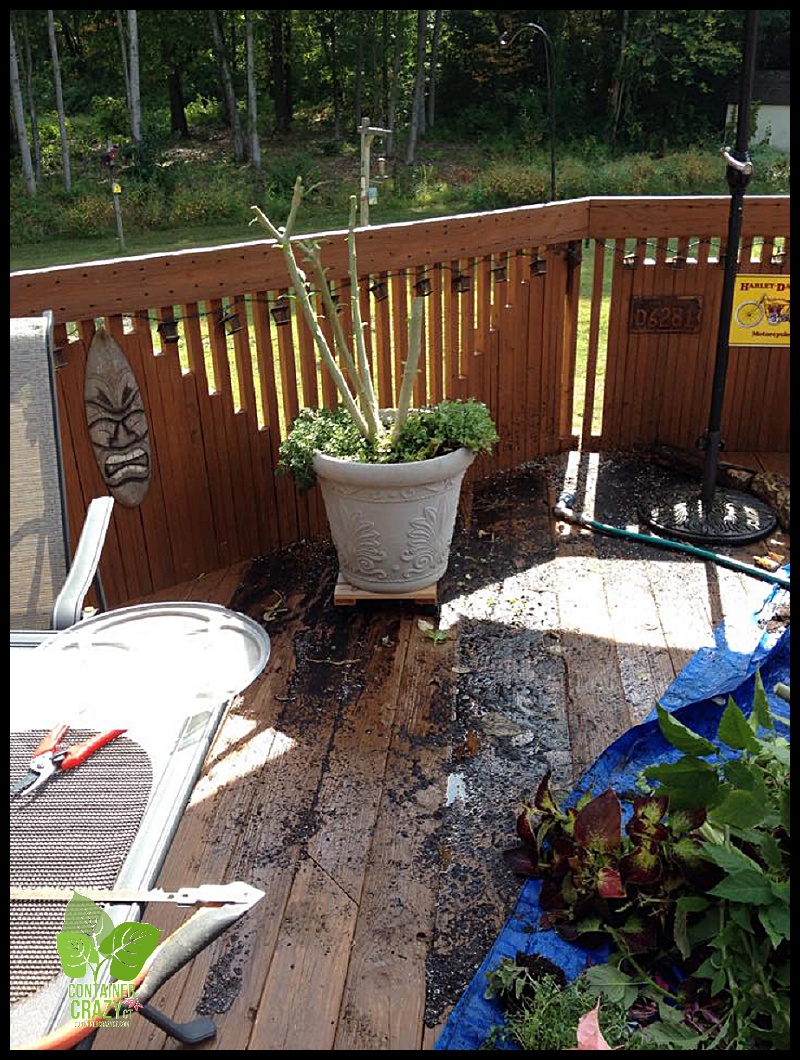
Lifting objects fifty times my weight would be handy right around now when I start taking apart my large container gardens and patio pots on my deck for the close of the season.

Years ago, I had no problem whatsoever doing this process, but as one ages – well, you know, if you don’t keep up with those muscle building routines, it can become difficult.  In fact, when I gave talks on container gardens and why “bigger pots are better,” some ladies in the classroom would ask, “How the heck did you manage moving all those big pots?!”

Sometimes I get so excited about container gardening, I instantly find super power energy enabling me to lift heavy bags of container garden soil or other items needed like the big pots. However, during this year’s take down process for my container gardens, I felt a little weak at times.

In fact, I started to tell myself, stop feeling frustrated about taking down your plants in your container gardens!  It is part of the process and get into the spirit.  So I did some of my work of breaking down the 20+ or so large container gardens on my deck yesterday, and as I was doing so, I thought I’d share some of the things I found frustrating or helpful during the process.

Soil from Containers

Soil from Containers

GET A WHEEL BARREL OUT

Last year I was lucky. I had a new huge cement planter near my deck and I tossed the left over soil into that, but this year, I had to use my wheel barrel.  At first, however, it fell over from the weight of the soil falling from the deck level above into the barrel as I tossed it over the railing.  So I attempted to move my pick up truck to the deck, well, that didn’t work.  It was too difficult to maneuver the truck to the corner of my deck.

photo (7)

So, it was back to using the wheel barrel.  After getting a big lump of a root ball or two into the barrel, it stabilized and I was able to continue dumping the soil into the wheel barrel receptacle from above.  I will use this soil in the ground somewhere to recycle it as it doesn’t do well being reused in my container pots next year – It is best to have fresh container gardening soil each season, in my opinion, but to use it as a top dress to a garden bed or for a new garden bed is a good idea.

PLASTIC LINERS FOR POTS

In my container garden demonstrations, I show folks how to line their containers and patio pots with plastic liners (which must have slits and holes cut into them for drainage).  The reason I started doing this many years ago was more to keep the containers in good shape, but it also turns out to be a very effective method for slipping the whole root ball out of the containers at the end of the season.  The roots circle a bit around the edges within the liner, and it forms a nice ball or chunk when you are ready to take the plants and soil out.  It is a great tip for plants like Canna plants because they get large rhizomes and roots in the soil, making removal difficult. So I was happy my liners were working perfectly as I was removing the soil from my pots.

Foliage being Tossed into a Bin.

Foliage being Tossed into a Bin.

CUTTING ALL THE STEMS AND FOLIAGE OFF

Before slipping the soil out of the pots with the liners, I cut off all the foliage and stems to about 4″ from the base for plants I’m tossing in the compost pile. The little stub of a stem helps to lift the root ball out of the pots, at least in sections or chunks. The key here – use good sharp pruners or a serrated knife for large stems, and make sure to clean or disinfect them so you don’t spread any yuck (diseases) around, even during the take down process, clean tools are important.  I tossed my cuttings into a large bin on my deck, another item which came in handy as I was working.  It is easier to take all the foliage off before trying to move pots to a location or to the spot where I was tossing out the soil into my wheel barrel. Seeing the cut off stems of my elephant ears made me sad, and also made me think that I should have setup a station to make leaf imprints in a concrete mix as a side project at this time, especially because I have plenty of leaves to use, but that’s another crafty project requiring time.

WASHING THE POTS

Sometimes I feel a little lazy, but I force myself to wash the pots with a little soapy water, and a soft brush to clear away any soil residue left in or on the pots.  Then air-dry the pots completely before moving the containers into a garage or shed.  It is important to not skip this step. Cleanliness is so important for your plants when you begin again next spring to replant your containers.  It greatly reduces, if not eliminates, potential plant diseases or problems and you will be happy you cleaned them the year prior.

My Big Kalanchoe, Going to a Foster Home.

My Big Kalanchoe, Going to a Foster Home.

FINDING NEW HOMES

For container plants which I can not fit into my home (yup, read my blog earlier about greenhouse procrastination), I stand there contemplating where I can fit this – or should I give the plant to a friend or family member with a bigger house? The one I’m struggling with right now is my Kalanchoe (paddle plant).  It is HUGE. I know I can easily propagate some with cuttings, but I keep looking at it saying, should I cram it in my bedroom again to keep it alive all winter? Or give it to my sis in law with a big open bright living room with lots of windows?  Oh gosh, the challenges!!  I don’t know.

Hypertufa at End of Season.

Hypertufa at End of Season.

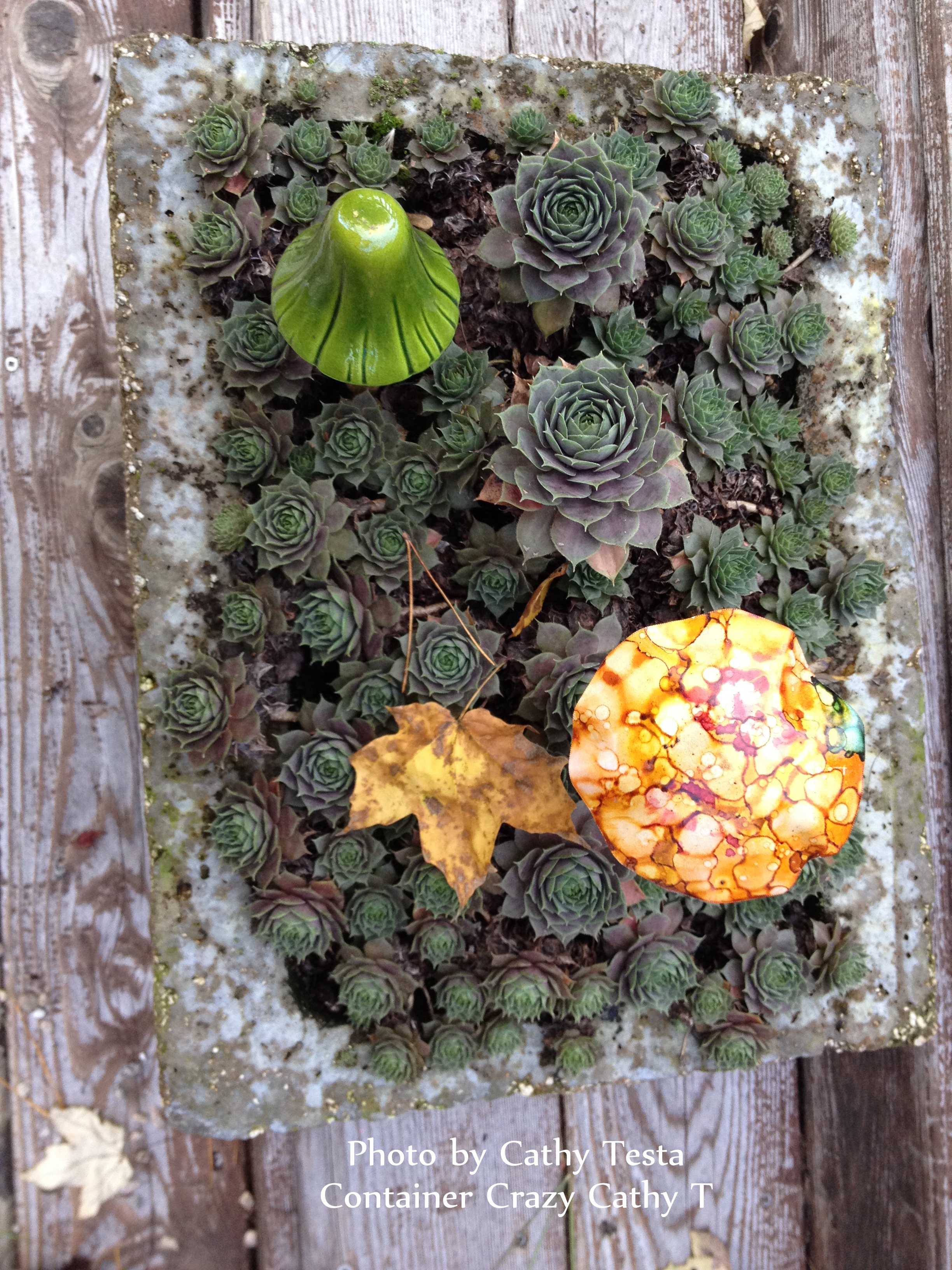
I also have a beautiful hypertufa stuffed with Sempervivums (hens-n-chicks).  They are pretty tough, can go really dry all winter with little watering, but I don’t have room in my kitchen garden window because I put my head planters there.  Gosh, where will this one go?

These are the challenges I face, never mind the fact I just don’t want to stop admiring my container garden plants outdoors, but winter is coming.

HAVING A GLASS OF WINE

Another downfall, or plus depending on your point of view, is that I started feeling like I wanted to have a glass of wine and enjoy my deck.  It is one of my favorite spots at my home. If you were to ask me – What is your favorite spot? Well, it is our deck.  I always feel like it is a vacation spot or oasis with all my big tropical plants every summer.  I get to decorate it with all my garden decor, and it faces a private backyard, so it is really a retreat.  So because I was out there on a nice, sunny fall day, and being around my beautiful plants, I felt like, gee, I should relax and have a glass of wine.  So I did after I disassembled about five or so of the smaller of my big containers.  Today, I will tackle the bigger ones.  This will require a hand-truck, some patience, and strength.

Wish me luck!

Cathy Testa

My Guest Post on CT Bloggers

Leave a comment
Featured CT Blogger

Featured CT Blogger

Visit the CT Bloggers website to see my Guest Post on a fail safe design technique for container gardening and patio pots.  I use it every time and talk about this in my classes, and you will find it very useful too if you aren’t aware of the “thriller-spiller-filler” method.  See also my Container Gardens page here for recently posted container garden creations and photos by me.

And don’t forget to look around at the CT Bloggers page and other links there.  There are a great deal of resources on all things CT.  I enjoy reading blogs over websites these days when I’m researching a particular town or city – the experiences are by people from CT passionate about sharing good things to see, do, and enjoy.

Happy Monday – Get ready for the heat wave!  Water those plants.  Cathy T