Custom Orders for Evergreens – Or Make Your Own by Appointment This Week!

Leave a comment

Ho, Ho, Ho Everyone!

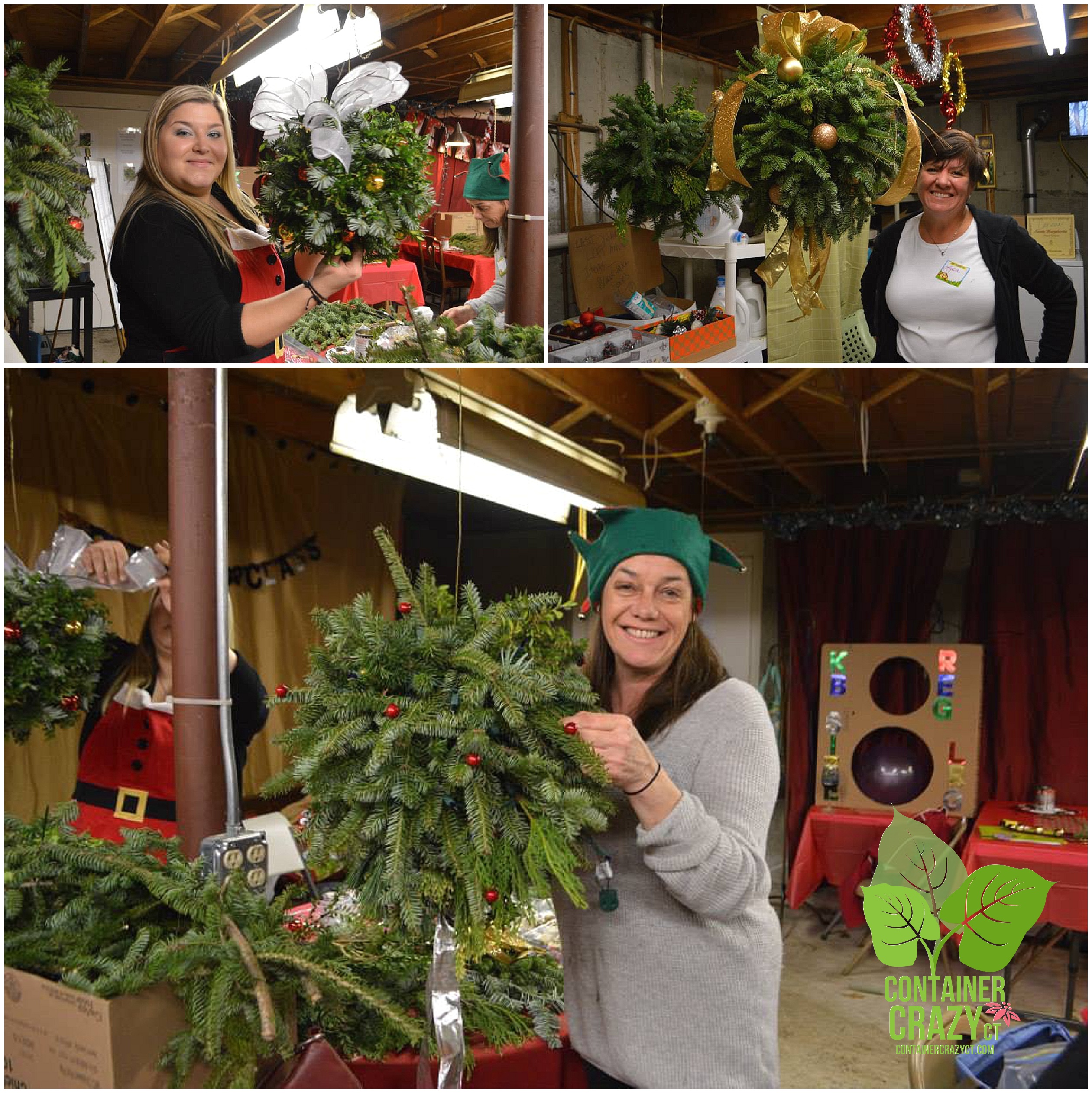
What fun we had on Saturday! Just look at these beautiful ladies with their evergreen handmade holiday creations from Saturday’s class at ContainerCrazyCT’s workshop.

Attendees at ContainerCrazyCT's class - Photos by HomePlaceBlogger

Attendees at ContainerCrazyCT’s class – Photos by HomePlaceBlogger

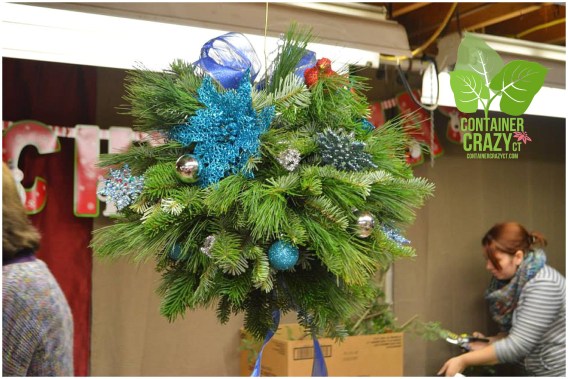
Advanced Kissing Ball Makers (returning each year) are really rockin’ their creations – lights were added to balls and wreaths, their bows are coming out fantastic, and each has new ideas every year.

Attendees at the 5th Annual Class Hosted by ContainerCrazyCT

Attendees at the 5th Annual Class Hosted by ContainerCrazyCT

Making Your Own by Appointment – Open Studio Days

If you are interested in making your own, you may do so during Cathy T’s Open Studio days this week from Dec 9-12th, any time, just book an appointment, come to her workshop in Broad Brook, CT and get one-on-one private instructions on how to make your very own kissing ball, wreath, or candle centerpiece with fresh greens.

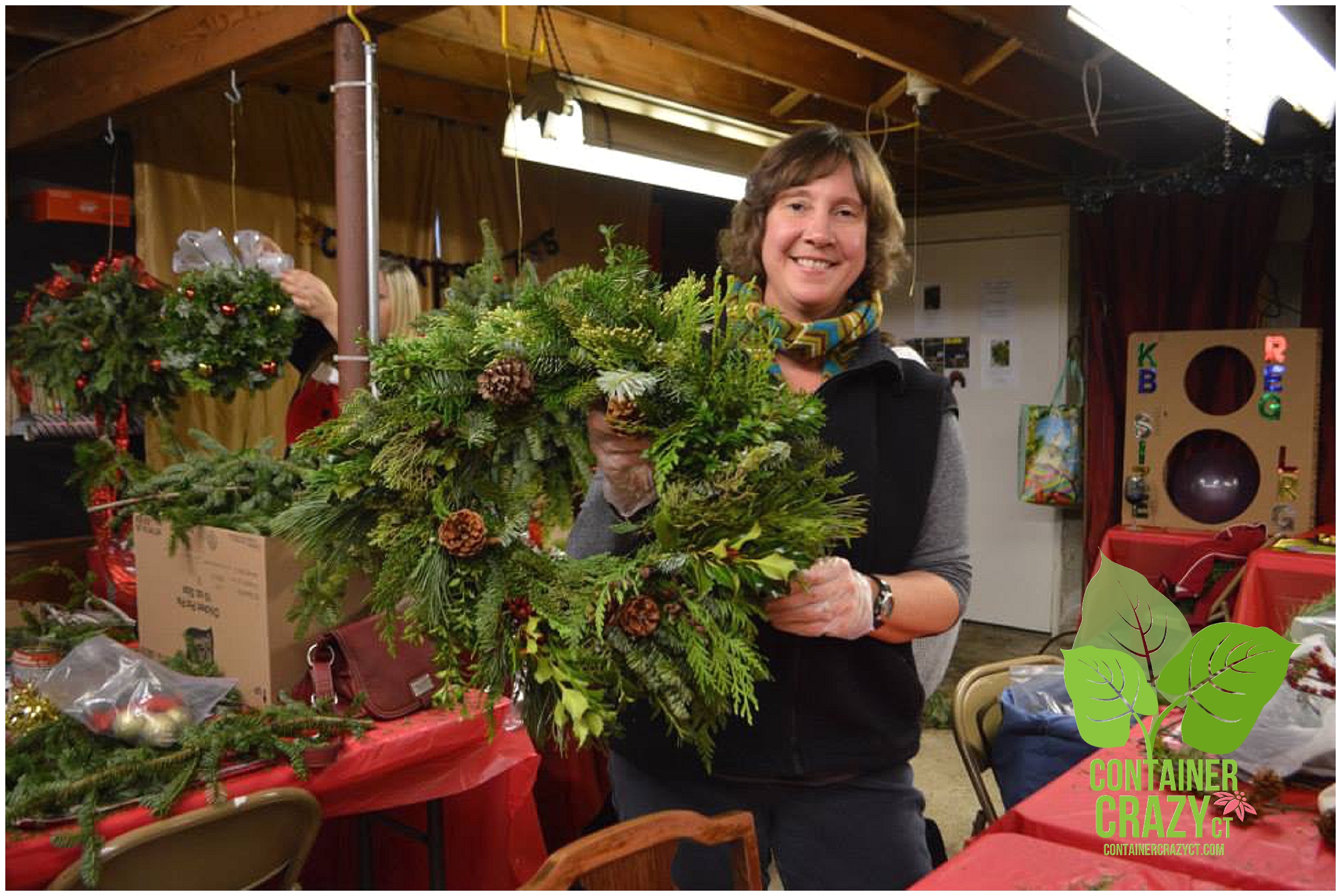
First Time Attendee Makes a Gorgeous round and square wreath!

First Time Attendee Makes a Gorgeous round wreath – Great Job!!

Place a Custom Order Soon!

Too busy for Open Studio Days?  Place a custom order today, and Cathy T will make an item for you.  Custom orders for a large kissing ball, wreath, or candle centerpiece are available. Prices range from $35-$45 based on items selected and decor.

Container Gardens With Evergreens at Home or Business Locations

Also, remember Cathy T installs container gardens at outdoor locations stuffed with greens and decor.  If you need an item for your home or business, call her today or text: 860-977-9473 or email: containercathy@gmail.com. See also the contact form below.

A Box of Greens – Is a Box of Jolly!

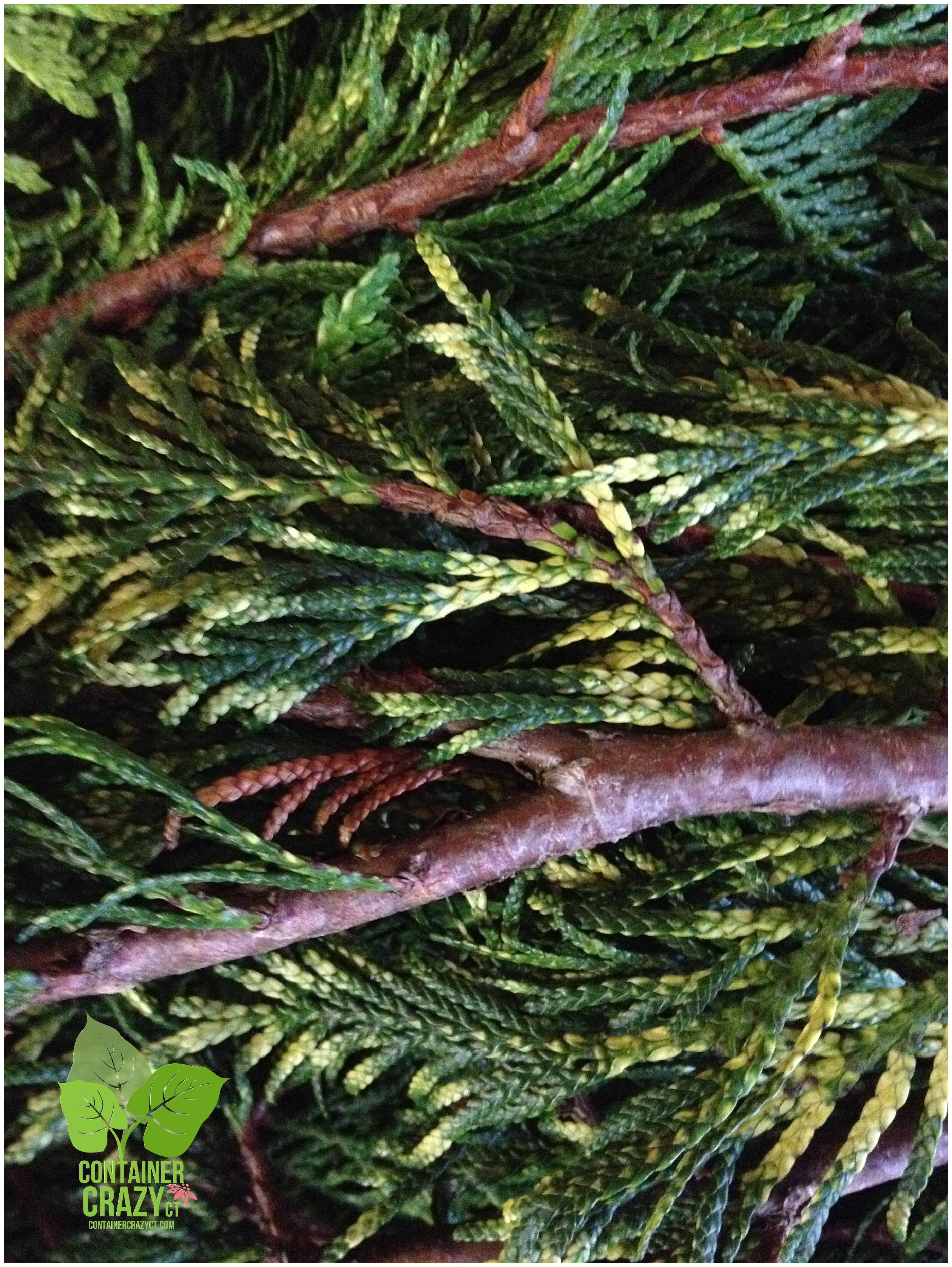
Do you need a stock of evergreens to dress up your home?  Another option available is to purchase a box of greens.  Pickup at Cathy T’s Broad Brook, CT location is required – so if you are local, give a holler at 860-977-9473. The box will include Balsam, Silver Fir, Golden Arborvitae, Yew, Cedar, and more. For information and prices, please contact Cathy T.

A Great Big Thank You!

I’d also like to take this quick opportunity to thank all the attendees for making my Christmas season kick off so much fun.  The appetizers you brought, the cheer, and special attendees giving their own demo’s (Maryse – Bow Queen!, Eilene – Light Queen!) during the class.

Contact Form

← Back

Thank you for your response. ✨

Cathy Testa
http://www.ContainerCrazyCT.com
860-977-9473 (cell)
containercathy@gmail.com


Rudolph Delivers Fresh Evergreens for Making Holiday Kissing Balls at Cathy T’s Class

4 Comments

Hello fellow blog followers, friends, clients, and new visitors!

A New Variety at Tomorrow Class - Golden Arborvitae!

Golden Arborvitae Used in Kissing Balls – A New Variety This Year!

Tomorrow marks the date of Cathy T’s “5th Annual Kissing Ball and Holiday Creations Class!

It’s hard to believe, but this class has been running for five years now.

It all started when an idea popped into my head to hold a class on making holiday kissing balls, wreaths, and centerpieces using fresh evergreens after helping a friend assemble her kissing balls at her home.

Each year, this class is coordinated with a mix of excitement, anticipation, and fears.

What do I mean about fears?

Well, when working in the plant world – because plants have the potential to be affected by any number of unexpected surprises, there is always that little bit of fear that something could go wrong.

Just yesterday, I shared a link about a California tree grower experiencing a huge loss of holiday grown trees due to drought. Christmas trees take many years to reach the perfect stage for sale during the holidays, so image his disappointment when 500 trees were so badly affected by lack of rain fall, they could not be offered for sale this season. This is something he really had no control over because his trees were suffering from the forces of Mother Nature.

But, most people in the horticulture trade learn how to roll with the punches, solve any unanticipated – or unwanted bumps in the road and move on quickly. And usually, they never give up either.

On the day I drove to my suppliers to finally pick up my order of fresh mixed evergreens  – a day highly anticipated and enjoyed every year around this time – a blip happened.

When I arrived at their door, they told me a big portion of my evergreens order was not in yet.

Cathy yelling "something is missing here!" Photo Source: Bitstrips

Cathy T is surprised to learn not all is in yet. (Photo Source: Bitstrips)

My reaction was not pure panic, because it was one of those – here we go moments, but disappointment set in. I have things to do and get done, and this would be a slight delay to deal with.

I thought, “I guess this is my unexpected storm this go around?”

As I questioned why and how quickly they could resolve this blip, suddenly, out of no where, a very pleasant gentleman showed up by my side.

I had never seen him before and he reassured me all would be fine. He promised to make a special delivery to my house the very next morning.

When I questioned him on the time of the delivery, he said they would be there by 8:30 am.

Timing was important to me, just like Santa Claus on Christmas Eve, a great deal of planning goes into my special day – so I didn’t want this little storm to delay the gift of greens used in my class by all the Kissing Ball Makers.

Thankfully, the next morning, one of his elves did show up, as promised — on time.

“Phew.” I thought.  All looked great and it was onto my next to do’s to prepare for the class activities.

As I was working, I started thinking, “Who was “that guy” yesterday?”

As I mentioned, I had never seen him before in all the five years I have driven to their place to pickup my evergreens. Was he an owner? Is he a new worker?

He certainly was very attentive and saved the day.

Was he my Rudolph?

Perhaps!! To me he was at that moment – he made sure the delivery took place no matter what it took – typical of horticulture people – especially this time of year.

So, long story short —

Making beautiful holiday kissing balls with fresh evergreens will happen yet again, despite those fears or blips which may happen from time to time in the plant world.

Snowmen Wine Stoppers - You know what these are for!

Snowmen Wine Stoppers – You know what these are for!

We will be surrounded by holiday decor, warmed by appetizers and holiday cheer, and share our day with enthusiastic kissing ball makers.

Dark and Classic Boxwood Used in KBs

Dark and Classic Boxwood Used in KBs

You may search the question: “How to make kissing balls?” via Google on the Internet, and you will find many videos and information on the how to’s, but you don’t get the holiday magic which happens in Container Crazy CT’s holiday workshop each year, unless of course, you are a fortunate attendee.

See you all soon new and advanced Kissing Ball Makers!

Ho, Ho, Ho…

Affectionately,

Your Pseudo Mrs. Claus

Cathy T - Photo by Bitstrips

Cathy T – Photo by Bitstrips

Giving Thanks for another Great Gardening Year

5 Comments
Container Garden Install

Container Garden Install

Another gardening year has passed quickly.  It was filled with lots of plant-loving activity, including garden talks for garden clubs and farmers markets, ‘walk and talk’ home tours of friends’ special gardens, and several classes hosted by guest instructors and Container Crazy Cathy T related to combining nature with art.  And along the way, I had many moments of thankfulness.

Now arrives the week of Thanksgiving.  A day approaches when we share time with our families to count our blessings – and enjoy home cooked meals. We may say a few words during these events to express our gratitude or a hug may suffice as you welcome your treasured family members and friends to your home and table.

As this fourth Thursday of the month approaches, I reflect upon many opportunities for which I am grateful.  Some may seem minor in the scheme of life, but each is something which helped me along my way and thus, here it goes, my “Give Thanks” List:

My, My – What a Beautiful Summer

We were blessed with an amazing summer where almost every weekend provided sun and comfortable temperatures.  I know this because I pay attention to the weather forecasts, especially for weekends where garden events are scheduled.  And, on every single summer weekend, the weather cooperated for my special events – how lucky am I!  Even on the only day when I had my family over for a summer picnic and pool time, well – that day was the warmest of all – it was perfect timing.

There were so many summer weekends when I looked to the skies and said, “Thank God it is beautiful out this weekend!” So, thankfulness prevails for cooperative weather. Hopefully, one more blessing will happen for good weather at my annual holiday evergreens class on December 6th to cap off the year. Please, no big snowstorms.

Supportive Gardening Friends and Family

As I look at the history of growing my small business, many times, it is friends and family members suggesting ideas to help improve processes and my classes.  And, it IS mostly friends and family members attending my gardening events. However, each new season brings new faces too – and thus, new gardening friends.  One of the best parts of working with plants is communication is almost universal in the gardening world – you don’t need to speak the same language or have the same gardening style to appreciate the beauty of nature and how to bring more of it to your surroundings. Thus, I am very grateful and thankful for all supportive people, new and old, and how they help me along the way. Each and every client is appreciated as well – and many are treasured friends and family members. Thank you for hiring me this gardening season and attending my events.

Healthy Me and Healthy Parents

This year, Thanksgiving Day falls one day before my big 50th birthday. Sure, I have more aches and pains than I did in my 30’s, but I am really thankful there have been no big health problems.  Truly a blessing – and good health becomes more important as we get older – the importance of health – not only for ourselves, but for our family members is of the utmost priority in life. And, for those who have struggled with tough health issues this year, I pray they are always getting better and feeling healthy once again. I’m thankful for when those prayers are answered.

As for my parents – gosh, they are elderly, yet both very healthy and still with us – Every single moment I spend with them, I thank God for sharing these two beautiful people with me.  And to be spending the upcoming Thanksgiving Day with them warms my heart and soul. They, along with my extended family, are a blessing for which I am grateful – and glad I can continue to have them in our lives to share special moments.

Small House with a Big Yard

The home I share with my husband (he is another blessing in of itself) may be somewhat on the small size, but it is cozy with plenty of outdoor space to enjoy. I’m so thankful for the day we were told of this home being for sale, and that we snagged it up over 20 years ago. I’m thankful for a solid roof over our heads, and a large outdoor space we enjoy with our animals, plants, and trees.  Years ago, when we stood on our former small 4 by 4 deck to toast the purchase of our new home, we knew it was what we wanted, because it had a big yard – but we had no idea how it would grow into so much pleasure as our personal daily destination – right in our backyard. When we sit to admire our space around us filled with plants and nature – we always think about how thankful we are for our own little place on earth, and how we love to share it with our friends and family.

Chicken Coop Pen at Cathy T's

Chicken Coop Pen at Cathy T’s

Thankful for Likes

One day, my niece told me how happy she was when someone liked her drawing on an artwork related social site, and, I thought to myself, “Do we give too much stock to the “likes, shares, and positive comments” of social media?” But in the end, yes – sometimes it is important.  As we share things we are proud of, often helping to inspire others, we are thankful when someone hits like or share.  For the followers, sharers, likers in my social world – thank you so much for taking the time to notice and for appreciating my efforts.

The Sun’s Rays upon My Face

Lately, I’ve been taking time to sit in the sunniest place available at my home to face the sun during the mid-afternoons before the sun sets. Especially during winter, this is a much needed therapy activity for me because the winter blues has potential to creep upon us as the days are darker and temperatures are colder.

Each time I feel the sun’s rays upon my face, I give thanks for the sun and all it offers to our world. It is such a powerful force – giving life to us, our plants, and our surroundings. Without the sun, we would have nothing, so thus I say, thank you Sun.  You are my Goddess, and I worship you.

Happy Thanksgiving Everyone,

Cathy Testa
www.cathytesta.com
www.ContainerCrazyCT.com
(860) 977-9473 (cell)
containercathy@gmail.com

Cathy T at her home in East Windsor, CT

Cathy T at her home in East Windsor, CT

Hypertufa Making Class – A Great Way to Enjoy a Chilly Fall Day

4 Comments

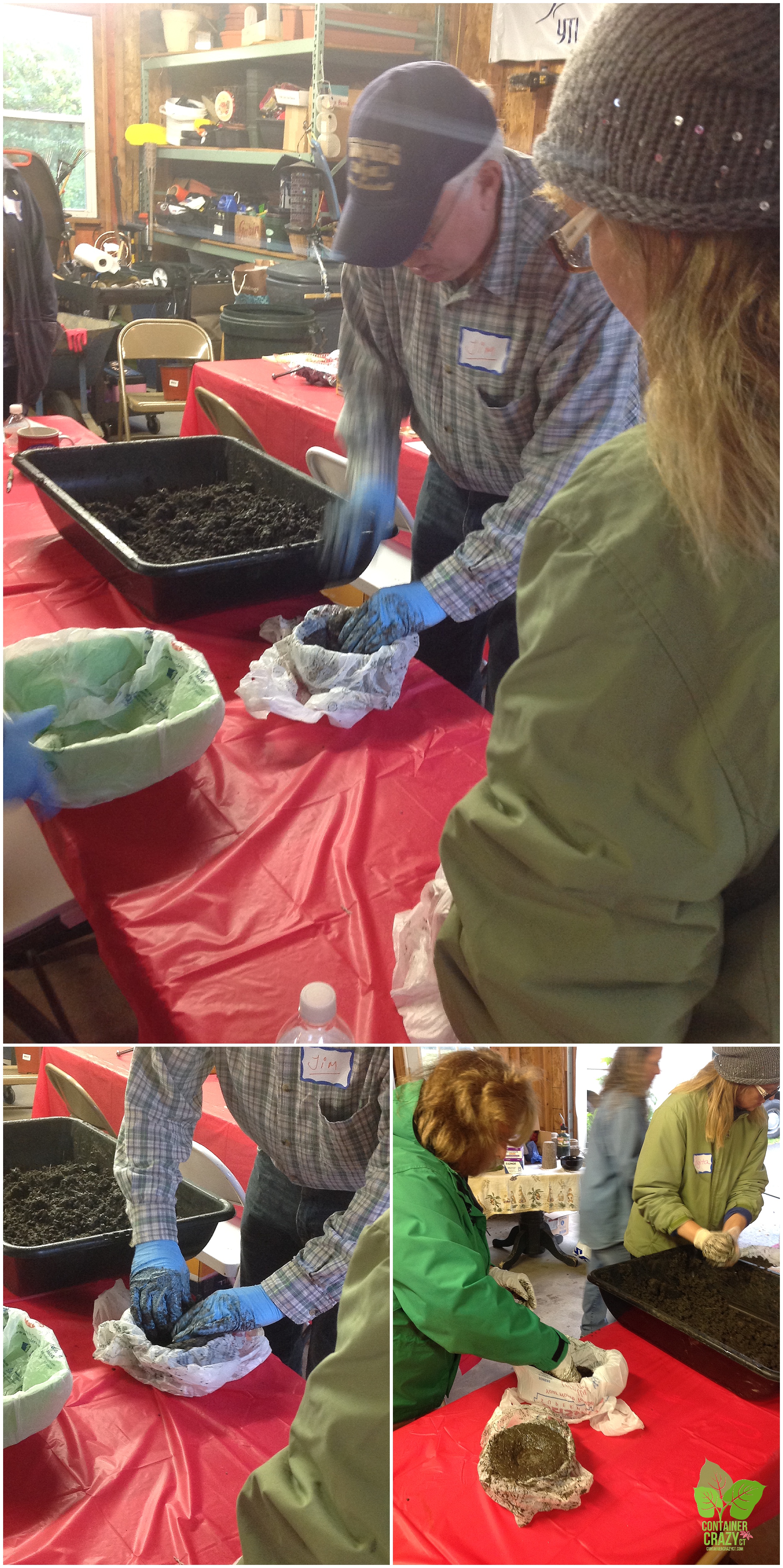
On a very cool and rainy Saturday, 12 ladies gathered to hear a professional hypertufa making artist talk about the how to’s and secrets of making hypertufa pots.

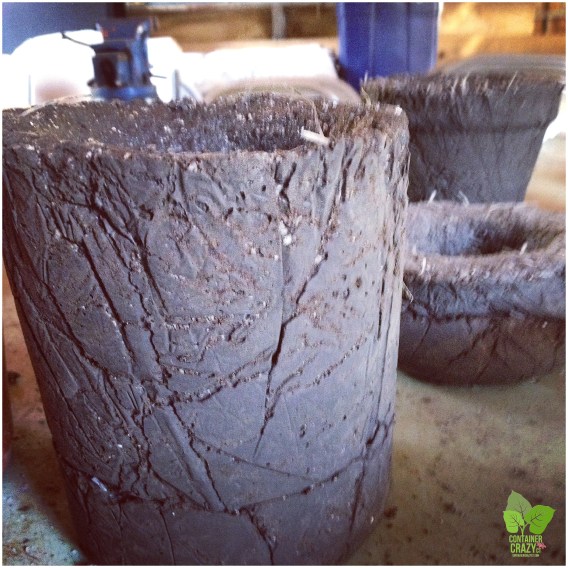
Hypertufa is a very lightweight natural material that looks like stone,” stated Jim Kandik of Ancient Gardens Hypertufa.

And he should know. He has been handcrafting planters and garden art in hypertufa style for years and offers them for sale at various garden and art shows, such as the Boston Flower Show, Newport Flower Show, and Celebrate West Hartford show – just to name a few.

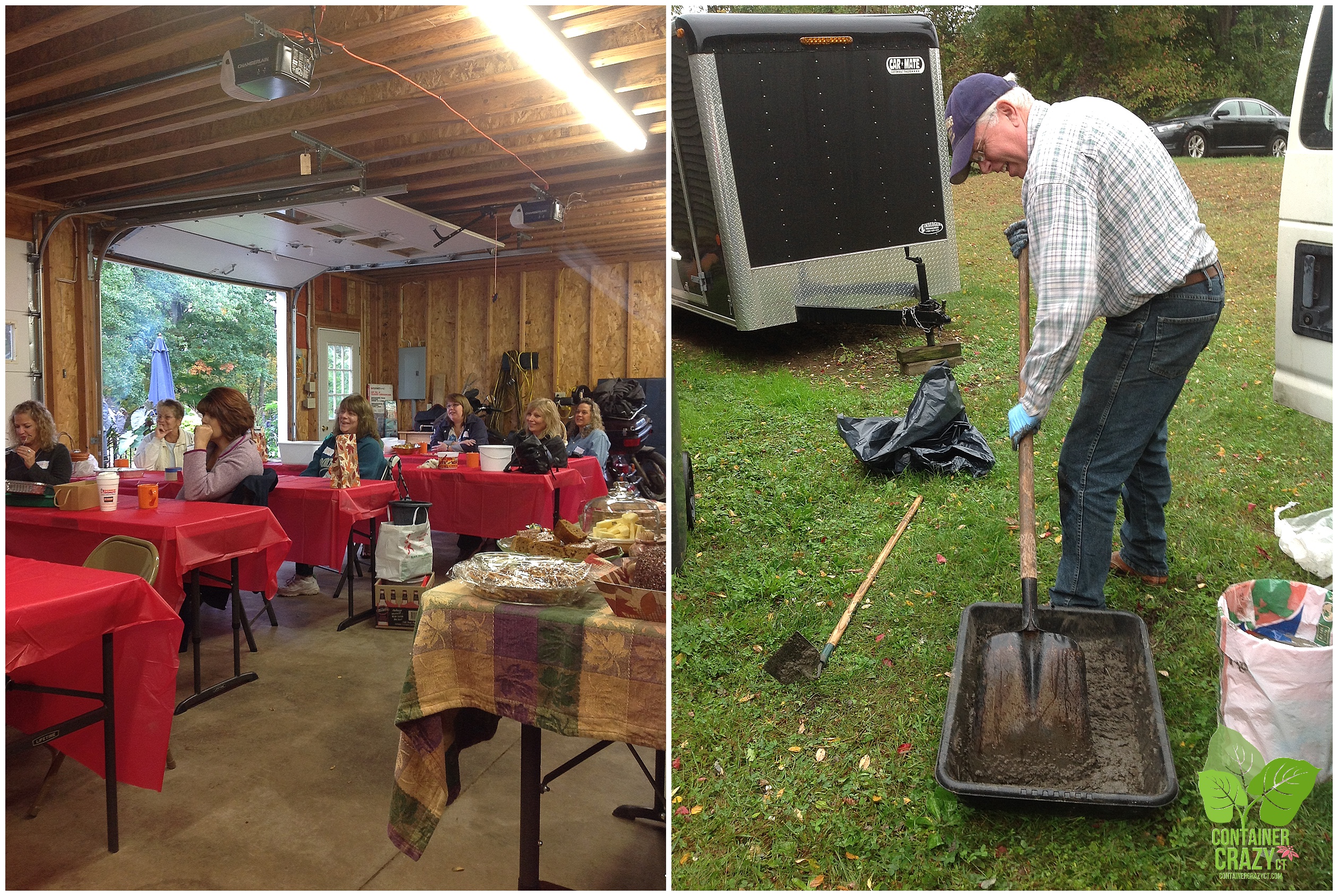
We all felt lucky to have Jim give us the low-downs on how to make hypertufa planters and containers as we wore our cozy sweatshirts and hats to ward off the slightly chilly air coming through the garage doors of Cathy T’s large classroom.

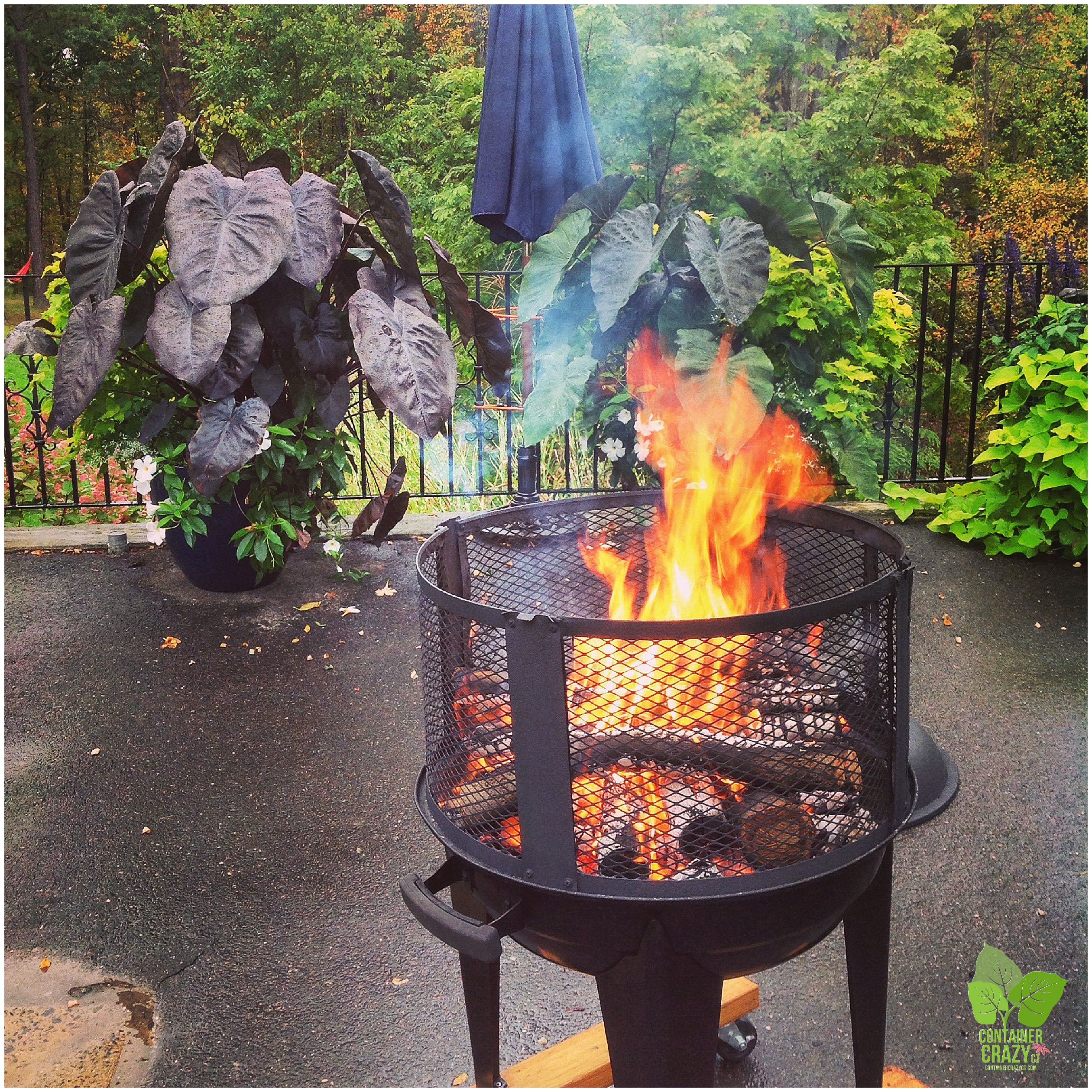
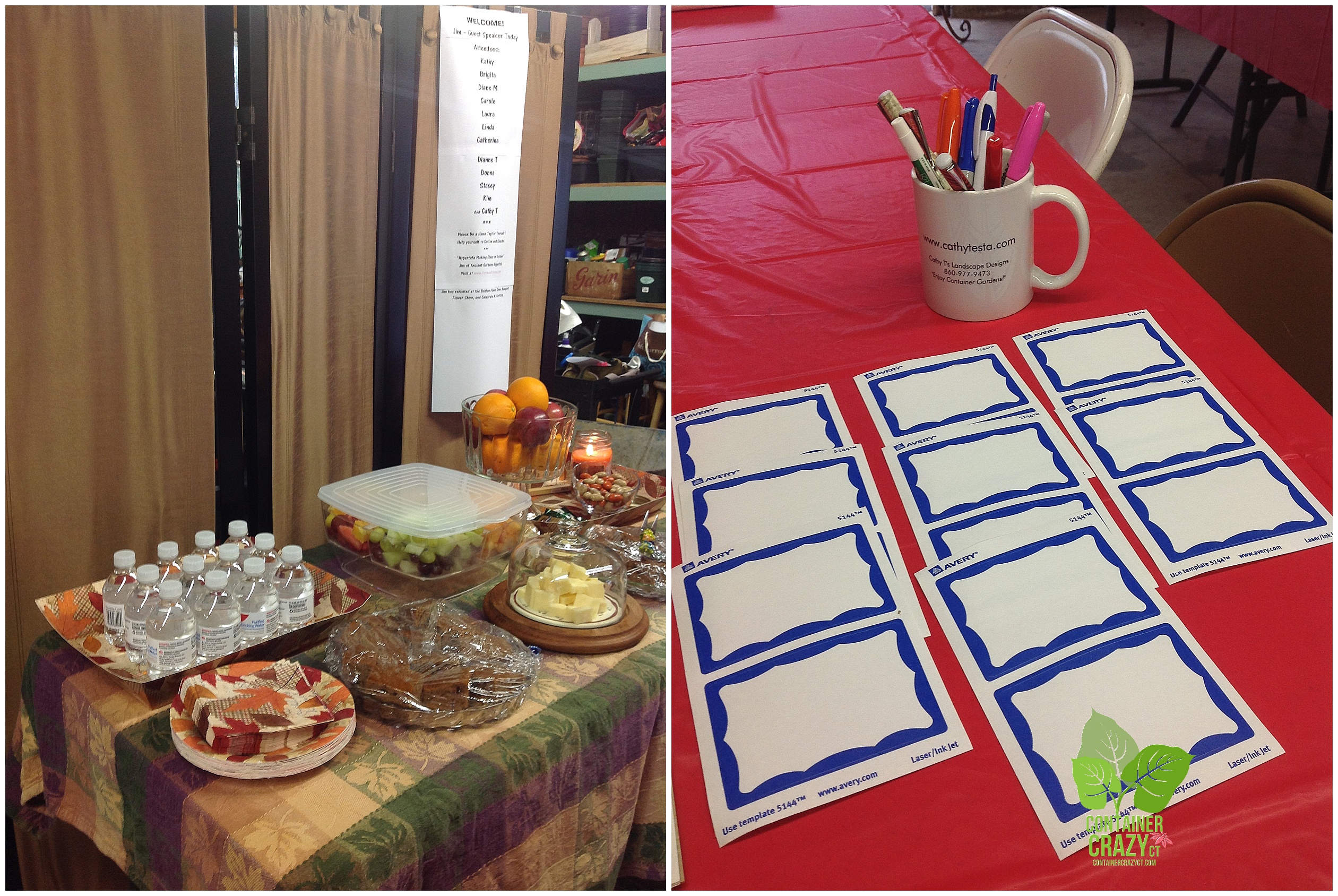
And if the fall clothing didn’t work, a cozy outdoor fire pit and hot coffee spiced up with pumpkin flavoring and whipped cream was offered to the attendees to warm up their fingers before they began their work of assembling their first hand-made hypertufa pots under the careful direction and guidance of Jim as our guest instructor.

As Jim explained in his class handouts for the attendees, “Tufa stone, a form of limestone, was used in olden times to form troughs on farms.  It is now so rare that “Hypertufa” was created to duplicate its look and function.

Jim has refined his hypertufa recipe and process to create the finest hypertufa available.  And this refinement is not an understatement as it was apparent to us all attending this class that Jim has a love for making these handcrafted pieces of art.

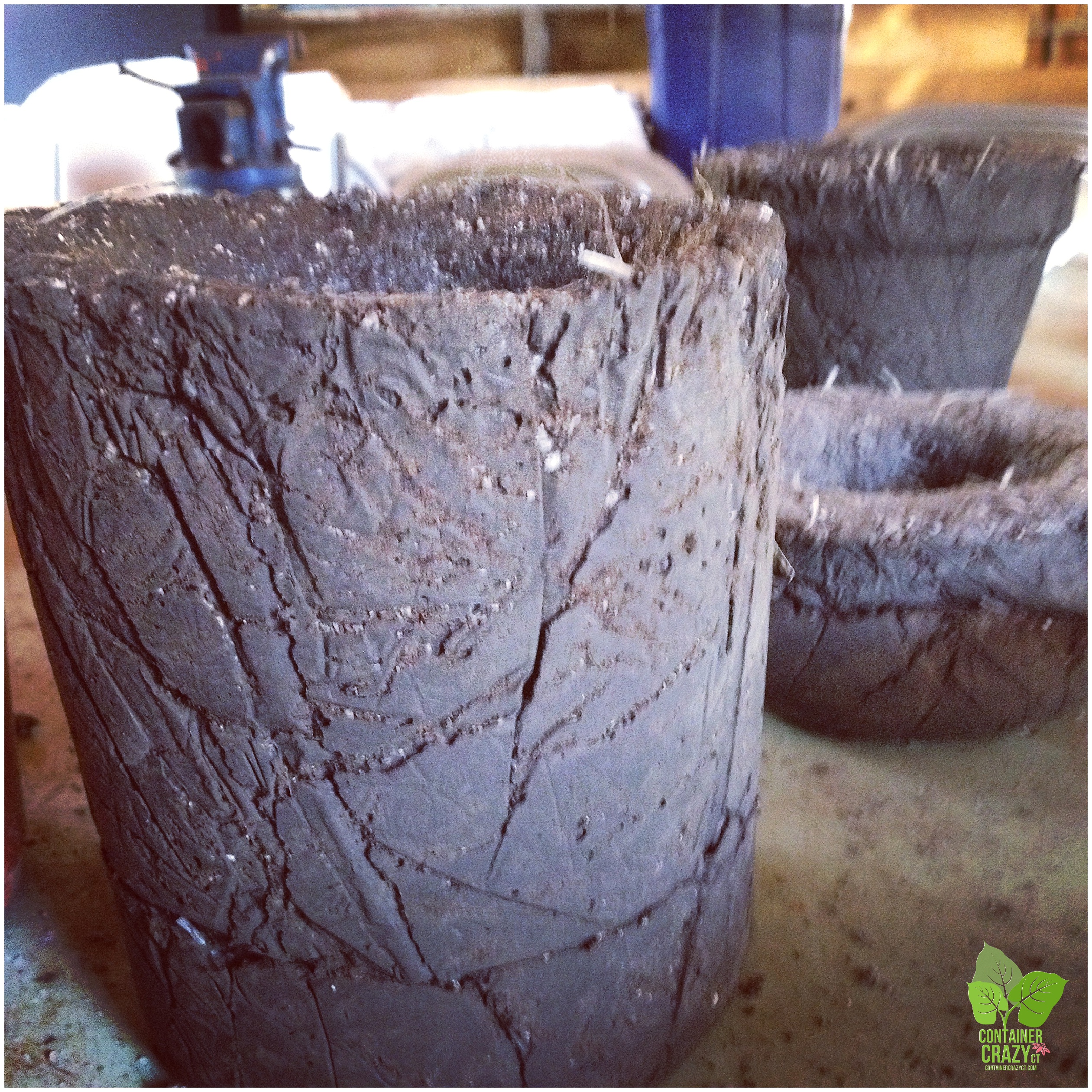
He makes beautiful birdbaths, planters, fairy houses, mushrooms, and sundials.  Even a gorgeous planter was showcased as part of the day’s activities.  Each is made with good lines and bones, so to speak.  The edges are clean and forms are nearly perfect, but each is unique.

Hypertufas are very lightweight, so they can be easily moved around as features in your gardens or as planters for a table top.  They are easy to care for as well.

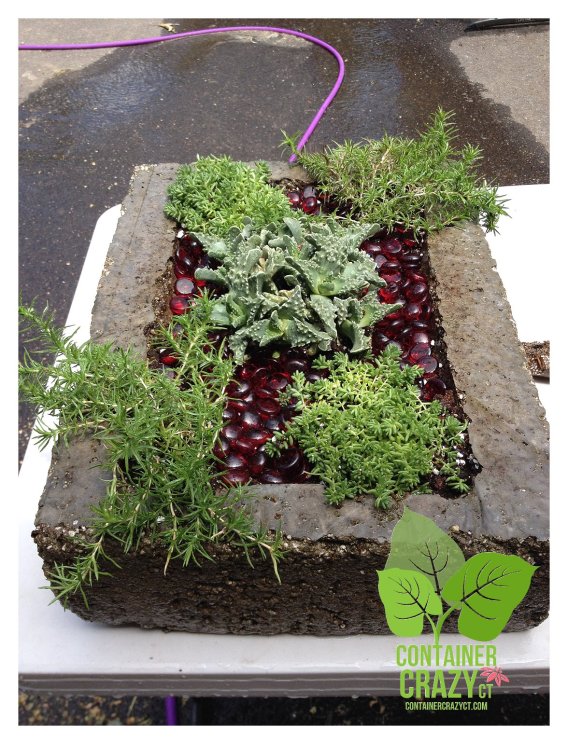
Any plant can go in them, from houseplants to succulents, and you may even elect to add a bit of mini garden art or delicate small stones to the top after planting them.

As Jim of Ancient Gardens Hypertufa stated, “Hypertufas need no other special attention and can last for many years.” But he strongly advises you should always move them under cover by bringing them inside during the winter, as standing water will freeze and crack the pieces.

Jim explained his passion of vegetable gardening from years ago, and how a special Aunt was an avid grower of roses.  She was so involved in the process of growing roses, she was eventually a judge at one time for the American Rose Society.

His love of making hypertufa pots and art is in his genes.  It was all passed on via the love of gardening by people like his Aunt. He remembers the first time he saw a hypertufa in friend’s garden and how he was drawn to it immediately and wanted to learn how to make them.  Once he learned the process, it was, well, all hypertufa history from there!

“Cement is an ingredient in hypertufas, but it is not technically accurate to call cement a hypertufa,” stated Jim during his lecture portion of the class.

He went over the other key ingredients to use in correct proportions by volume to achieve the correct mix and showed everyone exactly how to add water appropriately so you do not have too much or too little.

Mixing water into the hypertufa mix is an art form, similar to how one must master the art of watering plants in container gardens.  There’s a bit of science and art to the process, and our special guest instructor, Jim, was sure to show and tell this aspect very well to the attendees.

Hypertufas are porous, not as dense as cement,” explained Jim further during his lecture and demo.  “Cement is very fine (like talcum powder), and it is extremely important to get it well mixed thoroughly as it absorbs water, and it must be evenly distributed during the mixing process.

Jim adds other special ingredients to stabilize the mix and make it stronger, which he shared with the attendees of this class, and also provided lots of tips and the “secrets” of success.

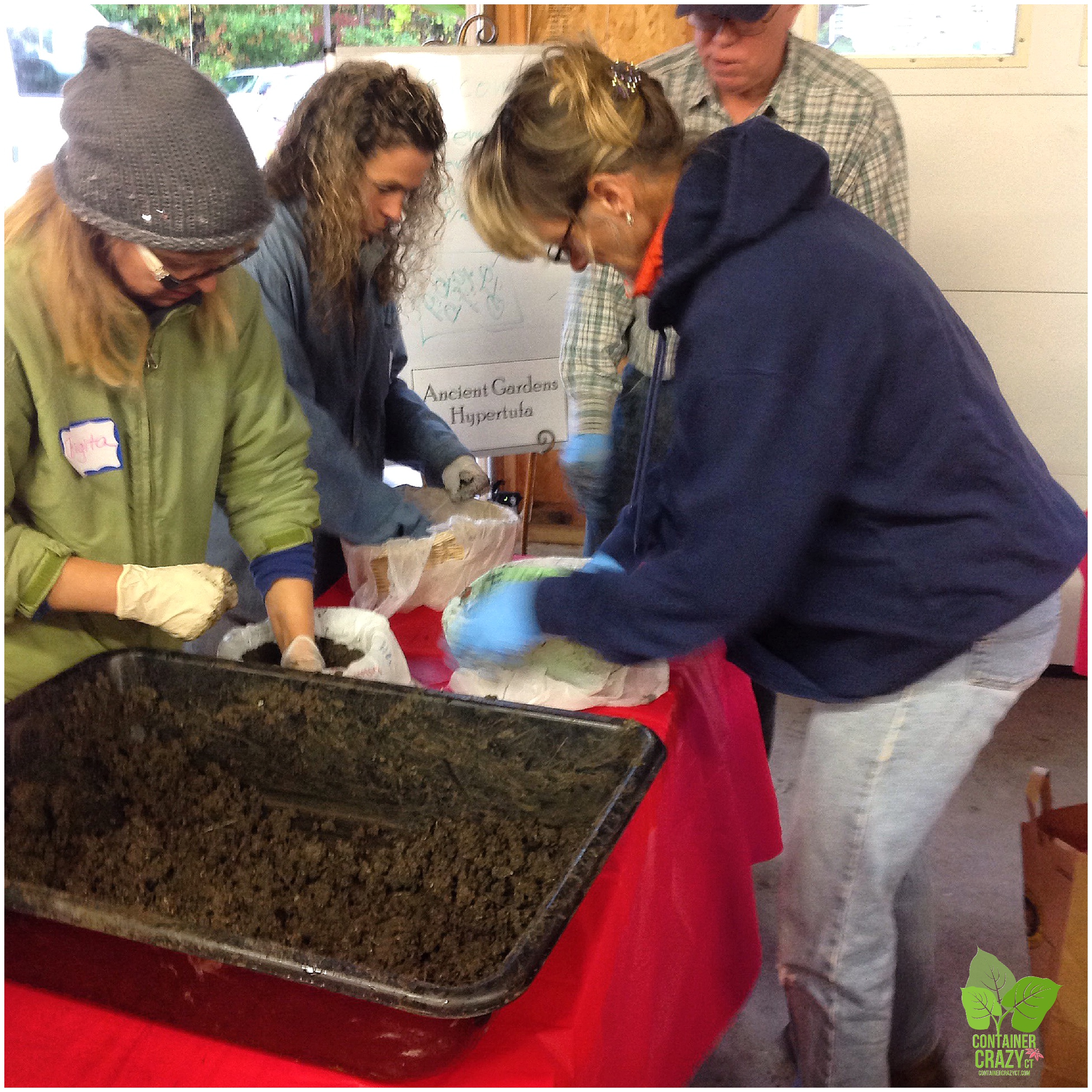
After Jim of Ancient Gardens Hypertufa went over all the specifics, tips and tricks, and details of the mix components, he showed us exactly how to mix up a batch, explaining his mixing process is similar to how masons do it for masonry work, using the appropriate mixing tools as well. He also showed the exact consistency and what to look out for as you prepare your batch.

As soon as things were mixed just perfectly, the attendees began assembling the mix into their molds.  This class was designed to teach the process, so the molds were on the smaller to medium size, just perfect to understand and learn the process from a master.

When making hypertufas, it is important to remember the mixing process is critical as well as the correct ratio of the components used in the mix, and then the last step, the curing process is critical.

After made, they are not ready to be used for a few weeks.  A few days of setting is involved, then removal from the molds, and followed by another period of curing and drying.

Depending on where this takes place, such as in a garage or inside a workshop in the home, the temperature and air environment will affect the amount of time required.

Also, the materials used to make the hypertufa can have an affect on the pH of the soil put into the pot, so Jim provided a tip on what to do if this is a concern for the type of plants used in the hypertufa container.

Jim of Ancient Gardens Hypertufa was very generous by offering us all his insider tips which he has learned and mastered over the years, and giving wonderful fall discounts on some of his pre-made hypertufa pieces of art.

And last but not least, he made us laugh too – what more could you ask for in a presenter?! We truly appreciate his expertise and hope to visit with him again soon at his upcoming art shows.

Here are some photos taken during the class.

To find out more about Jim and his products and exhibits, visit www.formedforyou.com. Also, his products will be available at online stores via Amazon.com soon.

ContainerCrazyCT Hypertufa Making Class_0004

ContainerCrazyCT Hypertufa Making Class_0001ContainerCrazyCT Hypertufa Making Class_0002-001ContainerCrazyCT Hypertufa Making Class_0003ContainerCrazyCT Hypertufa Making Class_0013ContainerCrazyCT Hypertufa Making Class_0015ContainerCrazyCT Hypertufa Making Class_0016-001ContainerCrazyCT Hypertufa Making Class_0017-001ContainerCrazyCT Hypertufa Making Class_0018ContainerCrazyCT Hypertufa Making Class_0014-001ContainerCrazyCT Hypertufa Making Class_0011ContainerCrazyCT Hypertufa Making Class_0010ContainerCrazyCT Hypertufa Making Class_0009ContainerCrazyCT Hypertufa Making Class_0006ContainerCrazyCT Hypertufa Making Class_0005

Cathy Testa
http://www.cathytesta.com
http://www.ContainerCrazyCT.com
860-977-9473 (cell)
containercathy@gmail.com (email)

Upcoming Workshop:

5th AnnualHoliday Kissing Ball and Evergreens Creation Class” is scheduled.

Date:  December 6, 2014 (first Saturday in December)
Start time:  11:00 am 

To Request Your Seat:  

Fill out the Contact Form by clicking on the top menu bar of this blog, or here:
Cathy T Classes-2014 Kissing Ball and Holiday Creations Class.

Pondering Ponds ‘Walk and Talk’ Reveals Many Unexpected Surprises

9 Comments

Hi Everyone,

First, thank you to our hostess and guests!

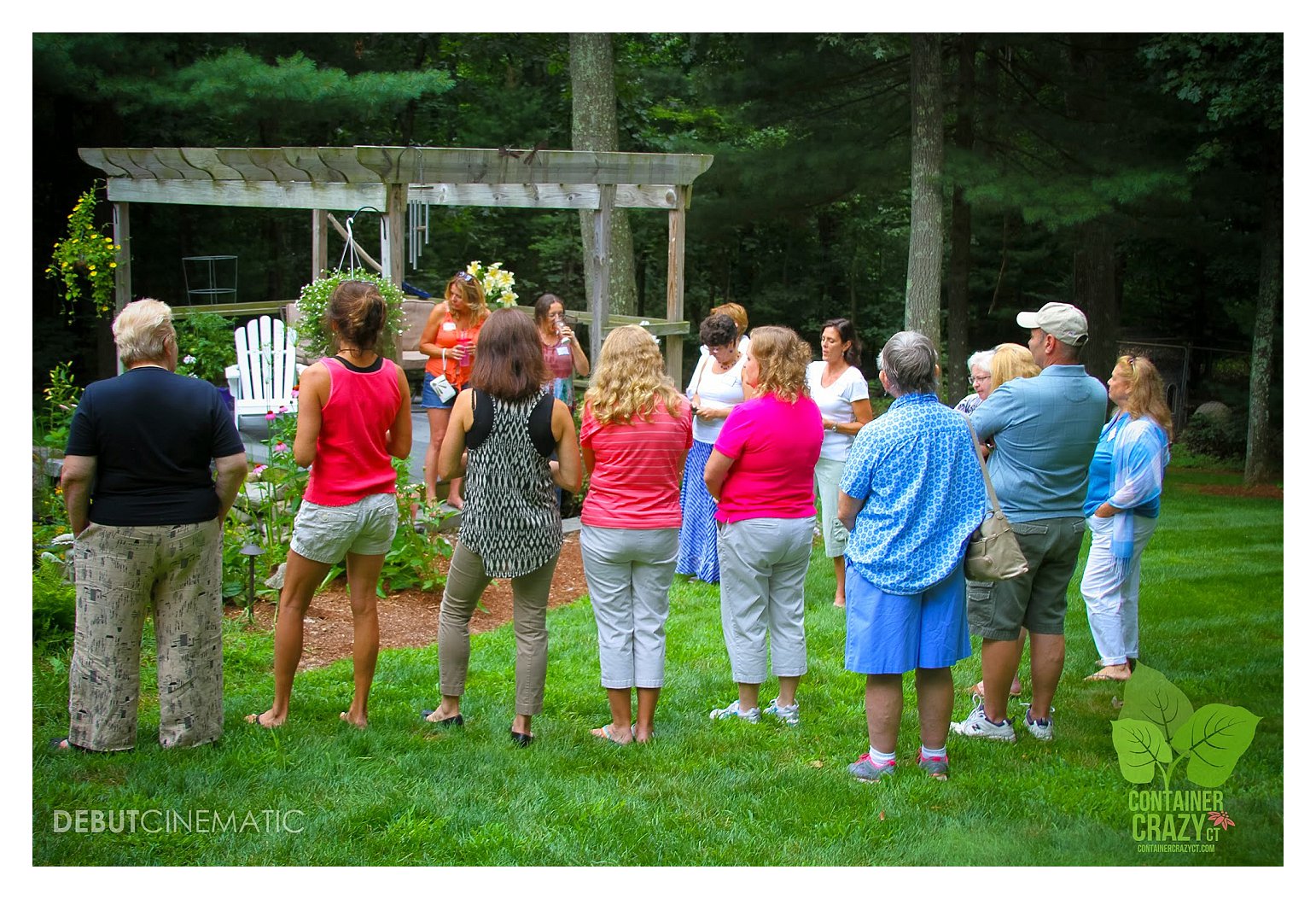
First, a great BIG thank you to our host, Rhonda Rafferty, for sharing her personal experience of starting her pond garden with one level, and then growing it by adding two more levels, as explained during our most recent “Walk and Talk” garden event, held last weekend.

Rhonda’s pond gardens are situated in her backyard, and they are visible from her deck patio area adjacent to her house.  At the base of her pond gardens is a beautiful sitting area flanked with a pergola.

Cathy T and Rhonda's reaction to a funny intro story!

Cathy T and Rhonda’s reaction to a funny intro story!

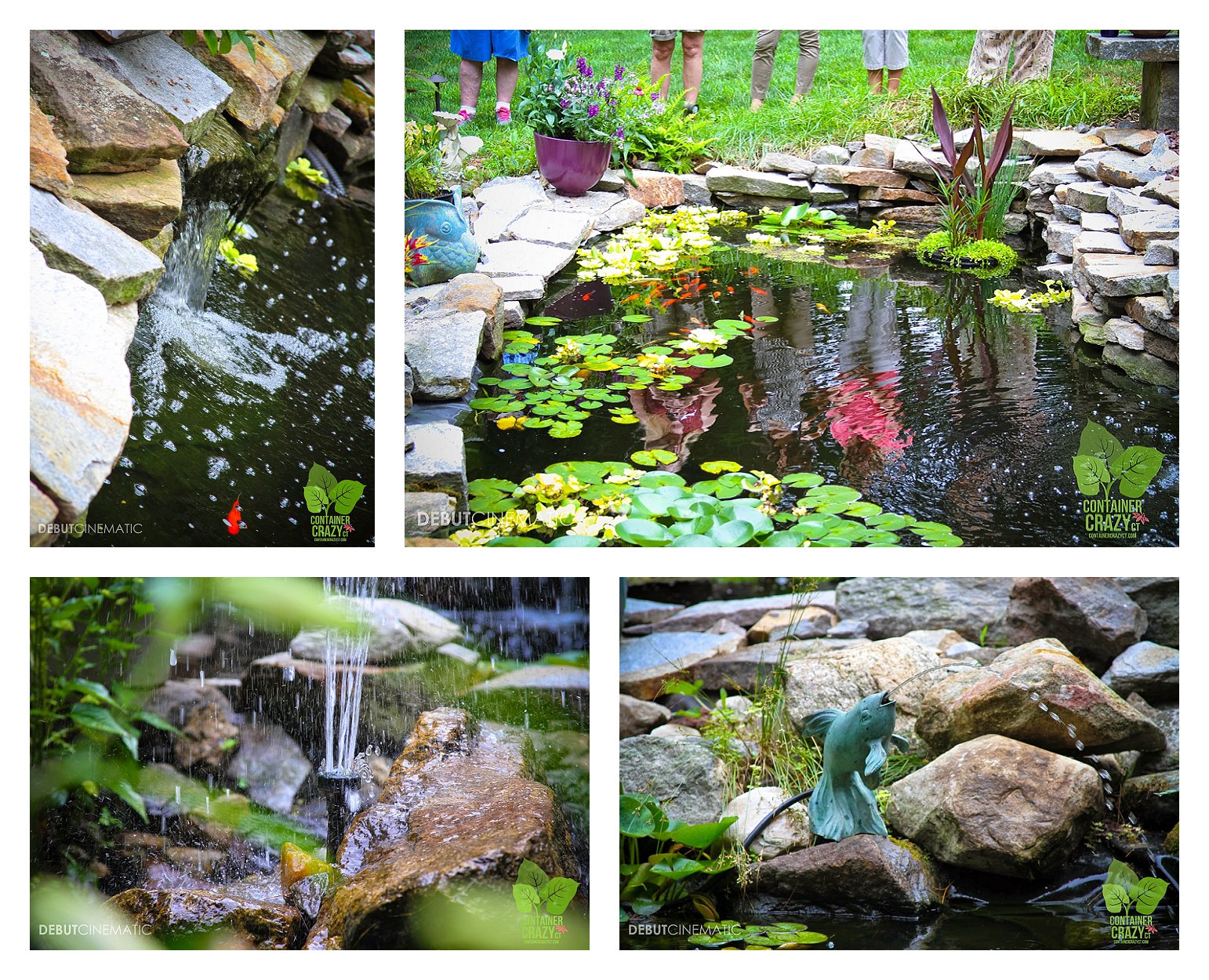
The sounds of the water trickling from decor spitting fishes and fountains in the ponds are enough to draw you from inside her home to the great outdoors in her backyard.

We had 15 attendees which made this tour a great success. Many of the attendees were from local areas, some folks from a new South Windsor church gardening group, and several attendees from Cathy T’s Classes.

Pondering Ponds Photos by Debut Cinematic_0012

Started with a kit, and built two more sections

Rhonda explained how she started her adventure with pond gardening by using a pond kit to build level one, or the very first tier of the current 3-tiered pond garden area in her yard. As soon as it was ready, her husband bought ten goldfish and put them in it, and of the ten, seven goldfish survived. All of the other goldfish in her ponds today, hundreds of them, are the offspring of the initial seven goldfish.

When Rhonda had shared pictures prior to the tour of her pond gardens, I had assumed the fish were Koi fish. They are rather large and very active in all three levels of her pond gardens, rising to the surface quickly and swimming around rapidly as you approach the water’s edge.

Pondering Ponds Photos by Debut Cinematic_0007

Rhonda explained the first level of the pond garden is rather shallow but the middle level is approximately 5 feet deep and 20 feet long.  Each pond section is structured a little differently, and they are not connected but adjacent to each other in a three-tiered pattern.

Attendees Listening to Talk by Rhonda

Attendees Listening to Talk by Rhonda

Spring and Winter Cleanup Routines

For maintenance, Rhonda drains the ponds completely in the spring.

The goldfish (which stay dormant in the winter months in the bottom of the ponds) are relocated to a 100 gallon horse troth until she’s done performing spring clean-up activities.

Easter is when Rhonda usually opens the ponds if the weather is warm enough.  She can tell when the lilies start growing that it is time to get moving and working on her ponds.

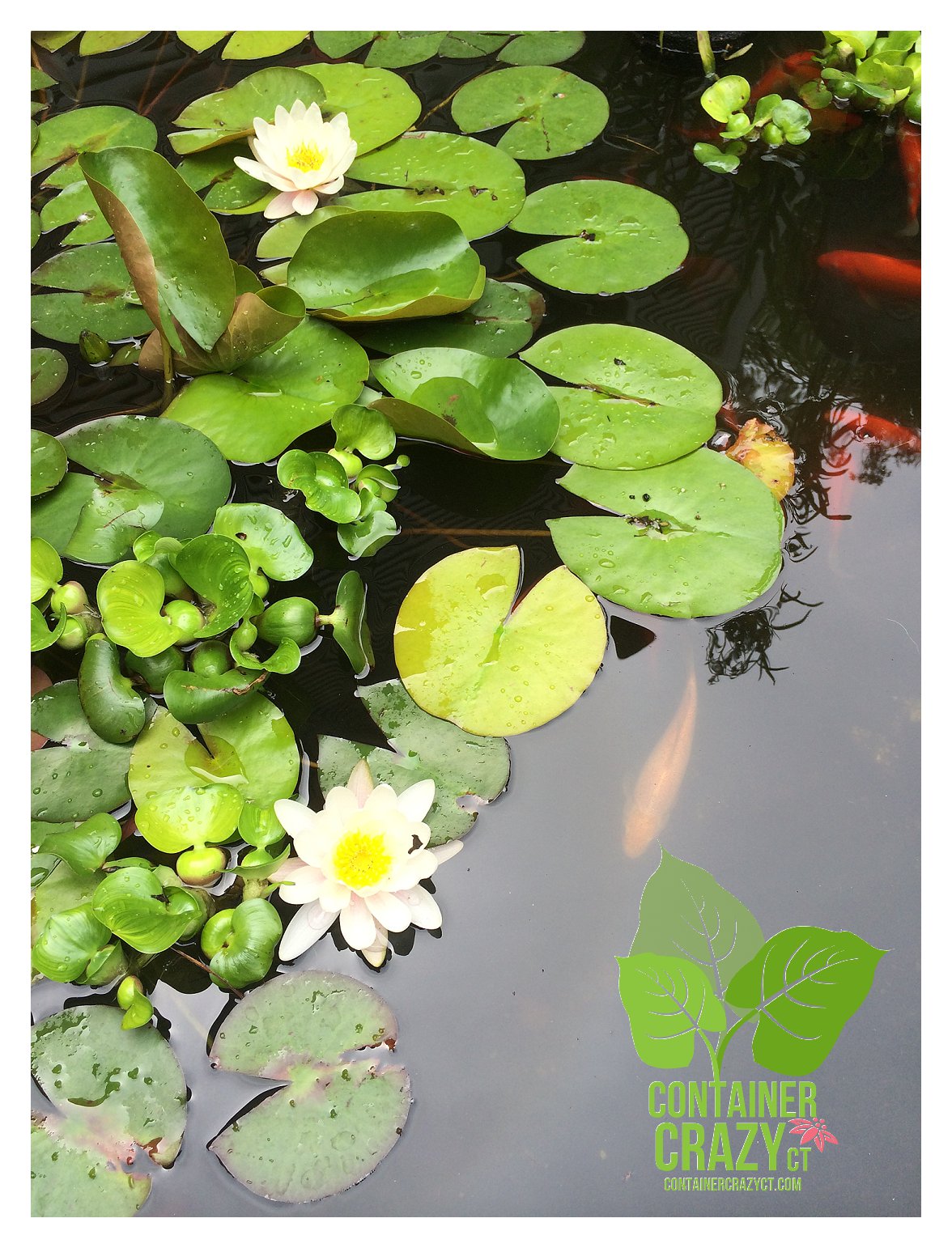
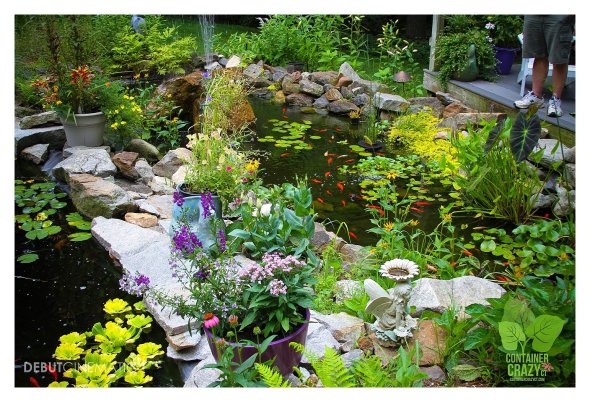
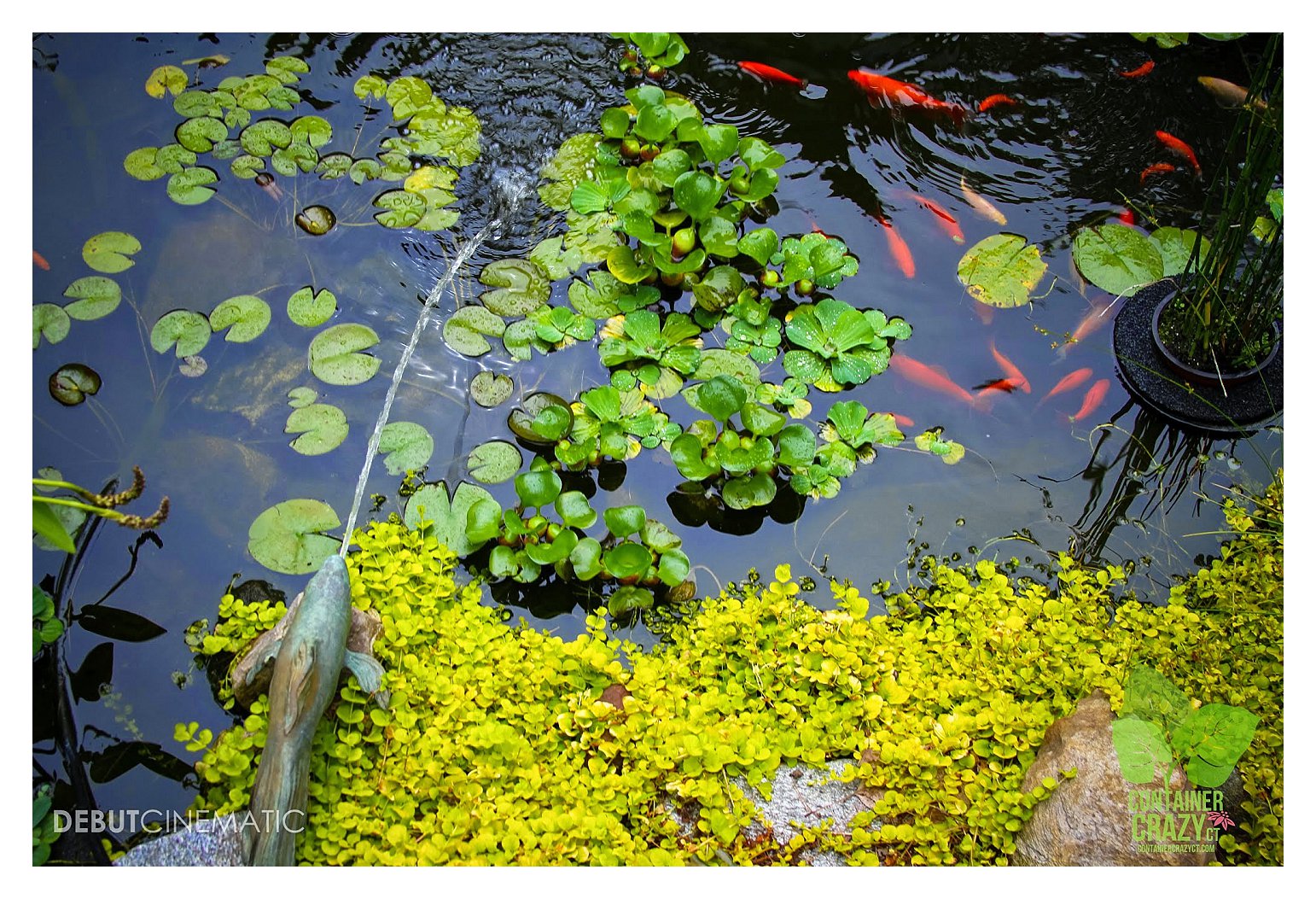
Water lettuce, Lilies, and Lysimachia near goldfish

Water lettuce, Lilies, and Lysimachia near goldfish

All the muck, which built up and decayed in the bottom of the ponds over the winter, is removed with a special muck vacuum she purchased because her ponds are so large.

Also, Rhonda noted using ‘Microbe-Lift‘ in the water filter to add good bacteria to the water.  This will keep her pond healthy throughout the season.
Pondering Ponds ContainerCrazyCT_0001

At one time, Rhonda used a power washer to clean the liner, but she no longer uses a power washer because she wants to keep the algae growing on the liner, and the power washer was removing it – so she uses a garden hose instead.

The algae helps the natural ecosystem get established after a complete water change, and provides food for the fish because you can’t feed them until the temperature of the water reaches a consistent 55 degrees.

There is a special ‘Spring & Fall’ food for cooler temps of approximately 55 – 75 degrees.

However, once the temperatures reach 75 degrees, Rhonda changes to feeding the fish a summer staple food.  Rhonda also noted she uses special UV filters to control bacteria so that the water stays clear during really hot temperatures in season.

During the fall season, the food is changed again when it gets cooler outside, and she stops feeding at 55 degrees.  She also turns off the filters when she stops feeding for the fall and winter months.

Standing at Level One, Rhonda talks about products used to keep water healthy

Standing at Level One, Rhonda talks about products used to keep water healthy; Photo by C. Testa

In the winter, she leaves all the water in the ponds, but will remove the filters and clean them for storage.  She basically washes them down with water because she avoids getting any chemicals in the filters.  She also cuts back all the hardy water lilies and plants, and sinks them to the bottom of the pond in her deepest tier.  A small low watt pond deicer, which floats on top of the water for the winter, is used.  This will create a small patch of open water in the ice to allow gases to escape in the winter.

Water Plants, Floating Plants, Perennials and Tropicals

Rhonda has a mix of plants in and around her pond gardens, and she noted, many have appeared on their own. Some self-sowed or got there perhaps by bird droppings of digested seeds, and even a few ferns arrived to her garden naturally. It is as if the plants know this is the right spot for them.

Elephant Ear (Colocasia)

Elephant Ear (Colocasia)

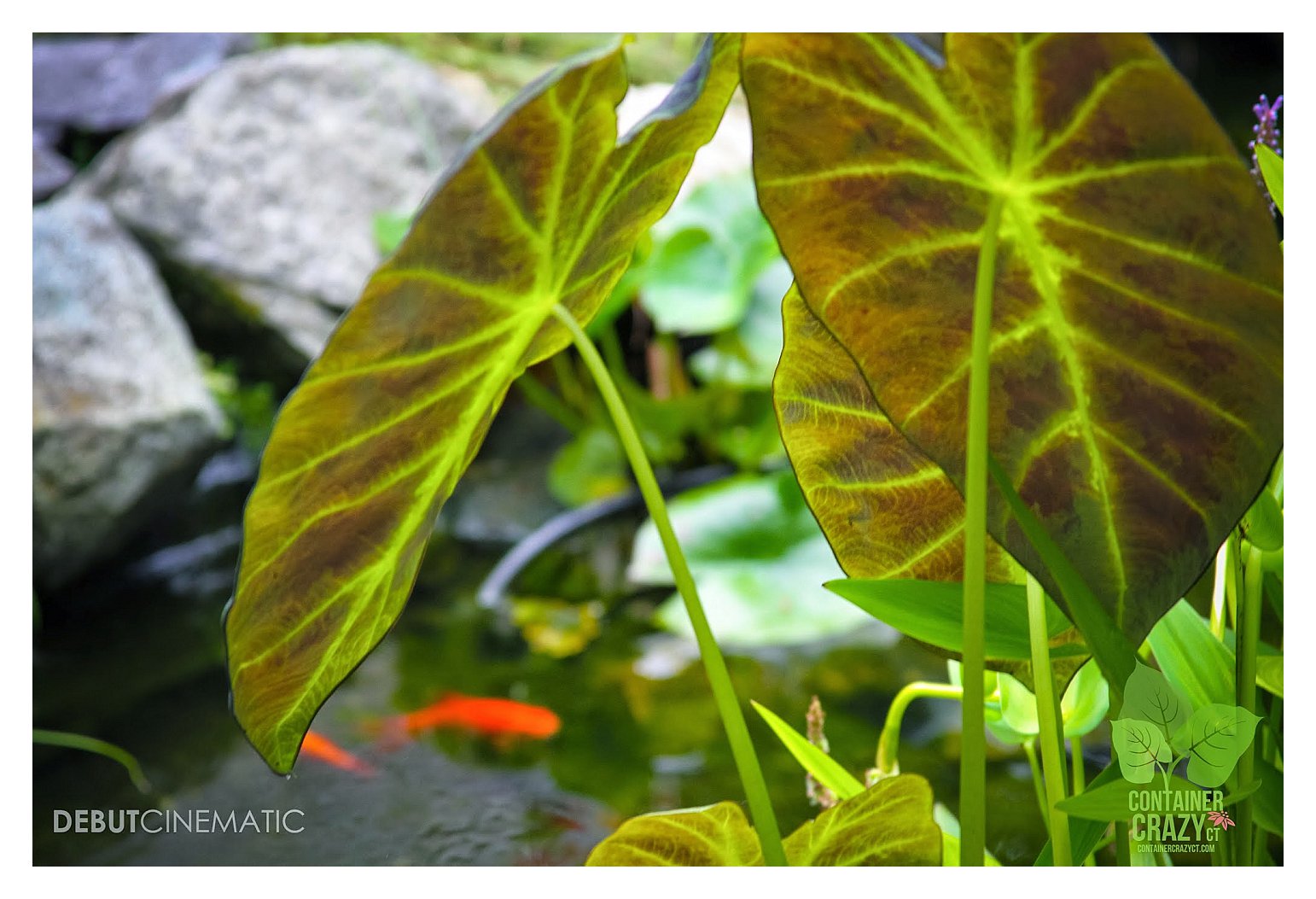
In the water of her pond gardens, she has water lettuce, elephant ears (one showing off a bloom on it during our tour) – Colocasia esculenta ‘Illustrious’, canna plants, hardy water lilies, papyrus (herbaceous perennial), and mosaic plants (Ludwigia sedioides, an aquatic perennial grown as an annual).

Some of the plants she overwinters by placing them in a fish tank in her home, and others are stored by division of rhizomes or corms, such as done with the canna and elephant ears, or by saving off-sets.  And some are allowed to sink to the bottom to decay or regrow the following season if hardy (as she noted above in maintenance comments.)

Rhonda mentioned Garden’s Dream in Enfield, CT as one place she purchases plants from because they started carrying water type and aquatic plants.

Other plants and bees

There is no doubt the bees are enjoying the plants, for not only could we hear water trickling, see fish moving, there were also many bees visiting the blooms of her coneflowers and other plants surrounding her pond gardens.
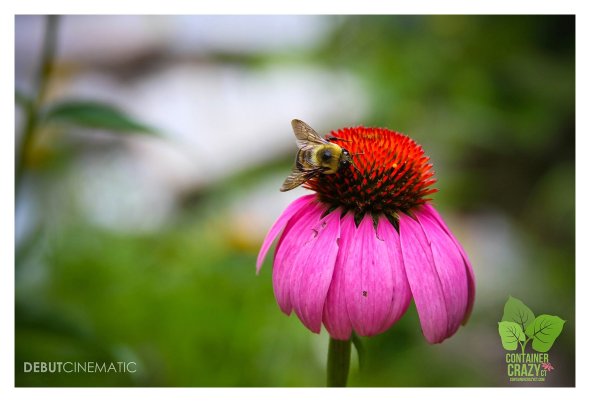
Pondering Ponds Photos by Debut Cinematic_0002

Perennials, such as Echinacea purpurea (purple coneflower), and various ornamental grasses are planted in the ground near the ponds, and one plant many attendees noticed planted in a pot sitting on a rock in the center of the pond was Amaranthus tricolor, an edible annual with bright red and yellow foliage, which grows rather tall and is showy.

Plant with red and yellow foliage in pot seen in background -Amaranthus tricolor

Plant with red and yellow foliage in pot seen in background -Amaranthus tricolor

When everyone asked me what it was, I drew a blank on the plant name, but Rhonda said she got her first plant of this variety from me a couple years ago and loved it – fortunately, she remembered the name of it.  Rhonda said she’ll never forget seeing this annual at my home in a container garden because she uses Amaranth flour as one of her gluten-free ingredients in her recipes at home.

Papyrus tops

Papyrus

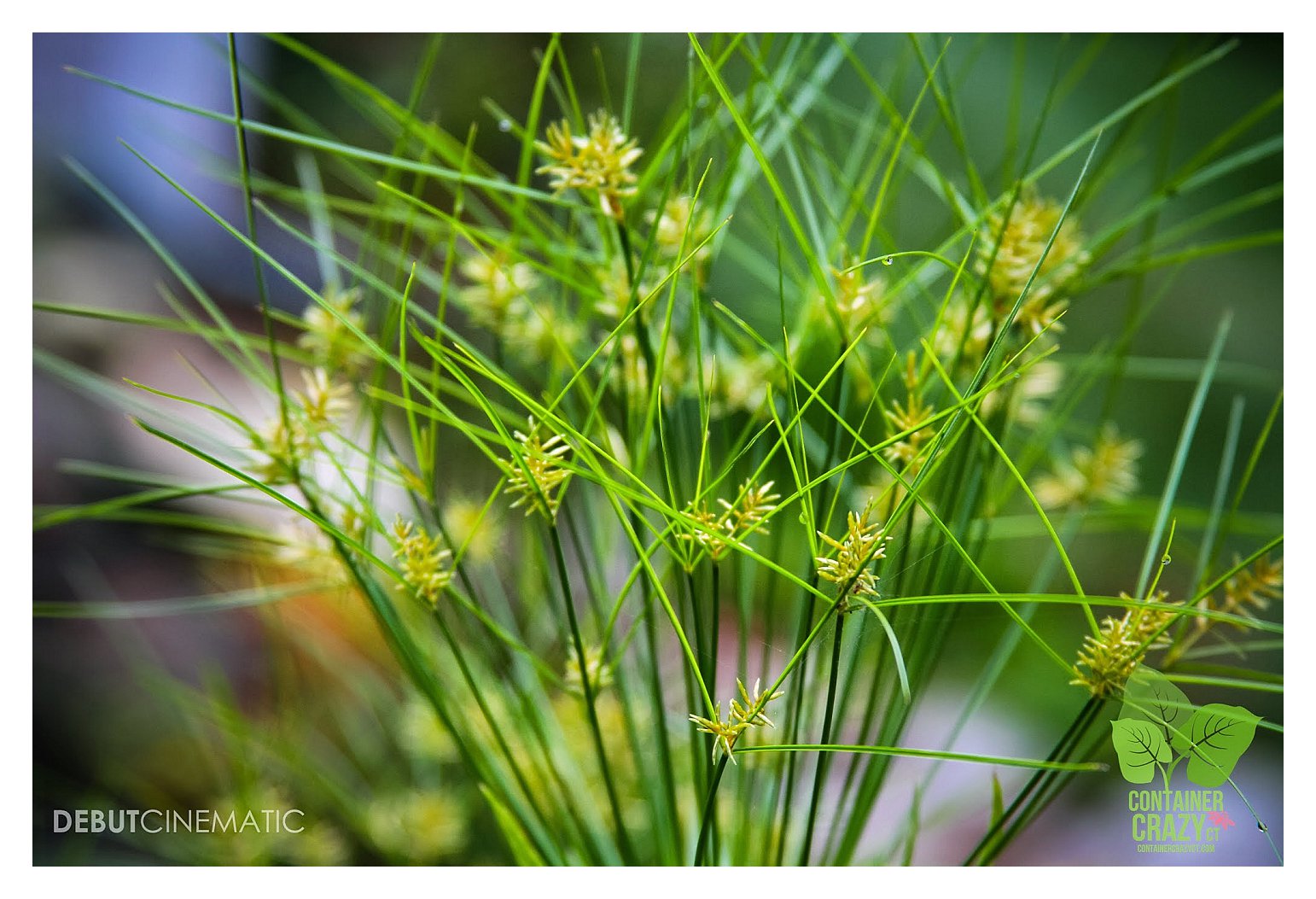
Other plants in the pond gardens, as noted above, were the elephant ears (can sit in water), papyrus (not technically a water plant but also can sit in boggy like water or on water’s edges in pots), and the aquatic water lettuce, hardy water lily, and more.  One we all found fascinating, and is relatively new in Rhonda’s pond gardens, is the mosaic plant (Ludwigia sedioides).  It is an herbaceous perennial (winter hardy to Zone 10) which floats and rests somewhat flat on the surface of the water and has a pretty mosaic like pattern to it.
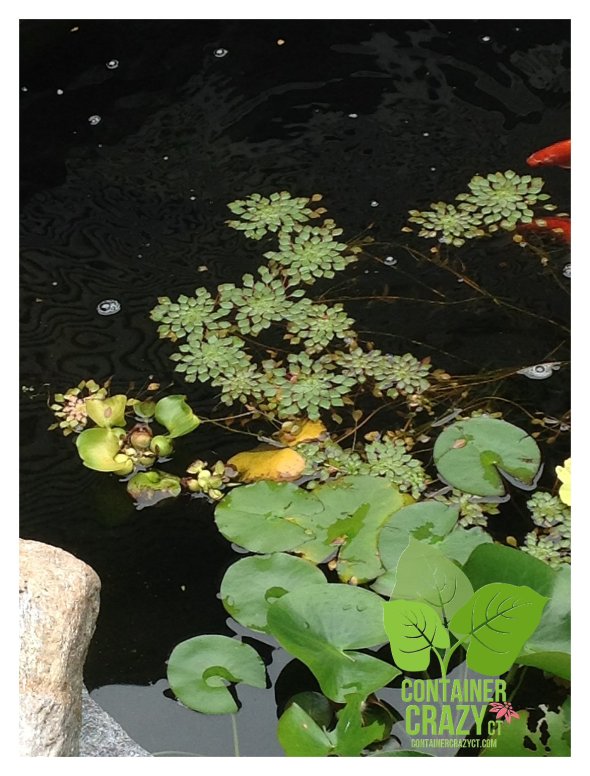
Mosiac Plants - Photo by C. Testa

Mosiac Plants – Photo by C. Testa

Root Mass Demonstrated 

Another surprise is when Rhonda reached into the water to pull up a huge mass of hardy water lily plants bound together by one root system, explaining how quickly plants grow in her water gardens.

Root Mass of Hardy Water Lilies

Root Mass of Hardy Water Lilies

She also noted another plant found by her husband in the wild, upon with, I gave a little caution to the attendees to be very careful with water plants or any plants you may find out in the wild if you do not know what it is.  There are invasive species in the wild or in natural ponds, which you should never relocate to your pond or home gardens by mistake, especially if it can run off to another water system nearby your home.  So just a note – know what you are planting, and if you decided to get rid of a rampant plant growing your gardens because it became out of control, and don’t know what it is, toss it in the garbage and not in the woods where it could potentially spread.  This is something I learned more about as a kayak-er, where you must be careful to not accidentally bring home an invasive aquatic plant after visiting a lake with your kayak or boat, as discussed in a previous blog here.

Floating Containers – Another Big Surprise of the day 

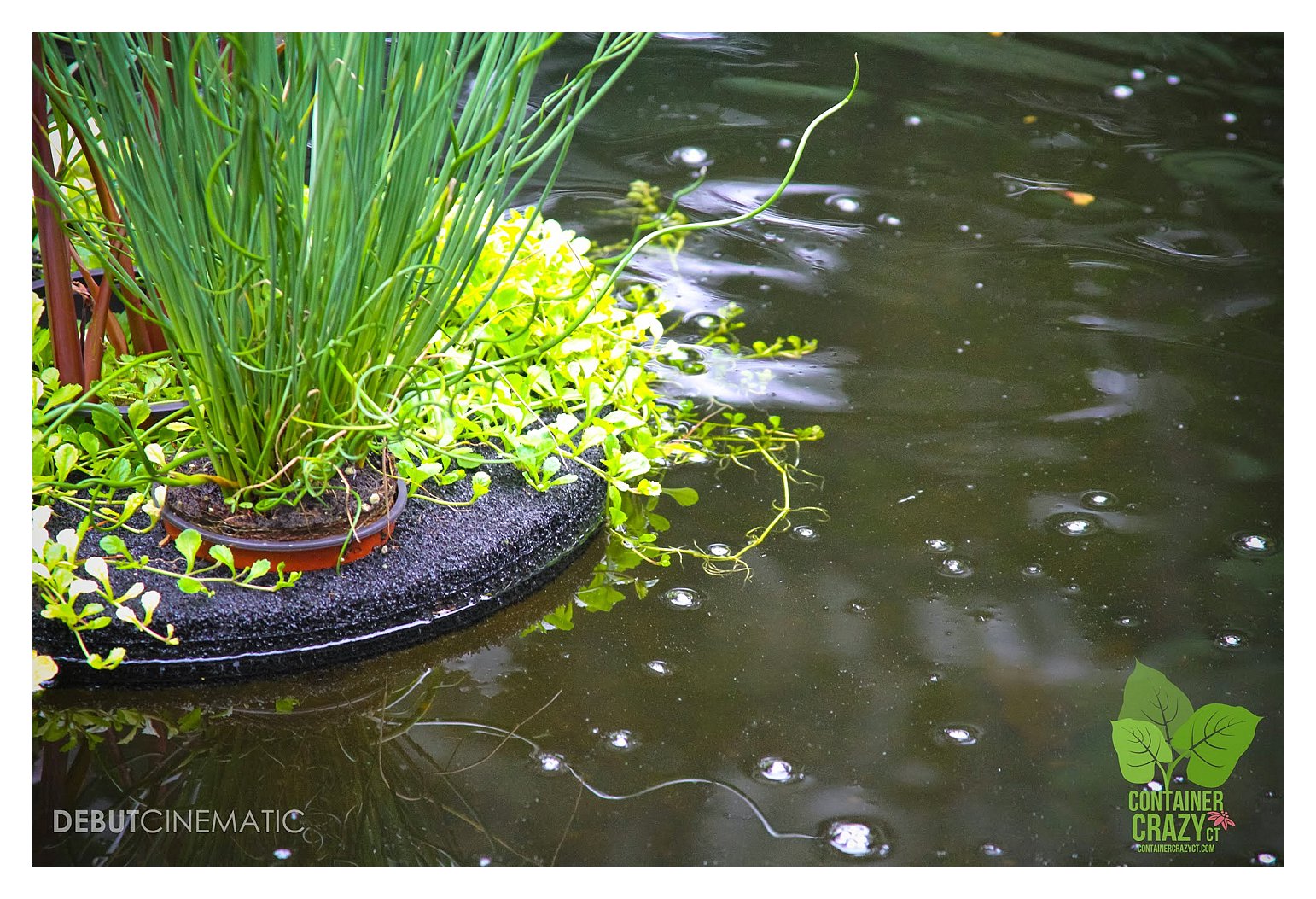
I’ve written about all types of containers to use in and around the gardens, but have never considered the type Rhonda had in her pond garden.  There was one container floating around in the pond garden, moving here and there gently in the water, and without hesitation, Rhonda lifted her floating container out of the water to show our attendees.  It is made of a black Styrofoam base with individual open sections where pots may be inserted easily.
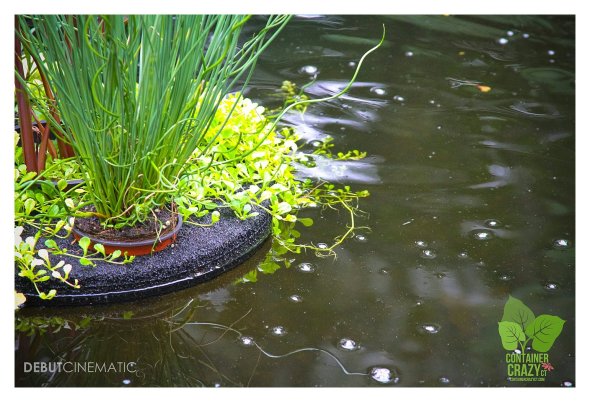
Pondering Ponds Photos by Debut Cinematic_0006 Pondering Ponds Photos by Debut Cinematic_0007 Pondering Ponds Photos by Debut Cinematic_0008

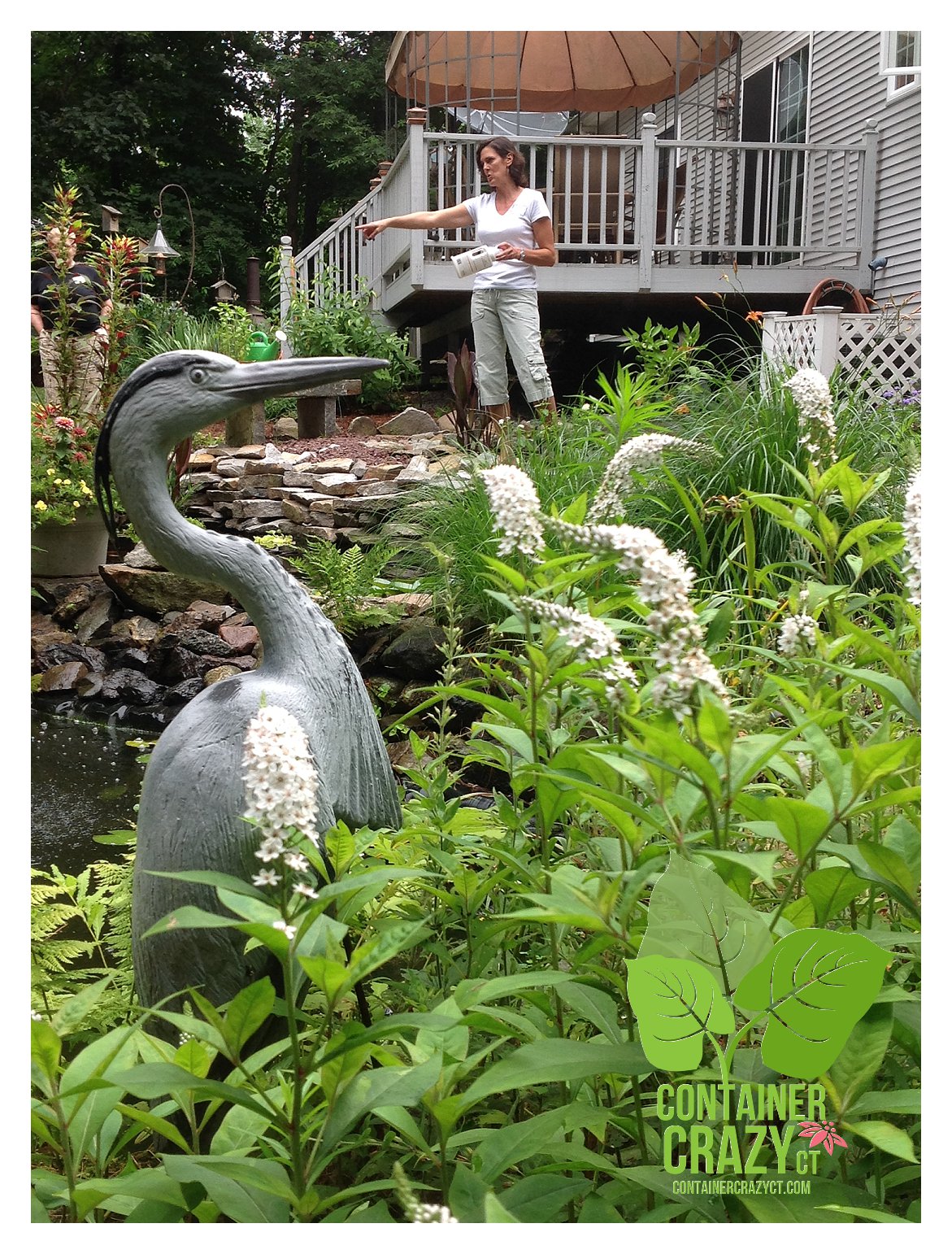
Garden Art is wonderfully displayed around her pond garden — this little pig in the corner, spitting fish here and there, and other surprises as you look and observe.
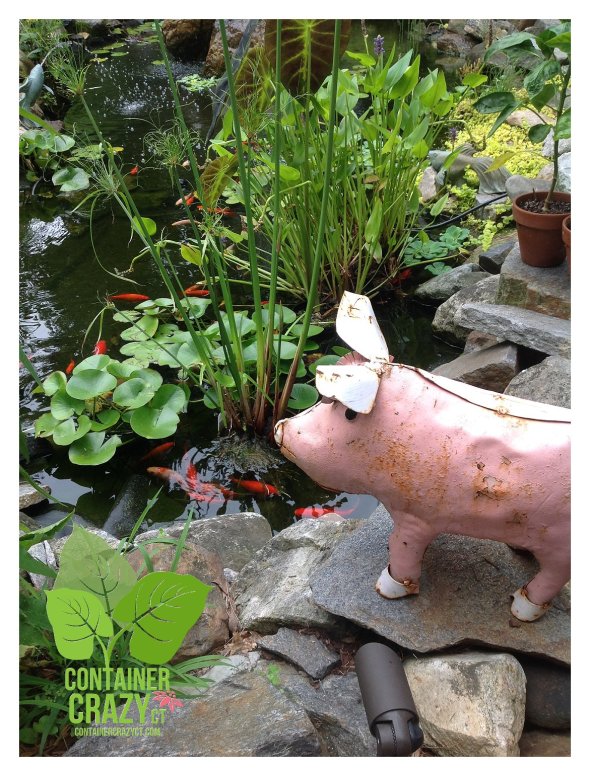
Pig by Pond; Photo by C. Testa

It is an adventure to spot them.  We all could imagine the days or evenings when she and her family has sat there to enjoy all the hard work put into the pond gardens at her home.

Pondering Ponds Photos by Debut Cinematic_0005

Sources for Pond Supplies

AZPonds.com is an online source Rhonda uses to order supplies. She gets her liner, filters, pumps, and water treatments from them. Shipping is pretty fast.  Orders arrive within 5 business days.

Rhonda started her first pond garden 12 years ago, and continues to learn and expand it.

We all could appreciate the amount of effort but how her efforts also equals the relaxing moments by the pond gardens enjoying nature, goldfish, and sounds.

Pond Gardening is Not for Weenies

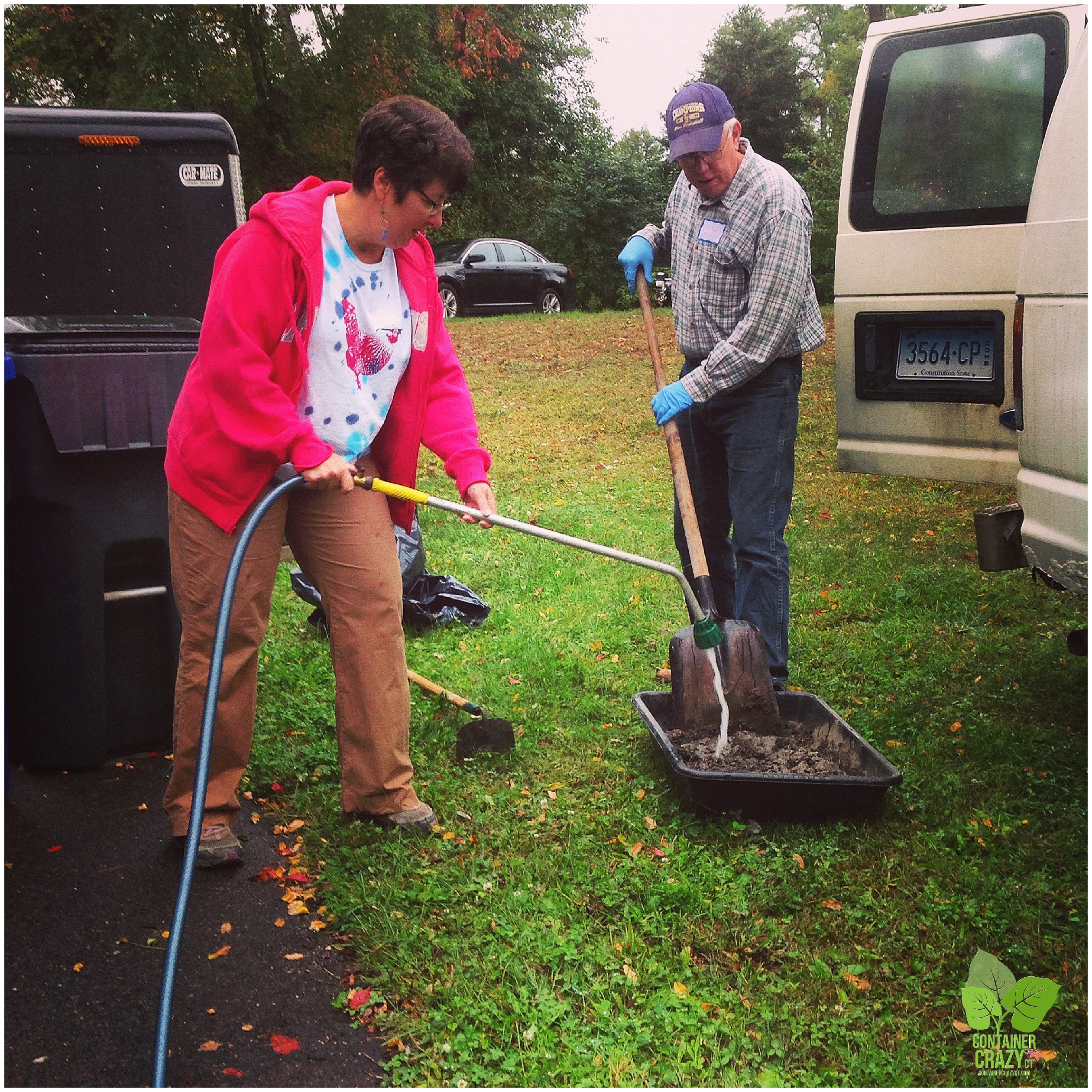
Water or pond gardening is not for weenies – it takes some effort to get it cleaned and prepared every season, but the payoff is grand. And if you were wondering, one of the reasons we were laughing in the above photo is because I shared a story of how Rhonda and I met during our corporate days – when we decided to take a motorcycle riding course together, and how we would ride into work side by side on our Harley Davidson motorcycles.  Rhonda still rides today, I, however, gave it up so you can see – she’s no weenie!  Makes sense to me that she manages to maintain such a diversity of plant life, fish, and more in her pond gardens.

Hostess Rhonda; Photo by C. Testa

Hostess Rhonda; Photo by C. Testa

Pondering Ponds ContainerCrazyCT_0013

Also, as for pH of the water, Rhonda noted she doesn’t monitor it – she lets nature take its course.  That sounded good to us – and fits the overall rule of the ‘Walk and Talk’ Garden events – it doesn’t have to be perfect for us to enjoy hearing and seeing what any homeowner has created in their backyards.

Pesto and Passion Flowers

The last big surprise of the hour was the handing out of freshly made pesto by one of our attendees — Thank you Linda C.

Pondering Ponds ContainerCrazyCT_0015

What a treat, and additionally, we all saw, on the way out for the day, Rhonda’s beautiful blooms on her passion flower (Passiflora) vine located at the front of her home. She said it returns every year via self-sowing (or perhaps she has one that is noted to be survive winters, Passiflora incarnata.)  It certainly looks like it!

Passion Flower; Photo by C. Testa

Passion Flower; Photo by C. Testa

She has seen fruit growing after the flowers pass, but wasn’t aware it is passion fruit until we discussed this fascinating flower further.

See here to also learn about this plant’s religious significance, which I looked up via my iPad and pointed out to everyone – each part of the flower has a special meaning – and is believed to represent symbols of Christ’s passion and cross.

Next Walk and Talk 

Our next ‘Walk and Talk’ event is scheduled on August 16th in East Granby, CT at 10:00 am.  This one will feature a sunny hillside garden where the homeowner will share her experiences on what thrived and what didn’t when it comes to the plants she has tried in a very informal, loose and spreading garden on a full sun hill which receives lots of heat in the midst of summer, and wind.  As per our rules, the garden is not perfect but a great place to learn directly from a home gardener with a particular passion.

For more information on planting aquatic plants, check out this post by thegardengeeks.com.

Thank you,

Cathy Testa
http://www.cathytesta.com
860-977-9473
ContainerCrazyCT.com

P.S. If interested in showcasing your home garden on our Walk and Talk tours, please feel free to contact Cathy Testa, author of this blog, and coordinator of these events.

Special note of thanks to Professional Lifestyle Photographer, Karen Ladany of Debut Cinematic, for attending to take various photos of the gardens.  She is currently located in East Windsor, CT.

Hypertufa Class Being Offered in October in Broad Brook, CT

2 Comments

Could this season get any better?

Cathy T has just lined up a special guest speaker to teach a Hypertufa making class in October.

See Cathy T’s Class Schedule to learn more.  Click on the drop-down menu selection titled, October (Concrete Art).

The date:  October 4th, 2014 – Saturday

The time:  11:00 am to 1 or 2 pm, depending on how much fun you are having

The teacher:  An expert hypertufa making artist by the name of Jim of Ancient Gardens Hypertufa.  He has exhibited at the Boston Flower Show, Newport Flower Show, and Celebrate West Hartford.  To see his works, visit http://www.formedforyou.com.

In this class – you will be making your own small to medium sized round or square hypertufa. More details will be posted very soon.

Not sure what a hypertufa is?  See Cathy T’s description on her Class Schedule above.

For inspiration, visit Cathy T’s Pinboard:

Sign up early – You don’t want to miss this chance, as our special guest artist rarely agrees to teaching classes, but guess what? – he did for Cathy T.  This is a special treat.

To Sign Up for the October Class:

To sign up – complete the Contact Form from the Cathy T Class Schedule above.

Or join the class via the Facebook Event.

This Weekend’s Pondering Ponds:

And don’t forget – this weekend is another opportunity – to see a homeowner’s pond garden in Enfield, CT.  We have a small group forming, a professional photographer joining us, and it is predicted to be another gorgeous weekend – the stars have aligned.

Pondering Ponds ContainerCrazyCT_0001

The Pondering Pond’s Walk and Talk is this Saturday, July 19th, 2014 at 10-11 am.

For the address to join us, contact Cathy T at containercathy@gmail.com or text 860-977-9473.

Thank you,

Cathy Testa
http://www.cathytesta.com
860-977-9473
ContainerCrazyCT.com
containercathy@gmail.com

Insects in Your Container Gardens – And What You Can Do…

2 Comments

Hello Everyone!

It is that time of year when we may be seeing little critters appear on some of our plants in our gardens or container gardens, and it ain’t pretty.  Fortunately, many of them do not last long due to their life cycles, stages of growth, and time of appearance, but regardless, it is best to battle them as soon as spotted on your plants.

I like to use the ‘pick and squish’ method first whenever possible, if bold enough, prior to reaching for any insecticides, or use of pesticides.  Sometimes just hand picking off or pruning, then disposing of them works.

In the photos below, you will see what I believe are eastern tent caterpillars on my honeysuckle vine (top left), aphids on the eggplant bloom (middle top photo), and mosquito larvae in the water image.  These were all spotted in late June, along with a first sighting of the infamous Japanese beetles, which emerge from the ground in early summer to feed on plants.

Yuck -- Insects on Plants

Yuck — Insects on Plants

Tent caterpillars on my trumpet honeysuckle – YUCK! That was a first – and my honeysuckle has been doing so well this year.  Obviously, I was not happy to find these buggers.  My honeysuckle plant is growing by the side of the house, and it surprised me to find tent caterpillars on it.  Fortunately, with a quick snip of the vine from which they were attached, they were easily bagged and tossed.

Honeysuckle bloom creeps into Delphinium

Honeysuckle bloom creeps into Delphinium’s blooms

TENT CATERPILLARS ON MY HONEYSUCKLE VINES

Using clean pruning shears, I cut of the portion of a vine with the nasty critters on it, put it in a plastic bag on the driveway and then stomped on the bag.  I left the bag laying on the driveway for a while.  Why? I figured the heat would fry any not crushed (oooh, gross – the things gardeners will do!).  Then, I went out for my day’s work at a client’s location.

That day, my parents dropped of some items at my door, and my mother saw the plastic bag sitting on the driveway so she included my bug bag as a hanging item on my door handle while I was not home.  I guess she figured I dropped something by mistake on the driveway.

Well, when I opened up that bag at the kitchen table – ACK.  Out to the garbage can it went – and quickly. You see, the other bags my parents often leave me are filled with fresh veggies from their home garden.  Imagine my surprise and reaction when I found bugs instead of radishes.

Prior to all this bug nonsense, I was enjoying the many orange trumpet shaped blooms growing from my honeysuckle so much all month.  At one point, a stem pushed its way through the center of a Delphinium stalk located near it – talk about stunning.

Do these two plants know they are complementary colors on the color wheel?

Opposite each other on the color wheel – are blue and orange – talk about a nice surprise nature combo in the garden! Although this Delphinium technically has more purples than blues in its blooms, the combination was breathtaking all the same – I have been enjoying it for a whole month.  I wrote about Delphiniums before on this blog, as it was a flower I selected in my wedding bouquet 24 years ago.  It probably was one of my first flower obsessions.  I find them a little difficult to keep growing in my garden, so this year, I just bought a new one and plopped it by the honeysuckle plant, and it has grown beautifully.

Honeysuckle Blooms

Honeysuckle Blooms

Honeysuckle (Lonicera) is a deciduous vine that grows quickly every year.  It is deer resistant and attracts butterflies. A trellis or arbor is needed to hold it up as it grows taller, sometimes reaching 15-20 feet.  I’ve had mine for several years in this spot with little problems – again, why I was surprised to see the tent caterpillars take a spot on it this year.

Although this vine grows quickly, I wouldn’t classify it as a invasive plant because it is easily removed if you find it over takes your space, but it can get large fast and needs to be watched.  It is included in my Troublemakers Turned Star Plants on my Pinterest page, because it can be very useful in a container garden if you find it a nuisance in the regular gardens of the ground.

It likes sun to part shade, and blooms for a long time.  The scent is intoxicating for many cultivars. This plant may be used as a thriller in a large container garden, so long as you add a nice big trellis in the container for support.

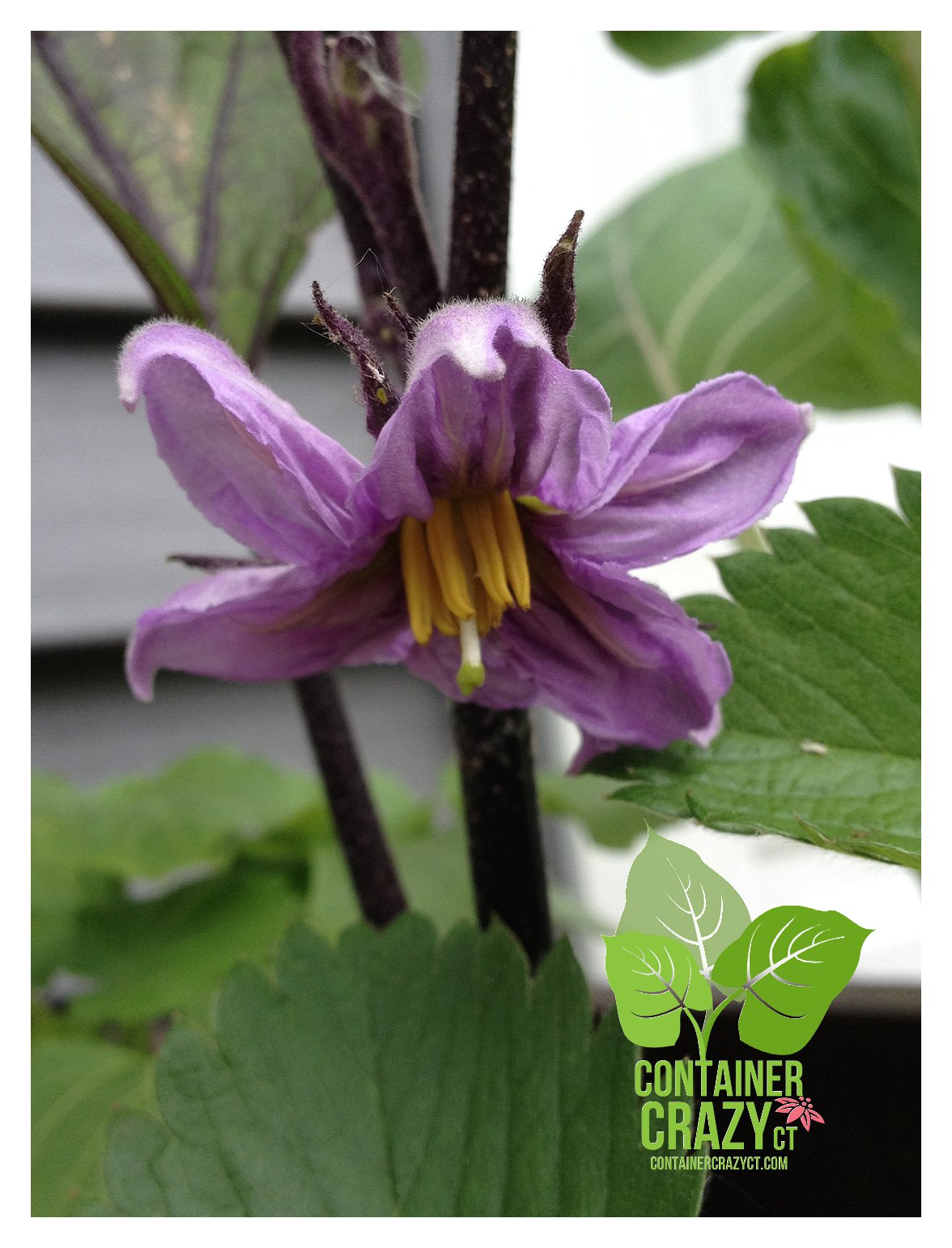
Happy Bloom on Japanese Long Eggplant

Happy Bloom on Japanese Long Eggplant Being Visited by Pest Aphids

APHIDS ON MY EGGPLANT BLOOM

If you take a close look above, you may see the little aphid bugs on my Japanese eggplant.

Aphids are very tiny pear-shaped insects with long antennae and tubes on their back-ends.  Some of the interesting tidbits about aphids are ants protect them because they enjoy their “sweet honeydew”, and they (aphids) reproduce faster than rabbits – the females do not need males to do so, and aphids vary in colors – not just green as the ones spotted on this plant.  To learn more about these little guys, see the CAES link.

Well, seeing them on my Japanese long eggplant flowers in my container garden was not pleasing. I’ve been using edibles in container gardens a great deal this season – and talking about it at garden clubs.  I am finding, however, the edible plants seem to get attacked by bugs much quicker than my tropical or annual plants.

To battle these aphids, I lightly sprayed the plant on a shady day when cool with a safe organic spray for vegetable plants (remember, don’t spray a plant when its very hot and located in full sun), and then a day later, I hosed off the leaves by using the garden hose with a watering wand at a good heavy pressure – it did the trick.  No more signs of the aphids since – and my first eggplant fruit growing right now on the plant – yeah!

I couldn’t really pick the small aphids by hand because they are too tiny, at the size of 1/8″ long.  And by the way, lady bugs are natural predators, releasing them can help if you can find the ladybugs from a garden center.

First eggplant

First eggplant

I potted up this eggplant plant along side an asparagus plant, strawberry plant, and would you believe, Brussels sprouts?! The asparagus added a nice soft texture with its fine and light foliage along side the coarse texture of the eggplant leaves, the strawberry plant is a spiller, and the Brussels sprouts – well, wow – what big texture those leaves have offered.

Eggplant with Mixed Edibles

Eggplant with Mixed Edibles

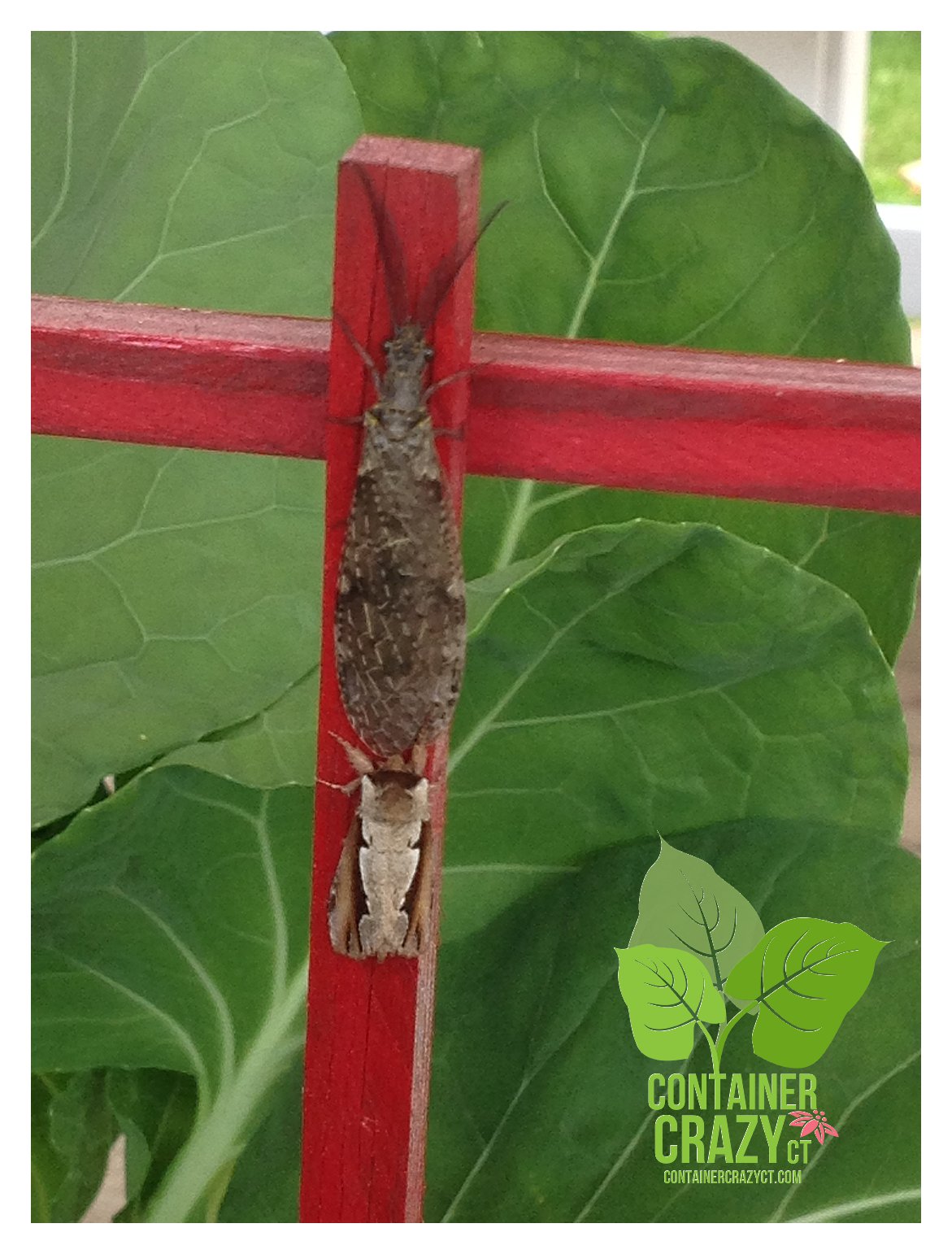
Earlier in June, I brought the container garden to the Ellington Farmers Market to show the combination during my talk about “Incorporating Decorative Edibles in Mixed Container Gardens.”  Well, low and behold, these two very interesting looking insects took their position on the red trellis in the pot – and stayed there all day during the market.  Thankfully they did not jump on me when I was driving home later that day with the container garden on my truck seat.  Not sure what they are, do you know?

Bugs on Trellis with brussel sprout Leaves behind it.

Bugs on Trellis with brussel sprout Leaves behind it.

MOSQUITO LARVAE IN MY WATER GARDEN

The other spot where I saw critters was in a water garden I have at home, which is a big galvanized feeding bin (for animals) filled with water and plants, such as elephant ears (Colocasia) or other water tolerant types, such as Cyperus papyrus (Tut). I put the plants in terracotta pots because they sink well into the water due to their weight and the clay is porous. Add some stones to the top of the soil of those pots so the soil does not escape into the water.  When submerging the pots, gently drop them into the water as to not disturb the soil too much.

Well, I should have known, tiny mosquito larvae started to grow in the water, and there were tons of them wiggling in the water one day.

To avoid this situation – you may try two things – place a mosquito dunk, which are not harmful to the plants, in the water, or just flush some of the water out occasionally with a garden hose so the water is not stagnant.  This is what I do. Later, no more larvae and no more bites.

Oh, when I was very young, I remember telling a teacher that I saw little things wiggling in a puddle at home. (Living on a farm, you tend to notice things like this – or I was just always fascinated with looking at things up close in nature.)  He told me to put them in a jar with water, cover it with plastic wrap and to bring it into class.  He set it on his desk and said, “Let’s see what happens.” A few days later, a bunch of mosquitoes were flying above the water.  A visual lesson for sure.

A PRETTIER INSECT

Fuzzy body of moth

Fuzzy body of moth

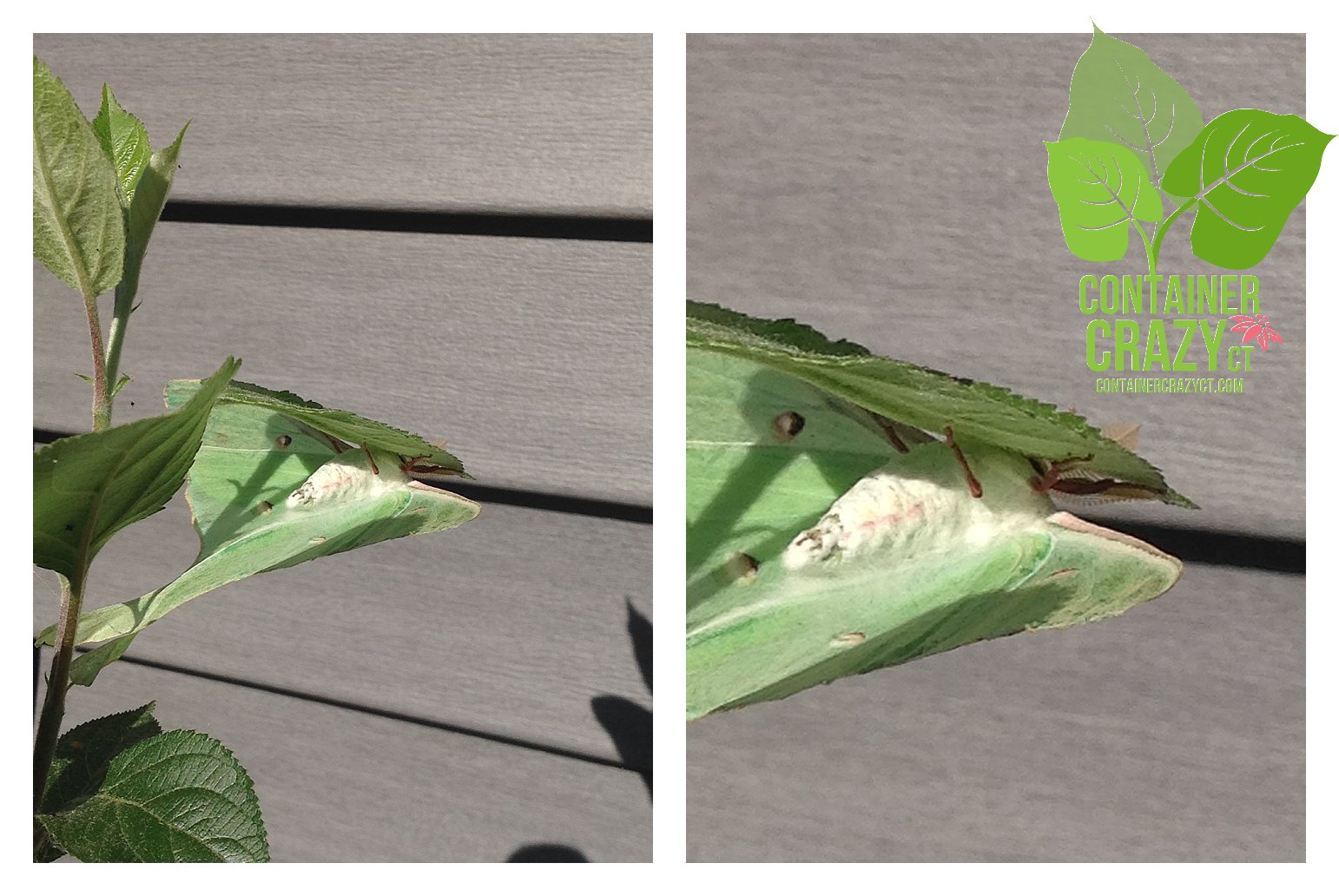
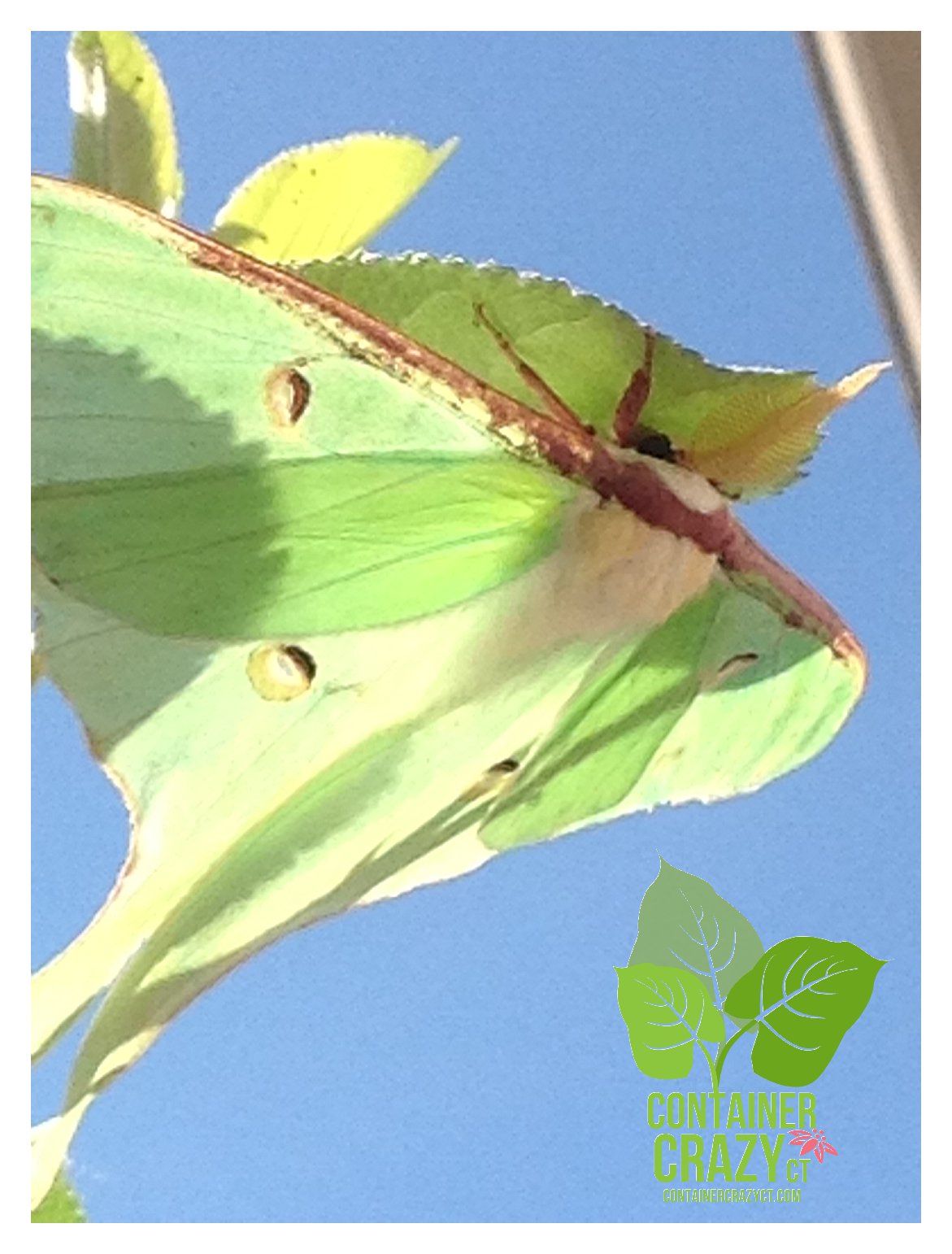
Another surprise sighting at my home this season was a Luna moth (Actias luna) on a apple tree in a pot.  As I was walking out to my garage, I saw a white substance on a leaf.  Well camouflaged, I didn’t see the wings of the moth at first.

I thought, “What the heck is that white fuzzy cocoon on my apple tree?”  (By the way, I often plant small trees in container gardens for a few years first – because I am crazy about container gardening, but it also can give a small tree some time to grow larger and stronger before I eventually transplant it to the ground when it outgrows a large pot – this way, I enjoy, learn and grow the plant first – as is the case with this apple tree.)

Insects ContainerCrazyCT_0015

To my surprise, it was a beautiful moth and not an ugly insect!  This was in the early morning and the east sun was brightly lighting up its wings.  The moth was completely motionless, and not moving at all – this gave me the wonderful opportunity to snap more photos.

Luna Moth on Apple Tree hanging on the underside of a leaf

Luna Moth on Apple Tree hanging on the underside of a leaf

I tried getting photos from every angle, which was difficult to do because it was on the backside of the plant along the garage wall.  After repeatedly taking photos, I tried moving the pot but it flew away.

Insects ContainerCrazyCT_0009

Luna Moth on Apple Tree

Luna Moth on Apple Tree

SPOTTING FIRST JAPANESE BEETLE

I also just spotted my first Japanese beetle on a plant yesterday – it happen to be a watermelon plant in a single container. Those beetles, I pick up with my hands and squish on the ground under foot.  They never scare me – even when they grab tightly onto my fingers.  I guess this is because my father would pick them from his garden plants and put them in a jar – another memory from childhood – and sometimes, I would help him collect the beetles.  I also would chase my younger sister, Louise, around in our pool, when I would find Japanese beetles in our pool too – and she would screech at the sight of them.  She told me this game as children put a fear of those beetles in her for a lifetime – oh well, the things we do when we are kids – LOL! However, she also practices the “pick and squish” method in her own vegetable garden for insects not so scary to her.

East Windsor Farmers Market

East Windsor Farmers Market

ALL BUGS ASIDE

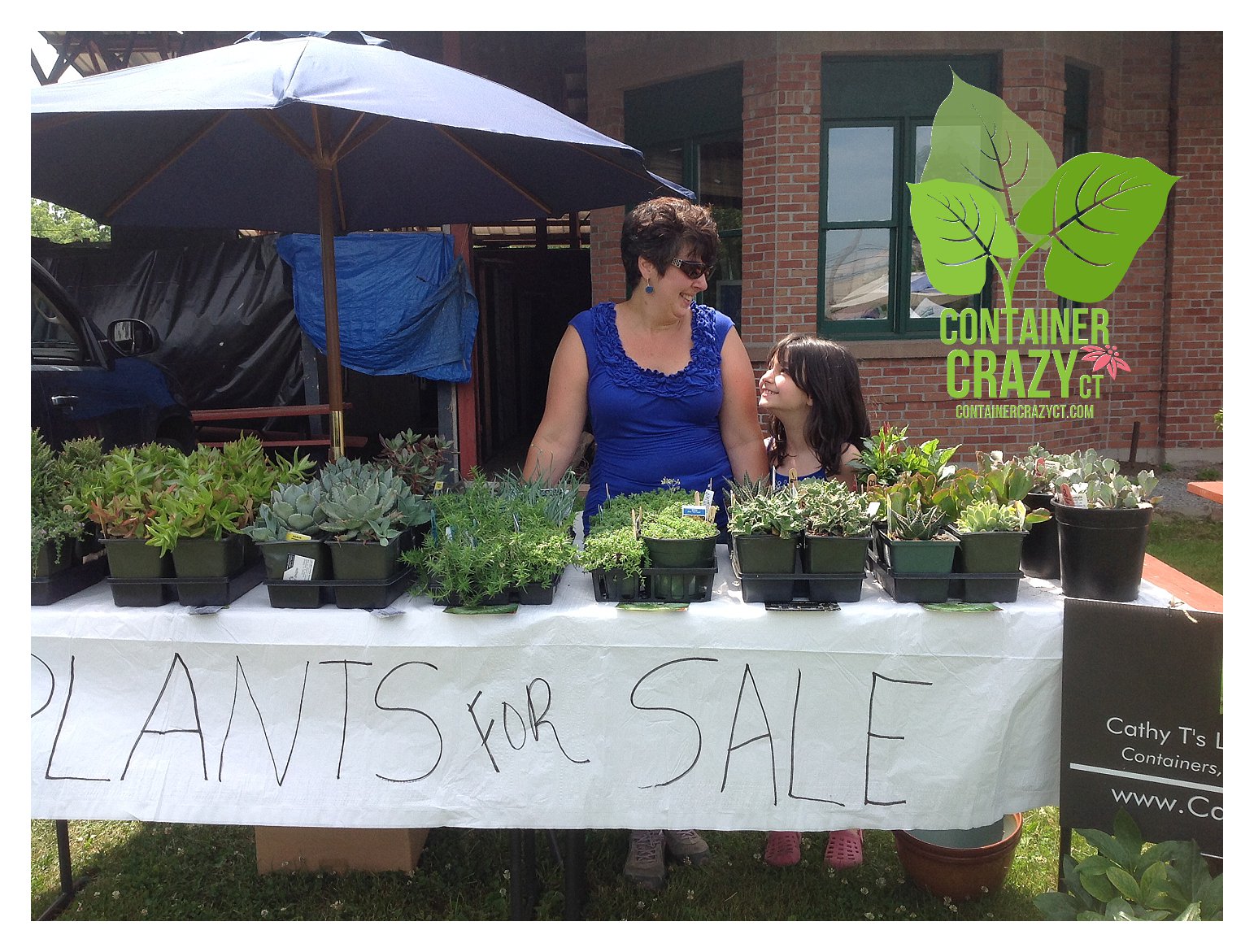
Last week, all bugs aside, I was featured as a guest speaker at the East Windsor Farmers Market on their opening day. Their market runs from now until October, on Sundays, 11 am to 2 pm, at the Trolley Museum off Rt 140.

My niece came for a visit – she loves to help me at the markets with my plants – and I love having her there.  We were goofing around, taking silly photos, and coincidentally, had matching blue shirts on.

See the next photo – this was my building at the market – pretty cool, huh?

Nope, just kidding – it was some sort of very old structure from the Trolley Museum next to my table setup.  I never got a chance to ask them what is was about, but it was sort of cool looking.  (BTW, if you go there, go see the old trolleys and even a few other interesting vehicles, such as airport shuttle buses built, but they were never installed at Bradley airport.)

The other cool thing about going to the market at this location is kids and family can take trolley rides on antique trolley cars as part of their day.  And, I did not know this – but there is a little movie theater inside the trolley museum building too – along with old cool trolley pics and more – so if you go, be sure to go inside as well as visit all the new vendors at this growing market in a great location – picnic tables and all.

Old Structure at the Trolley Museum

Old Structure at the Trolley Museum

AFTER THE MARKET

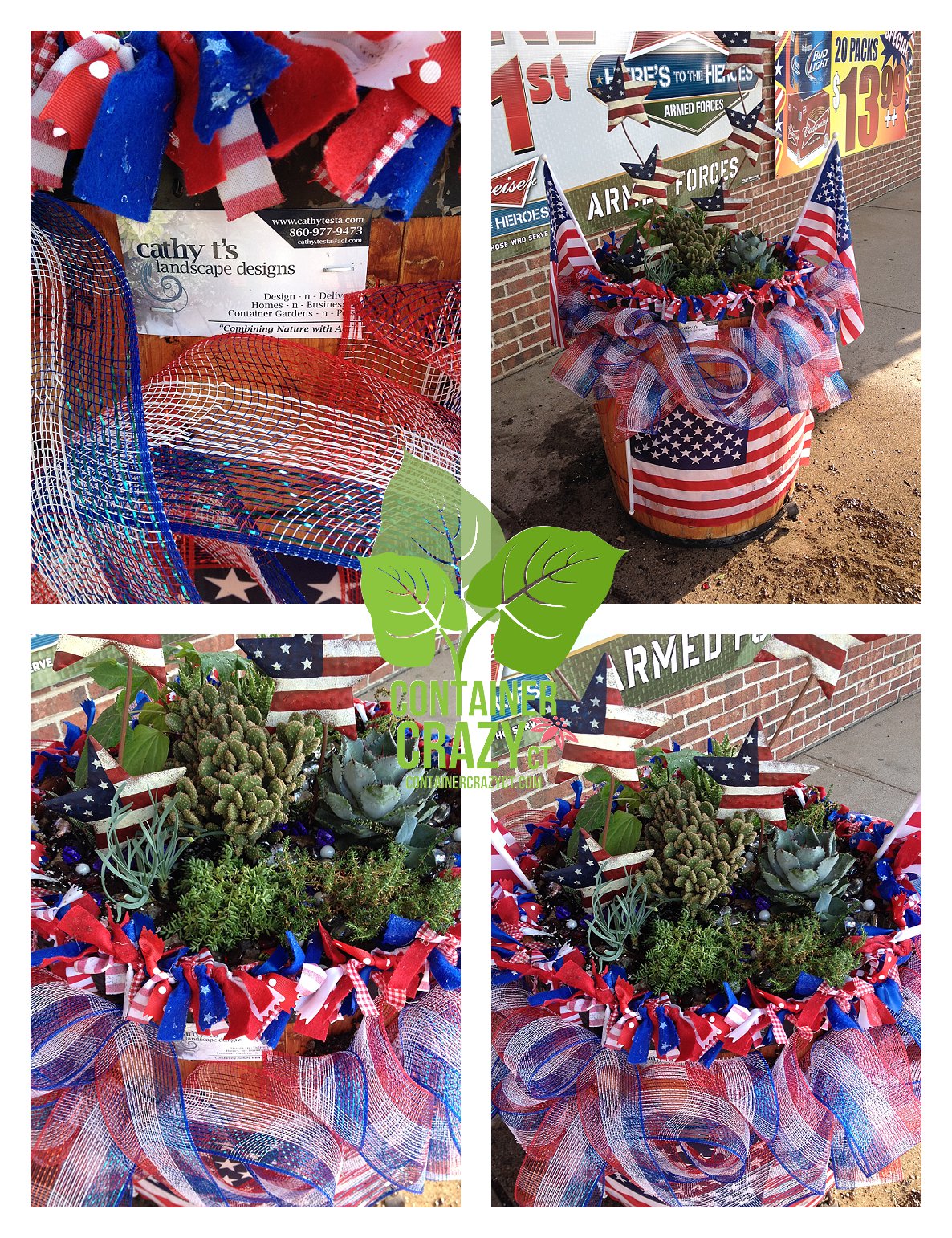
After the weekend, one of my first priorities was to update my client’s business store front with some red-white-and blues for the holiday and put a nice mix of succulents in the container gardens.  Cactic and succulents can be a little tricky to plant if they have spines and needles.  Just be sure to wear thick gloves and handle it by the root ball – and with some practice, you won’t get pinned, stuck, or aggravated by tiny spines.  I will say this however, whomever is putting their cigarette butts in my container gardens at this location – you will find a little surprise this time (hee-hee!). Fortunately, insects tend to not bother cacti and succulents much based on my experience, so they are useful for the non-insect people.

Client Barrels Decorated for the 4th

Client Barrels Decorated for the 4th

4th of July Succulents ContainerCrazyCT_0002

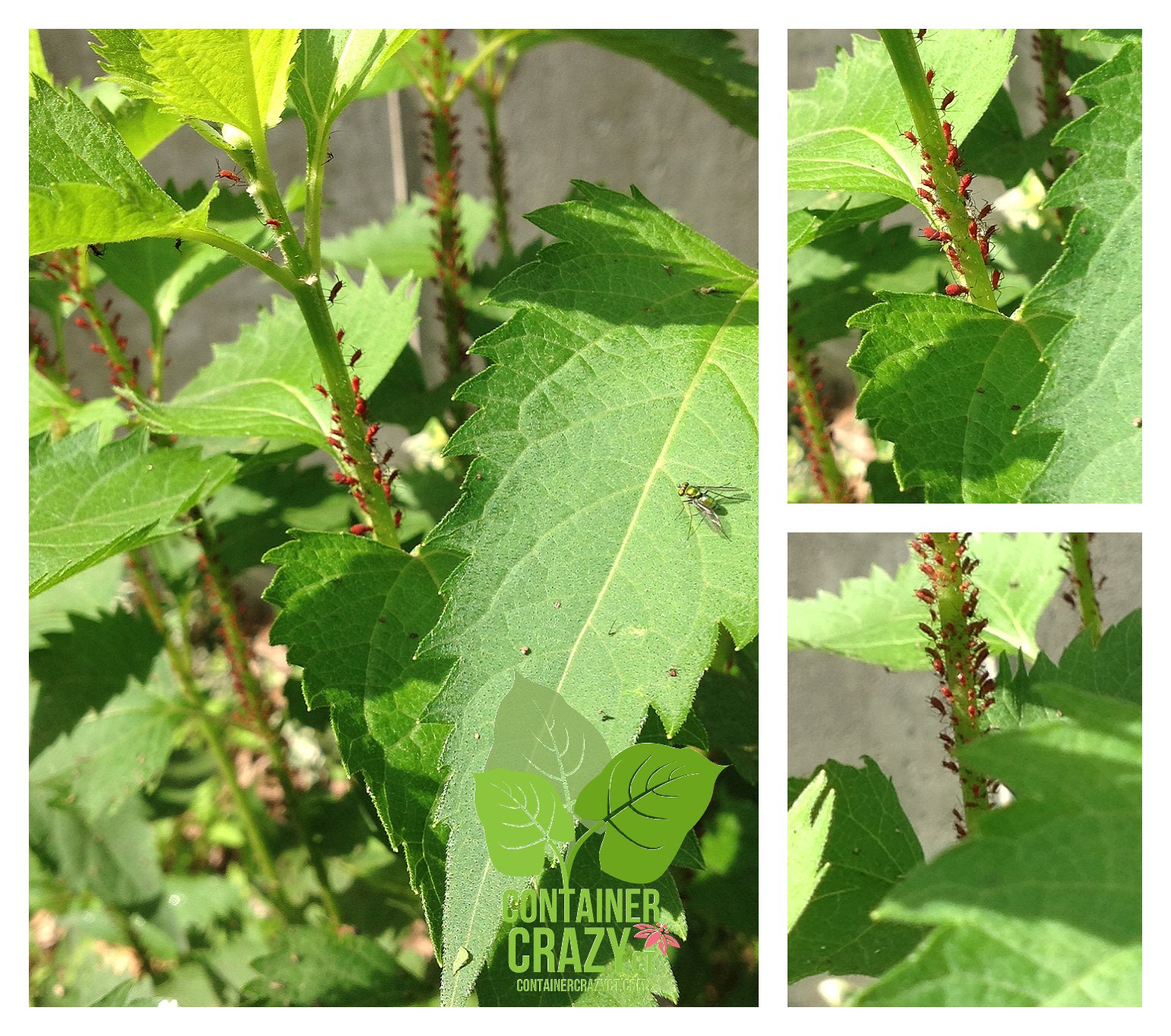
Oh by the way, what are these ugly critters below?  Saw these on a weed plant, so I pulled the plant out of the ground and took it to the chicken coop for the hens to deal with.  That’s another way to deal with insects.  Recycle to the coop…

More aphids or not??

More aphids or not??

Cathy Testa

860-977-9473
http://www.cathytesta.com
ContainerCrazyCT
containercathy@gmail.com

Condensed List- What You Can Do:

  1. Pick, Squish, Toss
  2. Prune away Plant Parts with Insects and Toss
  3. Pull Plant; Feed to Chickens
  4. Hose off with Strong Spray of Water
  5. Chase your Younger Sister around with them
  6. Lightly spray with Insecticide specific for plant and insects
  7. Get natural predators, like ladybugs and release near pest insects

Happy 4th of July Weekend Everyone – Hope it is filled with food, family, fun – and not many critters!

4th Photo Courtesy of Freedigitalimages.net, by nuttakit

4th Photo Courtesy of Freedigitalimages.net, by nuttakit

Upcoming Miniature Gardens Workshop – Details Posted for June 28th

2 Comments

Hello Everyone,

The next fun class on the Cathy T Class Series list is a Miniature Gardens Workshop by Rhonda Niles of Gardening Inspirations.  It will be held on Saturday, June 28th, 2014, from 11:00 am to 1:00 pm.

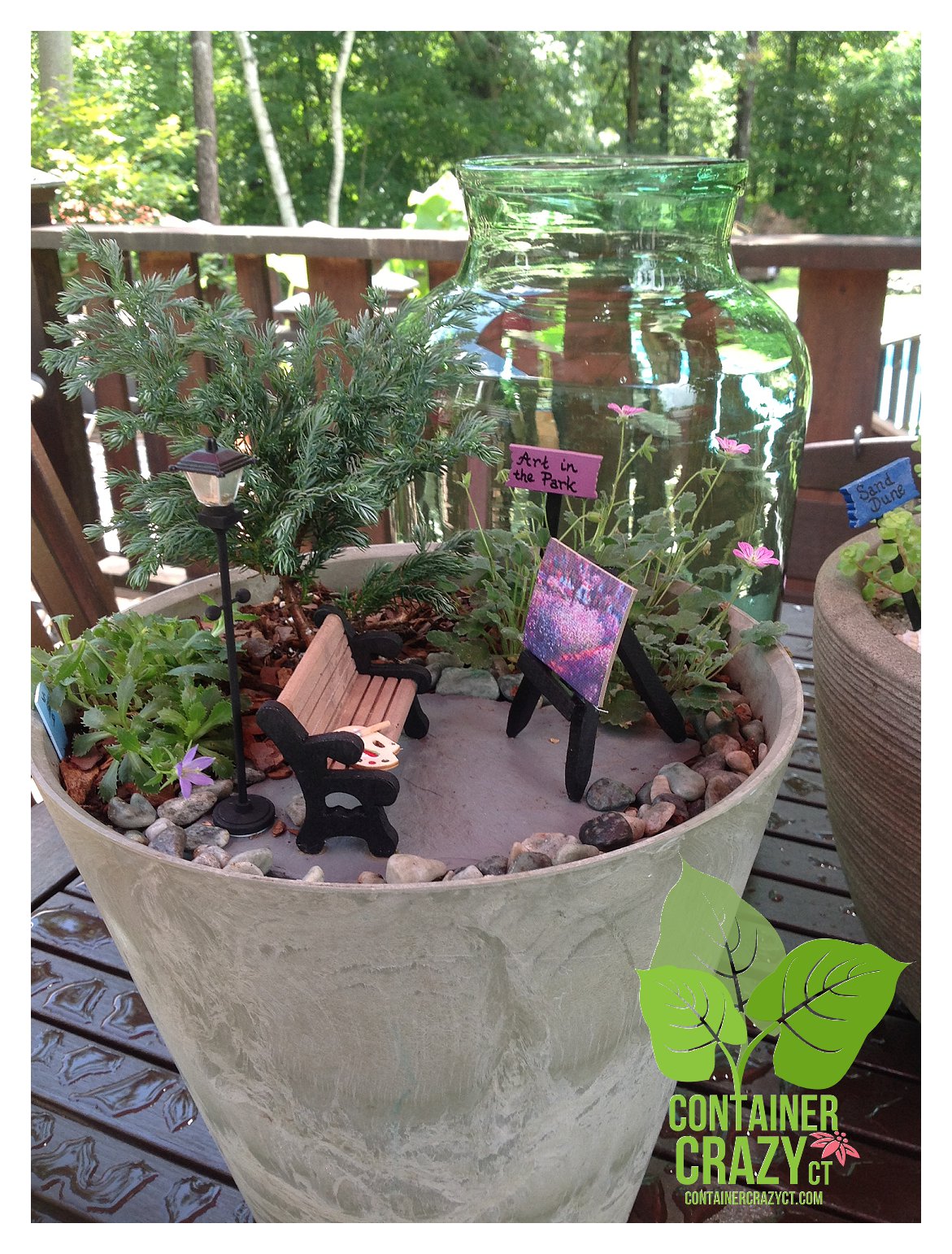
Miniature Garden by Rhonda Niles of Gardening Inspirations

Miniature Garden by Rhonda Niles of Gardening Inspirations

Nothing is cuter than a mini-garden creation on your patio table top outdoors during the summer season.  Just think – Your’s could be ready in time for the 4th of July weekend – because we are holding this session a whole two months earlier than last year’s workshop which was held in late summer – so attending and making your creation can be enjoyed even earlier this go around!

About Rhonda Niles, Our Featured Guest Instructor:

Rhonda is a horticulturist, accredited nursery professional, and advanced master gardener.  She has worked in various nurseries and garden centers, growing and selling plants.  She also has grown organic herbs and vegetables in her greenhouses for farmers’ markets.  For the last several years she has focused on miniature gardens in both New England and Florida.  She creates unique and artistic “dreamscape” gardens and miniature accessories for local craft shows, and especially enjoys teaching workshops for others.  She owns a business called, “Gardening Inspirations.”

About this Workshop

In this hands-on workshop, you will learn the secrets of designing, planting, and maintaining a miniature garden.  And you’ll have fun making your own endearing miniature garden for yourself or as a gift for a friend.  The best part is picking out your own plants and miniature accessories, the style of which are smaller, adorable versions of what you can realistically find in larger landscapes.  Plants used are low-maintenance and low light, including ferns and succulents.  You may wish to make a beach, serenity, woodland, or garden/farm scene, fairy garden, or your own creative vision.  New this year are healing stones and candles, which you can incorporate into your gardens. Photos of workshop can be found at www.facebook.com/GardeningInspirations.

Prior Attendees

Here’s a photo of a prior class.  We held the class on the deck, but due to a construction project, the class will be held on the driveway with tables and chairs provided.

An Attendees Works on her Miniature Garden

Attendees Works on their Miniature Gardens at Last Year’s Session

Classroom Location:

Cathy T’s Classroom is located at 72 Harrington Road, Broad Brook, CT 06016.

The class is held outdoors on a driveway in classroom format with tables/chairs provided.  If sunny, wear a gardening hat, use sunscreen, and note: some patio umbrellas will be setup for shade.  If raining, it will held in large garage on same day (no rain date).

Class Fee and Included Materials

Cost is $49 per person for the class, which includes three plants, instruction and all basic miniature garden supplies for your container such as soil, drainage rock, mulch, weed block, glue, as well as a materials credit for optional plants and miniature accessoriesRepeat attendees receive an automatic $5 off of the Class Fee.

Additional miniature materials may be purchased if desired, depending upon how elaborate you’d like your personal miniature garden to be.  There are plenty of materials to choose from with a wide selection of plants perfect for your mini creation.

New Feature:  This year’s workshop includes a new feature of “Healing Stones.”  Learn how these stones work at the class.

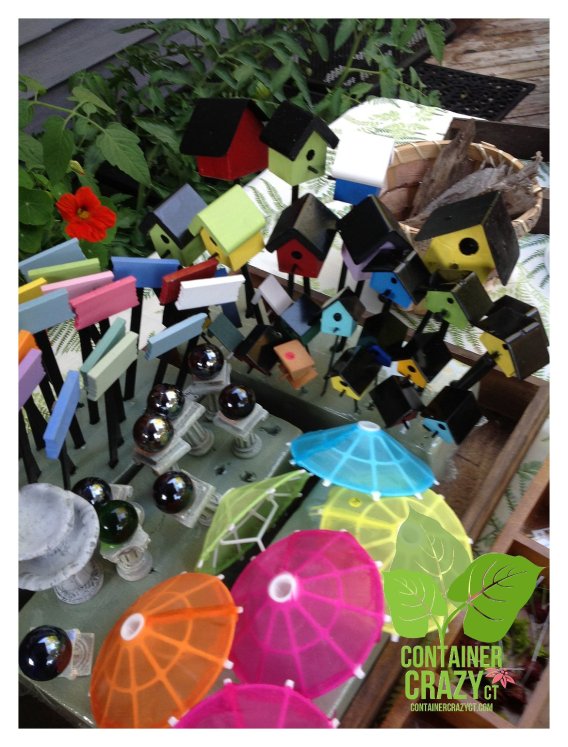
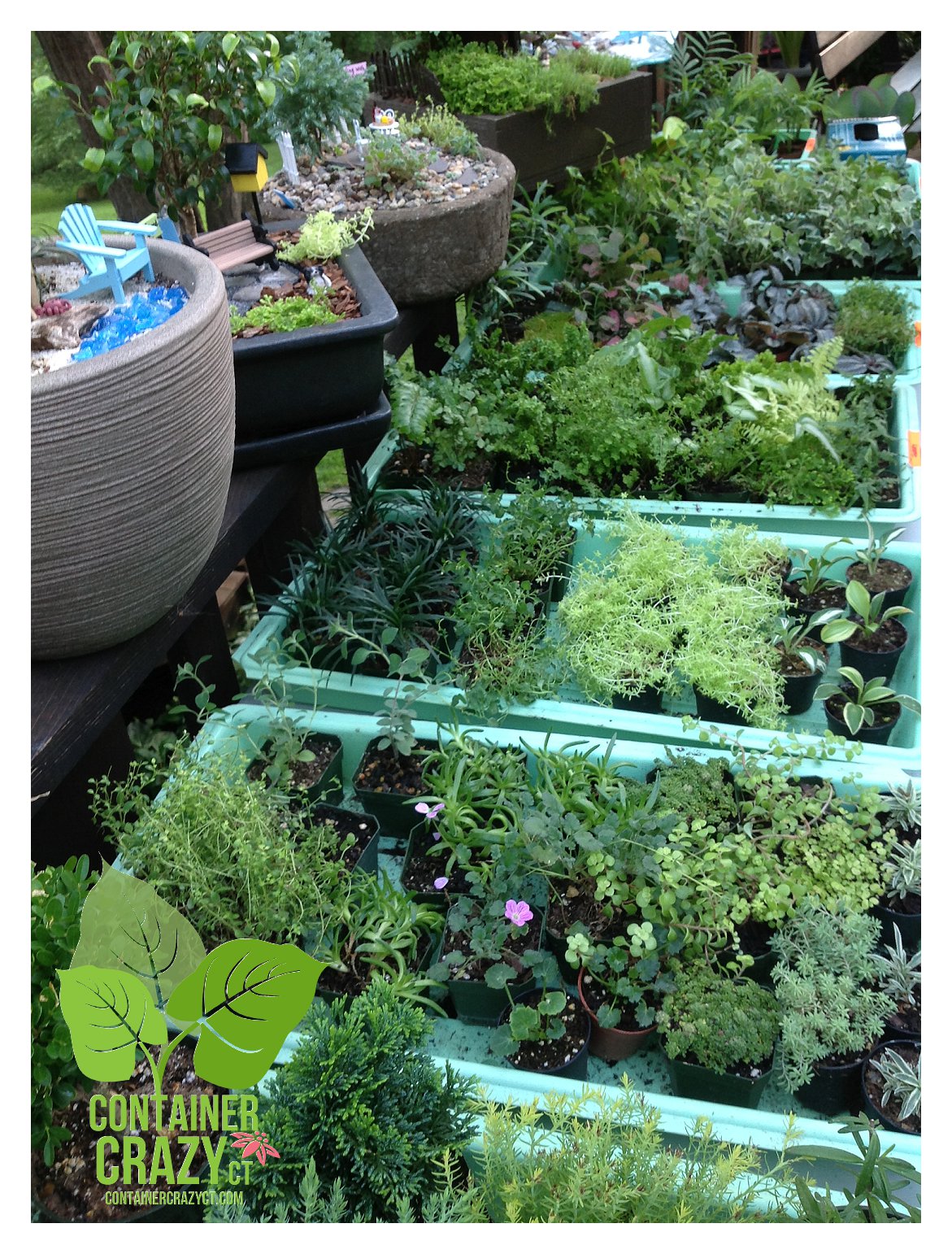
Plants by Gardening Inspirations for the Workshop

Plants by Gardening Inspirations for the Workshop

You Pick Your Theme

From fun farm animals to pool side umbrellas in mini style, you will have many creative options as you selecting a particular theme in this hands-on workshop.  Rhonda does an excellent job of providing lots of materials and explaining design layouts to achieve a great look.  She will cover the steps to care for and maintain your miniature gardens creation.

Creates by Gardening Inspirations and Attendees

Creations by Gardening Inspirations and Former Attendees

Bring Your Own Container or Purchase One at Class:

Participants are encouraged to bring their own container (a 10-12″ wide bowl, oval or rectangular pot, 4-6″ deep) to match their décor and tastes, although appropriate containers are also available for purchase.

Surprise Prizes!

As for all of Cathy T’s Upcoming Classes, when you sign up as a blog follower, you are eligible for Surprise Prizes given out at the class. Sign up today to join the other 590 Blog Flowers of ContainerCrazyCT.com.  See the menu bar on the right.

Miniature Gardens Workshop by R Niles_0003

For more information, see Cathy T Classes on this blogs menu bar above.  A class flyer has been posted with all the details.  Register today before the seats are sold out – See the Contact Form below to sign-up.

Looking forward to seeing you.  For any questions, contact Rhonda Niles or Cathy Testa.

Thank you,

Cathy Testa
http://www.cathytesta.com
860-977-9473
containercathy@gmail.com

← Back

Thank you for your response. ✨


Goofing Around With My Camera (New Chickens, Perennials Rising, and More)

Leave a comment

On this windy day, I decided to post some general pictures taken as I goofed around with my camera outdoors this weekend.  I got more accomplished than I had planned on which is good news.

We got our new Rhode Island Red chickens moved into our chicken coop finally, I cleaned up some perennials, and even raked up some leaves and moved out some container gardens and pots.

This was all accomplished after I held my first garden talk of the season on ornamental edibles in Broad Brook at the Pride Fitness building.  A small group from South Windsor attended, and they were very enthusiastic. They are thinking of forming a new garden club at their church so we had lots to share about edibles and gardening on Saturday morning during my presentation.

So back to “Goofing Around with My Camera.”  Here are some photos taken as I worked and played outside during the first weekend of May 2014.

Perennials Rising

Perennials Rising

Perennials Rising

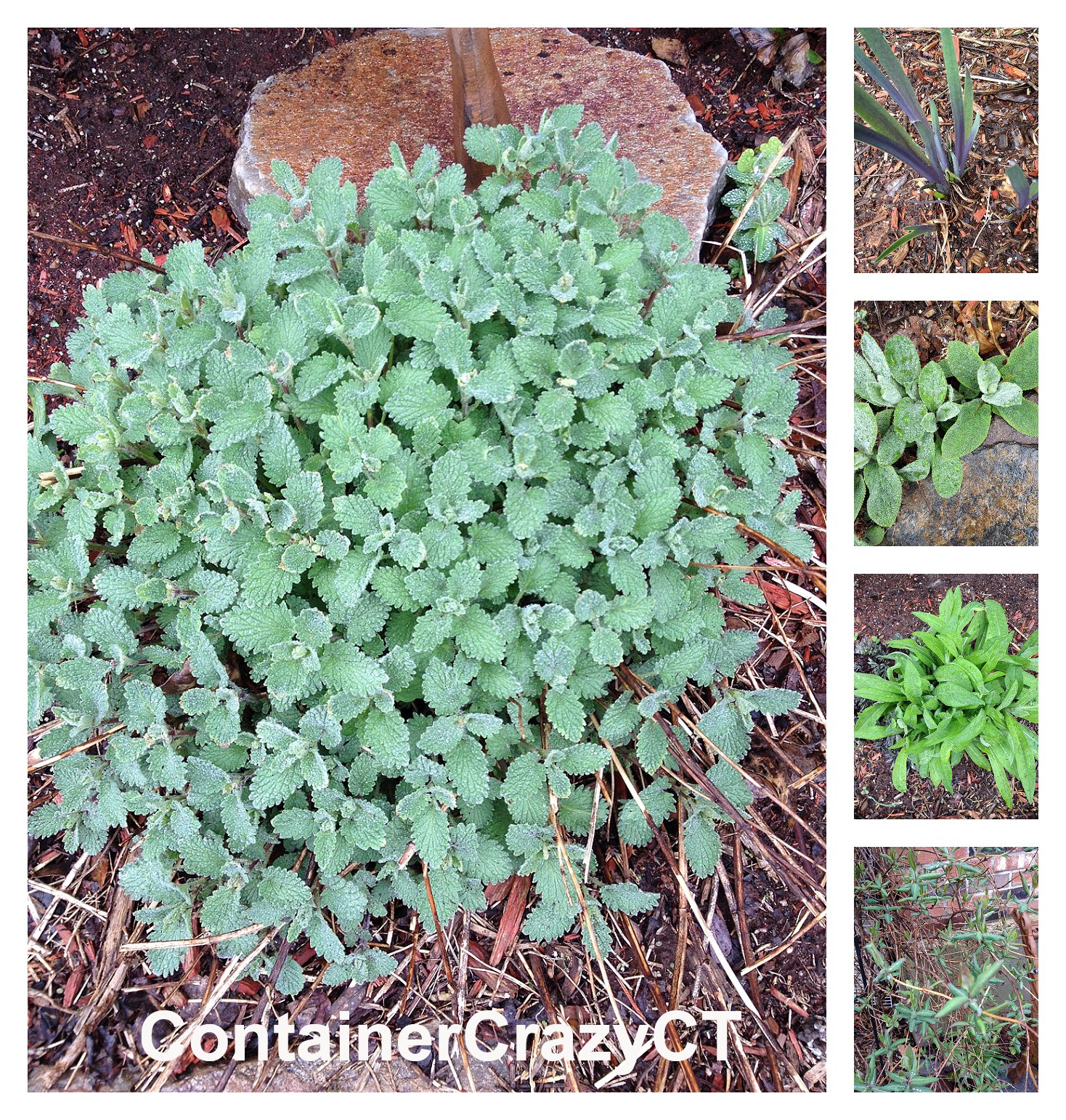
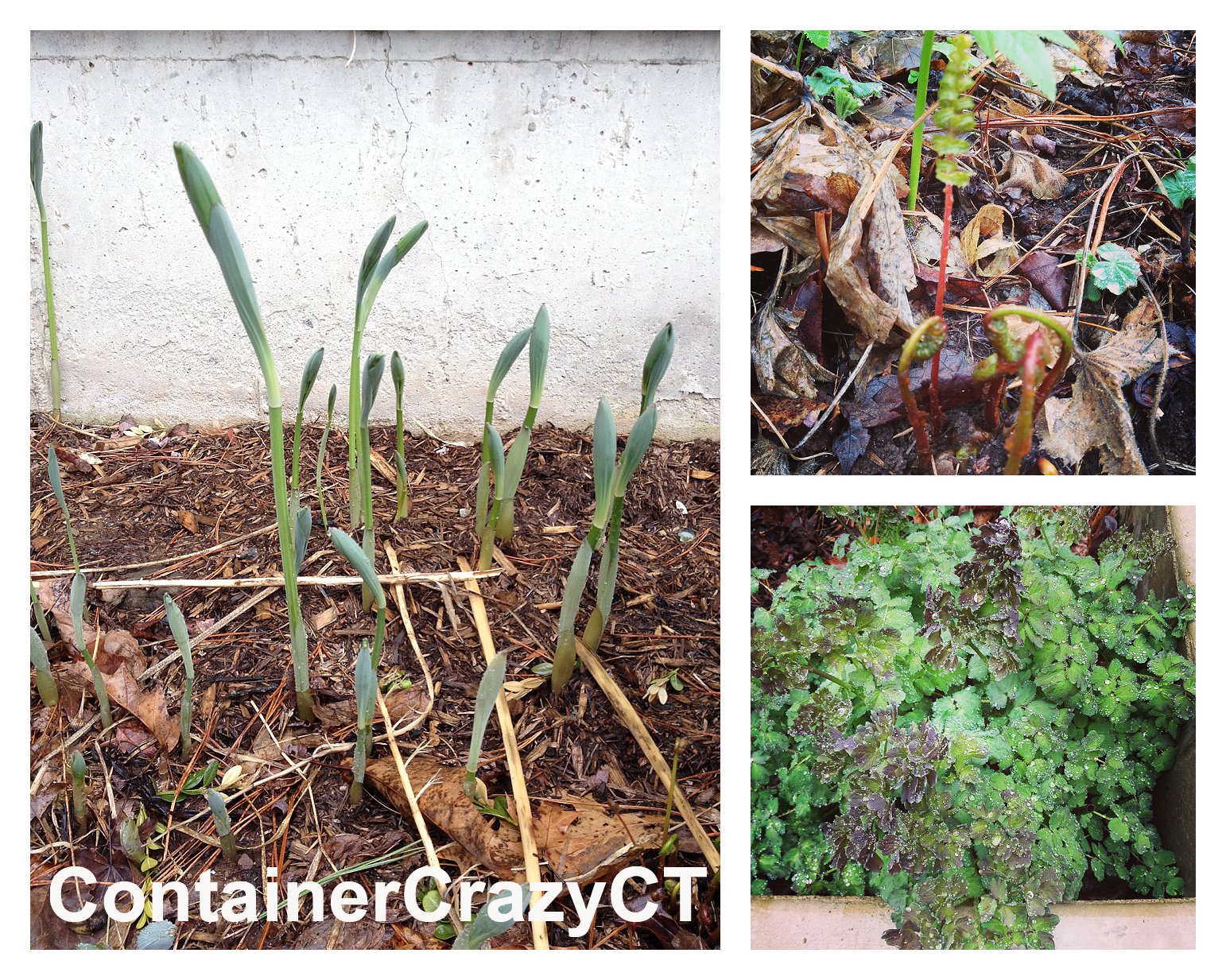
These are photos taken of perennials finally rising up from the soil and showing some initial growth. On the left is Nepeta (catmint), which is such an easy full sun perennial to grow.  The cats love rubbing against it from time to time.  It is super easy to clean up in the spring and can be pruned up or sheared anytime actually if it gets overgrown. Using sharp hand-pruners, I removed the old stems around the edges of this plant.

On the top right of this photo grouping is the leaves of an Iris with purple leaves, and then next a lamb’s ear (Stachys) perennial. Lamb’s ear always starts off slow, showing only a few leaves, but by early summer, it is much fuller and gently spreads near itself. I basically did not need to do anything to clean the remnants of last year’s lamb’s ear; it was looking fine right now and starting to grow.  On the Iris, it did not bloom, and I suspect it is because the soil is too moist there or not enough sun, or it was planted too deep, it will be moved later.

Below the photo of the lamb’s ear perennial was one where I experienced a CRS moment.  I could visualize the flowers in my head, as I looked down on the foliage coming out of the ground, but after months of dormancy for me and the plants, sometimes we have mental blocks.

When I took the photo, I was struggling to remember the name – but here it is Cornflower (Centaurea), also known as Bachelor Button to some gardeners. It grows showy violet-blue flowers in early summer (June-July), and I adore this perennial. Like its neighboring Nepeta and Lamb’s ear, it enjoys full sun conditions and can be kept on the dry side.  Butterflies and hummingbirds like the blooms too.

And on the bottom right of the photos above is a Honeysuckle vine with leaves coming out now.  I put a small garden bench near this area and kept smelling something sweet in the air when I took a break to sit.  I thought, could it be the Honeysuckle?  There are no blooms yet, but I leaned in to take a whiff and I think it was coming from the tips where the buds are beginning to form – amazing!

More Shade Loving Perennials

Ligularia, Peony, Bleeding Heart

Ligularia, Peony, Bleeding Heart

Around the corner, on the north facing side of my house are a couple Ligularia plants (top left photo).  The leaves are just beginning to come out and expand.  This plant is very showy in regards to foliage, which are round, large, and other cultivars have leaves with bronzy-green to plum colors and purple colors.  The blooms rise above in summer (around August) on tall spikes, usually showing off yellow flowers on dark stems.  It is a great shade plant, likes moisture, and is easy care.  Using my hand-pruners I cut away any old stems from last year – easypeasy cleanup.

The Peony is on the bottom left of the above photo.  They are starting to come up now, so I put my big round wire frames around them. I spray painted the wire frames first with green cause they looked a bit rusty.  I should have taken a photo of them – made by my father, they are round and fit around them well, and as soon as the foliage grows, you can’t see the wire frame which supports the blooms typically heavy and sometimes bending down from rainfall.

And of course, a bleeding heart (Dicentra spectablis) is on its way up with little flowers already appearing. Every time I witness this plant I think of the day my husband weed-whacked one down many years ago.  Let’s just say that I got him to stop when I explained accidentally cutting down a plant of mine is like if I went up and accidentally scratched his motorcycle paint.  He got it.

But he explained his fault, indicating it looked like a weed – and you know what, sometimes it can at first but once those flowers drip down heart-style, you can mistake it is a flowering perennial perfect for early spring and into May.  No cleanup was needed but later it will be cut down because it will go dormant earlier than many perennials and turn yellow.

Polygonaturm, Ferns, Thalictrum

Polygonatum, Ferns, Thalictrum

Further down the bed, under a Japanese Maple tree, are my Polygonatums (Solomon’s Seal).  I love the way the stems come out of the ground like graceful little – well, I don’t know what – they just look interesting before they grow more.  The leaves rise along the stems while little white flowers will dangle off the length of the stems, plus the stems will arch at the tops.  It makes a great woodland-like plant for part shade.  It prefers good moisture and rich soil too.  When you buy these at the nursery, sometimes the single plant doesn’t look too impressive at first – but over time, these keep rising up more plants (as seen here) and when you have a nice stand of them, they are pretty impressive.  On the top right is just a picture of some native ferns unfurling. Any nature lover gets why this is striking to look at – and I just grabbed a quick photo of that.

On the bottom right is a plant in my big cement planter around back of the house – can you guess what this is? You might think Columbine (Aquilegia) at first because its leaves are similar, but this plant is called Thalictrum aquilegifolium (Columbine Meadow Rue).  The specific epithet (2nd part of the Latin name) means columbine leaf.

Anyhow, I love this perennial because it shoots out stems that reach 2-3 feet tall!  Right now the leaves are coming out of the soil and they are tinged from the cool temperatures with some burgundy tones.  But in early summer, this plant will show off fluffy flowers in pink colors on very tall thin wiry stalks above the foliage below.  It is another woodland like plant and I love the height of it.

Hellebore Galore

Heleborus perennial

Helleborus perennial

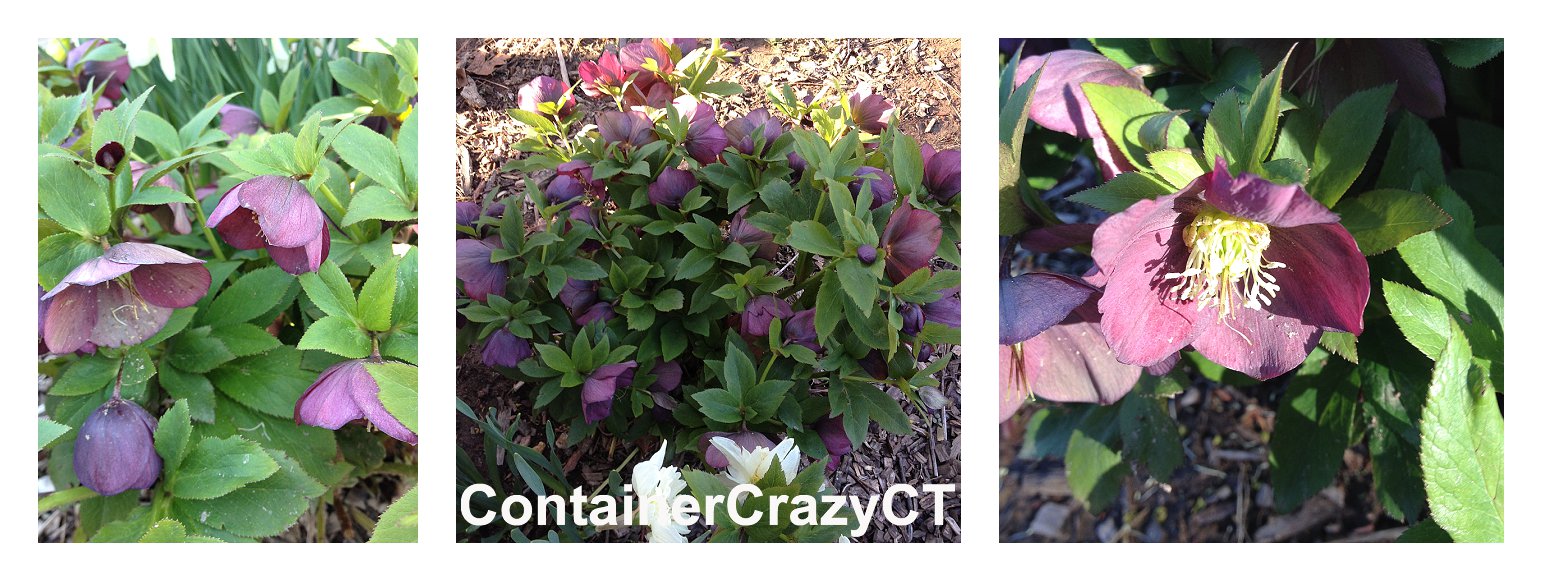
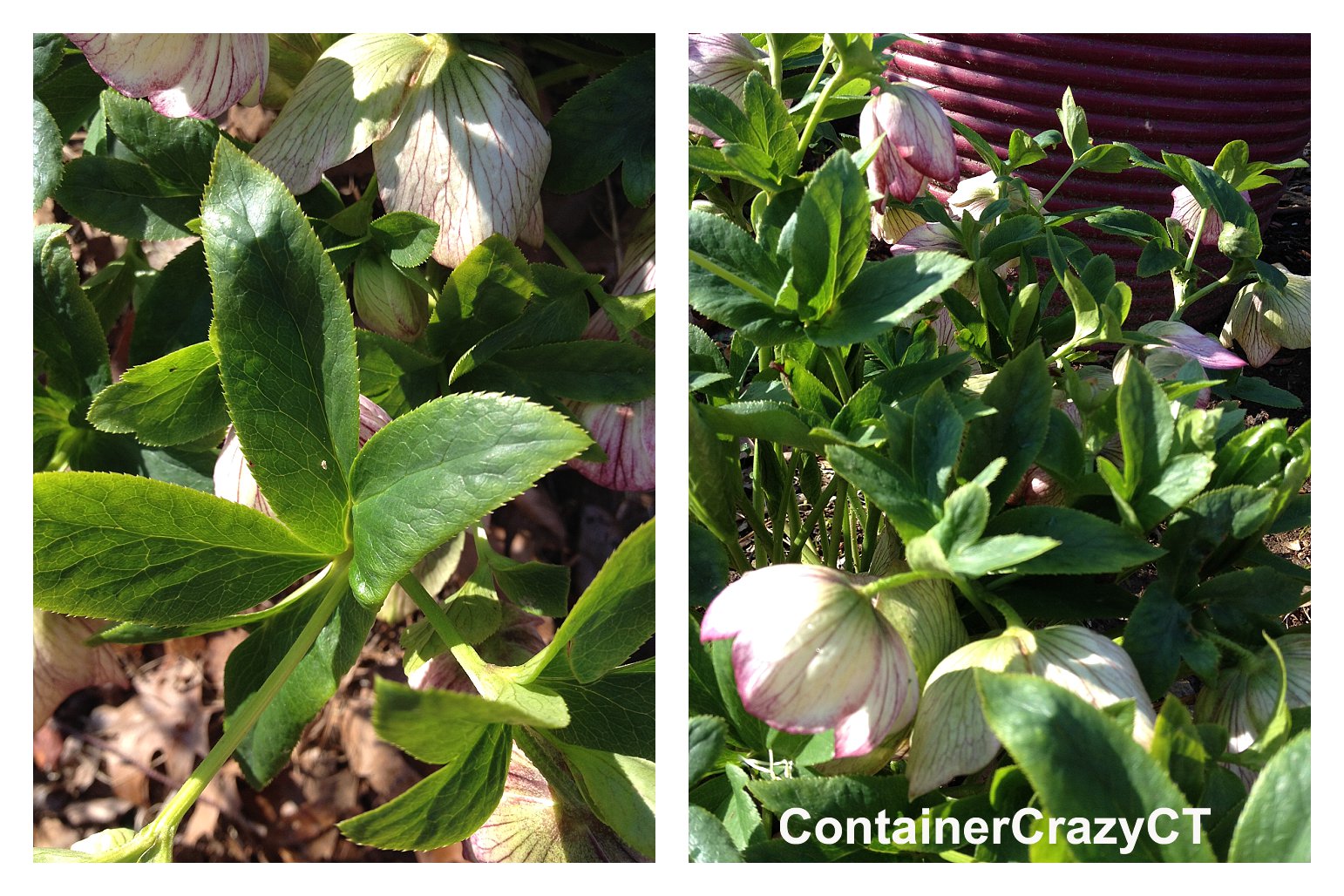
Because I was near the chicken coop this weekend moving in the new chicks and fixing some damaged parts of the pen, etc – I took time to notice my beautiful and full flourishing Heleborus perennials.  I will have to dig through my notes to remember the cultivar name of this one, but it was flushed with blooms – all dark purple toned. Unfortunately, the blooms nod downwards, but if you gently tip one up you can see how the insides look – stunning.

I can’t say enough about Helleborus perennials.  The leaves are tough and long-lasting, semi-evergreen, and easy to snip off any left overs on the plant from last season with hand-pruners.  These plants take partial shade (and can take full sun) in a well-drained soil, but they seem to do better in shade in my yard.  They are known as Lenten Rose and if you don’t have any, I recommend you get them – the deer don’t eat them by the way which is a bonus. (Oh and I will have some for sale at my upcoming Big Container Garden Party on May 24, 2014.)

Helleborus perennial

Helleborus perennial

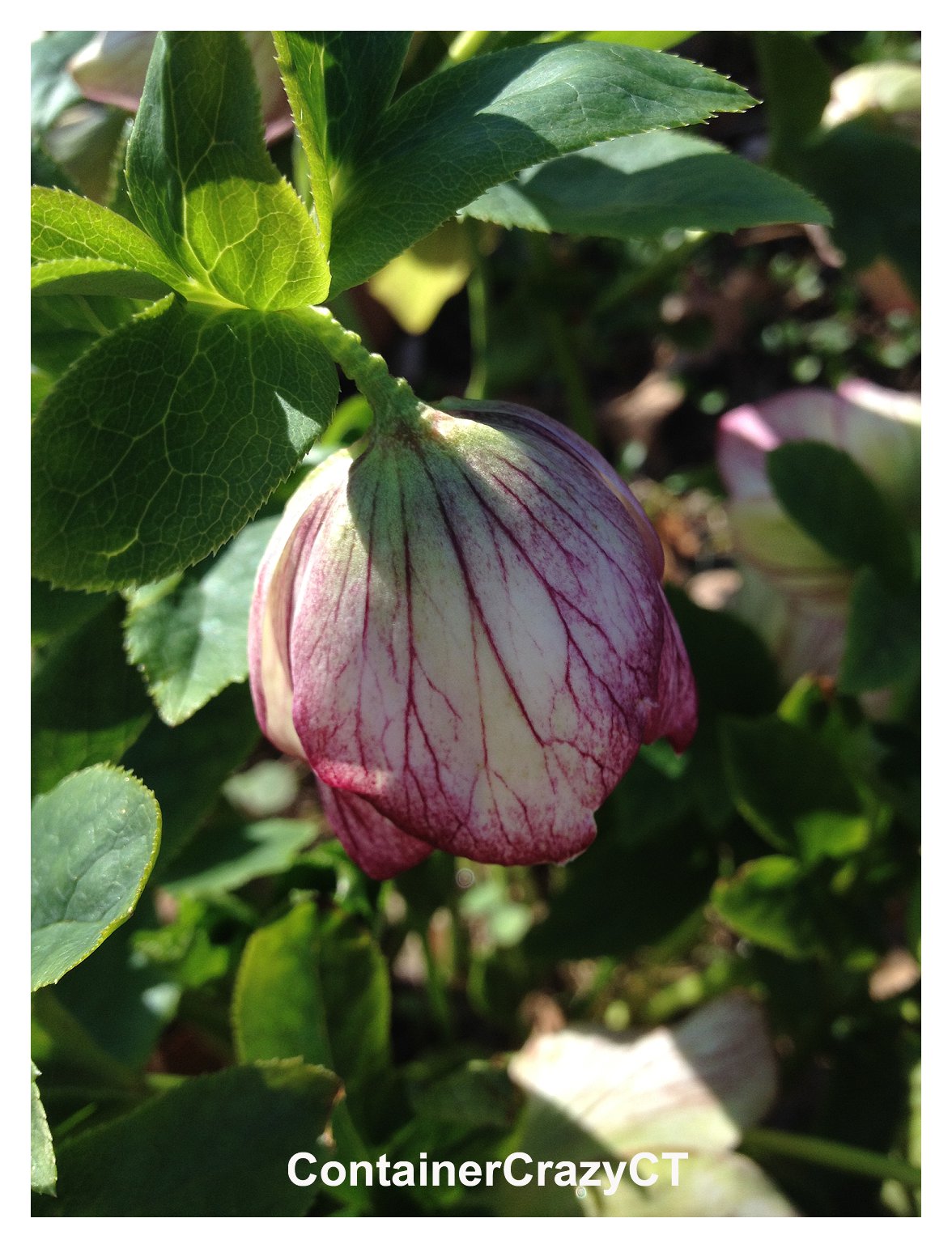
Here is another one I have near the coop.  Fascinating how the veins appear in the leaf petals.  Both of these stands of my Helleborus plantings are doing very well in their locations.  I had chickens in this pen before and the soil is very fertile.  In fact, when I was digging in the bed near these, worms were everywhere – a nice healthy sign of a living soil.  As I found them, I scouped the worms up to give to my new chickens.  They were ecstatic.  They really like the treatment they are getting at their new dwellings, the little Testa ranch.

New Rhode Island Reds Arrive

Newly Arrived RI Reds!

Newly Arrived RI Reds!

Here they are, we got six Rhode Island Reds.  We added a perch and four of them hopped up there right away, and I also put a box on the floor because they were hiding behind the feeder, so I realized they were a little “chicken” so I got them spots to hide by putting a box in there.

Chicken Coop Accessories

Chicken Coop Accessories

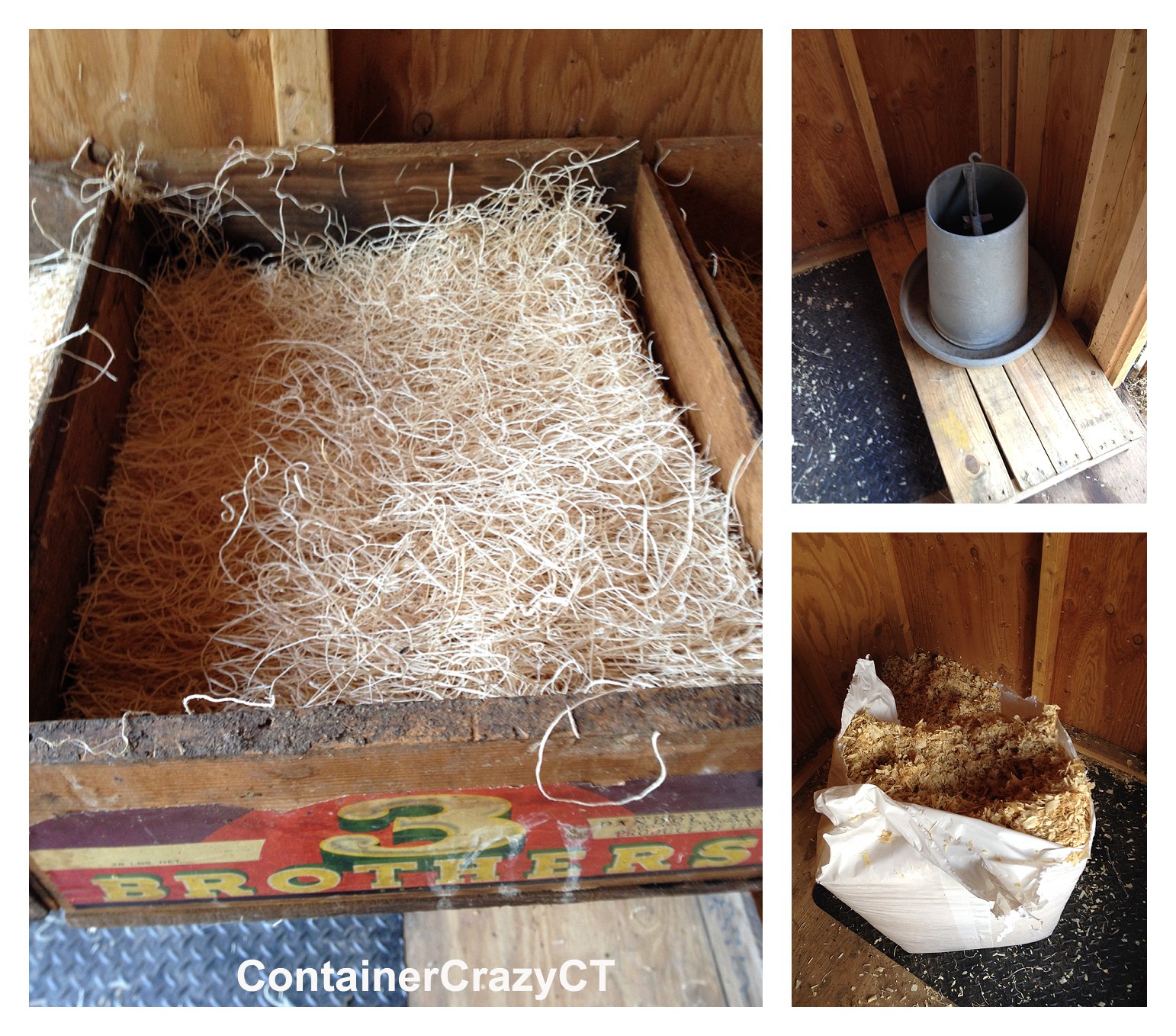
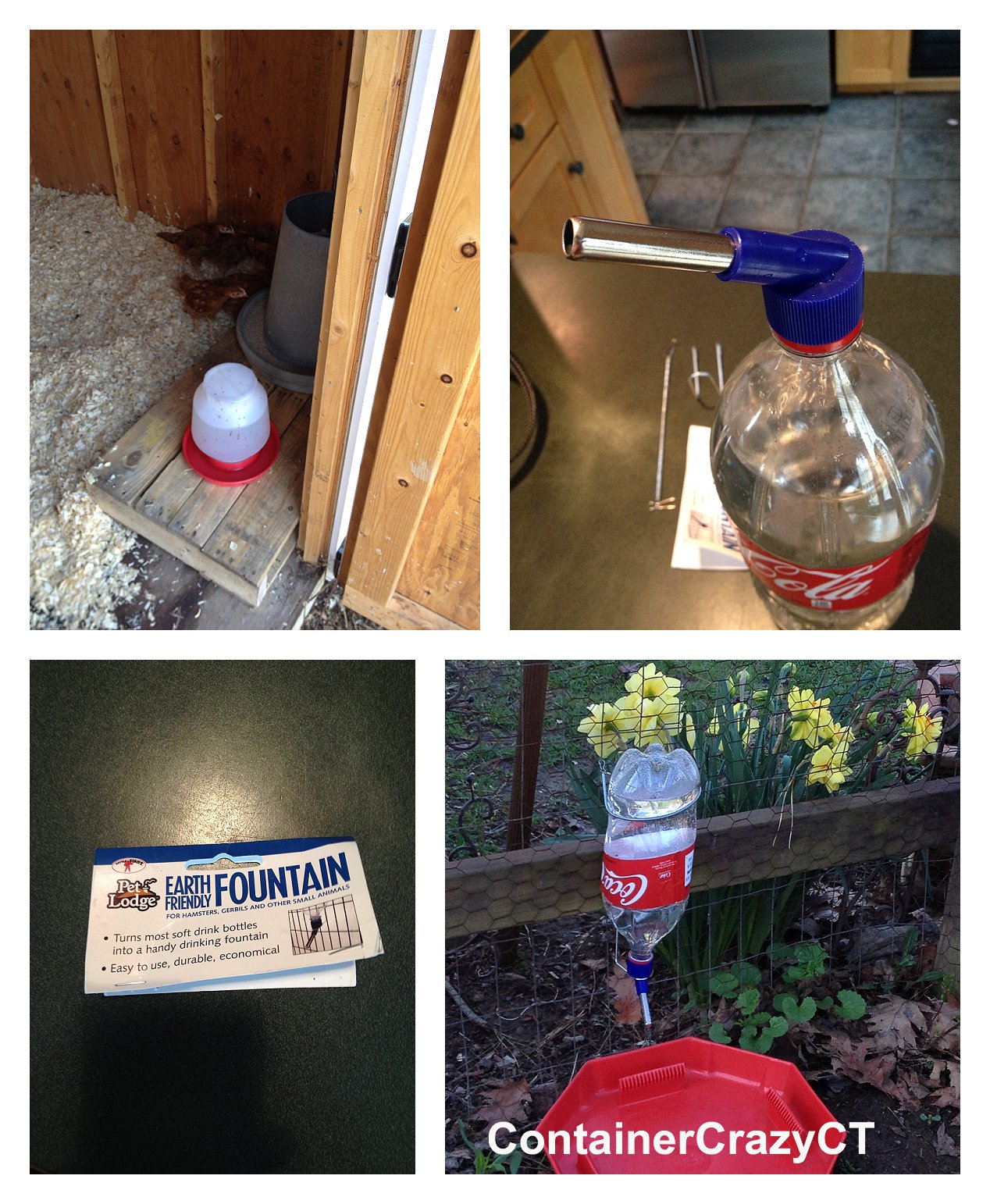
You are going to think my chickens are spoiled because I bought these perfect fit nest box pads to put in their future laying boxes. The boxes are a find of antique shipping crates and we are going to add side walls to the boxes so they have their preferred privacy when they lay eggs, expected by September.  I also got a big bail of pine shaving to put in the bottom of the coop, and have a galvanized antique chicken feeder given to us by a friend.  I put the feeder and water container on a pallet, raised off the ground, so they won’t poop in it as much as if it were level to the floor.

Soda Bottle Converter Kit

Soda Bottle Converter Kit

Soda Bottle Converter

Another nifty thing I ordered was a soda bottle converter kit which easily attaches to a bottle to drip water out for the chickens, but they have to be trained to use it.  How?  I’m not sure, but I set it up in the outdoor pen area.  They are still a bit chicken to walk outside into the pen, but they started poking their heads out to look around.  Both the nesting pads and bottle converter were purchased from My Pet Chicken online.  I also bought a galvanized hanging poultry feeder and waterer, but they were much smaller than I expected.  However will be handy and were hung outside in the pen for later use.

Incubator

Incubator

Incubator of Sorts

My brother, Jimmy, kept the baby chickens in his home-built incubator until they were large enough to move into our chicken coop.  I appreciated this very much because I did not have to setup a heat/warming place for them, and they are fine now to go without heat.  But I had to show his set-up here.  He got two shipping crates, attached them together with a door, and they had a nice warm and cozy home before coming to our house. Oh, I spotted his cat hiding behind the coop – she was probably waiting for a moment to get them, no luck my dear.  LOL.  But I guess raising chickens is in our blood.  My father had them when we were growing up and my sister also has chickens now in an urban setting no less.  She has pretty ones, with feathers on their feet and they are smaller – of course, CRS Again!  I can’t remember what they are called, the breed.  Hmmm, will come back to me.

Daffodils

Daffodils

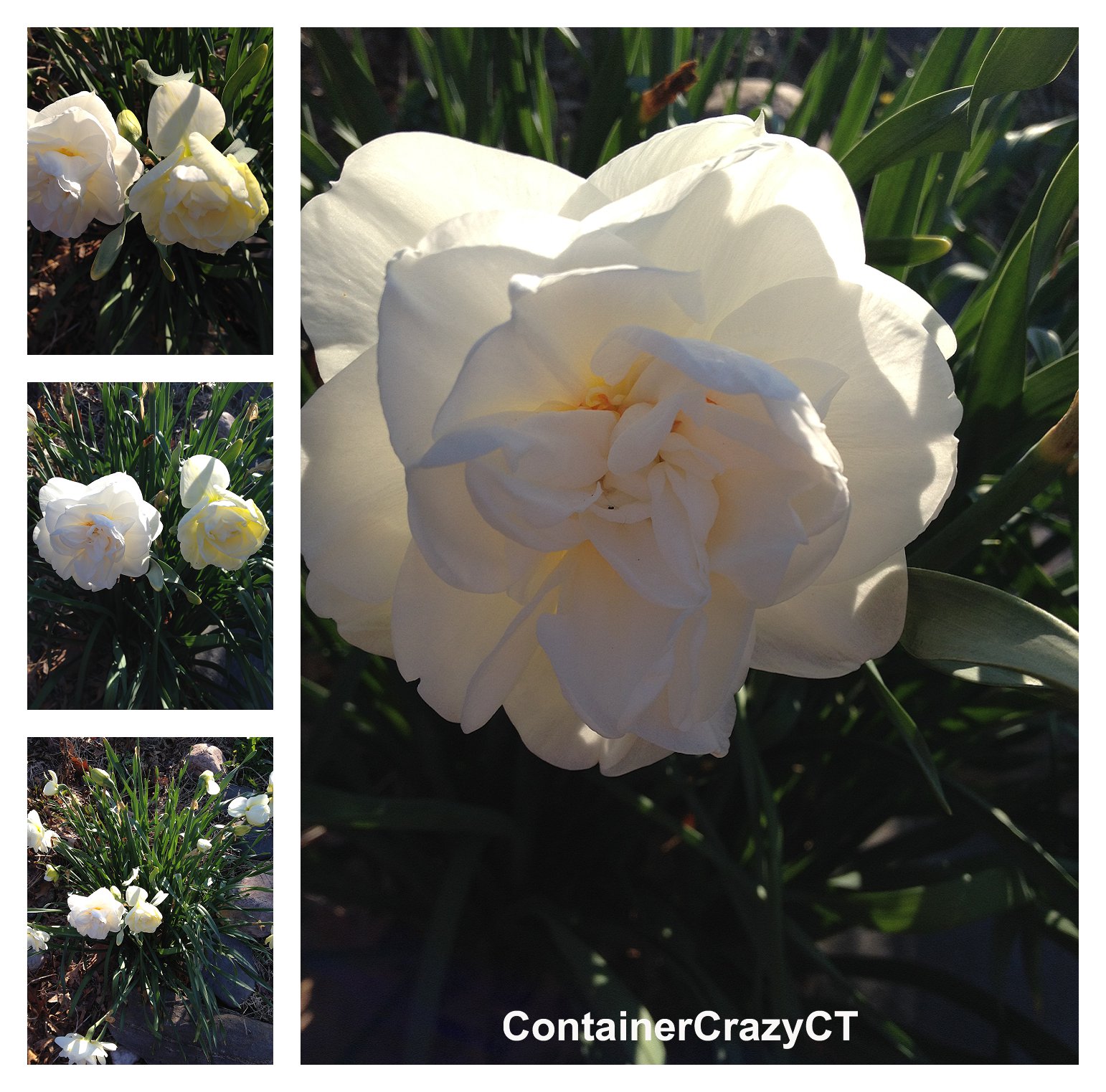
I couldn’t help but admire my daffodils around the coop.  I prefer the type of daffs with multiple flower petals.  Again, CRS, can’t remember the exact names of these types but they are just beautiful.  The healthy organic soil there is really making them bloom a lot this year.  And they don’t get eaten by varmints, unlike tulips.  I will have to remember to add more in the fall to this area.

Spring Plants_0027Another one of my favorite daffodils is this one – name, I’ll let you know when I remember!  But I bought the bulbs at a Connecticut Horticultural Society meeting several years ago and despite the location being clay, this one puts on a show every spring.  The soil is well-drained there however because this location is on a slope, not near my chicken coop.  The blooms smell lovely too!  I let the foliage of my daffodils stay on as long as possible after the flowesr fade so it can build up energy via photosynthesis.

Poking Out Slowly

Poking Out Slowly

First Attempts to Go Outside

The chickens poked out just a little but didn’t stay out – they are still testing the area and are hesitant, and it was windy so they may have been a little chilled.  However, it will be no time before they scratch and dig in the soil there for insects.  In fact, what was so funny was the minute I set them in the coop, they pecked at tiny insects on the walls – amazing – they were literally cleaning house.

My cat, Hunter, followed me to the coop this morning.  I didn’t seem him there, but he let out one of his big MEOWS.  “Get back,” I said – these ladies are your new friends!  I still haven’t named the chickens yet – right now, I refer to them as No 1, No 2, No 3, etc.

There are six of them, so I count them when I open the door to make sure they are all there.  Even though we checked every part of the coop walls, etc., there is this fear of a predator trying to get in to snatch them.  In fact, we plan to setup our outdoor motion sensor camera to see which predator shows up first to investiage.  I am sure they can hear and smell the chickens in the coops already.

Weeping Larch (left photo)

Weeping Larch (left photo)

Weeping Larch Coming Out too

On the left of the photo grouping above is a close up of a Weeping Larch (Larix decidua ‘Pendula’) located by my house entrance. Everyone who sees this tree usually points and comments on it.  It is especially pretty just when the needles start to come out of the branches.  It has a twisted curvy trunk and will grow rather large.  It may outgrow its space but I like it there for now.  I will show more on this plant later.

And on the right of this photo grouping above are more various perennials coming out of the soil now.  I managed to get to most of them to clean up any tattered growth from the previous year, so now they are ready for a mulch refresh.

More of the Helleborus

More of the Helleborus

Here is some funky garden type art I put around my pen.  My next step is to edge all the beds with low stone walls, planned this season.  It will look much better then.

Funky Art

Funky Art

More flower photos…

Spring Plants_0018 Spring Plants_0019

Spring Plants_0020

That’s it for now for my informal photo goofing around.  Enjoy your week everyone, and enjoy the rising of your perennials too.  It is time to come out and enjoy spring.

Written by Cathy Testa
http://www.ContainerCrazyCT.com
http://www.cathytesta.com
ContainerCrazyCT@gmail.com


The Unexpected Advantages of Using Boxwood to Make Wreaths

4 Comments

There is no doubt mixing various fresh evergreens cuttings, snips and tips makes a beautiful wreath or kissing ball.  It will add texture, color differences, and scents to your holiday creation – but using a single green, such as Boxwood, is also stunning because it creates a classic look and is easier to assemble, taking less time if you are in a hurry.  And using Boxwood has some other unexpected advantages.

Six Advantages of Using Boxwood:

  1. No sap = No sticky hands
  2. Elegant dark green color = Classic look
  3. Faster Assembly = No need to wire batches
  4. Lighter weight = Easier to hang
  5. Easy to re-hydrate = If dry after harvest
  6. Can be Preserved = Lasts forever

Minor Downfalls:

  1. No fresh scent like Pine or Balsam
  2. One of the more expensive greens to buy
  3. May yellow a tad over time if gets wet outdoors

Evergreen Creations_0035

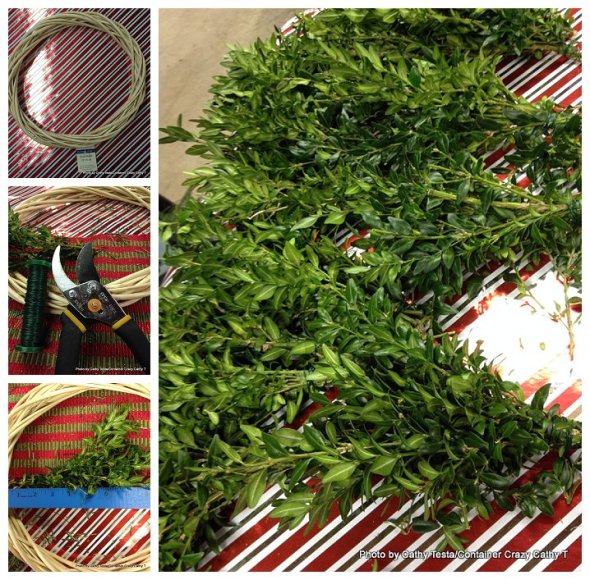
To make, you will need:

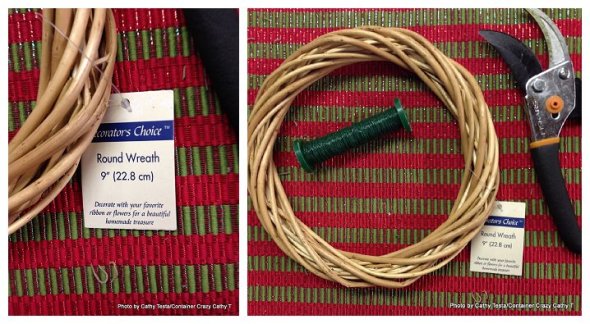
  1. Snips or pruners
  2. Green florist wire
  3. Boxwood greens (4-6″ cuttings)
  4. Wreath frame (13″ and 9″ used here)
  5. Ribbon (1.5″ width used) and ornamental decor
  6. Green zip ties (cable ties)
  7. Holiday background music (and perhaps a glass of wine)

Evergreen Creations_0025

Steps:

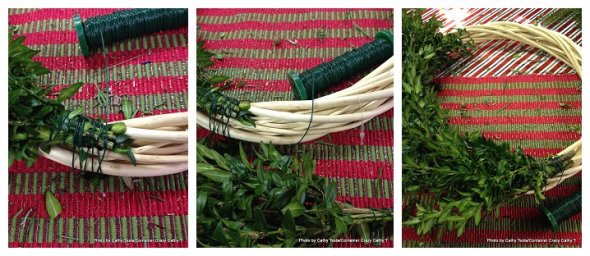
Prepare your batches of the boxwood greens first, cutting them at equal lengths.  About 6″ tips were used.  One of the other benefits, not mentioned above, is usually the boxwood pieces are full so you can easily get good cuttings of a decent fullness per each stem.  For the 16″ wreath, about 12-15″ pieces are needed.  The more you use, fuller the wreath.  It is easier if you get them all lined up a ready before you start attaching to the wreath frame.  For the 9″ wreath, about 8-10″ pieces are needed.

Evergreen Creations_0026

Wire the first piece of boxwood to your wreath frame with the florist wire.  Tightly secure to the wreath frame.  Once attached, move the wire down the wreath to the next position.  You may have to twine the wire between the first batch and second batch on the wreath, but this is optional.  It just makes the wire more smooth as you continue.

Be sure to put the next batch over the stems of the first batch so they are hidden well, and do not show.

Do not cut the wire as you work.  Keep the roll going as you move across the wreath frame.

Continue around the wreath, spacing equally each boxwood piece, and being sure to cover the prior batches stems each time.

When you arrive to the final batch where you started on the wreath frame, tuck the last batch under the first batch to hide the stems.

Evergreen Creations_0027

Back Side:

This part is optional, but if you wish to hide the back part of the wreath frame, preserved Spanish moss works well.  Heat up your glue gun and melt the glue on the back.  Attach bunches of the moss around the back side.  You could also attach felt, or some other decorative material.  Because this frame is not green, it showed up a bit but still worked very well.

Evergreen Creations_0028

Bow:

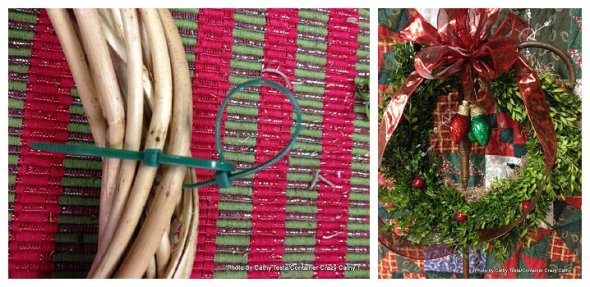
Attach a piece of ribbon to the top of the wreath (about 10″ long).  Make a bow and string the ribbon through one of the loops on the bow then pull tightly closed to attach the bow.  This will attach the bow, and create a place to attach a hook on the back.  You can either attach a hook to the bow ribbon on the back side, or attach a hook by using several zip ties.  The hook can be attached in the beginning or at the end – because sometimes you will find one position of the wreath looks best after it is finished.  Or if you have a place where it doesn’t look full, you may want to position the bow there to hide it.

Evergreen Creations_0029

Evergreen Creations_0032

Decor:

Go crazy or simple.  For this wreath, some simple weather proof small decor apples were picked in and a dab of hot glue was put on the back side to secure each apple.

Cluster glittery ornaments right under the bow to hang in the center.  Use a zip tie or wire to attach them to the base of the ribbon.

Because the Boxwood greens are a nice dark green, bright red looked amazing against this dark green color, so a bright red ornament was selected, along with two green ornaments.  On the smaller matching wreath, only one red ornament was included.

Evergreen Creations_0030

Matching Wreath:

A second smaller wreath was made to match the first.  This will be adorable for the recipient of these wreaths.  And because the Boxwood greens is simple, having a second smaller wreath adds that special touch.

Evergreen Creations_0031

Evergreen Creations_0033

Re-hydrating or Preserving Boxwood Greens:

If you have harvested your Boxwood greens and they appear a bit dry, you can rehydrate them by soaking in water for about an hour, and then lay them out to dry on towels.  Do not assemble the greens when wet – this will cause rot.

And did you know?  You can preserve boxwood greens!  Here is a link on the technique:  Preserving Boxwood Greens by CraftingRebellion blog.  Also, boxwood can be treated with Wilt-pruf to reduce drying of the greens prior to assembly.

Written by Cathy Testa

Evergreen Creations_0034