The Best Greens to Use in Holiday Wreaths

Leave a comment

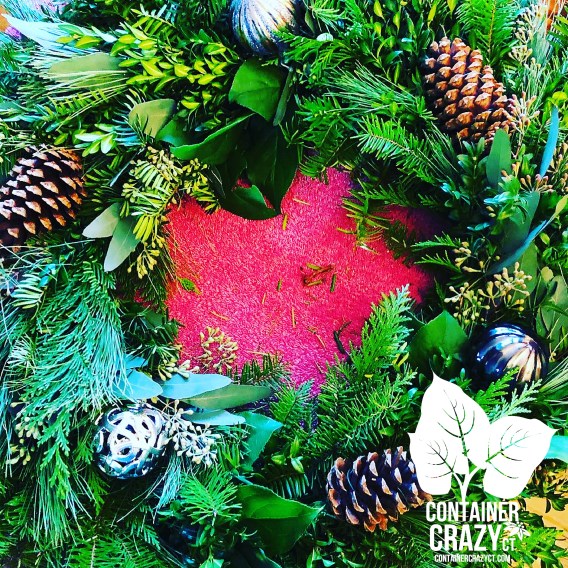
In my opinion, there are some greens which are better than others, but what really makes a wreath absolutely beautiful is using a “mix” of fresh greenery in the holiday wreaths.

When I first started working with fresh greens, I had no clue how to prep them, what they required to store well prior to creating wreaths, and which would be best to use.

Fresh greens will dry out thus getting them too early is not a good idea, so the timing is key. Like almost anything in the horticulture world, your items are perishable. I always waited until right after the Thanksgiving holiday to pick up my green’s orders to start making custom wreaths.

In order to reduce the loss of needles or drying out the greens, they must be stored in cold temperatures in boxes or some in plastic. Some of the boxes should be lined with plastic, while others are stored in boxes coated with wax inside. In general, all greens of all types gathered for holiday wreath making should not be exposed to winds, harsh sun, or even cold cement floors, which can draw out moisture. Some kinds may be laid out on tables, but key is storing them in cold and dark inside locations until ready for use.

Some greens, if a bit dry, may be rehydrated by cutting stems and setting them in vases or buckets of water, or even dunked in buckets of water, but some should not be treated that way. Others I would sometimes rinse with water from my hose outside in wagons, or let the snow fall on them in my driveway as they sat in wagons for a bit of moisture exposure, but then other types of greens should not get wet. If stored wet, they can turn yellow or rot. It depends on the type of greenery.

Learning how to handle the greens and which looked best and worked well in wreath making was something I learned by researching, experiencing, and testing various greens from balsam fir to berried juniper. I always took notes each year on how well the greens held up and would notice which performed better than others.

In this post, I want to share some tips with you on how to best prepare and use various greens in your wreaths. I will go over 15 different types in a series of posts. As I mentioned, I loved using a wide mix of greens to have full, fully, and textured creations. The contrasts of greens and various textures made the wreaths absolutely beautiful.

Let’s begin!

Holly

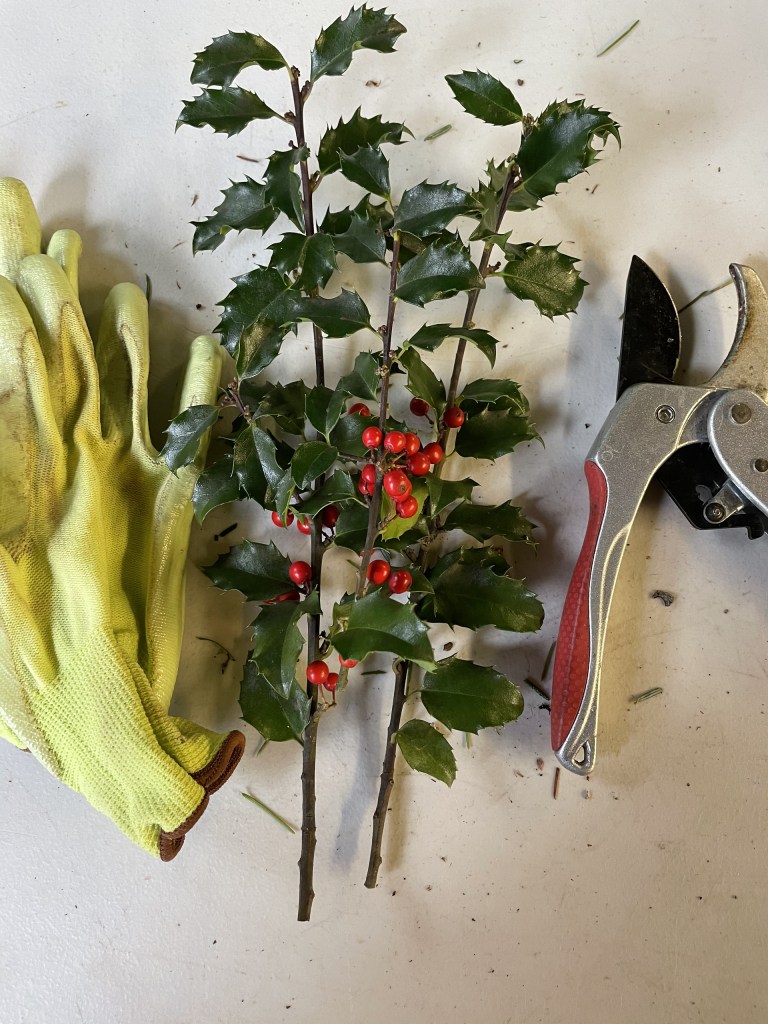
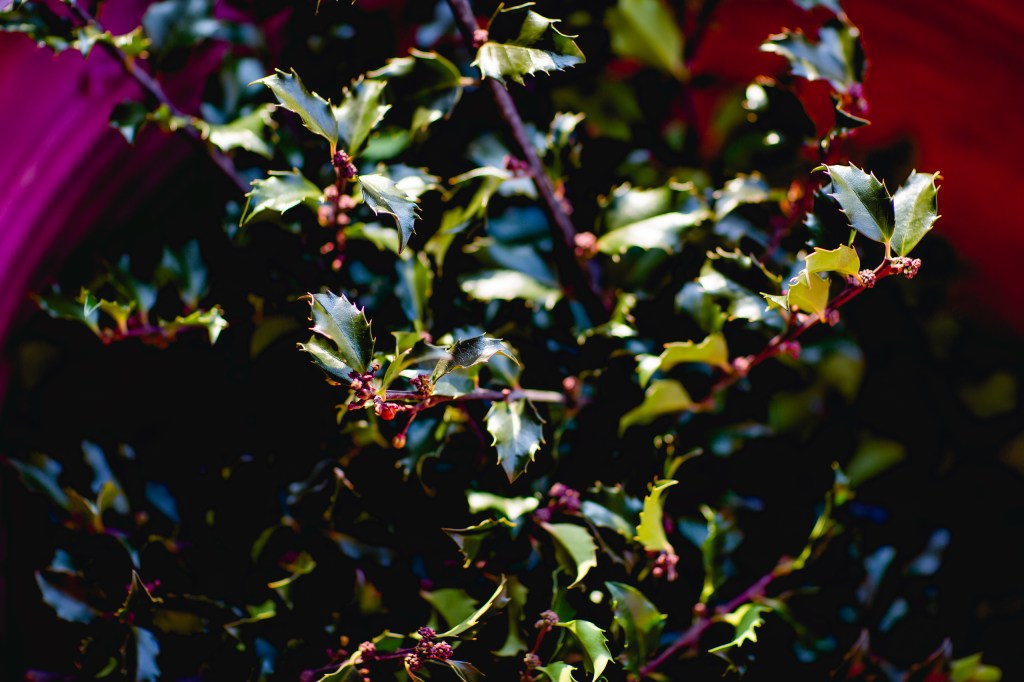
Evergreen holly is no doubt one of the type of greens people love in their holiday decorations. Their attached bright red berries stand out and they are the essence of Christmas memories. However, one downfall of holly is that it will turn black if wet and hit by frost or freeze. And handling them repeatedly when making wreaths can be painful due to the spiny edges of their leaves. However, holly is easy to insert into wreaths, sturdy, and provides a nice deep green with the red berries to the wreath with the mix of other tones of green colors, but holly is not super full or fully. That is fine, but just something to note about using holly. If it doesn’t get wet and frozen, it will last a very long time in a wreath until it kind of dries out. When they do dry out, however, they still retain the leaves on their sturdy stems for a long while.

Holly bushes, (Genus Ilex), are simple evergreen plants with dark green leaves and there are many cultivars available in our part of Connecticut to plant into your landscape. Many people have evergreen holly shrubs or trees readily available to prune from for their Christmas decorating from their own yards or landscape beds. But take note, these shrubs can suffer in the landscape from winter dry out from winds or water-loss when the ground is frozen, but otherwise, they are relatively easy to grow, taking part-shade or sun locations. And they can get rather large over the years too.

Every year, two of my friends offered to come take cuttings of their holly shrubs for my wreath making but I also ordered holly from a supplier too. I have a neighbor who generously offered her big, huge holly shrub to take from. It was gigantic. I’d quietly walk over with my wagon and pruners to take cuttings. It was always a type of annual pre-holiday ritual.

Her yard has lovely plants in her various gardens, and it was nice to take long holly stems with red berries and load them into my wagon. I was sure to do this only about 3-4 days before my wreath making workshops to have the best freshness. Sometimes, I would see a praying mantis case attached to a branch and leave that one be. Her holly shrub got rather large over the years where the top was not reachable without a ladder, so I never was able to get that high to cut them. I always methodically thought about taking cuttings to improve the outer shape and form of the plant. It was generous of her to offer cuttings.

My brother also offered to stop by his holly bushes one year to take cuttings for my workshops. He has a rather large expansive open back yard. The sun was shining on me that day when I went as it was a beautiful blue sky cold day. His holly shrubs are on a little slope. I sat on the ground taking cuttings. No one was home and it was a quiet, brisk, and sunny with a slightly cool air about. I remember thinking how wonderful his property was. Serene, quiet and peaceful. After I was done getting cuttings from his hollies, I laid on the ground next to the shrubs on the slope and faced the sun and sky above and felt the sun’s warmth on my face. There was something magical about my harvesting adventures.

Pruning evergreen hollies in the fall or winter however is really not the best time to do so. It should be pruned in the early summer for your typical landscape maintenance routines. Pruning them in winter exposes the stem’s ends to cool temperatures but only taking a limited amount in the winter didn’t detrimentally impact the shrubs. In fact, if my own hollies in my yard get out of shape, I wait to take top cuttings before the holiday wreath making process for my wreaths, or to gather to put in vases as holiday decoration.

If you decide to plant some evergreen hollies in your landscape, be aware that “some” types of holly plants require a male and female plant to set the beautiful red berries. If you decide to plant one for the first time, inquire about this at your local nursery. Female hollies produce the red berries and I believe you probably need only one male holly shrub to achieve success. Another consideration is pets, as some say the red berries are toxic to pets. I never had this issue here cause my adorable cat does not touch my plants but be aware holly berries can fall off and even leave a red mark on your hardwood floors if they get squished when you happen to step on one.

As I noted, the only downfall to holly is the leaves can turn totally black if wet and hit by frost. So, when you store them in a box with plastic, be sure you are not storing them wet. Freshly cut, when possible is best too, so you reduce the time is no longer attached to a shrub or tree and starts to lose some moisture. And storing them in plastic enclosed in a box is best done when the holly is cold. Loosely store them in the plastic too. They do not have to be tightly packed, but always in a cold room. An unheated garage is perfect.

In my workshops, I referred to holly as a specialty green to use in our wreath making – one to use as an accent in your creations. One year, I obtained a variegated type of holly with green and white leaf margins from a supplier, it was amazing, and I just loved it. It was so beautiful. It provided a more professional look to the wreaths, and it also felt and looked luxurious, at least I thought so. However, it was fairly pricy and not always readily available from the supplier, so if you decide to plant a shrub, consider the variegated types as well.

One last thought, I have read that holly is ethylene sensitive. If exposed to ethylene, the leaves and fruit will fall off. I never had to worry about that much. Ethylene is produced from some types of ripening fruit so businesses storing fruit or ripening produce with plants must be aware of this sensitivity. If you are running a business and holding holly with other plants or fruits, there are products out there to treat plants for this. I remember a grower talking about this when we went on a field trip during my college days. We walked into a huge freezer or maybe it was a fridge and he talked about the concern of ethylene. People in the floral industry are also those who are probably ethylene experts but for homeowner harvesting plants for wreath making it is most likely not an issue to worry about.

Overall, I did not have issues with harvesting, prepping it, or keeping any type of evergreen holly cuttings and stems fresh for my holiday making workshops. It was a bit pricier though and since we used it only as an accent, I started to remove it from my list of the 15-20 types of greens I would obtain. Often times, workshop attendees brought a little of supply of their own holly cuttings to use. Fortunately, as mentioned above, it is an easy type of evergreen shrub to obtain from our local nurseries. Sometimes I wish I had the forethought to plant all the types of plants used in wreaths in a big field and we could have a harvest party for the holidays! I have quite the imagination.

Stay tuned for the next post on the next greenery on the holiday list!

Thank you for visiting.

Cathy Testa
Located in the Broad Brook section of East Windsor, CT

High Rise Gardening

5 Comments

Back in 2019, I received a voicemail from a gentleman, and he was looking for a gardener for his balcony. I immediately felt a certain tone in his voice. Something about the phrases he used and his professional manner in his voicemail to me made me feel this would be a call worth returning. And, my friends, it was.

It led to quite the adventure of planting not only one but two high rise balconies for five years, located on the very top floor of a building in Hartford, CT. It’s a good thing I do not fear heights, because if you did, you would not be able to look over the railing at the scenes far below. It can make a person with a fear of heights queasy.

There’s something special about working in a high-rise urban situation. The background city sounds are constant, but they are not the typical sounds I hear at my home, which is filled with birds and maybe a slight sound of road traffic. On a high-rise, you hear sirens, distant constant highway background noises, an occasional high-flying hawk, and air sounds. I liked that. It is not overpowering, just there and didn’t bother me. In fact, because I have tinnitus, I rather liked the background city sounds. It drowned out my tinnitus and also the enjoyment of working in this special place, made me not focus on tinnitus either! Plus, the views were enough to not even think about the background noises.

I also liked how you are up there overlooking the world, and no one knows you are. It is a really neat and inspiring situation. One time, when working on their planters, two helicopters flew right near there, as if a pair flying together. I thought, can they see me here, and I even wondered if it was the president. I had read he visited an area in CT that day.

And after a few rounds of plantings, I started to see bees. Usually, a solo one or two. One time, the client heard a tree frog in the planters. They could not locate it, but they were amazed, and so was I! He either hitched a ride on one of my nursery pots, or could it be possible he climbed up that high?! The balconies are 38 floors up! I always liked pressing that PH button in the elevators, I have to admit.

I thought, gee, I so wish I landed this opportunity when I was younger. I was very excited to work for these clients and their balcony gardening projects, and yes, it was all very large planters the full length of the balconies. Fortunately, they referred me to another couple in the same building, so had two wonderful sets of clients and wonderful planting scenarios.

Probably the best part of it all was the upmost appreciation for my planting work and craft by these clients. I was told often that I was an artist. Can you imagine how that felt? It was wonderful and meaningful to me. And their flexibility, as they fully understood this planting situation is unique and has special challenges. They were always, always polite and understanding because things unexpected can happen on a high-rise situation with plants. I knew it would be challenging yet extremely fun and rewarding for a plant person. Plus, I liked their style. Both had their own unique style, and it was fun to think about how to best meet their needs in that regard as well.

Working on a high rise has many challenges. Try – no water sources outside. Extreme winds that will shred plants. Cold temperatures when I did winter installs. And in the summer, extreme heat. I had a lot to learn and research. And, not to mention, going up and down constantly in an elevator. I am lucky I am a thinker about organization because you have to organize all to be efficient in those situations. And I got to witness how plants respond differently in a high-rise balcony situation in planters, pots, and spaces. Plant colors are different when experiencing extreme heat, they grew to amazing large sizes in some cases, which blew me away. I would plant a small herb and it would reach the size of a shrub by the end of summer. It would shock me sometimes, like wow, they love this sunshine and heat! I read somewhere you could not grow tomatoes on a high-rise, NOT! You sure can and they were wonderful.

I thought it would be a great idea to talk about the plants which worked well in these situations and what didn’t work so well on a high-rise. And write about my high-rise balcony gardening adventures. I actually had trouble finding good books on balcony gardening. I could write one of my own I guess, but I choose to use my blog, here on Container Crazy CT, to write about scenarios I encountered in a series of posts.

It begins today!

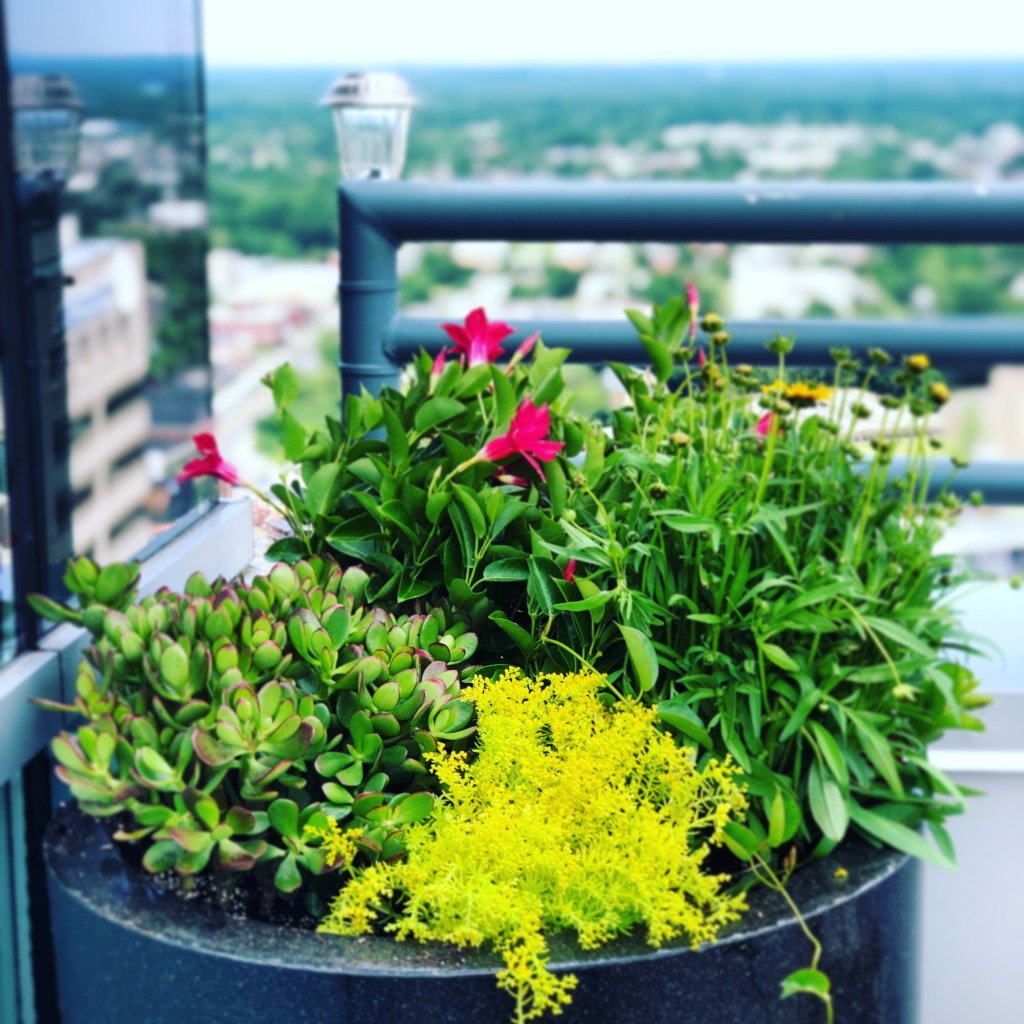
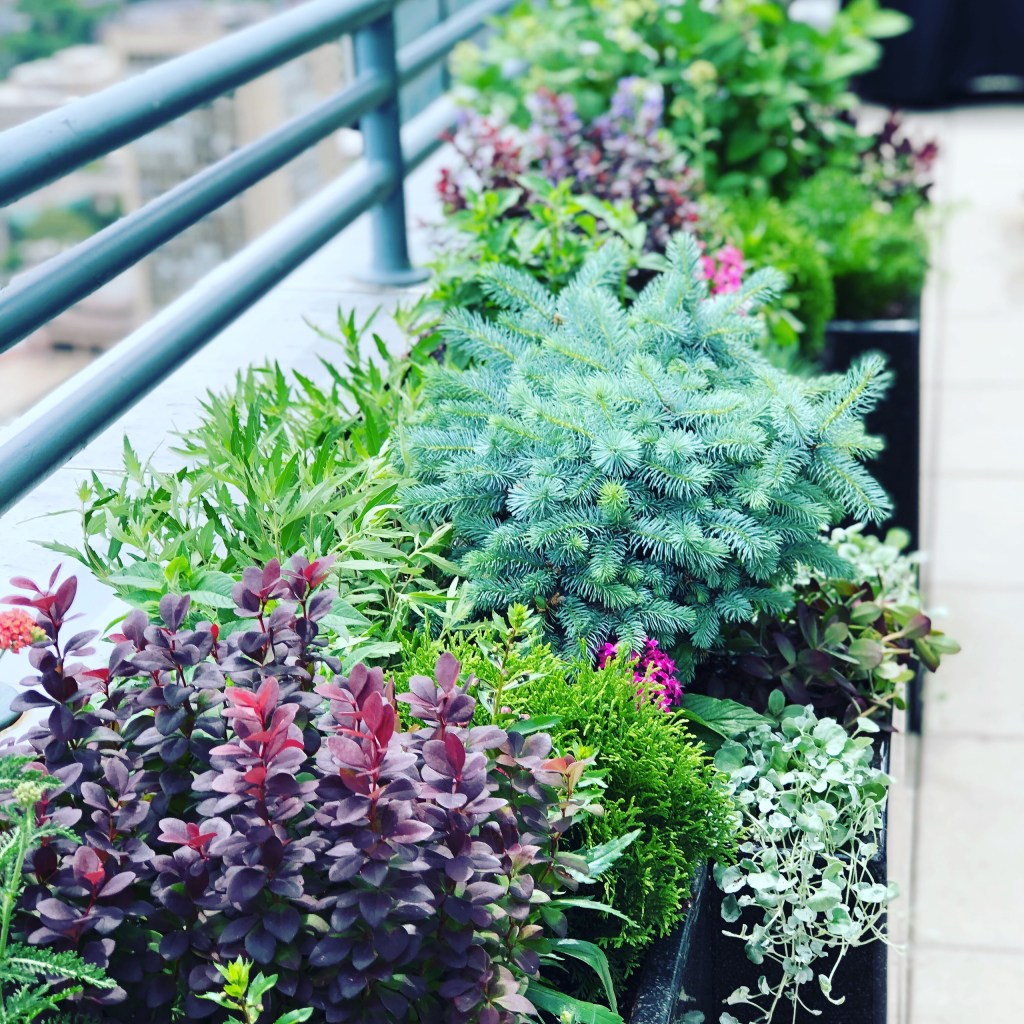
Sneak Peak of a Row of Big Square Planters
A tapestry of succulents in long square planters – Loved how this came out in year one!

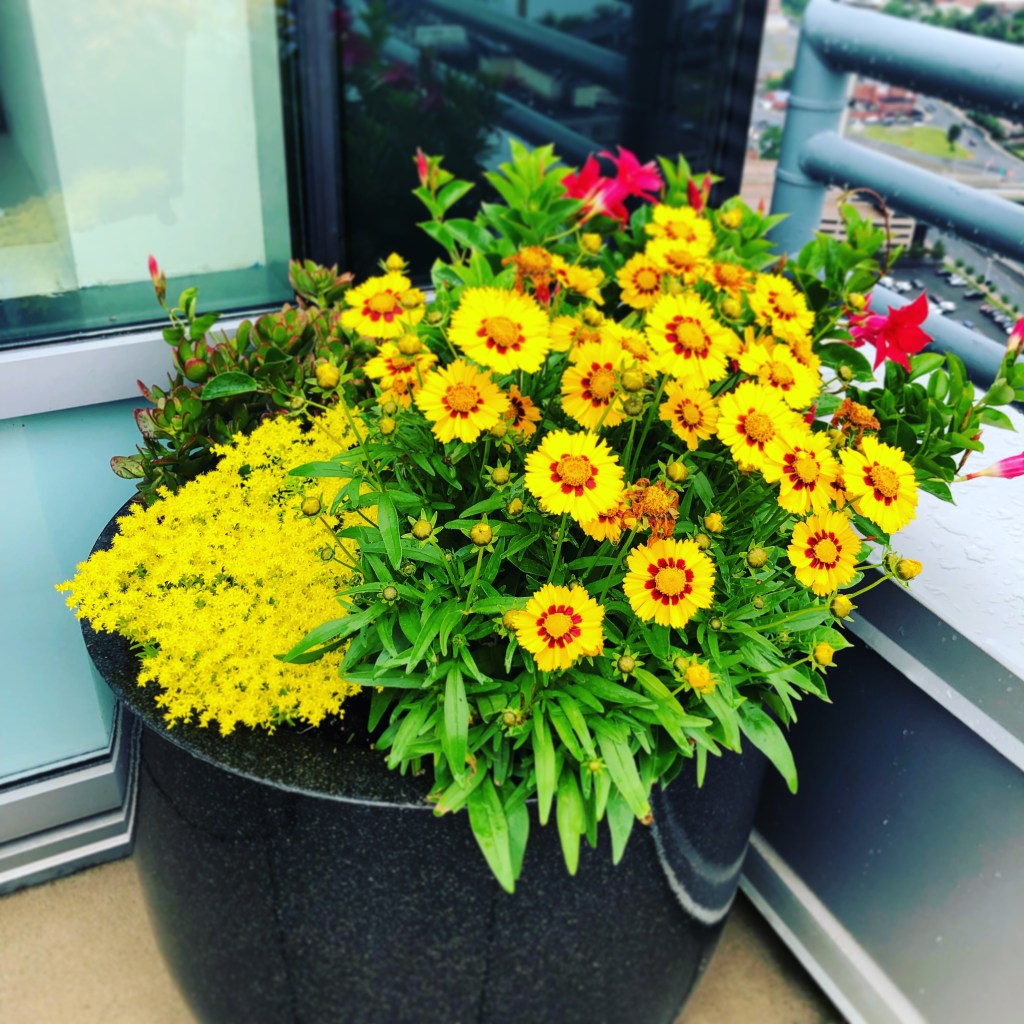
I’m not sure exactly where to start but these two images above are sneak peeks of two of the many planters. The first is client number 1 and after much thought and questions, I ended up putting together a mini garden and I loved how the deep plums accentuated it. And for the other photos, it was a mix of succulents. Some grew two to three sizes larger in one summer. It was amazing. I will write about these and many other planting arrangements as I do my series of posts upcoming!

More later!

Cathy Testa
Container Crazy CT
Date of post: 9/12/2023
Location of Photos: Hartford, CT
My Location: Broad Brook, CT

Growing Pumpkins – Round Two

Leave a comment

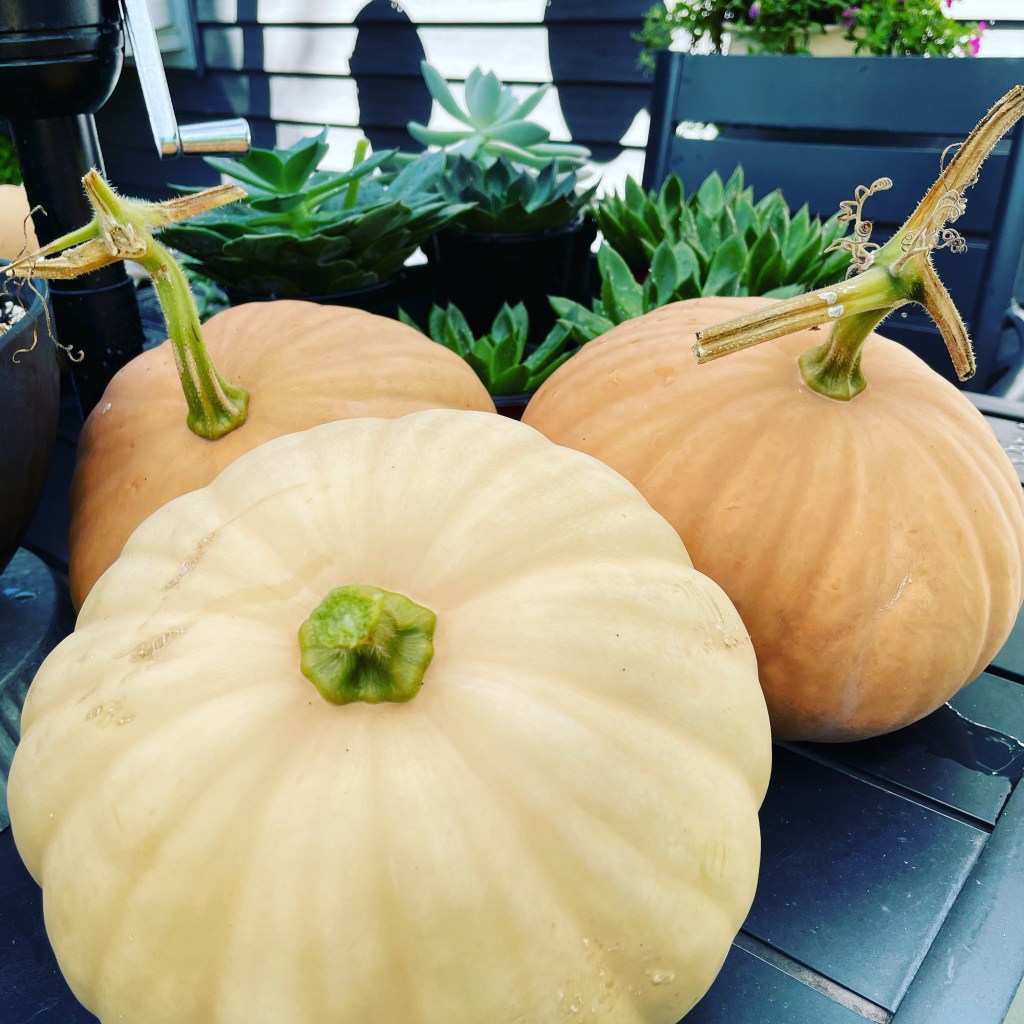
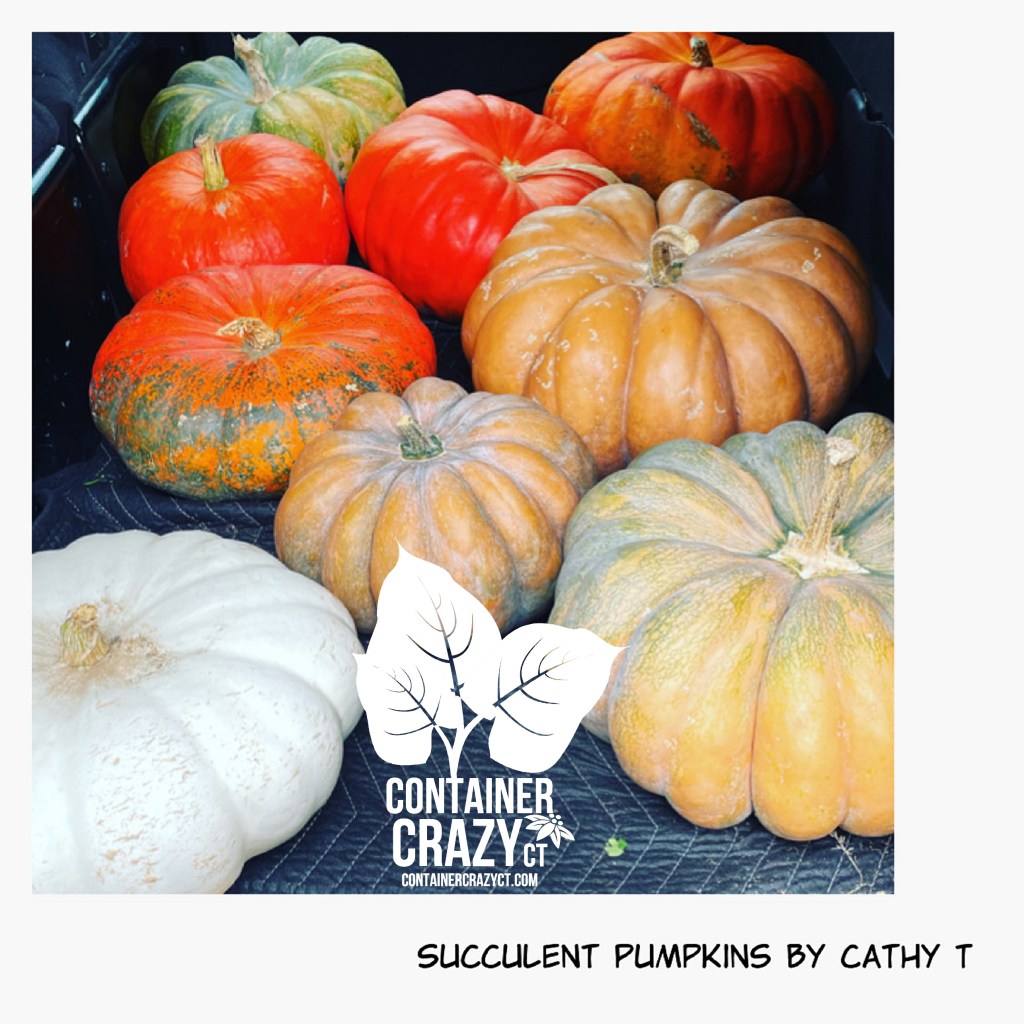
This is my 2nd year trying to grow some Long Island Cheese Pumpkins and I started them a bit too early again. They were ready by mid-August, and I’d prefer them to be ready by mid-September. Anyhow, they are just fine sitting on a table with no blemishes and curing for a week or two in the sun. I use them primarily to decorate for autumn but maybe I’ll get into growing more of them next year as a food source for winter soups and Thanksgiving pies!

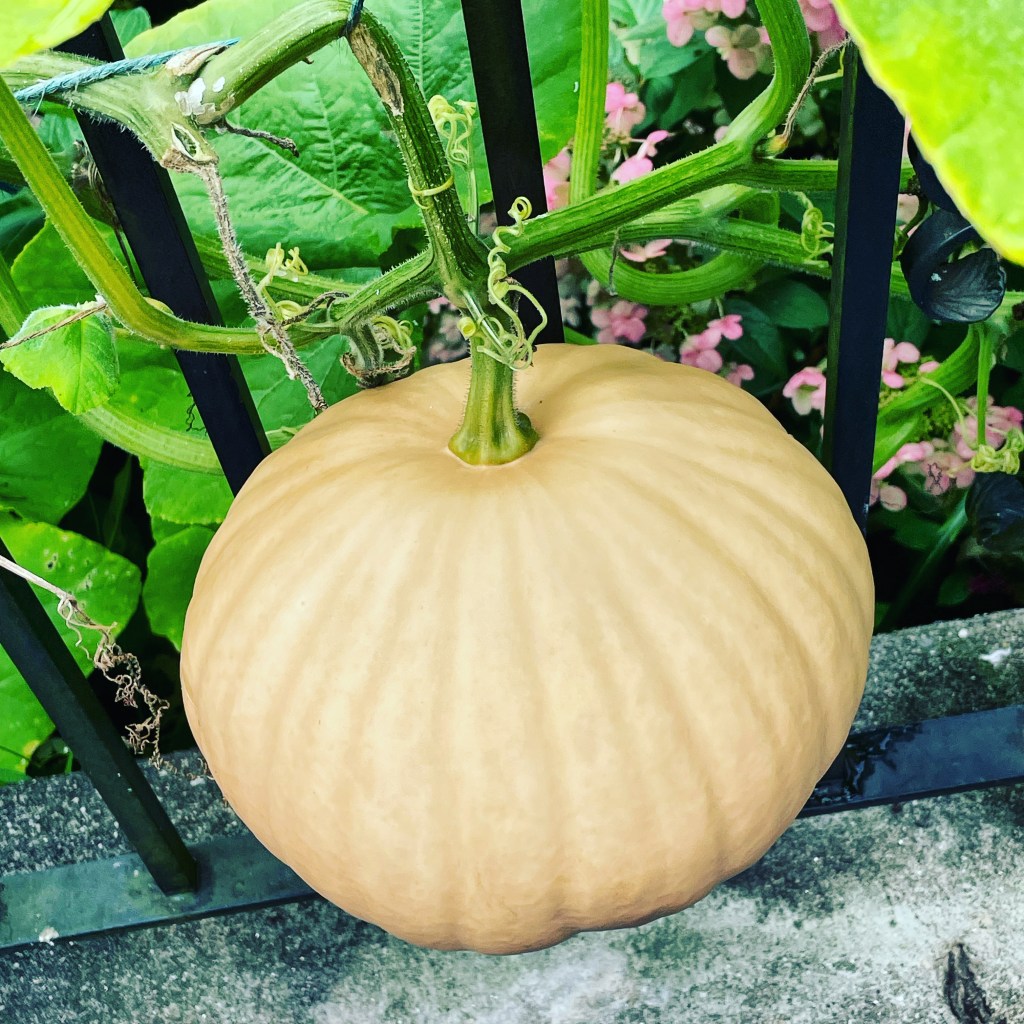
The Long Island Cheese Pumpkins resembles a wheel of cheese in shape and the color is very pale compared to ordinary orange pumpkins, but I like these for the shape. The seeds for these may be directly sown into a garden or large pot or started early indoors. I started these indoors in early to mid-May of this year, and last year, I had started them indoors in mid-April. It seems early May was still a tad bit too early. So, a new date is noted for 2024.

Because squash, which this pumpkin is technically a squash, grow really fast, they should not be started earlier than 3 weeks before spring frost. It takes about 98 days till they are ready. Anyhow, if they arrive earlier than your needs, just let them cure in the sun for a week or two. Cured squash will store all winter. They are pretty cool in that regard. And because they last a long time, they are perfect for the succulent topped pumpkins I usually make to display in the home thru Thanksgiving time.

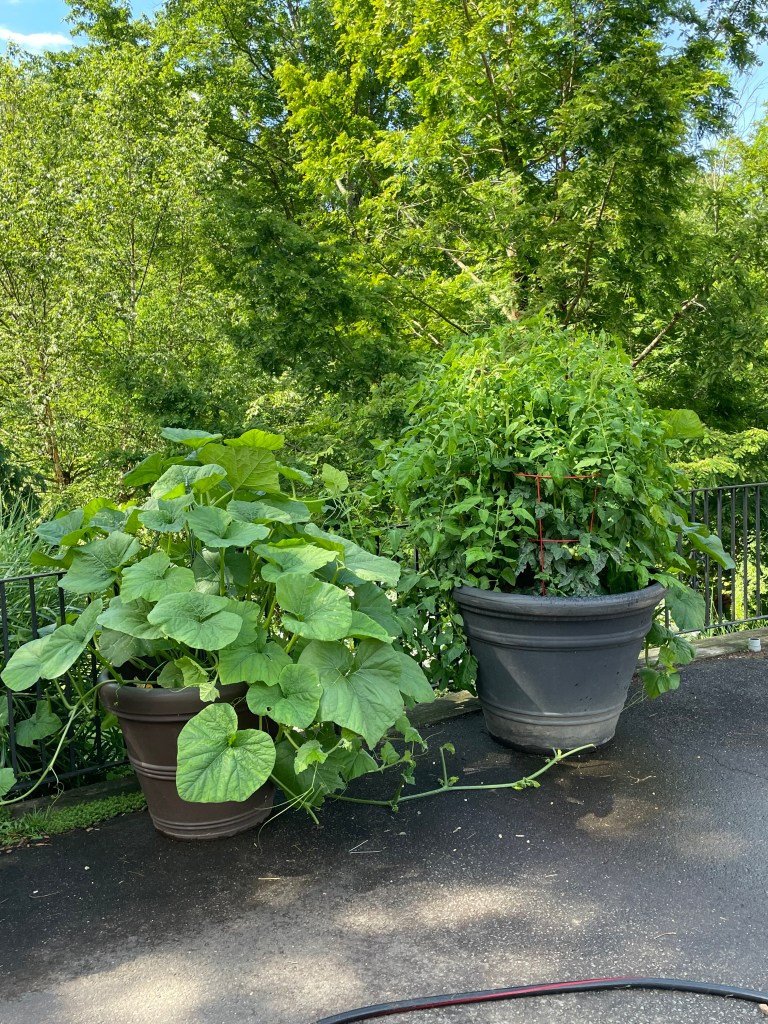
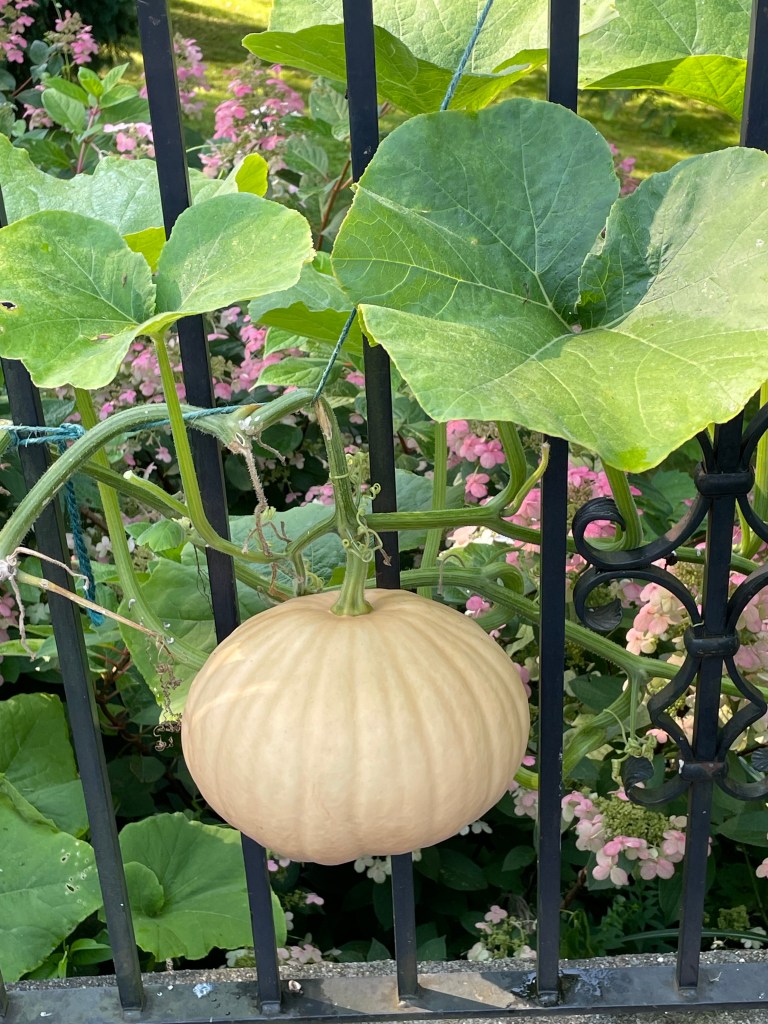
This year, I grew them in two places. One in a super big pot on my driveway and one in a large square planter on my deck. The one on the driveway worked out well because I take garden twine and help them run up the twine along a wrought iron fence. The tendrils quickly grasp on various places on the fencing, and they hang on. By having them on a twine like this, the pumpkins do not touch the ground so there is less chance of any rotting from sitting on a wet surface and no blemishes. Also, no animals messed with them. That could be because they were somewhat hidden by a background of other plants.

The one on my deck sprawled out on to the deck floor and then I let it hang over the edge of the deck. I got only one pumpkin on that one, but it was cool to see it hanging in the air, so I helped it stay put by using a hanger. Anyhow, the one on the driveway got 4 pumpkins. I’ve been just kind of experimenting and having fun with them. As I learn, maybe I’ll get into growing more next year.

One of the nice benefits of pumpkins is their huge beautiful yellow flowers – which the bees absolutely adore. Some mornings, I’d find up to 4 bees in one flower buzzing away. If you want to help pollinators, plant some pumpkins!

Pumpkin on the left (tomato plant on the right)
Pumpkin hanging from deck above.
Sitting on a table to cure for a couple weeks.

You can see the color difference in the last photo above. I kind of determined when to pick them by the firmness of the rind and also looking at the stem, but I was somewhat guessing too. Plus, the plants started to look a little worn, so I figured it was time to cut them loose around mid-August.

I watered the plants regularly with generous amounts of water, but I did not fertilize except one time with a liquid feed. The soil had compost in it in the pots. The plants prefer full to nearly full sun, and the one on the deck didn’t get as much sun as the one on the driveway. Oh I said the animals didn’t bother the pumpkins, but some of the leaves got munch off once, maybe by a brave rabbit. Brave because my cat is an excellent rabbit hunter.

I plan to do more research on pumpkins because for some reason I’m interested in them! Maybe because it seems they don’t get bothered much if provided a safe place to grow. Wish me luck for next year – I hope to have more harvested.

Have a good weekend,

Cathy Testa
Broad Brook, CT

Possible Pockets of Frost in CT and Mass 2023

Leave a comment

That is what two televisions station weathermen said last night (5/9/23), that we may get “possible pockets of frost in some areas” of Massachusetts and Connecticut.

If you look at my prior posts and some from past posts about when to expect our last spring frost date, I always use May 12th. The possible frost in some areas of CT (and MA) was announced for last night.

I am not going to count my chickens before they hatch, but this could mean we are fairly safe to put out warm season annuals, at least during the day, like Petunias.

Tomatoes and peppers wait till Memorial Day still for me – but it is a great time to harden off plants outdoors that you have started indoors from seed to acclimate them to the sun and temperatures gradually – remember shade first for those baby seedling starter plants and gradually into the sun every day for a few hours, back inside at night. If you put them directly into sun, the leaves will get sun scald/burn, and you will see white patches on the leaves the next day. And avoid windy days as you harden off plants.

As for the tropical plants, I still wait on some, like I won’t put out my Mandevillas yet, but other plants are going out! Yippee. Oh, and I don’t put out basil yet either – they like warmth like tomatoes or peppers do.

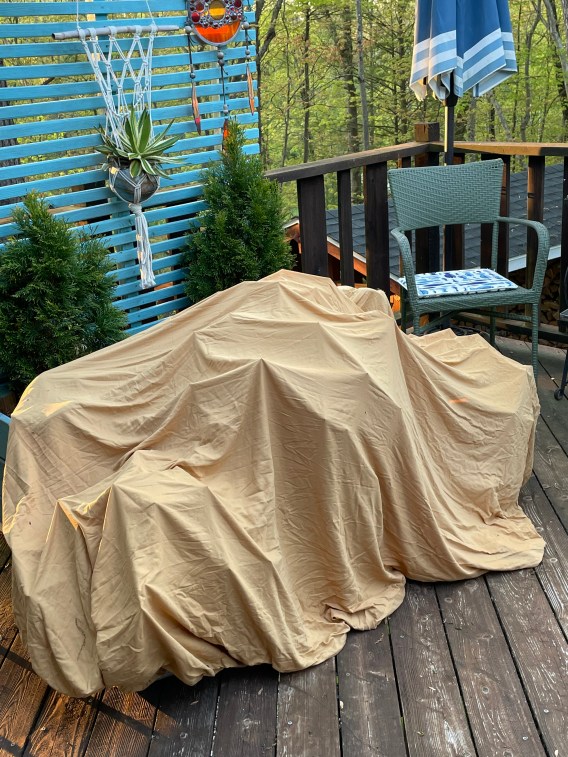
Last night, I used a bed sheet to cover up some Yucca plants which have been in pots in my greenhouse all winter. They are hardy but they were inside all winter, so with every plant I take out of the greenhouse, I introduce them to shade for a couple days first or dappled sun, then move them into full sun if they are sun lovers.

All the deck furniture is out – the patio umbrellas are out; the cushions are out! Just waiting to glam up all with my plants!

Hope you are enjoying this fantastic weather this week. (P.S. I saw a couple hummingbirds this week, so I put out the feeders too.)

Cathy Testa
Broad Brook, CT
Zone 6b
Container Gardener
Date of this post: 5/10/23; Wednesday
Potential Frost Pockets: 5/9/23, Tuesday evening

Light Bed Sheets are perfect for a little protection when the weatherman announced a potential light frost in springtime overnight.

How Many Days Till Thanksgiving

Leave a comment

I’m sure everyone knows how many days till Thanksgiving 2022! We are looking over menus, inviting friends and family to gatherings, and feeling the chill in the air to signal a new holiday upon us soon.

For me how many days till Thanksgiving is important because I start making custom holiday wreaths and kissing balls, some fresh made garlands, and other holiday gift items starting the weekend of Thanksgiving. So, we have 2 weeks to go before getting to my “start date!” for orders.

There’s quite a bit of pre-planning, such as reaching out to those who routinely order from me, posting various photos, wiring ornaments ahead (to save time while making wreaths), maybe spray painting some items for some outdoor holiday installations, or measuring various items, and checking the stock of my inventory needed is a big task as well. Do I have enough wreath frames in different sizes, florist wire, and other items needed to create? Remember COVID year, things were in low supply. I don’t think supply issues are as big but they do impact costs that continue to rise. Cost rising means more planning and careful to not over do things, which is tricky if you love to decorate!

Also, I usually make some special trips too to sources to find unique ornaments, ribbons, or decor to use – but restraint is also required because, not to be a broken record, but we all know prices of practically everything has gone up. As my SIL said recently, “Can you believe even celery is expensive?!” Yes! I can! However, I can not resist making beautiful wreaths with a mix of greens – everyone needs to at least have a wreath to adorn their door, mantels, or outside windows, you name it.

My wreaths come in various sizes from small, standard, large, and deluxe sizes. Usually, standard is a popular choice for folks, and standard or large sizes fit well on doors. I try to use color choices desired, but this year, I have to say with the rise in prices of greens to ribbons, I will be using standard colors mostly. There are some exceptions for special orders, etc. I do the best I can for everyone. And all is made with fresh greenery.

I also offer “boxes of greens” if you wish to make your own, and also make large kissing balls custom made. Fresh greens are great for your outdoor pots, window boxes, or to adorn a railing inside the home.

To inquire or learn more visit me at:

http://www.WorkshopsCT.com (posts by products there)

Instagram under my handle of “Container Crazy CT” where I post lots of pictures.

SmugMug Galleries (Click on HOLIDAY FOLDERS CATHY T) to see various galleries of past and present holiday creations.

Facebook under my handle of “Container Crazy CT

Hopefully, I will hear from you soon!

My Holiday Orders’ list has started to grow!

Cathy Testa
Container Crazy CT
860-977-9473
Located in Broad Brook section of East Windsor, Connecticut
containercathy@gmail.com

Storing Corms, Tubers, Bulbs, Rhizomes for Winter

1 Comment

This year I’m trying a new method for storing my Alocasia corms (sometimes referred to as bulbs or tubers, but they are not true bulbs). I have seen Alocasia corms referred to as “tubers” in many garden reference and technical books, but for the purposes of this post, I’ll stick with corms as the term used for these Alocasia plants I am putting away for the winter months in Connecticut.

Bins Years Prior Used

For years, I stored the bases of underground parts from my elephant’s ears and canna lily plants in plastic bins with covers (air holes drilled in the covers) with peat. When I say “parts”, I’m referring to corms for the elephant’s ear (Alocasia and Colocasia) and rhizomes for the Canna Lily plants).

The peat (only a small amount below; used almost like a bed below the corms/rhizomes, and some peat lightly sprinkled over the tops of the corms and rhizomes) helped maintain a bit of moisture but kept the tubers in a dry but not too dry or too moist state.

However last year, some of my Alocasia corms had rot areas on them when I went to take them out in the spring to start growing again. They were too damp. Plastic bins will hold onto some moisture (versus a dry cardboard type box) but this problem of rot really had never occurred before. Since I want to make sure I am able to save these dramatic large Alocasia plants’ corms, I’m trying this new method this year.

Dug Up about a Week or few days prior

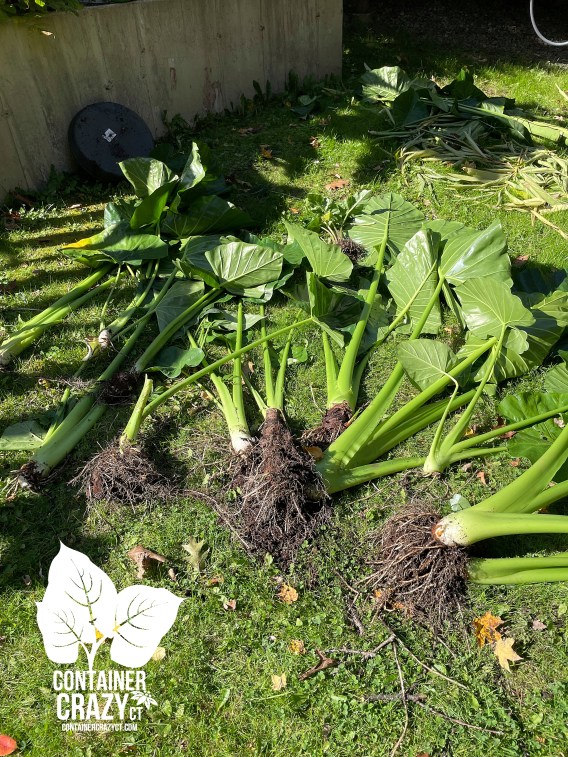
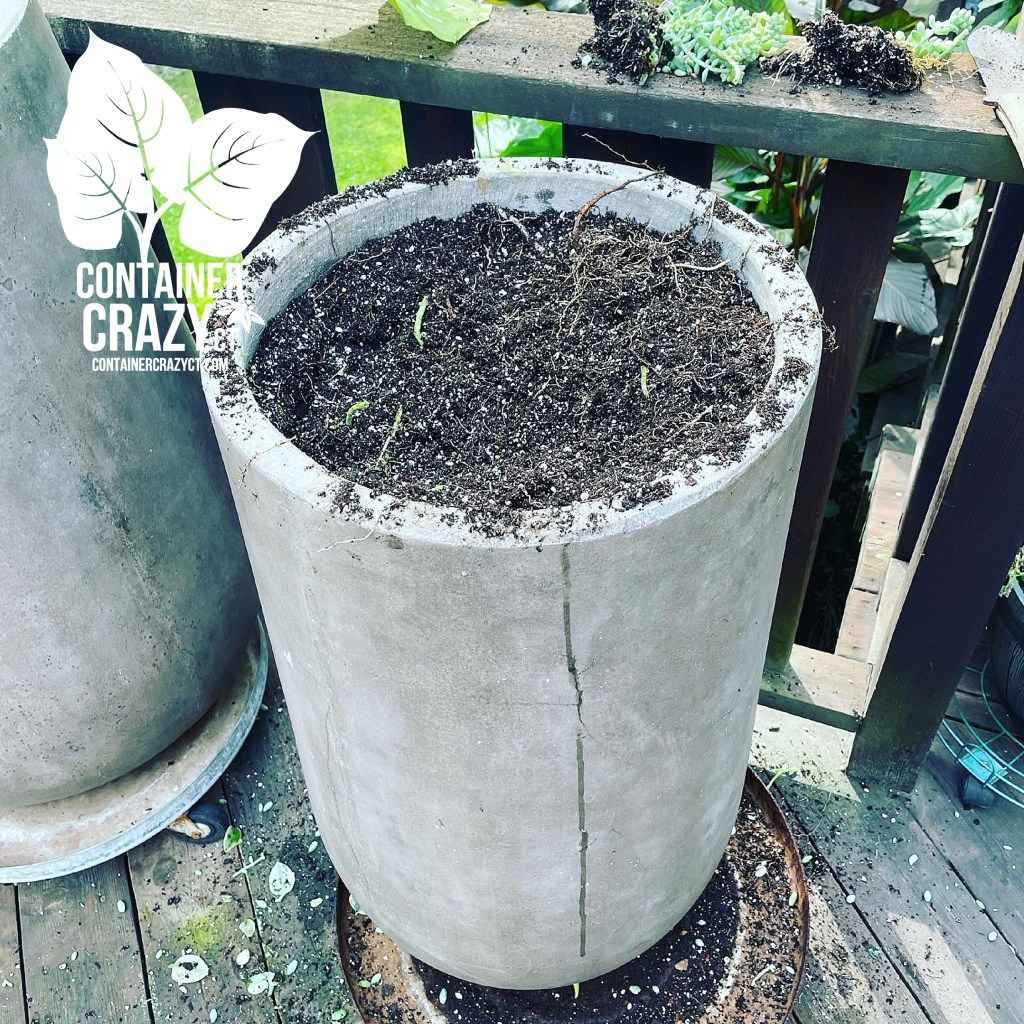
In last week’s post, I showed how I dug up the Alocasia plants from a huge cement planter, cutting off the foliage about 4-6″ from the top of the corm area, and laid them out in the sun for one day. Then I moved them to my basement in laundry baskets.

I also dug up a very large Alocasia plant prior to these, from a big tall patio planter, and laid out a huge corm with top part of the plant (stump like stem area) in a bin about a week before these above.

The ones in the laundry basket were still too damp when looking them over yesterday, so I laid them out on a table in my basement, and spread each corm on the table so they are not touching, and decided I will wait a few days longer before packing those up into boxes. I will leave these on a table another few days to air dry in my unheated basement.

However, I decided to pack up the others that were dug up prior from my gray patio planters. One of them is super large and heavy. It isn’t draining out any more water or moisture now, feels like it has dried enough, and there are no rot or damp areas on the corm area. It was placed in a bin in my basement about one week prior to those dug up from my cement planter so it and its side shoots have been drying longer.

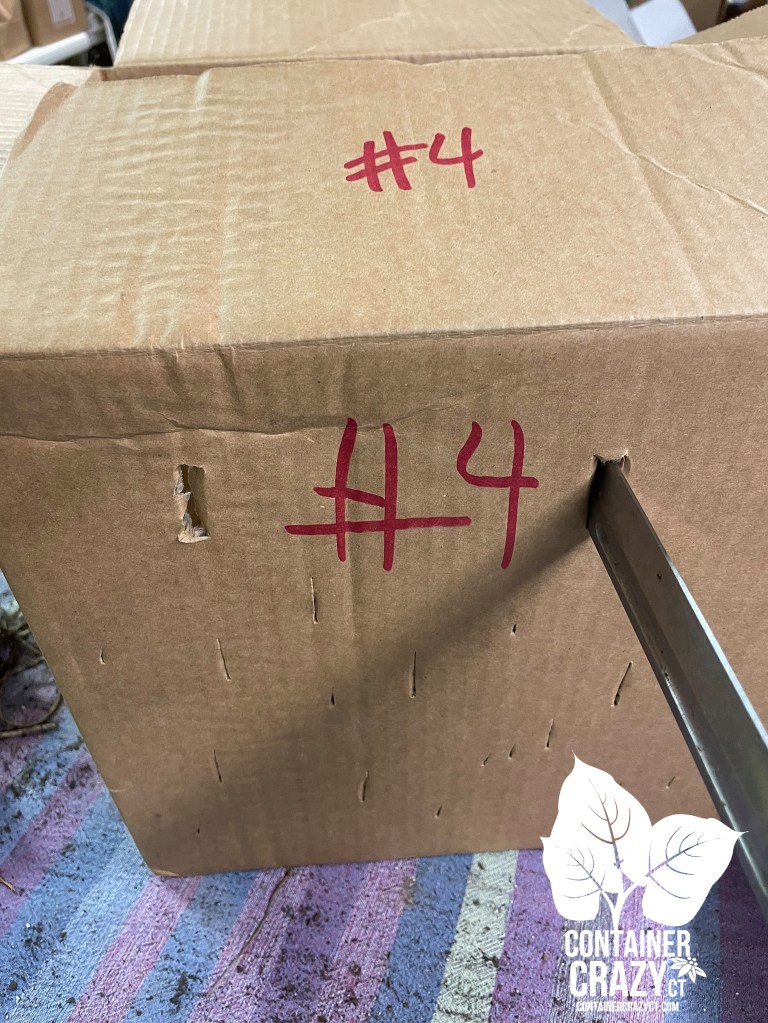
In doing a bit of research, I’ve read Alocasia corms may be stored in newspaper and put in a cardboard box with air vents. I happen to have some boxes available and used a large sharp knife to make slits in the boxes around the perimeter of the cardboard boxes for the air vents.

Making air vents

I placed crumbled up newspaper sheets in the base of the cardboard box and used the original plastic mesh bags, which were around each corm when they were originally shipped to me. I placed individual corms into these mesh bags for those that would fit. My largest “stump” shown top right of this photo below is too large for any of the mesh bags I kept on hand.

Mesh Bag with Corm inside

I loosely wrapped a couple sheets of newspaper around this mesh bag once the corm was inside and put it in the box. I am careful to not have them stacked or touching too much with other corms handled the same method because if anything is damp, that moisture will transfer to any touching corms. However, these were all fairly dry and not moist. The idea is to not overpack any boxes and keep air around each.

Now for the larger Alocasia stump. I keep calling it that because it is so much larger, it is more like a stump size! This one I had to find a larger long box and I have no mesh bag for it. It also has a large green area (the top part of where it grew) still attached which is not wet at all when I decided to lay it into the long cardboard box. Again, I crumpled up newspaper below in the box, and then I used a paper bag to cover it like a blanket and close up the box. I did not tape the box closed, as air circulation is important. I just overlapped the covers and I also put vents in the sides like with the other cardboard box prior to laying it in there.

Largest Alocasia “stump”

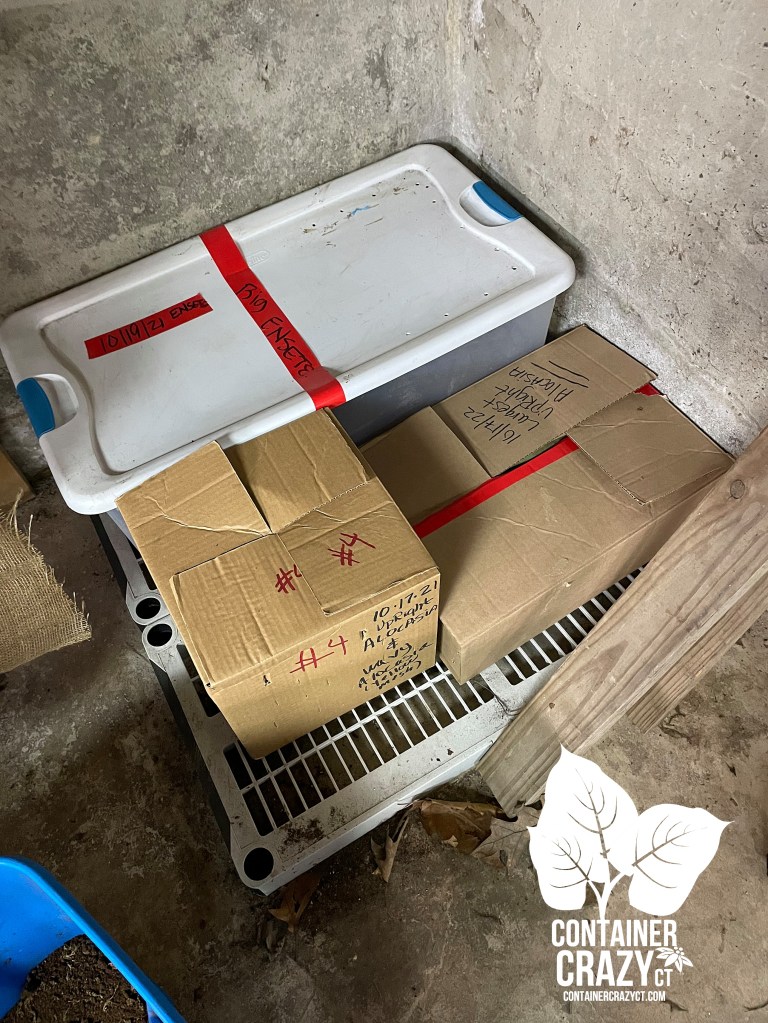
The root area is dry with dry soil a bit still on it, the corm area is dry, and there is still green life on the top part but there is no dripping water coming out of it – it seems like it is dry enough. I labeled all the cardboard boxes with date and placed it in the usual corner of my unheated basement (by the door where it is like tucked in a corner, stays cool, dark, dry and it does not go below freezing here.)

I have read the optimum temperature for storing Alocasia corms is 40-45 degrees F. Again, my basement is unheated. The only time it may get warm in there is when we use a woodstove at the opposite end of our basement, which is only occasionally. It does not go below freezing (32 degrees F) so they will not freeze. They are kept in a consistent cool 50 degree range or a bit below that for the whole winter. I will check on these in one month by making a note on my calendar to go look at the corms in these cardboard boxes and seeing if they look good (no rot, no moisture, no wet newspaper).

Again, this is the first time I’m trying the cardboard box method for these. I also wish to note, canna lily rhizomes tend to not survive if they completely dry and wither up, so I don’t think I’ll use this method for those plants, only for my precious upright huge Alocasia plants’ corms. I’ve read more about how these are okay more on the dry side. Makes sense because when I purchased the corms about 3-4 years ago, they showed up in a card boad box, with the white mesh bag, shown above, and only the brownish corm with no plant at all attached.

Label the boxes
Corner in Basement

You see the big plastic bin near these two cardboard boxes, that was the bin I last used for my big red banana plant (stump), the Ensete, I had for over 10 years. It failed this year, so there’s nothing in that box right now. I also put a plastic shelf section below the boxes so it is not directly on the concrete floor which may lead to dampness on the bottom of the boxes.

Pic of corm inside a mesh bag

I just hope this works well this year and will keep you posted. Next up will be to dig up my canna lily plants from containers outdoors. Sometimes I don’t bother anymore with those as they may be easily grown from new plants next season, but it is always a great feeling to reuse and regrow plants to save money on purchasing new ones, but sometimes I run out of energy to keep digging up these things. Each year, I seem to do less storing because of the effort. Sunny days help!

Thank you for visiting,

Cathy Testa
Connecticut Planting Zone 6b
Date of Post: 10/18/2022

P.S. I also want to note, many references will indicate to let the plants get hit by frost first before storing underground parts like the corms or rhizomes, etc. because the freeze will induce dormancy to the plants, however, I often do this process just before a hard frost. The weathermen indicated frost may be happening this week. Wednesday’s forecast indicates about 34 degrees F overnight – so that is chilly!

Overwintering Elephant’s Ear Plants

5 Comments

Overwintering Alocasia (al-oh-KAY-see-uh) plants, dug up from a large cement planter in my yard yesterday 10/11/22.

Since this plant is not hardy in my Connecticut planting zone (6b), they must either be dug up and stored (tubers) in a cool, dry place. Alternative options, if the plants are small enough, is overwintering them as houseplants in small pots where you have a sunny room. Or just moving the pots with the plant in tact into an unheated basement and letting them go dormant, but check to add moisture to the pot’s soil from time to time, and check for any insects on the foliage if moved in the pot. In this case, I dug up the plants, removed the foliage, and air dried the tubers yesterday outdoors.

The Planter – Cement

Because yesterday was sunny and warm, I wanted to get to the elephant’s ears in this planter. I was already tired from being on my feet all day, so I rushed getting these out. Luckily for me, the soil is super soft in this big cement planter due to worms and just great healthy soil. Rather than cut all the foliage off first, like I typically do, I dug around the tuber areas in the soil to break free some roots and just pulled them out one by one from the plant stems.

10/12/22 Before Removing the Elephant’s Ears plants

The soil and exposure

The soil in this planter stays relatively moist and receives the east morning sun, so it primarily gets partial sun or dappled sun, it doesn’t get too hot in this area. I do not fertilize – literally – I do not in this cement planter. Over the years, I’ve added recycled soil (from other pots), maybe some compost, but not often, and it is possible some wood ash from the woodstove in our basement, that is used only occasionally, was tossed in there by my husband, but I asked him not to do that after a while (wood ash changes the pH of soils). It is apparent when I dig in the soil, it has worm castings and the soil is very soft and easy to dig into. This is why I was able to pull out the tubers with the plant on the top rather easily after I broke the roots around the base with a trowel. I didn’t even use a shovel.

I do, however, water this planter by using a garden hose from above and showering it every time I was out there watering my other patio pots above on my deck. We had a very dry season this summer here in Connecticut so I’m sure the tropical plants in this cement planter enjoyed the moisture I gave them. These tropical like plants like moist soils, part shade or some full sun. After getting them out, I laid them on the ground and got my machete, which I finally found where I had stored it!

Chop off the foliage, then lay in the sun

It was super easy to chop off the foliage and stems with my machete. One whack and it was done! Then I put them in a laundry basket to sit in the sun for the rest of the afternoon, later, I moved the laundry basket to my basement. It will sit there drying a while before I move them to bins or paper bags for the winter. Some references will say to wait until the foliage dies back or wait till the foliage is hit by frost to dig and store the tubers, however, I like to work on nice days and yesterday was it – sunny and warm. I store mine in the basement, in a corner by the door, which is an unheated basement but it does not go below freezing in winters. We have a woodstove at the other end of the basement, but it is only used on stormy winter days when we feel like it. We do not use the woodstove to heat the house, only to warm it up sometimes. This means those tubers in the corner stay cold, but they never freeze there. It must be cold, but not freezing, and not too warm either. If warm, they may get soggy or start growing.

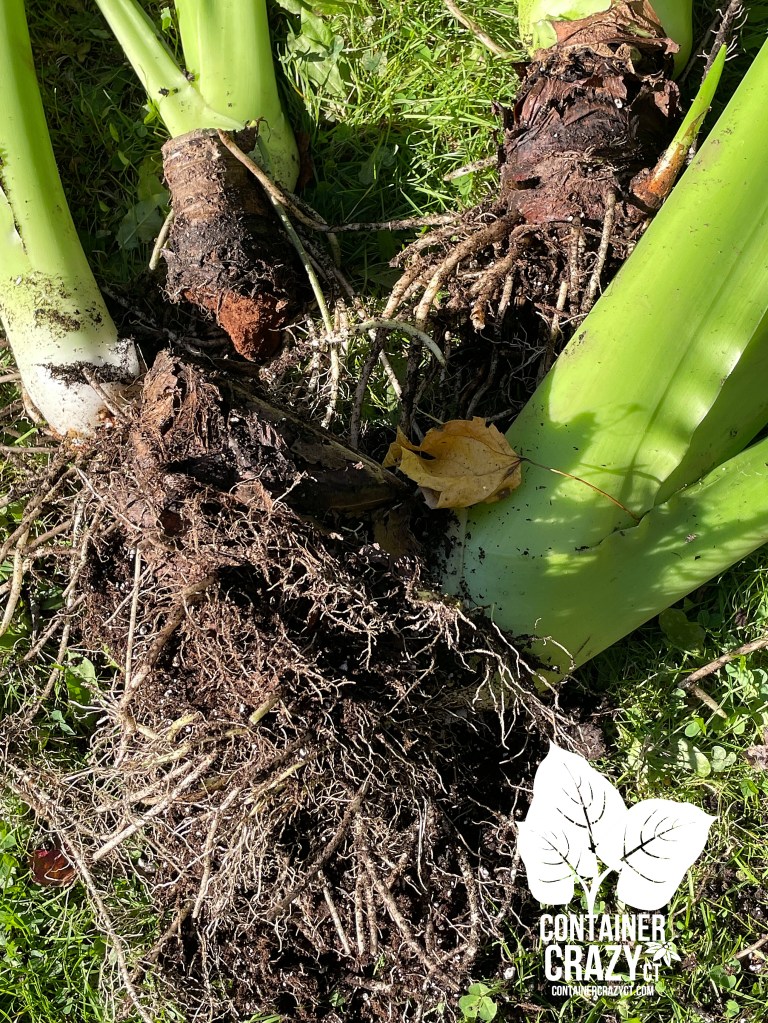
Side Shoot on Right

Notice my logo on the left side of this photo above; do you see the brown original tuber? The plant this season grew from the side of this tuber (a side shoot) which is attached on the right. Sometimes there are smaller side shoots which you may pull apart to create separate plants and replant those side shoots. Also the green parts above the brownish tuber is this year’s plant and I cut it about 4-5″ above the brown tuber in most cases when I remove them. I usually leave the green plant (like a stump or root base) on there but I am not absolutely sure that is required, because when I received the tubers, there was just the brown dry tuber to plant.

After Photo

It probably took me only a half-hour to get those elephant’s ears (in this case, Alocasia macrorrhiza, known as giant elephant’s ear or giant taro) out of the cement planter. I was lucky I think it was easy. I know rain is coming tonight and some parts of Connecticut got hit by a quick light frost already, but no hard frost here yet in East Windsor, CT. When it is a true frost, all the foliage will blacken and flops over. Next is to get to those tall Canna lily plants on the ends of this planter dug out and store the rhizomes or the whole root base.

Note: A. macrorrhiza is hardy in zones 8-10 from what I’ve read, but here in Connecticut (zone 6b for me), they are not hardy (will not survive in the ground over the winter months). Also, when I dug these out – there was no rot on any of the tubers, which is good news. Sometimes, if I wait too long to dig these out, there may be rot spots on the tubers because of cold, wet soils later in October. This is another reason why I like digging them out now. I don’t want any soft rotten spots on the tubers, rot only leads to storage problems as the rot may continue on the tuber, which is what you don’t want.

Sit to dry out a bit more before storing

Because these plants get huge and are gorgeous, I had to take the time to save them. I will let those tubers sit in a bin, spaced out for air, probably for another five days before I store them. I have always typically stored them in peat in bins with air holes in the lids, but last year, as noted on prior posts, they rotted a little. I am going to try storing them in paper bags in cardboard boxes this year with air holes. Plastic bins can trap moisture and for some reason, it just seemed they were too wet last year (maybe I was rushing too much last year, and stored them too wet). I have found when my rhizomes for Canna Lily were too dry stored, they didn’t make it. I have always balanced a bit of moisture from the peat and air, but I believe the Alocasias prefer more on the dry side. Everyone has different techniques for storing from what I’ve seen and read over the years.

Prior was making pumpkins

Prior to doing all of this quickly yesterday afternoon, I made a few more orders of my centerpiece succulent topped pumpkins. They were so fun to make and took me a few hours – and my feet give me a hard time, now that I’m getting a little older, standing for hours can be rough. I even put foam on the floor – below my feet, but I felt it later. I tend to make these centerpiece arrangements standing up, and anyhow, these are what I made for some requests. It was a perfect day to do them – sunny in the greenhouse. It’s that time of year when I’m making pumpkin centerpieces and still putting away plants and supplies.

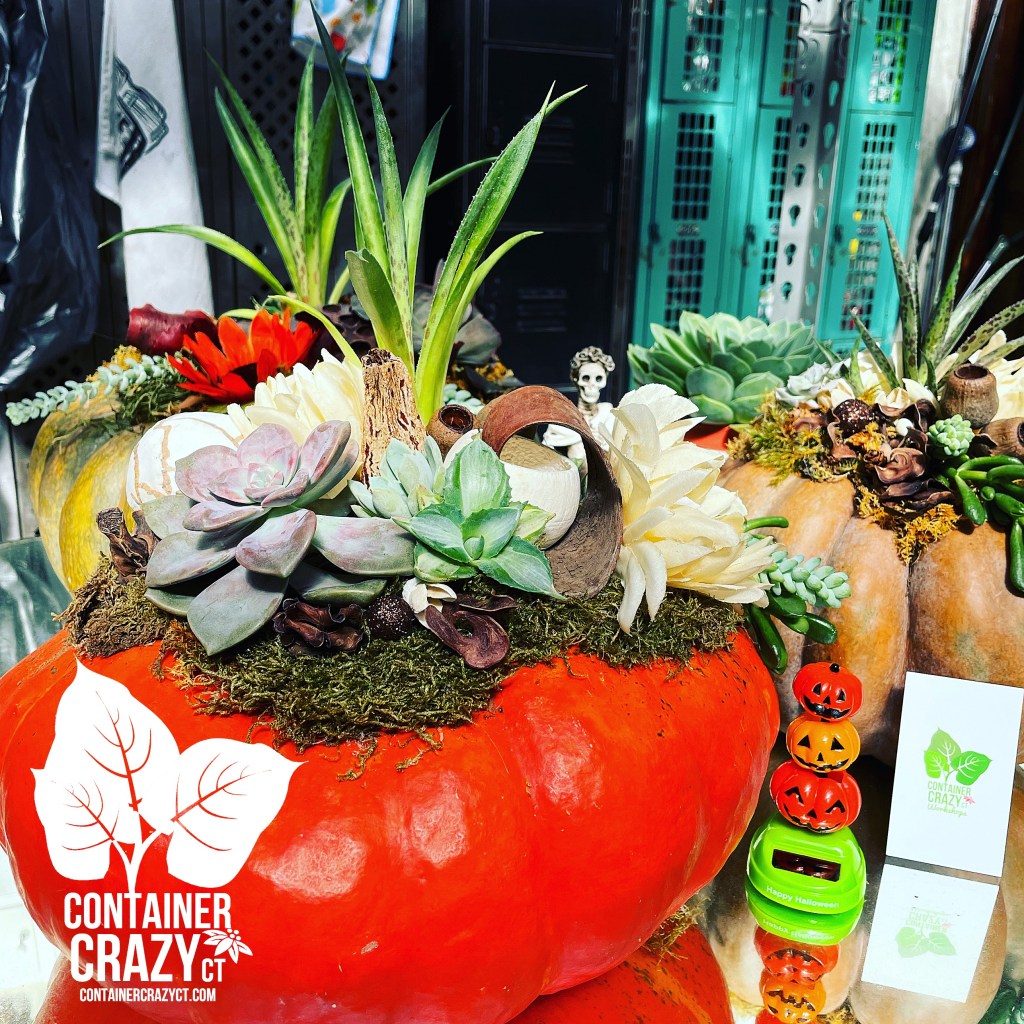
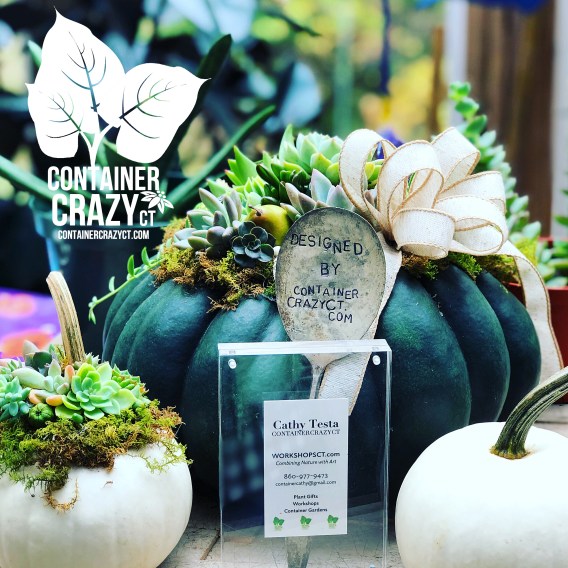
Succulent Topped Pumpkin Centerpieces by Cathy Testa of Container Crazy CT

If interested in a custom pumpkin, now is the time to order since it is pumpkin season. They last for months!

Thank you for visiting!

Cathy Testa
Connecticut Zone 6b
Container Gardener and Plant Enthusiast
Custom Creations for Seasonal Decor
860-977-9473
containercathy@gmail.com
www.WorkshopsCT.com
http://www.ContainerCrazyCT.com (you are here now!)
www.ContainerGardensCT.com

Stay tuned for more information on holiday creations for later in November!

Date of this post: 10/13/2022

Overwintering Alocasia 2022

1 Comment

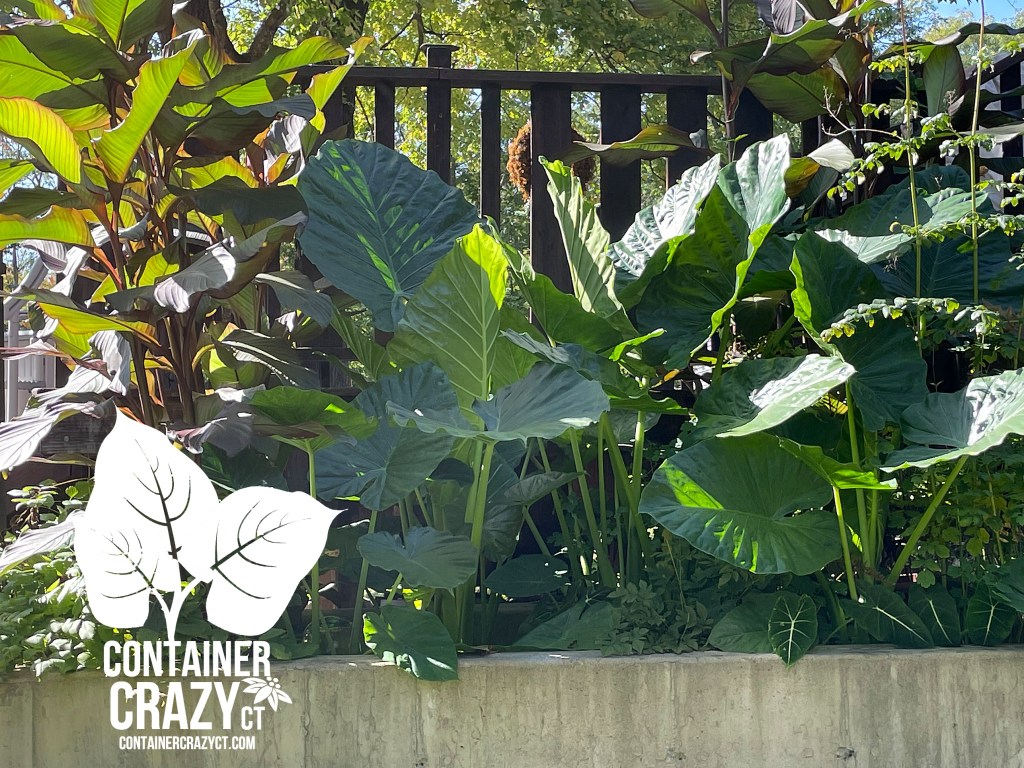
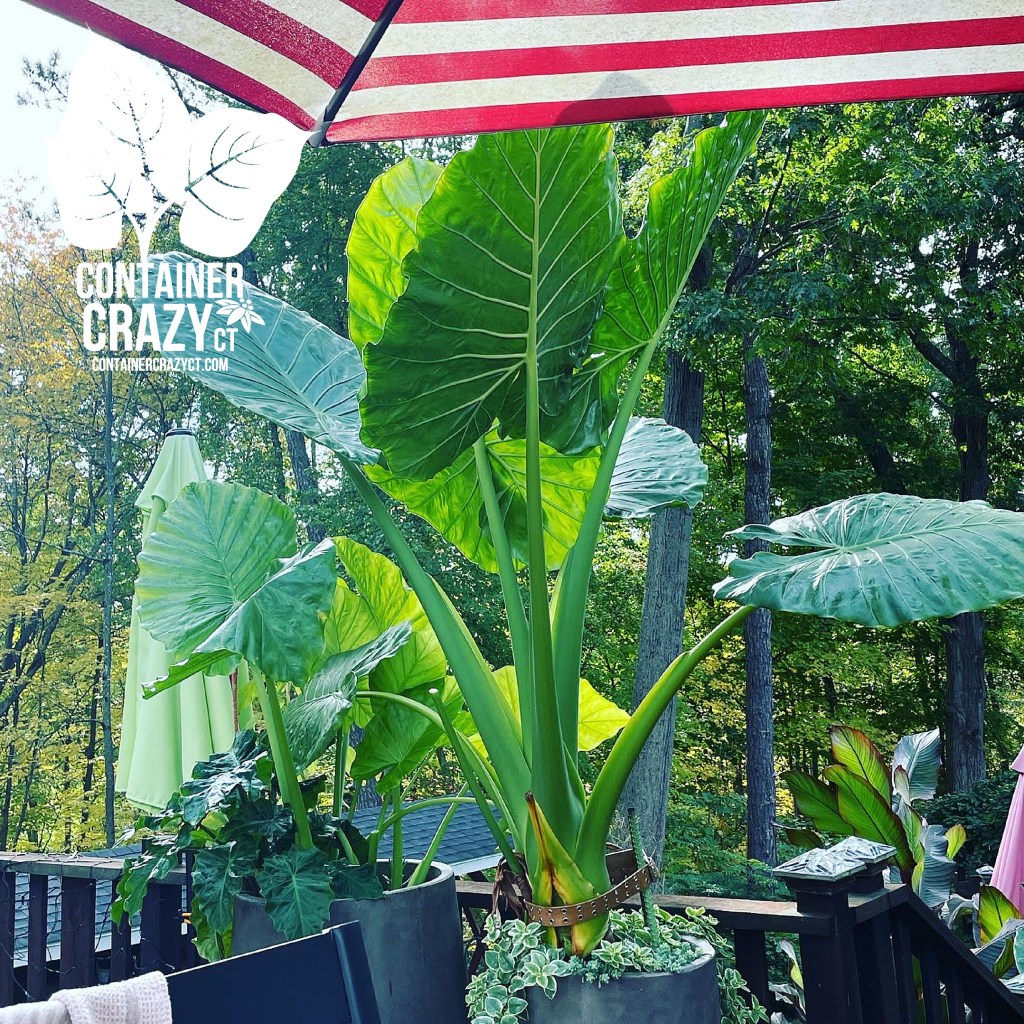
This is part one – showing my process of disassembling my largest elephant’s ear plants from containers or planters. I purchased the tubers in 2019 for this Alocasia, which I refer to as an “upright elephant’s ear” because the leaves point upwards towards the sky. It is often referred to as a Giant Elephant’s Ear, Giant Taro, or Upright Jumbo). Official name is A. macrorrhiza. They grow from 71 to 96 inches (6-8 feet tall) from summer to frost and prefer partial shade. The leaves are very dark green, glossy, and impressive! It prefers partial shade but will do well in more sun with appropriate moisture. In my zone, it must be stored, but warmer zones, I suspect you may keep them outdoors or protected somehow.

2022
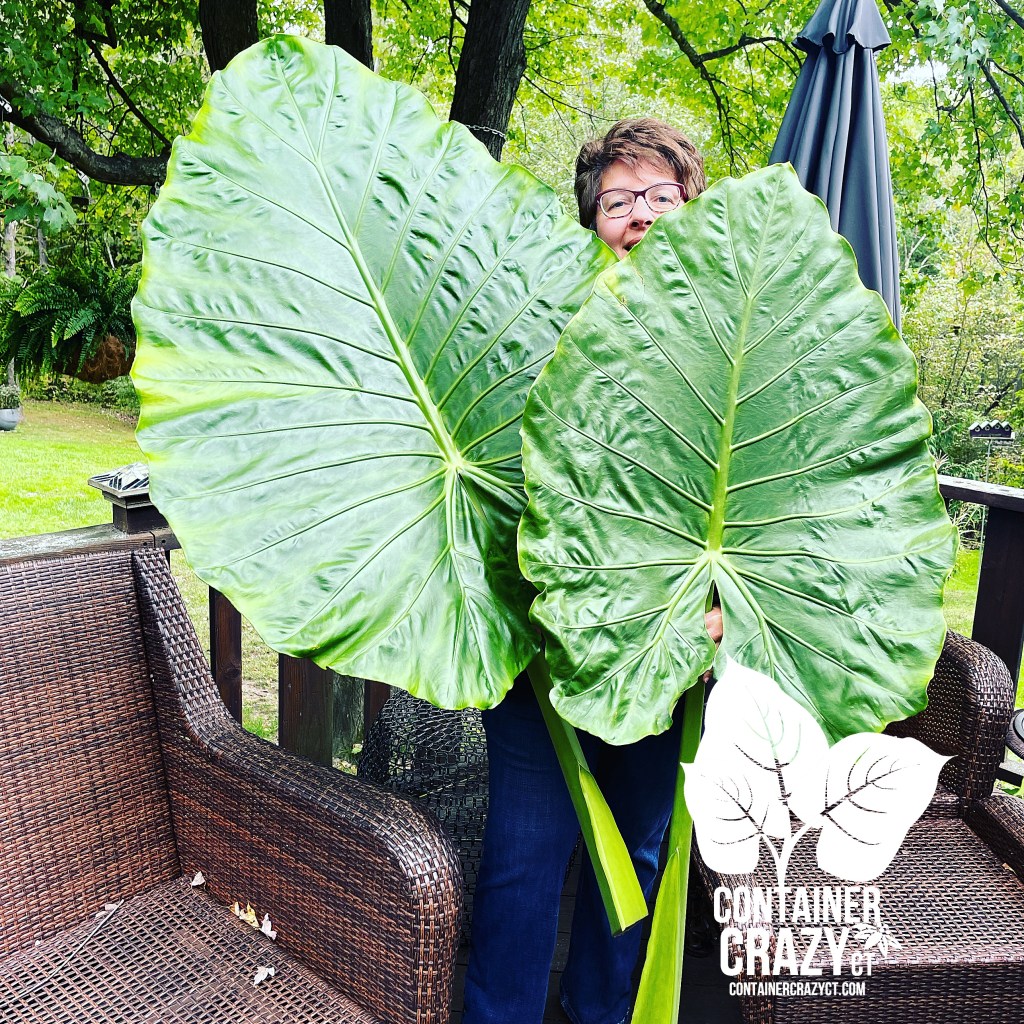
Cathy Testa holding two of the leaves

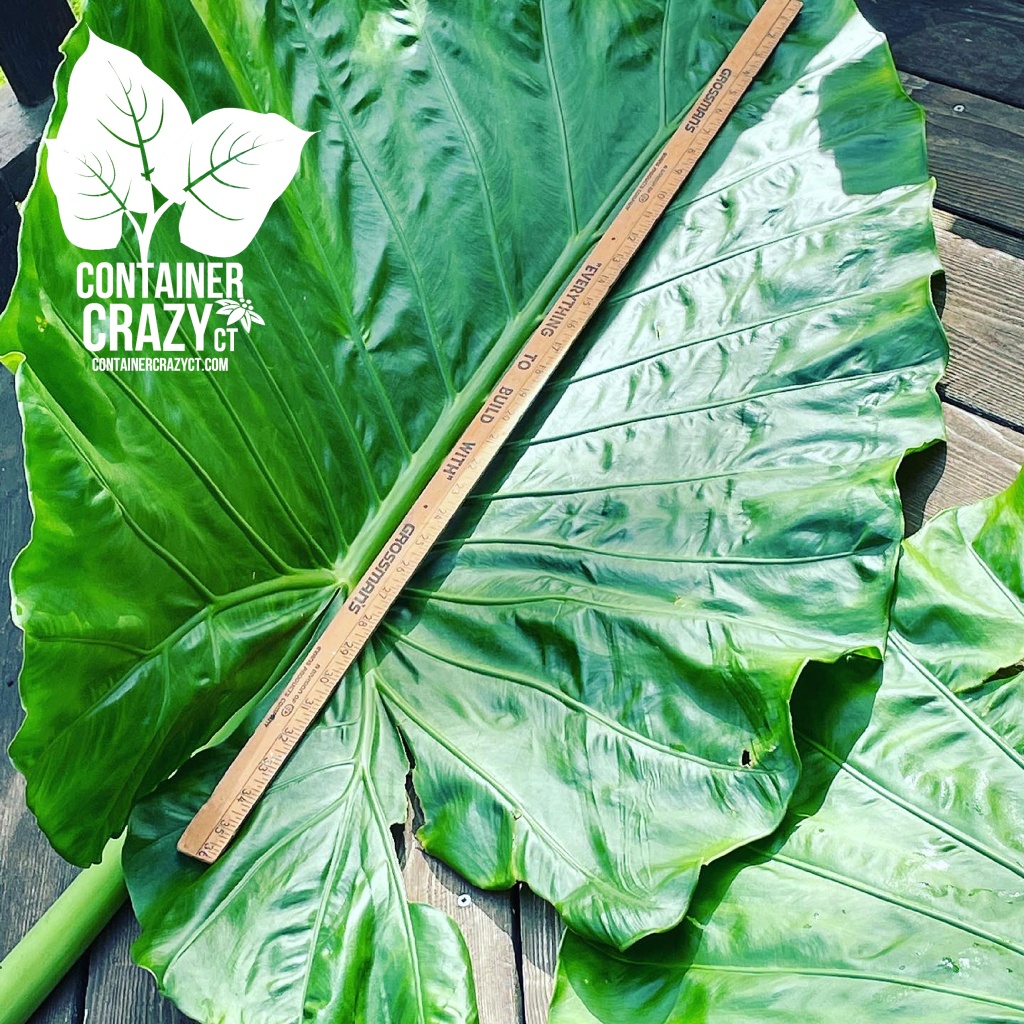
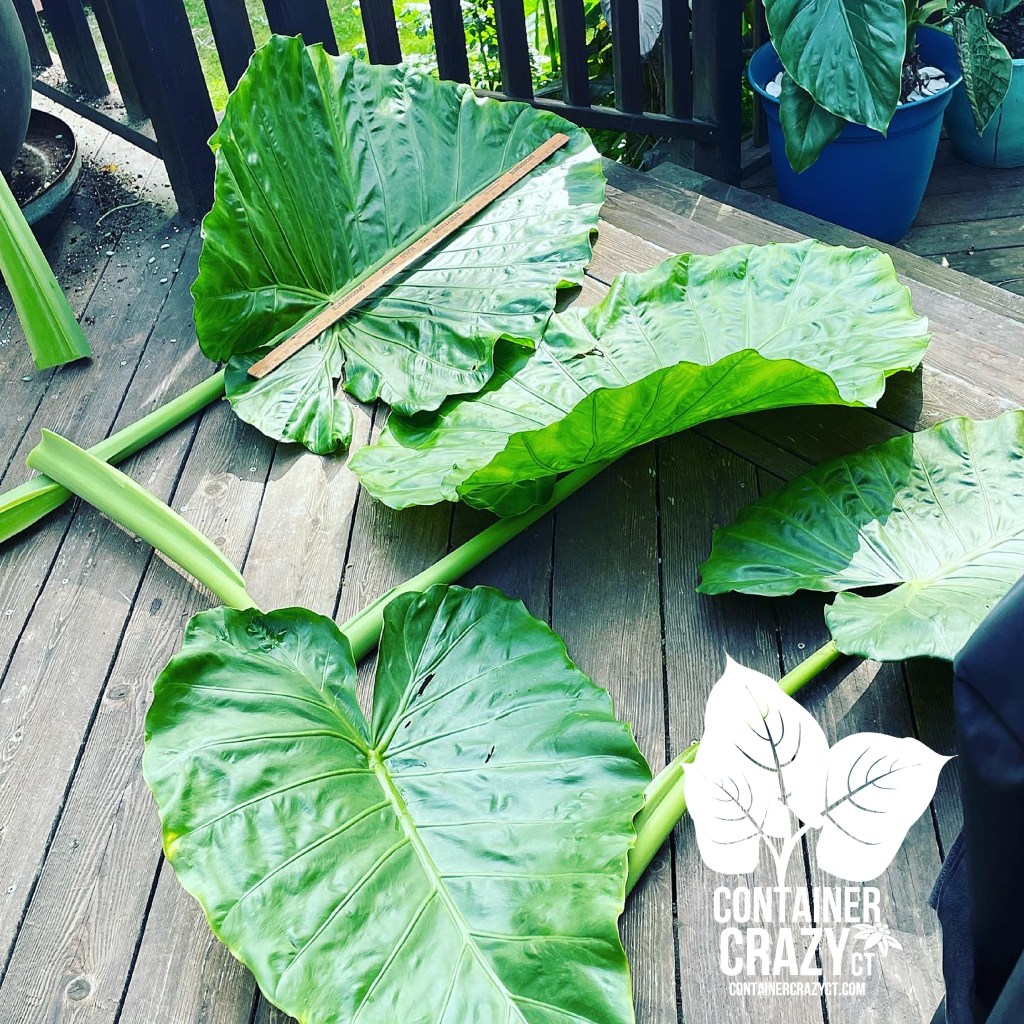
As you see here, I’m peaking behind two of the leaves. The leaves are at least 3 feet long with the stem an additional 3 feet as well. They tower above me in my planters and put on quite the big tropical show in summer. Now, on to how I disassemble them in preparation for our Connecticut winter months:

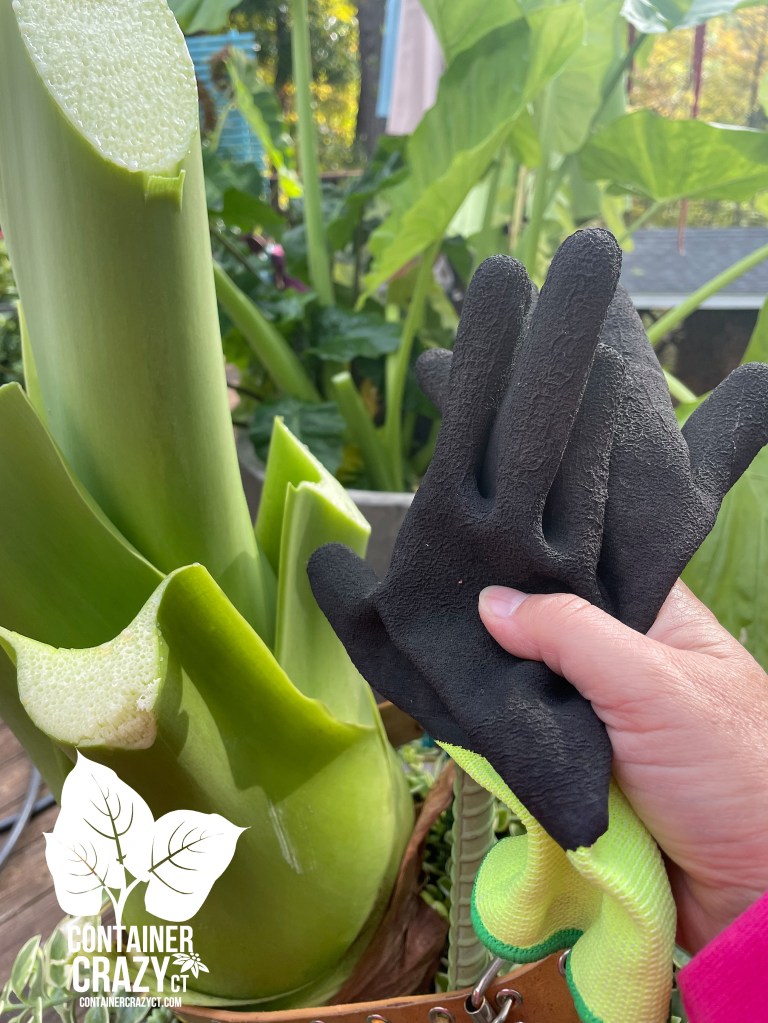
Definitely Wear Gloves

TOOLS

Gloves: Definitely wear garden gloves. These plants release a sap that will make your hands itchy – believe me, I regret when I don’t wear them. Even digging around the soil, I found my hands will itch later.

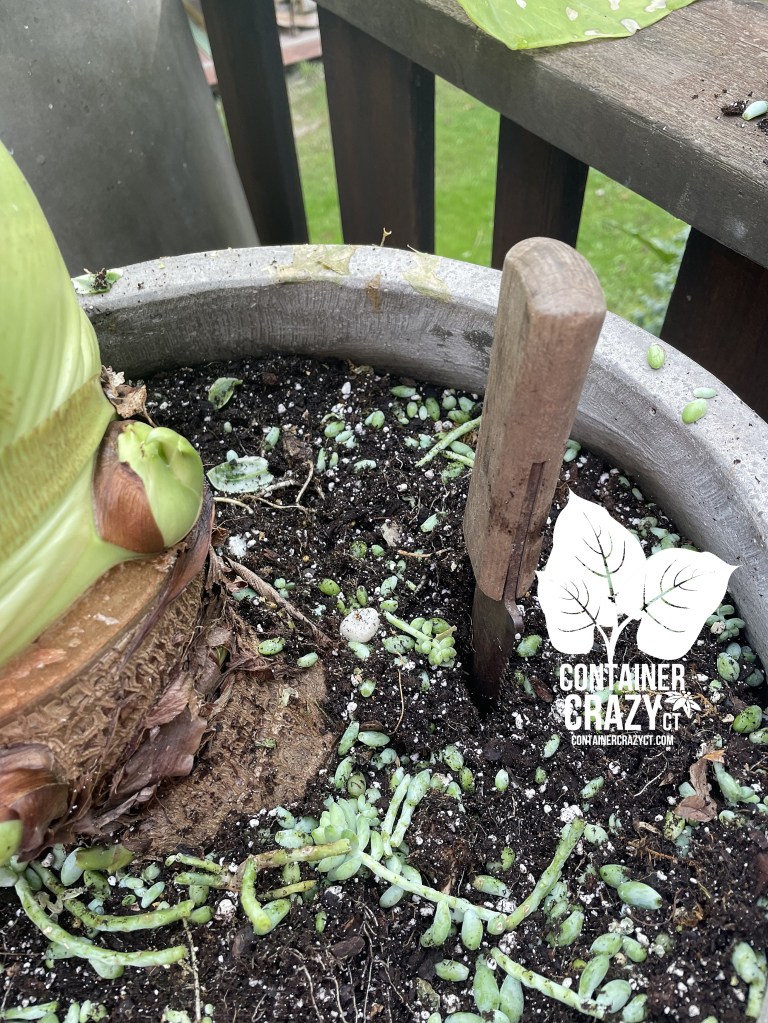
Hori hori knife: I really like this tool, heavy duty, serrated edge, perfect for cutting the roots in the soil around the base of the plant to release it. I find this to be one of my most useful overwintering tools.

Bin: A clean bin to put all the tubers and root bases in to let dry outside if it is pleasant weather, or inside if it is rainy.

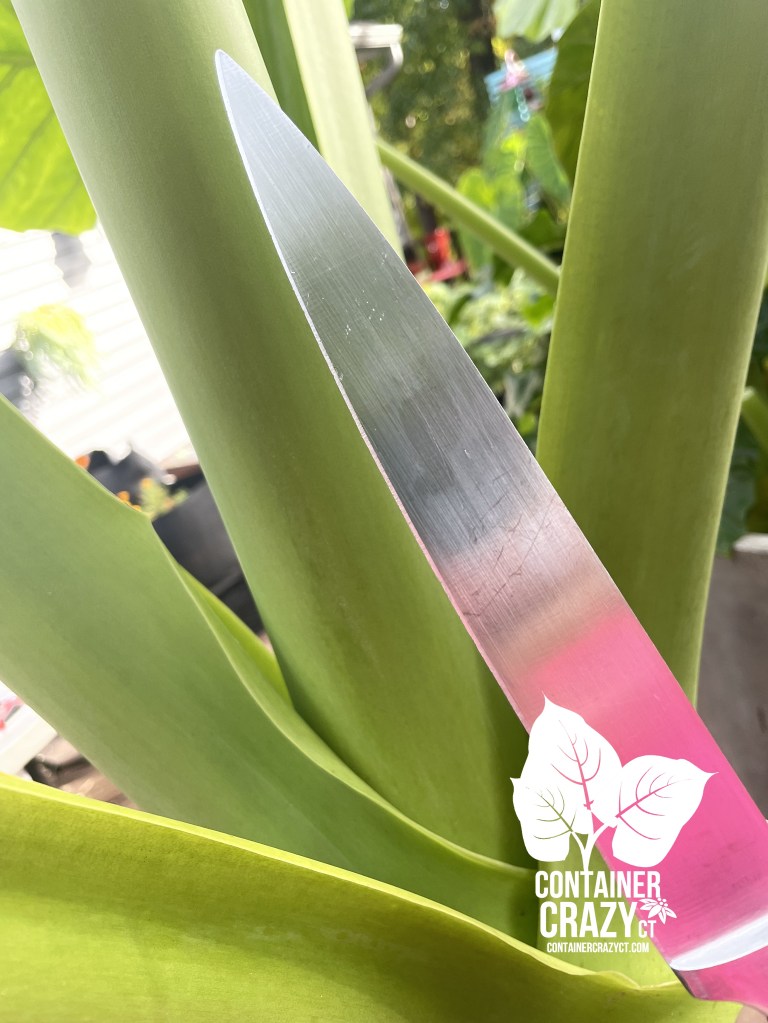
A Large Kitchen Knife or Machete: I couldn’t find my machete, so a long, clean, sharp knife is a great back up.

Clean Up Tools: A leaf blower works to blow away dirt that will fall everywhere.

Ruler: Yes, measure those babies!

Large Knife

Cut away all the foliage by using the knife to slice each stalk off individually at the base of the plant. The main thing is to cut away from the plant so the angle of the slices are able to drain away excess moisture. At least that is how I do it. I’m also very careful to not nick surfaces with my knife tip – always avoid any damage while I work.

Slicing off each leaf at the base of the stalk (petiole) – stem – whatever you wish to call it!

As you slice off each petiole at the base, be sure to do a clean cut, avoid tears or anything which would allow entrance of mold or insects later on. A clean cut is recommended. If you mess it up, cut it again below where you just cut it.

Measure the leaves cause it is impressive!

I always measure so a ruler is handy, or measuring tape, and then take photos. Because sharing is caring – LOL. Everyone loves to see how massive these leaves get. It is fun to Instagram the photos!

Here are two of the biggest leaves above. It is too bad I am not set up to make leaf castings of these babies, they would make impressive art for the garden!

Close up of Slice

As you can see, the slice is downwards and away from the center of the plant. I slice each stalk individually and pile the leaves to the side.

All leaves removed

After removing each stalk, I use my Hori hori knife to cut around the base of the “stump” in the soil. As I push the knife around in the soil, I hear the crack of the roots being cut. Then I will push on the stump back and forth to help loosen it. Once I feel it is ready to be “delivered” from the soil, I start to pull it out – It always makes me feel like I’m a doctor delivering a baby – hahahaha. I have quite the imagination at times!

Cutting a circle around the base of the plant to cut the roots below
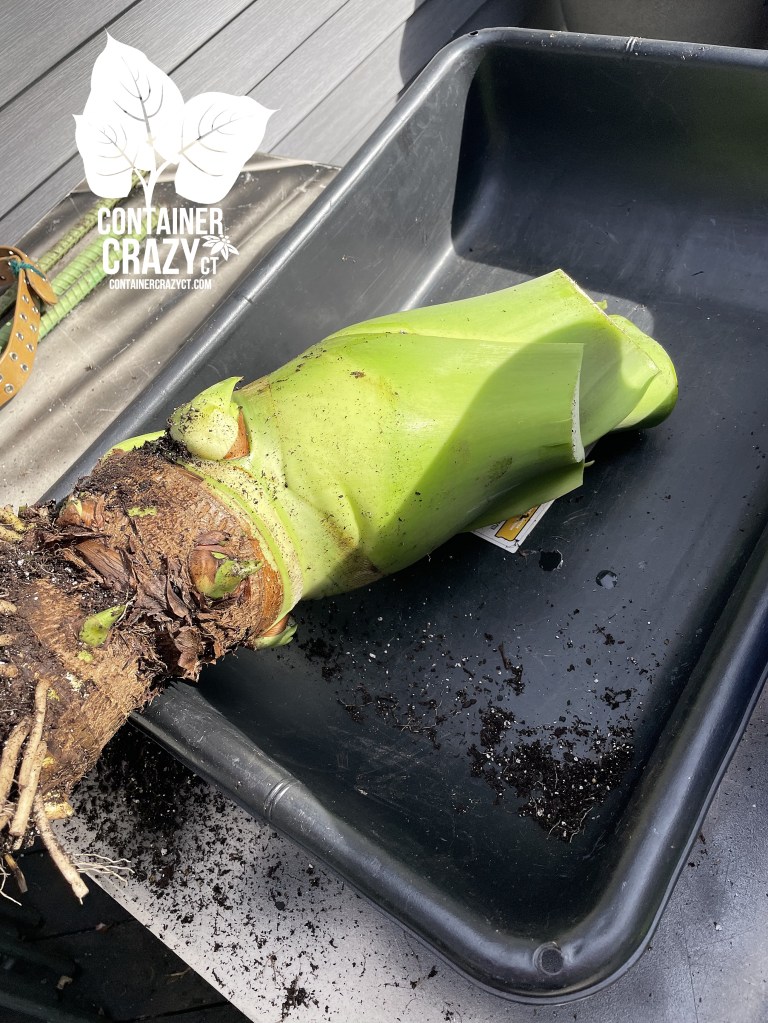
Out with more top sliced off

I will put it in the clean bin and trim the roots with clean sharp pruners or cutters, and slice the top off a bit if it still too big to fit into the bin. Leaning it upside down, or on the side to help drain excess moisture is helpful as well. Some folks may recommend not trimming the roots but I always have. New roots grow when it is replanted. My theory was less “fleshy” material the better. Fleshy material has the tendency to rot sometimes over the winter months.

After I got the massive big base out and laying out to dry, I worked on the planter next to it which had more off sets from the same type of Alocasia. I then let this dry in the house for about 6 days. Oh, I also removed as much soil as possible from the tuber areas. I used my gloved hands and kind of just rubbed or pushed off the soil. You may use a garden hose with water blast but that will only make the tuber wetter, so I didn’t do that. In the past, I have used a soft painters type brush to get soil off.

TIMING

In Connecticut (my planting zone is 6b) you may do this process either before or after we get a fall frost which could happen anytime now, but sometimes I like to start this while things are dry and temperatures are not too difficult to work in, so I started on these two planters last Thursday (9/29/22). It was a cool, breezy, day with little sunshine but that would be better than the rainy cold days expected the days following. The date if this post is 10/4/22 and no frost yet, but there are some talks it could happen this weekend, I hope not, cause I have lots more to do!

I placed the bin in the house for a few days and then moved it to a table in my basement. The next phase is storing them. For years, I stored all my tubers, rhizomes, corms in peat in bins with air holes drilled on the tops. But this past spring, I had rot on portions of my tubers. This year, I plan to store them dry in paper bags for some at least. I will most likely test the paper bag process and see the results. I will post photos of this soon. I also saved some mesh netting bags (like those used for Avocado’s in grocery stores) to put some tubers in.

Oh, when I took these apart last week from the gray planters, they had NO ROT anywhere on the tuber areas (brown area at the base) which is good news. No rot means they won’t have rot as they dry for a few more days. When I store the tubers, I will share it here as well.

The tubers need to be sored in a cool, dry place. I use my basement which does not drop below freezing but is unheated so it stays cool. It is recommended that you do not store them in plastic bags which would only trap moisture. If stored in a paper bag, make sure it has holes for vents. Again, for years, I stored them in peat moss in bins, but had rot issues this year in spring, and I didn’t want to loose these tubers of this super big Alocasias, now that I’ve regrown these plants each year. These particular tubers were from 2019 so it has been replanted 4 times now. A definite pay back from the investiment!

PLANT IN SPRING

Next year, after all danger of spring frosts, I will replant these Upright Elephant’s Ear tubers to grow again. Many tropical loving plants may be handled this way, such as Canna Lilies. For years, I stored my big red banana plant, Ensete, the same way as shown above. In fact, here is the link to the Ensete post if you are searching for it on my blog site: https://containercrazyct.com/2013/10/31/storing-my-big-red-banana-plant/. Unfortunately, I lost my big red banana plant this year in 2022. It was the first time it rotted too much.

NEXT OVERWINTERING PROJECT

Ack, I have to dig all of these up soon – anyone want to come help me?!

Canna Lily on ends with Upright Alocasias in the centers

Cathy Testa
Connecticut
A Container Garden Designer
Also make custom orders, grow tomatoes in spring time, make succulent pumpkins now in fall season, wreaths during the holidays! Thank you for visiting and your support.

DIASSEMBLY ALOCASIA QUICK STEPS:

Get your tools ready (knife, gloves, bin, hori hori knife, cleanup tools, etc.).
Cut away each leaf stalk at base cleanly.
Cut around base of plant in the soil area to break free roots with hori hori knife.
Pull out stump (base with the tuber) out of the planter, and let dry for several days to a week.
Store in an unheated, dry, cool area that does not go below freezing in winters.

It’s Succulent Pumpkin Time!

Leave a comment

Just a real quick post – It is that fall time of year and I’m starting to make custom orders for the large to medium style succulent topped pumpkins. To learn details, please visit www.WorkshopCT.com and see the top post.

Next up! Photos of me taking down my largest Alocasia plant. Stay tuned!

Cathy Testa
Container Garden Designer
Connecticut US Zone 6b

Thank you!

Succulent Topped Pumpkin Time

Leave a comment

Autumn Time

Hop on over to my site, called www.WorkshopsCT.com to learn about my custom made succulent topped pumpkins. They make wonderful autumn centerpieces, and now that there is a bit of fall in the air, these are my next fun endeavor. I love making them for orders. They are wonderful displayed inside your home for the fall and Halloween season, and last for months!

Winterizing Time

I’m also still taking down my tropical plants, probably working on them this weekend during the nice pleasant sunny cool fall weather. We have not had our October frost here yet, so there is still time but alas, my work must continue or I will be backlogged with plants! I have some Brugmansias which are blooming beautifully right now with huge yellow trumpet shaped flowers which smell wonderful in the evenings, as well as my Canna Lily plants, and I still have many elephant ears plants (Alocasia and Colocasia) outside in my larger container gardens. All will be taken down, pulled out of the soil, cut back and stored via the parts under the soil (corms, tubers, rhizomes, etc.) for storage during our winter months. I will show more photos soon but just enter search terms in the search box on this blog to locate directions and information and feel free to ask questions. I also have already collected my seeds from various seed pods by this time and stored them in cool dry places for use next spring to regrow some of my favorites. Pods should not get soggy and wet and be collected before that phase, or they will mold or rot on the plants outdoors at this time of year. I also put away most of my agaves, mangaves (one is shooting a flower stalk – it is 4 feet tall right now! So exciting!) And put my succulents in the greenhouse along with some of my larger house plants. The greenhouse is not being heated of course yet, and the natural air goes thru daily along with an auto fan as the temp rises on sunny days. Anyhow, the fun and plant work continues.

Winter Time

Boy, times are tough for small businesses. Every time I turn around prices are going up. This impact us greatly and we just can not afford to be “low priced” on our unique creations and please bear in mind, plants are perishables similar to vegetables from the grocery stores. Of course, you may make plants last for years, if not centuries, with the appropriate care, so it is a wonderful investment to have the beauty and company of plants surrounding us, but all the delivery costs, shipment fees and delays, materials and you name it, it has raised prices on materials for our industry, from the plants to the decorations we use for them. So thank you for supporting my small business – especially those who repeatedly visit me.

It brings me much joy, honestly, especially in the winter months to continue my work and custom orders. I guess my point is – I’m still planning to make my custom made holiday items as well as my succulent pumpkin centerpieces, but prices have gone up for me as a very small business owner. Custom is not cookie cutter, so if you enjoy unique, handmade, well cared for plant creations – I’m your girl! And also, the weather factors, this year our areas got hit hard with rain and floods – this impacted the availability of pumpkins locally. But this will not stop me from creating because it is my passion. Passions can not be stopped! 🙂

Thank you for visiting.

Cathy Testa
Container Crazy CT
Broad Brook/East Windsor, CT
Zone 6b
USA
Posted: 10/7/2021
Today’s weather: 54 degrees F, Foggy, H: 73, L:50
Weeknight temps for next week are in the mid 55’s range.
Friday and Sat – Party Sunny – yes! Glad we will have nice weekend weather.
Next week, looking good too in the mid-60’s to low 70’s, but maybe some rain showers