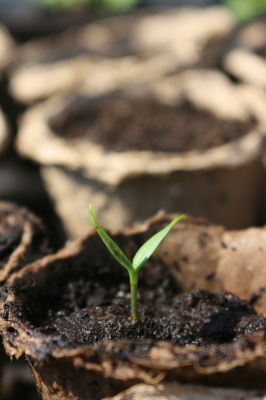
A Slow Warm-up for Spring – But Time to Get your Tropical Bulbs Reawakened

Leave a comment

Good Morning Everyone,

Last spring, we were concerned about planting too early because we had over-chilly temperatures around this time of year – but it was colder, whereas this year, it is taking longer for the cold to leave.

There is no doubt every single year brings an interesting challenge for gardeners when it comes to the weather, and often times we must have the endurance to patiently wait for the conditions to be favorable for our planting adventures.

But, as we know – “Good things come to those who wait.”  And, patience is a true virtue in the gardening world.  When things are not favorable to work in your gardens outdoors, take the opportunity to prepare other gardening tasks and plants for when the temperatures and conditions are perfect.

Here is my latest e:Pub for Spring 2014, which refers to our slow spring warm up and things you can do now with any stored summer or tropical bulbs to give them an early start as we wait for temperatures to creep up higher in Connecticut.

Spring 2014 – e:Pub Newsletter – “A Slow Warm-Up

A new page has been added to this blog from the top menu where this e:Publication is posted, and more will follow.

Click on ABOUT, then 2014 MENU, to see a drop down menu called e:Pub Newsletters.

I started writing e:Pubs many years ago, and there are prior versions on my website, www.cathytesta.com.  It is interesting to look back and read some of the prior versions, at least for me.

One year I wrote a poem about all the rain we had in June which seemed like it would never end – that was in 2009.  But fortunately, today, the weather is warming up – we may even reach the 70’s.  Can this be true? We sure hope so.

Have a Great Weekend Everyone!

Cathy Testa

UPCOMING CLASSES:

Don’t forget to check out Cathy T’s Container Gardening Class on May 24, 2014 in Broad Brook, CT.  See also Cathy T’s Garden Talks.

Please share or join this blog by entering your email on the sidebar, you will get updates via email and special offers or coupons of upcoming classes as a Cathy T blog follower!


Amaryllis Blooms are a Great Distraction

Leave a comment

During the Dreary Days of Winter

If you read my blog, you saw I potted up two Amaryllis bulbs in early February.  As the days moved along, I took several photos of the blooms, especially the white one, called Athene, because it grew far better than the red one.  The red one was not at fault however.  I put the red one by a north window which I knew wasn’t really warm enough and wouldn’t provide the sun it needed to really take off.  It did grow and bloomed, but was not nearly as nice as the white one.

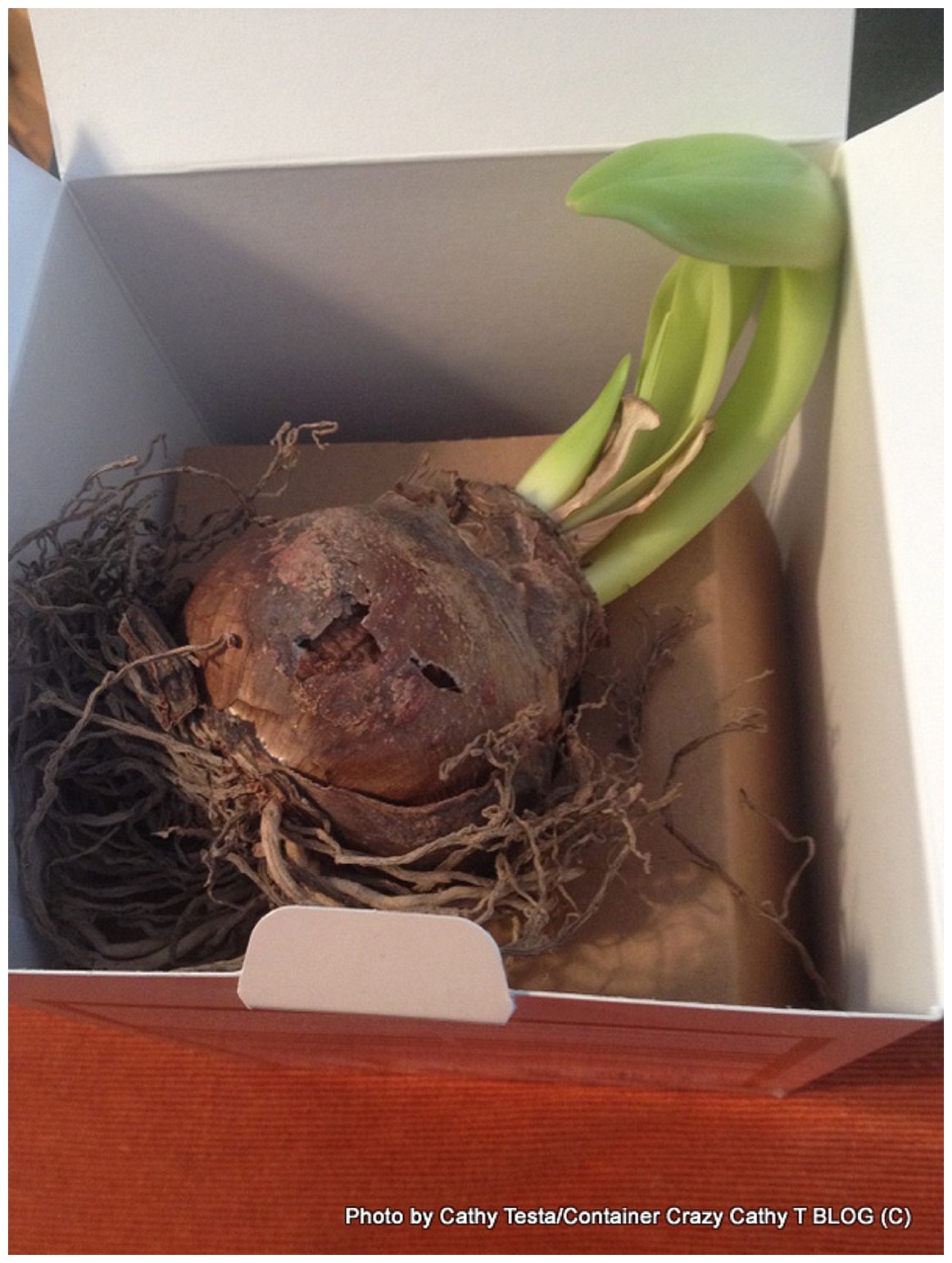
Red Amaryllis, Red Lion, in Box

Red Amaryllis, Red Lion, in Box

When I bought the two bulbs on sale, they were already sprouting in the box, so they bloomed in about 3 weeks (rather than the typical 6 weeks) after planting.  To see how I planted the red one in a glass vase with stones and water, see this post.

Red Lion in Glass Face by North Window

Red Lion in Glass Vase by North Window

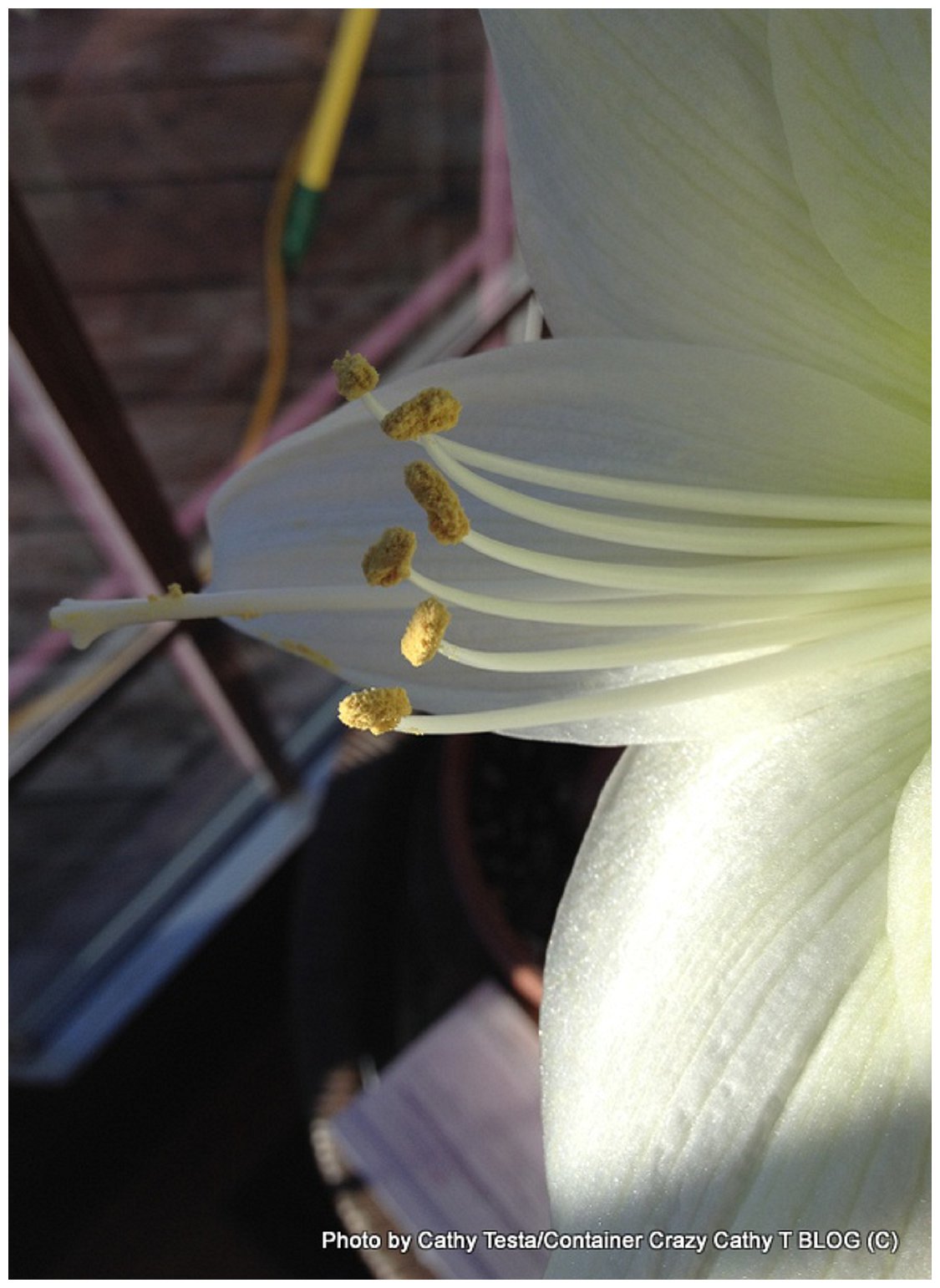
When the red blooming (Red Lion) Amaryllis was reaching the end of its blooming period, I decided to pull apart one of its trumpet shaped flowers, and remove the pistil (shown in photo below – right side) and stamens (6 shown sitting to the side of the pistil) because it was just a curiosity thing.  Each was attached at the base of a petal and it was a good photo opportunity.  The pistil is the female part of the flower and the stamens are the male parts (a bisexual flower structure).  The pistil is made up of a stigma (tip), style, and ovary (the ovary you can’t see in the one I removed because it hasn’t formed yet but it is usually found at the base of the female parts in the flower). Each stamen is made up of an anther (located at the tip) and filament, which is the stem like portion holding the anther at its tip.

End of Bloom

End of Bloom

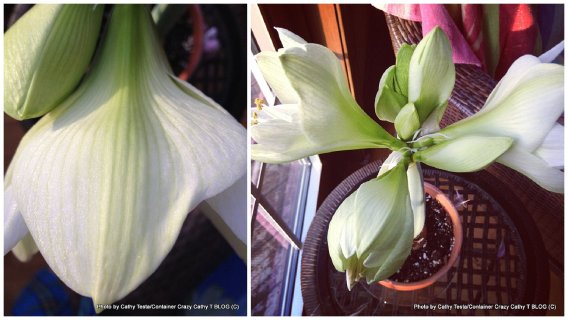
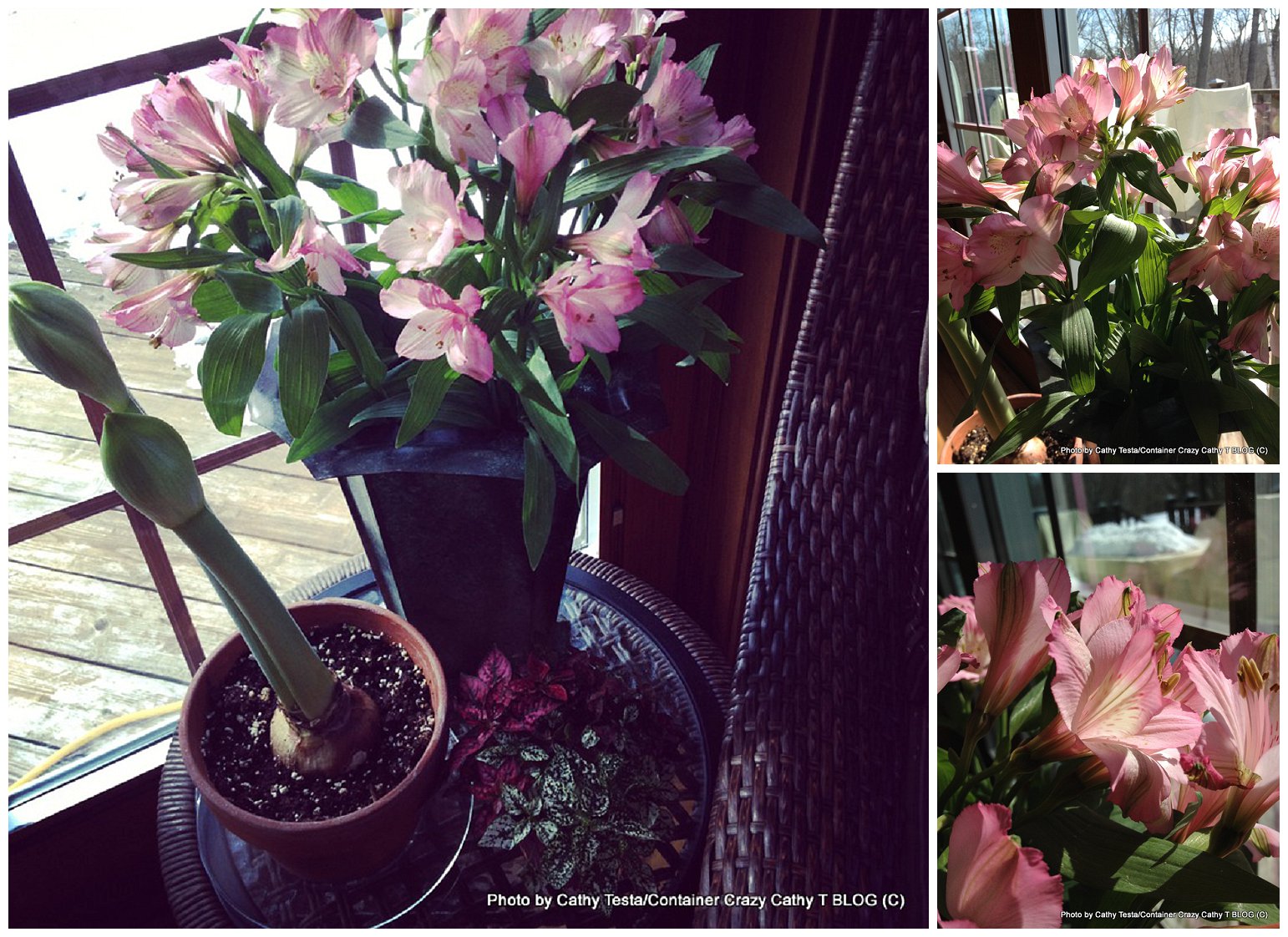
The white blooming Amaryllis Athene is shown in next photo below next to a vase of cut flowers (Alstroemeria).  The flowers of Amaryllis are borne in groups at the tips of each tall stem. As the big bud opened, individual flower buds expanded outward. There were four (or six) at the tip of each hollow stem.  When completely opened, the group of flowers formed a beautiful big white ball of funnel like flowers which were large and showy. (BTW, I included photos of the cut flowers because they were pretty and a good way to cheer up the dreary days of late winter as well. I recommend you buy a bunch for yourself and put in a vase, it makes things warm up a bit inside!)

White Blooming Amaryllis in Terracotta Pot

White Blooming Amaryllis in Terracotta Pot

As you can see in the photo above, the white Amaryllis Athene was potted up in a small terracotta pot.  As directions stated, about 2/3ths of the potting mix is below the bulb and the top 1/3 of the bulb remains exposed (uncovered by the potting mix) so it sits above the soil line a bit.  It is best to place them in a warm sunny location and this one found its home by my south window. Watering lightly is key, you don’t want the soil to be soggy or wet, and it should drain well.  The soil should be moist but not so much so that the bulb is in a wet and soggy situation where it can rot.  And the pot should be fairly small as the roots like some restriction. A good gauge is if you can fit your thumb or two fingers between the edge of the bulb and edge of your pot, you have enough space and it is comfy. Additionally, if you skip a day or two of watering, this plant usually can take it well. It doesn’t need constant attention and is usually very easy to grow and take care of once you know how to do so.

Back side of Flowers

Back side of Flowers

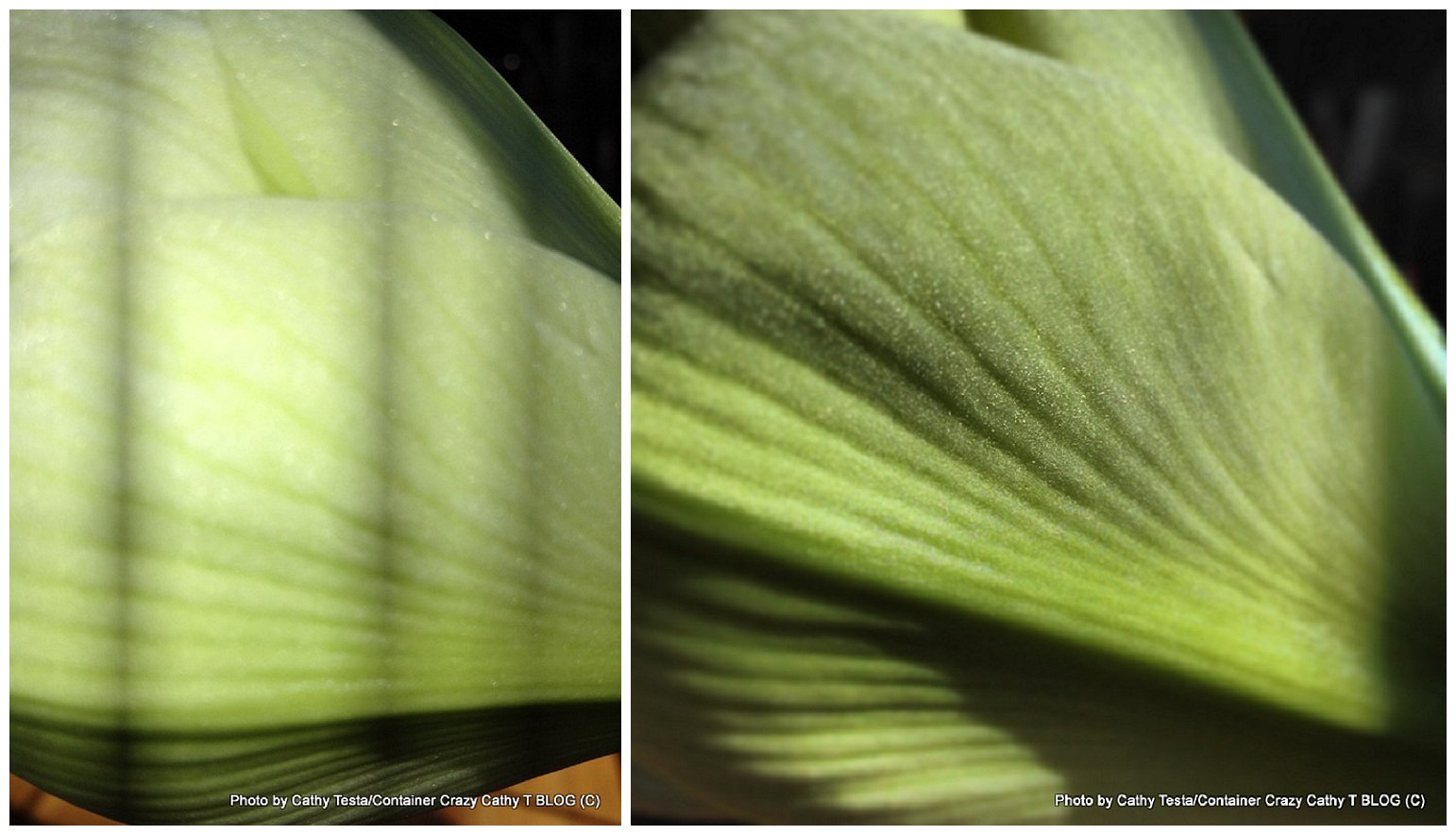
In the early mornings, as the sun cast through my southern facing slider window, I would take some more photos.  I love the way the backside of the flower petals sparkled when you looked up close.  It certainly was a nice distraction from the colder temperatures outdoors. It beat looking at the snow.

Rising and Opening

Rising and Opening

There were two stems, which are hollow, topped with several buds at the top.  As they began to pop open, I decided to add some decorative glass stones and sparkly sticks to the pot.  Just one of those things, playing around with it – since it was becoming so pretty.  I thought about how pretty these would be in groups or as a centerpiece for a special occasion in the winter. You can see the leaves starting to come out of the base. After the flowers go by, the leaves will grow quickly, and should remain on the plant to store energy in the bulb during the summer months.

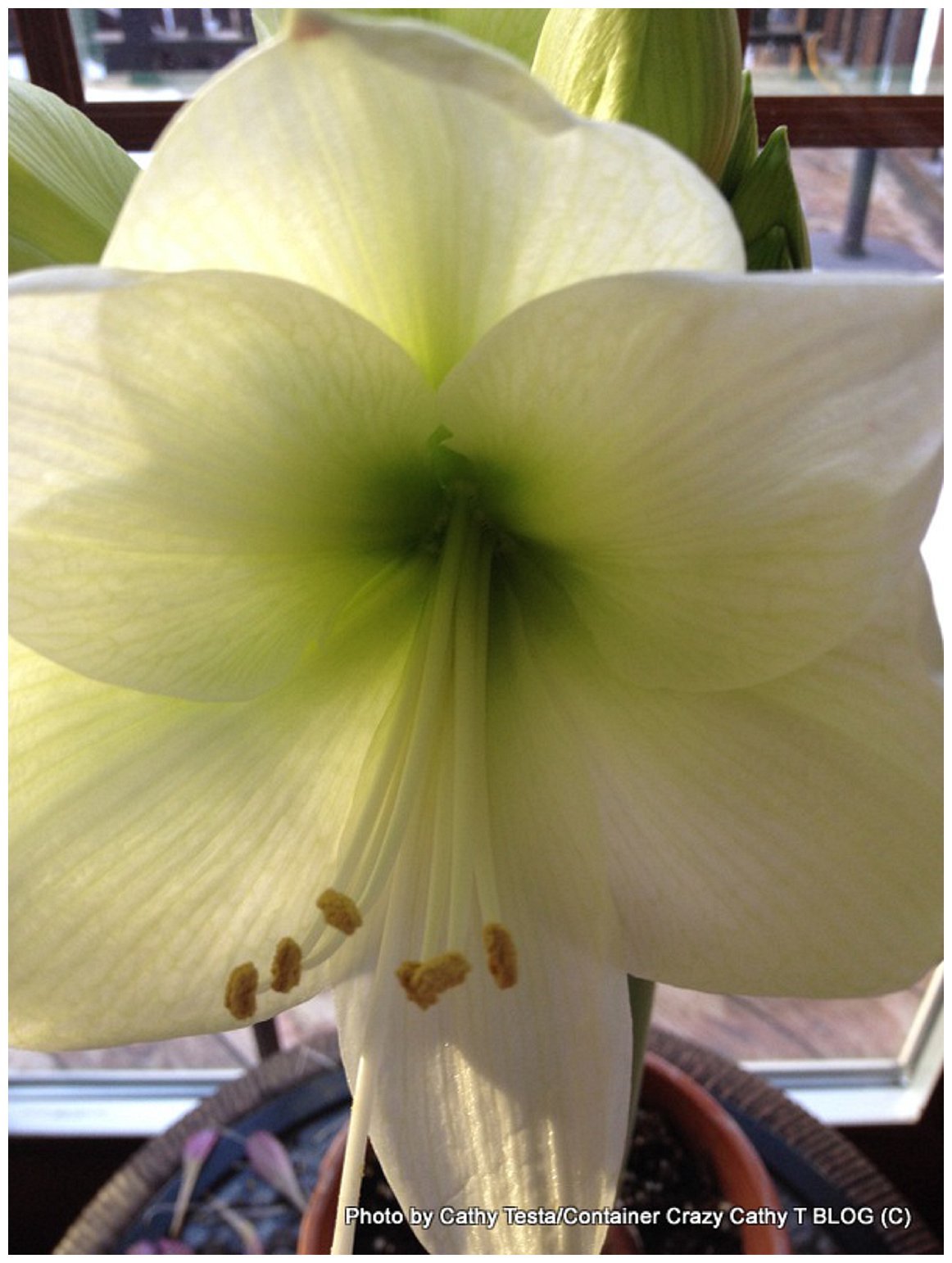
Stigma in Center

Pistil made up of Stigma and Style in the Center Photo above

In the center photo above, you can see the pistil (female part). When looking closely in the next photo, you can see pollen sticking to it from the anthers. The anthers are on the right and are the pollen bearing flower parts of the stamen, positioned at the top of individual filaments.  In this case, you can see six filaments extending out. Filaments are the stalks that bears the anthers in a stamen (male part).  Why you need six stamens for one pistil? Well, you know how males can be! LOL. The pollen will make its way down the pollen tube (part of the stigma structure) to the internal ovary in the base of the flower structure. It always amazes me how a tiny pollen grain can move down a pollen tube to continue the cycle of life in flowering plants.

Internal Parts

Internal Parts

To me, the internal parts of a flower are just as beautiful as the flower buds and petals. With Amaryllis blooms, you can see them clearly should you want to examine them or use them as a teaching opportunity for kids.  And if you want to learn how to pollinate your own Amaryllis by hand which is done to create hybrids (crossing with another variety) or to ensure pollination for seeds, see directions here by Amaryllisbulbs.org. There are some close up photos of how you can apply the pollen from the anthers to the stigma at the “right” romantic time.  See also the video at the bottom of this post for more on how to pollinate Amaryllis.

Blooms Opening

Blooms Opening

Soon enough, I was taking photos from every direction as all the flowers at the end of the two stalks started to completely open all around.  With two stalks, topped with 4-6 buds, it was turning into a globe of white beauty. There was 8 fully open flowers at the end of its show. At one point, I swear there were more flowers, like 12 but not sure now, and should have actually counted. Let’s just say it was magnificent.  The plant was about 20 inches tall and became a spectacular show in white.  I rotated the pot occasionally so the stems would not lean in one direction towards the sun.  It ended up being a very straight and tall specimen to enjoy through mid-February to mid-March.  It was a great distraction during the dreary days of late winter.

Gorgeous

Gorgeous Topped Blooms of a White Amaryllis

I started to post photos of it on Facebook and Pinterest to share.  It was really taking the edge off of winter for me during the month of March.  By the third week of March, the blooms began to fade, so I knew it would be time to say goodbye to quite a show.

One more shot

One more shot

Here’s one more shot from the top.  I wish I could have taken some professional photos of it because it was so pretty! The spot where this Amaryllis plant sat is near my sitting area for coffee in the mornings, which I love because the eastern sun rises and it starts to shine through the southern facing slider door window. I actually removed my kitchen table from this small area in my home to make it a cozy nook to enjoy when sipping coffee, reading, or just watching the birds on our feeders outside. We have a small kitchen island we use as our dining place now, and I can’t tell you how much more utilize the former dining space now that it is a sitting area. In summer, we tend to eat outside on our deck.

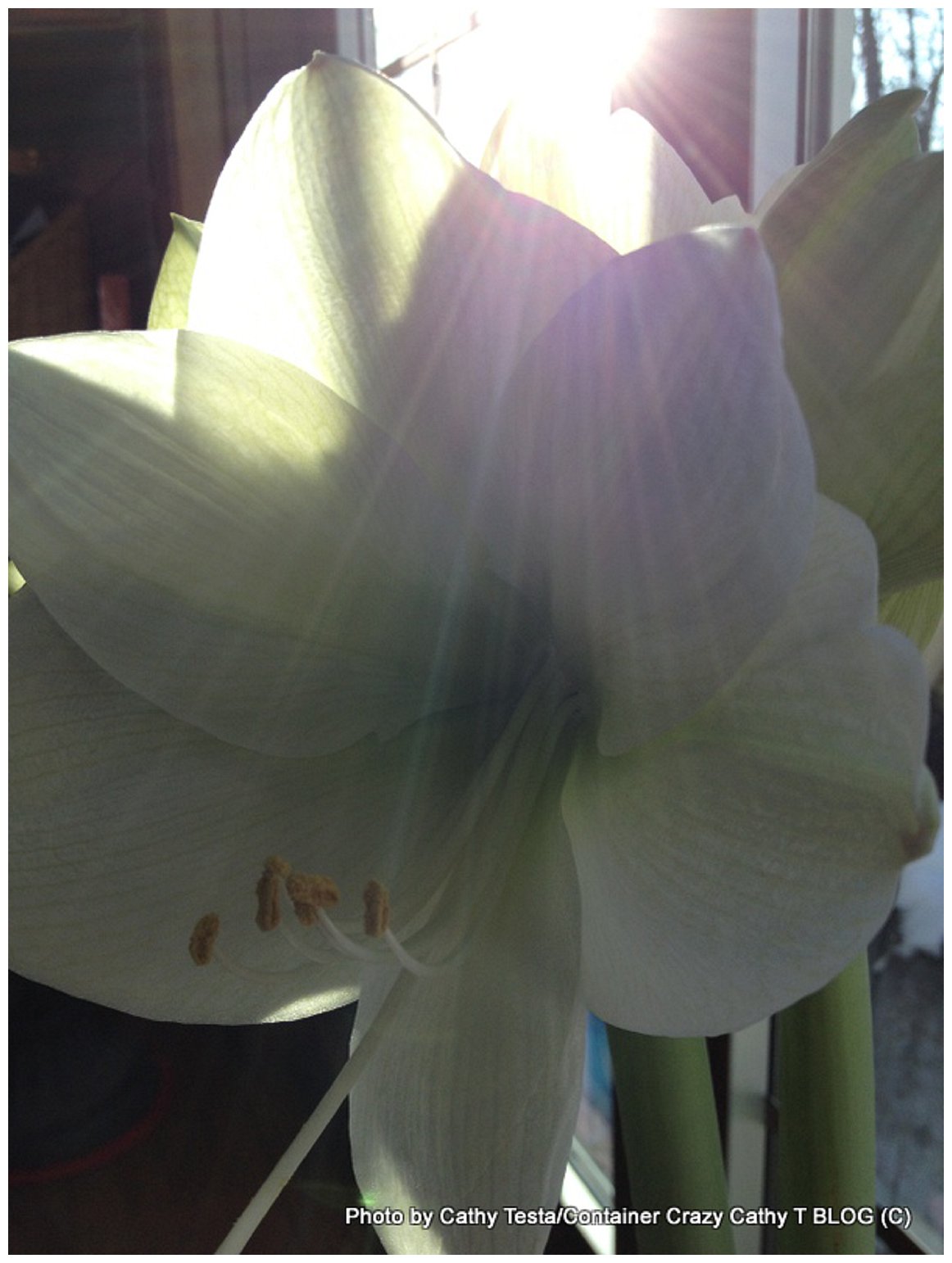
Sunlight

Sunlight

After all the flowers faded, I cut them off leaving the leaves and part of the hollow stems to continue growing. (FYI, if you want to try pollination, don’t cut them off and watch for the right time to move pollen from the anthers to the stigma; see the video below for more).  See also the website noted above for information on pollination or video below.)

Green centers of white petals

Green centers of white petals

In Summer:

I will move both plants outdoors in summer and let the long strap like leaves remaining on the plant enjoy the warm sun to increase in strength as they produce food by photosynthesis and store it in the bulb.   If the leaves are so long they flop over, you can use a stick or bamboo pole in the center and put a piece of twine around to hold them up while outdoors during the summer months (or late spring after any danger of frost). At the end of summer, they will be returned indoors and be allowed to dry completely (no watering) and stored in a cool dry place (basement) to stay in a dormant state and rest until I feel the need to return them to warm temperatures again – probably next February when I will be needing some indoor inspiration again.  Note:  The plant doesn’t need to be re-potted for a long time because it enjoys restricted root system.

Cathy Testa

Useful Links:

http://www.clemson.edu/psapublishing/pages/HORT/HORTLF63.PDF (Clemons Extension Horticulture)

http://www.usna.usda.gov/Gardens/faqs/AmaryllisBloom.html (The United States National Arboretum)

http://www.saga.co.uk/lifestyle/gardening/masterclass/growing-and-caring-for-hippeastrum.aspx (Saga)

Video of How to Pollinate Amaryllis by Mr. Brown Thumb:

Sun casting thru

Sun casting thru

Other Info:

Amaryllis are bulbs of the genus Hippeastrum that are native to tropical and subtropical areas of the Americas.  In Connecticut, they are popular around the Christmas holidays or during late-winter to force indoors as a houseplant.  They are easy to grow and can remain in the same pot for years as they cycle through their growth and bloom periods. And they are guaranteed to add some cheer during the holidays or dreary days of late winter. You usually can find them on sale in February, after the holiday season has passed.  Enjoy!


5 Things You Can Do Right Now to Get Ready for Spring!

7 Comments

#1 Go to the Flower and Garden Show this week in Hartford, CT

Go to the flower and garden show in Hartford, CT being held this week starting Thursday, Feb. 20th. Just walking into the building will get your senses thinking about spring and less about snow as you see, hear, smell, and experience the plants and plant offerings by the many exhibitors.  I plan to go – probably on Friday.  Got the day off?  Want to join me, just email me at containercathy@gmail.com.  There is parking adjacent to the convention center.  After parking, find your way through the parking garage to the main entrance and take the escalators up to the show floor. Don’t forget to visit the seminar speakers on the floor above the show floor too.  Food and wine is available at the show each year, and check in with your local nurseries before you go for tickets – they often offer discounted tickets by a couple bucks.  If you can’t make it during a week day, no worries – it runs through the weekend, and the weather is looking warmer by Friday.

#2 Visit Cathy T’s new Pinboards on Succulents and Tropicals

Why?  Because in May, Cathy T is offering a fun class on how to make container gardens with succulents, and will be having a Tropical Talk too.  To get inspired about this first annual BIG CONTAINER GARDEN PARTY to be held on Broad Brook, CT, visit her new pinboards right now, note the date on your calendar, and register today.  These pinboards will get you at least thinking about upcoming fun of creating beautiful containers for your outdoor spaces in the spring and summer. The possibilities are endless in the style and ways you can mix up plants for the season.

To learn more details about this class, see the pages listed under Cathy T’s Classes or under Container Gardens on the menu of this blog.  Share the information too with any local friends interested.

#3 Scout Containers for the Upcoming Season

Now could be a very good time indeed to think about containers or patio pots for not, only Cathy T’s BIG CONTAINER GARDEN PARTY (class) in May, but in general for your container gardening coming up in a matter of a month of so!  We may have snow right now, but it will begin to melt as soon as temps warm up – so why not rummage your own stock of goodies, or start looking for unique containers at the flower show this weekend?? – and of course, the tag sales that kick off in the spring. It is when you least expect it that you find a vintage item, a repurposed pot, or something sitting in your garage or basement right now that can be a container in spring and summer – old fancy shoes or pumps – heck, before tossing them, think – could this be a great container for succulents at Cathy T’s class?  I think yes!

#4 Think about Attending Other Garden Related Conferences

Did you know there is a great ELA conference next week in downtown Springfield, MA for plant enthusiasts and ground huggers?  Well, I say ground huggers in a very loving way – the focus at this conference is usually on natural horticultural practices and sustainability.  Is there any other kind?!!   The speakers at this conference are highly educated and the attendees inspiring for many are hort people in the business, but this doesn’t mean an avid gardener expanding their knowledge base and horizons can not attend too. If interested, visit their website for all the details. There is parking near the conference location, and places in downtown to eat if you want to adventure beyond the cafe onsite at this conference.  Do something different, and give this conference a try, or don’t forget other flower shows going on, such as the Rhode Island show (held same time as Hartford’s) or Boston show in March or UCONN’s Garden Conference in Storrs, CT.  You will be amazed how inspiring it can feel to attend a conference you haven’t tried before – you may not know what’s out there – but if you go – it surely makes you more ready for spring!  And many are in locations where you can adventure into the city and enjoy other places of interest if you make a weekend out of it, or stay overnight.

#5 Start some Seeds indoors, or Force some Pretty Bulbs:

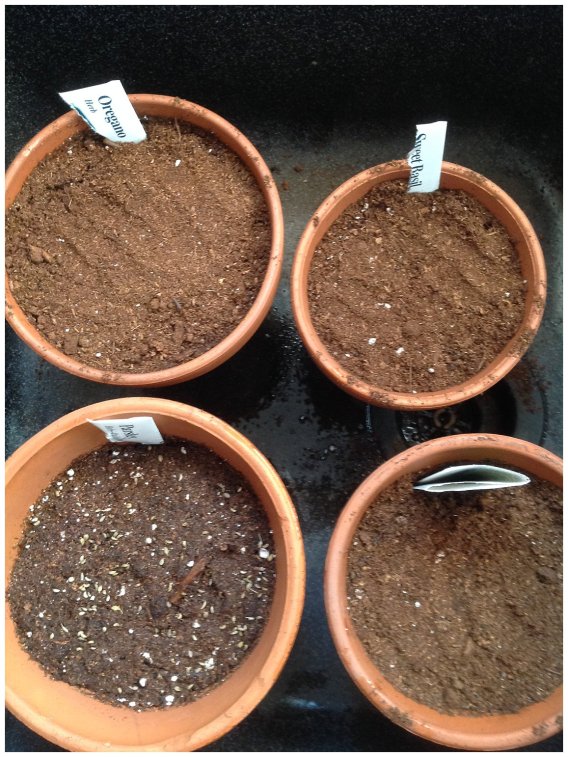
Herb Seeds (Photo by Cathy Testa)

Herb Seeds (Photo by Cathy Testa)

It may feel too early to start seeds, but heck if you pot up a few herb seeds in your home or grow an Amaryllis bulb, like I did recently inside the home – you start to feel inspired for the growing days of spring ahead when you see the bulb’s flowers open, or see the seeds popping up in the soil.  So go to your local supply shop, get some seed starting potting mix and a couple packets of seeds, put them in some pots, place by a sunny window sill, and watch it grow.

Photo by Cathy Testa, Panical Hydrangea Covered in Snow

Photo by Cathy Testa, Hydrangea Covered in Snow

Or if that doesn’t suit your fancy, get bundled up, walk your property and take some photos of plants in the snow covered with icicles, fluffy snow, and enjoy the shadows against the snow cast by branches.  This cheers me up and hopefully will do so for you.  By the way, if any of your shrubs are toppling over due to the weight of sticky snow, it is a good idea to gently shake the excess snow off the branches so they don’t break or bend too harshly.

Happy Monday Everyone,

Cathy Testa

Storing My Big Red Banana Plant

16 Comments

So It Can Return Again Next Spring

Storing Red Ban Plant_0010

Ensete ventricosum ‘Maurelii’ is a return visitor at my home.  I have fallen in love with this tropical red banana plant for so many reasons, but what has impressed me more than anything else, is how large it grew this year in my monster cement planter.

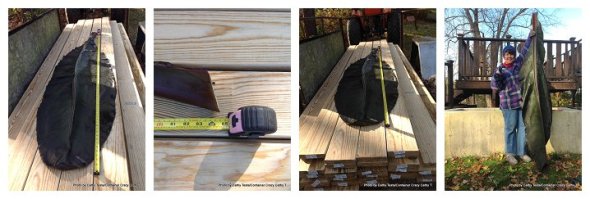
Although I’ve included this type of red banana plant in my container gardens before, I’ve never seen one grow this big so fast.  It reached a height of 8 feet tall with large leaves growing to 7 feet long and 1.5 feet wide.  It was at proportions I didn’t expect, but was very happy to witness.

As each new leaf grew and unrolled from its center throughout the summer, and even into early fall, I was in awe of its massive presence – and ability to stand so tall. By the end of October, the plant had a large fleshy trunk of a 1 foot diameter.

Planted on the eastern side of my home, the morning sun would rise to greet it every day.  By noon, dappled shade cast down upon it from the forest trees nearby.  And by late afternoon, its large showy tropical leaves with red coloring were wonderfully backlit by the afternoon’s setting sun.  I am not sure which part pleased me most, but each stage was worth taking pause in my day to enjoy.

There were so many times I took photos of my big red banana plant in the planter that it became a bit obsessive.  Even though it was difficult to get a good shot because of the glares and shadows – and its sheer size, I still clicked away taking as many as possible throughout the season.

I showed my big red banana plant to my family, visitors and unexpected guests when they were here.  Heck, I even made them pose in-front of it for more photos.

Later in the season, I finally broke down and did what I pondered doing.  I hired a professional photographer to take a few good shots.  The sounds of the camera clicking furiously made me feel as though I gave the ultimate red carpet attention to my plant.

Alas, the plant got hit by our first frost of fall on the evening of October 25th.  The next morning, I knew my guest would be leaving for a long winter’s rest. It was time to take it down and store the root base so it could return to visit again next spring.

Storing Red Ban Plant_0012

STORAGE STEPS FOLLOWED

First, a quick and easy haircut.  All of its gorgeous long leaves, now darkened by the frost and wilted, were cut off with large pruning shears and tossed in a pile.

Storing Red Ban Plant_0002

Second, using a bow saw large enough for the wide stump, I placed the blade about 12” from the base and began to zig-zag across.  “Timber,” I said, as the top portion fell to the ground with a loud thump. (To see a video of the cut, visit my HOW TO VIDEOS page.)

Storing Red Ban Plant_0001

Next was the careful removal of the root base from the soil.  Using a shovel to go around the root mass and cut the roots in the soil, I carefully lifted the large base with a couple of firm tugs.

Hand-pruners were used to trim the long roots as a way to eliminate additional soft fleshy material that may have the potential to rot in the storage box.

Storing Red Ban Plant_0014

With a soft brush and my gloved hands, I cleared away the final soil residue on the root base, making sure it was fairly clean and ready for its next step.  I also re-trimmed the cut end to be level and clean.

Storing Red Ban Plant_0015

In a nice sunny spot, I turned the root base upside down and placed it on a milk crate to drain of excess water for one solid day.

Storing Red Ban Plant_0008

Then was the box selection – a new home.  Inserting a light weight plastic bag into it, filling it with bedding material of peat moss, I then carefully laid the heavy root base in the center on its side.

Finally, covering it almost completely with more peat and loosely closing the bag. I shut the box and labeled the outside with the date, plant type, and a smiley face.

Red Ban Boxed_0001

The last step was moving the box to a cool dark place in above freezing temperatures in my basement.  And then I said a little prayer. (You know, because it doesn’t hurt.)

THE STORAGE PRAYER

Oh Banana Plant – You were so sweet

So now I lay you down to sleep

Please come back or I will weep

Enjoy your restful place of keep

Until I reawaken you in twenty-six weeks
Storing Red Ban Plant_0003

STORAGE PRACTICAL TIPS

Be careful to not dent, cut or nick the root base.  These can create wound places, serving as an invitation for mold to set in.

Take measurements so you will have a record of how large the plant grew and can compare notes in the following years.

Use clean, disinfected tools during the process to avoid transmitting any diseases to the plant.

Try to do the breakdown job before significant rainfall if possible.  It makes it easier to move from the soil.

Don’t wash the root base with water to remove soil. It only makes it wetter.  You want the base to be slightly moist but not soggy because this can rot in the storage box.

Reuse the peat moss every year – it last a long time, and is an excellent material to store root bases.  It holds moisture lightly and helps maintain a balance of air too.

After removing the root base, turn it upside down to allow water to drain out before storing it, but don’t let it get too dry.

Use a cardboard box with vents or spaces to allow some air circulation to set in.  You don’t want a box to seal tightly and leave moisture inside where it will rot the root base.

Select a plastic bag that is very light weight, like those used in grocery stores.  Close the bag lightly.  Do not tie it off – allow some breathing room.

Red Banana on Left with elephant ear corms on Right

Red Banana on Left with elephant ear corms on Right

THE STORAGE LOCATION

You want to find a location where it remains cool, but not below freezing.  Some references indicate a temperature range of 35° to 45° F.  I put mine in the basement by the door where it is coolest, but I also place the box on a bench so it is not in contact with the cold cement floor where condensation can possibly cause the box to get wet and then stay too damp.  If it gets frozen, your root base is going to die.  If it gets too warm, it will start to grow again.  You want to make sure it is just right.  For me, that spot in the basement seems to be the sweet spot.

FINAL NOTE

The storage prayer is optional, but I believe this helps.  And when you open the box next spring, you will hear the angels singing when you see your banana plant made it just fine to be your return visitor in your container gardens every season.

Written by Cathy Testa

P.S. More will be shared about my big red banana plant (highlights, professional photo shoot, guest visitors, companion plants, and more).  This is to be continued…Stay Tuned.

A Frosty Start to October 26th in Broad Brook, CT

2 Comments

And my plants felt it!

First Frost_0012

On the evening of October 25th, we received a drop in temperature around midnight, and it was only in the low 30’s around 6:00 am the next morning.  In fact, when checking Timeanddate.com, it reported the lowest temperature at 32 °F on October 26 at 5:53 AM.  That’s chilly. And my plants outdoors felt it.

Birdbath frozen with fall leaves

Birdbath frozen with fall leaves

So when I went outside around 8:00 am yesterday morning, it did not take long for me to realize I would need to go back into the house to get a felt hat, warm gloves, and heavy wool top to do my work of the day, which was taking down my big red banana plant in my large cement planter along with various elephant ears and Canna plants.

Elephant Ears and Other Tropicals Curled up

Elephant Ears and Other Tropicals Curled up

All of my tropical plants remaining outdoors were drooping downwards and heaped over from the effects of getting hit by their first frost of our autumn season.  And other plants had white and feathery frost patterns on their leaves.

Annual Thunbergia, a Blackberry plant, and Castor Bean

Annual Thunbergia, a Blackberry plant, and Castor Bean

Some leaves looked as if dew had frozen in time.  Tiny balls of clear ice could be seen on the undersides of the curled up leaves of elephant ears.  This was the pretty side to the frost on some plants, perhaps the only pretty side.  While other looked just horrible – particularly my tropical plants which can not survive below freezing temperatures.

Mojito elephant ear curled up with crystals

Mojito elephant ear curled up with crystals

They were all curled up, wilted over, and turned mushy overnight.  Liquid within their plant cells froze into ice crystals and ruptured.  This damages and kills the top part of the plant, but the underground storage organs, such as rhizomes and corms, can be stored over the winter.  Unfortunately for tropical plants, they do not have a way to protect themselves to survive frost.  However, their underground storage systems go into a semi-dormant state immediately, and can be moved to a cool but above freezing location over the winter inside the home.

Seed pods of Castor Bean frozen hard

Seed pods of Castor Bean frozen hard

Gazing ball with Mandevilla blooms and foliage

Gazing ball with Mandevilla blooms and foliage

Thus, it was definitely time for me to get the rest of my tropical plants stored for the winter season by digging up the underground storage organs or root balls and putting them away carefully. I could not put this process off any longer.  It would take most of the day and I managed to get it all done.

Canna by house not as bad as others

Canna by house not as bad as others

Ipomoea, elephant ears

Ipomoea, elephant ears

Written by Cathy Testa

P.S.  Stay tuned.  I will be sharing ‘how to’ overwinter tropical plants, but in the meantime, visit my HOW TO VIDEOS page to see some tips and tricks.

Holding an leaf and cut off top of my red banana plant.

Holding a leaf and cut off top of my red banana plant.

I Wish I Was as Strong as An Ant

3 Comments
Image Courtesy of FreeDigitalPhotos.net/by Sweet Crisis

Image Courtesy of FreeDigitalPhotos.net/by Sweet Crisis

When I take down my container gardens for the season.

Lifting objects fifty times my weight would be handy right around now when I start taking apart my large container gardens and patio pots on my deck for the close of the season.

Years ago, I had no problem whatsoever doing this process, but as one ages – well, you know, if you don’t keep up with those muscle building routines, it can become difficult.  In fact, when I gave talks on container gardens and why “bigger pots are better,” some ladies in the classroom would ask, “How the heck did you manage moving all those big pots?!”

Sometimes I get so excited about container gardening, I instantly find super power energy enabling me to lift heavy bags of container garden soil or other items needed like the big pots. However, during this year’s take down process for my container gardens, I felt a little weak at times.

In fact, I started to tell myself, stop feeling frustrated about taking down your plants in your container gardens!  It is part of the process and get into the spirit.  So I did some of my work of breaking down the 20+ or so large container gardens on my deck yesterday, and as I was doing so, I thought I’d share some of the things I found frustrating or helpful during the process.

Soil from Containers

Soil from Containers

GET A WHEEL BARREL OUT

Last year I was lucky. I had a new huge cement planter near my deck and I tossed the left over soil into that, but this year, I had to use my wheel barrel.  At first, however, it fell over from the weight of the soil falling from the deck level above into the barrel as I tossed it over the railing.  So I attempted to move my pick up truck to the deck, well, that didn’t work.  It was too difficult to maneuver the truck to the corner of my deck.

photo (7)

So, it was back to using the wheel barrel.  After getting a big lump of a root ball or two into the barrel, it stabilized and I was able to continue dumping the soil into the wheel barrel receptacle from above.  I will use this soil in the ground somewhere to recycle it as it doesn’t do well being reused in my container pots next year – It is best to have fresh container gardening soil each season, in my opinion, but to use it as a top dress to a garden bed or for a new garden bed is a good idea.

PLASTIC LINERS FOR POTS

In my container garden demonstrations, I show folks how to line their containers and patio pots with plastic liners (which must have slits and holes cut into them for drainage).  The reason I started doing this many years ago was more to keep the containers in good shape, but it also turns out to be a very effective method for slipping the whole root ball out of the containers at the end of the season.  The roots circle a bit around the edges within the liner, and it forms a nice ball or chunk when you are ready to take the plants and soil out.  It is a great tip for plants like Canna plants because they get large rhizomes and roots in the soil, making removal difficult. So I was happy my liners were working perfectly as I was removing the soil from my pots.

Foliage being Tossed into a Bin.

Foliage being Tossed into a Bin.

CUTTING ALL THE STEMS AND FOLIAGE OFF

Before slipping the soil out of the pots with the liners, I cut off all the foliage and stems to about 4″ from the base for plants I’m tossing in the compost pile. The little stub of a stem helps to lift the root ball out of the pots, at least in sections or chunks. The key here – use good sharp pruners or a serrated knife for large stems, and make sure to clean or disinfect them so you don’t spread any yuck (diseases) around, even during the take down process, clean tools are important.  I tossed my cuttings into a large bin on my deck, another item which came in handy as I was working.  It is easier to take all the foliage off before trying to move pots to a location or to the spot where I was tossing out the soil into my wheel barrel. Seeing the cut off stems of my elephant ears made me sad, and also made me think that I should have setup a station to make leaf imprints in a concrete mix as a side project at this time, especially because I have plenty of leaves to use, but that’s another crafty project requiring time.

WASHING THE POTS

Sometimes I feel a little lazy, but I force myself to wash the pots with a little soapy water, and a soft brush to clear away any soil residue left in or on the pots.  Then air-dry the pots completely before moving the containers into a garage or shed.  It is important to not skip this step. Cleanliness is so important for your plants when you begin again next spring to replant your containers.  It greatly reduces, if not eliminates, potential plant diseases or problems and you will be happy you cleaned them the year prior.

My Big Kalanchoe, Going to a Foster Home.

My Big Kalanchoe, Going to a Foster Home.

FINDING NEW HOMES

For container plants which I can not fit into my home (yup, read my blog earlier about greenhouse procrastination), I stand there contemplating where I can fit this – or should I give the plant to a friend or family member with a bigger house? The one I’m struggling with right now is my Kalanchoe (paddle plant).  It is HUGE. I know I can easily propagate some with cuttings, but I keep looking at it saying, should I cram it in my bedroom again to keep it alive all winter? Or give it to my sis in law with a big open bright living room with lots of windows?  Oh gosh, the challenges!!  I don’t know.

Hypertufa at End of Season.

Hypertufa at End of Season.

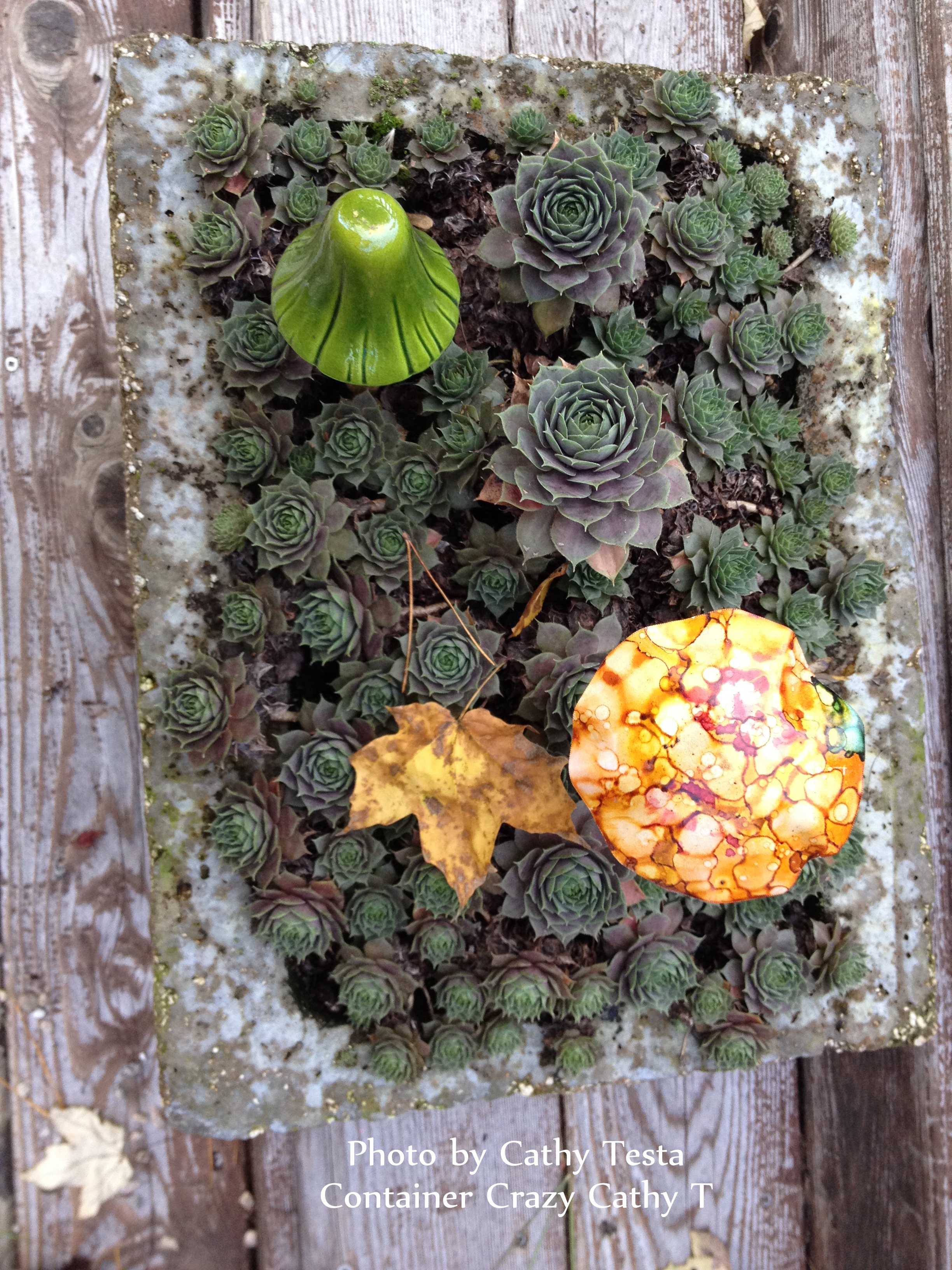
I also have a beautiful hypertufa stuffed with Sempervivums (hens-n-chicks).  They are pretty tough, can go really dry all winter with little watering, but I don’t have room in my kitchen garden window because I put my head planters there.  Gosh, where will this one go?

These are the challenges I face, never mind the fact I just don’t want to stop admiring my container garden plants outdoors, but winter is coming.

HAVING A GLASS OF WINE

Another downfall, or plus depending on your point of view, is that I started feeling like I wanted to have a glass of wine and enjoy my deck.  It is one of my favorite spots at my home. If you were to ask me – What is your favorite spot? Well, it is our deck.  I always feel like it is a vacation spot or oasis with all my big tropical plants every summer.  I get to decorate it with all my garden decor, and it faces a private backyard, so it is really a retreat.  So because I was out there on a nice, sunny fall day, and being around my beautiful plants, I felt like, gee, I should relax and have a glass of wine.  So I did after I disassembled about five or so of the smaller of my big containers.  Today, I will tackle the bigger ones.  This will require a hand-truck, some patience, and strength.

Wish me luck!

Cathy Testa

FOUR YEARS AND COUNTING

6 Comments

It is truly amazing how fast time flies by, especially as we get older. My mother always says, “Wait til you get my age! It goes sooo fast.”

I read somewhere the reason it feels like life is moving so fast sometimes is because of our “routines” and if we change them, things won’t feel so fast, but routines and traditions are inevitable, plus we enjoy them.

AN AWARD

Source: WordPress

Source: WordPress

Today I saw an “award” on my WordPress Blog message board.
It says today is the 4th year anniversary of my blog – geesh!  I can not believe I started this blog 4 years ago – where did the time go?  And I have 224 posts to date.  Stats continue to rise and I truly appreciate all the visitors to my blog.  It is incredible the other bloggers you can meet just by being a blogger.

Nowadays, I don’t bother searching for something via websites, I always go to blogs when I want to find something creative or when I need information.

But other things that seem to creep up quickly – are the months.  My husband always says, “Wow, it’s xx month already – like October – its here – and then he will follow with, “Next thing you know it is Christmas, and then New Years, and then time to open the pool, then time to close the pool, then time to take stuff off the deck…”  I usually stop him with, “Cut THAT out!”  LOL.  He’s right now, we barely swam in our pool and just closed it up recently, how does that happen so fast?

A CLASS IN DECEMBER

Source: Bitstrips

Source: Bitstrips

It may seem early to be talking about December, but I just posted more information regarding my annual holiday class called “Evergreen Kissing Ball & Holiday Creations“.

The planning for this event starts in October for me.  You see, I have to place orders to my growers and suppliers now to ensure I will receive my batches of fresh quality evergreens for my attendees.  They don’t get cut now but they need to know what to expect from their clients, so yesterday I had the pleasure of selecting the greens and creating my advance documentation about the class.  Some folks did ask recently if I’m holding the class again – and the answer is YES!  So click on my Cathy T Class page from my menu if you wish to get on board early.

That’s it for now – just a quick post.  Onto planning for my October class, being held this Sunday, October 13th, on how to overwinter tropical plants. The weather this year is warm compared to last year this time – I remember, because I setup a fire pit outside last year when I did this class, and this year, it is still warm and even humid.

Last night, I had my slider door open to allow the fresh air – amazing for October. But it could change with a snap of your fingers.  I’m starting to do some container garden clean-up this week – thinking tomorrow because the sun is suppose to be out, so it will be enjoyable.

The take down of my tropical plants for storage over the winter will be held off for Sunday.  So if you want to join me to learn the process, please contact me by Friday, October 11th, of this week.  It will be here before you know it.

Thanks for dropping in again – so enjoy your visits.

Cathy Testa

A Fairy, the Castor Bean Plant, and Poison. Can They All Live Happily Together?

16 Comments

Perhaps the only person to definitely know if the castor bean plant and its three little seeds lying within each of its seed capsules has been and continues to be falsely portrayed as a lurking killer is the beautiful and bold imaginary fairy by the name of Ricina, a clever creation by Nancy Farmer, an artist residing in the United Kingdom.

A FAIRY

  • a small imaginary being of human form that has magical powers, esp. a female one.” (source: Google)

Art may be left up to the interpretation of the admirer or defined by its originator but my perception of Nancy Farmer’s creation, the fairy she named Ricina, is of a mature woman seductively perched upon the stalk of a castor bean plant.  With her eyes glanced to the side and a sneaky facial expression, Ricina appears to be ready to protect or serve the possible magical yet deceptive powers of the plant and its seeds. Her bright red lips and finger nail polish flanked by a smart little red bow tie around her neck matching her classic attire provides the admirer a glimpse of her individualistic style. And she looks a little playful too with a suggestive rise in her sexy leg and fashionable but just the right sized heeled shoes. A handsome umbrella dangles from the tips of her fingers and she sports a masculine hat – teasing mementos to remind of past stories and tales regarding the castor bean seeds and its potentially lethal toxin known as ricin.

Copyright Photo, Permission Required by Originator

Image courtesy of Nancy Farmer/www.nancyfarmer.net and nancyfarmer.wordpress.com

If Ricina could buzz by our ears, perhaps she would whisper there is nothing to fear. For only those with harmful and deliberate intentions could possibly use the plant’s powerful little bean-shaped seeds for malice and not joy.  She knows it requires the elements of keen knowledge about the plant’s toxic components and a bit of unrealistic determination by the offender.  Or maybe she would tell us only a fool would pry apart prickly seed capsules designed to keep predators at bay and then chew its seeds obviously marked with suspicious patterns.

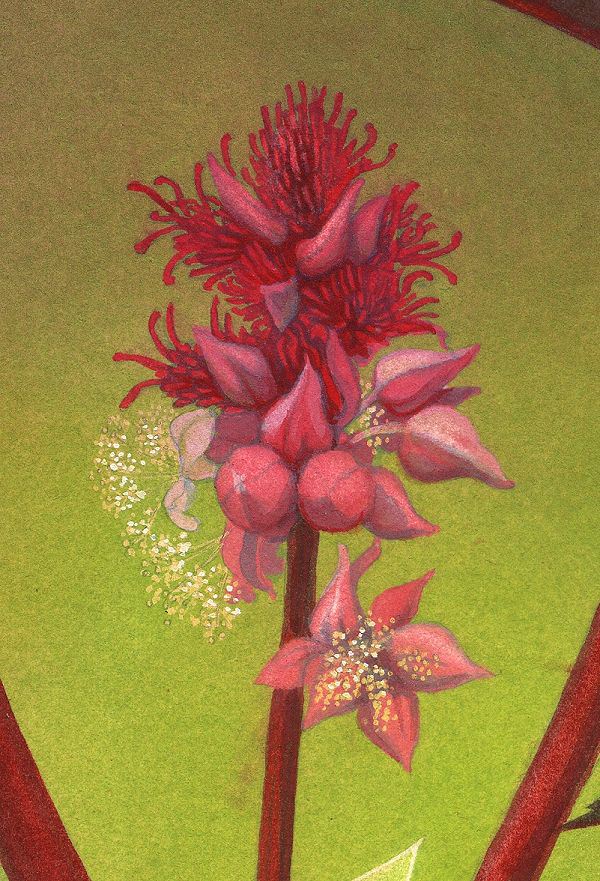
Nancy Farmers artwork of the castor bean flowers (www.nancyfarmer.net and anancyfarmer.wordpress.com)

Nancy Farmers artwork of the castor bean flowers (www.nancyfarmer.net and anancyfarmer.wordpress.com)

She would continue to reveal the beautiful benefits of the plants’ ornamental characteristics and its ability to thrive with little encouragement to provide grandeur in our gardens.  As she continues to deflect our attention from unproven matters of the castor bean plant, she may fly around exclaiming the exceptional as well as unattractive features of the plant from its large showy leaves, a towering height, and flowers with a combination of features as complex as its tales. The key, she should would say, is to admire ‘all of the plant’s’ wonderful virtues along with its adversity.  Because the castor bean plant has its good and bad sides.

Source Permitted by: Nancy Farmer (www.nancyfarmer.net/nancyfarmer.wordpress.com)

Source Permitted by: Nancy Farmer (www.nancyfarmer.net/nancyfarmer.wordpress.com)

Source Permitted by:  Nancy Farmer of www.nancyfarmer.net and nancyfarmer.wordpress.com

Source Permitted by: Nancy Farmer of http://www.nancyfarmer.net and nancyfarmer.wordpress.com

THE CASTOR BEAN PLANT

  • “A large shrub of tropical Africa and Asia having large palmate leaves and spiny capsules containing seeds that are the source of castor oil and ricin; widely naturalized throughout the tropics.”  (source: thefreedictionary.com)
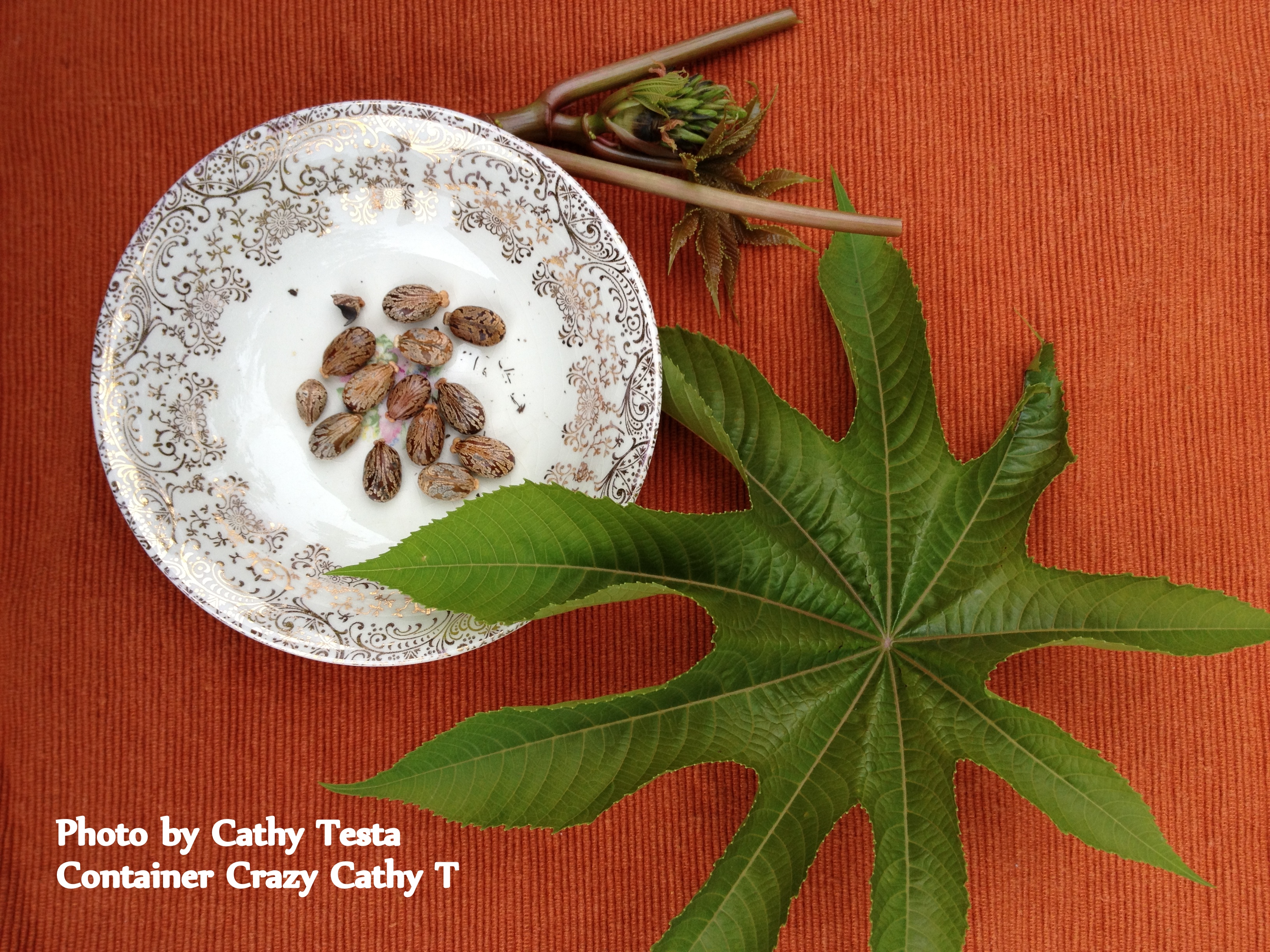
Castor Bean Seeds with a Leaf

Castor Bean Seeds with a Leaf

The castor bean plant or castor oil plant (Ricinus communis) is a tropical shrub or tree hardy in planting zones 10-11.  It is treated as an annual in Connecticut’s planting zones since it will not survive winter temperatures here. The plant grows rapidly from seed when planted in ideal conditions. It can easily reach between ten to twelve feet in a single season. As the stalk increases in diameter, it resembles thick bamboo. Large distinctive green leaves growing from the tips of long petioles are lobed shaped with several pointed star-like tips.  The species is primarily green, but cultivars come in vivid red to maroon colors, including the seed capsules.

Nancy Farmer's artwork of the red seed capsules of a cultivar the castor bean plant

Nancy Farmer’s artwork of the red seed capsules of a cultivar the castor bean plant

Photo Courtsey of Nancy Farmer's Artwork

Photo Courtesy of Nancy Farmer’s Artwork (www.nancyfarmer.net and nancyfarmer.wordpress.com)

The plant’s odd-looking flowers consist of separate male and female flowers on the same plant. When both sexes are on the same plant, this is termed monoecious. The male flowers are white and tiny, situated just below the female flowers.  Red styles, the narrow part of the pistils, are clearly visible on the female parts of the plant.

Female Flowers on a Castor Bean Plant

Female Flowers on a Castor Bean Plant

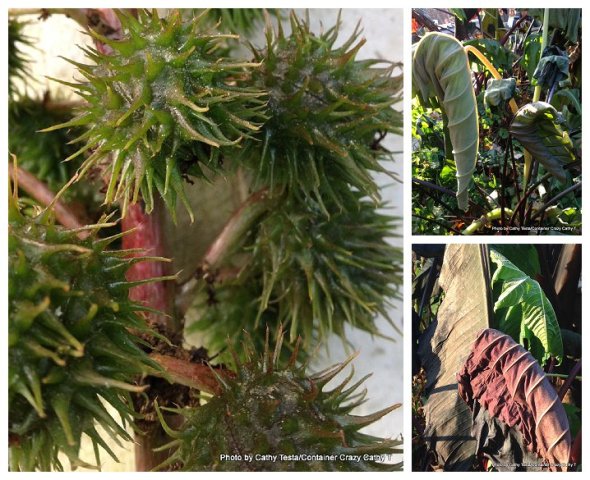
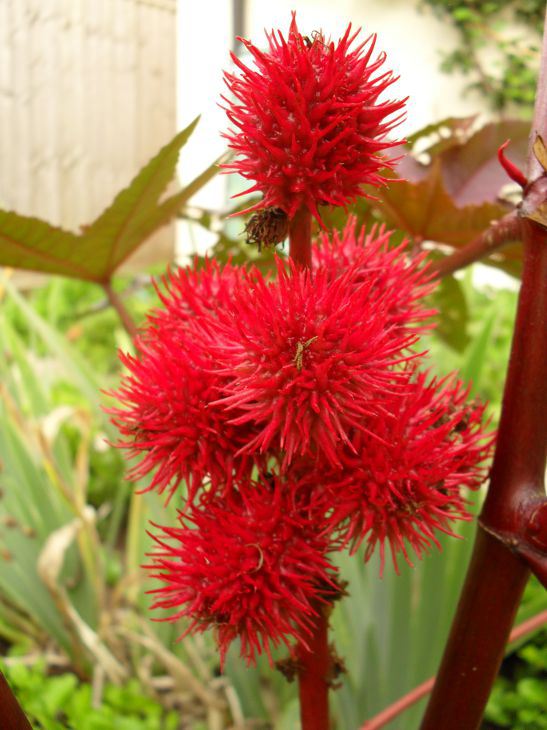
Prickly seed capsules - Ricinus communis

Prickly seed capsules – Ricinus communis

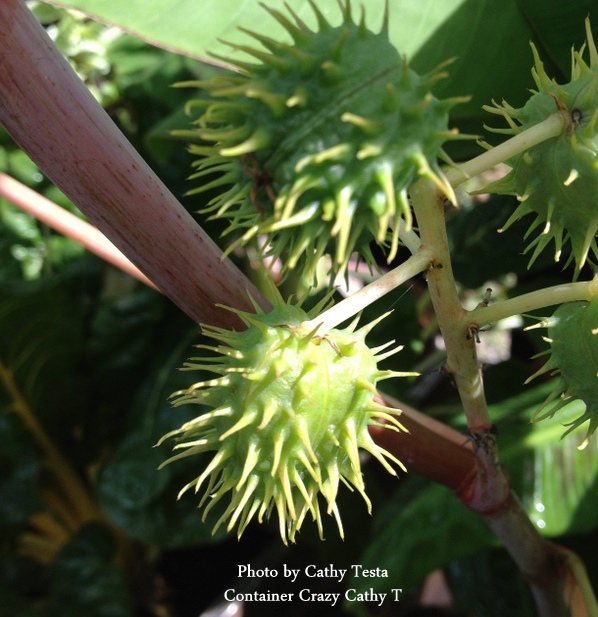
Round seed capsules grow from the female flowers which are rather interesting. They are composed of three joined lobes or hulls covered with soft prickly spines. Inside each prickly capsule are the infamous castor bean seeds, known to be the source of a potentially lethal toxic, known as ricin. Although the castor bean seeds are the size of edible beans, think kidney beans – they are not true beans at all.  And they are not meant for direct consumption, but used for the production of castor oil and other traditional medicines. Some people think the seeds resemble inflated ticks, and the genus name Ricinus is the Latin word for tick.

Mature seeds of the castor bean plant

Mature seeds of the castor bean plant

Immature seeds in the capsule.  Photo by Cathy Testa

Immature seeds in the capsule. Photo by Cathy Testa

A POISON

  • “a substance that, when introduced into or absorbed by a living organism, causes death or injury, esp. one that kills by rapid action even in a small quantity.” (source: Google)
  • “a person, idea, action, or situation that is considered to have a destructive or corrupting effect or influence.” (source: Google)

Relief from the use of castor oil derived from the seeds of the castor bean plant (Ricinus communis) may yield some benefits for people still using this remedy as a laxative, but there are reported sinister sides to the seeds, that when used in a specific fashion and with its toxic substance, will lead to illness and sometimes death of an unsuspecting victim. Some stories or myths shared from past to present about such occurrences, including claims of sneaky murders from administering ricin with a common umbrella as the mode of transmission, to claims of accidental deaths from chewing the seeds without the realization of the disastrous results days later, may be somewhat exaggerated.

In the words of John Robertson who has spent ten years researching, writing and talking about poisonous plants:

Butthough ricin is extremely poisonous it actually does little harm. Around one million tons of castor beans are processed each year for castor oil production leaving the waste pulp with up to 50,000 tons of ricin in it. And, yet, finding instances of ricin poisoning is not an easy task. (source: THE POISON GARDEN website)

Victims are said to suffer from vomiting, diarrhea and dehydration once attacked by the evil person in possession of the ricin.  Others have eaten the castor bean seeds in ignorance with the belief it is a medical solution to their health problem. Yet the more you read regarding the poisoning powers of the infamous castor bean seeds, the more unclear the accusations and exaggerations become regarding the potential for eventual death to occur. Some sources attempt to explain the differences between poisonous and dangerous because a person can do no harm without the right combination of both a lethal toxin and attitude.

In a ten minute video on THE POISON GARDEN website about ricin, John Robertson states, There’s a big difference between poisonous and harmful.  For a poisonous plant to become harmful, there has to be a way to administer the poison.

Leaf of the castor bean plant (Ricinus communis)

Leaf of the castor bean plant (Ricinus communis)

THE HAPPY TOGETHER

Many references will indicate you should keep the castor bean plant and especially its seeds away from children or animals, and should you have either, this may be a needed precaution.  More important, I would say, is to be knowledgeable about the plants before placing one in your gardens. Unlike plant tags listing all the beneficial reasons a plant is successful (a winner, deer-resistant, hummingbird magnet, drought tolerant, etc.), the downsides of plants are not indicated at all.  One is to wonder if plants should have warning tags (e.g., potentially toxic, invasive, aggressive, addictive, etc.) but for obvious reason, they do not.  However, I have grown castor bean plants at my home and so have many others worldwide.  In some parts of the country, the plant grows as a common roadside weed and the population of people near these situations are aware of its hazards. Similar to other things in our society which are dangerous under the wrong circumstances and in the wrong hands, we must just be more educated and not be put in a state of fear.  After all, if the castor bean plant and its potential poison is a killer, why am I not dead?

Racina, the plant, and myself co-exist without any ill effects – and you can too if you admire the castor bean plant’s features.  One way to limit your anxiousness regarding the prickly seed capsules with seeds within is to remove the flowers all together on the plant, or remove the capsules before they mature and potentially crack open to drop seeds on the ground.  Wild animals seem to understand the precautions and warnings provided by the plants as an adaptation to say “don’t eat me, stay away, I’m trying to reproduce.  And if you tempt it, I will make you sick enough so you remember.”  How incredibly wondrous by the plant.  Racina, as I imagine her, understands this.  She, the plant, and the poison all live happily together.

And I think you could too,

Written by Cathy Testa©

White male flowers on the Castor Bean Plant (Ricinus communis)

White male flowers on the Castor Bean Plant (Ricinus communis)

P.S.  A very special thank you to Nancy Farmer, the obviously talented artist capturing the essence of the castor bean plant’s legends with a fairy.  She and her amazing works of combining ‘nature with art’ may be found at:

http://www.nancyfarmer.net/

http://nancyfarmer.wordpress.com/

References and Other Sources:

http://www.uicnmed.org/nabp/database/HTM/PDF/p86.pdf

http://en.wikipedia.org/wiki/Castor_oil_plant

http://www.thepoisongarden.co.uk/atoz/ricinus_communis.htm

http://www.missouribotanicalgarden.org/PlantFinder/PlantFinderDetails.aspx?kempercode=b459

http://www.ct.gov/caes/lib/caes/documents/publications/fact_sheets/plant_pathology_and_ecology/poisonous_plants_06-27-08r.pdf

http://www.ansci.cornell.edu/plants/castorbean.html

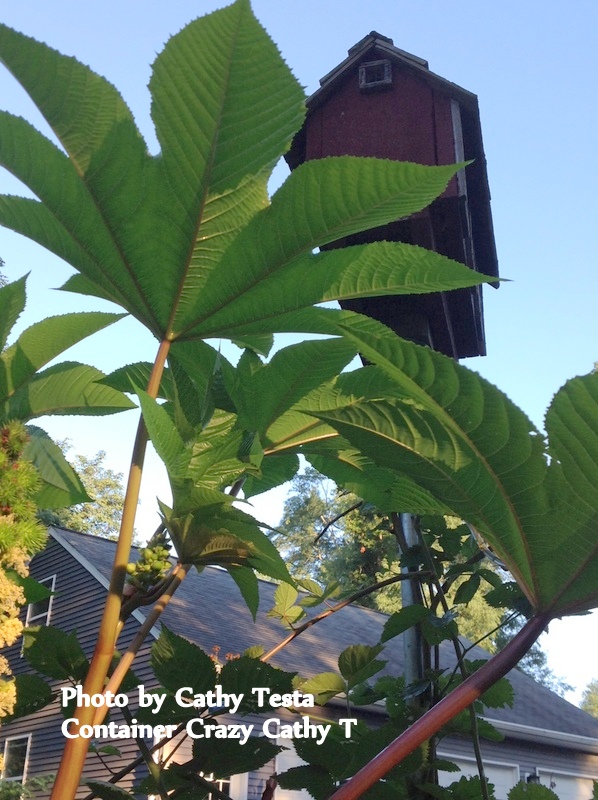
Castor Bean Plant growing at Cathy Testa's home near a birdhouse on a 10 feet high pole.

Castor Bean Plant growing at Cathy Testa’s home near a birdhouse on a 10 feet high pole.

Ten Dirty Little Secrets Master Gardeners Don’t Want You to Know

5 Comments
Image Courtesy of Grant Cochrane/FreeDigitalPhotos.net

Image Courtesy of Grant Cochrane/FreeDigitalPhotos.net

You may be standing there questioning your own abilities as a gardener while envying a master gardener’s garden, but what you don’t know is the so called master gardener you are in awe of (or the professional gardener you asked for help), is hiding some truths about how they do it.

Image Courtesy of imagerymajestic/FreeDigitalPhotos.net

Image Courtesy of imagerymajestic/FreeDigitalPhotos.net

So before your gardening failures bring you to tears – or make you want to just give up – learn the truth.  Here are some dirty little secrets master gardeners and professional gardeners don’t want you to know.

1 – They hire help.

Image courtesy of FreeDigitalPhotos.net

Image courtesy of FreeDigitalPhotos.net

Anyone who’s attempted gardening is fully aware it is high-maintenance to keep all spaces and plants pristine unless your plants are made of plastic.  You can bet the person, as in the master gardener or professional, who’s garden you have been admiring, has been hiring someone to tend to their garden behind the scenes. They have a full time or part time servant doing their dirty work.  It may be a landscaper, a teenager, or just an overly ambitious newbie to gardening eager to learn from the “master or pro.” Whoever it is – they are not doing it alone. This is especially true for gardens designed by professional gardeners featured in magazines, on websites or television. Their gardens are so spectacular, the photos speak volumes and you grow your envy as you look over their talents, but just remember, they have help.

2 – They make up plant names.

Image Courtesy of phanlop88/FreeDigitalPhotos.net

Image Courtesy of phanlop88/FreeDigitalPhotos.net

Its true.  Those Latin names they are so eloquently pronouncing as they point to their unique plant specimen may not be its true name.  In times of panic or memory loss, where it would be revealed to the casual gardener their Latin expertise is not up to par, they may just make something up spontaneously under pressure, AND make it sound great.  Master gardeners and professional gardeners study plant names – believe me, and know them – or most of them.  The best in the business can pronounce them with such precision, the accent in their voice rises your envy level to a new high. And pro’s take pride in this skill – and thus, they should.  However, everyone forgets. Once in a while, when showing off their amazing and stunning garden plants to their captivated audience, they may have an embarrassing lapse in their memory bank.  So they just make it up.  Next thing you know you are pointing to your new plant, telling your friends it is the Hosta ‘Monster Fries’ with no awareness you are sounding like a fool – or pro, depending on how convincing you are.

3 – They claim to be totally organic.

Image Courtesy of digitalart/FreeDigitalPhotos.net

Image Courtesy of digitalart/FreeDigitalPhotos.net

I bet my bottom dollar if we set up a hidden camera near an “organic gardener’s” unblemished gardens, we would witness the awful truth – they claim to be totally organic but have reached for a synthetic pesticide (at least once, or twice in their desperation).  Let’s face it – professional and master gardeners take immense pride in their showcases, so if they have tried soapy water, picking off bugs by hand, setting up insect traps, and other natural organic methods – and still find a pest on their prized plant ordered for beaucoup dollars from a specialty nursery, they reach for a hidden bottle of “x” and spritz the sucker when no one is looking.  By the way, to be “certified organic” you must prove it by supplying a great deal of tedious documentation.  So anytime you see the words ‘certified’ – you should be able to trust it.

4 – They hide a really great reference source.

Image Courtesy of imagerymajestic/FreeDigitalPhotos.net

Image Courtesy of imagerymajestic/FreeDigitalPhotos.net

Master gardeners and professionals learn a great deal about plants and gardening by studying, trial and error, hands-on experience, or by taking college horticulture classes. But along the way, they discover an amazing resource book. Or they may have a trusted (other secret) professional gardener with whom they exchange all their tricks of the trade.  But, they don’t tell you about this secret source or reference book. It is like a private club of pro’s sticking together and not letting anyone else in unless you are worthy. You know who I’m talking about, don’t you?  Just like chefs do not reveal their “secret” ingredients, master and professional gardeners don’t tell all of their secrets either.  They have some tools they keep to themselves.  Otherwise, they risk not being “the master.”

5 – They are not really “Master” Gardeners.

Image Courtesy of stockimages/FreeDigitalImages.net

Image Courtesy of stockimages/FreeDigitalImages.net

Yes, this is probably the biggest dirty little secret of them all.  Anyone can sign up for the master gardening program, and many of those who do are avid gardeners.  When I took the classes, I discovered the true meaning of gardeners.  So many of the program’s attendees were people with lots of dirt under their fingernails and have spent years, almost a life time, practicing the art.  But if an attendee has little to no experience, and sits in a classroom for 16 weeks of training for 10+ hours a day, this does not instantly make them a MASTER gardener.  So if someone says, I’m a Master Gardener, you may want to differentiate if that means they actually mastered years of experience in the garden, took other training (like college hort courses), and have official proof they are a “master” – Or if they just took the training program and are now claiming they are a Master.  And really? A MASTER — This term is not applicable in the gardening world. Everyone knows you never truly master nature. Master gardeners are passionate, finish the program, pass the test, and are special volunteers contributing their time and energy to many horticulture related needs. These are the attributes which make unique and worthy.

6 – They have no social life.

Image Courtesy of Sira Anamwong/FreeDigitalPhotos.net

Image Courtesy of Sira Anamwong/FreeDigitalPhotos.net

People who spend all of their time in their gardens have little social life – how can they? Their gardens are perfect, lush, full, and maintained – so they are most likely spending most of their free time in their gardens. Granted they want to do so, and this is what makes them truly happy – but they are not using up their free hours to go on trips, shows, events, or parties.  In fact, the only time they may be talking to real people is when those people are admiring their gardens.  Gardening is their preferred past time, which yes, is “a life,” but most of the time they spend admiring and talking to their plants, and not people.  Plants don’t talk back.  If they are available for social events, see dirty little secret no. 1.

7 – They steal plants.

Image courtesy of Simon Howden/FreeDigitalPhotos.net

Image courtesy of Simon Howden/FreeDigitalPhotos.net

Most avid gardeners with master or professional skills will succumb to stealing a cutting from someone else’s garden or while on a tour of a botanical garden at some point.  Why? Because they get jealous and must have that plant too in their garden to rank as high as the garden they visited. You see, they can’t resist taking a plant like a drug addict can’t stop taking pills.  They have secret pruning tools hidden in their pockets and snip a cutting or grab some seeds, and then go home and enter their greenhouses to propagate them.  They may even, God forbid, propagate plants with plant patents, prohibited by the horticulture industry.  And some of them will sneak into their neighbor’s gardens while the neighbor is at work to take a seedling, thinking you won’t notice. They may even give you false flattery so you will volunteer a cutting to them. Even pro’s can reach those lows.

8 – They have a large bank account.

Image Courtesy of stockimages/FreeDigitalPhotos.net

Image Courtesy of stockimages/FreeDigitalPhotos.net

Some pro’s or masters have unlimited funds to spend on their garden maintenance, plants, and replacements when something fails.  They don’t have tight budgets holding them back from buying brandy new plants anytime they wish – or big plants which they plop into their gardens and claim to have grown from a baby seedling.  They can afford to load up their Lexus SUV with many expensive and unique specimens to add to their garden collections. When a plant is doing poorly, they can rip it out, and toss it in the compost. They will just go buy a new one.  They dress up their gardens before their garden tour by doing just that. They may even buy some container gardens created by someone else (hint-hint), and place them just perfectly for your admiration as if it was their own.  As shocking as this may be, some gardeners, especially pro’s can spend fortunes on their gardens – they may even have an inherited amount to use just for that!  Not all of them are able to achieve grandeur without sufficient funds.  Grandeur without funds can be achieved, but it takes skill, practice, knowledge – and patience.  So hope is not lost if you are not rich.

9 – They misdiagnose plant problems.

Image Courtesy of lemonade/FreeDigitalImages.net

Image Courtesy of lemonade/FreeDigitalImages.net

There is a plethora of reasons why a plant may be ill or fail.  To properly determine what the problem is, you have to do a thorough assessment, carefully look at symptoms and signs, and what the gardener has been doing wrong or where they planted it – or maybe the plant was sick before it left the nursery.  You may ask your friend, the master gardener or a professional, and they give you an answer that sounds right.  “Oh, that’s black spot,” they said. Well, you see spots, and they are black, but maybe it is not black spot.  A pro should not guess, and many will not do so, but sometimes they just don’t know “for sure.”  Even a scientist looking through a microscope can misinterpret the issue with the plant.  That is because plants are a combination of science and art.  Some diagnoses are obvious and based on facts, others are just guesses.  Don’t be surprised if a pro misses the target from time to time. They are not as perfect as you think – they make mistakes too – just like an unseasoned or beginning gardener.

10 – They are better at mowing lawns.

Image Courtesy of foto76/FreeDigitalPhotos.net

Image Courtesy of foto76/FreeDigitalPhotos.net

When working in a garden center, I came across a few so called professionals knowing nothing about plants.  They’d send their “clients” to the center to review their created design or ask questions about plants, and I would help them.  But I thought, “Why isn’t the pro doing this with them?”  Or a pro would show up and didn’t know that Ilex is a holly (well, genus of Holly trees and shrubs).  There are lots of people out there offering their services with no formal education, experience, or plant knowledge.  But everyone has to start somewhere – don’t they?  And it could turn out that guy starting off mowing lawns has a great personality, the desire to meet their customers’ needs – and is willing learn – and maybe even become a true professional.  But they started somewhere, and probably had some crying moments too. They just don’t want you to know about it.

Written by Cathy Testa

Two-Tiered Container Garden with Portulaca and Elephant Ears on the Side

2 Comments

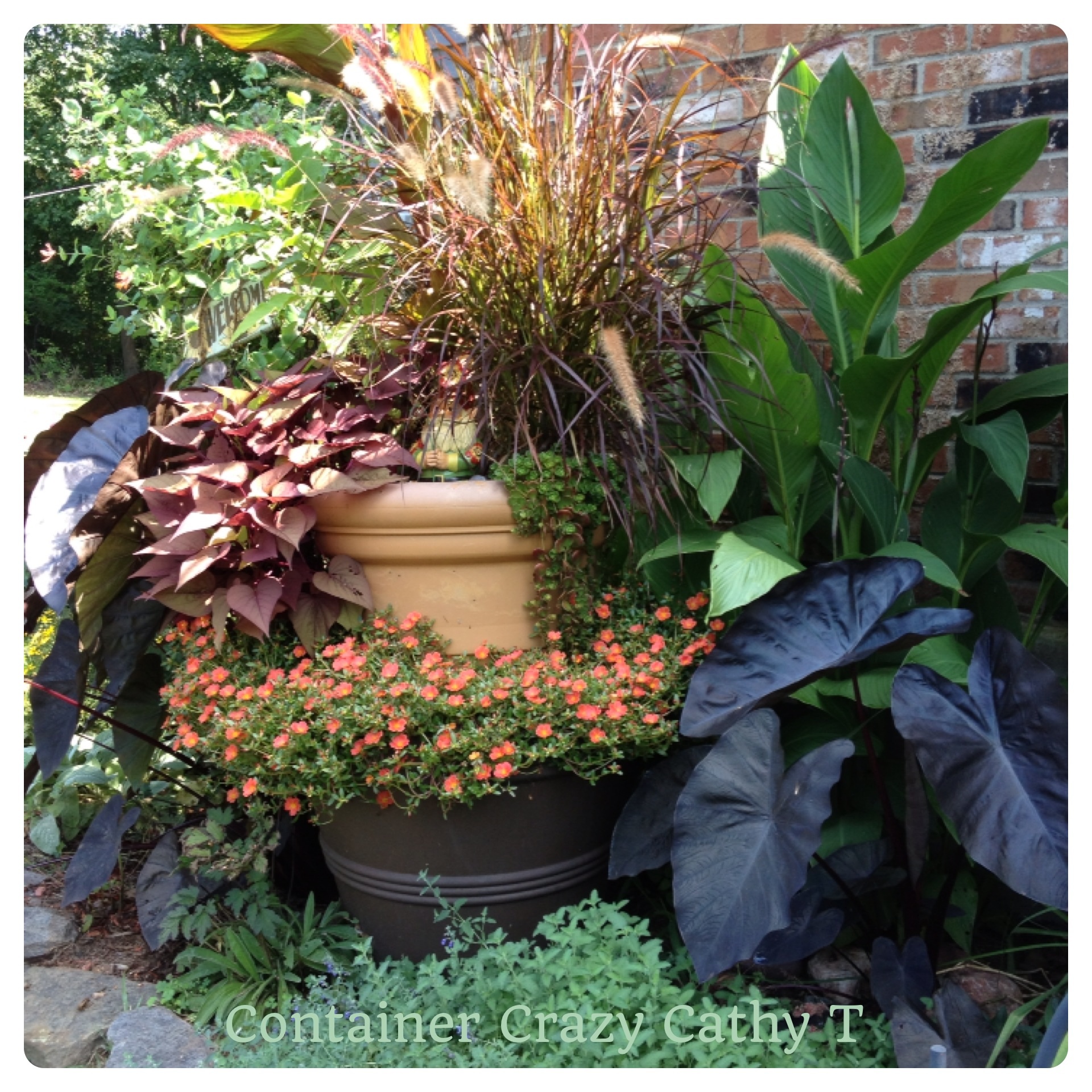
This two-tiered container garden has been impressing me all summer, and received lots of likes on my Facebook page, so I decided to share it here too.

Two Tiered Love

Two Tiered Love

It is two containers stacked, the smaller one sitting on top of the soil of the larger container.  I wasn’t sure what would be planted in the bottom level at first until I spotted some nice looking six packs of Portulaca grandiflora MOJAVE Tangerine Purslane at a local nursery. I could tell the plants were fresh and healthy, so I grabbed two 6 packs and planted them around the base when I got home. They were small sizes and easy to tuck into the soil.

I also knew this annual was a great candidate for the location of the containers, because Portulaca can take hot sun and is drought tolerant. The color of the blooms are a bright to soft orange, and with some Nepeta (catmint) planted in the ground below, the color combo of orange and blue blooms of the Nepeta would be complementary. Portulaca has a spreading habit and grows to 6″ to 8″. It blooms from early summer to frost. Definitely a hard working annual for our CT planting zones.

Orange with yellow centers of Portulaca

Orange with yellow centers of Portulaca

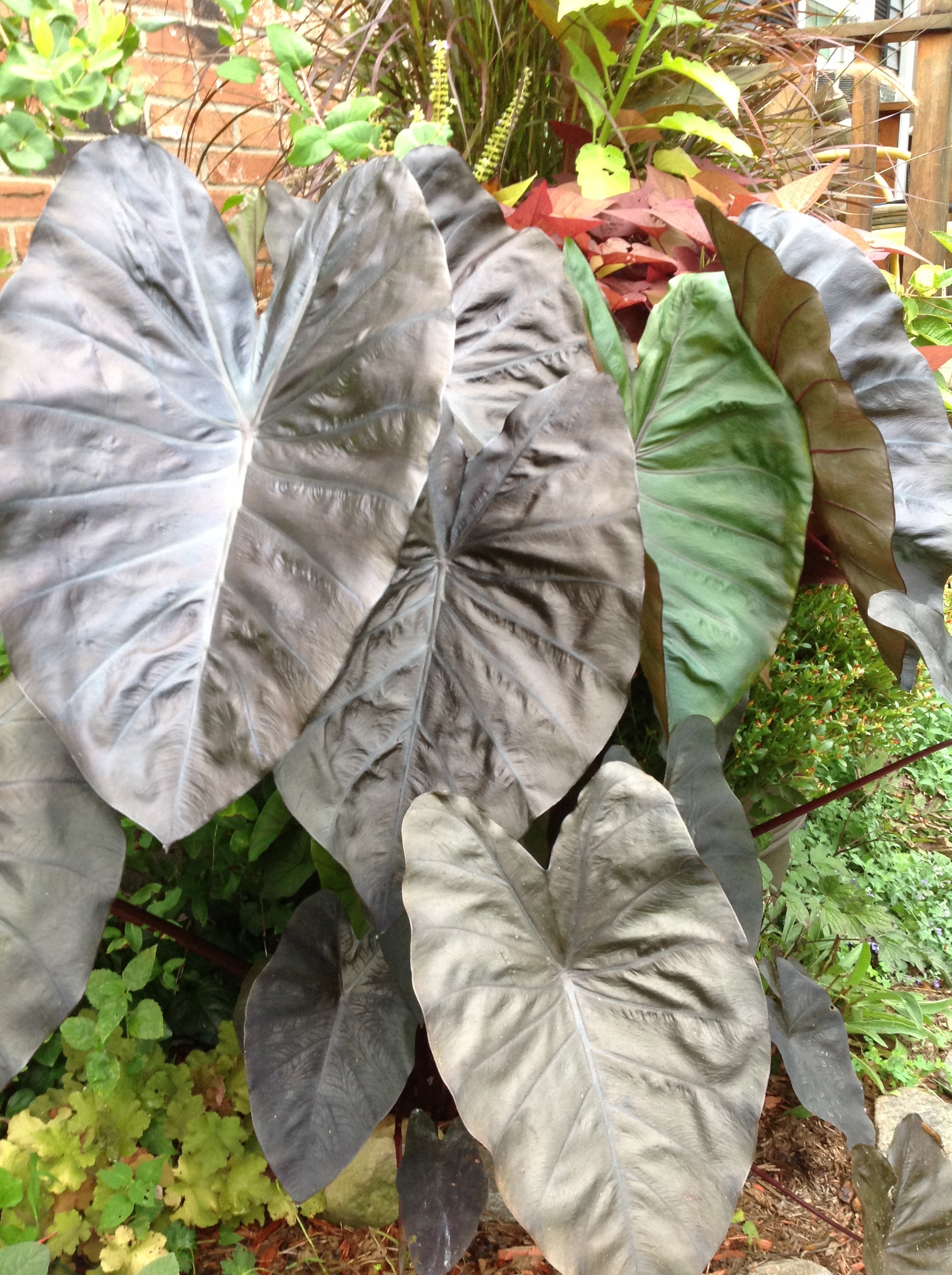
Elephant ears (Colocasia) were planted on each side of the container in the ground.  Using some kept from my overwintered stock, I thought they were Colocasia esculenta ‘Maui Magic’ but the color got so rich and lush, and at the right time of day, the leaves shimmer like a silky black negligee. So I was considering that maybe they were ‘Black Diamond’ but now I’m just not sure because ‘Black Diamond’ has pointy tips to their leaves.  Its possible the color intensified due to the location, which faces west.  I decided this was the case as I watched it grow larger all season and is still showy in fall.

Because it is against my house, it has nice shade in the morning, and the sun gradually warms up the area mid day, but by mid afternoon, it gets hot sun. As long as you water your elephant ears regularly, they can take the sun too. It turned out the rich dark color of the elephant ears look amazing against and near the showy orange of the Portulaca. It made the Portulaca stand out more with the contrast in color plus the leaf textures of both, the Portulaca being fine and Colocasia being coarse, worked.

Colocasia elephant ears, tropical

Colocasia elephant ears, tropical

The only downfall of the Portulaca is the blooms roll up tight for the evening. So, around 3 pm, the bloom show closes for the day.  The disappointment was my guests missed out on how incredibly beautiful they are if they visited later in the day. I had forgotten these flowers do this. In fact, a friend told me recently she has some at her house, and her husband asked her what happened to their plant when he came home one evening to see their’s rolled up tight too.

Closed by mid afternoon

Closed by mid afternoon

The top part of the two-tiered container let me down a tad. I expected the Brugmansia (Angel Trumpet) to grow taller along with the Canna next to it. However, the Pennisetum setaceum ‘Rubrum filled in nicely. Known as Fountain Grass, it is always a great filler or thriller in a container garden.  It is an annual in our region. But the coloring of red blades can’t be beat, and worth replanting every year in containers. It reaches 2-3 feet tall and its fuzzy plumes are showy into the fall season.  It looks great with fall decor for some reason, guess because it has movement and has a nice rich color against the yellows, reds, and oranges of the autumn season.

Planted to the right of the pot were also some Canna plants with red blooms. Sometimes when I was admiring the Portulaca blooms, a buzz from a hummingbird would go by my ears as it visited the Canna. I call the Cannas, my ‘Rene Cannas,’ because my friend, Rene, gave the rhizomes to me last season.

My Rene Cannas with red blooms

My Rene Cannas with red blooms

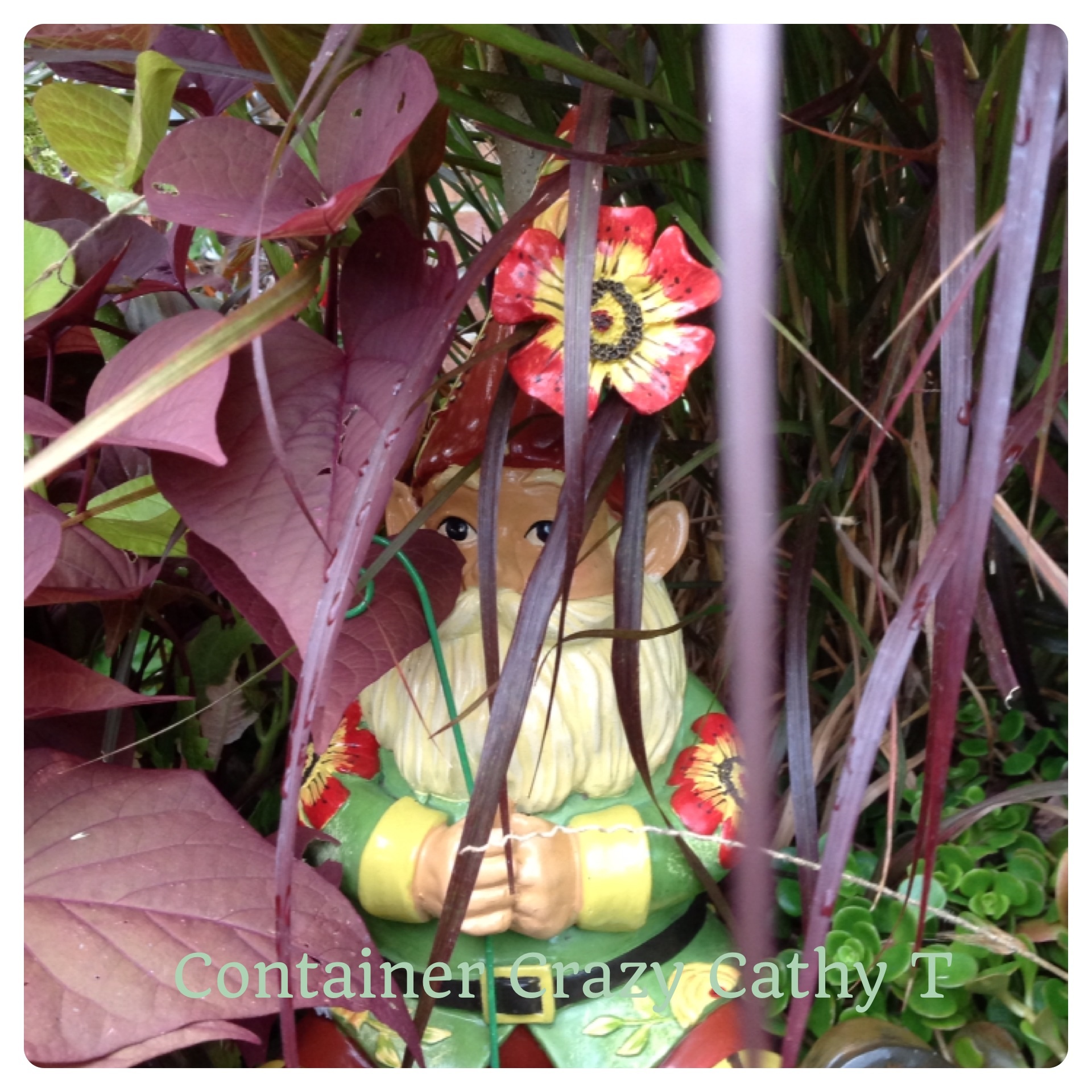
For the spiller, the reliable Ipomoea batatas (sweet potato) vine was planted on the left side.  This one is Sweet Georgia Heart Red.  And on the right side is Sedum makinoi, which is new to me. It has a nice shape to its leaves and dark coloring so it fit in with the rest. Lastly, a little decorative Gnome was tucked in for fun.

Protecting my containers

Protecting my containers

The fact my containers are old and a bit worn did not matter because the plants created a lush and full look hiding the scratches on the pots. As one Facebook friend posted, it is “Beautiful, rich, luscious, heavenly.”  I, of course, agree!

Written by Cathy Testa

One more photo:

On second tiere

PORTULACA LOVE