Powerful Perennials in Container Gardens – An Intro to May’s Hands-On Workshop

7 Comments

The Theme – Powerful Perennials

Perennials, which return year after year in your gardens (or more technically stated, are a plant that normally survives for three or more seasons), are excellent candidates in container gardens and patio pots.

However, they are often overlooked for this use and many people do not understand their amazing benefits in container gardens or know which to select to achieve stunning combinations to make your container gardens look amazing in your outdoor surroundings!

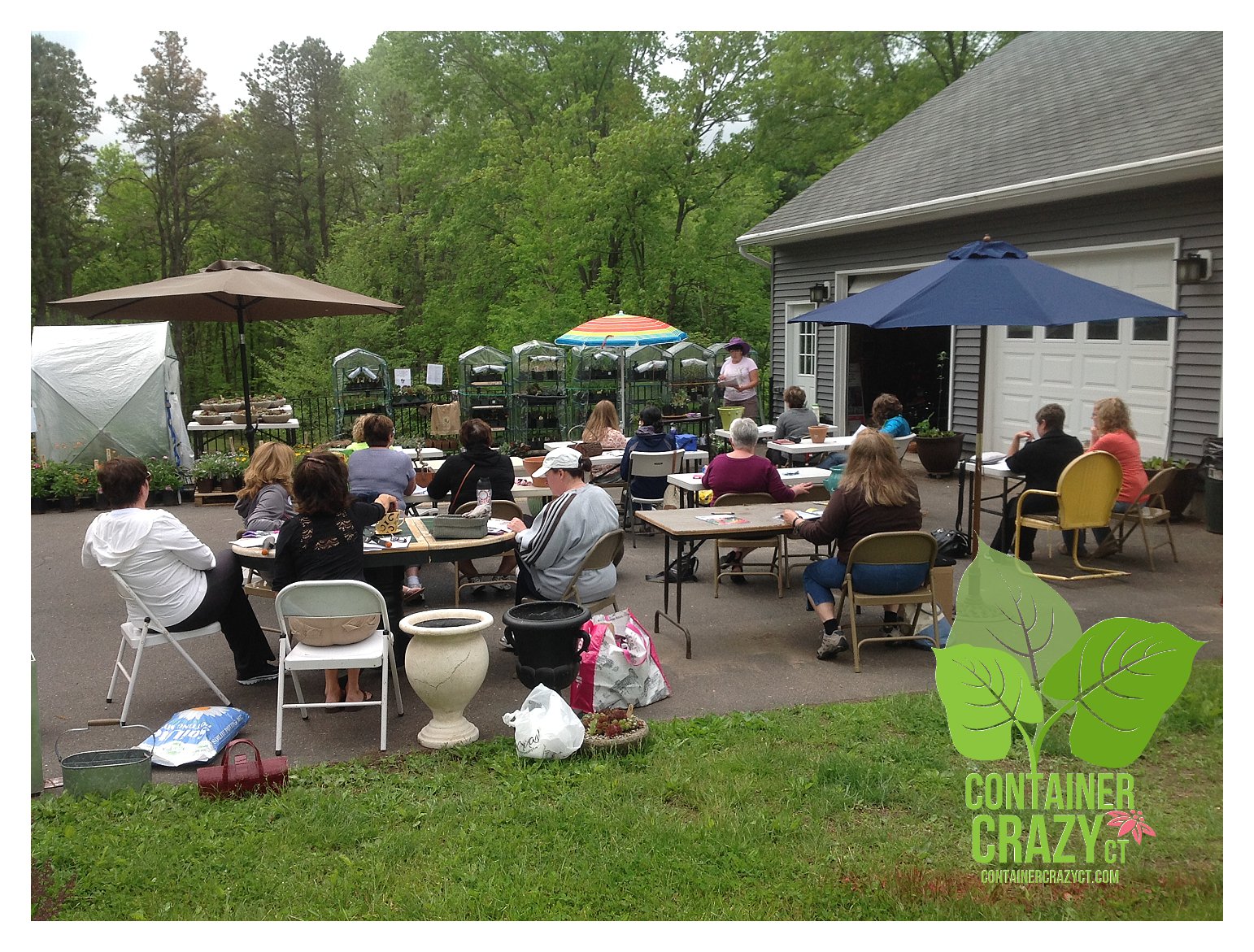
This year’s Container Garden Workshops hosted by Cathy Testa of Container Crazy CT in Broad Brook, CT will focus on perennials which perform beautifully in container gardens and patio pots, and how and why you should use them to your advantage.

Container Garden with Mix of Perennials and Annuals

Container Garden with Mix of Perennials and Annuals Upon Planting!

Burst of “Dynamic” Color Periods

We all love color – and know many annual plants provide constant color in your container gardens, but so do perennials. Many perennials bloom at specific times during the season so they add a dynamic element to your containers. Some are short bloomers for a period of weeks, while other are long lasting for several months – It is a matter of knowing which perform best to maximize their show in your container gardens. Think of perennials as providing a burst of color at the right times to compliment the other mix of plants in your container gardens and patio pots.

Perennial: Agastache 'Blue Fortune' blooms all summer long

Perennial: Agastache ‘Blue Fortune’ blooms all summer long

For example, a blue flowering perennial, called Agastache ‘Blue Fortune’, which also goes by the common name of anise hyssop, has a very long lasting soft blue flowers in summer. The blooms start in July and continue blooming all the way into September. Not only is that long-lasting, if you find the blooms look tired towards the end of the summer, you only have to snip them off from the tall stems of the plant, and guess what? Within two weeks, you will see new fresh buds forming and opening up on your plant in the container garden.

Perennials Don’t Get Exhausted

Perennials don’t peter out as quickly as annuals because most do not profusely bloom during the entire summer which takes lots of energy, and they have reserves from previous year’s growth, unlike annuals, such as a petunias. Petunias, as an example, usually look tired or worn out by the end of August. I’m not saying annuals don’t rock in container gardens because they do and they are a must have – but people often overlook the values and bonuses of using perennials in container gardens and only consider them for the gardens of the ground.

Are Stars in Containers

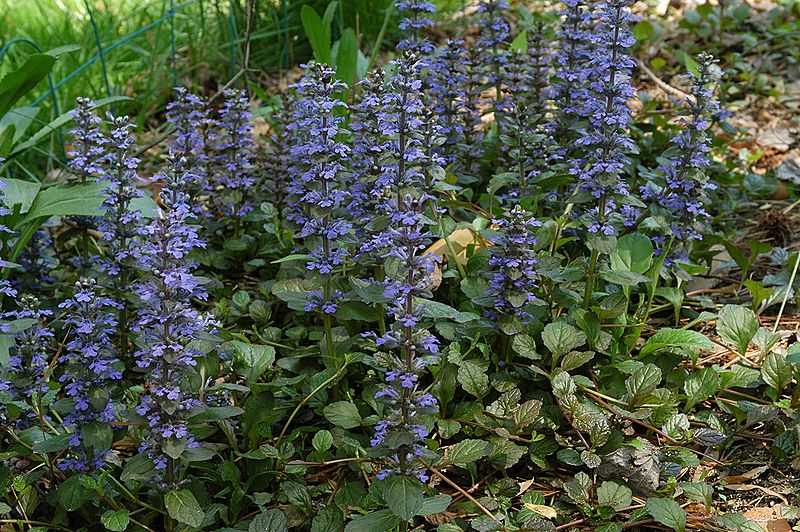
Some perennials are aggressive spreaders in gardens, but when used in container gardens, they turn into stars. An example is the perennial, Ajuga reptans, also by the common name of bugleweed. You may know this one too. In the spring time, this low growing, ground cover looking perennial spikes up tons of purple flowers in May; they are noticeable.  However, they also have a habit of spreading in lawns – which is a nuisance.  This perennial actually travels from one spot to the next underground – so folks who desire perfect lawns dislike this plant.

Ajuga in a small pot

Ajuga reptans in a small pot packs a lot of punch – Just Adorable!!

In a container garden, however, the spreading issue of Ajuga is eliminated and controlled.  Because it is a tenacious plant, it will return in a container garden for several years however – the problem aspect is now a solution in container gardens and patio pots; it shines during the growing season with various foliage colors and tidy habit serving as an exception filler in container gardens with other mixed arrangements.

Ajuga reptans

Image: Wikipedia/EnLorax – Ajuga in the ground – shows the blooms, which are so pretty in a container!

Ajuga reptans is just one of the many examples of perennials which can be vigorous or quick spreaders in the ground, but is not a problem in a container. The flush of purple color from its blooms is beautiful in a container especially when combined with other spring colored plants like the soft yellow of daffodils or pinks of tulips. Or it can serve as a very long lasting foliage feature in your container gardens, and this perennial doesn’t get lots of problems.

For this upcoming Container Garden Workshop in May 2015, two cultivars of Ajuga reptans: ‘Burgundy Glow’ and Ajuga ‘Chocolate Chip’ will be available for purchase along with many other wonderful perennial plants. Both of these cultivars I have used in containers and patio pots with wonderful results.

‘Burgundy Glow’ has white, pink and purple variegation on its leaves with 6” spikes of blue flowers in May, and ‘Chocolate Chip’ has intense violet-blue spikes rising 3” above miniature, vibrant, chocolate-hued foliage in May through June. One year, I used ‘Chocolate Chip’ in a little container and it was so pretty, and this one can take shady conditions too.

Ornamental Grasses or Grass-like Perennials

You may not think of ornamental grasses or grass like perennials as container garden plants but two of these which I can name right off the bat are Hakonechloa macra ‘All Gold’ and its counter opposite in regards to color is Liriope muscari ‘Big Blue’.

Hakonechloa macra 'Aureola' on right

Hakonechloa macra ‘Aureola’ on right – Similar to ‘All Gold’ but All Gold  is well – all gold!

Hakonechloa macra ‘All Gold’ is one of many hakon grasses I selected for this workshop because it has stunning gold blades of foliage that grows in graceful clumps and the color is intense and vivid. Take that intense vivid color and put it next to the right color bloom of another perennial – and voila – you have eye magic or eye candy.

Then there’s Lirope muscari ‘Big Blue’, the polar opposite in color compared to the hakon grass – it has a dark green long strap-like leaves – and it is not an ornamental grass but a perennial, so it, like ornamental grasses, it returns year after year and is tough too.

Lily turf is Lirope’s common name, and it can be used to cover lots of turf – because it does spread – so this one fits my “Troublemaker Turned Star” scenarios for container gardens. It is a strong grower which is a problem in landscape situations, but it makes a wonderful low height type thriller with 15-18” long leaves with violet flower spikes in late summer in containers and patio pots! I’ve used Lirope in containers and it comes back every single year – it’s tough! This enables me to reuse it and just add new supporting candidates with it in the pot every season.

Container Garden with Perennials: Heuchera, Hellebore, Bellis, Euphorbia.

Container Garden with Perennials: Heuchera, Hellebore, Bellis perennis, Euphorbia in early Spring!

Other Perennial Benefits

There are other wonderful benefits to using perennials in your pots – Again, they return, as mentioned above, for at least three or more years – so this saves you money; they may be transplanted into your gardens or yard after the summer season is over in the fall, so you will enjoy them for years to come; and they give a dynamic bloom period or show at specific times in your container gardens. This gives your container a living interest because suddenly, in the midst of summer, a burst of a new color opens in the blooms of a perennial in the container, or perhaps it is an early spring bloomer or late bloomer in the fall – either way, it adds a new interest for you to enjoy and view. It is the ta-da of container gardening.

Perennial Purposes

Perennials also serve lots of other wonderful purposes. They have fragrant foliage and flowers, many can be used as a cut flower for your vases, and they attract butterflies and bees – and others have medicinal purposes too.

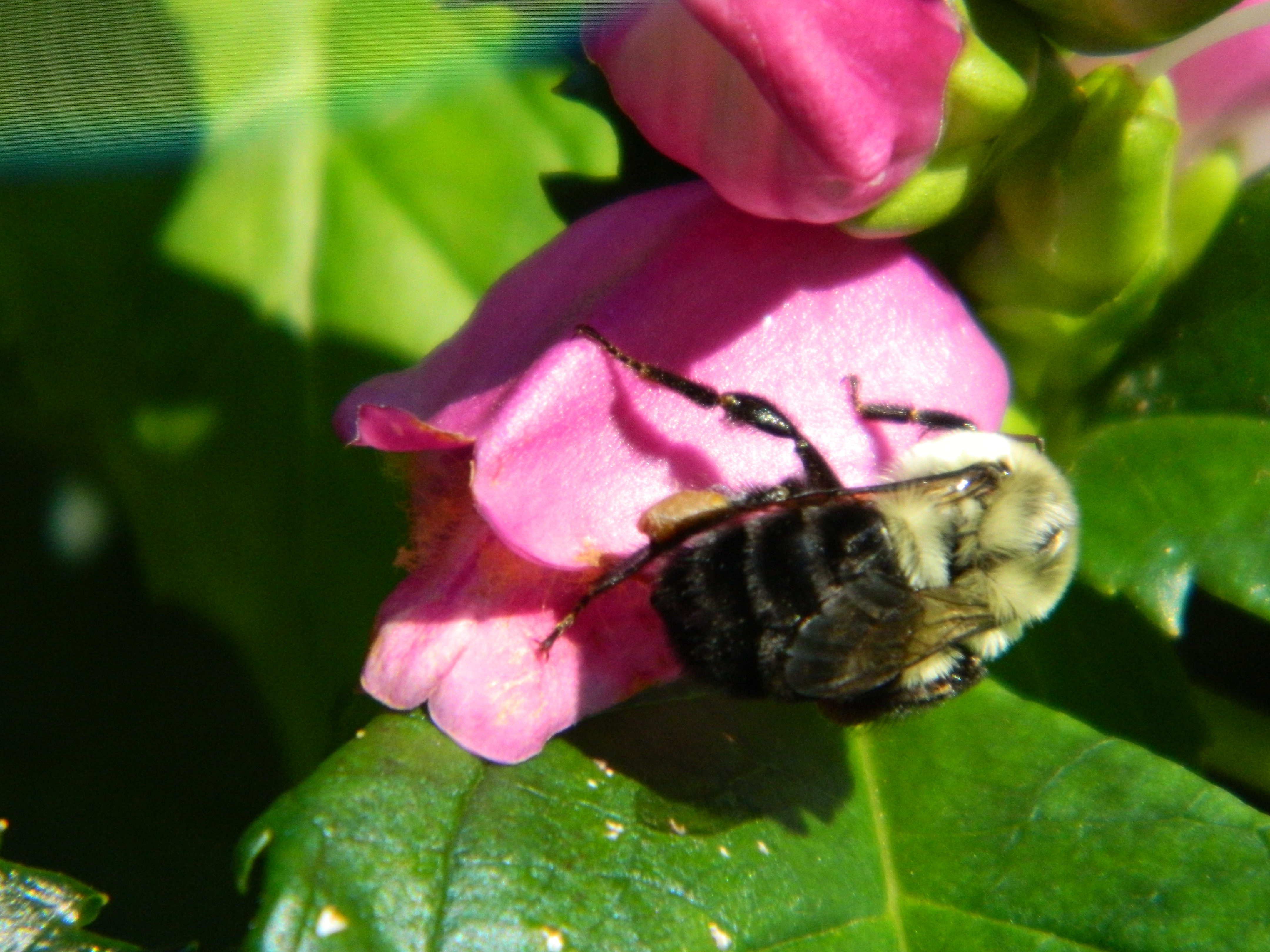
Bee enjoys a Perennial (Turtlehead)

Bee enjoys a perennial (Turtlehead) – A late season bloomer and very showy plant in containers!

There will be varieties for sun and shade available at these two workshops in May 2015. A total of 120 perennial plants have been ordered, 6 each of 23 species. Learning their features and how to use them with other plants in the containers will be part of this workshops offerings.

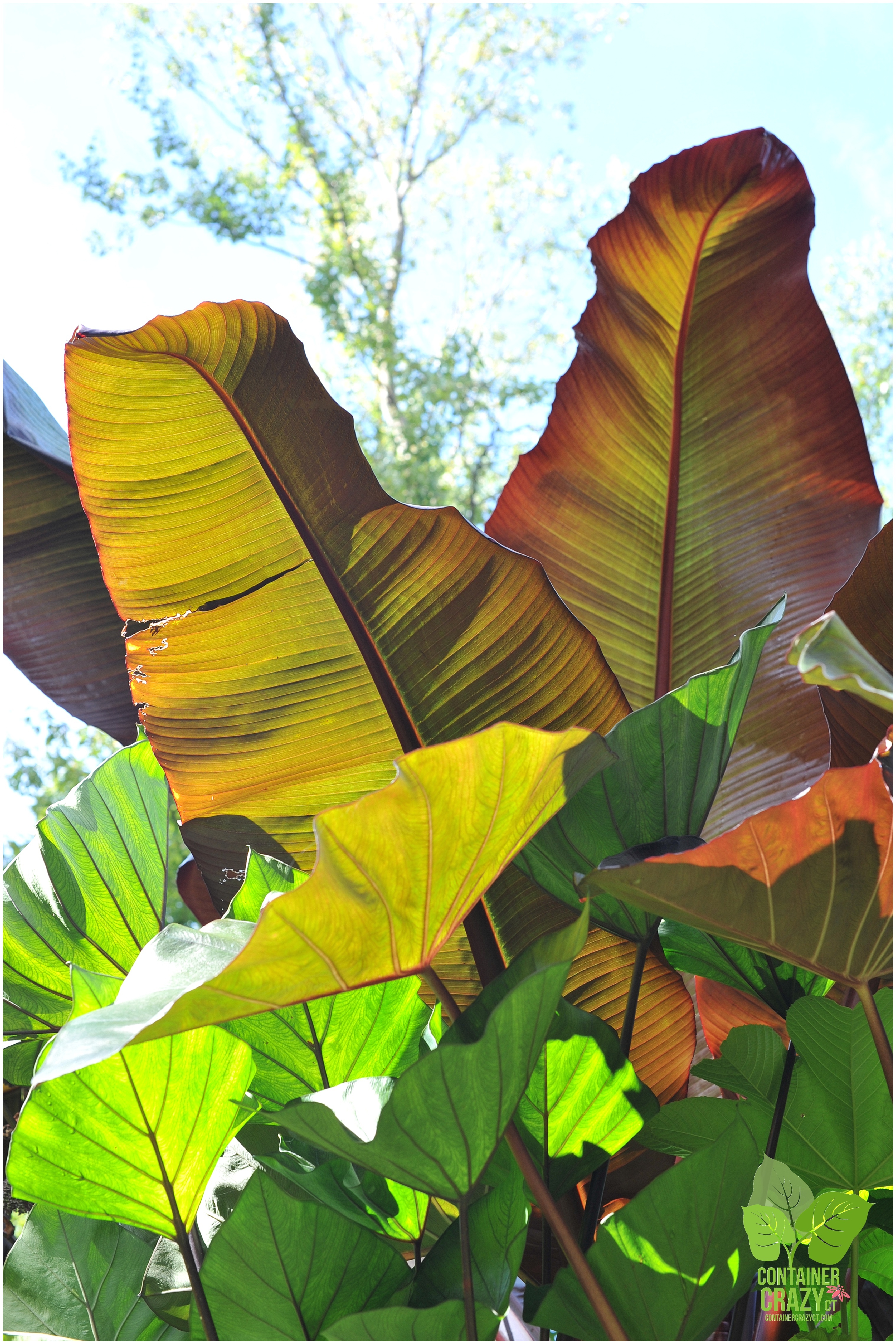
Red Banana Leaves with Various Elephant Ears

Red Banana Leaves with Various Elephant Ears – The Type of Tropical Plants Available at the May Workshops!

Tropical Additions

Tropical plants with large lush foliage features will be part of the Container Garden Workshops this year as well – because they are a passion and, like perennials, they have great benefits – the ability to reuse them year after year when appropriately stored over the winter, their dramatic and showy role due to their ability to grow fast, and adaptability to warm climates, which is what we have here in CT during the summer months. Many tropical will last all the way into October with no signs of stress, giving you a real show until the first frost of fall arrives.

Containers in Sept 2015

Containers in Sept 2015 shows the thriller of Colocasias (Elephant Ears) – Available for Purchase at the Workshops!

Every year, elephant ears (Colocasia), banana plants (Ensete and Musa), and some other unique tropical plants are offered as part of this workshop. Pairing up a dark toned elephant ear, such as Colocasia ‘Maui Magic’ with a vivid bloom of a perennial has dramatic effects in containers, and in this workshop you will see how it’s done.

A total of 185 tropical plants have been ordered, 8 each of 21 species, and learning their features and how to use them with other plants in the containers will be part of this workshops offerings.

Pinboards – Perennials with Power for Container Gardens

Start visiting my pinboard titled, Perennials with Power for Container Gardens, to get a glimpse of what the featured perennials and tropical plants will be at the Container Garden Workshops scheduled on May 16th and May 23rd, 2015. I will be adding photos up until the workshop dates. This will give you an idea of what will be featured, and some are shown in container gardens and patio pots too.

Two Workshop Date Options

This year, the workshop is being offered on two dates. There are some considerations beyond your calendar’s availability on which date you may want to select. Both sessions will have the same topics and materials available.  More details of what is included in the class is listed on www.ContainerCrazyCT.com, click MAY CLASS (BIG CONTAINER GARDEN) under the Nature with Art Programs menu.

May 16, Saturday – Session No. 1:

The May 16th date is after our typical spring frost date but we won’t know until we hit April. Experts say we are “almost guaranteed” to not get frost from May 10th through September 26th, but after our winter and global changes – do we trust weather guarantees anymore?

This means if you elect to attend session no. 1 on May 16th, your containers may require protection if we get an overnight frost. Frost is not as harsh to perennials, but will affect tropicals. If you are okay with moving your pot or covering it with a light sheet if forcasters say we will get a frosting, then May 16th is for you.

May 23, Saturday – Session No. 2:

The May 23rd date will be safe – however, it is Memorial Day weekend, and schedules tend to be busy – but with that said, nothing is better than placing your newly arranged container garden out on your deck or patio just in time for the festivities.

Registration one of 3 ways:

  1. Visit the Facebook page for Container Crazy CT and click on EVENTS to join.
  2. Complete the Contact Form found at the bottom of the class pages from the top-menu bars of http://www.ContainerCrazyCT.com.
  3. Email containercathy@gmail.com or call (860) 977-9473

Payment:

$15 per person + cost of plants purchased at the class. Payment of class fee of $15 is required by mail one month prior to the class date. Payment is non-refundable for any cancellations one week prior to the class date. Sales tax is applicable on all plant purchases during the class.

Send to: Cathy T’s Landscape Designs, 72 Harrington Road, Broad Brook, CT 06016

For a PDF version of this text: Container Garden Workshops Intro 2015

Go back

Your message has been sent

Warning
Warning
Warning
Warning

Warning.

Thank you,

Cathy Testa

Cathy Testa is a container garden designer in Broad Brook, CT. Her work has been featured on the television program, CT Style, and in several gardening publications. She offers classes year round where nature is combined with art and is available for container garden installations.

Succulents ContainerCrazyCT_0010For a Calendar of All Events and Workshops, click HERE.


Flashback Friday – My Little Perennial Garden with Echinacea purpurea

1 Comment

This was my very first little perennial garden in my backyard.

Focal Point

Marigolds fill a golden pot in a carefree perennial garden – Photo taken in Year 2009 by C. Testa

My first perennial garden was framed with a tiny white picket fence, the type you push into the ground.

The small garden space was filled with a mix of tall blooming perennials, such as Echinacea purpurea (coneflower), which you see on the right – a perfect perennial plant for a carefree setting.

Their blooms lasted all summer long in the garden’s full sun location, which is why I had selected this spot for a garden – and because it was visible from almost every direction in my backyard.

As you can see, it had a small golden container.
Perched up on a chair, simple, filled with bright and vivid Marigolds.

My dear departed cat, Ruby, hides near Ajuga reptans and a Jack and The Pulpit plant

My dear departed cat, Ruby, hides near Ajuga reptans and a jack-in-the-pulpit plant

In the photo above, my dear departed cat, Ruby, is seen sitting by Ajuga reptans (bugleweed). She visited this area to play. When she passed, we buried her in this garden.

The jack-in-the-pulpit plant (Arisaema triphyllum) was found in my woodlands near this area, and transplanted here. It grew well for many years in this spot.

The jack-in-the pulpit plant was the first plant introduced to us in an herbaceous ornamentals’ class at UCONN by our professor. I remember he was surprised when many of us were familiar with it. Discovering a stand of this plant growing naturally in my woodlands was a thrill.

******

Interesting & Healthy Facts about Echinacea

The center of the plant has hard spines shaped like a sea urchin.

The greek word, echino, means “sea urchin.”

When taken as an extract, Echinacea helps with colds or flu, boosts the immune system, and may increase red blood cell production and oxygen intake.

It is one of the most popular plants in the perennial garden because they are so easy to grow and are drought-tolerant.

Echinacea plants work extremely well as “thrillers” in container gardens and patio pots because they are long lasting, very tall growers, and easy!

*************

ContainerCrazyCT 2015 Calendar
Me in 2010 at the CT Flower Show as a CT Hort Society Volunteer.

Me in 2010 at the CT Flower Show as a CT Hort Society Volunteer.

Don’t forget – the CT Flower and Garden Show in Hartford, CT is next week, starting on Thursday, February 19th.

 ********************************

"Valentine's Day, Greeting Card, Illustration" by kraifreedom curtosey of FreeDigitalImages.net

“Valentine’s Day, Greeting Card, Illustration” by kraifreedom courtesy of FreeDigitalImages.net

TGIF Everyone and Happy Valentine’s Day,

Cathy Testa

Flashback Friday – Crocosmia Perennial with Fire Red Blooms in a Whiskey Barrel

2 Comments

Good Day Everyone!  

For this week’s Flashback Friday,’ where I select photos from a prior blog post, here is a perennial from the genus Crocosmia in full bloom in the middle of summer.

Crocosmia_0004

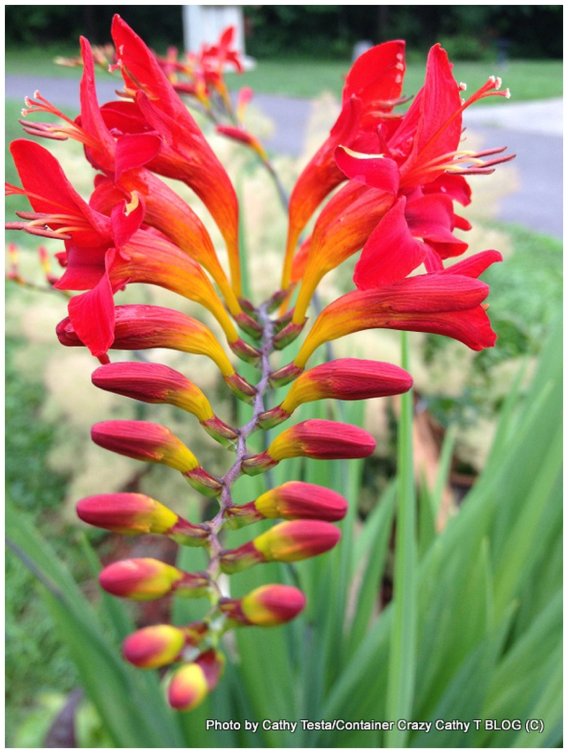
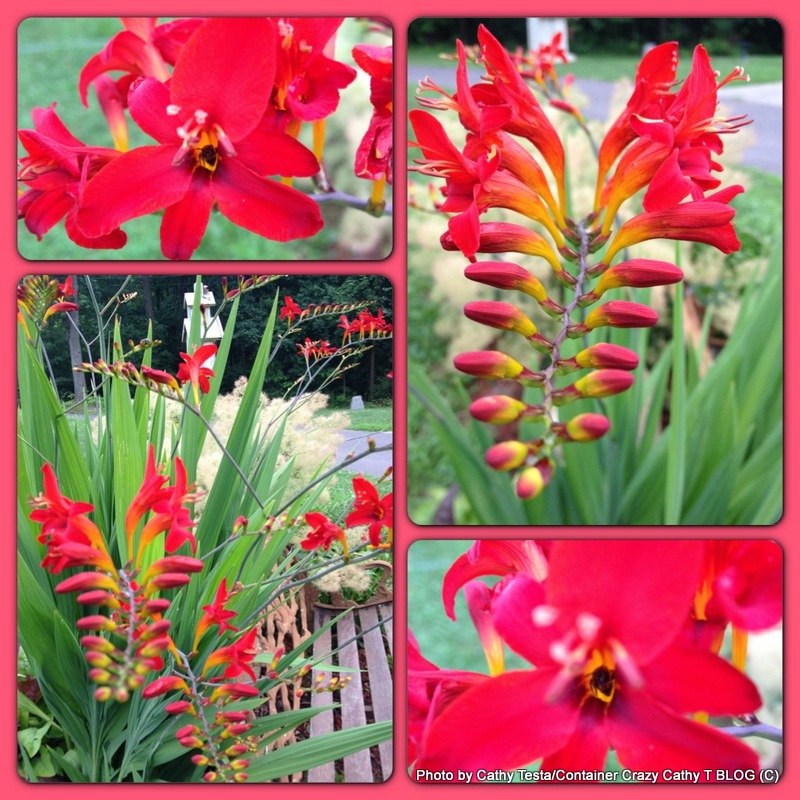
It was planted in a container garden the size of a whiskey barrel and placed behind a bench in a small garden area by my house. Shown here is the cultivar ‘Lucifer’, and it impressed me quite a bit during the summer of 2013.

Crocosmia_0005

“It will flower in the late summer with VIBRANT wands of scarlet and yellow pops of color.  When most annuals tend to fade away from the summer heat, this tall, spiky foliage perennial plant provides a big thrill , and it may be transplanted into your garden in the fall to reuse.” – CT

Crocosmia_0002

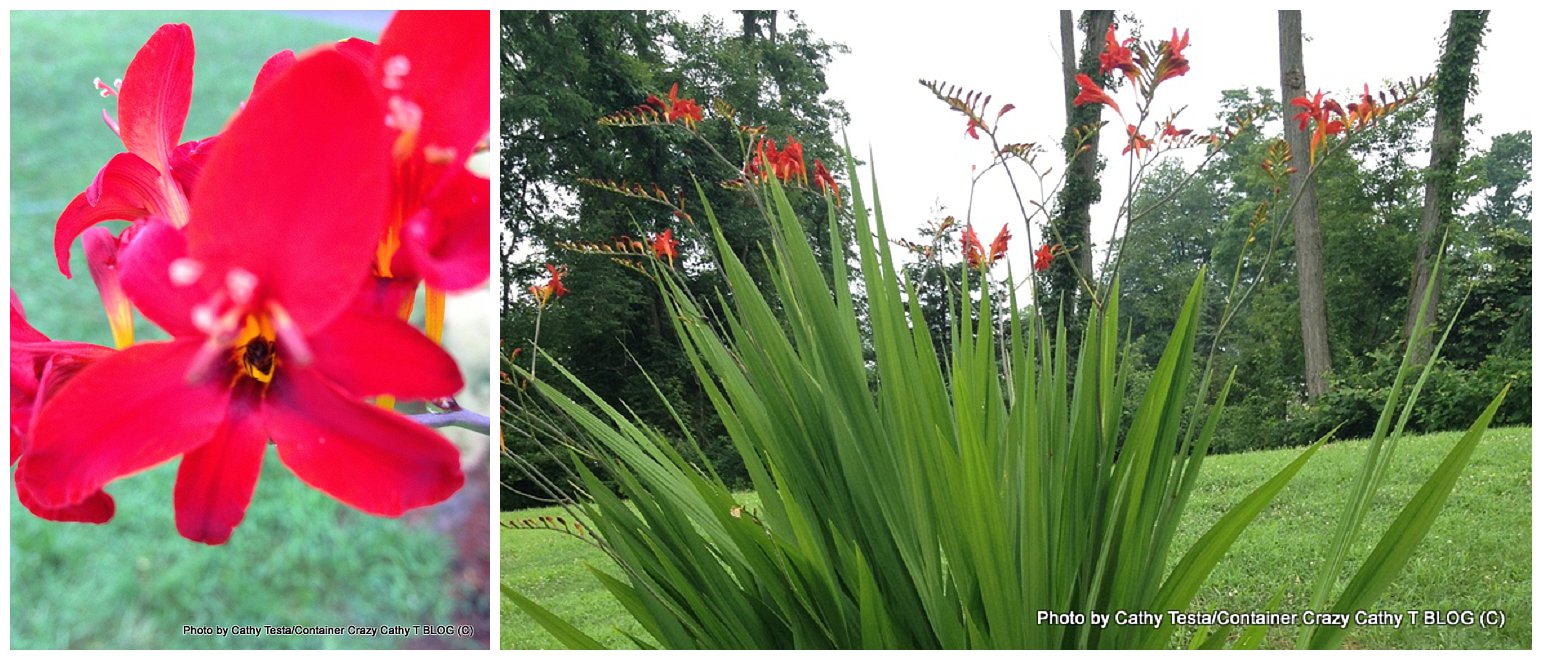
How could you not adore these vivid red and yellow flower buds and funnel shaped flowers?  They are really eye-catching. The bees and hummingbirds visited often that year, and it was fun to stop by to take photos of them. In addition, the plant’s sword-like foliage is really striking, tall, and makes a showy full thriller in a big container or patio pot.

Photo by C. Testa

Photo by C. Testa

Do you ever wonder if the bee sees the end of the camera and thinks, “please stop taking my photo! I’m busy.”

IMG_8223

This perennial is truly grand and enjoys sun to part sun conditions. It makes a wonderful cut flower in floral design arrangements (re-cut the stems and use lukewarm water in a vase to keep the color intensity).

Additionally, this perennial is deer resistant – another bonus!

IMG_8236

And best of all – it returned in my container for two straight years, but on the third year, it was hurting a little bit with reduced growth, which was a sign it required better growing conditions, refreshed soil – or a new home – into the ground.

As a perennial here, a Zone 5-9 plant, it will survive in a garden bed for years to come.

**************************

To see more details about this plant, visit my blog post complete with videos and reference links:

Crocosmia It will Rock On in your Container Gardens

TGIF Everyone, Cathy Testa

******************************

See the 2015 May Container Garden Workshops themed this year Perennials with Power in Container Gardens.


What do Horticulture People do during January? Plan and Rest, or Rest and Plan!

Leave a comment

Around this time of year, I see people in the horticulture industry either vacationing somewhere tropical for a much needed rest before spring arrives, placing their plant orders, preparing calendars for the upcoming growing season, and attending conferences to keep learning more about growing, selling, and sharing their plant passions with garden enthusiasts.

Thus, in January, our minds are very busy with planning and hopefully taking some time to rest – because in the growing season, it is a busy time and non-stop.

Container Crazy CT’s 2015 Monthly Snapshot Calendar

A calendar depicting activity underway on my calendar for my clients and gardening friends has been posted on this blog, under the “Nature with Art Programs” drop-down menus. Or you can see it here:

ContainerCrazyCT 2015 Calendar (2)

WORKSHOPS

You will see, there are a lot of fun gardening shows and conferences underway. I’ve already ordered my plants from my local Connecticut grower for the upcoming spring season, specifically for Cathy T’s May Container Garden Workshops scheduled on “two” dates this year – May 16th and May 23rd.  SAVE THE DATES!  And for visits to local farmers markets.

CATHY T CLASSES

In April, there is an Eclectic Wind Chimes Making Class – and we are very excited to have lined up a very special guest artist, Laura Sinsigallo, whom is originally from the Broad Brook / East Windsor, CT area. Click the links above to see the details. We already have sign-ups – it will be a fun way to kick off spring.

ContainerCrazyCT 2015 Calendar (3)

GARDEN WALK AND TALK TOURS

The 2nd half of the 2015 year will bring on Garden Walk and Talk Tours, which were started up last year, and are FREE. Save the Dates – first will be an amazing vegetable garden in Willington, CT by another talented artist and garden lover. More details will be posted, but to learn more – visit the drop down menus on the top banner of this blog page.

GUIDED TOURS

In September, a Guided Tour of the Brimfield Antique Show is on the schedule as well – Yup, you can go with Cathy T – and let me tell you – this is such a fun event to attend, and at the end of the season is a good time to get the best bargains and try to haggle with the sellers – something I’ve learned to do over time.  Want to go? Save the Date, Click the above drop down menus for the details and contact forms.

ARTISTS INVITED

If you are a local artist interested in showcasing your products and sharing your skills with a captivated audience, feel free to contact me. The theme is creating with Nature and Art.  Don’t be shy – reach out!  We’d love to hear from you.  Same goes for anyone interested in sharing their garden with us – it is really a great way to network, meet new friends, learn tips you have used in your own garden – big or small – we are in!

Email: containercathy@gmail.com or containercrazyct@gmail.com.

Happy Hump Day Everyone,

Cathy Testa
ContainerCrazyCT.com
860-977-9743

Flashback Friday – Golden Head Planter with a native Autumn Fern

Leave a comment

For this week’s Flashback Friday

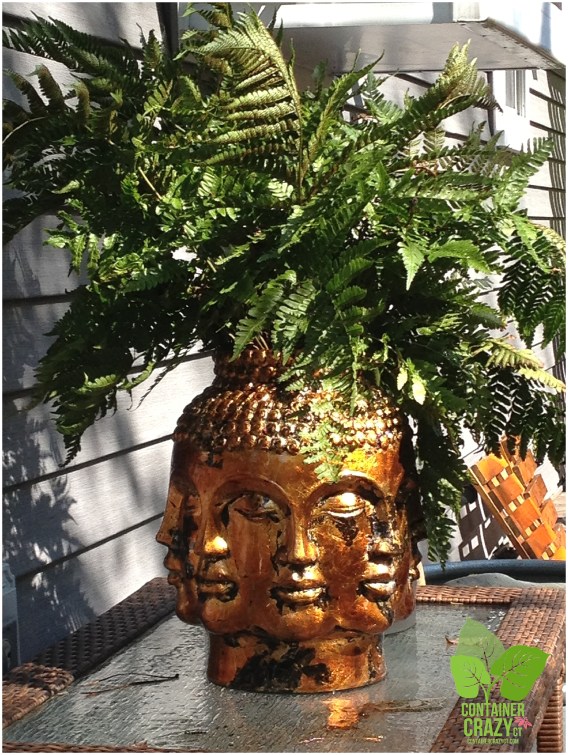
Brilliance Autumn Fern in a Golden Head Planter

Dryopteris erythrosora ‘Brilliance’
Zone 5-8/9; Perennial and Native

Head Planters ContainerCrazyCT_0001

In season, this fern’s upright fronds remain a dark green color, as shown in the photo above when it was growing in the container during the early 2012 summer. The beautiful golden face planter with splashes of black was a find from the Pottery Barn store. Knowing it would glimmer in the summer sun, there was no hesitation to get one. Placing a fern in it was a good choice because the planter did not have a drain hole, and this fern can take moist conditions. I did not want to risk cracking this pot so a drain hole was not drilled into the bottom, as typically done so the roots may breath and not rot from overly wet soils. However, ferns can withstand moist conditions with appropriate controlled watering in pots. If I felt the soil was too wet from a rainfall, I would tip the pot to let the excess water drain out.

Head Pots (1)

The fern’s name includes the word ‘Autumn.’ I’ve read this is because when the plant is young, it is a copper color, but it also takes on highlights of copper later in the summer season. Here it was moved to a shadier spot on my deck that season because this fern prefers dappled shade.  It was easy to grow in a container garden (or head planter). Some perennials will return in stored containers – which is a topic I will be teaching in detail in the 2015 season when two Container Garden Workshops are scheduled in May.

Head Pots (3)

The golden color of the head pot is really rich.  As it was sitting next to another container garden with mixed plantings, including the thriller – a dark leaved Colocasia (elephant ear or taro), which was the cultivar, ‘Diamond Head,’ the effect was gorgeous. Colocasias are plants I plan to include in my plant ordering list every year. I love foliage and love how the big leaves toss from side to side in the wind and the plant will last all the way into the fall season, up to the last frost date, plus they are easily stored over the winter for regrowing every season here in my Connecticut planting zones (5-6).  By the way, the plant with yellow and red leaves in-front of the elephant ear is called Amaranthus tricolor – it was noticed during a “Walk and Talk” Pond Garden Tour last summer in my friend’s planter near her three-tiered water gardens which everyone seemed to like it and asked what the plant was. It really stands out in the right situations and has a unique look to it.

This particular Colocasia cultivar was not too big for its pot, even though its leaves reached about 3-4′ tall, because it has a compact habit.  While the Autumn Fern is a semi-evergreen perennial (hardy to zones 5-9 – and native), the elephant ear is a tropical type plant (not hardy to CT), but hardy to zones 8/9-10.  The Colocasia is a sun to part sun/shade plant so the exposure was fine next to my beautiful and elegant golden head planter with faces all around it.

So, again, the two pots near each other in a shady spot on my deck was a good combo for they enjoyed the shady mornings and dappled sun later in the day.  By the way, Autumn Ferns are deer resistant – good for gardens with deer eating issues. Most ferns grow best with a high organic matter content in the soil when grown in the garden.

Head Pots (2)

The following year, I planted a succulent in my golden head pot, a Kalanchoe. But, because I was unable to drill a drain hole, I inserted the plastic pot it was in into the golden head pot so water could drain freely below it without creating a overly wet base.

Kalanchoe plants prefer the opposite exposure of ferns.  They enjoy sun and dry soils, able to withstand drought like conditions, within reason, in a small pot. Ironically, the leaves on this plant also highlighted some copper to red coloring on the edges. Matching plants to pots should not be exact matches (what I call matchy-matchy) but connect to the pot somehow perhaps in a subtle way – as done with this fern and succulent because the pot of golden to copper colors highlighted the copper tones of the plants used – it just worked – at least for me – I loved the look!

Why Use Head Planters?

Head pots make heads turn – When used in your gardens as art, or in special pots as decor elements in your outdoor spaces, and inside the home during the winter season.  And when you change up the plant in a pot – you change up the feeling, look, and affect of the pot or planter itself.  A big fern like plant gives it an exotic hairdo style, a smaller succulent may keep the head pot looking tidy and neat – it is fun to play with and – thus – I will share more in my ‘Flashback Friday’ posts about my head planters of other styles soon.

Happy Friday Everyone – T.G.I.F.

Cathy Testa
http://www.ContainerCrazyCT.com

“A Blog to share Container Garden Passions and Nature Combined with Art”

For more information about this fern shown in my new Flashback Friday posts, see the Missouri Botanical Garden Plant Finder.

Pondering Ponds ‘Walk and Talk’ Reveals Many Unexpected Surprises

9 Comments

Hi Everyone,

First, thank you to our hostess and guests!

First, a great BIG thank you to our host, Rhonda Rafferty, for sharing her personal experience of starting her pond garden with one level, and then growing it by adding two more levels, as explained during our most recent “Walk and Talk” garden event, held last weekend.

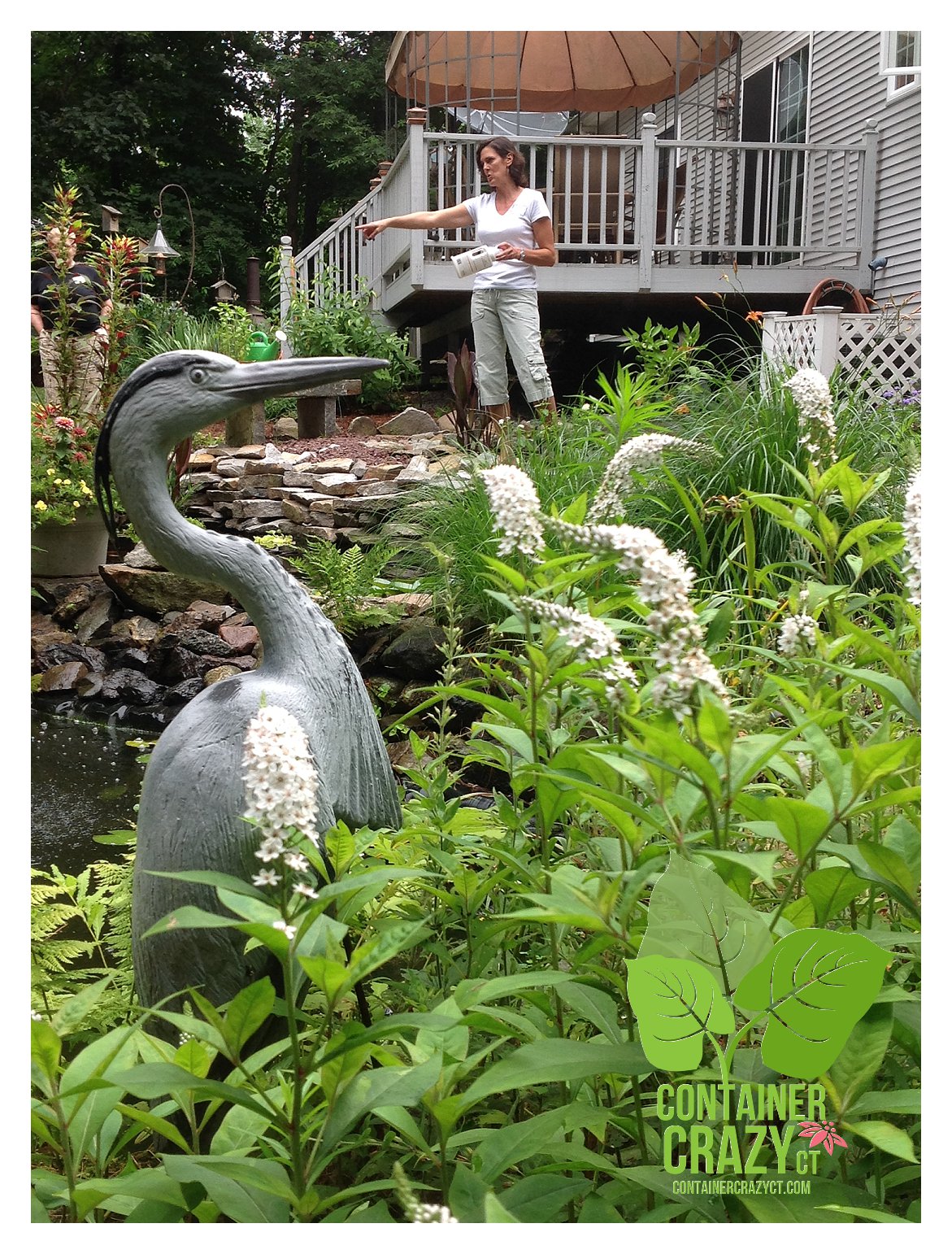
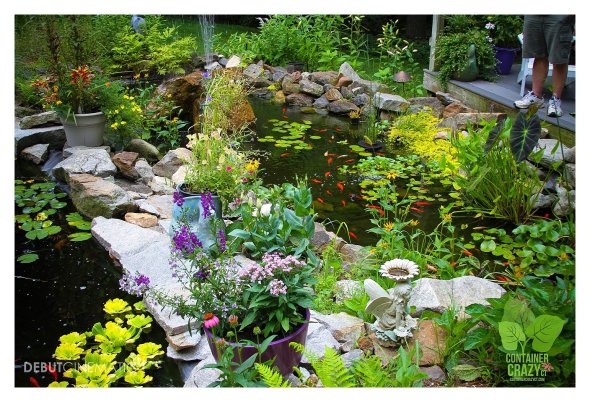
Rhonda’s pond gardens are situated in her backyard, and they are visible from her deck patio area adjacent to her house.  At the base of her pond gardens is a beautiful sitting area flanked with a pergola.

Cathy T and Rhonda's reaction to a funny intro story!

Cathy T and Rhonda’s reaction to a funny intro story!

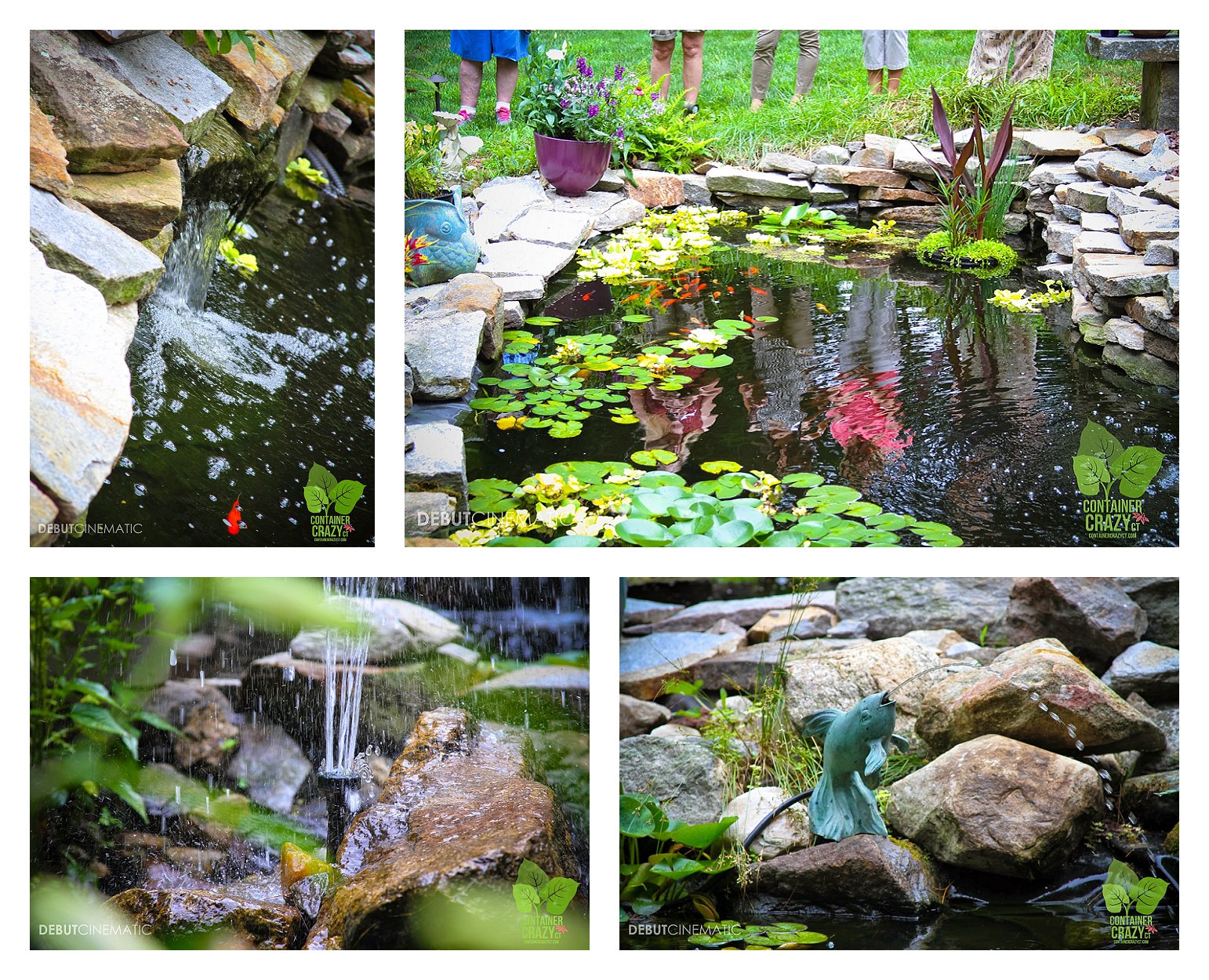
The sounds of the water trickling from decor spitting fishes and fountains in the ponds are enough to draw you from inside her home to the great outdoors in her backyard.

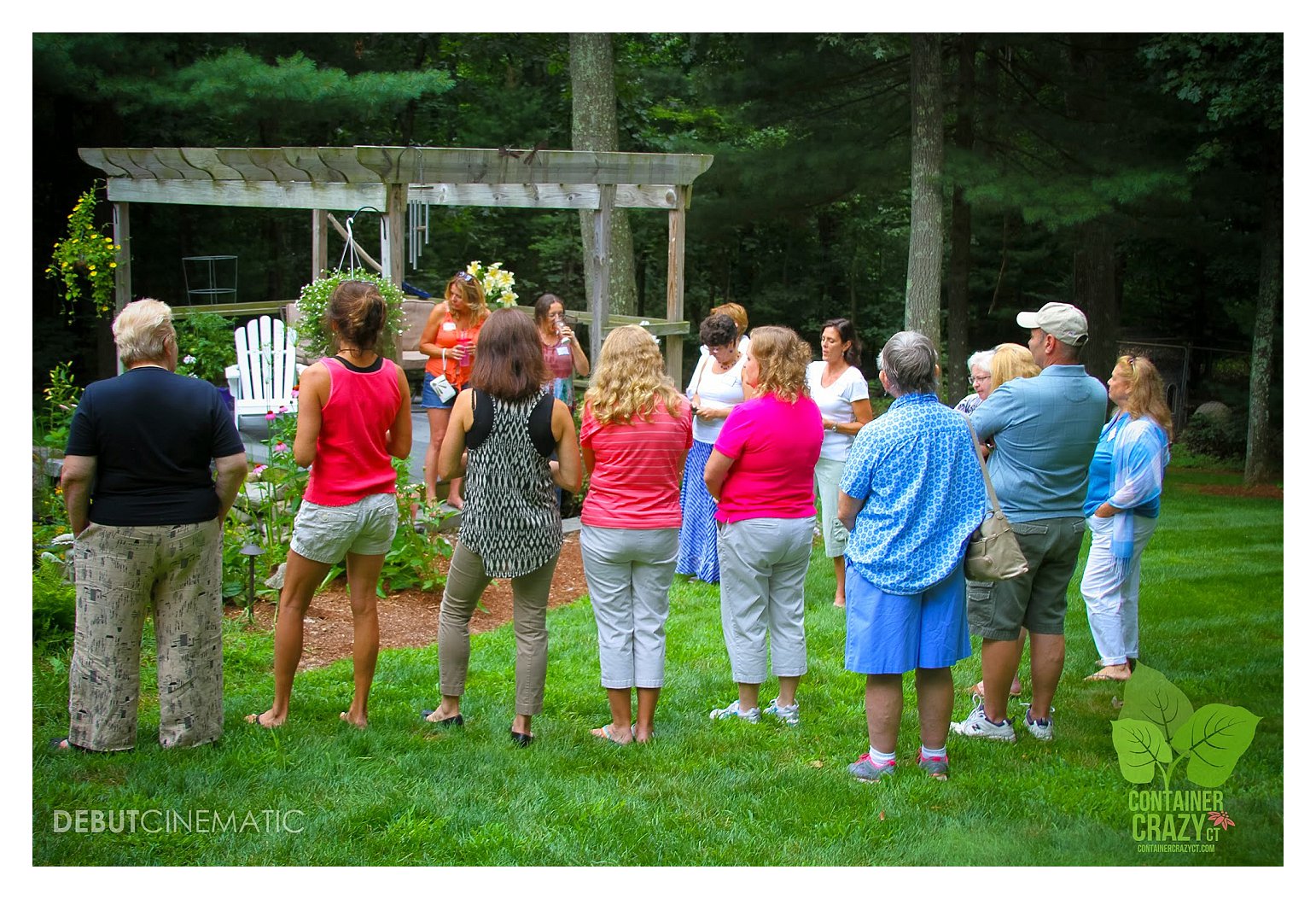
We had 15 attendees which made this tour a great success. Many of the attendees were from local areas, some folks from a new South Windsor church gardening group, and several attendees from Cathy T’s Classes.

Pondering Ponds Photos by Debut Cinematic_0012

Started with a kit, and built two more sections

Rhonda explained how she started her adventure with pond gardening by using a pond kit to build level one, or the very first tier of the current 3-tiered pond garden area in her yard. As soon as it was ready, her husband bought ten goldfish and put them in it, and of the ten, seven goldfish survived. All of the other goldfish in her ponds today, hundreds of them, are the offspring of the initial seven goldfish.

When Rhonda had shared pictures prior to the tour of her pond gardens, I had assumed the fish were Koi fish. They are rather large and very active in all three levels of her pond gardens, rising to the surface quickly and swimming around rapidly as you approach the water’s edge.

Pondering Ponds Photos by Debut Cinematic_0007

Rhonda explained the first level of the pond garden is rather shallow but the middle level is approximately 5 feet deep and 20 feet long.  Each pond section is structured a little differently, and they are not connected but adjacent to each other in a three-tiered pattern.

Attendees Listening to Talk by Rhonda

Attendees Listening to Talk by Rhonda

Spring and Winter Cleanup Routines

For maintenance, Rhonda drains the ponds completely in the spring.

The goldfish (which stay dormant in the winter months in the bottom of the ponds) are relocated to a 100 gallon horse troth until she’s done performing spring clean-up activities.

Easter is when Rhonda usually opens the ponds if the weather is warm enough.  She can tell when the lilies start growing that it is time to get moving and working on her ponds.

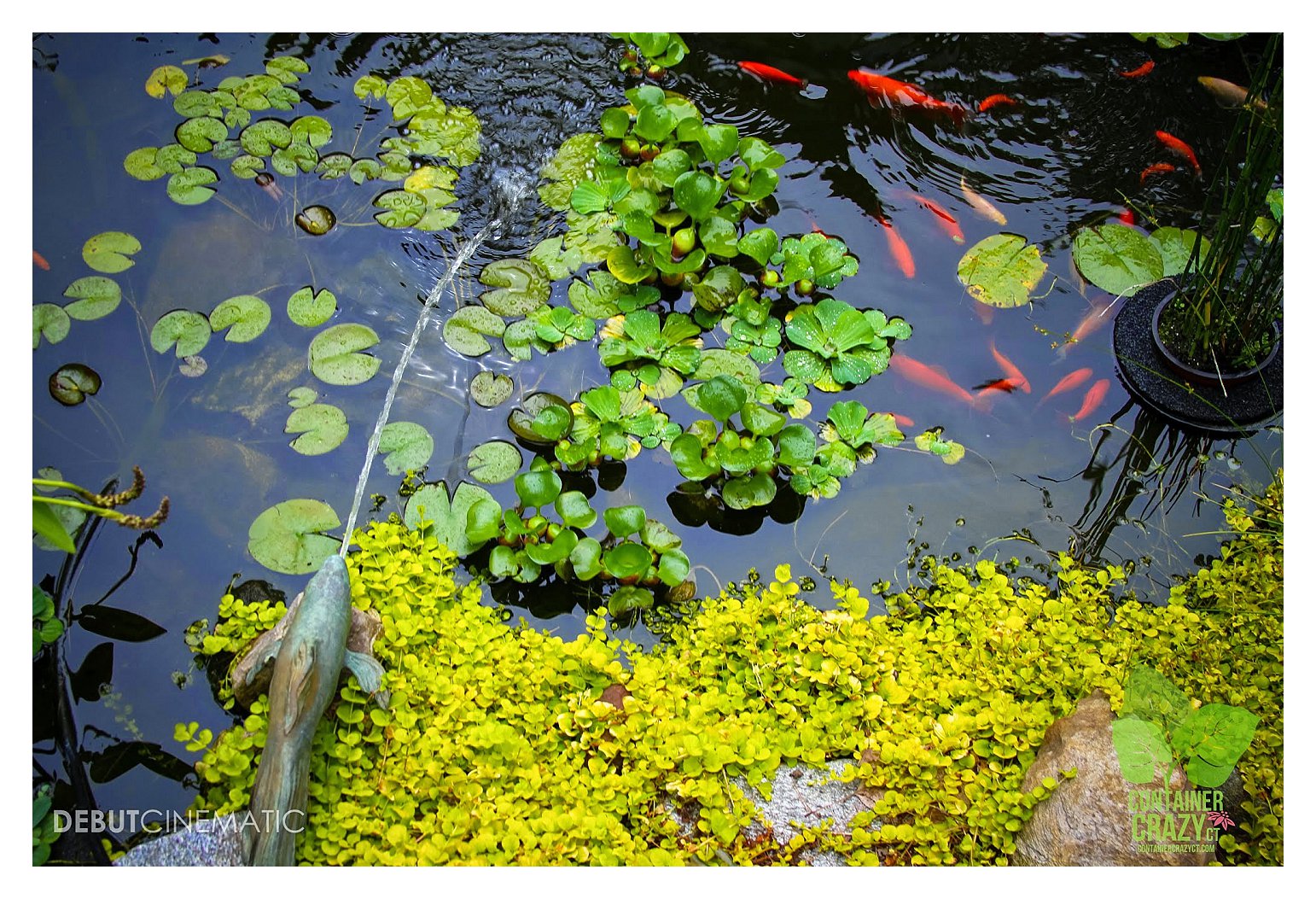
Water lettuce, Lilies, and Lysimachia near goldfish

Water lettuce, Lilies, and Lysimachia near goldfish

All the muck, which built up and decayed in the bottom of the ponds over the winter, is removed with a special muck vacuum she purchased because her ponds are so large.

Also, Rhonda noted using ‘Microbe-Lift‘ in the water filter to add good bacteria to the water.  This will keep her pond healthy throughout the season.
Pondering Ponds ContainerCrazyCT_0001

At one time, Rhonda used a power washer to clean the liner, but she no longer uses a power washer because she wants to keep the algae growing on the liner, and the power washer was removing it – so she uses a garden hose instead.

The algae helps the natural ecosystem get established after a complete water change, and provides food for the fish because you can’t feed them until the temperature of the water reaches a consistent 55 degrees.

There is a special ‘Spring & Fall’ food for cooler temps of approximately 55 – 75 degrees.

However, once the temperatures reach 75 degrees, Rhonda changes to feeding the fish a summer staple food.  Rhonda also noted she uses special UV filters to control bacteria so that the water stays clear during really hot temperatures in season.

During the fall season, the food is changed again when it gets cooler outside, and she stops feeding at 55 degrees.  She also turns off the filters when she stops feeding for the fall and winter months.

Standing at Level One, Rhonda talks about products used to keep water healthy

Standing at Level One, Rhonda talks about products used to keep water healthy; Photo by C. Testa

In the winter, she leaves all the water in the ponds, but will remove the filters and clean them for storage.  She basically washes them down with water because she avoids getting any chemicals in the filters.  She also cuts back all the hardy water lilies and plants, and sinks them to the bottom of the pond in her deepest tier.  A small low watt pond deicer, which floats on top of the water for the winter, is used.  This will create a small patch of open water in the ice to allow gases to escape in the winter.

Water Plants, Floating Plants, Perennials and Tropicals

Rhonda has a mix of plants in and around her pond gardens, and she noted, many have appeared on their own. Some self-sowed or got there perhaps by bird droppings of digested seeds, and even a few ferns arrived to her garden naturally. It is as if the plants know this is the right spot for them.

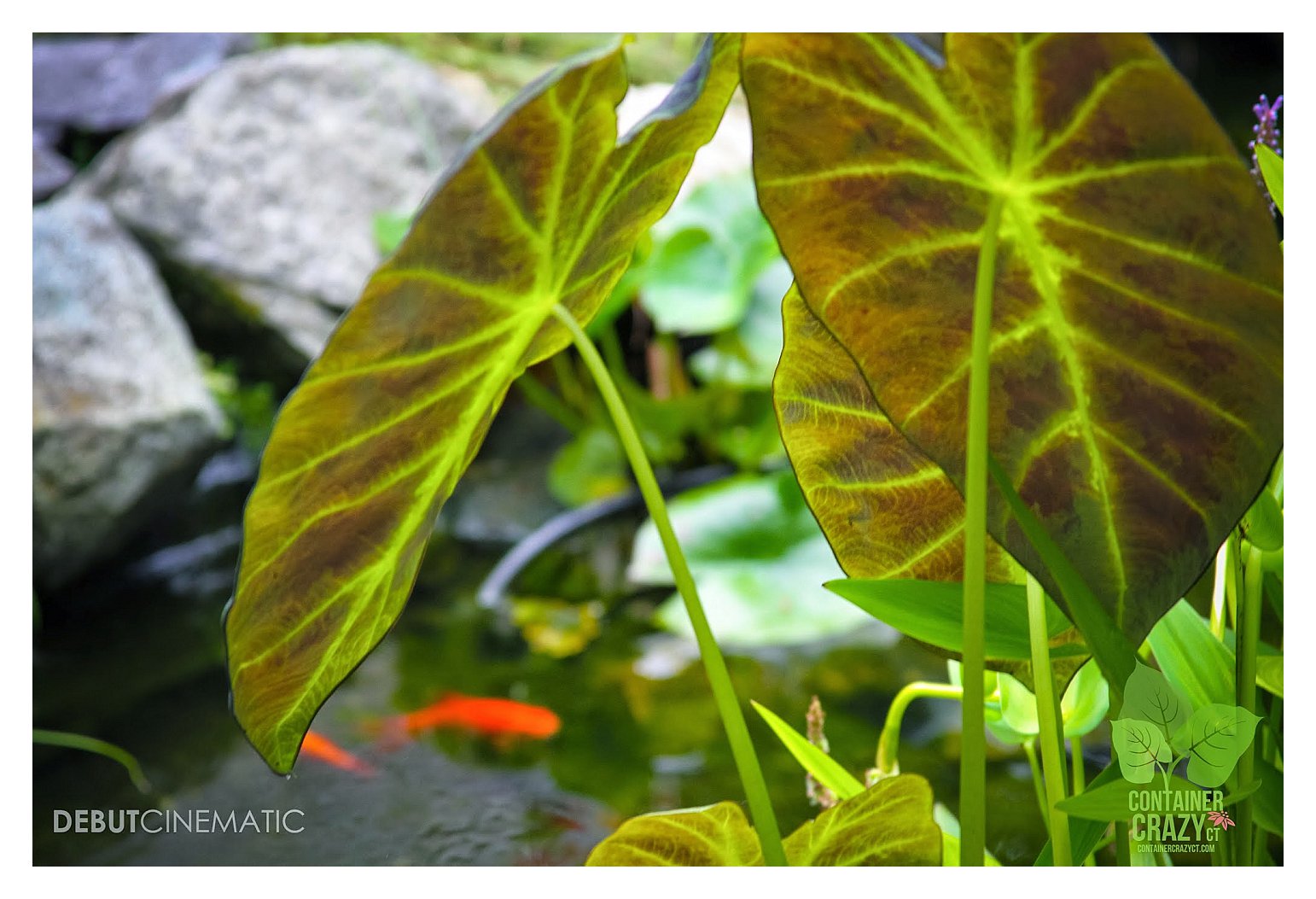
Elephant Ear (Colocasia)

Elephant Ear (Colocasia)

In the water of her pond gardens, she has water lettuce, elephant ears (one showing off a bloom on it during our tour) – Colocasia esculenta ‘Illustrious’, canna plants, hardy water lilies, papyrus (herbaceous perennial), and mosaic plants (Ludwigia sedioides, an aquatic perennial grown as an annual).

Some of the plants she overwinters by placing them in a fish tank in her home, and others are stored by division of rhizomes or corms, such as done with the canna and elephant ears, or by saving off-sets.  And some are allowed to sink to the bottom to decay or regrow the following season if hardy (as she noted above in maintenance comments.)

Rhonda mentioned Garden’s Dream in Enfield, CT as one place she purchases plants from because they started carrying water type and aquatic plants.

Other plants and bees

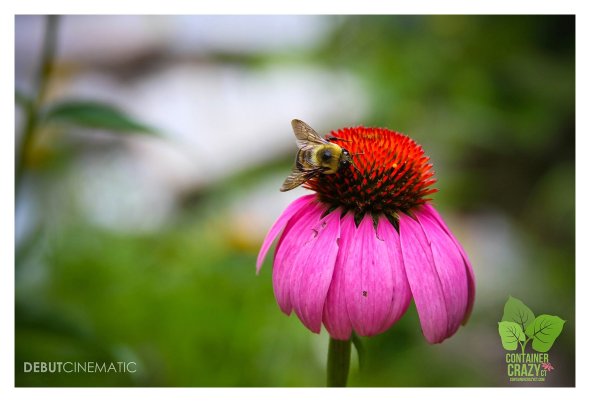
There is no doubt the bees are enjoying the plants, for not only could we hear water trickling, see fish moving, there were also many bees visiting the blooms of her coneflowers and other plants surrounding her pond gardens.
Pondering Ponds Photos by Debut Cinematic_0002

Perennials, such as Echinacea purpurea (purple coneflower), and various ornamental grasses are planted in the ground near the ponds, and one plant many attendees noticed planted in a pot sitting on a rock in the center of the pond was Amaranthus tricolor, an edible annual with bright red and yellow foliage, which grows rather tall and is showy.

Plant with red and yellow foliage in pot seen in background -Amaranthus tricolor

Plant with red and yellow foliage in pot seen in background -Amaranthus tricolor

When everyone asked me what it was, I drew a blank on the plant name, but Rhonda said she got her first plant of this variety from me a couple years ago and loved it – fortunately, she remembered the name of it.  Rhonda said she’ll never forget seeing this annual at my home in a container garden because she uses Amaranth flour as one of her gluten-free ingredients in her recipes at home.

Papyrus tops

Papyrus

Other plants in the pond gardens, as noted above, were the elephant ears (can sit in water), papyrus (not technically a water plant but also can sit in boggy like water or on water’s edges in pots), and the aquatic water lettuce, hardy water lily, and more.  One we all found fascinating, and is relatively new in Rhonda’s pond gardens, is the mosaic plant (Ludwigia sedioides).  It is an herbaceous perennial (winter hardy to Zone 10) which floats and rests somewhat flat on the surface of the water and has a pretty mosaic like pattern to it.
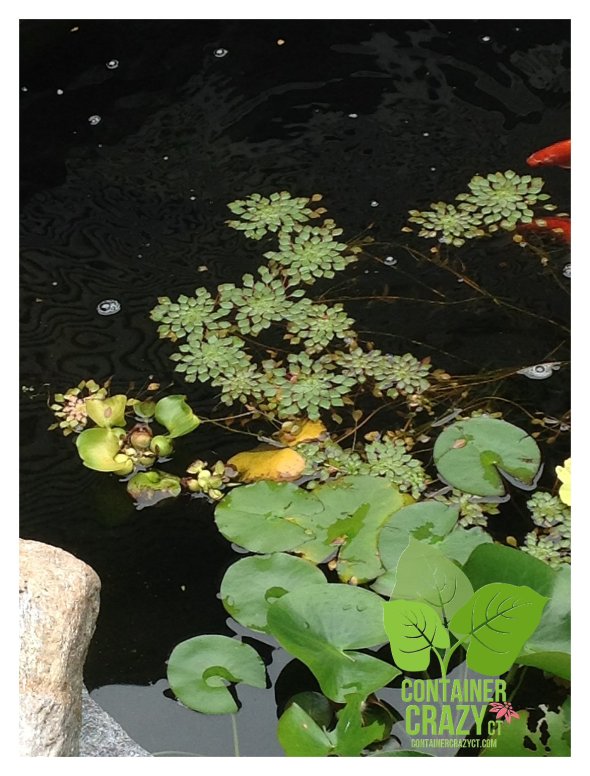
Mosiac Plants - Photo by C. Testa

Mosiac Plants – Photo by C. Testa

Root Mass Demonstrated 

Another surprise is when Rhonda reached into the water to pull up a huge mass of hardy water lily plants bound together by one root system, explaining how quickly plants grow in her water gardens.

Root Mass of Hardy Water Lilies

Root Mass of Hardy Water Lilies

She also noted another plant found by her husband in the wild, upon with, I gave a little caution to the attendees to be very careful with water plants or any plants you may find out in the wild if you do not know what it is.  There are invasive species in the wild or in natural ponds, which you should never relocate to your pond or home gardens by mistake, especially if it can run off to another water system nearby your home.  So just a note – know what you are planting, and if you decided to get rid of a rampant plant growing your gardens because it became out of control, and don’t know what it is, toss it in the garbage and not in the woods where it could potentially spread.  This is something I learned more about as a kayak-er, where you must be careful to not accidentally bring home an invasive aquatic plant after visiting a lake with your kayak or boat, as discussed in a previous blog here.

Floating Containers – Another Big Surprise of the day 

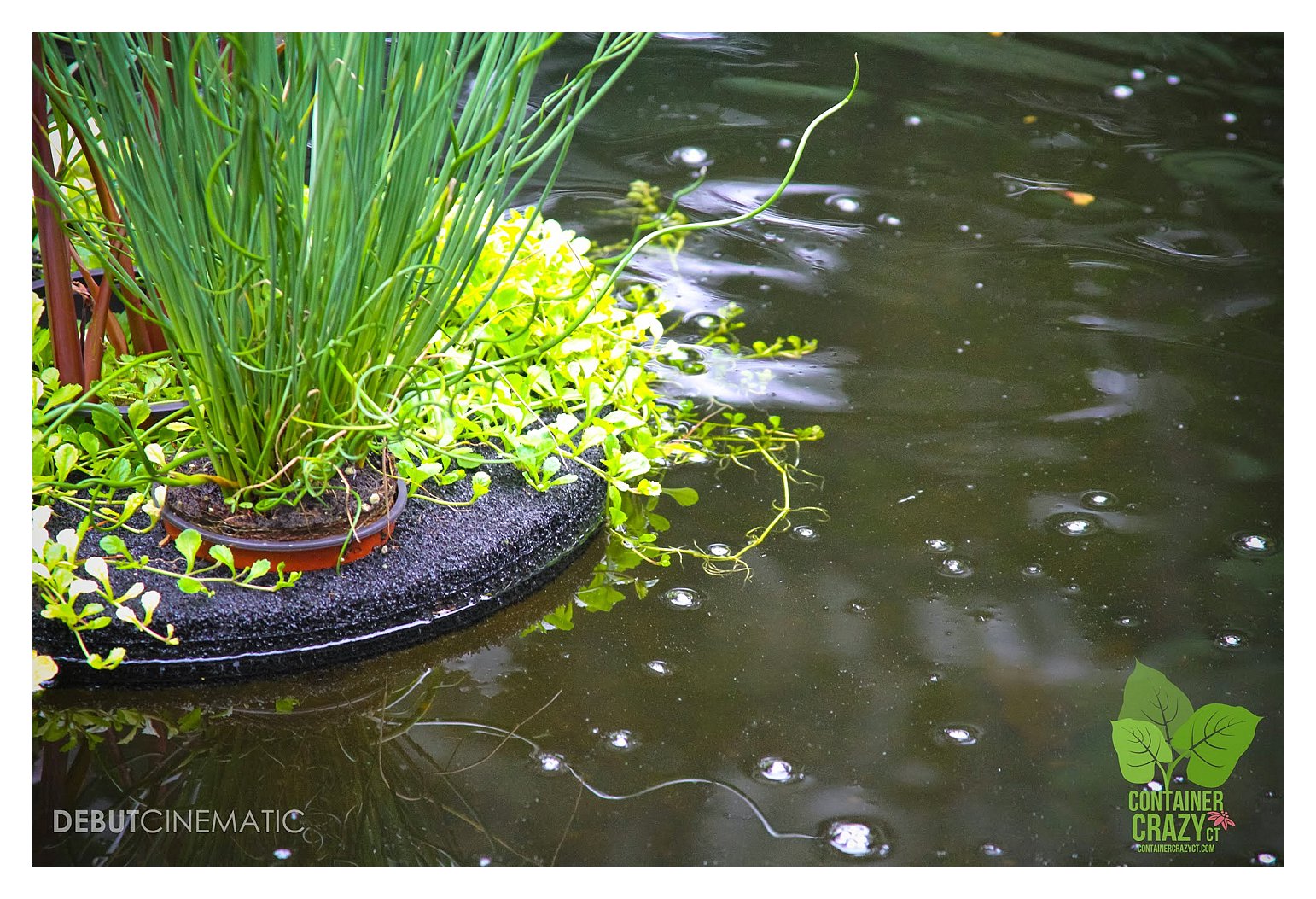
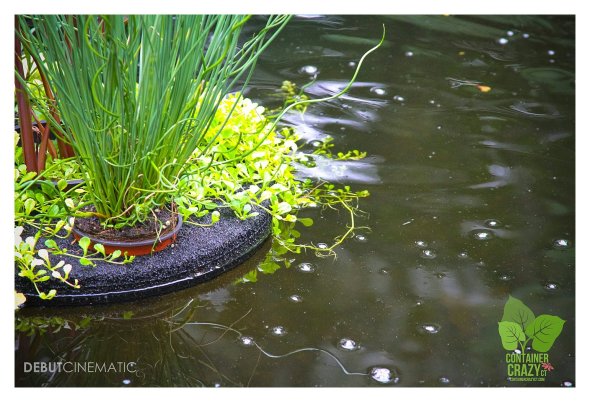
I’ve written about all types of containers to use in and around the gardens, but have never considered the type Rhonda had in her pond garden.  There was one container floating around in the pond garden, moving here and there gently in the water, and without hesitation, Rhonda lifted her floating container out of the water to show our attendees.  It is made of a black Styrofoam base with individual open sections where pots may be inserted easily.
Pondering Ponds Photos by Debut Cinematic_0006 Pondering Ponds Photos by Debut Cinematic_0007 Pondering Ponds Photos by Debut Cinematic_0008

Garden Art is wonderfully displayed around her pond garden — this little pig in the corner, spitting fish here and there, and other surprises as you look and observe.
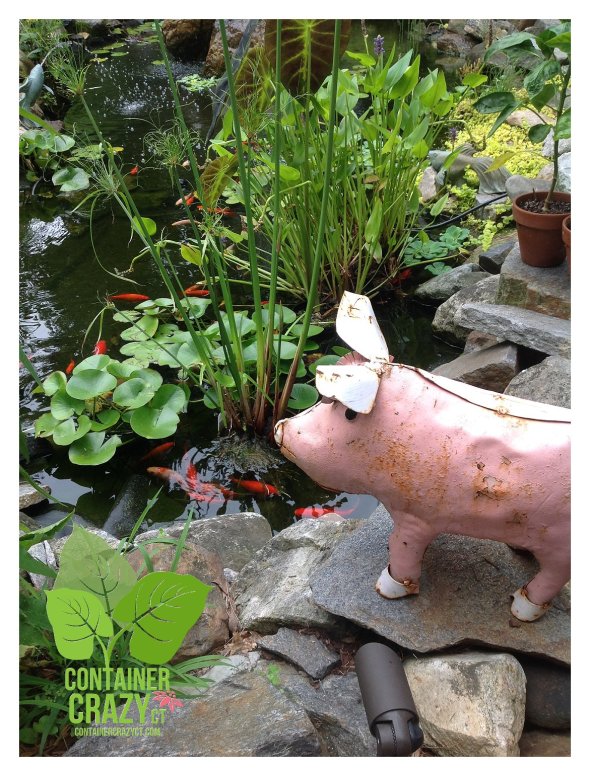
Pig by Pond; Photo by C. Testa

It is an adventure to spot them.  We all could imagine the days or evenings when she and her family has sat there to enjoy all the hard work put into the pond gardens at her home.

Pondering Ponds Photos by Debut Cinematic_0005

Sources for Pond Supplies

AZPonds.com is an online source Rhonda uses to order supplies. She gets her liner, filters, pumps, and water treatments from them. Shipping is pretty fast.  Orders arrive within 5 business days.

Rhonda started her first pond garden 12 years ago, and continues to learn and expand it.

We all could appreciate the amount of effort but how her efforts also equals the relaxing moments by the pond gardens enjoying nature, goldfish, and sounds.

Pond Gardening is Not for Weenies

Water or pond gardening is not for weenies – it takes some effort to get it cleaned and prepared every season, but the payoff is grand. And if you were wondering, one of the reasons we were laughing in the above photo is because I shared a story of how Rhonda and I met during our corporate days – when we decided to take a motorcycle riding course together, and how we would ride into work side by side on our Harley Davidson motorcycles.  Rhonda still rides today, I, however, gave it up so you can see – she’s no weenie!  Makes sense to me that she manages to maintain such a diversity of plant life, fish, and more in her pond gardens.

Hostess Rhonda; Photo by C. Testa

Hostess Rhonda; Photo by C. Testa

Pondering Ponds ContainerCrazyCT_0013

Also, as for pH of the water, Rhonda noted she doesn’t monitor it – she lets nature take its course.  That sounded good to us – and fits the overall rule of the ‘Walk and Talk’ Garden events – it doesn’t have to be perfect for us to enjoy hearing and seeing what any homeowner has created in their backyards.

Pesto and Passion Flowers

The last big surprise of the hour was the handing out of freshly made pesto by one of our attendees — Thank you Linda C.

Pondering Ponds ContainerCrazyCT_0015

What a treat, and additionally, we all saw, on the way out for the day, Rhonda’s beautiful blooms on her passion flower (Passiflora) vine located at the front of her home. She said it returns every year via self-sowing (or perhaps she has one that is noted to be survive winters, Passiflora incarnata.)  It certainly looks like it!

Passion Flower; Photo by C. Testa

Passion Flower; Photo by C. Testa

She has seen fruit growing after the flowers pass, but wasn’t aware it is passion fruit until we discussed this fascinating flower further.

See here to also learn about this plant’s religious significance, which I looked up via my iPad and pointed out to everyone – each part of the flower has a special meaning – and is believed to represent symbols of Christ’s passion and cross.

Next Walk and Talk 

Our next ‘Walk and Talk’ event is scheduled on August 16th in East Granby, CT at 10:00 am.  This one will feature a sunny hillside garden where the homeowner will share her experiences on what thrived and what didn’t when it comes to the plants she has tried in a very informal, loose and spreading garden on a full sun hill which receives lots of heat in the midst of summer, and wind.  As per our rules, the garden is not perfect but a great place to learn directly from a home gardener with a particular passion.

For more information on planting aquatic plants, check out this post by thegardengeeks.com.

Thank you,

Cathy Testa
http://www.cathytesta.com
860-977-9473
ContainerCrazyCT.com

P.S. If interested in showcasing your home garden on our Walk and Talk tours, please feel free to contact Cathy Testa, author of this blog, and coordinator of these events.

Special note of thanks to Professional Lifestyle Photographer, Karen Ladany of Debut Cinematic, for attending to take various photos of the gardens.  She is currently located in East Windsor, CT.

Insects in Your Container Gardens – And What You Can Do…

2 Comments

Hello Everyone!

It is that time of year when we may be seeing little critters appear on some of our plants in our gardens or container gardens, and it ain’t pretty.  Fortunately, many of them do not last long due to their life cycles, stages of growth, and time of appearance, but regardless, it is best to battle them as soon as spotted on your plants.

I like to use the ‘pick and squish’ method first whenever possible, if bold enough, prior to reaching for any insecticides, or use of pesticides.  Sometimes just hand picking off or pruning, then disposing of them works.

In the photos below, you will see what I believe are eastern tent caterpillars on my honeysuckle vine (top left), aphids on the eggplant bloom (middle top photo), and mosquito larvae in the water image.  These were all spotted in late June, along with a first sighting of the infamous Japanese beetles, which emerge from the ground in early summer to feed on plants.

Yuck -- Insects on Plants

Yuck — Insects on Plants

Tent caterpillars on my trumpet honeysuckle – YUCK! That was a first – and my honeysuckle has been doing so well this year.  Obviously, I was not happy to find these buggers.  My honeysuckle plant is growing by the side of the house, and it surprised me to find tent caterpillars on it.  Fortunately, with a quick snip of the vine from which they were attached, they were easily bagged and tossed.

Honeysuckle bloom creeps into Delphinium

Honeysuckle bloom creeps into Delphinium’s blooms

TENT CATERPILLARS ON MY HONEYSUCKLE VINES

Using clean pruning shears, I cut of the portion of a vine with the nasty critters on it, put it in a plastic bag on the driveway and then stomped on the bag.  I left the bag laying on the driveway for a while.  Why? I figured the heat would fry any not crushed (oooh, gross – the things gardeners will do!).  Then, I went out for my day’s work at a client’s location.

That day, my parents dropped of some items at my door, and my mother saw the plastic bag sitting on the driveway so she included my bug bag as a hanging item on my door handle while I was not home.  I guess she figured I dropped something by mistake on the driveway.

Well, when I opened up that bag at the kitchen table – ACK.  Out to the garbage can it went – and quickly. You see, the other bags my parents often leave me are filled with fresh veggies from their home garden.  Imagine my surprise and reaction when I found bugs instead of radishes.

Prior to all this bug nonsense, I was enjoying the many orange trumpet shaped blooms growing from my honeysuckle so much all month.  At one point, a stem pushed its way through the center of a Delphinium stalk located near it – talk about stunning.

Do these two plants know they are complementary colors on the color wheel?

Opposite each other on the color wheel – are blue and orange – talk about a nice surprise nature combo in the garden! Although this Delphinium technically has more purples than blues in its blooms, the combination was breathtaking all the same – I have been enjoying it for a whole month.  I wrote about Delphiniums before on this blog, as it was a flower I selected in my wedding bouquet 24 years ago.  It probably was one of my first flower obsessions.  I find them a little difficult to keep growing in my garden, so this year, I just bought a new one and plopped it by the honeysuckle plant, and it has grown beautifully.

Honeysuckle Blooms

Honeysuckle Blooms

Honeysuckle (Lonicera) is a deciduous vine that grows quickly every year.  It is deer resistant and attracts butterflies. A trellis or arbor is needed to hold it up as it grows taller, sometimes reaching 15-20 feet.  I’ve had mine for several years in this spot with little problems – again, why I was surprised to see the tent caterpillars take a spot on it this year.

Although this vine grows quickly, I wouldn’t classify it as a invasive plant because it is easily removed if you find it over takes your space, but it can get large fast and needs to be watched.  It is included in my Troublemakers Turned Star Plants on my Pinterest page, because it can be very useful in a container garden if you find it a nuisance in the regular gardens of the ground.

It likes sun to part shade, and blooms for a long time.  The scent is intoxicating for many cultivars. This plant may be used as a thriller in a large container garden, so long as you add a nice big trellis in the container for support.

Happy Bloom on Japanese Long Eggplant

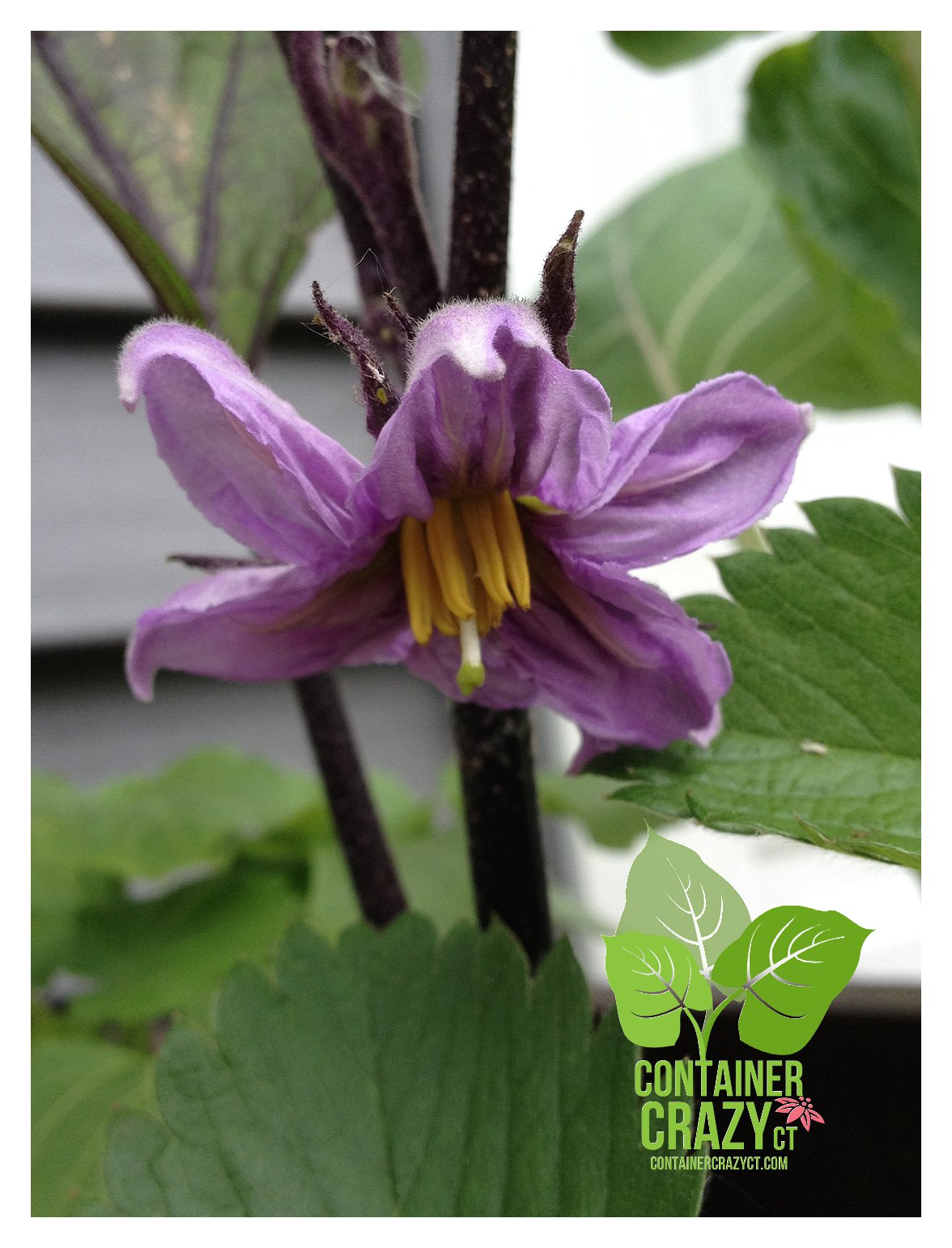
Happy Bloom on Japanese Long Eggplant Being Visited by Pest Aphids

APHIDS ON MY EGGPLANT BLOOM

If you take a close look above, you may see the little aphid bugs on my Japanese eggplant.

Aphids are very tiny pear-shaped insects with long antennae and tubes on their back-ends.  Some of the interesting tidbits about aphids are ants protect them because they enjoy their “sweet honeydew”, and they (aphids) reproduce faster than rabbits – the females do not need males to do so, and aphids vary in colors – not just green as the ones spotted on this plant.  To learn more about these little guys, see the CAES link.

Well, seeing them on my Japanese long eggplant flowers in my container garden was not pleasing. I’ve been using edibles in container gardens a great deal this season – and talking about it at garden clubs.  I am finding, however, the edible plants seem to get attacked by bugs much quicker than my tropical or annual plants.

To battle these aphids, I lightly sprayed the plant on a shady day when cool with a safe organic spray for vegetable plants (remember, don’t spray a plant when its very hot and located in full sun), and then a day later, I hosed off the leaves by using the garden hose with a watering wand at a good heavy pressure – it did the trick.  No more signs of the aphids since – and my first eggplant fruit growing right now on the plant – yeah!

I couldn’t really pick the small aphids by hand because they are too tiny, at the size of 1/8″ long.  And by the way, lady bugs are natural predators, releasing them can help if you can find the ladybugs from a garden center.

First eggplant

First eggplant

I potted up this eggplant plant along side an asparagus plant, strawberry plant, and would you believe, Brussels sprouts?! The asparagus added a nice soft texture with its fine and light foliage along side the coarse texture of the eggplant leaves, the strawberry plant is a spiller, and the Brussels sprouts – well, wow – what big texture those leaves have offered.

Eggplant with Mixed Edibles

Eggplant with Mixed Edibles

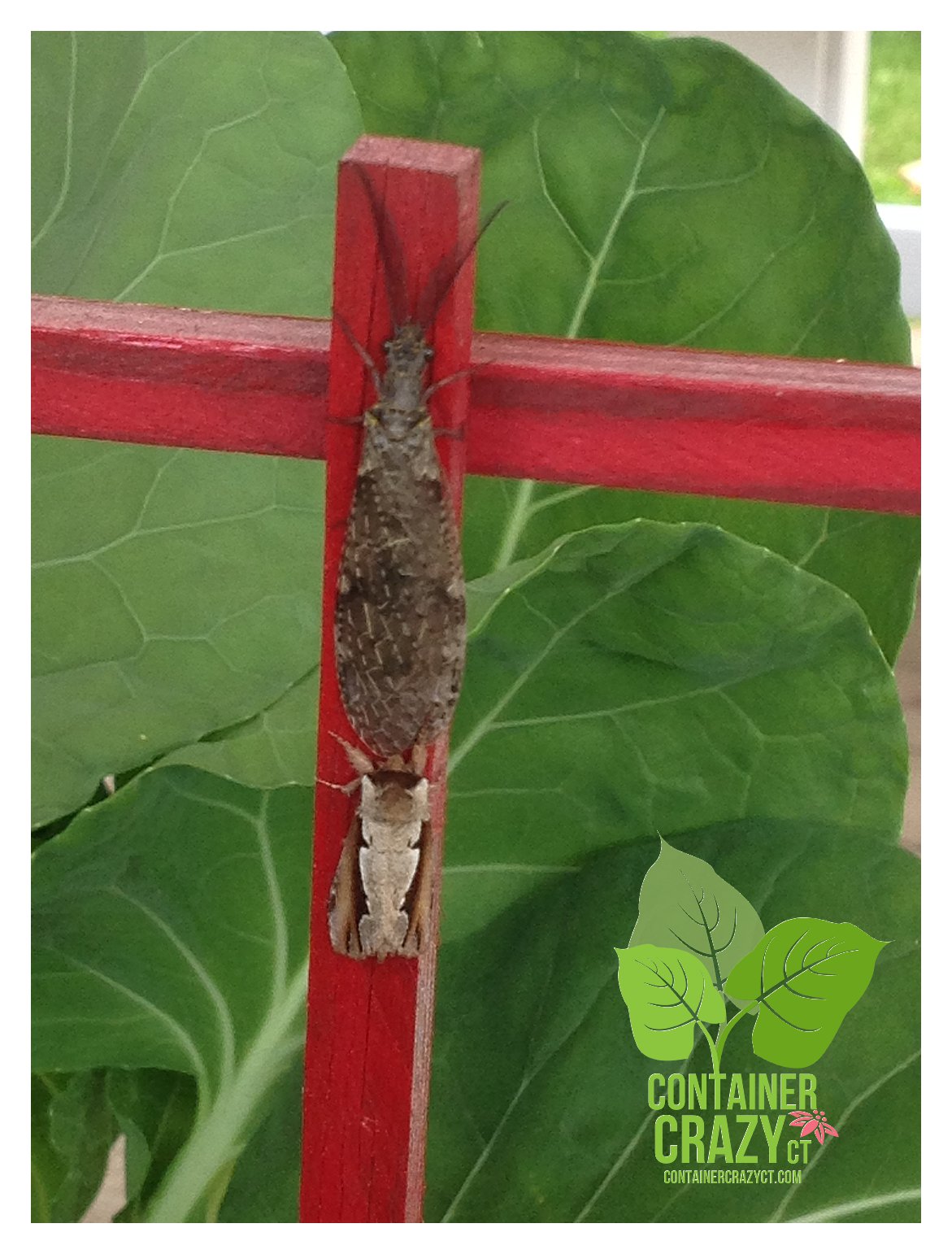
Earlier in June, I brought the container garden to the Ellington Farmers Market to show the combination during my talk about “Incorporating Decorative Edibles in Mixed Container Gardens.”  Well, low and behold, these two very interesting looking insects took their position on the red trellis in the pot – and stayed there all day during the market.  Thankfully they did not jump on me when I was driving home later that day with the container garden on my truck seat.  Not sure what they are, do you know?

Bugs on Trellis with brussel sprout Leaves behind it.

Bugs on Trellis with brussel sprout Leaves behind it.

MOSQUITO LARVAE IN MY WATER GARDEN

The other spot where I saw critters was in a water garden I have at home, which is a big galvanized feeding bin (for animals) filled with water and plants, such as elephant ears (Colocasia) or other water tolerant types, such as Cyperus papyrus (Tut). I put the plants in terracotta pots because they sink well into the water due to their weight and the clay is porous. Add some stones to the top of the soil of those pots so the soil does not escape into the water.  When submerging the pots, gently drop them into the water as to not disturb the soil too much.

Well, I should have known, tiny mosquito larvae started to grow in the water, and there were tons of them wiggling in the water one day.

To avoid this situation – you may try two things – place a mosquito dunk, which are not harmful to the plants, in the water, or just flush some of the water out occasionally with a garden hose so the water is not stagnant.  This is what I do. Later, no more larvae and no more bites.

Oh, when I was very young, I remember telling a teacher that I saw little things wiggling in a puddle at home. (Living on a farm, you tend to notice things like this – or I was just always fascinated with looking at things up close in nature.)  He told me to put them in a jar with water, cover it with plastic wrap and to bring it into class.  He set it on his desk and said, “Let’s see what happens.” A few days later, a bunch of mosquitoes were flying above the water.  A visual lesson for sure.

A PRETTIER INSECT

Fuzzy body of moth

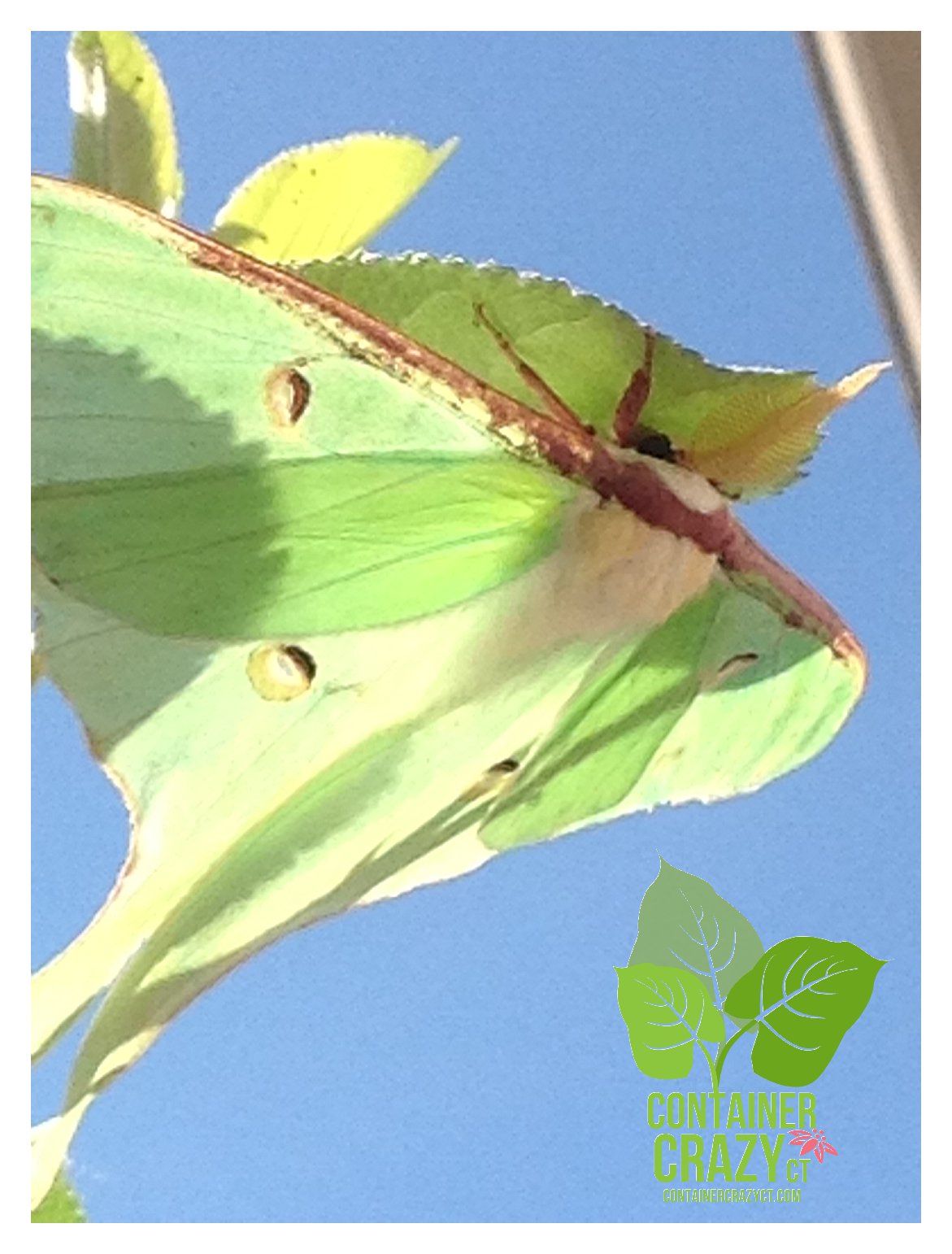
Fuzzy body of moth

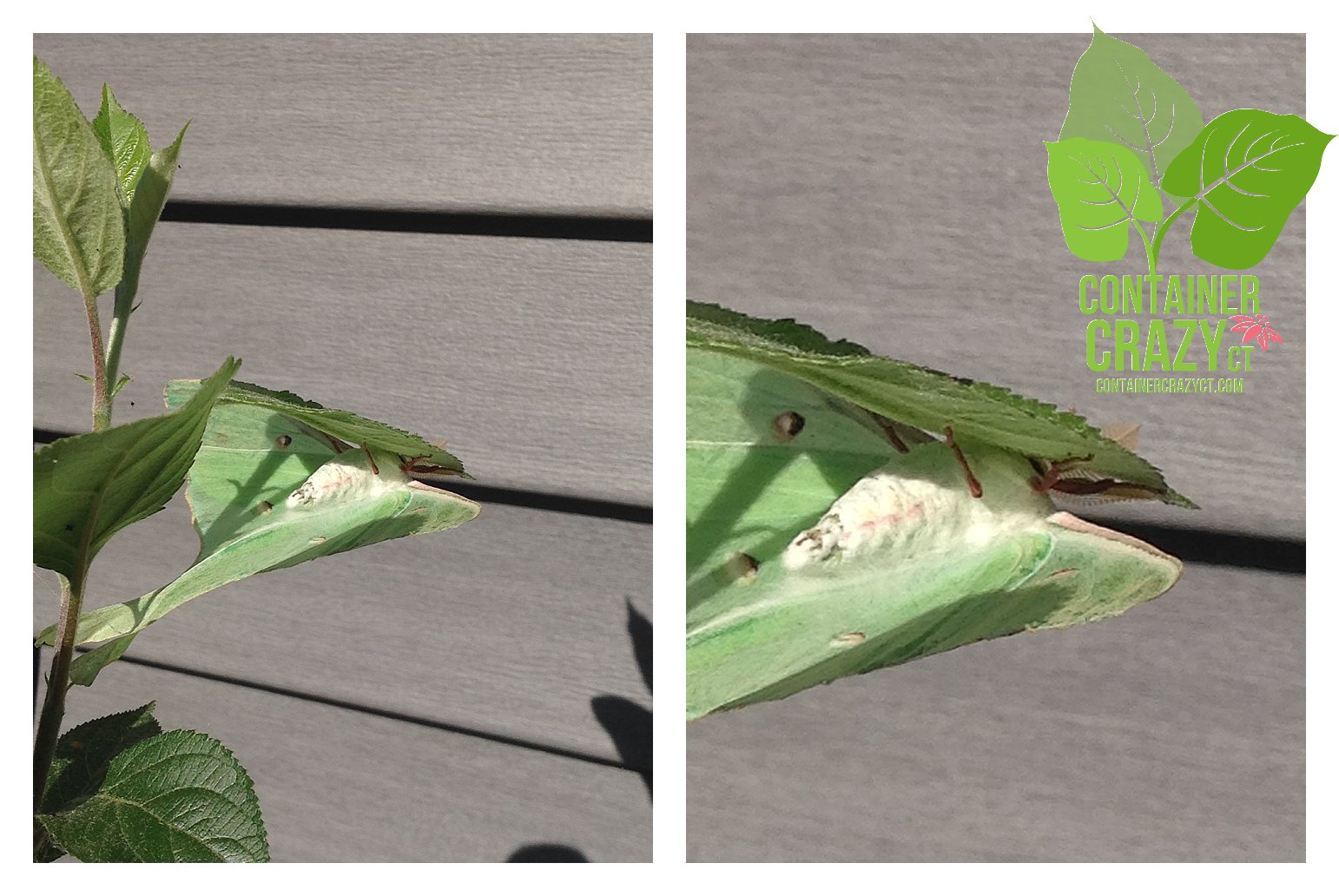
Another surprise sighting at my home this season was a Luna moth (Actias luna) on a apple tree in a pot.  As I was walking out to my garage, I saw a white substance on a leaf.  Well camouflaged, I didn’t see the wings of the moth at first.

I thought, “What the heck is that white fuzzy cocoon on my apple tree?”  (By the way, I often plant small trees in container gardens for a few years first – because I am crazy about container gardening, but it also can give a small tree some time to grow larger and stronger before I eventually transplant it to the ground when it outgrows a large pot – this way, I enjoy, learn and grow the plant first – as is the case with this apple tree.)

Insects ContainerCrazyCT_0015

To my surprise, it was a beautiful moth and not an ugly insect!  This was in the early morning and the east sun was brightly lighting up its wings.  The moth was completely motionless, and not moving at all – this gave me the wonderful opportunity to snap more photos.

Luna Moth on Apple Tree hanging on the underside of a leaf

Luna Moth on Apple Tree hanging on the underside of a leaf

I tried getting photos from every angle, which was difficult to do because it was on the backside of the plant along the garage wall.  After repeatedly taking photos, I tried moving the pot but it flew away.

Insects ContainerCrazyCT_0009

Luna Moth on Apple Tree

Luna Moth on Apple Tree

SPOTTING FIRST JAPANESE BEETLE

I also just spotted my first Japanese beetle on a plant yesterday – it happen to be a watermelon plant in a single container. Those beetles, I pick up with my hands and squish on the ground under foot.  They never scare me – even when they grab tightly onto my fingers.  I guess this is because my father would pick them from his garden plants and put them in a jar – another memory from childhood – and sometimes, I would help him collect the beetles.  I also would chase my younger sister, Louise, around in our pool, when I would find Japanese beetles in our pool too – and she would screech at the sight of them.  She told me this game as children put a fear of those beetles in her for a lifetime – oh well, the things we do when we are kids – LOL! However, she also practices the “pick and squish” method in her own vegetable garden for insects not so scary to her.

East Windsor Farmers Market

East Windsor Farmers Market

ALL BUGS ASIDE

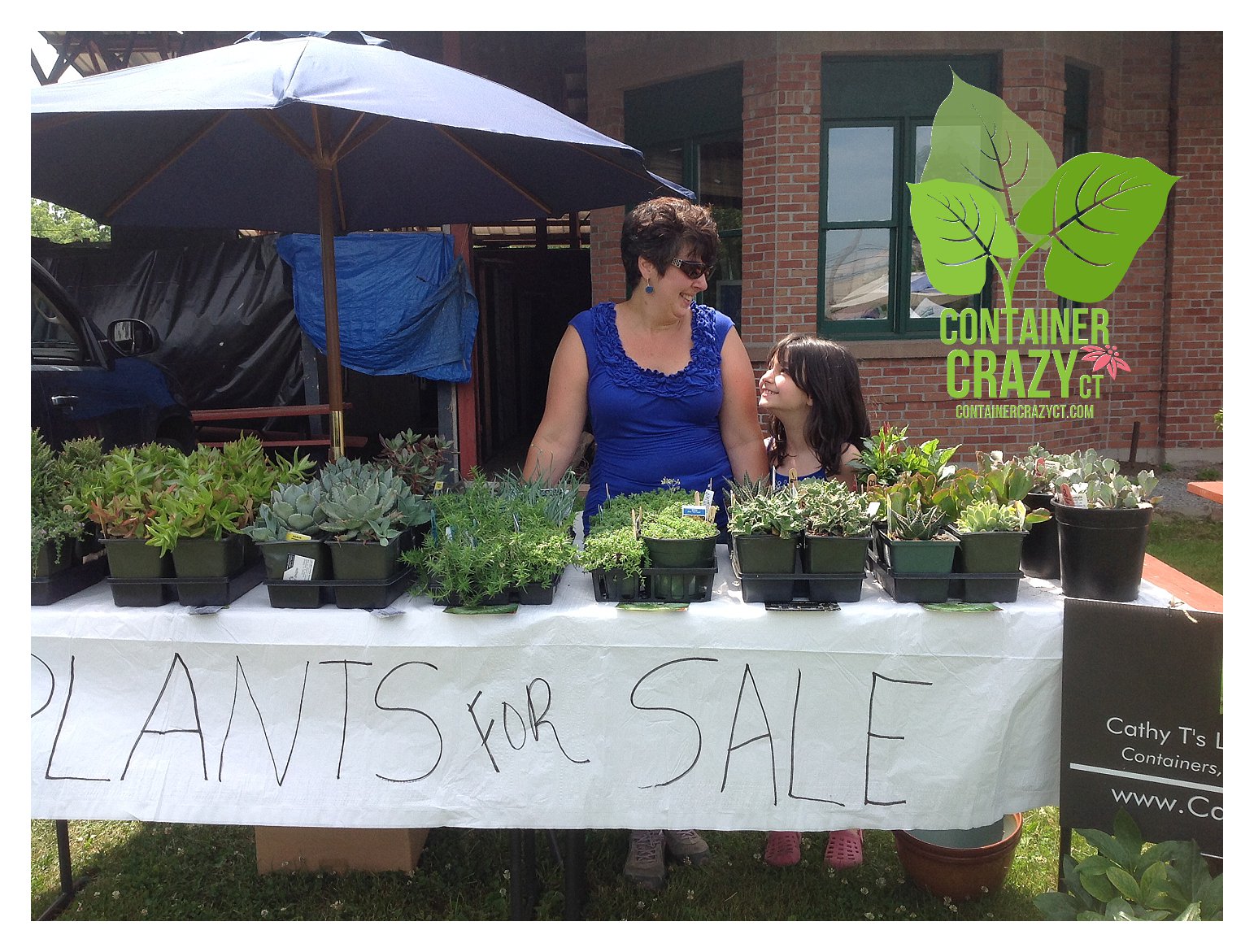
Last week, all bugs aside, I was featured as a guest speaker at the East Windsor Farmers Market on their opening day. Their market runs from now until October, on Sundays, 11 am to 2 pm, at the Trolley Museum off Rt 140.

My niece came for a visit – she loves to help me at the markets with my plants – and I love having her there.  We were goofing around, taking silly photos, and coincidentally, had matching blue shirts on.

See the next photo – this was my building at the market – pretty cool, huh?

Nope, just kidding – it was some sort of very old structure from the Trolley Museum next to my table setup.  I never got a chance to ask them what is was about, but it was sort of cool looking.  (BTW, if you go there, go see the old trolleys and even a few other interesting vehicles, such as airport shuttle buses built, but they were never installed at Bradley airport.)

The other cool thing about going to the market at this location is kids and family can take trolley rides on antique trolley cars as part of their day.  And, I did not know this – but there is a little movie theater inside the trolley museum building too – along with old cool trolley pics and more – so if you go, be sure to go inside as well as visit all the new vendors at this growing market in a great location – picnic tables and all.

Old Structure at the Trolley Museum

Old Structure at the Trolley Museum

AFTER THE MARKET

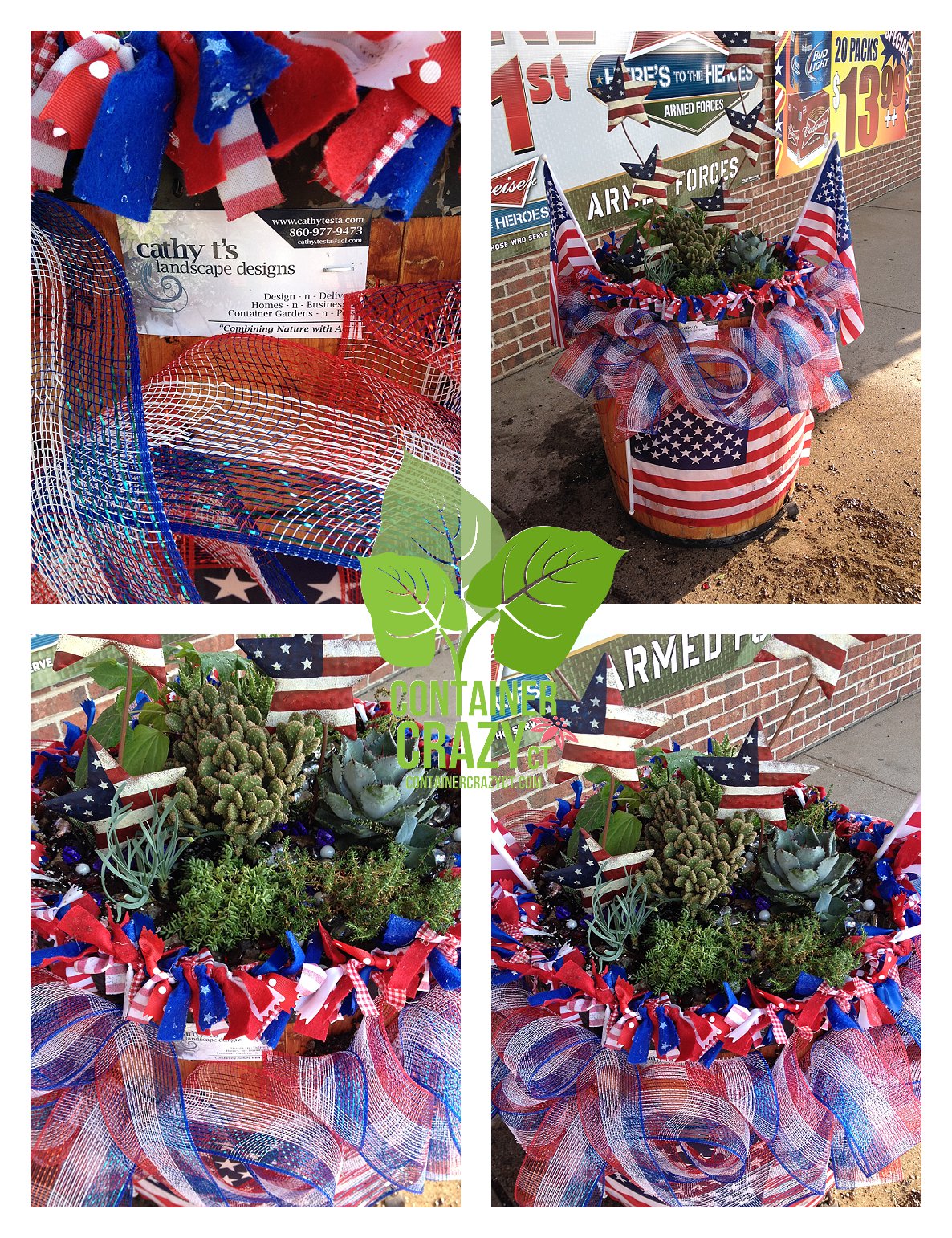
After the weekend, one of my first priorities was to update my client’s business store front with some red-white-and blues for the holiday and put a nice mix of succulents in the container gardens.  Cactic and succulents can be a little tricky to plant if they have spines and needles.  Just be sure to wear thick gloves and handle it by the root ball – and with some practice, you won’t get pinned, stuck, or aggravated by tiny spines.  I will say this however, whomever is putting their cigarette butts in my container gardens at this location – you will find a little surprise this time (hee-hee!). Fortunately, insects tend to not bother cacti and succulents much based on my experience, so they are useful for the non-insect people.

Client Barrels Decorated for the 4th

Client Barrels Decorated for the 4th

4th of July Succulents ContainerCrazyCT_0002

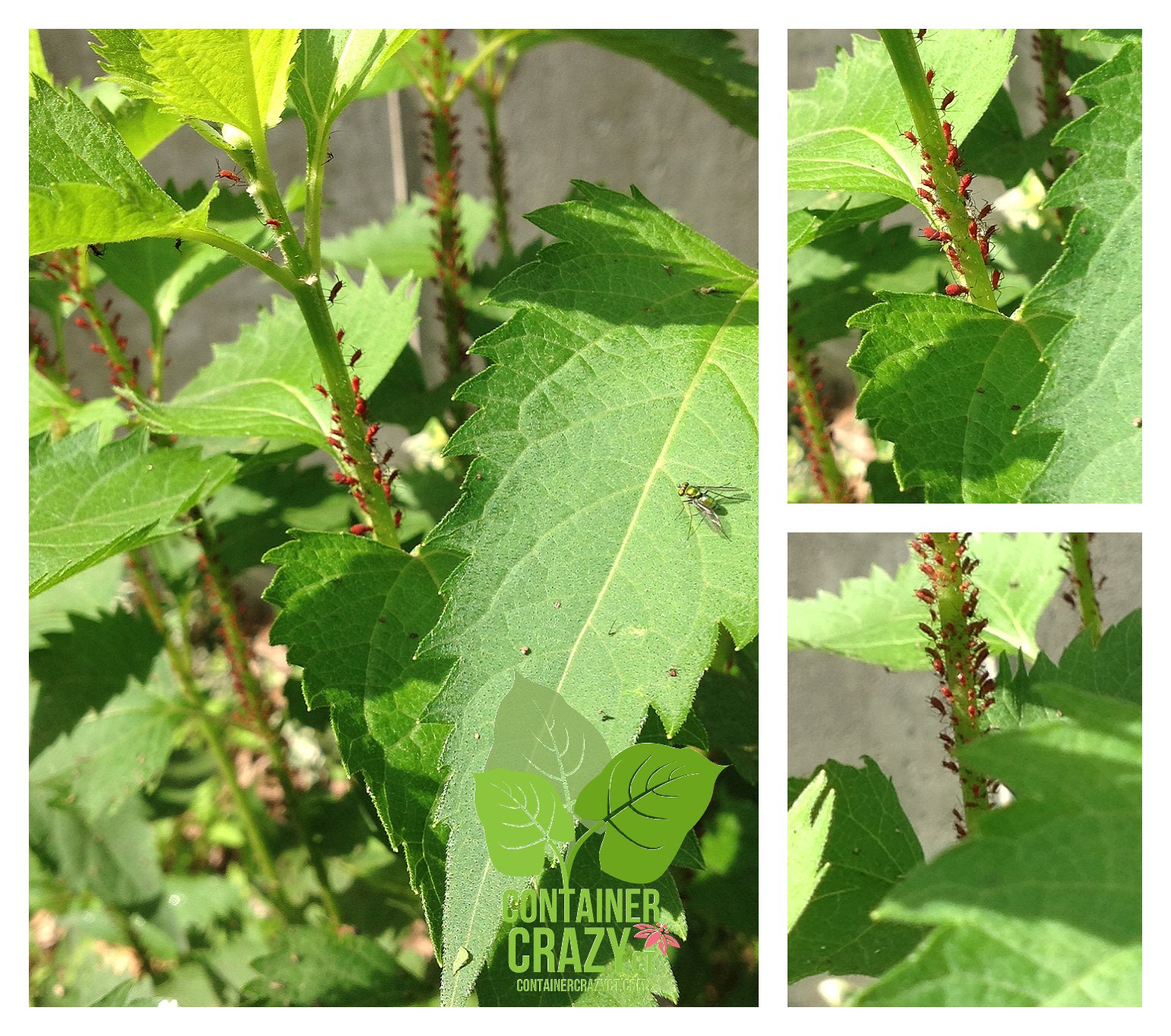
Oh by the way, what are these ugly critters below?  Saw these on a weed plant, so I pulled the plant out of the ground and took it to the chicken coop for the hens to deal with.  That’s another way to deal with insects.  Recycle to the coop…

More aphids or not??

More aphids or not??

Cathy Testa

860-977-9473
http://www.cathytesta.com
ContainerCrazyCT
containercathy@gmail.com

Condensed List- What You Can Do:

  1. Pick, Squish, Toss
  2. Prune away Plant Parts with Insects and Toss
  3. Pull Plant; Feed to Chickens
  4. Hose off with Strong Spray of Water
  5. Chase your Younger Sister around with them
  6. Lightly spray with Insecticide specific for plant and insects
  7. Get natural predators, like ladybugs and release near pest insects

Happy 4th of July Weekend Everyone – Hope it is filled with food, family, fun – and not many critters!

4th Photo Courtesy of Freedigitalimages.net, by nuttakit

4th Photo Courtesy of Freedigitalimages.net, by nuttakit

Goofing Around with My Camera (Predators, Coop Renovation, Blooms)

4 Comments

I’ve been so busy preparing for this weekend’s class on Container Gardening with succulents, alpines, and cacti that I woke up at 2:00 am unable to sleep.  The excitement is getting to me, as it always does.  So, after tossing around in bed for another couple hours, I gave up and got up. I decided a distraction may be in order, so to continue my trend, I’m posting some general photos I took around my home, and here or there, related to gardening – and chickens – yes, have those now and we are enjoying our six hens.

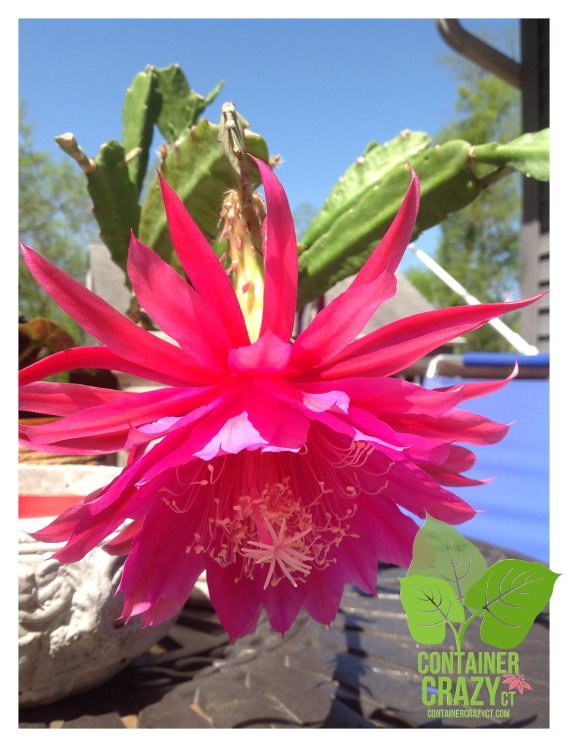
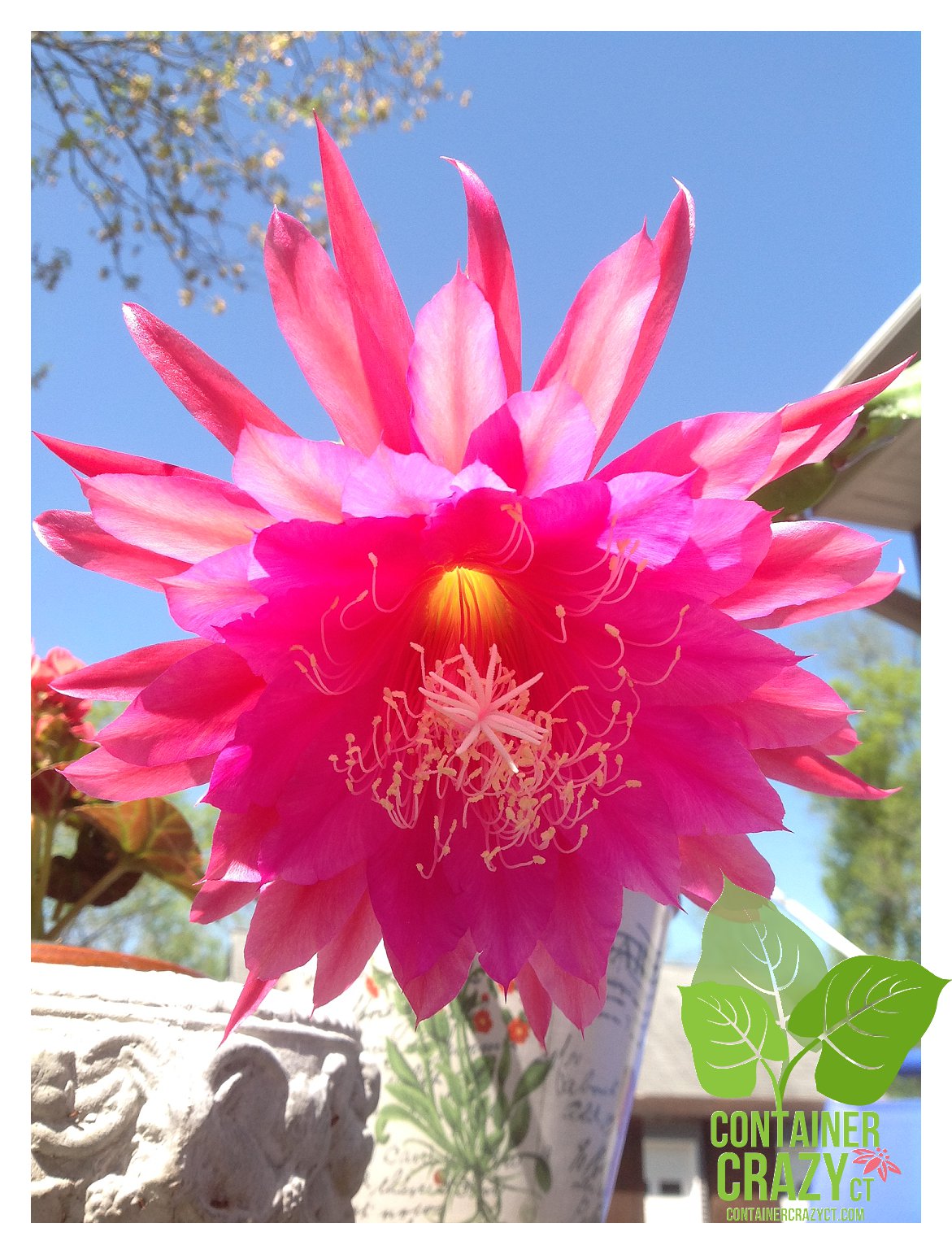
Orchid Cactus

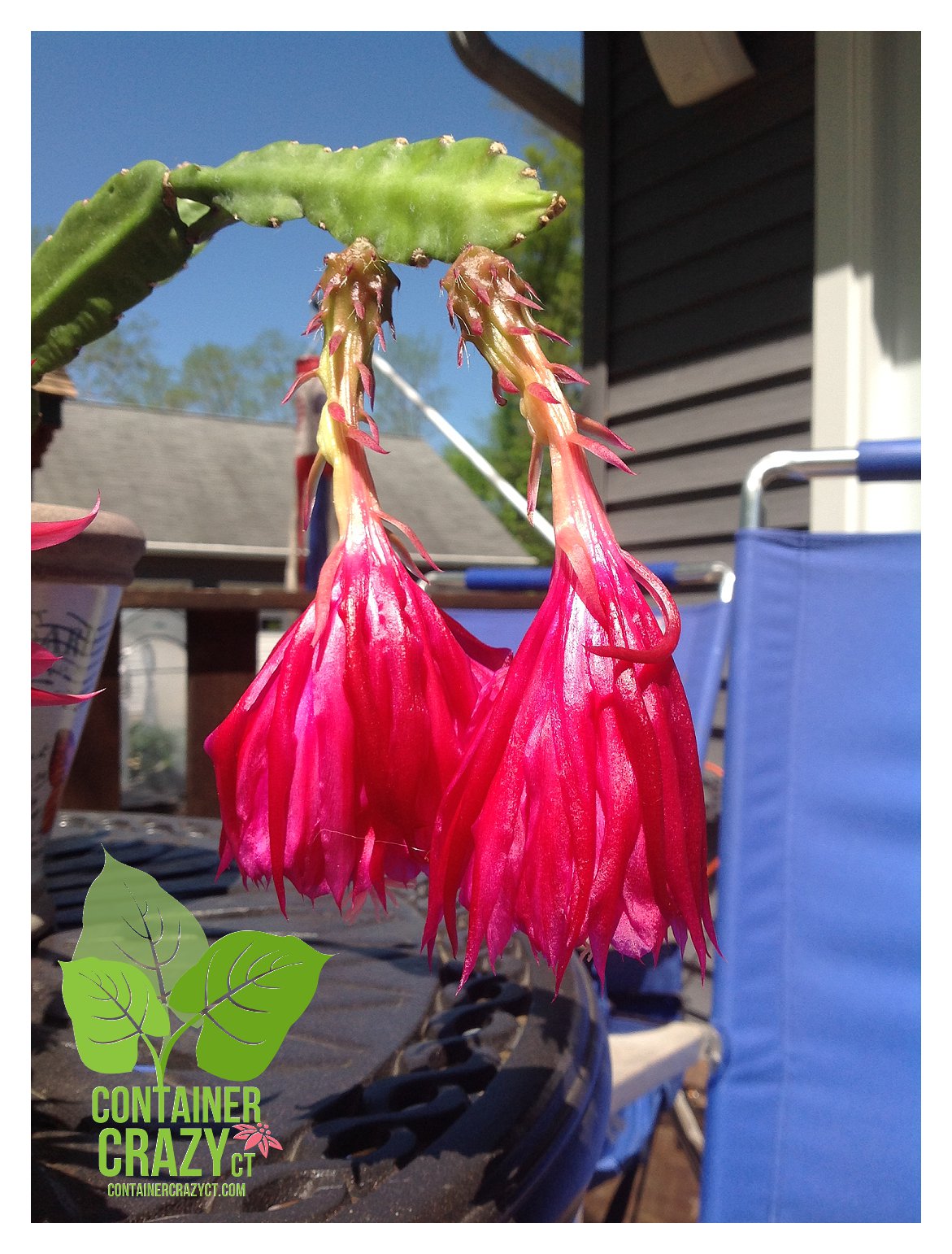
On a clear day last weekend, I took this plant outside to take some photos of its amazing bloom.  And geesh, is this not stunning?  I love the hot pink color against the clear blue sky.  Why haven’t I had one of these plants before?  I plan to research and blog about in detail later.  Do you have one or grow these?  If yes, I would love to hear from you.  The bottom photo is of two closed up blooms that finished their show.

Orchid Cactus Bloom

Orchid Cactus Bloom

Goofing w Camera_0002 Goofing w Camera_0003Take a Guess

Can you guess what this plant is?  As noted, they are tobacco plant seedlings.  Last summer, I asked a nearby grower of these if I could have one plant.  His response, well, no, I can’t give any away.  I wanted to remind him of the day his big cows came into my yard and rubbed against my Arborvitae trees many years back, and how I didn’t complain – Why? Because I grew up on a farm and have an appreciation of how cows can get free, running loose from time to time.  But his cows did major damage, so I tore the trees out without much of a word about it and moo’ed on.

Well, last winter, I happen to mention this story to a friend, and this spring, she text me to say she got me some seedlings of tobacco plants from a farmer friend of her’s, and she even dropped them off for me in this pot.  I thought, what an amazing gesture on her part.  Why, you wonder, would I want one of these?  Well, they grow fast, have large showy leaves, and I just want to experiment with it for the features.  Will let you know how it goes, it is time to prick these out and get them into individual pots.

Tobacco Plants

Tobacco Plants

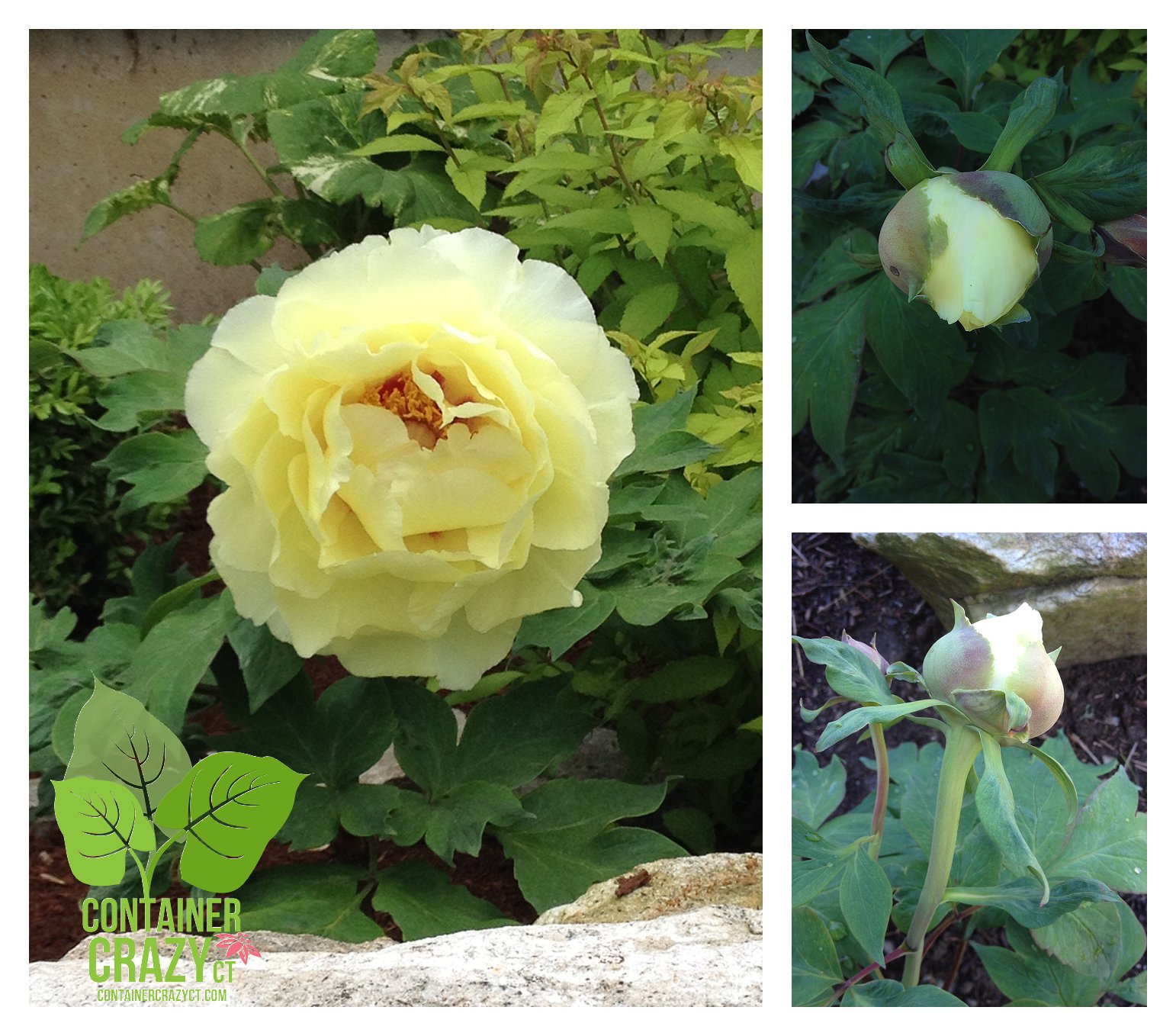
Japanese Tree Peony

I finally got my first Japanese Tree Peony (Paeonis suff. ‘High Noon’) and I couldn’t be more thrilled with its show.  The yellow blooms are luxurious.  This one has an exceptional yellow flower and they are the double type which I prefer on Peony plants.

As the afternoon sun hits it, I just ooze over it.  It will grow to 48″ tall and is for Zones 4-8.  It was a little pricey, but worth it.  For those of you who do not know, these have a wood based stem and look more like a shrub when mature.

Japanese Tree Peony

Japanese Tree Peony

Goofing w Camera_0010

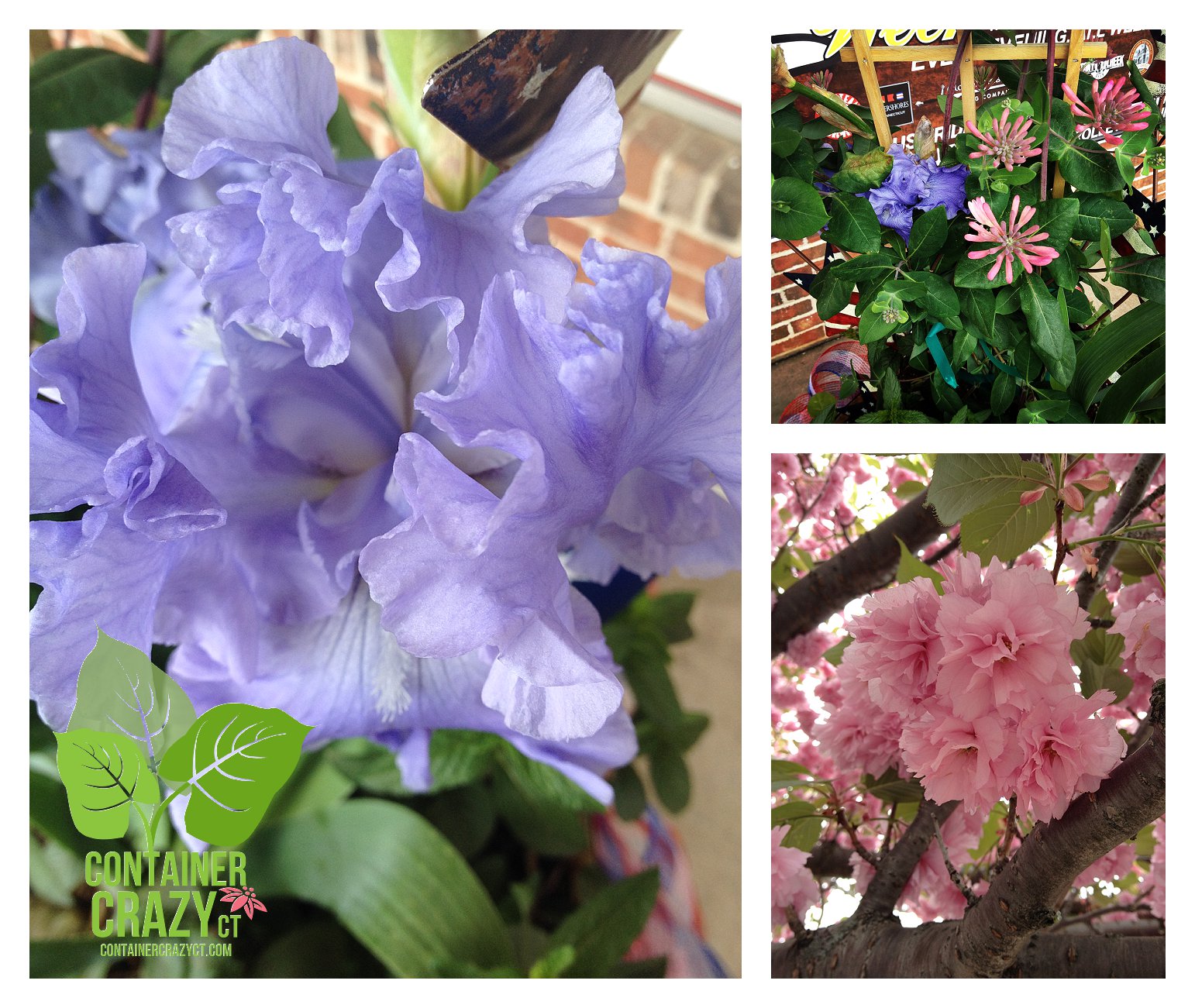
Iris with Honeysuckle

I planted a tall bearded Iris with honeysuckle and chocolate mint plants, one of each type in two large container gardens for a business client.  Imagine the scents in this arrangement?  The honeysuckle is Lonicera x heckrottii ‘Gold Flame’, a perennial with a vine and shrub like habit.  It is super fragrant with deep magenta blooms appearing in late spring through early fall.  It takes sun to part shade and I think the color looks spectacular with the blue blooms of the Iris ‘Abiqua Falls’. Ironically, I stopped at a local garden center this past weekend, and one of the owners told me someone had asked her recently what was in these planters – thinking her store planted them.  (Note to self: I have to get my sign in these containers!) I don’t like the look of a sign poking out of the containers, one of the reasons I haven’t done so yet.  Oh, the Iris is an award winner, prized for its large, sky blue blossoms.  The only problem with using Irises is they toppled over a bit, but luckily the trellis helped to anchor them back up.  In the bottom right photo is a Kwanzan cherry tree’s blooms which I took a photo of while on the road the same week as stopping in to check on these two container gardens.

Iris with Honeysuckle

Iris with Honeysuckle

Goofing w Camera_0008

Fold Up Cart

Taking a break from the flowers – I also wanted to show a handy cart I ordered, which folds up super easily.  It can hold a lot of items and rolls really well too.  For years, when I would go to a Container Garden Party to do my classes or for talks at garden clubs, I lugged heavy items into the building practically by hand.  This wagon so helped me this past Monday when I did a talk at the Vernon Garden Club on incorporating edibles into container gardens.  It folds in a snap and goes right into the back bed of my truck.  Love it!

Fold Up Cart

Fold Up Cart

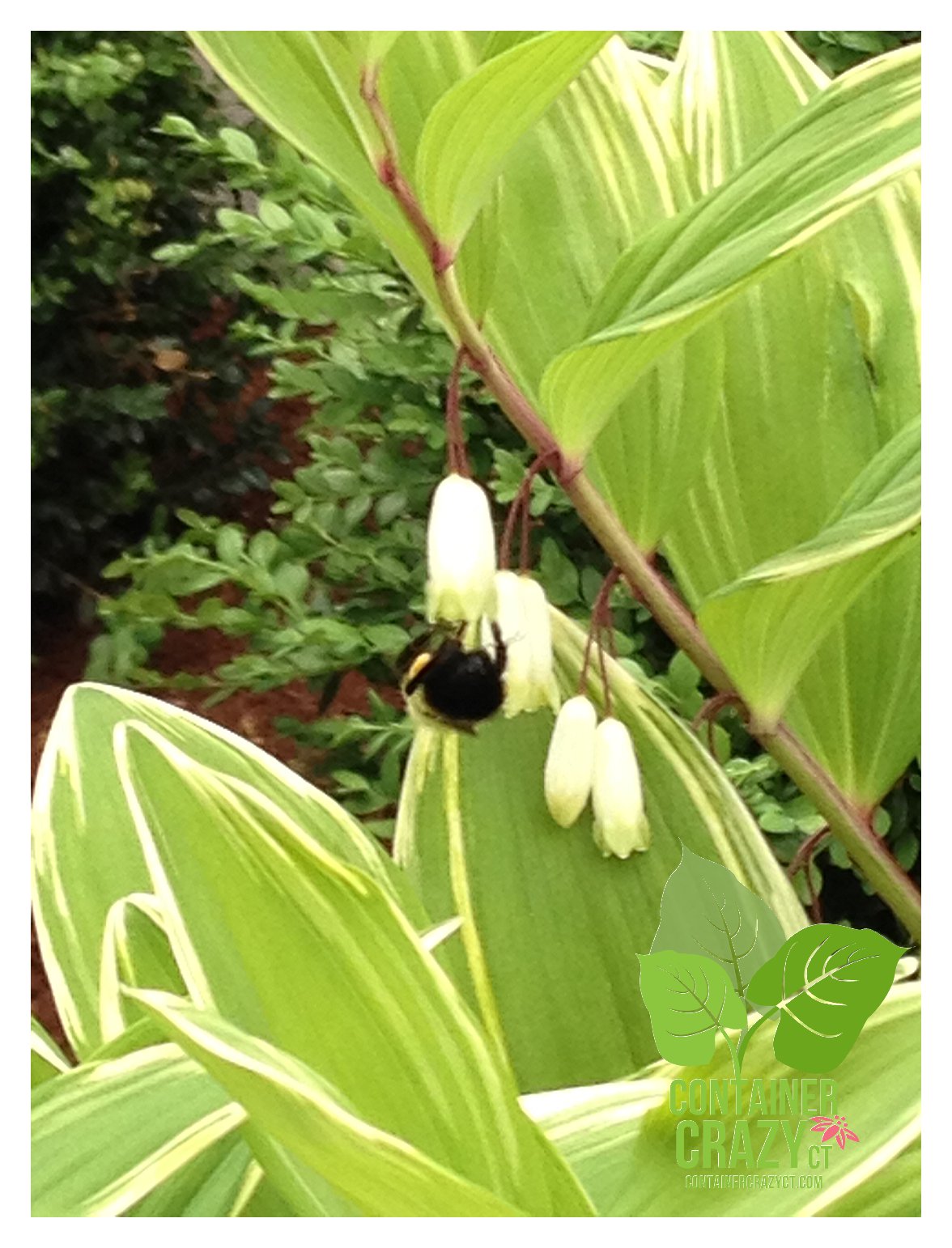
Bee on Polygonatum

I was trying to get a photo of this bee – but it came out a bit blurry.  This is a perennial I get CRS on every spring. I mix up the name sometimes with Polemonium which is similar but not quite.  However, I love my Polygonatums on the north side of my house in a shade area.  Their long and graceful arching stems are eloquent.  I divided up some and moved them to appear in batches in the bed and this year they look really great.  This makes a great woodland plant too and the dangling flowers are serving the bees coming by.  The foliage on this variegated one is very pretty, painted white on the edges.  This perennial prefers good moisture too.

Goofing w Camera_0011

Stone Edging for the Coop

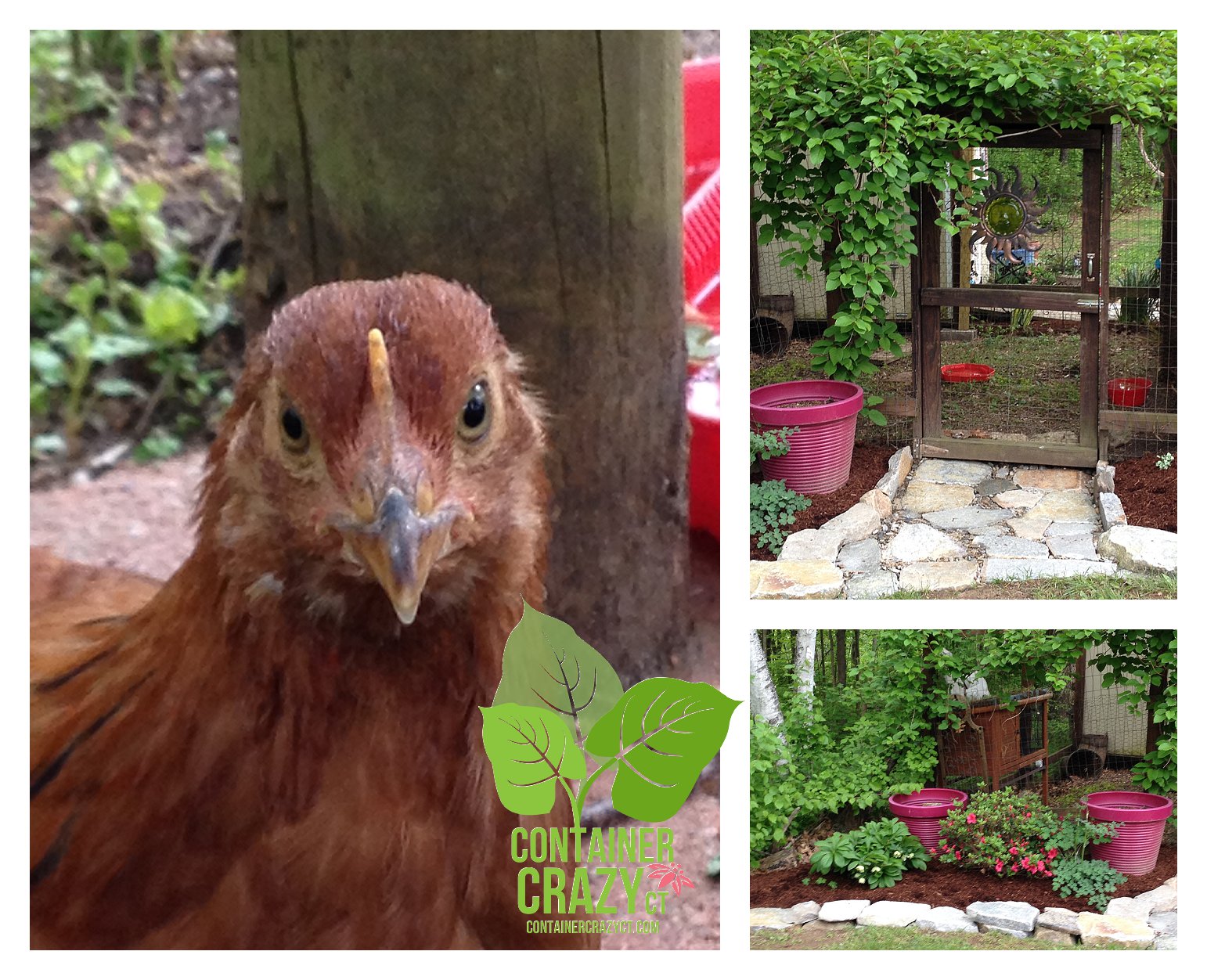
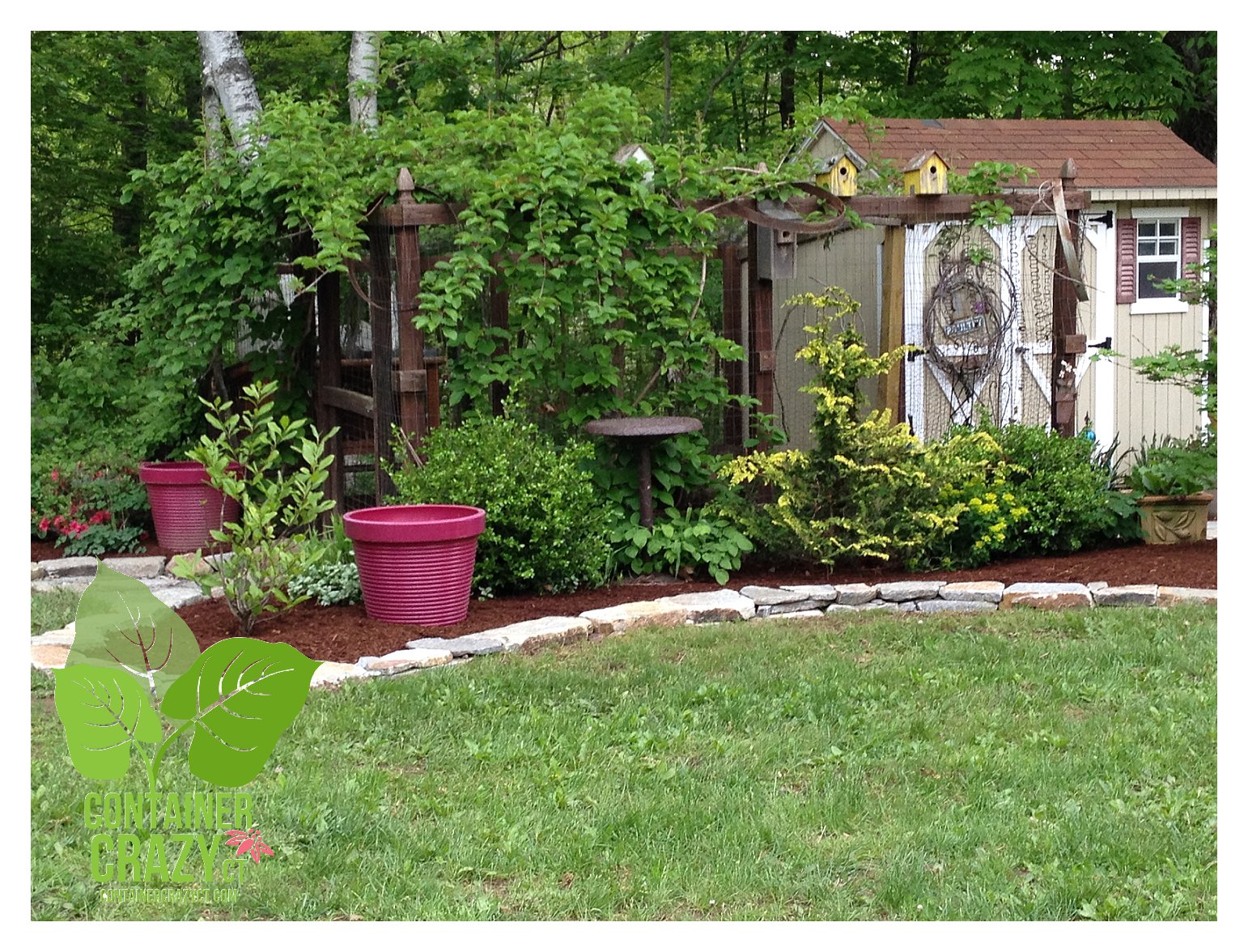
For years, I wanted to edge the area around my chicken coop – and my friendly landscape installer connection, Chris of Outdoor Creations of Ellington, obliged my request to have it done in time for this weekend.  I am thrilled with how it came out.  I like the natural look of this type of stone, and now I can have fun fixing up my plantings and adding perennials and container gardens to this area.  Talk about spoiled chickens!  Not only is their surrounding enhanced, they were fed grubs and worms by Chris as he was working on the building of the edge and mulching the beds.  He said they were fun to watch, and I’m sure they enjoyed his company while he was here.  Sparkles, the recently named chicken, agrees.  She’s the boss of my six Rhode Island Red hens, seen in the photo below.

Goofing w Camera_0017 Goofing w Camera_0015 Goofing w Camera_0014

Kiwi Vine Feeds My Chics

Two kiwi vines, plants several years ago, a male and female plant on each side as required for pollination, are above my pen area of the coop.  One day, Sparkles was jumping up to grab some leaves.  We caught her on our motion censor camera which we move around the house to capture photos of wild life – and predators, as you will see following this photo.  Look at Sparkle’s feet – she jumped right off the ground.  My first priority was to determine if this vine could be poisonous to the chickens, and thankfully, it is not.  They get a feeding of them every day now when I go visit, tearing some leaves off to toss down for them.  And, I think this will be the year we finally get kiwi fruit from these vines. I saw tiny buds on one plant, the female plant.  It takes about five years for them to bloom and produce fruit – so we will see.  The vines require a great deal of pruning to keep in check, it can overtake anything, and grows fast.  We removed branches off a tree above the pen area last year because the vines were twining up to it, so it has to be watched.  Feeding some leaves to the chickens will help, I think.

Kiwi Vine Above Coop Pen

Kiwi Vine Above Coop Pen

Wild Predators Don’t Take Long

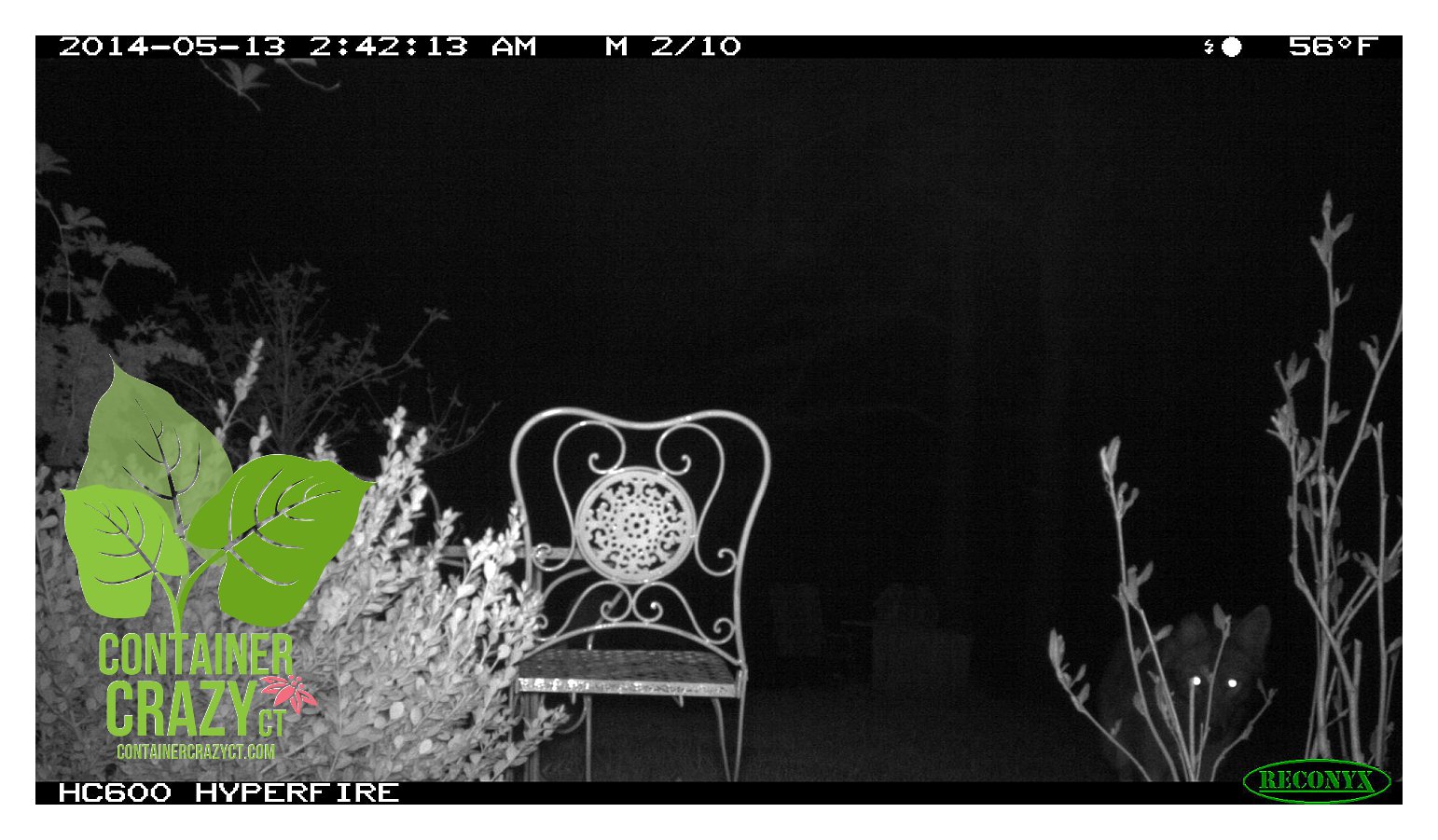
As I have mentioned, we attempted chicken raising here twice before, and gave up for a couple years.  The former chickens were allowed to free range, and got snatched by foxs, hawks – you name it.  But our new ones will not go beyond their protected coop and outdoor pen.  Since we have a motion censor camera, we set it up nearby to see what would lurk to investigate our new chickens.

The first week, we spotted a raccoon and coyote in the photos, and one early morning, I saw a fox running around the coop with something in its mouth.  Thankfully, it wasn’t one of my chicken.  We are sure to close their coop door every evening, and we are keeping a steady watch to make sure their pen is safe.  So far so good.  Kind of creepy to see the coyote checking it out.

Predators, first racoon, then Coyote

Predators, first raccoon, then Coyote

Goofing w Camera_0022 Goofing w Camera_0023

That’s all for goofing around with my camera.  Now, its time to get back to work.

Written by Cathy Testa
http://www.cathytesta.com
ContainerCrazyCT.com
860-977-9473


Goofing Around With My Camera (New Chickens, Perennials Rising, and More)

Leave a comment

On this windy day, I decided to post some general pictures taken as I goofed around with my camera outdoors this weekend.  I got more accomplished than I had planned on which is good news.

We got our new Rhode Island Red chickens moved into our chicken coop finally, I cleaned up some perennials, and even raked up some leaves and moved out some container gardens and pots.

This was all accomplished after I held my first garden talk of the season on ornamental edibles in Broad Brook at the Pride Fitness building.  A small group from South Windsor attended, and they were very enthusiastic. They are thinking of forming a new garden club at their church so we had lots to share about edibles and gardening on Saturday morning during my presentation.

So back to “Goofing Around with My Camera.”  Here are some photos taken as I worked and played outside during the first weekend of May 2014.

Perennials Rising

Perennials Rising

Perennials Rising

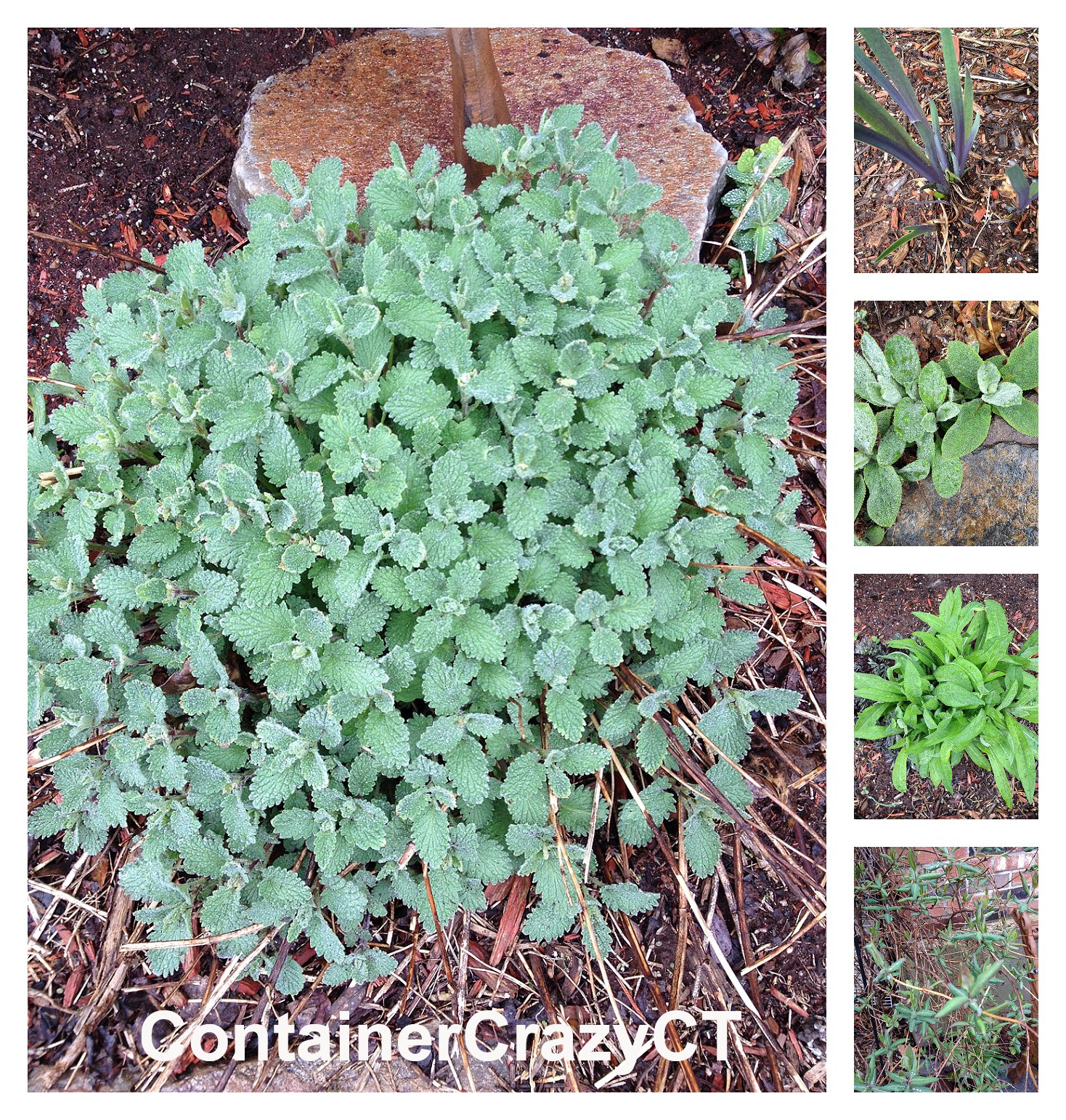
These are photos taken of perennials finally rising up from the soil and showing some initial growth. On the left is Nepeta (catmint), which is such an easy full sun perennial to grow.  The cats love rubbing against it from time to time.  It is super easy to clean up in the spring and can be pruned up or sheared anytime actually if it gets overgrown. Using sharp hand-pruners, I removed the old stems around the edges of this plant.

On the top right of this photo grouping is the leaves of an Iris with purple leaves, and then next a lamb’s ear (Stachys) perennial. Lamb’s ear always starts off slow, showing only a few leaves, but by early summer, it is much fuller and gently spreads near itself. I basically did not need to do anything to clean the remnants of last year’s lamb’s ear; it was looking fine right now and starting to grow.  On the Iris, it did not bloom, and I suspect it is because the soil is too moist there or not enough sun, or it was planted too deep, it will be moved later.

Below the photo of the lamb’s ear perennial was one where I experienced a CRS moment.  I could visualize the flowers in my head, as I looked down on the foliage coming out of the ground, but after months of dormancy for me and the plants, sometimes we have mental blocks.

When I took the photo, I was struggling to remember the name – but here it is Cornflower (Centaurea), also known as Bachelor Button to some gardeners. It grows showy violet-blue flowers in early summer (June-July), and I adore this perennial. Like its neighboring Nepeta and Lamb’s ear, it enjoys full sun conditions and can be kept on the dry side.  Butterflies and hummingbirds like the blooms too.

And on the bottom right of the photos above is a Honeysuckle vine with leaves coming out now.  I put a small garden bench near this area and kept smelling something sweet in the air when I took a break to sit.  I thought, could it be the Honeysuckle?  There are no blooms yet, but I leaned in to take a whiff and I think it was coming from the tips where the buds are beginning to form – amazing!

More Shade Loving Perennials

Ligularia, Peony, Bleeding Heart

Ligularia, Peony, Bleeding Heart

Around the corner, on the north facing side of my house are a couple Ligularia plants (top left photo).  The leaves are just beginning to come out and expand.  This plant is very showy in regards to foliage, which are round, large, and other cultivars have leaves with bronzy-green to plum colors and purple colors.  The blooms rise above in summer (around August) on tall spikes, usually showing off yellow flowers on dark stems.  It is a great shade plant, likes moisture, and is easy care.  Using my hand-pruners I cut away any old stems from last year – easypeasy cleanup.

The Peony is on the bottom left of the above photo.  They are starting to come up now, so I put my big round wire frames around them. I spray painted the wire frames first with green cause they looked a bit rusty.  I should have taken a photo of them – made by my father, they are round and fit around them well, and as soon as the foliage grows, you can’t see the wire frame which supports the blooms typically heavy and sometimes bending down from rainfall.

And of course, a bleeding heart (Dicentra spectablis) is on its way up with little flowers already appearing. Every time I witness this plant I think of the day my husband weed-whacked one down many years ago.  Let’s just say that I got him to stop when I explained accidentally cutting down a plant of mine is like if I went up and accidentally scratched his motorcycle paint.  He got it.

But he explained his fault, indicating it looked like a weed – and you know what, sometimes it can at first but once those flowers drip down heart-style, you can mistake it is a flowering perennial perfect for early spring and into May.  No cleanup was needed but later it will be cut down because it will go dormant earlier than many perennials and turn yellow.

Polygonaturm, Ferns, Thalictrum

Polygonatum, Ferns, Thalictrum

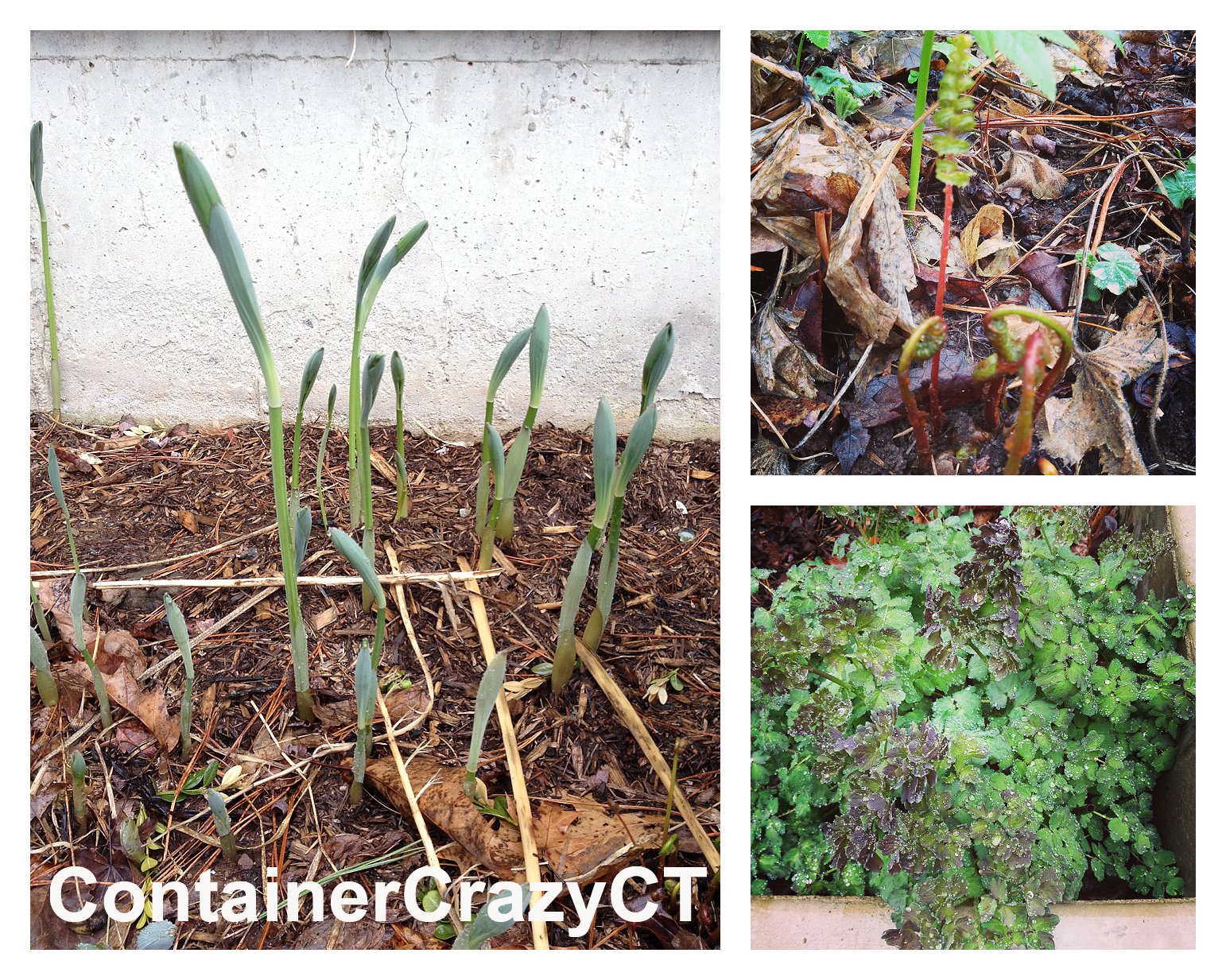
Further down the bed, under a Japanese Maple tree, are my Polygonatums (Solomon’s Seal).  I love the way the stems come out of the ground like graceful little – well, I don’t know what – they just look interesting before they grow more.  The leaves rise along the stems while little white flowers will dangle off the length of the stems, plus the stems will arch at the tops.  It makes a great woodland-like plant for part shade.  It prefers good moisture and rich soil too.  When you buy these at the nursery, sometimes the single plant doesn’t look too impressive at first – but over time, these keep rising up more plants (as seen here) and when you have a nice stand of them, they are pretty impressive.  On the top right is just a picture of some native ferns unfurling. Any nature lover gets why this is striking to look at – and I just grabbed a quick photo of that.

On the bottom right is a plant in my big cement planter around back of the house – can you guess what this is? You might think Columbine (Aquilegia) at first because its leaves are similar, but this plant is called Thalictrum aquilegifolium (Columbine Meadow Rue).  The specific epithet (2nd part of the Latin name) means columbine leaf.

Anyhow, I love this perennial because it shoots out stems that reach 2-3 feet tall!  Right now the leaves are coming out of the soil and they are tinged from the cool temperatures with some burgundy tones.  But in early summer, this plant will show off fluffy flowers in pink colors on very tall thin wiry stalks above the foliage below.  It is another woodland like plant and I love the height of it.

Hellebore Galore

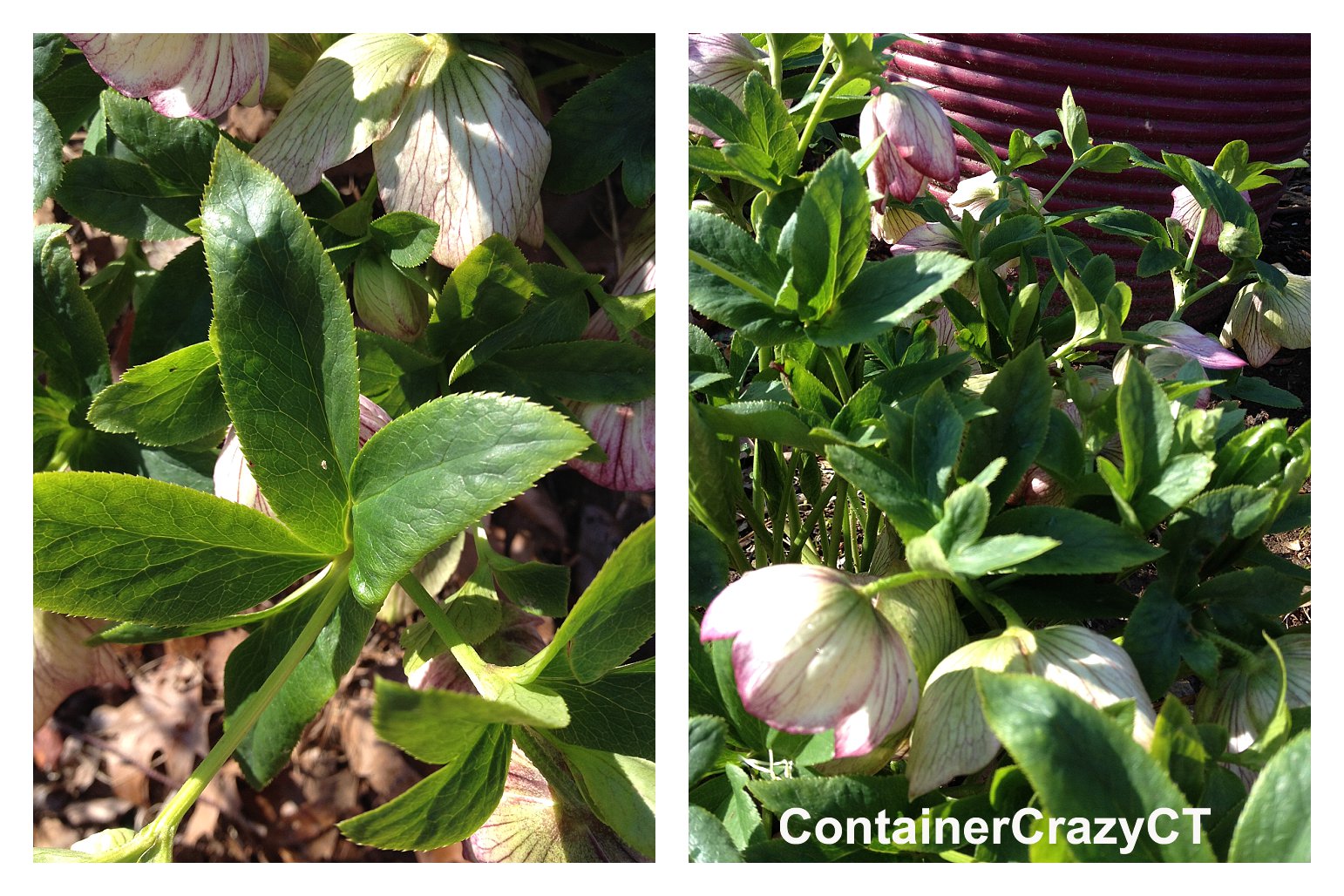
Heleborus perennial

Helleborus perennial

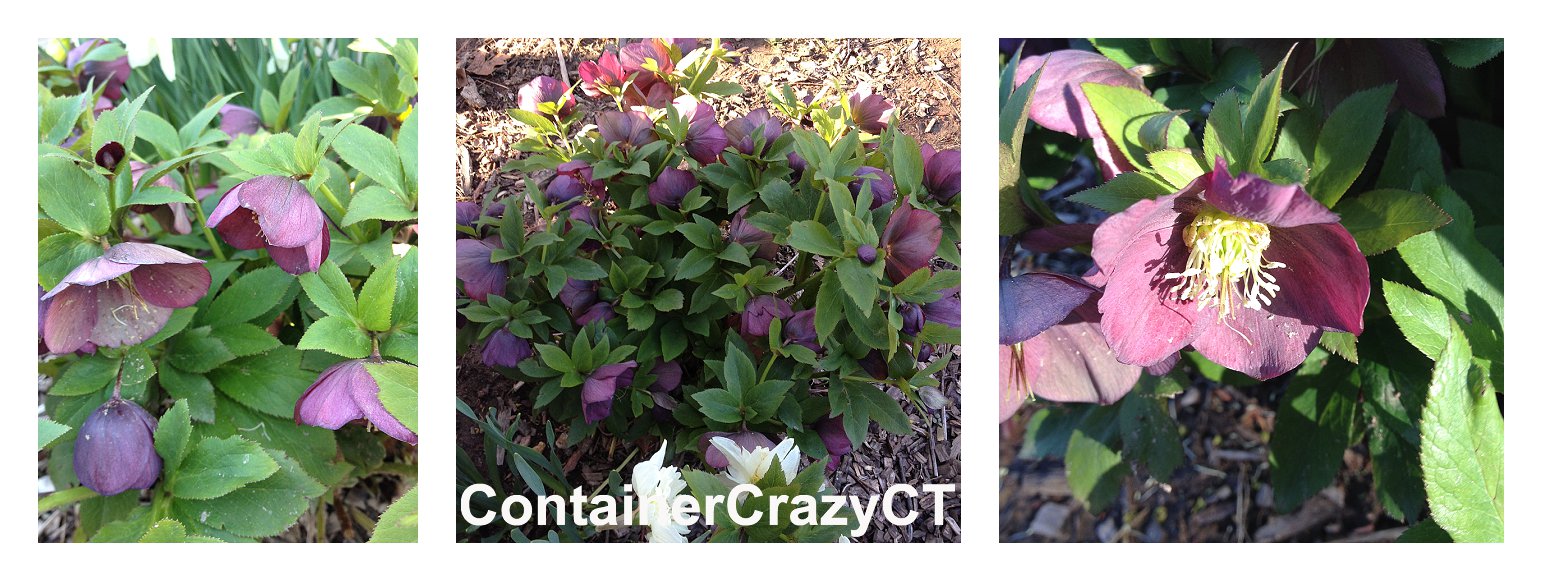
Because I was near the chicken coop this weekend moving in the new chicks and fixing some damaged parts of the pen, etc – I took time to notice my beautiful and full flourishing Heleborus perennials.  I will have to dig through my notes to remember the cultivar name of this one, but it was flushed with blooms – all dark purple toned. Unfortunately, the blooms nod downwards, but if you gently tip one up you can see how the insides look – stunning.

I can’t say enough about Helleborus perennials.  The leaves are tough and long-lasting, semi-evergreen, and easy to snip off any left overs on the plant from last season with hand-pruners.  These plants take partial shade (and can take full sun) in a well-drained soil, but they seem to do better in shade in my yard.  They are known as Lenten Rose and if you don’t have any, I recommend you get them – the deer don’t eat them by the way which is a bonus. (Oh and I will have some for sale at my upcoming Big Container Garden Party on May 24, 2014.)

Helleborus perennial

Helleborus perennial

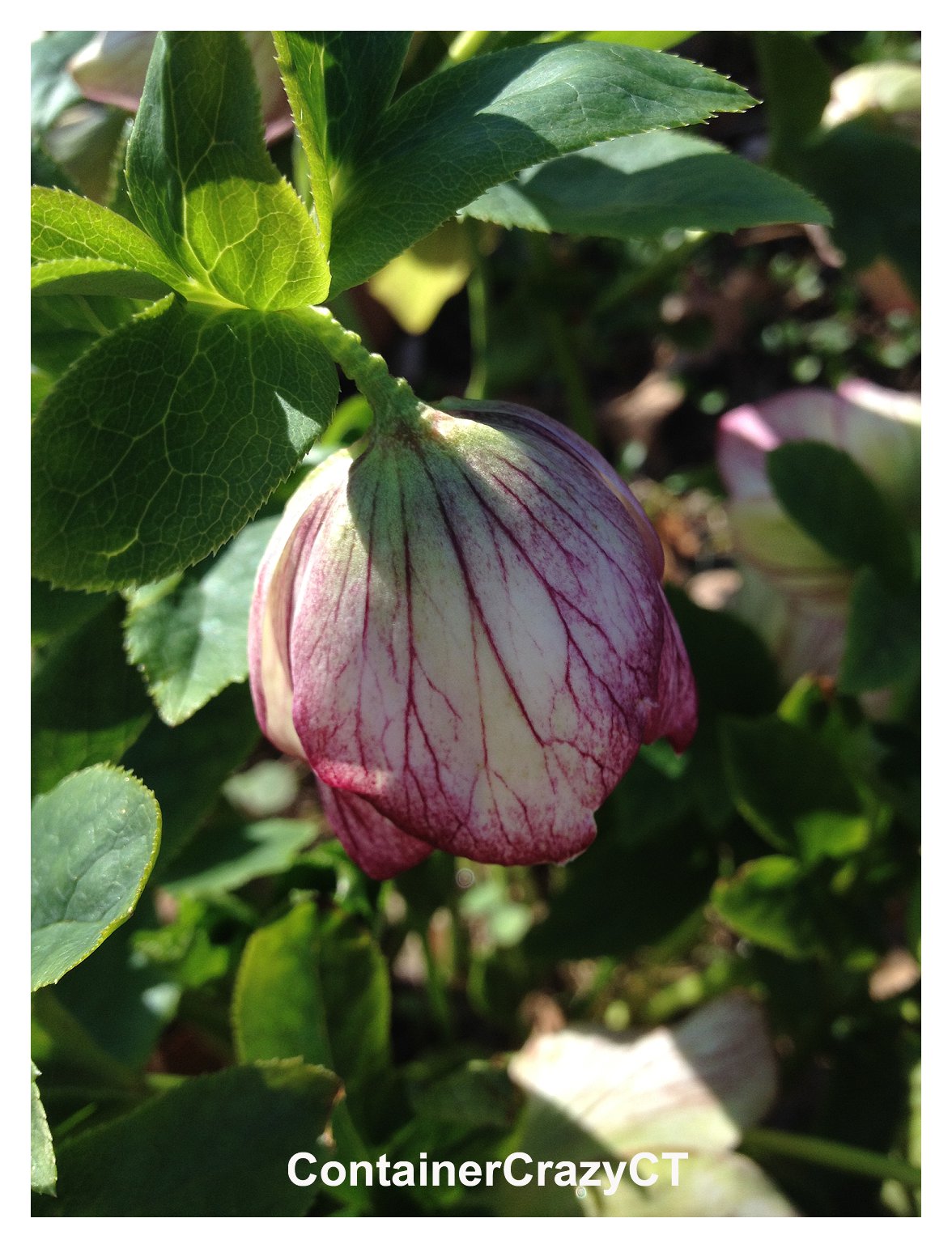
Here is another one I have near the coop.  Fascinating how the veins appear in the leaf petals.  Both of these stands of my Helleborus plantings are doing very well in their locations.  I had chickens in this pen before and the soil is very fertile.  In fact, when I was digging in the bed near these, worms were everywhere – a nice healthy sign of a living soil.  As I found them, I scouped the worms up to give to my new chickens.  They were ecstatic.  They really like the treatment they are getting at their new dwellings, the little Testa ranch.

New Rhode Island Reds Arrive

Newly Arrived RI Reds!

Newly Arrived RI Reds!

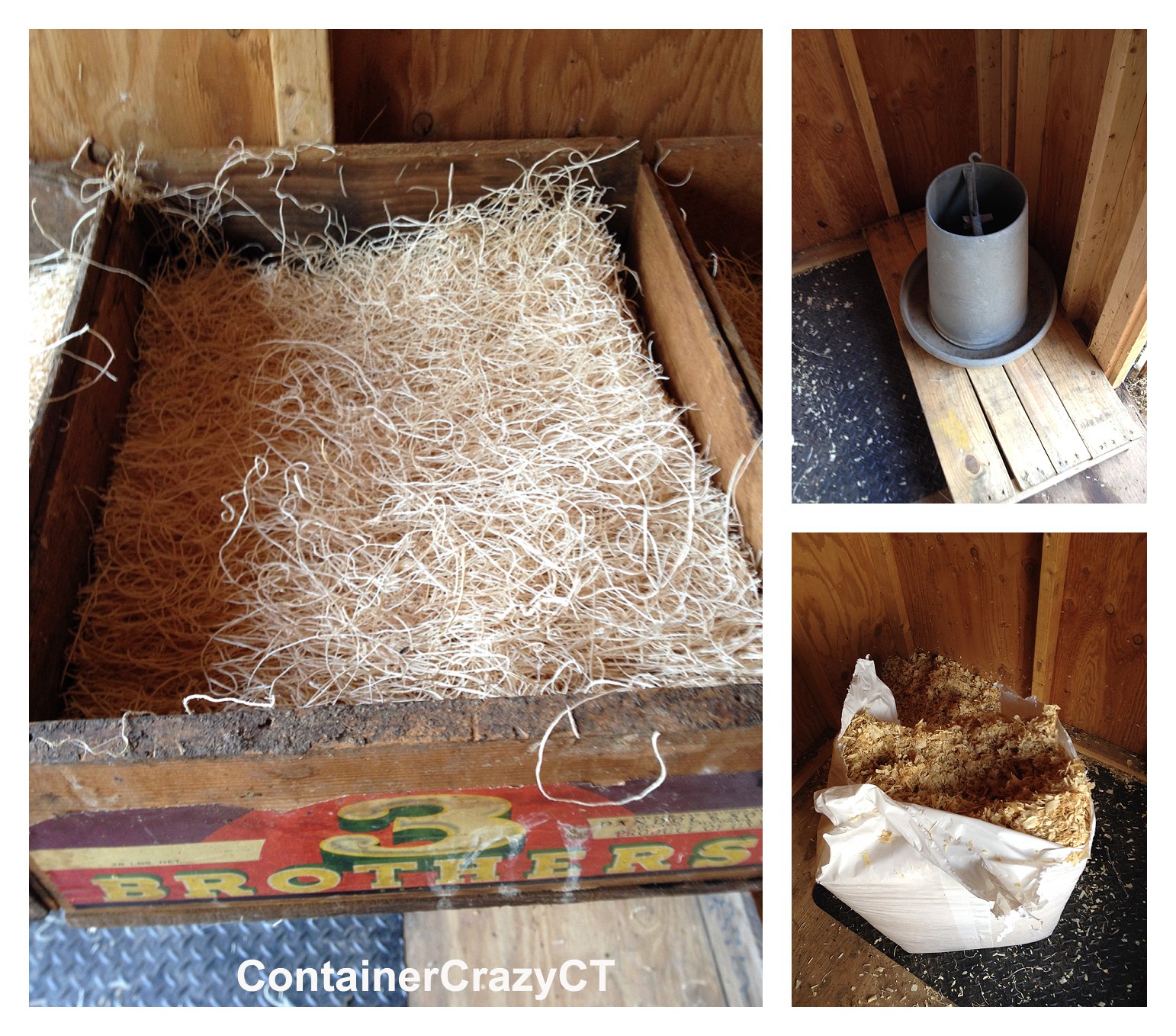
Here they are, we got six Rhode Island Reds.  We added a perch and four of them hopped up there right away, and I also put a box on the floor because they were hiding behind the feeder, so I realized they were a little “chicken” so I got them spots to hide by putting a box in there.

Chicken Coop Accessories

Chicken Coop Accessories

You are going to think my chickens are spoiled because I bought these perfect fit nest box pads to put in their future laying boxes. The boxes are a find of antique shipping crates and we are going to add side walls to the boxes so they have their preferred privacy when they lay eggs, expected by September.  I also got a big bail of pine shaving to put in the bottom of the coop, and have a galvanized antique chicken feeder given to us by a friend.  I put the feeder and water container on a pallet, raised off the ground, so they won’t poop in it as much as if it were level to the floor.

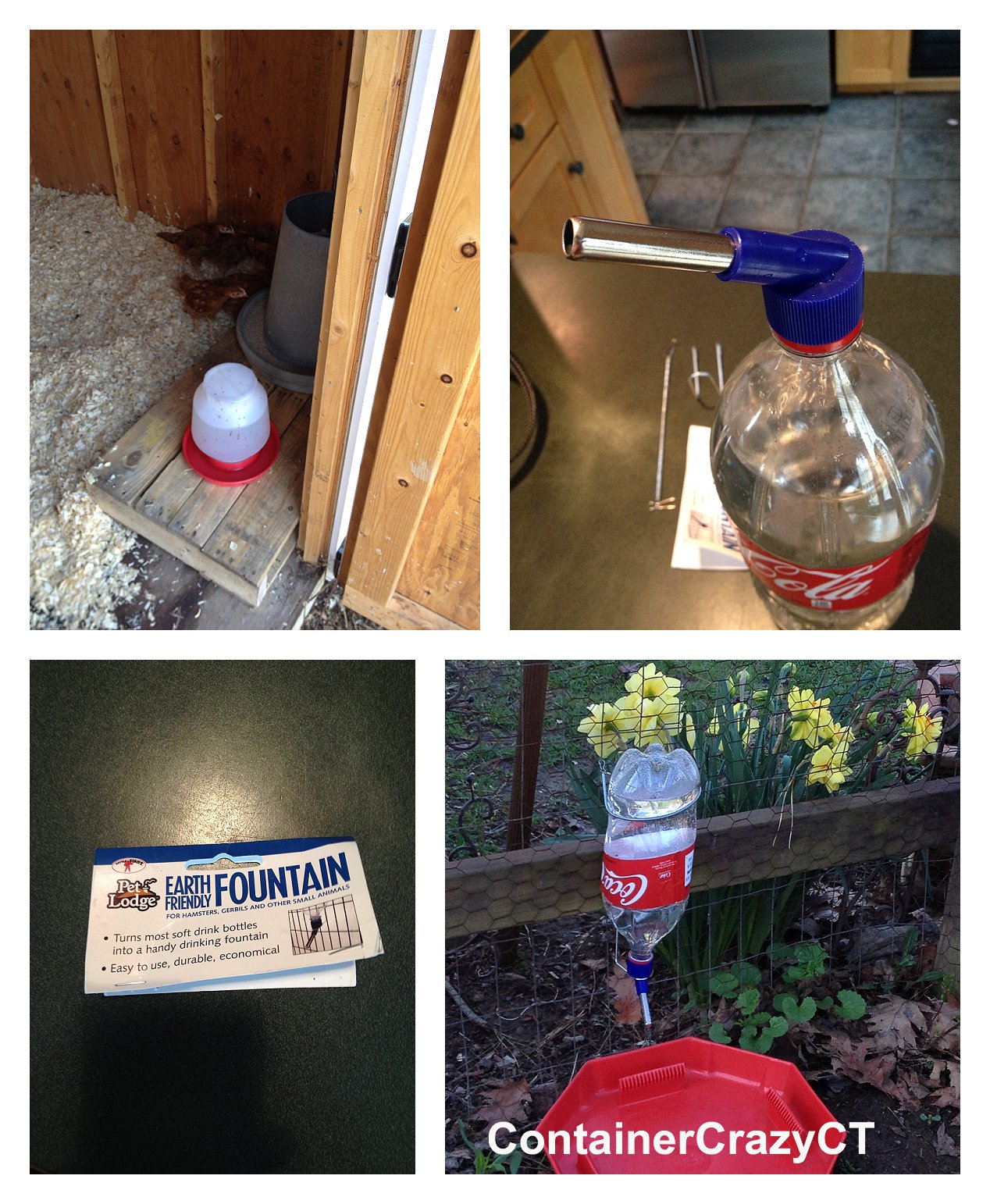
Soda Bottle Converter Kit

Soda Bottle Converter Kit

Soda Bottle Converter

Another nifty thing I ordered was a soda bottle converter kit which easily attaches to a bottle to drip water out for the chickens, but they have to be trained to use it.  How?  I’m not sure, but I set it up in the outdoor pen area.  They are still a bit chicken to walk outside into the pen, but they started poking their heads out to look around.  Both the nesting pads and bottle converter were purchased from My Pet Chicken online.  I also bought a galvanized hanging poultry feeder and waterer, but they were much smaller than I expected.  However will be handy and were hung outside in the pen for later use.

Incubator

Incubator

Incubator of Sorts

My brother, Jimmy, kept the baby chickens in his home-built incubator until they were large enough to move into our chicken coop.  I appreciated this very much because I did not have to setup a heat/warming place for them, and they are fine now to go without heat.  But I had to show his set-up here.  He got two shipping crates, attached them together with a door, and they had a nice warm and cozy home before coming to our house. Oh, I spotted his cat hiding behind the coop – she was probably waiting for a moment to get them, no luck my dear.  LOL.  But I guess raising chickens is in our blood.  My father had them when we were growing up and my sister also has chickens now in an urban setting no less.  She has pretty ones, with feathers on their feet and they are smaller – of course, CRS Again!  I can’t remember what they are called, the breed.  Hmmm, will come back to me.

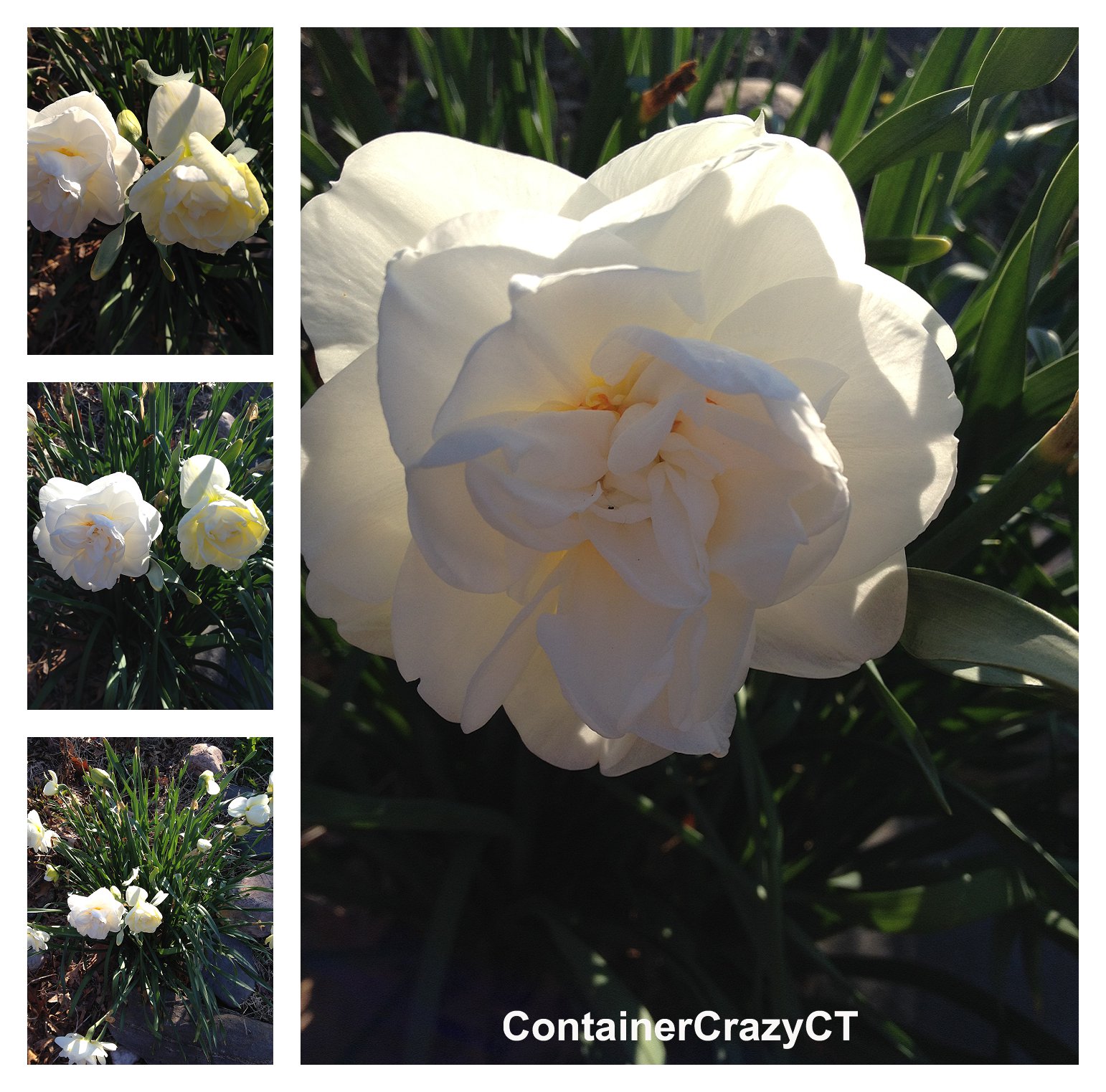
Daffodils

Daffodils

I couldn’t help but admire my daffodils around the coop.  I prefer the type of daffs with multiple flower petals.  Again, CRS, can’t remember the exact names of these types but they are just beautiful.  The healthy organic soil there is really making them bloom a lot this year.  And they don’t get eaten by varmints, unlike tulips.  I will have to remember to add more in the fall to this area.

Spring Plants_0027Another one of my favorite daffodils is this one – name, I’ll let you know when I remember!  But I bought the bulbs at a Connecticut Horticultural Society meeting several years ago and despite the location being clay, this one puts on a show every spring.  The soil is well-drained there however because this location is on a slope, not near my chicken coop.  The blooms smell lovely too!  I let the foliage of my daffodils stay on as long as possible after the flowesr fade so it can build up energy via photosynthesis.

Poking Out Slowly

Poking Out Slowly

First Attempts to Go Outside

The chickens poked out just a little but didn’t stay out – they are still testing the area and are hesitant, and it was windy so they may have been a little chilled.  However, it will be no time before they scratch and dig in the soil there for insects.  In fact, what was so funny was the minute I set them in the coop, they pecked at tiny insects on the walls – amazing – they were literally cleaning house.

My cat, Hunter, followed me to the coop this morning.  I didn’t seem him there, but he let out one of his big MEOWS.  “Get back,” I said – these ladies are your new friends!  I still haven’t named the chickens yet – right now, I refer to them as No 1, No 2, No 3, etc.

There are six of them, so I count them when I open the door to make sure they are all there.  Even though we checked every part of the coop walls, etc., there is this fear of a predator trying to get in to snatch them.  In fact, we plan to setup our outdoor motion sensor camera to see which predator shows up first to investiage.  I am sure they can hear and smell the chickens in the coops already.

Weeping Larch (left photo)

Weeping Larch (left photo)

Weeping Larch Coming Out too

On the left of the photo grouping above is a close up of a Weeping Larch (Larix decidua ‘Pendula’) located by my house entrance. Everyone who sees this tree usually points and comments on it.  It is especially pretty just when the needles start to come out of the branches.  It has a twisted curvy trunk and will grow rather large.  It may outgrow its space but I like it there for now.  I will show more on this plant later.

And on the right of this photo grouping above are more various perennials coming out of the soil now.  I managed to get to most of them to clean up any tattered growth from the previous year, so now they are ready for a mulch refresh.

More of the Helleborus

More of the Helleborus

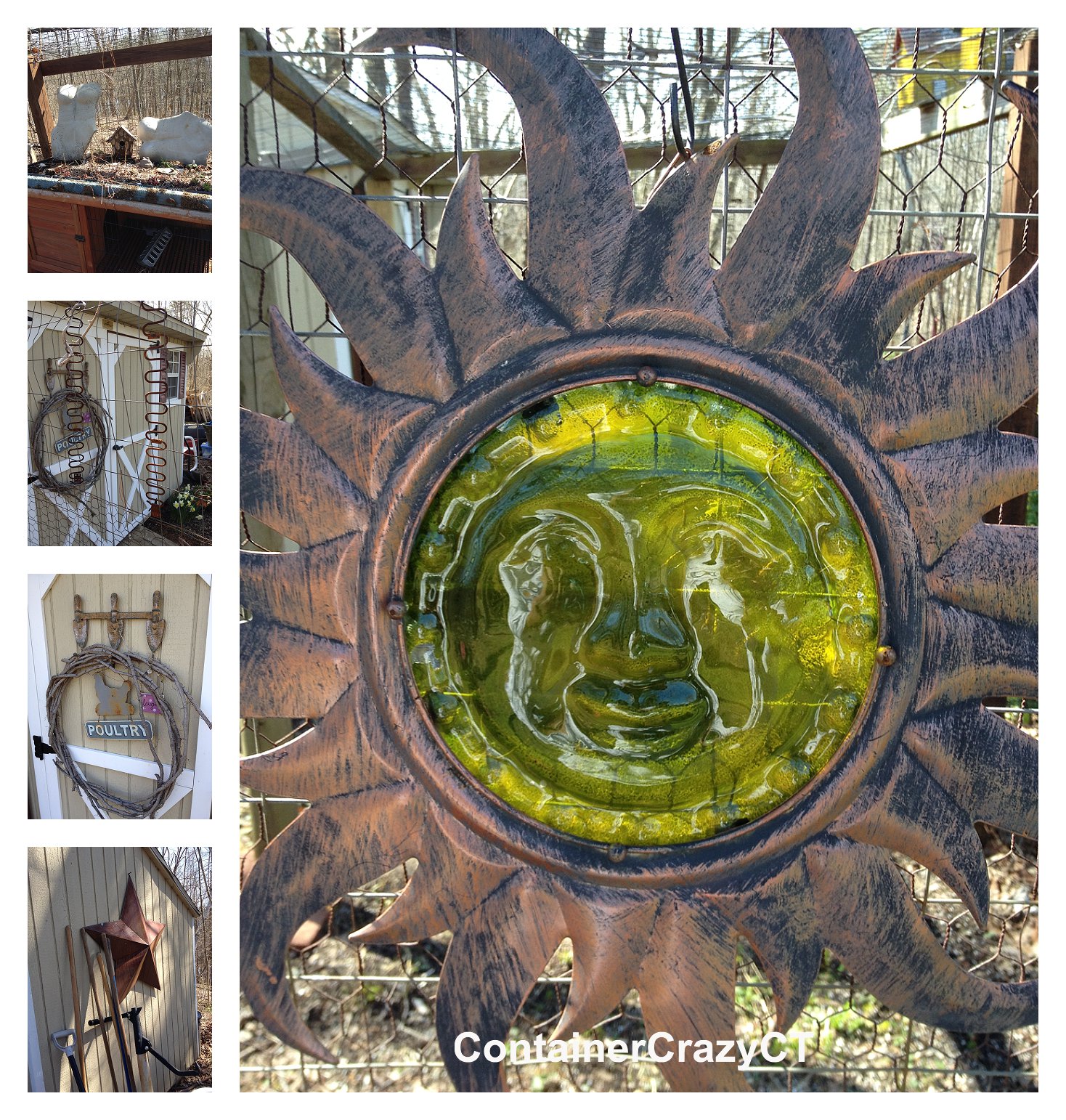
Here is some funky garden type art I put around my pen.  My next step is to edge all the beds with low stone walls, planned this season.  It will look much better then.

Funky Art

Funky Art

More flower photos…

Spring Plants_0018 Spring Plants_0019

Spring Plants_0020

That’s it for now for my informal photo goofing around.  Enjoy your week everyone, and enjoy the rising of your perennials too.  It is time to come out and enjoy spring.

Written by Cathy Testa
http://www.ContainerCrazyCT.com
http://www.cathytesta.com
ContainerCrazyCT@gmail.com


Crocosmia ‘Lucifer’ – It will ‘Rock On’ in Your Container Garden Over and Over Again

10 Comments

Crocosmia ‘Lucifer’ was a plant included in a mixed container garden one summer as I prepared many for sale at a farmers market.  I liked the plant’s sword like foliage, and admired the photos of its exotic vivid red blooms, but this perennial was somewhat new to me.

IMG_8236

Because the container was being offered for sale during Father’s Day weekend, and it contained large and showy plants along with the Crocosmia, the container was given the name of, “The Big Daddy.”  Each plant in the arrangement was described as follows:

******************************************************************************

THE BIG DADDY

Only $145 (w/tax included)

 This “Big Daddy” Planter will give the Dad, Father, or Hubby in your life a show fit for a king!

7 Big Daddy Plants with fertilizer, compost, and water reducer amendment already added.

Red Banana Thriller – In the center – Ensete ‘Maurelii’ red banana will go bananas fast, showing off big and wide leaves with tropical red coloration!  It can reach 6 to even 12 feet tall in one season, wow.  You can’t beat this THRILLER.

CrocosmiaA perennial that will flower in the late summer with VIBRANT wands of scarlet, red, orange, yellow pops of color.  When most annuals tend to fade away from the summer heat, this tall, spiky foliage plant also gives another big thrill to this combo, and can be transplanted into your garden in the fall.

Leonotis – Lion’s Ears, don’t see it?  You will by the end of summer. It will display the most amazing whorls of bright orange flowers, to give a last big blast of show in this container.  This plant is is a sub-shrub from Africa.  Very UNIQUE.

Farfugium japonicum – Leopard Plant.  The glossy leaves dotted with yellow and gold are soon to expand to 6 inches across.  This plant adds a FASCINATING filler to your thrillers.  Large, daisy like flowers bloom in early summer.

Rudbeckia ‘Prairie Sun’ – Blooming now thru the end of September, this black eye Susan with a green eye is the NON-STOP show in your Big Daddy Container.  Snip off a couple for the vases inside and out too.

Gerber Daisy – A spot of more yellow to complement the design of bright intense colors, and will shoot up new SHOWY flowers continuously.  Look how the center echo other colors.

Cathy T

*********************************************************************************

It turned out that no one bought the amazing “Big Daddy” container garden filled with large perennials, annuals, and tropical plants, even though many visitors came by to see it. There were some tentative buyers, but none the less, it remained unsold by the end of the market’s day.

Crocosmia_0008

EXOTIC VIVID RED FUNNEL SHAPED FLOWERS

During Crocosmia’s bloom period in the summer, the individual funnel shaped flower buds are held on each side of an arching flowering stem, held up like jewels above the spiky foliage.  The buds open up sequentially, and in my opinion, the closed buds are just as pretty as the open ones.

The show it put on for two seasons, with the expectation it will repeat its rock-star like performance again this summer, has stayed etched in my mind.  Not only will the plant look good from the beginning of spring when the foliage arrives, but it will start to display a fireworks show of red brilliant buds and blooms starting in late June or early July.  And the show continues into early September.

Crocosmia_0002

ATTRACTS HUMMINGBIRDS AND OTHER POLLINATORS

A friend referred to Crocosmia as a hummingbird plant, because she feels the buds resemble hummingbirds, plus the opened blooms attract them regularly. I totally agree on both points. Hummingbirds visited it often during its blooming period, and bees dove into the funnel shaped flowers regularly on their nectar seeking journeys.

The bright red flower color of this exotic looking perennial does not go dull either, as with some plants’ blooms. Against its dark-green sword like tall and erect foliage, which is also a bold texture in the mixed planting of the container, the red flower coloring is intensified.

See Below for Photo Attribution

See Below for Photo Attribution

Photo by C. Testa

Photo by C. Testa

ECHOING THE COLORS

Another aspect I really enjoy is how the colors within the Crocosmia were echoed here and there by the adjoining red banana plant’s foliage, and even a bit of yellow in the buds or center of blooms, was echoed by the bright yellow daisy blooms of the Rubeckia perennial also in the container garden arrangement.

Photo by C. Testa

Photo by C. Testa

The red banana plant (Ensete), the key thriller in the center, reached about seven to nine feet tall by the end of summer.  And the Rudbeckia was about three to four feet, with the Crocosmia blooms hovering over its foliage at the same approximate height as the Rudbeckia.  They were in sync and created a nice balance.

The yellow blooms colors of the perennial Rudbeckia complemented the whole arrangement as well.  It was another warm and bright contrasting color in the container garden. These warm colors can be seen from afar, or up close if you are like me examining plants as they bloom open, which is something you will want to do because the Crocosmia blooms are alluring, attracting pollinators and admirers.

STORING OVER THE WINTER AS A CONTAINER GARDEN

After a full summer season of enjoying all of the plants in the Big Daddy, the container garden was moved into the garage for protection. I removed the growing structures of the tropical plants, such as the root base of the red banana plant, but the Crocosmia perennial remained in the pot with the soil as it was put to rest in a shelter for the winter.

The following spring when things began to warm, the growth of Crocosmia started to pop out of the container garden’s soil. The Big Daddy was rolled outside with my trusty hand-trucked to a new location by a bench in a small garden space by my driveway.

The blooms were even more showy this past year as this perennial grew into a larger clump. Eventually it will need to be dug out to be divided (see video below for a demonstration of the process) or the cormels (small corms growing near the side of a large corm) can be removed to be stored over the winter, similar to the process for Canna rhizomes and Colocasia (elephant ear) bulbs.

Crocosmia_0001


Crocosmia_0005

IN THE GARDEN

Crocosmia is known to not always return in the garden if not well-protected with a thick layer of mulch or leaves during the winter (and if there was no snow cover to offer insulation), but in a container garden that risk of non-repeat performances is minimized, if not eliminated.  It is not a picky perennial but it can be short-lived.

IN A CONTAINER

All you have to do is move the container with the plant into a garage, shed, or even your basement for the winter and then roll it back out in early spring – and Crocosmia is sure to return – as it did for me last summer.  It will ‘rock on’ for a long time in a container garden or patio pot for many years to come.

Crocosmia_0004

DIVIDING THE CLUMP AND/OR CORMELS

And one more note, the plant grows in a clump and from corms.  The clump may need to be divided after 3 or 4 years if it outgrows your container or pot.  Or you can divide the actual cormels as they reproduce below the soil overtime, providing more plants for you.  For a video on how-to do this, see below.

Written by Cathy Testa

Other Information:

  • Native to South Africa
  • Prefers moist, rich soil, full sun or light shade
  • Tolerates sand and heavy clay
  • Makes a long-lasting cut flower
  • Divide clumps every couple years (2-3 years) as needed or separate cormels
  • Foliage lastS from spring until fall
  • Flowers last mid-summer to early September
  • 2 to 4 ft. Height; 1 to 2 ft. Width for ‘Lucifer’ cultivar
  • Not bothered by serious pests
  • Zones 5-7 (Zones 1-4 store like Canna)
  • Other cultivar colors: Fiery yellow‚ orange‚ red and tan
  • Pronounce something like this: Crow-Cause-Mia (Crocosmia)

Useful Links:

http://www.missouribotanicalgarden.org/PlantFinder/PlantFinderDetails.aspx?kempercode=b461 (Missouri Botanical Garden, Rubeckia hirta ‘Prairie Sun’)

How to Videos:

For an informational video about varieties, how to plant them in the garden, autumn care, plant partners to use with it, and how to propagate Crocosmia, see this video by Trecanna.

To see how to separate the small cormels, and for tips on how to plant in a garden bed, see Yolanda Vanveen of HowToGardenVideos.com:


Photo Attributions:

Photo of Hummingbird flying away from Crocosmia:

Brocken Inaglory [GFDL (http://www.gnu.org/copyleft/fdl.html) or CC-BY-SA-3.0-2.5-2.0-1.0 (http://creativecommons.org/licenses/by-sa/3.0)%5D, via Wikimedia Commons

UPCOMING CLASS:

Don’t forget to check out Cathy T’s Container Gardening Class on May 24, 2014 in Broad Brook, CT.  See also Cathy T’s Garden Talks.
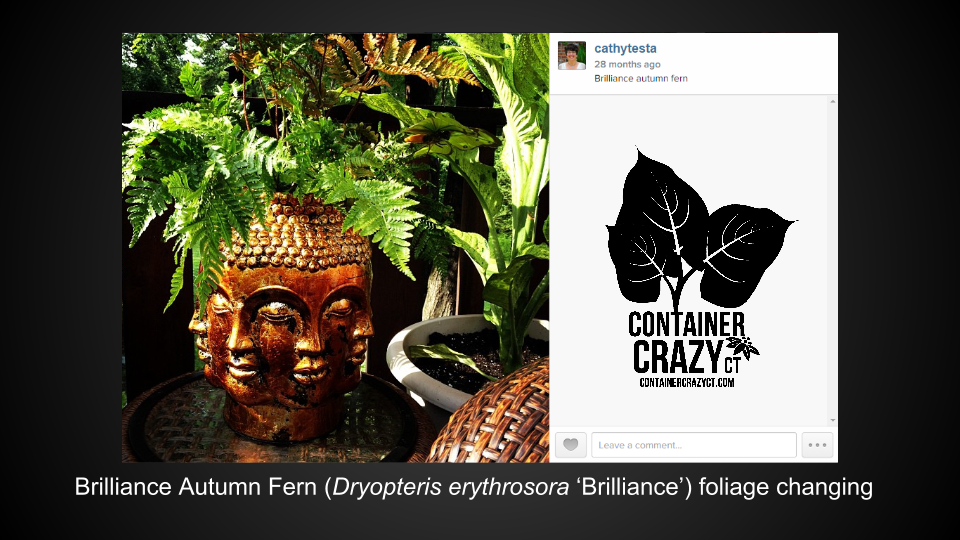
Please share or join this blog by entering your email on the sidebar, you will get updates via email and special offers of upcoming classes as a blog follower!

Happy Saturday Everyone…

Photo by C. Testa (Rudbeckia blooms)
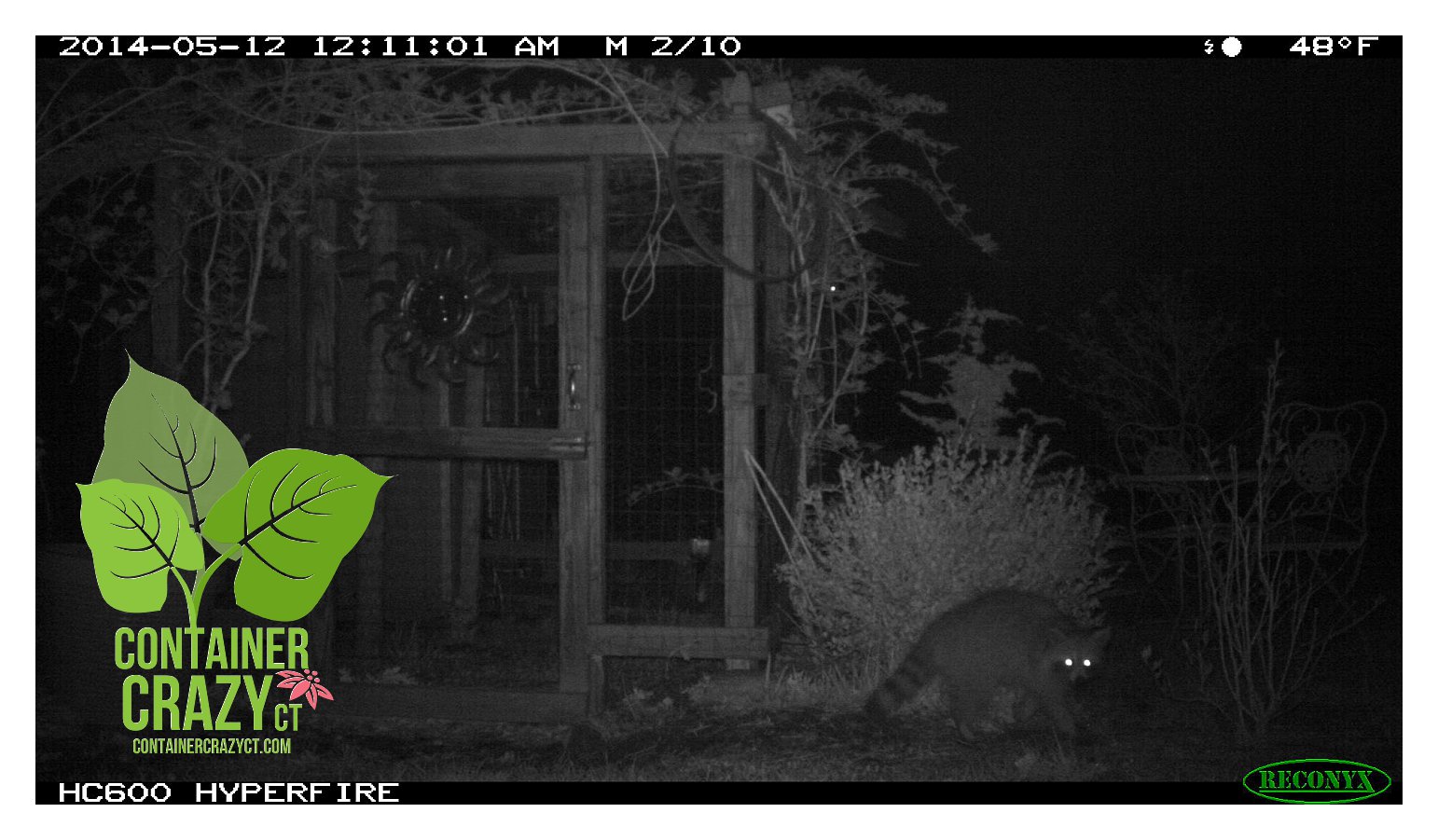
Photo by C. Testa (Rudbeckia blooms)

Black-Eyed Susan ‘Prairie Sun’
Rudbeckia hirta (perennial)
Sun to partial sun
Midsummer to early fall blooms
Well-drained soil moisture
8-36″ in height
Zone 4-9
Daisy-like flowers bloom yellow.
2003 All-American Selections Winner
Attract butterflies
Excellent cutting flower