Fall is Here; Overwinter Plants Soon

Leave a comment

Wow! It’s been a very long time since I’ve written a plant related blog post. Times have changed for me since entering the world of early retirement. It is difficult to have as many plants as I have had in the past because of the care involved, and my goals have changed. To travel means needing care at my home for plants while I’m away, and this is not always possible, so I cut back on having lots and lots of plants. And I also tried to focus on drought tolerant plants, so they won’t need as much watering when I’m away on travel.

I didn’t plant as much either to reduce care needs. But I still have the very serious addiction of needing plants on my deck at home. And to save money, another retirement requirement, I want to still overwinter plants as best as possible to reuse them next year in the summer again.

I have written many times how I’ve stored my red banana plant (Ensete) and Canna Lily rhizomes, and elephant ear tubers (both Alocasias and Colocasias) but it bears repeating my basic steps to remind those who ask this time of year.

Frost Expected Soon

A frost is expected later this week on Thursday, 10/10/24, this year. Tropical plants may be touched by frost if you are storing the underground parts (tubers, rhizomes, corms, etc.), but if you want to store the plant in its pot, it is best to move it before frost, so the foliage doesn’t get damaged, stressed, or destroyed from the chills. Move them in tomorrow or the next day, before the frost hits.

Agaves Disassembled

I also move in Agaves as best as possible into my home, but space is limited. I no longer heat my greenhouse (again to save money for retirement fun), so that option is out. In the past, it was no problem to store my Agaves in my low-temp greenhouse over the winter, so they just barely hung on. And then return them outdoors the next summer, but now I have to move them inside the home.

A few of my agaves got very crowded in their pots because of the side shoot babies which had been forming, so my tactic for taking care of those was to take the agave out of its pot, remove all the babies by carefully tugging them away, trying to keep roots if possible, and then placing the babies in mason jars filled with water to sit for a while. This will encourage new roots. Then for the momma agave, I pruned some roots and remove soil quite a bit to fit it into a smaller pot and then move them inside the home in a space I have by my indoor slider. Done!

The baby agave plants may look a little tattered or uneven but give it time. Soon these will have fresh roots, I’ll replant them into very small appropriately sized pots and let them grow. The shape will be normal over time, and they can grow as big as my big agaves have. This particular agave is Kissho Kan. These plants inside the home of the winter are kept on the dry side, barely watering, and in some sun by either my bedroom or kitchen slider doors. They are easy to overwinter if you have the space.

Agaves in mason jars with water above photo

Alocasia Tubers

I still have to work on my Ensete and other big pot on my deck, but I managed to take apart one of the alocasias in a smaller pot. I cut off all the foliage first, then dig out the base with roots if possible, and some will have the brown papery covering on the tuber area whereas the smaller sides shoots often do not, either way, I store the alocasia tubers in my basement in boxes with just paper wrapped around them or as a bed (like crunched up newspapers). They can go a bit on the dry side and I make sure to have some slits or air holes in the boxes used to store them. This works fine in an unheated basement that does not go below freezing. Colocasias (elephant ears) are stored a bit more on the moist side by using peat as a bed material in the box. Before moving them into boxes (either plastic or just your basic cardboard boxes), I leave the tubers to sit in the sun for a week or days for a while. I don’t put them in immediately. I may even leave them to dry some on a table in my basement if it becomes too wet outdoors due to rain etc.

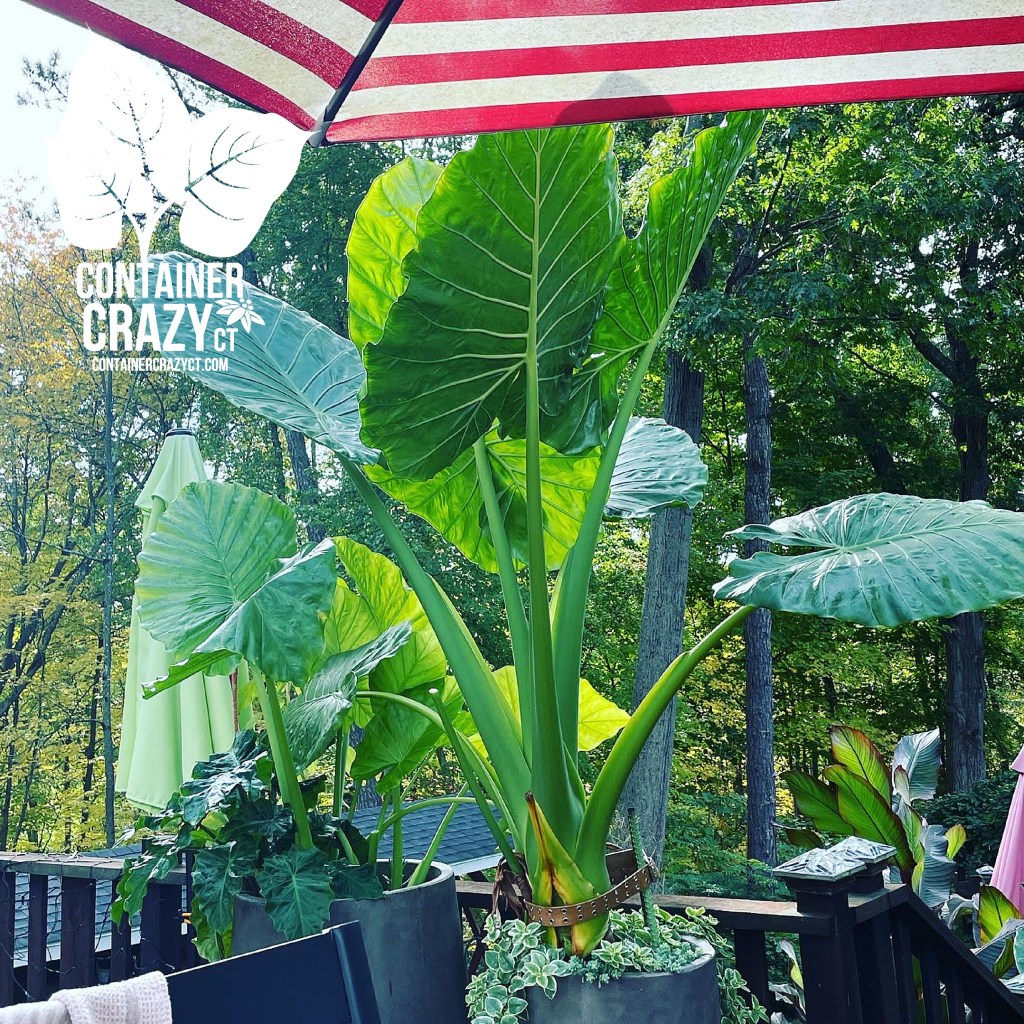
These plants (the alocasias) can grow very very large, and the tuber gets bigger and bigger each year. I still have quite a few of those to do. The next two days will be sunny so that helps. The alocasia plants have the elephant ears where the tips point upwards to the sky. Regular elephant ears (Colocasia) point downwards. I didn’t do any of the regular ones this season. I’m kind of hooked on the alocasias.
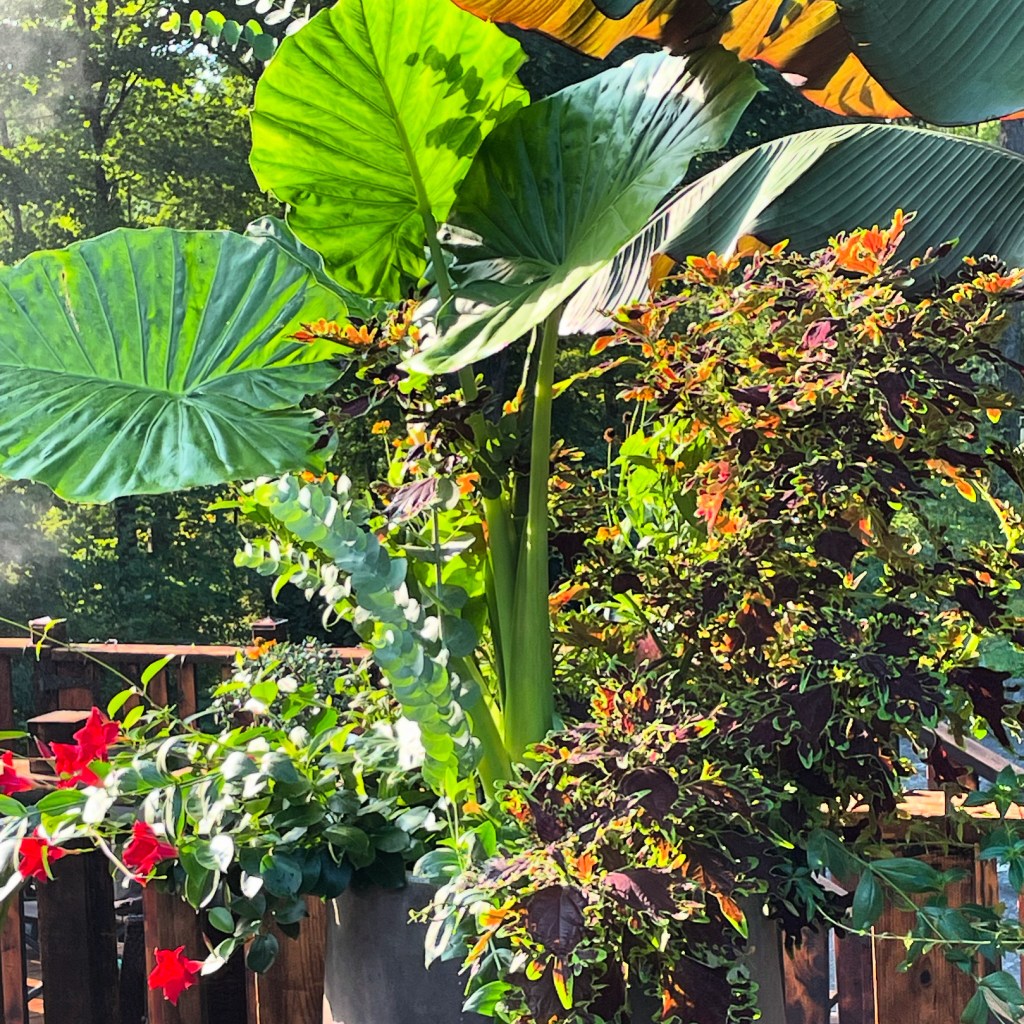
This planter above is my next project. I have to say the alocasia is paired with the most beautiful Coleus Limewire. It is so huge right now; it will be sad to cut it down! It has done wonderfully has a filler plant with the tall alocasia. The burgundy foliage edged with lime green was just stunning when hit by the sun, and the plant was tiny when started, now it is huge! You can also see there is a eucalyptus plant stuck in there, first year I’ve tried one. It is super tall right now and I’ll probably give the plant to my niece. She likes the smell of those plants, but I find the smell disagreeable. However, while it is living in the pot, I haven’t smelled that scent, guess it is when it is cut down.

I took this photo this weekend so I could have a reminder of how large this Ensete (red banana plant) grew this season, which is only year 2 of it. I stored it last year, and it shot up a lot this year with growth, and I have to remind myself to plant it in the larger planter next year, because it fell over twice during windy storms here – thankfully the pot/planter did not crack! I was trying to encourage my black cat to pose with me, she wasn’t having it – she wanted to walk around the deck. Her name is Mini and she is our treasure pet! We just love her. She never bothers my plants, it is like she knows, they are important to me, just like she is.

Anyhow, tomorrow I will start to take these apart and store them and will show the steps but here’s some links from prior posts about the processes I have followed with success.

Please note: Years ago, I would put moist peat with my Alocasia tubers, but no longer. I use paper for those, and it works better. That is for the Alocasias specifically. (For Canna Lily rhizomes, I use peat, and for Colocasia regular elephant ears, I use peat).

Hope this is helpful.

Enjoy your day!

Cathy Testa
Broad Brook/East Windsor, CT
Date of this post: 10/7/2024
Plant Take Downs – Alocasia and Ensete

1 Comment

Yesterday I started the process of taking down my tropical Alocasia and Ensete plants from my container gardens and patio planters at home. It was a nice sunny day, and it is much more pleasant to work on them in the fall when the weather is not cold or too wet. These tropical plants must be removed and stored over the winter because they do not tolerate our cold winters here in Connecticut in pots and planters.

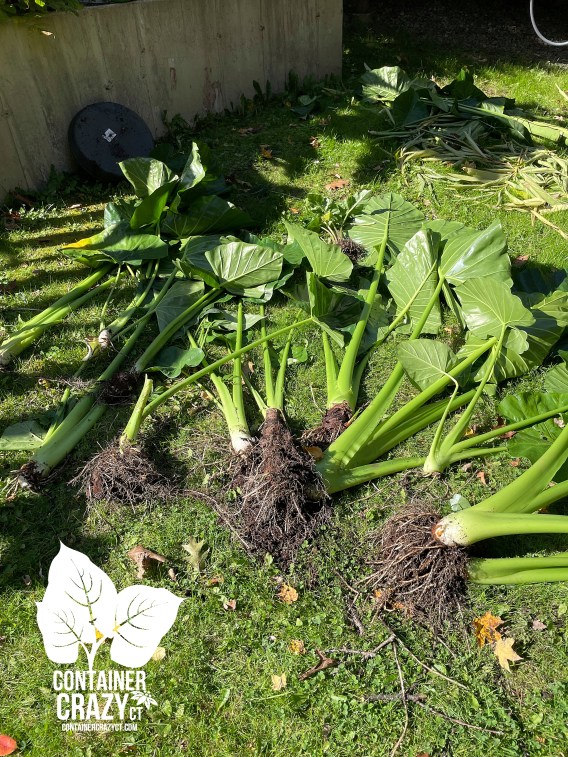
Here’s a photo of the plants I took out of the planters.

October 17, 2023 – Base of Alocasia plants (Upright Elephants Ears) and One Ensete (red banana plant)

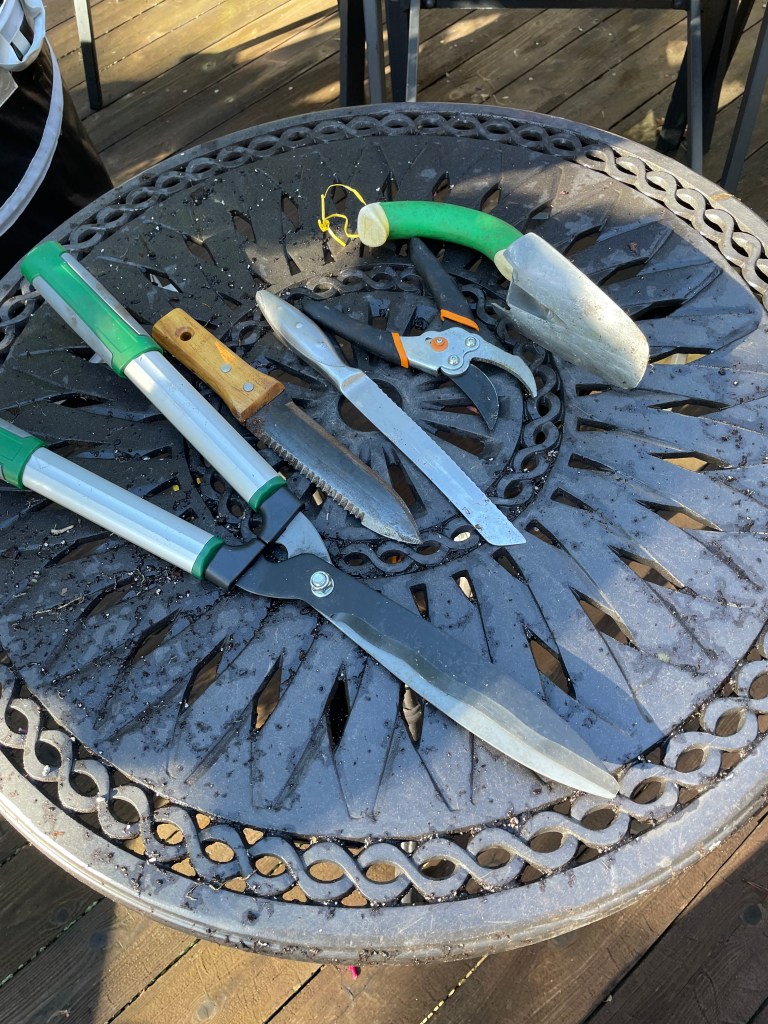
And here are my tools:

Tools Typically Used

Garden Sheers, Hori Hori Garden Knife, Kitchen Serrated Bread Knife, Pruners, Trowel, and Small Shovel.

Cutting off the foliage and stems

Cutting back the foliage is the first step and is relatively easy to do. Using the garden sheers or the kitchen serrated knife works perfect. I recorded several videos of me doing this and posted them on my Instagram page as well as my Facebook pages under Container Crazy CT if you wish to see how I used the tools to cut all the foliage back. Here are the links:

https://www.instagram.com/containercrazyct/

https://www.facebook.com/containercrazyct

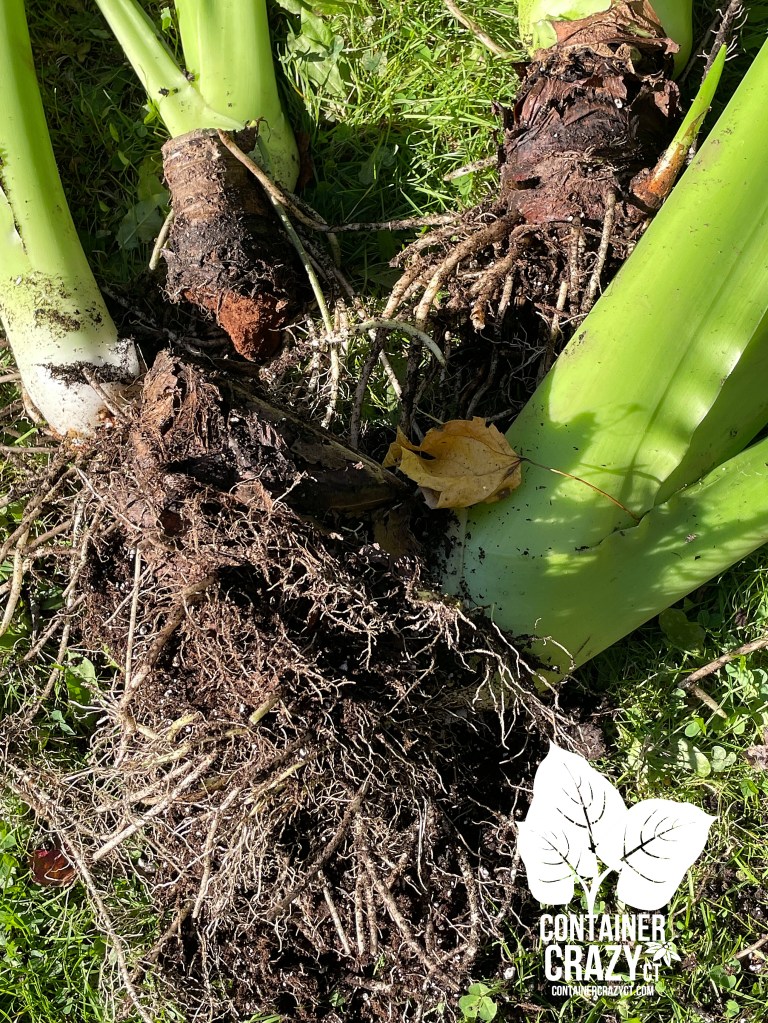
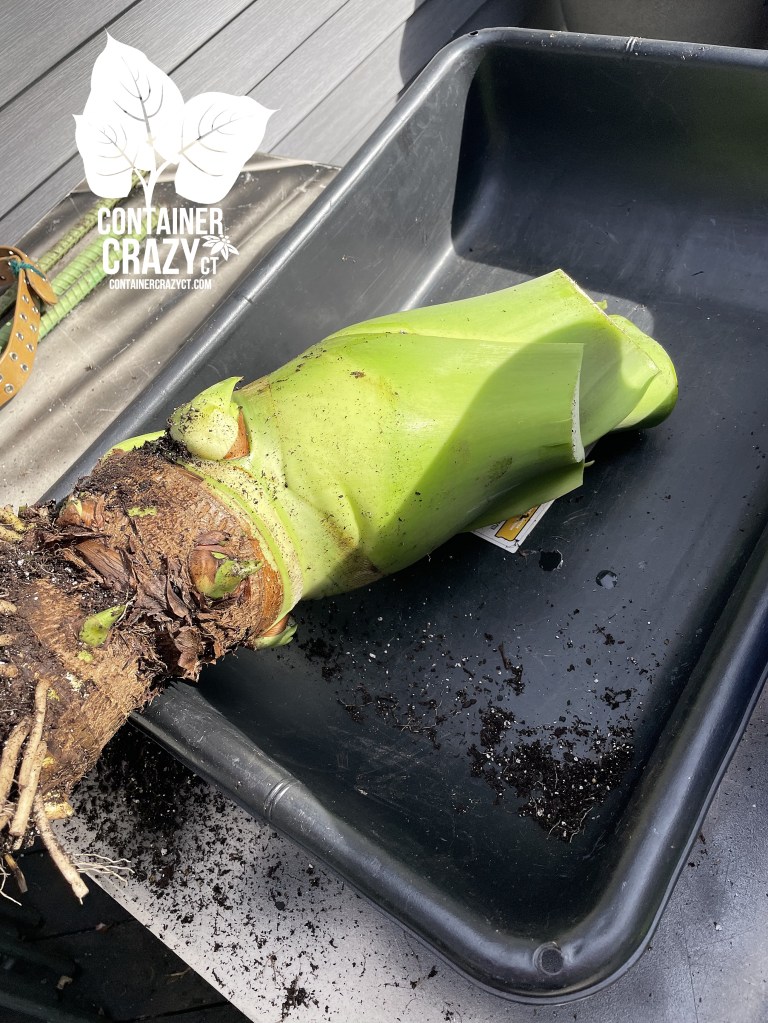
For the Alocasia (upright type), I cut off all the leaves with stem (petioles) attached about 6 to 9 inches from the base of the plant. After getting all the foliage off and tossing the items into the compost, the next step is to dig out the base of the plant. This is the area where the corm is at the base (often covered with furry looking or papery material and has the roots attached at the bottom), and up to where the petioles grow from and up to the green part of the plant. Sometimes you will see little round suckers forming at the bottom of the base. For the purposes of this post, I’ll refer to the whole thing as the “base of the plant.”

Base of Alocasia’s above
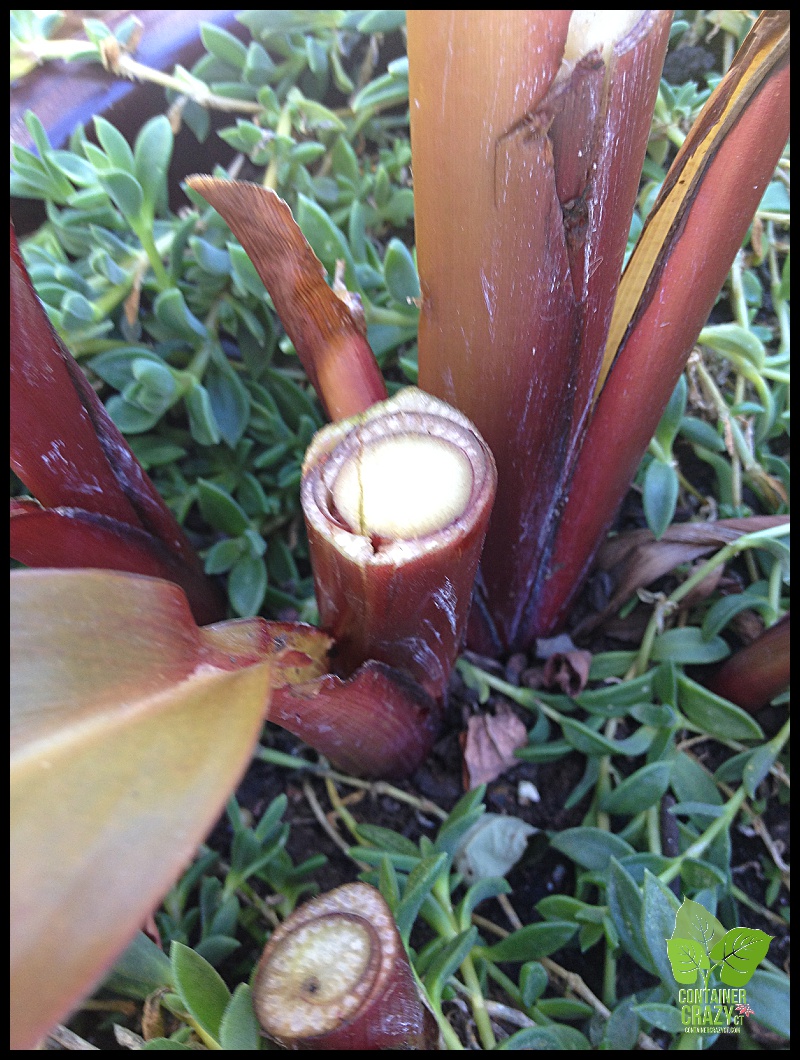
Base of Ensete (red banana plant) photo above

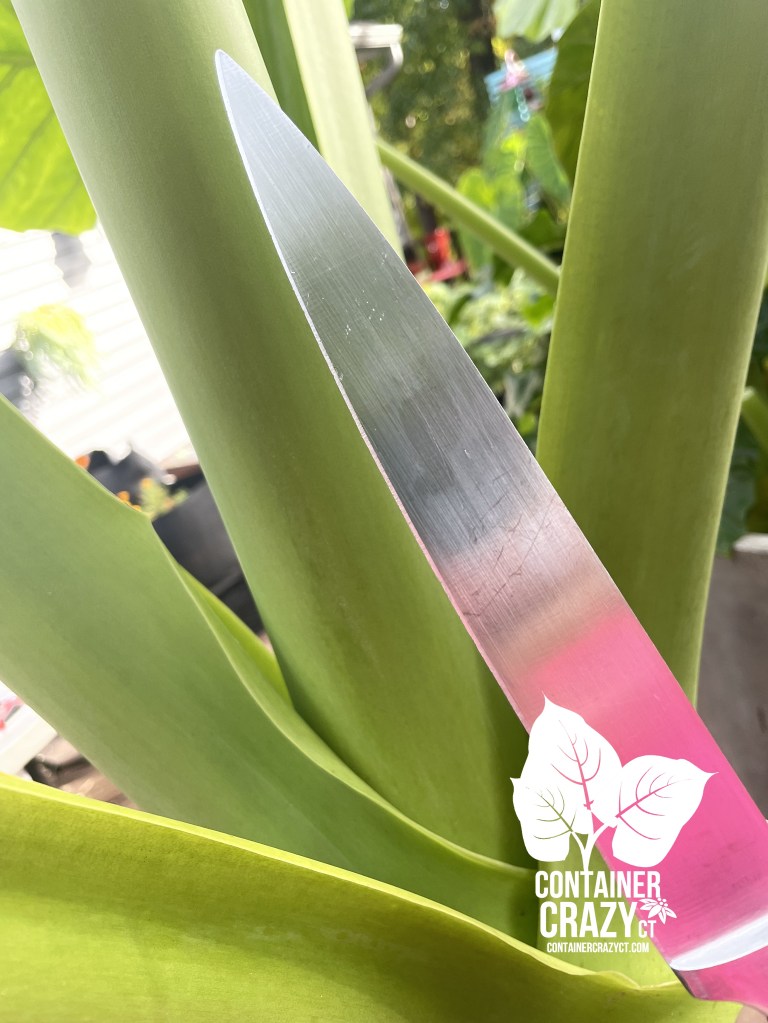
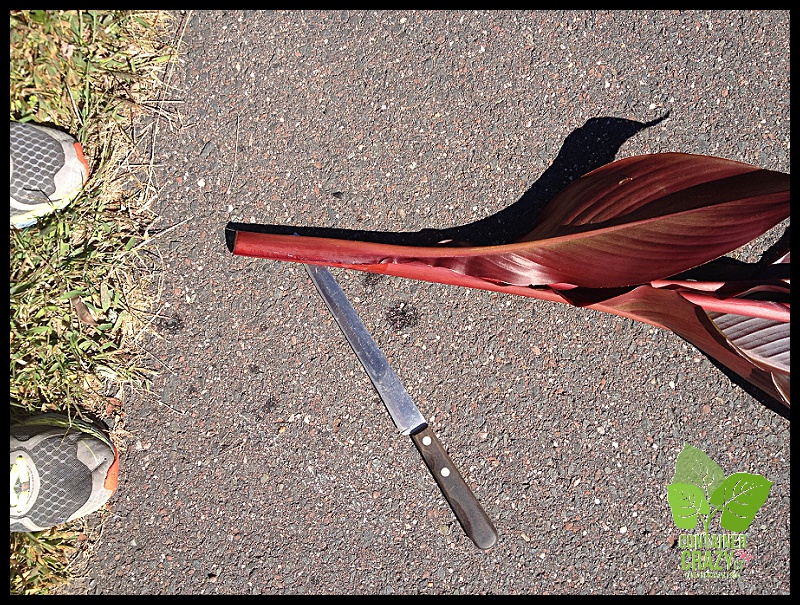
The components of the Ensete (red banana plant) are a little different than the Alocasia (upright elephant ears) because it does not form a corm per say as the Alocasia does. It is basically like a big stump, with the roots at the bottom. When I cut the leaves off the Ensete, notice I use a knife and cut away from the plant base to avoid nicking or damaging the trunk. Technically, it is called a pseudo-stem formed by the leaf bases but for ease of writing this blog post, I call it the base or the trunk when it comes to the Ensete (red banana plant).

Dig out, Upside Down to Drain, Air Dry

In both cases, the fleshy material can be damp and contain some water so after I dig them out, I lined them up upside down to allow water to drain before laying them on a table in the sun for a few days to dry out some more. If the weather is rainy, I move these into the basement to dry out on a table.

I will trim the roots somewhat so there isn’t as many roots as possible to deal when they are stored in a box. The boxes I use are cardboard with air holes made in them with a knife – slits basically. In a prior post, I talked about how I store the upright Alocasias differently than the regular elephant ears. In my experience, these upright elephant ears store better in a dry and dark state versus a damp and dark state.

I allow the plants to air dry and then I place the base (as shown above) inside a cardboard box that will not allow any light in, and I put the box in a cool, dark place in my basement. I will check them in a few months to see how they are doing. Storing my upright Alocasias this method worked very well last year.

In years prior, I had stored most of my tropical plant bases in plastic bins, with air holes drilled in the top covers, and in some slightly moist peat. This worked well for my Canna Lily rhizomes and regular elephant ears, but I started to see rot on the upright Alocasias and learned dry storage was better for those types of tropical plants. Either way, if you discover the bases are rotting in the boxes, it is best to toss them out. And try again next year.

Now back to how I dig them out of my planters.

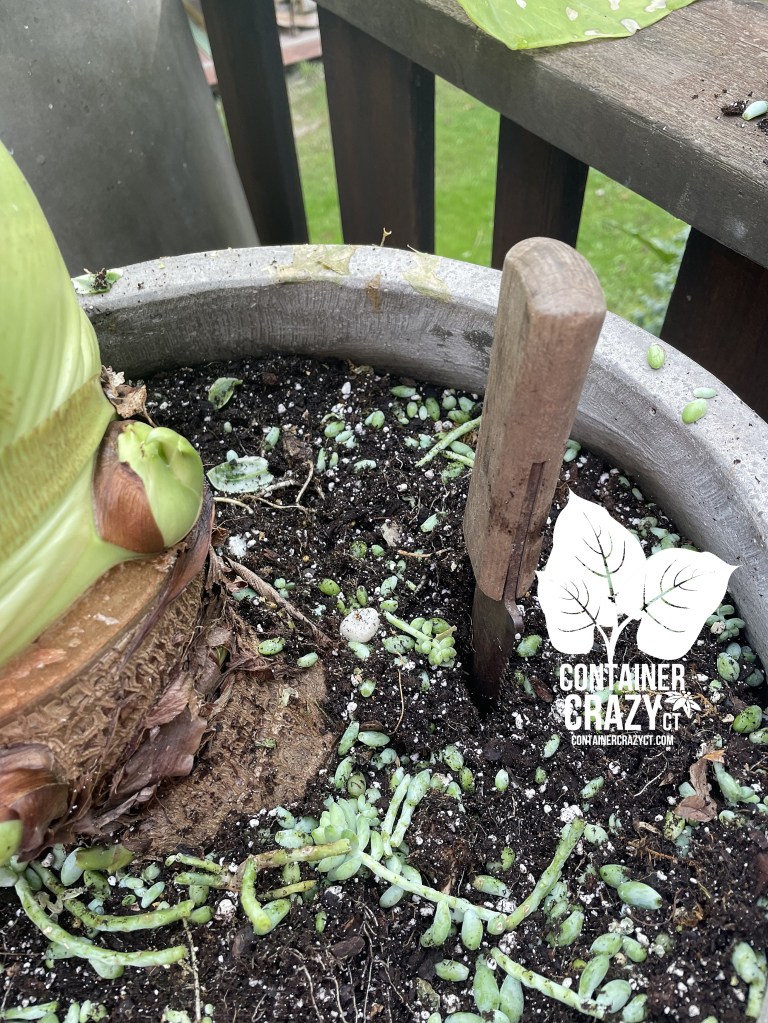
The Hori Hori knife is my go-to tool first. I basically stick the knife straight down into the soil and dig around it (the base of the plant) to cut the roots under the soil. I’m careful not to hit the corm or any part of the plant below but I can hear the roots crack as I saw around them with the Hori Hori knife. Sometimes that is all it takes. If that doesn’t get it out, I use a small shovel to dig more around the plant and then I rock the base back and forth with my hands and eventually it comes loose from the soil.

Timing

You can do this process before or after CT’s fall frost, but again, when it is cold wet and frosty, sometimes the corms will start to rot in your pots, so I like to do this “take down” process before things are mushy and wet. It always works for me. I usually do this mid-October when are days are cooling down.

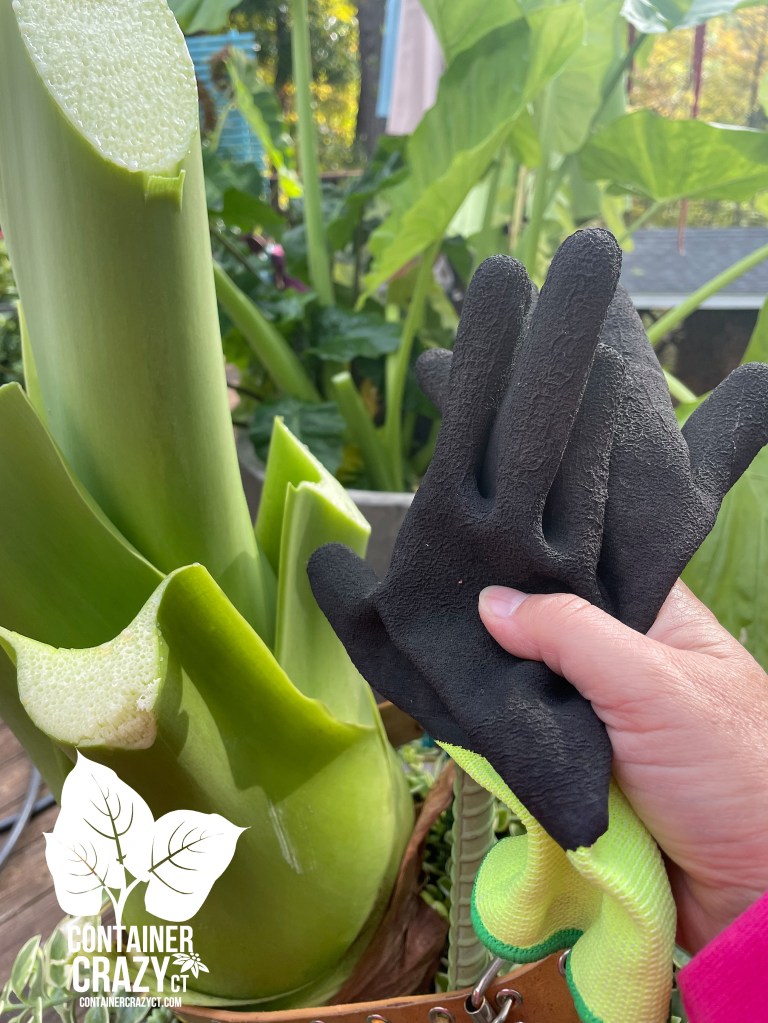
I do brush off or use a leaf blower or just my gloved hands to remove the soil around the roots and the base of the plant base as much as possible. By the way, gloves are mandatory for me – the sap from these can make your hands itch and it is difficult to wash off – so I always wear gloves.

Collapsible Bin – Very Handy

My sister-in-law gave me this bin this year and wow, I wish I had this for years prior. It is so handy. I toss all the foliage in there and toss into the compost.

Check the bases later

As noted above, I will check on the stored boxes of these periodically. Here’s a post I did last March when I check on them and they were doing well. You can see I used newpapers to make a bed for them and how the green is slowly fading on the photo below and eventually it goes dry.

Prior post in March when I looked at the bases.
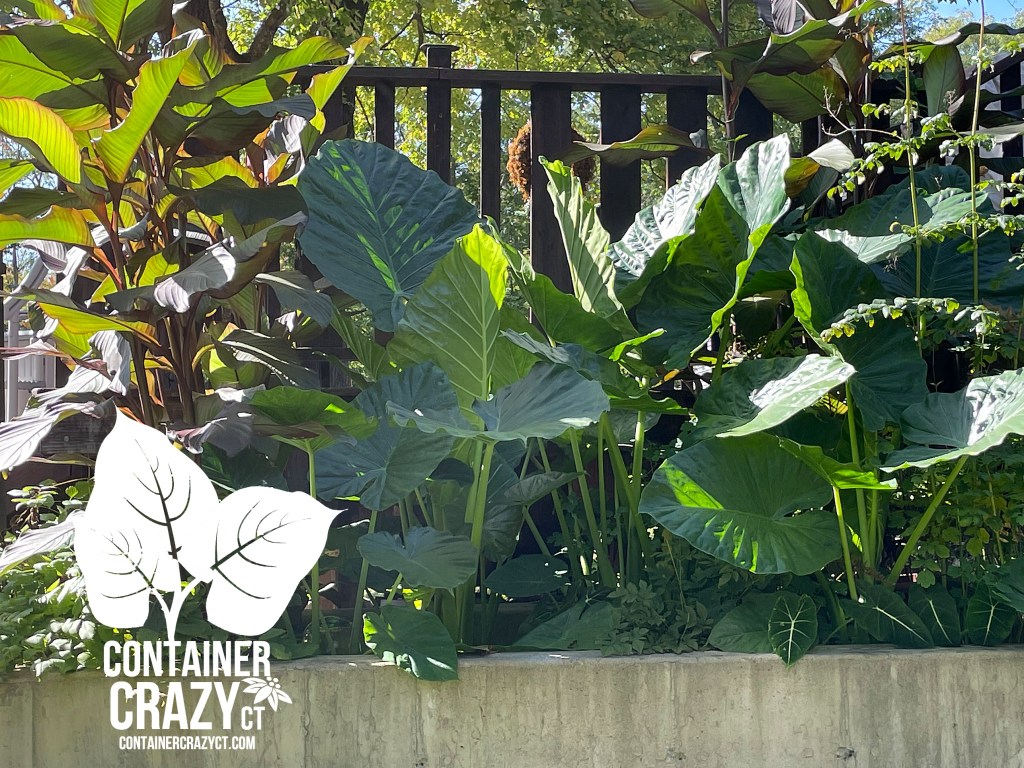
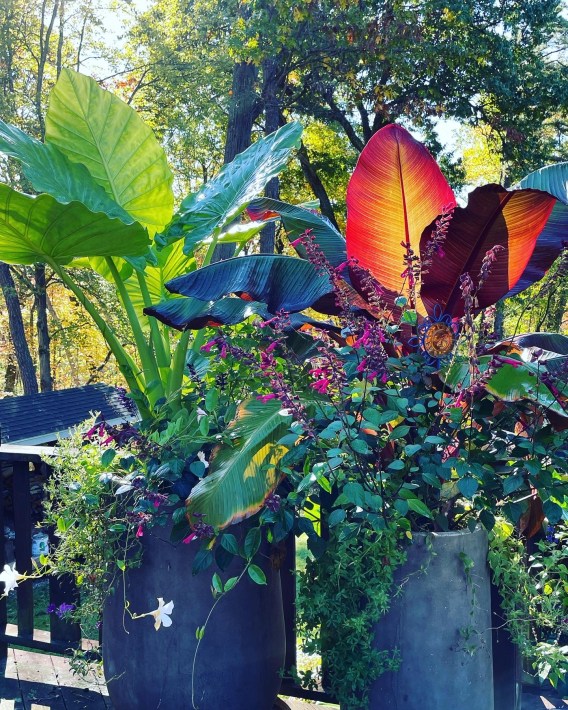
October photo of two of the planters (left Alocasia; Right Ensete)

As you can see, the flowers around the two tropical plants are starting to fade. The Salvias were still blooming (purple flowers), and I will miss those very much because two hummingbirds fed from them all summer. A bee or two was still visiting the blooms as well this month. They were so tall and beautiful. The White mandevilla was still offering some last blooms and the petunias faded pretty much. But the two tropicals still steal the show all the way into our fall season – why I love them so much.

The Ensete (red banana plant) on the right is a new one this year. I had stored a base of an Ensete for over 12-14 years but last year, I lost it, so I scored a new one this season. The Alocasia plants are from an original I got about 4 or so years ago and each year I get more from the pups and the repeat storing of the original. They are tricky to get growing in the spring though – and take a while to start from dormancy, but so worth it. Once they take off – they grow big.

Storing container plants is a way to save money and keep a plant growing larger as the base gets bigger each season. It’s a bit of a process but it went well yesterday for me. I’ve written my steps many times and just use the search bar to locate the posts.

Thank you for visiting.

Cathy Testa
Broad Brook, CT

Overwintering Elephant’s Ear Plants

5 Comments

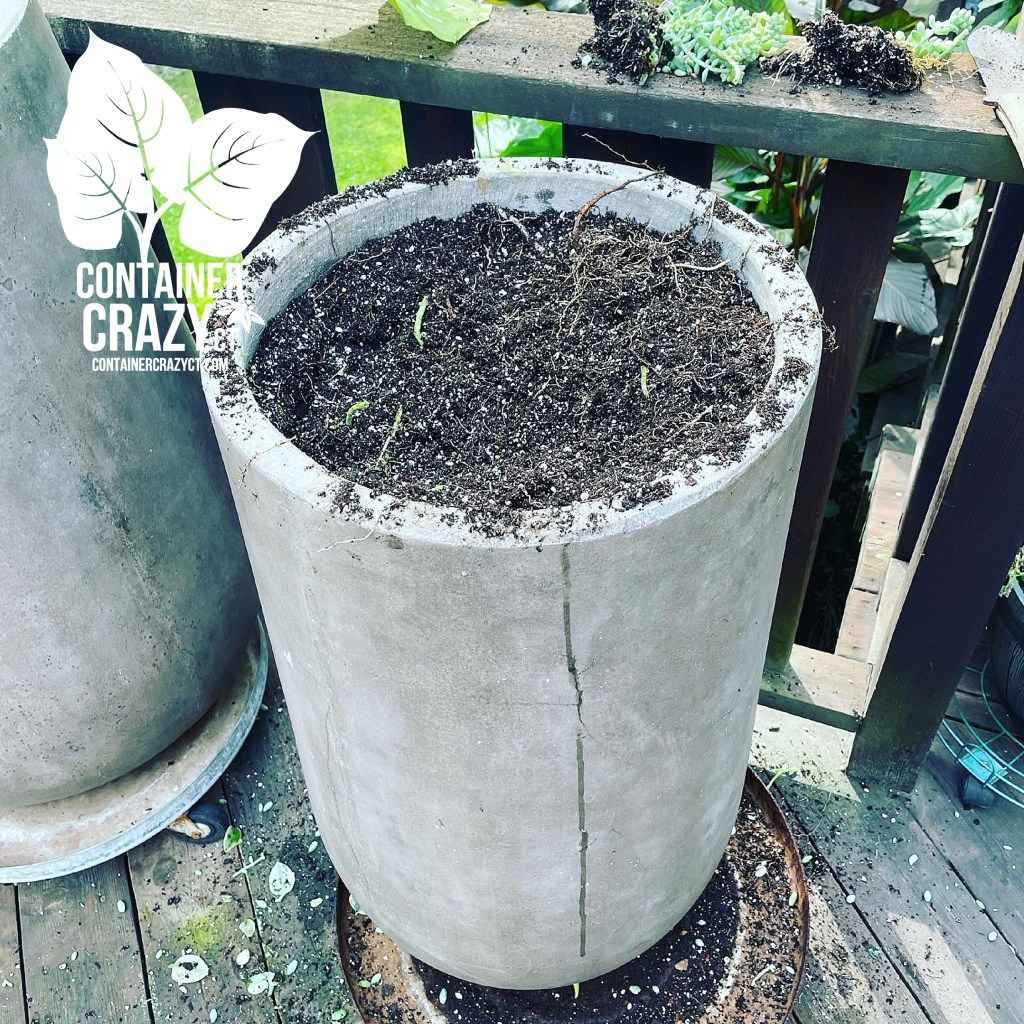
Overwintering Alocasia (al-oh-KAY-see-uh) plants, dug up from a large cement planter in my yard yesterday 10/11/22.

Since this plant is not hardy in my Connecticut planting zone (6b), they must either be dug up and stored (tubers) in a cool, dry place. Alternative options, if the plants are small enough, is overwintering them as houseplants in small pots where you have a sunny room. Or just moving the pots with the plant in tact into an unheated basement and letting them go dormant, but check to add moisture to the pot’s soil from time to time, and check for any insects on the foliage if moved in the pot. In this case, I dug up the plants, removed the foliage, and air dried the tubers yesterday outdoors.

The Planter – Cement

Because yesterday was sunny and warm, I wanted to get to the elephant’s ears in this planter. I was already tired from being on my feet all day, so I rushed getting these out. Luckily for me, the soil is super soft in this big cement planter due to worms and just great healthy soil. Rather than cut all the foliage off first, like I typically do, I dug around the tuber areas in the soil to break free some roots and just pulled them out one by one from the plant stems.

10/12/22 Before Removing the Elephant’s Ears plants

The soil and exposure

The soil in this planter stays relatively moist and receives the east morning sun, so it primarily gets partial sun or dappled sun, it doesn’t get too hot in this area. I do not fertilize – literally – I do not in this cement planter. Over the years, I’ve added recycled soil (from other pots), maybe some compost, but not often, and it is possible some wood ash from the woodstove in our basement, that is used only occasionally, was tossed in there by my husband, but I asked him not to do that after a while (wood ash changes the pH of soils). It is apparent when I dig in the soil, it has worm castings and the soil is very soft and easy to dig into. This is why I was able to pull out the tubers with the plant on the top rather easily after I broke the roots around the base with a trowel. I didn’t even use a shovel.

I do, however, water this planter by using a garden hose from above and showering it every time I was out there watering my other patio pots above on my deck. We had a very dry season this summer here in Connecticut so I’m sure the tropical plants in this cement planter enjoyed the moisture I gave them. These tropical like plants like moist soils, part shade or some full sun. After getting them out, I laid them on the ground and got my machete, which I finally found where I had stored it!

Chop off the foliage, then lay in the sun

It was super easy to chop off the foliage and stems with my machete. One whack and it was done! Then I put them in a laundry basket to sit in the sun for the rest of the afternoon, later, I moved the laundry basket to my basement. It will sit there drying a while before I move them to bins or paper bags for the winter. Some references will say to wait until the foliage dies back or wait till the foliage is hit by frost to dig and store the tubers, however, I like to work on nice days and yesterday was it – sunny and warm. I store mine in the basement, in a corner by the door, which is an unheated basement but it does not go below freezing in winters. We have a woodstove at the other end of the basement, but it is only used on stormy winter days when we feel like it. We do not use the woodstove to heat the house, only to warm it up sometimes. This means those tubers in the corner stay cold, but they never freeze there. It must be cold, but not freezing, and not too warm either. If warm, they may get soggy or start growing.

Side Shoot on Right

Notice my logo on the left side of this photo above; do you see the brown original tuber? The plant this season grew from the side of this tuber (a side shoot) which is attached on the right. Sometimes there are smaller side shoots which you may pull apart to create separate plants and replant those side shoots. Also the green parts above the brownish tuber is this year’s plant and I cut it about 4-5″ above the brown tuber in most cases when I remove them. I usually leave the green plant (like a stump or root base) on there but I am not absolutely sure that is required, because when I received the tubers, there was just the brown dry tuber to plant.

After Photo

It probably took me only a half-hour to get those elephant’s ears (in this case, Alocasia macrorrhiza, known as giant elephant’s ear or giant taro) out of the cement planter. I was lucky I think it was easy. I know rain is coming tonight and some parts of Connecticut got hit by a quick light frost already, but no hard frost here yet in East Windsor, CT. When it is a true frost, all the foliage will blacken and flops over. Next is to get to those tall Canna lily plants on the ends of this planter dug out and store the rhizomes or the whole root base.

Note: A. macrorrhiza is hardy in zones 8-10 from what I’ve read, but here in Connecticut (zone 6b for me), they are not hardy (will not survive in the ground over the winter months). Also, when I dug these out – there was no rot on any of the tubers, which is good news. Sometimes, if I wait too long to dig these out, there may be rot spots on the tubers because of cold, wet soils later in October. This is another reason why I like digging them out now. I don’t want any soft rotten spots on the tubers, rot only leads to storage problems as the rot may continue on the tuber, which is what you don’t want.

Sit to dry out a bit more before storing

Because these plants get huge and are gorgeous, I had to take the time to save them. I will let those tubers sit in a bin, spaced out for air, probably for another five days before I store them. I have always typically stored them in peat in bins with air holes in the lids, but last year, as noted on prior posts, they rotted a little. I am going to try storing them in paper bags in cardboard boxes this year with air holes. Plastic bins can trap moisture and for some reason, it just seemed they were too wet last year (maybe I was rushing too much last year, and stored them too wet). I have found when my rhizomes for Canna Lily were too dry stored, they didn’t make it. I have always balanced a bit of moisture from the peat and air, but I believe the Alocasias prefer more on the dry side. Everyone has different techniques for storing from what I’ve seen and read over the years.

Prior was making pumpkins

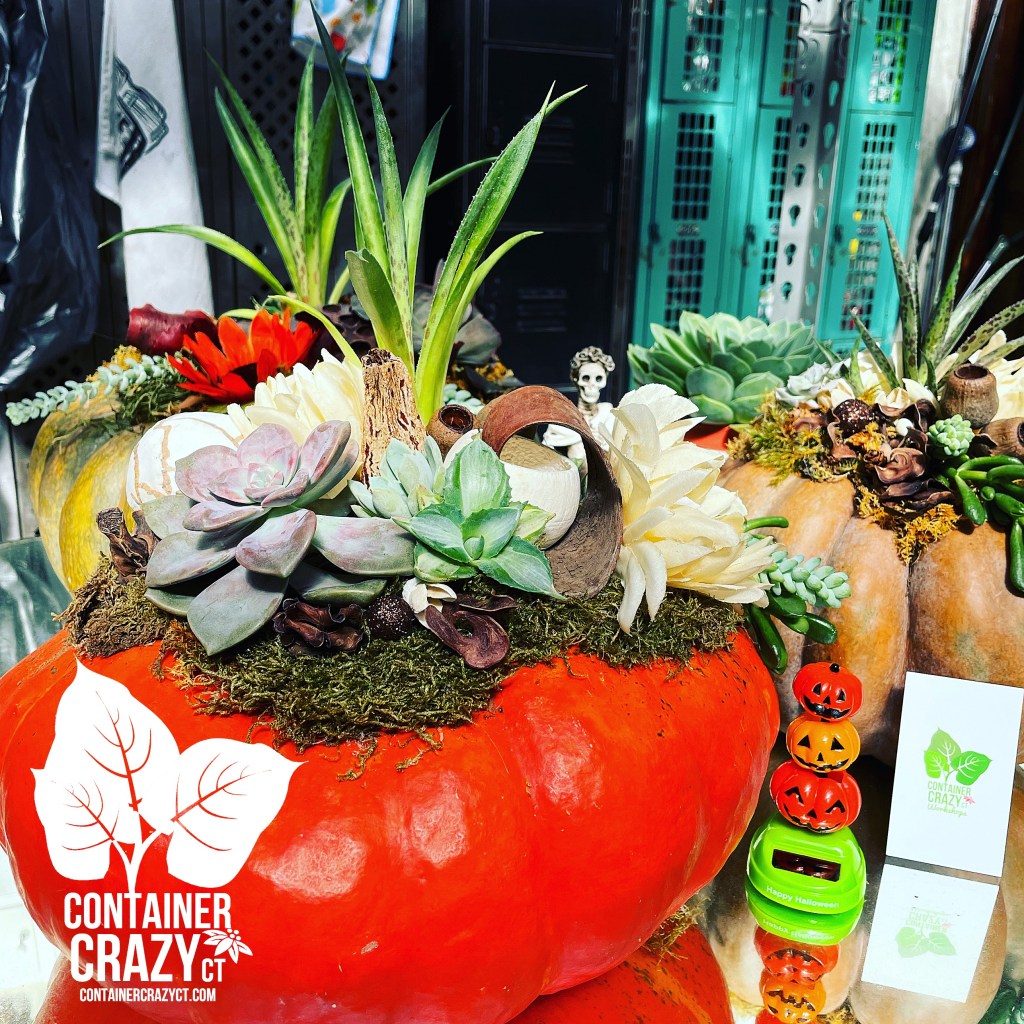
Prior to doing all of this quickly yesterday afternoon, I made a few more orders of my centerpiece succulent topped pumpkins. They were so fun to make and took me a few hours – and my feet give me a hard time, now that I’m getting a little older, standing for hours can be rough. I even put foam on the floor – below my feet, but I felt it later. I tend to make these centerpiece arrangements standing up, and anyhow, these are what I made for some requests. It was a perfect day to do them – sunny in the greenhouse. It’s that time of year when I’m making pumpkin centerpieces and still putting away plants and supplies.

Succulent Topped Pumpkin Centerpieces by Cathy Testa of Container Crazy CT

If interested in a custom pumpkin, now is the time to order since it is pumpkin season. They last for months!

Thank you for visiting!

Cathy Testa
Connecticut Zone 6b
Container Gardener and Plant Enthusiast
Custom Creations for Seasonal Decor
860-977-9473
containercathy@gmail.com
www.WorkshopsCT.com
http://www.ContainerCrazyCT.com (you are here now!)
www.ContainerGardensCT.com

Stay tuned for more information on holiday creations for later in November!

Date of this post: 10/13/2022

Overwintering Alocasia 2022

1 Comment

This is part one – showing my process of disassembling my largest elephant’s ear plants from containers or planters. I purchased the tubers in 2019 for this Alocasia, which I refer to as an “upright elephant’s ear” because the leaves point upwards towards the sky. It is often referred to as a Giant Elephant’s Ear, Giant Taro, or Upright Jumbo). Official name is A. macrorrhiza. They grow from 71 to 96 inches (6-8 feet tall) from summer to frost and prefer partial shade. The leaves are very dark green, glossy, and impressive! It prefers partial shade but will do well in more sun with appropriate moisture. In my zone, it must be stored, but warmer zones, I suspect you may keep them outdoors or protected somehow.

2022
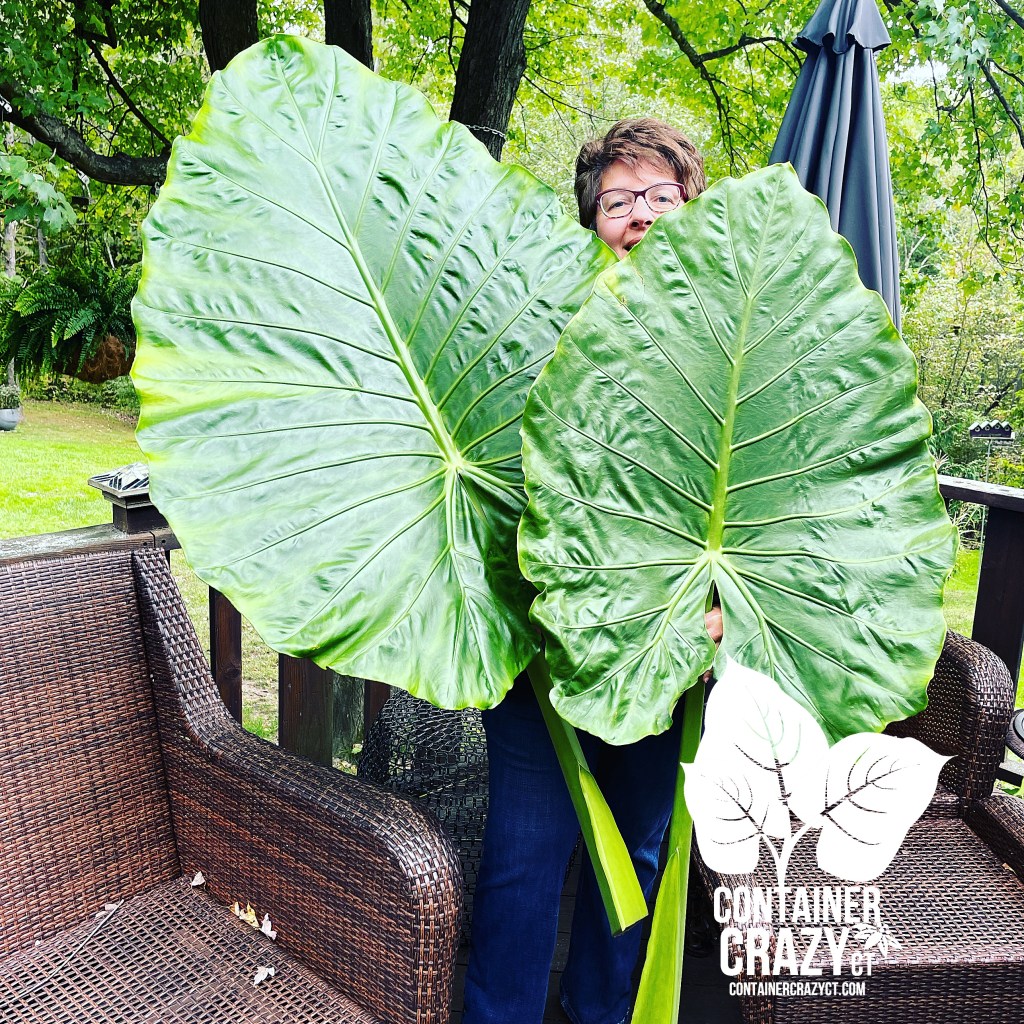
Cathy Testa holding two of the leaves

As you see here, I’m peaking behind two of the leaves. The leaves are at least 3 feet long with the stem an additional 3 feet as well. They tower above me in my planters and put on quite the big tropical show in summer. Now, on to how I disassemble them in preparation for our Connecticut winter months:

Definitely Wear Gloves

TOOLS

Gloves: Definitely wear garden gloves. These plants release a sap that will make your hands itchy – believe me, I regret when I don’t wear them. Even digging around the soil, I found my hands will itch later.

Hori hori knife: I really like this tool, heavy duty, serrated edge, perfect for cutting the roots in the soil around the base of the plant to release it. I find this to be one of my most useful overwintering tools.

Bin: A clean bin to put all the tubers and root bases in to let dry outside if it is pleasant weather, or inside if it is rainy.

A Large Kitchen Knife or Machete: I couldn’t find my machete, so a long, clean, sharp knife is a great back up.

Clean Up Tools: A leaf blower works to blow away dirt that will fall everywhere.

Ruler: Yes, measure those babies!

Large Knife

Cut away all the foliage by using the knife to slice each stalk off individually at the base of the plant. The main thing is to cut away from the plant so the angle of the slices are able to drain away excess moisture. At least that is how I do it. I’m also very careful to not nick surfaces with my knife tip – always avoid any damage while I work.

Slicing off each leaf at the base of the stalk (petiole) – stem – whatever you wish to call it!

As you slice off each petiole at the base, be sure to do a clean cut, avoid tears or anything which would allow entrance of mold or insects later on. A clean cut is recommended. If you mess it up, cut it again below where you just cut it.

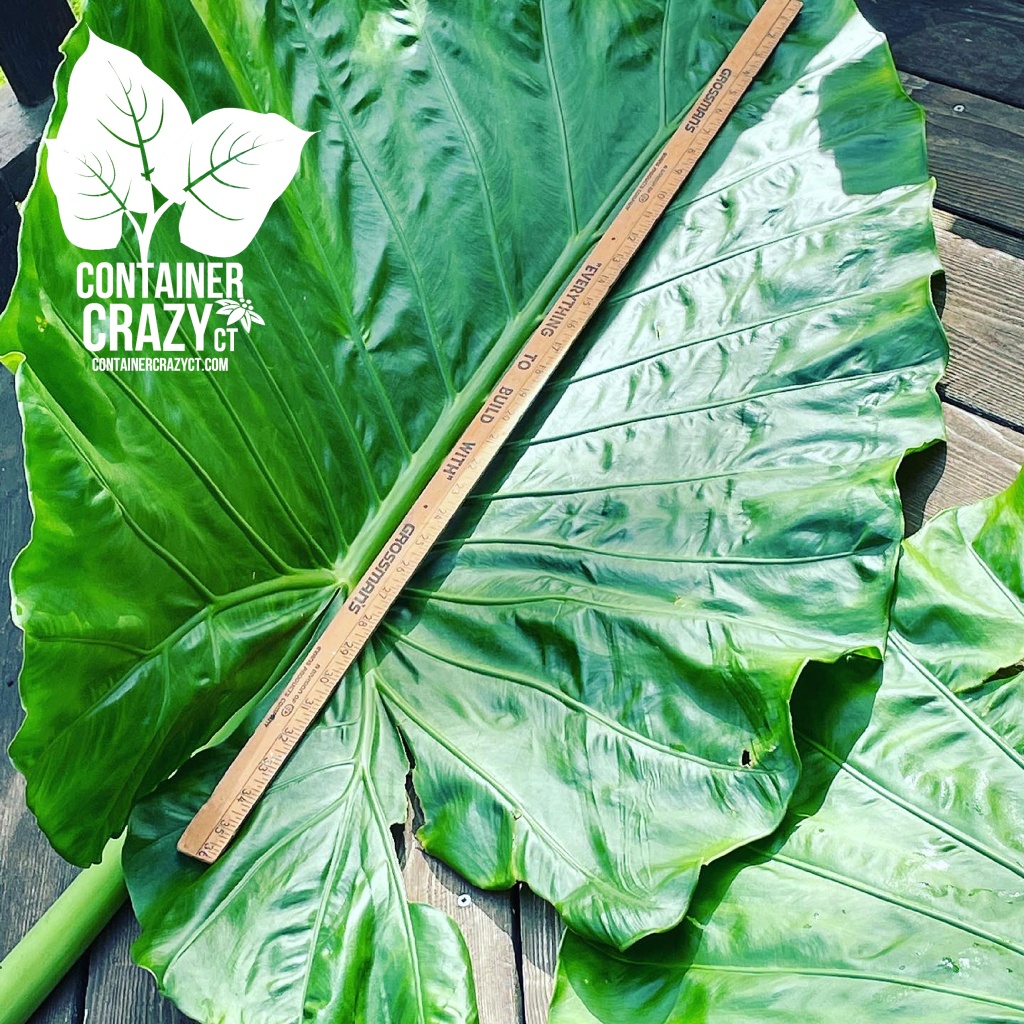
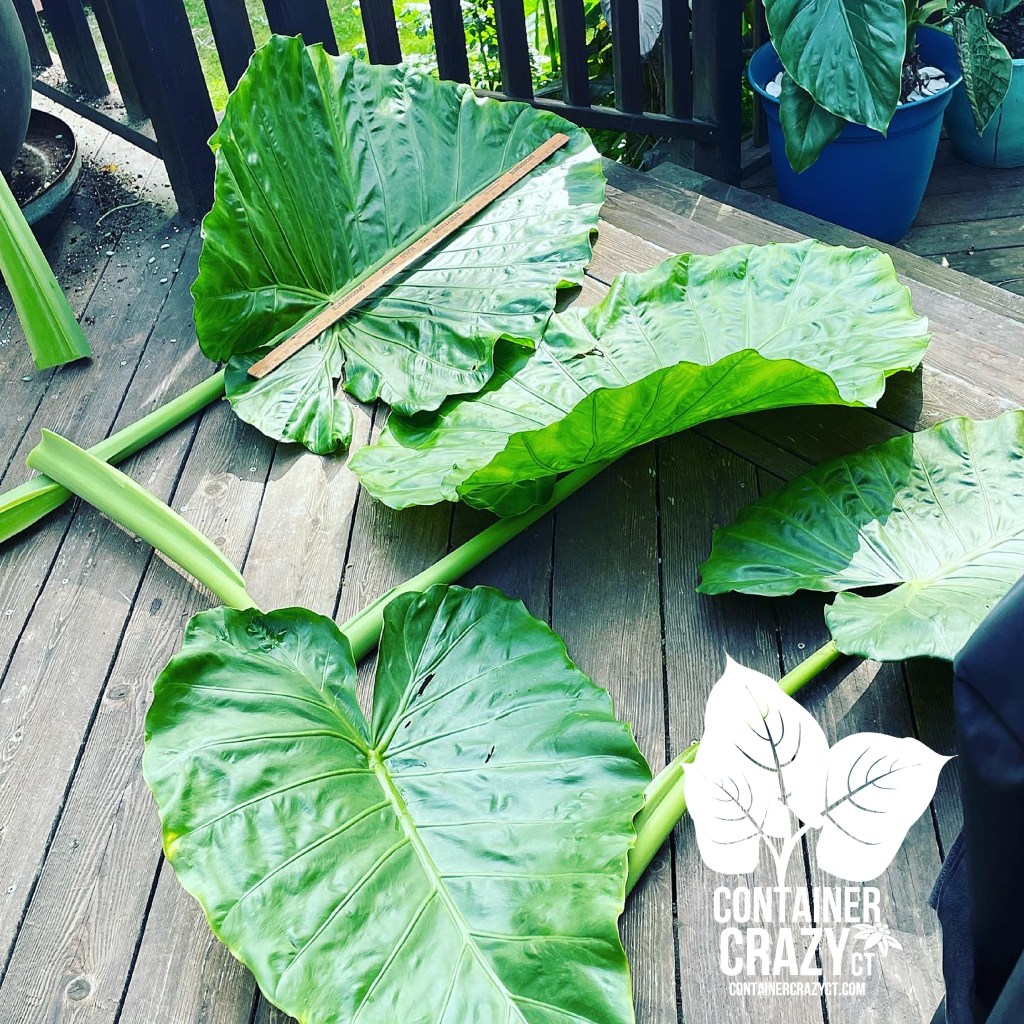
Measure the leaves cause it is impressive!

I always measure so a ruler is handy, or measuring tape, and then take photos. Because sharing is caring – LOL. Everyone loves to see how massive these leaves get. It is fun to Instagram the photos!

Here are two of the biggest leaves above. It is too bad I am not set up to make leaf castings of these babies, they would make impressive art for the garden!

Close up of Slice

As you can see, the slice is downwards and away from the center of the plant. I slice each stalk individually and pile the leaves to the side.

All leaves removed

After removing each stalk, I use my Hori hori knife to cut around the base of the “stump” in the soil. As I push the knife around in the soil, I hear the crack of the roots being cut. Then I will push on the stump back and forth to help loosen it. Once I feel it is ready to be “delivered” from the soil, I start to pull it out – It always makes me feel like I’m a doctor delivering a baby – hahahaha. I have quite the imagination at times!

Cutting a circle around the base of the plant to cut the roots below
Out with more top sliced off

I will put it in the clean bin and trim the roots with clean sharp pruners or cutters, and slice the top off a bit if it still too big to fit into the bin. Leaning it upside down, or on the side to help drain excess moisture is helpful as well. Some folks may recommend not trimming the roots but I always have. New roots grow when it is replanted. My theory was less “fleshy” material the better. Fleshy material has the tendency to rot sometimes over the winter months.

After I got the massive big base out and laying out to dry, I worked on the planter next to it which had more off sets from the same type of Alocasia. I then let this dry in the house for about 6 days. Oh, I also removed as much soil as possible from the tuber areas. I used my gloved hands and kind of just rubbed or pushed off the soil. You may use a garden hose with water blast but that will only make the tuber wetter, so I didn’t do that. In the past, I have used a soft painters type brush to get soil off.

TIMING

In Connecticut (my planting zone is 6b) you may do this process either before or after we get a fall frost which could happen anytime now, but sometimes I like to start this while things are dry and temperatures are not too difficult to work in, so I started on these two planters last Thursday (9/29/22). It was a cool, breezy, day with little sunshine but that would be better than the rainy cold days expected the days following. The date if this post is 10/4/22 and no frost yet, but there are some talks it could happen this weekend, I hope not, cause I have lots more to do!

I placed the bin in the house for a few days and then moved it to a table in my basement. The next phase is storing them. For years, I stored all my tubers, rhizomes, corms in peat in bins with air holes drilled on the tops. But this past spring, I had rot on portions of my tubers. This year, I plan to store them dry in paper bags for some at least. I will most likely test the paper bag process and see the results. I will post photos of this soon. I also saved some mesh netting bags (like those used for Avocado’s in grocery stores) to put some tubers in.

Oh, when I took these apart last week from the gray planters, they had NO ROT anywhere on the tuber areas (brown area at the base) which is good news. No rot means they won’t have rot as they dry for a few more days. When I store the tubers, I will share it here as well.

The tubers need to be sored in a cool, dry place. I use my basement which does not drop below freezing but is unheated so it stays cool. It is recommended that you do not store them in plastic bags which would only trap moisture. If stored in a paper bag, make sure it has holes for vents. Again, for years, I stored them in peat moss in bins, but had rot issues this year in spring, and I didn’t want to loose these tubers of this super big Alocasias, now that I’ve regrown these plants each year. These particular tubers were from 2019 so it has been replanted 4 times now. A definite pay back from the investiment!

PLANT IN SPRING

Next year, after all danger of spring frosts, I will replant these Upright Elephant’s Ear tubers to grow again. Many tropical loving plants may be handled this way, such as Canna Lilies. For years, I stored my big red banana plant, Ensete, the same way as shown above. In fact, here is the link to the Ensete post if you are searching for it on my blog site: https://containercrazyct.com/2013/10/31/storing-my-big-red-banana-plant/. Unfortunately, I lost my big red banana plant this year in 2022. It was the first time it rotted too much.

NEXT OVERWINTERING PROJECT

Ack, I have to dig all of these up soon – anyone want to come help me?!

Canna Lily on ends with Upright Alocasias in the centers

Cathy Testa
Connecticut
A Container Garden Designer
Also make custom orders, grow tomatoes in spring time, make succulent pumpkins now in fall season, wreaths during the holidays! Thank you for visiting and your support.

DIASSEMBLY ALOCASIA QUICK STEPS:

Get your tools ready (knife, gloves, bin, hori hori knife, cleanup tools, etc.).
Cut away each leaf stalk at base cleanly.
Cut around base of plant in the soil area to break free roots with hori hori knife.
Pull out stump (base with the tuber) out of the planter, and let dry for several days to a week.
Store in an unheated, dry, cool area that does not go below freezing in winters.

Pre-Planted Elephant’s Ears Tubers in Planters – My Take

5 Comments

It’s always interesting to see new ideas in the plant world, and of course, one caught my eye recently. It is a planter preassembled with elephant’s ear tubers, boxed up for easy handling, and ready for the consumer to just water and wait for growth.

How I’ve Stored Tubers and Grow Them:

I’ve grown elephant’s ears from tubers over the years. I typically store them (the tubers only) over the winter in my unheated basement in bins with some peat to wait out winter until spring time. Because the plants are not hardy here in our winter planting zone (CT Zone 6b), I can not leave them in the ground or in pots outdoors over the winter. I dig them out of my planters (the tubers that is), clean off the soil from the tubers, and store them. Usually I am successful with opening the box in spring time to find them in tact. I’ve blogged about my process many times, search the word “overwintering” for more on that.

When I’ve Started Them:

I typically start them indoors around end of April or early May as spring is approaching. For years, I started them in my house by planting the tubers in pots with potting mix and setting them by my kitchen glass slider door. It was sufficient to get them started. Within a few weeks or so, a growing tip would appear above the soil and start to grow. When all chance of frost passed, out they went into larger planters and containers in my yard or on my deck, etc. These plants reach huge sizes (4 to 6 to 8 feet tall), so larger pots are always my aim to show them off in the right places.

Tried to Start Them Earlier:

However, last year, I wanted to try to start them earlier. I attempted to start some in March in my greenhouse (years ago, I didn’t have a greenhouse). It didn’t really work out as I had planned. My greenhouse is heated only to about 45-50 degrees F in the winter (to over winter other plants). It is a low temp because heat is a huge expense (especially this year), and elephant’s ears (Colocasia) require warmer soil temperatures (65 degrees F or warmer). They didn’t take off any faster than they would in my home, in fact, it was probably a bit slower going. They weren’t popping out of the soil and when I inspected them under the soil, some rot had started as well on part of the tubers (or bulbs if you prefer that wording). I learned a lesson, the soil needs to be warmer. I somehow overlooked a fact I knew due to being anxious to start them.

I considered maybe it was too soon to even attempt growing them earlier. What ended up happening is the potting soil remained too cold (because it was too cold in the greenhouse) and too wet because the tubers weren’t actively growing yet. Cold temps + damp soils leads to rot of the tubers. In fact, storing them is usually at a temp of 40-45 degrees F so the whole situation was it was just too cold still in my greenhouse, despite those rapid warm ups during winter days when the sun is out – the evenings were still a bit chilly.

How they Do This in the UK:

I’ve seen posts by people in the UK (via the wonderful sharing of posts on various tropical pages) usually start their elephant’s ear tubers in what they refer to as a propagator or cupboard. Terms we don’t use here in CT. From what I can tell, many of them put the tubers in plastic bags and place them in a warm spot (a cupboard or propagator) until they see some growth coming from the tuber – and then they put them into soil mix – or the ground perhaps (I’m not sure). Makes sense, they give them a head start but don’t subject them to cold wet soils. I remember asking someone one day via a comment on a post about this, what is a cupboard? If I recall, it is like a warm cabinet you have in your home somewhere to serve as a place to start tubers, or perhaps some seeds. I have some places like these (over the fridge I have a small cabinet that stays warm) or a cabinet in a corner near our heat source, which actually, I did use that cabinet to start sprouts years ago and that was one of my things then – starting and eating sprouts. Maybe this will be a location to kick start the tubers first – I may give this a try this year.)

Anyhow, I think the message here is if you start them too early in the wrong conditions, it could lead to issues, which was the case for me last year. Thus, when I saw those pre-planted tuber pots at the local big box store (just yesterday), I had some initial thoughts. I like the idea but I also know of what could go wrong with them, but I’m not saying it would go wrong (see disclaimers below!). And I also thought about what was right about these pre-planted tuber pots.

Pre-Planted Pots with Tubers

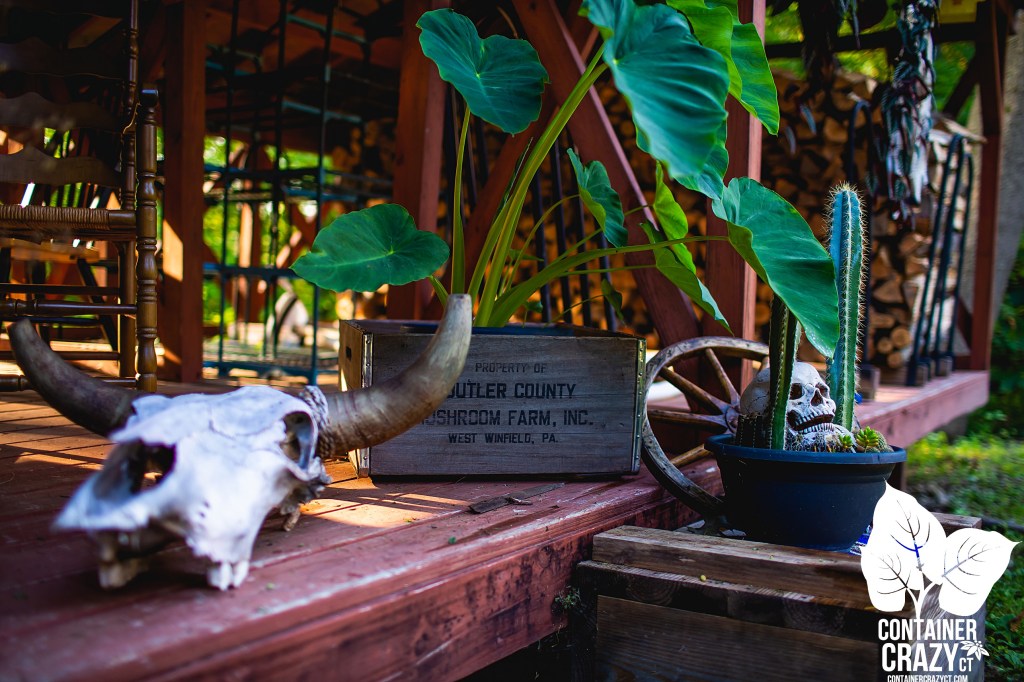
I have always been somewhat addicted to elephant’s ears because of their large showy heart shaped leaves which point down (or up as in the case with many Alocasias). They give a wonderful vibe to a space and I have used them everywhere in planters. I even hired a photographer a few years back to take photos (check her out at jmsartandphoto.com).

One year when I got into skulls, LOL! Note: The Human One is not REAL! LOL!

Elephant’s ears are just so very cool. And grow large and tall. The wave around in the wind, they create shade for plants below them, and they look good from the tops or bottoms and are relatively easy care. I just have to share another photo here of them. I typically plant some around my big red banana plant (Ensete) as well in this massive concrete planter at my home. Over time, it becomes lush and dramatic looking. I find they work in sun or shade, if more sun, more watering is required. They also make excellent thriller type plants in pots. They can even be grown in water – they are versatile plants for a tropical look and you may propagate them too.

Cathy Testa’s Large Cement Planter with a Mix of Elephant’s Ears and Other Tropical Plants

Digging them up for storing them is a fall gardening chore, but re-growing them in spring time is not so much of a chore, but I did take notice of those pre-planted tubers in pots with soil at the big box store yesterday. I didn’t see a price tag on them, and believe they were freshly delivered to display and sell so the price was not on there yet, I was curious about how much they cost.

My Take On the Pre-Planted Pots Seen Just Yesterday – Just my opinion!

Pluses: Talk about convenience. All was so well packaged and boxed up, it would be very easy to plop into your store cart and go. The pot size was good; usually I start my tubers in a one-gallon nursery pots. These black pots were bigger and nice enough to use for the summer as your planter, basic black color. The plant care information on the side of the packaging was decent, indicating they should not be planted outdoors until frost has passed (true), and to “water sparingly” and to keep the mixture “moist, not wet.” But they didn’t say why on the moisture, nor was there any botanical information on the packaging. Since I could not see the inside, not sure if more details are provided. They do not give Latin names for example, but did indicate there are 2 plants (bulbs) inside pre-planted, or that is the impression I got.

The Minuses: What are you getting inside? The top of the pot is closed off with more cardboard, and I wondered, hmmm, how big are the tubers in there? How much soil, is it half full or filled all the way, are the tubers in the soil or do you have to plant them, what does the soil look like but I bet the soil is perfectly fine as they are produced by bulb or plant producers, most likely but I kind of wished I could peek inside. And the price tag wasn’t on them yet, and I’m curious on that part as well. How much does this whole package cost?

The Timing: It depends what you have for getting these started? If you have a warm home with some place to set them down where the soil will be warm enough (see noted above), you could start to water them and see them pop up over time. But it is still February, so you would be maintaining them perhaps as a house plant all the way until the end of May when all chances of frost outdoors are passed. I did consider the “what if” you just moved them as is (don’t unpack the box, don’t water them) and keep them in your basement. Will they be okay? They probably put the tubers in there with dry soil, so nothing will happen until moisture is provided, usually. I guess I pondered that because what if you just wanted to get it but not start them just yet.

Another plus, you don’t have to go buy a whole bag of potting mix soil if you want to grow these from these planters. Everything is all set for you. Another minus, what if they get wet at the store while they sit there waiting for the purchaser? They shouldn’t but if they did, then the soil gets wet and they may start to grow, or if the soil gets wet, it could lead to soil problems, if they are not in the right temperature conditions. And another minus, it is not technically supporting the local small businesses, but we all go to these big box places from time to time, don’t we? In fact, I feel like anytime someone creative comes up with a cool plant idea, these big box places are very quick to copy it – which is good or bad, depending on who you are supporting, a local small business or plant passions overall – I won’t go there, but any how, perhaps a minus is buying this is not supporting a local grower who takes the time to grow it themselves to a proportion and health readily available at the right time. It is just a matter of opinion, give or take. A matter of timing. A matter of preference, but anyhow, innovations and new ideas are cool overall. Maybe this is not a new idea either. It was the first time I saw it though.

Anyhow, I’m sharing it cause I spotted it, and thought I’d give my thoughts! What do you think??

Cathy Testa
Owner of Container Crazy CT
A Container Gardener
Location: Broad Brook, CT
Zone 6b

DISCLAIMER INFORMATION BELOW:

1.   Copyright Policy

Unless otherwise noted, Cathy Testa and Container Crazy CT are the legal copyright holder of all material on this blog and others cannot use it to reprint or publish without our written consent. If interested in sharing a post written specifically by Container Crazy CT authors, do not hesitate to contact us to inquire on more details. Note: Reblogged posts from other fellow bloggers are done if the blogger automatically allows this feature on their blog, but they are the legal owner of their written materials unless otherwise noted by the author of the featured blog.

2.   Hold Harmless

All the information provided on our blog is for entertainment purposes only and we are not providing medical, legal or other professional advice. You are reading and/or using any of the information from Container Crazy CT’s blog at your own risk. Most posts are totally harmless, but do not for example, eat a poisonous plant featured on this blog, for you will be doing so at your own risk.

3.   Privacy Statement

We will not sell any of your personal or contact information to another company. Will not put your information on spam lists. We are not responsible for the privacy practices of any of your advertisers or blog commenters.

4.   Reserve Rights

Container Crazy CT reserves the right to change the focus on this blog, to shut it down, sell it or to change the terms of use at our own discretion. However, we highly doubt we will do so, as we enjoy writing and sharing the information of this blog to our fellow followers.

5.   Advertisers and Sponsors

Container Crazy CT has recently added WordAds, yet, we are not responsible for the actions of our advertisers or sponsors. For example, when our readers buy a product of service based upon a link from this blog, you must take action with that exact company to resolve any issues, not with us at Container Crazy CT.

6.   Letters to the Editor

Any letters, messages, tweets or e-mails that readers of this blog send to Container Crazy CT are shared as needed when applicable to a post, such as a “comment” entered in the Contact Form below a post or when you comment via the red icon comment box at the top right of an individual blog post. If you wish to keep your comment confidential, we will do so upon your request.

Beautiful Photo – Really Captures the Beauty below the Elephant’s Ear foliage – Cathy Testa’s Planter

Beautiful Weather!

3 Comments

Happy Friday Everyone!

How about this beau-beau-Beautiful weather we are having – and it will continue for the next few days! Yipeeee!

Not sure if I’m totally diggin’ the cool night’s though – it has slowed down the ripening of my cherry tomato plants, but it sure does help for a restful sleep. And overall, the non-stressful weather has been fab for my other plants – they are not as stressed from high humidity this year.

Just a few notes – as updates, for today:

Terrarium One-on-One’s

I am offering Terrarium one-on-one sessions, at the bookstore, on Tuesdays and Thursday’s, by your scheduled appointment times. Hours are between 10:30 am to 6:00 pm, starting August 31st thru Sept 26. Only date not available is Tuesday, 9/12.

If interested, see my Facebook Events or my http://www.WORKSHOPSCT.com site.

Location is the Book Club Bookstore & More, 869 Sullivan Avenue, South Windsor, CT, where by the way, I have thriving houseplants and succulents available there – still doing well, if you have a need to spruce up a tired plant at your home, swing by to see!

Overwintering Plants Demo’s

I’m offering my demo on how to overwinter plants early this season, so that if you are interested, you may learn first and then get ready to take care of your plants in October right before or after our frost date.

If you prefer to wait, I will also be offering it in October at my house on 10/14.

The sessions are being offered at the bookstore (address above) and at my home based location in Broad Brook, CT. All session dates are posted on http://www.WORKSHOPSCT.com

Because the themed plants for my May Container Garden Workshops were houseplants, this type of plant will be discussed on how to transition them to the home before it gets too cold out. And I will be including my usual tropicals, and talk succulents too.

Succulent Topped Pumpkins

This is a fun workshop for the fall, our 2nd annual. It will be offered at my home based location and at the new Stafford Cidery. They are filling up quickly so be sure to register early.

Dates are 10/7, 11 am – my place in Broad Brook, and 10/16, 6 pm, Stafford Cidery. You know where to find info…Yup, http://www.WORKSHOPSCT.com.

Other Late Season Tips

We still have PLENTY of time to enjoy our plants – but here are some top of mind tips:

Let plants flowers go to seed. Wait for seed pods to blacken to collect. Store them for next year. Be sure to keep them out of sunlight, it a semi-tight container or dry envelope, in a cool room, and label them. You may try your hand at sowing them next year.

Cut old gone by flowers off plants, such as Canna plants. If the flower dries up and is papery, you may cut the stalk off the plant – it will help other stalks to push growth and bloom. Or you may leave the seed pods on the plant too to collect. These plants are beautiful all the way till frost – still lots of time to enjoy the flowers and foliage.

Watch your succulents. If we get really COLD DAMP rains – they sometimes don’t like this as it may cause some to rot. I moved some of my succulents in to the greenhouse already that were outside. It is not mandatory to do “now” but just be mindful of what I told you in my workshops about transitioning plants. When the cold wet rain hits, it may dampen that soil while cold out – not a good scenario for succulents. They like the soil to dry between waterings too.

Collect wild nature items now for fall decorations. I added a new workshop on Succulent Wreaths, for example, and we are having the Succulent Topped Pumpkins workshops. Wood sticks, beach shells, feathers, pine cones, if you find them, think creatively. Items which may be attached are good finds for free while you are outdoors exploring.

Water your container gardens even if it rains. So, you may be thinking, I don’t have to water my plants – it just rained. That is somewhat true – but if your pot outdoors has lots of foliage above the pot rim, the rain water may not have trickled down into the soil. Check it anyways. I do this with my big pots of elephant ears and banana plant. Many times, the soil isn’t that wet after a rain fall. Feel the soil. We may slow down our watering routines, but it doesn’t completely end.

Cut off damaged leaves from cold snaps. When we get cool nights, you may see a yellow leaf or two on your plants, like elephants’ ears. Take the time to cut it off with clean pruners. That will look better and keep your plant healthy. Speaking of that – remove any mush you see on your plants if something rotted.

Watch for caterpillars. I saw a few on my Canna leaves when I noticed some rugged edged holes, and looked “under” the leaf – sure enough, a white interesting fussy caterpillar was having her snack. I took those off, cut off the damaged leaves, and that took care of that.

Ever see a pattern of holes on a Canna leaf which are lined up in a row symmetrical style?

My friend just sent me a photo of just that – and what happened is the bug ate thru a “rolled up” leaf – before it unfurled. It created a pattern when the leaf opened. You may have seen this too, and thought – Wow, that insect is a Picasso!

Send me “Your Proud Plant Pics”

I get so excited when you send me a photo of a container garden which you made at my May workshops to show how well it is doing – or a photo of a plant you bought from me this season.

Please feel free to text a photo to me if you wish.

I love sharing success stories on my Instagram feed. It makes me proud – and happy you are enjoying your plants as much as I do.

That’s all I can think of for now. Enjoy your weekend. It’s gonna be a beauty.

Cathy Testa
860-977-8473 (texts welcome!)
containercathy@gmail.com
www.WORKSHOPSCT.com

Overwintering Canna Plants from Container Gardens

19 Comments

Hello Visitors,

As noted yesterday, I am beginning to disassemble, dismantle, and take apart my container gardens and patio pots.

As I do, I will share with you the photos and steps in the event you can not attend my demo on Oct 17th, Saturday.

Yesterday, I took apart one pot of Canna plants. I selected the tall red one, figuring it would be easy to show you what I do.

Canna plants may be kept in the pot and stored inside, but today’s post shows you how to store the rhizomes.

Rhizomes

Rhizomes are the storage organs which are swollen stems under the soil that usually grow horizontally, below the soil about 6-8″ from the top of the soil line in the pot.

Mature rhizomes may be cut into sections to produce more plants, but you don’t need to do that step now. Just remove them from the soil and store them in peat moss.

Other Overwintering Options

Option #2: If you have a nice sun room in your home, you have the option of continuing to grow your Canna in the pot. However, I find if you keep your Canna plants in the same container for several years in a row, they start to get crowded and tend to not bloom or flourish as much.

Option #3: A third option is to leave the Canna plants in the pot and move it to an unheated basement where it remains cool all winter, but not below freezing. The plant will go dormant and may be revived the following spring after spring frost. In this case, however, you will need to watch for insects and water it sparingly so the soil does not go completely dry during the winter.

Canna Rhizome Removal

Tools: Clean pruners, loppers, or if you are not a full time gardener with various garden tools, use a long kitchen knife (like one you would use to cut bread).

When: You may wait until the Canna plants get hit by our fall frost later in October, and many references will say wait until it gets hit by frost. However, I’ve stored rhizomes in fall before frost and all works out fine as well.

Canna Australia in a Tall Red Pot

Canna Australia in a Tall Red Pot

Cleaning: Using sharp, clean tools is important to prevent pests and diseases from being transmitted to your plants or storage organs (rhizomes). It is also a good practice to wear gloves and wash your hands as you work, and wash your pots when you are done dismantling everything.

The Steps

Step One: Cut the stalks at the base, leave a little 5-6″ stub if you want. Most important – make a CLEAN cut. Do not tear, pull, tug or make a jagged like cut – the cleaner cut the better. If the stems are thin, pruners work. If not, I like using loppers for a clean cut. If you use a kitchen knife, remember to make the slice/cut as clean as possible.

Clean Cut at Base

Clean Cut at Base

ContainerGardenTakeDown_0022

ContainerGardenTakeDown_0020

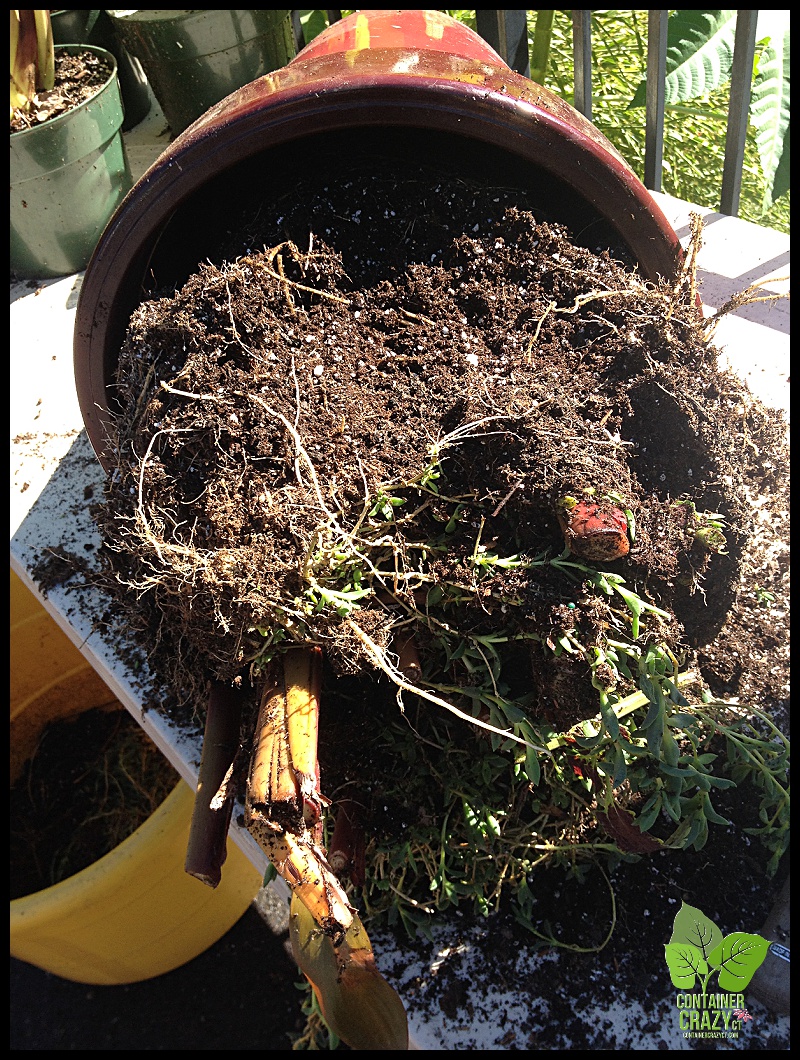
Step Two: Remove other plants in the pot and save as needed or toss. Then remove the root ball. Usually, if the pot does not have a edge on the top rim, it slides out just by turning it over or rolling it on a table (unfortunately, for this red pot, I had to work at removing some soil inside to get it out).

ContainerGardenTakeDown_0024
ContainerGardenTakeDown_0018

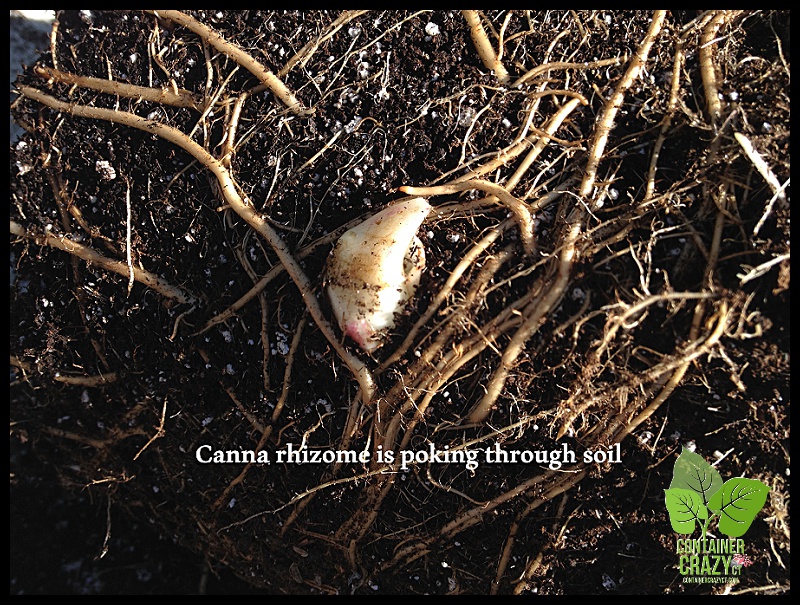
You can see a rhizome poking out of the soil here in this photo above. This can help to locate where they are but you will not always see this in every case.

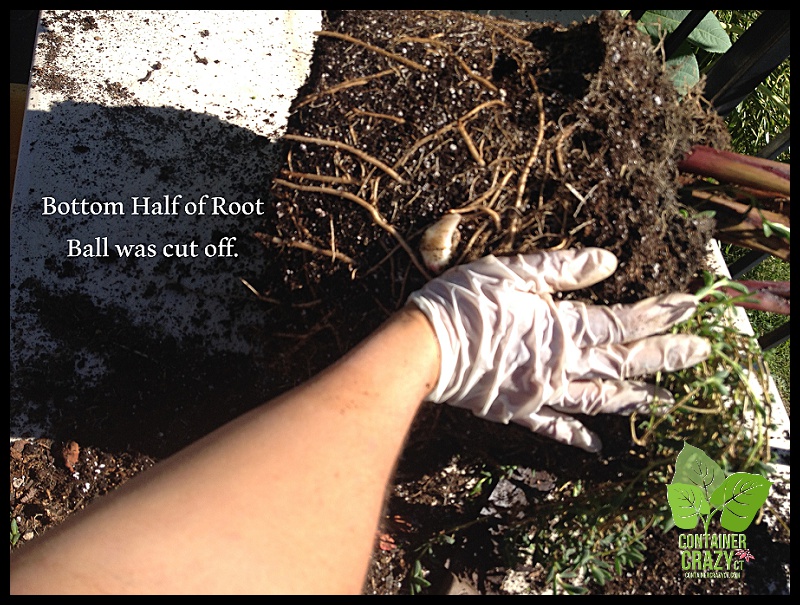
Step Three: Cut off (slice off) the bottom half of the soil mass. Be careful to not cut the rhizomes which should be about 6-8″ from the top of the soil line.

ContainerGardenTakeDown_0016

ContainerGardenTakeDown_0021

Step Four: I placed my hand to show about the distance from the top of the soil to where the rhizomes are in the soil. Start to remove the soil away from the rhizomes using your hands or tools. If you use tools, try to not damage the rhizomes accidentally — but if you do – don’t panic. Rhizomes are often cut into sections for propagation, it won’t kill them if you break one by accident.

ContainerGardenTakeDown_0017

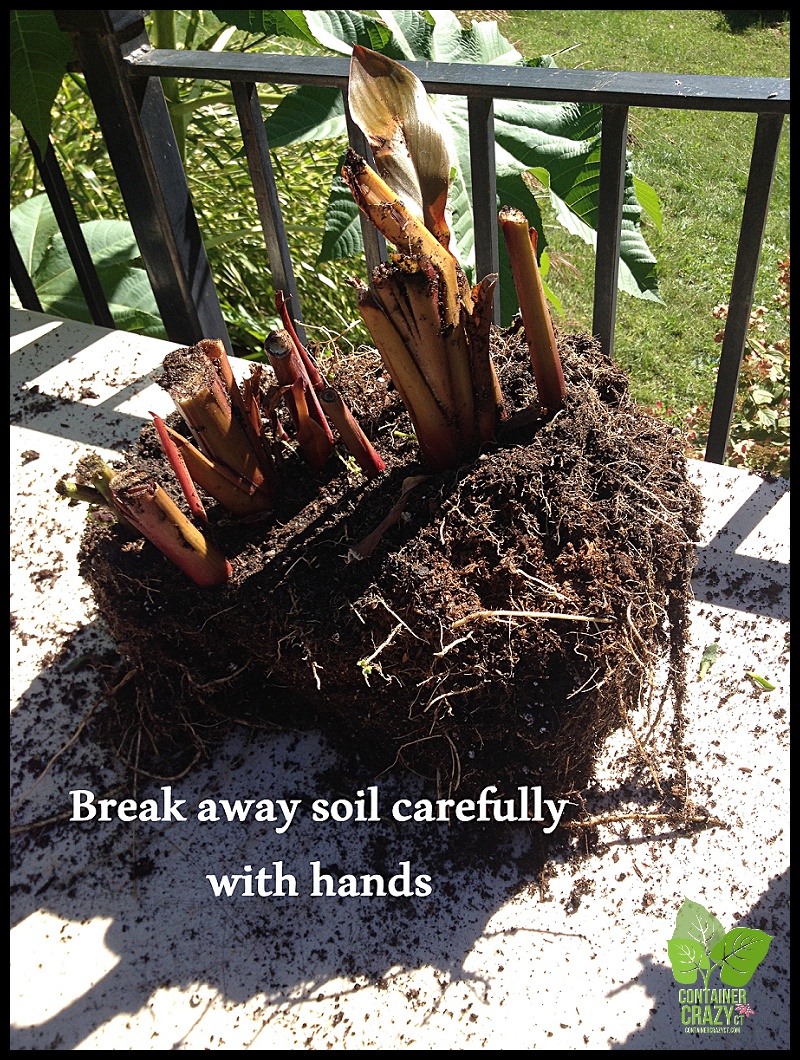
Step Five: Pull the stems a bit apart, they may break away freely, meaning the rhizomes will separate. Take one stem in one hand, and another in the other hand and pull them away from each other, you will see how they break away. Then clean off as much as the soil as you can. You may use a garden hose to wash them off with sprays of water, but I don’t always do this because then the rhizomes get super wet. In this case, I did to show you how they looked.

ContainerGardenTakeDown_0015

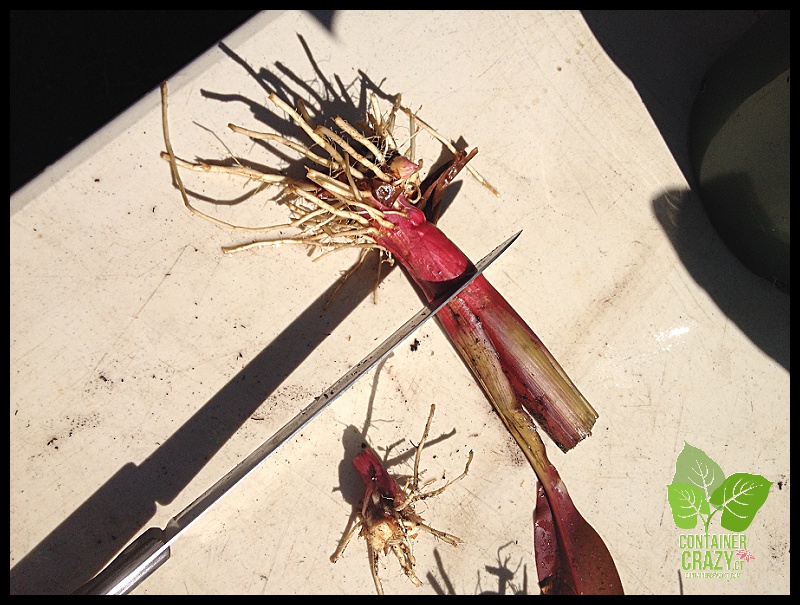
Step Six: Trim off the stem stalks. I do this because any fleshy material stored has the potential to rot in the box of peat moss. I even trim the roots if they are super long with sharp pruners. Then let them air dry a bit (couple hours).

The last step is putting them in a container (box) with peat which I will show in tomorrow’s post.

ContainerGardenTakeDown_0023

In this particular case, the rhizomes were on the small side, but that doesn’t matter. Each piece you save is another new plant for next year.

Crocosmia (perennial)

This summer, I put a Croscosmia perennial in a blue pot. The hummingbirds adored this plant’s blooms. It was amazing to see them zip by every day. So, you have choices with perennials too on what to do with them if you grew them in your container gardens and patio pots.

They may be removed now and put into the ground to have in your garden or if you have a garage, some perennials will come back if you store the whole pot with the un-removed plant over the winter in the garage.

You may also bury pots with perennials in the ground, but I don’t like that idea because the pot will get dirty and probably worn out more – but this is an option. This information was noted on the container garden workshop handouts in May as well (for those attendees reading this information).

Before I cut back all the foliage from the Crocosmia perennial, which was tattered by the end of the summer, I collected the seeds from this plant for next season. They may be scattered in your garden or stored for next season.

I put seeds in prescription bottles. Its a great way to recycle the bottles and the label is available – with a quick sharpie marker, I write the plant’s name and date, and store the seeds in a cool, dark place until next spring.

ContainerGardenTakeDown_0009

ContainerGardenTakeDown_0012

The seeds are stored in pill bottles as shown above.

ContainerGardenTakeDown_0010

The root ball was removed from the blue pot. I decided to plant it in my big cement planter after doing a bunch of cutting back of the existing perennials in the cement planter, which also has some huge castor beans growing.

ContainerGardenTakeDown_0011

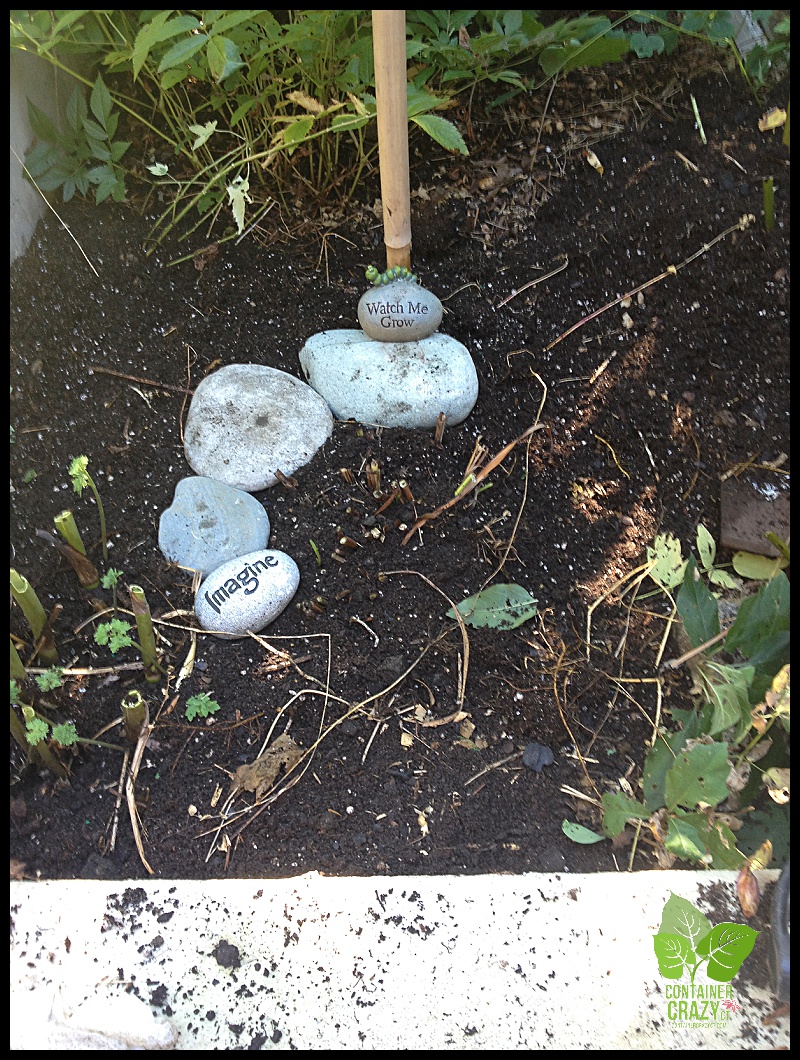
Then I put some stones around the Crocosmia to help me remember I moved it there. Even if I don’t keep it in this spot permanently, it is now saved for next season.

Crocosmia Blooms from a Prior Season

Crocosmia Blooms from a Prior Season

I love my big cement planter because the soil is so healthy and easy to work in, and dig in. Yesterday, I noticed some worm castings in the soil. This is what they look like below. It a sign the little critters in the soil are doing a great job of keeping the soil healthy. Worms increase air and water movement in the soil and help break down organic matter when they eat, leaving these worm castings behind which help the plant’s growth.

Worm Castings in Soil

Worm Castings in Soil

As noted in yesterday’s post, I sometimes put old soil balls/masses from dismantled containers into “big” pots or into gardens as a filler in the base – this is one example. The soil in this big cement planter is from former container gardens, and the worms moved in quickly. The soil is rich now.

ContainerGardenTakeDown_0013

Begonia from Tubers (see yesterday's post!)

Begonia from Tubers (see yesterday’s post!)

By the way, yesterday I wrote about storing tubers from tuberous Begonias. Here’s a photo of the plant from this summer (see above) which I found this morning in my files.

Note: The details about appropriate storing temperature, methods, and specifics by type of plant for overwintering various plants will be covered in the demo session on October 17th. If I were to write all the details here, this would be a very long post – and I’m wordy enough! But this shows you the basics. It is fairly easy to overwinter plants but there are other tips to be learned.

Keep tuned in – more tomorrow…

Cathy Testa
860-977-9473
containercathy@gmail.com

ContainerGardenTakeDown_0025

NEXT UP: How to Overwinter or Store Plants from Your Container Gardens

Leave a comment

In about five weeks or so from today, it will be time to disassemble and clean-up your container gardens and patio pots, which includes overwintering or storing your plants to reuse/regrow the following year.

Smaller Pots

I already started doing some of this work – starting with smaller pots and window boxes that had lettuce and cucumbers growing in them. My first step is removing any tidbits of stems from the soil, pulling it away with my hands. Then I dump the soil on a table and break it up with my hands. The soil gets placed into a big plastic bin because I plan to grow more lettuce, parsley, basil, and kale this fall and winter in my growing room – so I will reuse this soil. I think it is important to break up the soil to revive the air spaces. Big plastic bins work well for these types of pots for me for the soil storage. They are easy to move and keep things tidy. The empty window boxes and small pots get washed a bit by using my garden hose, and if they don’t clean up easily, a bit of soapy water is used. Cleaning is an important step in the process to avoid any disease transmittal and to maintain the life of your containers and window boxes.

Tropical Plants

In October, either before our frost hits plants or immediately after, I put away my Canna and Banana plants (Note: Some tropical plants should not be hit by frost before moving them inside or storing the storage organs or root bases). I plan to demo my process of storing plants from container gardens and patio pots on October 17th and will be offering it as a demo day. Anyone whom wishes to witness the process is welcome to come to my house at 10:30 am. A small attendance fee applies. If for some reason the cold weather arrives earlier however, this may get moved to October 10th – I will keep you posted if you sign up (see the Contact Form below).

Seeing is Believing

Seeing is believing, and seeing is learning. Many friends prefer to see how this process is done to learn it – but you may also read the how to’s in my prior posts. For example, when I stored my red banana plant one year, every step was documented with photos (and yes, this is the same red banana plant I’ve been posting photos of this summer, growing in my big black pot this year). It was a very cold day at the end of October when I documented the process, requiring a thick pull over and warm gloves, but I enjoyed every minute regardless, because it was worth it. This particular plant has been regrown in a container for the past 4 years. It just keeps getting bigger and showier.

STORING MY BIG RED BANANA PLANT POST

Holding an leaf and cut off top of my red banana plant.

Holding an leaf and cut off top of my red banana plant.

Perennials in Pots

This year’s theme for my Container Garden Workshops in May was perennials in pots. So, if you have some in your containers, you may start any time from now until the end of October to start moving them from your pots to your gardens. Transplanting perennials is best done in the spring so they have time to establish, but it will work out fine if done in the fall for many hardy and tougher perennials – I’ve done this many times with container plants – and they survive. There are other ways to overwinter them (leave in the pot and move to a sheltered spot such as your garage, or sink pots into the ground). But you may do this now or up to end of October before the ground starts to get too cold to work in. I’ve moved perennials even in early November with success. More will be discussed on the demo day too.

Base of Canna Roots

Base of removed soil mass from a big pot

Succulents

One thing I have emphasized in my workshops is moving succulents (cacti like plants, Jade plants, Agaves, Aloe, etc.) into the home before it gets too cold during October. Think of days when we start getting some cold rain falls and the nights begin to get cooler. I find when the foliage of cacti like plants or succulents get hit by cold wet rain and the soil stay damp, they start to rot. Sometimes I move them inside before this type of weather pattern begins in the fall. While these plants may still survive a bit of chill before it gets really cold, it leads to trouble. For example, I have a beautiful Jade plant in my red head planter, I plan to move it in soon.

Red Head with Jade

Red Hed with Gem Dangling – Gets Moved Inside before Chills – Photo by Joyful Reflections Photography of Ellington, CT.

Save Your Pots for Winter Decor

Another good tip is pots with soil are handy in the winter if you wish to stuff them with live evergreen cuttings and stem tips as a winter themed decoration on your deck for the holidays. So, empty all the plants, but leave the soil in the pot, store it, and when the “Holiday Kissing Ball and Evergreen Decorations” workshop comes up in early December, you will find this ‘soil filled pot’ handy to insert your green decor. The 2015 dates for these fun holiday workshops are December 5th and 12th. See the link for all the details or click on Nature with Art Class Programs on the blog’s top menu bar.

Barrels in-front of Joe's Fine Wine & Spirits by Cathy T

Evergreens in a big container garden for holiday displays

October Demo Information

If you can’t make the demo day noted above (and see more information below), you also have the option of hiring me by appointment to show you how to disassemble and save your container garden plants. We will work together.

Have Me Do It for You

And the thought occurred to me recently, if you wish to hire me to do it for you – feel free to ask! As I know days are busy and you may have difficulty getting to the task yourself. But book me soon, time is running out fast. An hourly rate applies (see below).

Instagram screen of my big red banana plant

Instagram screen of my big red banana plant above photo.

Storing Tropical Plants Demo/Workshop

Date: Saturday, October 17th, 2015
(Note: If frost arrives early – this date “could get moved” to the weekend prior, October 10th)

Time: 10:30 am to 11:30 am (end time may run over a bit)

Location: 72 Harrington Road, Broad Brook, CT 06016

Cost: $8 per person (pay at session)

In this session, Cathy T will walk her property and demonstrate how to take down tropical plants from various container gardens to show you how to store (over winter) the plants for reuse the following season. You will learn which tools to use, what products to store them in, and misc tips on the how-to’s.

If you wish to see the process to learn the hands-on how to, this session is for you – and especially for attendees of Cathy T’s May Container Garden Workshops.

Plants to Be Demonstrated: Red banana plant (Ensete), Canna, Elephant Ears (Colocasia), and Angel Trumpet (Brugmansia).

A cart filled with tops of summer plants after the summer season is over

A cart filled with tops of summer plants after the summer season is over

Private Appointments:

Available at $25 per hour where I work with you to store your plants from your container gardens. To schedule, email containercathy@gmail.com.

To sign up, complete the form below:

Go back

Your message has been sent

Warning
Warning
Warning
Warning

Warning.