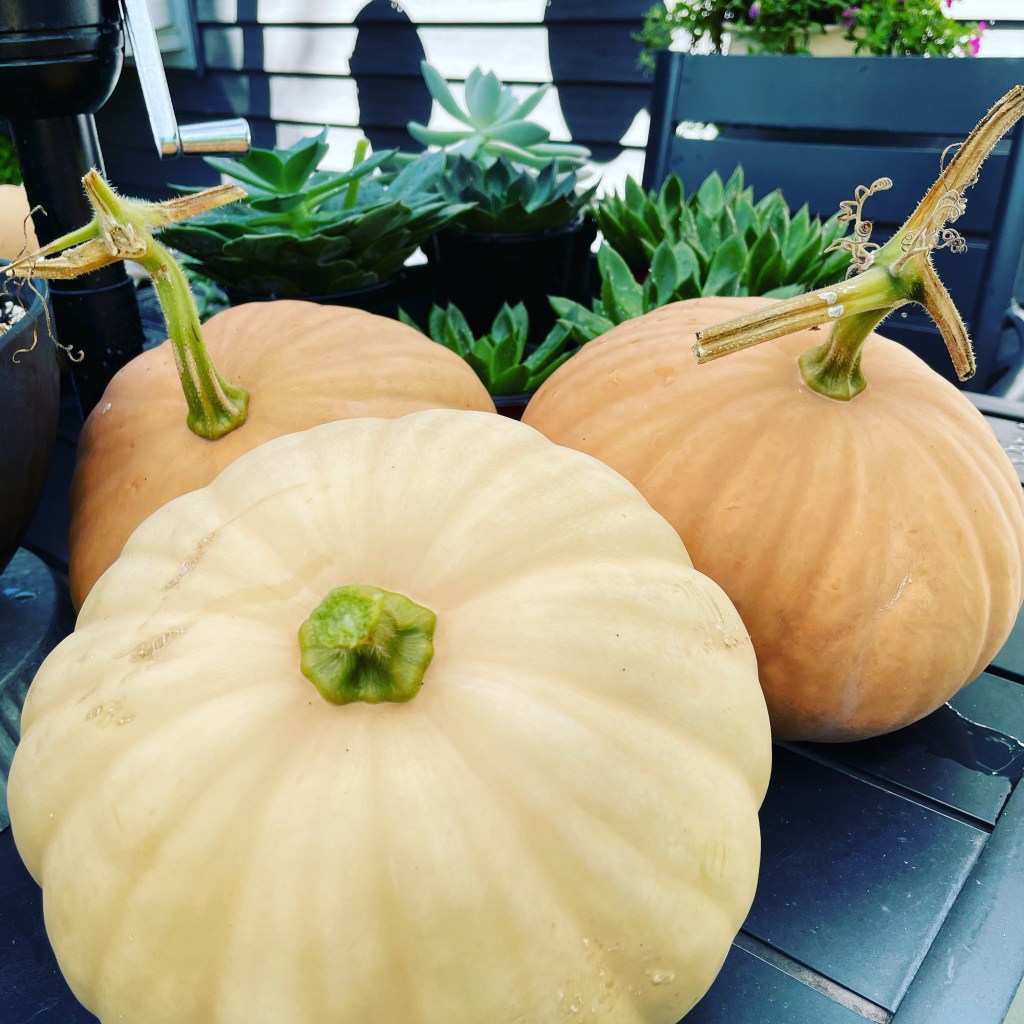
This is my 2nd year trying to grow some Long Island Cheese Pumpkins and I started them a bit too early again. They were ready by mid-August, and I’d prefer them to be ready by mid-September. Anyhow, they are just fine sitting on a table with no blemishes and curing for a week or two in the sun. I use them primarily to decorate for autumn but maybe I’ll get into growing more of them next year as a food source for winter soups and Thanksgiving pies!
The Long Island Cheese Pumpkins resembles a wheel of cheese in shape and the color is very pale compared to ordinary orange pumpkins, but I like these for the shape. The seeds for these may be directly sown into a garden or large pot or started early indoors. I started these indoors in early to mid-May of this year, and last year, I had started them indoors in mid-April. It seems early May was still a tad bit too early. So, a new date is noted for 2024.
Because squash, which this pumpkin is technically a squash, grow really fast, they should not be started earlier than 3 weeks before spring frost. It takes about 98 days till they are ready. Anyhow, if they arrive earlier than your needs, just let them cure in the sun for a week or two. Cured squash will store all winter. They are pretty cool in that regard. And because they last a long time, they are perfect for the succulent topped pumpkins I usually make to display in the home thru Thanksgiving time.
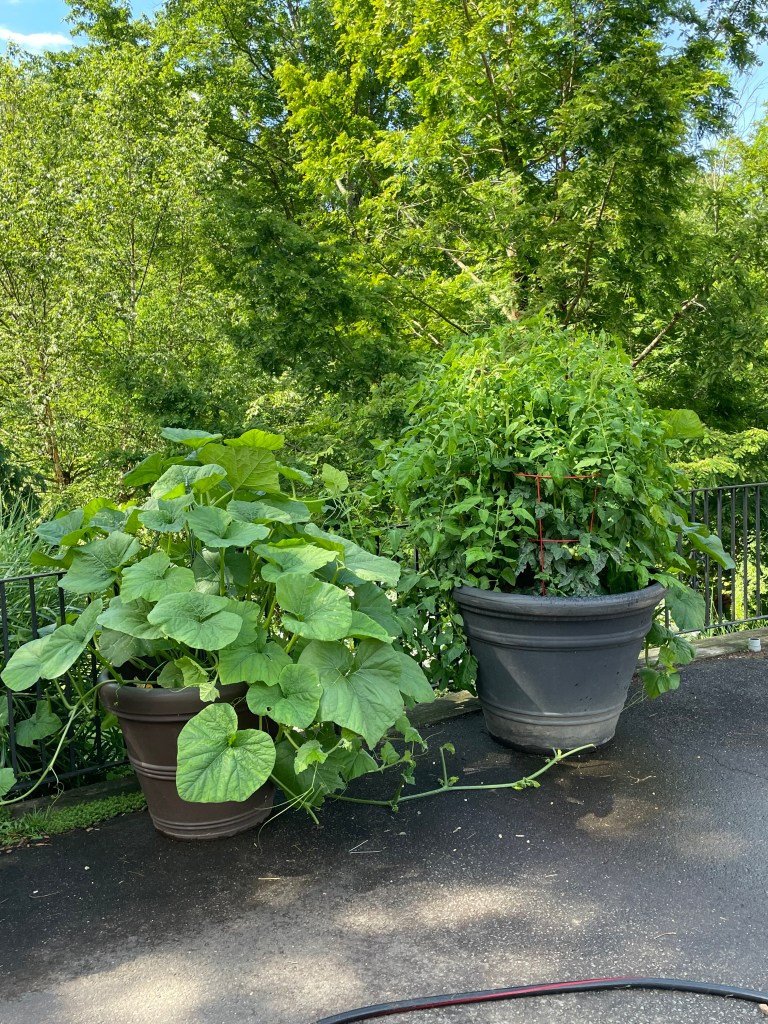
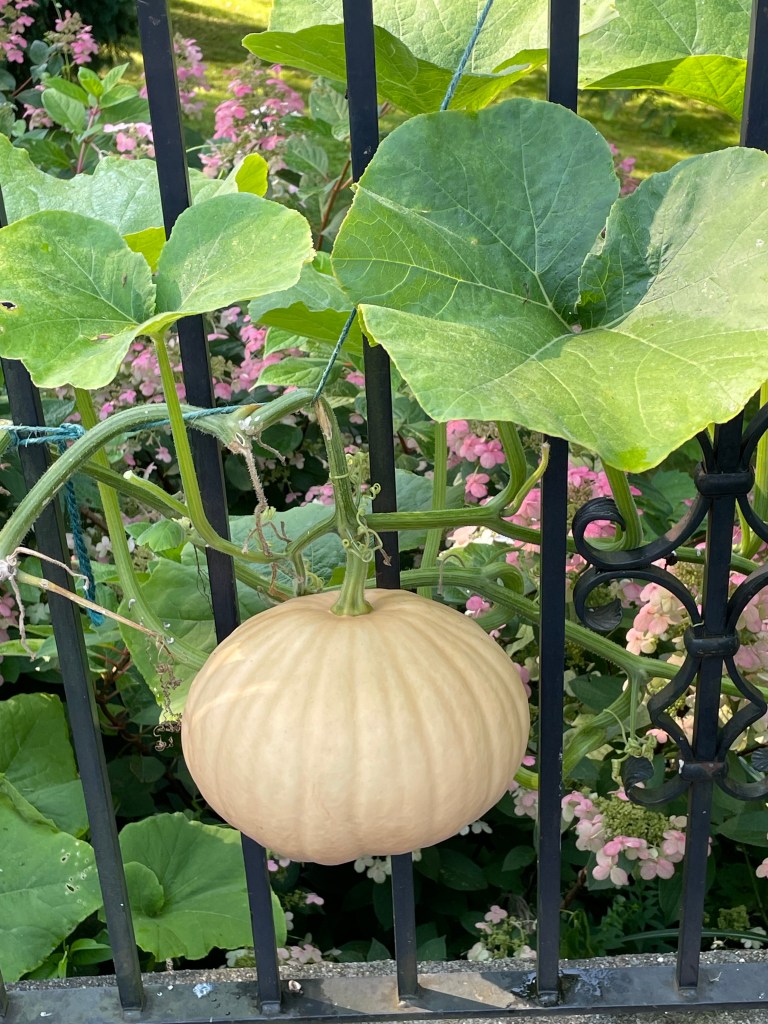
This year, I grew them in two places. One in a super big pot on my driveway and one in a large square planter on my deck. The one on the driveway worked out well because I take garden twine and help them run up the twine along a wrought iron fence. The tendrils quickly grasp on various places on the fencing, and they hang on. By having them on a twine like this, the pumpkins do not touch the ground so there is less chance of any rotting from sitting on a wet surface and no blemishes. Also, no animals messed with them. That could be because they were somewhat hidden by a background of other plants.
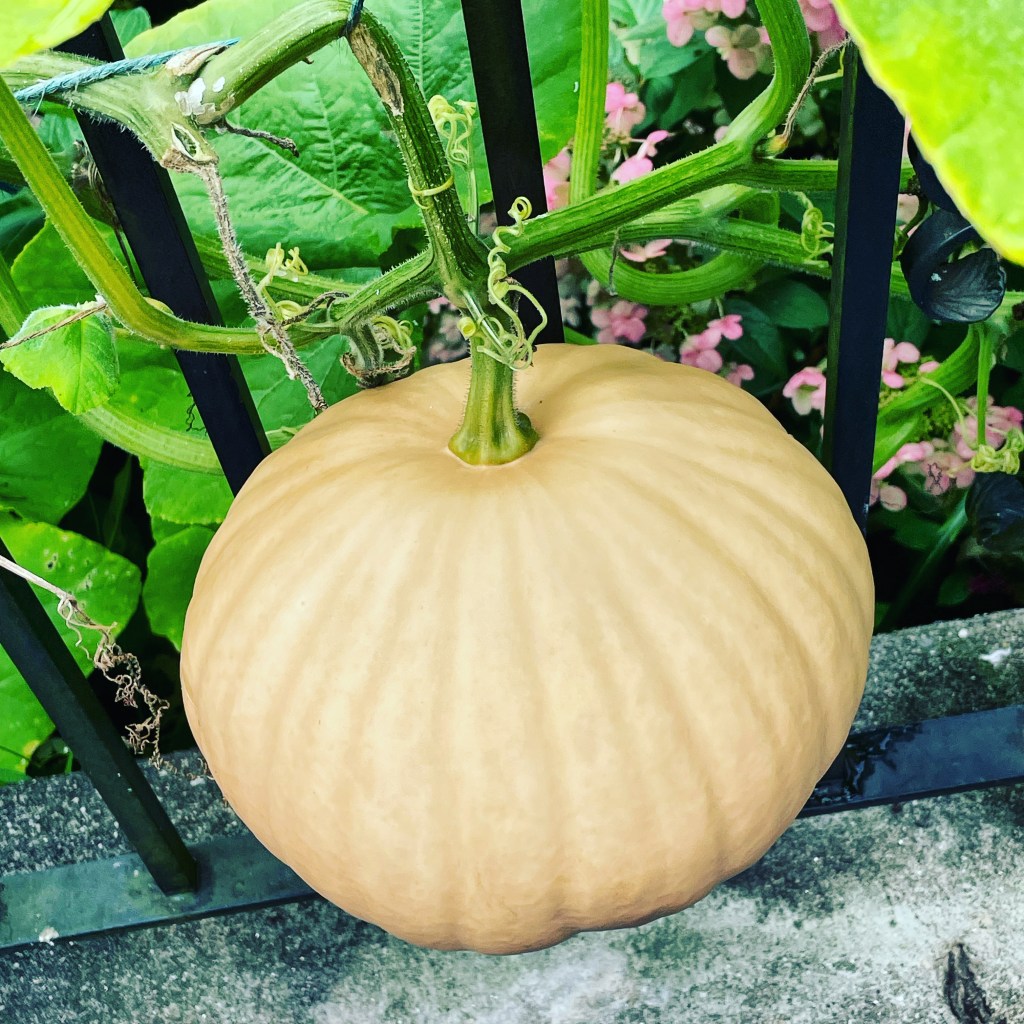
The one on my deck sprawled out on to the deck floor and then I let it hang over the edge of the deck. I got only one pumpkin on that one, but it was cool to see it hanging in the air, so I helped it stay put by using a hanger. Anyhow, the one on the driveway got 4 pumpkins. I’ve been just kind of experimenting and having fun with them. As I learn, maybe I’ll get into growing more next year.
One of the nice benefits of pumpkins is their huge beautiful yellow flowers – which the bees absolutely adore. Some mornings, I’d find up to 4 bees in one flower buzzing away. If you want to help pollinators, plant some pumpkins!
Pumpkin on the left (tomato plant on the right)
Pumpkin hanging from deck above.
Sitting on a table to cure for a couple weeks.
You can see the color difference in the last photo above. I kind of determined when to pick them by the firmness of the rind and also looking at the stem, but I was somewhat guessing too. Plus, the plants started to look a little worn, so I figured it was time to cut them loose around mid-August.
I watered the plants regularly with generous amounts of water, but I did not fertilize except one time with a liquid feed. The soil had compost in it in the pots. The plants prefer full to nearly full sun, and the one on the deck didn’t get as much sun as the one on the driveway. Oh I said the animals didn’t bother the pumpkins, but some of the leaves got munch off once, maybe by a brave rabbit. Brave because my cat is an excellent rabbit hunter.
I plan to do more research on pumpkins because for some reason I’m interested in them! Maybe because it seems they don’t get bothered much if provided a safe place to grow. Wish me luck for next year – I hope to have more harvested.
Just a reminder, I offer watering services for your plants during the heat of summer. Focus is on container gardens, patio pots, window boxes, hanging baskets, raised garden beds, and anything grown in pots. I also water community garden plots. I do not handle newly installed landscaping areas or trees recently planted.
If you are in need and are local to or near my area, reach out by contacting me. I’d be happy to provide more information and availability with an information sheet detailing all. While we had a great deal of rain, the hot days are coming! It is nice to return from your vacations knowing your precious plants are not going to suffer while you are gone. Plants put out the most blooms and focus on fruits in the height of summer, which is why watering and care is so important when you are away.
I also offer help with monitoring your plants for any problem insects as well while you are away. They are best caught early, and this is part of the service when watering and I’ll pick up mail or other items for you too. When plants become stressed and thirsty, it signals pests to attack. Keeping up with your watering and come home to beautiful, lush plants!
Thank you and enjoy this beautifully sunny day,
Cathy Testa Container Crazy CT 860-977-9473 (Texts welcome. I’m also on Facebook under Container Crazy CT. DM’s welcome!) containercathy@gmail.com
Located in the Broad Brook section of East Windsor, CT. References provided upon request. See also http://www.WORKSHOPSCT.com for more service listings.
Camping is a new adventure for me and my hubby, Steve. We decided to buy a small camper last year. It was quite spontaneous, somewhat. We got a bit tired of the airline scene and thought, we could give this a try.
Steve really was all for it – but I panicked a little after he signed the dotted line and thought, is camping for me? Well, long story short – I absolutely love it. You are surrounded by nature, you are forced to relax and chill, and it is a fun adventure each time we try a new place. As one of his friends said, “Camping is just plain fun.” And it is and has been so far.
It got me thinking about plants too. On our most recent journey, to the Acadia National Park area, I saw plants here and there and welp, I decided to blog today on what I spotted.
Acadia National Park
Steve was the one who picked the Acadia location. Because I knew there are lots of nature things to do there, from hiking to kayaking, I wanted to make sure we could find hiking trails and know where to go, so I picked up a book by Hilary Nangle about the Acadia National Park area and it was quite helpful. She provides maps, tips and locations for hiking and kayaking, eating, etc. She divided the book into chapters about Mount Desert Island, Schoodic Peninsula, Blue Hill Peninsula, Deer Isle, Ellsworth and Trenton and more towns.
Our first little camper! You can see my basil on the table brought from home for my cooking.
Trenton, Maine
Trenton is where we stayed at a place called Wild Acadia Camping Resort. It is near towns like Ellsworth and Bar Harbor, and we liked the location. Originally, we picked this location because it has a kid’s zone, but we are kid-less, so it was more around the thought that my younger sister might meet us there with her kids. But that didn’t happen this go around, anyhow, we did like this little campground. One of the best amenities was a new barn they have complete with wonderful bathrooms, showers (coin operated), laundry and even a sink area for doing dishes for the campers. I thought it was just beautiful. They did have flowers barrels outside but stupid me, I didn’t take a photo, but it was several barrels of petunias out front.
Barn with showers and bathrooms
Every morning a crew cleaned this new barn, and I was very impressed with it – we got lucky! I had no idea this was there, and it is new. So are two new cabins they were in the process of building. They also have tents sites and RV sites. Some more in the wooded area in the far back than others. The kids’ zone is in the front entrance areas. I liked that our site was in the back by the barn.
Anyhow, that was our home base and we enjoyed it. Unfortunately, it was cool, misty weather the whole week with rain, but it was never a downpour or total rainy day. We had breaks of sun one day, and we were never rained out of sitting by a fire at the campsite, thankfully!
Planter outside of a Store in Ellsworth
Ellsworth and Bar Harbor, ME
One day we met up with my sister, Lisa and her husband to have BBQ at a place called Mainely Meat BBQ at 15 Knox Road in Bar Harbor. It was very good and had an excellent vibe with a brewery next door. That was fun and after we decided to go to Ellsworth and do a little quaint store shopping. As Lisa and I walked store fronts, I spotted this planter above with a Coleus (with the bright lime green edges around wine-colored centers), Sweet Potatoe Vine (with the dark chocolate color), and a trailing fuzzy foliage plant (having a brain fart on the name at the moment – I’ll update!). I paused to take two photos. What a lovely combination, I thought! I loved how all three plants intermingled well together. And whomever was watering and caring for it was doing a nice job – all was very healthy. We shopped the stores here and I really liked several of them, from cool clothing to artsy finds. Worth a stop on a rainy day.
Update: The trailing silver fuzzy plant in the combination above is called: Helichrysum petiolare ‘Silver’
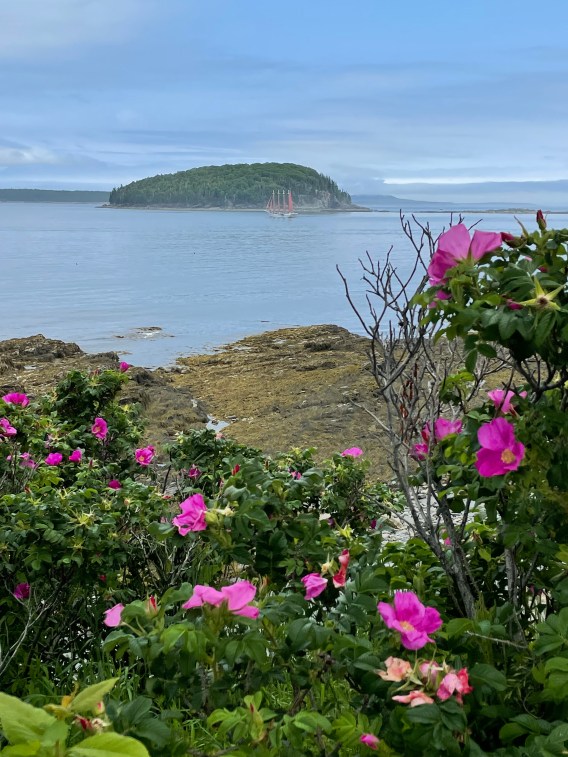
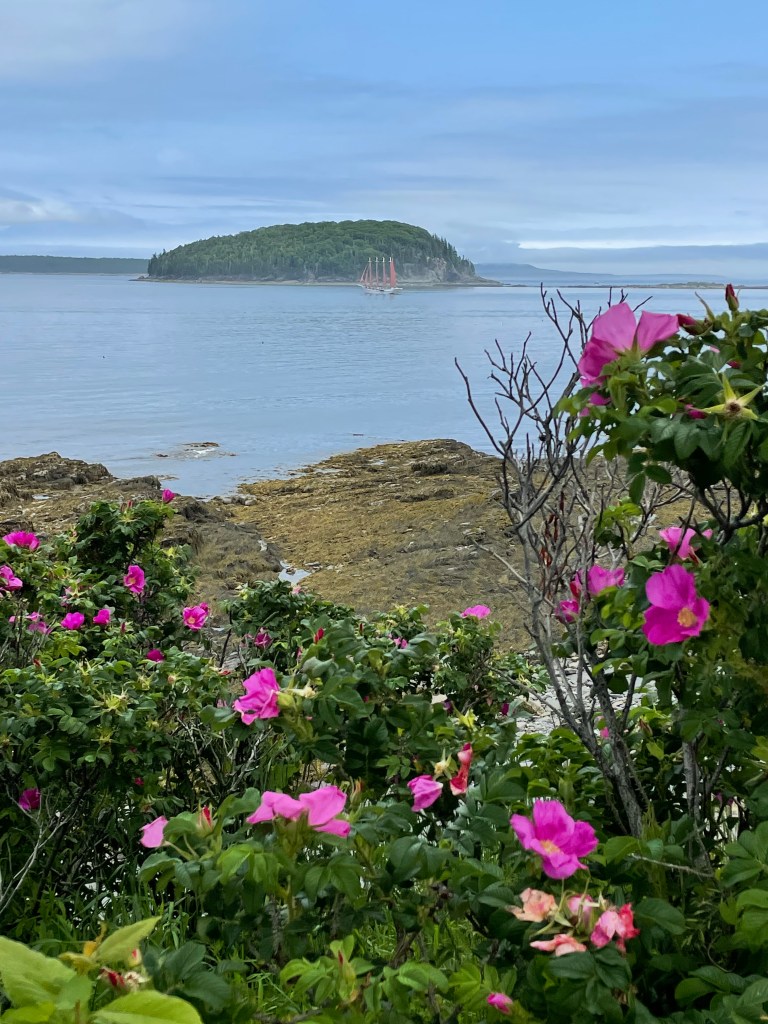
Roses along a shore path behind Bar Harbor Shops
Bar Harbor Area
My husband and I walked the Bar Harbor area as well on another slightly rainy day. There are several shops and restaurants. Down one side street off Main Street is a larger parking place, so we parked there and took a walkway shore path along the back that is lovely. We packed some snacks and a blanket, so we sat there admiring the views and watching boats for a while. Beach roses scented the area for us. We watched sea kayakers go by, there is a town pier to checkout, and a really nice Inn facing the water along the shore path. In the old days, we would stay in an Inn like that – but these days we are campers! LOL. And of course, there are shops and pubs. The shops had lots and lots of t-shirts and sweatshirts. Lots of trinket shops whereas Ellsworth had more artsy shops, at least I thought so.
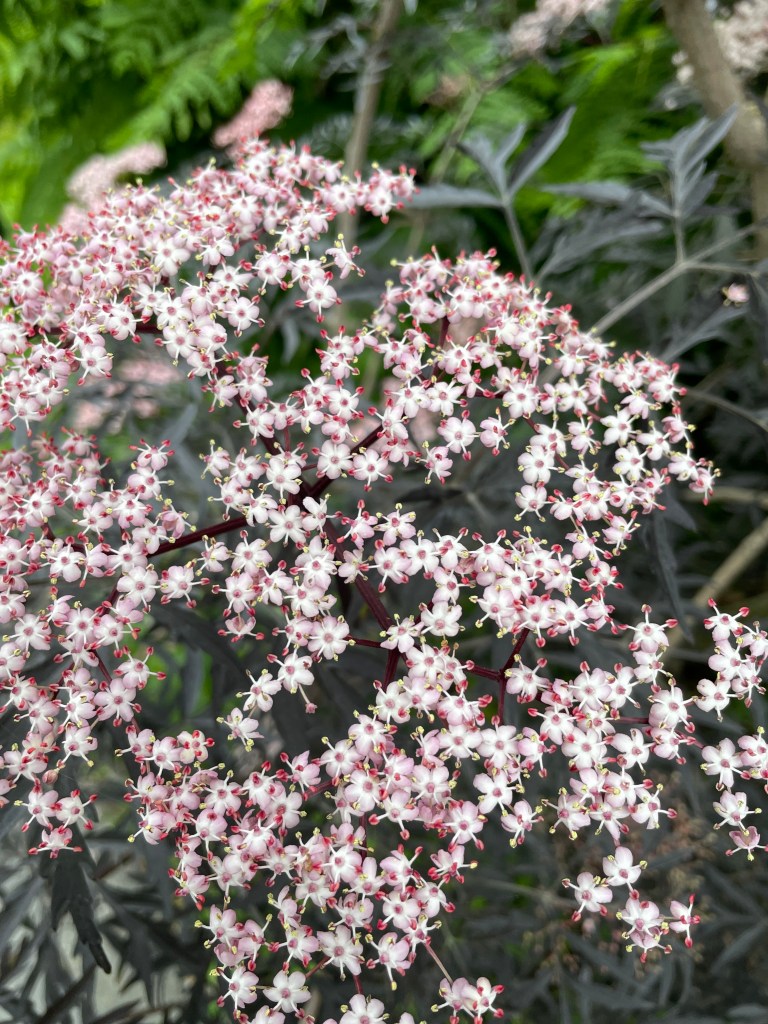
Not Cimicifuga Plant! This is a Black Lace Elderberry!
Along the road to the parking area, where we started our walk the shore path, was a very impressive Elderberry plant. In my prior post, I mis-identified it as Cimcifuga. Their foliage is similar, and I was super tired when I wrote my blog post yesterday, ooops! I realized my error this morning. Either way, it was one of those that I knew the plant, but my brain fog made me forget the name at the time and later. Must be getting old! LOL.
Crabapple Tree at Lamoine State Park Beach
Lamoine State Park and Beach were not that far from our camping place, so one day, I said, let’s go look at it – maybe it is a nice place to camp next time we come out this way. They charge $6 per person to enter the area beach area, and because it was rainy or wet like weather, the place was pretty much void of people. There were a couple of people fishing and a few just kind of looking at the views like we did from the beach. It has a big vast ocean view, and I noticed this tree as we stood at the beach. I believe it is a crabapple. Anyhow, the beach area is not huge, and neither was the parking, so I can imagine when sunny and busy, it may be tricky to get a spot there. It has a boat launch too. There was also the state park with campsites area, however, we were not allowed to go there so we could not see how it was set up. Apparently, the state park area is 55-acres. I was disappointed to not be able to drive thru to see how it was setup.
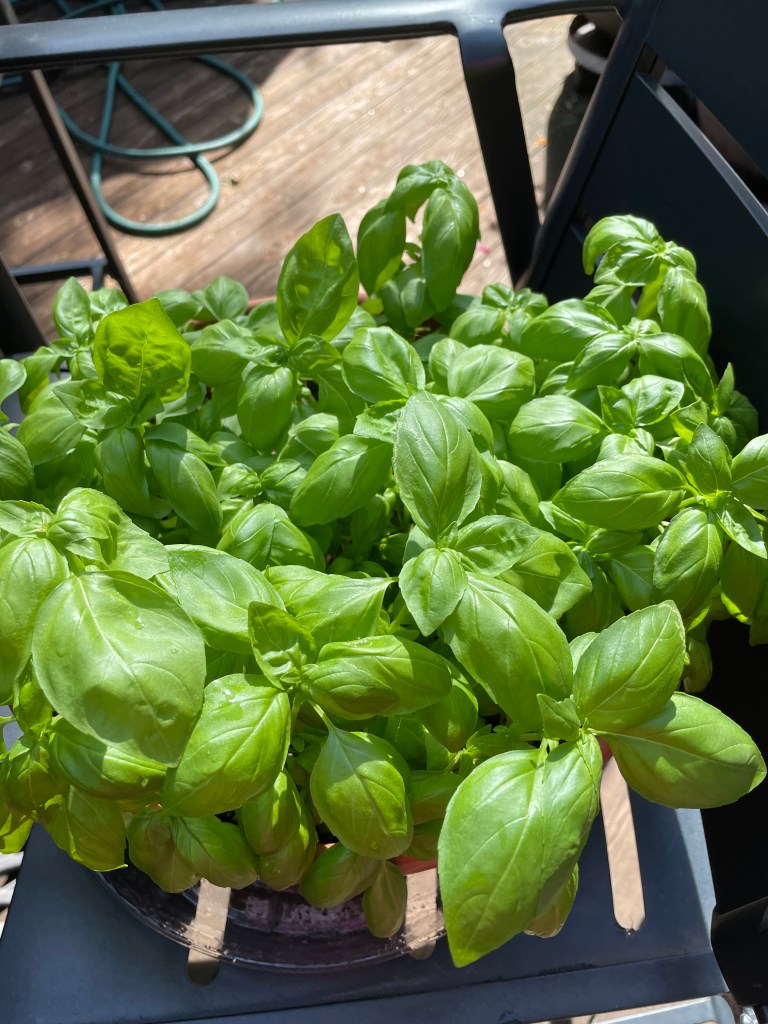
My homegrown basil
Yummy pasta creation with Gorgonzola Sauce
After several days of grilling food, we really had a hankering for some pasta by our fire at the campsite. I had purchased some Gorgonzola Cream Sauce from Difiore’s in Ellington and made up this quick recipe with my basil, of course. I cooked the small sized brussel sprouts in a little bit of olive oil and tossed them around for a while. The were frozen in a bag, and then I added the yummy sauce, some white wine, and angel-hair pasta that was pre-boiled, and wow, I have to say, it was just delicious! Maybe it was that sauce and the fact it was like a cool fall wet day; we gobbled it up!
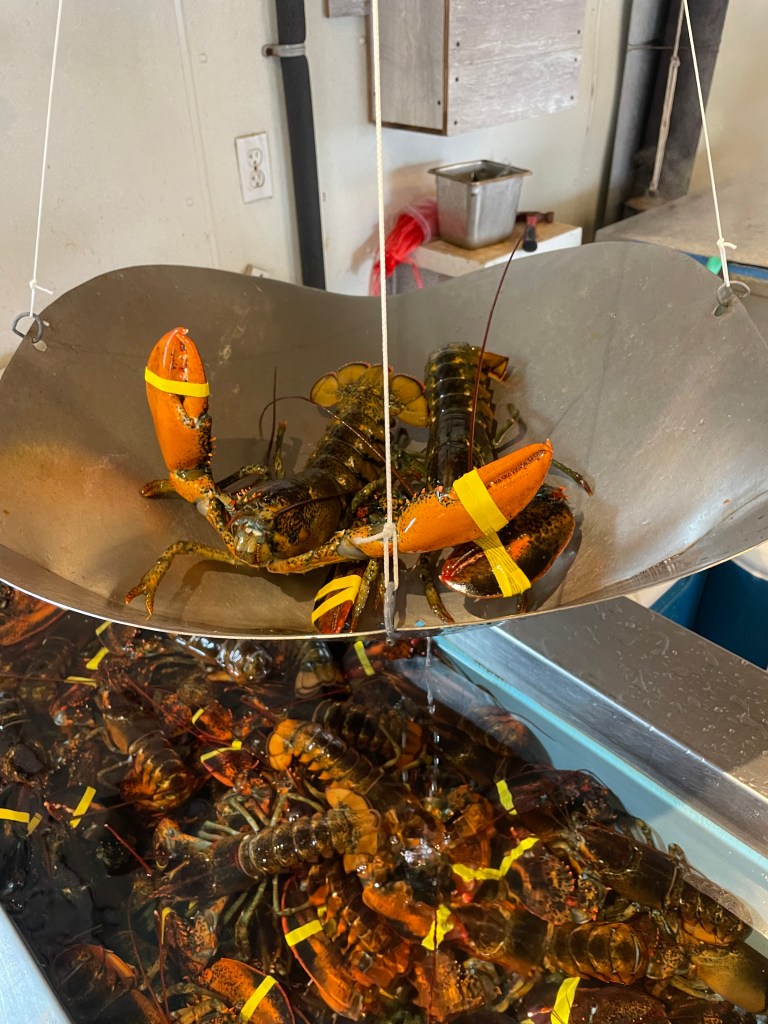
Lively Lobsters!
We also had lobsters, of course, while in Maine – and found this place from the book I referenced above. Wow, it did not disappoint. Nothing like fresh lobsters while viewing views of the pier and ocean, and boats. This place was 12 miles from our campsite location and worth the drive. It is called Beal’s Lobster Pier at 182 Clark Road, Southwest Harbor area.
We did tons and tons of other activities, from walks to browsing areas. Two favs of the week were the drive to Schoodic Point and Peninsula of Acadia National Park. And hiking Ocean Path starting at Otter Cliffs on the one sunny day we had. Those were amazing sights to see. We did not eat and only sit by campfires but the weather prevented us from some hikes and kayak plans. There’s always next time!
I hope to take more photos on the next camping adventure and continue sharing it with you. I think it will become a new hobby for me.
Thanks for visiting!
Cathy Testa http://www.ContainerCrazyCT.com Located in Broad Brook, CT Date of this post: 7/10/2023 Location of Camping: Trenton, Maine
Salvias are definitely a favorite by the hummingbirds visiting my surroundings at home. I have 2 male hummingbirds and I’ve seen one female hummingbird so far. Every evening, one visits my Salvia blooms between 5 and 6 pm.
Cathy T’s Planters at Home with Salvias, Sky Petunias, and other plants.
This one with the fuchsia-colored blooms seem to be his favorite. A male hummingbird pops by it and bounces from bloom to bloom. This one I don’t have the plant tag for but the darker Salvia in the taller planter is Salvia Rockin’ Deep Purple.
Salvia Rockin’ Deep Purple
The Rockin Deep Purple hybrid is a bit shorter than the other one. I’m not sure if the other one just bolted more due to weather conditions. Rockin Deep Purple Salvia reaches about 30-40″ tall per the plant’s tag.
Salvia with Fuchsia-colored Blooms
I didn’t have a tag for this one, but it has the most beautiful vivid deep fuchsia color to its blooms. They all have an upright and vertical habit and bloom till end of the summer season here in Connecticut. They are treated as an annual here in Connecticut as well.
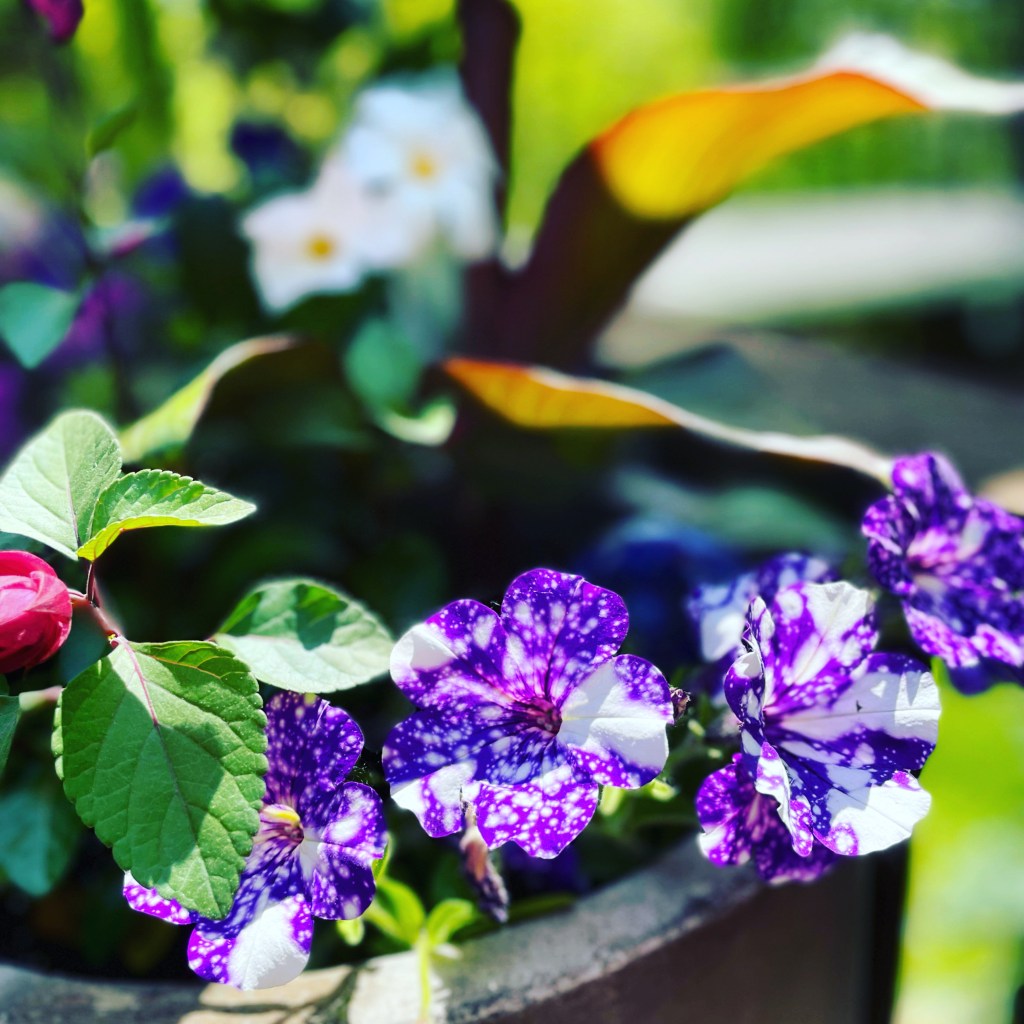
Sky Petunias
I wanted more color this year in my planters to attract the hummingbirds and butterflies. Although I’ve witnessed butterflies going by my trees near my house often this year, I still haven’t managed to catch one on a bloom. The Sky Petunia annuals really add a nice pop of color. Although, I tend to love big foliage plants, I decided to add these along with the Salvia plants. The hummingbirds do not feed from the Petunias (yet). I’ve seen them look at them, but they do not feed for whatever reason.
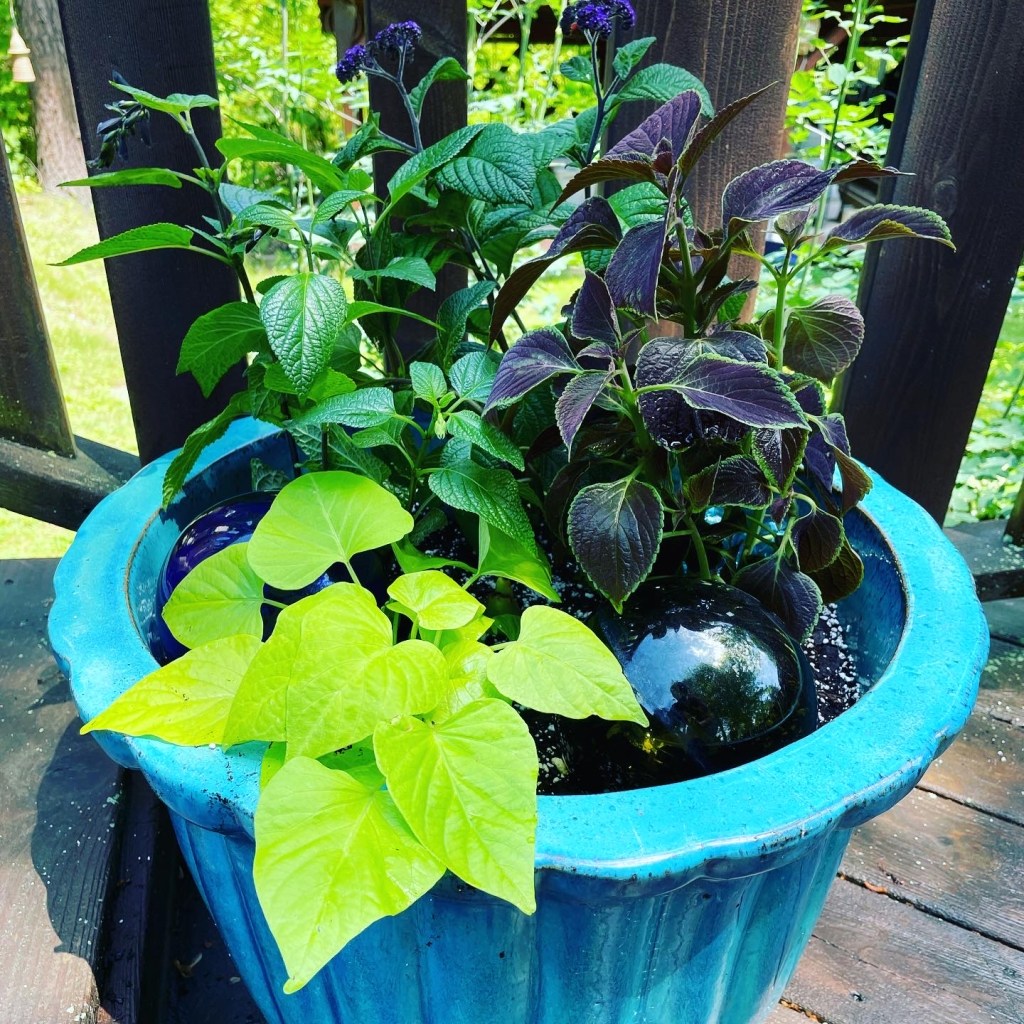
My New Blue Glazed Pot
My sister-in-law gave me this nice big blue glazed pot because she moved into an apartment and there is no place for outdoor gardens. She generously donated this pot to me. So, yesterday, I wanted to again add color around my deck and got a Salvia Black & Bloom to plant with these other annuals.
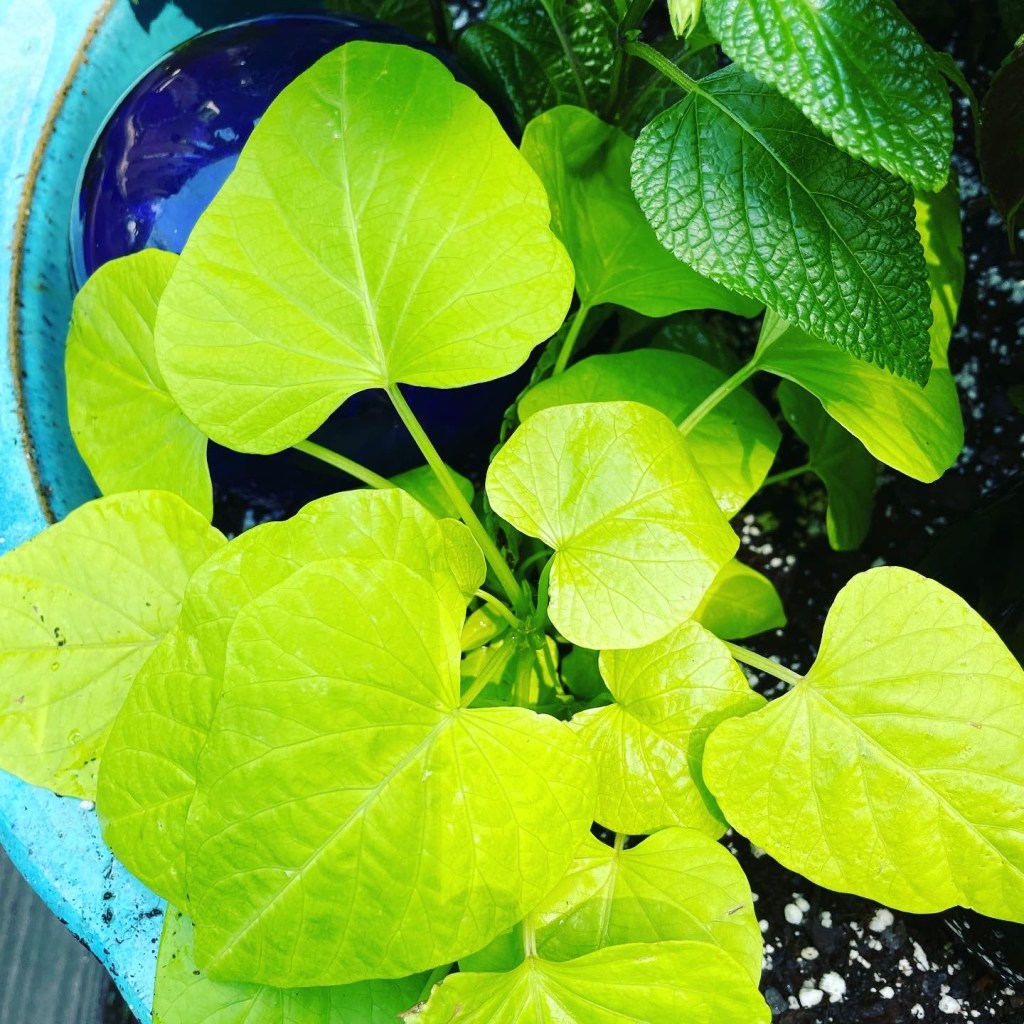
Sweet Georgia Heart Light Green (Sweet Potatoe Vine).
I added a Sweet Potatoe Vine with a bright light green color to give an additional contrasting pop of color. I felt like I hadn’t planted a sweet potato vine in years. It was like being reunited with an old friend. This one picks up on the colors of the Coleus in the planter which has edges in a similar color. Sweet potatoes vines are vigorous once they get established so it will spill over the pot’s edges eventually.
Coleus Vino
I swear I had no idea this cultivar was called Coleus Vino! LOL! Contrast is so key and the darker tone next to the bright tone of the potatoe vine would work I thought when I grabbed this Coleus. The edges are perfect to pair.
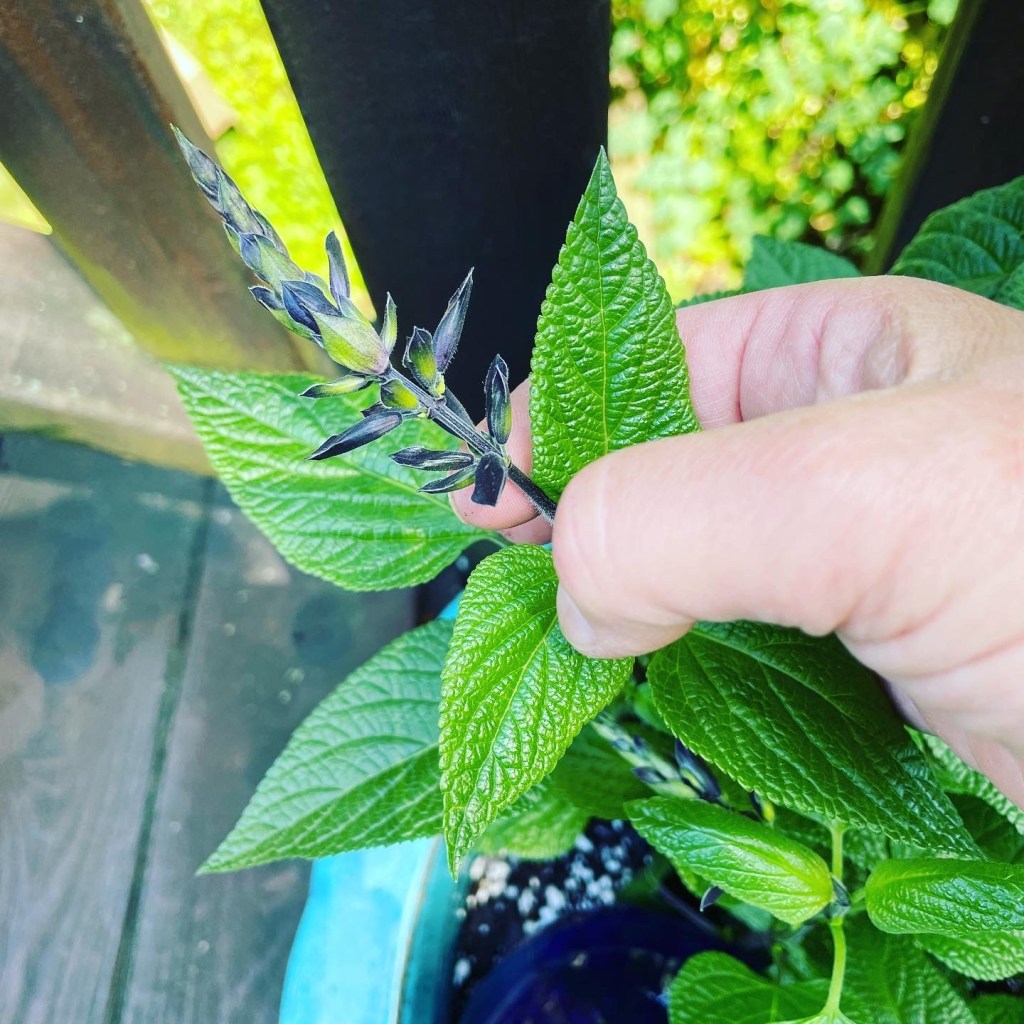
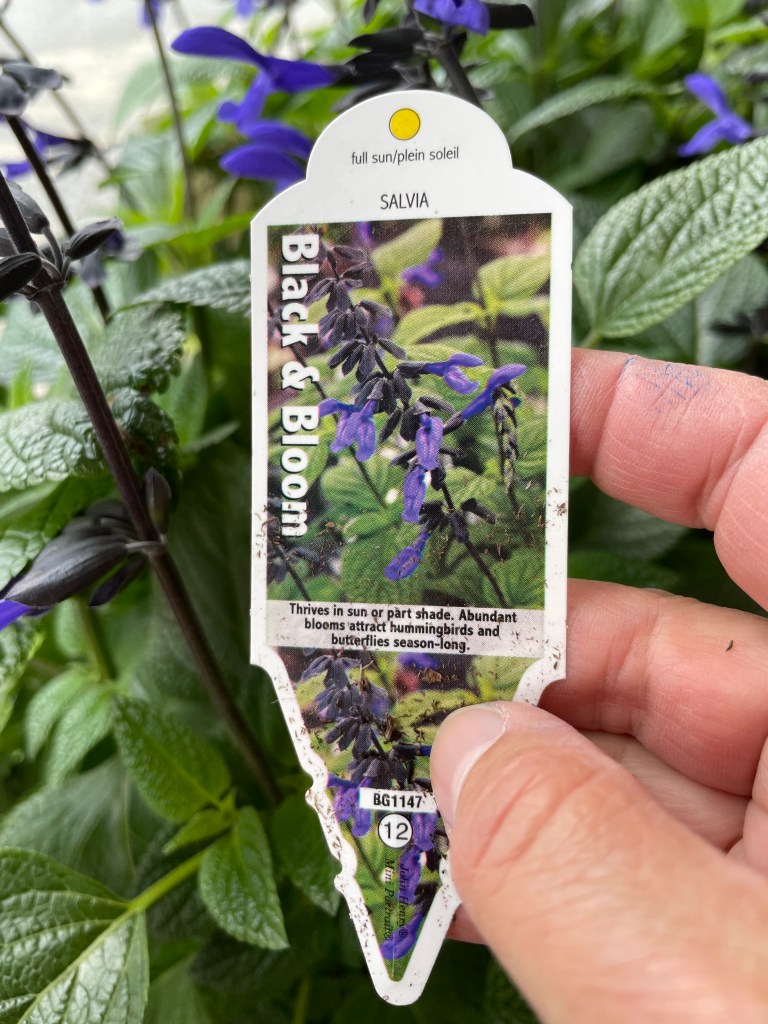
Salvia Black & Bloom
This one has many flower buds about to open. I think this one is popular and I’ve seen huge plants of this one before many times. It reaches 24-36″ tall and blooms spring till fall. I’m hoping my humminbird friend will spot this one as well soon.
The Salvias like full to part sun, and the Coleus likes full sun and/or shade.
In the center of the blue planter, I put an upright Alocasia that is just starting to push its top growth out of the soil. Hopefully all will look splendid together this summer as the planter fills out.
Tucked in the back is a Heliotrope. A purple bloomer.
Heliotrope
I think I saw Heliotropes for the first time when I worked at a small business in Grandby. The owner liked these and used them a lot. They are low-maintenance, just like Salvias, in my opinion. However, I felt they were (the Heliotropes that is) a bit old fashioned looking for my taste. I must be getting older cause I like them now, but my overall goal was more color in my container gardens.
As for the hummingbirds, I am always thrilled to see and hear them around me. I put out feeders with the sugar water and one trick I do to make sure the sugar water remains fresh is I don’t fill the feeders all the way. I usually put about 1/3 of the mix in there and it forces me to refresh it often. Sometimes sugar water goes sour and that can make the hummingbirds sick or may even die. It is also good to keep sugar water out of full sun and wash the feeders between refills. I would never want to hurt a hummingbird as they are far too precious.
About two weeks ago, I witness a hummingbird do a u-shape pattern by my honeysuckle perennial plant in the ground. They like honeysuckles too. But back to the dance he did, I witnessed that same thing a few years back. I read it has to do with a mating dance. As noted below on Princeton’s website, they dive up and down (to me as a u-shape) and it is a super-fast motion. Very cool to witness!
I also have seen a hummingbird perch on the power lines to the corner of my house. Every evening, around 6 pm, there he is perched. He looks left to right up and down for about 5 or so minutes, takes off, comes back and does it again. I started to wonder if he/or maybe it is she, has a nest nearby in my front landscape.
“Hummingbirds are no exception when it comes to snazzy performances, as males of many species perform spectacular courtship dives. Broad-tailed hummingbirds (Selasphorus platycercus) fly up to 100 feet in the air before sweeping down toward a perched female, then climb back up for a subsequent dive in the opposite direction. At the Rocky Mountain Biological Laboratory in Gothic, Colorado, home to a population of breeding broad-tailed hummingbirds, researchers from Princeton University have been investigating how hummingbirds combine speed, sound and color in their displays. Their work appears in the Dec. 18 issue of the journal Nature Communications.”
Lastly, above it the Salvia plant label. I spotted some yesterday at Dzens garden stand, and you could probably find these at The Garden Barn in Vernon, CT or at Revay’s Garden Center in Broad Brook, CT. However, some of the local nurseries are already low on stock and/or appear to be closing. I think June 14th is way too early to close shop, but I realize patterns dictate. However, us plant junkies do need our plant fixes all summer long. If you see some good Salvias and want hummingbird visitors, I suggest you grab them fast. They really do attract hummingbirds!!
Find me on Facebook and Instagram under Container Crazy CT
Don’t forget – I’m offering Watering Services again this summer! It will get very hot eventually. Contact me at 860-977-9473 if you are local and have the need. Thank you – Cathy T.
That is what two televisions station weathermen said last night (5/9/23), that we may get “possible pockets of frost in some areas” of Massachusetts and Connecticut.
If you look at my prior posts and some from past posts about when to expect our last spring frost date, I always use May 12th. The possible frost in some areas of CT (and MA) was announced for last night.
I am not going to count my chickens before they hatch, but this could mean we are fairly safe to put out warm season annuals, at least during the day, like Petunias.
Tomatoes and peppers wait till Memorial Day still for me – but it is a great time to harden off plants outdoors that you have started indoors from seed to acclimate them to the sun and temperatures gradually – remember shade first for those baby seedling starter plants and gradually into the sun every day for a few hours, back inside at night. If you put them directly into sun, the leaves will get sun scald/burn, and you will see white patches on the leaves the next day. And avoid windy days as you harden off plants.
As for the tropical plants, I still wait on some, like I won’t put out my Mandevillas yet, but other plants are going out! Yippee. Oh, and I don’t put out basil yet either – they like warmth like tomatoes or peppers do.
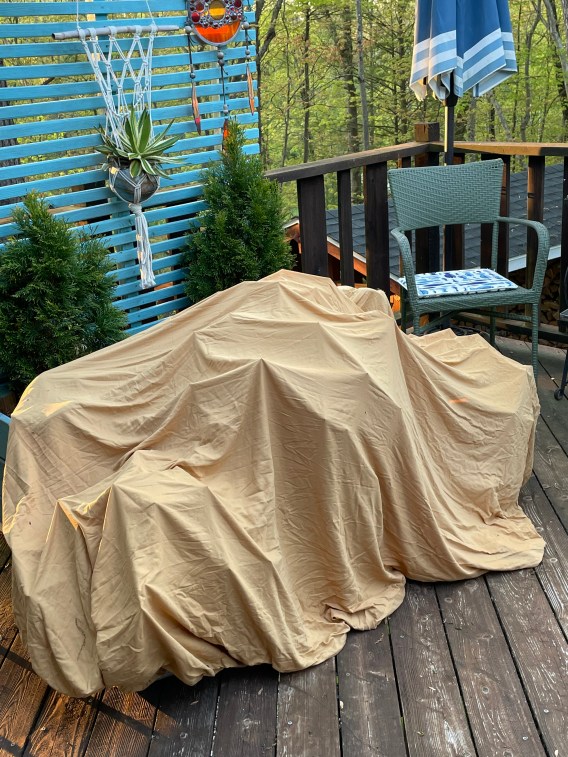
Last night, I used a bed sheet to cover up some Yucca plants which have been in pots in my greenhouse all winter. They are hardy but they were inside all winter, so with every plant I take out of the greenhouse, I introduce them to shade for a couple days first or dappled sun, then move them into full sun if they are sun lovers.
All the deck furniture is out – the patio umbrellas are out; the cushions are out! Just waiting to glam up all with my plants!
Hope you are enjoying this fantastic weather this week. (P.S. I saw a couple hummingbirds this week, so I put out the feeders too.)
Cathy Testa Broad Brook, CT Zone 6b Container Gardener Date of this post: 5/10/23; Wednesday Potential Frost Pockets: 5/9/23, Tuesday evening
Light Bed Sheets are perfect for a little protection when the weatherman announced a potential light frost in springtime overnight.
As we age, things with our bodies change and some things are out of our control. I recently found out I have an eye condition which could potentially lead to loss of vision in the center of one eye. Today I go see a specialist. I really dread this appointment because I envision a needle coming my way. But then I tell myself, stop obsessing and all will be fine.
But this had led me to think about what if I did lose my vision. What if I couldn’t see my plants, all the amazing flower colors, and the beauty of what plants bring to my eyes, and my heart?
Being a “what-iffer” is not a good thing and maybe my eye issue won’t be severe and allow me to be free of vision problems for several more years. I won’t know till after today’s assessment, or perhaps for a few years, who knows.
My Mom lost partial vision in one of her eyes many years ago too. I remember going to the doctor’s appointment with her and the process they explained for a surgery at that time involved lying face down for several weeks at home after the surgery for the recovery process. It was an insane scenario to me. I remember thinking how anyone can lay face down for that long? She didn’t do the surgery back then.
She managed a very long time with partial vision in her eye, but today, as she is more in her elder years, she cannot drive due to her vision issues. She used to crochet a lot but said she cannot do that anymore, and that she can’t even read the newspaper now.
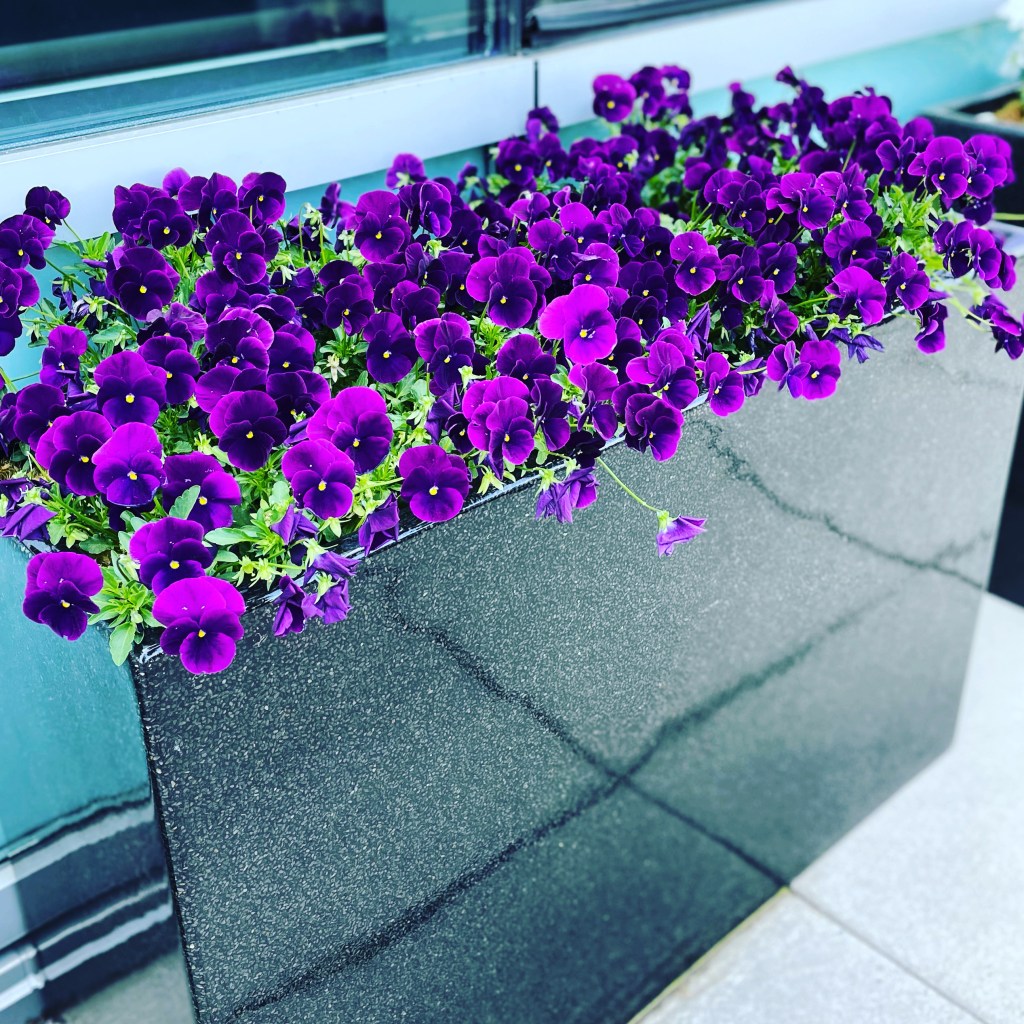
I often browse my plant photos and it really brings me a feeling of good vibes. I love colors, I love looking at the colors of flowers. Even simple Pansies are amazing when you really look at the flowers, and think, how on earth could God, Nature, whomever is responsible for these colorful wonders do such an amazing job. It is such a gift to us. Truly. Just look at these purple Pansies in the photo below. The outer edges are a lighter purple than the centers. The color is two toned! Nature does that!
If you think about the colors of the world, so many come from plants, flowers, fruits, and of course, the sea, ocean, sky, etc. Colors paint our world. Can you imagine a world without flower colors? I cannot. I am always amazed at the beauty of gardens and plants. And color patterns of birds and more.
Recently, I started playing around with needle felting and I really enjoy it. I started to think, what if I couldn’t do this if I was vision impaired. What would I do to replace this creative therapy.
Could I envision plants and their amazing colors in my mind. I guess if someone said, oh this photo of your planter with x-y-z has this and that, I think I could envision it. I could see it in my mind, hopefully.
Again, I’m not in the gloom and doom phase – don’t get me wrong, just it got me thinking about it. Certain scents can bring you back to a moment in time. I remember the scent of sugar canes in Hawaii. I will never forget that – and if I smelled it right now, it would zoom me back to that moment.
Our senses are all part of the equation.
In a jewelry class I took this winter, a woman moaned a bit and the instructor asked if she was, okay? She replied that her darn arthritis was bothering her hands. I guessed she was probably the same age as me. I thought to myself, we all have our struggles as we age. For me it is my eyes, for her it is her hands. I have heard how painful arthritis can be.
I suppose you just have to adjust and deal. Heck, my hearing is already having issues. I joke with my husband that there should be a special form of sign language for people who start to lose hearing in their later years. He said, there is, it is called sign language. I always told him; we will learn and use sign language if we ever lose our hearing.
Anyhow, until any of those days come, I will try to “focus” (no pun intended) on enjoying colors even more than I already have. I will enjoy listening to the tree frogs, birds, crickets even more than I already have, and try not to think about those what-ifs!
To see photos of some beautiful flower colors, visit my SmugMug Gallery of Flowers.
Photos above:
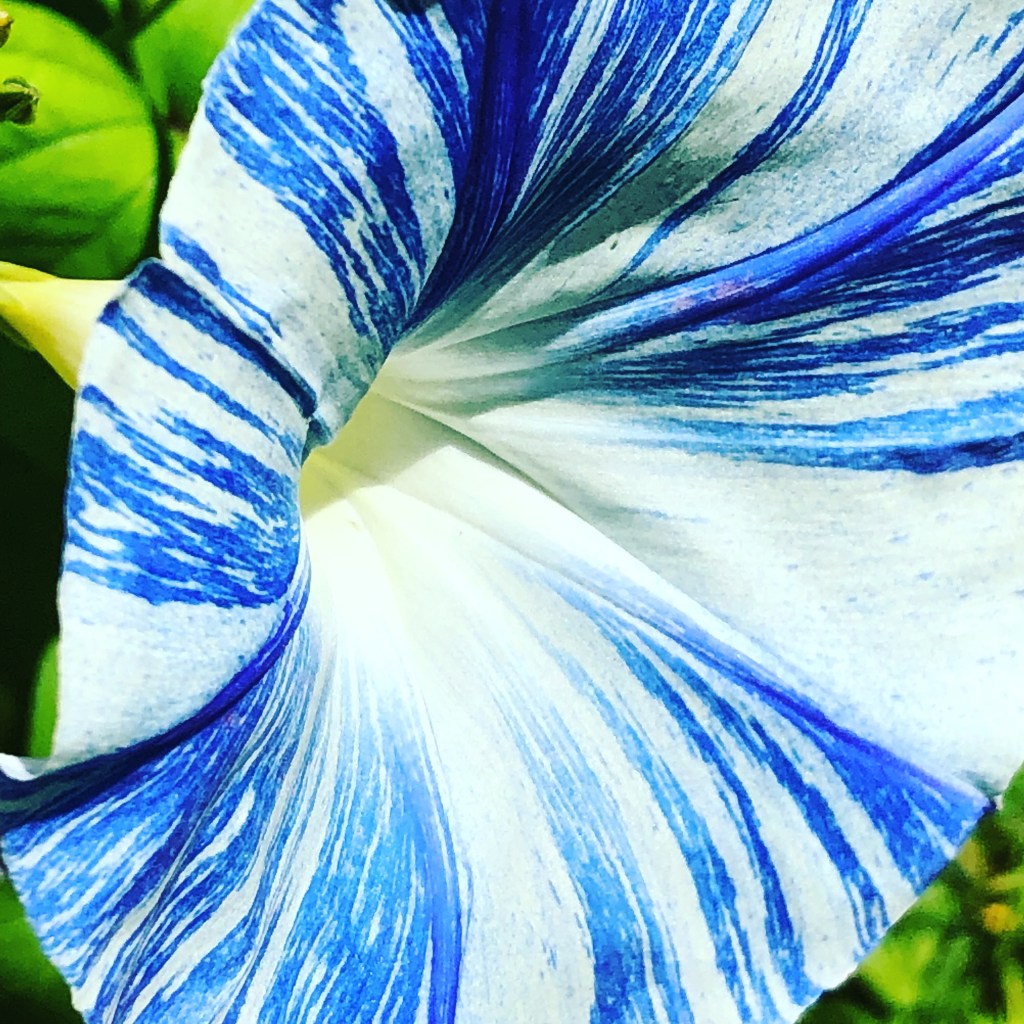
Blue and White pinwheel morning glories. Grown from seed one year. Absolutely stunning and fun.
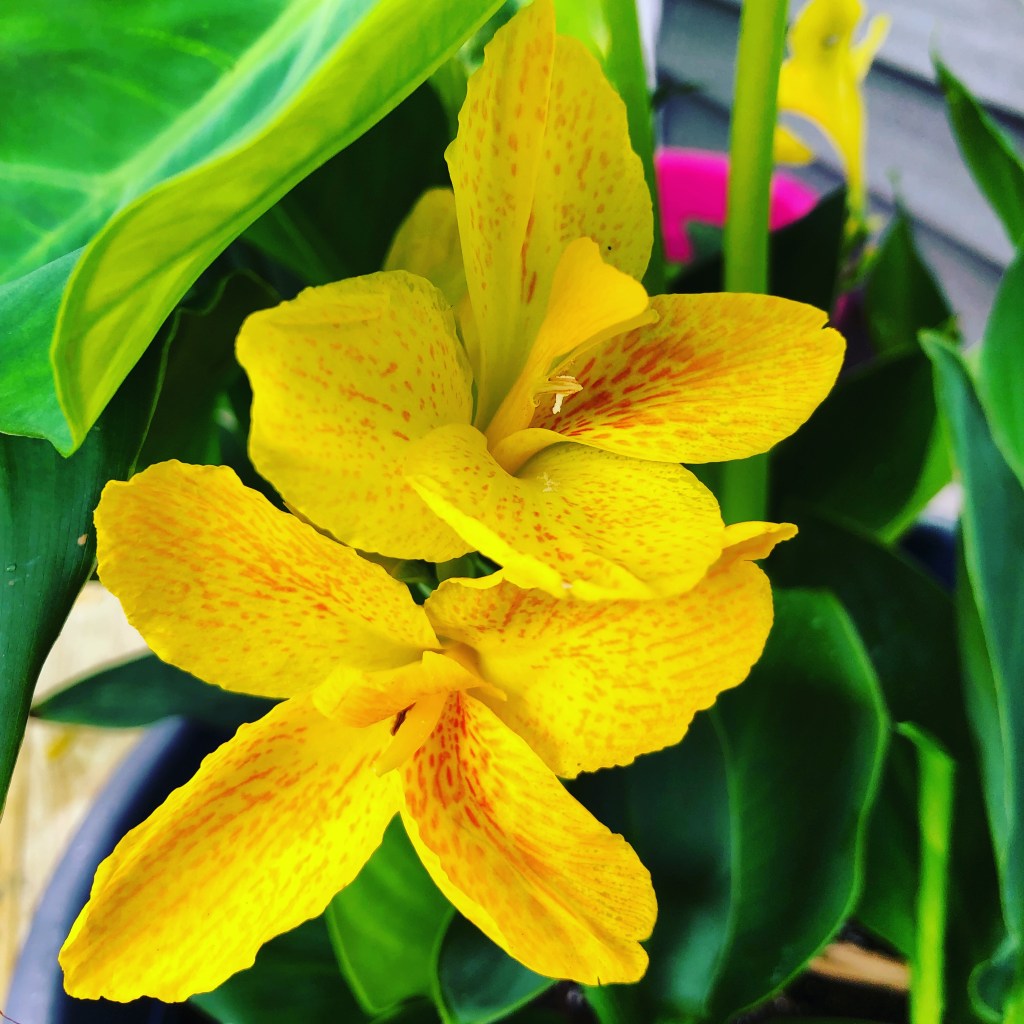
Yellow blooms with red speck of Canna Lily. Love growing Canna Lilies and using them as big tropical thrillers in my container gardens every year.
Deep red Canna Lily blooms with purple flowering annual behind it. I think the purple is annual salvias. I love how this spontaneous photo I took came out. Truly – does it not bring joy to your eyes, and then your heart? It does for me!
Almost all photos on my blog are photos I took with my iPhone. Yes, it’s an obsession!
Yesterday was our first fluffy snow fall, which I have to admit, made me happy. I can picture the soft white snow on the items I made for many holiday orders this year at people’s homes, such as Kissing Balls hanging outdoors, Patio Pots filled with holiday greenery, Garlands, Wreaths, and more. The snow is also a great way to add some moisture to the greens on the wreaths and such.
The past two weeks were extremely busy. As a one woman owned business, with a very helpful special Elf Helper, my hubby, we did it – installed and created holiday scenes for everyone. Today, I hope to make a nice big Boxwood Wreath. I show all my photos on my Instagram page under Container Crazy CT handle.
I want to take this morning to say THANK YOU to all the people who hired me to work on their holiday scenes and patio pots, and also to all who ordered a Wreath, Kissing Ball, or Garland this year. It puts me (and hopefully them) into the holiday spirit. I finally got to do some of my own outdoor decorating yesterday a little bit before the snow started to fall. But it is a real treat and a special thing for me to create Holiday Items for people – THANK YOU AGAIN FOR YOUR SUPPORT – and pick-ups.
I also have to admit, I do stay inside a lot when people pick up their orders cause I’m so busy and can’t talk too long, plus I really really didn’t want to catch any colds or COVID during my work of holiday crunch time. But I find the “Pick-ups” are extremely useful and helpful to people when they are also doing their own rush holiday errands and they may pop by to get their handmade wreath with fresh greenery and other items quickly (Grab and Go!).
Next on the list is making some unique holiday pick-up gifts which are great for last minute shoppers, me included! I haven’t shopped at all yet for Christmas gifts on my own to-do lists. I never have the time in early December.
Hope you are enjoying this snow fall – it sure looks pretty from my office window – I can say that!
Sincerely,
Cathy Testa Container Garden Designer located in Broad Brook, CT 860-977-9473 containercathy@gmail.com
I’m sure everyone knows how many days till Thanksgiving 2022! We are looking over menus, inviting friends and family to gatherings, and feeling the chill in the air to signal a new holiday upon us soon.
For me how many days till Thanksgiving is important because I start making custom holiday wreaths and kissing balls, some fresh made garlands, and other holiday gift items starting the weekend of Thanksgiving. So, we have 2 weeks to go before getting to my “start date!” for orders.
There’s quite a bit of pre-planning, such as reaching out to those who routinely order from me, posting various photos, wiring ornaments ahead (to save time while making wreaths), maybe spray painting some items for some outdoor holiday installations, or measuring various items, and checking the stock of my inventory needed is a big task as well. Do I have enough wreath frames in different sizes, florist wire, and other items needed to create? Remember COVID year, things were in low supply. I don’t think supply issues are as big but they do impact costs that continue to rise. Cost rising means more planning and careful to not over do things, which is tricky if you love to decorate!
Also, I usually make some special trips too to sources to find unique ornaments, ribbons, or decor to use – but restraint is also required because, not to be a broken record, but we all know prices of practically everything has gone up. As my SIL said recently, “Can you believe even celery is expensive?!” Yes! I can! However, I can not resist making beautiful wreaths with a mix of greens – everyone needs to at least have a wreath to adorn their door, mantels, or outside windows, you name it.
My wreaths come in various sizes from small, standard, large, and deluxe sizes. Usually, standard is a popular choice for folks, and standard or large sizes fit well on doors. I try to use color choices desired, but this year, I have to say with the rise in prices of greens to ribbons, I will be using standard colors mostly. There are some exceptions for special orders, etc. I do the best I can for everyone. And all is made with fresh greenery.
I also offer “boxes of greens” if you wish to make your own, and also make large kissing balls custom made. Fresh greens are great for your outdoor pots, window boxes, or to adorn a railing inside the home.
This year I’m trying a new method for storing my Alocasia corms (sometimes referred to as bulbs or tubers, but they are not true bulbs). I have seen Alocasia corms referred to as “tubers” in many garden reference and technical books, but for the purposes of this post, I’ll stick with corms as the term used for these Alocasia plants I am putting away for the winter months in Connecticut.
Bins Years Prior Used
For years, I stored the bases of underground parts from my elephant’s ears and canna lily plants in plastic bins with covers (air holes drilled in the covers) with peat. When I say “parts”, I’m referring to corms for the elephant’s ear (Alocasia and Colocasia) and rhizomes for the Canna Lily plants).
The peat (only a small amount below; used almost like a bed below the corms/rhizomes, and some peat lightly sprinkled over the tops of the corms and rhizomes) helped maintain a bit of moisture but kept the tubers in a dry but not too dry or too moist state.
However last year, some of my Alocasia corms had rot areas on them when I went to take them out in the spring to start growing again. They were too damp. Plastic bins will hold onto some moisture (versus a dry cardboard type box) but this problem of rot really had never occurred before. Since I want to make sure I am able to save these dramatic large Alocasia plants’ corms, I’m trying this new method this year.
Dug Up about a Week or few days prior
In last week’s post, I showed how I dug up the Alocasia plants from a huge cement planter, cutting off the foliage about 4-6″ from the top of the corm area, and laid them out in the sun for one day. Then I moved them to my basement in laundry baskets.
I also dug up a very large Alocasia plant prior to these, from a big tall patio planter, and laid out a huge corm with top part of the plant (stump like stem area) in a bin about a week before these above.
The ones in the laundry basket were still too damp when looking them over yesterday, so I laid them out on a table in my basement, and spread each corm on the table so they are not touching, and decided I will wait a few days longer before packing those up into boxes. I will leave these on a table another few days to air dry in my unheated basement.
However, I decided to pack up the others that were dug up prior from my gray patio planters. One of them is super large and heavy. It isn’t draining out any more water or moisture now, feels like it has dried enough, and there are no rot or damp areas on the corm area. It was placed in a bin in my basement about one week prior to those dug up from my cement planter so it and its side shoots have been drying longer.
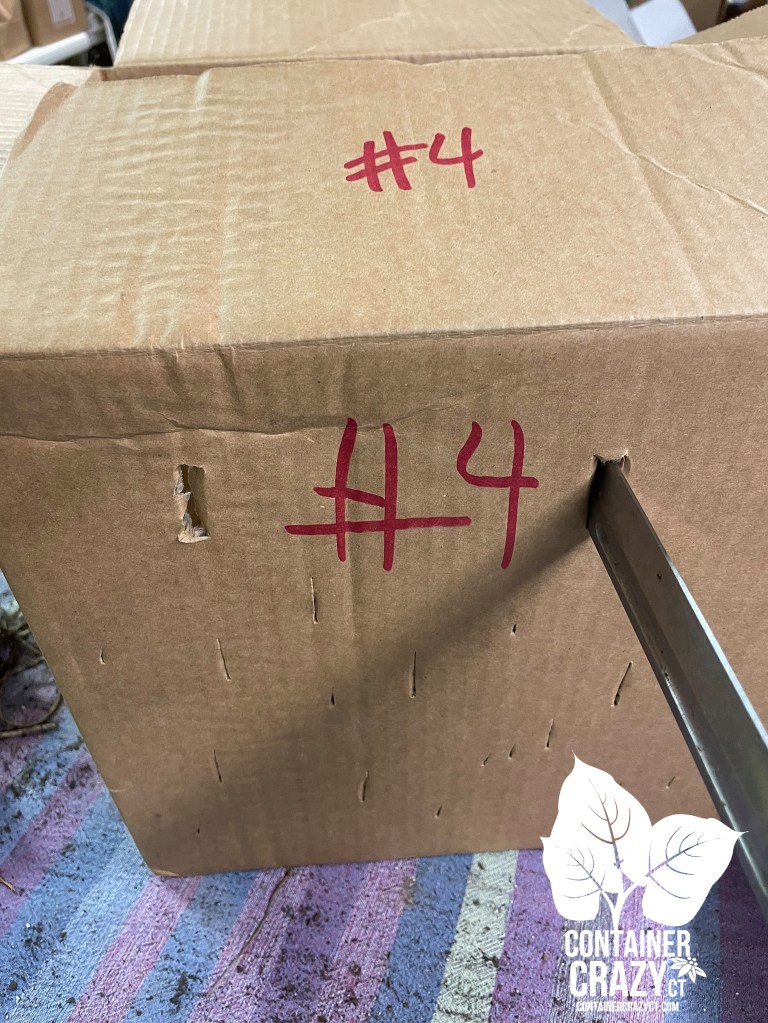
In doing a bit of research, I’ve read Alocasia corms may be stored in newspaper and put in a cardboard box with air vents. I happen to have some boxes available and used a large sharp knife to make slits in the boxes around the perimeter of the cardboard boxes for the air vents.
Making air vents
I placed crumbled up newspaper sheets in the base of the cardboard box and used the original plastic mesh bags, which were around each corm when they were originally shipped to me. I placed individual corms into these mesh bags for those that would fit. My largest “stump” shown top right of this photo below is too large for any of the mesh bags I kept on hand.
Mesh Bag with Corm inside
I loosely wrapped a couple sheets of newspaper around this mesh bag once the corm was inside and put it in the box. I am careful to not have them stacked or touching too much with other corms handled the same method because if anything is damp, that moisture will transfer to any touching corms. However, these were all fairly dry and not moist. The idea is to not overpack any boxes and keep air around each.
Now for the larger Alocasia stump. I keep calling it that because it is so much larger, it is more like a stump size! This one I had to find a larger long box and I have no mesh bag for it. It also has a large green area (the top part of where it grew) still attached which is not wet at all when I decided to lay it into the long cardboard box. Again, I crumpled up newspaper below in the box, and then I used a paper bag to cover it like a blanket and close up the box. I did not tape the box closed, as air circulation is important. I just overlapped the covers and I also put vents in the sides like with the other cardboard box prior to laying it in there.
Largest Alocasia “stump”
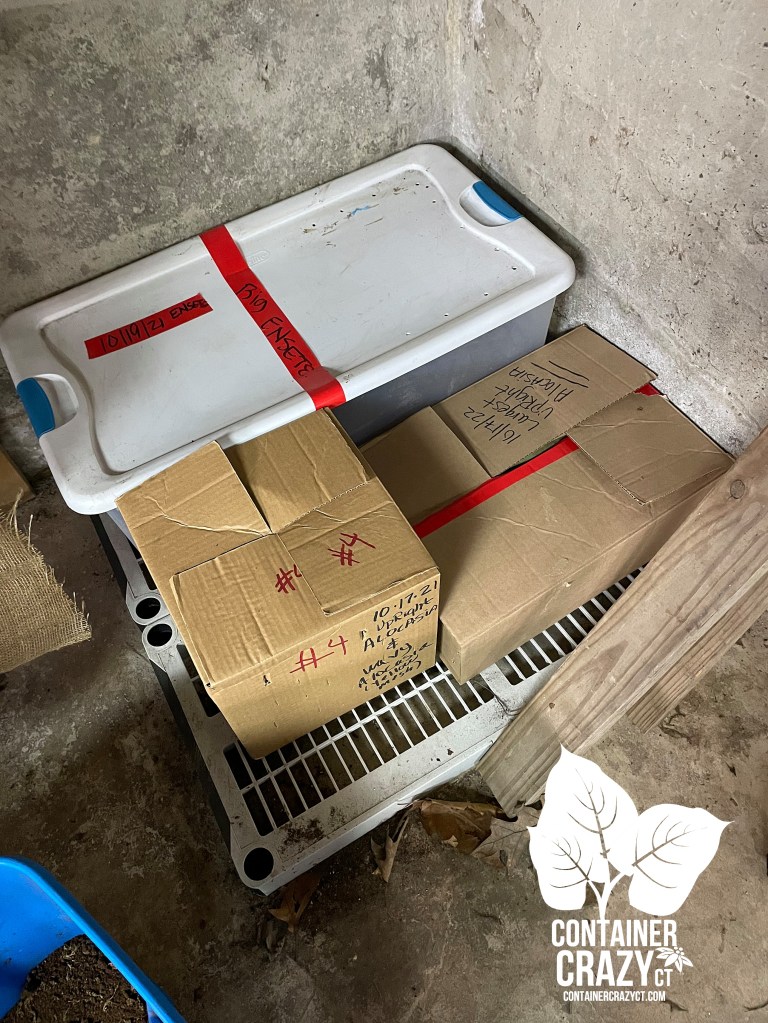
The root area is dry with dry soil a bit still on it, the corm area is dry, and there is still green life on the top part but there is no dripping water coming out of it – it seems like it is dry enough. I labeled all the cardboard boxes with date and placed it in the usual corner of my unheated basement (by the door where it is like tucked in a corner, stays cool, dark, dry and it does not go below freezing here.)
Box Top DatePaper bag serving as a blanket
I have read the optimum temperature for storing Alocasia corms is 40-45 degrees F. Again, my basement is unheated. The only time it may get warm in there is when we use a woodstove at the opposite end of our basement, which is only occasionally. It does not go below freezing (32 degrees F) so they will not freeze. They are kept in a consistent cool 50 degree range or a bit below that for the whole winter. I will check on these in one month by making a note on my calendar to go look at the corms in these cardboard boxes and seeing if they look good (no rot, no moisture, no wet newspaper).
Again, this is the first time I’m trying the cardboard box method for these. I also wish to note, canna lily rhizomes tend to not survive if they completely dry and wither up, so I don’t think I’ll use this method for those plants, only for my precious upright huge Alocasia plants’ corms. I’ve read more about how these are okay more on the dry side. Makes sense because when I purchased the corms about 3-4 years ago, they showed up in a card boad box, with the white mesh bag, shown above, and only the brownish corm with no plant at all attached.
Label the boxes
Corner in Basement
You see the big plastic bin near these two cardboard boxes, that was the bin I last used for my big red banana plant (stump), the Ensete, I had for over 10 years. It failed this year, so there’s nothing in that box right now. I also put a plastic shelf section below the boxes so it is not directly on the concrete floor which may lead to dampness on the bottom of the boxes.
Pic of corm inside a mesh bag
I just hope this works well this year and will keep you posted. Next up will be to dig up my canna lily plants from containers outdoors. Sometimes I don’t bother anymore with those as they may be easily grown from new plants next season, but it is always a great feeling to reuse and regrow plants to save money on purchasing new ones, but sometimes I run out of energy to keep digging up these things. Each year, I seem to do less storing because of the effort. Sunny days help!
Thank you for visiting,
Cathy Testa Connecticut Planting Zone 6b Date of Post: 10/18/2022
P.S. I also want to note, many references will indicate to let the plants get hit by frost first before storing underground parts like the corms or rhizomes, etc. because the freeze will induce dormancy to the plants, however, I often do this process just before a hard frost. The weathermen indicated frost may be happening this week. Wednesday’s forecast indicates about 34 degrees F overnight – so that is chilly!
Overwintering Alocasia (al-oh-KAY-see-uh) plants, dug up from a large cement planter in my yard yesterday 10/11/22.
Since this plant is not hardy in my Connecticut planting zone (6b), they must either be dug up and stored (tubers) in a cool, dry place. Alternative options, if the plants are small enough, is overwintering them as houseplants in small pots where you have a sunny room. Or just moving the pots with the plant in tact into an unheated basement and letting them go dormant, but check to add moisture to the pot’s soil from time to time, and check for any insects on the foliage if moved in the pot. In this case, I dug up the plants, removed the foliage, and air dried the tubers yesterday outdoors.
The Planter – Cement
Because yesterday was sunny and warm, I wanted to get to the elephant’s ears in this planter. I was already tired from being on my feet all day, so I rushed getting these out. Luckily for me, the soil is super soft in this big cement planter due to worms and just great healthy soil. Rather than cut all the foliage off first, like I typically do, I dug around the tuber areas in the soil to break free some roots and just pulled them out one by one from the plant stems.
10/12/22 Before Removing the Elephant’s Ears plants
The soil and exposure
The soil in this planter stays relatively moist and receives the east morning sun, so it primarily gets partial sun or dappled sun, it doesn’t get too hot in this area. I do not fertilize – literally – I do not in this cement planter. Over the years, I’ve added recycled soil (from other pots), maybe some compost, but not often, and it is possible some wood ash from the woodstove in our basement, that is used only occasionally, was tossed in there by my husband, but I asked him not to do that after a while (wood ash changes the pH of soils). It is apparent when I dig in the soil, it has worm castings and the soil is very soft and easy to dig into. This is why I was able to pull out the tubers with the plant on the top rather easily after I broke the roots around the base with a trowel. I didn’t even use a shovel.
Laying the plants on the ground after digging them out
I do, however, water this planter by using a garden hose from above and showering it every time I was out there watering my other patio pots above on my deck. We had a very dry season this summer here in Connecticut so I’m sure the tropical plants in this cement planter enjoyed the moisture I gave them. These tropical like plants like moist soils, part shade or some full sun. After getting them out, I laid them on the ground and got my machete, which I finally found where I had stored it!
Chop off the foliage, then lay in the sun
It was super easy to chop off the foliage and stems with my machete. One whack and it was done! Then I put them in a laundry basket to sit in the sun for the rest of the afternoon, later, I moved the laundry basket to my basement. It will sit there drying a while before I move them to bins or paper bags for the winter. Some references will say to wait until the foliage dies back or wait till the foliage is hit by frost to dig and store the tubers, however, I like to work on nice days and yesterday was it – sunny and warm. I store mine in the basement, in a corner by the door, which is an unheated basement but it does not go below freezing in winters. We have a woodstove at the other end of the basement, but it is only used on stormy winter days when we feel like it. We do not use the woodstove to heat the house, only to warm it up sometimes. This means those tubers in the corner stay cold, but they never freeze there. It must be cold, but not freezing, and not too warm either. If warm, they may get soggy or start growing.
Side Shoot on Right
Notice my logo on the left side of this photo above; do you see the brown original tuber? The plant this season grew from the side of this tuber (a side shoot) which is attached on the right. Sometimes there are smaller side shoots which you may pull apart to create separate plants and replant those side shoots. Also the green parts above the brownish tuber is this year’s plant and I cut it about 4-5″ above the brown tuber in most cases when I remove them. I usually leave the green plant (like a stump or root base) on there but I am not absolutely sure that is required, because when I received the tubers, there was just the brown dry tuber to plant.
After Photo
It probably took me only a half-hour to get those elephant’s ears (in this case, Alocasia macrorrhiza, known as giant elephant’s ear or giant taro) out of the cement planter. I was lucky I think it was easy. I know rain is coming tonight and some parts of Connecticut got hit by a quick light frost already, but no hard frost here yet in East Windsor, CT. When it is a true frost, all the foliage will blacken and flops over. Next is to get to those tall Canna lily plants on the ends of this planter dug out and store the rhizomes or the whole root base.
Note: A. macrorrhiza is hardy in zones 8-10 from what I’ve read, but here in Connecticut (zone 6b for me), they are not hardy (will not survive in the ground over the winter months). Also, when I dug these out – there was no rot on any of the tubers, which is good news. Sometimes, if I wait too long to dig these out, there may be rot spots on the tubers because of cold, wet soils later in October. This is another reason why I like digging them out now. I don’t want any soft rotten spots on the tubers, rot only leads to storage problems as the rot may continue on the tuber, which is what you don’t want.
Sit to dry out a bit more before storing
Because these plants get huge and are gorgeous, I had to take the time to save them. I will let those tubers sit in a bin, spaced out for air, probably for another five days before I store them. I have always typically stored them in peat in bins with air holes in the lids, but last year, as noted on prior posts, they rotted a little. I am going to try storing them in paper bags in cardboard boxes this year with air holes. Plastic bins can trap moisture and for some reason, it just seemed they were too wet last year (maybe I was rushing too much last year, and stored them too wet). I have found when my rhizomes for Canna Lily were too dry stored, they didn’t make it. I have always balanced a bit of moisture from the peat and air, but I believe the Alocasias prefer more on the dry side. Everyone has different techniques for storing from what I’ve seen and read over the years.
Prior was making pumpkins
Prior to doing all of this quickly yesterday afternoon, I made a few more orders of my centerpiece succulent topped pumpkins. They were so fun to make and took me a few hours – and my feet give me a hard time, now that I’m getting a little older, standing for hours can be rough. I even put foam on the floor – below my feet, but I felt it later. I tend to make these centerpiece arrangements standing up, and anyhow, these are what I made for some requests. It was a perfect day to do them – sunny in the greenhouse. It’s that time of year when I’m making pumpkin centerpieces and still putting away plants and supplies.
Succulent Topped Pumpkin Centerpieces by Cathy Testa of Container Crazy CT
If interested in a custom pumpkin, now is the time to order since it is pumpkin season. They last for months!