Easy Moss Crafts for a Beautiful Easter

Leave a comment

Easter is on April 5th this year, 2026. Although it is still 2 months away, I recently thought about some Easter creations. I made them with plants and moss a few years ago.

You can use sheet moss, Spanish moss, reindeer moss, mood moss, sphagnum moss, or faux moss. In my examples below, I used two or three types of natural live moss.
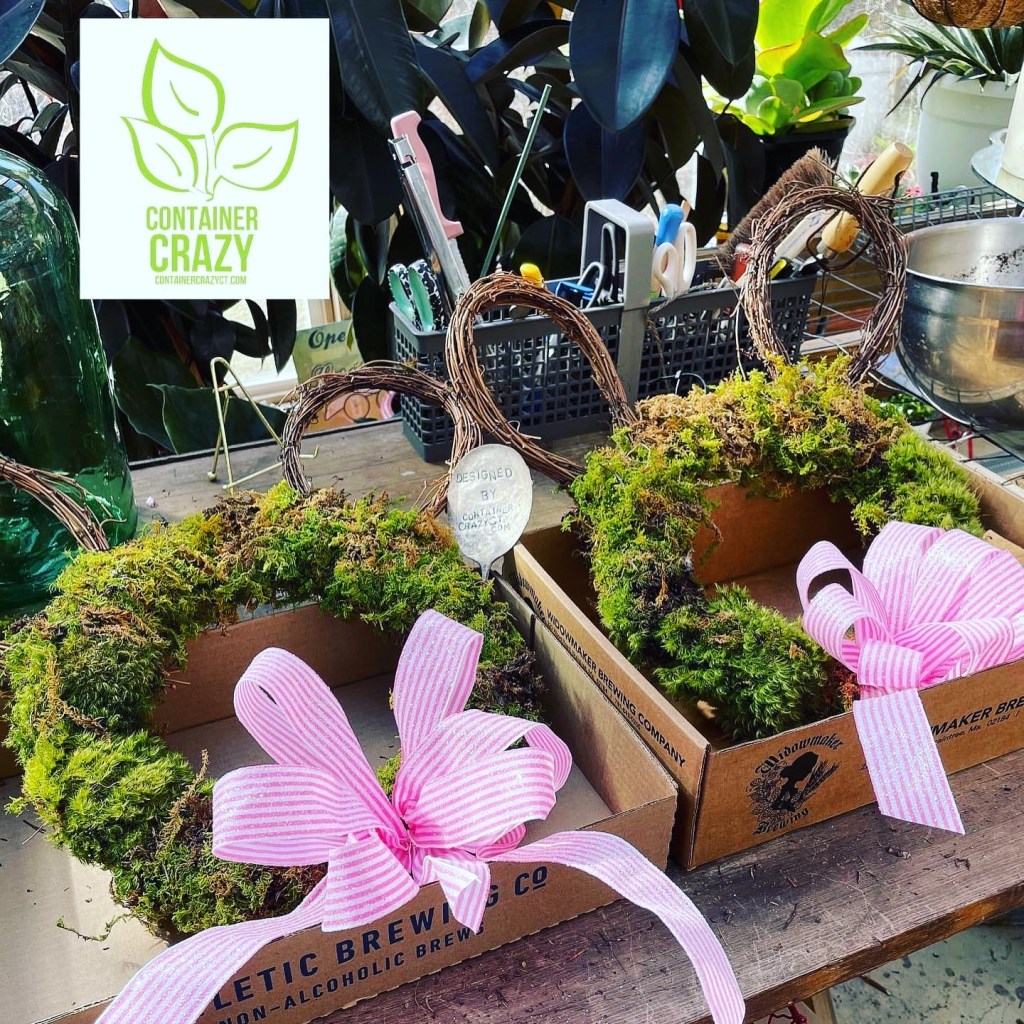
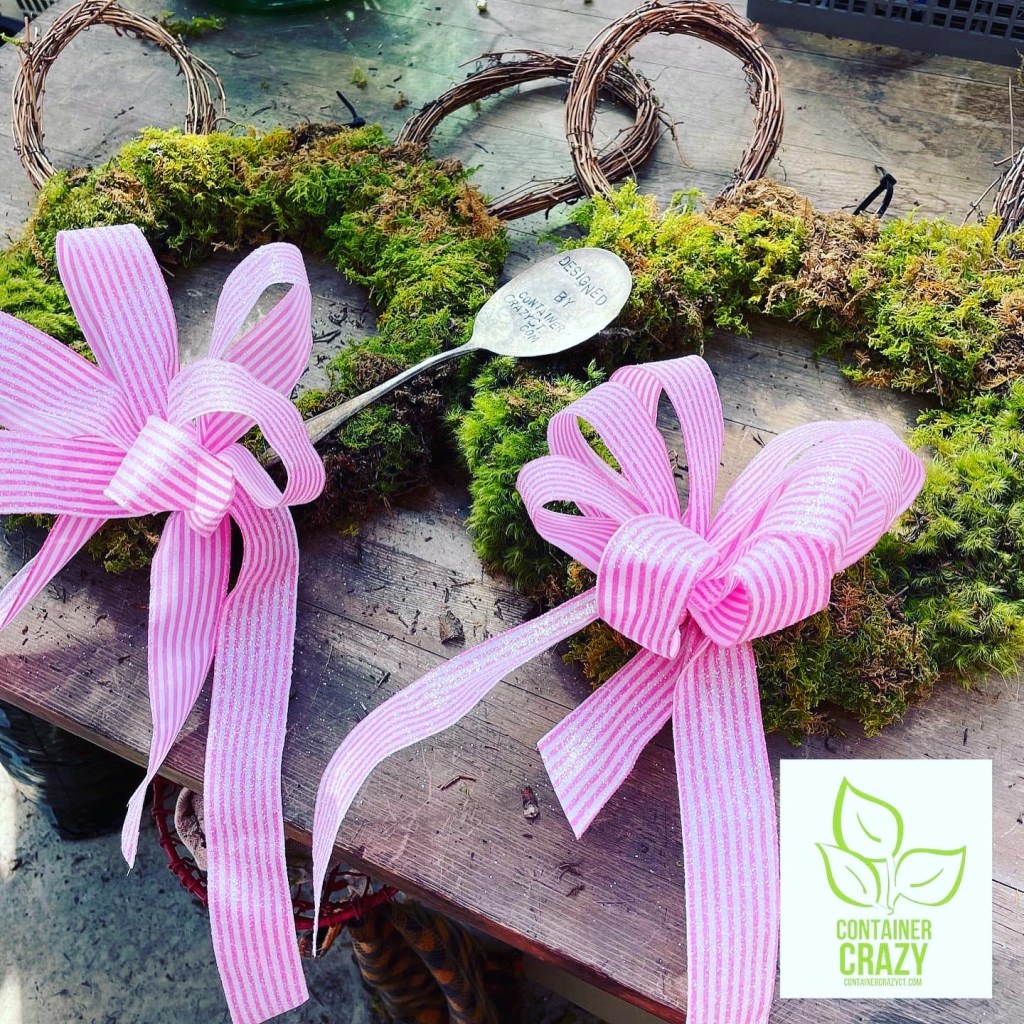
Easter Moss Wreath with Grape Vine Bunny Ears

Round Metal 12″ Wreath Frame
Natural Moss (different types)
Natural Grape Vine Twig Garland
Green florist wire
Ribbon

Making this wreath was rather easy. It does make a mess though because the moss will scatter bits here and there. I made them in my greenhouse. The moss was live natural moss I had in my stock. Moss can be kept in cardboard boxes in a cold environment, like an unheated garage. Some florists keep moss in their florist coolers. The wire wreath frame was in my stock from prior years of making holiday wreaths. I also had some florist wire from before. And the grape vine twig as well. At first, I didn’t know how to make the bunny ears, and the grape vine came to mind. Attaching the moss with the florist wire by just repeat wrapping is simple. The grape vine was bendable to I attached it to the wire frame as well.
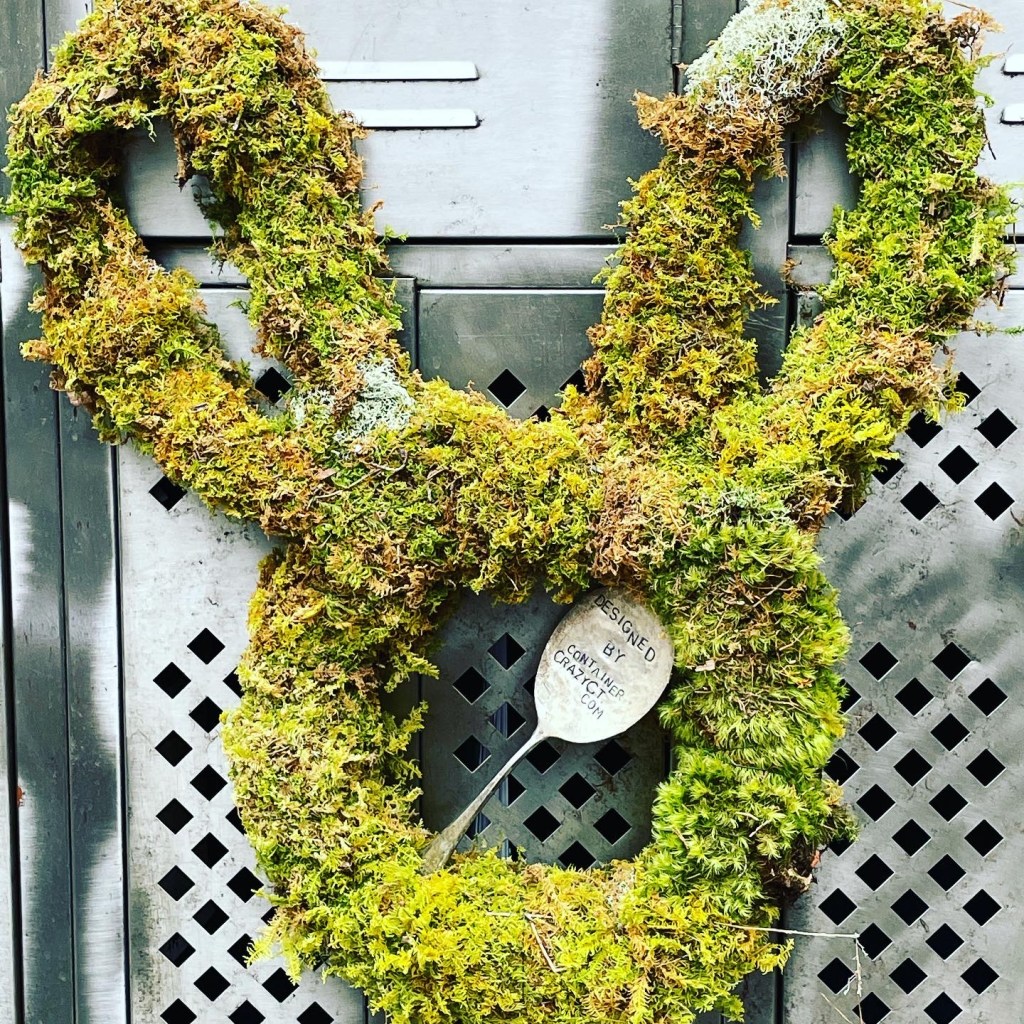
I attempted to make bunny ears by using coat wire hangers and bending them into the bunny ear shapes. It worked too but was more time consuming. I preferred the grape vine ears instead.
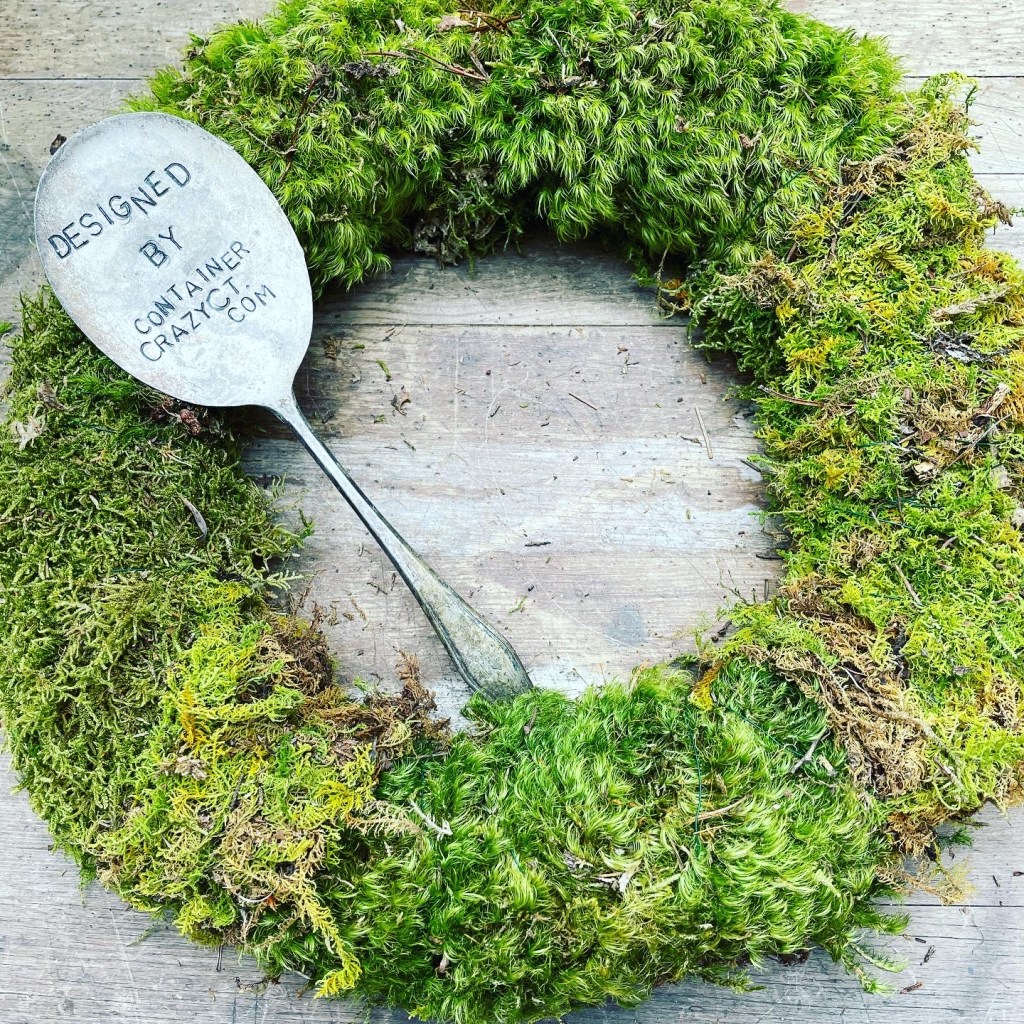
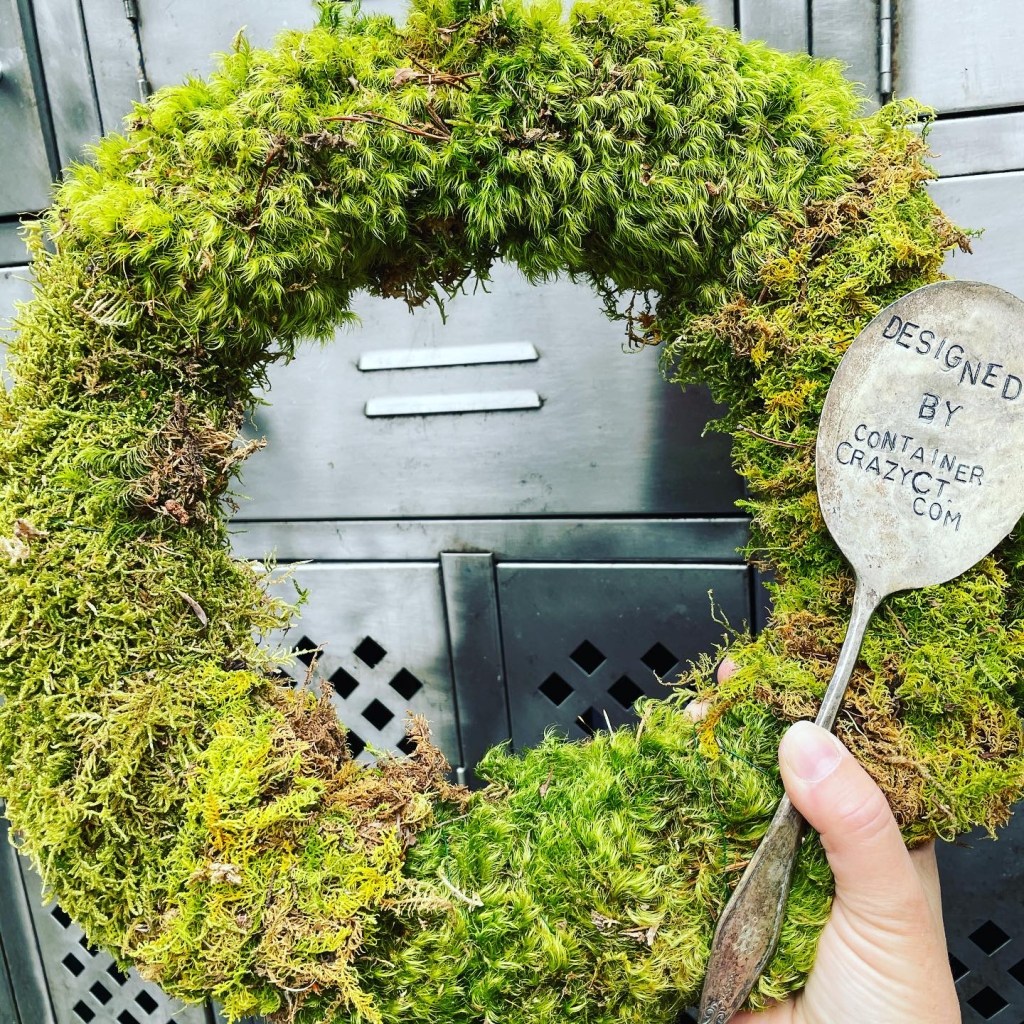
I also like the look of just a simple natural moss wreath. There are actually several different types of mosses used in the wreath made shown above. Moss gives me a feeling of just enjoying nature. It is earthy, has an almost like soil smell, and pliable. If the moss needed a little moisture, just lightly spray it with a water bottle sprayer. Outdoors it lasts for months if not indefinitely. The moss on the one in the photo above was a combination. It included mood moss, which is wavy looking, and sheet moss. Sheet moss pulls apart in pieces. It works well to wrap a piece or section of it around the metal wreath frame. Then using florist wire, I just wrapped the florist wire around the tops. The florist wire, which was green, disappears as it gets pushed into the moss somewhat.
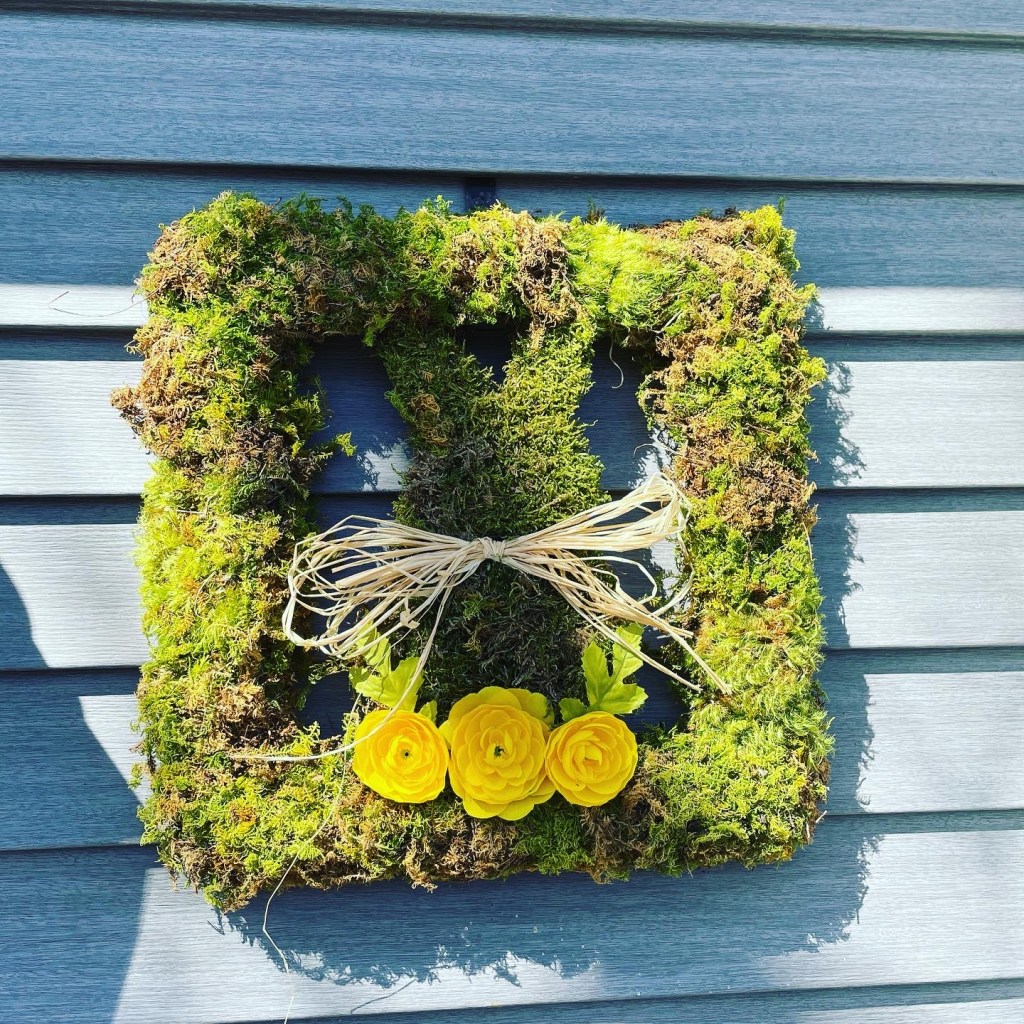
Square Wreath with Bunny in the Center

Square Double Rail Metal Frame
Natural Moss (different types)
Faux flowers
Green florist wire
Raffia ribbon
Cardboard (used either an empty cereal or beer box)

This one was made on a square wreath frame. In the center, I made a bunny. I cut a bunny shape using cardboard and used glue gun glue to glue moss over the bunny shape. It was rather easy and then I attached it in the center. The yellow flowers are faux material. It came out rather cute. The bow was made with natural raffia ribbon.
Next, is a bunny cut out project fun and simple to do with kids.
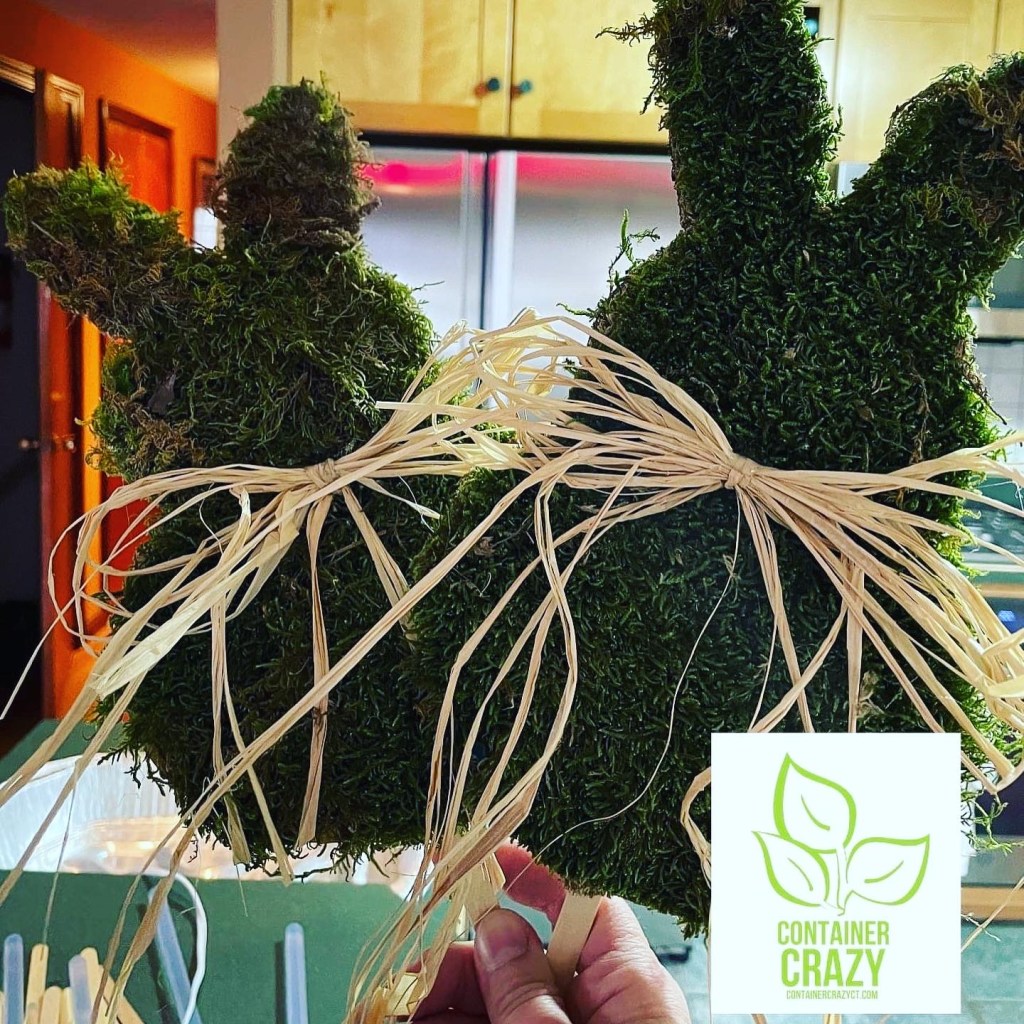
Bunny Sticks with Moss

Sheet moss
Glue gun with glue sticks (or other type of glue)
Raffia ribbon
Cardboard (used either an empty cereal or beer box)
Popsicle sticks
Green spray paint

Another crafty bunny idea was these moss bunny cutouts. I thought how this is an easy and fun project to do with kids. First, I cut the bunny shapes out using cardboard. I found that beer cases, like Budweiser beer boxes really worked well. It was easy to cut shapes with that type of cardboard. Or you can use empty cereal boxes. Wooden Popsicle sticks were used as the stick part. Then these can be inserted into things like potted plants or whatever. Again, I had natural raffia ribbon on hand to make the bow for the bunny’s neck area.
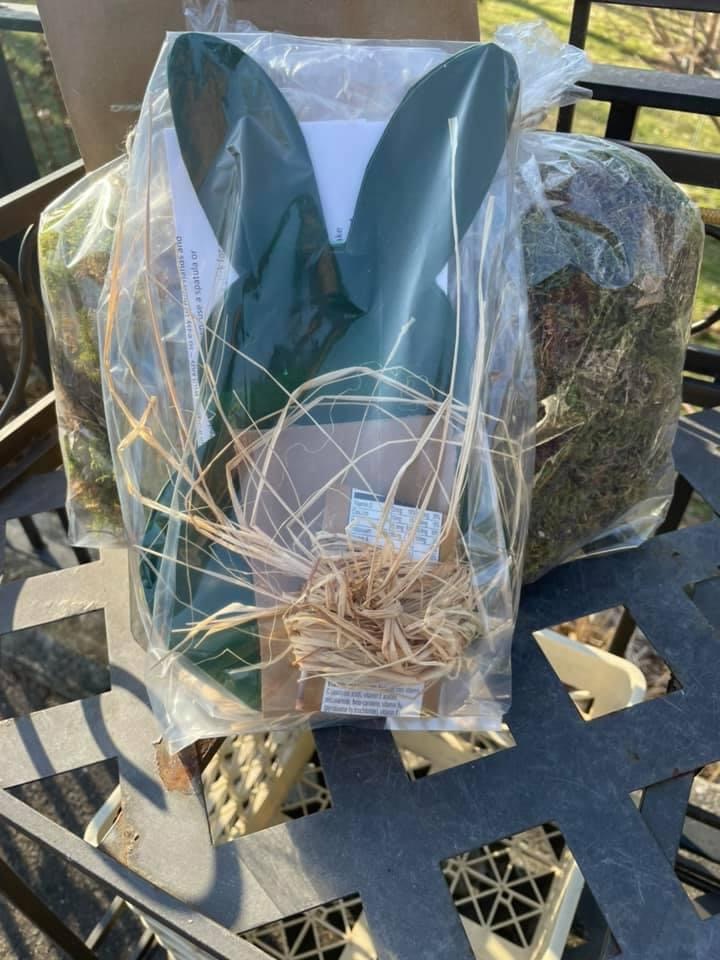
That year I decided to make kits with all the components to sell. I had spray painted the bunny cutouts with green spray paint. This helped to hide the print of the cereal box. I left the other side bare. It was a very easy and fun craft to do with kids. Use your imagination. Add eyes or a bunny tail!

The next project is hanging glass globes.
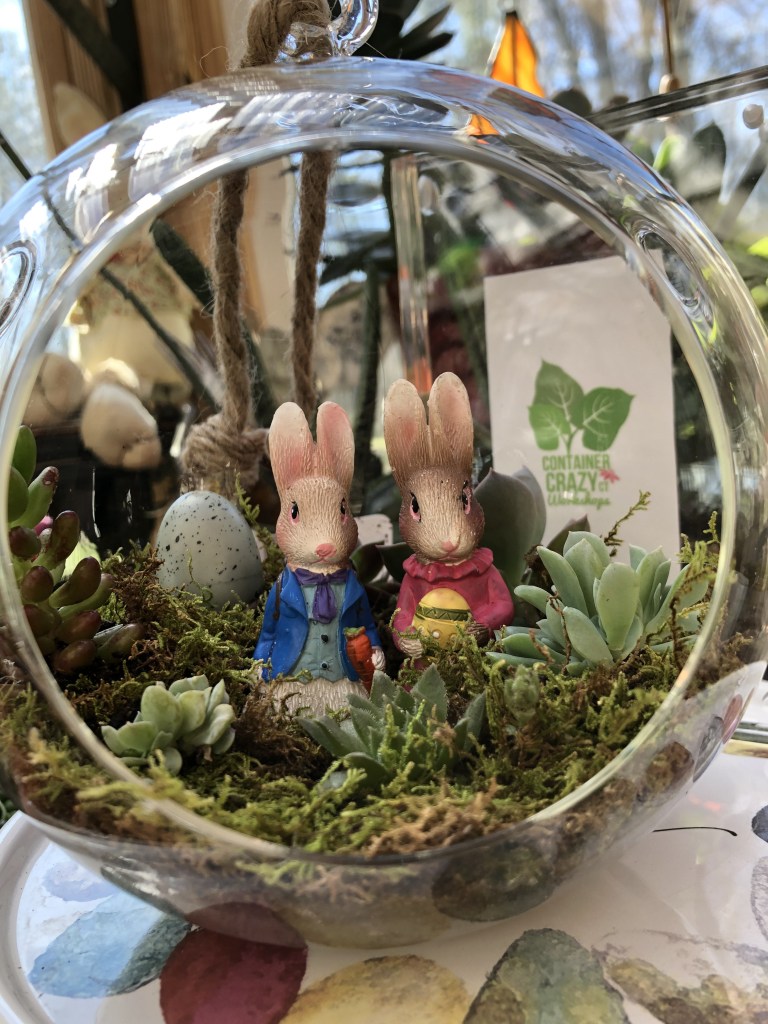
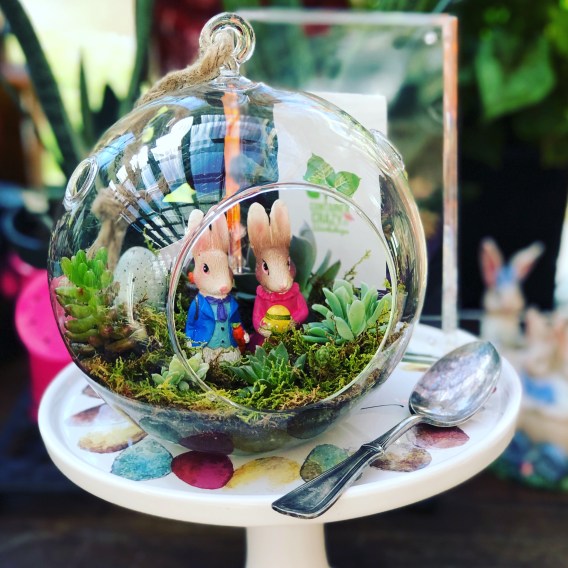
Hanging Glass Globes with Succulents and Bunny Figurines

Natural moss (recommend any type except Spanish or Faux Mosses)
Hanging Glass Globe
Decorative small bunny figurines
Faux decorative Easter eggs
Live plants (hens and chicks, jades, donkey tails, echeveria, or other succulents)
Potting soil (small amount recommended)
Activated horticulture charcoal (optional)
Glue gun with glue sticks (optional)
Round wooden craft like disk (size of a quarter, optional)
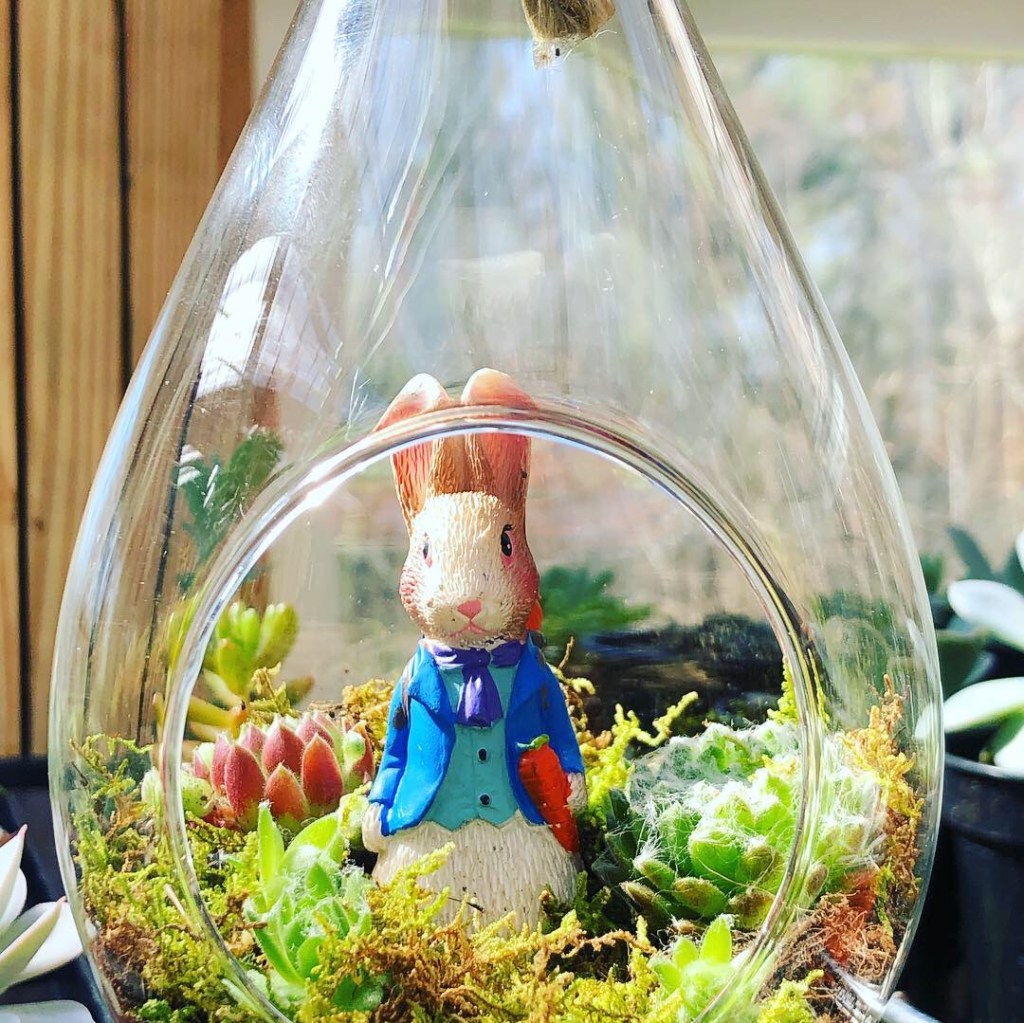
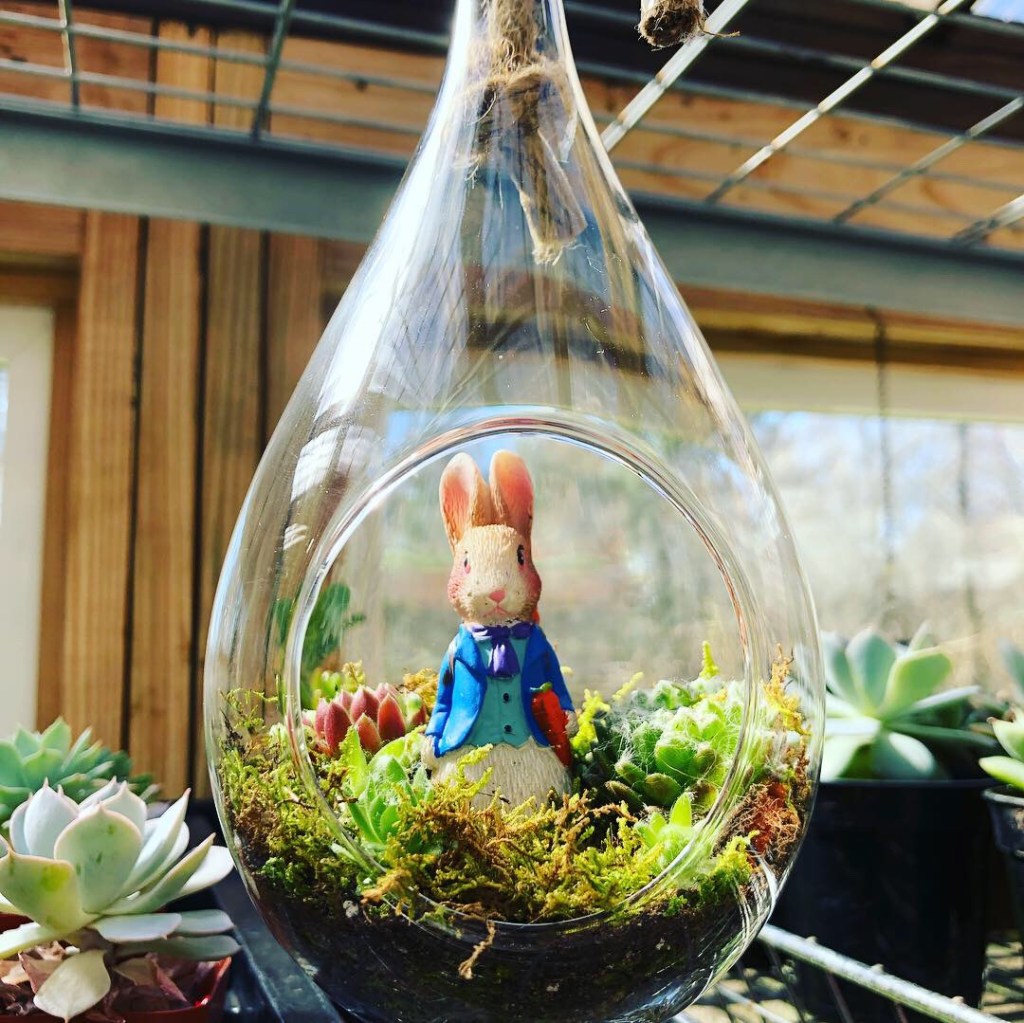
Before you start, be sure your decorative bunny figurine fits into the hole of the glass globe. Succulents can live in natural moss. The roots will naturally grow into the moss and the bit of potting soil below it. The activated horticulture charcoal, which is infused with oxygen, helps absorb odors. It is an optional item. If you don’t have any, don’t worry too much about it. But if you decide to use the charcoal, place a little bit of it over the well-draining potting mix before the moss layer.
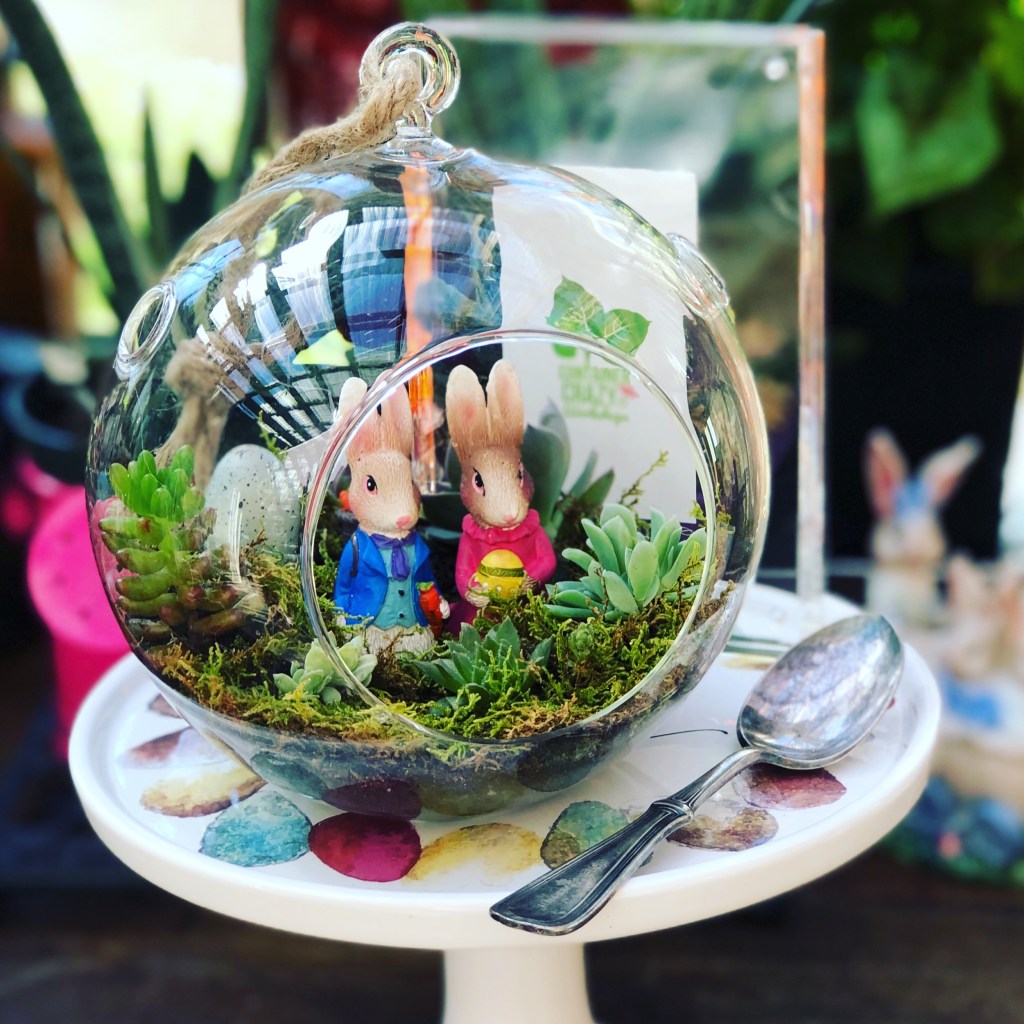
The round wooden disks I mentioned in the items list are the size of a quarter coin. I used them to glue my bunnies onto. This helps stabilize them. I used some glue gun glue to attach it to a disk. Then I inserted it into the hanging glass globe. I do not recommend dry mosses that tend to rot which is what I feel Spanish moss does. Spanish moss may be green or light tan brown and it looks stringy. When it gets wet, it tends to stay too wet for the succulent plants. I prefer the other types of natural living mosses like sheet moss, mood moss, or others noted above.
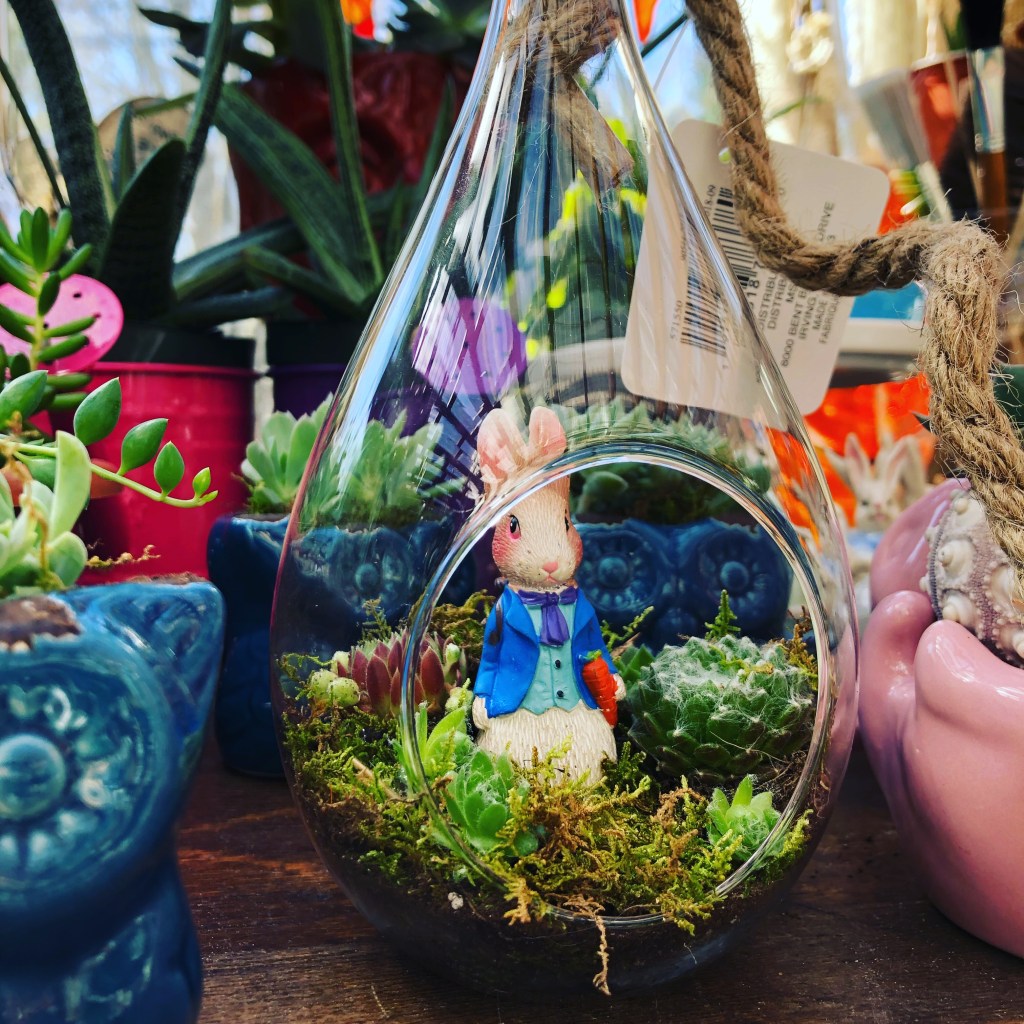
The moss is the next step, tucking it around the bunny and onto the potting soil. Then comes adding the tiny succulent plants. Most of these were cuttings or really small hens and chick plants (Sempervivums). If you think the plant won’t stay in place, add a tiny dab of glue gun glue underneath. This will help secure it.

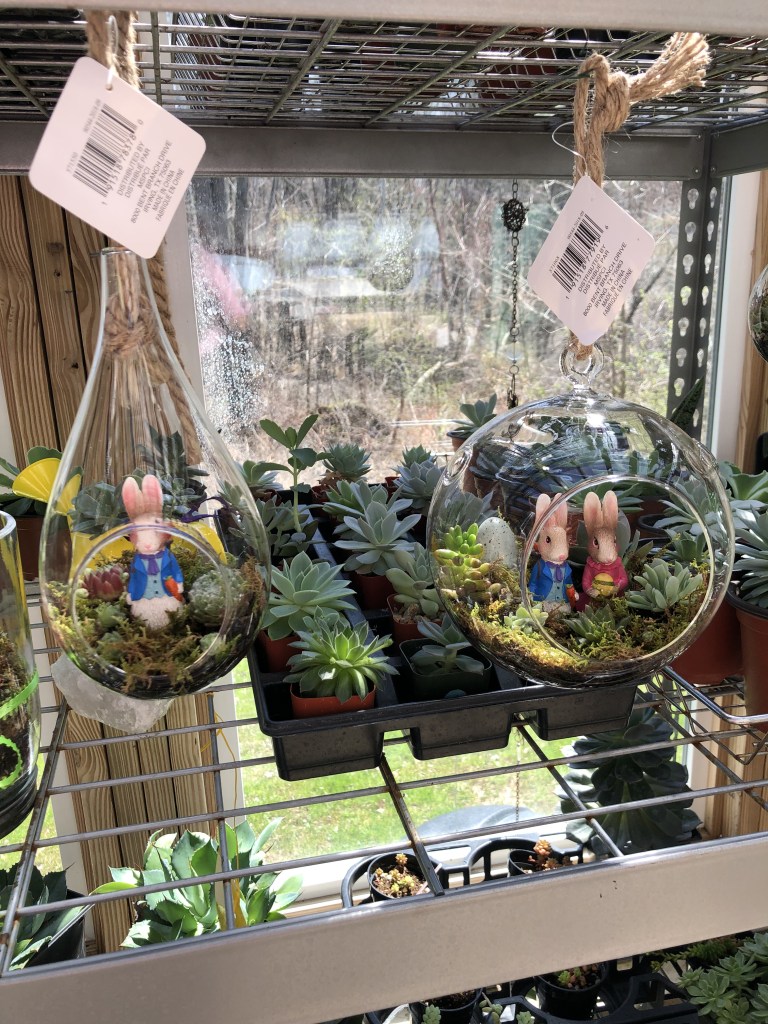
In this example next, I acquired tiny little bunny decor. So cute!
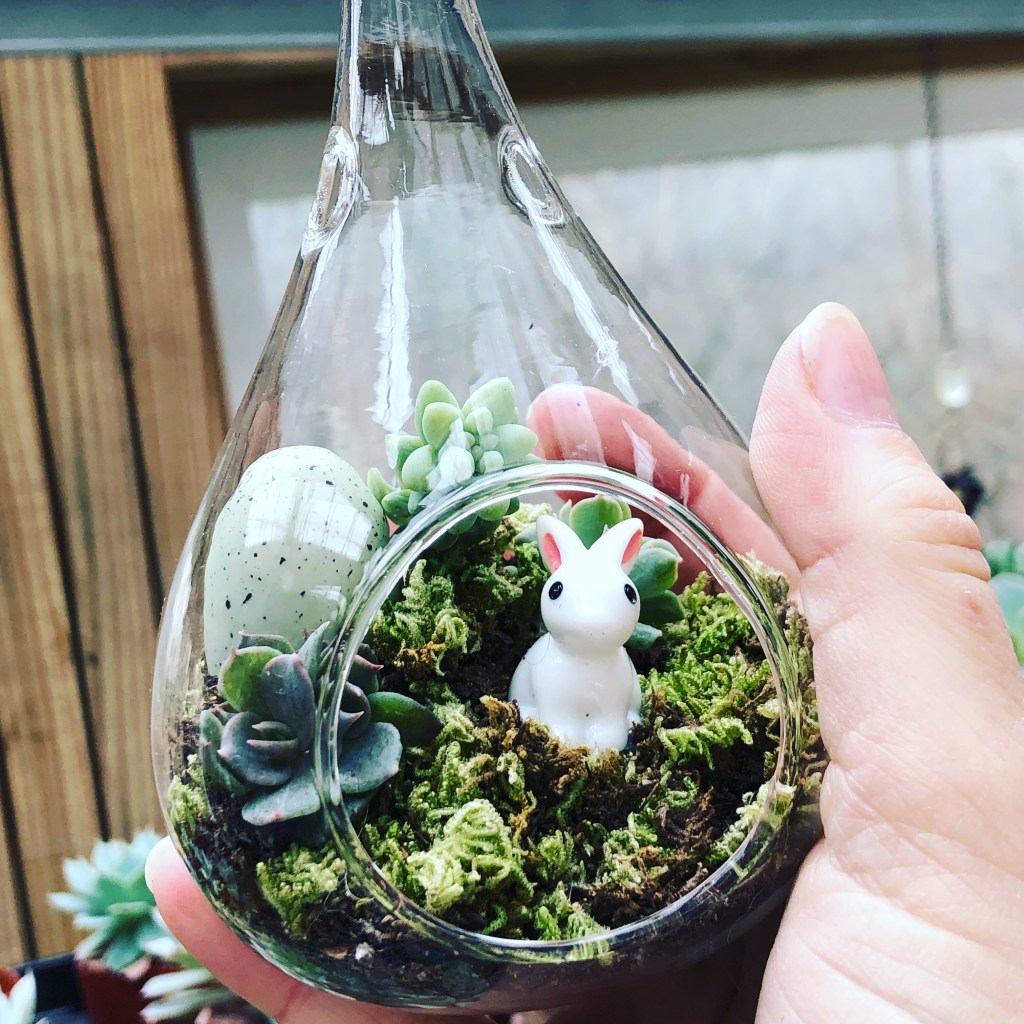
Are these little, tiny bunnies adorable or what? It made the project so cute. The nice aspect of these hanging glass globes is they function like mini terrariums. The succulent plant will grow very slowly. Once you are done with the Easter decorating season, you can remove all if you wish.
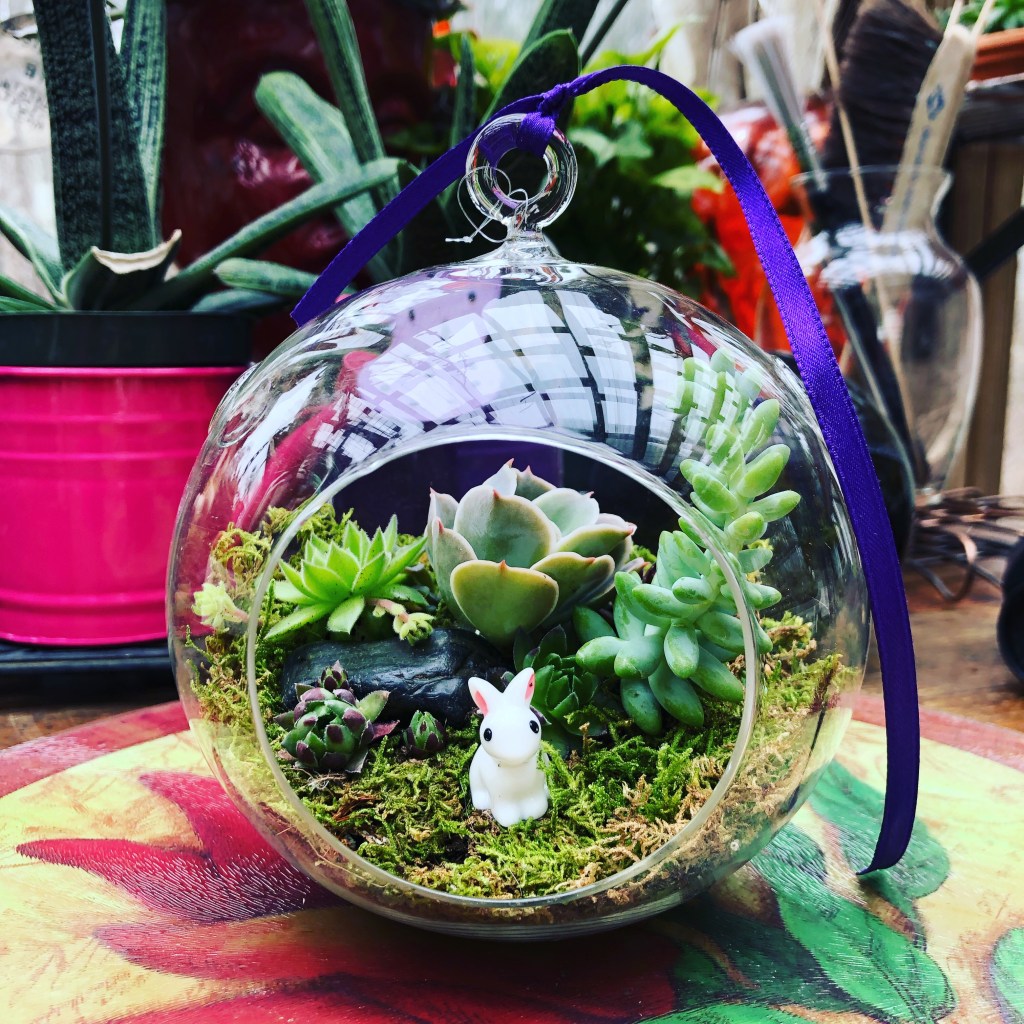
Add items you have on hand. Perhaps you have some nice stones or twigs to add. A pretty ribbon to hang it with or twine. You are only limited by your imagination. These make adorable gifts for your Easter dinner hostess. Every once in a while, add a tiny bit of moisture to the moss and let it dry between. You do not need to water it often. Only enough for the tiny root hairs of the small succulent plants. I’m talking less than a shot glass of water. Less is more with smaller hanging glass globes. I do not recommend spraying the moss with mists of water, it will only get the glass stained. The idea is minimal damp moss at times. If you wet it too much, things will rot.
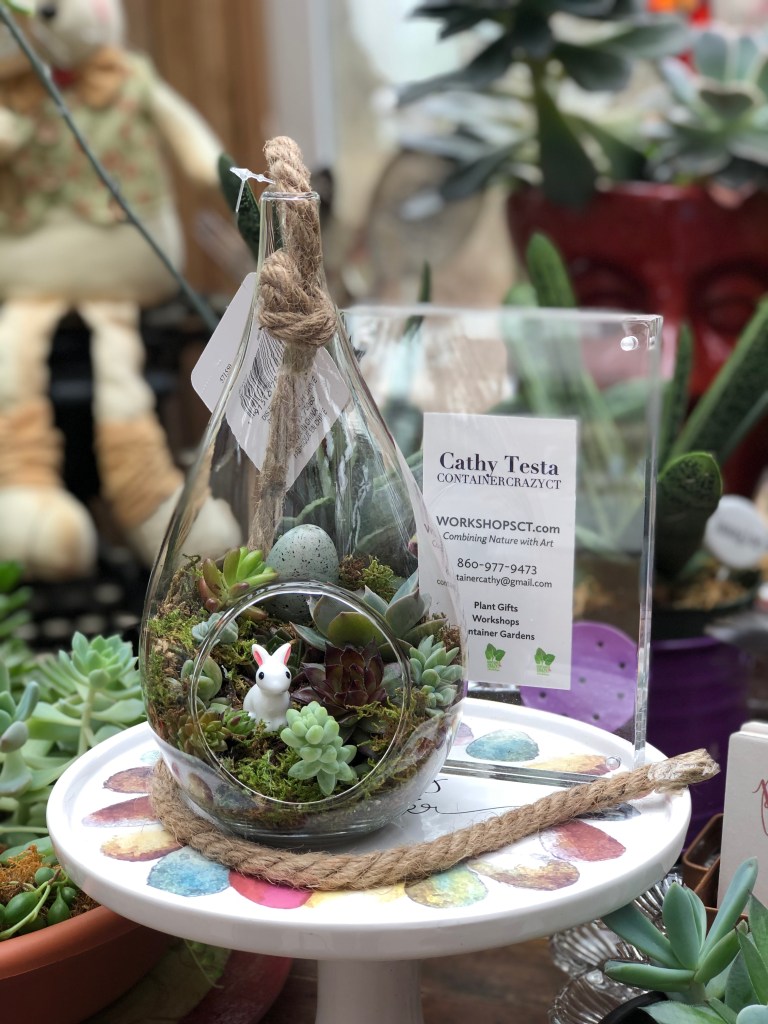
Sometimes maneuvering my fingers into the globes was difficult. Tweezers or long bamboo like sticks can help. Use them to position items as needed. Once completed, hang them in indirect sunlight inside the home and away from super cold drafts. Remember, when including live plants, glass vessels are like mini environments. The open hole allows for air, and you will lightly water the moss at times. Don’t overdo the watering. If you happen to put too much water in there, carefully tip your glass globe to drain it out. Allow the moss to completely dry between watering cycles. Succulents can go for weeks without water.
The next project is making a centerpiece with live perennial plants.
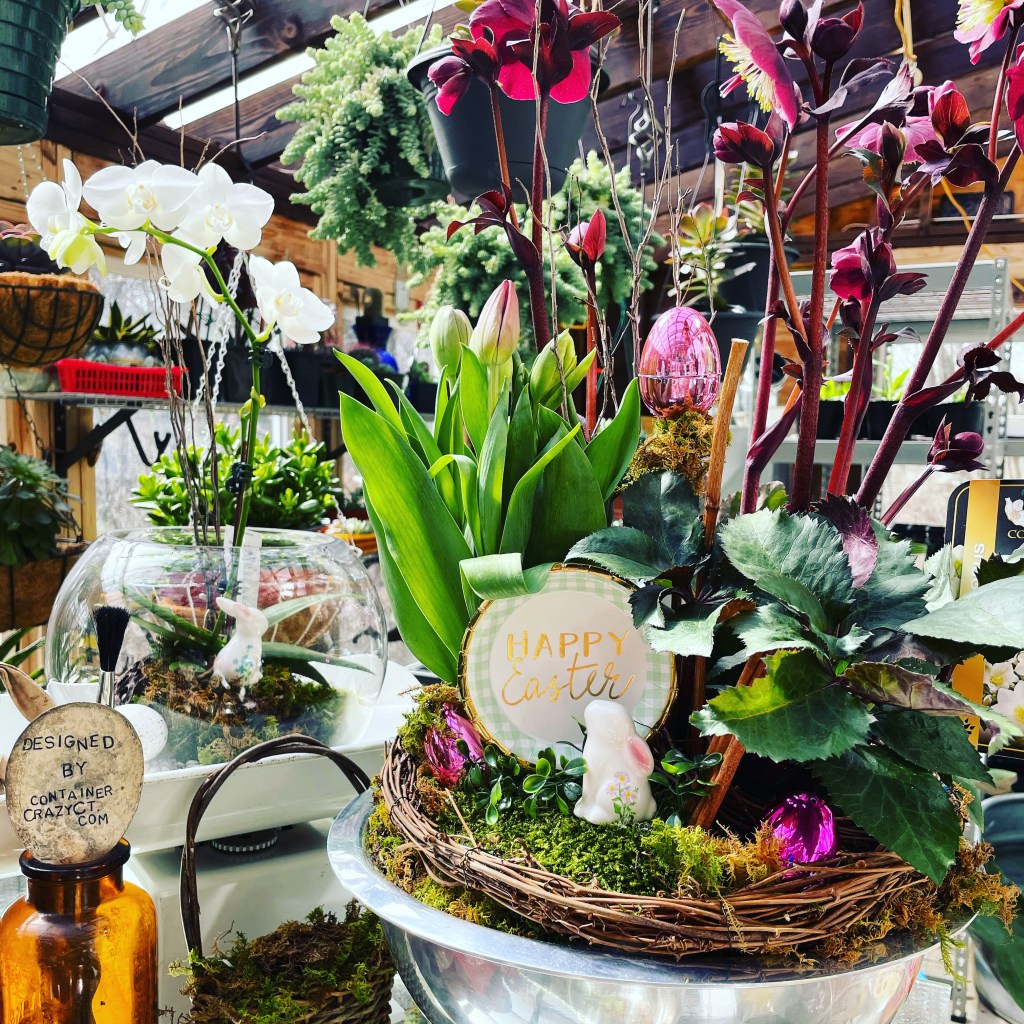
In the background, you can see a terrarium fishbowl. Just like the hanging glass globes, the base components are important. Use the potting mix (well-draining types), activated horticulture charcoal, and live moss. A drainage layer, like pea gravel is beneficial as well below all of that. You can see I put a live orchard in the glass fishbowl terrarium. The pea gravel is important when using larger plants to allow for drainage in the vessel you use.

The last project shown is a big silver bowl with two plants. One is a Helleborus perennial. You start to see these at nurseries and stores during Easter time. Also commonly available are tulips. I just tucked each of these live plants into the silver bowl in their original growing nursery pots. Then, I used moss to cover that up. Then the fun part is just adding your own Easter decoration. By the way, the perennial (common name is lenten rose) takes partial to full shade and flowers March thru April. The leaves are evergreen and will stay green outdoors. They are one of the earliest perennials to bloom. They are also deer resistant.

Hopefully this post inspired you for the Easter season to come. Go get your supplies now so you can enjoy making them before the season arrives.

Cathy Testa
Date of this post: 2/10/2026

Cathy had a small business focused on container gardening. Today she and her husband are retired. They like to go camping so camping topics are being added to this blog site. Also, Cathy likes making holiday decor and is sharing some of her creations here as well. Some with plants and some without! Thank you for visiting.
Memorable Container Garden Designs to Revisit

Leave a comment

Here’s ten container gardens which I fell in love with and why from my past creations. I plan to show 10 at a time over the next months. Why? Because I will be deleting the photos from my database soon and it is a way to savor the memories!

Hanging Baskets with a Mix of Houseplants

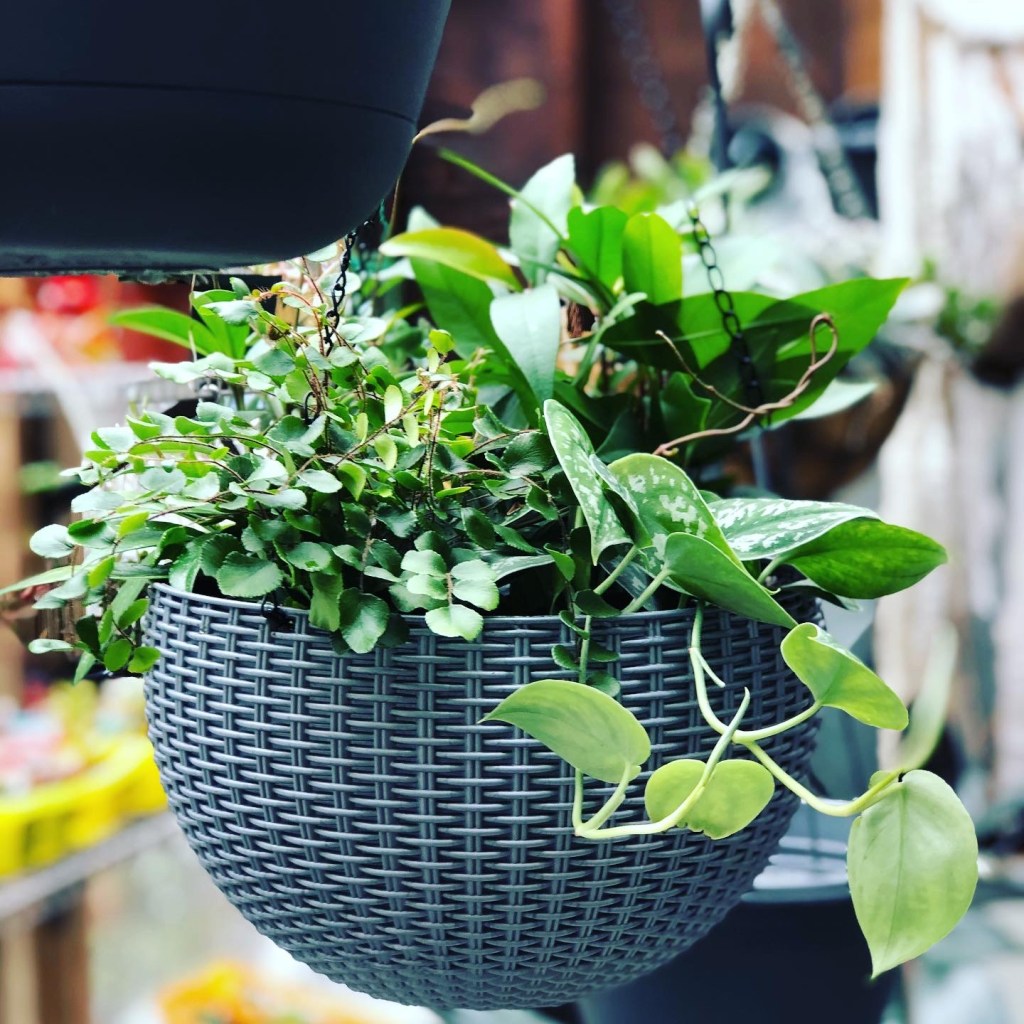
One year, I created many hanging baskets with various houseplants for sale. The reason was the houseplants were gorgeous. Additionally, the hanging baskets had a drain hole with a removable plug. It is so important to have drainage for your plants so these hanging baskets would work well. The plants were also extremely healthy and I thought, “Why not?” I sold quite a few of them. Each had a different mix of houseplants. Houseplants have their own unique sets of challenges. To help reduce them, start with healthy plants, which these were. Look the leaves over and make sure there are no discolorations or signs of insect damage. Houseplants like warm temperatures during the day and cool at night. They would be fine hung outdoors in the summer in these hangers in the right spot. Most houseplants enjoy bright indirect light and do not take direct sun too well. Having them in hanging baskets allowed placement in the home or outdoors in summer. In the summer outdoors, use caution so it is not in full sun where it would burn the leaves. It is imperative to allow water to drain out of the pot, and in this case, a hanging basket. These had a removable plug. This allowed proper drainage. Otherwise, I would not have used hangers for these plants. Hopefully the plants continued to thrive for the customers who purchased them.

Balcony Spiller Plant on a High-Rise

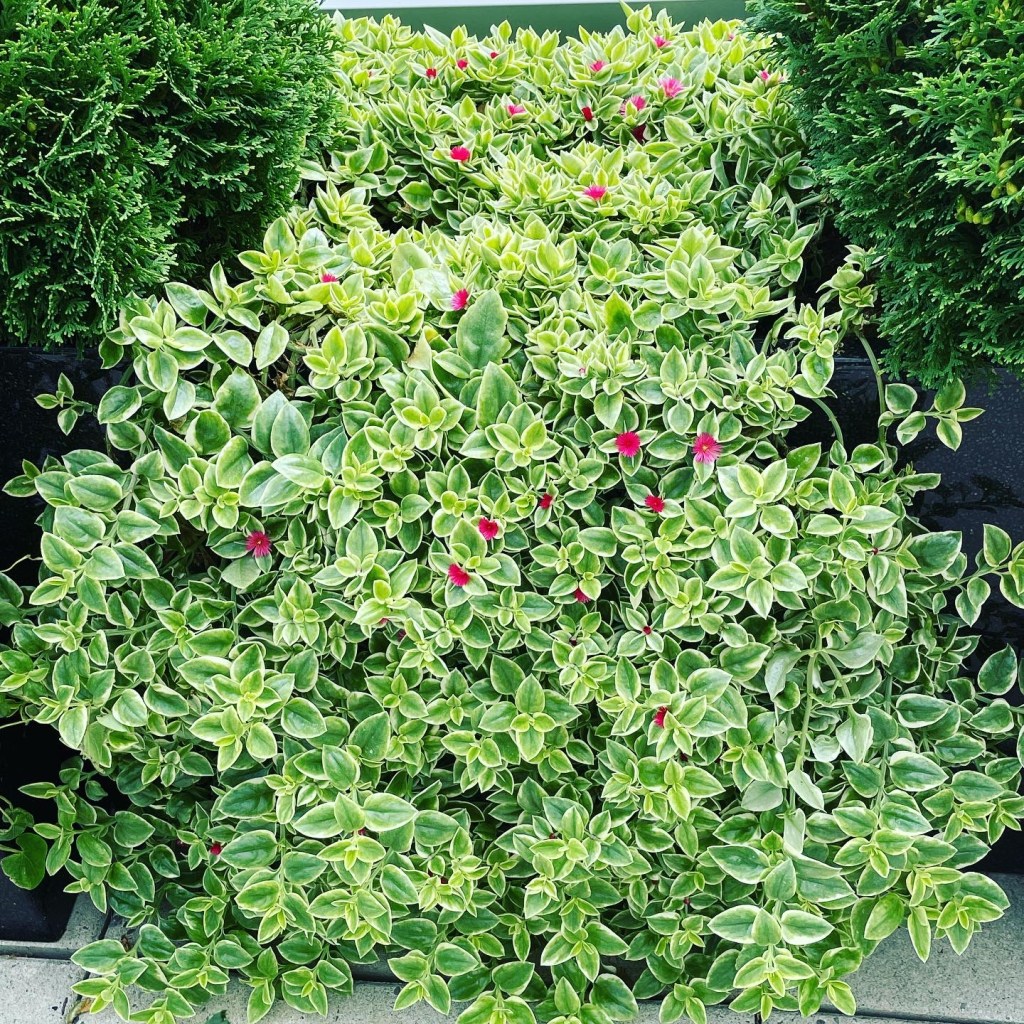
This plant impressed me immensely. First, it tolerated the full sun conditions of a high-rise balcony, and it grew so fast and full. It would make my plant-based mind mouth water! I started with a small plant and it grew very long, spilling over the edge of square planters. This is why I refer to them as “spillers.” I wrote all about this plant in a prior post. It really had other amazing features like it is easy to take a cutting to root for more plants. The red blooms appeared all summer. The plant did not get any insect damage and was drought tolerant. Read the post below if you wish to learn more. The post has some more photos too. Click below for more detailed information.

Blue Planter Box with Blue Wall and Canna Lily

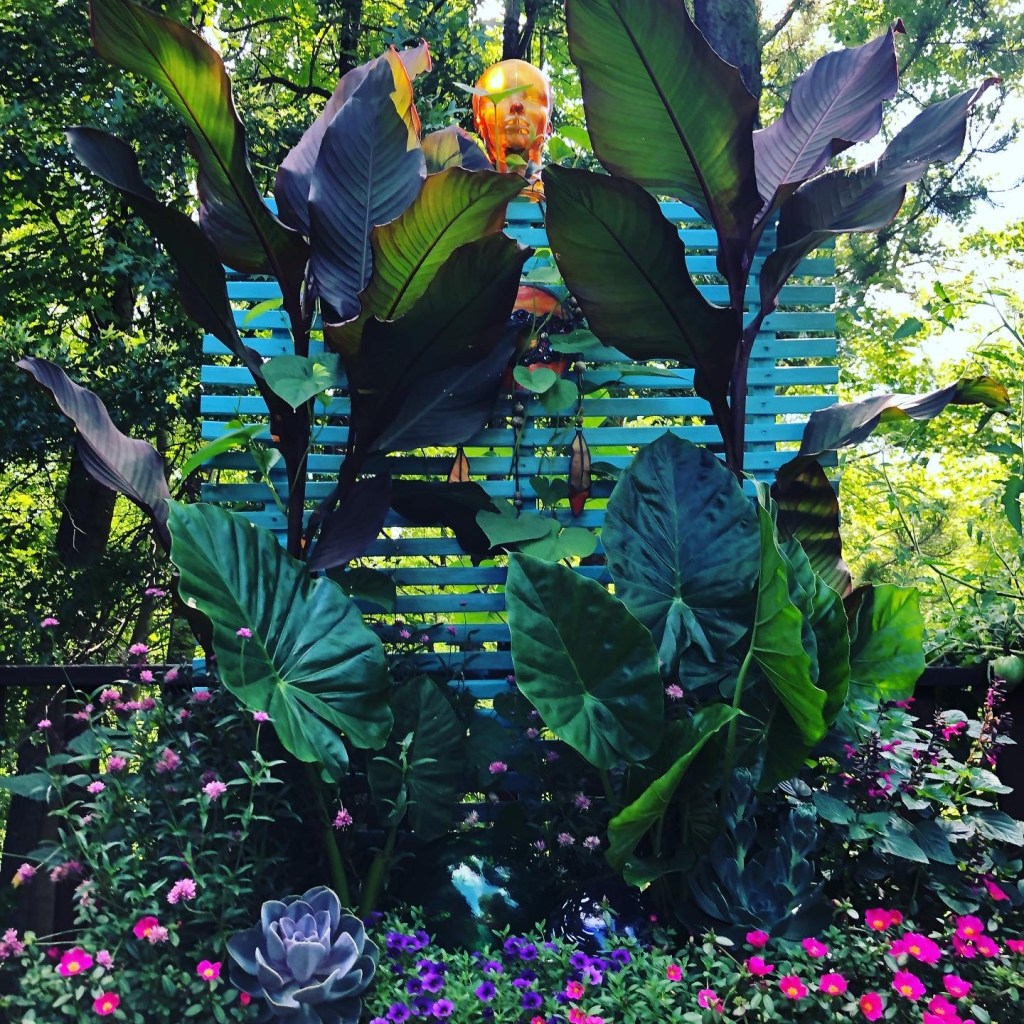
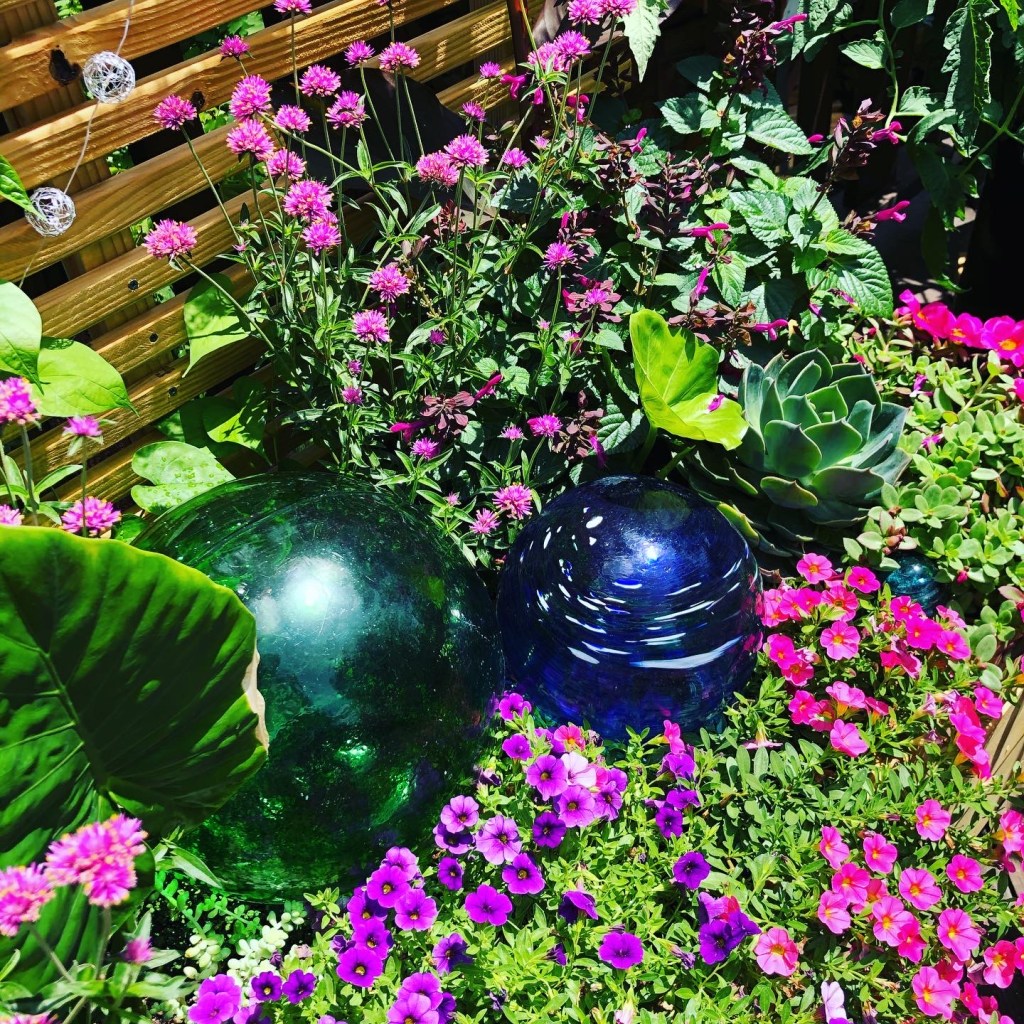
One year a lady in my town was building and selling wooden garden planters. I had to have one and situated it on my deck. I stained the planter box and attached trellis wall with an aqua-blue colored stain. Then started to plant it with a mix of sun lovers. The tall canna lilies were stunning and grew to the top of the wall. Below in the base wooden square planter were succulents, flowering summer annuals, and lots of color. I blogged about this planter too. Here’s the post. It shows the progression of growth of the plants from start to later in the summer season. It also identifies all the plants. Click below for more.

Wedding Pots with Euphorbia ‘Diamond Frost’

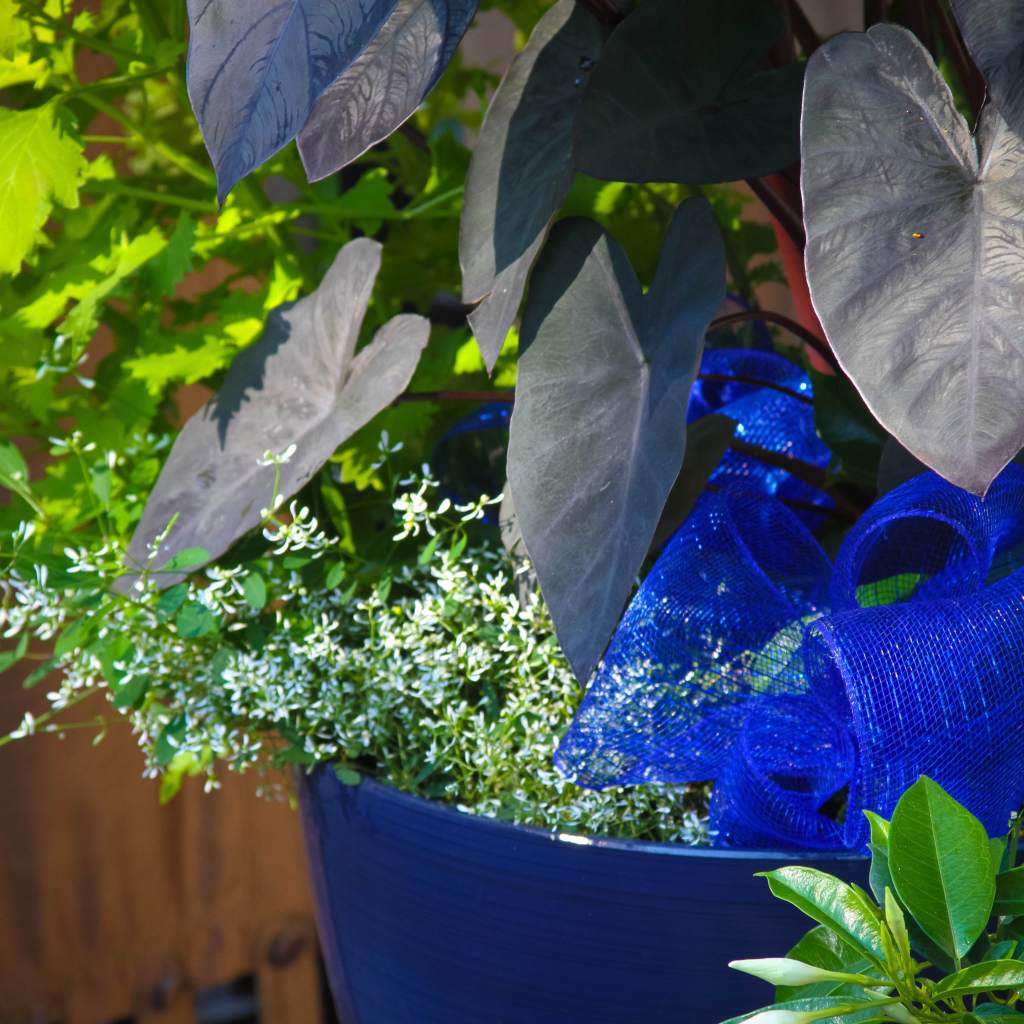
I remember Euphorbia ‘Diamond Frost’ being super popular one year. It has delicate white flowers. They are suitable for a wedding theme. These were used in wedding pots I rented to a customer one year. The client asked for blue pots and abundant flowers. I worked hard on these tending to them all summer and delivering them for the outdoor wedding. I wrote a blog post about them below. The nice thing about the white blooming plant is it can stand alone. It can also be used in combinations. Either way, it still looks lovely. Click the prior post link below for details about Euphorbia and the accompanying plants in these blue planters and pots.

A Tapestry of Succulents and Hens-n-Chicks

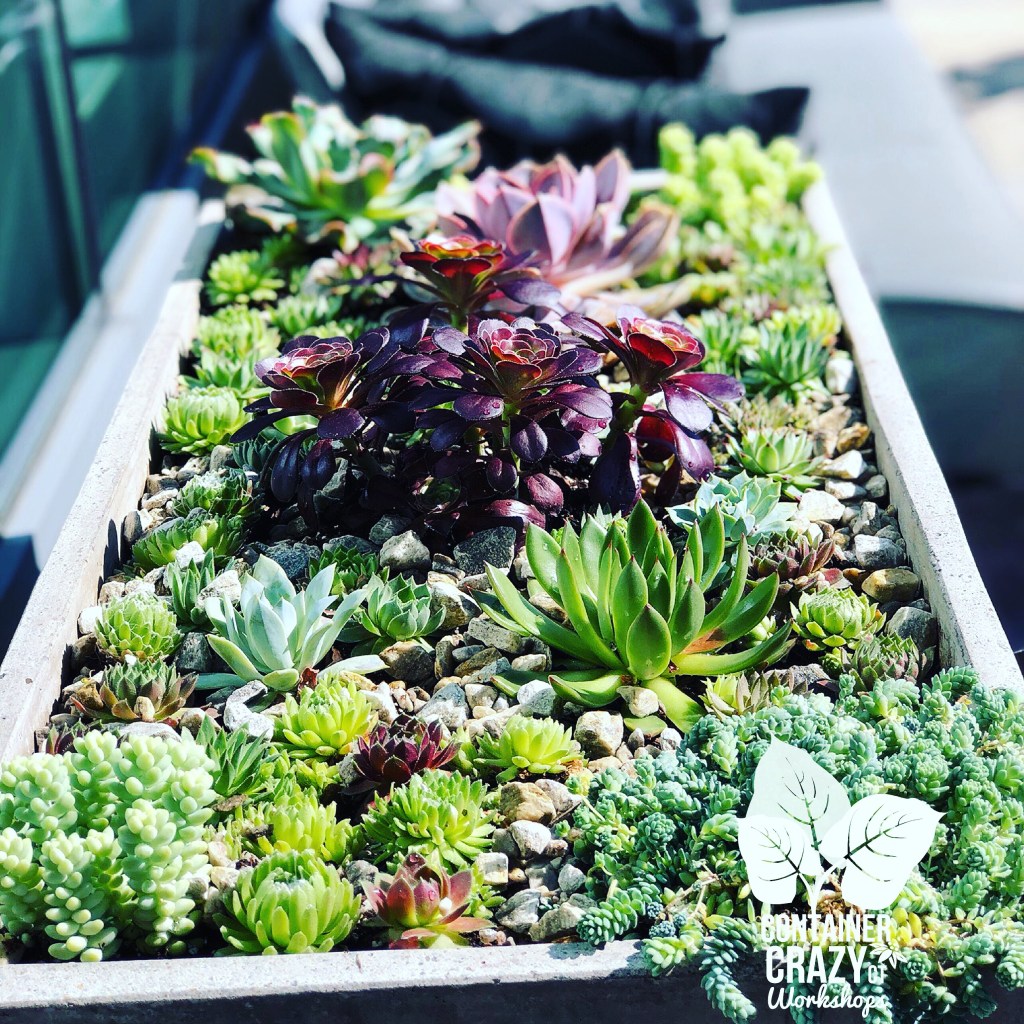
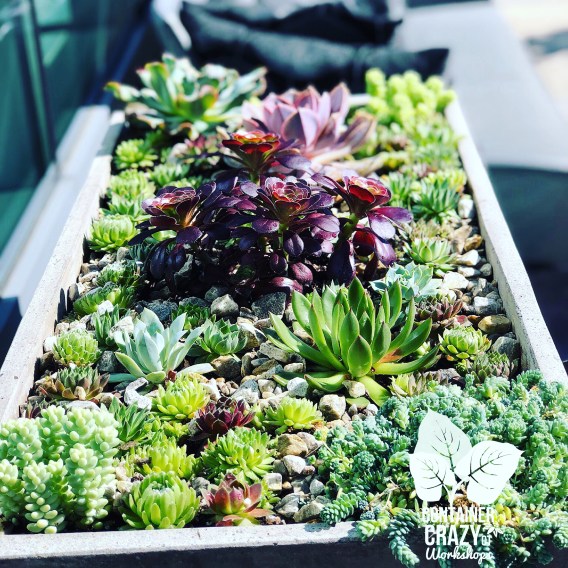
This has got to be one of my all-time favorite creations. It was a square cement like colored planter on a high-rise balcony. I was thrilled to fill it with various small hen-n-chick plants (Sempervivums). I also used other unique succulents and dripping down spillers. I felt it was “magazine worthy” to be honest. I know I took a boat load of photos of this planter and the accompanying ones. I’m surprised I don’t have a post about them on this website, but I’ll research that more later. You can see I used small gravel to top dress the soil around the plants. This offered a more finished look. I placed Donkey’s Tail (Sedum morganianum) in two of the corners. This way, it would drip down over the edges of the square planter. By mid-summer, these plants were double in size! Some larger Echeveria plants were included (they look like rosettes). In the center is a stunning Aeonium (plum colored). All of these succulents were in top-notch condition upon planting them. The planter was seen from inside too. This offered a nice touch for admiring the plants all summer long. After the season was over, I removed many of them to continue propagating them.

Barrels with Rubber Plant (Ficus elastica)

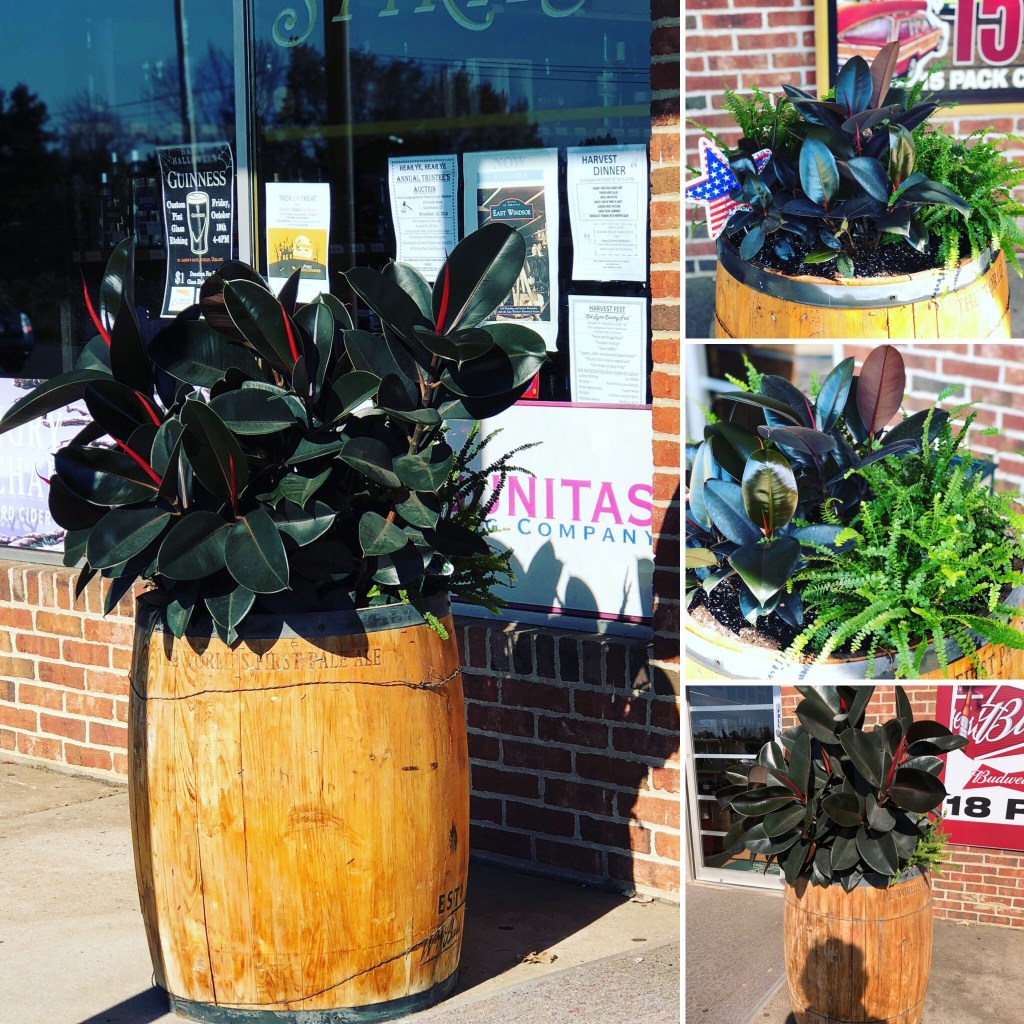
For years I planted two barrels in front of a package store in my town. One year, I used Rubber Trees. Why not I thought, they are an easy-care plant and have huge leaves and they should not be over-watered. Being watered infrequently is beneficial. The store owners sometimes found it challenging to find time for watering. But what really surprised me was how large they grew in one season! I stuffed some small houseplant ferns around the corners. The rubber plants were showstoppers. They grew wide and full. This particular Ficus had darker leaves and red tips which made it more striking. I was able to remove these plants and keep them a few more years longer inside my greenhouse.

Round galvanized pots

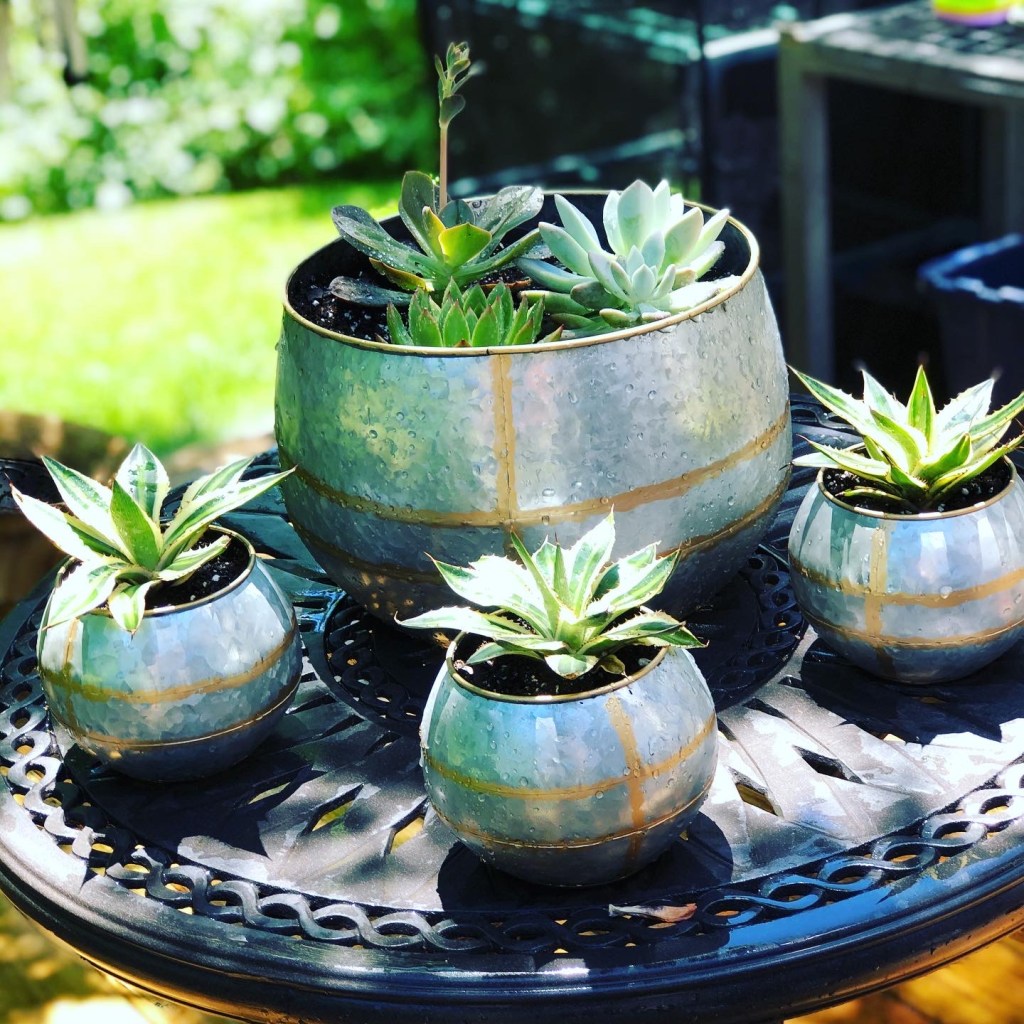
This one is more about the pots than the plants. I just loved these pots and had to have them. I placed some Agave babies in the three small pots. I also put a few succulents (Echeverias and a Hen-n-Chick) in the larger round pot. Each had a simple pre-drilled single drain hole in the bottom (a must). I took this particular photo on the deck next to my greenhouse one day. These ended up being moved to my large deck against my house. I didn’t sell them and still own those pots today. The agave plants outgrew them of course and were moved into larger pots later.

Round Urban Pot with More Succulents

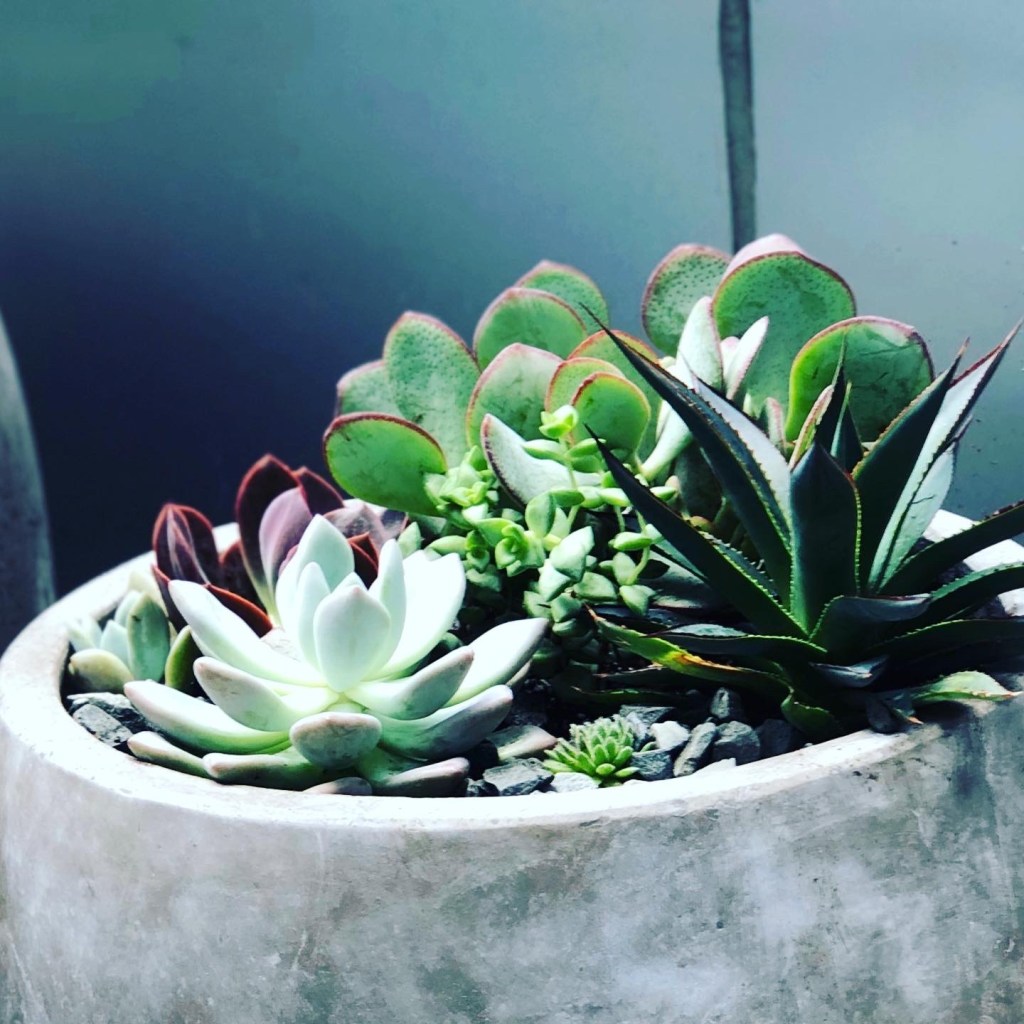
This was one of the accompanying planters on the high-rise. I filled them that year with succulents, agave, and other heat lovers. As with the square planter noted above, I topped dress them with gravel or stone. It gave a nice, finished look plus it helps reduce splashing of water when watering or during rain falls. These plants thrived in a rough environment of heat and strong sun outdoors. Granted some succulents actually like less sun but these performed very well. Succulents like well-draining soil. They need good air circulation, and it would get breezy or very windy here. Some prefer bright indirect light, while others thrive in full sun. A moderate temperature is also ideal. They can handle extreme heat, which they did handle in these urban cement styled planters. Also, the outdoor location provided sun for half the day and shade for half. It was perfect because the shade gave them rest from the intense heat. The plant in the background with rounded shaped leaves is a Silver Dollar Jade (Crassula arborescens).

Thank you for visiting. Stay tuned for more features!

Cathy Testa
Date of this post: 2/7/2026

Cathy had a small business focused on container gardening. Today she and her husband are retired. They like to go camping now thus camping locations have been added to this blog in addition to plant stories.

Bringing In Some Plants for Winter

Leave a comment

In Connecticut, many plants we use and display in our container gardens and patio pots will not survive the winters here, and must be handled by taking them in as houseplants or storing them by digging out tubers if they have tubers, corms or rhizomes, such as tropical plants like Canna Lilies, Elephants Ears, etc.

I’ve started some of this overwintering setup process already this year. This year, I mostly have agaves, cacti, and succulents to take inside as houseplants candidates. Some of them are rather large and this is becoming like a jigsaw puzzle in my home, because I’m taking them into the house instead of my greenhouse this winter. I don’t want to pay for the heat for my greenhouse – it is becoming too costly. So, I’m literally back to how I used to store plants when I was first into playing with plants over 20 years or so ago!

Pick and Choose the Best Plants to Take Inside

The process of picking and choosing which are worth taking into the home is interesting. I have literally stared at a giant agave and thought, Hmmm, where could I fit this? I’ve rearranged my small home office so a table has space for some plants by a window. And I put many smaller succulent plants (like in 3-4″ pots) in the kitchen garden window over my kitchen sink that faces south. I even moved a small couch from my kitchen sitting area to fit plants under a window facing west there too. Plant people will do anything for their green babies, like a complete furniture rearrangement to make space by a window.

I see people asking all the time on gardening Facebook group pages, what do I need to do to move in this plant? Sometimes it is a tropical Hibiscus plant, other times it is a traditional houseplant they had outdoors, or perhaps it is a giant Canna Lily plant. Everyone has their suggestions, like dousing them with a dish soap liquid combo, or other methods, like putting them in a garage and doing a bug bomb routine, and someone said they even put theirs in paper bags and spray them with insecticide and let that sit for a day to kill any bugs. Are these methods good? Well, if it works for them – perhaps. Not sure about the bag method, however. But you will try anything to take in a plant for the winter and keep it growing or stay dormant so you may use it again next year outside in the summer months here in CT.

My Ground Rules for Taking Plants In:

I, however, use certain “ground rules” for which plants are selected to be brought into the home for the winter. And here are my rules:

The soil must be dry (as dry as possible).

For succulents, cacti, or agaves, I make sure the soil in the pot has dried out – so they were either kept under a patio umbrella (if there’s been rain) or brought into more sun to help dry out the soil on sunny days recently. I make sure the pot is draining very well, even have tipped a pot on its side and let water run out, and I look at the soil to inspect it. If possible, I may tap the plant out of the pot and inspect the roots and just kind of look over if there are any critters in there. Or rotting roots. Dry soil reduces the potential for soil born insects, I find. And cacti, succulents, and agaves do not need lots of moisture in the winter. So before taking them in, I make sure the soil is as dry as possible. We have had a mini summer episode this week for weather, so it is good right now to try to get the soil dry if possible, so I’m doing that now. Rain is coming Saturday. I want to take them in before that.

Blow any Debris off the Plant

I have a small leaf blower and I will use that – especially for Agaves since their leaves are stiff and can take the blowing of air, to remove any debris. Leaves from trees sometimes fall on them and get stuck between the leaves of the plant. A leaf blower is perfect this this – it may blow away a spider or two as well, but spiders are usually good bugs, however, if you have a fear of spiders, you probably want them gone before taking the plant indoors. I cut off any bad or damaged leaves of plants after this. What I’m trying to do is remove any potential for something to cause issues. Some insects feed on decaying plant material, so getting rid of anything decaying on the plant is a must. A vacuum may be another handy tool, and also look under leaves of plants for anything lurking.

Washing the Outside of the Pot

I use soapy dish water to very thoroughly clean the outside of the pot. I want to make sure I’m not bringing along any debris, dirt, or maybe something unseen. All of this is done to prevent bringing in trouble, like hidden insects or any kind of lurking problem. It is a precaution of sorts. But worth doing.

Selecting Best Location Possible Inside

It is tough if you don’t have a glass house, but there are some places I know my plants could make it. Some of my medium sizes agaves went inside the bedroom by the slider. It is Southeast, it will get some sun, just enough to hang in there. I put the mini succulents in the kitchen garden window but remember that window gets cold in winter, but most succulents or cacti can take “some cold”. On good days, I am sure to open the little side windows on the garden window to give the plants air circulation. I also put some on a table in my home office which faces north. I’m not sure if that is going to work though, but I may get a small grow light and try that location. That window and room is colder, but not as cold as an unheated greenhouse would be. However, there are some succulents that actually are fine with less sun so those will go in the office. My bathroom small window works for a couple plants. Plants that don’t need a lot of sun and like humidity from the bathroom shower may go on a little table there.

Spraying Plants with Houseplant & Garden Insect Killer

This I do with only some. If a plant has a bug issue and I see it – and it is bad, it doesn’t make the selection list at all to bring inside. It is too much of a risk to increase and spread. If I may suspect a tiny problem; I may lightly spray the plant before bringing it in to try to treat it. Garden Safe is one I have used. But I truly don’t do this too much. Look at the bottle label on the back, make sure it is a safe product for your particular houseplant candidate (some products should not be used on particular types of plants), and do that outside before you bring it in. Again, I avoid plants with problems, and usually I don’t have too many big issues because I coddle my plants in the summer as well. Many people use insecticidal soaps or horticulture oils, etc. Ask your local nursery person for a good product or browse those sold in stores, but read the label on the back, open it up and see if any plants should not have that spray on them.

Giving Plants Away

I select the people I give my plants to with as much carefully thought-out consideration as I do with which plants come into my home. My sister-in-law has a beautiful big glass living room, and she has a green thumb. I just gave her one of my huge Jades. She was thrilled. I have given her plants before, and she always keeps them thriving for years. It makes me feel good when I see the plants in her home, but I also have that tang of jealousy, like, wow, I gave that one away?! But like I said, my house is small. And she truly does take good care of them.

Overwintering Saves Money for Next Season

Overwintering plants is a way to save money and also is a method to keep your treasured long time plant companions going for years. It also adds beauty inside your home. And life! But probably the biggest concern people will have been insects and the correct place to put your plant so it can make it. A room with absolutely no light may not work for the houseplant candidates. It depends greatly on the type of plant and the temperature too in the house. If you keep a room totally unheated, that can stress a plant. But that room may be perfect for tubers you are storing in boxes, for example. I will go over tuber and storing of corms and rhizomes again soon.

I have a rather large Agave which I’m currently trying to figure out where to fit it. It has matured so much over the years; it is huge and heavy! I noticed one day ants going to the base of the large pot. I thought, uh-oh. I won’t move that one in the house without potentially taking it all together out of the pot and removing all the soil – what a chore, and it can be dangerous due to their spines. I’m still contemplating this one. Should I try to sell it? It’s a monster! What will I do? I don’t know.

Other methods:

There are other ways to capture some of the parts of the plants like taking off-sets or cuttings of annuals or even some succulents will have off-sets or plants on the stalks, seed gathering for other types of plants, etc. And storing tubers or rhizomes of tropical plants which I will most likely cover here again, but I also have many posts from years past on this on this blog. Use the search bar to search for them. But right now, I’m focused on my agaves, cacti and succulents for this post.

Keep your Inspection Hat On!

Finally, once you have decided to keep a plant and take it indoors, keep your inspection hat on. Look over the plants every few weeks or even every few days initially. If you see a problem, act on it before it spreads. Reduce watering greatly for cacti, succulents, and agaves. They don’t need water much during the winter.

Thank you for visiting!

Cathy Testa
Plant Blogger
Connecticut
Date: 10/4/2023, Warm sunny weather this week but rain and cold on Saturday!

I have a post from 2013 on how I stored my Big Red Banana Plant (tropical plant). It is sometimes difficult to search for, so I’m linking it here below for those asking:

Storing My Big Red Banana Plant

Photos related to today’s post:

My Kitchen Garden Window – Mix of smaller cacti, agave, succulents (South facing)
Prized Agaves (Southeast) Bedroom
A mix of Succulents – By Kitchen Slider (Southwest spot in the house)

Self-Watering Pots Rock on a High Rise

Leave a comment

Self-watering pots, those with a reservoir area at the base of the pot to hold water for the roots, were not high on my list in regard to usefulness. I had tried them at home on my deck outside and I found that I didn’t like them for several reasons, such as, they tend to get overwatered when it rains and stay in a flooded state (unless you use the drain plug to release the overload of water), they don’t allow air to circulate well when waterlogged, and things like that. In fact, several years ago, I actually wrote a post about how I just didn’t like self-watering pots. I felt they were not good for plants! See that prior post below:

Post above from 2015. Wow, times have changed.

Boy, did I change my mind when I experienced using self-watering pots on a high-rise balcony. On the high-rise balcony, which I tended to for five years for clients’ plants in various pots and some self-watering pots, the environment is so different, I guess you could say, the environment has big weather extremes. And because one of those extremes is intense heat and strong sun, the self-watering pots (they were actually long planter boxes) did not stay flooded after a rain fall for long. The sun and heat dried them out much faster than self-watering pots I used at my home at ground level or on my deck.

A big environmental or climate consideration on a high-rise balcony for the plants was the extreme heat and full-on sun (as I refer to it – sun that is full on and intense). On some days, in the middle of fall, or even winter, it was like being on the beach up there on a balcony so high up if the sun was out. On hot summer days, I would have to make sure I worked on the balcony during the period of day when the sun passed by and there was shade from the buildings so I wouldn’t roast, but that was not often doable. Let’s just say, it gets very hot at times, almost unbearable, so plants which tolerate drought and heat were critical as well. To clarify, this was 38 floors up on the top of a building in a city exposed to all elements from sun, wind, etc.

Because of the environmental extremes such as sun (and wind), trying to keep the soil moist for the plants was more of a job for my clients. They would have to carry water out from inside their penthouse. By hand, with buckets! There was no outside water source, so my big fear was will they water enough? And they did fortunately. Otherwise, the plants would be toast from the extreme sun and heat.

However, with self-watering pots, some of that was solved. My clients actually had two long planters that were self-watering pots before I came onto the scene. When they pointed them out to me, I didn’t say much because I always felt those planters were problematic (as noted above in my prior post from many years ago), and I believed in watering plants in pots yourself. But I was the fool in this case, because I learned quickly, those self-watering planters were winners on a high-rise. So, for those who may be doing some urban gardening, take a look at self-watering pots. They may be very helpful to use if you have plants that require moisture and also if you have intense sun (and wind) on your open balcony up high.

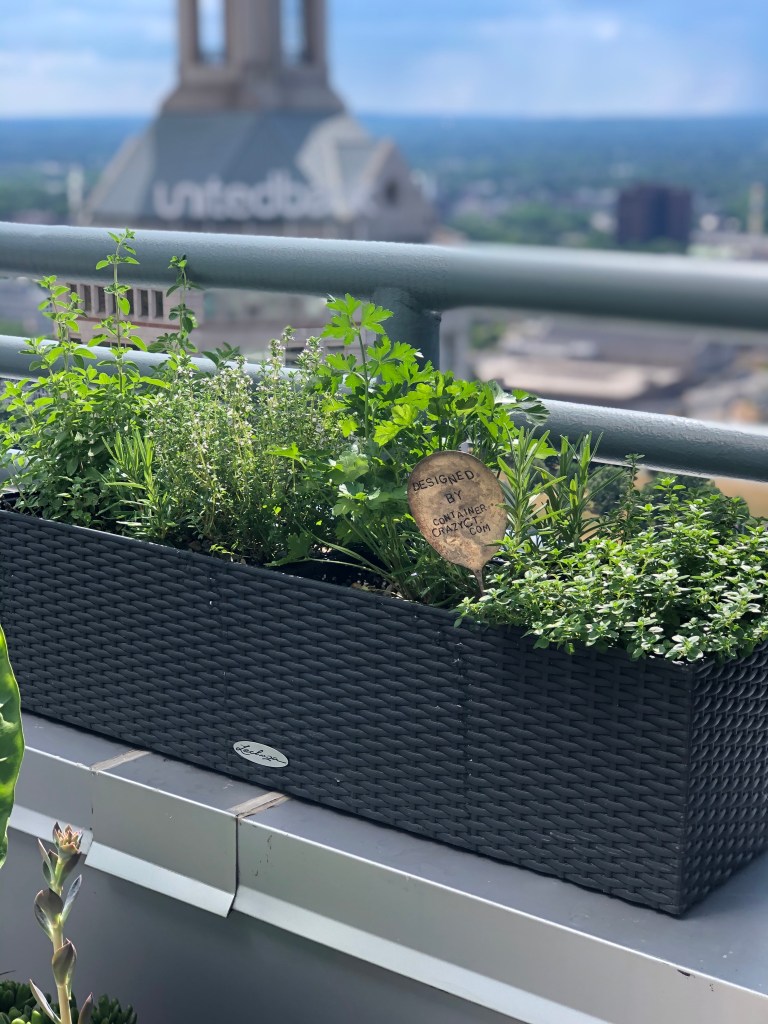
Let me explain why. If the rain fall was abundant, the fact that the sun was so strong and hot after at times, the soil would dry out. The water would not stay in there and flood the planters, like they did at my home after a rain fall. It would be the same exact weather at my house and theirs but due to being up so high, the planter would not stay waterlogged. Waterlogged soil will rot the roots or kill them. It was working out, especially for herbs. Herbs can take dry soils usually, but they do need moisture at times. I started to fall in love with their long self-watering planters.

I learned lots of lessons by working on a high-rise thru experience. I also have knowledge on plants and which were tolerant of conditions, drought tolerant, loved heat and full sun, but I still had lots to learn and plants to test out. In the case of self-watering pots, I discovered that they rock on a high-rise balcony.

The self-watering planters did need to be stored for the winter, however, which I offered as part of my services. I would wash them well, store them and return them in the spring with fresh soil and fertilizer. It was working out and they still have those planters today – those were a very good idea, and an excellent investment.

Pots and planters have special considerations on a high-rise which is another thing I will write about, and I had to find solutions. I’m kind of an out-of-the box thinker – AT TIMES … so I got really creative when during the first year there, which I will write more about later. Weight for example is a big factor. Again, it is not like pots near the ground, there were weather considerations all the time.

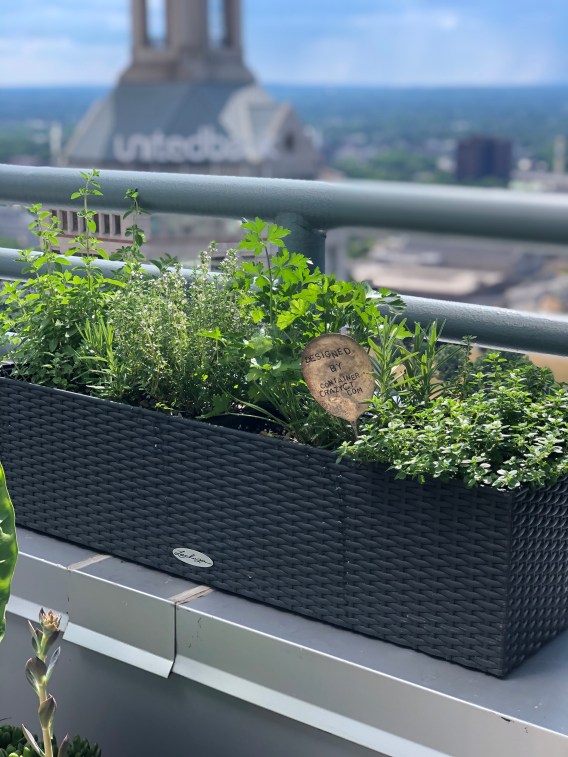
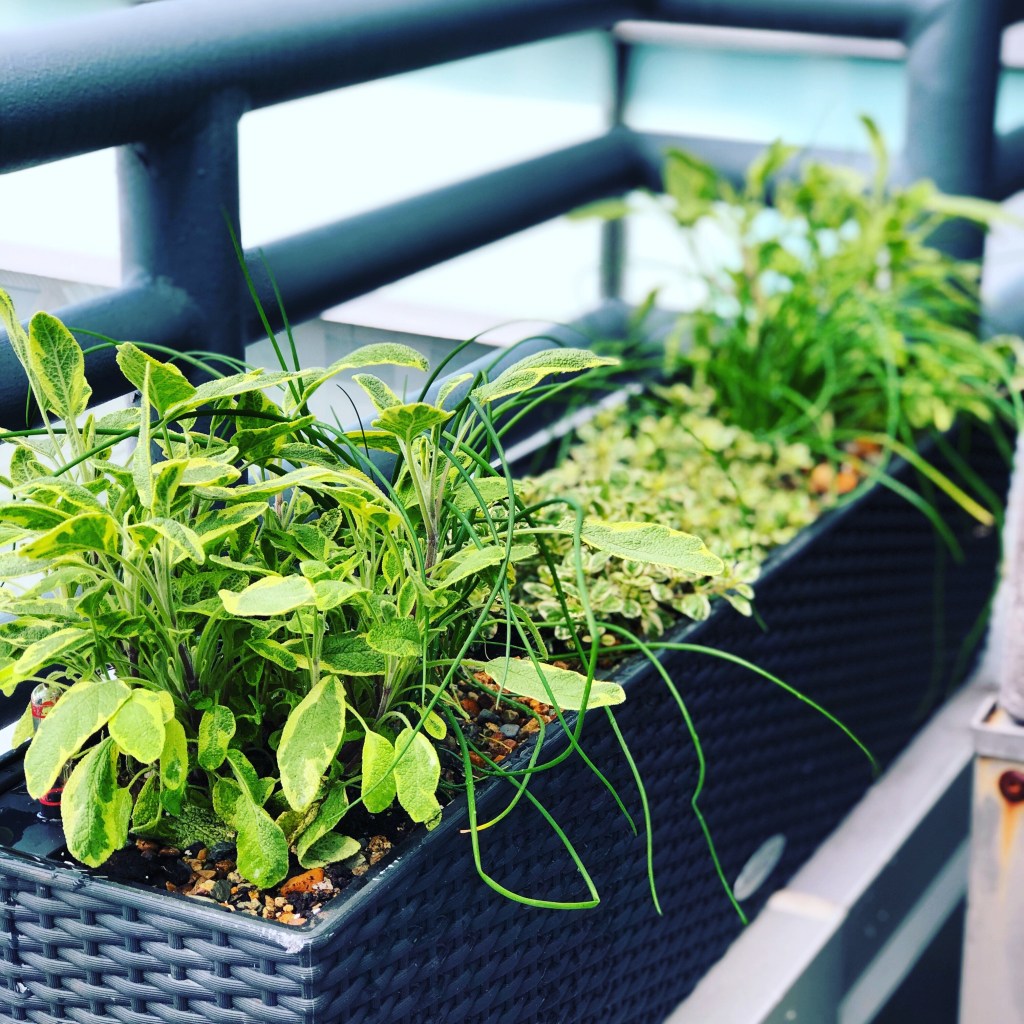
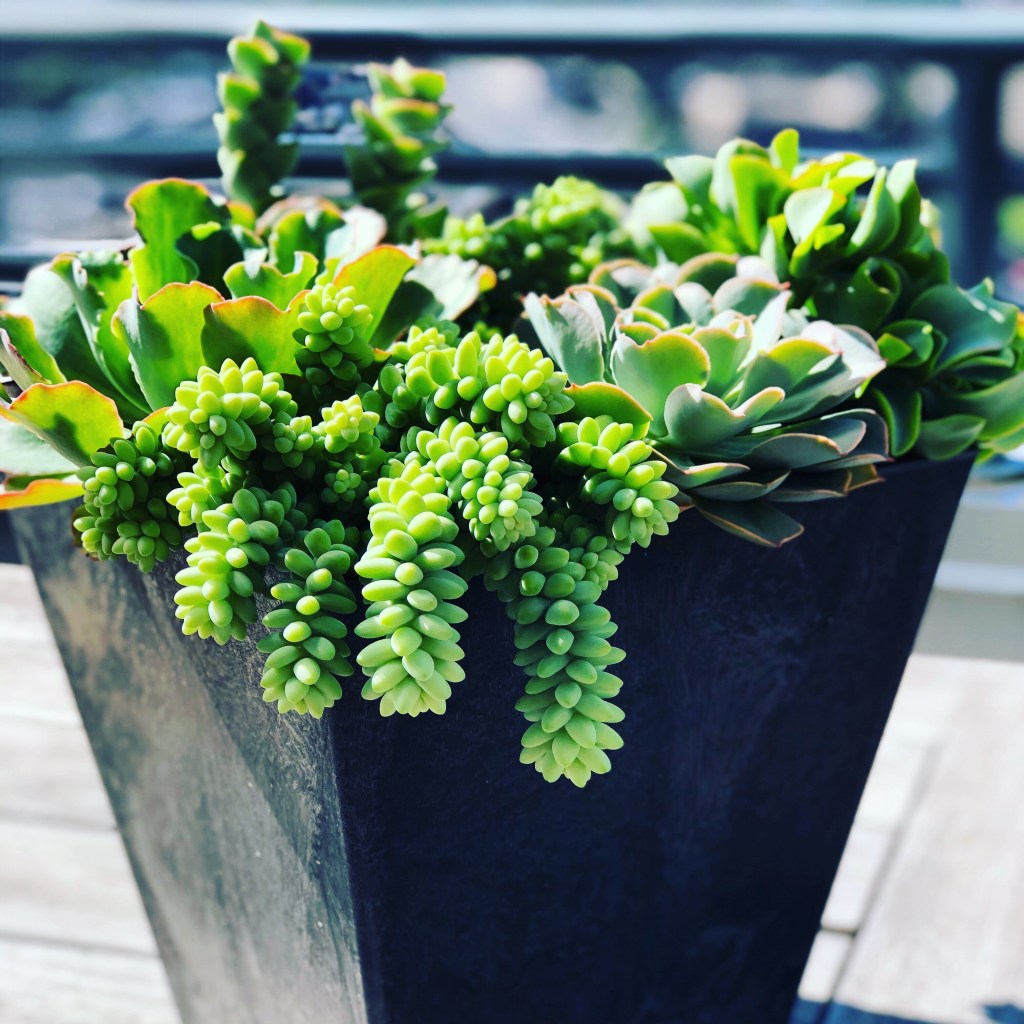
Plants that I felt did very well in their self-watering long planters were herbs. I did try smaller compact type of patio cherry tomato plants one year, but they kind of fell over from the winds, so that did not work where the long self-watering planters were positioned near the railing. However, herbs did very well in these. Some herbs in general can take dry soils – herbs like rosemary, for example. Later, I ended up acquiring some tabletop pots which were also self-watering and started to use them with succulents on their high rise as well. Those worked out well also. Succulents do not like soggy soils, so when it rained so much that it flooded the pots, it was fine because the sun and heat would dry them out fairly quickly. Or you can drain them if need be. It was just working out so much better than I would have thought.

A couple things I did was I added some small pea gravel in the base where the reservoir holds the water to weigh down the planters. As noted above, due to extreme winds on a high-rise, I was concerned the planter was not heavy enough. I also used standard potting mix with slow-release fertilizer. And sometimes, I top-dressed the top of the soil with either pea gravel, mulch, or moss, however, it was not really needed but I liked that “finished off” look to add some style to planters.

Here are some photos. I know I have more, but it takes a while to locate them. When I find them, I will add to the next post. I rather enjoyed taking them the planters to my greenhouse to clean for the winter and replant in the greenhouse to deliver in each spring. I felt they were kind of Zen. The herbs would grow three times the size at their balcony – I know I have photos of that but will have to share them when located! It always amazed me how much the plants grew when I would return for a fall change out. Balconies are wonderful places to have a full blow herb garden if you have enough sun, which this place did.

Self-Watering Long Planters with Various Herbs
Self-Watering Tabletop Planter with Succulents Above

Thank you for visiting,

Cathy Testa
Container Crazy CT
Blogger in East Windsor, CT

One more photo below!

High Rise Gardening

5 Comments

Back in 2019, I received a voicemail from a gentleman, and he was looking for a gardener for his balcony. I immediately felt a certain tone in his voice. Something about the phrases he used and his professional manner in his voicemail to me made me feel this would be a call worth returning. And, my friends, it was.

It led to quite the adventure of planting not only one but two high rise balconies for five years, located on the very top floor of a building in Hartford, CT. It’s a good thing I do not fear heights, because if you did, you would not be able to look over the railing at the scenes far below. It can make a person with a fear of heights queasy.

There’s something special about working in a high-rise urban situation. The background city sounds are constant, but they are not the typical sounds I hear at my home, which is filled with birds and maybe a slight sound of road traffic. On a high-rise, you hear sirens, distant constant highway background noises, an occasional high-flying hawk, and air sounds. I liked that. It is not overpowering, just there and didn’t bother me. In fact, because I have tinnitus, I rather liked the background city sounds. It drowned out my tinnitus and also the enjoyment of working in this special place, made me not focus on tinnitus either! Plus, the views were enough to not even think about the background noises.

I also liked how you are up there overlooking the world, and no one knows you are. It is a really neat and inspiring situation. One time, when working on their planters, two helicopters flew right near there, as if a pair flying together. I thought, can they see me here, and I even wondered if it was the president. I had read he visited an area in CT that day.

And after a few rounds of plantings, I started to see bees. Usually, a solo one or two. One time, the client heard a tree frog in the planters. They could not locate it, but they were amazed, and so was I! He either hitched a ride on one of my nursery pots, or could it be possible he climbed up that high?! The balconies are 38 floors up! I always liked pressing that PH button in the elevators, I have to admit.

I thought, gee, I so wish I landed this opportunity when I was younger. I was very excited to work for these clients and their balcony gardening projects, and yes, it was all very large planters the full length of the balconies. Fortunately, they referred me to another couple in the same building, so had two wonderful sets of clients and wonderful planting scenarios.

Probably the best part of it all was the upmost appreciation for my planting work and craft by these clients. I was told often that I was an artist. Can you imagine how that felt? It was wonderful and meaningful to me. And their flexibility, as they fully understood this planting situation is unique and has special challenges. They were always, always polite and understanding because things unexpected can happen on a high-rise situation with plants. I knew it would be challenging yet extremely fun and rewarding for a plant person. Plus, I liked their style. Both had their own unique style, and it was fun to think about how to best meet their needs in that regard as well.

Working on a high rise has many challenges. Try – no water sources outside. Extreme winds that will shred plants. Cold temperatures when I did winter installs. And in the summer, extreme heat. I had a lot to learn and research. And, not to mention, going up and down constantly in an elevator. I am lucky I am a thinker about organization because you have to organize all to be efficient in those situations. And I got to witness how plants respond differently in a high-rise balcony situation in planters, pots, and spaces. Plant colors are different when experiencing extreme heat, they grew to amazing large sizes in some cases, which blew me away. I would plant a small herb and it would reach the size of a shrub by the end of summer. It would shock me sometimes, like wow, they love this sunshine and heat! I read somewhere you could not grow tomatoes on a high-rise, NOT! You sure can and they were wonderful.

I thought it would be a great idea to talk about the plants which worked well in these situations and what didn’t work so well on a high-rise. And write about my high-rise balcony gardening adventures. I actually had trouble finding good books on balcony gardening. I could write one of my own I guess, but I choose to use my blog, here on Container Crazy CT, to write about scenarios I encountered in a series of posts.

It begins today!

Sneak Peak of a Row of Big Square Planters
A tapestry of succulents in long square planters – Loved how this came out in year one!

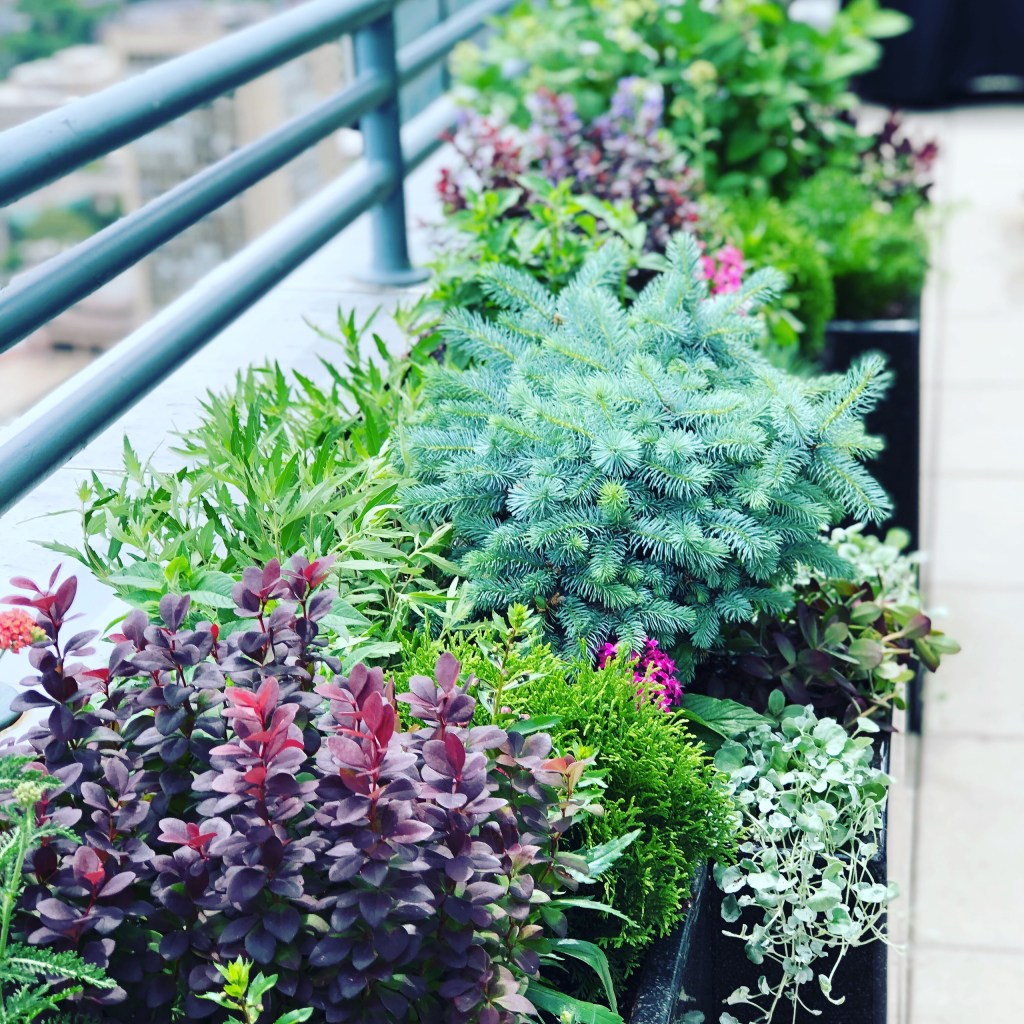
I’m not sure exactly where to start but these two images above are sneak peeks of two of the many planters. The first is client number 1 and after much thought and questions, I ended up putting together a mini garden and I loved how the deep plums accentuated it. And for the other photos, it was a mix of succulents. Some grew two to three sizes larger in one summer. It was amazing. I will write about these and many other planting arrangements as I do my series of posts upcoming!

More later!

Cathy Testa
Container Crazy CT
Date of post: 9/12/2023
Location of Photos: Hartford, CT
My Location: Broad Brook, CT

It’s Succulent Pumpkin Time!

Leave a comment

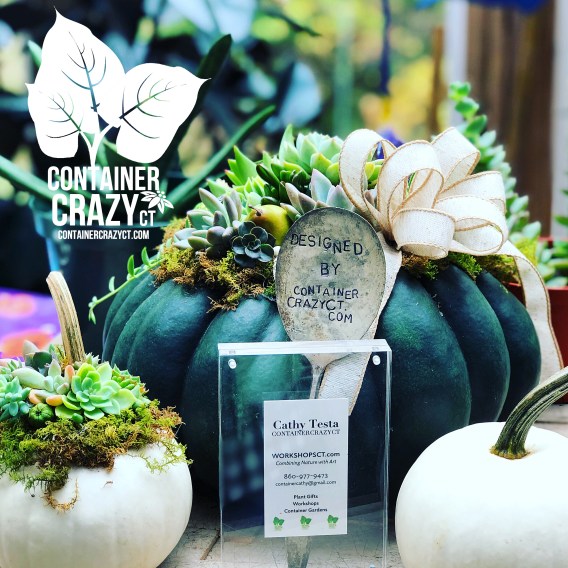
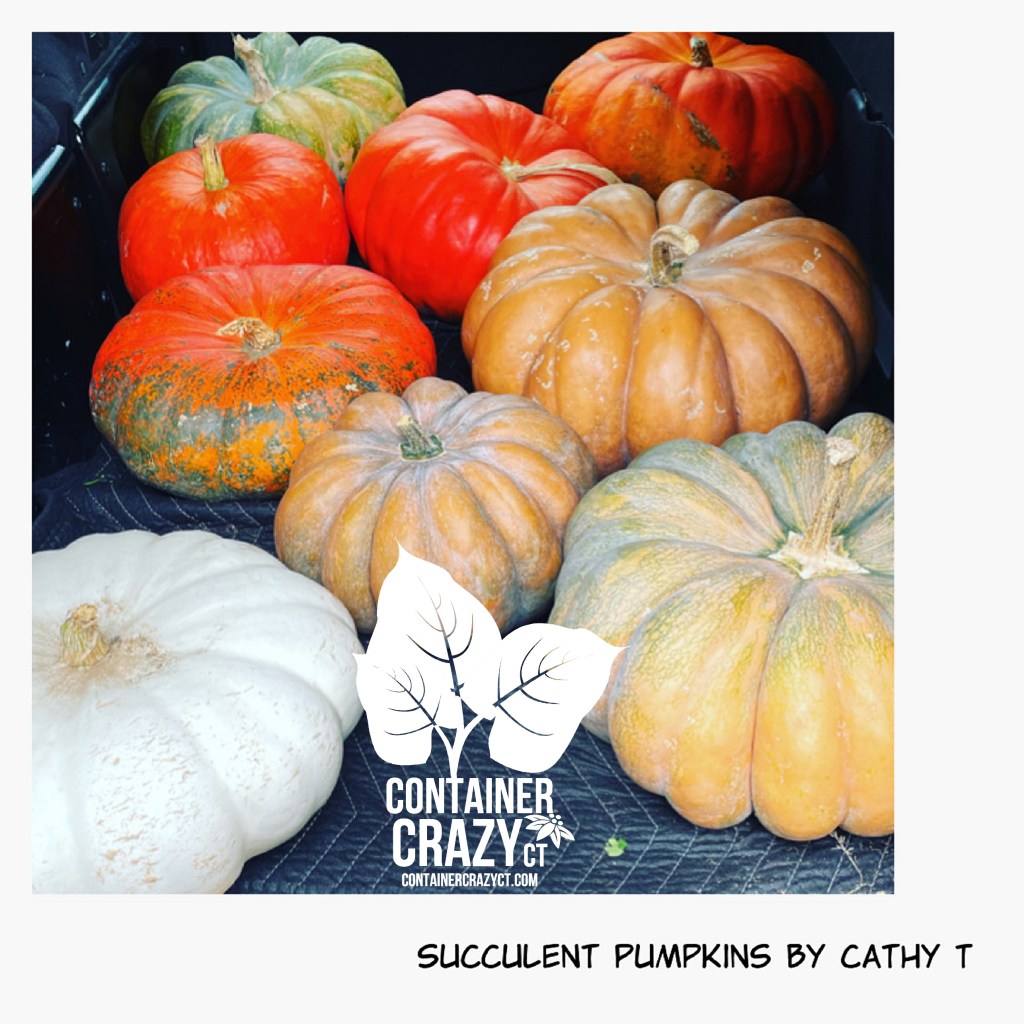
Just a real quick post – It is that fall time of year and I’m starting to make custom orders for the large to medium style succulent topped pumpkins. To learn details, please visit www.WorkshopCT.com and see the top post.

Next up! Photos of me taking down my largest Alocasia plant. Stay tuned!

Cathy Testa
Container Garden Designer
Connecticut US Zone 6b

Thank you!

Succulent Topped Pumpkin Time

Leave a comment

Autumn Time

Hop on over to my site, called www.WorkshopsCT.com to learn about my custom made succulent topped pumpkins. They make wonderful autumn centerpieces, and now that there is a bit of fall in the air, these are my next fun endeavor. I love making them for orders. They are wonderful displayed inside your home for the fall and Halloween season, and last for months!

Winterizing Time

I’m also still taking down my tropical plants, probably working on them this weekend during the nice pleasant sunny cool fall weather. We have not had our October frost here yet, so there is still time but alas, my work must continue or I will be backlogged with plants! I have some Brugmansias which are blooming beautifully right now with huge yellow trumpet shaped flowers which smell wonderful in the evenings, as well as my Canna Lily plants, and I still have many elephant ears plants (Alocasia and Colocasia) outside in my larger container gardens. All will be taken down, pulled out of the soil, cut back and stored via the parts under the soil (corms, tubers, rhizomes, etc.) for storage during our winter months. I will show more photos soon but just enter search terms in the search box on this blog to locate directions and information and feel free to ask questions. I also have already collected my seeds from various seed pods by this time and stored them in cool dry places for use next spring to regrow some of my favorites. Pods should not get soggy and wet and be collected before that phase, or they will mold or rot on the plants outdoors at this time of year. I also put away most of my agaves, mangaves (one is shooting a flower stalk – it is 4 feet tall right now! So exciting!) And put my succulents in the greenhouse along with some of my larger house plants. The greenhouse is not being heated of course yet, and the natural air goes thru daily along with an auto fan as the temp rises on sunny days. Anyhow, the fun and plant work continues.

Winter Time

Boy, times are tough for small businesses. Every time I turn around prices are going up. This impact us greatly and we just can not afford to be “low priced” on our unique creations and please bear in mind, plants are perishables similar to vegetables from the grocery stores. Of course, you may make plants last for years, if not centuries, with the appropriate care, so it is a wonderful investment to have the beauty and company of plants surrounding us, but all the delivery costs, shipment fees and delays, materials and you name it, it has raised prices on materials for our industry, from the plants to the decorations we use for them. So thank you for supporting my small business – especially those who repeatedly visit me.

It brings me much joy, honestly, especially in the winter months to continue my work and custom orders. I guess my point is – I’m still planning to make my custom made holiday items as well as my succulent pumpkin centerpieces, but prices have gone up for me as a very small business owner. Custom is not cookie cutter, so if you enjoy unique, handmade, well cared for plant creations – I’m your girl! And also, the weather factors, this year our areas got hit hard with rain and floods – this impacted the availability of pumpkins locally. But this will not stop me from creating because it is my passion. Passions can not be stopped! 🙂

Thank you for visiting.
Cathy Testa
Container Crazy CT
Broad Brook/East Windsor, CT
Zone 6b
USA
Posted: 10/7/2021
Today’s weather: 54 degrees F, Foggy, H: 73, L:50
Weeknight temps for next week are in the mid 55’s range.
Friday and Sat – Party Sunny – yes! Glad we will have nice weekend weather.
Next week, looking good too in the mid-60’s to low 70’s, but maybe some rain showers

Overwintering Agaves Early

2 Comments

This will be a quick post. I am trying to document how I overwinter various plants from the outdoors to the indoors in my area of Connecticut as I work on them. This week we are having gorgeous weather, thus I am getting a head start on my plants at home because I will be busy the rest of the month working on clients’ plants.

Agave (ah-GAH-vay)

These plants are considered succulent perennials hardy in zones 9-11, some maybe hardy in zones 7-6, but in my case, I treat them as non-hardy plants and move them into a lower temperature greenhouse for the winter. The greenhouse is not heated right now because it is still warm enough outside, but by mid-October, we could get frosts and my agaves should not be subjected to any frosts.

During the summer, my agave plants are in full sun locations on my outdoor deck in individual pots. Some are super heavy and require a hand-truck to move them to my greenhouse, while others I can manage to lift and carry in my arms in the pot, although it requires a bit of muscle power to do so.

I usually allow the soil to dry in the pot as much as possible but we had so much rain and moisture this year, some of them are still holding damp to moist soils. However, it is best to move them indoors when the soil is dry if possible.

Over the winter, I suggest you do not water them at all and allow them to stay on the dry side. If the soil stays wet and you move them indoors, they may get root rot (especially if you are moving them into a house with air conditioning still on and in a non sunny situation).

Inspect the Plant

Steps

  1. Let the soil dry out as much as possible before you decide to move in your agave plant. As noted above, wet soggy soils only invites problems (i.e., root rot, insects that like moisture, and fungus sometimes)
  2. Inspect the plant for insects. Use the methods below to blow away any insects, debris, etc.
  3. Lift to inspect roots if possible (optional)
  4. Wash the outside of the pot with mild soapy dish water if possible

Inspect

Usually my agaves do not have any insect issues on the succulent foliage. You may find a spider in there (a good one), a cricket hiding between the foliage, maybe even a tree frog sitting on the plant! They seem to like one of my bigger agaves. I find one or two tree frogs every year hanging on them earlier in the season. Before moving them inside, check them over for any potential insects or debris (like fallen tree leaves or twigs, etc.). Ways you can handle the inspection are by:

Using a leaf blower to blow anything off of it.
Using a hose with a harsh spray to blast the leaves with water to dislodge any debris.
Use a little brush to brush away items caught between the leaves.

Lift from pot to look at roots – optional and if possible

This agave is in a plastic pot inserted within a glazed pottery pot. I decided to lift the plant out and inspect under. Yes, the soil is still moist, but otherwise, the roots look fine. When I lifted it up, a tiny cricket insect jumped out – so it is helpful to check and get all those little hiding bugs a chance to get out before they move into your home or greenhouse.

You can see here the plant is pushing out a side shoot (pup) which will eventually form another baby agave. Overall, the roots look fine, but the soil is staying so wet, I decided not to reinsert the plastic pot into the glazed pottery pot when I moved it into the greenhouse. This will allow the air to help dry out the situation. Also, right now, the greenhouse is nice and sunny and warm. It will help to dry out the soil.

Overall this agave showed no major concerns. It is now safe in my sunny greenhouse to await the cooler days of fall and then eventually winter where it will be protected until next year. I have written about overwintering agave plants before. To locate the posts, type the word ‘Agave’ in the search box on this site.

Thank you for visiting. Let me know if you have any questions.
Cathy Testa
Container Gardener
860-977-9473
containercathy@gmail.com

Protect Pots from Rain

Leave a comment

In most cases, we adore the days of rainfall during the summer because it offers a break from watering our container gardens and patio pots, but this year, 2021, we got our fair share of rainstorms and too much at times.

I found that soil remained wet too long in some cases. It stressed our tomatoes, however, most tropical like plants love the rain. For some of my succulents, it was just too soggy. They did fine, but with today’s expected downpours (due to Hurricane Ida remnants passing over Connecticut today, tonight, and tomorrow), once again my succulent plants (agaves, jades, echeverias, etc.) will get more rain pounded on them as they sit in their patio pots. They haven’t had lots of dry periods this season, so the soil has stayed more on the “moist” side than dry side for days.

Because of this, I decided yesterday to move some of my plants onto a deck table with a patio umbrella so they won’t get blasted again. Yes, it is a bit of a PIA (pain in the a**) to move them, but I just don’t want that soil water logged at this point as we transition into September.

I will most likely move some of them to my greenhouse too. I am only doing this as part of my overwintering process early because I have a busy month coming up and this is my only week to get come chores done early. So again, plants may stay outdoors for quite some time, even into early October “for some types of plants.” However, when it comes to my succulents, I don’t like them to stay in a water logged state too long. Fortunately, this weekend’s forcast looks fantastic. It is predicted to be in the mid-70’s with sun from Friday to Saturday (yes!). But it looks like more rain on Labor Day! Rain rain rain this year.

Plants not poorly affected by rain are my tropical plants, such as this upright Alocasia, which I adore. Tropical plants add a real feel of a jungle or rain forest, and I love having that look on my deck because it makes me feel like I’m in Hawaii. If you can’t be somewhere tropical, might as well try to get that feeling at your home.

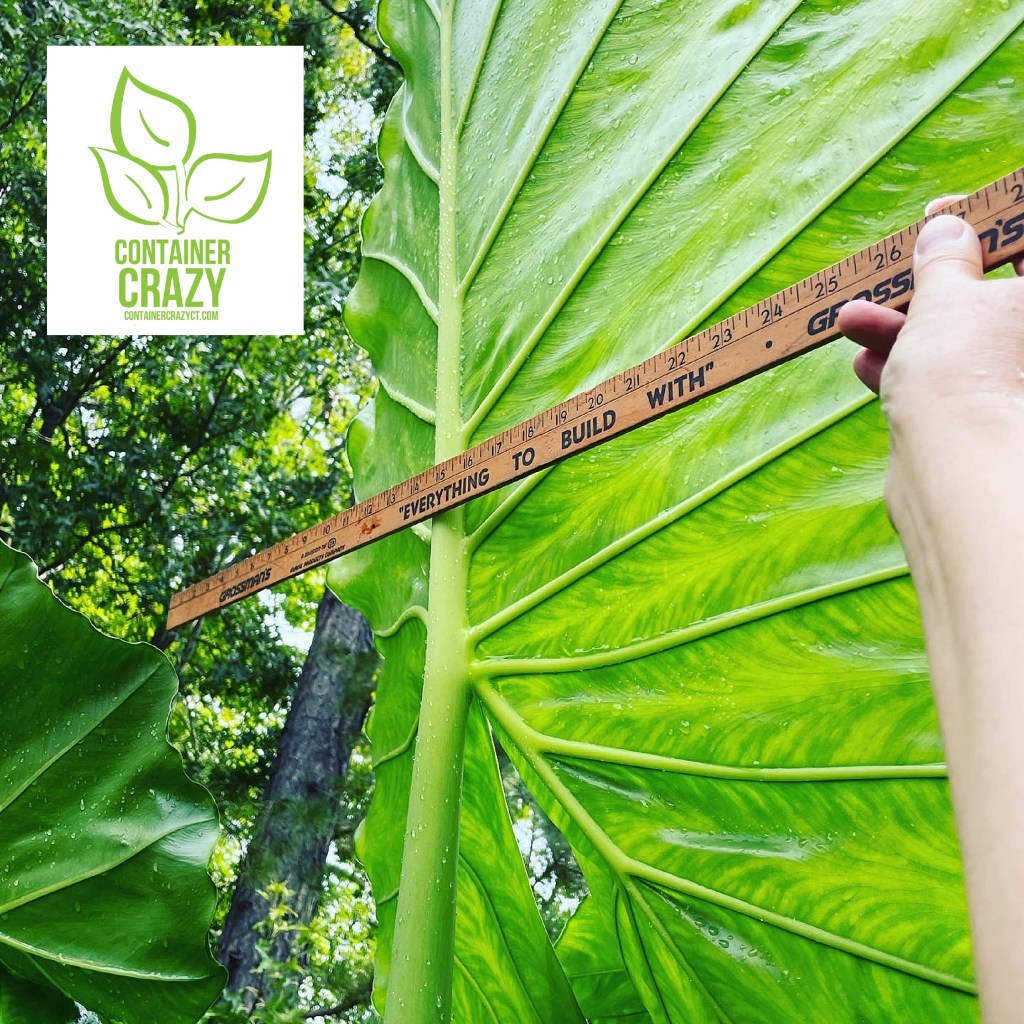
This plant is showy and grows extremely large leaves. I took the time to measure the biggest leaf yesterday. It is 3 feet height and 3 feet wide with a 3 foot long stalk. In fact, it was hard to hold up the ruler as I tried to take a few photos of it yesterday.

These plants are accustom to dealing with tons of rain fall cause they are from the tropics and are used to it – it is in their genetics, basically. That is cool. With all the strong rainstorms we had this summer, the leaves just kind of tussled around and didn’t break or even tear. Also, the leaves have the ability to shed water droplets and also the texture of the Alocasia leaves allow the water to run off quickly.

Members of the Alocasia, Colocasia, and Xanthosoma are always on my plant list. They grow huge. I love the heart-shaped elephant ear leaves and enjoy looking at them every single day. In fact, my jungle look is at the end of my house by my bedroom, so I see this via a slider door and have watched hummingbirds visit quite a bit this year as they go to the orange tubular flowers below this Alocasia shown above.

Another plant which has done well despite the rain is my Mandevilla. In fact, the Mandevilla twined around one of the stalks of the Alocasia this summer as it reached out for places to twine as it grew. This one is called, Alice Du Pont, and it is a plant which I overwintered last year in my basement in the pot. I took it out early to start growing in my greenhouse and then planted it in a big raised bed like planter on my deck. I fed it bloom booster water soluble food about once a week for a time in the middle of the summer and it has bloom beautifully. It is considered a tropical vine and works well when trying to create that jungle look with some trumpet like gorgeous hot rose colored flowers.

These tropical plants will grow well into early fall. I perform a combo of overwintering techniques from mid September till mid-October. Some are stored in their small pots in my basement or greenhouse, some are taken down (foliage and tops cut off) and tubers or rhizomes below are stored in boxes in my unheated but not freezing basement. And some are kept going by harvesting seeds and sowing them next season. The Mandevilla (and Dipladenia) can be a little tricky to overwinter and get growing again. It helps that I can start them early in the greenhouse. I started some others and they did not take off or produce as many blooms. You can’t win them all in the world of nature. There are just so many factors which are out of your control. Like rain for example, but then again, rain is a helper at times as well. Mandevilla are stored as dormant plants in a dark place at about 40 degrees F over the winter. The soil should not completely 100% dry out but stay more on the dry side than wet.

As for the Alocasia noted above, also known as Elephant’s Ear or Taro, I’ve dUg them up and divided off any side shoots as well as put the tubers in boxes in my unheated basement. I’ve detailed the steps in prior blog posts on this site. This spring, I did encounter a problem. Some of my tubers were soft in spots which usually doesn’t happen. I know what I did wrong. I used “new boxes and bins” and neglected to drill some air holes in the covers. I was rushing because I was busy. I planted them anyways in spring but they were really slow to grow AND I was worried the rotted parts would ruin the whole process. Some made it and some others were tossed. The tubers must be stored in a dry cool place, away from any chances of freezing, and after the plants go dormant for the winter. I hope I will be more successful this year. Time to get the drill out!
This photo is of my Ensete (red banana plant) with Castor Bean plant (left) and another type of elephant’s ear on the right. It is the first time in years that I did not directly plant the Ensete into the large square big cement planter. I planted it into a big pot and set it into the big cement planter. I got a little lazy and busy, but it is doing just fine. It still grew massive leaves and looks super healthy. I added compost to the soilless potting mix in the black pot. I grew the castor bean from seeds of last year and the elephant ear from a stored tuber. I won’t be working on these plants until early October.

Well, I think it is time to go work in the light rain before the harsh rain arrives later today and will be pounding overnight. We have seen a lot of flooded areas around here, ditches over flowing, damp lawns, and run off. We even got a huge sink hole down the road from rain this season. It is at least 6 feet deep. We are lucky compared to the people in NOLA. I can’t imagine what they are going through and they are in our thoughts.

One last thing – other methods for dealing with rain (drain holes are a must in pots, elevating the pots with plant saucers or trays, moving them under tables, and spacing them out so air flow circulates around the patio pots after the rainstorm, and maybe even a fan. Yes, I put a fan on my tomato plants this summer, it was that wet out there!)

Cathy Testa
860-977-9473
9/1/2021
Today’s temps: 66 degrees F (100% rain at 10 am); 60% rain tomorrow (Thursday)
Container Crazy CT
Broad Brook, CT

Another huge pot with Canna Lily, Amaranth (from seed), and annuals – will blog on these later!

March is a Big Sow Month

Leave a comment

March is a key time to start sowing many warm season vegetables seeds in order to give them enough time to grow indoors before they are safely moved outdoors in mid-May.

I started sowing many seeds yesterday, and had to caution myself a few times to not over do it, which is easily done when you get on a roll. Because every seed you sow will need to be potted up at some point between now and May, you must ensure you don’t waste time, energy, and effort – as well as supplies, like seedling mix, etc.

It is important to remember, March is a big sowing seeds month. It is really when you start to hit some of the early seeds, like some hot peppers, which may be started between the 8 to 6 weeks before our spring frost date in Connecticut.

I will be sowing seeds now thru end of April for all kinds of plants. I still have some seed packets available. If you are local, and are considering sowing some of your own or want to sow with kids as a day project, now is a good time to reach out. Again, mostly seeds for tomato, cherry tomato, hot pepper plants, some herbs (parsley, thyme, basil, chives) and a speciality flower.

Other things I’m tending to is looking over some of my prized plants. And updating my WorkshopsCT.com site with current availability. Also, I’m planning out my container install game plans. And thinking spring!

A big Succulent!

We had the most gorgeous week last week, some days where we didn’t need a coat on for a period of time. The sun was just glorious and helped to push along some of my early sprouted seeds. But, I know that we get a “flash type snow storm” every March usually. In fact, last year, I wrote the words COVID with a sad face in the snow on my steps in March.

Last Year March 2020

While we need to still be patient, March is a key sow month. Time to pay attention to your calendars, consider getting your seeds now before it is too late if you haven’t done so already, and clean up supplies.

Seed Packets

Some things I’m thinking of getting for myself this year are Rain Barrels. I like the look of urn rain barrels and it is a great resource for on the go watering around the home. Another item I think I may acquire is a portable hose reel for my job sites, where it can quickly connect to an indoor tap, or perhaps a leakproof carrying type watering bag to carry water. A bag that may be rolled up like a tote. Good for me for my off site jobs because I usually have to put a lot into my truck, the more portable, the better.

Anyhow, I just wanted to do a super quick post about how March is a month to pay attention. Time to get those birdhouses out and get ready. Spring is coming but winter may show its face one more time!

Bert’s Birdhouses – Made by my Dad

Cathy Testa
860-977-9473
containercathy@gmail.com
www.WorkshopsCT.com
www.ContainerGardensCT.com