Protecting my Tomatoes from Squirrels

Leave a comment
Netting the Tomatoes

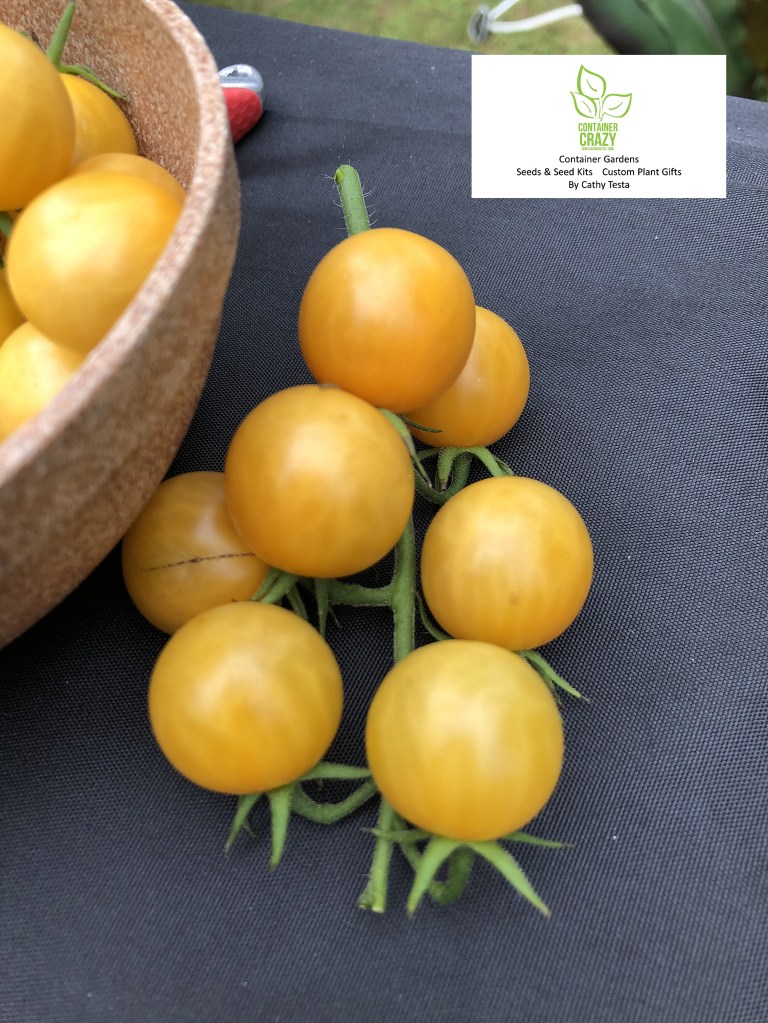
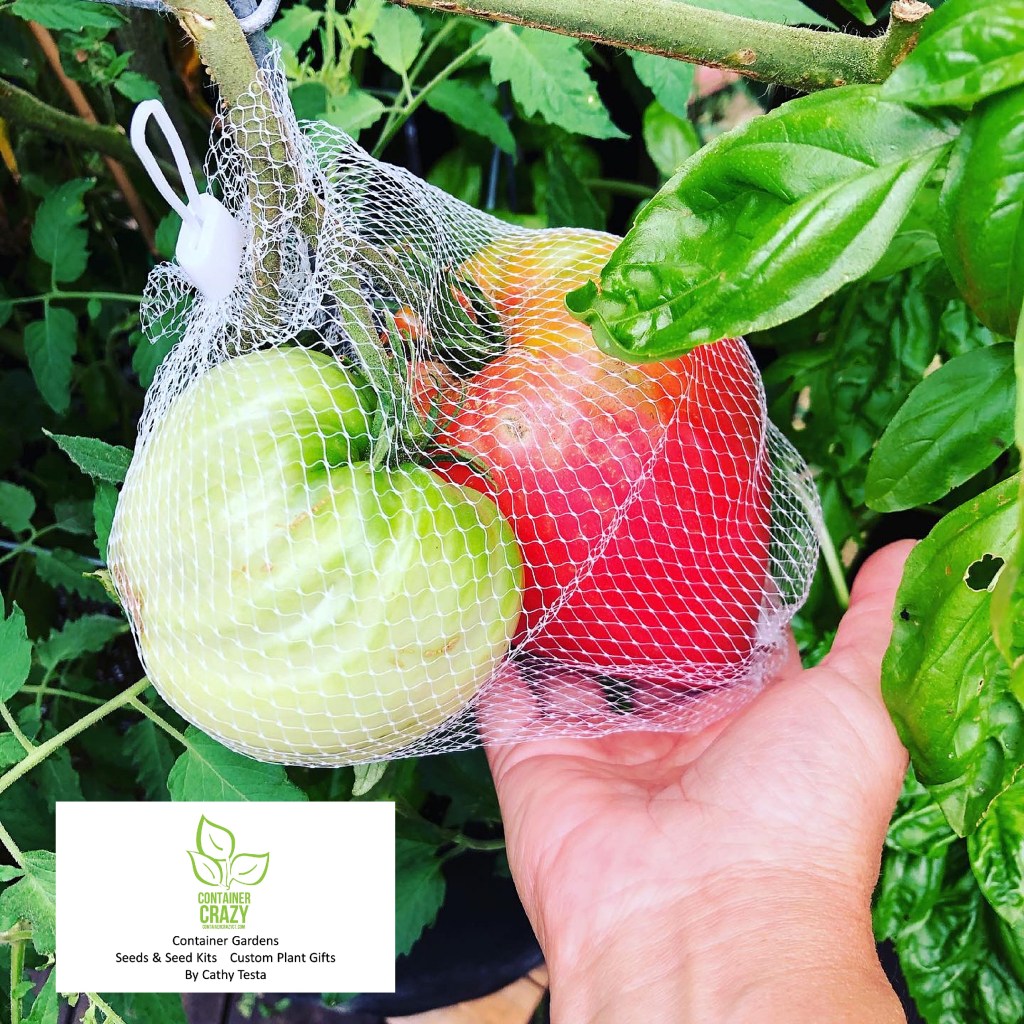
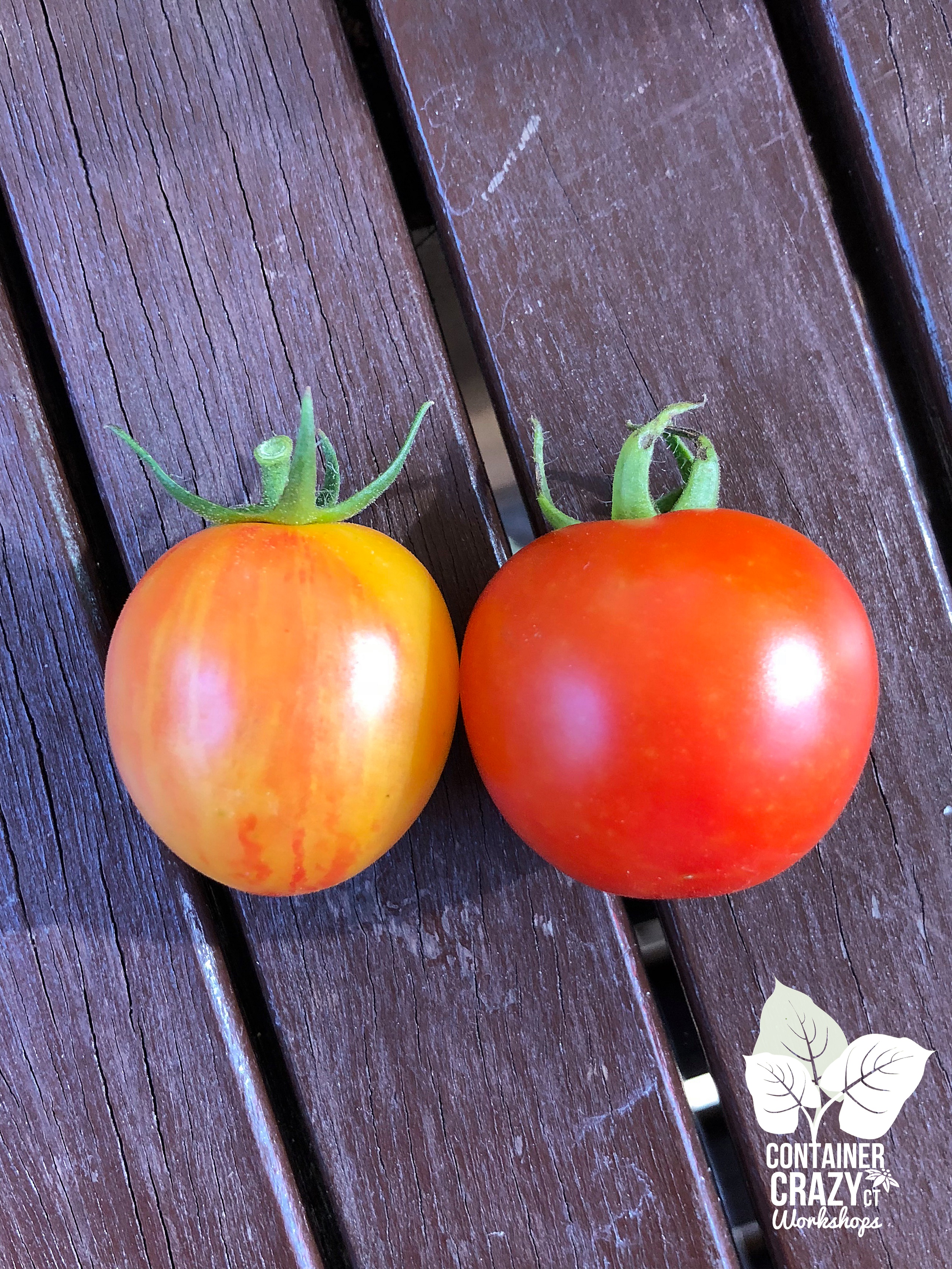
The squirrels discovered my beautiful Upstate Oxheart tomatoes on my deck last year and out of frustration, I decided to net them with plastic fruit type netting. You can see from this photo, the tomatoes are huge. The seed packet details these as “a stunner: huge, heart-shaped, and delicious fruit,” all of which is very accurate.

GROWING FROM SEED

I have grown these from seed the past couple years and I was super impressed with the yield, sizes of the fruit (2-3 lbs), and exceptional light but favorable sweet taste. Additionally, they really do look like the inside of a heart when you slice them open. Both my husband and I enjoyed eating these beauties, and it didn’t take long for a squirrel to spot them up on my high level deck along the railing last season last summer at the peak of their tomato’s ripening phases. They ripen to a rosy pink color.

FABRIC GROW BAGS

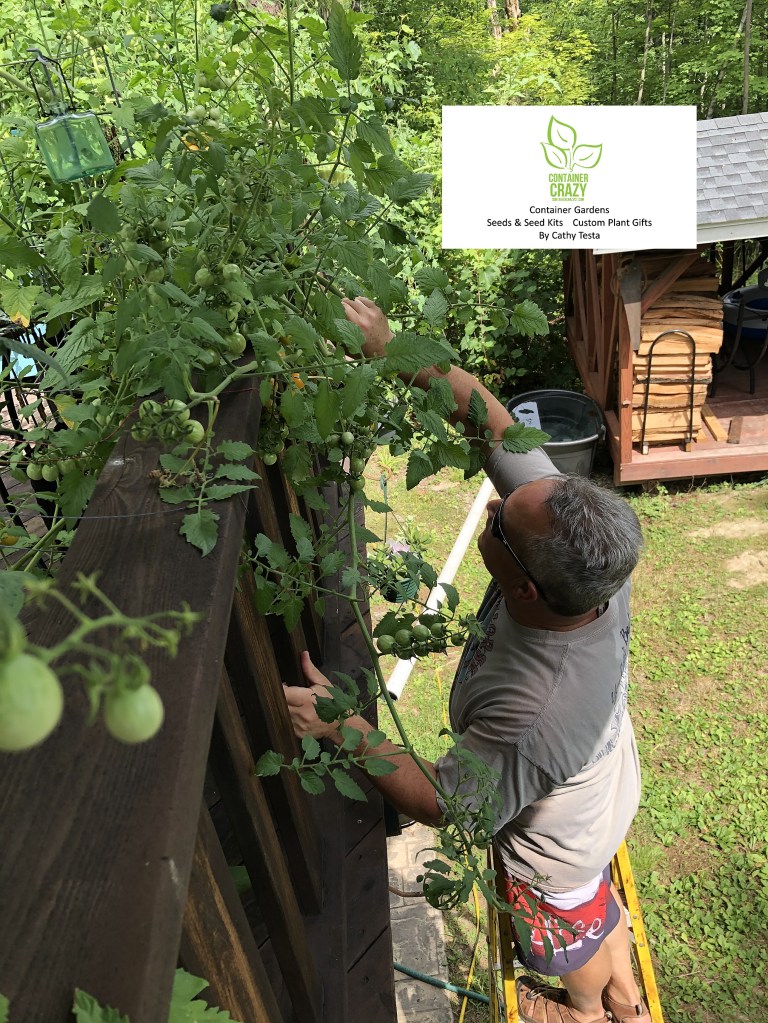
I grew them in my black fabric grow bags last year and the plants grew large and some of the branches hung over the railing of the deck. Each time I’d witness a fruit starting to turn slightly pink, I started to worry about a squirrel discovering them – which they did and that was starting to get really annoying. Nothing is more frustrating then seeing a big bite out of a huge tomato just about to ripen to maximum perfection! Ugh!

DID THE NETTING WORK?

Did the white plastic netting, surrounding the fruit only, work? Kind of. I didn’t see them munch on them in the nets, but I also got accustom to taking the fruits off the plant before they were fully ripened so the squirrel wouldn’t have a chance either. Then I would let the tomato fruit finish ripening on the counter. This worked just fine for this type of tomato – meaning it ripened with no big issues right on the counter.

WHEN TO START THE SEEDS

I didn’t order new seeds of this type this season because I still have some packets left from 2020 and they are still very much viable, but I probably will not sow all of them, or if I do, just a limited amount this year because I am excited to try new types of tomato and have new 2021 seed for the newbies on my seed sowing list.

But this type of tomato needs to be started early. The upstate oxhearts seeds should be started 6-10 weeks before our last spring frost date. Last year, I started them at the 10 week mark, but this season, I’m going to wait to start them a little later. I found they grew quite large in the greenhouse and some needed to be potted up into gallon pots, so I made a note to maybe start them more like at the 8 week mark and see how that goes.

HARD WIRED MESH IN A BIG POT WORKED

The squirrels seem to be more aware of my goodies the past two years. The year prior, I grew the upstate oxheart tomatoes in a giant black plastic pot, which is 3 feet tall, so kind of my waist height. I inserted 3 feet long bamboo poles into the pot along the top rim and then surround the whole thing with hard-wired mesh. That definitely kept out any critters, like squirrels or groundhogs, but it was difficult for me to “reach in” to get the tomatoes. However, it did prevent any unwelcomed diners from visiting the fruit. The pot also was located in a place that was a job to drag my garden hose to it to water, but it worked at keeping critters away! In fact, I found those really big pots to be useful that way – they can’t easily climb up the pot and into the big pots, but for those in grow bag last year, on my deck, squirrels would sometimes jump from a tree limb onto a deck railing to go investigate. We decided to trim back some trees near the end of the deck to make it more difficult for them.

SQUIRRELS WON’T STOP ME

The whole issue of squirrels visiting the tomato fruits is a big problem it seems for many, but for myself, I know it won’t stop me from growing tomatoes again this year. One neat thing that happened with the plastic mesh (shown in the photo above) is a cross-cross pattern appeared on the skin of the fruit. It developed a pattern! That was interesting.

I suppose I will keep testing more techniques to keep the squirrels away. I read that hot pepper spray may work, and there are probably some products on the market. But for now, my strategy is a) not to give up, b) pick the fruit before it is fully ripe, c) yell at the squirrels, and or d) grow them in that super-sized pot again that is so high up and wrap the whole thing in hard type of mesh wire. Gosh, the things we do for fresh juicy tomatoes.

WHEN THEY RIPEN

Upstate oxheart tomatoes ripen 84 days from transplanting the seedlings into your pots or gardens. They are indeterminate plants so they will keep growing taller and produce fruit continuously. Pruning or staking them is necessary or letting the branches (vines) topple over my deck railing worked well. The plant can reach up to 10 feet high. It sprawls out and around and when I grew them in that big black pot I mentioned above, the hard-wired mesh I put around it served to help support it as well. The fruits, which can grow to 3 lbs sizes, are heavy so that extra support is helpful.

Cathy Testa
860-977-9473
containercathy@gmail.com
http://www.WorkshopsCT.com
http://www.ContainerGardensCT.com

http://www.ContainerCrazyCT.com

COMMENTS Please! If you enjoyed this post – please comment by clicking the red block on the top. I would love to hear what you have used to keep squirrels way from your tomatoes in the summer.

Dealing with Fungus gnats in Potting Mixes

Leave a comment

I picked up my bags of potting mix soil early this year. It felt even a bit crazy, to be driving to go get them, when there were very cold temps outdoors that day, yet, it was a very sunny winter day and I was enjoying that part of it. But I did pause to think, “Am I getting these too early?”

Last year, I used more bags of potting mix than I expected, and I am constantly potting up plants, moving succulent babies into small pots, repotting larger plants, then comes seed starting soon where both my potting mix and seedling mix is used in trays. I also use some in my container installs later in the season, and it is kind of endless. I even repot houseplants for people from time to time. So, I need potting mix, and lots of it.

One thing I have noticed a lot lately, on various Facebook group pages related to gardening, plants, and interior houseplants, is the constant frustrations by people, some are newbies, some are not, on how they get fungus gnats in their houseplant pots inside their home. Everyone suggests a remedy they have tried from putting cinnamon on the soil to using hydrogen peroxide, misquote bits, and other home remedies. Whatever their remedy is, there is a growing (no pun intended) frustration with issues such as fungus gnats in the pots of plants and it has to be difficult for people to accept, especially when it gets out of control. They want to succeed and keep their plants healthy, but they encounter something like this and it drives them nuts.

Here’s a fact sheet about fungus gnats from Cornell, if you wish to read about them in formal, technical terms: http://www.greenhouse.cornell.edu/pests/pdfs/insects/FG.pdf

No growing mixes are immune to fungus gnat infestation, but fungus gnat numbers can vary among growing mixes. Adults are strongly attracted to microbial activity in soil/media. For fungus gnat management, avoid immature composts (<1yr old), including composted pine bark mix. Mixes with any compost are usually more attractive to fungus gnats than pure sphagnum peat. Good sanitation is vital.

Fungus Gnat Biology and Control
J.P. Sanderson

I thought this statement above from the Cornell fact sheet by J.P. Sanderson was key, especially when he wrote, “no growing mixes are immune to fungus gnat infestation” and also the part about mixes with compost are usually more attractive to fungus gnats. In other words, to me anyhow, the more sterile and clean the mix, the less likely you will get the dreaded FGs (fungus gnats) in the potting mix when the conditions are right for them to start up in the pot (such as moisture and temperature).

For monitoring adults, yellow sticky traps placed horizontally at soil level are most effective. However, fungus gnats can be monitored along with most other flying greenhouse pests by positioning yellow sticky traps vertically just above the crop canopy.

Fungus Gnat Biology and Control
J.P. Sanderson

Many times, on these gardening Facebook pages, people will say, “I use those yellow sticky tapes” to get rid of them, but in my opinion, those do not get rid of them – they MONITOR them. As noted above, these are useful to keep track of the amount of a FG infestation you may have and they also should be placed relatively close to the plant’s surface area. If you have a yellow sticky cards filled with them and you see FGs flying all around your kitchen, you definitely have a major problem. Usually the best place to start is thinking about the potting soil mix you used in the first place, and also your habits on how often and much you water your plants in pots inside the home.

“However, the primary reason why fungus
gnats are abundant in homes is related to
changes in moisture levels associated with the growing media of houseplants. Fungus
gnat adults are highly attracted to moist growing media. Furthermore, as the growing medium ages or degrades it tends to retain more moisture, which will also attract fungus gnat adults. In addition, decreased day length and cooler temperatures slow plant growth and water usage. If watering practices are not altered….

— by W.S. Cranshaw and R.A. Cloyd*

The link for the quote above and the full article is from Colorado State University Extension.

But one reason I pulled this quote from the article above (in the black box) is because I feel I see more of the FG problem in the winter as well. As they are pointing out, three things occur: the FGs like moisture and they note growing medium (potting mixes) sometimes hold onto too much moisture (meaning if in a pot for years and it doesn’t drain well for whatever reason), and lastly, plants tend to slow down growth in the winter months inside the home, so less moisture is being used up by the plants now in the winter months (so it stays too damp and maybe even too cold).

Cathy T (me) in my greenhouse

Another article noted that people notice FGs more so in the winter because they are inside with their plants, versus the plants perhaps being located outside during the summer, or you are outside more in the summers than winter. Houseplants in particular grow slowly and roots may not take up as much moisture such as a big tropical plant would in the summer outdoors. You get the idea. But they are pointing out, you may just notice them more in the winter months than summer.

Whatever the reason, these FGs are a real PIA to people. And they ain’t pretty either when you get into sowing seeds in a few months for your warm season vegetables, such as tomatoes, in your seedling trays. So, it is critical you pick the correct seedling mix in the first place. And have the right temperature, environment, clean pots, and good potting or seedling mix, in this case when you start your seeds. Perhaps correct is not the right wording, you want quality seedling mix.

Usually my number one rule, when you go to buy potting mix or seedling mix, is to be sure you are purchasing fresh mix that is in good standing condition in the bag. If the bag is a mess, at whatever location you are getting them from, I’d stay away. I’ve talked about this in the following post:

https://containercrazyct.com/2019/04/15/cathy-ts-5-must-dos-for-successful-container-gardening-and-patio-pots/

When I see people upset that they can’t get rid of the FGs in their planted house plants in pots (from these posts I’ve been reading), and they feel they’ve done everything right, such as let the soil dry out on the top (since the FGs prefer moisture), they bought reputable potting mix from a reputable place, they keep their pots and areas clean, their pots have drain holes, they been careful with watering, and they are truly trying to be the best plant parent they can be, I feel their pain. Why, oh why, can’t we count on potting mixes in the retail market place to be problem-free?!

I remember once telling a guy at a garden show years ago that when I get my greenhouse I’m going to keep it super clean, and he laughed and said, bio-diversity is just as important. True I’ve learned, and no matter how clean, you just can’t sometimes prevent nature from stepping in. That is true.

And I agree with the above article too, if the soil is too damp, AND cold, and in winter, I think there is more of an issue with FGs (fungus gnats) appearing. The best thing you can do is ACT on it immediately when you see the little buggers flying around your potted plant.

However, I do everything I can to start with good, quality potting mixes. And I see that question asked often on Facebook gardening like group pages, well, what is the BEST mix?

Oh boy, that one gets all kinds of responses. I know which I like and which I don’t. I don’t get any paid advertising on my (this) blog at all, so if I listed them, it would not be for the purposes of gaining that but I also sometimes don’t want to list them because they can seem like the best, and whack, you get FGs anyhow!

One year, I offered a Seed Starting Workshop and we decided to test various seedling mixes. Each attendee had 32 cell trays and we split up the rows by using a different seedling mix per row. We used some of my professional potting mix and other potting mixes on the market, and two different types of “seedling mixes”. One type of seedling mix, for some reason, completely failed. The seedlings in those rows were so tiny and did not grow much. All the other rows were just fine. All was sown at the same time and in the same growing conditions, and I was watering the seedlings after the class for a few weeks for the attendees. I was so excited that I even thought of testing out the various potting and seedling mixes in this experiment without knowing the results would show us a really good example of how you might think a mix is great (and I did think the brand and place I got from was reputable) but it failed. Why? Hmmm. One thing was that mix did have more heavy components (bark) even though it was listed as “seedling mix.” As per the note in the first listed article above where they said mixes with more compost are more attractive to FGs, so the mix was heavier and probably a bit more compost like. Where all the other mixes were primarily sphagnum peat moss and perlite.

Seedlings in Cathy T’s Greenhouse

I never went back to the retail store to say, hey, we used this mix – and it really didn’t work well compared to the others. But what would the store owner say? He’s probably think I was a nut job. Not knowing, I’m Cathy T. LOL.

For years, I’ve been saying, I’m going to write a full blog post about potting mixes and which are the best (in my opinion based on use). And make it very technical, but I still really haven’t done that. I always just repeat what I’ve always said, use a fresh bag of quality potting mix (or seedling mix if sowing seeds) and follow these watering instructions (provided with my kits or in my workshops, etc.) and all should be fine.

I think probably the most important thing is the potting or seedling mix needs to be fresh, sterile, and well-draining. Mixes with additional components are sometimes too heavy for container gardening, seed starting trays, and patio pots. It also greatly depends on what you are growing (seeds versus a perennial plant). Heavier potting mixes are needed for certain types of plants. But I’m generally referring to seedlings right now and smaller plants, or those in smaller pots, such as houseplants being a good example.

As you can see, it is a hard topic to narrow down.

Because I am vigilant at cleaning my greenhouse and keeping watch of my plants, and my pots, and picking up debris, using good potting or seedling mix to start with, I rarely have a potting mix issues or major fungus gnats. However, recently I had one big succulent plant in a single 6-7″ pot, and I saw them, saw those FGs flying around that particular plant, and I immediately put a yellow sticky pest trap card near the surface of the succulent plant on a little stake inserted into the pot, and yup, I knew right away that plant had an issue when I checked that card one or two days later. There were quite a few FG attached to it in places. I tried treating it, the soil, with various methods. Then I checked again, the problem was not going away. What did I do? I repotted the whole plant into new fresh potting mix and even a new fresh pot, and I’ll keep watching. I did it because I love that big succulent, and it was worth it to redo the potting of it, at least it was worth it to me. Plus I didn’t want it to spread to other plants.

Because this topic is big and is difficult to write about, I’m going to stop writing right here and continue more on this later. It is time for my second cup of coffee!

BTW, my seedling kits come with my professional well-draining fresh potting mix (the one I trust) and planting instructions, growing charts, when to sow timing, seedling trays and seeds! If you are local to my areas, check out my offerings on www.WORKSHOPSCT.com. I am offering free delivery to areas near me!

Thank you,

Cathy Testa
860-977-9473
containercathy@gmail.com

How Many Seeds Per Packet

1 Comment

Last year, when I was showing my seed packets for sale and my sowing process, a friend who was interested in both asked me, “How many seeds are in a packet?

This seems like a reasonable question to ask, especially if you haven’t tried sowing seeds before. In general, for the seeds I sell, there are about 25 seeds in the tomato and cherry tomato seed packets, except for one I offer called, Upstate Oxheart tomato. It has only 15 seeds per packet. Why? The tomatoes are nearly seedless and that is apparent when you cut a Oxheart tomato in half – and yes, it is shaped just like a heart – amazing. There are hardly any seeds in the actual tomato. This makes a challenge for the seed producers, so I always am sure to sow those seeds carefully as I don’t want to waste one – these tomatoes are big and juicy.

Oxheart tomatoes are not only huge! They are nearly seedless.

The same is about true for the hot pepper plants I’ve sown and grown, about 25 seeds per packet, and cucumbers. But plants like parsley will have 200 seeds, same with the basils, and they are smaller seeds than the typical tomato or hot pepper seed in size. In fact, they are so tiny that I am unsure how anyone could plop one tiny seed per a seed cell tray filled with seedling mix. Often, I will scatter seeds over the top of the seedling mix and lightly dust it with fine seedling mix to cover them. That is the case with how I handle parsley and basil seeds. Same with some lettuce mixes. I call it the ‘scatter’ method and I show exactly how I do it via my video’s. Videos are provided to my purchasers of seeds and seed kits, by the way.

Most seed companies will identify the number of seeds per pack, but other companies may just list the net weight on the packet or envelope. Some will provide this information in milligrams.

Seed sizes vary. Hot pepper and tomato seeds are about the same size, but larger seeds, like those of cucumbers or a moonflower, for example, are much larger and easier to handle. Larger seeds are great to use if sowing seeds with young children learning for the first time how to sow seeds. Think pumpkin seeds too.

I obtained Celosia seed one year. This is a flowering plant producing colorful fuzzy flowers, but the variety I selected is a mammoth type. It grows up to 60″ tall and you need to start the seed early indoors. When I opened the packet, I couldn’t believe how tiny the seeds were. There are 200 seeds per packet. Can you imagine sowing 200 seeds and having 200 of those plants?! So, I’m sure there is a method to sow seeds which are super tiny, but I decided to fill a square flat tray of about 3.5″ deep with the soil mix and just scatter the seeds on top. It worked. They germinated and then I carefully pricked out the seedlings when they were ready into 3-4″ pots to continue growing them. I have to admit though, I am not sure if this was the best or recommended method. To give you an idea of how small the Celosia seeds are, the packet indicates that there are about 600,000 seeds in 1 pound.

I often use the scatter method with lettuce mixes too, and will sow them in small long window box types of containers, always being sure to drill drainage holes in the bottom if there are none. I find for lettuce mixes, parsley, and basil, this scatter method works perfectly. It is important to scatter them as evenly as possible and you don’t need a whole packet to do this (unless your window box is huge). For example, one type of lettuce mix I sow has 500 seeds per packet. I often use half of the seed packet or less per container. Then I lightly top the seeds with fine seedling mix and let it all grow. If you want to prick out each individual tiny seedling later, you may do so to put them into larger pots (or the next size pot up) for the basils for example. Some may find the scatter method wasteful, but it works for me. Because you may harvest lettuce mixes, parsley, and basil repeatedly from the plant by cutting some off and just letting it regrow, I find this is suitable.

A larger seed popping up from the mix

Another time, I grew Panther Edamame Soybeans from seeds. The seeds are large, similar to cucumber seeds (but round), they are easy to handle. I was so excited when I grew these in patio pot containers on my deck. Because it is just me and my hubby at home, a couple plants was sufficient to get a handful of edamame beans to put in a bowl, add some water, and micro-wave to heat them up and then I toss some sea salt on them and eat the beans right from the pods. Yummy. They have a nutty flavor and these seeds may be direct sown into the ground or your patio pots if you want, versus starting them early indoors before the planting season. The packet holds about 100 seeds.

Some seeds need special treatment prior to sowing them, but tomato and hot pepper seeds are not one of them, but others like the moonflower needs to be nicked before you plant them. Otherwise, the hard seed coat prevents water from entering the seed for germination to start easily. When handling a seed that requires nicking (scarification), it is easier if the seed is bigger; it helps a lot as you attempt to make a nick in it without damaging the interior of the seed (the embryo). Many seeds with hard coats need to be nicked with a file, sandpaper, or a tool. Some may be soaked in water first. It is best to research the seed before proceeding and follow the recommended method. I have never seen a tool specifically for nicking hard coated seeds on the market (I think if someone invented it, it would sell like hotcakes). I read once that commercial growers use acid, something we surely can’t play with! Some hard coated seeds with crack open if you soak them for 24 hours.

Do you sow a whole packet of seeds? Let’s talk tomatoes, if you have 25 seeds in the packet, should you sow them all? Some may say yes because if any of them fail, you will have extra’s. Some will say no because are you really going to plant all 25 of those tomato plants? And if you did sow all of them, remember, you have to move them from the seed cell trays at some point into a next larger size pot and may even have to move them into a 1-gallon size pot before they go outdoors. This requires more pots and more potting mix.

Photo from Cathy T’s greenhouse – couple seasons ago. Can see the scatter method in the window box type planters.

One thing I love about the seed packets I get and sell is they are an envelope within an envelope. Each packet has a envelope (white) containing the seeds, and it has all the planting details on the white envelope. The white envelope is inside an outer separate envelope with even more plant information, and it is a colorful art pack made with a thicker type paper. It is almost like a little sleeve to protect your seeds within. I like that because if you don’t use all of the seed, you have a protected package to store them in.

Fox Cherry Tomatoes coming up – One seed per cell was used

Storing is another topic but when well stored, the seeds will remain viable based on the seed type and all of that, and the number of years is different based on the type of seed or plant. Look it up if you are concerned and use up all the seed if it is a type that doesn’t remain viable for more than one year. Parsley is an example. Parsley seed should be used in year one. At least for the type of parsley I have been sowing.

The next question that followed how many seeds are in a packet, was of course, ok, “How much soil (seedling mix) do I need?”

That is a good question! I love questions! LOL. The seedling mix often comes in an 8 quart bag in retail locations. I will put about that amount into a big bowl and add some water (I think it was one cup but I will double-check) and then very lightly stir it to moisten the mix. You don’t want mud or mush, you only want to lightly give it moisture. In fact, don’t pour the whole cup of water in there initially, pour some water, and mix and feel it in your hands. I often sow seeds in 32 cell plastic black trays with 3-3.5″ depth. I like that size plus they fit nicely on my seedling heat mats. I use about 8 cups of soil per tray, I believe. I will check my notes! Your containers or seed trays should be filled with pre-moistened mix or medium (as they refer to it) before you put your seeds in the trays. You may also moisten the mix in a plastic bag if you don’t have a bowl handy. Another method is to put the dry soil into your seed trays and set it in a base of water so the water will wick up into the mix prior to sowing your seeds. I don’t do this method however. I mix the soil with water like a cook does in the kitchen in a big bowl and it works for me. The seed kits I offer has mix, trays, and instructions as well.

By the way, I like the plastic trays because they are pathogen free and reusable. I have had issues with peat pots before. For some reason, they tend to grow mold on the sides. I tend to stay away from those now, however, if you use peat, I’ve read you need to moisten the pots first and never to reuse the peat pots which would be difficult anyhow because they fall apart. Peat pots are great for plants which do not like their roots disturbed (cucumbers) so you place the peat pot and the plant right into the ground when they are ready for outdoors. And I have never used compressed peat pellets. They are just not for me, perhaps because I always have soil mixes on hand. In fact, I got all my soil bags already last week. I wanted to plan ahead. More on the soil and potting mix world later, that is a big topic. Sowing starts in March so I am preparing ahead right now in January – and you should too!

Thanks for visiting.

Cathy Testa
860-977-9473
containercathy@gmail.com
See http://www.WORKSHOPSCT.com if interested in seed packet purchases.
Location: Broad Brook, CT
Part of East Windsor, CT

Seeds Arrived On Time!

3 Comments

I was starting to worry that my seeds may be delivered late because I keep reading on various gardening websites about people experiencing shipping delays. One lady, in fact, made a joke that she has been stalking her mailman waiting for her seed delivery, which made me chuckle!

Well, my seed order arrived yesterday, and I’m thrilled. When my husband walked in from work, he said, “Your seeds are here.” He had grabbed the box from the mailbox for me.

I immediately opened the box and scanned the many seed packets. All there except one type which hopefully will show up or the charge will be removed from my invoice. So, I thought this early morning, I would just write a bit of what I do the minute I get my seed order in.

  • Of course, open the box and review the order. Count the packets and make sure all are in the box and in good condition. Enjoy the moment – I do!
  • Now, this am, I will take out one set of each type of packet I ordered (BTW, these are primarily tomato, hot peppers, herb seeds, and a couple of flowers). Because some of the sowing and growing instructions are “inside the seed packets” and not on the back of the seed packet envelope, I will keep one set of the packets for me and read all the instructions carefully (now, don’t wait). I think key is learn about the growing habits or needs of that plant a bit – don’t over look it, especially if you are totally new to trying sowing of seeds indoors before the growing season.
  • Take out my Planning and Growing Calendars and verify I counted back the number of weeks correctly for each type of plant. Remember, one type of tomato plant maybe slightly different than another variety. So one may say 6-4 weeks before your last frost date in spring to start sowing the seeds indoors, or it may indicate 8-10 weeks before. For example, for a few years now, I’ve grown Upstate Oxheart tomatoes. They are a type that indicate 10 weeks before, but another tomato, like my Bumble Bee cherry tomatoes, are indicated at 6-8 weeks before our last frost date. Thus, I will review Planning Charts I created to verify all, such as one chart I created which indicates “when to sow your seeds indoors based on the last frost date expected in mid-May in Connecticut.” If you have general charts from various sites, compare those with the instructions on your specific seed packets. And be aware, do not use “days from transplant” if this is noted on your packet – this is not the same “as days or weeks before frost.” The days to transplant is the number of days once the seedling is transplanted into your gardens or outdoor container gardens, fabric grow bags, or whatever place you want to grow them outside. It indicates when the plants will produce fruit or mature.
Trays on heating mats. Note I tested various seedling mixes in these trays. See the color differences?
  • I also will day dream about how amazing these plants will be and remind myself that spring is only a few months away. Hang in there, January can be a tough month. I focus on the upcoming weeks to prepare. Some things to do now are get your growing pots and seedling trays ready (I prefer 3-3.5″ deep cell trays for proper root development and plastic because the stay clean, pathogen free, keep the soil consistently moist, and are long lasting and reusable), take out your seed heating mats and clean them up, and think about getting seedling soils before March. I usually pick up soils mid-February but I am going to get them early this year. I want to be ahead of the game. As noted in my prior post, get “seedling mixes” or “sterilized potting mix for container gardens or patio pots” to start you seeds. Avoid heavy soils which may be amended with compost as you don’t need that at the seed sowing stages. The lighter the soil, usually the better, and no dirt from the ground. Look for fresh bags, avoid cheap mixes that may be too old to take up water (meaning from dollar type stores if they look old – they may be new and just fine – just be aware). You want potting mixes made with peat, sphagnum peat moss, vermiculite and perlite if not using seedling mix. Seedling mix is finer (not as dense as container or potting mix) but both will work. Do not use mix labeled as “garden soil” or for the garden. Keep the bags in a safe dry place till use.
  • Store my seed packets after I have all reviewed and organized. Then wait till early March to start sowing in general (again, these are warm season vegetables (tomatoes and hot peppers) that need to be started indoors in seedling trays/cells and then transitioned to the outdoors after frost to harden off.) Hardening off is all about acclimating the seedlings you have started indoors to the outdoor exposures and temperatures gradually on the right days (shady area then gradually to sun, not too windy, not cold, and watch for shade which may not exist if trees are not leafed out yet, and only for a few hours each day, etc.). This is usually the week or two weeks before Memorial Day for me.
  • Key dates: Jan (get ready and order seeds early), Feb (get organized), March (start sowing), April (monitor all your seedlings), May (start potting up-moving the seedlings from your cell trays into larger one size up pots), Mid-May (start hardening off outdoors gradually), May at Memorial Day (all safe to plant outdoors).
  • Storing the seeds. They must stay dry and cool. No humidity, don’t put in freezing temperatures or in a hot place, like a sunny greenhouse. Keep them in a cool spot away from moisture. I put mine in metal lunch boxes! They are the perfect container. I also just happened to go to a vintage market last weekend, and found these really old lockable long boxes (steel bank safe deposit boxes) and thought, these are perfect for storing my seed packets. The metal lunch boxes or tin boxes also tend to stay cold. I put them in a room in my home that doesn’t heat well under a table away from any heat sources. In general, if you store the seeds appropriately, based on the types of seeds, they may last 3-5 years, however, some seeds are short lived and should be used the first year (i.e., parsley). The ideal conditions for storing seeds are cold (but not freezing), dark, dry places. Be aware of storing them in basements (humidity), garage (too cold or hot), greenhouse (can get too hot), and anywhere where moisture could be an issue. I have read you may store seeds in refrigerators but I have not tried that out yet.

Okay, so I don’t have much time this morning to focus on writing a post so I apologize if a bit sloppy writing and any typo’s I’ve missed! I want to get to my seeds and this is also a time where I start preparing my tax paperwork (yes, in January) so that I don’t have to focus on taxes when I want to be playing in my greenhouse in a month or so.

I will be posting things like this for those interested in my seed sowing steps. Perhaps if you are new to seed sowing indoors before the planting season, you find some of my experience here useful.

Thank you,

Cathy Testa
860-977-9473
containercathy@gmail.com
http://www.ContainerCrazyCT.com
http://www.WorkshopsCT.com (site to learn more about ordering seeds from me)
http://www.ContainerGardensCT.com

Have a good day! Be kind, be happy, stay the course!

All You Need to Know About Starting Seeds Indoors

2 Comments

If you search the web, you will find a plethora of sites offering many articles, step by step instructions, growing charts, and tips, but will any one link or article give you all the simple answers you need to start seeds indoors? Probably not.

Think about this – there are millions of vegetable plants you may grow from seed in our world. How could anyone sum it all up in one fell swoop?

When I started growing vegetable plants from seeds, the desire to do so was sparked by the love of art packs from a particular seed company. The art sparked my interest and then I started to buy seed packets. I was interested in unique tomato plants and flashy hot pepper plants, rather than the traditional types I ate growing up on a farm. Maybe I got overloaded with the same types of tomatoes from when I was a kid, I don’t know, or maybe it is my love of art and creativity that got me into the different, unique, interesting varieties because they are like a work of art to me. A colorful purple tomato to me is cool. Or a pepper shaped like a UFO – that rocks! Plus you get to eat them and they taste delicious.

Need I say more? This is a photo from last season!!

However, I have spent countless hours reading seed sowing books, reviewing growing charts, looking up frost dates from different sites and all of which seem to give a slightly different answer, and determining what supplies and seeds are best for my area of Connecticut, and then I spent hours putting my own guides together. I guess, in some ways, it is good that I am an organized person and an over-thinker! Maybe I looked at too much, because my head would spin. After all, you could just buy a pack of seeds and plop them into soil, and it would sprout – but would it be successful?

Today, I want to try to share some of my seed sowing considerations in a random casual fashion:

#1) Start small and pick easy to grow plants. So, what veggie plants are easy, what grows like weeds? Hmmm, well, that is a tricky question. One may say, well a pumpkin seed is sure to pop up from the soil or a cucumber seed, but do you like pumpkins, do you have space to grow pumpkins in containers or a garden? They sprawl out for miles (well, for many many feet) and so that may not be the best choice for you. And cucumbers, well, they vine up and down and all around, but they don’t like their roots disturbed, so even though they are easy to grow, they have considerations if you start seeds indoors and then transplant. In my opinion, some herbs are easy to grow, like parsley, or mixed lettuces seem easy, or some basils, but even if they are easy, they all have unique personalities to consider. For example, basils like warmth. If you put them out too early when cool in the early spring, they don’t like that and won’t flourish. Cherry tomatoes are easier than regular tomatoes in my experience. No matter what – you will get tons of cherry tomatoes from one plant – it is amazing! Parsley is easily and it likes a bit of the cooler weather, unlike the basils.

Shown in this photo, Thai Basil (top left), Sacred Basil (top right), Curley Parsley (bottom left) and Genovese Basil (bottom right). Easy to grow herbs, as seen last year!

#2) Get the tools ready. Do you need a grow light? Many people will argue you do. And it does increase your success at sowing vegetable seeds indoors. But what is success? A perfectly straight upright seedling? Maybe. Maybe not. After all, I know many people who grow seedlings in seed trays set on their old fashioned heat radiators in their home, and the seedlings leaned towards the window for more sunlight, but they made it – and make it into their gardens. However, as you learn more, you start to consider the options of getting a lighting system so it increases your success and makes for healthier seedlings. As for myself, I have a greenhouse which provides sufficient lighting when the sun is out. In early spring, on many days, there are cloudy days. So far, I’ve gotten by just fine without grow lights. As I learn more, maybe I will get grow lights to add to my set up, but it is not going to be this season. Anyhow, what I’m getting at, is at a minimum, think about the tools you will need to sow seeds and start to pick up your supplies based on what you think you want to grow. BTW, I do use heat seedling mats to encourage germination of the seeds and to increase the start of healthy roots. This I have found helpful to invest in. That is a tool you may want to consider ordering now.

#3) Soil mix – This IS critical. First, for the ultra beginners, you should know that you can not sow your seeds in dirt from the ground for vegetable plants you need to start indoors in seedling trays ahead of the growing season. Believe it or not, when I offered seed kits last spring, one person thought you could put dirt from the ground into your seedling trays. They said my instruction sheet enlightened them and they had no idea dirt was a no-no. So, when you go out to get your soil for sowing seeds indoors, get bagged seedling mix or sterilized potting mix for patio pots. Either will be fine. The seedling mixes are finer than potting mixes, usually fresher since it is going to be seed sowing time soon, and perfect for tiny seeds to make contact with the seeds, etc. If you don’t want to deal with that, and want to sow seeds in the dirt, pick vegetable plants that you may directly sow into the ground after all chances of our spring frost and when the garden soil is workable. But you need to determine which plants you can sow directly into the ground, things like beets, for example. Some plants prefer to be directly sown into the ground. If you pick this option – remember, you have to prepare your garden area ahead as well.

A tomato seedling that was potted up into a larger pot by Cathy Testa

#4) Timing. This is another critical factor. All plants grow at different rates. Some take longer and some are faster. They need a certain number of days or weeks before they produce fruit. If you start your seeds too soon, they will be outgrowing your starter pots, getting root bound, start to struggle for the moisture it needs, and even start flowering, which leads to fruit (and for ultra beginners, flowers are where the fruits are produced. I don’t mean to sound rude or condescending, but if you are new to the world of gardening and plants, and didn’t know this – don’t feel embarrassed. I didn’t either when I was a kid and I grew up on a farm!). So, say you sow your tomato seeds too soon, then they grow larger and larger indoors, and then you need to put them in a bigger pot, and then they get flowers and then, you want to put the plant outside but it is still too cold out – it may even freeze one night if the temperatures drop down. You could loose the flowers from the cold temps, now you will have no fruit. Potentially, all your seedling work is lost. The same goes for starting seeds too late. If you start too late, your plant will sprout, it will grow, and you will think, awesome, and, now I can put it into my gardens or containers in spring outdoors, fine, but then you wait and wait and wait after its been growing in the garden, and it is almost early fall and you still don’t have any peppers. You started the seeds too late indoors. Peppers take more weeks to produce their peppers for some varieties (as an example), they have a required longer growing season. Timing is a critical thing. Get yourself a seed sowing calendar, look it over, and count back the number of weeks it indicates on the seed packet (or inside the packet) as to when to sow your seeds indoors. You count back from your last frost date in spring which in Connecticut usually falls around mid-May. If you end up buying seeds from me or a seed kit, I already did all this timing homework for you in my charts and calendars based on the seeds I will have available for sale.

#5) Okay, what else is needed? I guess it is Determination + Enthusiasm. Last year, we had the start of the pandemic and lots of things were short in supply (including some foods), AND as we all know, people were home so they had time to start their own gardens. The enthusiasm to start sowing your own seeds for your own amazing vegetable gardens was very high, and many people came to me for advice and for seeds or seed kits. Everyone was so enthusiastic, I just loved it. The pandemic even created a seed shortage by seed companies because so many people were trying to grow their own for the very first time! But, growing plants from seeds is not like making brownies for the first time. You read the directions on the box, set it in the oven after mixing all as directed, and you are successful, and you eat the brownies. Sometimes in the plant world, there are factors out of our control. So, you read the directions, you sow the seeds, but then all of a sudden there is an issue after planting them outdoors and they’ve been growing for a while. Say it is blossom end rot or a tomato horn worm, and ack! You are bummed!! But if you are still determined, you will succeed. So you take on the challenge, fix it if possible, and then you reap the rewards of an amazing tomato harvest or pepper harvest. And it feels good, it tastes good, and it is right there at your finger tips. Oh, again, that makes me remember something, I think cherry tomatoes are easier to grow from seed than regular tomatoes, so that is another tip for beginners. Usually you get lots of cherry tomatoes! Like tons of them! Did I say that already?

Heirloom Tomatoes I grew from Seed!

Will those of you who gave tomato and pepper growing from seed last season give it a go again this season? Yes! I know you will. I know there are some of you that so enjoyed it, you are on board. But maybe not, maybe you thought all these considerations were too much, too many things to think about, and if you don’t like to water plants, talk to them, and treat them like a cherished pet dog that needs care, well, then maybe you won’t. That’s okay too. The choice is yours and if you decide to make that choice again this season, and get seeds and/or seed starting kits from me, I promise to be your cheerleader and encourage you as well as give you as much information as I can about how to start sowing seeds indoors based on my experience.

Thank you,

Cathy Testa
Container Crazy CT
Broad Brook/East Windsor, CT
860-977-9473
containercathy@gmail.com

For details about my seed offerings, visit http://www.WorkshopsCT.com.

How to Determine which Plants to Bring Inside

4 Comments

I’ve been sharing my methods and timing regarding when to bring in outdoor plants (in container gardens or patio pots) indoors during the fall season to prepare for the winter months here in my area of Connecticut (Broad Brook/East Windsor, Zones 6).

But how do you actually determine which plants to bring inside and when?

Sometimes other factors come into play besides the lower temperature drops that some plants will not tolerate.

For example, this kitchen herb garden, which I planted for a client on a balcony, is booming still. I visited the site just yesterday, and look how large these herbs are in September. Amazing! All of the herb plants are still thriving and not showing much stress yet from being exhausted from growing all summer in the heat nor from drops in evening temperatures recently.

Herb Gardens at Container Crazy CT Client Site as of September 15th

It would be a sin to take these all down right now, don’t you agree? There still time to enjoy these wonderful, fresh, aromatic, and delicious herbs. Due to the full sun conditions and appropriate watering by my clients at their residence, their herbs are absolutely thriving.

I’m especially proud of these herb plants because many of the herbs in these planters were started from seed by me earlier in the season and planted as starter plants. I’m in love with how well they did and how amazing they taste. The clients are still enjoying every snip and harvest.

We decided to let them be for a while more. While my herbs at my home are dwindling, such as my basil (which prefers warmer temperatures than we get during our fall cooler temperatures), their herbs are still perfectly fine. They get more sun where they are located compared to my location.

MatchBox Peppers Grown by Cathy T of Container Crazy CT

Just look at these matchbox peppers, which I grew from seed earlier this year as well. They are booming with small hot peppers. They are tiny and super spicy. They completely cover this plant, which was described as compact. I’ve grown these in hanging baskets too and they are perfect for them. Of course, these can remain outdoors a couple more weeks until we get frosts.

Sometimes we get a few “light” frosts before a hard frost. Light frosts may occur as early as October 4th. A hard frost could be anywhere from mid-October to very early November, based on my experience and records. So, yes, you could decide to leave something like this herb garden growing a while longer to capitalize on the wonderful harvest. The key is to pay attention to the weather forecasts and your weather apps.

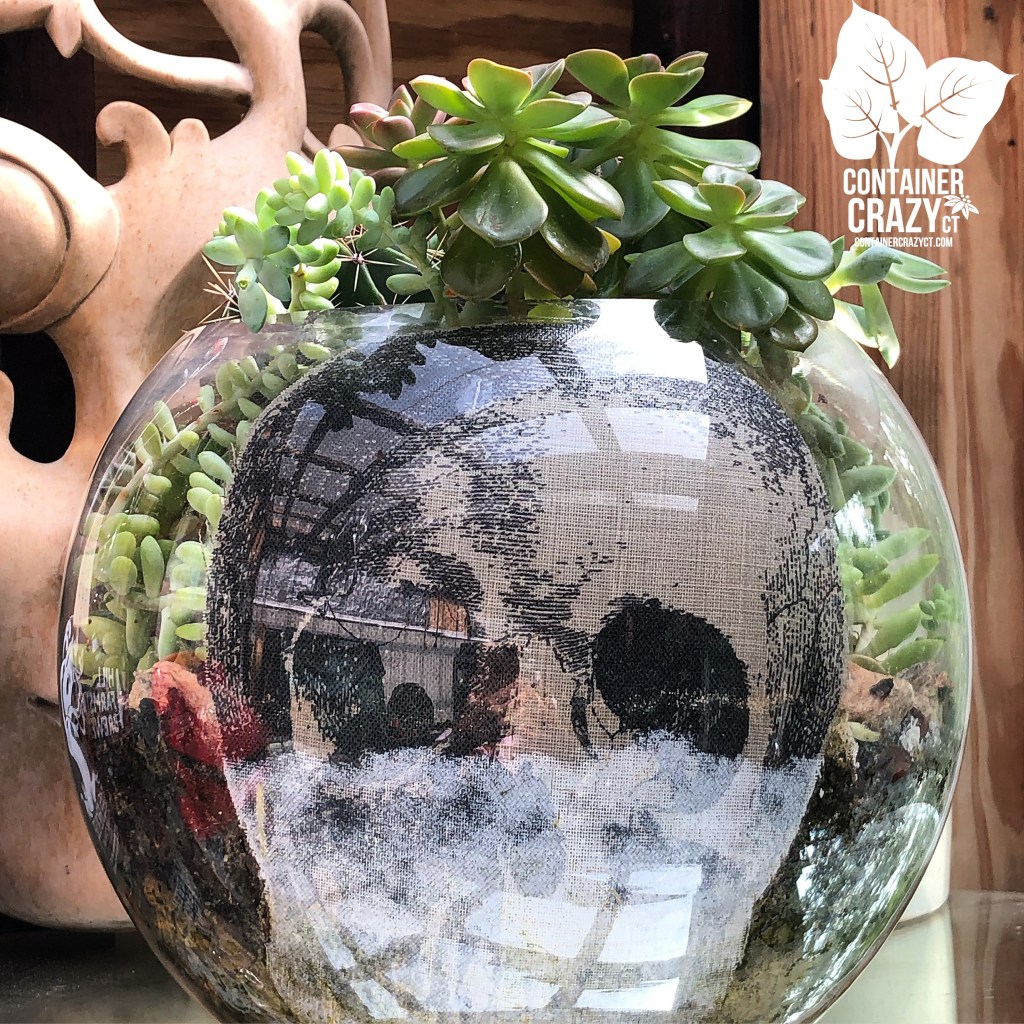
Skull Terrarium with Succulents and Cacti

Here is another example of a plant related item which could stay outdoors a while longer. It is a terrarium I made a couple seasons ago. I created it around Halloween and used decoupage glue to adhere a skull print on fabric inside of it. I remember thinking it would look super cool with plants.

You will notice the white area, ironically resembling a mask, which is where the glue will get wet. It left a white area mark there – so my test of this fabric has a flaw, or does it? It looks super cool to me.

A terrarium with a creepy mask image, all coincidental, not planned!

I could leave this terrarium outdoors for a few weeks more here in Connecticut. Before any frost would hit it. But I wanted to move it indoors into my greenhouse before it gets waterlogged with rain. We initially had rain predicted for this Friday by our weather forecasters, but that seems to have changed to “chances of rain” now. Anyhow, the plants are thriving, there are no insect issues, so why chance it? It is easy to take inside to keep growing another season.

The key thing is things change fast in regards to weather this time of year. You may be humming along, enjoying your outdoor plants, and thinking it is so beautiful outside. It is warm, some flowers are still blooming, and the fall air is just right where you feel comfortable working outdoors in the 70 degree range. And the next day, it will be 80 degrees F out. Like summer! What’s the rush, right?

But there will be that night where it gets cold fast, like this Saturday, predicted to be in the 40’s. Still not freezing, still safe for many plants, but it is coming.

Determining what to move indoors has the factors of weather, upcoming freezes, but also, some of that determination is based on how you use the plants (or how you enjoy their show). As in the example of the herbs – still very much usable. Or, it could be how beautiful the plant is at the moment.

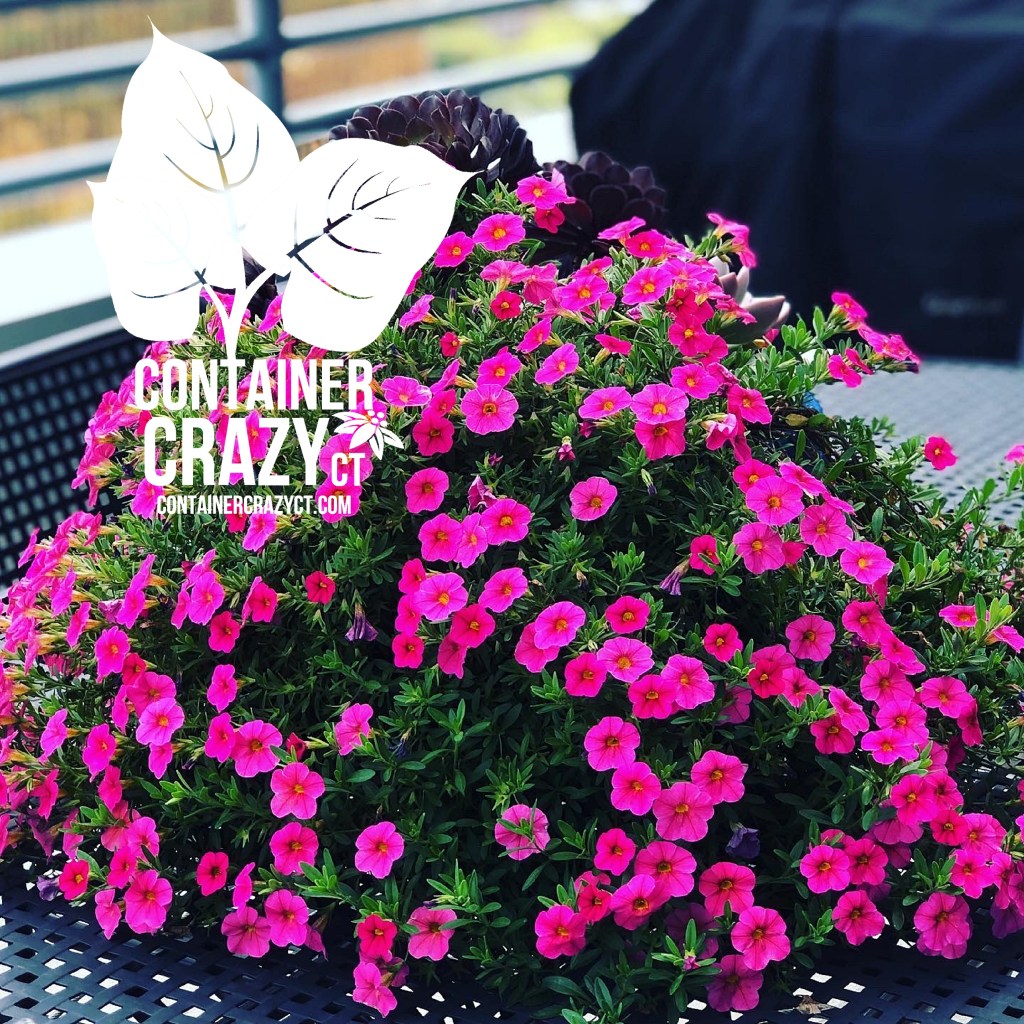
Supertunia annuals in full bloom and glory at the start of the fall season

Take for example, this dish garden, also at my clients’ site. Good Lord. Look at those hot pink Supertunia annual flowers. I gasped when I saw how much they grew from earlier this season to now in mid-September. Usually, I would take this dish garden away to take apart and store, but how could we? They are still amazing. And until they get hit by frost, might as well enjoy the show, right?

This dish garden also houses some amazing succulents. All look fabulousa. However, for succulents, I prefer to take special care with removing if you are taking them indoors. I prefer to move them before things get really damp and cold. With a drop in temperatures by the weekend at night, this could happen. Then tender succulent plants may start to suffer. If you are not taking them in, you may risk it and keep them outdoors. But most non-hardy tender succulents, in my opinion, should be moved in before it starts to get chilly consistently in the low 50’s and 40’s.

Succulents still thriving but Moving them in Before Cold Rains is Smart

What happens this time of year is we get temp swings. All will humm along fine and then BAM! It will turn cold and you will be taking out your favorite sweatshirt. As for myself, getting some of this moving in container work done early may be a bummer because you want to enjoy the beautiful creations a while longer, however, I never regret getting some of it done ahead (before warm gloves, sweatshirts, and my warmer hiking boots are required.)

A dish garden with annuals and succulents by Cathy T.

And another factor is the fall mums we have available around here in Connecticut this time of year. If you are going to display them, you might as well get them out soon so you may enjoy them throughout the fall season. There are tons of mums around to be had. Some places sell out of mums by mid-October, so you want to get them soon so you can enjoy them for a while before snow comes right?

Did I say snow, OMG, don’t even go there Cathy! LOL.

Cathy Testa
Container Garden Designer
Plant Blogger
Workshop Organizer
Plant Obsessor
860-977-9473
containercathy@gmail.com

Don’t forget! Towards the end of September, it is succulent pumpkin creation time. I will have some succulent new stock available if locals are interested! I will post photos on my usual feeds. If interested in a custom made succulent topped pumpkin, now is the time to give me the order.

Bringing Plants Indoors

2 Comments

I usually call this process, “overwintering plants,” but I figured that is a term which may be unfamiliar to newer gardeners.

Thus, this post titled, “Bringing Plants Indoors,” is referring to just that. I’m starting to bring in some plants this week (Sept 7th, 2020).

Some plants, like hardy succulents, are able to stay outdoors all winter here in our CT planting zones. They are able to tolerate frost and winter temperatures, and are referred to as, “winter hardy.”

For example, Sempervivums (a.k.a., Hens & Chicks) succulents. However, if you decide to keep any of these hardy succulents, which were grown in containers, patio pots, or hanging baskets outdoors, be sure to put them in a protected location, such as under a porch, in an unheated garage, or shed. They are more sensitive to winter conditions if in a pot versus grown in the ground in a garden.

If they have been growing in the ground, they will be fine over the winter, and do not need protection. They will go dormant when the time is right as temperatures drop in the fall and winter, and come back alive next summer season.

This particular hanging basket (shown above) is filled with Sempervivums which are looking perfect right now. There is no damage, no insects, and they are as happy as can be. I just love how they filled this hanging basket in fully. The color intensified recently, as many succulents do when they get a bit of stress of cooler temps.

I decided to move these Sempervivums in a hanging basket into my greenhouse yesterday, however, it is not because they can’t remain outdoors for another few weeks (or all winter in a protected location), but because they look so healthy. I want to keep them that way.

Tip: Move them in while healthy!

I find the best time to move some plants indoors, especially succulents and houseplants, is while they are looking great, are free of insects, and haven’t been stressed by a drop in temps during the fall season, which is usually accompanied by rain fall. When this happens, the soil, the pot, and the plant get cold and damp. This starts to invite issues such as rot, insects, and stress.

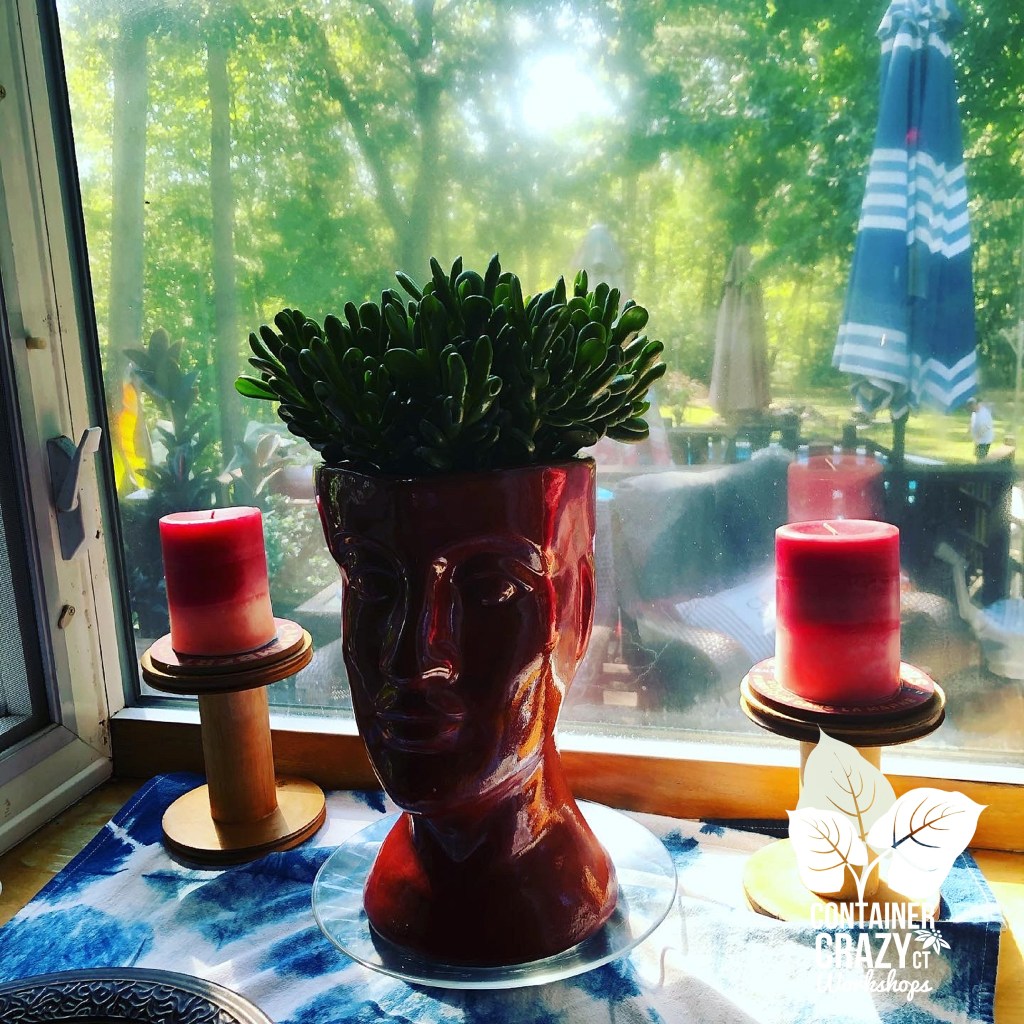
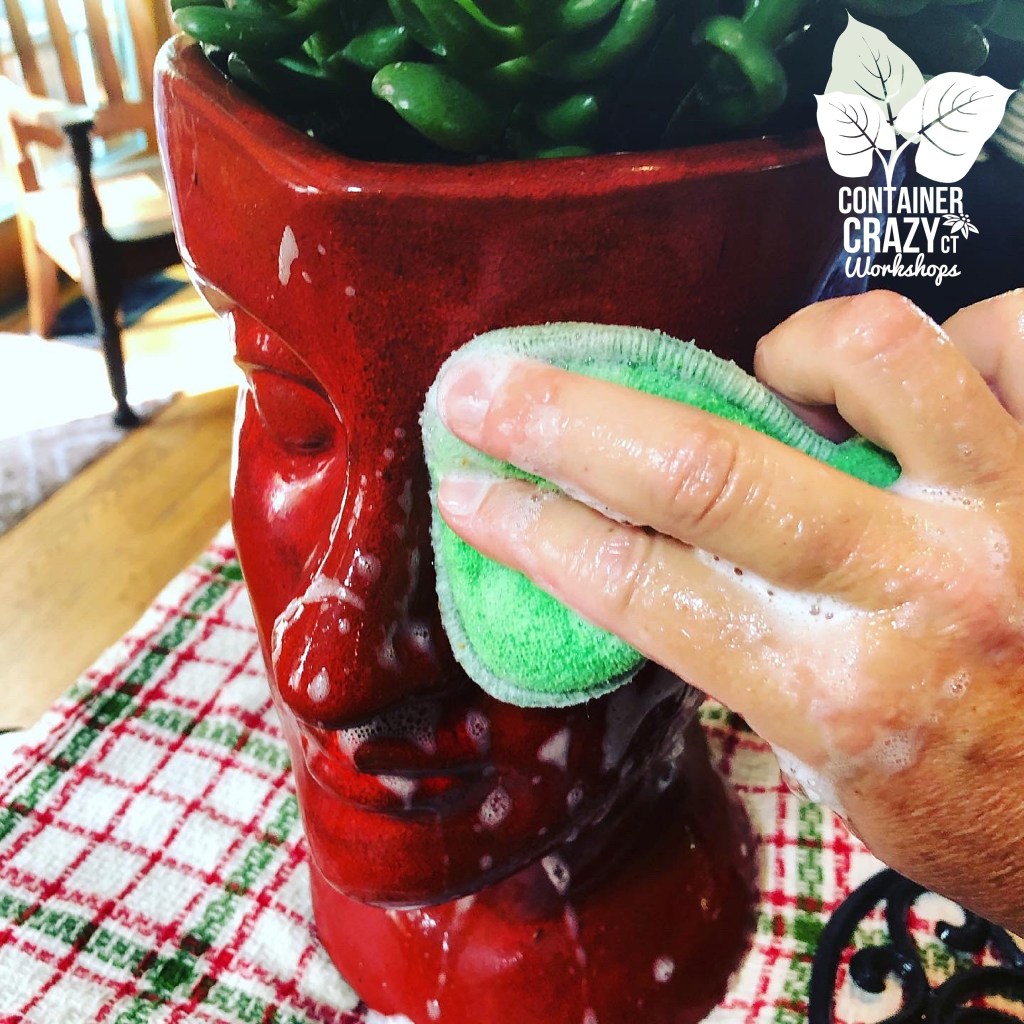
This plant above, a Jade in my red head planter, is another example. It could tolerate a few more weeks outdoors. Once it is consistently 50’s degrees at night, they should be moved in however.

It probably won’t go into the 50’s for another week or so, and even if it did – it still might be okay for one night or two of 50’s lower temperatures if our day temps stay warm (60’s, 70’s and maybe even another day of 80’s!).

But, it must be moved in before it gets hit by frost. Frost would kill it. It is not “winter hardy.” It can not tolerate the CT winter temperatures. Frost usually hits in early October.

However, because this Jade plant is so healthy right now, this week of September 7th, I wanted to take this gorgeous red head planter in before the beautiful Jade plant in it experiences any fall weather related stress. It has grown so much and has done well in this planter.

What do I mean by fall weather related stress? Well, when it drops down to chilly, 50 degrees F or below, in the fall season, we usually also get rain. Then the planter would be damp, cold, and this will affect the plant and the soil. It may not kill it – but it most likely will stress it. The soil gets cold and damp, and I find this scenario to not be ideal for plants you are moving indoors.

Tip: Move them in before major rain fall during a temp drop. And let the soil dry out in the containers outdoors before moving them inside.

Additionally, I advise my plant followers to let the soil dry out in your container gardens and patio pots before you move them indoors, AND, move them in before they get too chilly (before there is a consistent temp in the 50’s in the evenings.) A succulent is able to tolerate drought, so let that soil dry out before moving it in.

The plant got tall enough, so I had to remove the top shelf of this south facing kitchen window that extends out. It will be good enough sunlight to keep this plant happy all winter. The window area sometimes gets a little chilly in winters, but this plant is able to take 55 degrees “indoors” during the winters at night. It won’t get too cold here for this type of plant.

Before you move it indoors, here are other things you should do:

  • Don’t water it before moving it indoors for a few days if possible or even a week. Drier soils are better for moving in plants.
  • Inspect it for damaged leaves or any signs of insects. Treat if you find insects with the appropriate spray or treatment.
  • Remove any fallen debris from the plant (I found pine needles in there.)
  • Remove any damaged leaves if possible. Wiggle them back and forth to pull away if you see leaves with holes or damage.
  • Inspect under the pot. (I did this. I found a small round insect cocoon.)
  • Wash the outside of the pot with soapy water (mild dish soap is fine).
  • Move it before it gets 50 degrees F or below at night consistently. (This could happen anytime between now and the next couple weeks.) Watch your weather app for night temperatures.
  • Pick the appropriate home location. Some plants need some sunlight, others are able to tolerate low-light.

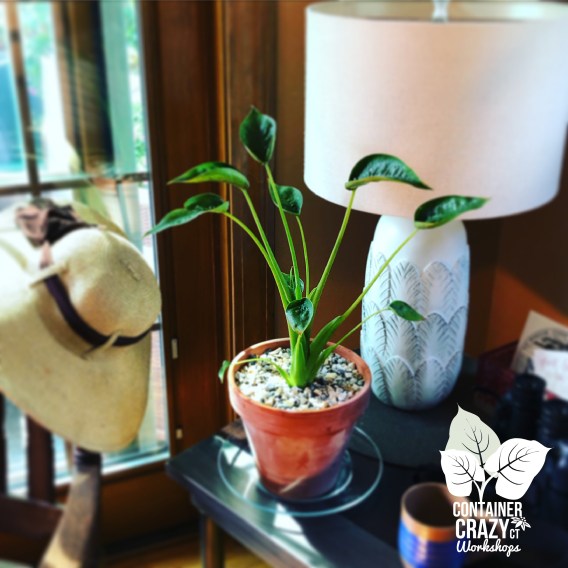
The next plant, shown above, is an Alocasia called ‘Tiny Dancers.’ When I saw it at a growers, I had to have it. I have lots of huge monster size Alocasias but I never had a dwarf sized one, like this one. It is too cute!

It started off in a tiny 3″ square nursery black pot. I potted it into a new terracotta pot and had it outdoors all summer. Usually, I store Alocasias by storing their tubers (round like bulbs located under the soil) only, but this is a tiny Alocasia, in fact, more along the lines of a dwarf. It makes it a houseplant candidate in my book, at least, I can test it out as such this year.

I decided to move it in and give it a spot by my south facing kitchen slider. It will receive sun light only a portion of the day during the winter which should be sufficient.

I don’t think it would do well in a north facing window which does not receive much sunlight at all. Another good place for this plant, if there is sun light in the room, is a bathroom because this plant likes a bit of humidity.

This Alocasia has been is pushing out new growth and is very happy. This one will be treated as a houseplant this winter rather than storing it like I do with my giant Alocasias (which are tropical plants and can not withstand winter temperatures). Sorry repeating myself.

I followed the same steps above: inspect, look it over, remove any damaged leaves. I did not wash this pot because it is terracotta and porous so the soap could go into the pot and although probably not too harmful, I just used a rag to wipe away any debris.

But this Alocasia ‘Tiny Dancers’ did have some signs of insects. When you inspect your plants before moving them indoors, look closely.

I did see, in the cups of one leaf, that there were little spiders in there. I am not sure if they were spider mites, but I decided to “lightly” spray the plant with Neem Horticulture Oil in a spray bottle as a precaution.

Tip: Please read the label or ask a nursery staff about insecticides, fungicides, or other products before you treat your plants. You could damage a plants’ leaves if you use the wrong product.

Check any treatments you use on plants by reading the label first. Make sure it is appropriate for the plant type! If you spray a plant with the wrong product, you will damage the plant, not help it.

Another plant I moved in to the house is considered a houseplant, the ZZ Plant. It has been thriving under a patio umbrella and had no insect issues, and is also pushing out new growth. When you see the growth, this is a good sign your plant is happy. Moving them in when happy is a good idea.

Tip: And I can not emphasize this enough, the best time to move plants inside as fall approaches is when or if they are healthy. If they have no issues, get them in before they do. Colder temps often times invites problems.

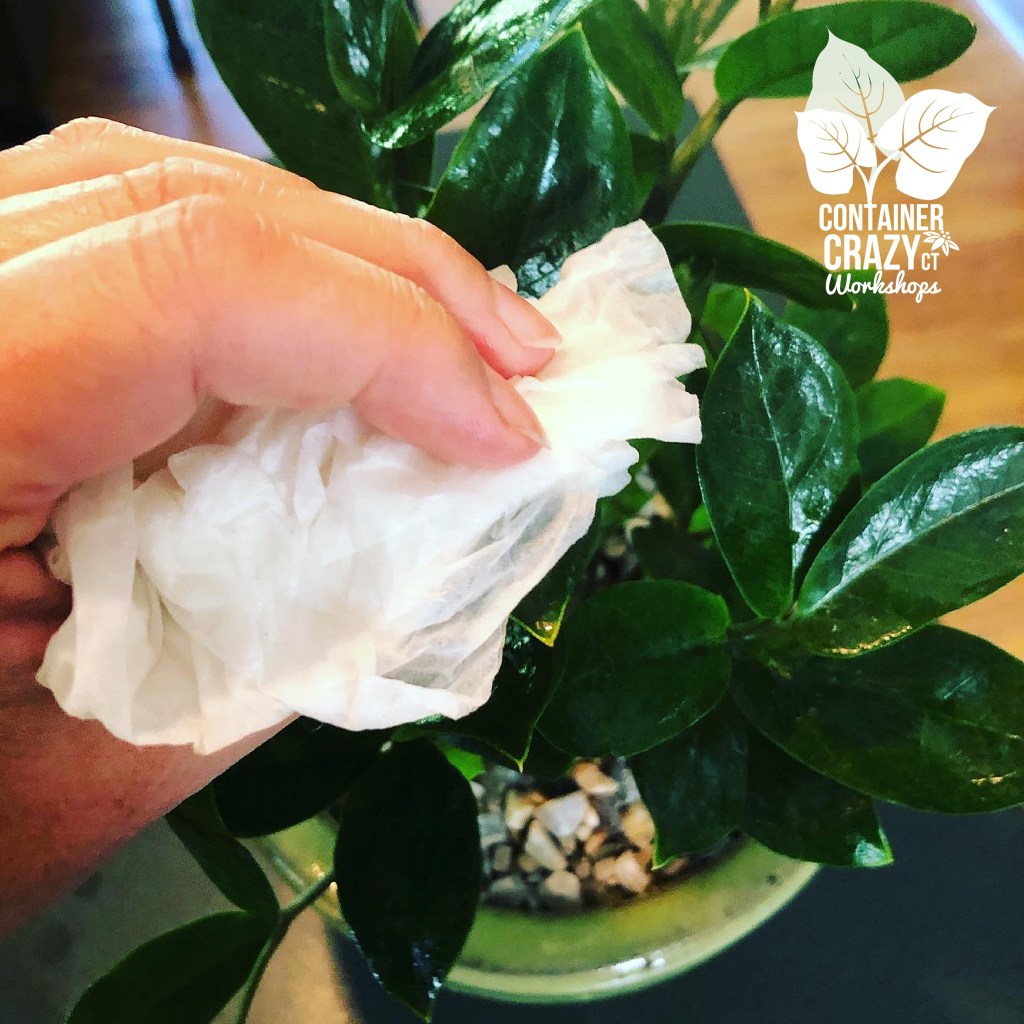
I carefully cleaned each ZZ Plant leaf with a wet paper towel to wipe away any debris or dust, washed the outside of the pot, and this one was placed in a north facing window that receives very little light. Since this plant is able to tolerate lower light, I think it will be fine in my north facing window this winter. This plant is marketed as being easy and care free, so the north window is its home for the rest of the year. Water this plant less as it does not like overly moist soils.

To recap, plants may stay outdoors for the most part, but some I start to work on early, partially because I have the time this week to work on my own plants before overwintering my clients’ plants from their container gardens. Also, sometimes working in mild and comfortable temperatures is better on me.

Also, I believe plants perform better indoors over the winter when you move them in before they get stresses from drops in temps in the evening. This is especially true for “non-hardy” succulents, such as Echeverias. I will be showing those as I work on them in future blog posts as well.

Tropical plants, like my Canna Lilies, Elephant Ears (Colocasias and Alocasias), and Banana plant (Ensete) may remain outdoors all the way up to frost (early October) or just after frost (IF you plan to store the under the soil bulbs, rhizomes, corms, or tubers only). If you want to keep the plant indoors as a house plant, move them in before frost.

Succulents plants, just to recap, may remain outdoors all winter if they are winter hardy. However, if they are not, they must be moved in before frost in October, and I recommend (sorry repeating myself) to move them in before they get cold, damp, wet, and chilly (BEFORE it gets consistently 50 degrees or below at night). Again, you may wait till we get the temp drop, but I prefer to do it a bit at a time before that phase.

Houseplants, well, I would move those in now too. While plants are healthy, strong, and not stressed out. It is a difficult thing to do because we want to enjoy every last minute of outdoor goodness (and so do the plants), but if they are doing well, might as well capitalize on that because they will be more likely to do well indoors if healthy now.

I already took down my tomato plants, by the way, and herbs are dwindling down so I am trying to use as much as I can before they are goners, and made pesto with my basil. I am considering sowing more herb seeds this fall in the greenhouse however. Maybe have a fresh batch available in a month or so. Sorry, that is a side bar comment. LOL.

Here’s a recap list:

  • Tropicals – Can wait til frost or after frost if storing tubers (specifically Canna Lily, Elephant Ears, and Banana Plants). Mandevillas you should move in before frost if keeping the plant in tact or storing the plant.
  • Non-Hardy Succulents – Can wait till the evening temps hit 50′ degrees F, but I recommend moving them in earlier, for reasons noted above.
  • Hardy Succulents – Can leave outdoors all winter. If in a pot, move to a protected location before winter. If in the ground, no worries, leave and let it be.
  • Houseplants – Move them in now while healthy. Each houseplant is different on lower temp tolerance, but treat them like the non-hardy succulents above.
  • Herbs and Tomatoes – Already took down my tomato plants because they are not producing fruit now and it is too cool at night, and herbs are starting to dwindle so collect what you can now. But that is up to you based on your own gardening veggie habits.
  • Agaves and Cacti – Can take drop in temps and tolerate it but can not take frost. Take them in before October frost or treat as I do with non-hardy succulents. The Agaves and Cacti I will leave out for a while longer probably, or take them in “if healthy” and cherished. Again, if they are “healthy” with no issues, I like to move them in before any chance of issues.

Hopes this helps if you are considering on working on your outdoor plants too. And please share my site with friends who may find this information useful. Feel free to ask for any clarifications, and also, note that these are all my opinions based on my years as a container gardener.

Thank you and enjoy your Wednesday!

Cathy T.
Cathy Testa
http://www.ContainerCrazyCT.com
http://www.WorkshopsCT.com
http://www.ContainerGardensCT.com
860-977-9473
containercathy@gmail.com

P.S. Unfortunately, I am not offering my typical Autumn Succulent Pumpkin Workshops due to Covid this year. However, I will be taking custom orders around the end of September. Reach out if local and interested. Thank you for visiting my blog.

This is a tough one

2 Comments

This is a tough one.

It is the perfect time to start working on your gardens while you are sheltering at home, but should you go to your local garden center or supply store during this COVID-19 pandemic?

I saw a Facebook post the other day of a person upset someone was going to the store to get mulch. They shouted out on their post about how this is not the time to go to the store, risking contact with others, for mulch.

I thought, I see their point.

But darn it, it IS the time to be outside, to do something meditative, and get fresh air safely at home in your own yard with no one but you and the birds.

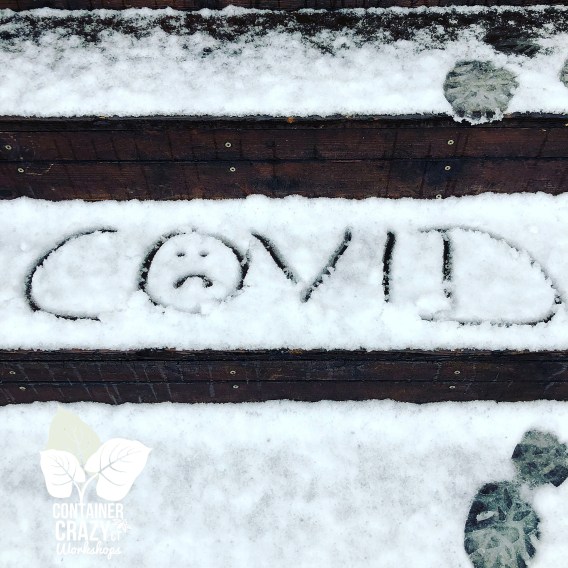
Covid Times C Testa Copywrite_0006

Bird Houses are Garden Art too

People are stuck at home, and I am absolutely sure, people who love plants and gardening want to work on what they may while they have the spare time right now.

Conundrum

We have a conundrum on our hands here. Is it okay to go to the garden center or a supply store for plants or gardening items?

I am not going to answer that question.

I suppose if you are doing your six foot distancing, they have curb side pick-up for individual needed items, and you are not touching bags of soil – maybe.

But, I don’t know.

Covid Times C Testa Copywrite_0003

Hopefully you have some soil on hand!

It kind of sucks for a gardener to not to take advantage of this free time.

After all, as noted above, gardening is very meditative and relaxes the mind. Something we all need right now.

And it is actually a good time to do some clean-up work outdoors in early spring, especially on sunny days.

Gardening and being outside may also help the kids at home now with breaks from at-home schooling.

Covid Times C Testa Copywrite_0001

Micro-greens on a window sill

Things you could do possibly, if you don’t have the need for actual items like mulch or plants, are:

Prune your shrubs – those which should be done in early spring before new growth starts.

Remove dead leaves from your landscape or garden beds you didn’t get to in the fall.

Clean your patio pots and containers with water and bleach per the appropriate mixing directions.

Sow your seeds indoors. If no seedling trays on hand, use alternatives – egg cartons, yogurt cups, or toilet paper rolls. (If you don’t have seedling mix, that is a dilemma however.)

Sharpen your garden tools, clean up your garden shelves, and take inventory of your gardening items on hand and make a list of what is missing so when it is safe to go out, you will be ready.

Covid Times C Testa Copywrite_0002

Clean Your Tools

Plan out a new garden bed you’ve always dreamed of.

Watch the patterns of sun and shade in your yard for a day – see where sun lovers are best suited and look for good places for shade plants, etc.

Dust off and read some of those garden books you have but never had the time to fully read before. You need to clean anyhow.

Get your garden decor items out of storage and place them in your favorite spots.

Grow some micro-greens inside the home (did you go to my sessions on those a couple seasons ago?)

Watch some garden related video’s for inspiration. (I have some on seed sowing on my sites right now). Visit my Container Crazy CT page on Facebook if interested.

Gather some stalks of spring flowering shrubs to force into bloom inside the home (e.g., forsythia).

Order some new container gardens and patio pots online. They may arrive a little later than normal but heck, they may be right on time for May plantings.

Get your tubers and bulbs out of winter storage. Pot them up early to get them started inside the home.

Covid Times C Testa Copywrite_0004

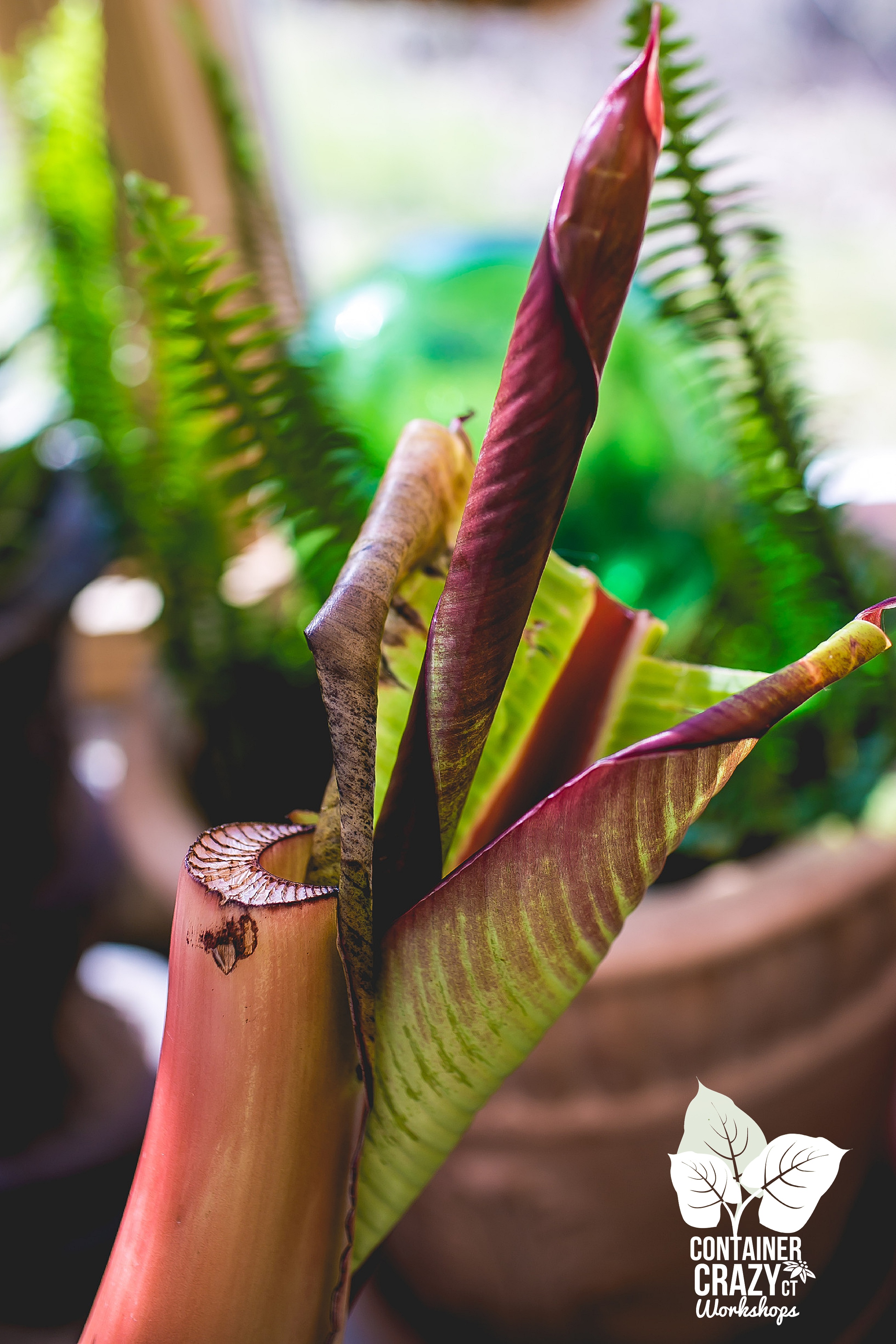
Stalk of a Red Banana Plant starting to push out growth

Clean your hummingbird feeders and hang them up – empty, if need be. But they will be ready for when the hummingbirds are and you are ready to make your own sugar water.

Get your patio furniture set up. Okay, maybe risking a last season weird snow fall or spring frost incident, but it will melt fast.

Put your big pots out and dream of planting them. I am! Envision the future.

Collect your tomato cages, trellises, and bamboo poles. Put them where you will be using them when the garden green light is set to go.

Put out your peony hoops around the peony plants starting to pop up now from the ground.

Build a scarecrow with your kids to put in the garden with materials you have on hand. You’ve been cleaning your closets out anyhow, right?

Have your kids search for a hollow log in your landscape if you are near woods to create a planter of sorts. It doesn’t have to be live plants – add some dirt and make twig people. Or find some ferns in the wild to plant in the stump.

Paint some rocks. Another great kid activity. They could pick specific locations in your yard to put them out or place them in gardens. Make them herb markers. Don’t have paint, maybe use nail polish?

Enforcing policies if you have to go:

If we get creative, we can avoid the visits to supply stores or open garden centers, but if we truly do need supplies, then at a minimum, store owners need to enforce policies (see the article below).

And please people, don’t rush to judgement.

Some people may need a propane refill or pet food – which are also at some garden like stores.

Article stated above:

An article by AgCenter Research Extension Teacher outlines some tips in an article titled, “Public Health Emergency Response for Retail Store Managers.”

https://www.lsuagcenter.com/profiles/aiverson/articles/page1584563222650

Cathy Testa
Container Crazy CT
860-977-9473
containercathy@gmail.com
Broad Brook, CT

P.S. If you are local to me and need seed packets, I still have some in stock for tomatoes, cherry tomatoes, hot peppers, some flowers, herbs, etc for sale. I could mail them to you. The details are on WORKSHOPSCT.com. I will have seedlings for sale in mid-May too.


Finding the Bright Spots

8 Comments

I was getting a little depressed the past couple days, I think because I started to worry about my husband still going to work. His company is considered essential, but to be honest, I want him to stay put at home and work remotely. Who wouldn’t want that?

Obviously, my worrisome feelings are because of those lurking fears of COVID-19 risks, but the other part is he is my only family member outside of me in our home! I am used to being at home alone, working here, and staying busy, but the pandemic made me feel a bit too alone. I’m sure many may relate to this feeling.

However, I had quite a few bright spots in the past week or so while I dealt with the emotional ups and downs of this challenge we are all facing. I’m up when I am in my greenhouse, for example, sowing seeds, but I get down real quick when I see the news and start to worry about loved-ones. And although I’m somewhat safe here at home, there are so many who are not safe, who have to face the danger every single day. I can’t imagine what their ups and downs feel like today.

I guess, from what I’ve read, it is important to focus on the bright spots right now when we can. Here are some of mine:

Bright Spot #1 – A thank you letter in the mail

I don’t always pick up our mail myself. My husband does it every day when he arrives at the end of our long driveway from work. He hops out of his car to get the mail and our newspapers, but yesterday, I walked to the mailbox to put an envelope in there to return a prepayment check for a workshop I was hired to do for a prep school in May. Of course, the May session has been cancelled. No worries, that is okay. On the way back from the mailbox, however, as I sifted thru my mail pile, I saw a card in the stack. It was from Garden Media Group. It stopped me in my tracks.

Bright Spots C Testa Copywrite_0006

The Thank You Card

I attended a presentation by the owner and founder of Garden Media Group, Suzi McCoy, many years ago at UCONN. I was just starting my own small plant related business at that time, and her speech made an impact on me. I could write a whole page on why, let’s just say, she knows marketing, especially plant related marketing. Everything she stated during that presentation spoke to me. It had a lot to do about the “new” Facebook world and how to market there, and what not to do on social media as well. Also, she included a whole presentation on TRENDS in the gardening world for that particular year. If you do a google search on Garden Media Group, you may see this about her company:

Today Garden Media is one of the top 10 public relations firms in the Philadelphia region and the top marketing communications and PR firm in the lawn and garden industry. We know this industry inside and out, and people know us, from the top media to garden center owners to horticultural breeders.

I’ve read every single one of Garden Media’s annual gardening trends reports since attending that talk years ago. I find marketing in general fascinating but even more exciting when it is related to plants of course. Sometimes, to be honest, I felt I was a trend-setter because some of the things I offered related to plants would be in that report. Other times, the trends report tuned me in to what is on the rise. It was always on the mark, I’ll say that – in my opinion.

Recently, it was announced Suzi McCoy was retiring and her daughter is taking over the company. Right at that moment, I decided to type Suzi McCoy a letter and tell her how her presentation that day spoke to me and how I followed her advice in her company’s newsletters and trend reports ever since. Me, being a very small solo business, with very little mentors of my own, she was a mentor from afar but she didn’t know it. I let her know this. This letter was sent to her at least a month or more ago.

When I was reading her handwritten thank you card in my driveway at the base of the hill yesterday, half way back up to my house, the sun was shining on me and I thought, wow, one of my garden heroes wrote me back. I stopped in my driveway to read it completely. It was one of those letters you can’t wait to open till you get inside the house. She said she saved my letter to her. She also said that she was flabbergasted, as one never knows how or when they can make a difference in someone’s life. To get her thank you in return for my letter to her, which I didn’t anticipate or expect at all, right now during COVID-19, made it extra special to me. Her letter and the timing was a bright spot.

Bright Spot #2 – My nephew face-timed me

My young nephew is stuck at home now due to school closings, so I’m sure he was searching to play with his new messaging app, which is monitored by his parents, but I was pleased he face-timed me this past weekend. It was a bright spot for sure as it was a surprise as well. While talking to him, I walked myself and my phone to the greenhouse to show him all the seed trays I’ve sown, and he replied with, “Wow!” Then he told me I was breaking up due to a low connection, and I told him, “Oh yes, that happens when I’m in my greenhouse.” Anyhow, after that, I showed him a view of his Uncle Steve chainsawing wood. This got him all excited. That was a bright spot.

Bright Spots C Testa Copywrite_0002

Bagged Seed Sowing Kits 

Bright Spot #3 – Seed Sowing Kits

First of all, I sold seed starting kits to about 15 people when the presentation I was going to do at a market was cancelled (due to COVID-19). I want to say thank you to those who purchased the kits from me. I finally packed up the remaining kits I had pre-assembled for the market because I realize we should not be risking social contact anymore. But a bright spot was hearing how happy people were who got the kits and sowed their seeds at home. They got a bit of “excitement” knowing that they had something to look forward to – seeds germinating and sprouting above the soil!

Bright Spots C Testa Copywrite_0005

Sealed Seed Packets for Mailing

You see, it makes ME happy when others are happy about plants. I even had a friend of a friend ask me to mail him a few seed packets, and I did. Along with sending him my instructional PDFs to show all on how to sow the seeds. As you can see, I’m a wordy girl, so they get lots of PDF details along with their seeds and/or kits. And I gave a seed sowing kit to a friend’s mother who is dealing with throat cancer. She sent me a message to say thank you. That was a bright spot.

Bright Spots C Testa Copywrite_0001

The Tiny Bright Spot making a Big Impact

Bright Spot #4 – Seeds Actually Sprouting

I’ve been doing some Facebook Lives from my private workshops page for my regulars on how to sow seeds, what to do, how to watch over your seedlings, how to transplant them and what have you when it comes to sowing tomato and pepper seeds. And this did and does make me happy – very happy in fact, especially last week on the sunny days. It gave me a focus and people are at home anyways, so how perfect is it to share what I can with them?

Bright Spots C Testa Copywrite_0004

Bumble Bee is on the left, Fox Cherry on the Right

But as noted above, I started to get the blues real fast this week. I felt the blahs. Then I walked into my greenhouse yesterday, and saw my Bumble Bee Mix Cherry Tomato seeds are starting to sprout. And when I say sprout, I mean the tiniest tinniest baby sprout. This thing, this tiny thing, made me smile. Why? It is just a seed, after all. Because it shows renewal, growth, future, success, and I don’t know – I’m a plant freak, is why! Nature has always amazed me. Even from childhood. I often looked at nature and pondered it. Nature and plants are my savior right now. I’m not just saying that. Plants are my bright spot. And eating those yummy cherry tomatoes this summer will be even more appreciated than normal.

Bright Spot #5 – Hubby working from home today

He is working remotely today. He handed me a cup of coffee as I was typing this. He made his typical jokes the way he always does. He is an eternal optimist. But his work is considered essential and not on the stay at home list, so I know he will have to go back in to do some rotating duties at the office. But for now, I will soak up this bright spot and feel a bit of relief. Hopefully the next bright spot on my list will be scoring TP today, because I have to go out and get some. Wish me luck!

Cathy Testa
860-977-9473
containercathy@gmail.com

P.S. I received another bright spot this morning. A text from a client, showing me the new containers I will be planting this spring for her! 🙂

Cathy Testa of Container Crazy CT by C Testa Copywrite_0002

Me, Cathy T, last spring. Looking forward to more bright spots to come!


First Talk Coming Up, and First Workshop Posted

Leave a comment

Good Morning Everyone,

Just letting everyone know I posted the first Container Crazy CT Workshop today to be held in May 2020. See www.WORKSHOPSCT.com for all the details, which includes a Mother’s Day special. The topic is again, Succulent Hanging Baskets, with new twists!
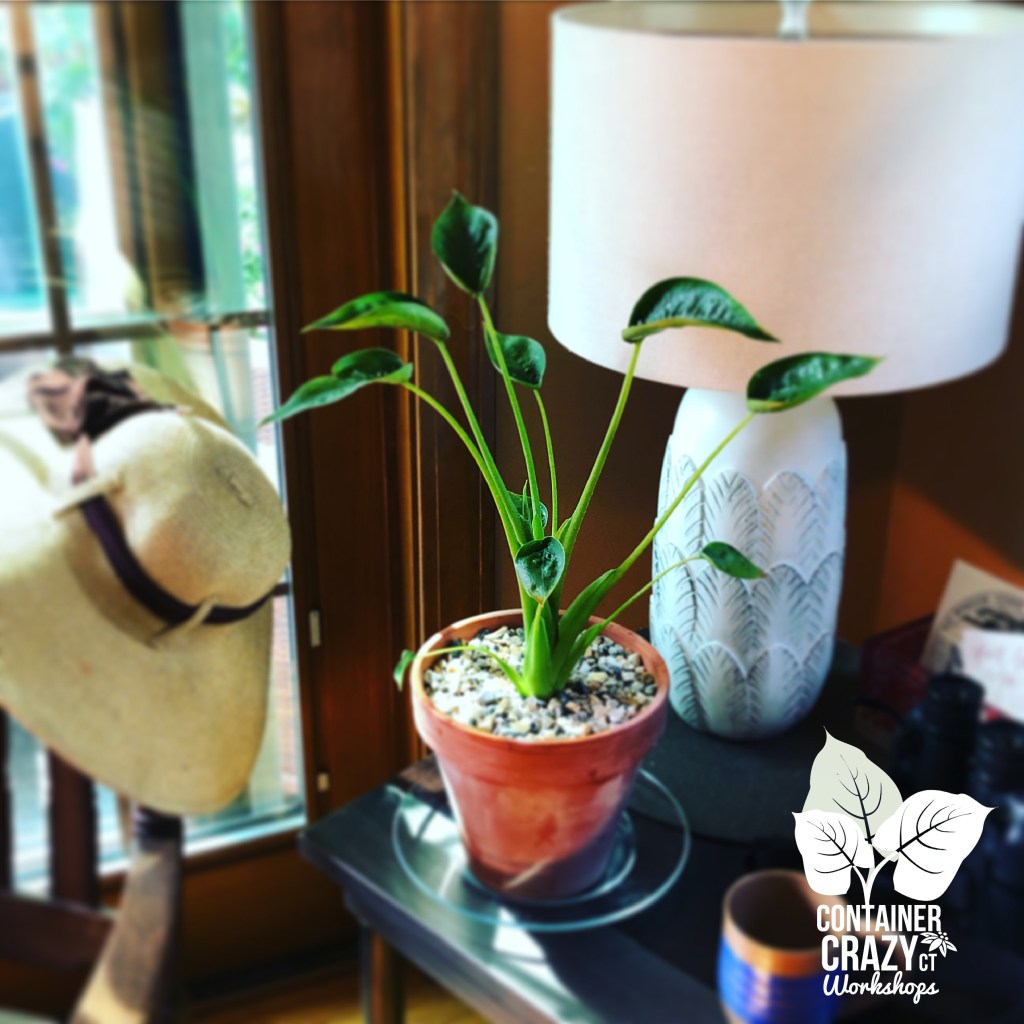
5E699446-336A-4DCF-8B62-141A49E40B01

Also, I will be speaking in a week and a half at the Burlington Garden Club on Seed Starting (focusing on tomato and pepper plants – warm season crops). The session will be held on Thursday evening, 2/13/2020, at the club’s location. See their site for more details. Seeds will be available for purchase following my demonstration. March is the time to start “some varieties” and I’m excited to share the types I will be offering this season. It is a good time to consider all aspects of seed starting.

tomatoe 2018_0002

And we all know that Valentine’s Day is around the corner – only two weeks away. I make custom items for Valentine’s Day with plants and here’s an example. Local meet-up’s and I will be showcasing some at a store soon as well. If interested in any, contact me for a meeting up or drop by for pick up (Location: Broad Brook, CT).

In the meantime, enjoy your weekend!

Cathy Testa
860-977-9473
containercathy@gmail.com