Pondering Ponds ‘Walk and Talk’ Reveals Many Unexpected Surprises

9 Comments

Hi Everyone,

First, thank you to our hostess and guests!

First, a great BIG thank you to our host, Rhonda Rafferty, for sharing her personal experience of starting her pond garden with one level, and then growing it by adding two more levels, as explained during our most recent “Walk and Talk” garden event, held last weekend.

Rhonda’s pond gardens are situated in her backyard, and they are visible from her deck patio area adjacent to her house.  At the base of her pond gardens is a beautiful sitting area flanked with a pergola.

Cathy T and Rhonda's reaction to a funny intro story!

Cathy T and Rhonda’s reaction to a funny intro story!

The sounds of the water trickling from decor spitting fishes and fountains in the ponds are enough to draw you from inside her home to the great outdoors in her backyard.

We had 15 attendees which made this tour a great success. Many of the attendees were from local areas, some folks from a new South Windsor church gardening group, and several attendees from Cathy T’s Classes.

Pondering Ponds Photos by Debut Cinematic_0012

Started with a kit, and built two more sections

Rhonda explained how she started her adventure with pond gardening by using a pond kit to build level one, or the very first tier of the current 3-tiered pond garden area in her yard. As soon as it was ready, her husband bought ten goldfish and put them in it, and of the ten, seven goldfish survived. All of the other goldfish in her ponds today, hundreds of them, are the offspring of the initial seven goldfish.

When Rhonda had shared pictures prior to the tour of her pond gardens, I had assumed the fish were Koi fish. They are rather large and very active in all three levels of her pond gardens, rising to the surface quickly and swimming around rapidly as you approach the water’s edge.

Pondering Ponds Photos by Debut Cinematic_0007

Rhonda explained the first level of the pond garden is rather shallow but the middle level is approximately 5 feet deep and 20 feet long.  Each pond section is structured a little differently, and they are not connected but adjacent to each other in a three-tiered pattern.
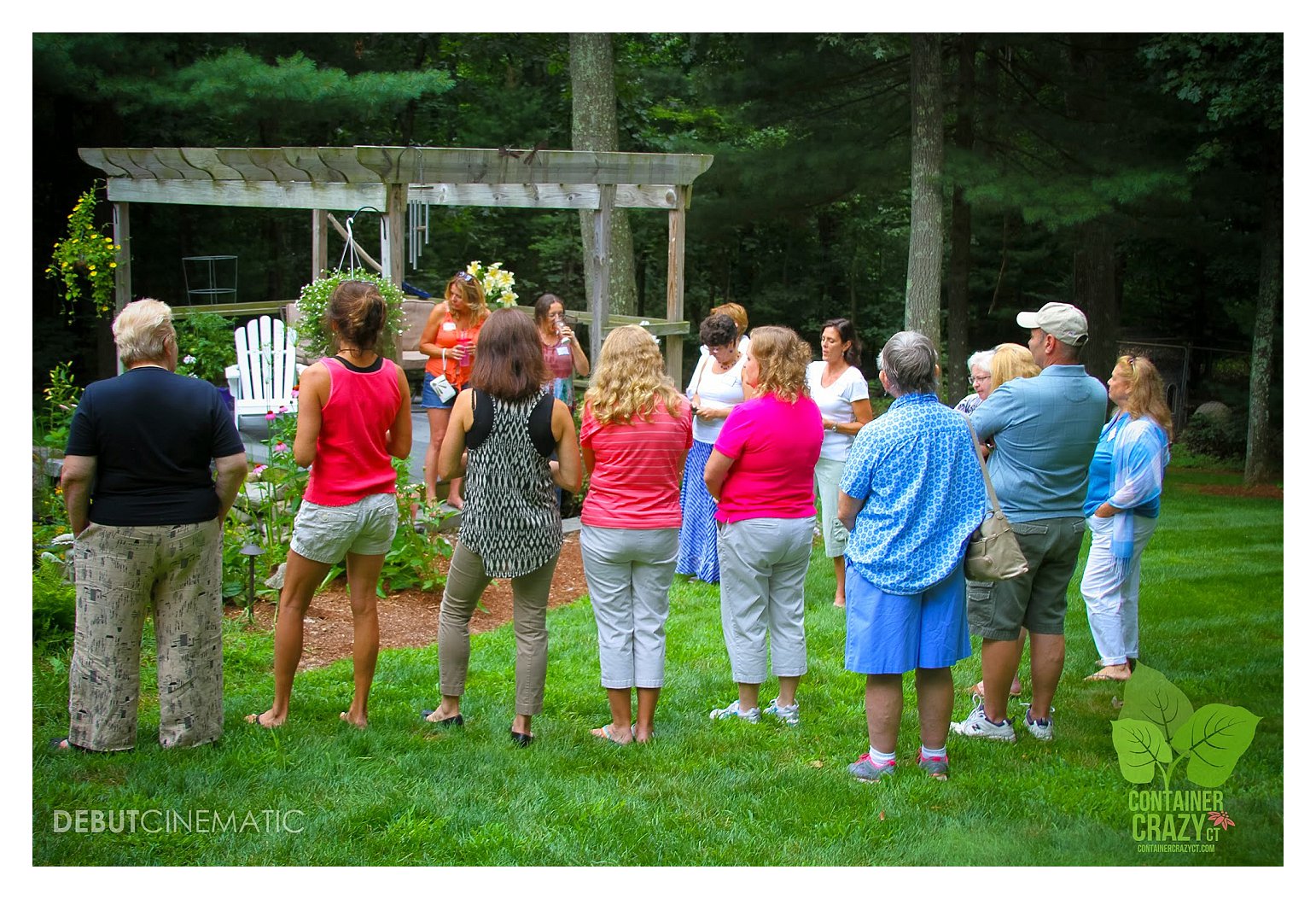
Attendees Listening to Talk by Rhonda

Attendees Listening to Talk by Rhonda

Spring and Winter Cleanup Routines

For maintenance, Rhonda drains the ponds completely in the spring.

The goldfish (which stay dormant in the winter months in the bottom of the ponds) are relocated to a 100 gallon horse troth until she’s done performing spring clean-up activities.

Easter is when Rhonda usually opens the ponds if the weather is warm enough.  She can tell when the lilies start growing that it is time to get moving and working on her ponds.
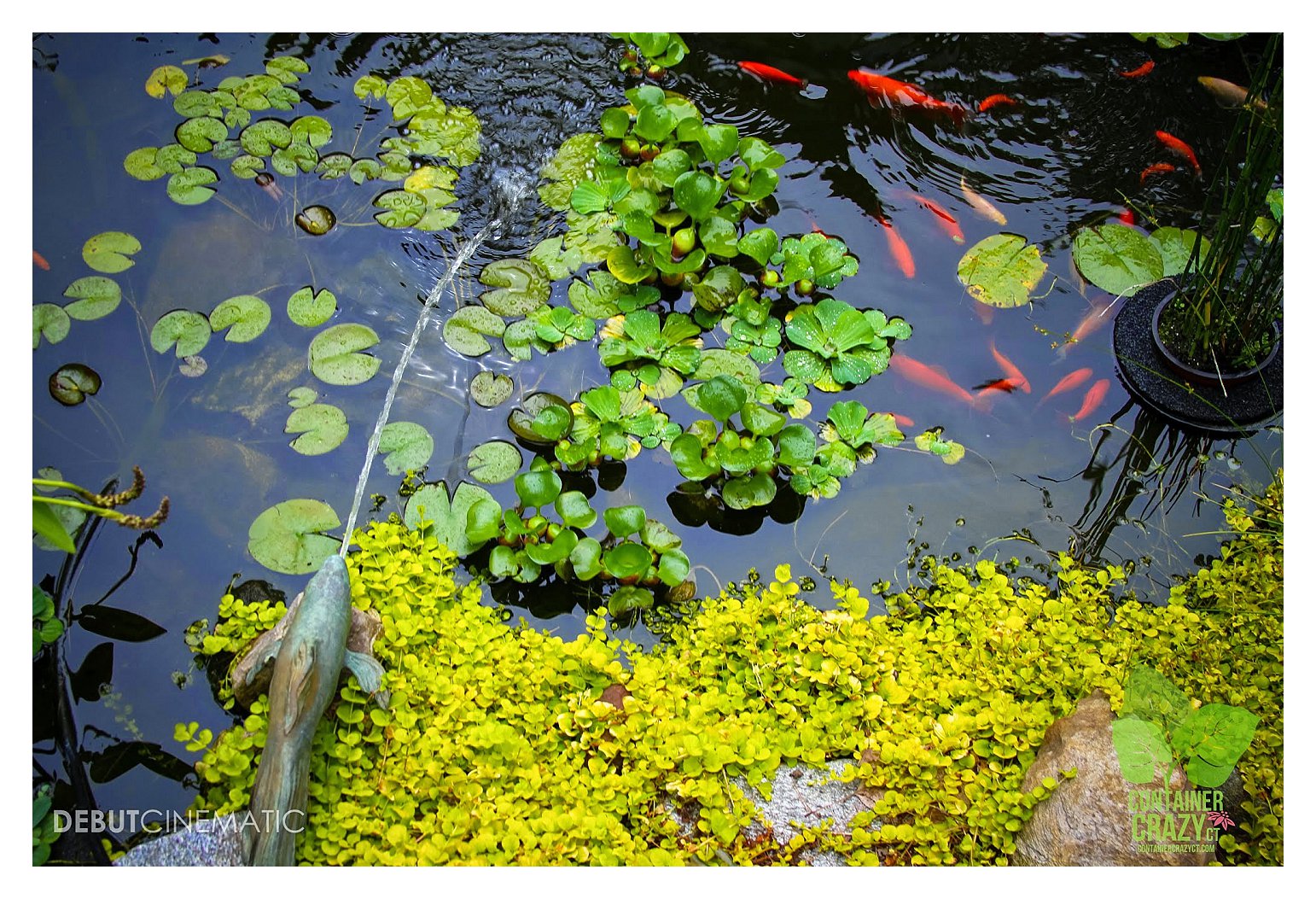
Water lettuce, Lilies, and Lysimachia near goldfish

Water lettuce, Lilies, and Lysimachia near goldfish

All the muck, which built up and decayed in the bottom of the ponds over the winter, is removed with a special muck vacuum she purchased because her ponds are so large.

Also, Rhonda noted using ‘Microbe-Lift‘ in the water filter to add good bacteria to the water.  This will keep her pond healthy throughout the season.

Pondering Ponds ContainerCrazyCT_0001

At one time, Rhonda used a power washer to clean the liner, but she no longer uses a power washer because she wants to keep the algae growing on the liner, and the power washer was removing it – so she uses a garden hose instead.

The algae helps the natural ecosystem get established after a complete water change, and provides food for the fish because you can’t feed them until the temperature of the water reaches a consistent 55 degrees.

There is a special ‘Spring & Fall’ food for cooler temps of approximately 55 – 75 degrees.

However, once the temperatures reach 75 degrees, Rhonda changes to feeding the fish a summer staple food.  Rhonda also noted she uses special UV filters to control bacteria so that the water stays clear during really hot temperatures in season.

During the fall season, the food is changed again when it gets cooler outside, and she stops feeding at 55 degrees.  She also turns off the filters when she stops feeding for the fall and winter months.

Standing at Level One, Rhonda talks about products used to keep water healthy

Standing at Level One, Rhonda talks about products used to keep water healthy; Photo by C. Testa

In the winter, she leaves all the water in the ponds, but will remove the filters and clean them for storage.  She basically washes them down with water because she avoids getting any chemicals in the filters.  She also cuts back all the hardy water lilies and plants, and sinks them to the bottom of the pond in her deepest tier.  A small low watt pond deicer, which floats on top of the water for the winter, is used.  This will create a small patch of open water in the ice to allow gases to escape in the winter.

Water Plants, Floating Plants, Perennials and Tropicals

Rhonda has a mix of plants in and around her pond gardens, and she noted, many have appeared on their own. Some self-sowed or got there perhaps by bird droppings of digested seeds, and even a few ferns arrived to her garden naturally. It is as if the plants know this is the right spot for them.
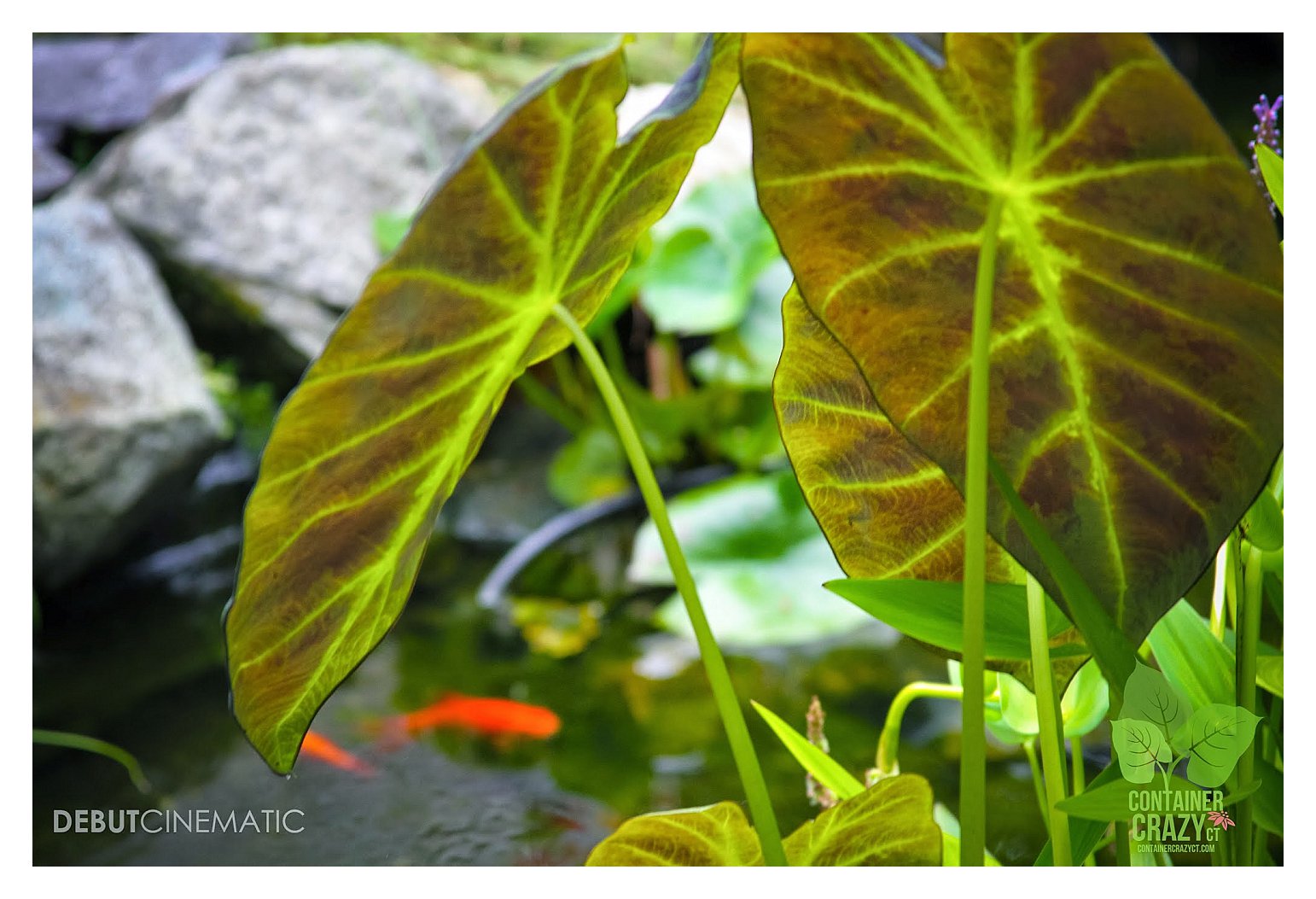
Elephant Ear (Colocasia)

Elephant Ear (Colocasia)

In the water of her pond gardens, she has water lettuce, elephant ears (one showing off a bloom on it during our tour) – Colocasia esculenta ‘Illustrious’, canna plants, hardy water lilies, papyrus (herbaceous perennial), and mosaic plants (Ludwigia sedioides, an aquatic perennial grown as an annual).

Some of the plants she overwinters by placing them in a fish tank in her home, and others are stored by division of rhizomes or corms, such as done with the canna and elephant ears, or by saving off-sets.  And some are allowed to sink to the bottom to decay or regrow the following season if hardy (as she noted above in maintenance comments.)

Rhonda mentioned Garden’s Dream in Enfield, CT as one place she purchases plants from because they started carrying water type and aquatic plants.

Other plants and bees

There is no doubt the bees are enjoying the plants, for not only could we hear water trickling, see fish moving, there were also many bees visiting the blooms of her coneflowers and other plants surrounding her pond gardens.

Pondering Ponds Photos by Debut Cinematic_0002

Perennials, such as Echinacea purpurea (purple coneflower), and various ornamental grasses are planted in the ground near the ponds, and one plant many attendees noticed planted in a pot sitting on a rock in the center of the pond was Amaranthus tricolor, an edible annual with bright red and yellow foliage, which grows rather tall and is showy.

Plant with red and yellow foliage in pot seen in background -Amaranthus tricolor

Plant with red and yellow foliage in pot seen in background -Amaranthus tricolor

When everyone asked me what it was, I drew a blank on the plant name, but Rhonda said she got her first plant of this variety from me a couple years ago and loved it – fortunately, she remembered the name of it.  Rhonda said she’ll never forget seeing this annual at my home in a container garden because she uses Amaranth flour as one of her gluten-free ingredients in her recipes at home.
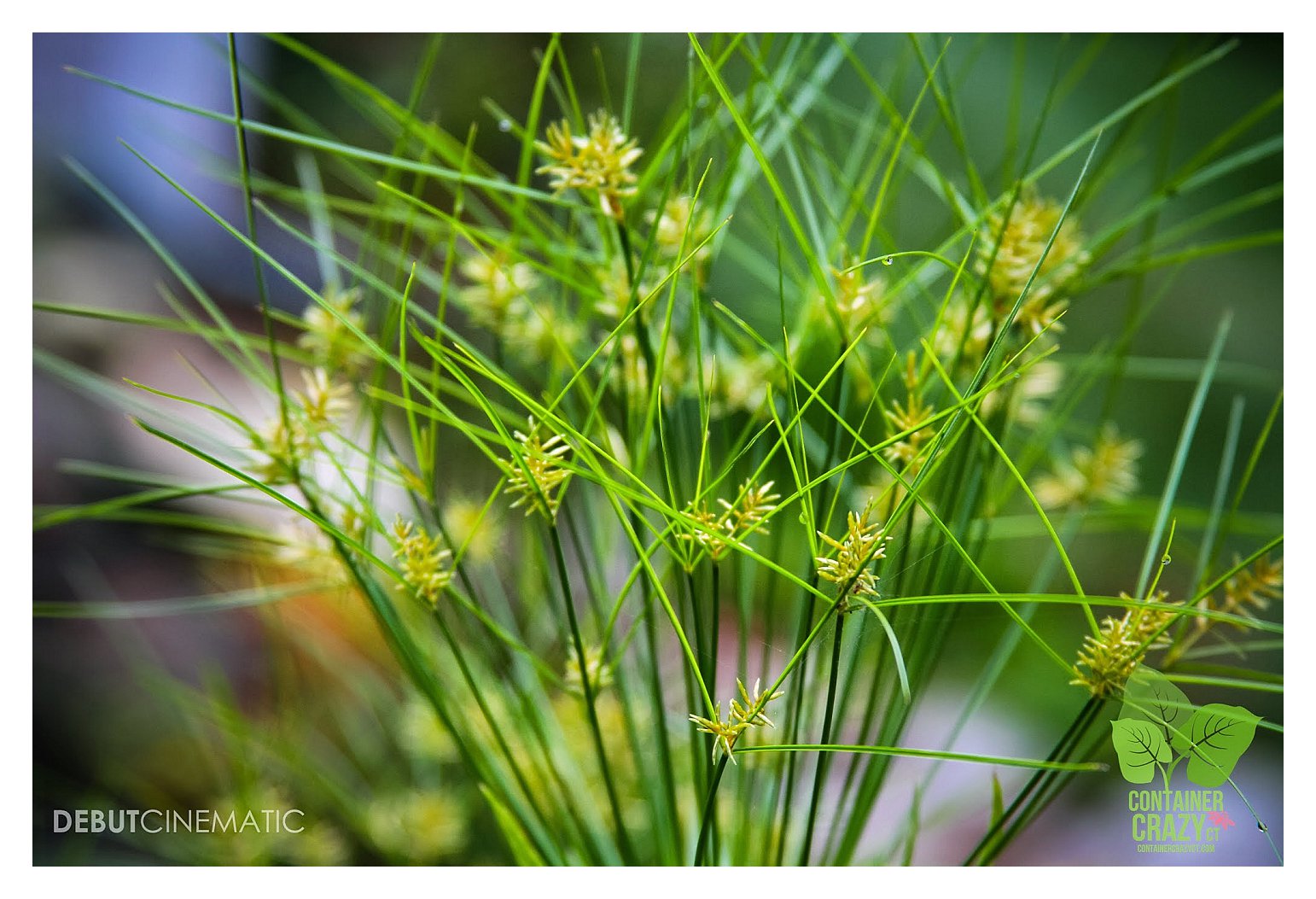
Papyrus tops

Papyrus

Other plants in the pond gardens, as noted above, were the elephant ears (can sit in water), papyrus (not technically a water plant but also can sit in boggy like water or on water’s edges in pots), and the aquatic water lettuce, hardy water lily, and more.  One we all found fascinating, and is relatively new in Rhonda’s pond gardens, is the mosaic plant (Ludwigia sedioides).  It is an herbaceous perennial (winter hardy to Zone 10) which floats and rests somewhat flat on the surface of the water and has a pretty mosaic like pattern to it.

Mosiac Plants - Photo by C. Testa

Mosiac Plants – Photo by C. Testa

Root Mass Demonstrated 

Another surprise is when Rhonda reached into the water to pull up a huge mass of hardy water lily plants bound together by one root system, explaining how quickly plants grow in her water gardens.

Root Mass of Hardy Water Lilies

Root Mass of Hardy Water Lilies

She also noted another plant found by her husband in the wild, upon with, I gave a little caution to the attendees to be very careful with water plants or any plants you may find out in the wild if you do not know what it is.  There are invasive species in the wild or in natural ponds, which you should never relocate to your pond or home gardens by mistake, especially if it can run off to another water system nearby your home.  So just a note – know what you are planting, and if you decided to get rid of a rampant plant growing your gardens because it became out of control, and don’t know what it is, toss it in the garbage and not in the woods where it could potentially spread.  This is something I learned more about as a kayak-er, where you must be careful to not accidentally bring home an invasive aquatic plant after visiting a lake with your kayak or boat, as discussed in a previous blog here.

Floating Containers – Another Big Surprise of the day 

I’ve written about all types of containers to use in and around the gardens, but have never considered the type Rhonda had in her pond garden.  There was one container floating around in the pond garden, moving here and there gently in the water, and without hesitation, Rhonda lifted her floating container out of the water to show our attendees.  It is made of a black Styrofoam base with individual open sections where pots may be inserted easily.
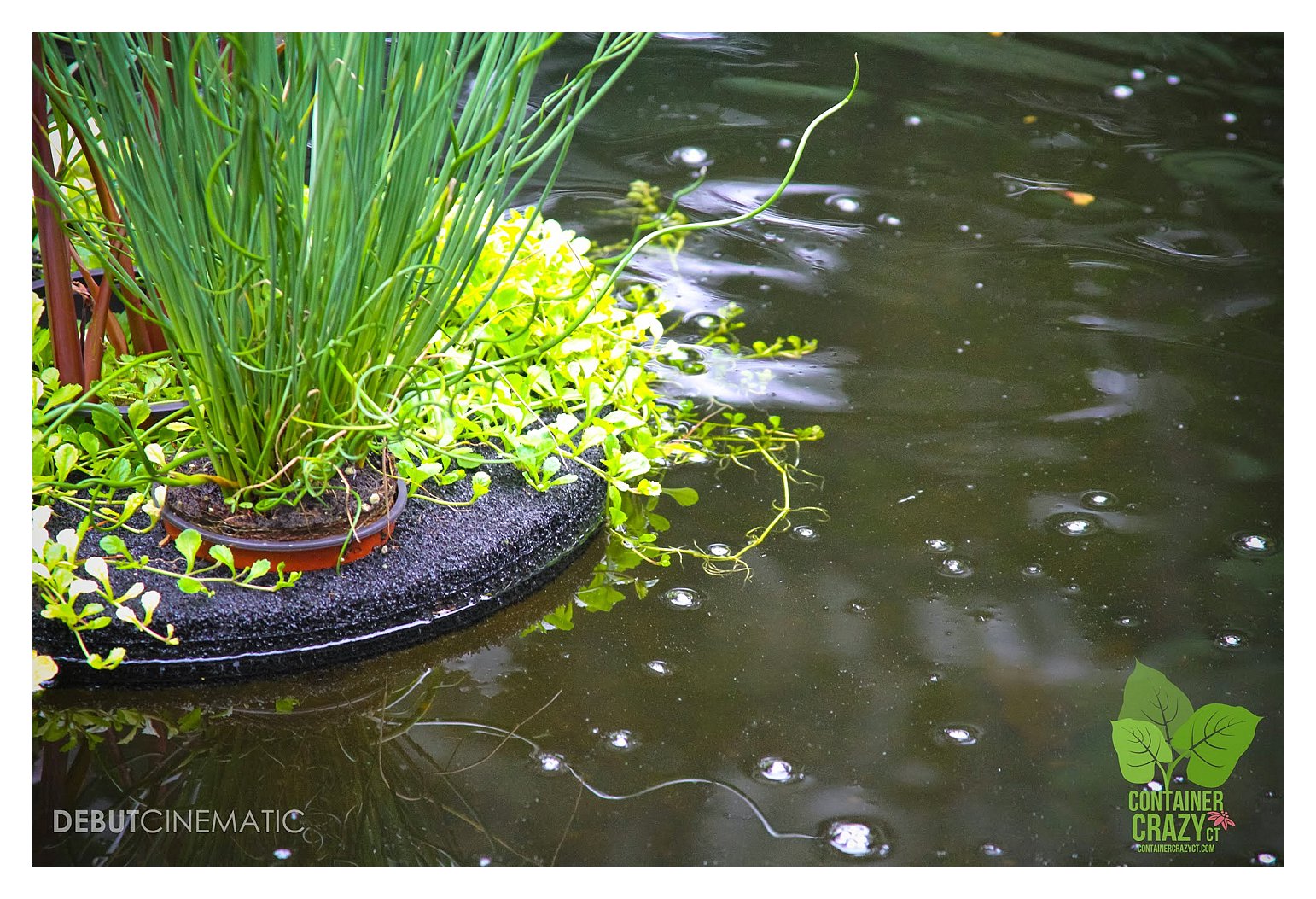
Pondering Ponds Photos by Debut Cinematic_0006 Pondering Ponds Photos by Debut Cinematic_0007 Pondering Ponds Photos by Debut Cinematic_0008

Garden Art is wonderfully displayed around her pond garden — this little pig in the corner, spitting fish here and there, and other surprises as you look and observe.

Pig by Pond; Photo by C. Testa

It is an adventure to spot them.  We all could imagine the days or evenings when she and her family has sat there to enjoy all the hard work put into the pond gardens at her home.
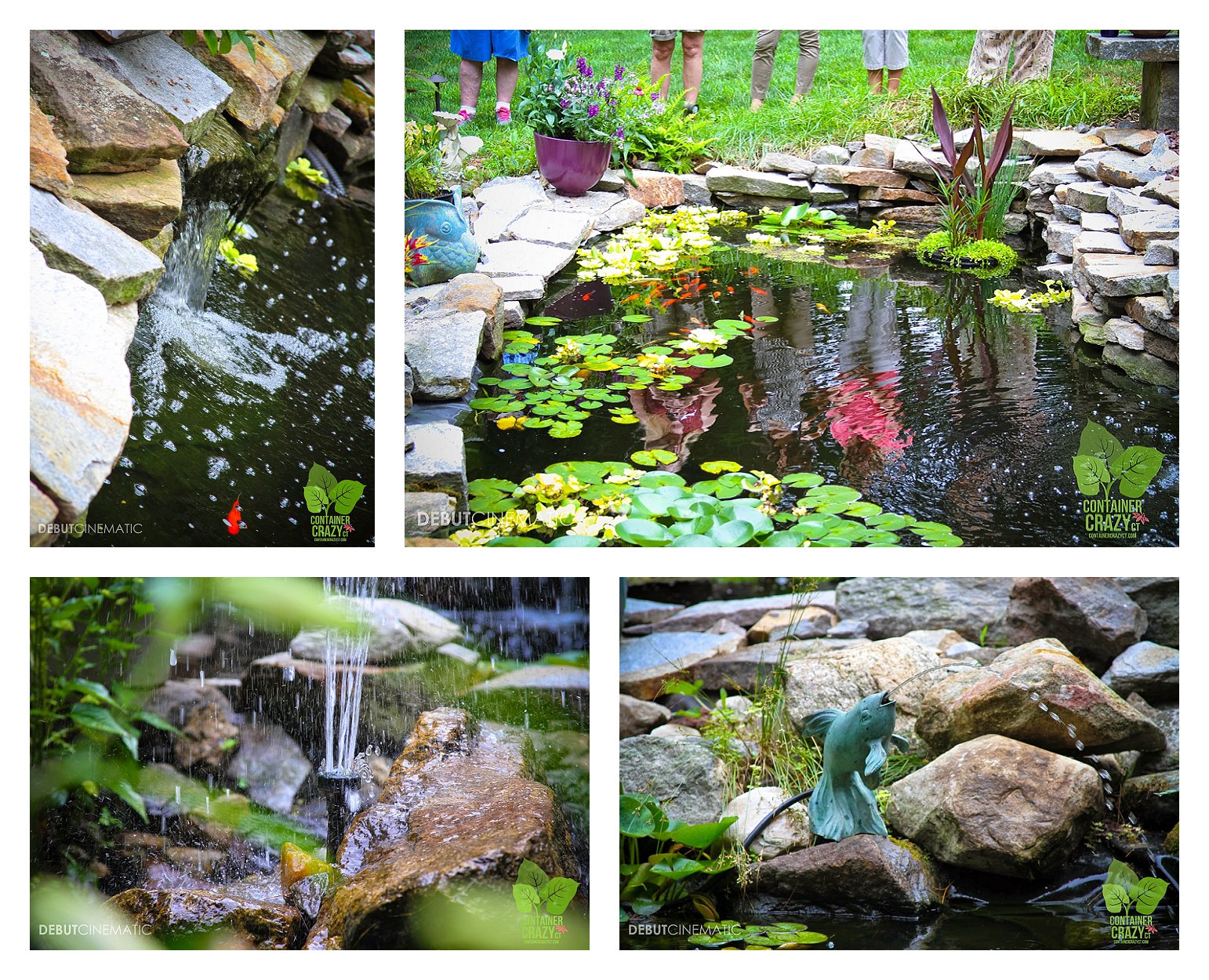
Pondering Ponds Photos by Debut Cinematic_0005

Sources for Pond Supplies

AZPonds.com is an online source Rhonda uses to order supplies. She gets her liner, filters, pumps, and water treatments from them. Shipping is pretty fast.  Orders arrive within 5 business days.

Rhonda started her first pond garden 12 years ago, and continues to learn and expand it.

We all could appreciate the amount of effort but how her efforts also equals the relaxing moments by the pond gardens enjoying nature, goldfish, and sounds.

Pond Gardening is Not for Weenies

Water or pond gardening is not for weenies – it takes some effort to get it cleaned and prepared every season, but the payoff is grand. And if you were wondering, one of the reasons we were laughing in the above photo is because I shared a story of how Rhonda and I met during our corporate days – when we decided to take a motorcycle riding course together, and how we would ride into work side by side on our Harley Davidson motorcycles.  Rhonda still rides today, I, however, gave it up so you can see – she’s no weenie!  Makes sense to me that she manages to maintain such a diversity of plant life, fish, and more in her pond gardens.

Hostess Rhonda; Photo by C. Testa
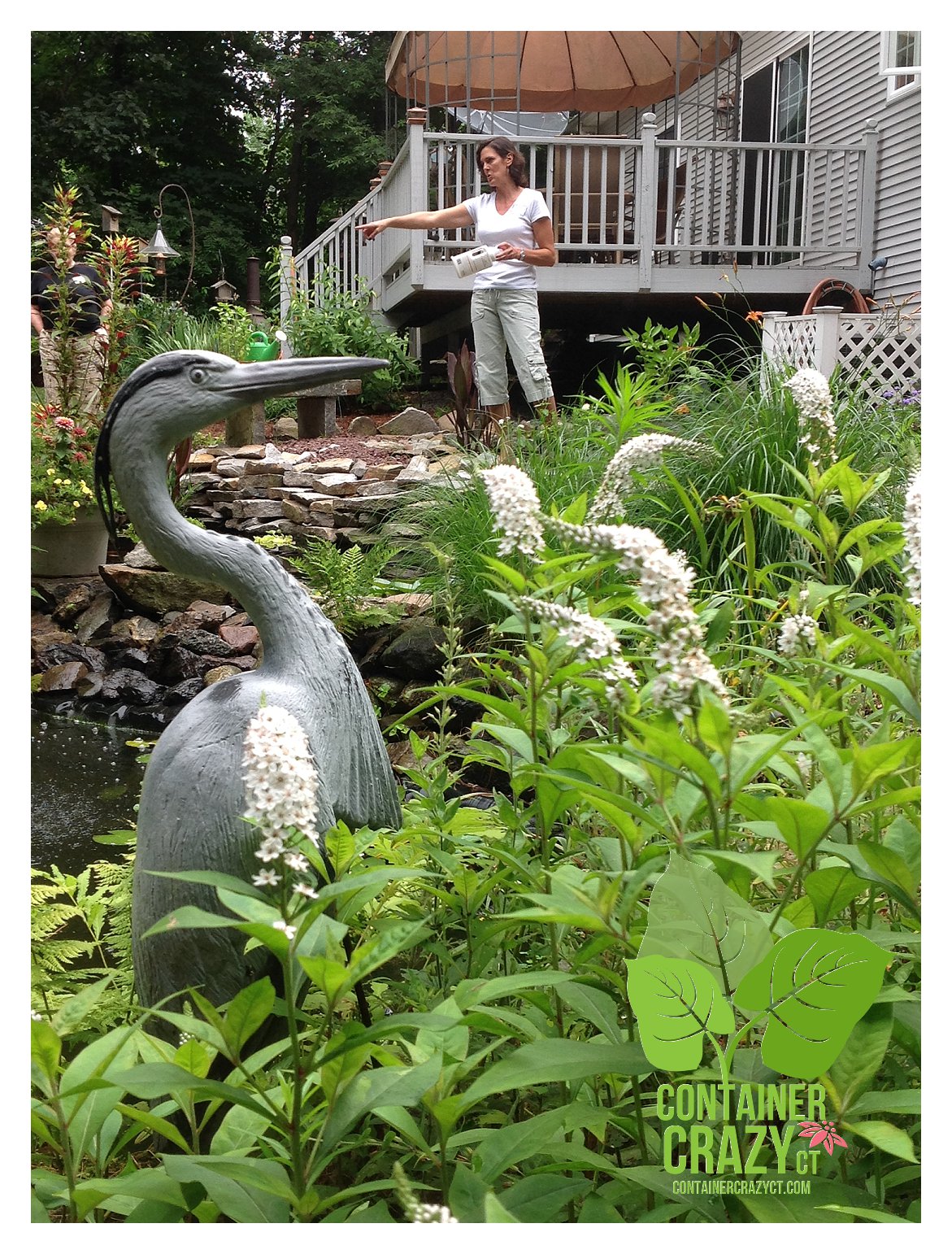
Hostess Rhonda; Photo by C. Testa

Pondering Ponds ContainerCrazyCT_0013

Also, as for pH of the water, Rhonda noted she doesn’t monitor it – she lets nature take its course.  That sounded good to us – and fits the overall rule of the ‘Walk and Talk’ Garden events – it doesn’t have to be perfect for us to enjoy hearing and seeing what any homeowner has created in their backyards.

Pesto and Passion Flowers

The last big surprise of the hour was the handing out of freshly made pesto by one of our attendees — Thank you Linda C.

Pondering Ponds ContainerCrazyCT_0015

What a treat, and additionally, we all saw, on the way out for the day, Rhonda’s beautiful blooms on her passion flower (Passiflora) vine located at the front of her home. She said it returns every year via self-sowing (or perhaps she has one that is noted to be survive winters, Passiflora incarnata.)  It certainly looks like it!

Passion Flower; Photo by C. Testa

Passion Flower; Photo by C. Testa

She has seen fruit growing after the flowers pass, but wasn’t aware it is passion fruit until we discussed this fascinating flower further.

See here to also learn about this plant’s religious significance, which I looked up via my iPad and pointed out to everyone – each part of the flower has a special meaning – and is believed to represent symbols of Christ’s passion and cross.

Next Walk and Talk 

Our next ‘Walk and Talk’ event is scheduled on August 16th in East Granby, CT at 10:00 am.  This one will feature a sunny hillside garden where the homeowner will share her experiences on what thrived and what didn’t when it comes to the plants she has tried in a very informal, loose and spreading garden on a full sun hill which receives lots of heat in the midst of summer, and wind.  As per our rules, the garden is not perfect but a great place to learn directly from a home gardener with a particular passion.

For more information on planting aquatic plants, check out this post by thegardengeeks.com.

Thank you,

Cathy Testa
http://www.cathytesta.com
860-977-9473
ContainerCrazyCT.com

P.S. If interested in showcasing your home garden on our Walk and Talk tours, please feel free to contact Cathy Testa, author of this blog, and coordinator of these events.

Special note of thanks to Professional Lifestyle Photographer, Karen Ladany of Debut Cinematic, for attending to take various photos of the gardens.  She is currently located in East Windsor, CT.
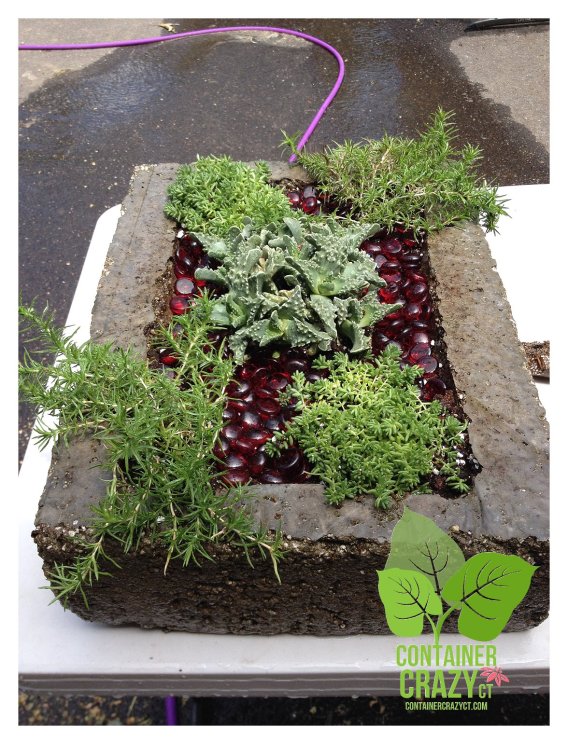
Hypertufa Class Being Offered in October in Broad Brook, CT

2 Comments

Could this season get any better?

Cathy T has just lined up a special guest speaker to teach a Hypertufa making class in October.

See Cathy T’s Class Schedule to learn more.  Click on the drop-down menu selection titled, October (Concrete Art).

The date:  October 4th, 2014 – Saturday

The time:  11:00 am to 1 or 2 pm, depending on how much fun you are having

The teacher:  An expert hypertufa making artist by the name of Jim of Ancient Gardens Hypertufa.  He has exhibited at the Boston Flower Show, Newport Flower Show, and Celebrate West Hartford.  To see his works, visit http://www.formedforyou.com.

In this class – you will be making your own small to medium sized round or square hypertufa. More details will be posted very soon.

Not sure what a hypertufa is?  See Cathy T’s description on her Class Schedule above.

For inspiration, visit Cathy T’s Pinboard:

Sign up early – You don’t want to miss this chance, as our special guest artist rarely agrees to teaching classes, but guess what? – he did for Cathy T.  This is a special treat.

To Sign Up for the October Class:

To sign up – complete the Contact Form from the Cathy T Class Schedule above.

Or join the class via the Facebook Event.

This Weekend’s Pondering Ponds:

And don’t forget – this weekend is another opportunity – to see a homeowner’s pond garden in Enfield, CT.  We have a small group forming, a professional photographer joining us, and it is predicted to be another gorgeous weekend – the stars have aligned.
Pondering Ponds ContainerCrazyCT_0001

The Pondering Pond’s Walk and Talk is this Saturday, July 19th, 2014 at 10-11 am.

For the address to join us, contact Cathy T at containercathy@gmail.com or text 860-977-9473.

Thank you,

Cathy Testa
http://www.cathytesta.com
860-977-9473
ContainerCrazyCT.com
containercathy@gmail.com

Landscape Design Infographic – A Visual to help Guide You

Leave a comment

Hello Everyone,

Today’s post is to show an Infographic I found on the web while looking at other Infographics.  I love these visual depictions used to present data or information.  They are helpful, easy to read, useful and quick.  So, I had to share this one in particular recently spotted on Landscaping.  You will see they show “focal points” (#3) — and you know me – Container Gardens serve this purpose very well in gardens, outdoor spaces, and more.  On my Pinterest Boards, you will see more helpful finds of various Infographics.  In fact, last night there was a spike in the views of my Pinterest site, and it appears people were viewing lots of the Infographics I had pinned.  To see one on why pot smokers are skinny, go check it out – hey, I love the look of pot plants (they are pretty cool looking) – and when they are legal – you know I will have one in a container garden some day!  After all, it is kind of unfair we can’t enjoy the beauty of the plant for its visual features only. Also, there is a Pinterest board called, “Containers in the Garden,” on my Pinterest site, showing many examples of where I’ve spotted good photos of containers in gardens.  Enjoy!  Cathy T

Your Field of Dreams

Explore more visuals like this one on the web’s largest information design community – Visually.

UPCOMING CLASSES:

Don’t forget to check out Cathy T’s Container Gardening Class on May 24, 2014 in Broad Brook, CT.  See also Cathy T’s Garden Talks.
Please share or join this blog by entering your email on the sidebar, you will get updates via email and special offers or coupons of upcoming classes as a Cathy T blog follower!

Mommy, Where do baby Praying Mantis come from?

9 Comments

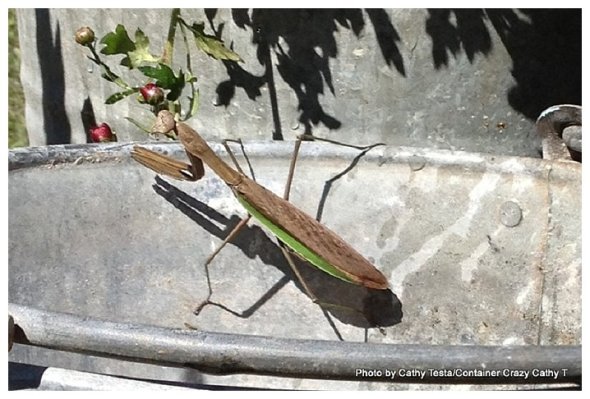
Chinese praying mantis (or Tenodera aridifolia sinensis) are commonly seen by many people in their gardens from time to time, but perhaps not so common of a sighting is that of the actual birth place of baby praying mantises.

praying mantis_0003

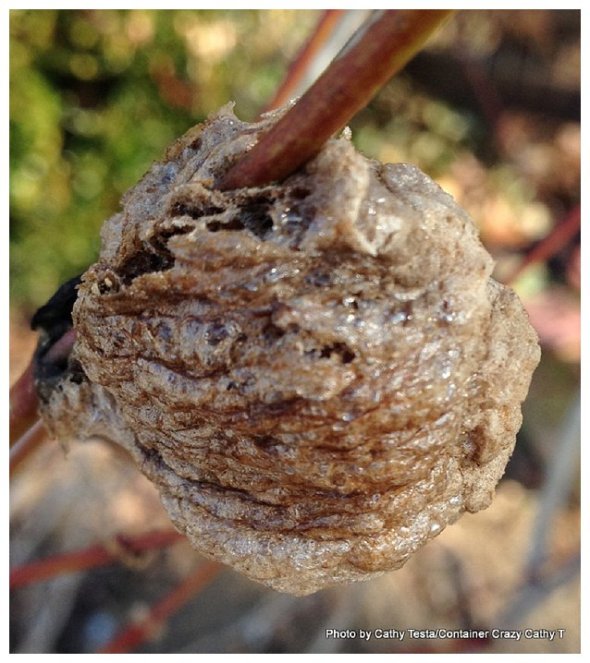
Well, my darlings – this is where baby praying mantids come from.

praying mantis_0004

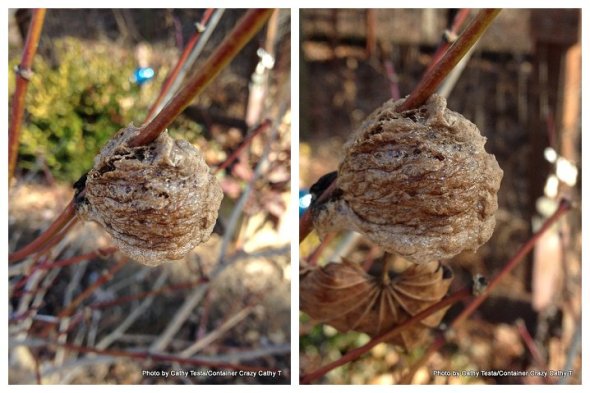
It is called an ootheca – or you can just call it the egg case, or birthing place of tiny baby mantis.

This one was spotted this winter on a fullmoon Japanese maple tree in my backyard.  You can see it looks papery and is attached to a twig, where it becomes dry and tough to survive winter.

After the mommy mantis lays her eggs in her styrofoam looking egg case (the ootheca), which is secreted from her unmentionables, she unfortunately dies.  Her army of tiny babies will have to enter the world on their own in the spring.

praying mantis_0005

But the good news is her little baby eggs remain protected until they are ready to make their first appearance.
(If only I knew exactly when, I’d love to capture photos of the baby praying mantises coming out of the ootheca!)

However, there are some photos available via VIRALNOVA.COM of baby mantids emerging.  Just click the link below to see the little babies  — they are so tiny and cute.

http://www.viralnova.com/mantis-birth/

Aren’t they just adorable?  Apparently, all the eggs (some say as many as 200) will hatch at the same time.  These little newborns enter the big nature world all together.  (Did you know they are born so tiny?  I didn’t.)

http://13tmp.wordpress.com/2013/12/21/macro-mantis-on-my-fingertips/

Check out “13tmp blog” via the link above to see an amazing photo captured of a tiny mantis on finger tips.  Nice macro, wouldn’t you say?

http://entomologytoday.org/2013/12/22/do-female-praying-mantises-always-eat-the-males/

There are lots of stories about the acts of a female mantises eating her male potential partners somewhere during the mating process. Well, in a study published by Entomologytoday, (see above link), it appears they only desire the smaller males as a meal. And perhaps the head of a larger male as dessert or an appetizer?  Don’t worry though – the male still can “get it on” despite being headless, and this keeps the female sufficiently happy.

“Yah, ummm, the mommy mantis lays her one or two hundred eggs in this styrofoam mass in the fall, but before this, she eats daddy – but only if he was born small and short.  Otherwise, he has a few “duties” to accomplish and this can be done even if he’s headless.”

Guess there’s not a lot of foreplay in this mantis’s relationship.  She doesn’t eat the males while mating, but may have a bite or two as an aphrodisiac.

http://lexyleksono.com/2014/01/06/photography-yellow-praying-mantis/

Or you could just change the subject to avoid the whole mommy and daddy mating gig, and show them a yellow praying mantis!
Check out “lexylesono” blog above.  A very rare sighting to see a yellow one, if not impossible, for our region.

http://www.youtube.com/watch?v=UlCEJyNlDqY

Seriously, praying mantids are way smarter than we think, this is for sure. Besides ambushing predators, they serve as radar detectors.  For another distraction of discussing the eating rituals before mating, just show your kid the video above.  So, that’s where speeding tickets come from!  Mystery solved.

praying mantis_0006

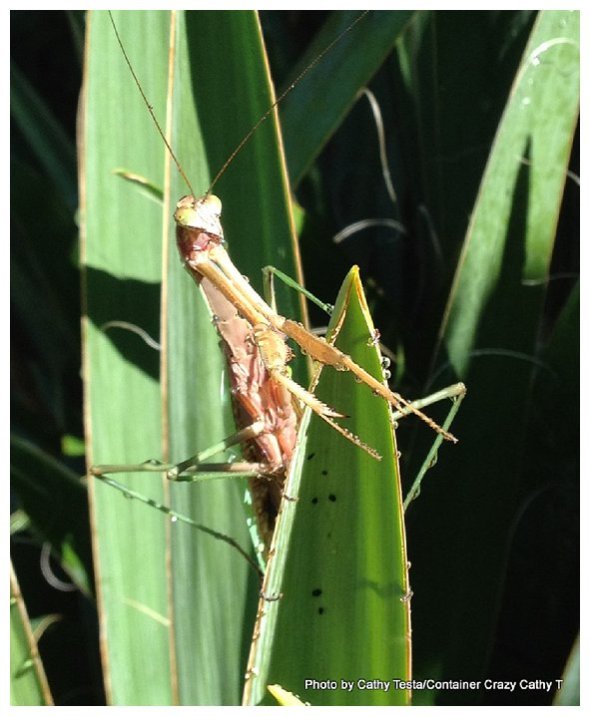
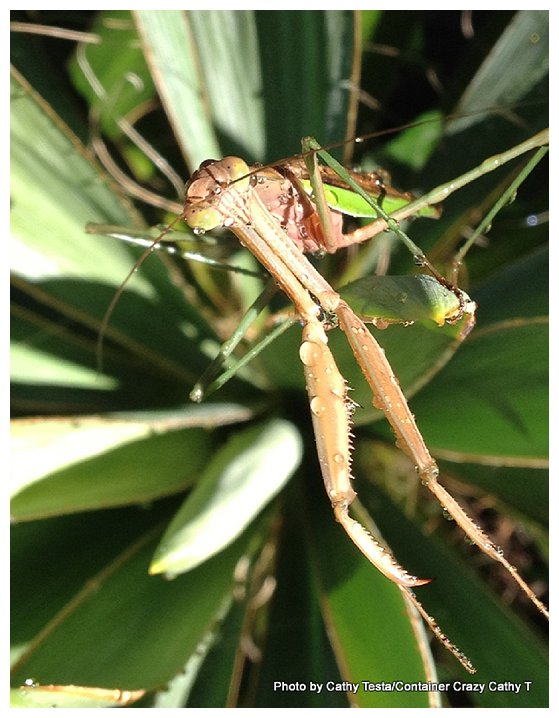
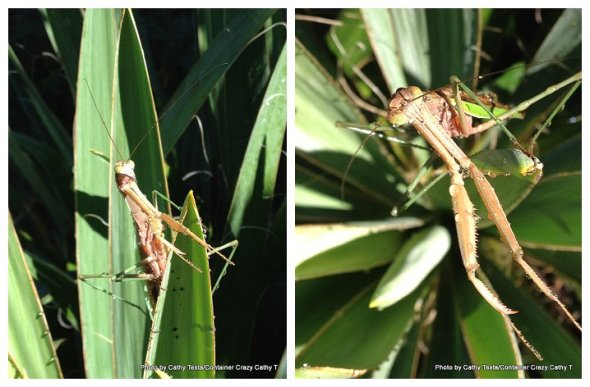
Last summer, I accidentally sprinkled a praying mantis with water from my garden hose as he was perched on a yucca plant.  I don’t think he liked me very much.  I could tell, as he turned his head over to look at me, that he was displeased indeed. Their head swivel action makes them very unique in the bug world, for not many insects have this special ability – plus it gives you that eerie feeling that he just may spit up nasty green pea soup towards you next!

praying mantis_0007

Praying mantis are always positioned, it seems, to strike.  Their grasping forelegs are armed to snag whatever meal may happen to unknowingly pass before them as they sit and patiently wait.

The leg segment near their body is called a coxa, which is elongated, so their arms tend to be positioned in a “praying” position, but the only thing they are praying for is their unsuspecting passerby.  The strike in ‘kung fu’ style.
I know, I tried to pick one up once and screeched as it whipped its grasping legs at me.

praying mantis_0008

Did you know praying mantis eat all kinds of insects – even the good bees?  And they enjoy spiders too.  But they tend to be good guys because they take care of pest insects regularly.  Plus, they are so amazing to watch and photograph, you just can’t resist their alluring body architecture, big bulging eyes, and sleek slow movements.  And silently, but deadly, nature.

References I have in stock on insects:

“Bugs in the System” by May R. Berenbaum
“Peterson First Guides. Insects” by Christopher Leahy

Happy Monday Everyone,

Cathy Testa

Bottling Intoxicating Scents of Fresh Evergreens by Making Potpourri

3 Comments

Sweeping up the floor of my classroom after an Evergreen Creations Class, a thought occurred to me.  I should collect some of the smaller cut pieces which fell to the floor to make potpourri.

And it was then I remembered, I picked up some mason jar covers at a Vintage Bazaar this summer with a precut pattern in them. They will be perfect.

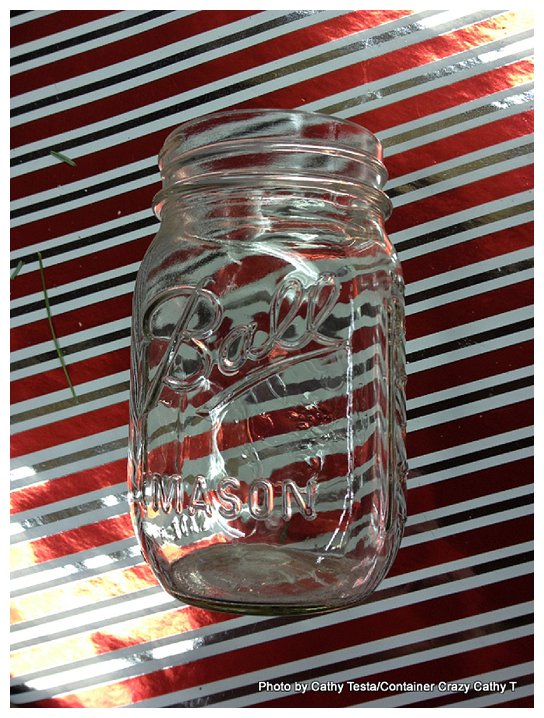
Using some mason jars I had in stock, I filled the jars with bits and pieces of the greens. It was amazing how quickly the scent permeated from the jar.

Most people enjoy the scent of freshly cut evergreens – especially because it brings back memories.  Scent being one of the most powerful to remind you of something from the past.

The Cornell Cooperative Extension has an article on their website which states the feeling of evergreen aromas perfectly.

“Of all the memorable aromas of the holiday season, nothing evokes its spirit like the perfume of fresh-cut evergreen. Every species of conifer has its own slightly different complex of terpenols and esters that account for that “piney woods” perfume. While all natural Christmas trees share many of the same aromatic compounds, some people develop a preference for the smell of a certain type of tree, possibly the one they remember from childhood. Even if it turns out that using a polyvinyl chloride Christmas tree is more eco-friendly than using a natural one, no chemistry lab will ever quite match the fragrance of fresh pine, fir or spruce in the living room.” – Paul Hetzler, Cornell Cooperative Extension of St. Lawrence County

Evergreen Creations_0012

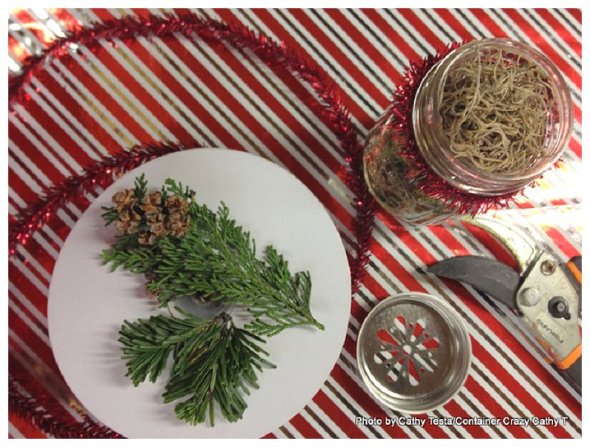
Items used to make Homemade Evergreen Potpourri:

  1. Mason Jars
  2. Mason Jar Covers with Holes in the top
  3. Snips or pruners
  4. Decorative Ribbon
  5. Preserved Moss
  6. Pine cones
  7. Holly berries
  8. Fresh evergreens bits and pieces

The steps are pretty straight forward.  Gather up small snips and clips of evergreens, and put them into the mason jar.  Make sure the cuttings are not wet because they will rot.  Make sure the mason jar is not wet inside either if you washed it in soapy water prior.

Evergreen Creations_0015

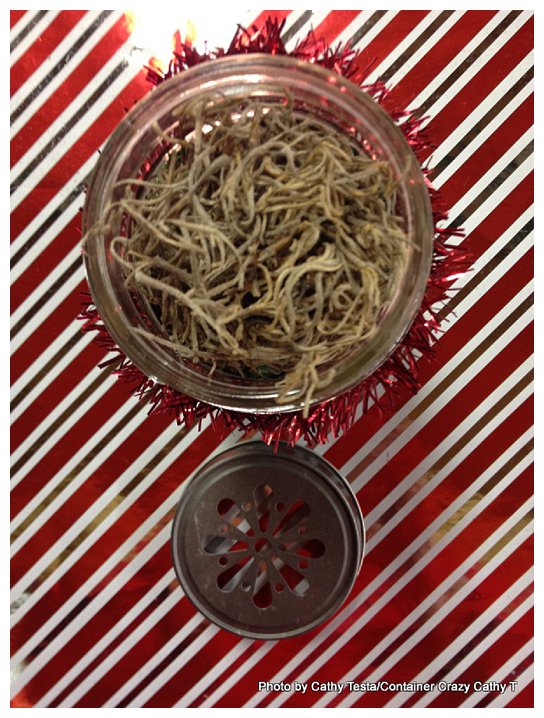
Add some preserved moss to the top for a decorative look or to eliminate any potential spillage from the cover of needles.

Evergreen Creations_0014

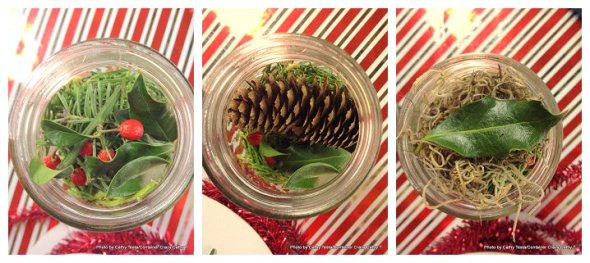
Speaking of needles, got some on your table that fell off?  Put those in the jar too.

Evergreen Creations_0013

Add a couple cones to make it pretty.  Perhaps a snip or two of holly with the red berries as well.  I also placed one item on top of the preserved moss, like a single holly leaf.

Evergreen Creations_0016

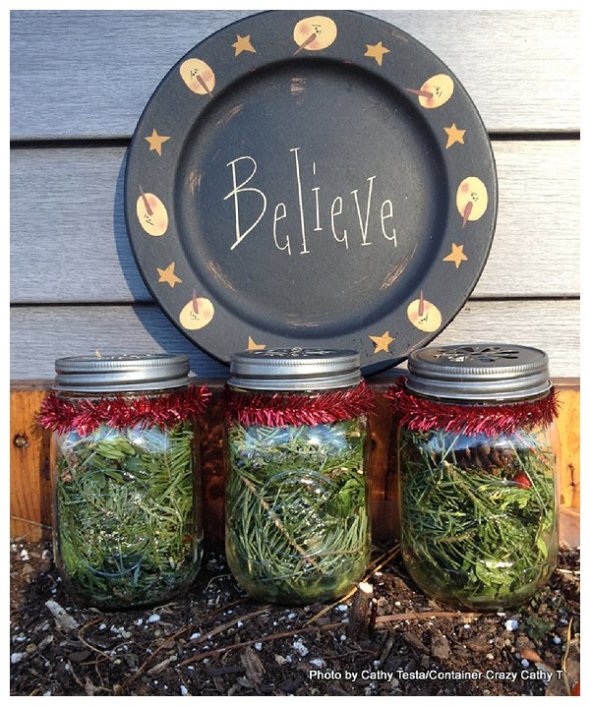
Cover it with a cover that has holes so the scent will release.  Add a decorative ribbon or tinsel wire and perhaps an ornament.

Evergreen Creations_0017

Keep in a cold place until you give to a friend, use as a table setting pieces, or put in a room to enjoy right away.  Again, I set one down at one point after it was finished and realized as I was sitting there the scent was strong right away.  I don’t think scented oil is required, but it is an option if you want it to last past the holidays.

Evergreen Creations_0022

Open Studio Days

That same day, as I bottled up these cute and highly scented potpourri jars, a new friend, Cathy, attended my Open Studio Days, where by appointment you get the valuable one-on-one opportunity to learn how to make an evergreen Kissing Ball, wreath, candle centerpiece or other items for the holidays.

Cathy called me up to inquire about my sessions and how they work.  When I asked how she heard about my classes, she said she noticed some kissing balls hanging at a house in another town, but had never seen them in her area.  She wondered how they were made, and so she Googled it, and found my appearance on the CT Style television program when I talked about making them last year.

Homemade items are big on Cathy’s list – and I couldn’t agree more.  She said it is so much more valuable and special for so many reasons.  They are well-made (with love) and unique.  This is absolutely true with kissing balls.  Each and every one made in my Evergreens Creations Classes are one of a kind.  And mixed with lots of various evergreens creating amazing textures – and yes, of course, evergreen scents!

So while Cathy worked on her kissing ball, I made a small wreath.

Here’s are the items I used to make the small wreath:

  1. 10″ grapevine wreath
  2. 2-3″ cuttings of mixed evergreens (pine, juniper, balsam, and more)
  3. green florist wire (on a roll)
  4. green zip ties (cable ties)
  5. pruners
  6. ribbon

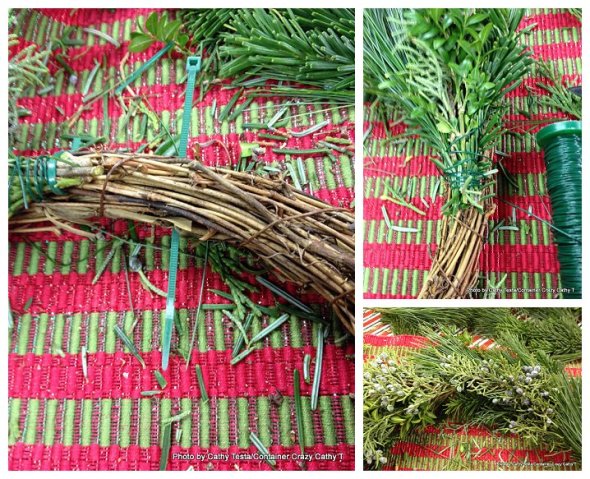
Start by cutting your greens and batching them together with florist wire.  Use about 3 snips of evergreens for each bundle.

Evergreen Creations_0018

Remember to lay the most decorative green on the top layer, as done with the blue berried juniper, so it shows up on the wreath.

Set your bundles aside.  You will need at least 8 bundles.  Each is twined at the stem end with green florist wire, wrapping around several times so they are well secured.

Evergreen Creations_0019

Attach the first bundle to your wreath with a zip tie.  Why, you may ask – a zip tie and not the florist wire?  Well, I feel it is really secure that way as the starting point.  And the zip tie is easily threaded through the grape vine.  Sometimes it is easier than using the wire.

However, if you decide to use wire instead.  Attach it to the grapevine for your first bundle.  Keep the wire attached to the wreath as you continue around the wreath to attach your pre-cut evergreen bundles.  You don’t have to stop to cut wire for each bundle.

Evergreen Creations_0021

As you attach each bundle of greens, be sure to position it to cover the zip tie or wire of the previous batch.

I started using my roll of green florist wire to continue.  Keeping the wire attached to the wreath frame and winding it over the frame as I moved to the next batch of greens.

Evergreen Creations_0022

In between working on my little wreath, I would stop to help Cathy cut greens for her kissing ball.  She was proceeding very well and had lots of questions.  This is when I realized having the Open Studio Days enables more individual attention for the student versus the large class held on the first weekend in December.

The large class is lots of fun, and it will remain in session every year – but should you be the type of person wanting more quiet time and some personalized help, the Open Studio days, following the Evergreens Creation Class, is your best option.

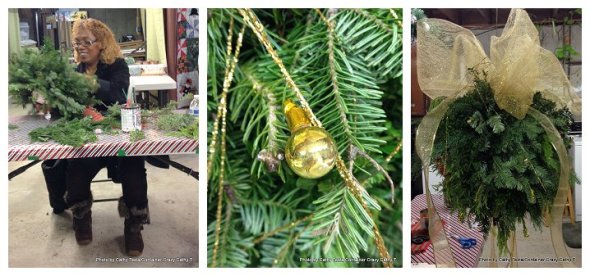
Cathy and I spent 3 hours – yes 3 hours chatting and discussing upcoming holidays as we created.  After Cathy was all done creating her kissing ball, we decided on a sparkly gold wide mesh ribbon.  It went on the top with tails on the bottom.  The tails included gold cord which made it more dramatic.  This set the color decor theme for her kissing ball.

We picked out small round gold ball ornaments to attach on the needles and a few decorative florist picks.  And, we also added a new item I had in my decor stock called, golden rain.  It is beautiful, thin long strands of sparkling gold which hangs from a central long pick.  Inserting it on the top of the ball to drip over the sides really finished off the look.  We both just loved it.

Evergreen Creations_0023

Cathy considered adding some golden bows, but when she asked if she should, I told her no – I thought it was just right and too much might be overdoing it.  She agreed.

I think Cathy will be the talk of the town, because she said none of her neighbors have kissing balls.  When the outdoor lights hit that ball, the sparkling from the golden decor will evoke the feeling of the holiday spirit, just as scents of the evergreens will do.

Enjoy your weekend everyone!

P.S.  The evergreen potpourri jars make great hostess gifts – and you may be a recipient soon. 😉

Cathy Testa

Evergreen Creations_0020

Counting the Final Hours til the Evergreens Class Begins

Leave a comment
Bitstrips: Source for Image

Bitstrips: Source for Image

The rain and sleet rapped on my window and helped me to sleep all evening, but this morning our loud cat meowed and woke up my mind.  Darn it, now I’m awake at 5:30 am.

Well, guess I’ll load some wood in the woodstove, get a cup of coffee going, and relax for a bit before going outside later this morning! Of course, I have to wait for the sun to rise.

The weatherman said last night, the sun would shine by noon and this light dusting of snow will naturally melt away.  Perfect, I thought.  In fact, could it be any more perfect?

For the past 4 years, I’ve organized this event – and every year, the weather has cooperated on the day of this class. The snow one year lightly fell right on queue.

I’ve considered maybe I get too obsessed about this event – seriously – can one go overboard?  Perhaps, but I do this for my friends, passionate clients, and those who appreciate the efforts.  And it is a great way to meet “new” friends and socialize.  Plus, you know what, my husband enjoys it too.  I truly believe he loves that I get into the spirit of decorating this time of year.

So I guess I’ll recoop my zzz’s after this week.  For those in the business supplying greens, trees, holiday decor, florist items, and more – they are very very busy this time of year.  And they do it all for their customers.  Why?  Cause we all love the season, and couldn’t image life without it.

And look who stole my spot in the bed.  My cat Hunter.  He is a male cat, he is loud, and if you enter a room he is sleeping in, within minutes he leaves to find another spot to sleep.  He is impatient.  (Get your rest buddy, cause you know what, there will be some activity here later!)

My cat Hunter.  He is a screamer - meows very loud when he wants something.

My cat Hunter. He is a screamer – meows very loud when he wants something.

Cyou soon!  Cathy Testa

Barbed Wire Wreaths and Bows for the Holidays

2 Comments

My Evergreen Creations Class being held tomorrow will include various decorations for my attendees to dress up their Kissing Ball, Wreath, Candle Centerpiece, or Mailbox Swag – whichever item they choose to make in the class.

And, I can not imagine not adding bling, glam, or organic decor to a holiday creation made with a mix of fresh evergreens for it would not make it complete.

However, sometimes less is more.  Like in this photo below, Dianne, my good friend, and also a class attendee, showcased wreaths and bows made from barbed wire on her horse barn one year.

Decor for Evergreens_0009

There was a major snow storm that day when we visited her home – but we made it anyways, because we knew her event would be worth the trip!

She had setup a big fire outside to keep us warm, or we could sit in her cozy home filled with holiday touches and friends.  Either way, we had a great time and made it home safely with our four wheel drive truck when it was time to head out.

One of the best parts of decorating for the holidays is adding your own unique style to your items. In Dianne’s case, she is really into the horse and animal world, and it shows at her cozy dwellings. She had some curtains hanging from vintage styled wooden horse apparel, old wooden crates filled with fresh evergreens and decor, and touches of classy country in her home.  I remember feeling honored we were part of her holiday event, and especially wanted to capture the mix of barbed wire wreaths on her barn wall in a photo, even if it was snowing like heck outside.

As you can see, the wreaths were simple with little decor – which worked, especially with her beautiful barn as the backdrop to the barb wire arrangement.

But in other case, more is more – you may have a style of maxing it to the fullest with decorations! Or, you may have a color theme in mind to suit your home. For example, this year I ended up with some candy cane colors in one room.  And — of course, the organic and natural decor, the brown and tans of pine cones, pods, raffia, dried mushrooms or fruit, with a splash of gold, red or white to add just that bit of that must needed holiday sparkle is another style.  Who can resist bright red or gold berries on a wreath or candle centerpiece?!  All of these types of decorations will be available at my class tomorrow for the attendees.

Decor for Evergreens_0006

And per the weatherman, we will have a light dusting of snow in the morning, which I think is just perfect.  It makes the day feel like the holidays are approaching.

Thankfully it is not a major snow storm like we experienced when we went to my friend Dianne’s house that year.

Decor for Evergreens_0004

See you all tomorrow ladies.  One more day til the annual “Evergreen Kissing Balls and Holiday Creations Class.”  Get your crafty juices warmed up – we will be creating soon.

Written by Cathy Testa

Using Zip Ties to attach Deco Mesh Ribbon to your Decorating Projects

3 Comments

Mesh ribbon is incredibly easy to use and attach to your mechanics by using zip ties (a.k.a., cable ties).  You can use pipe cleaners (as an alternative) instead of the zip ties, but zip ties secure the ribbon tightly at each puff or bunch, which makes the pulling and tucking more efficient as you work to create your design for a wreath or swag.

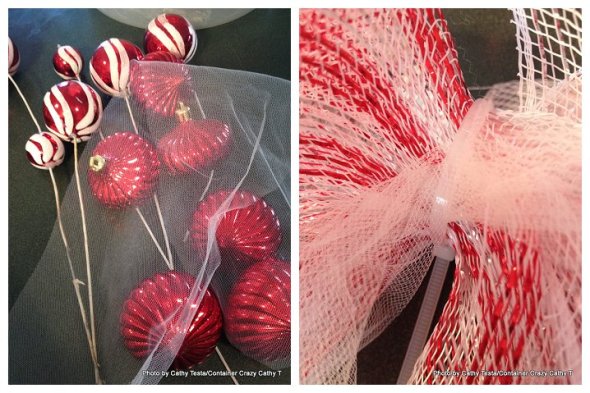
The zip ties also work well for attaching ornaments because they slide easily into the ornament hooks.  The size you want to get is at least a 3-4″ length for the zip ties, or you can go longer, and just cut the tail ends off at the end of your project.

Zip ties will last for years, where I think pipe cleaners can wear a bit over time.  And if you want to take apart your project later (for whatever reason), zip ties are easily cut with sharp scissors or pruners.

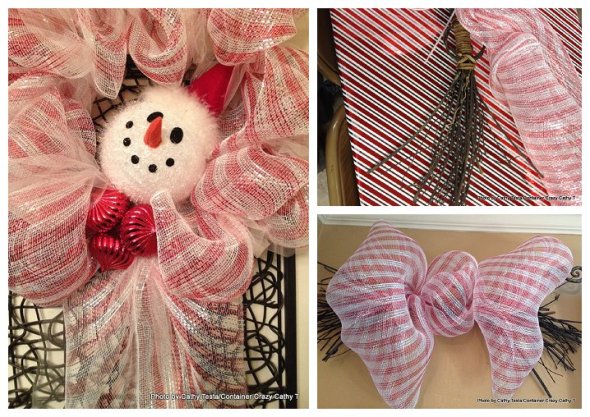
PROJECT No. 1: Wreath with Candy Cane Mesh Ribbon:

  1. 13″ Round Wreath
  2. Zip Ties (3-4″ lengths, white colored)
  3. Deco Mesh Ribbon (rolls usually come in 20″ widths and apprx. 20-30 ft.)
  4. Sharp scissors or pruners
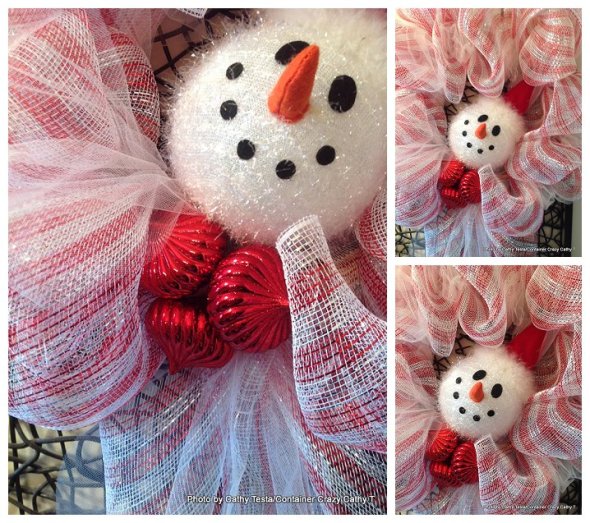
  5. Ornaments (3 red holiday ornaments used with a snowman head for this project)
  6. Another type of ribbon if you want to add more to the design

Decor Mesh Ribbon_0001

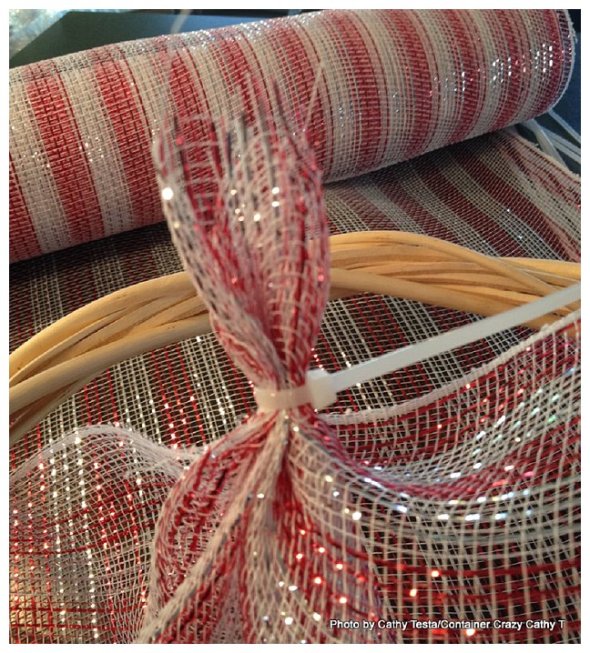
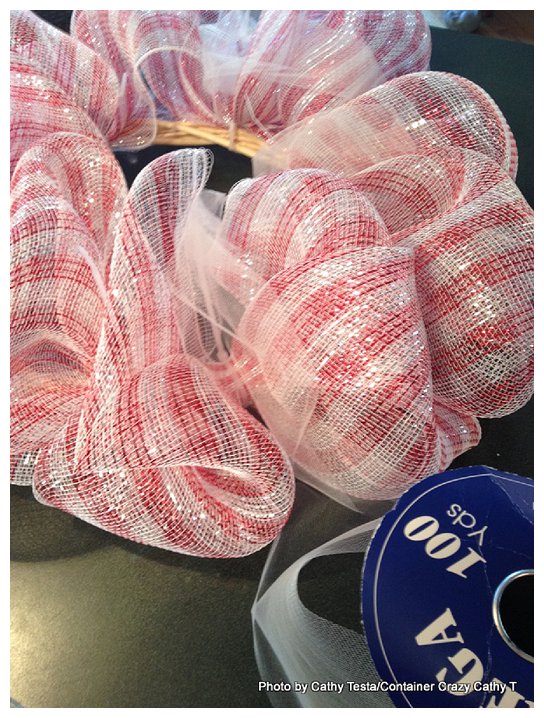
The key here is to bunch the starting end of your ribbon by gathering it, and then using a zip tie to secure it to the wreath.  In this first step, you want the bunched starting end to be “tightly” secured to your wreath frame.  Pull the zip tie closed and then move down the ribbon to gather your next attachment point.

Decor Mesh Ribbon_0002

Bunch the starting end first tightly.  Then grab another zip tie and attach it to your wreath frame.  When selecting your zip ties, consider the color of your ribbon.  Since this is a white and red, I used white zip ties so they won’t show.

Decor Mesh Ribbon_0003At regular equal length intervals (about 4 or 6″ apart), gather your next bunch.  You do not need to cut the ribbon at any point as you are working from your roll.  But what is key, is as you move to the next zip tie, do not tighten it as you did with the starting point.  Attach the gathered end in you hand to the wreath with the zip tie.

Attach it, but do not fully tighten the zip tie closed – because you may want to slide other items under the zip ties when decorating with embellishments later.

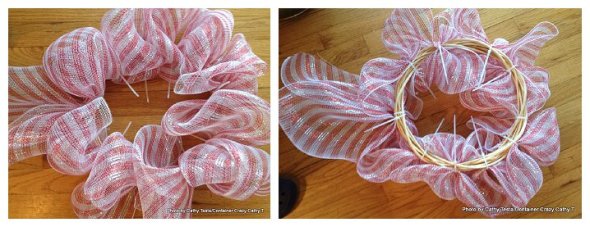
Decor Mesh Ribbon_0005The photo on the left shows the front of the wreath.  As you move around the wreath frame, equally spacing each bunch and gathering with a zip tie, remember to finish off with leaving “tails” for the bottom of the wreath.

The photo on the right above shows the back side.  Do not cut off the zip tie tail ends until you have completely finished adding additional decorations.

Decor Mesh Ribbon_0004

Decor Mesh Ribbon_0006

I decided to grab a finer ribbon to add a little softness of white.  As you can see, just slide the ribbon through the loose zip ties.  This ribbon was a little difficult because it kept catching and snagging on the mesh ribbon, but I managed to get it done all the way around the wreath.

Decor Mesh Ribbon_0010

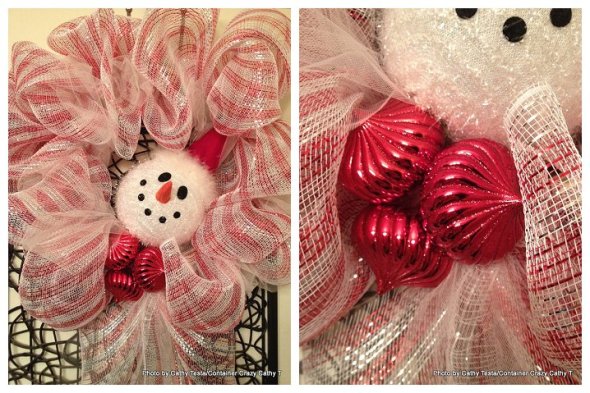
Next was adding some bright red ornaments and a snowman head I picked up from a craft store.  Use a zip tie to connect 2 of the red ornaments together, then attach the 3rd ornament to the two.  The reason to do them this way is if you bunch all three with one zip tie, and then tighten, it can pull apart the ornament hook.  It fits better when you put two ornaments together with one zip tie, then add the third to your bunch.  Grab another zip tie and attach it to your wreath at the base.  The snowman head was attached by using a zip tie to attach the tip of his hat to the wreath.  After all done adding your preferred decor, go around to tighten every zip tie and cut off the tail ends of them.

Decor Mesh Ribbon_0008

Decor Mesh Ribbon_0007Much more could be added to this wreath to bling it up or add more whimsy, but I decided to just keep it like this for now.

PROJECT NO. 2:  Swag with Big Bow using Mesh Ribbon

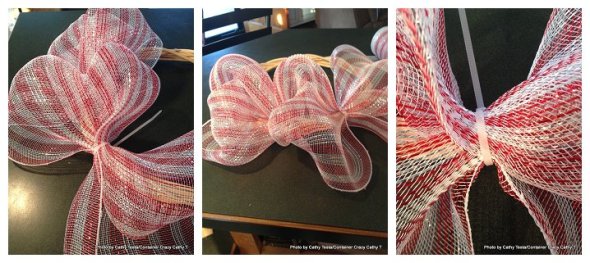
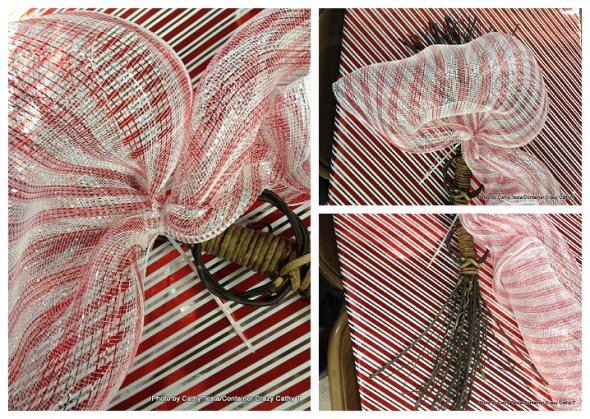
Next was creating a bow with a stick swag, using 3 zip ties and one piece of the deco mesh ribbon at about 3 ft. length. You can literally use any kind of stick, vine, or metal mechanics to attach mesh ribbon easily.  The product is pliable, bunchy, and showy.  I still haven’t figured out how to fix the frayed ends where the ribbon is cut, but I saw recently that using a lit candle to lightly burn the ends of a ribbon may help this problem – this is to be tested later.  I will let you know how it works, but I imagine you have to be super careful – mesh ribbon product is flammable.

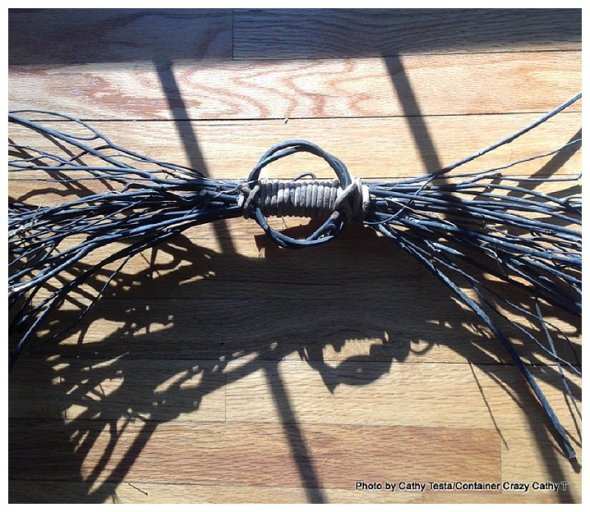
Decor Mesh Ribbon_0009This is the stick swag I decided to use to attempt a bow creation with the mesh ribbon.

Decor Mesh Ribbon_0011

Basically I did a big puff first, smaller one in the center, and then big puff again.  It came out rather “who-vill-ish” and I wasn’t sure if I liked it – but my husband said he did, thus it got hung up on the wall in the same room with my other candy caned themed items.  When start to feel crafty again, I may add more bling to these but this is how I started them.

P.S.  You don’t need a 30 ft roll of this material to do these two projects, but I guarantee, you will end up using the rest of the roll as you learn to create with the mesh ribbon.  Give it a try!  For more ideas, click HERE.

Decor Mesh Ribbon_0012Cathy Testa

Living with Wild Turkeys in My Connecticut Yard

7 Comments

Eastern wild turkeys (Meleagris gallopavo silvestris) have routines and rituals in my Connecticut yard during every season.

In the spring, summer, and winter, the flock walks up from the woodlands into my open yard behind my house in single file. Their first stop is the bird feeder.  They hit up the fallen seeds near our lower deck by scratching the ground for leftovers.

Last year, around this time of year, I thought about how the lower deck is a great place to position our motion sensor outdoor camera because it would capture images of the flock as they were eating seeds from the ground.

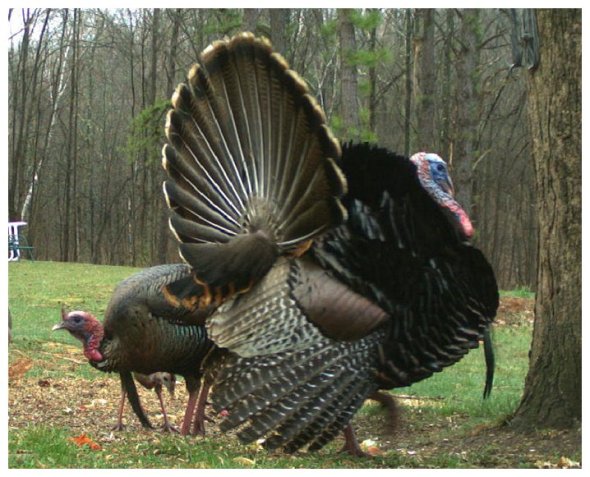
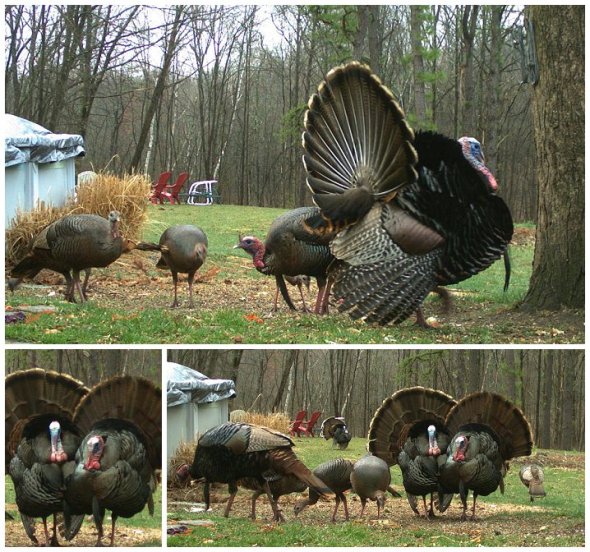
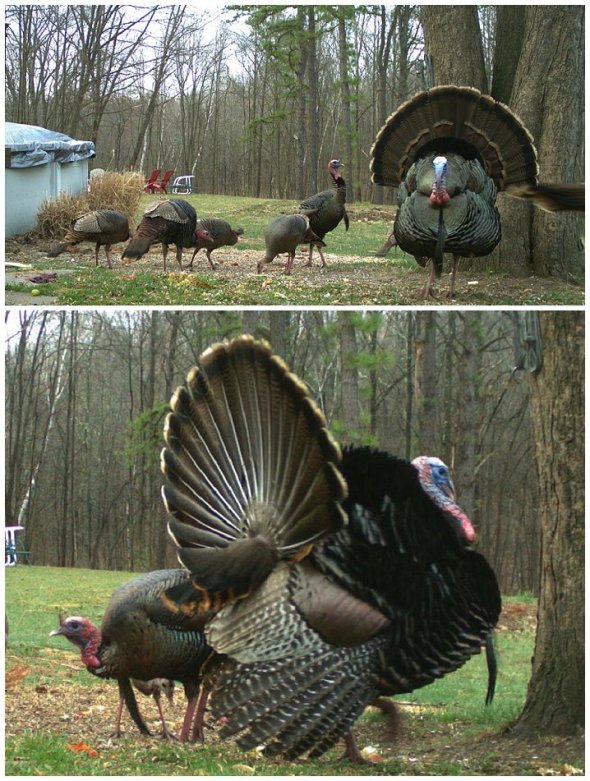
It worked.  The camera captured images of male turkeys puffing out their feathers and strutting their stuff.

November 2012

November 2012

And as you can see from these photos, it is truly astonishing how large they look when fully puffed out.  The male toms can reach 4 feet tall, but they look even larger at this stage.  And you will notice, its blue head and red caruncle at the neck is in full color.  I guess this occurs as another way to “show off” to the female turkeys in the group.  It is just incredible what these guys do for their females.  They put on quite a show.

Side View - Massive!

Side View – Massive!

After they are done snacking on the birdseeds, the flock will slowly and cautiously walk past my side door over the driveway, and then proceed down my long driveway to the road.  As they strut along in single file, it is quite amusing.  I always think to myself, “Well, there they go, off to work again for the day.”

Turkey Testa_0024

They probably have a routine of visiting every feeder or garden on our street, but by late day, you can guarantee, they come right back down my driveway – in single file – to return to our birdfeeder for their last snack before retreating into the woods again for their evening roost.

Once, in the very early morning, I could see several turkeys perched way up high in tall pine trees.  Eventually, they fly down again, and it is something to see a big turkey gliding through the sky to land on our lawn.

There’s been times when the turkeys have stood on a railing of our deck or on the edge of the pool.  Usually there is one turkey “on guard” being careful to look around for potential threats.  The guard turkey won’t eat with the others while on duty, and sends out warnings sounds if something, like me, comes by.

Turkey Testa_0023

But this past summer, there were many times when the turkeys would also sit in the yard and relax.  They are getting comfortable to say the least.  And a few times, in fact, this summer, when I was on my deck sitting in a chair, they would extend their necks up to look at me, but they didn’t run away. Until I got up.  Then they would feel threatened and take off or at least move a distance away until they felt it was safe again.

One year, I witnessed three toms standing side by side and shoulder to shoulder during their mating season.  They were completely puffed out and turned together in unison as if they were locked together.  If you can imagine it like an airplane turning slowly around, it looked like that.  Remarkable.  I wished I caught that one on camera as they turned slowly together to face the females in their surroundings.  I guess they were looking for a threesome. LOL.

Another time, I saw two toms in a serious battle in my front yard.  Their necks were wrapped around each other – and each pushed and tussled the other as they were locked into this position for at least a half hour or so.  At times, I was sure one would have their neck broken by the other.  I felt sorry for them, but best to let nature do their thing as they continued into the woodlands to duke it out.  I didn’t witness the end of their wrestling match.

In early June, the young baby poults arrive.  There are many with the female hens.  It does not take long for them to grow up and look like full sized adult turkeys. And then there are times when I see a solo turkey in the yard.  He wanders the yard by himself.  But, I guess they do this until they find a mate.  Or he thinks I’m his mate, he seems to like hanging around.

Another year, we had an injured turkey visiting – walking with a hobbled leg.  Because he was weak, the other turkeys would be a little aggressive towards him.  However, he wouldn’t give up and continued to stay with the group as much as he could.  The turkey pecking order is strong, and part of the wild scene you have to accept, even though it seems cruel at times. It is wild turkey bullying.

We don’t directly feed the wild turkeys, but allow them to take what they find from our yard.  They have never damaged our gardens, and sometimes will peck at the blackberries, but overall, they have been harmless.

Our cat inspecting the hidden camera, notice her ear moves in second shot!

Our cat inspecting the hidden camera, notice her ear moves in second shot!

And as close as they get to us proximity wise, no real danger has ever come to us ever since we’ve been witnessing them here in our yard.  They only bring us joy because they seem so comfortable here and offer an occasional laugh, like when they chase off our cats.  It doesn’t take long for the cats to realize who is in charge.

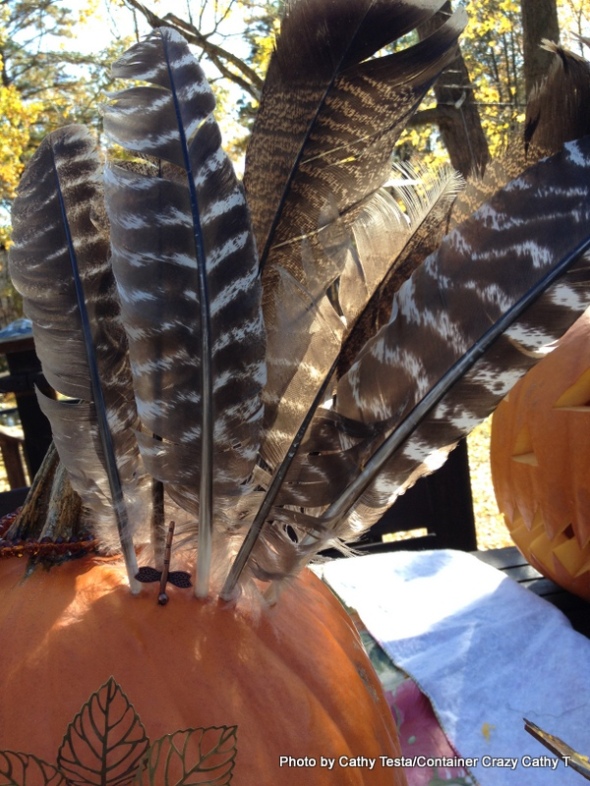
When I find turkey feathers left behind in the yard, I collect them to use in decorations, like I did with a pumpkin this year, or I’ll put them in my Thanksgiving Day arrangements or on Christmas wreaths.

Feathers in Pumpkin

Feathers in Pumpkin

The gobble noises and sounds made by the wild turkeys can be quite loud at times, especially during their breeding season in the fall.  I’ve read you can hear it from a mile away.  I’m not surprised. I often hear them in my backyard from the house.  I love the noises they make because it is interesting.  The different tones and cackles represent every action or purpose.  One of these days, I will know them all.

But the most interesting thing I think I saw in regards to wild turkeys was when one was helping an injured turkey across the road.  A large turkey had a small one under its big wing, and was carrying it away.  At first I wasn’t sure what was going on, but as I approached closer, it appeared the mature turkey was carrying away an injured smaller turkey, perhaps hit by a car.

Image courtesy of FreeDigitalImages.net/boulemonademoon

Image courtesy of FreeDigitalImages.net/boulemonademoon

Nature never ceases to amaze me.  And with Thanksgiving approaching, talking about wild turkeys seems a bit appropriate.  Unless you like to eat them.  In that case, I say stick with the store-bought or farm raised types.  I suffer from the Bambi syndrome.  I prefer to watch the wild types, and can’t seem to eat meat from wild deer, turkey, or rabbits.  No matter how many times my hunting relatives tell me it is good.

Images courtesy of FreeDigitalImages.net/nongpimmy

Images courtesy of FreeDigitalImages.net/nongpimmy

It is only 2 weeks until Thanksgiving everyone.  I hope you have a very pleasant holiday and spot some turkeys in your surroundings.  If not in your yard, perhaps on your plate!

Gobble, Gobble,

Cathy Testa

Turkey Links:

http://nwco.net/PDF/turkey.pdf

http://www.nhptv.org/natureworks/wildturkey.htm

http://www.nwtf.org/conservation/bulletins/bulletin_1_9-9-09.pdf

Camera Used:

We purchased our camera from Cabela’s.  It is called RECONYX Hyperfire model, and it has worked very well at capturing motion in the woods or other areas of our surroundings as we have moved it around from place to place. We have also captured photos of deer, a bobcat (Lynx rufus), coyote, fox, racoons, beaver, skunks, our male cat, other stray cats, rabbits, birds, and even a man with a machete.  Turns out it was a neighbor (phew).  One very interesting shot was when a deer bed down to sleep right in front of the camera – very cool.  And moving trees, leaves, even sunshine casting down, showing shadows moving across the ground during the day, is photographed. Snowstorms are fun too as you can see the level of the snow rising over time in sequential shots, so long as it doesn’t bury the camera. Maybe even YOU were snapped – a friend captured when you came by to visit – Bet you didn’t know that, did ya?  LOL!!!

Unique Wreaths capture a Native and Organic style

1 Comment

And they are the creations of Mauli McDonald of ‘art and nature’ out of New London, NH.

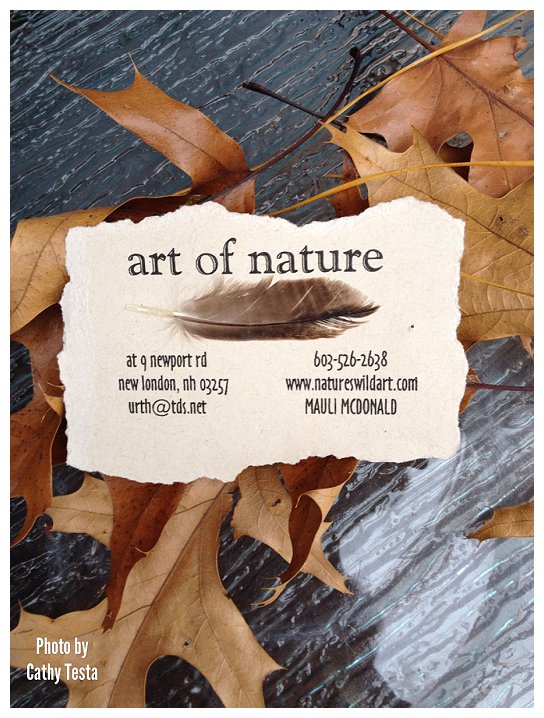
Art of Nature_0001

A visit to a fine arts festival at Roseland Cottage situated in the heart of Woodstock, Connecticut makes for a pleasant afternoon.  The grounds of this 1846 home, a national historic landmark, is filled from corner to corner with 175 artisans and their wares, from jewelry to pottery and more for two days every October.

As I toured the artisans’ booths this year, on October 19th, I did not bother much to take out my camera as usual.  For some reason, I wasn’t in the picture taking mood, but I was admiring many of the art works showcased and being offered for sale by the participants.  I picked up a few holiday themed ornaments, a really nice pottery piece, and enjoyed a lunch as I chatted with a group at a table filled with visitors from all around New England.

But one artisan that day struck me in particular – and it was the works by Mauli McDonald of ‘art of nature’ from New London, NH.  She had beautiful organic wreaths and center pieces.  Even her business card connected with me.  It was created on torn edged paper with a real feather pasted on the center below her business name.

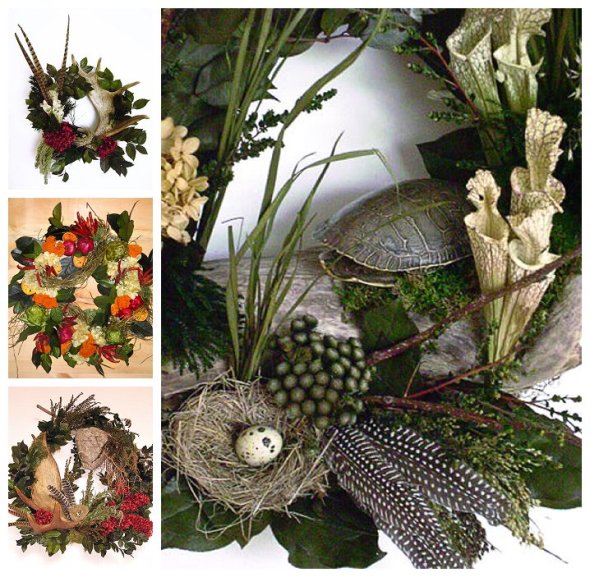
Images property of Mauli McDonald

Images property of Mauli McDonald

Mauli’s words provide the perfect explanation, as presented on her website, of her art form:

“The materials that I have chosen to work with have in some way enchanted me.  The soft edge of a feather, the curve and cradle of an antler, the green pool moss on a white wintered log—each object speaks.  And as you will discover, many of the designs carry, as well, a native, organic, almost unsophisticated style.”

As I looked over her unique wreaths created with native and organic materials that day, I was in awe of how she assembled the textures, colors, and overall feel.  She definitely has talent – and when you see her pieces in person, you witness her ability to capture materials from the forest floors in well-balanced compositions.

But more importantly, the objects she uses are organic, natural and make one think of things in nature which she so beautifully captured in an art form.  As you look and admire them, many may bring you memories of scenes in nature you have experienced in your own walks through parks, forests, or even in your own backyard.

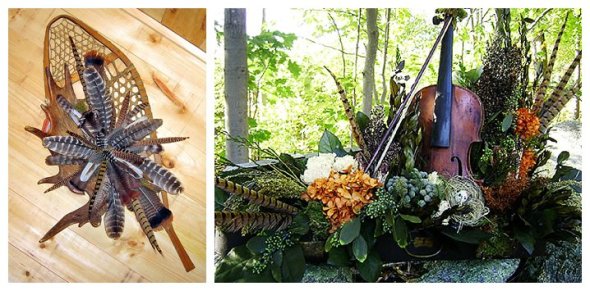
As I browsed along her website later, I spotted her ‘antique art’ pieces where a violin or snowshoe was used in combination with treasures from nature.  How wonderful these pieces are because they capture a keepsakes and combine it with nature’s treasures.

Images property of Mauli McDonald

Images property of Mauli McDonald

As Mauli McDonald states,

“I am drawn to certain thing simply because I like the object.  A singular piece may have no function, but there is something about it that I find appealing.”

I totally get that statement. Being ‘drawn to something’ because it has a particular connection or appeal.  Like the violin, for example, made me think of my father who plays one.  And the snowshoe is one of my hobbies in winter.  But the way this artist assembles theses treasures with nature is truly beautiful.  It pays homage to both objects – the treasures found in life and given by nature to us every day.

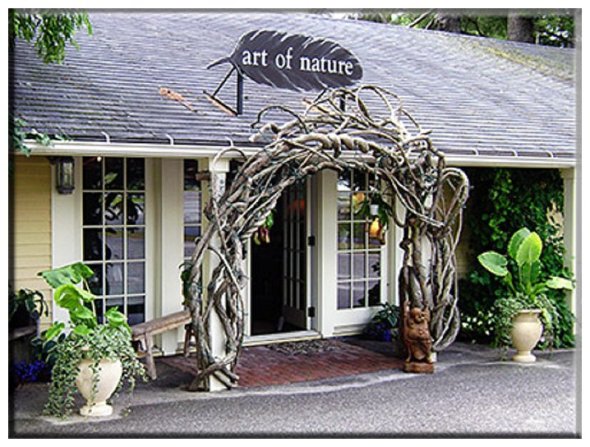
Mauli McDonald’s works are wonderful examples of “combining nature with art” and I wanted to share them with you. Take the time to visit Mauli McDonald’s website at www.natureswildart.com and if you should happen to be traveling in New Hampshire, I suspect a visit to her beautiful shop would be worthwhile.  Just look at the entrance!

Image property of Mauli McDonald

Image property of Mauli McDonald

It is located at 9 Newport Road, New London, NH 03257.  To reach Mauli, email to urth@tds.net or call 603-526-2638.

For more information regarding the Roseland Cottage Fine Arts and Crafts Festival, visit HistoricNewEngland.org/Festivals.

Written by Cathy Testa

P.S. Tips when you visit Roseland Cottage for their next annual show, just enjoy – everything is there for you, parking is in lots across the street, some on lawn areas, lunch is available as there are many choices by the food vendors, live music is playing too.  I would say the only tip is to note this event on your calendar so you don’t miss it next year.