Fall is Here; Overwinter Plants Soon

Leave a comment

Wow! It’s been a very long time since I’ve written a plant related blog post. Times have changed for me since entering the world of early retirement. It is difficult to have as many plants as I have had in the past because of the care involved, and my goals have changed. To travel means needing care at my home for plants while I’m away, and this is not always possible, so I cut back on having lots and lots of plants. And I also tried to focus on drought tolerant plants, so they won’t need as much watering when I’m away on travel.

I didn’t plant as much either to reduce care needs. But I still have the very serious addiction of needing plants on my deck at home. And to save money, another retirement requirement, I want to still overwinter plants as best as possible to reuse them next year in the summer again.

I have written many times how I’ve stored my red banana plant (Ensete) and Canna Lily rhizomes, and elephant ear tubers (both Alocasias and Colocasias) but it bears repeating my basic steps to remind those who ask this time of year.

Frost Expected Soon

A frost is expected later this week on Thursday, 10/10/24, this year. Tropical plants may be touched by frost if you are storing the underground parts (tubers, rhizomes, corms, etc.), but if you want to store the plant in its pot, it is best to move it before frost, so the foliage doesn’t get damaged, stressed, or destroyed from the chills. Move them in tomorrow or the next day, before the frost hits.

Agaves Disassembled

I also move in Agaves as best as possible into my home, but space is limited. I no longer heat my greenhouse (again to save money for retirement fun), so that option is out. In the past, it was no problem to store my Agaves in my low-temp greenhouse over the winter, so they just barely hung on. And then return them outdoors the next summer, but now I have to move them inside the home.

A few of my agaves got very crowded in their pots because of the side shoot babies which had been forming, so my tactic for taking care of those was to take the agave out of its pot, remove all the babies by carefully tugging them away, trying to keep roots if possible, and then placing the babies in mason jars filled with water to sit for a while. This will encourage new roots. Then for the momma agave, I pruned some roots and remove soil quite a bit to fit it into a smaller pot and then move them inside the home in a space I have by my indoor slider. Done!

The baby agave plants may look a little tattered or uneven but give it time. Soon these will have fresh roots, I’ll replant them into very small appropriately sized pots and let them grow. The shape will be normal over time, and they can grow as big as my big agaves have. This particular agave is Kissho Kan. These plants inside the home of the winter are kept on the dry side, barely watering, and in some sun by either my bedroom or kitchen slider doors. They are easy to overwinter if you have the space.

Agaves in mason jars with water above photo

Alocasia Tubers

I still have to work on my Ensete and other big pot on my deck, but I managed to take apart one of the alocasias in a smaller pot. I cut off all the foliage first, then dig out the base with roots if possible, and some will have the brown papery covering on the tuber area whereas the smaller sides shoots often do not, either way, I store the alocasia tubers in my basement in boxes with just paper wrapped around them or as a bed (like crunched up newspapers). They can go a bit on the dry side and I make sure to have some slits or air holes in the boxes used to store them. This works fine in an unheated basement that does not go below freezing. Colocasias (elephant ears) are stored a bit more on the moist side by using peat as a bed material in the box. Before moving them into boxes (either plastic or just your basic cardboard boxes), I leave the tubers to sit in the sun for a week or days for a while. I don’t put them in immediately. I may even leave them to dry some on a table in my basement if it becomes too wet outdoors due to rain etc.

These plants (the alocasias) can grow very very large, and the tuber gets bigger and bigger each year. I still have quite a few of those to do. The next two days will be sunny so that helps. The alocasia plants have the elephant ears where the tips point upwards to the sky. Regular elephant ears (Colocasia) point downwards. I didn’t do any of the regular ones this season. I’m kind of hooked on the alocasias.
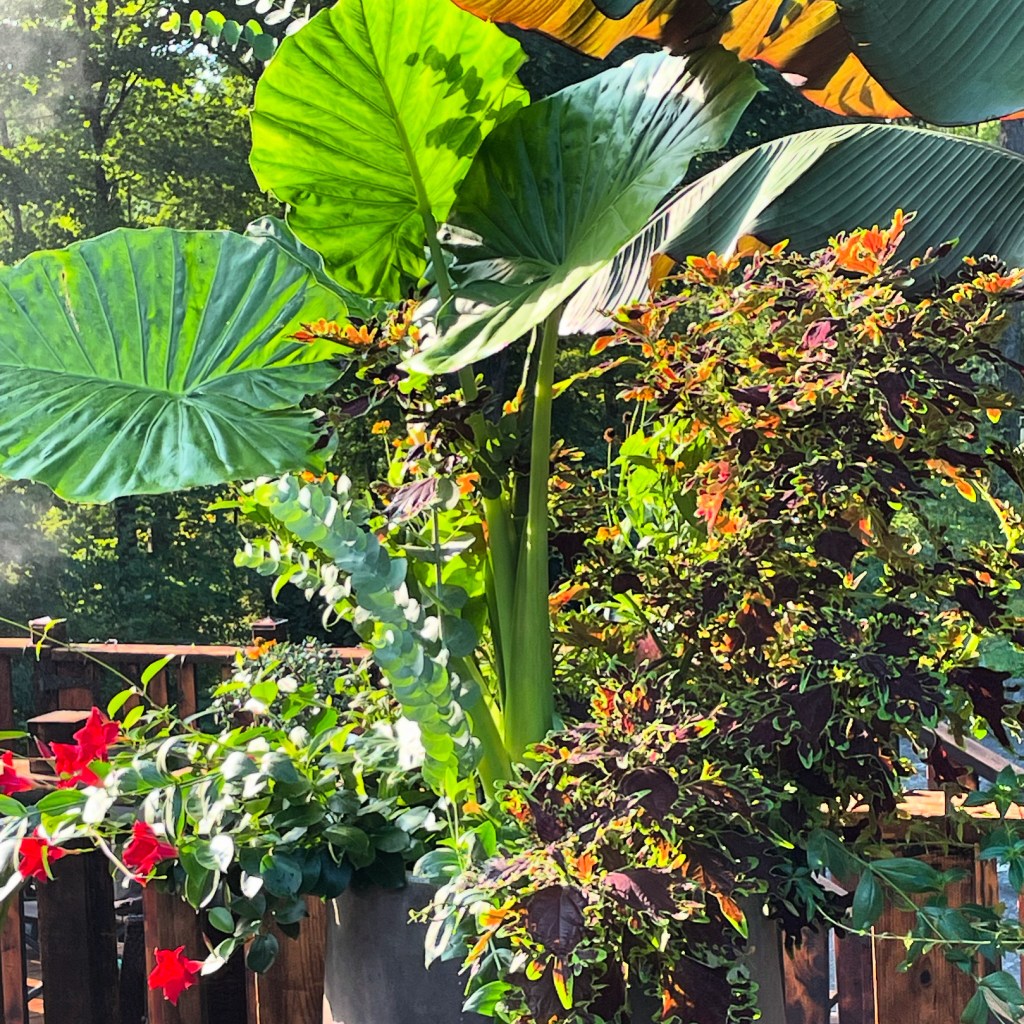
This planter above is my next project. I have to say the alocasia is paired with the most beautiful Coleus Limewire. It is so huge right now; it will be sad to cut it down! It has done wonderfully has a filler plant with the tall alocasia. The burgundy foliage edged with lime green was just stunning when hit by the sun, and the plant was tiny when started, now it is huge! You can also see there is a eucalyptus plant stuck in there, first year I’ve tried one. It is super tall right now and I’ll probably give the plant to my niece. She likes the smell of those plants, but I find the smell disagreeable. However, while it is living in the pot, I haven’t smelled that scent, guess it is when it is cut down.

I took this photo this weekend so I could have a reminder of how large this Ensete (red banana plant) grew this season, which is only year 2 of it. I stored it last year, and it shot up a lot this year with growth, and I have to remind myself to plant it in the larger planter next year, because it fell over twice during windy storms here – thankfully the pot/planter did not crack! I was trying to encourage my black cat to pose with me, she wasn’t having it – she wanted to walk around the deck. Her name is Mini and she is our treasure pet! We just love her. She never bothers my plants, it is like she knows, they are important to me, just like she is.

Anyhow, tomorrow I will start to take these apart and store them and will show the steps but here’s some links from prior posts about the processes I have followed with success.

Please note: Years ago, I would put moist peat with my Alocasia tubers, but no longer. I use paper for those, and it works better. That is for the Alocasias specifically. (For Canna Lily rhizomes, I use peat, and for Colocasia regular elephant ears, I use peat).

Hope this is helpful.

Enjoy your day!

Cathy Testa
Broad Brook/East Windsor, CT
Date of this post: 10/7/2024
Bringing Plants Indoors

2 Comments

I usually call this process, “overwintering plants,” but I figured that is a term which may be unfamiliar to newer gardeners.

Thus, this post titled, “Bringing Plants Indoors,” is referring to just that. I’m starting to bring in some plants this week (Sept 7th, 2020).

Some plants, like hardy succulents, are able to stay outdoors all winter here in our CT planting zones. They are able to tolerate frost and winter temperatures, and are referred to as, “winter hardy.”

For example, Sempervivums (a.k.a., Hens & Chicks) succulents. However, if you decide to keep any of these hardy succulents, which were grown in containers, patio pots, or hanging baskets outdoors, be sure to put them in a protected location, such as under a porch, in an unheated garage, or shed. They are more sensitive to winter conditions if in a pot versus grown in the ground in a garden.

If they have been growing in the ground, they will be fine over the winter, and do not need protection. They will go dormant when the time is right as temperatures drop in the fall and winter, and come back alive next summer season.

This particular hanging basket (shown above) is filled with Sempervivums which are looking perfect right now. There is no damage, no insects, and they are as happy as can be. I just love how they filled this hanging basket in fully. The color intensified recently, as many succulents do when they get a bit of stress of cooler temps.

I decided to move these Sempervivums in a hanging basket into my greenhouse yesterday, however, it is not because they can’t remain outdoors for another few weeks (or all winter in a protected location), but because they look so healthy. I want to keep them that way.

Tip: Move them in while healthy!

I find the best time to move some plants indoors, especially succulents and houseplants, is while they are looking great, are free of insects, and haven’t been stressed by a drop in temps during the fall season, which is usually accompanied by rain fall. When this happens, the soil, the pot, and the plant get cold and damp. This starts to invite issues such as rot, insects, and stress.

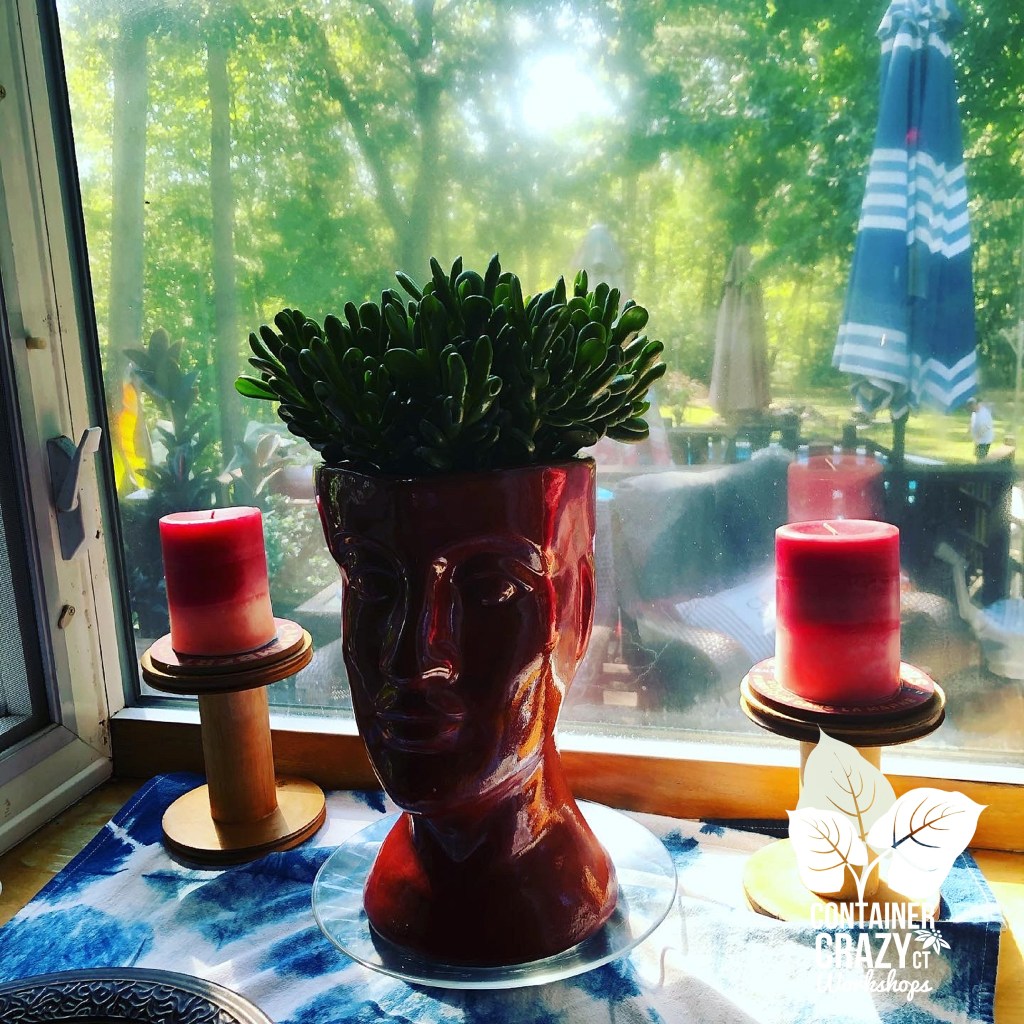
This plant above, a Jade in my red head planter, is another example. It could tolerate a few more weeks outdoors. Once it is consistently 50’s degrees at night, they should be moved in however.

It probably won’t go into the 50’s for another week or so, and even if it did – it still might be okay for one night or two of 50’s lower temperatures if our day temps stay warm (60’s, 70’s and maybe even another day of 80’s!).

But, it must be moved in before it gets hit by frost. Frost would kill it. It is not “winter hardy.” It can not tolerate the CT winter temperatures. Frost usually hits in early October.

However, because this Jade plant is so healthy right now, this week of September 7th, I wanted to take this gorgeous red head planter in before the beautiful Jade plant in it experiences any fall weather related stress. It has grown so much and has done well in this planter.

What do I mean by fall weather related stress? Well, when it drops down to chilly, 50 degrees F or below, in the fall season, we usually also get rain. Then the planter would be damp, cold, and this will affect the plant and the soil. It may not kill it – but it most likely will stress it. The soil gets cold and damp, and I find this scenario to not be ideal for plants you are moving indoors.

Tip: Move them in before major rain fall during a temp drop. And let the soil dry out in the containers outdoors before moving them inside.

Additionally, I advise my plant followers to let the soil dry out in your container gardens and patio pots before you move them indoors, AND, move them in before they get too chilly (before there is a consistent temp in the 50’s in the evenings.) A succulent is able to tolerate drought, so let that soil dry out before moving it in.

The plant got tall enough, so I had to remove the top shelf of this south facing kitchen window that extends out. It will be good enough sunlight to keep this plant happy all winter. The window area sometimes gets a little chilly in winters, but this plant is able to take 55 degrees “indoors” during the winters at night. It won’t get too cold here for this type of plant.

Before you move it indoors, here are other things you should do:

  • Don’t water it before moving it indoors for a few days if possible or even a week. Drier soils are better for moving in plants.
  • Inspect it for damaged leaves or any signs of insects. Treat if you find insects with the appropriate spray or treatment.
  • Remove any fallen debris from the plant (I found pine needles in there.)
  • Remove any damaged leaves if possible. Wiggle them back and forth to pull away if you see leaves with holes or damage.
  • Inspect under the pot. (I did this. I found a small round insect cocoon.)
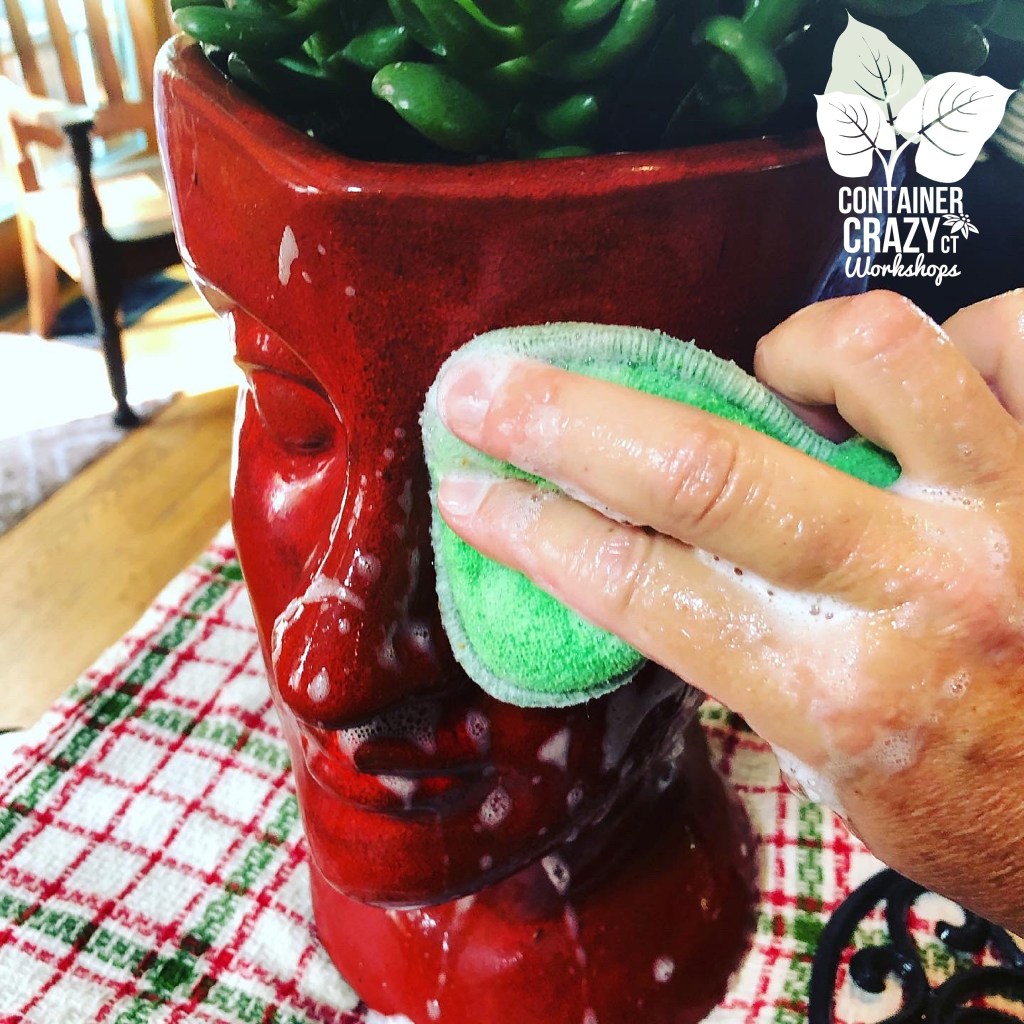
  • Wash the outside of the pot with soapy water (mild dish soap is fine).
  • Move it before it gets 50 degrees F or below at night consistently. (This could happen anytime between now and the next couple weeks.) Watch your weather app for night temperatures.
  • Pick the appropriate home location. Some plants need some sunlight, others are able to tolerate low-light.

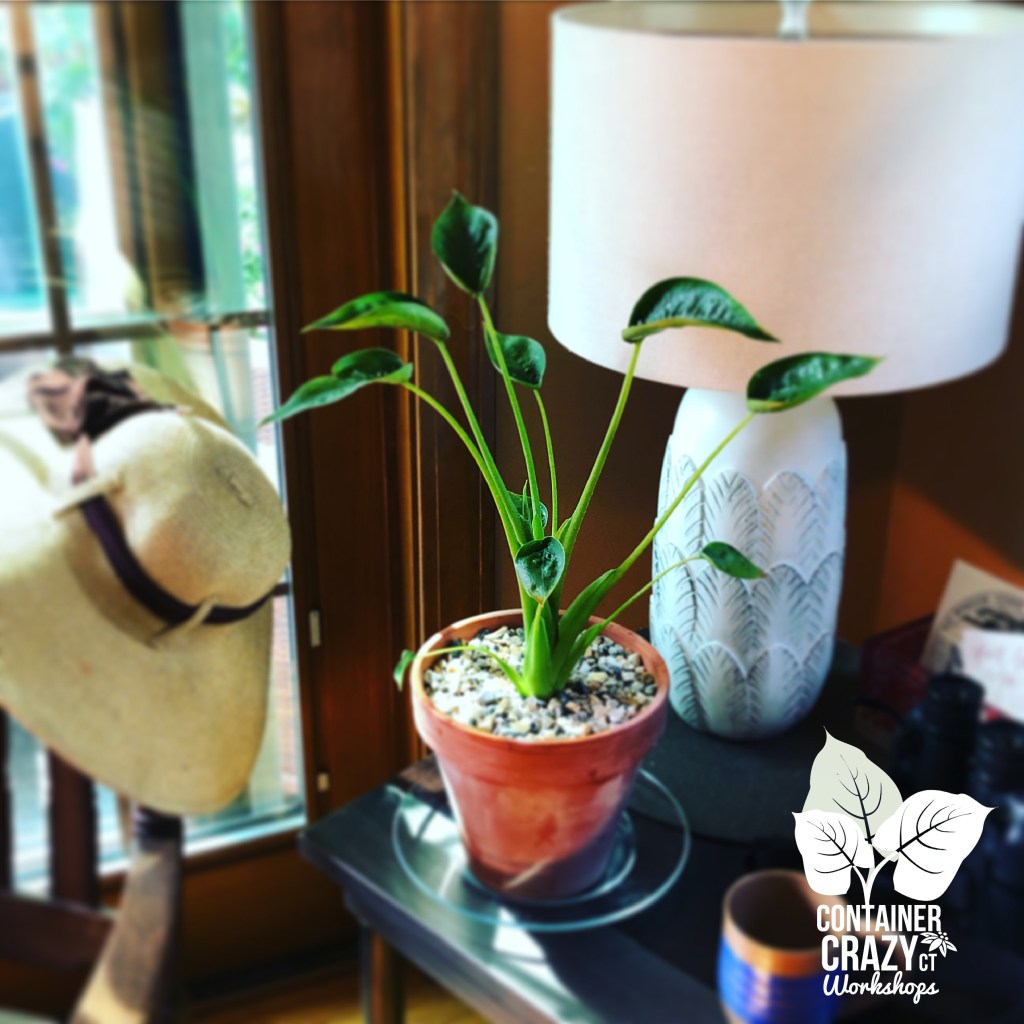
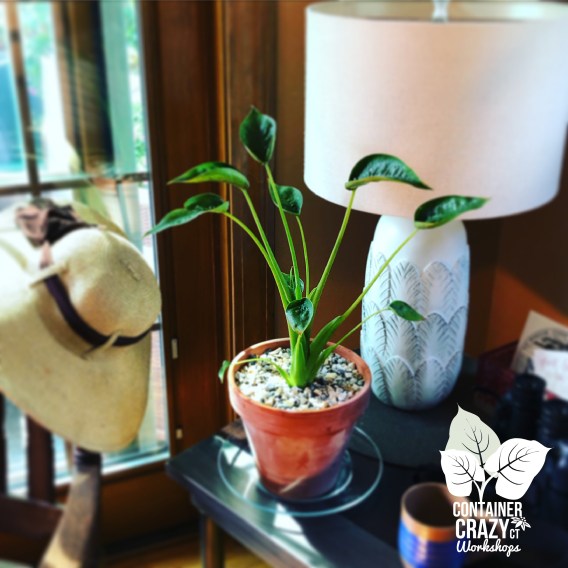
The next plant, shown above, is an Alocasia called ‘Tiny Dancers.’ When I saw it at a growers, I had to have it. I have lots of huge monster size Alocasias but I never had a dwarf sized one, like this one. It is too cute!

It started off in a tiny 3″ square nursery black pot. I potted it into a new terracotta pot and had it outdoors all summer. Usually, I store Alocasias by storing their tubers (round like bulbs located under the soil) only, but this is a tiny Alocasia, in fact, more along the lines of a dwarf. It makes it a houseplant candidate in my book, at least, I can test it out as such this year.

I decided to move it in and give it a spot by my south facing kitchen slider. It will receive sun light only a portion of the day during the winter which should be sufficient.

I don’t think it would do well in a north facing window which does not receive much sunlight at all. Another good place for this plant, if there is sun light in the room, is a bathroom because this plant likes a bit of humidity.

This Alocasia has been is pushing out new growth and is very happy. This one will be treated as a houseplant this winter rather than storing it like I do with my giant Alocasias (which are tropical plants and can not withstand winter temperatures). Sorry repeating myself.

I followed the same steps above: inspect, look it over, remove any damaged leaves. I did not wash this pot because it is terracotta and porous so the soap could go into the pot and although probably not too harmful, I just used a rag to wipe away any debris.

But this Alocasia ‘Tiny Dancers’ did have some signs of insects. When you inspect your plants before moving them indoors, look closely.

I did see, in the cups of one leaf, that there were little spiders in there. I am not sure if they were spider mites, but I decided to “lightly” spray the plant with Neem Horticulture Oil in a spray bottle as a precaution.

Tip: Please read the label or ask a nursery staff about insecticides, fungicides, or other products before you treat your plants. You could damage a plants’ leaves if you use the wrong product.

Check any treatments you use on plants by reading the label first. Make sure it is appropriate for the plant type! If you spray a plant with the wrong product, you will damage the plant, not help it.

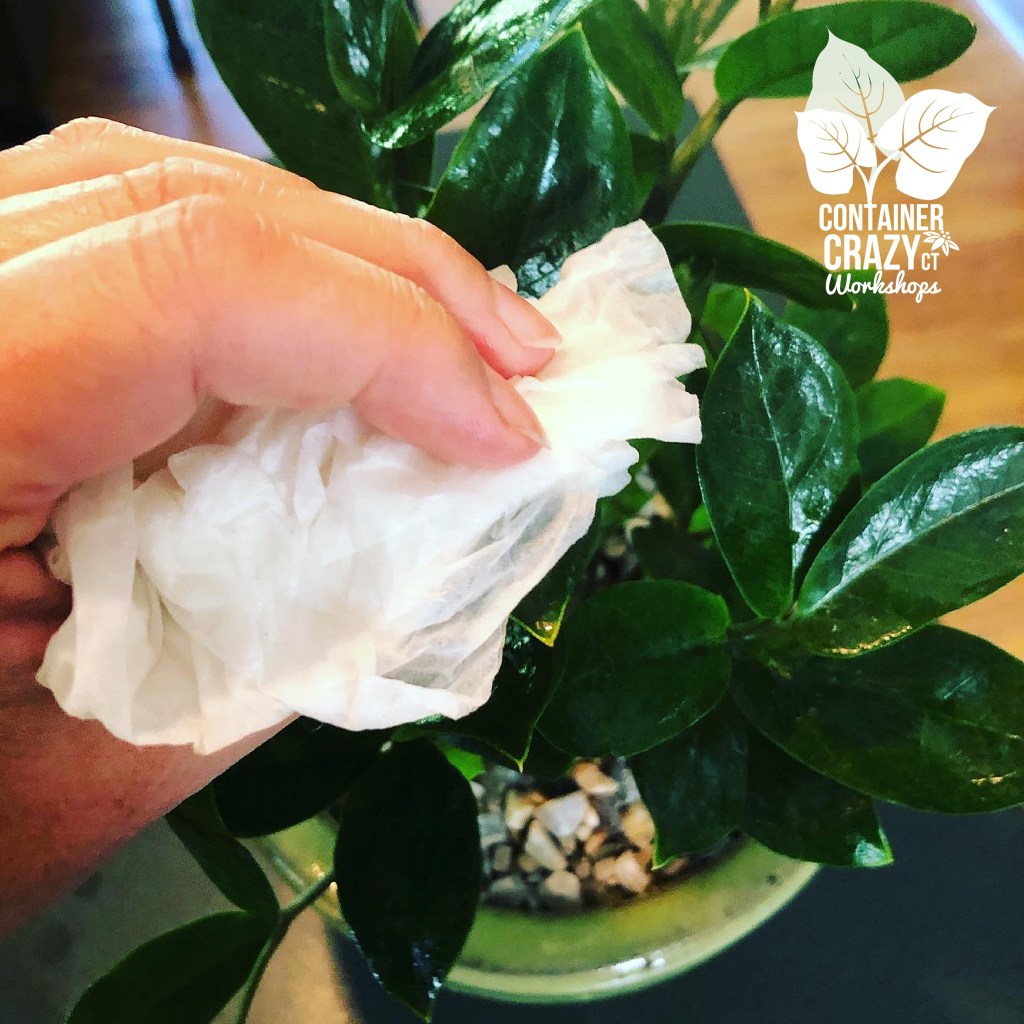
Another plant I moved in to the house is considered a houseplant, the ZZ Plant. It has been thriving under a patio umbrella and had no insect issues, and is also pushing out new growth. When you see the growth, this is a good sign your plant is happy. Moving them in when happy is a good idea.

Tip: And I can not emphasize this enough, the best time to move plants inside as fall approaches is when or if they are healthy. If they have no issues, get them in before they do. Colder temps often times invites problems.

I carefully cleaned each ZZ Plant leaf with a wet paper towel to wipe away any debris or dust, washed the outside of the pot, and this one was placed in a north facing window that receives very little light. Since this plant is able to tolerate lower light, I think it will be fine in my north facing window this winter. This plant is marketed as being easy and care free, so the north window is its home for the rest of the year. Water this plant less as it does not like overly moist soils.

To recap, plants may stay outdoors for the most part, but some I start to work on early, partially because I have the time this week to work on my own plants before overwintering my clients’ plants from their container gardens. Also, sometimes working in mild and comfortable temperatures is better on me.

Also, I believe plants perform better indoors over the winter when you move them in before they get stresses from drops in temps in the evening. This is especially true for “non-hardy” succulents, such as Echeverias. I will be showing those as I work on them in future blog posts as well.

Tropical plants, like my Canna Lilies, Elephant Ears (Colocasias and Alocasias), and Banana plant (Ensete) may remain outdoors all the way up to frost (early October) or just after frost (IF you plan to store the under the soil bulbs, rhizomes, corms, or tubers only). If you want to keep the plant indoors as a house plant, move them in before frost.

Succulents plants, just to recap, may remain outdoors all winter if they are winter hardy. However, if they are not, they must be moved in before frost in October, and I recommend (sorry repeating myself) to move them in before they get cold, damp, wet, and chilly (BEFORE it gets consistently 50 degrees or below at night). Again, you may wait till we get the temp drop, but I prefer to do it a bit at a time before that phase.

Houseplants, well, I would move those in now too. While plants are healthy, strong, and not stressed out. It is a difficult thing to do because we want to enjoy every last minute of outdoor goodness (and so do the plants), but if they are doing well, might as well capitalize on that because they will be more likely to do well indoors if healthy now.

I already took down my tomato plants, by the way, and herbs are dwindling down so I am trying to use as much as I can before they are goners, and made pesto with my basil. I am considering sowing more herb seeds this fall in the greenhouse however. Maybe have a fresh batch available in a month or so. Sorry, that is a side bar comment. LOL.

Here’s a recap list:

  • Tropicals – Can wait til frost or after frost if storing tubers (specifically Canna Lily, Elephant Ears, and Banana Plants). Mandevillas you should move in before frost if keeping the plant in tact or storing the plant.
  • Non-Hardy Succulents – Can wait till the evening temps hit 50′ degrees F, but I recommend moving them in earlier, for reasons noted above.
  • Hardy Succulents – Can leave outdoors all winter. If in a pot, move to a protected location before winter. If in the ground, no worries, leave and let it be.
  • Houseplants – Move them in now while healthy. Each houseplant is different on lower temp tolerance, but treat them like the non-hardy succulents above.
  • Herbs and Tomatoes – Already took down my tomato plants because they are not producing fruit now and it is too cool at night, and herbs are starting to dwindle so collect what you can now. But that is up to you based on your own gardening veggie habits.
  • Agaves and Cacti – Can take drop in temps and tolerate it but can not take frost. Take them in before October frost or treat as I do with non-hardy succulents. The Agaves and Cacti I will leave out for a while longer probably, or take them in “if healthy” and cherished. Again, if they are “healthy” with no issues, I like to move them in before any chance of issues.

Hopes this helps if you are considering on working on your outdoor plants too. And please share my site with friends who may find this information useful. Feel free to ask for any clarifications, and also, note that these are all my opinions based on my years as a container gardener.

Thank you and enjoy your Wednesday!

Cathy T.
Cathy Testa
http://www.ContainerCrazyCT.com
http://www.WorkshopsCT.com
http://www.ContainerGardensCT.com
860-977-9473
containercathy@gmail.com

P.S. Unfortunately, I am not offering my typical Autumn Succulent Pumpkin Workshops due to Covid this year. However, I will be taking custom orders around the end of September. Reach out if local and interested. Thank you for visiting my blog.