Gutt Reaction

Leave a comment

Last week I spent a full day at New England Grows in Boston.  This is my 4th year attending so I am very familiar with what to expect.  However, I also hope for new surprises.  As I browse the showroom floor, I search for a new, different, or perhaps not yet noticed gardening product or plants.  My goal is to learn, but more importantly, to see what is useful to my design clients and gardening friends.  Here is my gutt reaction to those I took notice of.

Dyeing Orchids.  No, not dead orchids.  Orchids dyed the color blue.  As I took a photo of Phalaenopsis (the Moth Orchid), I told the guy manning the booth that this was the first time I’ve seen this.  My reaction:  I found it curious long enough to take notice, but I’m not so sure orchids should be treated this way (see photo below).  Orchids are not your typical flowers as you know.  Often gardeners who grow them also collect them.  The moth orchid is one of the favorites and perhaps easier to grow.  They require moderate light and consistent moisture, and bloom late winter into spring.  But there are other more sophisticated types of orchids.  You could say that orchids are somewhat in the elite class.  And typically collectors don’t really like their prized plants to be “messed with” – at least maybe not this way.  Sure, we’ve seen dyed poinsettia plants the past few holiday seasons.  But somehow, at least my gutt reaction said, doing this to orchids is not as cool.  Actually, it kind of made me feel blue. 

The Smart Pot.  Because of my love for container gardening, The Smart Pot caught my attention at the show.  It is a soft-sided fabric container.  Commercial growers have used this product, but now its an option for container gardening at home.  As described by the sales person, it has many growing benefits.  The soft sided material allows for better aeration for the plant’s roots.  Unlike plastic containers, the heat held is also released when it is too hot outside.  The aeration process also eliminates (so they claim) the circling or girdling of roots at the base of the pot due to what is known as air-root pruning.  These root benefits greatly improves the root structure and increases top growth.  You should end up with a higher yield or more blooms.  My reaction:  I believed every word the gentlemen told me as he described the benefits of The Smart Pot’s features and that it promotes better top growth because of the benefits provided to the root area, resulting in higher yields.  The Smart Pot certainly has a High IQ!   However, the drawback for me is it is just a plain black container with no embellishments.  I like a lot more bling for my container gardens.  For the vegetable lovers out there, this is a handy, portable, reusable, and lighter growing container.  And it comes in various sizes from 7 to 20 gallon.   This patented aeration container definitely has its advantages.  It may have other uses to consider, which I am.  I have some more thoughts about it to share at my Container Garden Parties in 2011. 

Verticle (or Vertical) Gardening.  Identified as one of the 2011 hot new garden trends.  We are not talking about slapping a trellis against a wall and allowing a clematis to grow up it.  It is about verticle gardening on a larger scale.  A component system shown at the show entailed modular sections made from stainless steel sections and filled with growing medium for quick assembly.  My reaction:  I would love to create this wall of planting glamour at my home where I have a tall and bare foundation wall below my garage facing my lawn.  I feel these component wall systems of verticle green walls are somewhat site specific however.  They could be used to create outdoor room dividers, hide an eyesore (like my garage foundation cement wall) or create artistic elements in the garden.  I could also see them also used in commercial building settings where space is otherwise limited or to bring a concept to eye level for visitors.  Perhaps a wall of herbs at a restaurant’s outdoor seating?  For a smaller scaled environments or interior rooms, there was another interesting option shown by another vendor at the show.  It was framed wall art designed to accommodate plants, roots, soil and watering.  I liked this too, but to be honest, I also felt the garden framed wall art is something one could easily create on their own, should they have the desire.  Just pick up a old picture frame or window pane, and go at it.  Maybe it is because of the plants they used to showcase the wall art.  They did not do it for me.  I would have used coleus and created patterns, or a painting.  Oh, the juices are flowing!  Both the component large wall system and the small frame plant wall art provided inspiration.  That’s a good thing.

Rice Hull and Bamboo Pots.  We have definitely seen a great deal about recycling pots the past couple years with the green movement.  But this year at the show, it was the first time I saw a plant wholesaler selling the starter plants right in the compostable pots.   This grower had pots made from rice hulls and bamboo.  Completely compostable or biodegradable, and serving as beneficial decay matter to the soil environment for the plant.  Once in the ground, the pot will slowly decompose or breakdown as the roots reach thru the vents or slots in the pots, or as the base of the pot decays.  You don’t end up tossing the pot into the garbage, it helps the soil, and eliminates the repotting step.  I really like this.  The grower also is focused on using recycled water and renewable components throughout their production process. If others had done this already (meaning using the attractive “right size” bamboo/rice containers), for some reason I didn’t notice it before at this show.  I’ve seen smaller plugs or pots of this type of material, but not in the size pot I typically like to start with for my garden installs or for container gardens.  And their compostable type pots were attractive enough should you want to just enjoy the plant in the pot before it reaches the ground.  My gutt reaction:  All good.  No bad.  Just right.  (Just wished I had a nursery of my own so I could load up on them!)

Click on the photos below to expand the view! 

Playing with EVs

Leave a comment

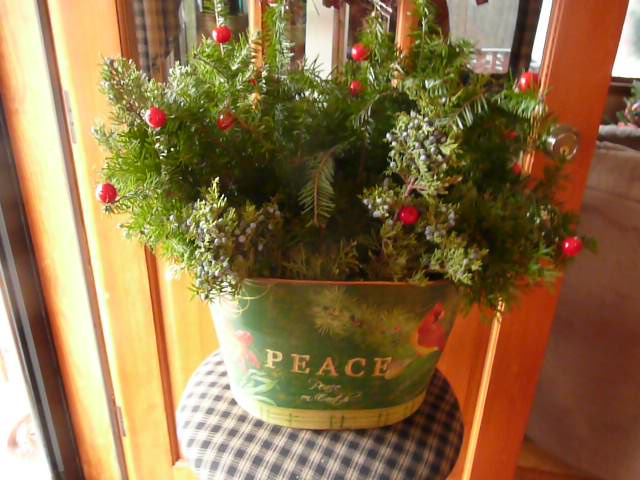
Ever since I held a class called, “Making Evergreen Holiday Kissing Balls“, earlier this month, I can’t stop playing with creating fun holiday containers stuffed with various evergreens!  Winter container gardening is fun!  Tin containers work really well because they can handle the expansion and contraction of the soil which is moistened in the container and then freezes from the outdoor winter temps. 

Tin with EVs

Festive and Fun

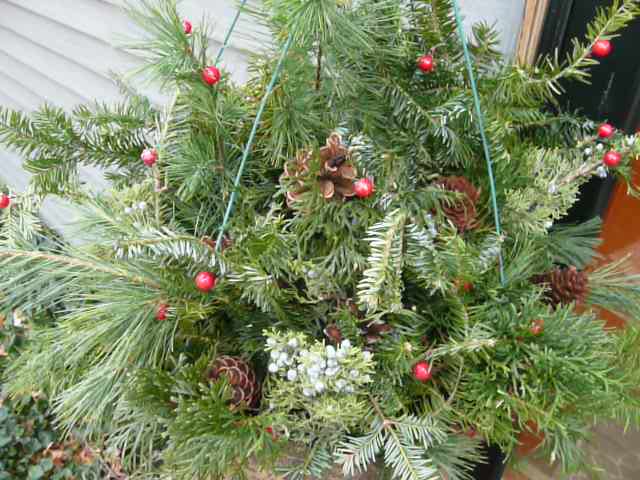
Other good container choices are antique wooden boxes or moss hanging planters.  I took a moss hanger which I had stored in my basement from this summer. 

Hanger

Reused Hanger

I kept the soil in there with plans to create a evergreen basket for the holidays. It worked perfectly.  The soil was pre-moistened before I inserted the pines, junipers, balsam fir and arborvitae cuttings.  Then I let the basket sit outside for a night so the soil freezes really well which anchors the cuttings in the container.  The next day I started inserting pine cones and other holiday decorative artifical elements like berries and sparkly fruits. 

I love having these evergreen container arrangements staged around the outside of the house. The other day a friend stopped by and commented on how wonderful everything looks outside, but it really consisted of all the pretty container of evergreens and red ribbons.  Easy to do and it is great to reuse your summer containers in a new way. 

Next winter, I plan to hold a class on making these!  On my business page on Facebook, you can see some videos of how I do this, or just signup for my class next year! It will be held in early December and I will post it 2 months prior for signups.  It is a year away, but this season, I’m testing out various processes and materials.  You can play with fun containers or more formal.

Frosty!

Let It Snow

This weekend, I’m going to create a evergreen arrangement in a beautiful urn.  Urns are great for this winter container gardening and can be very showy on a front porch or entry way.  They are formal and elegant. 

It is best to keep the creations outside as they will remain green for months, up to February.  Inside they can dry out quicker, but these containers stuffed with evergreens can be used as a holiday centerpiece on your table.  I would just recommend keeping it outside to extend the life of the greens as they are dormant. 

Wait til it snows, I love the snow on the evergreens too. Enjoy the festivities!  Happy Holidays!  And keep on containering into the New Year!  Cathy T

MG 2010

Leave a comment

Well, I received it!  My Master Gardener 2010 official certificate of completion!  I had such a busy year, it is hard for me to believe I also completd 16 weeks of classes from early January thru mid-April this year.  But it didn’t end there, the classes were followed with an open book exam then 60 hours of volunteer work during the months of May thru Sept on outreach projects.  Many projects were presented prior to beginning our outreach activity hours.  It was so difficult to select, but I did a mix of creating some container gardens at the MG office, helping at a local community garden in Thompsonville, CT (this included giving a couple classes and revamping a perennial garden bed), and working at some agricultural fairs later in the season.  I also helped with a garden id project at the ag buildings.  As part of the program, I also completed a tree, shrub, and vine identification project by the end of August.  And there was office work time in the Extension Master Gardener Office in Vernon/Tolland where Master Gardeners diagnose and answer questions about plants, plant problems, insects and more. 

The Master Gardener program is all about providing education and information to the public about horticultural-related topics.  And it all begins with a solid foundation of learning, and more importan,t direct experience gained by participating in this programs requirements and various activities.  I can hardly believe I completed this program while keeping up with my workload from my small professional landscape design business and other gardening events held this past year for the first time.

Of all the MG activity involved, I guess I have to say, working in the Cooperative Extension Office was the most beneficial to me because I was able to see what types of problems the home gardener experienced and understand where they needed help.  I’ve gain horticultural education years prior via the degree program at UCONN, but the MG program offers a different type of learning – where you meet not only other very avid gardeners in the classes, but the people in the community that just want to do gardening correctly, or should I say “better” (for gardening should not be totally correct!)… or just want to have answers to problems they encounter along the way at their home gardens.  The Cooperative Extension Offices are designed to help the public, and I suspect many people in the community are not even aware they exist!  But this service is available.  Make note!

I also strongly believe the program is a great bargain.  You learn, practice, experience, and teach (if you are up to the challenge of intense classes and time commitment for the program’s requirements) throughout the program and also receive a tremendous amount of amazing reference material that you will surely use as you continue your gardening experiences.  In 2010, all of this was included in the MG fee of under $400!  There is an application process, but don’t let it scare you if you think you want to backup your gardening hobby with some solid horticultural knowledge.  I’m sure anyone with the desire to learn and the ability to commit to the program would be accepted – at least I think so, but I’m not a coordinator so I can’t say for sure – just my opinion!  I don’t make the rules, I’m just trying to say, I think it is worth pursuing if you are interested and can manage the time. 

After all was said and done, I couldn’t even attend the graduation ceremony in late October because I had another family commitment, and then I didn’t even have time to go pick up my certificate from the office!  So they eventually mailed it to me!  I guess once February rolls around in 2011, I can spend more time reflecting on all that I did during this program, how much it benefited me as a gardener and person in the trade, and soak in the accomplishment. 

Lastly, I’ve often pondered, what would have been better?… Going to MG Program first then take the UCONN Degree Program– or doing it as I did, taking the degree program (finished in 2005) and taking MG 5 years later?  But that is like asking if the chicken came before the egg?  There is no correct answer!  Both are amazing opportunities and provide layers of learning about horticulture.  I feel very fortunate to be able to do both!  And I know it will help me to better service my clients and gardening friends.

New Blog Title

Leave a comment

Well, folks, I didn’t realize when I first setup my blog about a year ago that it should be titled with something other than my name!  I’ve been trying to brainstorm something catchy but still nothing has clicked.  Because I’m crazy about container gardening, and anyone who has been to my classes or hired me to install containers at their home or business knows this about me.  My home and deck are loaded with abundant container gardens every season with a different theme and focus on colors, textures, and large bold lush foliage.  It is surely my passion.  And the other big thing about me is I’m a plant lover more than a hands-on gardener.  I don’t have much time to work on my own gardens because I work in the hort world, but I’m passionate about plants, from the botanical point of view.  I love seeing plants grow, observe their features, learn about the components of plants, and always find it fascinating to see how a flower can be so darn beautiful and serve so many purposes!  Without plants, we would not exist.  Period. So for now, I switched my Blog Title to Container Crazy.  But if I find something a bit more creative, I’ll change it later.  Any suggestions?

Thankful for a busy year

Leave a comment

This season was extremely busy for me and my business. For starters, I set up booths at a few garden related shows in the winter. Then I decided to sign up for master gardening classes that ran thru the winter into mid summer. And I also worked on a big first time gardening event in my town in June with new artisan friends. In between and during all this activity, I designed gardens and landscapes for about fifteen clients. In May, I had container garden parties booked every weekend. I ordered plants from growers for the first time this year versus just using my usual nursery sources. I acquired two new container install clients along with the usual onside guidance type visits. If you saw my calendar, you would laugh for it has so many notations. Now, it is November already, and in one week, I will be holding a kissing ball class in my home as we move into the holiday season. I am surely thankful to all my gardening friends and clients for their support! It is seven a.m. As I write this, two days after Thanksgiving, and i can say I am truly blessed for the support of friends, mentors, gardeners, and of course my husband who encourages me on my journeys! Time to take down the fall decor and untangle the Xmas lights, and save your hanging baskets for evergreens, leave the dirt in it, moisten the soil, and add the evergreens. More later.

Plant ESP

Leave a comment

Sometimes when reading a garden magazine, I will come across a plant, color combo, or design technique that I used myself.  It makes me feel like I have Plant ESP or the coincidence is reasonable because plant types should match cultural conditions.  But for the more curious incidents, like a discussion about an unusual tropical I planted for the first time, I have to pause and think, “How does that happen?!”  I just bought that plant this year, and now it shows up in a hort publication!  When these incidents occur, it is reaffirming at times because it validates my concepts and ideas.  Or perhaps it is a case of noticing trends due to my observations with my clients and all the materials I read regarding the trade of plants.

This ‘plant ESP thing’ (for lack of finding a better way to describe it) happened to me just last nite. I was quickly browsing thru the latest issue of “Horticulture” while simultaneously watching the news on t.v.  In a section about new varieties for 2011, there was a Papaya carica ‘Tainung’ featured.  I couldn’t believe it.  I just took pictures of papaya trees in a field in Hawai`i during my October vacation on the Big Island.  I remember thinking how cool it would be to grow papaya trees in my container gardens at home.  And here it is (or a variety of it) in the latest issue of a magazine issued just one month after my trip!  Is this Plant ESP or what?  Whatever it is, I guess it might be a sign that I really pay attention to plants. 

The article, titled  “New Varieties”,  covers 2011’s new introductions coming out of breeding programs across the country.  And Logee’s, a place I’ve visited in the past in Danielson, CT, featured a Papaya carica ‘Tainung’ (right next to the paragraph about Brugmansia ‘Angel’s Blushing Beauty’ (ANOTHER OF MY FAVORITES, weird, huh?!).  It states that Logee’s is offering this variety of papaya in 2011, and I for one plan to get at least one plant to test it out next season! 

The article states it is native to southern Mexico.  It has a red papaya with deliciously sweet fruit that can weigh 3 to 5 pounds.  I can attest to the delicious part.  I loved eating papaya on the island every morning and would stop at roadside stands to buy a few as we traveled around the island. It was my favorite flavor of all the fruits I tasted there.  The article also states the plant will begin producing fruit within the first year (so cool!) and at 2 feet tall (even cooler).  This means I don’t have to wait long to achieve a big plant and possibly one bearing fruit!  If I could bring that flavor to a plant right on my driveway (a place I love to place large

Papaya Trees

containers of tropical plants due to the heat below from the pavement), I will be feeling “at home” again, well, at least my “dream home” of Hawai`i!  The article also indicates to grow it above 60 degrees F and keep the roots warm for best results (not a problem, as I mentioned, on my driveway area).  Also recommended is lots of water and moderate amounts of fertilizer for fast growth. 

Here’s the photo I took on the east side of the Big Island of papaya trees growing in a field. It is called Mikana on the island per my reference book, and it shows the Latin name with the Genus Carica and species of papaya, so I’m not sure if the magazine reversed the naming convention order or what, but that doesn’t matter, for now I can look forward to obtaining this plant right here in Connecticut and giving it a shot next year.  Wish me luck!

Elephant Ear Bulb Storage

1 Comment

I had the full intention of continuing the process of breaking down my outdoor container gardens yesterday, but a nice lunch and movie sounded better on a Sunday afternoon.  Since there was a weather prediction of some light snow or sleet for Monday, I put my pots of elephant ears in a wagon and rolled them into my garage where they would be protected, at least, until I could dig up the bulbs below the soil later.  By this time, the plants had flopped into a messy mush from cold temperatures prior.  I hadn’t had the time to get to them, but it is not too late to get the bulbs out of the soil and stored for replanting next year.   (BTW, I also moved my perennials in pots into the garage too to deal with later; more on that in another blog.)

I love elephant ears of all kinds for the big showy leaves that bounce in the wind.  This year, some that I planted in the ground instead of in container gardens, didn’t do so well because we had such a droughty season.  Leaves turned yellow and the plant did not thrive, but those in containers which received my constant attention for watering did wonderfully. 

I also saw many elephant ear plants during my recent trip to Hawai`i (Big Island, see my e:Pub on my website).  In fact, one day on the trip when my husband and I took a road on the east side that was one-laned through fields of very tall sugar cane grasses and invasive Eucalyptus trees, we came across a very large elephant ear in a dip by the roadside where some water was feeding it well. 

Sugar Cane

I had used up my memory card on my digital camera, so I captured a photo of it on a disposable type camera.  This is the biggest elephant ear I’ve seen to date.  Too bad the picture is a little grainy.  Wished I’d taken more.

Big Elephant Ear

We also saw fields of taro (Colocasia esculenta) at the base of Waipi`o Valley on the island.  Polynesian settlers had brought these types of elephant ears to Hawai`i as a food source.  However, most of it is toxic until cooked appropriately, and since I’ve never attempted to eat my elephant ear plants or bulbs, I won’t give information on the process!  The root-like stem, called the corm, is the starch-filled part, and the leaves, stems and flowers are also edible when cooked.  It was really neat to see big fields of it after we took a 900 foot decent road (which gave me a stomach ache) only accessible by four-wheel drive and a brave driver like my husband!  At the base when reaching level ground, we continued down a bumpy dirt road and crossed low streams which were waterways from the taro fields.  A big field of taro with workers tending to the plants was beyond one of the streams. 

My resource book indicates there are at least three hundred varieties of Hawaiian taro recorded.  Calcium oxalate crystals in the plant is the potential poisonous entity. Cooking methods reduce its concentration.  But don’t go try eating it without further research on your own part!  I know I wouldn’t.  Hawaiians, however, know how to cook it to avoid getting sick.  If undercooked, they risk getting pain in the mouth from the calcium oxalate crystals. The valley where we saw the fields of taro has abundant water ways from rain fall into the valley, so it is perfect for growing taro (also know as kalo on the island).  They make “Poi” from it by pounding the root (and again, cooking it right!)

I grow the plant here in summer because its large bulb provides a spectacular show in the garden and containers.  And the bonus is you can store it easily every fall and often get little baby bulbs for more plants.  Since I didn’t get to my plants yet, I started with removing the dead mucky foliage first.  The next step is to cut off the stalk of the plant about 3-4″ above the soil line.  I sometimes use a large serrated kitchen knife to slice thru it, or if it is super thick (like with some of my banana plants), I even use a hand-saw!  Then you have the choice to place the pot into your unheated basement where it will go into a tricked dormant state for the winter.  Keep it in a dark place and watch it for insects.  They find a way to a plant once moved in. 

But for mine moved into the garage yesterday, I think I’ll take a warmer day later this week to dig out the bulb out of the soil and store it in peat, just as I did with my canna plants on Saturday.  (See yesterday’s blog).  The elephant ear bulbs are large and round, and sometimes you will find a baby bulb attached to it.  But should you take the basement option with the bulb in the soil in the container, you may find on a warmer day or in the very early spring as your basement warms up, an ear of the plant may begin to arise from the bulb.  If this happens that is okay until the temps warm enough to move the entire container back outside.  Just clip off the early risers and more healthy leaves will be sure to arrive!  But until then, we’ll have to learn to enjoy the coming fall and winter as we rest and so do our elephant ear plants!  I cannot believe sleet is here already.  So glad I had moved about 20 other containers into my shed on Saturday; at least a majority of it got done!

Removing Rhizomes

Leave a comment

Cathy T snips roots

Last year, around this time, I posted a blog about taking apart Container Gardens (located under ARCHIVES).  Since my gardening clients and friends have asked for information again, I took photos yesterday as I began to break down my containers of canna plants.  The canna’s storage roots, called rhizomes, get stored in moist peat in a dark, cool place. You can wait until the first frost to dig them out of your containers.  I start mine in early fall, frost or not, when I’m ready and the plants are ready too.  Over winter, they stay in a room at about 45-50 degrees F, a lightly ventilated place, where it is not too dry or too cold.  The ideal temperature is around 40 degree F.  Cannas are propagated by dividing the rhizomes, done in the spring, when I bring them out of storage to grow again each season.  These tender tropical perennial plants grow well in our summer climate but can  not endure freezing and must be stored during our winter months.

Here are the steps w/photo’s#1 Cut all stalks about 4″ from base and toss the foliage and stalks.  (Tools:  Japanese garden knife, loppers, or hand-pruners).  #2) Tap the outside walls and sides of the container with a rubber mallet, doing this gently.  This helps to loosen up the rootball along the edges. 

Tap outside

Loosens Soil

#3) Lay the container on its side and roll it a bit to loosen more, check base of pot for any roots coming out of drainage holes and remove any anchoring the rootball to the container.  (Note:  Those containers with liners pop out even easier – A tip from our Container Gardening Parties by me this past spring.)

It may take a few jiggles and wiggles, but eventually the rootball loosens enough.  You will notice when it starts happening.  The rootballs of my plants were damp so it went easily.  It also works easily if the soil has completely dried out, but we got rain this week, so these were wet, but not yet frozen thankfully!  Then turn the pot over.  With a little more encouragement, dump it onto the ground, in a wheelbarrel (if liftable), or onto a large tarp, blanket, or old cloth if you don’t want a soil mess after.  #4) Put the rootball onto a handtruck and move it to the location where you want to keep any remaining soil, like a new planned garden bed area, compost pile, or into the woods.  Don’t reuse potting soil next year. It won’t retain its properties well.   Remember from our Container Gardening Parties in May, we went over why reusing old potting soil from containers does not lead to success.  Reuse it different ways.  It is not a loss if you can reuse in your gardens or in your compost pile which I have done many times! 

Handtruck helps to move

Use handtruck to move pots or soilball

I move mine to a holding area and work there to remove the rhizomes.  The handtruck works great.  You can also move the pot there first!  Duh, which I did later, to do steps #1-2-3-4 for more pots!

Rootball loosens

Rootball easily dumped out

#5 ) Then begin the process of removing a big chunk of the soil “from the bottom” part of the rootball.  Often you can see where the canna rhizomes are, plus you usually have a general idea of how deep they were planted, so they are not at the very bottom of the container.  Work from the bottom up.  Cut a big slice off the rootball just to make it easier to get the rhizomes above the base.  I use my Japanese garden knife to do this slicing process.  Then locate your rhizomes for removal from the soil.  In this next photo, I’m showing canna rhizomes (the underground storage stems). See them just below the liner in this pot?

See the rhizomes here

Rhizomes Seen

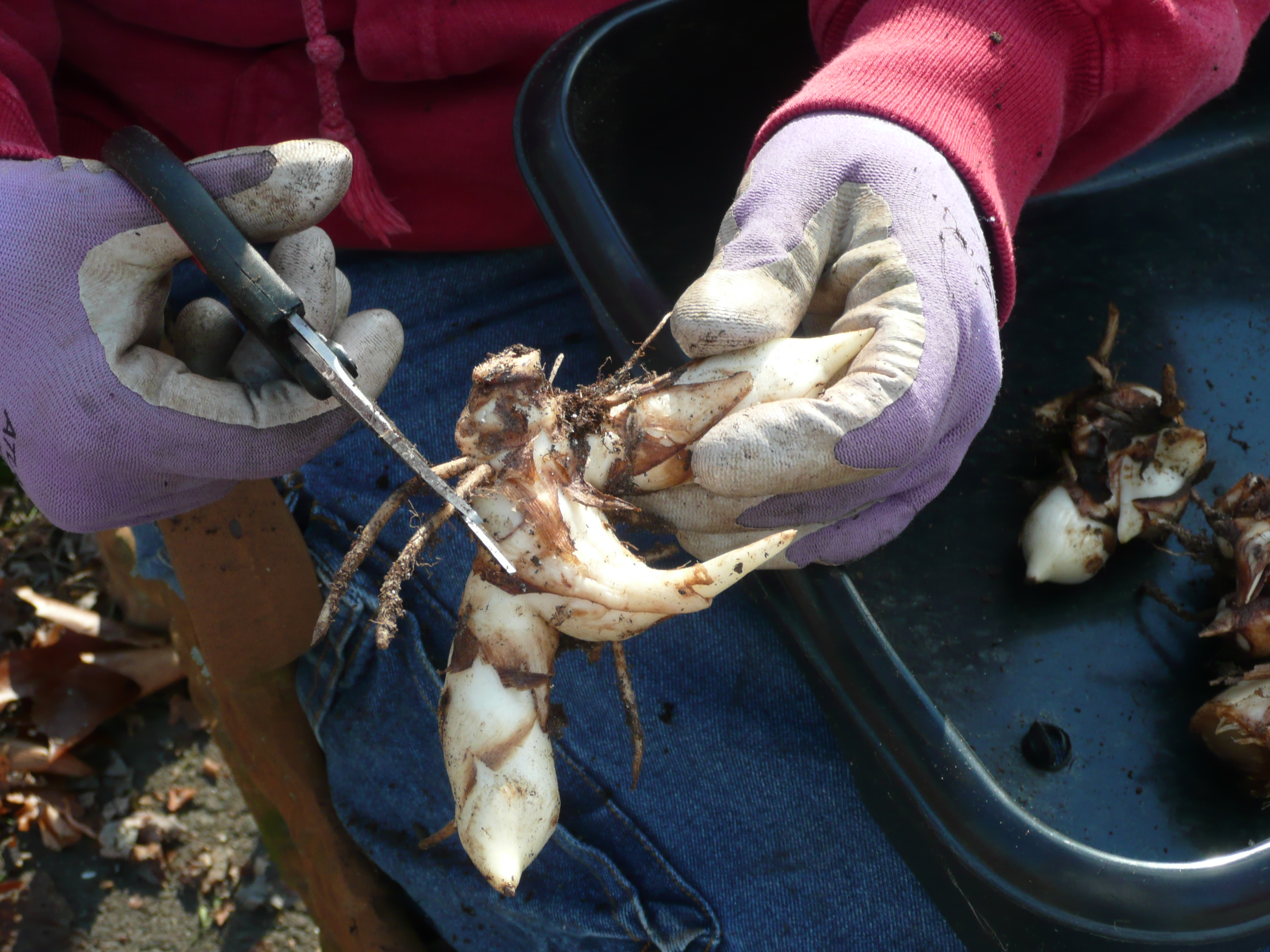
#6) Gently work away the soil around the rhizomes or pull them out.  Try to not break or damage the rhizomes.  Then cut away the skinny roots from it with “clean” scissors to trim them off (I do this so the little roots won’t rot when stored; just to clean up the rhizomes a bit). 

Cut skinny roots away

Snipping small roots

Let the rhizomes sit in the sun to dry just a bit so they are not soaking wet before storing them in peat.  My soil was damp yesterday so the rhizomes came out quite clean without much soil attached, so I just used my fingers to take soil off and gently tapped the rhizomes on a log or hard surface to get the soil off the lifted clump of rhizomes.   If needed a semi-hard brush can be used to work away any tougher soil, or even a splash of water (but remember, not a good idea to get them too wet).  I like the removed rhizomes to be clean, neat, and somewhat dry a little before moving them into a bag for storage with peat, as follows.

Rhizomes in the sun

Let sit in sun a bit

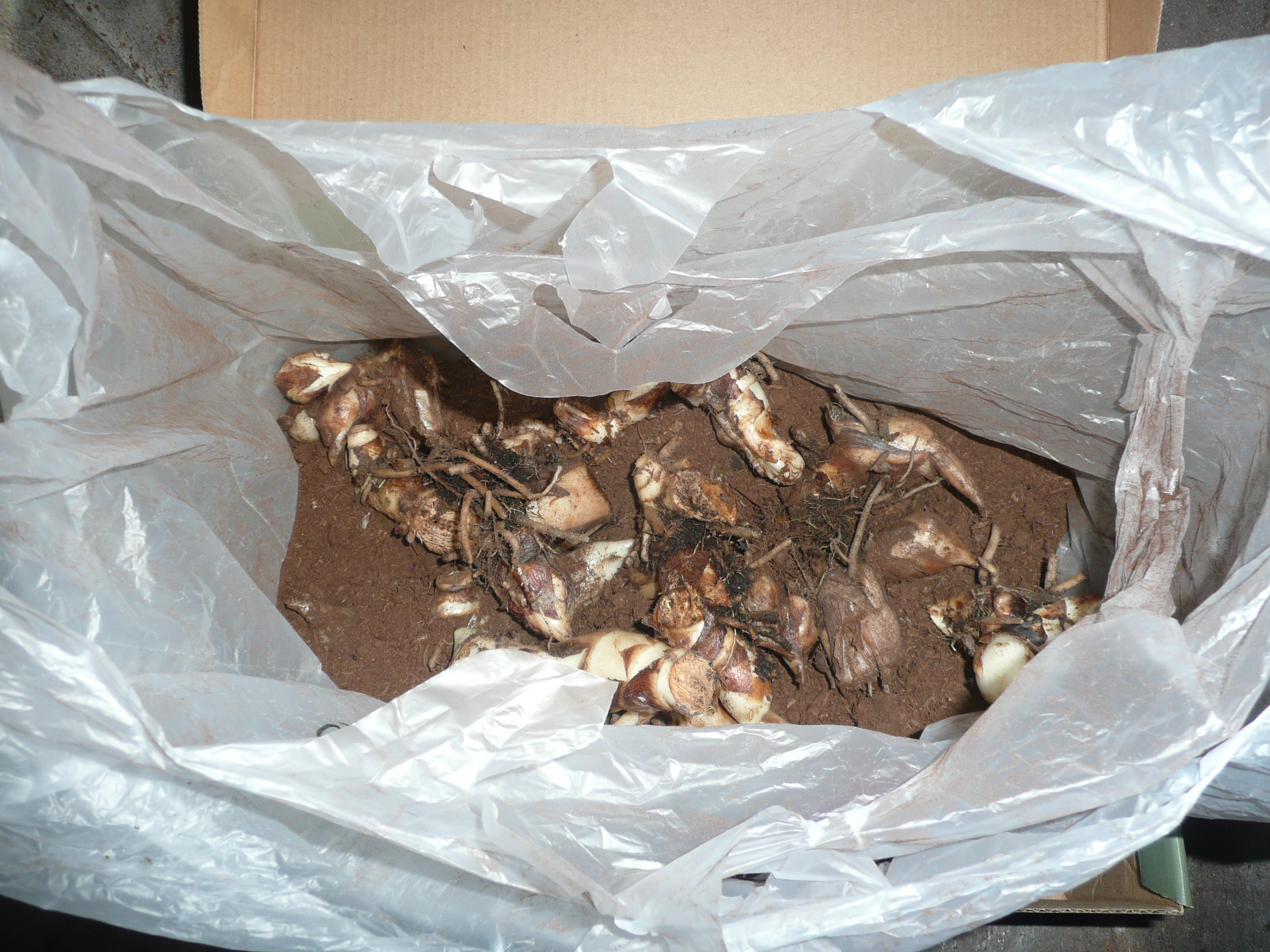
#7)  After they sit for about an hour or so in the sun, put them in light weight bags (I use bags from the grocery store) and fill them with peat.  (If the rhizomes are wet, I don’t bother moistening the peat as often recommended.  You can mist the peat very lightly.)   I toss the peat around the rhizomes, tie the bag (not tight though) and then put the bag in a cardbox box. #8)  Label the box with the plant and date stored.

Peat around Rhizomes

Rhizomes in bag w/Peat

#9)  Put the box in the basement in the coolest spot.  Again, you never want them to freeze or get dried out.  Either situation ruins them.  If it freezes, it rots.  If dry, it dies.  My place is in the basement, near the basement door, is where it is just cool enough, up off the floor on a bench.  Not near a woodstove!  This will not work, they will get too warm.  You are basicaly letting the rhizomes go dormant until next season.  I used old shoe boxes, and some tape to keep the cover closed, but not so tight there is no air.  This process has worked successfully for me for years.  It is very rewarding to reuse the rhizomes for it saves money each year.  In spring, you can cut the rhizomes to container 2-3 ‘eyes’ and start them in sand or potting soil early in the season inside the home if desired..  Then transplant into larger containers or your garden outside after the frost free date when things warm up. 

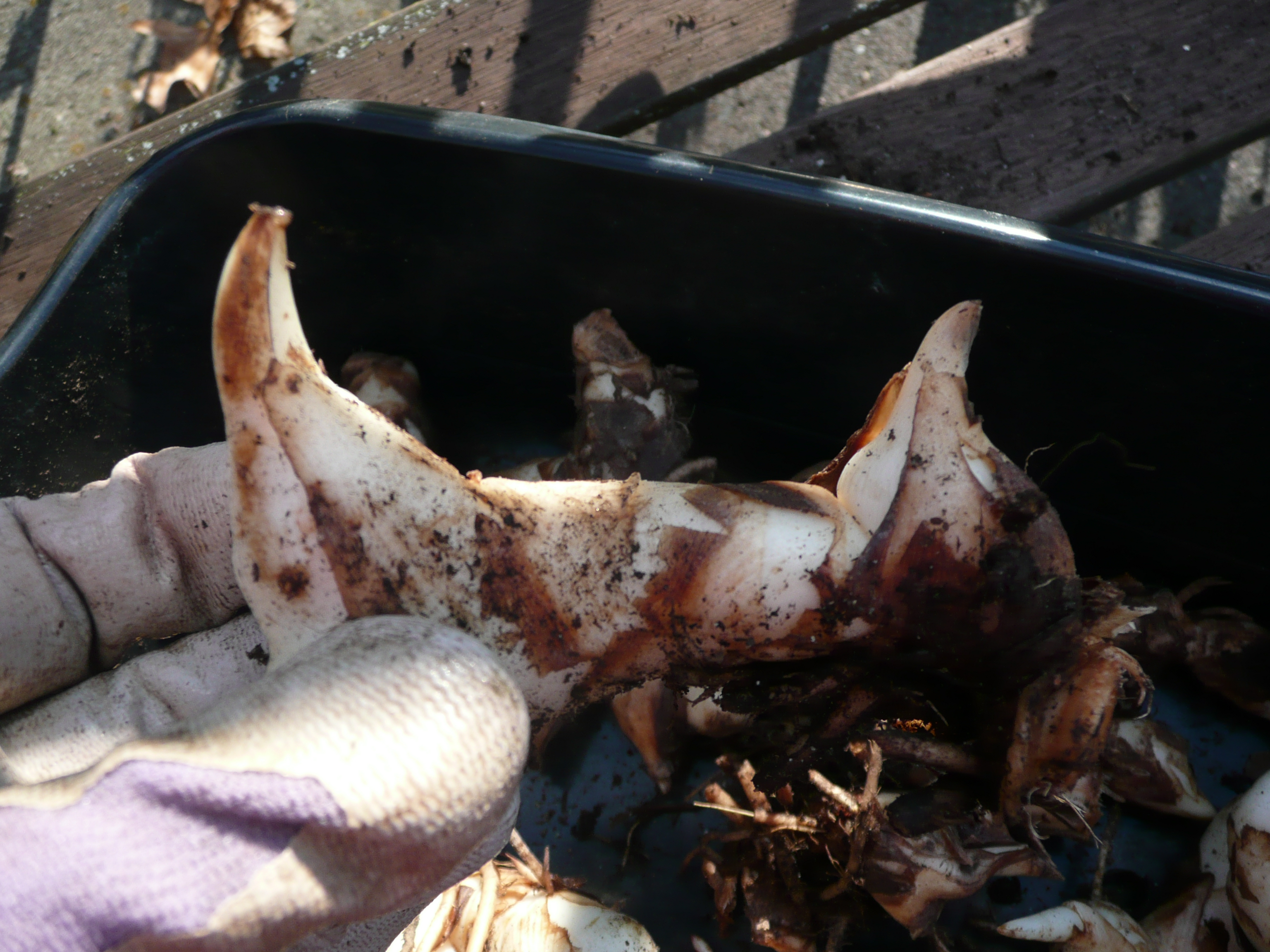
As for the rhizomes, you will see in this photo there are two bulbs like structures attached to the underground storage stem.  Don’t cut them apart before storing them.  The fleshy parts can get rotted a bit in the storage process if you do because it exposes the softer tissue.  Just leave them as is.  If you find little bulbs that pull away easily as you take them out of the soil ball, this is okay, but avoid breaking them apart.  So in this photo on the left, you can see how it is a stem with the tips pointing up of two new bulbs or eyes that can be separated next year.   Cannas are wonderful topical plants with 1 to 5 feet tall stalks, blooming mid to late summer, and showing off large lush tropical leaves in full sun.  I also store my elephant ear bulbs and dahlia tuberous roots the same way.  Dahlia clumps may be dug in the fall too but before frost and stored at 30-50F and covered with moist vermiculite.  The tuberous roots are divided so that each section has at least one shoot.  Well, more later on banana plant storage and other favorite tropicals.  Thanks, Cathy T

Gardening with Cakes

Leave a comment

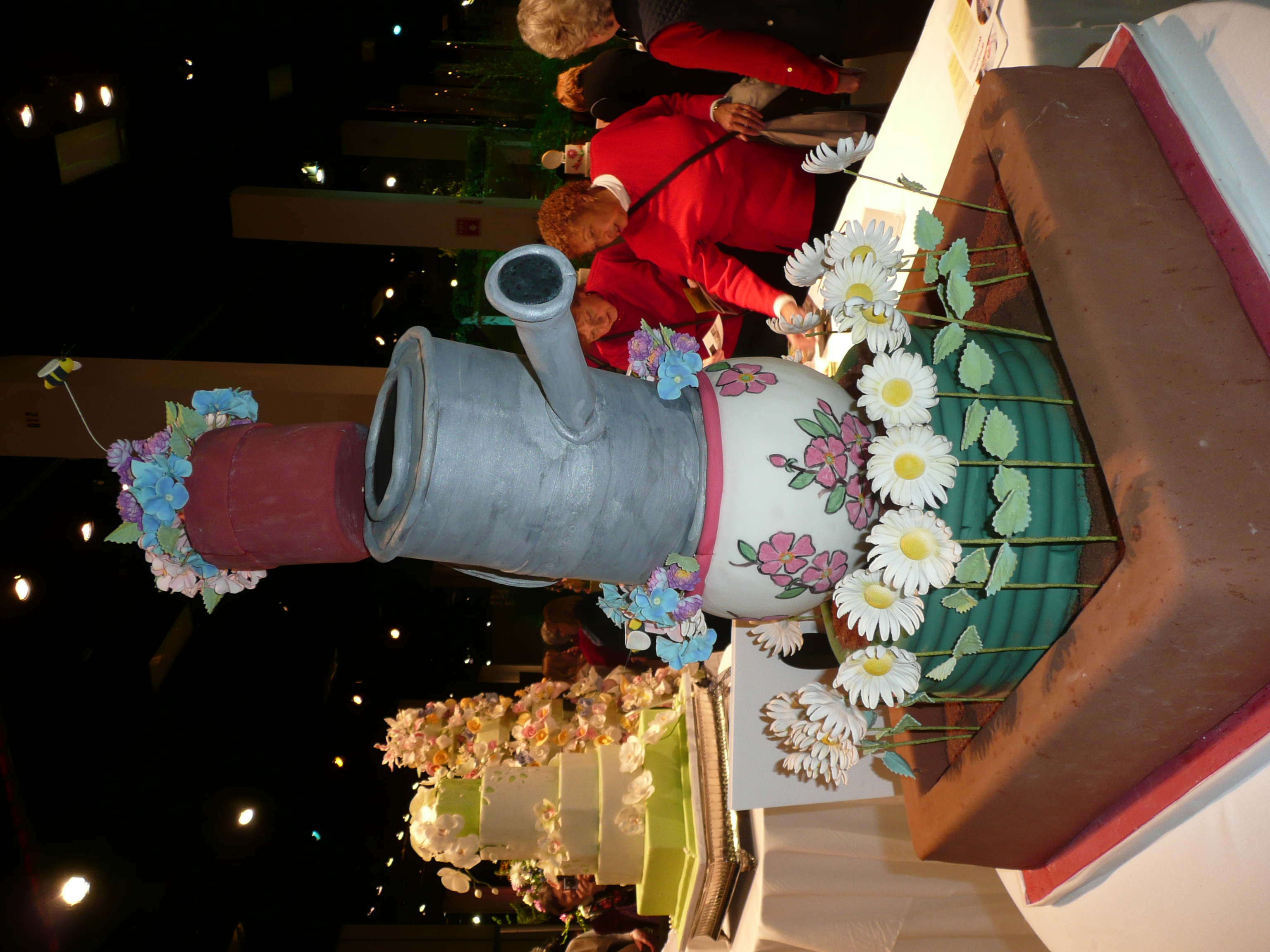
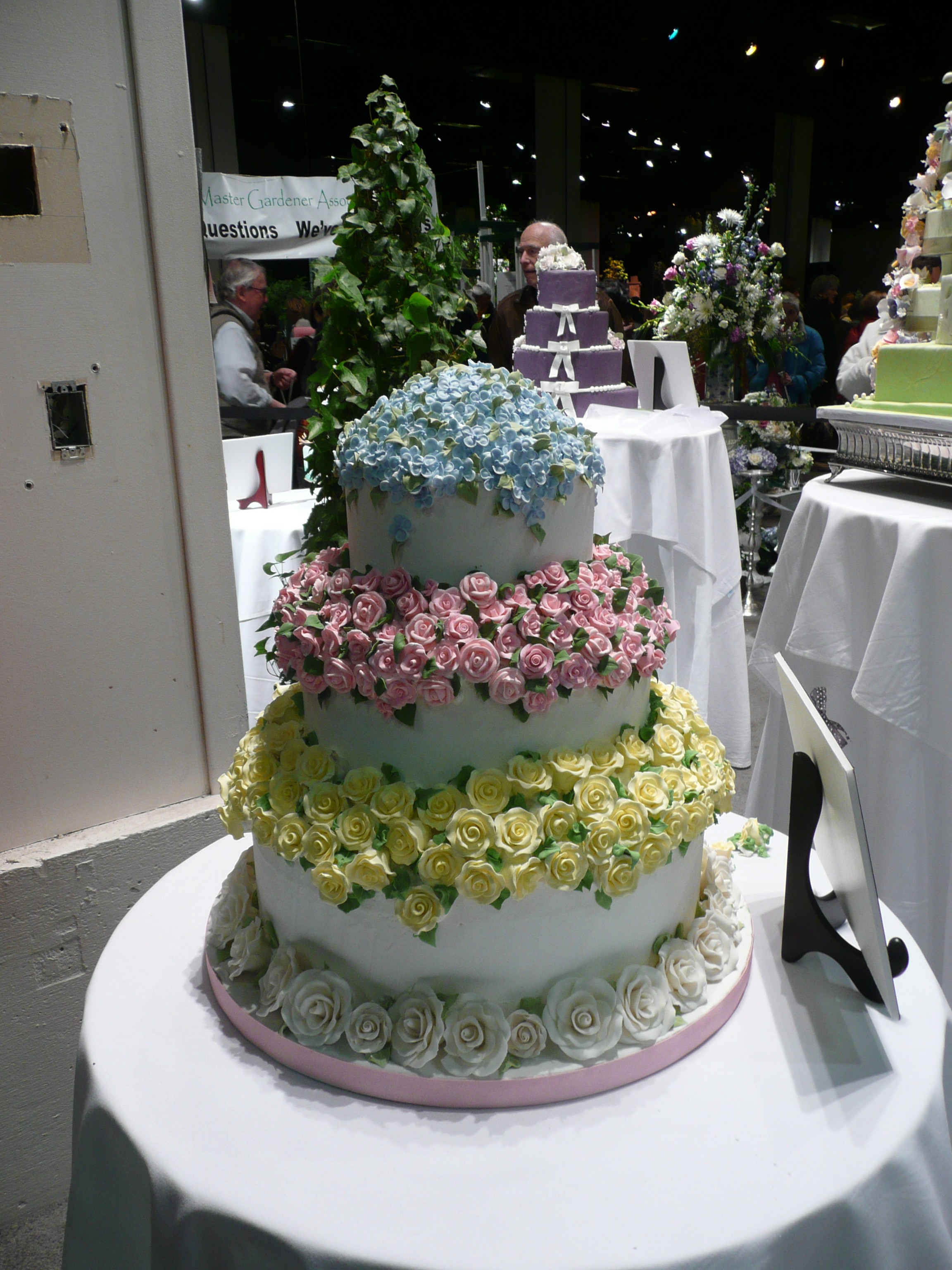
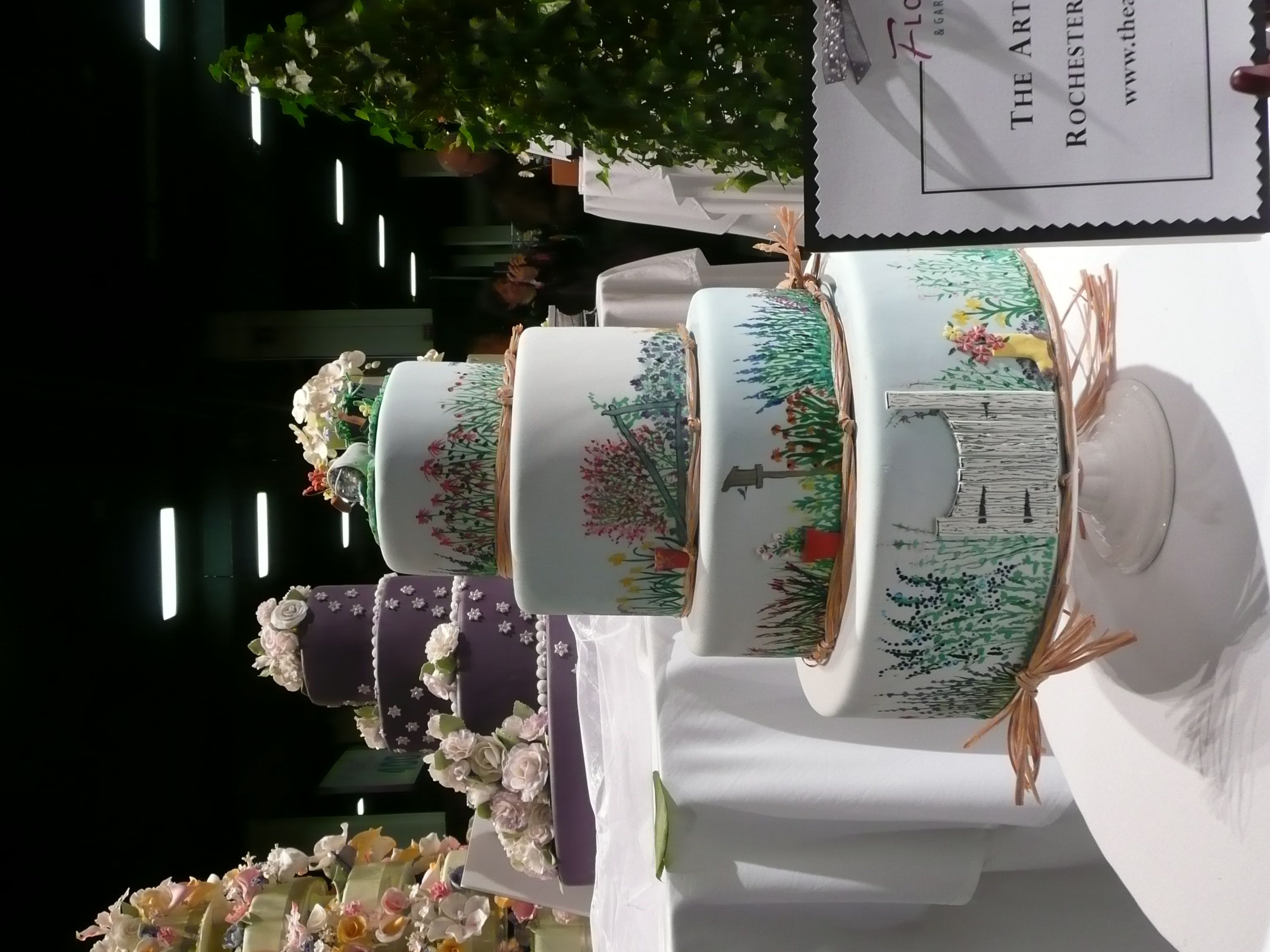
I remember writing in an email to my clients some time ago about how much I enjoy watching the cake decorating shows on television.  So, as you can imagine, it was thrilling to see the cakes featured at this year’s flower show in Boston at the Seaport World Trade Center. 

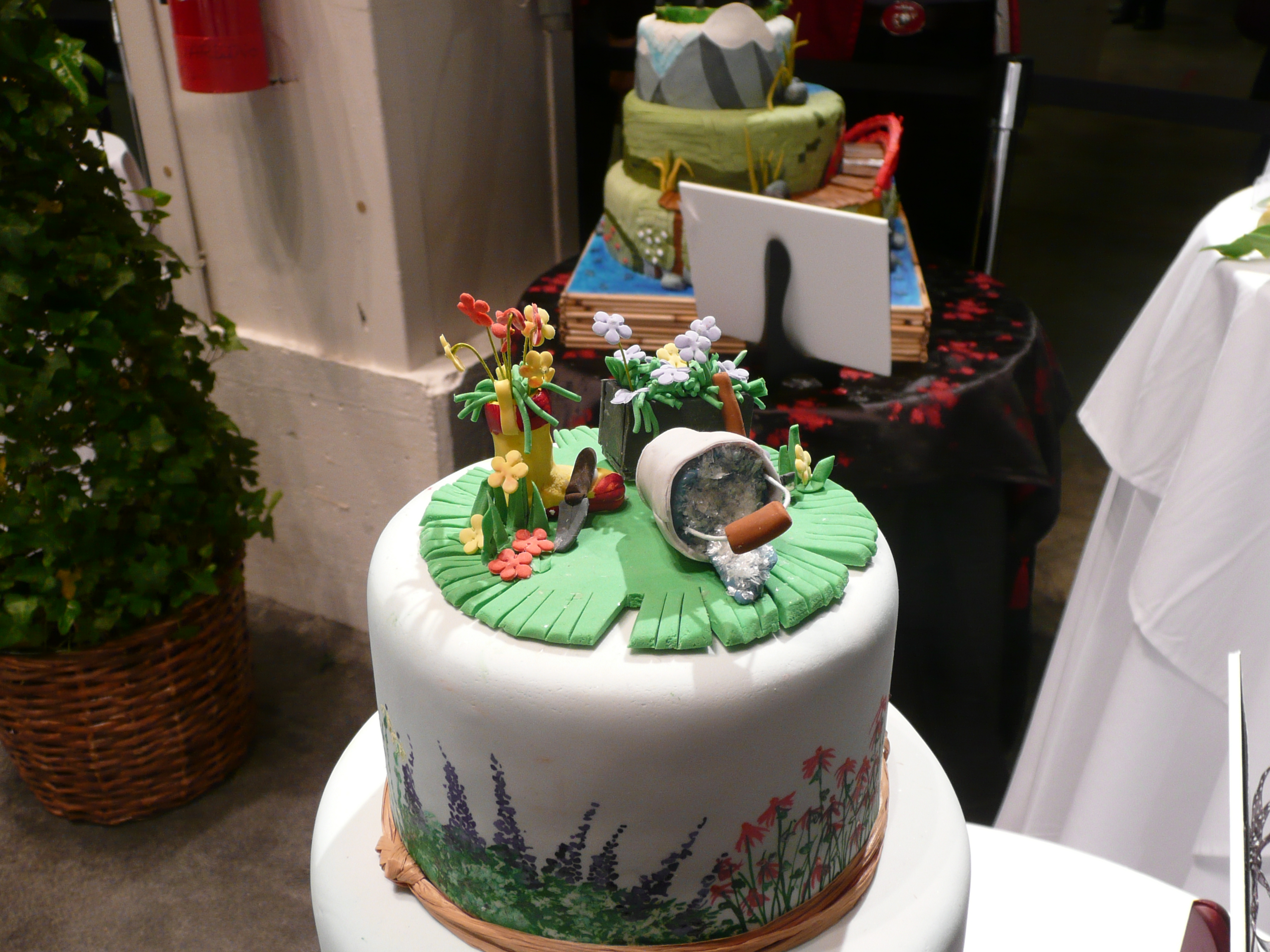
Titled “The Garden of Cakes“, their display featured amazing cakes decorated by 16 businesses throughout Massachusettes and New Hampshire.  For the first time, I took more photos of cakes than plants at a garden show.  I joked to my friend that cake decorating may be my third career someday.  

From watering cans to tasty looking roses and orchids, it was incredible to see the talents of these decorators’ spectacular inspirations.  I certainly didn’t have these choices for wedding cakes back in the 1990’s.  Today’s brides are lucky indeed.  These displays made me want to throw a garden party just to have an excuse to order one of them. 

Cake decorating reminds me a bit of the process one may go through when creating gardens or designing landscapes.  It involves a phase of inspiration to create a vision first.  On the television shows like ‘Cake Boss’ or ‘Food Network’s Extreme Cake Challenges’, the cake designers will sketch an idea for their design based on a theme.  Follows is their experience involved from knowing which materials and ingredients work best, the talent and skill needed to create blown sugars and working with fondant, and then the cakes, sometimes towering 6 to 10 feet high, have to be moved to a judging area without toppling over!  All happening within a set amount of hours and sometimes it is so rushed at the end, everyone gets nervous but has to keep their cool.  Many times the cake decorators have to make adjustments to their plans on the spot.  This is very similar to the garden design process.  It has been completely thought out and designed, yet nature may impose a change on the spot when you begin planting, so you make adjustments and that is okay. 

The other amazing part of seeing these cakes at the Boston flower show was each was uniquely different.  This holds true for designers of gardens and landscapes too.  No one garden design is ever exactly the same for each designer or gardener has their own style, preference, and knowledge base for plants – and that makes designing fun and challenging. 

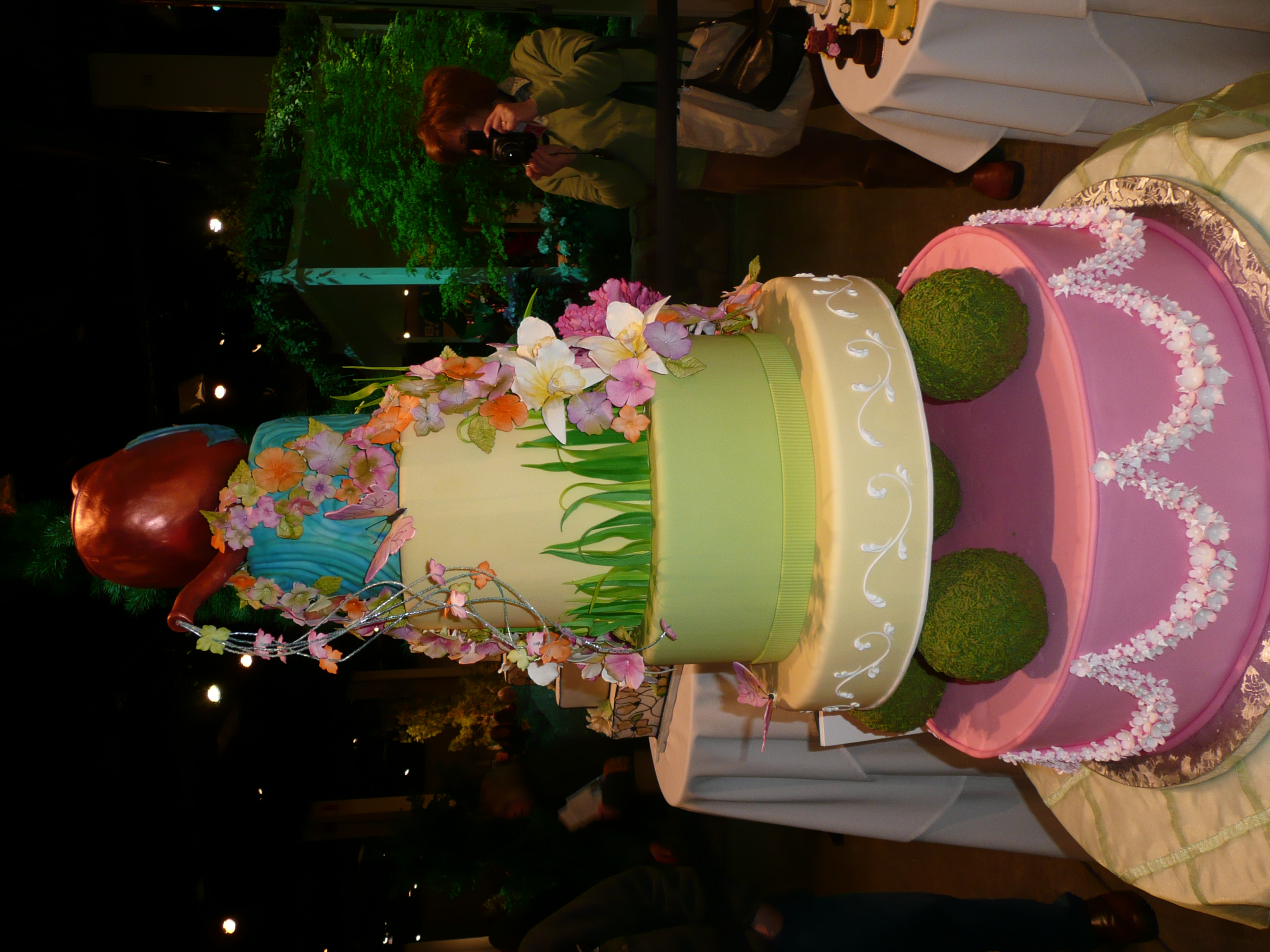
One of my favorite cakes was a design that featured moss balls (made with frosting of course) that were supporting the individual cake tiers.  The moss looked extremely real, and in the gardening world, moss seems big this year.  I’m seeing it sold more often in live form but also faux form on stones and pots for decorating up items.  In fact, later I came across the cutest handpinched pottery and moss balls (shown on the left) created by Cleve Hayes of Puddingstone Farm that specializes in handmade terracota pottery at a plant nursery items in Lawton, MI.  I was trying to get the best photos possible, but the lighting at the show is always difficult for me to manage since I’m just an amateur photographer with a digital camera (so click on the photo to enlarge it if you need to on my blog pages for a bigger, closer view of photos). 

There were other cakes that had garden flowers painted on the fondant or frosting areas with paint brushes.  These designers are not only great with techniques, but they are artists!  One can only admire their efforts as we fooled into believing some of the flowers are real on the cake!  The orchids in particular were so realistic that eventually eating them seems like it would be a crime for they were so pretty.

Perhaps trying to build a garden that looks like a cake would take this to a whole concept to new level of challenges – something for next year’s show?! 

Here’s a listing of the websites and see more photos below this list:

www.theartisankitchen.com; www.bumblebeecakes.com; www.cakeperiod.com; www.cakes4occasions.com; www.cakestoremember.biz; www.wwwisp.com/cakelady; www.jacquespastries.com; www.montilios.com; www.pepperscatering.com; www.rochebros.com; www.scrumptions.com; www.seaportboston.com; www.eatwicked.com; www.sweetcupscakes.com; www.sweetlifeconfections.com; www.tastefullywright.com

Events Make Sense!

Leave a comment

I attended New England Grows in Boston, MA last week.  It is a premier event for hort professionals where we have the opportunity to review new product lines, plant introductions, visit growers, and many other green industry organizations.  As you can imagine, being surrounded by inspiring products, cutting-edge technologies, and new plants is a treat for anyone obsessed with horticulture!  

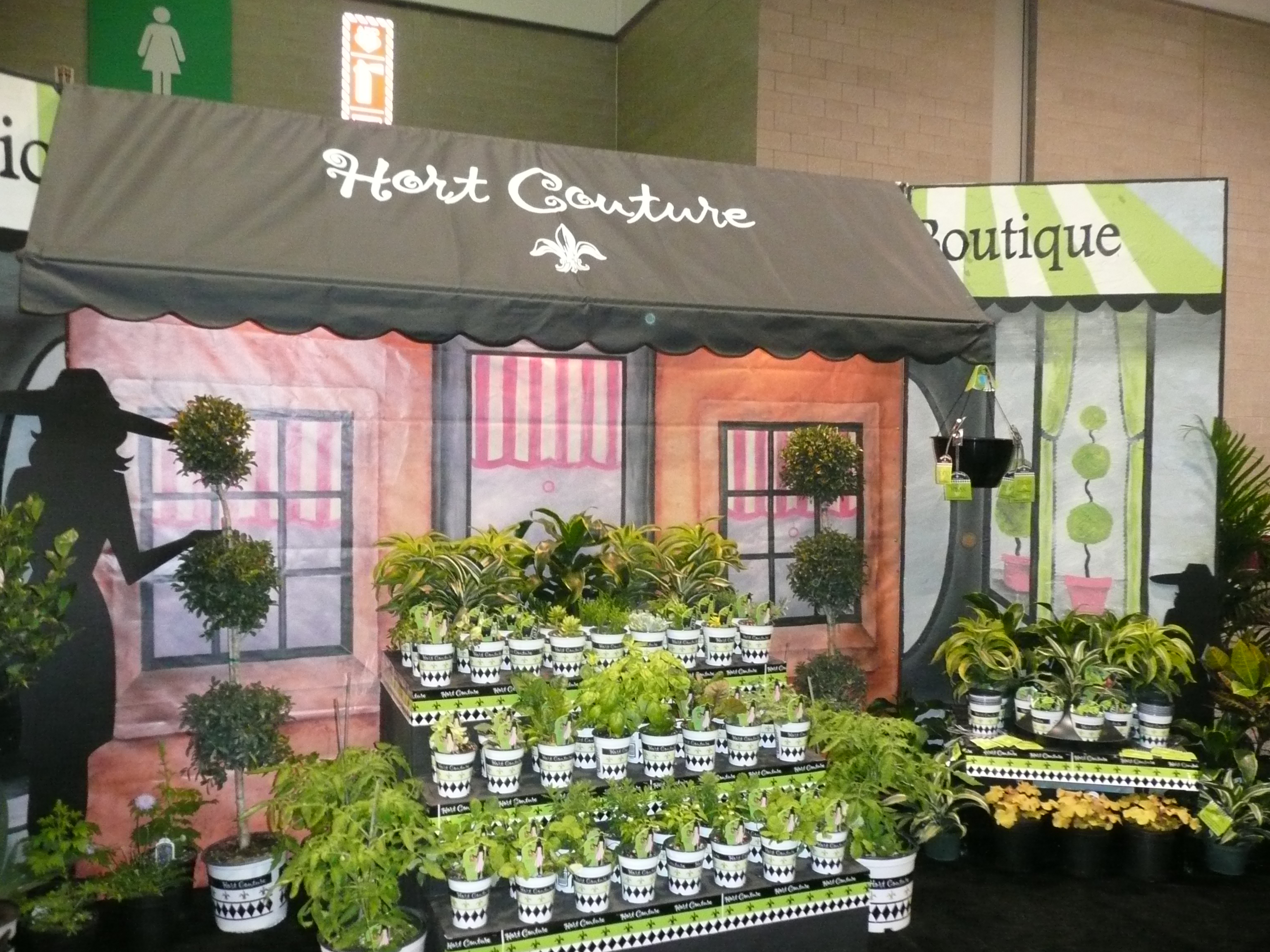
One my favorites was the display showcasing a new, fast growing plant brand called Hort Couture.  You will see from the photos in my Blog why.  This brand expresses a presence of sophistication and style via Lady Couture – their classy spokeswomen and icon!  She is a black silhouette cutout image of a lady wearing a dress and big wide brim hat – like one you would see on a runway model in Paris.  Her curvy body and simple flat shoes lets you know she has designer flare and smarts in a very Avant Garde way. 

As if strolling past boutiques along the streets of Paris, you get a sense of plant accessories as jewlery by the way this plant brand expresses their product with breeders and fine propagators behind their line.  Even the shopping bags match the potted plant labels adorned in trendy black and white diamond patterns. 
Walking the streets of plant fashion

A new plant brand and showstopper

Hort Couture’s plant tags provide catchy phrases, such as “Sun Goddess” or “Shady Lady” to indicate the cultural requirements of the plant in the pot.  My enthusiasm for their new brand, display and plants was so raised that I accidentally dropped a plant I was taking a photo of on the showroom floor!  I was so embarrassed by my faux pas, yet the booth owners didn’t turn their noses up at all.  They handled it as if it were no problem whatsoever – just as Lady Couture would have with elegance.

It was really something to see the annual Lobelia blooming deep purple-blue flowers right there in the pot that matched the embellishments printed on Lady Couture’s dress on the plant tag.  How perfect is that

This new brand works for me. It certainly beats tomatoes hanging upside down from a plastic bag on a string.  Not only is their packaging creative, they work with independent garden retailers versus the big box stores, after all a lady of Lady Couture’s standing requires the professional care performed by reputable nurseries to keep up her reputation just as plants require quality maintenance to keep up their performance.

Print on Dress matches Lobelia!

Pot Details

Hort Couture’s display racks are very colorful, informative, and eye-catching.  They meet every aspect of a gardeners’ needs and their plant line is extensive from Culinary to Tres Chic Tropicals.  They carry Coleus, Impatiens, Lantana, Nemesia, Osteospermum, Petunia, Verbena – just to name a few annuals.  As for their Culinary Couture, you can expect to see Basil, Chard, Cucumber, Cilantro, Lavender, Nasturtium, Oregano, Pepper, Rosemary, Sage, and more!  And my favorite tropicals are included: Alocasia, Caladium, Musa, Cordyline, Phormium – all popular in my container garden designs consisting of large, lush and bold.  I believe many consumers will enjoy purchasing their line of plants.

Next on my fav’s list is a product called Moss Milkshake by Moss Acres.  This company packages and ships quantities of live moss for home gardeners, landscape designers, and contractors.  Moss is a popular alternative to grass or ground covers in shady areas.  I don’t know about you but when I see a lush stand of moss in the right part of a landscape, it really gives a whole different textural, relaxing feel to the scene.  Well, now you too can grow your own moss with their new release of Moss Milkshake.

It is a convenient mix that comes in a milk carton easily prepared by just adding water, placing it on the right surfaces in the right conditions (damp, moist, shade), and voila – watch it grow within several weeks!  I like how they packaged the product for the consumer in a milk carton and how easy it is to use.  This could be applied to ground, rocks, or other flat surfaces.  I could see this being used when gardening with kids too.  When inquiring if this could be use on the outside of containers, the answer was no for it requires a flat surface and must remain damp. 

By Moss Acres

Mix and Moss It!

It would be too difficult to keep that container moist for the moss to grow, but I may test it out regardless.  I’m intrigued by this product, and like the ease of use factor.  I hope you will see this product available at your local garden centers this year too.
After a full day at New England Grows that left my feet exhausted, I had another event to look forward to at the end of the week called, “Spring into the Garden”, held annually by the CT Horticultural Society.  At this event, I had the pleasure of setting up my booth to showcase my Container Gardening and Landscape Design services.  I so enjoyed meeting the many avid gardeners visiting between the lectures.  Over 250 people attended, and luckily we did not get that huge snow storm very close to reaching our state that day.  There were many vendors and exceptional artisans featuring paintings on silks, herb products, jewelry, plants, books, orchids, bonsai, and even landscape lighting.  Visit www.cthort.org where photos to be posted soon.
Hort Couture

All lined up for the runway!