UPDATES TO MY BLOG’S MENU

Leave a comment

Just a quick FYI, I’ve been updating my blog with new menus and sub-menus. Click the links below or visit my blog to take a glimpse.  Click on the menu bar to see new drop down menus! They are works in progress and will be updated with more information daily.

HOW TO VIDEOS:

https://cathytesta.wordpress.com/writer/videos/

TROUBLEMAKER TURNED STARS:

https://cathytesta.wordpress.com/container-gardens/stars-versus-troublemakers/

THRILLER – FILLER – SPILLER:

https://cathytesta.wordpress.com/container-gardens/thriller-filler-spiller/

CONTAINER GARDEN POT TYPES:

https://cathytesta.wordpress.com/container-gardens/container-garden-pot-types/

NEW CONTAINER GARDENING BOOK COVER:

https://cathytesta.wordpress.com/container-gardens/new-container-gardening-book-cover/

Check in for more…Stay Tuned!  Cathy T

Photo: Bitstrips Source

Photo: Bitstrips Source

Bloggers are Here to Stay. Like it or Lump it, Martha.

5 Comments
Image courtesy of FreeDigitalImages.net by Stuart Miles

Image courtesy of FreeDigitalImages.net by Stuart Miles

When I saw a post shared on a private bloggers’ group page regarding how Martha Stewart dissed bloggers with her recent comments on Bloomberg TV, I immediately responded to my fellow blogging friends with an instant reply.

This is what I wrote:

This is their way of “protecting their turf” and not letting others rise to the top. I’m referring to MS and I didn’t have to listen to the video. People who rank themselves as the experts and have all the attention don’t want to let others get to their position, bloggers are people in training in some cases. OK, now I should just write a topic about this – getting wordy! LOL.

After I posted my comment above, many bloggers on this private bloggers’ page began to chime in with their thoughts and replies to my reply and everyone else’s comments.

Basically, we all took some level of offense to Martha’s comment about bloggers because everyone in this group is passionate about their blogs and what they offer to the world, which by the way, in many cases, is voluntary and without much compensation.

After re-tweeting a couple tweets related to this Martha blogger-dissing story, one of which was me tweeting this:

Bloggers are here to stay. Like it or Lump It.

I stepped away from my desk and went to the kitchen to make a quick sandwich for lunch.  Then I thought, I better get these dishes done before I go back to researching information for my next post on my blog.

As I moved my hands through the soapy dish water, I kept thinking about those words Martha spoke:

“Who are these bloggers?”

Like a rap song, it started to repeat in my head…, “Who-who-who are these (zip-zip noise of a rapper’s album spinning) bloggers? Who are these Bloggers anyways? Who-who are these Bloggers?”

It made me shake my head a bit in disgust thinking about her using the word “gripe” and saying “they are not the experts,” along with her question: “Who are these bloggers?” – which of course, she presented in a pretentious tone.  But it also made me think more about the people “like Martha Stewart” than Martha Stewart herself.

What I mean by “people like Martha” is there are people who believe they are the experts and don’t want to allow anyone else to be better than them or reach higher status, because obviously, they would lose their rank as being the best.  They hold onto their high status position strongly for either monetary reasons or some kind of elite recognition.  But in addition to this, they have a high and mighty attitude about their position.

It doesn’t matter what field you are in or which you are representing.  It could be cooking, décor, plants, or aprons – but somehow, someway, this person reached “glory” status and was given a perceived title of expert.  And sure, they worked their butts off and knew how to run a business to get there, but that very status got to their heads a little too much at some point.  They somewhere along the journey crossed from being a person who inspires to a person whom must be worshiped.

These “people like Martha” believe they are the experts in their field and maybe they are, but they also are the very ones who are or were admired from afar by people who aspire to be like them.  Or maybe their fans don’t technically aspire to be like them, but have a passion very similar to theirs.  The fans may be beginners at the expert’s similar field, been practicing it for a while, have studied too, learned, and gained experience.  Maybe they are close to being an expert themselves.  But those “people like Martha” don’t want to let them get there.

Why?  Because they fear losing their number one spot.

One of the things I love about blogging, bloggers, and the ability to share across the world with anyone willing to hear about your passion, craft, and expertise – is that you do not need an expert to give you permission to do so.  You don’t have to kiss their ring first or sing their praises.

On the flip side of that, it is also very disappointing when you have admired someone considered to be an expert and they don’t see that you would have appreciated their mentor-ship, encouragement, or even praise to acknowledge that you have achieved some level of greatness as well.  It may be big or small, comparable to theirs, or not even close – but you have been working hard at it too.

When they, the people like Martha, get to that place where they don’t want to allow anyone else to be as grand as them, this is when they have lost their true gift – The gift which got them to their expert status in the first place.

If you were or are a super football player for example, and you coach students to learn how to be the best player as well, this is admirable and a worthwhile way to live.

If you are a super-star player, and won’t let anyone else on the playing field, what’s the point?

As I continued to click through tweets to find other bloggers’ commentaries on the Martha blogger-dissing story, I felt an even stronger admiration for bloggers and their willingness to share the playing field and not keep it all to themselves.  This, again, is what is powerful about blogging.  We ‘can’ share, can be seen and heard, and don’t have to meet anyone’s standards to do so.  The only people who need to approve are those admiring our offerings.

Does the fact we are not experts diminish the quality of our posts and shared information at times? Perhaps.  But you know what, I say it’s worth the risk.  I’d rather discover an unknown talent willing to share what they know in a passionate true way than not know they are out there because some expert would rather keep all the glory to themselves.

Written by Cathy Testa

P.S.  Yes, I know I have some grammatical errors.  I haven’t had ‘my recipe’ tested yet.  Now let me get back to my post – about how to build birdhouses.  Thank you.

Image courtesy of FreeDigitalImages.net by Kibsri. SHOWING EXPRESSIONS OF BLOGGERS WHEN THEY READ THE NEWS.

Image courtesy of FreeDigitalImages.net by Kibsri. SHOWING EXPRESSIONS OF PUMPKIN BLOGGERS WHEN THEY READ THE NEWS ABOUT MARTHA.

I like Jen Singer’s MommaSaid.net post about the Martha blogger dissing story as well – FYI: Click HERE.

Tall blazing-star

Leave a comment

Very cool to see a different blazing star, thanks to “Portraits of Wildflowers” blog, I was able to see this one, Cathy T

Steve Schwartzman's avatarPortraits of Wildflowers

Another thing that excited me on my visit to Bastrop State Park on September 6th was Liatris aspera, a species of blazing-star (also called gayfeather) that I’d never seen before, and one that doesn’t grow in Austin. Apparently the common name of this species is tall blazing-star, based on its relatively tall flower spikes. (The Latin species name means ‘rough,’ but I didn’t notice anything that made this species any rougher than the Liatris mucronata so common in Austin.)

The flower spike shown here was obviously leaning to the side, and I photographed just a portion of it in order to record the details in the clusters of flowers and buds. And what, you must be wondering, accounts for that rich orange background that sets off the purple flowers so well? What you’re seeing there, out of focus of course, is a patch of the sandy, iron-rich soil so…

View original post 20 more words

I Wish I Was as Strong as An Ant

3 Comments
Image Courtesy of FreeDigitalPhotos.net/by Sweet Crisis

Image Courtesy of FreeDigitalPhotos.net/by Sweet Crisis

When I take down my container gardens for the season.

Lifting objects fifty times my weight would be handy right around now when I start taking apart my large container gardens and patio pots on my deck for the close of the season.

Years ago, I had no problem whatsoever doing this process, but as one ages – well, you know, if you don’t keep up with those muscle building routines, it can become difficult.  In fact, when I gave talks on container gardens and why “bigger pots are better,” some ladies in the classroom would ask, “How the heck did you manage moving all those big pots?!”

Sometimes I get so excited about container gardening, I instantly find super power energy enabling me to lift heavy bags of container garden soil or other items needed like the big pots. However, during this year’s take down process for my container gardens, I felt a little weak at times.

In fact, I started to tell myself, stop feeling frustrated about taking down your plants in your container gardens!  It is part of the process and get into the spirit.  So I did some of my work of breaking down the 20+ or so large container gardens on my deck yesterday, and as I was doing so, I thought I’d share some of the things I found frustrating or helpful during the process.

Soil from Containers

Soil from Containers

GET A WHEEL BARREL OUT

Last year I was lucky. I had a new huge cement planter near my deck and I tossed the left over soil into that, but this year, I had to use my wheel barrel.  At first, however, it fell over from the weight of the soil falling from the deck level above into the barrel as I tossed it over the railing.  So I attempted to move my pick up truck to the deck, well, that didn’t work.  It was too difficult to maneuver the truck to the corner of my deck.

photo (7)

So, it was back to using the wheel barrel.  After getting a big lump of a root ball or two into the barrel, it stabilized and I was able to continue dumping the soil into the wheel barrel receptacle from above.  I will use this soil in the ground somewhere to recycle it as it doesn’t do well being reused in my container pots next year – It is best to have fresh container gardening soil each season, in my opinion, but to use it as a top dress to a garden bed or for a new garden bed is a good idea.

PLASTIC LINERS FOR POTS

In my container garden demonstrations, I show folks how to line their containers and patio pots with plastic liners (which must have slits and holes cut into them for drainage).  The reason I started doing this many years ago was more to keep the containers in good shape, but it also turns out to be a very effective method for slipping the whole root ball out of the containers at the end of the season.  The roots circle a bit around the edges within the liner, and it forms a nice ball or chunk when you are ready to take the plants and soil out.  It is a great tip for plants like Canna plants because they get large rhizomes and roots in the soil, making removal difficult. So I was happy my liners were working perfectly as I was removing the soil from my pots.

Foliage being Tossed into a Bin.

Foliage being Tossed into a Bin.

CUTTING ALL THE STEMS AND FOLIAGE OFF

Before slipping the soil out of the pots with the liners, I cut off all the foliage and stems to about 4″ from the base for plants I’m tossing in the compost pile. The little stub of a stem helps to lift the root ball out of the pots, at least in sections or chunks. The key here – use good sharp pruners or a serrated knife for large stems, and make sure to clean or disinfect them so you don’t spread any yuck (diseases) around, even during the take down process, clean tools are important.  I tossed my cuttings into a large bin on my deck, another item which came in handy as I was working.  It is easier to take all the foliage off before trying to move pots to a location or to the spot where I was tossing out the soil into my wheel barrel. Seeing the cut off stems of my elephant ears made me sad, and also made me think that I should have setup a station to make leaf imprints in a concrete mix as a side project at this time, especially because I have plenty of leaves to use, but that’s another crafty project requiring time.

WASHING THE POTS

Sometimes I feel a little lazy, but I force myself to wash the pots with a little soapy water, and a soft brush to clear away any soil residue left in or on the pots.  Then air-dry the pots completely before moving the containers into a garage or shed.  It is important to not skip this step. Cleanliness is so important for your plants when you begin again next spring to replant your containers.  It greatly reduces, if not eliminates, potential plant diseases or problems and you will be happy you cleaned them the year prior.

My Big Kalanchoe, Going to a Foster Home.

My Big Kalanchoe, Going to a Foster Home.

FINDING NEW HOMES

For container plants which I can not fit into my home (yup, read my blog earlier about greenhouse procrastination), I stand there contemplating where I can fit this – or should I give the plant to a friend or family member with a bigger house? The one I’m struggling with right now is my Kalanchoe (paddle plant).  It is HUGE. I know I can easily propagate some with cuttings, but I keep looking at it saying, should I cram it in my bedroom again to keep it alive all winter? Or give it to my sis in law with a big open bright living room with lots of windows?  Oh gosh, the challenges!!  I don’t know.

Hypertufa at End of Season.

Hypertufa at End of Season.

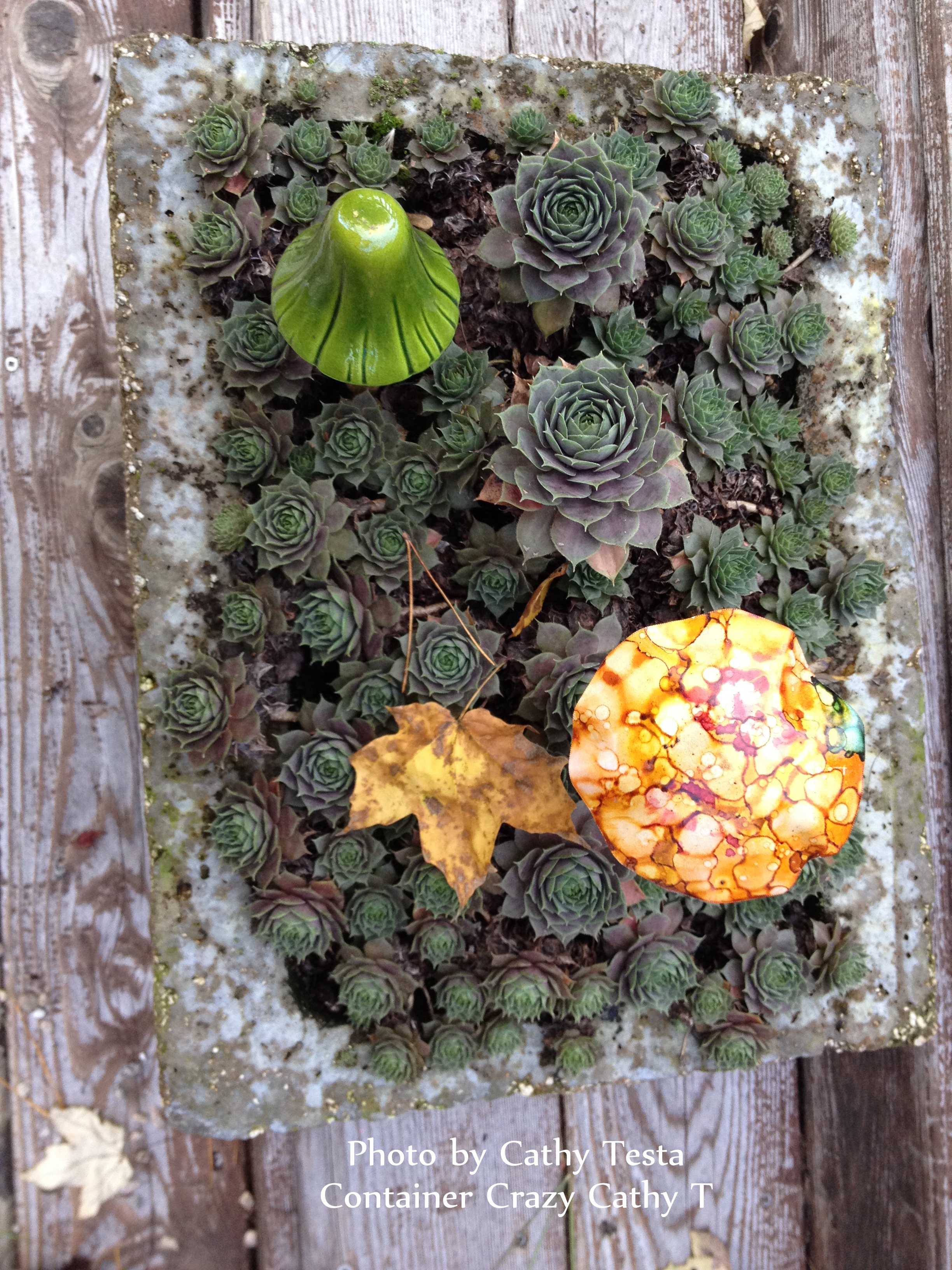
I also have a beautiful hypertufa stuffed with Sempervivums (hens-n-chicks).  They are pretty tough, can go really dry all winter with little watering, but I don’t have room in my kitchen garden window because I put my head planters there.  Gosh, where will this one go?

These are the challenges I face, never mind the fact I just don’t want to stop admiring my container garden plants outdoors, but winter is coming.

HAVING A GLASS OF WINE

Another downfall, or plus depending on your point of view, is that I started feeling like I wanted to have a glass of wine and enjoy my deck.  It is one of my favorite spots at my home. If you were to ask me – What is your favorite spot? Well, it is our deck.  I always feel like it is a vacation spot or oasis with all my big tropical plants every summer.  I get to decorate it with all my garden decor, and it faces a private backyard, so it is really a retreat.  So because I was out there on a nice, sunny fall day, and being around my beautiful plants, I felt like, gee, I should relax and have a glass of wine.  So I did after I disassembled about five or so of the smaller of my big containers.  Today, I will tackle the bigger ones.  This will require a hand-truck, some patience, and strength.

Wish me luck!

Cathy Testa

Because it is October.

10 Comments
Photo by Cathy Testa

Photo by Cathy Testa

We had wonderful weather the past two weeks, best of fall (so far), at least in my opinion.  And the rainfall yesterday was needed to shower our beautiful mums and other plants in our landscapes.  Mums provide the much needed splashes of bright color along with the leaves changing as we transition through October.  Hope you have or are getting your pumpkins out.

A Reminder:  Don’t forget, a class offering on October 13th, Sunday for anyone interested in learning how to overwinter canna, elephant ears, or banana plants.  See my posting regarding the details HERE.  It is casual and informal but a great way to learn if you need that hands-on experience for your tender plants.  Feel free to contact me with any questions or to sign up, email me at containercathy@gmail.com.
Enjoy your week in the meantime, heard mid-week will be sunny!

Cathy Testa

A Fairy, the Castor Bean Plant, and Poison. Can They All Live Happily Together?

16 Comments

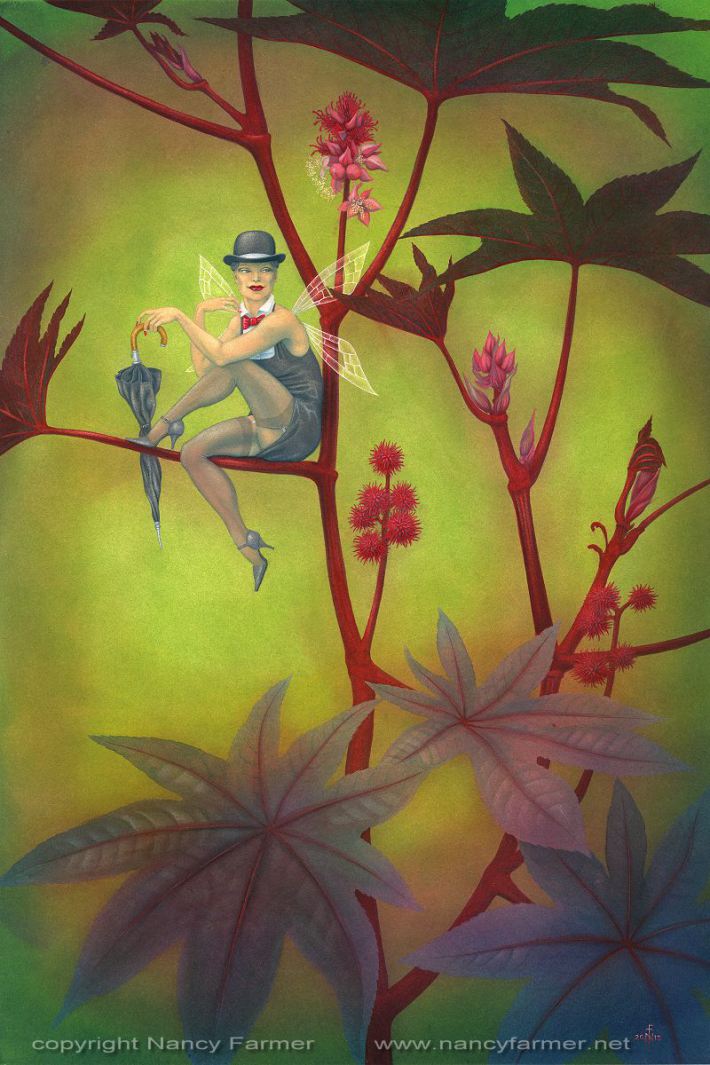
Perhaps the only person to definitely know if the castor bean plant and its three little seeds lying within each of its seed capsules has been and continues to be falsely portrayed as a lurking killer is the beautiful and bold imaginary fairy by the name of Ricina, a clever creation by Nancy Farmer, an artist residing in the United Kingdom.

A FAIRY

  • a small imaginary being of human form that has magical powers, esp. a female one.” (source: Google)

Art may be left up to the interpretation of the admirer or defined by its originator but my perception of Nancy Farmer’s creation, the fairy she named Ricina, is of a mature woman seductively perched upon the stalk of a castor bean plant.  With her eyes glanced to the side and a sneaky facial expression, Ricina appears to be ready to protect or serve the possible magical yet deceptive powers of the plant and its seeds. Her bright red lips and finger nail polish flanked by a smart little red bow tie around her neck matching her classic attire provides the admirer a glimpse of her individualistic style. And she looks a little playful too with a suggestive rise in her sexy leg and fashionable but just the right sized heeled shoes. A handsome umbrella dangles from the tips of her fingers and she sports a masculine hat – teasing mementos to remind of past stories and tales regarding the castor bean seeds and its potentially lethal toxin known as ricin.

Copyright Photo, Permission Required by Originator

Image courtesy of Nancy Farmer/www.nancyfarmer.net and nancyfarmer.wordpress.com

If Ricina could buzz by our ears, perhaps she would whisper there is nothing to fear. For only those with harmful and deliberate intentions could possibly use the plant’s powerful little bean-shaped seeds for malice and not joy.  She knows it requires the elements of keen knowledge about the plant’s toxic components and a bit of unrealistic determination by the offender.  Or maybe she would tell us only a fool would pry apart prickly seed capsules designed to keep predators at bay and then chew its seeds obviously marked with suspicious patterns.

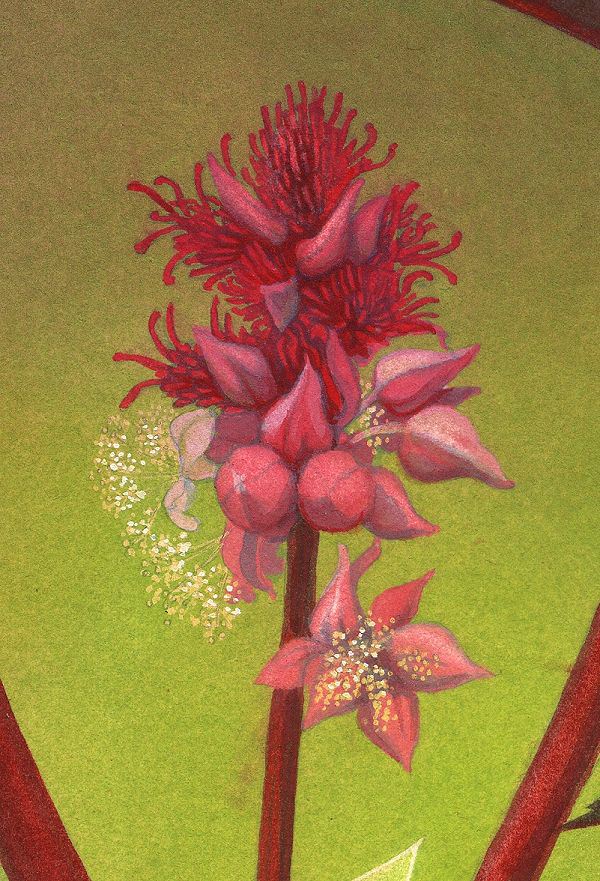
Nancy Farmers artwork of the castor bean flowers (www.nancyfarmer.net and anancyfarmer.wordpress.com)

Nancy Farmers artwork of the castor bean flowers (www.nancyfarmer.net and anancyfarmer.wordpress.com)

She would continue to reveal the beautiful benefits of the plants’ ornamental characteristics and its ability to thrive with little encouragement to provide grandeur in our gardens.  As she continues to deflect our attention from unproven matters of the castor bean plant, she may fly around exclaiming the exceptional as well as unattractive features of the plant from its large showy leaves, a towering height, and flowers with a combination of features as complex as its tales. The key, she should would say, is to admire ‘all of the plant’s’ wonderful virtues along with its adversity.  Because the castor bean plant has its good and bad sides.

Source Permitted by: Nancy Farmer (www.nancyfarmer.net/nancyfarmer.wordpress.com)

Source Permitted by: Nancy Farmer (www.nancyfarmer.net/nancyfarmer.wordpress.com)

Source Permitted by:  Nancy Farmer of www.nancyfarmer.net and nancyfarmer.wordpress.com

Source Permitted by: Nancy Farmer of http://www.nancyfarmer.net and nancyfarmer.wordpress.com

THE CASTOR BEAN PLANT

  • “A large shrub of tropical Africa and Asia having large palmate leaves and spiny capsules containing seeds that are the source of castor oil and ricin; widely naturalized throughout the tropics.”  (source: thefreedictionary.com)
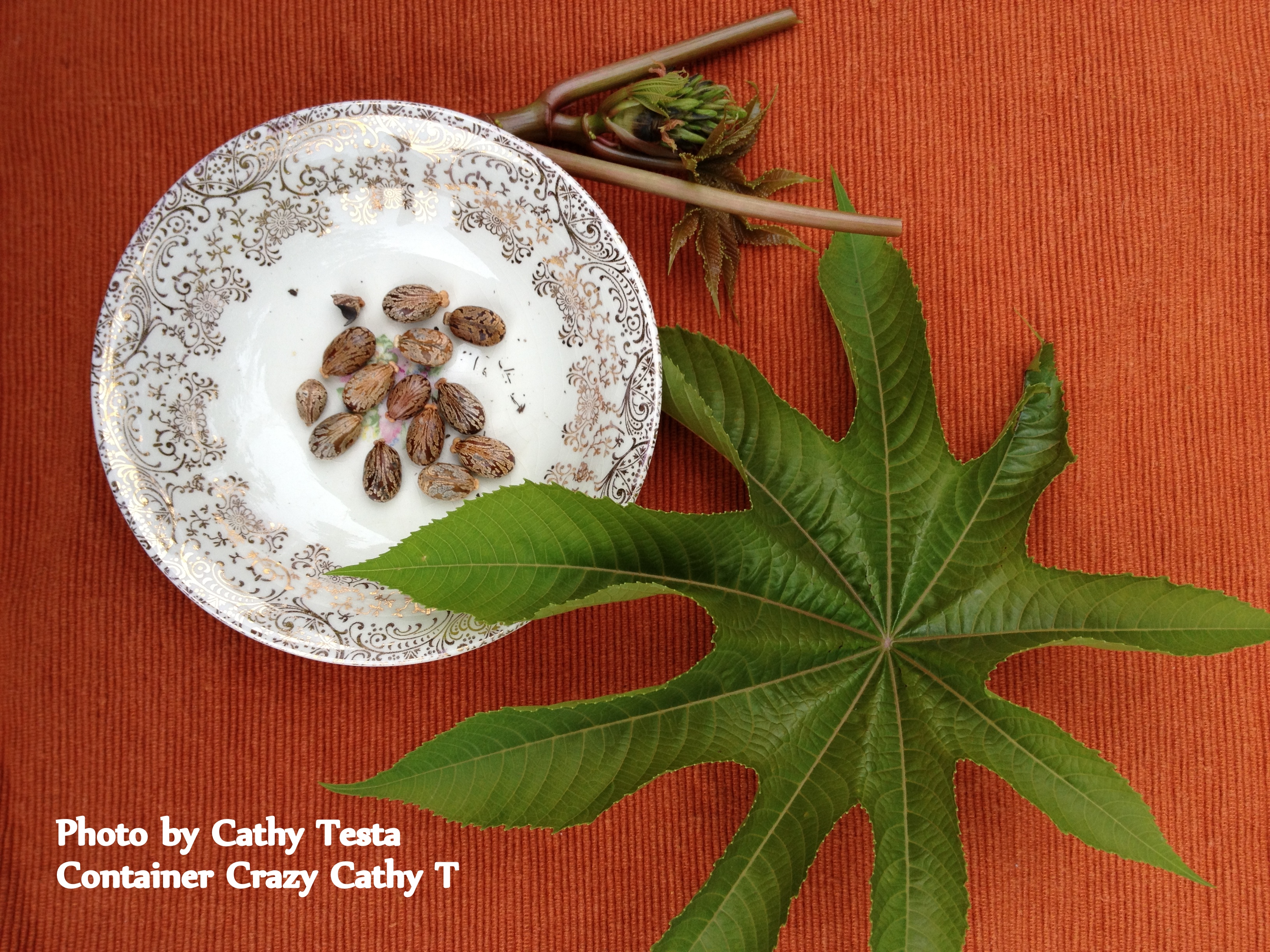
Castor Bean Seeds with a Leaf

Castor Bean Seeds with a Leaf

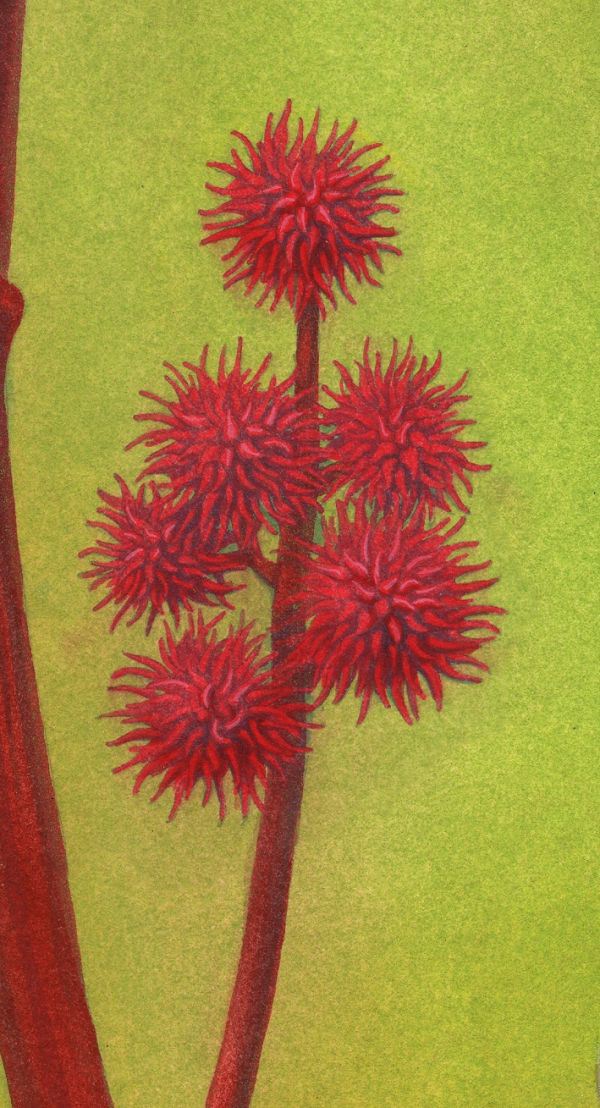
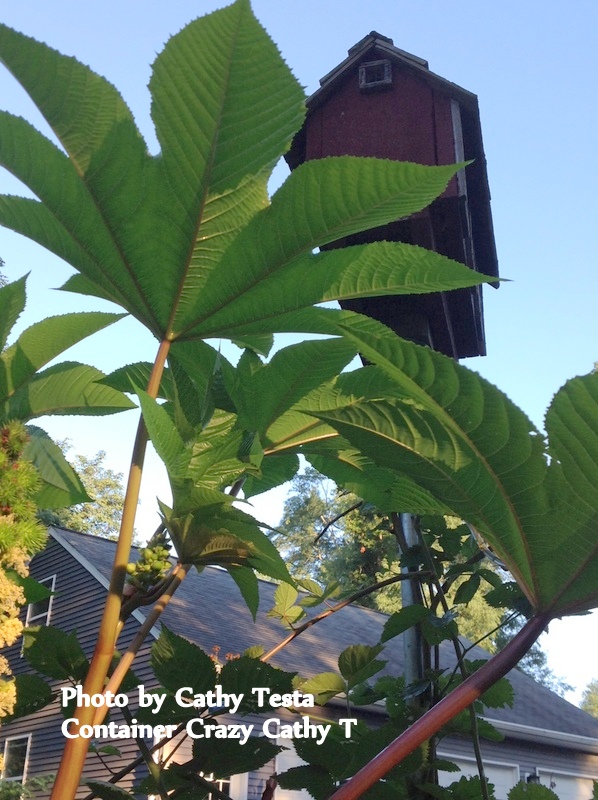
The castor bean plant or castor oil plant (Ricinus communis) is a tropical shrub or tree hardy in planting zones 10-11.  It is treated as an annual in Connecticut’s planting zones since it will not survive winter temperatures here. The plant grows rapidly from seed when planted in ideal conditions. It can easily reach between ten to twelve feet in a single season. As the stalk increases in diameter, it resembles thick bamboo. Large distinctive green leaves growing from the tips of long petioles are lobed shaped with several pointed star-like tips.  The species is primarily green, but cultivars come in vivid red to maroon colors, including the seed capsules.

Nancy Farmer's artwork of the red seed capsules of a cultivar the castor bean plant

Nancy Farmer’s artwork of the red seed capsules of a cultivar the castor bean plant

Photo Courtsey of Nancy Farmer's Artwork

Photo Courtesy of Nancy Farmer’s Artwork (www.nancyfarmer.net and nancyfarmer.wordpress.com)

The plant’s odd-looking flowers consist of separate male and female flowers on the same plant. When both sexes are on the same plant, this is termed monoecious. The male flowers are white and tiny, situated just below the female flowers.  Red styles, the narrow part of the pistils, are clearly visible on the female parts of the plant.

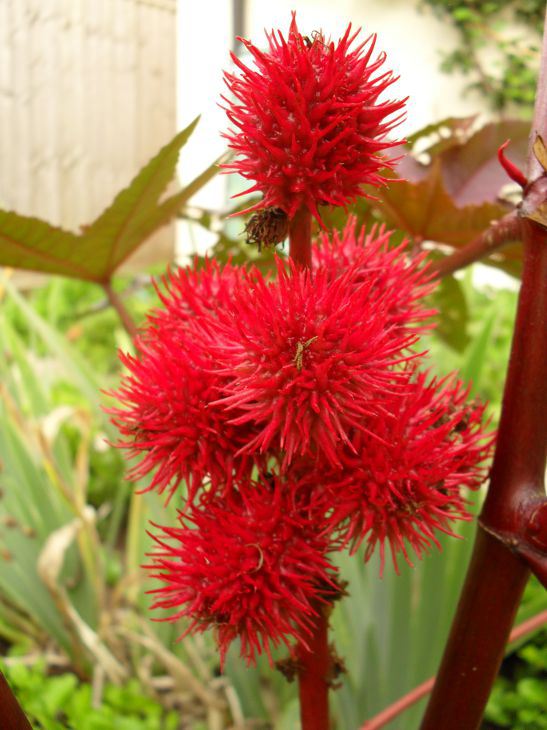
Female Flowers on a Castor Bean Plant

Female Flowers on a Castor Bean Plant

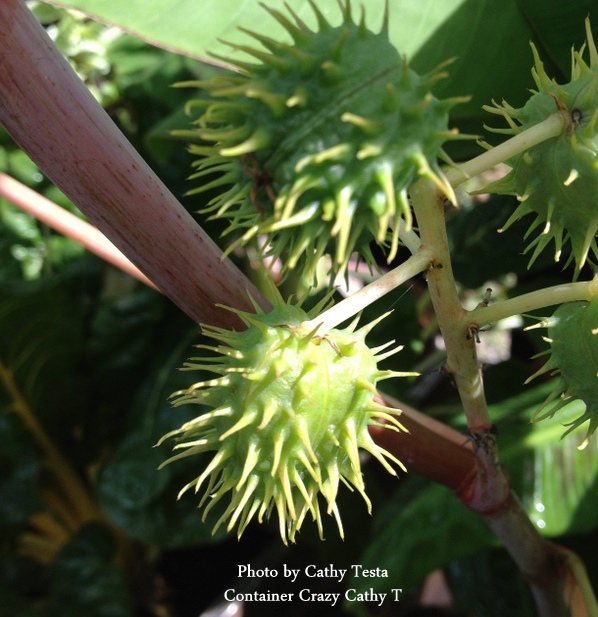
Prickly seed capsules - Ricinus communis

Prickly seed capsules – Ricinus communis

Round seed capsules grow from the female flowers which are rather interesting. They are composed of three joined lobes or hulls covered with soft prickly spines. Inside each prickly capsule are the infamous castor bean seeds, known to be the source of a potentially lethal toxic, known as ricin. Although the castor bean seeds are the size of edible beans, think kidney beans – they are not true beans at all.  And they are not meant for direct consumption, but used for the production of castor oil and other traditional medicines. Some people think the seeds resemble inflated ticks, and the genus name Ricinus is the Latin word for tick.

Mature seeds of the castor bean plant

Mature seeds of the castor bean plant

Immature seeds in the capsule.  Photo by Cathy Testa

Immature seeds in the capsule. Photo by Cathy Testa

A POISON

  • “a substance that, when introduced into or absorbed by a living organism, causes death or injury, esp. one that kills by rapid action even in a small quantity.” (source: Google)
  • “a person, idea, action, or situation that is considered to have a destructive or corrupting effect or influence.” (source: Google)

Relief from the use of castor oil derived from the seeds of the castor bean plant (Ricinus communis) may yield some benefits for people still using this remedy as a laxative, but there are reported sinister sides to the seeds, that when used in a specific fashion and with its toxic substance, will lead to illness and sometimes death of an unsuspecting victim. Some stories or myths shared from past to present about such occurrences, including claims of sneaky murders from administering ricin with a common umbrella as the mode of transmission, to claims of accidental deaths from chewing the seeds without the realization of the disastrous results days later, may be somewhat exaggerated.

In the words of John Robertson who has spent ten years researching, writing and talking about poisonous plants:

Butthough ricin is extremely poisonous it actually does little harm. Around one million tons of castor beans are processed each year for castor oil production leaving the waste pulp with up to 50,000 tons of ricin in it. And, yet, finding instances of ricin poisoning is not an easy task. (source: THE POISON GARDEN website)

Victims are said to suffer from vomiting, diarrhea and dehydration once attacked by the evil person in possession of the ricin.  Others have eaten the castor bean seeds in ignorance with the belief it is a medical solution to their health problem. Yet the more you read regarding the poisoning powers of the infamous castor bean seeds, the more unclear the accusations and exaggerations become regarding the potential for eventual death to occur. Some sources attempt to explain the differences between poisonous and dangerous because a person can do no harm without the right combination of both a lethal toxin and attitude.

In a ten minute video on THE POISON GARDEN website about ricin, John Robertson states, There’s a big difference between poisonous and harmful.  For a poisonous plant to become harmful, there has to be a way to administer the poison.

Leaf of the castor bean plant (Ricinus communis)

Leaf of the castor bean plant (Ricinus communis)

THE HAPPY TOGETHER

Many references will indicate you should keep the castor bean plant and especially its seeds away from children or animals, and should you have either, this may be a needed precaution.  More important, I would say, is to be knowledgeable about the plants before placing one in your gardens. Unlike plant tags listing all the beneficial reasons a plant is successful (a winner, deer-resistant, hummingbird magnet, drought tolerant, etc.), the downsides of plants are not indicated at all.  One is to wonder if plants should have warning tags (e.g., potentially toxic, invasive, aggressive, addictive, etc.) but for obvious reason, they do not.  However, I have grown castor bean plants at my home and so have many others worldwide.  In some parts of the country, the plant grows as a common roadside weed and the population of people near these situations are aware of its hazards. Similar to other things in our society which are dangerous under the wrong circumstances and in the wrong hands, we must just be more educated and not be put in a state of fear.  After all, if the castor bean plant and its potential poison is a killer, why am I not dead?

Racina, the plant, and myself co-exist without any ill effects – and you can too if you admire the castor bean plant’s features.  One way to limit your anxiousness regarding the prickly seed capsules with seeds within is to remove the flowers all together on the plant, or remove the capsules before they mature and potentially crack open to drop seeds on the ground.  Wild animals seem to understand the precautions and warnings provided by the plants as an adaptation to say “don’t eat me, stay away, I’m trying to reproduce.  And if you tempt it, I will make you sick enough so you remember.”  How incredibly wondrous by the plant.  Racina, as I imagine her, understands this.  She, the plant, and the poison all live happily together.

And I think you could too,

Written by Cathy Testa©

White male flowers on the Castor Bean Plant (Ricinus communis)

White male flowers on the Castor Bean Plant (Ricinus communis)

P.S.  A very special thank you to Nancy Farmer, the obviously talented artist capturing the essence of the castor bean plant’s legends with a fairy.  She and her amazing works of combining ‘nature with art’ may be found at:

http://www.nancyfarmer.net/

http://nancyfarmer.wordpress.com/

References and Other Sources:

http://www.uicnmed.org/nabp/database/HTM/PDF/p86.pdf

http://en.wikipedia.org/wiki/Castor_oil_plant

http://www.thepoisongarden.co.uk/atoz/ricinus_communis.htm

http://www.missouribotanicalgarden.org/PlantFinder/PlantFinderDetails.aspx?kempercode=b459

http://www.ct.gov/caes/lib/caes/documents/publications/fact_sheets/plant_pathology_and_ecology/poisonous_plants_06-27-08r.pdf

http://www.ansci.cornell.edu/plants/castorbean.html

Castor Bean Plant growing at Cathy Testa's home near a birdhouse on a 10 feet high pole.

Castor Bean Plant growing at Cathy Testa’s home near a birdhouse on a 10 feet high pole.

Something new under the sun after all

Leave a comment

I just added Steven Schwartzman’s blog called, “Portraits of Wildflowers” to BLOGS I LIKE (side-bar menu). And with his permission, I’m reblogging this AMAAAAZING PHOTO of a snail he took on a flower bud. Mr. Schwartzman has contributed over 200 photos to the native plant database of the Lady Bird Johnson Wildflower Center, and this is only the tip of the iceberg of his contributions. Love his photography! Cathy T (Note: Please respect all copyright notices, photos reblogged are the property of the originator.)

Steve Schwartzman's avatarPortraits of Wildflowers

Small Tan Snail on Firewheel Seed Head Remains 1491

The firewheel was dead: to begin with.* There is no doubt whatever about that. But the little snail had given this dry Gaillardia pulchella a new sort of life by anointing it with slime, some of which accounted for the firewheel’s glistening in a way I’d never seen. Now you get to see it too.

Like yesterday’s picture, today’s is from a July 19th session on a piece of the Blackland Prairie along Schultz Ln. in southern Round Rock.

————

* Bonus points to anyone who can identify what this is a parody of.

© 2013 Steven Schwartzman

View original post

Pimping Pumpkins with Nylon and Bling-Bling

11 Comments

IMG_9310The past week’s weather prompted me to start decorating for “Falloween,” the period where it may feel a tad bit early to put out your scary Halloween decorations, but not too early to begin decorating with pumpkins, gourds, cornstalks, mums, and other goodies.

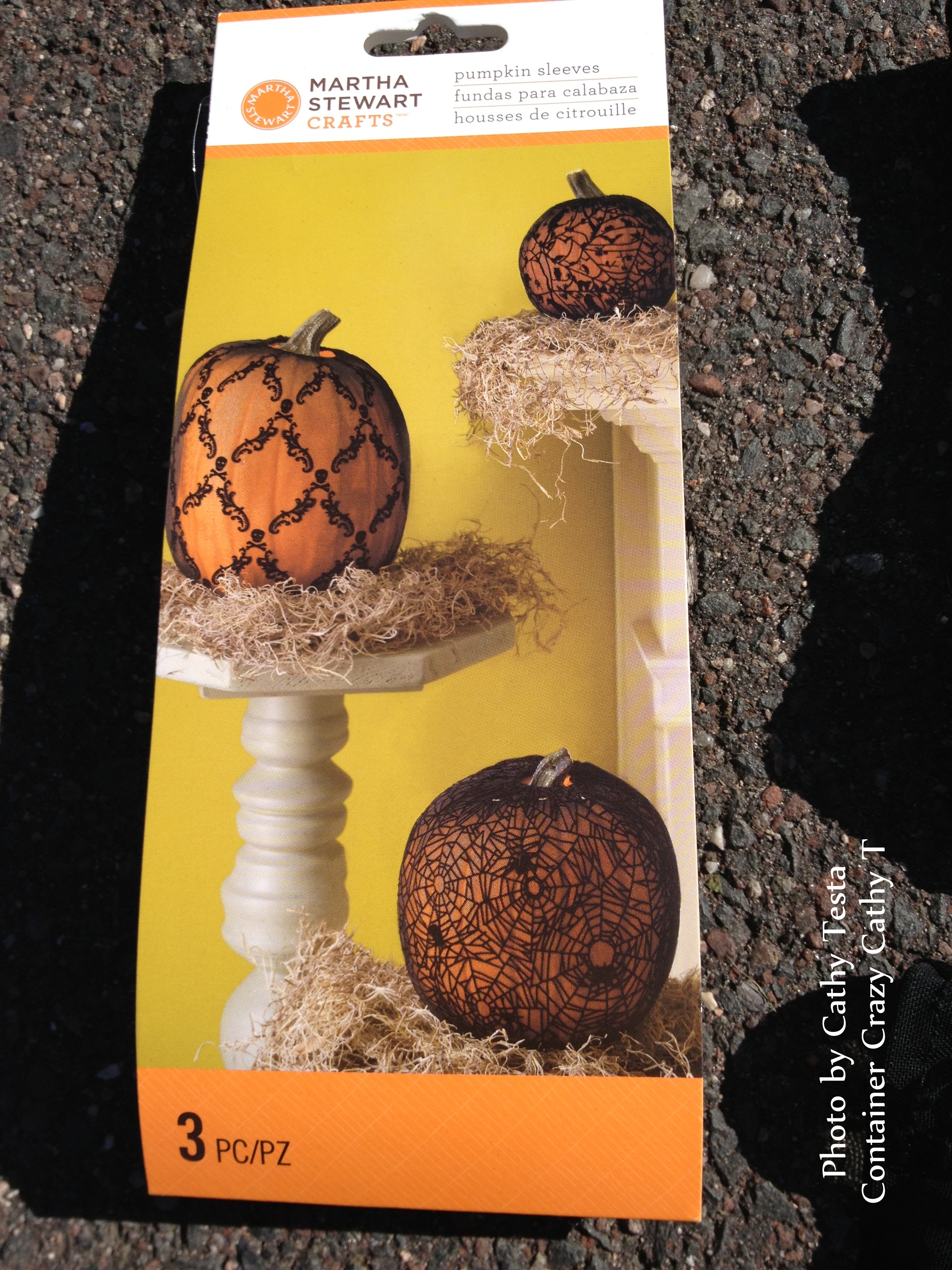
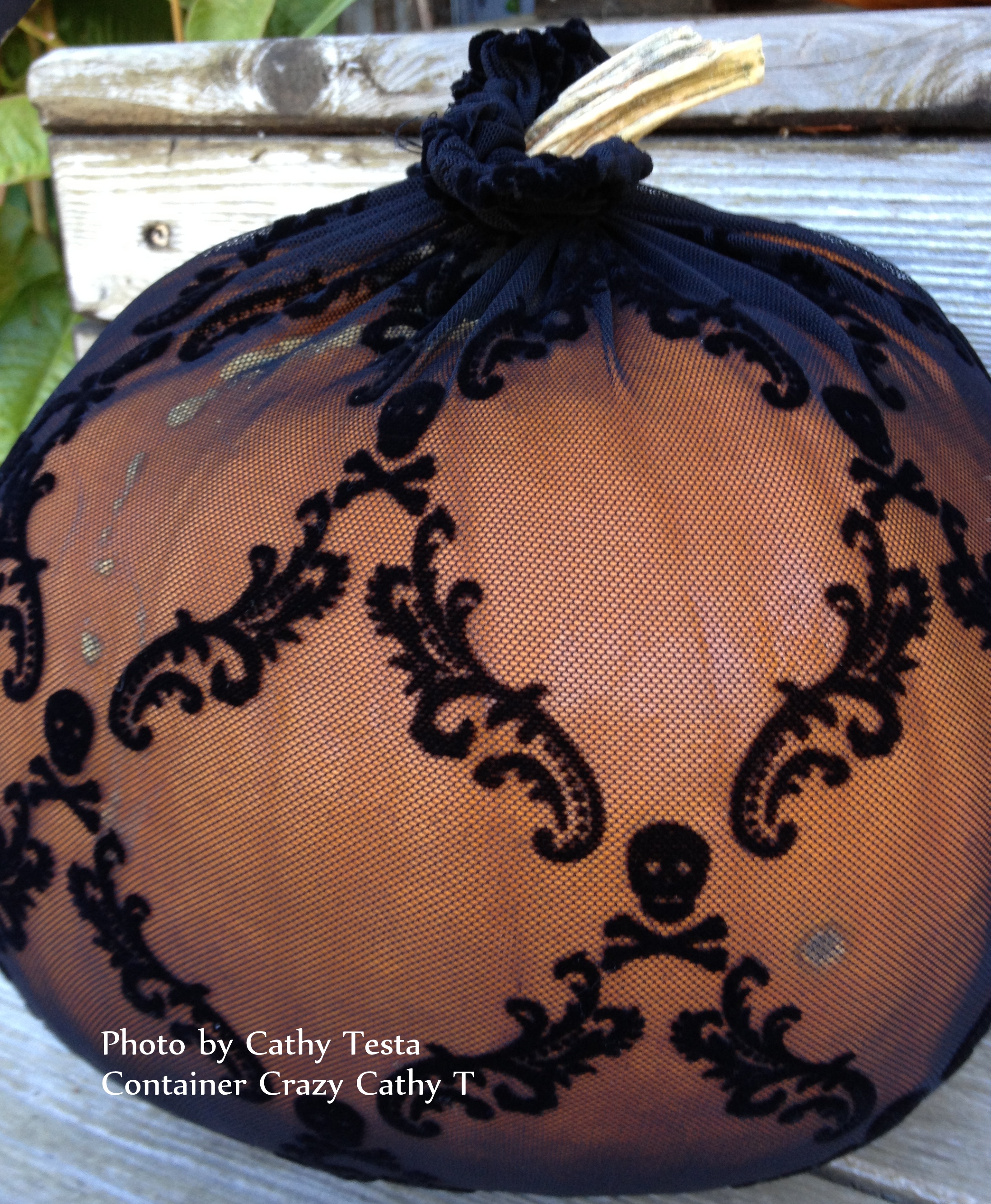
IMG_9276So I decided to go with the easy packaged Martha Stewart find called “pumpkin sleeves” discovered at a local Michaels craft store.  When I tried looking up instructions, because there really wasn’t any on the package, I could not locate this item on the Martha Stewart website.

IMG_9275

IMG_9277

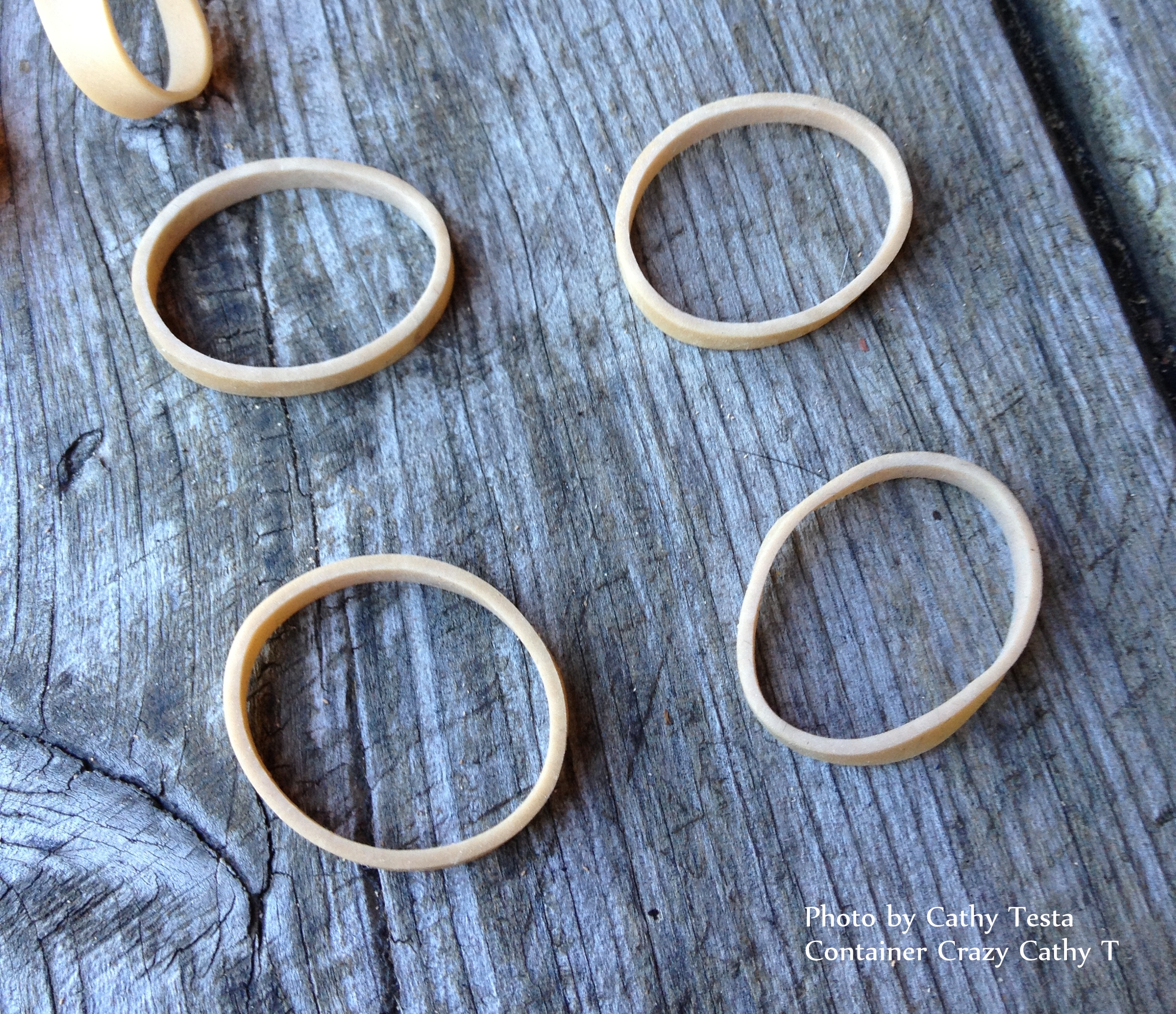
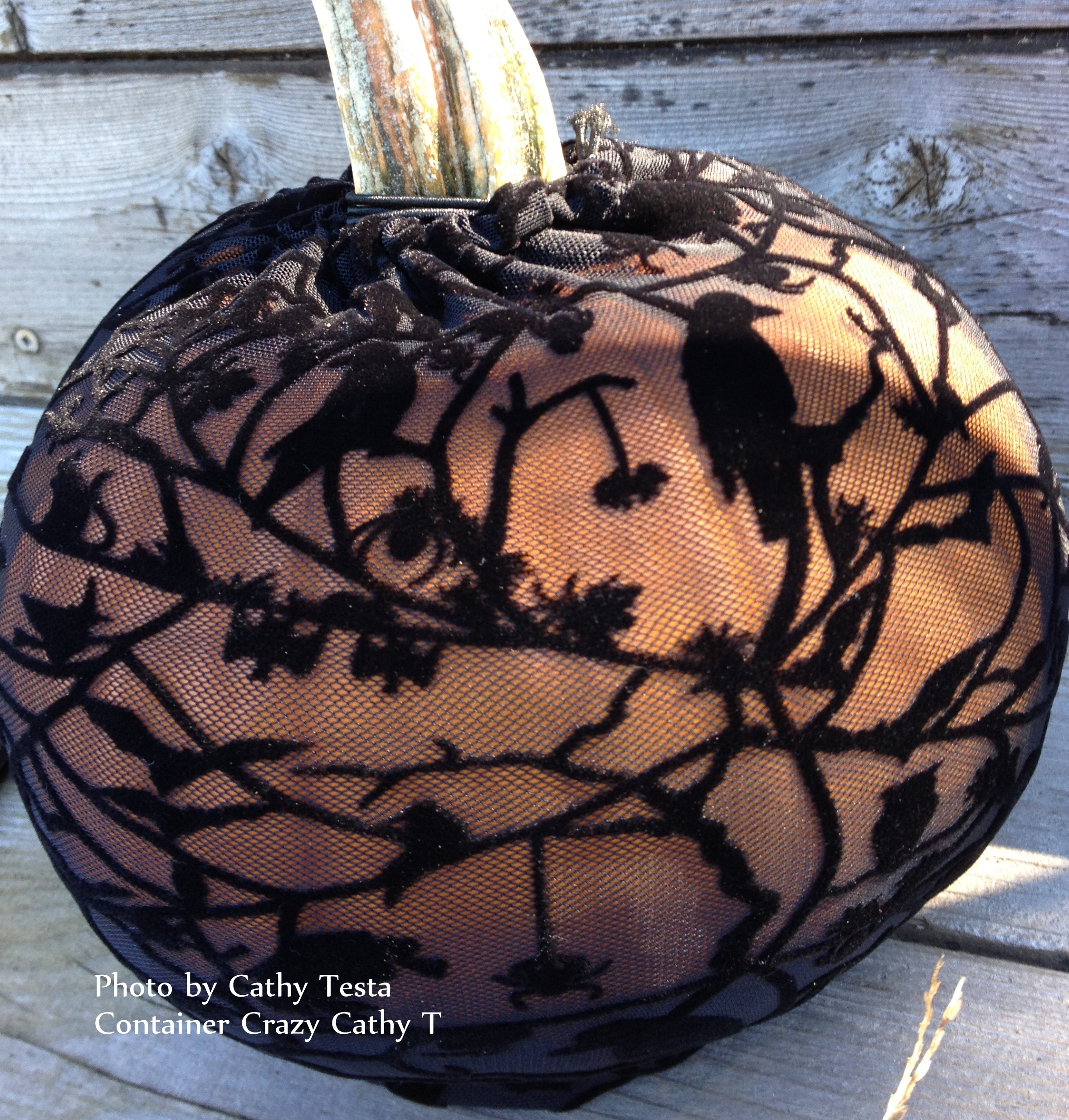
Not a bother – because it was very easy.  Just slip it over and secure the ends.  At first I used small rubber bands to gather the ends on the bottom and top, but later discovered a draw string for the top end of the sleeve.  However, I still found the rubber band trick to secure it tightly worked better.

IMG_9278

IMG_9288

IMG_9293

IMG_9292

IMG_9291

As I went to pimp my last pumpkin, I realized I didn’t have enough sleeves (only 3 per package), so I went to my drawer, found a pair of plain black nylon stockings, cut a portion off the foot end, and pulled it over. It is not as pretty because there isn’t a pattern on it, but I’m sure I could use a Sharpie permanent marker to create some images on it if I wanted to later.

IMG_9290

IMG_9300My cat, Mini, came by to investigate my project – like most of my curious cats do when I’m outside dressing up areas for the season.

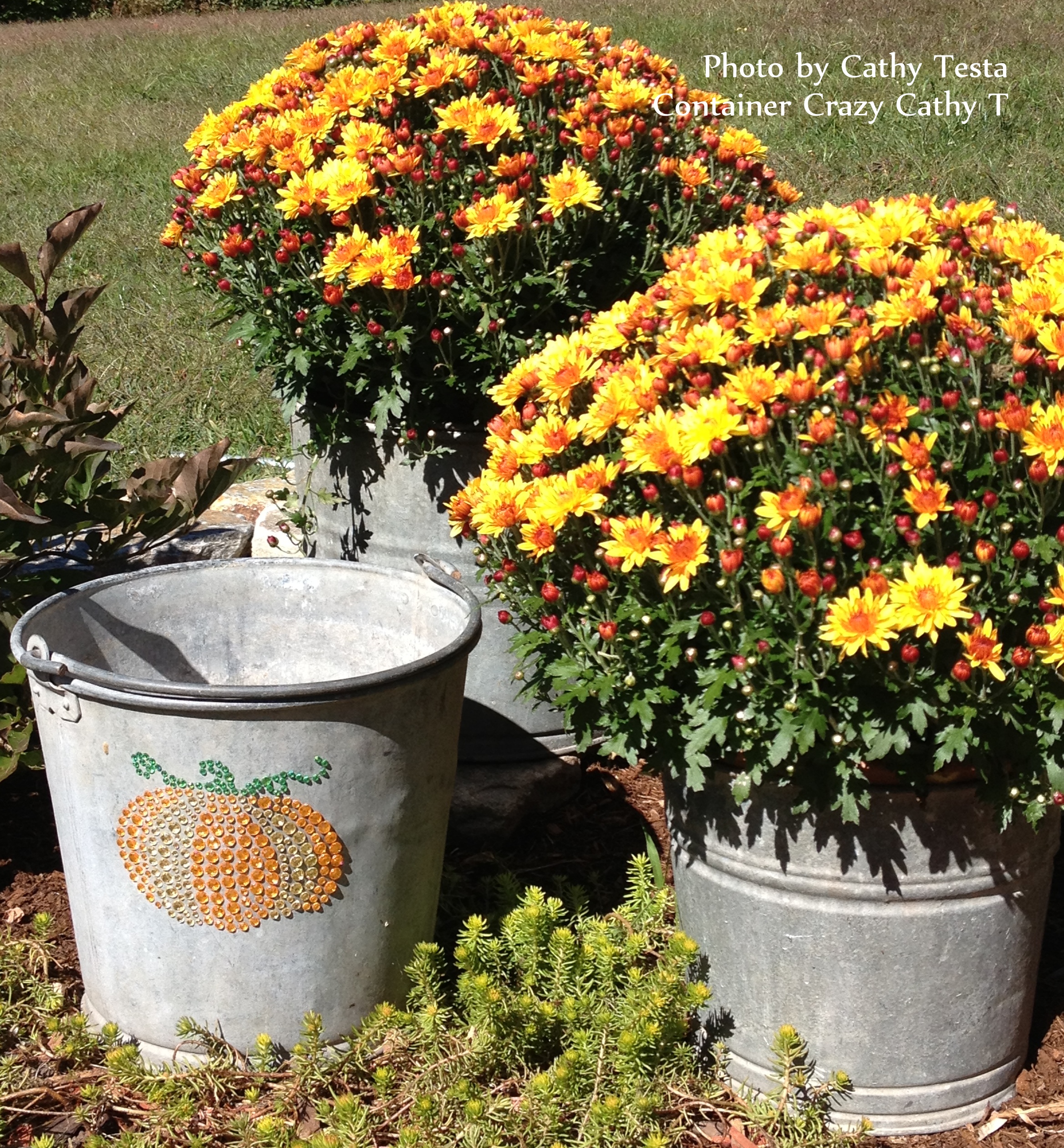
IMG_9305I also picked up some bling-bling from Michaels by Recollections.  It is rhinestone stickers, probably intended to stick on windows, but I attempted to apply them to my pumpkins and galvanized buckets.

IMG_9304

Because the temperature of the pumpkin will get cold in the evenings and warm during the day, I added some additional clear glue under to help it stay adhered.  We will see if it hangs on for the rest of the month.

IMG_9306

IMG_9308

Both the sleeves and rhinestone stickers are a quick and easy fix to pimping your pumpkins.  And since there is no cutting involved, it will last much longer than a carved pumpkin.  Plus you can reuse the pumpkin sleeves every year.  For rhinestones, you could also investigate your unused jewelry beads, buttons, or small pieces to upcycle them for a look similar to the rhinestones.

IMG_9321

That’s it!  Just a quick bit of inspiration – and right after, I went to my hammock and rested a bit to enjoy the beautiful blue skies of this past weekend.  It was absolutely gorgeous out – and the weatherman said it would be nice and warm all week.

IMG_9316

Enjoy your week.

Written by Cathy Testa

IMG_9244

The Acers in September

Leave a comment

Beautiful fall photos of maples (Acers) by a blogger named Cara Lockhart Smith from the Scottish Borders. Check out her paintings too – many focused on natural settings. Cathy T

Cara Lockhart Smith's avatarcaralockhartsmith

September Acers

After the green of the willows in the woods, these acers round the little pond demonstrate the vibrancy of a different part of the spectrum altogether. These are colours that I love to use when painting. The creator of the garden was told that acers would not flourish this far north, so since he loved the plants, he set out to proved them wrong.  And did so. Up close the leaves of the acers are exquisite, but I wanted to make an image which showed the colour they create in the garden at this time of year when, apart from the spears of the gladioli, the flowers are fading in the garden, and the wildflowers have almost disappeared.

acer1

DSCN8670

DSCN8663

acer8

View original post