Flashback Friday – Golden Head Planter with a native Autumn Fern

Leave a comment

For this week’s Flashback Friday

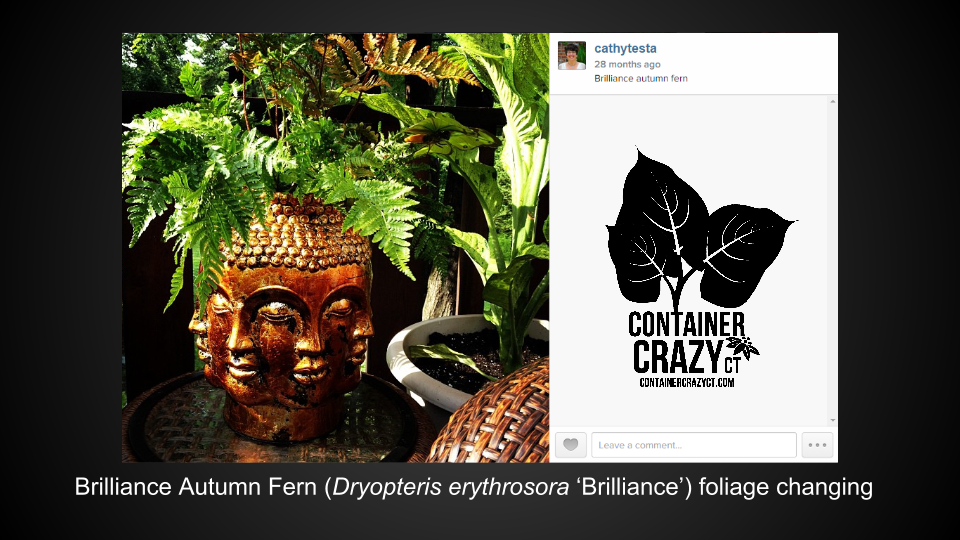
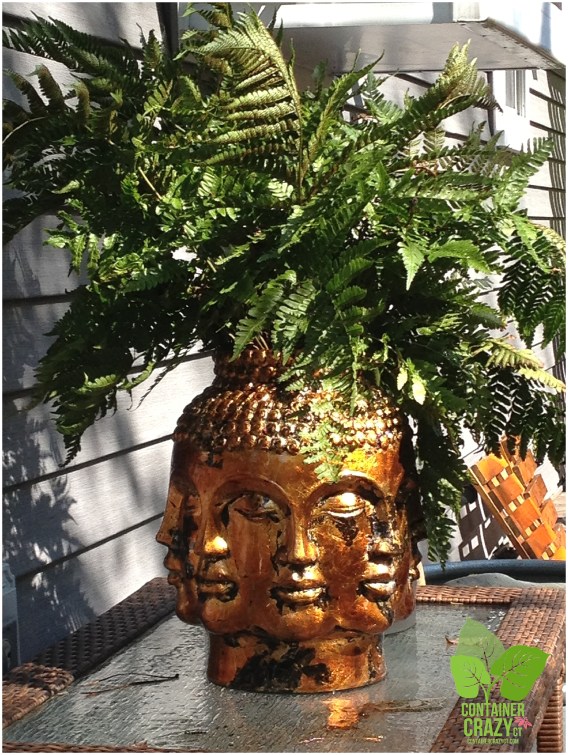
Brilliance Autumn Fern in a Golden Head Planter

Dryopteris erythrosora ‘Brilliance’
Zone 5-8/9; Perennial and Native

Head Planters ContainerCrazyCT_0001

In season, this fern’s upright fronds remain a dark green color, as shown in the photo above when it was growing in the container during the early 2012 summer. The beautiful golden face planter with splashes of black was a find from the Pottery Barn store. Knowing it would glimmer in the summer sun, there was no hesitation to get one. Placing a fern in it was a good choice because the planter did not have a drain hole, and this fern can take moist conditions. I did not want to risk cracking this pot so a drain hole was not drilled into the bottom, as typically done so the roots may breath and not rot from overly wet soils. However, ferns can withstand moist conditions with appropriate controlled watering in pots. If I felt the soil was too wet from a rainfall, I would tip the pot to let the excess water drain out.

Head Pots (1)

The fern’s name includes the word ‘Autumn.’ I’ve read this is because when the plant is young, it is a copper color, but it also takes on highlights of copper later in the summer season. Here it was moved to a shadier spot on my deck that season because this fern prefers dappled shade.  It was easy to grow in a container garden (or head planter). Some perennials will return in stored containers – which is a topic I will be teaching in detail in the 2015 season when two Container Garden Workshops are scheduled in May.

Head Pots (3)

The golden color of the head pot is really rich.  As it was sitting next to another container garden with mixed plantings, including the thriller – a dark leaved Colocasia (elephant ear or taro), which was the cultivar, ‘Diamond Head,’ the effect was gorgeous. Colocasias are plants I plan to include in my plant ordering list every year. I love foliage and love how the big leaves toss from side to side in the wind and the plant will last all the way into the fall season, up to the last frost date, plus they are easily stored over the winter for regrowing every season here in my Connecticut planting zones (5-6).  By the way, the plant with yellow and red leaves in-front of the elephant ear is called Amaranthus tricolor – it was noticed during a “Walk and Talk” Pond Garden Tour last summer in my friend’s planter near her three-tiered water gardens which everyone seemed to like it and asked what the plant was. It really stands out in the right situations and has a unique look to it.

This particular Colocasia cultivar was not too big for its pot, even though its leaves reached about 3-4′ tall, because it has a compact habit.  While the Autumn Fern is a semi-evergreen perennial (hardy to zones 5-9 – and native), the elephant ear is a tropical type plant (not hardy to CT), but hardy to zones 8/9-10.  The Colocasia is a sun to part sun/shade plant so the exposure was fine next to my beautiful and elegant golden head planter with faces all around it.

So, again, the two pots near each other in a shady spot on my deck was a good combo for they enjoyed the shady mornings and dappled sun later in the day.  By the way, Autumn Ferns are deer resistant – good for gardens with deer eating issues. Most ferns grow best with a high organic matter content in the soil when grown in the garden.

Head Pots (2)

The following year, I planted a succulent in my golden head pot, a Kalanchoe. But, because I was unable to drill a drain hole, I inserted the plastic pot it was in into the golden head pot so water could drain freely below it without creating a overly wet base.

Kalanchoe plants prefer the opposite exposure of ferns.  They enjoy sun and dry soils, able to withstand drought like conditions, within reason, in a small pot. Ironically, the leaves on this plant also highlighted some copper to red coloring on the edges. Matching plants to pots should not be exact matches (what I call matchy-matchy) but connect to the pot somehow perhaps in a subtle way – as done with this fern and succulent because the pot of golden to copper colors highlighted the copper tones of the plants used – it just worked – at least for me – I loved the look!

Why Use Head Planters?

Head pots make heads turn – When used in your gardens as art, or in special pots as decor elements in your outdoor spaces, and inside the home during the winter season.  And when you change up the plant in a pot – you change up the feeling, look, and affect of the pot or planter itself.  A big fern like plant gives it an exotic hairdo style, a smaller succulent may keep the head pot looking tidy and neat – it is fun to play with and – thus – I will share more in my ‘Flashback Friday’ posts about my head planters of other styles soon.

Happy Friday Everyone – T.G.I.F.

Cathy Testa
http://www.ContainerCrazyCT.com

“A Blog to share Container Garden Passions and Nature Combined with Art”

For more information about this fern shown in my new Flashback Friday posts, see the Missouri Botanical Garden Plant Finder.

Flashback Friday – Coco Bowls with Succulents

6 Comments
Coconut Bowls Turned into Adorable Decor

Coconut Bowls Turned into Adorable Decor

Flashback Fridays – NEW!

It is fun to look back on memories, and thus, I thought – Why not share some of my prior photos of blog posts from earlier days. Some of my blog pages get buried (i.e., I don’t think everyone knows if you click on a menu bar’s title, such as Container Garden Services, a whole page appears of photos of my container gardens.)

Coco Bowls from The Big Island

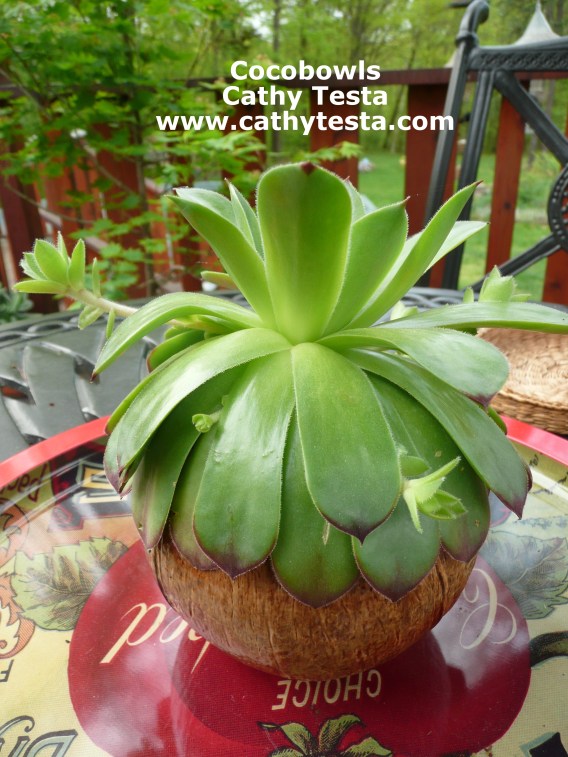
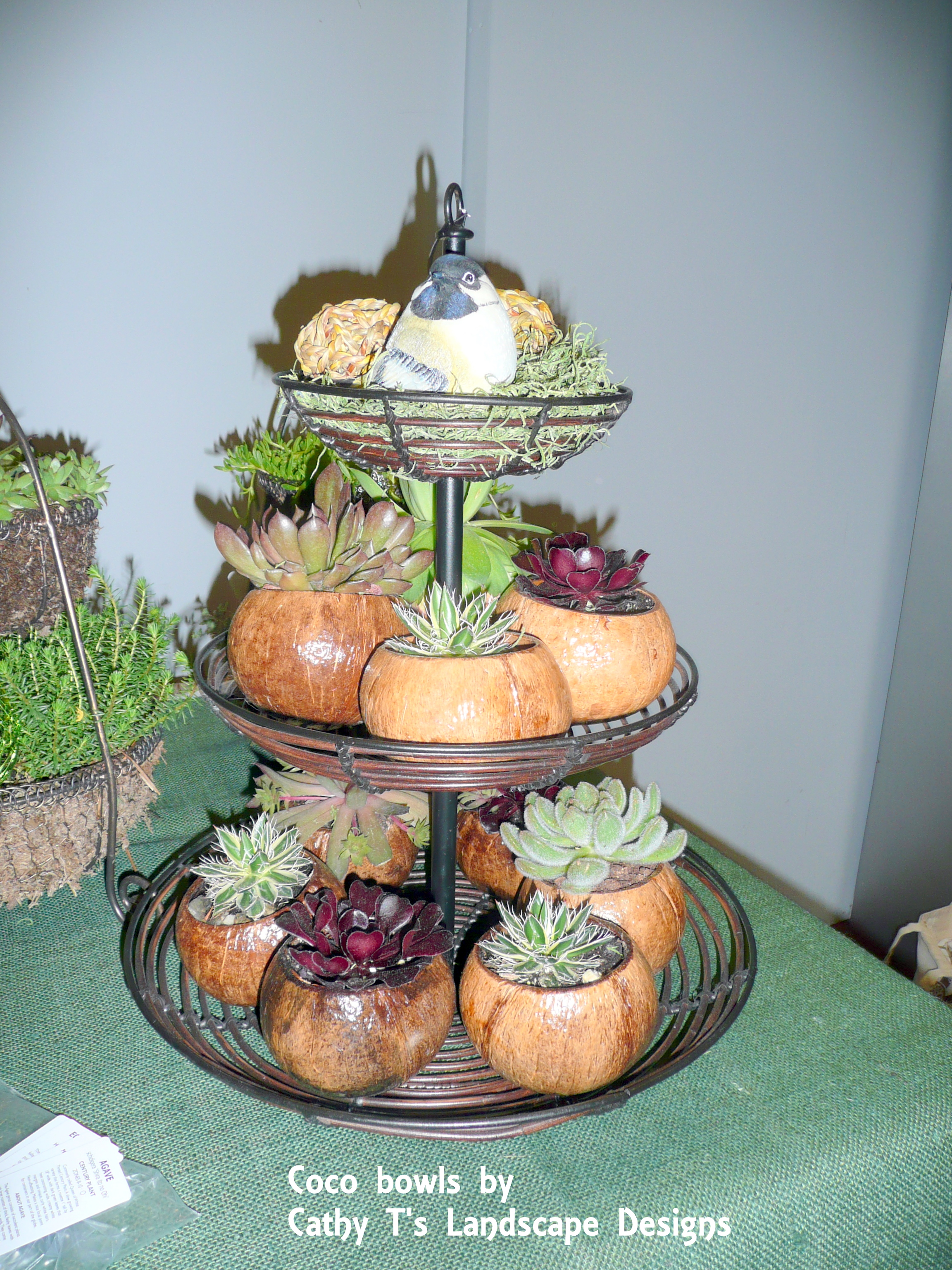
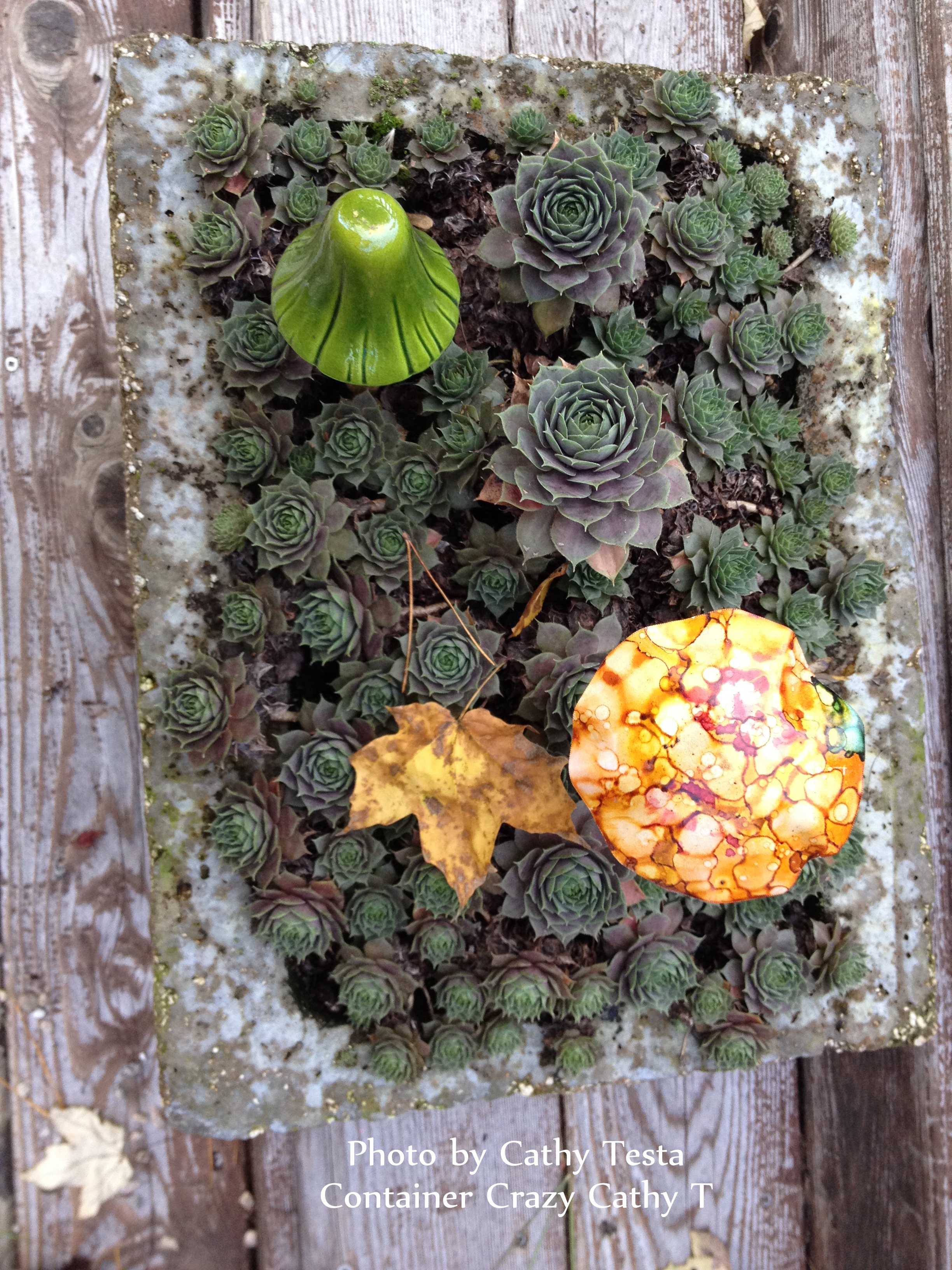
For today’s ‘Flashback Friday,’ I selected the photos of coco bowls obtained in Hawaii a few years back. Little succulents, such as Hens and Chicks (Sempervivum), were carefully inserted into the coco bowls. A single hole was drilled into the bottom of each bowl to allow water to drain out.

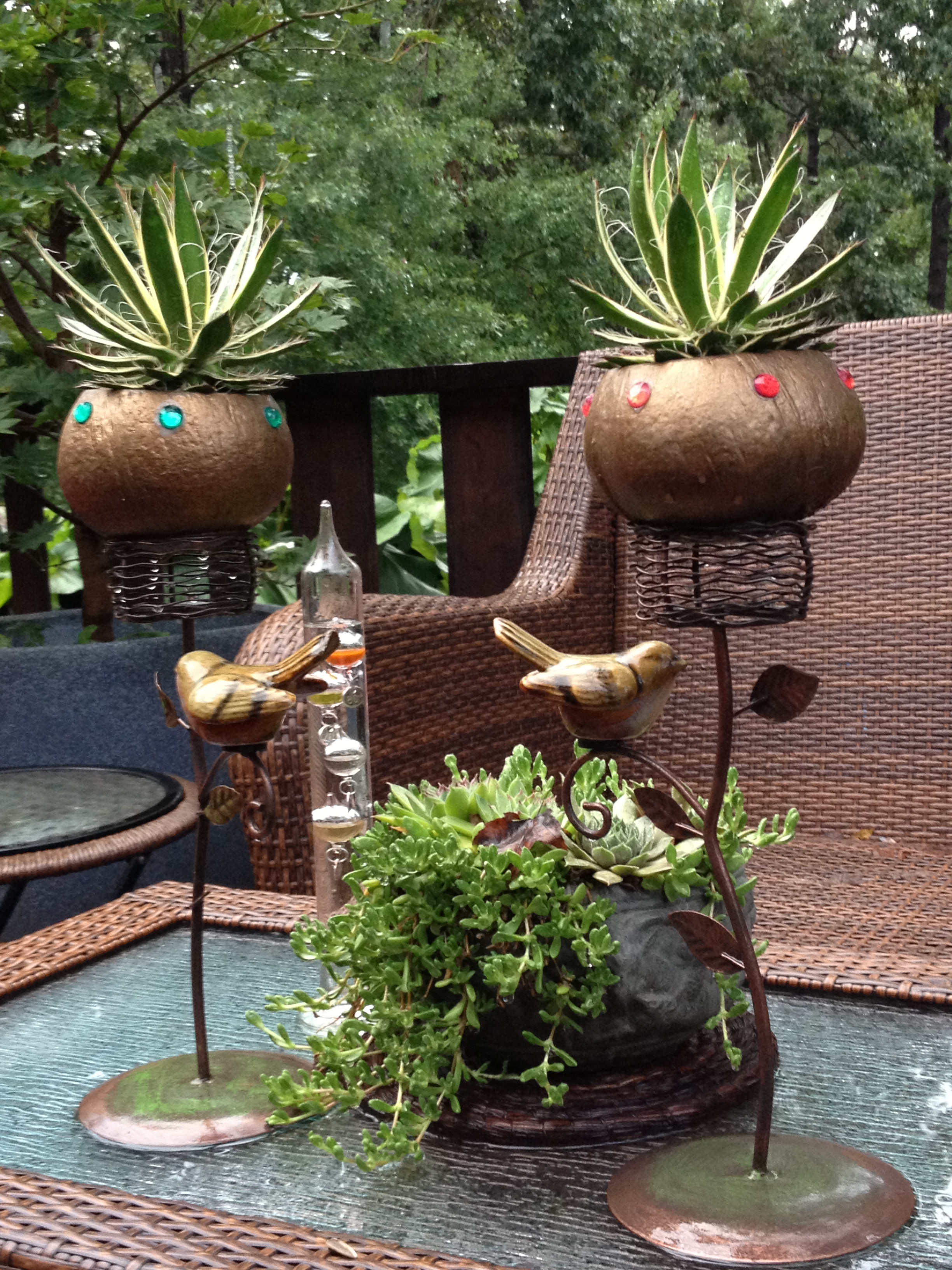
Coco bowls with bling

Coco bowls with bling

See these cacti plants above – Well, guess what? – They are still growing in the coco bowls after, I think at least 4 years. For the life of me, I can’t recall the name of the plant – but I will come across it in my books in no time to share with you, but this plant has as sharp tips as you can imagine on the tips – Literally, it could be a weapon.

Update: I located the plant tag for the Agave in the two coco bowls shown above: Agave schidigera ‘Shira ito no Ohi’ — No wonder I couldn’t remember! That’s a long cultivar name. A century plant, and I do believe they could last a century.

Cocobowls

Cocobowls

At the show, this is how I displayed a grouping of them. They sold very well. And, I could not part with a few for myself. The bowls themselves are a treasured item because it is a natural material and from a place I visited on a special journey several years back, on the big island of Hawai’i.

Coco Portulaca

Coco Portulaca

Portulaca was put into one as well, but the hens and chick plants and other various succulents really fit better and looked better, in my opinion. You may wonder how I watered them due to the plants top portion eventually covering the top of the bowl, and basically all I do is hold the coco bowl under the faucet and position it so the water runs into the bowl as much as possible, then let the excess drain out.

ePublication

The coco bowls are truly amazing pots; they don’t rot, last a long time, are adorable to show and even hold. I wrote about our entire adventure to the island and posted it on my original website at the time of putting these together. It is rewarding to look back at the memories, especially the “lava” boat story at the end of my e:Publication. Check out the photos – what a blast.

So, that’s it for my new ‘Flashback Fridays.’

Hey, fellow garden bloggers – Want to join me on this idea?  Share your Flashback – I’d love to see it.

Cathy Testa
http://www.ContainerCrazyCT.com
860-977-9473
containercathy@gmail.com

Autumn Begins On Monday – Time to Move In Your Plants

Leave a comment

Hi Everyone,

Just a quick note to remind you to think about that statement I made at the Big Container Garden Party in May:

Do not let your succulent plants, cacti, or houseplants with tender foliage in your outdoor container gardens and pots stay out in the cold damp weather too long.

It has been my experience if you let that soil stay cold, and it remains wet – and then you move them inside, two things typically happen.  The tender soft foliage of these types of plants start to rot at the base, or sometimes the damp wet soil invites little critters to take residence in the pot.

So as noted on your handouts from the May Big Container Garden Party class titled, “The 7 MUST NOT DO’S WITH SUCCULENTS & CACTI“, is that you should not leave them out beyond summer when we start to get continuous cold evening temperatures.  (Try this test: Touch the side of your pots – if Terracotta or glazed, they are chilly right now – even in the sun.  The type of container may contribute to cold soil at this time of year, despite the nice warm sun we are having.)

This week has been nice and sunny during the day, so if for some reason your soil in your pots is really damp/wet, give it some sun, don’t water, and let it dry out a bit – then start to move them in soon.  Frost typically happens early to mid-October, so there is still time to enjoy other plants, as follows:

Canna, Elephant Ears, and Banana Plants

As for the Canna, Elephant Ears, and Banana plants – they can handle this weather a while longer into early October before the first frost of Autumn hits.

If you wish to keep the Canna, Elephant Ears, or Banana plants in their pots inside the home – my advice is reduce the watering now – it will dry out the soil a bit, makes the pot lighter to move, and kind of the same theory as above, the soil won’t be damp when it is moved inside – reducing your risk if critters moving into damp soil. Pick a sunny window in the house from that point forward.

If you wish to store the Canna, Elephant Ear, or Banana plants base or storage organ, such as the rhizomes under the soil for the Canna, you may allow it to get hit by the fall frost – The foliage will turn black and soft – and you can cut that all off and then work to remove the rhizome or corm for the Canna and Elephant ear respectively.  For the Banana Plant, refer to my blog where I posted all the steps.

There is also choice #3 – if you want to keep the Canna, Elephant Ear, or Banana plants in their pots and you have a basement to move them into – this is also a technique for overwintering them.  Again, pick a spot, don’t water it much now, and let it look tattered over the winter but just hanging in there. For basement option, must do before frost as well – which probably will happen in mid-October.

Elephant Ear - Colcocasia

Elephant Ear – Colcocasia

Brugmansia (Angel Trumpets)

Another plant sold at the Big Container Garden Party was the Brugmansia (Angel Trumpets).  These should not be hit by frost.  I recommend you move them in to the home if you wish as a houseplant before frost hits, or into your basement to go dormant.  In the basement, most of the leaves will fall off, it will look tattered over the winter, but will bounce back (usually!).  Also, Brugmansia (Angel Trumpets) may be pruned back hard if you wish – pruning off all the stems and part of the stalk, but then you would not have the tall height next season if you wish to keep it tall.

Succulents, Cacti, Alpine Plants

Also, a reminder about another “do not do’s” with the succulents, cacti, and alpine like plants – do not put them in dark rooms, or between curtains in the house.  Do not let them sit in water catch trays.  Do not put them in a very shady spot in the home, or by really cold pockets. They need a bright sunny window, and reduce watering them regularly.  South or West facing windows are typically best. Refer to your handout on more details about how to water them in the winter months.

Hens and Chics

Hens and Chicks – Sempervivums

Hypertufas with Hens and Chick Plants

Hypertufas!  Did you buy one in May?  Well, the good news is they can remain outdoors – the material of the pot is pretty tough – but I say move it to a protected outdoor location, the hens and chicks in the pot will come back next season.  You may want to put it under your porch steps, or if you have a woodstove, heck, put it by the foundation wall near that area outdoors.  Or bring it in and place in a sunny window to treat as a houseplant, reduce the watering, etc.  The plants will look like they are not alive at some point, but they hang in there – believe me – they bounce back.

Mini-Crimson Mandevilla

Mini-Crimson Mandevilla

Mandevillas

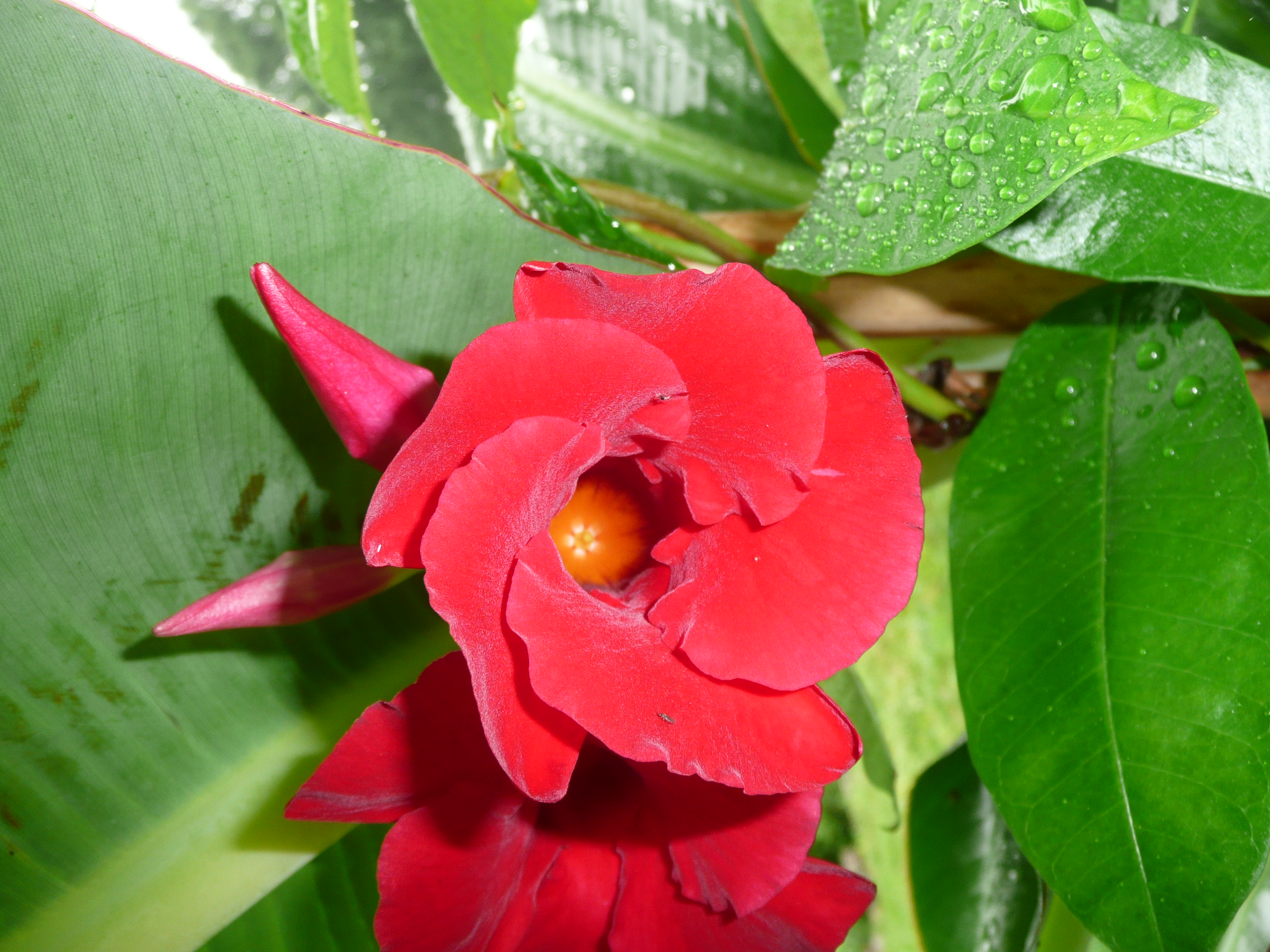
Mandevilla – These too can be stored over the winter in somewhat of a tattered state, cut the vines back, and put them in the basement, they will loose leaves over the winter, but will hang in there.  More information can be provided if you have any further questions. This tropical like vine will be showy for a while more too – but don’t let it get hit by frost.

Perennials – Some of the plants were perennial and you may remove them from your container gardens and transplant them into the gardens of the ground, or often they return in the pots if you move them to a protected location over the winter (i.e., garage), especially if you used a big pot with lots of soil mass as your container garden when you put these together in May.

Thank you, and for those registered for the Octobert Hypertufa Class – I’ll see you soon!

Cathy Testa

P.S.  The “Evergreens Kissing Ball & Holiday Creations” class date has been noted above and on the side bar of this blog.  It is Saturday, December 6th, 2014.

Insects in Your Container Gardens – And What You Can Do…

2 Comments

Hello Everyone!

It is that time of year when we may be seeing little critters appear on some of our plants in our gardens or container gardens, and it ain’t pretty.  Fortunately, many of them do not last long due to their life cycles, stages of growth, and time of appearance, but regardless, it is best to battle them as soon as spotted on your plants.

I like to use the ‘pick and squish’ method first whenever possible, if bold enough, prior to reaching for any insecticides, or use of pesticides.  Sometimes just hand picking off or pruning, then disposing of them works.

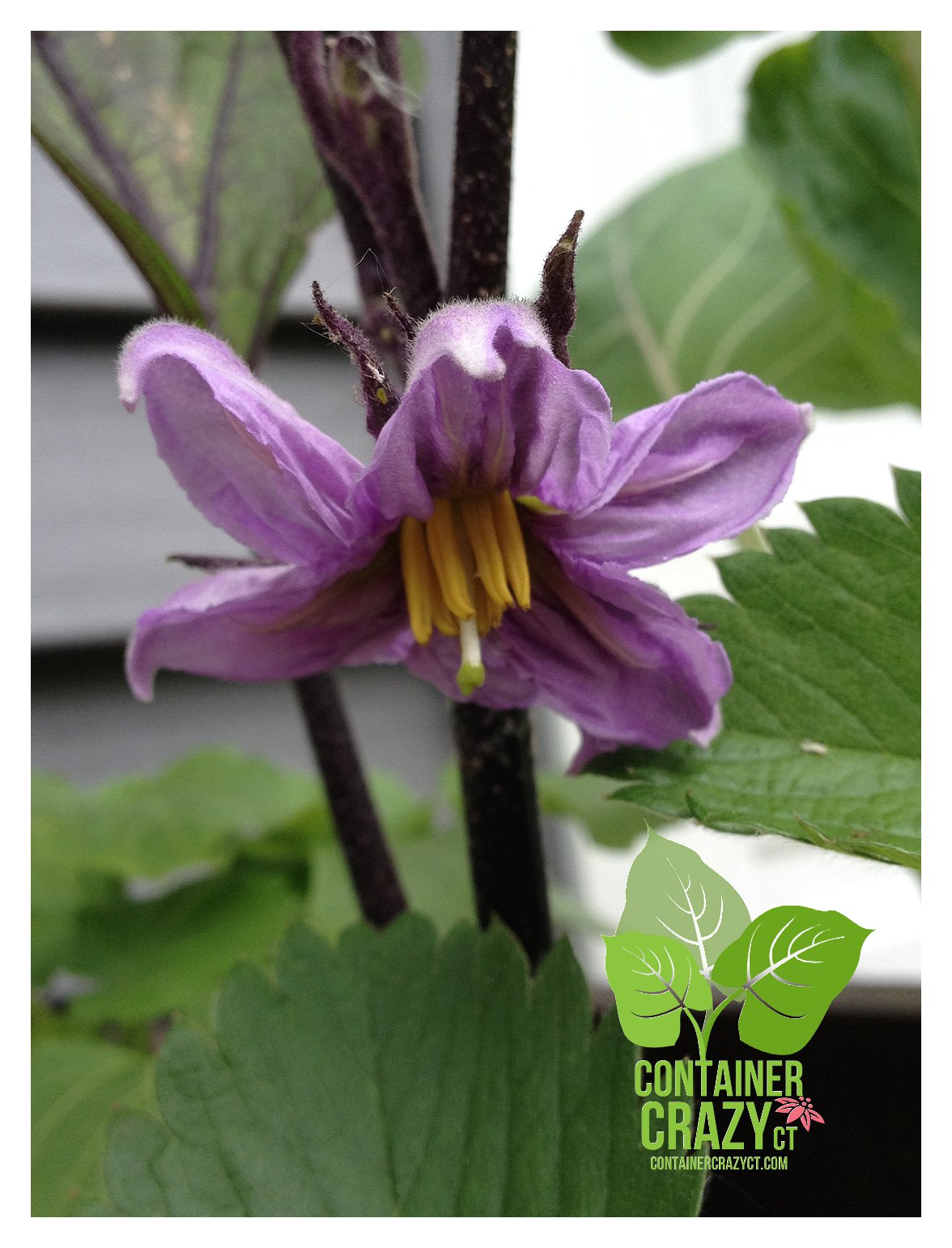
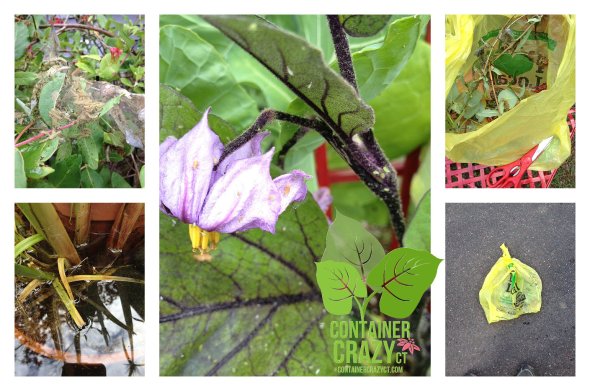
In the photos below, you will see what I believe are eastern tent caterpillars on my honeysuckle vine (top left), aphids on the eggplant bloom (middle top photo), and mosquito larvae in the water image.  These were all spotted in late June, along with a first sighting of the infamous Japanese beetles, which emerge from the ground in early summer to feed on plants.
Yuck -- Insects on Plants

Yuck — Insects on Plants

Tent caterpillars on my trumpet honeysuckle – YUCK! That was a first – and my honeysuckle has been doing so well this year.  Obviously, I was not happy to find these buggers.  My honeysuckle plant is growing by the side of the house, and it surprised me to find tent caterpillars on it.  Fortunately, with a quick snip of the vine from which they were attached, they were easily bagged and tossed.

Honeysuckle bloom creeps into Delphinium

Honeysuckle bloom creeps into Delphinium’s blooms

TENT CATERPILLARS ON MY HONEYSUCKLE VINES

Using clean pruning shears, I cut of the portion of a vine with the nasty critters on it, put it in a plastic bag on the driveway and then stomped on the bag.  I left the bag laying on the driveway for a while.  Why? I figured the heat would fry any not crushed (oooh, gross – the things gardeners will do!).  Then, I went out for my day’s work at a client’s location.

That day, my parents dropped of some items at my door, and my mother saw the plastic bag sitting on the driveway so she included my bug bag as a hanging item on my door handle while I was not home.  I guess she figured I dropped something by mistake on the driveway.

Well, when I opened up that bag at the kitchen table – ACK.  Out to the garbage can it went – and quickly. You see, the other bags my parents often leave me are filled with fresh veggies from their home garden.  Imagine my surprise and reaction when I found bugs instead of radishes.

Prior to all this bug nonsense, I was enjoying the many orange trumpet shaped blooms growing from my honeysuckle so much all month.  At one point, a stem pushed its way through the center of a Delphinium stalk located near it – talk about stunning.

Do these two plants know they are complementary colors on the color wheel?

Opposite each other on the color wheel – are blue and orange – talk about a nice surprise nature combo in the garden! Although this Delphinium technically has more purples than blues in its blooms, the combination was breathtaking all the same – I have been enjoying it for a whole month.  I wrote about Delphiniums before on this blog, as it was a flower I selected in my wedding bouquet 24 years ago.  It probably was one of my first flower obsessions.  I find them a little difficult to keep growing in my garden, so this year, I just bought a new one and plopped it by the honeysuckle plant, and it has grown beautifully.

Honeysuckle Blooms

Honeysuckle Blooms

Honeysuckle (Lonicera) is a deciduous vine that grows quickly every year.  It is deer resistant and attracts butterflies. A trellis or arbor is needed to hold it up as it grows taller, sometimes reaching 15-20 feet.  I’ve had mine for several years in this spot with little problems – again, why I was surprised to see the tent caterpillars take a spot on it this year.

Although this vine grows quickly, I wouldn’t classify it as a invasive plant because it is easily removed if you find it over takes your space, but it can get large fast and needs to be watched.  It is included in my Troublemakers Turned Star Plants on my Pinterest page, because it can be very useful in a container garden if you find it a nuisance in the regular gardens of the ground.

It likes sun to part shade, and blooms for a long time.  The scent is intoxicating for many cultivars. This plant may be used as a thriller in a large container garden, so long as you add a nice big trellis in the container for support.

Happy Bloom on Japanese Long Eggplant

Happy Bloom on Japanese Long Eggplant Being Visited by Pest Aphids

APHIDS ON MY EGGPLANT BLOOM

If you take a close look above, you may see the little aphid bugs on my Japanese eggplant.

Aphids are very tiny pear-shaped insects with long antennae and tubes on their back-ends.  Some of the interesting tidbits about aphids are ants protect them because they enjoy their “sweet honeydew”, and they (aphids) reproduce faster than rabbits – the females do not need males to do so, and aphids vary in colors – not just green as the ones spotted on this plant.  To learn more about these little guys, see the CAES link.

Well, seeing them on my Japanese long eggplant flowers in my container garden was not pleasing. I’ve been using edibles in container gardens a great deal this season – and talking about it at garden clubs.  I am finding, however, the edible plants seem to get attacked by bugs much quicker than my tropical or annual plants.

To battle these aphids, I lightly sprayed the plant on a shady day when cool with a safe organic spray for vegetable plants (remember, don’t spray a plant when its very hot and located in full sun), and then a day later, I hosed off the leaves by using the garden hose with a watering wand at a good heavy pressure – it did the trick.  No more signs of the aphids since – and my first eggplant fruit growing right now on the plant – yeah!

I couldn’t really pick the small aphids by hand because they are too tiny, at the size of 1/8″ long.  And by the way, lady bugs are natural predators, releasing them can help if you can find the ladybugs from a garden center.

First eggplant

First eggplant

I potted up this eggplant plant along side an asparagus plant, strawberry plant, and would you believe, Brussels sprouts?! The asparagus added a nice soft texture with its fine and light foliage along side the coarse texture of the eggplant leaves, the strawberry plant is a spiller, and the Brussels sprouts – well, wow – what big texture those leaves have offered.

Eggplant with Mixed Edibles

Eggplant with Mixed Edibles

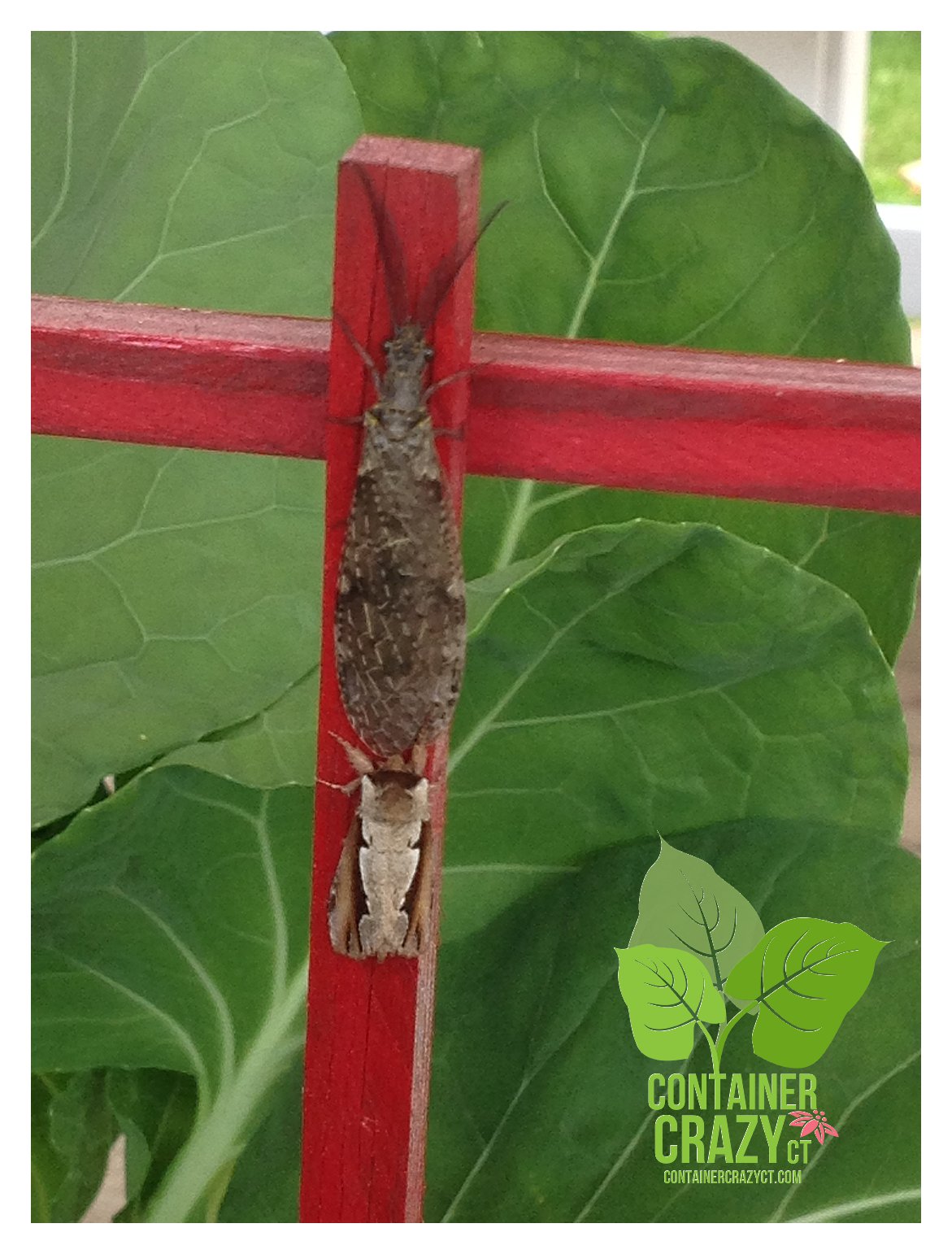
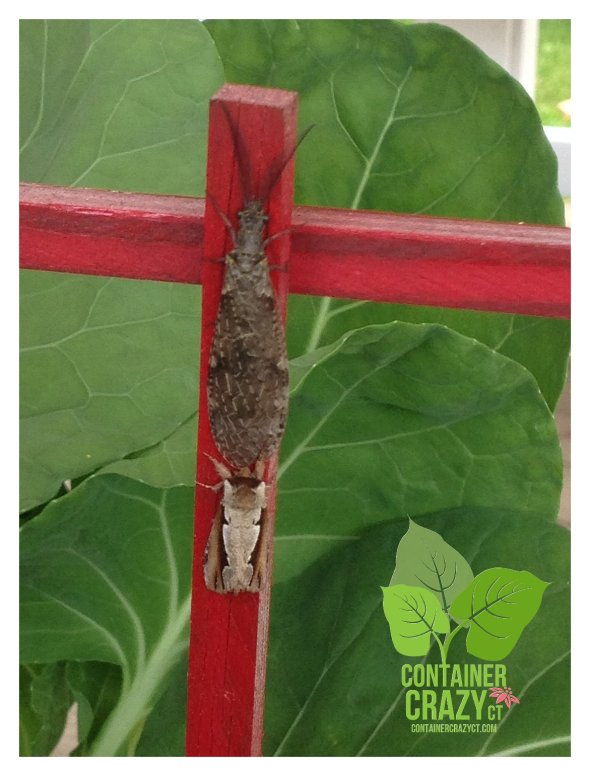
Earlier in June, I brought the container garden to the Ellington Farmers Market to show the combination during my talk about “Incorporating Decorative Edibles in Mixed Container Gardens.”  Well, low and behold, these two very interesting looking insects took their position on the red trellis in the pot – and stayed there all day during the market.  Thankfully they did not jump on me when I was driving home later that day with the container garden on my truck seat.  Not sure what they are, do you know?
Bugs on Trellis with brussel sprout Leaves behind it.

Bugs on Trellis with brussel sprout Leaves behind it.

MOSQUITO LARVAE IN MY WATER GARDEN

The other spot where I saw critters was in a water garden I have at home, which is a big galvanized feeding bin (for animals) filled with water and plants, such as elephant ears (Colocasia) or other water tolerant types, such as Cyperus papyrus (Tut). I put the plants in terracotta pots because they sink well into the water due to their weight and the clay is porous. Add some stones to the top of the soil of those pots so the soil does not escape into the water.  When submerging the pots, gently drop them into the water as to not disturb the soil too much.

Well, I should have known, tiny mosquito larvae started to grow in the water, and there were tons of them wiggling in the water one day.

To avoid this situation – you may try two things – place a mosquito dunk, which are not harmful to the plants, in the water, or just flush some of the water out occasionally with a garden hose so the water is not stagnant.  This is what I do. Later, no more larvae and no more bites.

Oh, when I was very young, I remember telling a teacher that I saw little things wiggling in a puddle at home. (Living on a farm, you tend to notice things like this – or I was just always fascinated with looking at things up close in nature.)  He told me to put them in a jar with water, cover it with plastic wrap and to bring it into class.  He set it on his desk and said, “Let’s see what happens.” A few days later, a bunch of mosquitoes were flying above the water.  A visual lesson for sure.

A PRETTIER INSECT

Fuzzy body of moth

Fuzzy body of moth

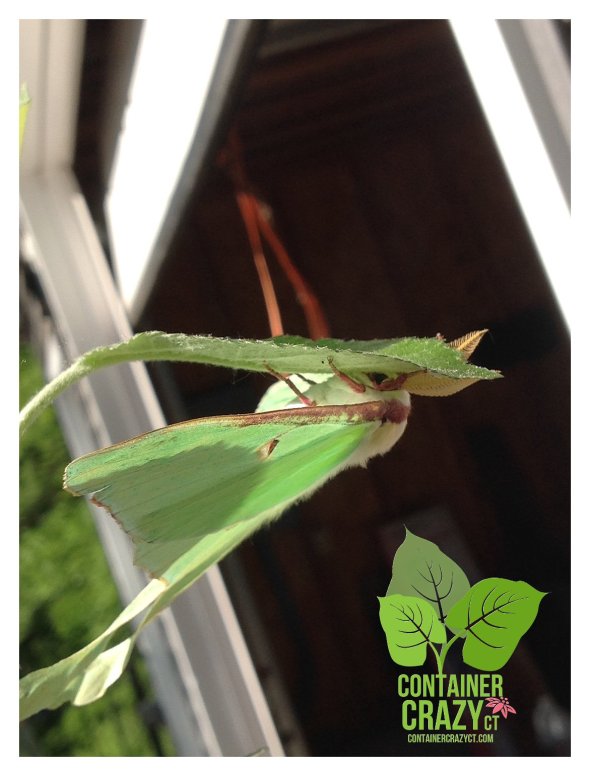
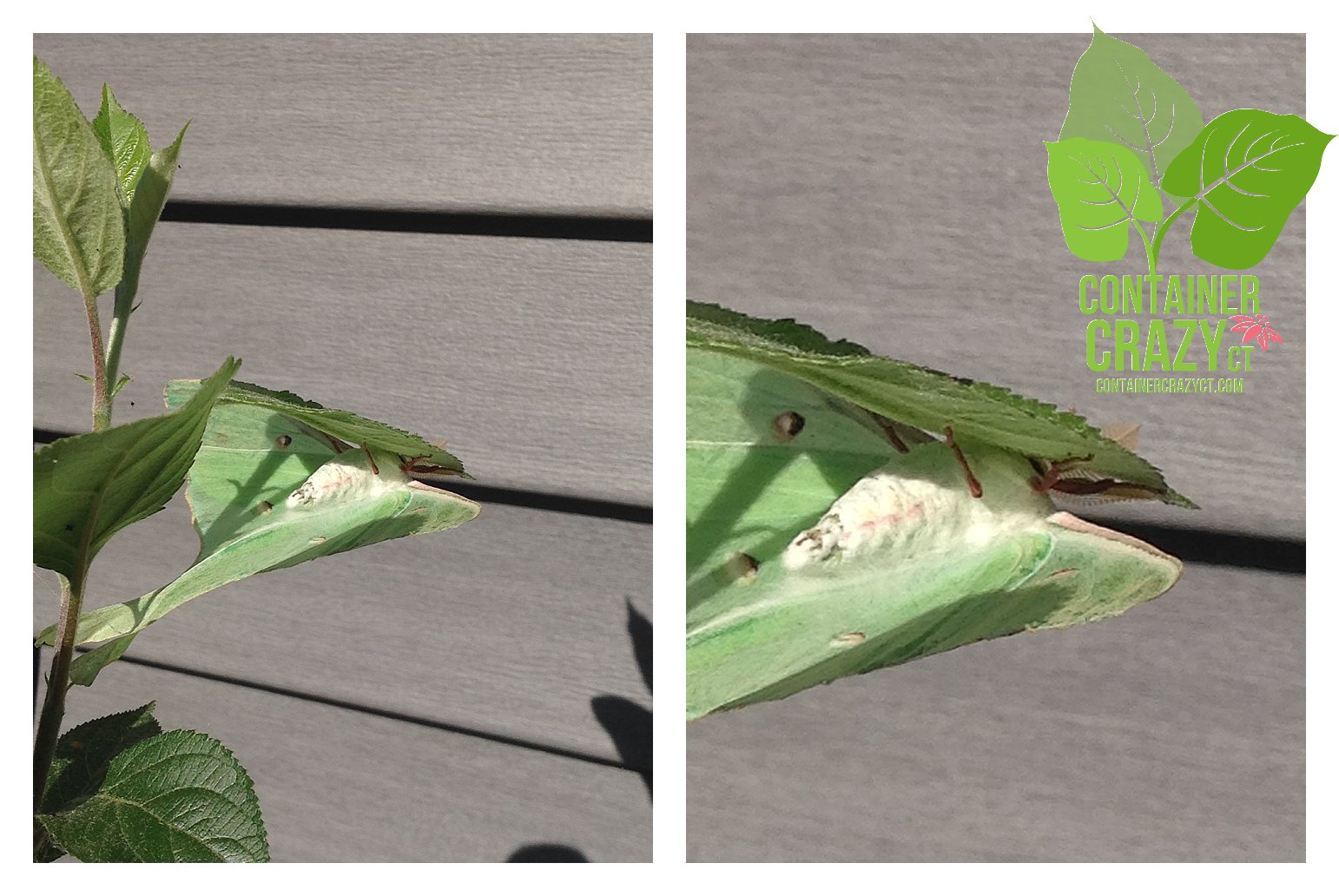
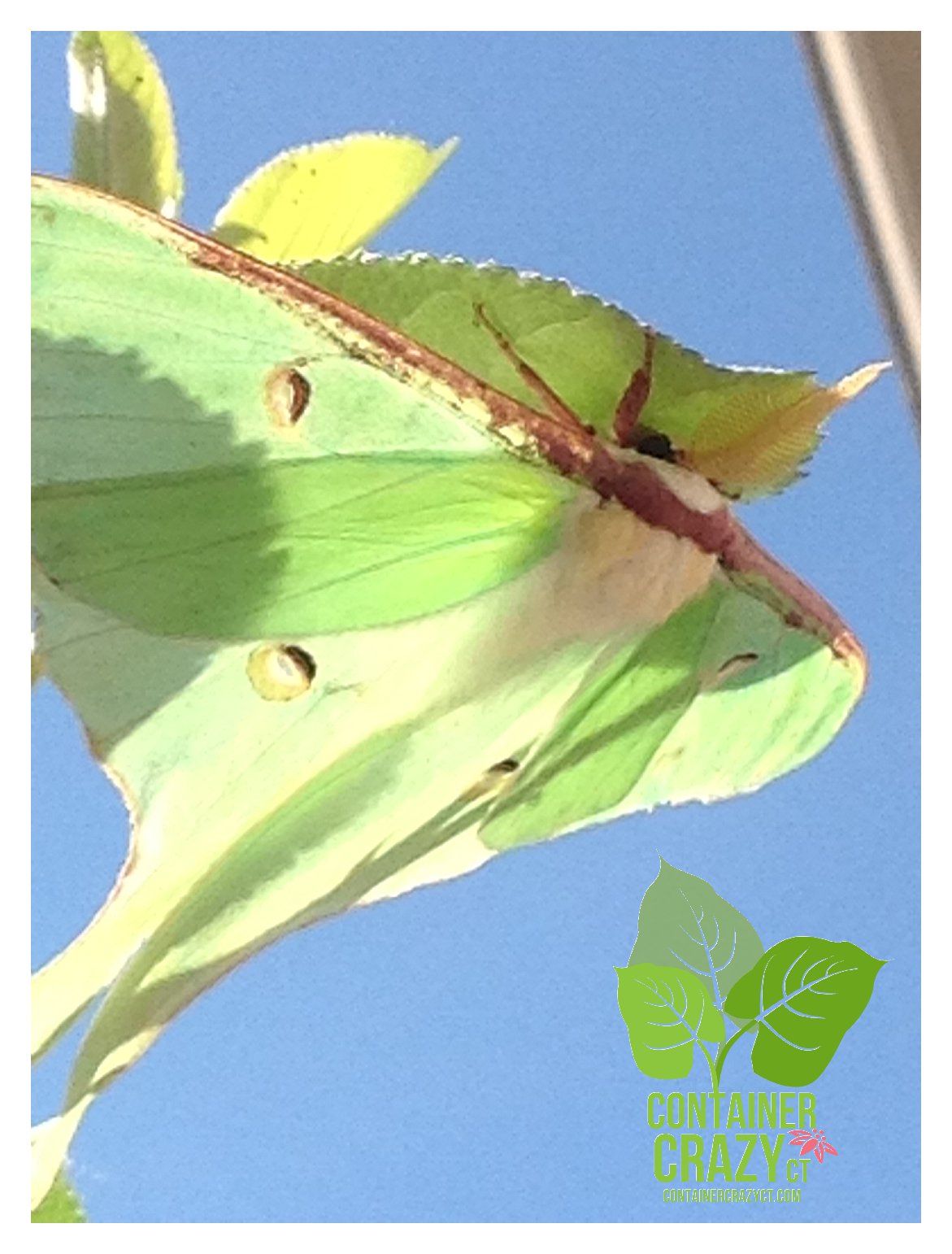
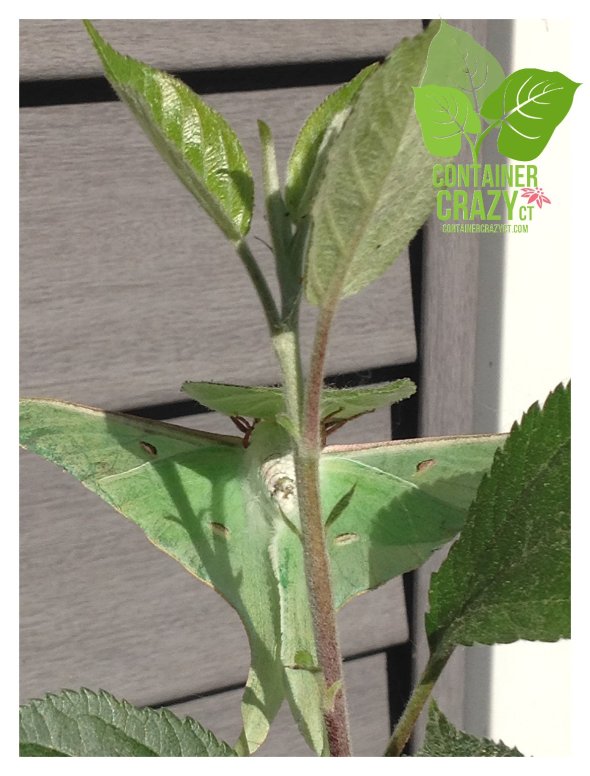
Another surprise sighting at my home this season was a Luna moth (Actias luna) on a apple tree in a pot.  As I was walking out to my garage, I saw a white substance on a leaf.  Well camouflaged, I didn’t see the wings of the moth at first.

I thought, “What the heck is that white fuzzy cocoon on my apple tree?”  (By the way, I often plant small trees in container gardens for a few years first – because I am crazy about container gardening, but it also can give a small tree some time to grow larger and stronger before I eventually transplant it to the ground when it outgrows a large pot – this way, I enjoy, learn and grow the plant first – as is the case with this apple tree.)

Insects ContainerCrazyCT_0015

To my surprise, it was a beautiful moth and not an ugly insect!  This was in the early morning and the east sun was brightly lighting up its wings.  The moth was completely motionless, and not moving at all – this gave me the wonderful opportunity to snap more photos.

Luna Moth on Apple Tree hanging on the underside of a leaf

Luna Moth on Apple Tree hanging on the underside of a leaf

I tried getting photos from every angle, which was difficult to do because it was on the backside of the plant along the garage wall.  After repeatedly taking photos, I tried moving the pot but it flew away.
Insects ContainerCrazyCT_0009

Luna Moth on Apple Tree

Luna Moth on Apple Tree

SPOTTING FIRST JAPANESE BEETLE

I also just spotted my first Japanese beetle on a plant yesterday – it happen to be a watermelon plant in a single container. Those beetles, I pick up with my hands and squish on the ground under foot.  They never scare me – even when they grab tightly onto my fingers.  I guess this is because my father would pick them from his garden plants and put them in a jar – another memory from childhood – and sometimes, I would help him collect the beetles.  I also would chase my younger sister, Louise, around in our pool, when I would find Japanese beetles in our pool too – and she would screech at the sight of them.  She told me this game as children put a fear of those beetles in her for a lifetime – oh well, the things we do when we are kids – LOL! However, she also practices the “pick and squish” method in her own vegetable garden for insects not so scary to her.

East Windsor Farmers Market

East Windsor Farmers Market

ALL BUGS ASIDE

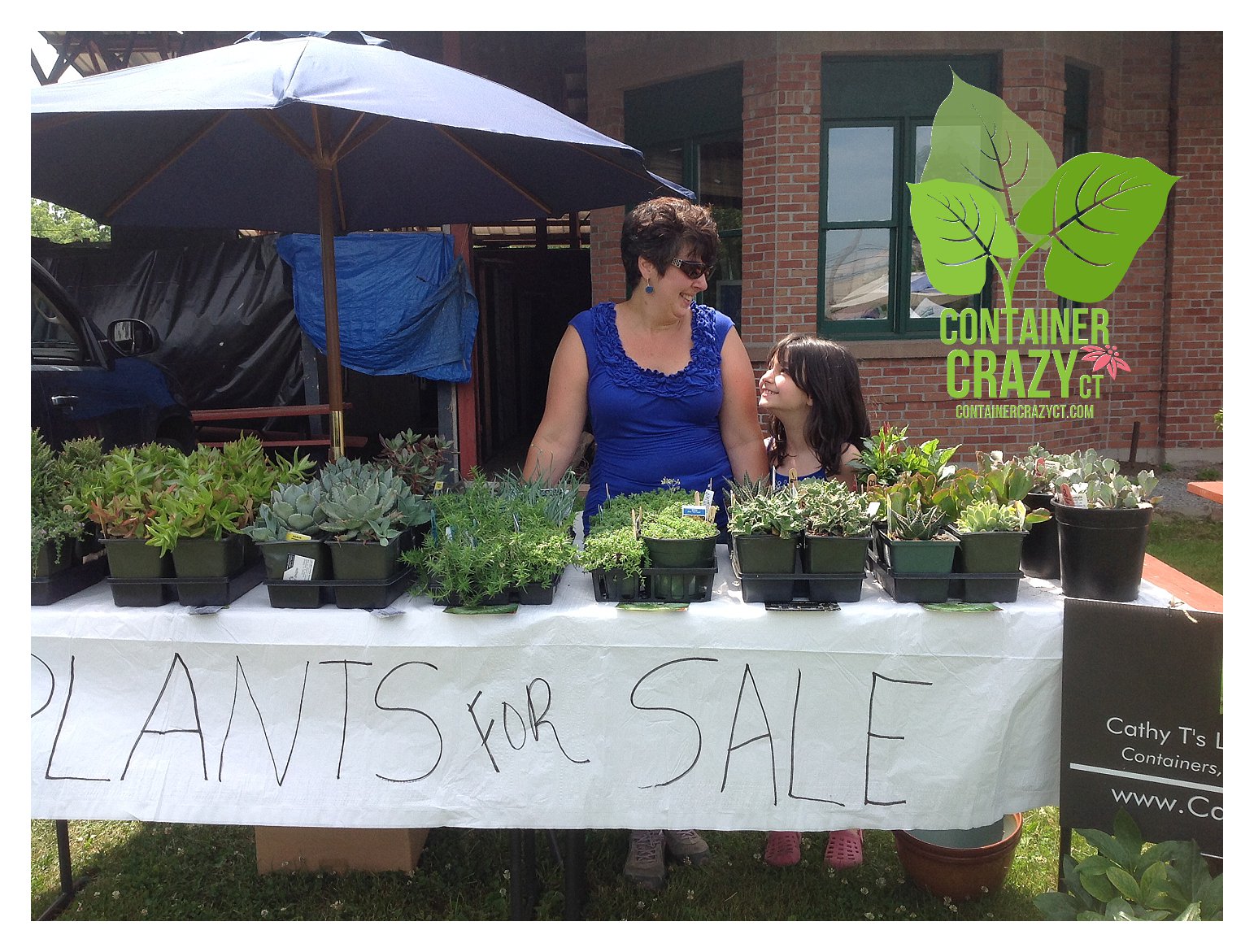
Last week, all bugs aside, I was featured as a guest speaker at the East Windsor Farmers Market on their opening day. Their market runs from now until October, on Sundays, 11 am to 2 pm, at the Trolley Museum off Rt 140.

My niece came for a visit – she loves to help me at the markets with my plants – and I love having her there.  We were goofing around, taking silly photos, and coincidentally, had matching blue shirts on.

See the next photo – this was my building at the market – pretty cool, huh?

Nope, just kidding – it was some sort of very old structure from the Trolley Museum next to my table setup.  I never got a chance to ask them what is was about, but it was sort of cool looking.  (BTW, if you go there, go see the old trolleys and even a few other interesting vehicles, such as airport shuttle buses built, but they were never installed at Bradley airport.)

The other cool thing about going to the market at this location is kids and family can take trolley rides on antique trolley cars as part of their day.  And, I did not know this – but there is a little movie theater inside the trolley museum building too – along with old cool trolley pics and more – so if you go, be sure to go inside as well as visit all the new vendors at this growing market in a great location – picnic tables and all.

Old Structure at the Trolley Museum

Old Structure at the Trolley Museum

AFTER THE MARKET

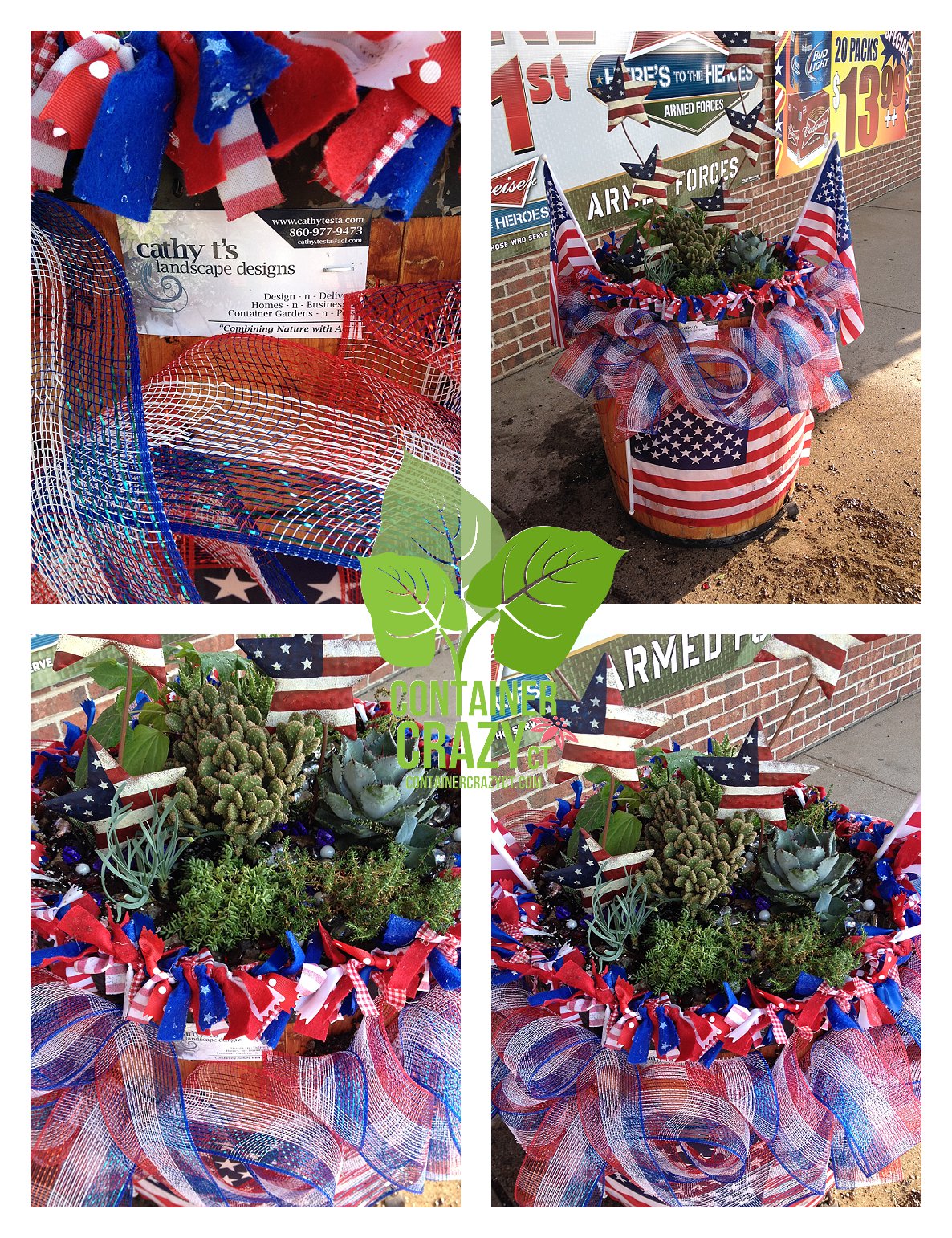
After the weekend, one of my first priorities was to update my client’s business store front with some red-white-and blues for the holiday and put a nice mix of succulents in the container gardens.  Cactic and succulents can be a little tricky to plant if they have spines and needles.  Just be sure to wear thick gloves and handle it by the root ball – and with some practice, you won’t get pinned, stuck, or aggravated by tiny spines.  I will say this however, whomever is putting their cigarette butts in my container gardens at this location – you will find a little surprise this time (hee-hee!). Fortunately, insects tend to not bother cacti and succulents much based on my experience, so they are useful for the non-insect people.

Client Barrels Decorated for the 4th

Client Barrels Decorated for the 4th

4th of July Succulents ContainerCrazyCT_0002

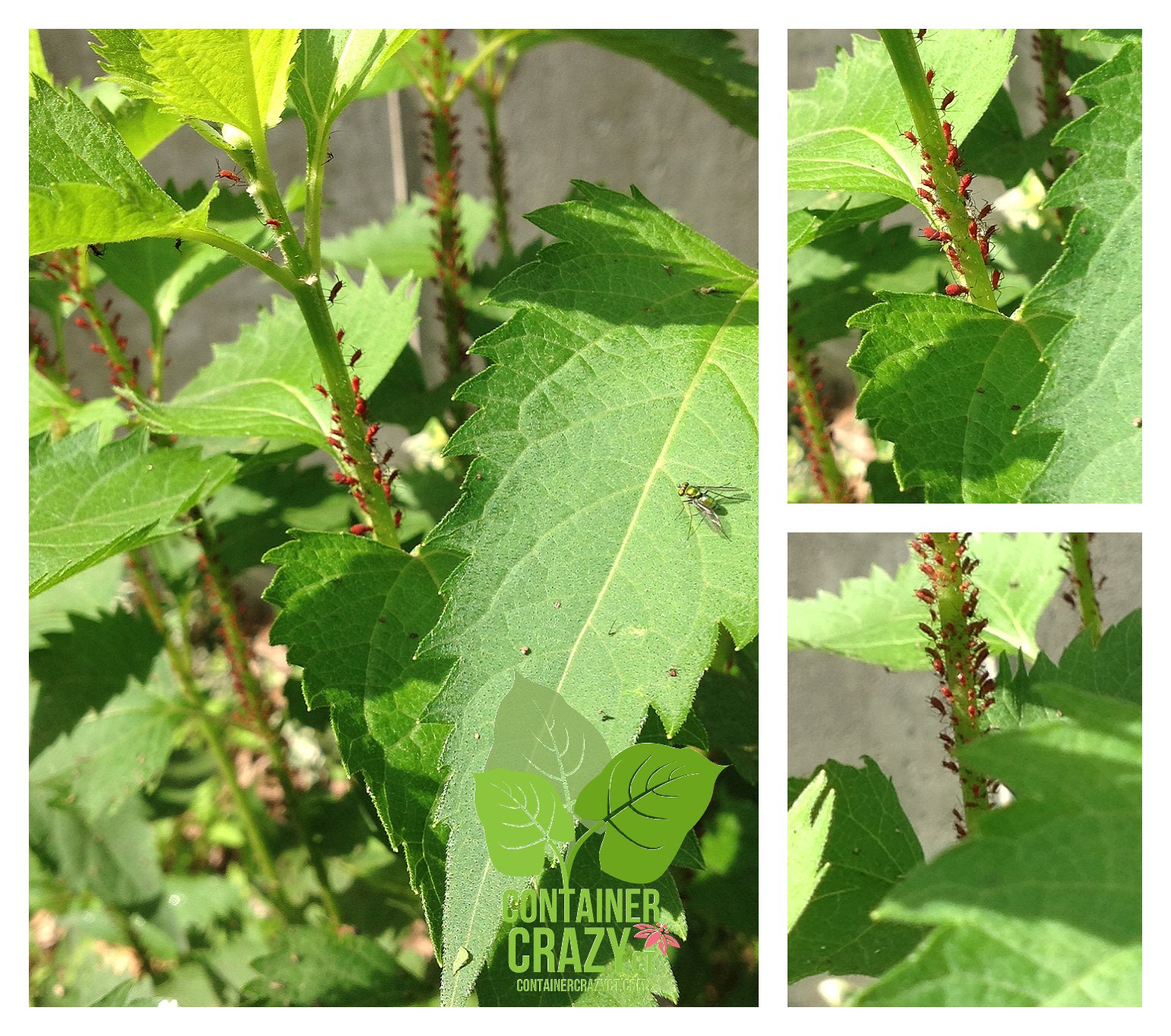
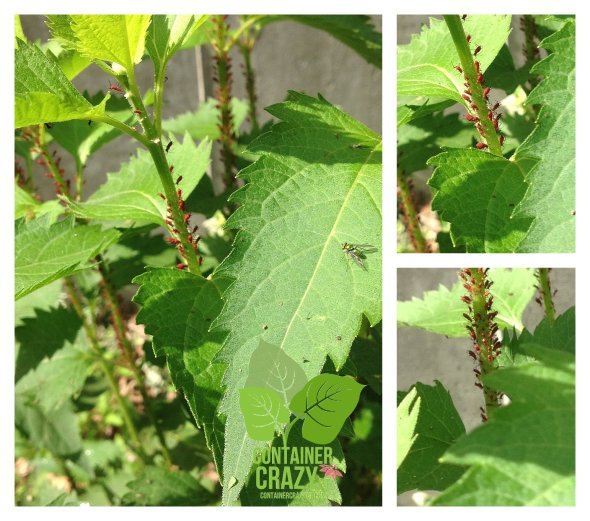
Oh by the way, what are these ugly critters below?  Saw these on a weed plant, so I pulled the plant out of the ground and took it to the chicken coop for the hens to deal with.  That’s another way to deal with insects.  Recycle to the coop…
More aphids or not??

More aphids or not??

Cathy Testa

860-977-9473
http://www.cathytesta.com
ContainerCrazyCT
containercathy@gmail.com

Condensed List- What You Can Do:

  1. Pick, Squish, Toss
  2. Prune away Plant Parts with Insects and Toss
  3. Pull Plant; Feed to Chickens
  4. Hose off with Strong Spray of Water
  5. Chase your Younger Sister around with them
  6. Lightly spray with Insecticide specific for plant and insects
  7. Get natural predators, like ladybugs and release near pest insects

Happy 4th of July Weekend Everyone – Hope it is filled with food, family, fun – and not many critters!

4th Photo Courtesy of Freedigitalimages.net, by nuttakit

4th Photo Courtesy of Freedigitalimages.net, by nuttakit

Cathy T at the Ellington Farmers Market – Edibles, Succulents, and More

2 Comments

Good Morning Everyone,

In June of 2009, I was interviewed by Sarah Martinez for “Garden Center Magazine” about my Container Garden Parties at people’s homes, and one statement I made to her at that time was, “Holding these parties at people’s homes is a lot of work – but I enjoy it.”

Well, the same holds true today.

Last weekend, Cathy T’s Big Container Garden Party (Class) was held, and the plant feature was succulents, alpines and tropical plants – and again – it was a lot of work to setup, but so much fun.  Being with a group of attendees interested in creating and learning – well, it can not be beat.

Attendees listening to Cathy T's Tips

Attendees listening to Cathy T’s Tips

The opportunity to share what I have learned over the years about Container Gardens and plants presents itself again at the Ellington Farmers Market today in Arbor Park on Main Street in Ellington, CT.

Come see me at 10:00 am in the gazebo. (Note:  There are 2 gazebo’s on the property, one will have musicians, the other along Main Street is where I will be on the farmers market grounds.)

The market opens at 9:00 am and closes by noon.  It will be a fast paced day filled with goodies – including a talk on “Decorative Edibles in mixed Container Gardens” by me.  I hope to see you there today.

And because I have beautiful succulents and alpines in stock, I will have those available for sale too.  If you haven’t completed planting up your container gardens and patio pots – come see the goodies available.

Succulents, Alpines, and Cacti

Succulents are plants with thick and strong leaves and stems.  Because they are designed to store water during periods of drought – they are tough little plants.  Some are dainty and others offer bold and strong architectural forms.

Cacti are similar to succulents; they store water in their stems.  Some have areoles with spines, so they can be very strong and even dangerous if not handled appropriately, but so worth it in my opinion, for many offer values in design compositions in container gardens.

In my class last weekend, I went over the 7 ‘Must Not Do’s’ with Succulents, so if you want to know what those are – see me today or sign up for a future class.

Oh and alpines – well, they are just adorable little plants popular to use in rock garden settings, as ground covers, and in crevices — and of course, in big or small container gardens.  This small wired basket is a creation by an attendee last weekend, Linda.  Isn’t it as sweet as ever – so small but so cute.

A dainty creation with alpines by an attendee

A dainty creation with alpines and herbs by an attendee

Sometimes you get inspired when you work with small plants too.  Yesterday, I took snips and cuttings of various succulents and alpines to create this adorable, dainty tea cup embellishment for a table.  Want to give it a try?  All supplies, the vintage bone china tea cups, plants, and instructions will be available at the market at the gazebo.

Cuttings of Succulents in Vintage Tea Cups

Cuttings of Succulents in Vintage Tea Cups

The tea cup plate and cup on the left, by the way, will be available for purchase. These cups go for $20-25 dollars on eBay – I will have them for a deal at a limited supply so if you want one, arrive early before they are all sold out.

But succulents, as noted above, can be very edge looking, and another attendee at the class scored an amazing container – check this out!  Topped with a very large Sempervirens (Hens and Chick), alone it makes a statement.  Her tall silver GARDEN container will rock it outdoors, and is easily moved indoors over the winter if desired.  I think it was my favorite container style brought by an attendee this year – so fun to see what they find and design in class.

Lisa's GARDEN container rules!

Lisa’s GARDEN container rules!

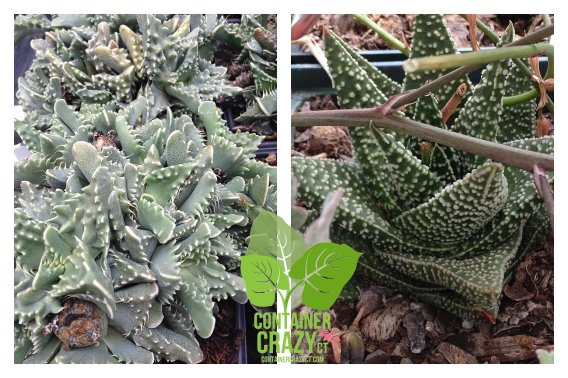
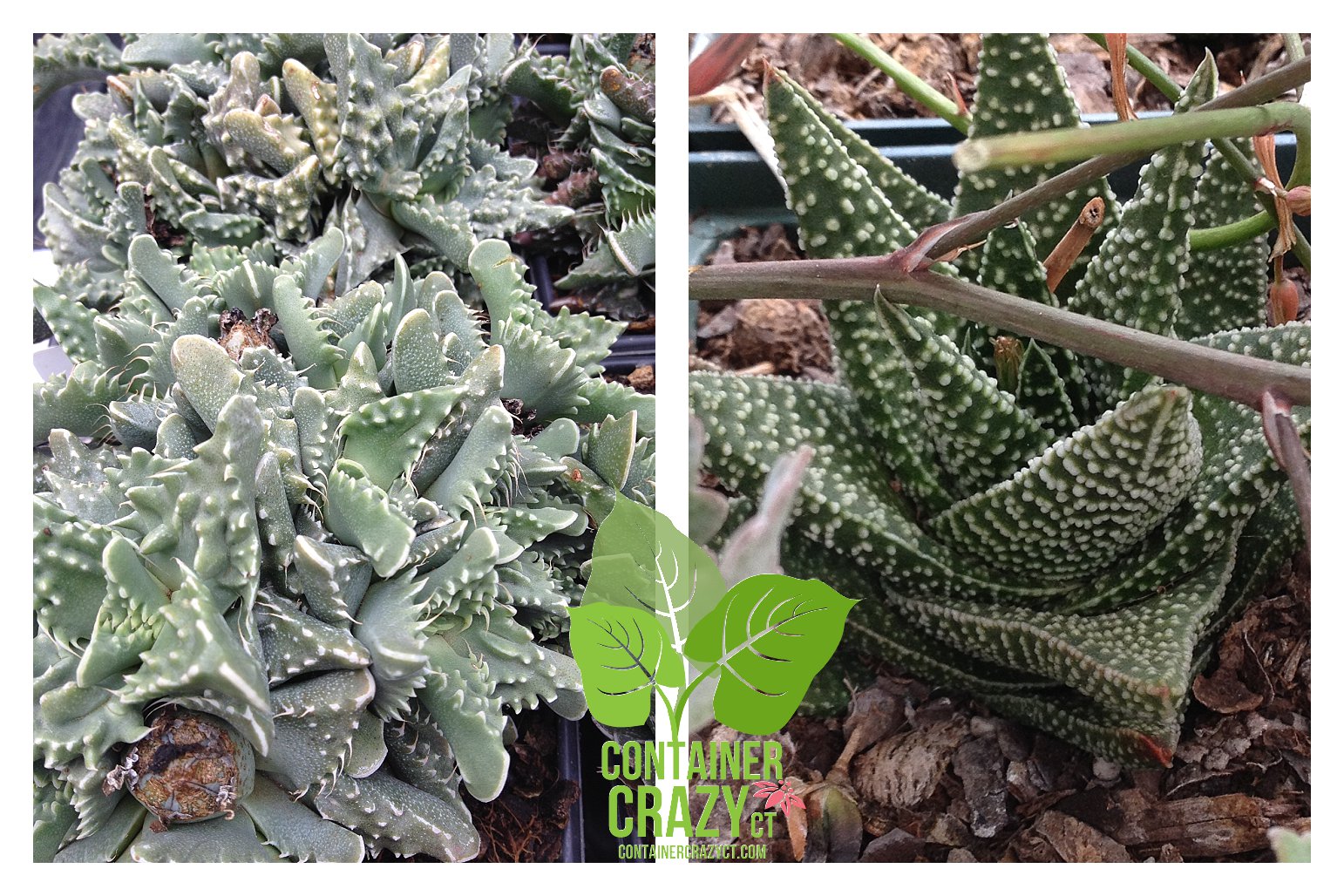
Succulents and cacti offer extremely different ranges of forms and textures.  Take the Faucaria tuberculosa on the left in the photo below.  This plant is a South African native and has the most interesting triangular leaves and it is a soft silvery blue color. This looks great with darker toned succulents in a pot, but it is also a neat form to work with.  It is a Zones 10-11 plant so perfect for the heat of summer and as a house plant in winter.  It is very easy to grow and will bloom yellow flowers in late summer.  The common name is Pebbled Tiger Jaws – perfect name, I would say.

Awesome forms and textures

Awesome forms and textures

And check out the plant on the right – Gasterworthia ‘American Beauty’ – it is NEW on the scene.  This is a hybrid of Gasteria and Haworthia pumila (maxima) grown by local growers in CT – and the rosette is stunning – patterned with spotting on the leaves. It is shooting up yellow flowers right now.  Both will be available for sale today at the market, along with many other types.

Two Types of Jades

Two Types of Jades

The plant with red edged leaves is a Jade plant by the name of Crassula arborescens – also NEW on the scene.  How can you resist this plant? – it has fleshy, blue-gray foliage and stands upright but full and mounded too.  It eventually grows to 3 to 4 feet wide, and I think they are stunning.  Also, a common Jade (as seen in the background), Crassula ovata, is in this photo – a common houseplant which I think looks amazing in head planters.  Go see my Container Garden Collages for photos of a red head pot to see.

Hens and Chics

Hens and Chics

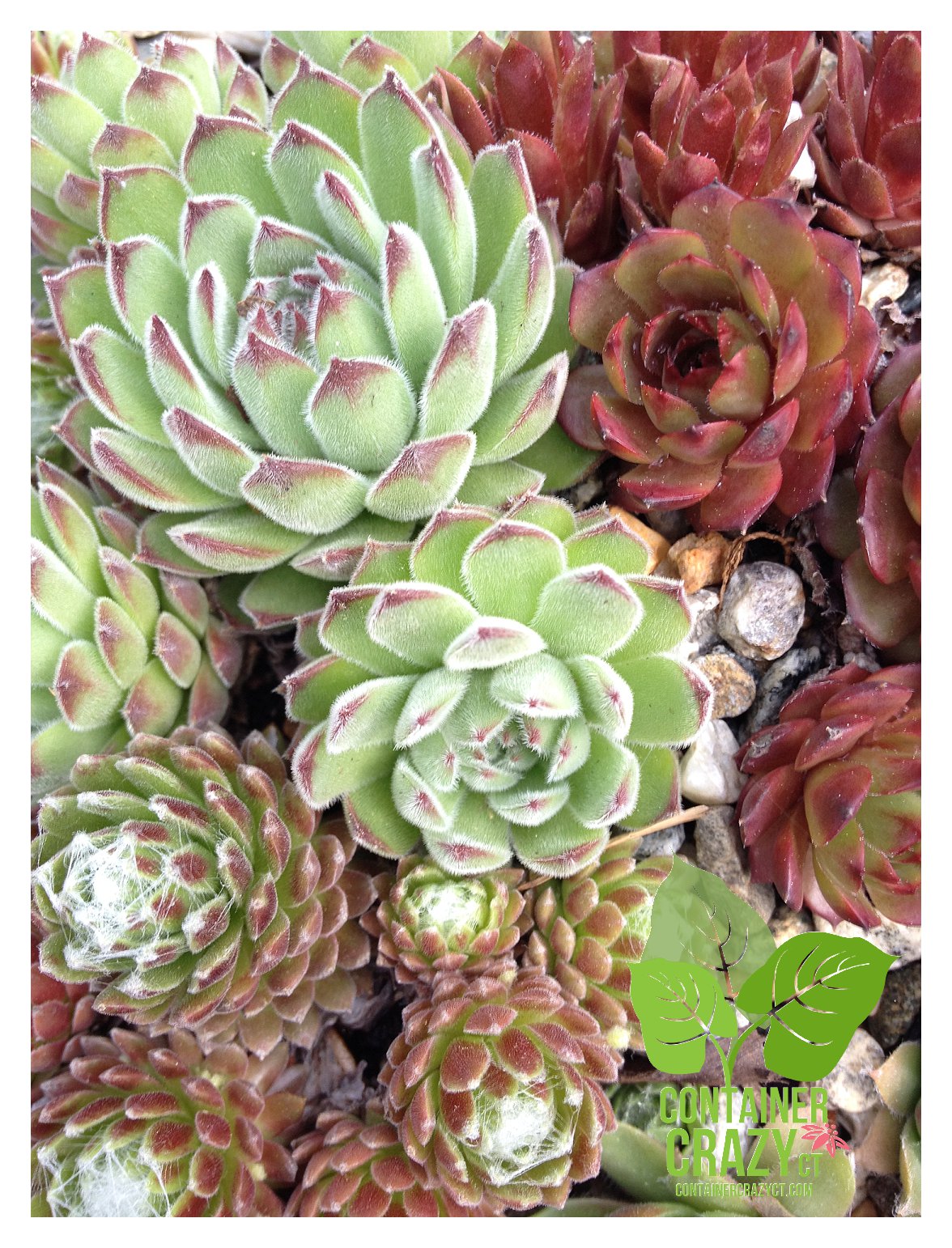
These are just ‘sneak peeks’ of today’s plant features.  Echeverias with a variety of colors and fleshy leaves tinged with colored edges will be available too.  The Genus name is named after an 18th century Mexican botanical artist, Atanasio Echeveria y Godoy – now you know why they are called Echeverias (a.k.a., Hens and Chicks).  And be on the look out for Agaves, Aloes, Kalanchoes, and other’s.

But now it’s time for me to sign-off and get ready for my day.

See you there,

Cathy Testa
http://www.cathytesta.com
ContainerCrazyCT.com
860-977-9473


A Succulent of a Different Kind is Rescued – Aeonium arboreum

8 Comments

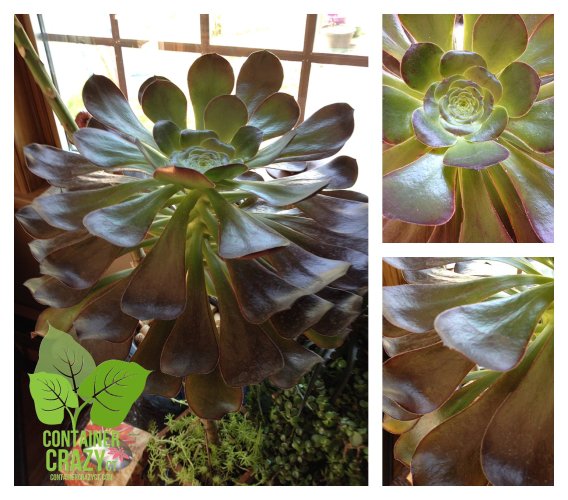
I recently rescued an Aeonium suffering in the confines of a small square terracotta pot at a garden center.  It was tucked on the floor below potting benches where it stood solo with no others like it nearby.  Spotting its dish plate sized rosette, I stopped to look it over.

Hand shows size of  rosette

Hand shows size of rosette

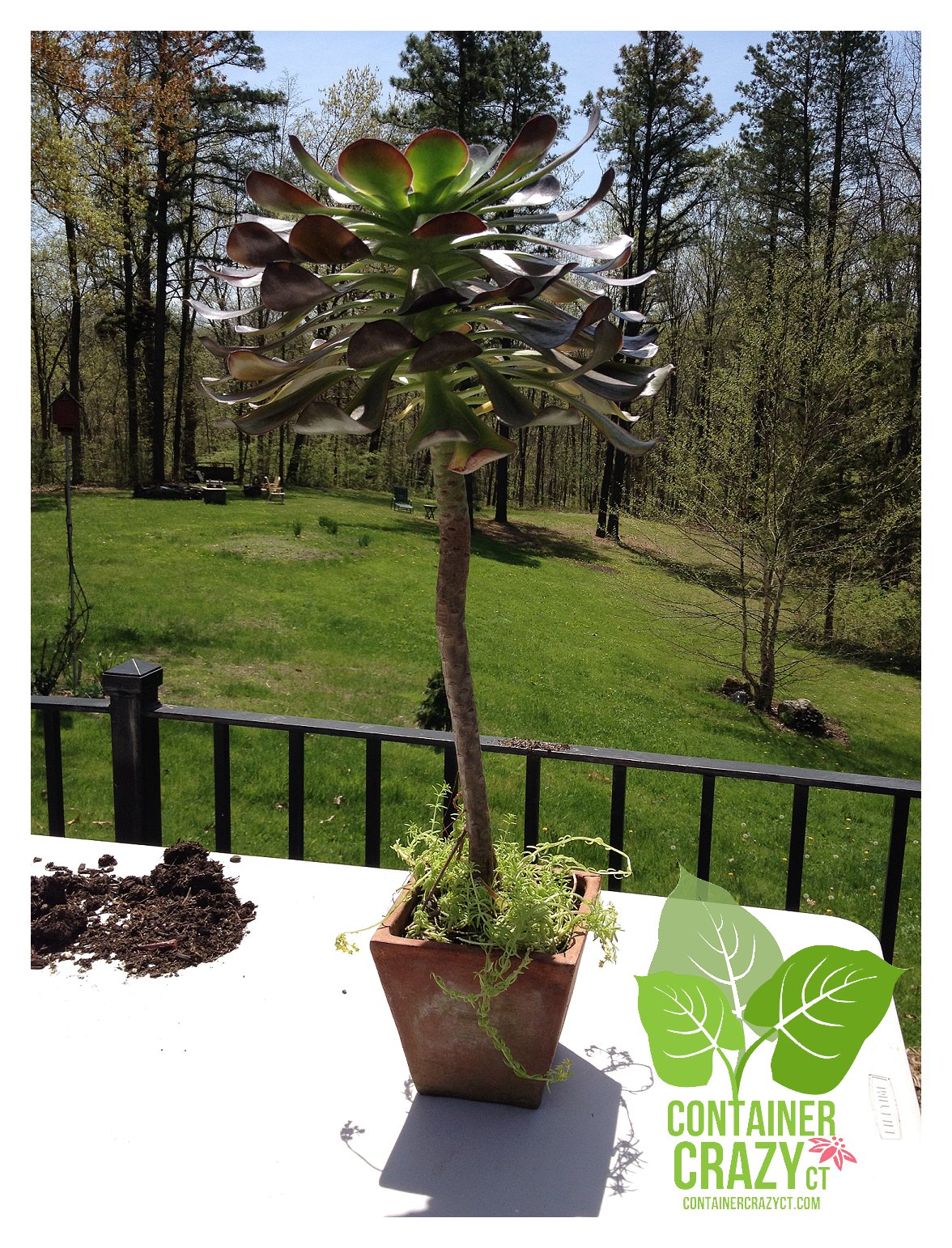
It was apparent this showy and tall succulent plant had been sitting there for a very long time.  The pot it was growing in was very small, much smaller than the diameter of the plant’s terminal rosette which was growing from a single stem of 15 inches tall.  And although the plant looked great overall with no signs of problems, the pot was tattered and was barely holding up this plant.

This particular succulent could easily be overlooked at the garden center if you are not a scouter of plants, such as I am.  Additionally, there was no plant label in the pot, so if you are unfamiliar with this different kind of succulent, you may have decided to leave it where it sat. However, I decided to return to the garden center to go get it and bring it home.

Original Pot - Ready to be Potted Up

Original Pot – Ready to be Potted Up

I instinctively assumed it was a variety called, Aeonium arboretum ‘Zwartkop’ or Aeonium arboretum var. artopurpureum, because of its dark plum colored foliage, but now I am not sure.  Only because the rosette is so large, I thought perhaps it is a cultivar unknown to me, or just a very mature ‘Zwartkop’ growing for some time.

Either way, the technical plant name is of no matter because the large size of the plant’s rosette is so spectacular, I know it will be a showcase in a container garden at my home this summer.

Potting It Up into a New Home

These plants should be repotted every two to three years. When Aeoniums get pot bound, they may send out additional aerial roots from the base of their stem, which was the case with mine.

The new pot selected should be a size up in diameter of the existing pot, or the plant itself.  Or it can go into a larger container garden with other mixed succulents sharing the same exposure and soil preferences. Either way, the container must have a drain hole, or perhaps two or three, for free drainage of water through the soil profile.

It helps to keep the soil moisture level regular for Aeoniums because their roots are fine and can dry out easily.  This is not to imply you should over water the plant. You do not want soggy soils for any succulents because they have the tendency to rot at the base when the soil is wet.  Most succulents or cacti can handle heat, drought, and dry soils from time to time because they store moisture in their leaves or stems during drought periods – which this one does, but it also is a bit different in regards to moisture levels because of its fine root system.

New Glazed Pot and Soil Mix

New Glazed Pot and Soil Mix

To help keep the soil at its best, use quality, fresh soilless mix specifically for container gardening or patio pots.  You may use soil mix labeled for growing cacti, but Aeoniums can also grow in regular potting mix for containers because it likes a bit of regular moisture.

Be careful when moving the plant to be repotted so you won’t bump into anything.  Gently remove it from the pot by holding the base of the stem.  The stem of this plant is fairly strong, but you do not want to risk damaging it during the repotting process.

As I removed it from the terracotta pot, it was very apparent there were some critters in the soil, such as sow bugs and centipedes.  These bugs like warm moist locations in the soil. I wanted to eliminate them as much as possible, so I gently removed away most of the soil from the plant’s root system.

Removing, inspecting the soil, and seeing the sow bugs

Removing, inspecting the soil, and seeing the sow bugs

In addition to seeing critters in the soil, there was an indication the soil was not taking in moisture anymore.  When potting soil is not renewed, it can actually repel water.  The soil in its original pot was moist only around the edges, and not in the center, so it was not permeating through completely.  It was just another indication the plant needed a new fresh growing environment.

Filling my new glazed pot almost to the top (about 2” from the rim) of fresh potting mix is the process I typically follow when potting up plants.  After it is full, I scoop out some of the soil to make a nice comfy pocket for the plant being transplanted.

Some people may fill the pot halfway with soil, place the plant in there, and then fill around the plant by adding soil up the rest of the way in the pot – but I prefer to make a pocket so the roots come into contact all the way around the plant.

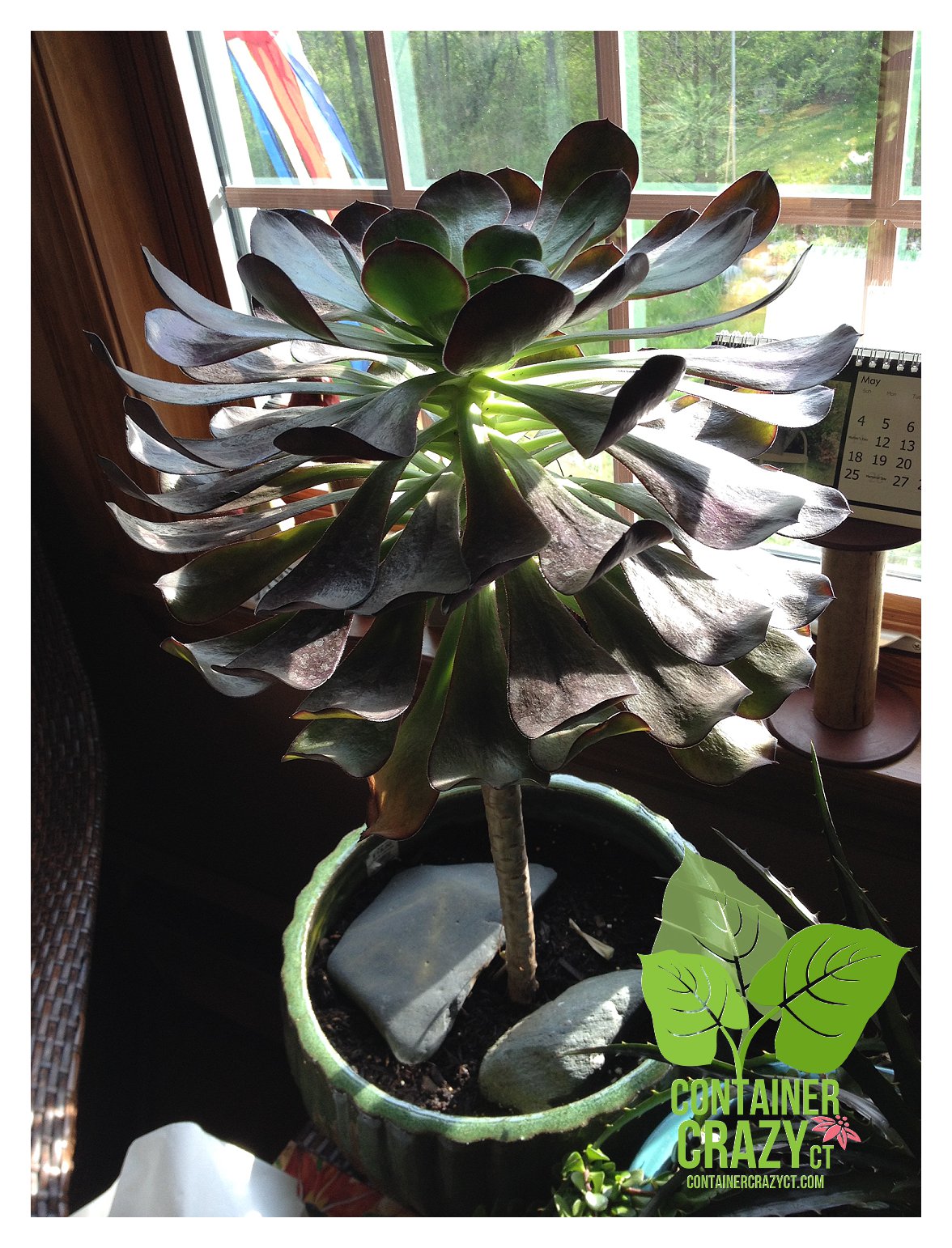
Holding it down with stones

Holding it down with stones

This pocket process was especially important for this Aeonium because the rosette is so large, it was a little top heavy – especially because I removed the old soil from the roots.  To secure the plant better, I placed two large stones on top of the soil, adding a bit of weight there to help keep it stable until roots take hold.

I also added some slow-release fertilizer to the soil, and lightly mixed it into the top.  Always water any transplanted plants right after you are done.  Don’t leave it until later to give it a sprinkling of water – it will help to awaken the roots to the new fresh soil and get them established.

In a shady spot to drain after lightly watering in

In a shady spot to drain after lightly watering in

Succulents are Easy to Grow

Succulents can handle heat and drought, but as mentioned above, this species prefers some light shade for part of the day as it doesn’t really like super hot summers or very humid weather.  They like a mild cool weather which may seem odd because many people think of succulents as heat lovers, but some do well in moderately cool weather, and Aeoniums are one of them.

If you see the leaves curl when this plant is outdoors in summer, it may be an indication you have it located in too hot of a spot.  Relocate it to where it gets a break from the heat, a part-sun area or where it will get bright sunlight such as under a patio umbrella, and all will be fine.  And also remember, moving any tropical like plants outdoors after being inside for the winter should be done so with care – putting them in a shady spot for a day or so.  Foliage can burn when put into direct sun immediately.

The many different textures and forms of succulents are fun to combine in mixed container gardens and patio pots.  And ‘Zwartkop’ cultivars are especially useful because they have a dark coloring which works nicely against other light colored succulents, from the soft silvers of Agaves and Senecios, to bright yellows typically seen on succulent plants, such as Sedums.

The older, lower leaves on most Aeoniums will wither and fall off.  If they turn yellow and are unsightly, you can easily snip them off with a pair of common household scissors before they drop if you prefer – and sometimes they pull off easily by hand.

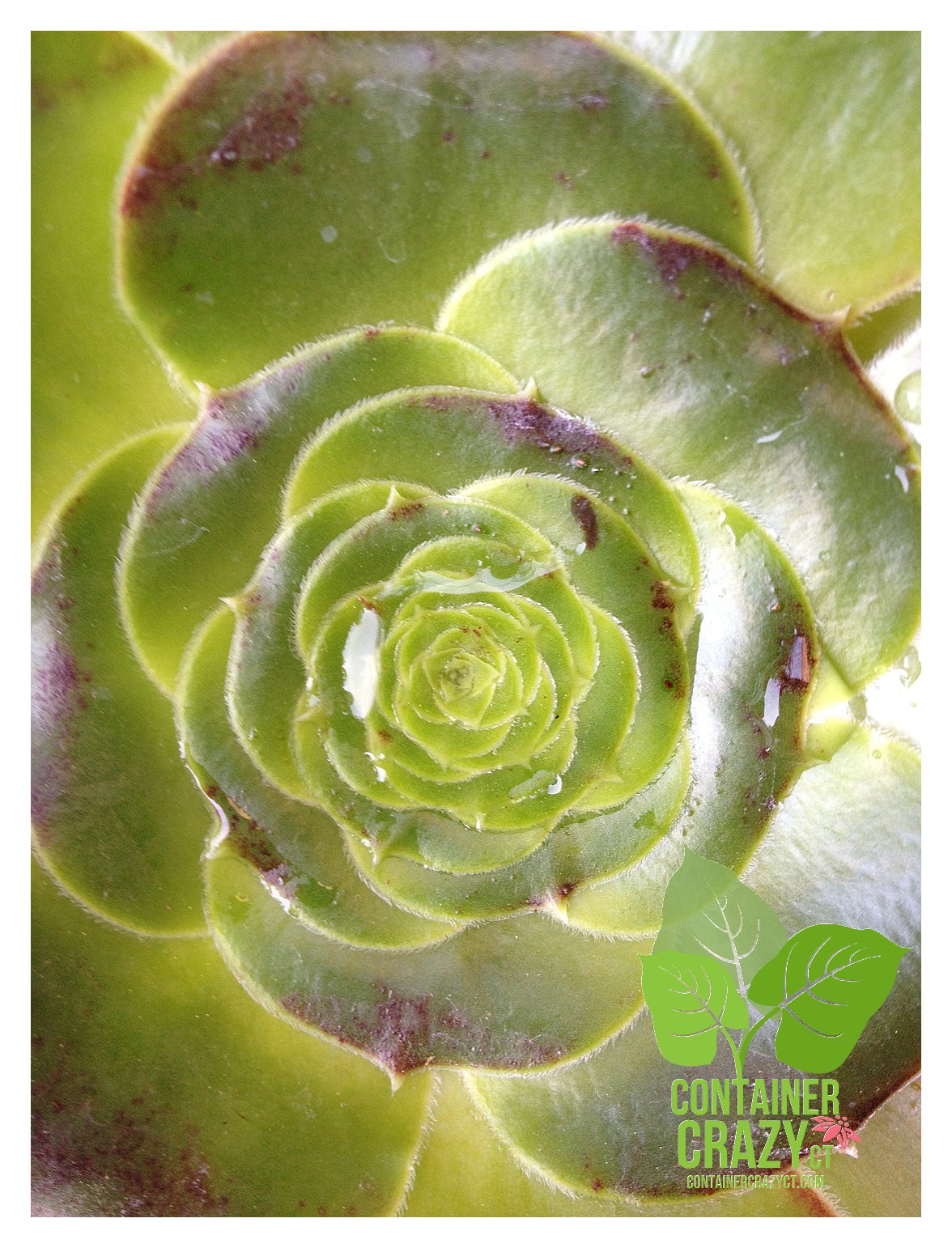
Tight Rosette in the Center

Tight Rosette in the Center

The top of the rosette stays tight in the center, and the foliage directly below it is usually more spaced out.  A lovely feature is the very center of the rosette.  It can have a tone of yellow or green, more prevalent when the plant is grown in part shade.  When in full sun, the coloring is more on the darker plum to black side.  Water droplets on this plant’s rubbery foliage can be very pretty too.

Different Growing Habits

Aeonium plants may be trained into looking like a topiary by removing side branches, such as the one I took home, and some cultivars grow very low to the ground.  They also grow like a shrub with side branches reaching out from the main stem with rosettes appearing on their tips.

The dramatic shape of the rosettes is useful in container gardens, adding interest and uniqueness to a composition.  And the branches offers an architectural appeal as well, resembling a large bonsai form.  And if you are lucky, you will see their amazing blooms.

I have yet to see an Aeonium bloom from my prior stock of these succulents because I usually get them when they are young plants.  Blooms grow on mature plants. The blooms are an excellent yellow color which contrast nicely against its attractive dark colored foliage.  But witnessing a blooming show has a double-edge sword because some succulent plants will die after they bloom.

To see the different growth habits and blooms of this interesting succulent, see my Pinterest board titled, “Succulent Sensations!” which is filled with examples.

Making More Plants

Propagating this plant is an easy process to do, so long as you are patient enough to wait for it to root and start a new plant.

Snip off rosettes with about 5-6” inches of the stem intact (still attached) with a clean sharp knife, and insert it into a small pot of fresh soil to take root.  This should be done during the active growing period of Aeoniums for it to be successful.

If your Aeonium has many branches, you have the capability to start a whole family of them by snipping and inserting cut stems into soil.  It helps if you allow the cutting to sit for 24 hours to dry a bit before inserting it into the soil, or just set it on newspaper to sit overnight.

The soil for the cuttings may be regular potting mix or one amended with fine sand and drainage material – but I find either works easily.  Moisten the soil before inserting the cut stem into it so it is slightly moist.  Cuttings can also be inserted into container gardens mixed with other plants in fresh soil – it will eventually take root.  This is a great way to capitalize on your purchase of an Aeonium, or other succulents easily propagated by cuttings.

By the way, Aeonium is pronounced like ay-OO-nee-um.  Get practicing so when you show off your specimen, you will sound like a pro.  Or you can just refer to it as a black rose succulent or black tree succulent.

Written by Cathy Testa
www.ContainerCrazyCT.com
www.CathyTesta.com
860-977-9473 cell

Hardiness Zone:  9 or warmer; grown as a tender perennial in Connecticut during the summers, and as an indoor house plant in the winters.

Upcoming Cathy T Class:

To learn more, register for Cathy T’s “Big Container Garden Party (Class)” on Saturday, May 24th – there’s still time to sign-up!  See “Garden Talks” on the menu of this blog for more information.  Succulents will be the key feature for this class.  Some Aeoniums will be available too.

Returned Inside Until Temps Warm Outside

Returned Inside Until Temps Warm Outside

Upcoming Cathy T Class – Lots of Succulents to Play With!

Leave a comment

Click the link below, (when it opens, close the ad to bypass it), and you will see a quick slide deck of an upcoming class by Cathy T on May 24th, 2014, Saturday.  Don’t miss out – there will be lots and lots of different succulents to choose from as you learn and design your fun, unique, interesting, and creative container garden.

To get some inspiration and ideas of the type of container gardens we are talking about, check out Cathy T’s “Succulent Sensations” PinBoard.  The ideas are “endless” – got a cute rustic toy truck, a hot shoe, a broken bird bath, a sink or tub? Many of these items can be made into a container garden stuffed with a variety of succulents in this class!

To learn more (because there IS more, from tropical plants for sale at the class too and a mini-slide presentation) and sign up, go to Cathy T’s Classes pages on the top menu bar of this blog, or click here:

https://cathytesta.wordpress.com/schedule/may-class/

Current attendee count:

We currently have 11 attendees, so don’t delay to express you interest to join us.  A complete detailed document will be emailed to signed-up attendees by the end of this week on the cost, types of succulents on the list, and what to expect – so if you want to express an interest to be part of the gang to hold your seat, email or fill the contact form below today.

containercathy@gmail.com

← Back

Thank you for your response. ✨

Please share this class with local friends interested.  Thank you – Cathy T


Agave ‘Kissho Kan’ – When it Flowers, I’ll need a Shot of Tequila

3 Comments

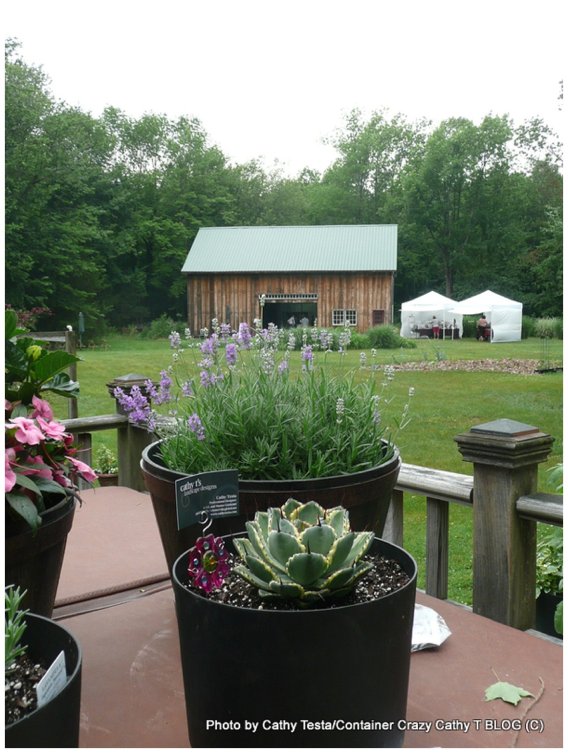
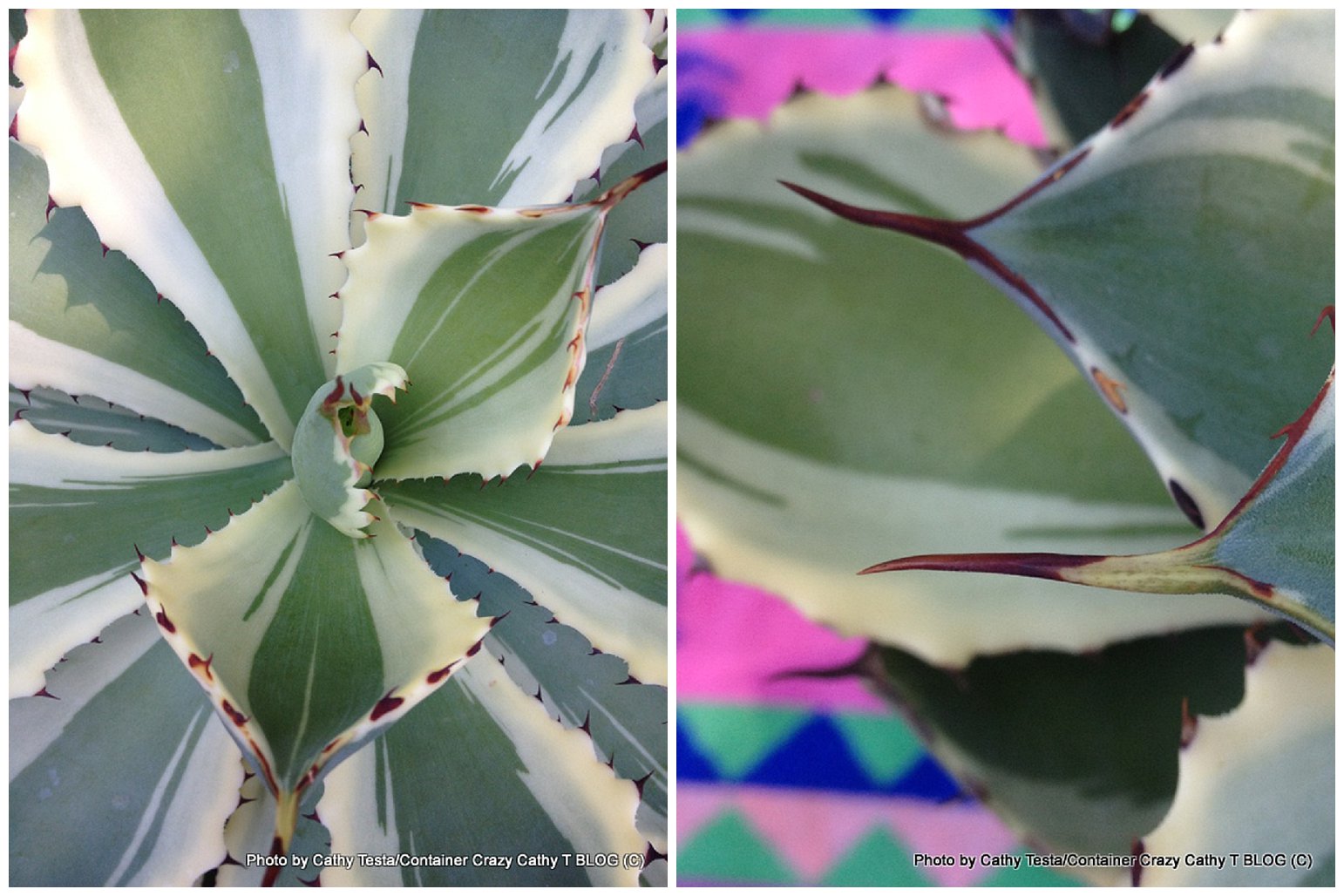
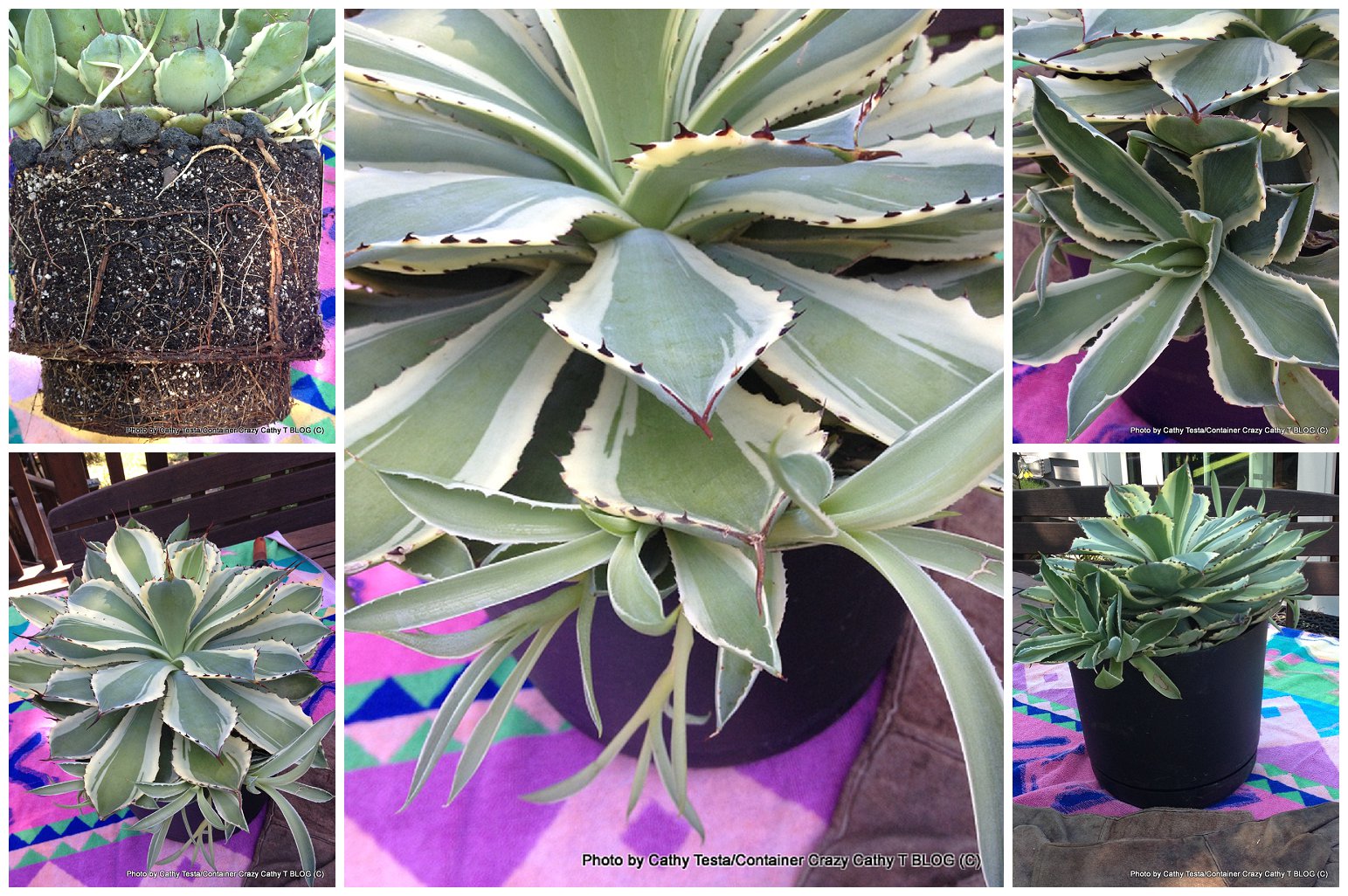
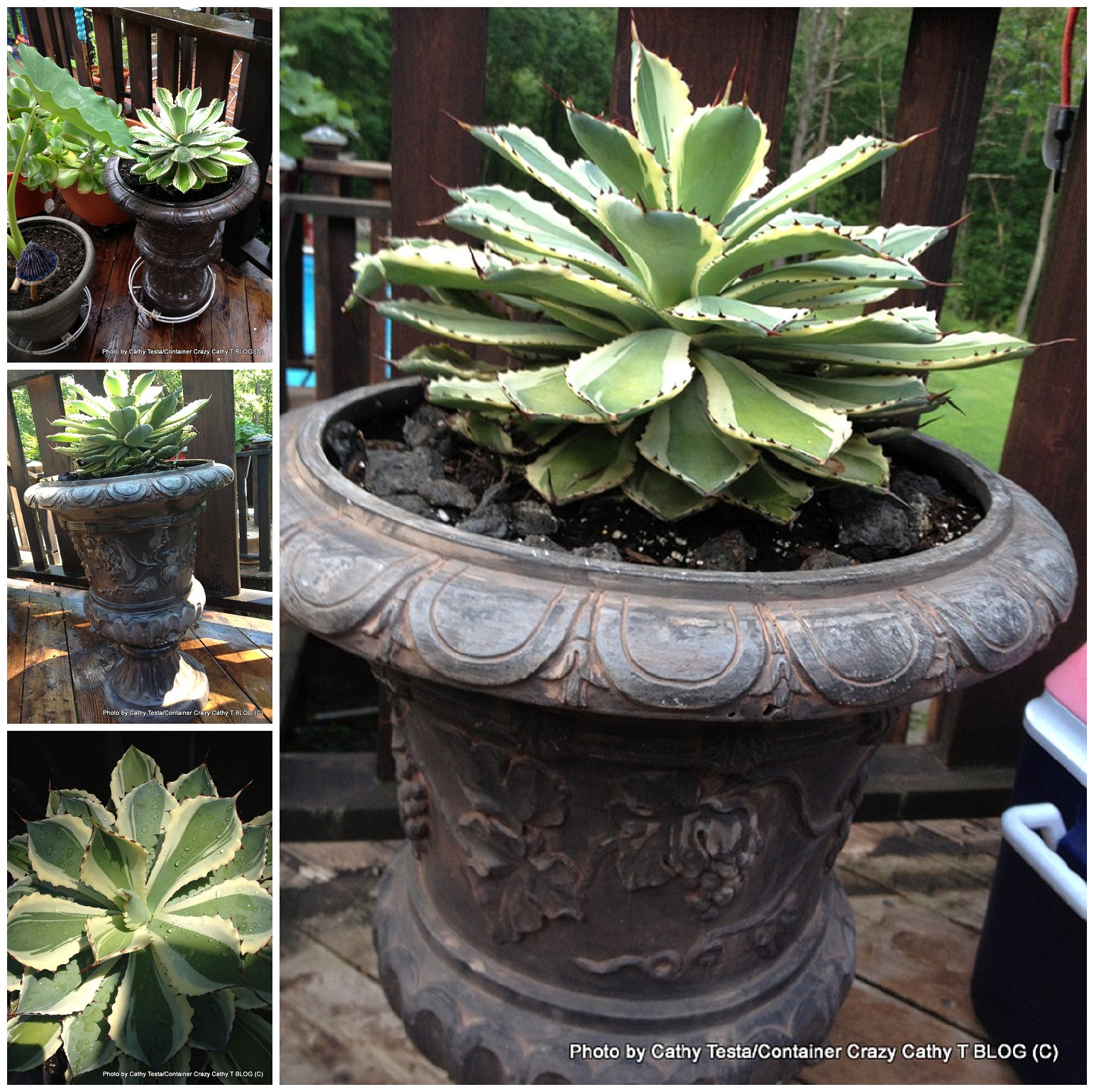
Agave ‘Kissho Kan’ (Century Plant) is a tough and beautiful ornamental succulent plant for container gardens. The plant has a strong form growing in a tight symmetrical rosette.  It has more coloring than many other species of Agave plants.  It bears creamy light yellow coloring adjacent to the blue green centers on its leaves.  And the spines at the tips are cinnamon colored but prominent enough to be used as a color echo in a mixed container garden.

Original Plant

Original Plant

Besides being beautiful, it is a really easy to grow plant.  Low-maintenance, it will last for years and potentially bloom (if you are lucky), and then die.  Yup, croak.  However, it will offer up Mini-Me’s over time as offshoots from the base prior to its death.  And if the plant lasts at your home long enough for it to offer its flower stalks as its final gift to you, you may in turn want to honor its life and eventual passing by downing a shot of tequila — because, as many folks know, Agaves are used to produce the strong elixir.

Rosette, Spines

Rosette, Spines

Mini-Me’s from the Mother Plant

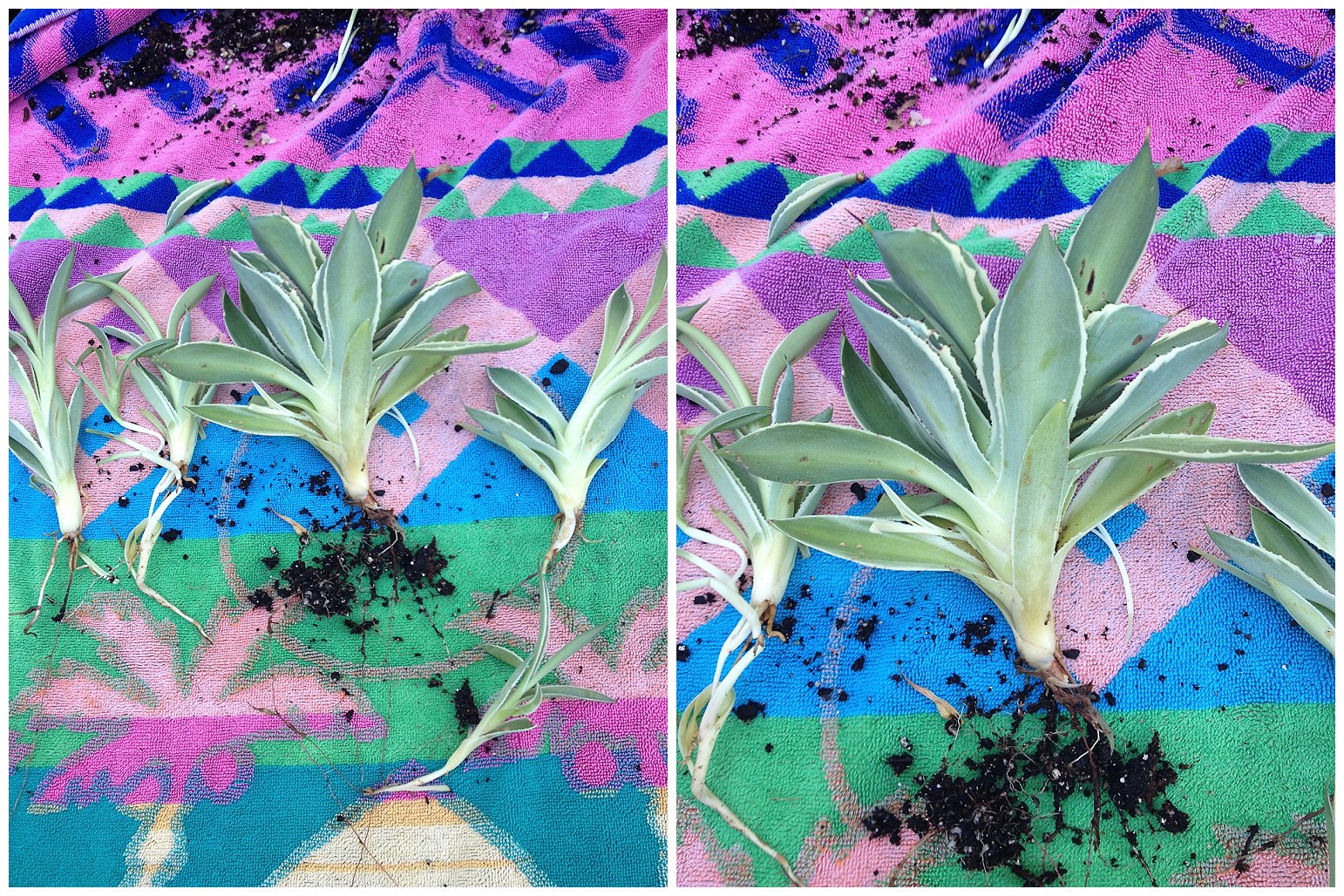
When mine was sprouting offsets (Mini-Me’s) at the base, I decided it was time for it to be re-potted. I grabbed a couple special gardening tools and selected an urn I had in my stock (perfect as it was one size up from the former pot).  Collecting up some tools, I did my propagation routine which was easier than I expected.

Getting Ready to Repot

Getting Ready to Repot

Tools:

  1. Beach towel
  2. Large grill tongs
  3. Fish tank gravel
  4. Potting mix amended with some coarse gravel and sand
  5. Thick garden gloves, the type with rubber fingers and palms
  6. Coarse airy stones for the top of the soil

The beach towel was used because I was lazy, and wanted to grab something quickly to put on my table to collect any fallen soil as I worked.

The grill tongs used because I couldn’t think of what else was handy to hold onto the Agave, but it turns out I didn’t really need those cause the plant easily shook out of the pot onto the towel.

The fish tank gravel was from a fish tank years ago.  I knew I’d find a use for it.  It was washed and rinsed prior to filling the base of the urn with it, to about a 1/3 of the way up from the base for drainage.  Remember, well-draining soil is critical for this plant.

The thick garden gloves, well – for obvious reasons. To protect my hands from the Agave’s spines at the leaf tips.

And lastly, coarse porous black stones were for the top of the soil.  Agave plants sit so close to the soil line that putting some barrier material between it and potentially wet soil will help to avoid rot situations.  Also, the soil mix used must be porous.  You can look for the type used for succulents or cacti if you don’t want to amend it yourself.

Pulling away offshoots

Pulling away offshoots

Each little baby plant or Mini-Me (a.k.a., sucker, sprout, offsets or offshoots) at the base of the Momma plant were easily pulled away and re-potted.  Given to special gardening friends with a word of caution:  Not hardy, avoid cold wet rain situations (early spring, late fall), and watch your hands or butt should you walk by this plant – the spines are sharp.

Mini Me's

Mini Me’s

The pot should be relative to the size of the current plant.  It thrives in tight conditions and is a slow-grower so it won’t overtake a pot or container garden quickly. Select a pot that is form fitting if you plan to grow it solo, or in a mixed planting situation, you can go somewhat bigger if desired.

Repotted into Urn

Repotted into Urn

There are plenty of succulents and alpine type plants you can use to mix it up in a container garden for a real show.  Want some ideas of what those are? Visit my Succulent Sensations Pinterest boards and attend my May 24th class in 2014.

There is much to know including how easy it is to give birth (propagate) new plants (Mini-Me’s) from the mother plant. Because, as I said earlier, this plant is easy to grow, you should have grandchildren from Agave ‘Kissho Kan’ in a two to three years.

Mixed container

Mixed container with Senecio and Sage

Celebrate its Birth and Size with Tequila

This plant will grow to about 15″ or so, slowly.  However, other Agave species grow rather large. If you want to see a really big blue agave plant being dug out of the soil by a strong farmer, check out this video.  I’d like to hire this guy to dig out some yucca plants in garden beds, equally tough to remove.  And then have a couple tequila shots with him, because the plant he is harvesting is used to make tequila.  And, believe me, he’s earned a shot or two if he does this process for the whole field of plants.

Fortunately, Agave ‘Kissho Kan’ is far more manageable, and it will not grow as large as shown in the video above.  It is perfect for container gardens and for people who are a little negligent with their watering routines because the plant enjoys desert to semi desert conditions.  

As mentioned above, the only thing you can do wrong to it is let it sit in cold wet conditions – this usually leads to rot on the leaves. My recommendation is to put it outdoors in the early summer after the early cold spring rains are done, and it is warm outside regularly.  And to move it back inside for the winter before the cold autumn rains hit.  It likes to stay warm.  Most people fail with this plant because they think it will be okay if it gets rain at that time period because you still have warm days between cold rainfall, but I say avoid that cold rain situation all together for success.

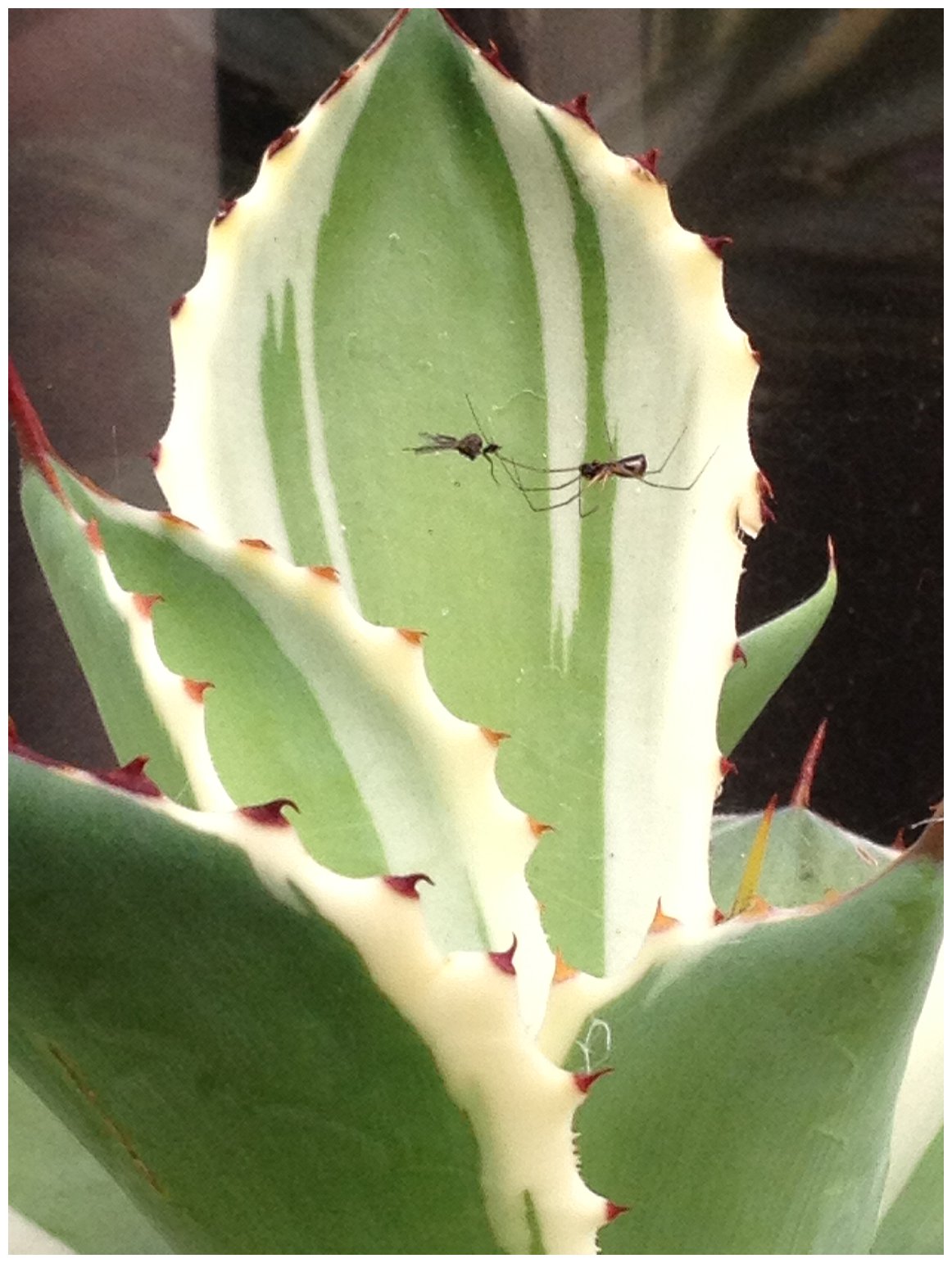
Spiders Visit the Plant on Summer

Spiders Visit the Plant on Summer

Death after Flowering

If you don’t kill it, or die from doing too many tequila shots – great – the plant (and you) will last a very long time, and even perhaps a beyond a few centuries. They grow so slow that many won’t produce a flower spike until after 15, 20 or even 30 years when it reaches maturity.  The flowers rise on tall stalks and put on quite a show.  In this video, you can see how a flower stalk reaches to the heavens.  It is quite spectacular, requiring years and then just the right conditions to come out into the open.

Some Agaves will grow flowers regularly, but I must confess, I am not sure if Agave ‘Kissho Kan’ is one of them.  There are some confusing references on it but not a concern, if I see a flower stalk appear, I’ll let you know immediately.  In fact, I’ll be sure to brag about it.  And then do a tequila shot to celebrate my success and to honor plant’s eventual passing after giving so much to its life.

Want to join me when this happens?  I’ll get the good kind.

Cathy Testa

Agave_0005

Plant Details:

Agave (Century Plant)
Agave sp. Kichokan
Agave potatorum ‘Variegata’
Zones 9-10 / Full Sun
15″ Tall Rosette

Useful Links:

Agave Kissho Kan
Plant Delights

http://www.monrovia.com/plant-catalog/plants/3155/lucky-crown-century-plant/
Monrovia

http://www.logees.com/Agave-Kissho-Kan/productinfo/S7713-4/
Logee’s Greenhouses
See my blog post about this place HERE.

Click to access temperennials.pdf

Proven Winners

Sharing:

If you like what you see on this blog, please SHARE this post with your GARDENING FRIENDS.

Thank you!

Agave_0007

5 Things You Can Do Right Now to Get Ready for Spring!

7 Comments

#1 Go to the Flower and Garden Show this week in Hartford, CT

Go to the flower and garden show in Hartford, CT being held this week starting Thursday, Feb. 20th. Just walking into the building will get your senses thinking about spring and less about snow as you see, hear, smell, and experience the plants and plant offerings by the many exhibitors.  I plan to go – probably on Friday.  Got the day off?  Want to join me, just email me at containercathy@gmail.com.  There is parking adjacent to the convention center.  After parking, find your way through the parking garage to the main entrance and take the escalators up to the show floor. Don’t forget to visit the seminar speakers on the floor above the show floor too.  Food and wine is available at the show each year, and check in with your local nurseries before you go for tickets – they often offer discounted tickets by a couple bucks.  If you can’t make it during a week day, no worries – it runs through the weekend, and the weather is looking warmer by Friday.

#2 Visit Cathy T’s new Pinboards on Succulents and Tropicals

Why?  Because in May, Cathy T is offering a fun class on how to make container gardens with succulents, and will be having a Tropical Talk too.  To get inspired about this first annual BIG CONTAINER GARDEN PARTY to be held on Broad Brook, CT, visit her new pinboards right now, note the date on your calendar, and register today.  These pinboards will get you at least thinking about upcoming fun of creating beautiful containers for your outdoor spaces in the spring and summer. The possibilities are endless in the style and ways you can mix up plants for the season.

To learn more details about this class, see the pages listed under Cathy T’s Classes or under Container Gardens on the menu of this blog.  Share the information too with any local friends interested.

#3 Scout Containers for the Upcoming Season

Now could be a very good time indeed to think about containers or patio pots for not, only Cathy T’s BIG CONTAINER GARDEN PARTY (class) in May, but in general for your container gardening coming up in a matter of a month of so!  We may have snow right now, but it will begin to melt as soon as temps warm up – so why not rummage your own stock of goodies, or start looking for unique containers at the flower show this weekend?? – and of course, the tag sales that kick off in the spring. It is when you least expect it that you find a vintage item, a repurposed pot, or something sitting in your garage or basement right now that can be a container in spring and summer – old fancy shoes or pumps – heck, before tossing them, think – could this be a great container for succulents at Cathy T’s class?  I think yes!

#4 Think about Attending Other Garden Related Conferences

Did you know there is a great ELA conference next week in downtown Springfield, MA for plant enthusiasts and ground huggers?  Well, I say ground huggers in a very loving way – the focus at this conference is usually on natural horticultural practices and sustainability.  Is there any other kind?!!   The speakers at this conference are highly educated and the attendees inspiring for many are hort people in the business, but this doesn’t mean an avid gardener expanding their knowledge base and horizons can not attend too. If interested, visit their website for all the details. There is parking near the conference location, and places in downtown to eat if you want to adventure beyond the cafe onsite at this conference.  Do something different, and give this conference a try, or don’t forget other flower shows going on, such as the Rhode Island show (held same time as Hartford’s) or Boston show in March or UCONN’s Garden Conference in Storrs, CT.  You will be amazed how inspiring it can feel to attend a conference you haven’t tried before – you may not know what’s out there – but if you go – it surely makes you more ready for spring!  And many are in locations where you can adventure into the city and enjoy other places of interest if you make a weekend out of it, or stay overnight.

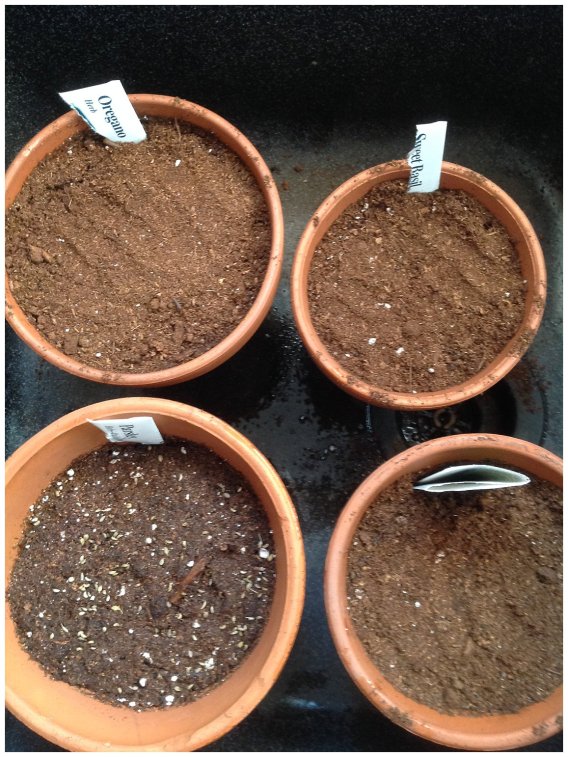
#5 Start some Seeds indoors, or Force some Pretty Bulbs:

Herb Seeds (Photo by Cathy Testa)

Herb Seeds (Photo by Cathy Testa)

It may feel too early to start seeds, but heck if you pot up a few herb seeds in your home or grow an Amaryllis bulb, like I did recently inside the home – you start to feel inspired for the growing days of spring ahead when you see the bulb’s flowers open, or see the seeds popping up in the soil.  So go to your local supply shop, get some seed starting potting mix and a couple packets of seeds, put them in some pots, place by a sunny window sill, and watch it grow.

Photo by Cathy Testa, Panical Hydrangea Covered in Snow

Photo by Cathy Testa, Hydrangea Covered in Snow

Or if that doesn’t suit your fancy, get bundled up, walk your property and take some photos of plants in the snow covered with icicles, fluffy snow, and enjoy the shadows against the snow cast by branches.  This cheers me up and hopefully will do so for you.  By the way, if any of your shrubs are toppling over due to the weight of sticky snow, it is a good idea to gently shake the excess snow off the branches so they don’t break or bend too harshly.

Happy Monday Everyone,

Cathy Testa

I Wish I Was as Strong as An Ant

3 Comments
Image Courtesy of FreeDigitalPhotos.net/by Sweet Crisis

Image Courtesy of FreeDigitalPhotos.net/by Sweet Crisis

When I take down my container gardens for the season.

Lifting objects fifty times my weight would be handy right around now when I start taking apart my large container gardens and patio pots on my deck for the close of the season.

Years ago, I had no problem whatsoever doing this process, but as one ages – well, you know, if you don’t keep up with those muscle building routines, it can become difficult.  In fact, when I gave talks on container gardens and why “bigger pots are better,” some ladies in the classroom would ask, “How the heck did you manage moving all those big pots?!”

Sometimes I get so excited about container gardening, I instantly find super power energy enabling me to lift heavy bags of container garden soil or other items needed like the big pots. However, during this year’s take down process for my container gardens, I felt a little weak at times.

In fact, I started to tell myself, stop feeling frustrated about taking down your plants in your container gardens!  It is part of the process and get into the spirit.  So I did some of my work of breaking down the 20+ or so large container gardens on my deck yesterday, and as I was doing so, I thought I’d share some of the things I found frustrating or helpful during the process.

Soil from Containers

Soil from Containers

GET A WHEEL BARREL OUT

Last year I was lucky. I had a new huge cement planter near my deck and I tossed the left over soil into that, but this year, I had to use my wheel barrel.  At first, however, it fell over from the weight of the soil falling from the deck level above into the barrel as I tossed it over the railing.  So I attempted to move my pick up truck to the deck, well, that didn’t work.  It was too difficult to maneuver the truck to the corner of my deck.

photo (7)

So, it was back to using the wheel barrel.  After getting a big lump of a root ball or two into the barrel, it stabilized and I was able to continue dumping the soil into the wheel barrel receptacle from above.  I will use this soil in the ground somewhere to recycle it as it doesn’t do well being reused in my container pots next year – It is best to have fresh container gardening soil each season, in my opinion, but to use it as a top dress to a garden bed or for a new garden bed is a good idea.

PLASTIC LINERS FOR POTS

In my container garden demonstrations, I show folks how to line their containers and patio pots with plastic liners (which must have slits and holes cut into them for drainage).  The reason I started doing this many years ago was more to keep the containers in good shape, but it also turns out to be a very effective method for slipping the whole root ball out of the containers at the end of the season.  The roots circle a bit around the edges within the liner, and it forms a nice ball or chunk when you are ready to take the plants and soil out.  It is a great tip for plants like Canna plants because they get large rhizomes and roots in the soil, making removal difficult. So I was happy my liners were working perfectly as I was removing the soil from my pots.

Foliage being Tossed into a Bin.

Foliage being Tossed into a Bin.

CUTTING ALL THE STEMS AND FOLIAGE OFF

Before slipping the soil out of the pots with the liners, I cut off all the foliage and stems to about 4″ from the base for plants I’m tossing in the compost pile. The little stub of a stem helps to lift the root ball out of the pots, at least in sections or chunks. The key here – use good sharp pruners or a serrated knife for large stems, and make sure to clean or disinfect them so you don’t spread any yuck (diseases) around, even during the take down process, clean tools are important.  I tossed my cuttings into a large bin on my deck, another item which came in handy as I was working.  It is easier to take all the foliage off before trying to move pots to a location or to the spot where I was tossing out the soil into my wheel barrel. Seeing the cut off stems of my elephant ears made me sad, and also made me think that I should have setup a station to make leaf imprints in a concrete mix as a side project at this time, especially because I have plenty of leaves to use, but that’s another crafty project requiring time.

WASHING THE POTS

Sometimes I feel a little lazy, but I force myself to wash the pots with a little soapy water, and a soft brush to clear away any soil residue left in or on the pots.  Then air-dry the pots completely before moving the containers into a garage or shed.  It is important to not skip this step. Cleanliness is so important for your plants when you begin again next spring to replant your containers.  It greatly reduces, if not eliminates, potential plant diseases or problems and you will be happy you cleaned them the year prior.

My Big Kalanchoe, Going to a Foster Home.

My Big Kalanchoe, Going to a Foster Home.

FINDING NEW HOMES

For container plants which I can not fit into my home (yup, read my blog earlier about greenhouse procrastination), I stand there contemplating where I can fit this – or should I give the plant to a friend or family member with a bigger house? The one I’m struggling with right now is my Kalanchoe (paddle plant).  It is HUGE. I know I can easily propagate some with cuttings, but I keep looking at it saying, should I cram it in my bedroom again to keep it alive all winter? Or give it to my sis in law with a big open bright living room with lots of windows?  Oh gosh, the challenges!!  I don’t know.

Hypertufa at End of Season.

Hypertufa at End of Season.

I also have a beautiful hypertufa stuffed with Sempervivums (hens-n-chicks).  They are pretty tough, can go really dry all winter with little watering, but I don’t have room in my kitchen garden window because I put my head planters there.  Gosh, where will this one go?

These are the challenges I face, never mind the fact I just don’t want to stop admiring my container garden plants outdoors, but winter is coming.

HAVING A GLASS OF WINE

Another downfall, or plus depending on your point of view, is that I started feeling like I wanted to have a glass of wine and enjoy my deck.  It is one of my favorite spots at my home. If you were to ask me – What is your favorite spot? Well, it is our deck.  I always feel like it is a vacation spot or oasis with all my big tropical plants every summer.  I get to decorate it with all my garden decor, and it faces a private backyard, so it is really a retreat.  So because I was out there on a nice, sunny fall day, and being around my beautiful plants, I felt like, gee, I should relax and have a glass of wine.  So I did after I disassembled about five or so of the smaller of my big containers.  Today, I will tackle the bigger ones.  This will require a hand-truck, some patience, and strength.

Wish me luck!

Cathy Testa