Four Tools Used to Make Carving Pumpkins Easier

3 Comments

IMG_9840There is no doubt carving pumpkins this time of year is all about tradition and fun.  So when my husband and I decided to carve our designated chosen pumpkins this weekend, I took out some tools which I use to make the process easier.

A Power Drill
A Metal File
A Hammer
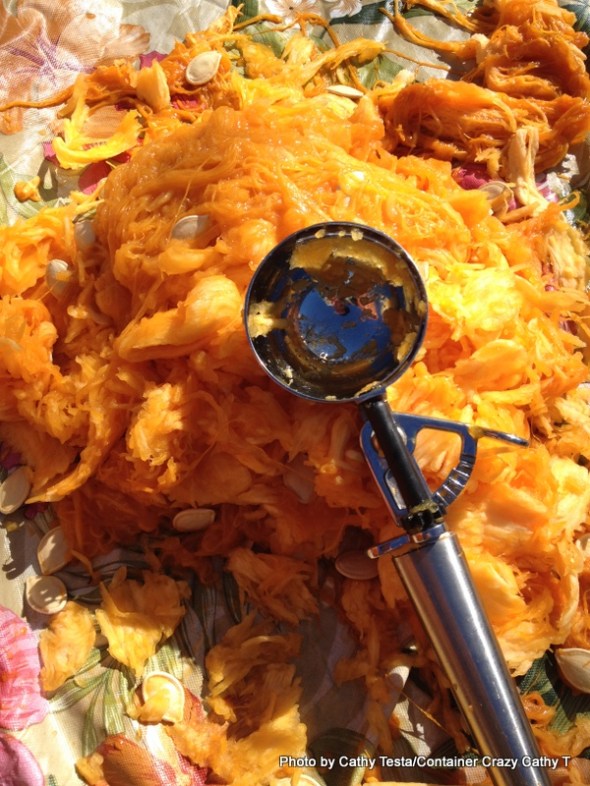
An Ice Cream Scoop

Steve just needs a sharp knife!

As we enjoyed the rays of the autumn sun and a few specialty fall cocktails, we began our carving ritual.  It didn’t take long for Steve to utter the words he repeats every single year, “Uhm, let me see. What face should I do?”

Well, folks – while he makes that statement every single year, he always just goes with the traditional triangle eyes and nose with a smile face.  It cracks me up.  And it takes him only a few minutes to get his pumpkin carving job done.

IMG_9846

Meanwhile, I had no idea what I was going to make for a face on my pumpkin, but I suddenly remembered a bag of mixed beads and jewelry pieces I bought at a warehouse sale, and thought – Oh yah, now I have a use for those! But of course before the bling and decor, I had to clean out the pulp and I find an ice cream scoop to be the best for this process.  It is strong enough to scrape the inside edges and take out big chunks of the pulp.  Steve is in charge of separating all the seeds, which he proudly does every year because he likes to bake them.

IMG_9841

IMG_9843

The power drill is used to drill 3 medium holes where my pumpkin’s eyes were placed, then I used the knife to carve out the shape.  Because holes were there first, it was easier to cut the thick pumpkin’s shell to create the shape of my pumpkins eyes.

IMG_9849

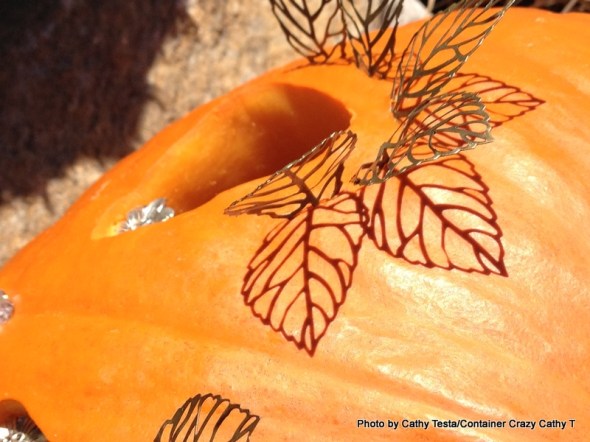
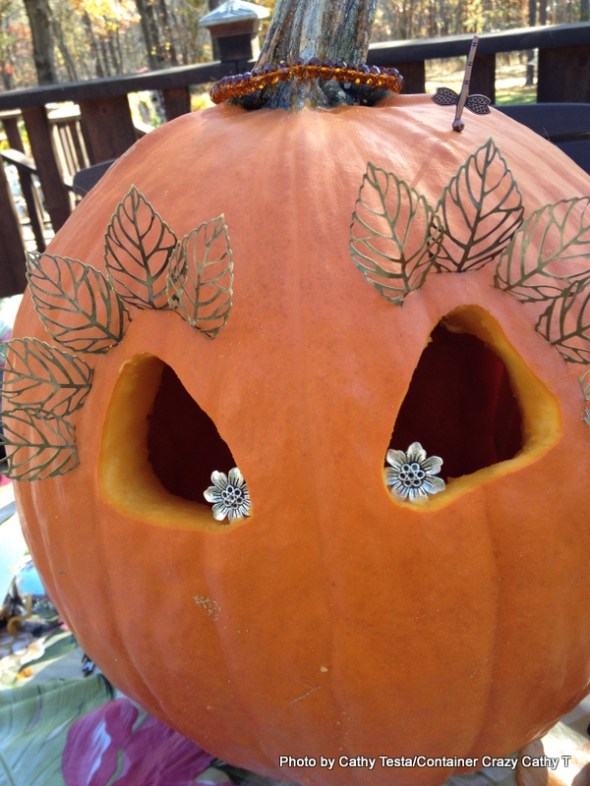
I also use the file to smooth out the edges of the eyes.  Once the eyes were done, I stuck in leaf shaped jewelry pieces made of flexible metal.  I love how the pieces reflected shadows on the pumpkin in the sun, and the leaves kind of looked like lush eye lashes.  My pumpkin was developing a personality.

IMG_9865

IMG_9850

IMG_9852

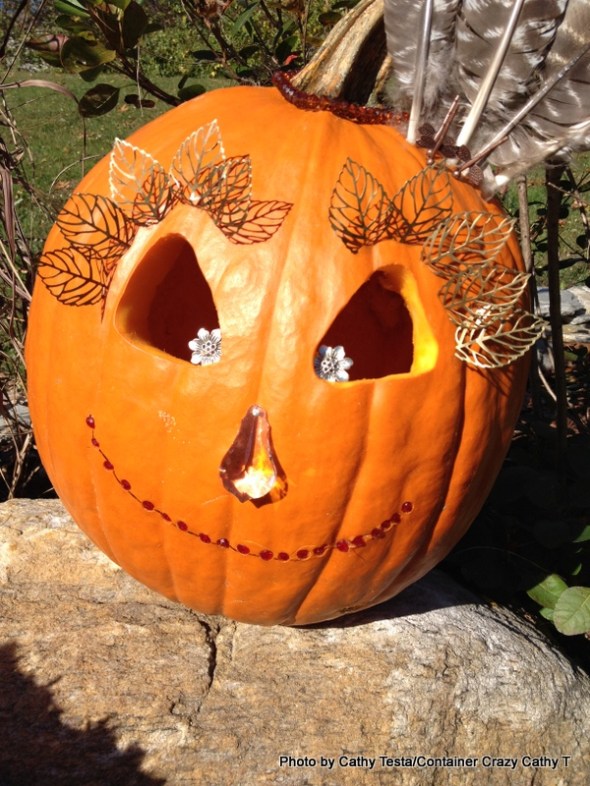
The power drill is also used to make indents or small pilot like holes for the mouth. Using a sharpie marker, I first drew the line for the smile.  Then a small drill bit to make little holes along the line.  I inserted little red beads into each hole and used a hammer to tap them in.  Then I attached a crystal as the nose with a simple small nail.

IMG_9855

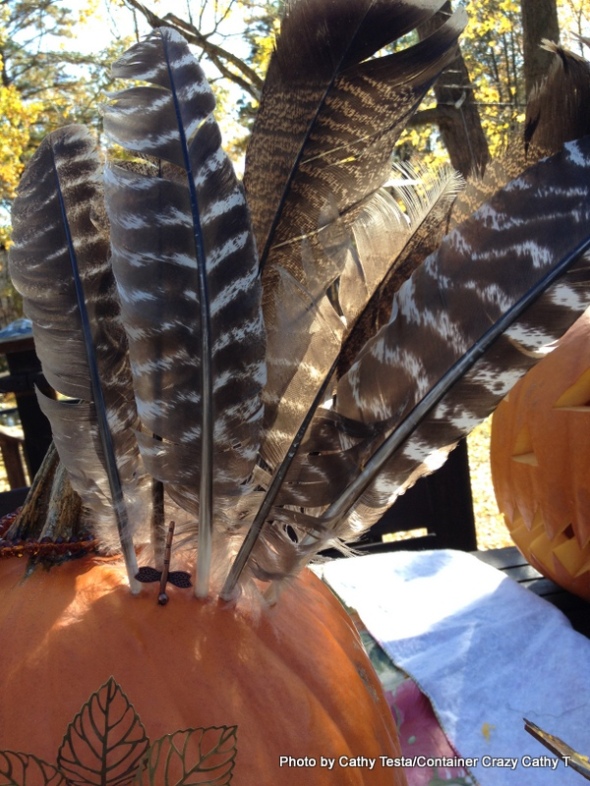
Another saved item that popped into my head which I could use were turkey feathers I found in my yard.  They were super easy to just insert right into the pumpkin because the tips are so strong.  So thus, there was a bit more bling.

IMG_9853

After we were done with our craft, we set them into their positions in our yard, then pulled out two cozy chairs, faced the western sky with a bright full sun, and enjoyed the rest of our day relaxing (and admiring our pumpkins).

IMG_9856

Even though our pumpkins are not really visible from the road since we have a long driveway, we still light the candles in them every night up to Halloween eve.

IMG_9863

And, by the way, the pumpkin ritual is always initiated by my husband, Steve.  I love that he is a kid at heart – especially during the holidays.

IMG_9870

P.S.  He also insists on baking the pumpkin seeds very very slowly, but then I debated turning up the heat – thus the combined result – some with a bit of smoked flavor and some soft and chewy.  Each having its own unique twist, just like our pumpkins!

photo (10)

Happy Halloween Everyone.  It will be here soon!

Written by Cathy Testa

2013-10-22_0017

A Unique Way to Install a Bird House

25 Comments

IMG_9418At my home, my husband and I have started a unique way of installing bird houses which entails the bird house being at a height of 12 feet.  It may take a few hours to get the job done, but the new home is more receptive to the birds because it is at a safe height where they are less vulnerable to potential predators.

So, we wanted to share our process with you.  Here are the materials needed, followed by instructions, and photos (note we are showing two types of houses installed), and a list of plants is included with useful links on more bird information below.

IMG_9366

Materials Needed:

  • 12 ft length of 3/4 inch rigid electrical conduit.  These standard lengths can be found in the electrical department at Home Depot.  (Note: The rigid conduit should come with pre-threaded ends.)
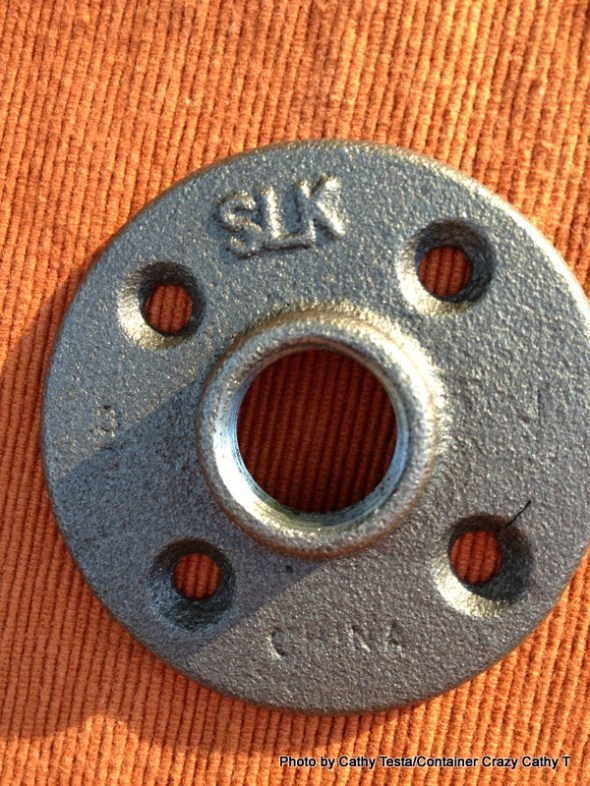
  • 3/4 inch floor flange.  This can be found in the plumbing department at Home Depot.
  • 12-14″ inches of an 8 inch diameter footing tube.  You will need to buy the standard 4 ft length found in the concrete section usually located in the outside area at Home Depot, and cut to 12-14″ long.
  • (1) 80 lb. bag of ‘Quick-Crete’ pre-mix concrete found in the concrete section located in the outside area at Home Depot.
  • Wood screws ½ inch long and ¼ inch diameter
  • Post hole digger tool and power drill
  • 1 very pretty and unique bird house!
Floor Flange

Floor Flange

Let’s Get Started:

1003097_10200588046796250_1420861369_nSelect your bird house location or site.  Think about the exposure, too much shade can be too cold for the birds.  Sunny exposures are great for warmth but if you have a very sunny spot, face the house east or north so it doesn’t get too hot.  You may also want to select a site visible from inside your home or from your favorite outdoor sitting place so you can view them.  But not too close either because baby birds chirping are very loud.  And of course, consider it as a vertical element in your garden bed. The placement is important if you want to use it as a piece of art in your natural landscape along with your beautiful plantings.

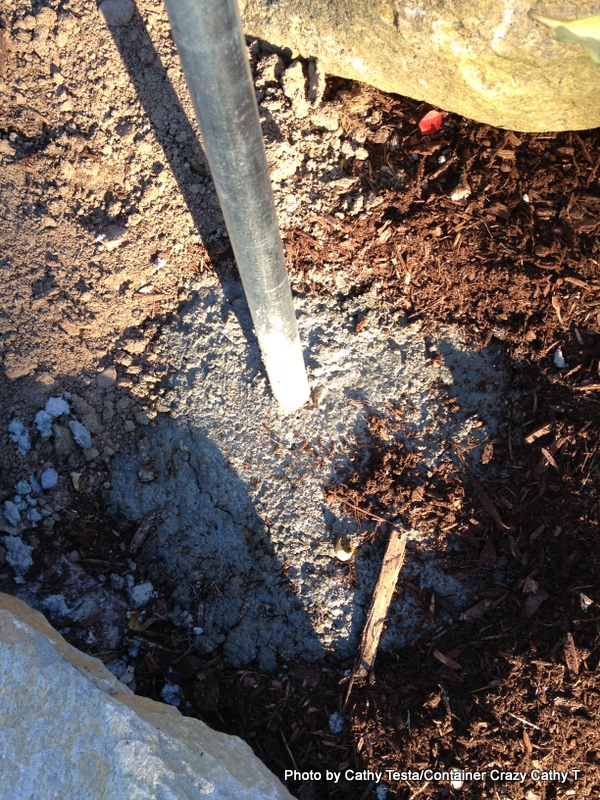
Dig the hole with a post hole digger.  Or ask your handsome husband to do so. Insert the footing tube cut to the specified depth (approximately 12 to 14″; see above). Mix the concrete as directed and pour into the footing tube.  Get ready to set the pole (rigid conduit).
IMG_9378Note:  My husband says he doesn’t pay attention to the freeze line because it does not matter if there is a little frost heave as it will only move back in place when the ground thaws.  But the rule is to dig below the frost depth to prevent frost heaving, approximately 42″ down.  If you want to be more cautious, you can dig deeper as per the guidelines for your region.

Set the pole (rigid conduit) in the wet cement.  As noted above, the 12 ft length of 3/4 inch rigid conduit works great. It is strong, very tall, cat proof, and useful for twining plants.  It does sway just a tad in strong winds, but no more than a thick branch might move on a tree.  If needed, use some wood stakes to keep the pole securely in place temporarily until the concrete mix dries completely.  The concrete drying process takes about 8 hours (or that is what we do, is wait a day before attaching the bird house to the pole.)
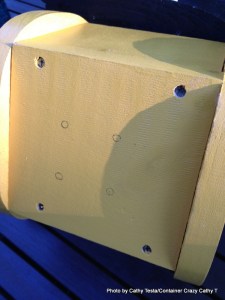
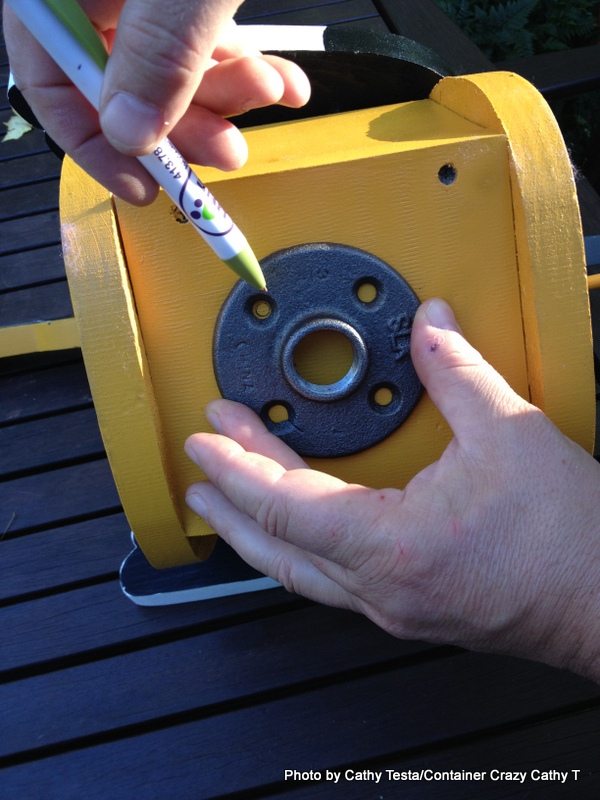
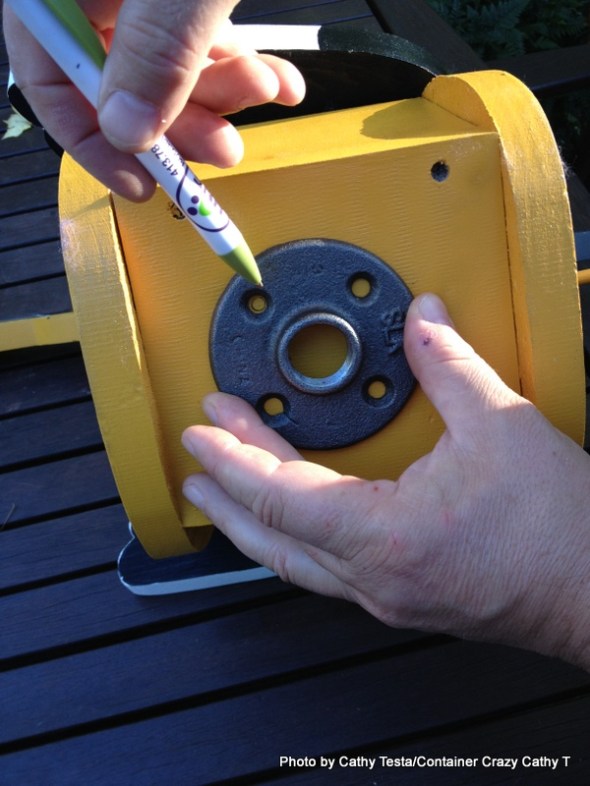
IMG_9367Attach the floor flange to the base of the birdhouse.  Pretty straight forward, mark the holes with a pencil, drill, and screw.  Takes a few minutes, and a power drill is handy for this. (Note: Pre-drilling pilot holes is helpful and recommended.)

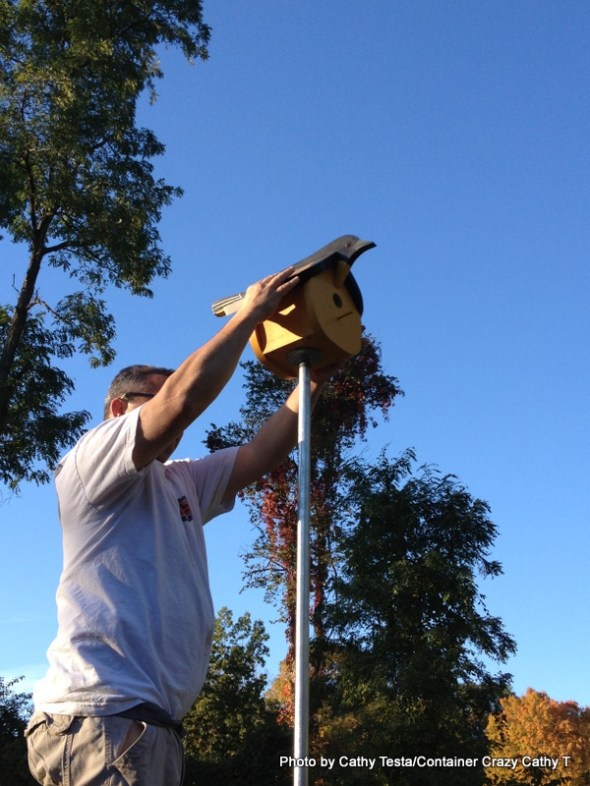
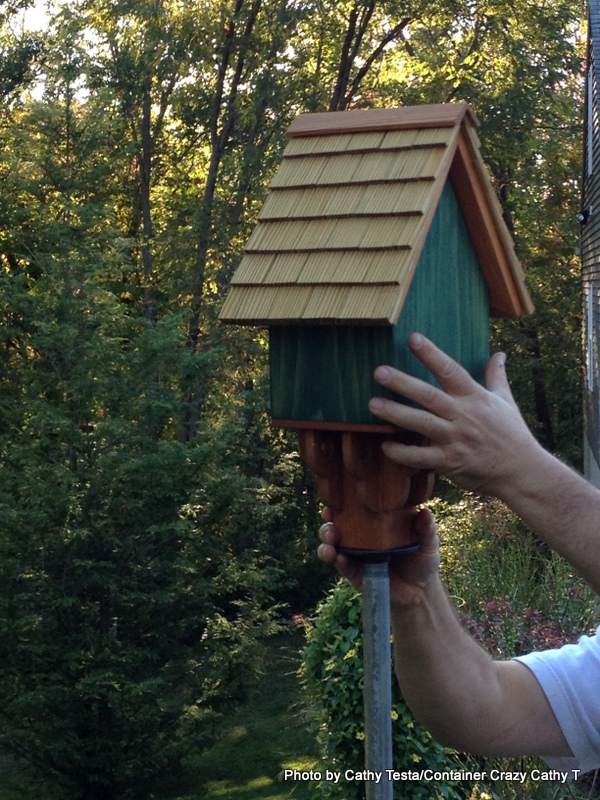
Attach the house to the pole.  Because the rigid conduit used as the pole has pre-threaded ends, just turn the house until it is screwed on firmly. Or turn it to face the direction desired in your landscape.

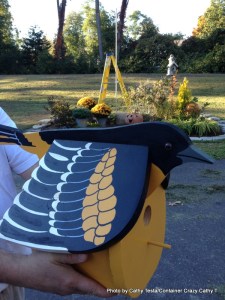
Watch.  In a day, you should have a bird moving in – we always do!  It’s great.  When we setup the bird house that looks like a Baltimore oriole, we saw a bird move in by the very next day, and this was during October, not in the spring.
IMG_9365

IMG_9369

IMG_9370

IMG_9376

Plants Attracting Birds:

Having a bird house in your yard will definitely entice birds to live there, but other features which help a great deal, are of course, the plants selected to feed or encourage birds. They enjoy plants with edible berries.  They also use natural scrubby bushes around your landscape for protection and as hiding places, especially during the winter for those not migrating southward.  And having a water source, such as a heated bird bath is very helpful.
Heated Bird Bath or Waterer

Heated Bird Bath or Waterer

They visit our heated birdbath all year round, and it is especially nice to see them take drinks from it during the winter when other water sources may be limited.

  • American Beauties offers a website with a bird focus design HERE.  You can narrow your search by your region, exposure of the garden, and soil type.
  • National Wildlife Federation offers information HERE.  You can find out which bird plants are native to your region and see more detailed information about attracting wildlife to your landscape and yard.
  • The Bird & Butterfly Garden at Lockwood Farm in Hamden, CT is a way to see an environment suited for birds in person.  You can find the map of the grounds here and it also includes a list of plants in the garden on page 2.
Thunbergia (black-eyed Susan vine)

Thunbergia (black-eyed Susan vine)

Twining Plants for the Bird House Pole:

In addition to considering plantings around the base of your new bird house, you may want to include a climber, twiner, or vine like plant to grow up the pole.  This will dress up the pole and create a vertical element in your garden, plus I believe the birds like it too.  More foliage and flowers, more natural for them.

Here are some recommendations:

Thunbergia starting to climb early in season

Thunbergia starting to climb early in season

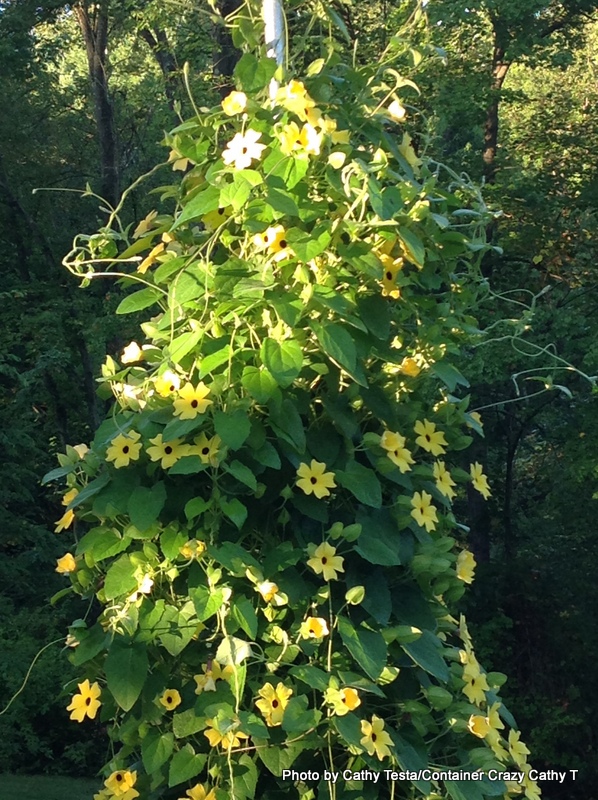
Thunbergia (black-eyed Susan vine), as shown.  It is an annual, but it climbs very quickly.  Mine rose to the top of a bird house pole by mid-summer easily.  The repeat blooms are vivid and the sepals are pretty too.  It gets wider too and fuller.  This plant is tossed by end of season because it is an annual, but it is easy to replace with a starter plant in the spring because they are commonly available in the nurseries.

Mandevilla vine flower

Mandevilla vine flower

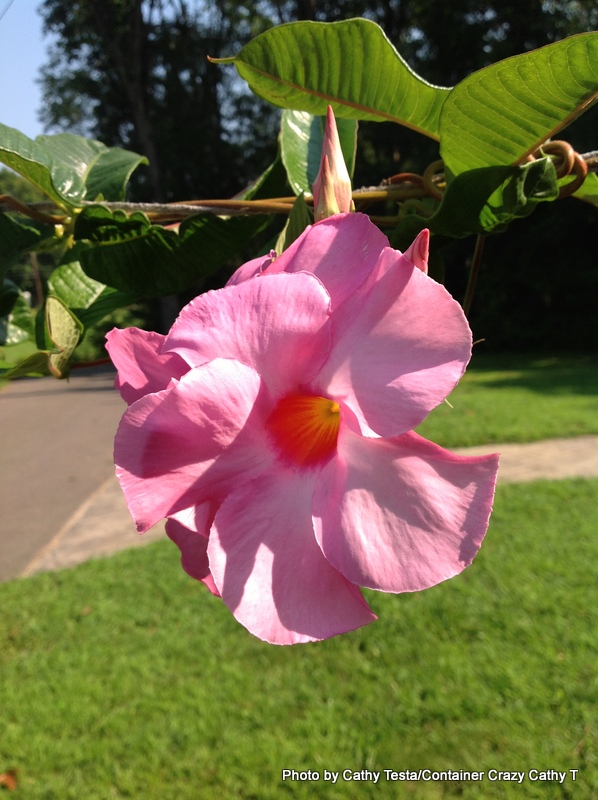
Mandevilla vine.  A tropical vine used in the summer, but can be overwintered by storage in a above freezing place over the winter months.  These vines grow quickly and flowers non-stop with large, tubular flowers.  I enjoy watching bees dive into the blooms.  This plant enjoys “full sun” for best performance.  To store them, wait til the first frost of autumn, cut it back, and put the root system in a container of soil or in the original pot if you didn’t plant it in the ground, move it inside the house, basement, or place where it doesn’t get below freezing, preferably between 35-40 degrees Fahrenheit.  By the way, I have a friend who stores their Mandevillas every fall, see the story here at Mandevilla Sightings on my blog.  The pink flowers were amazing this season.

Blackberries

Blackberries

Rubus (blackberry).  This will grow tall canes, but they won’t automatically twine onto the pole on its own.  You may attach the canes to the pole with zip ties (loosely) or garden twine.  We have one under a bird house and ironically, the berries don’t all get eaten by birds!  I think this is because we have lots of bird feeders too. But I have seen turkeys pecking at the leaves and I think they nibble on the lower berries. To read about the type of blackberry we planted, click HERE to see my former post.

Lonicera (honeysuckle vine).  This vine grows any where from 15 to 30 feet, and it may need some assistance to stay attached to a single pole, like the blackberry plant does, but it is a great plant for its flowers and foliage.  It may not be as fast growing as the annual Thunbergia noted above, but the tubular scented flowers are wonderful, and also attracts hummingbirds. This plant can sometimes become too aggressive, but it can be cut back and controlled.  Because it is perennial, you do not need to replant it every season as you do with the Thunbergia or Mandevilla.

Ipomoea (morning glory) or Tropaeolum (nasturtiums).  These are two plants easily grown from seeds.  Both grow rather quickly an have showy flowers, so they must be added to the potentials list for the bird house pole natural decor.  Just grab a packet of seeds in spring, start some in little pots, and transplant to the base of your pole.  The nasturtiums are edible too – by humans I mean.  Sometimes morning glories will self-sow to return on their own.

Miscanthus. Ornamental Grasses are a good choice to put at the  base of the pole as well.  It tends to soften the lines of the upright pole, and sways in the wind.  It seems to fill in that empty space below.  I also like to add decor to the poles in the fall season such as a garland of fake leaves with the orange and yellow colors.  Or you could attach a corn stalk on the pole as we enjoy the pumpkins at that time.
IMG_9375

Other Resources for Vine Plant Lists:

  • Better Homes and Gardens offers a vine list HERE.  Just be careful, some vines are aggressive and trouble-makers in the ground or when directly planted in a garden versus a container garden or patio pot.  Refer to my page called Troublemakers Turned Stars for more information.
  • Plant Facts by the Ohio State University has a nice list with pronunciations you can hear over your speakers.  Geesh, I’ve been mispronouncing Ipomoea for years.  LOL.  Click HERE to hear them out.
  • Birds & Blooms has a top 10 list for backyard vines, click HERE.  Remember, be cautious with some vines that become too aggressive and take over.  You may want to research more information on a vine before you plant it – think Wisteria or English Ivy as examples.  Both grow fast.
  • Fine Gardening has a vine list for full sun to part shade conditions, click HERE.  This magazine has always been one of my favorites because they do a great job of combining the beautify of botany with technical information about plants.
bird on plantAnd remember to check the rate of growth of the vine you select.  You want your vine to climb quickly – especially for our Connecticut season from spring through summer – it can feel short.  For woody or perennial vines, this is not as much of a concern since they will be there year round.

Enjoy your new bird house installation.

Whether you do it this year or in the early spring of next, I’m sure you will have more birds to enjoy in your surroundings for years to come.

Written by Cathy Testa (and co-authored by hubby, Steve!)

http://www.cathytesta.com

860-977-9473 (cell)


2013-10-22_0018

Need a Way to Dress Up your Mailbox for the Holidays?

2 Comments
MailWrap by Magnet Works

MailWraps by Magnet Works, Ltd.

Try Magnet Works

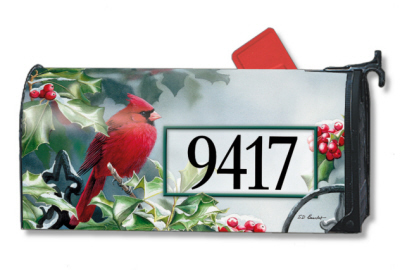
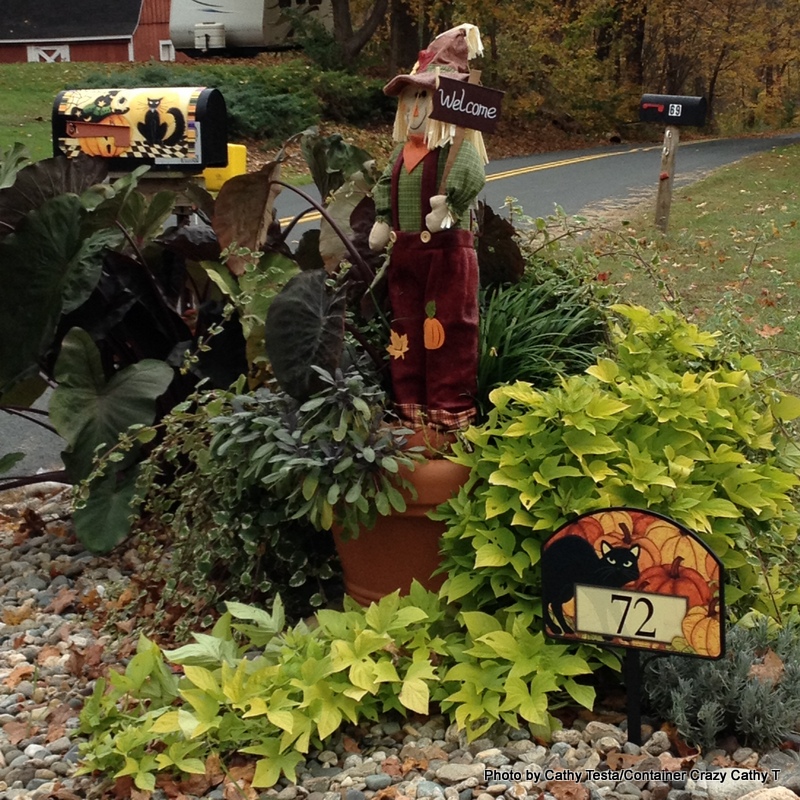
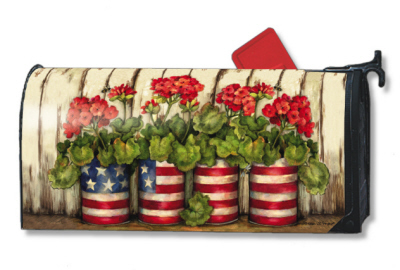
My mailbox is kind of shoddy looking and we never got around to getting it renovated to new materials, so when I spotted colorful mailbox covers, called “MailWraps” by Magnet Works, Ltd., I was interested in getting one to disguise my not-so-attractive mailbox – plus the ‘MailWraps’ are very cute and colorful. And there is a wide variety of themes to choose from for each season or holiday.

MailWrap by Magnet Works

MailWraps by Magnet Works

The first one I purchased has an image of a happy snowman on it with bright red colors and birds. Every winter, I take it out of my supply storage to reapply it to my mailbox. It is super easy to attach because they are magnetic and readily stick to the mailbox. But what also surprised me is the fact they last a long time.  They are very durable.

Mine, after a couple years of use, has not torn or faded, so I can attest they are worth the investment.  Additionally, they are reusable every year and can be changed out according to the seasons, which I love.  The only tip I would offer is to just store it carefully in the original plastic wrapper when you remove it until you take it back out again to display.

Winter Theme MailWrap

Winter Theme MailWraps by Magnet Works, Ltd.

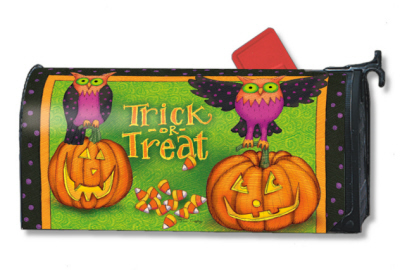
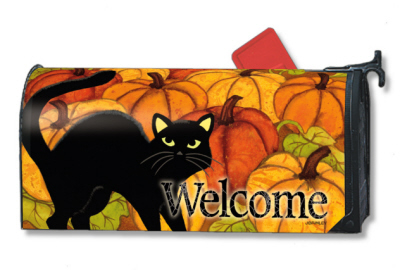
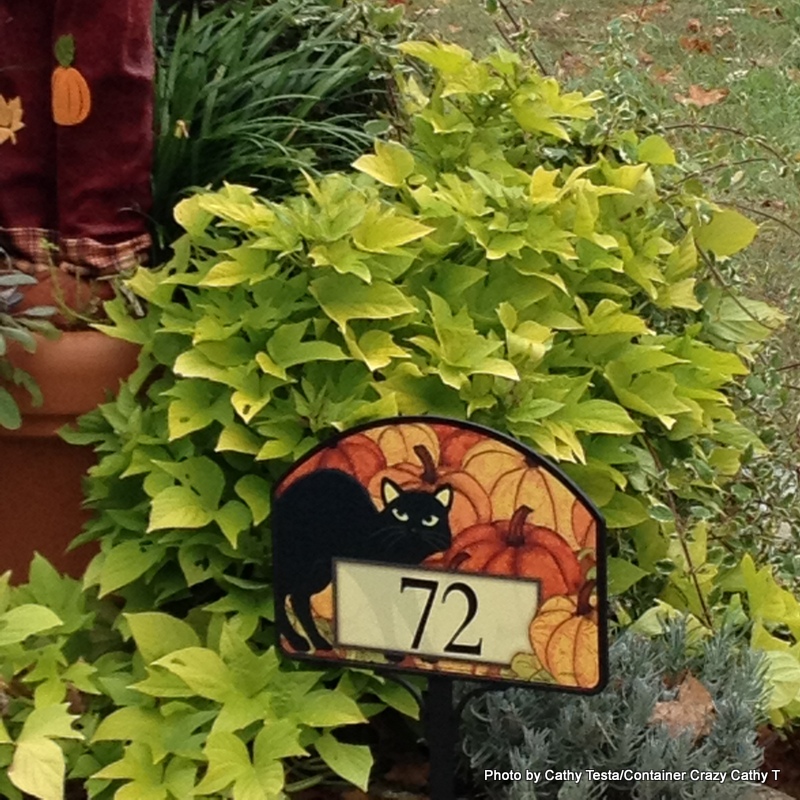
The Big E (Eastern States Exposition in Massachusetts) is where I found them originally, so this year, when I returned to check them out again, I got three more ‘MailWraps’ – one for each season: autumn, winter, and spring. And I discovered they offer matching yard signs where you can apply your house number to the sign, so I got a matching pair for the “Falloween” season.

Matching Yard DeSigns by Magnet Works

Matching Yard DeSigns by Magnet Works

SIGNS TO MATCH

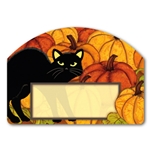
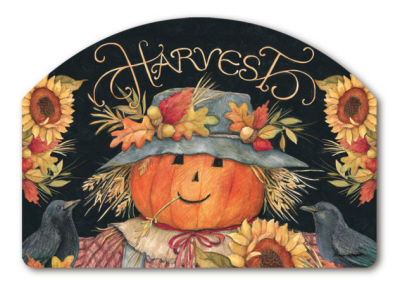
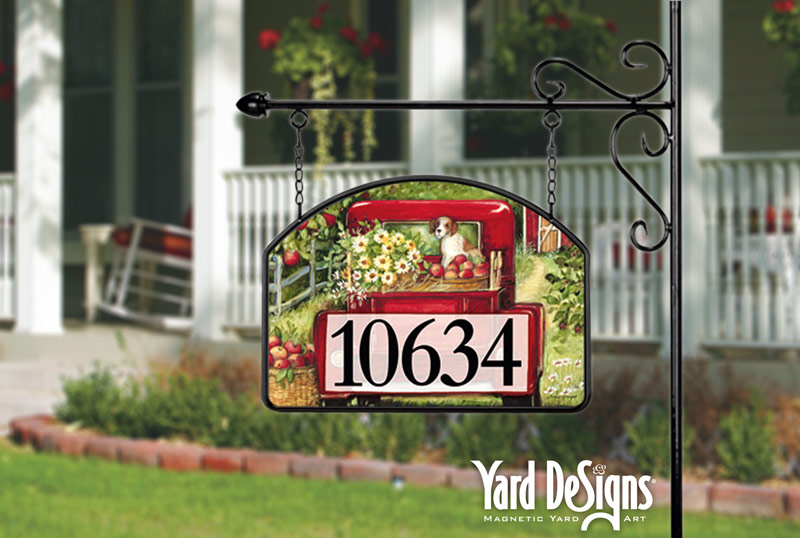
Called “Yard DeSigns” by Magnet Works, these are an easy way to display house numbers by your mailbox or at the end of your driveway.  Just peel the numbers off a sheet provided, wet the letters a bit (as instructed in the packet), apply them to the Yard DeSigns sign, and then place on the metal stand (accessory of your choice).  Let it dry! Voila!  You have a new item to dress up your mailbox area and in my case, my plantings around my mailbox too.  The options for accessories include hanging signs or types which attached to a pole as well, so there are choices.

MagnetWorks MailWraps

MagnetWorks MailWraps

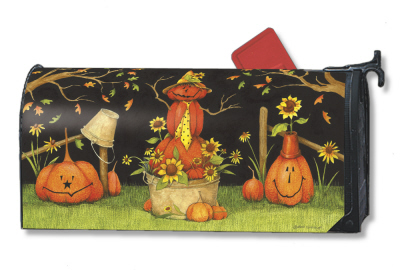
Each is removable because they are magnetic, so changing them out for the seasons or holidays is a breeze. When I decided this product is suitable to “combine nature with art,” I visited the Magnet Works website some more to see what else they had to offer. And I was happy to see the theme I purchased this year with a black cat and orange pumpkins at the Big E is a “best seller.”  For some reason, this fact made me happy.

By my Mailbox with Plantings

By my Mailbox with Plantings

Matching box and sign

Matching box and sign

CHANGE FOR THE SEASON

In the winter, I will change both the ‘MailWraps’ on the mailbox and the yard sign, called ‘Yard DeSigns,’ to a holiday theme.  And in the spring, I selected one themed with colorful flowers (of course!).  There is a wide variety of themes to suit every taste, hobby, or style. If you are an animal lover – there are dog themes. Like Birds? They have those too. And there are matching products in addition to the mailbox covers and signs, such as doormats.

Yard DeSign by Magnet Works

Yard DeSign by Magnet Works

HOW IT STARTED

It is always inspiring to hear the story of how a product becomes real and popular, starting with an idea.  When you read the “Our Story” page on Magnet Works website, you will see how a husband and wife team created this decorative concept and figured out a method to make it “stick.”

NEW ART POLES

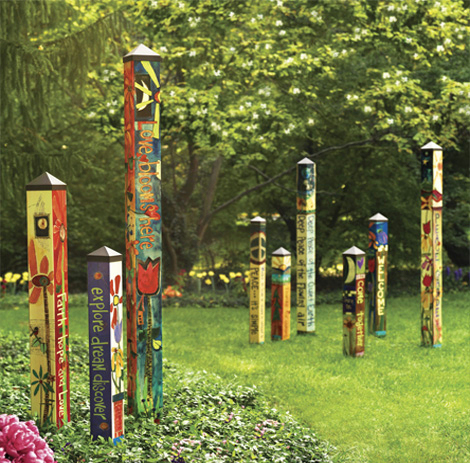
Upon further clicking here and there on the Magnet Works website, I saw beautiful “Art Poles” by Studio M, a division of their company, which is relatively new.  These poles are decorated with beautiful colors and images. I could easily see Art Poles used in the garden, with a birdhouse on the top or a flag attached to the side.  They are really pretty and colorful. Stephanie Burgess is the artist launching this collection and partnering with Magnet Works. It also includes other artful items such as chalkboards and address plaques.

Image courtsey of Magnet Works/Art Poles by Studio M

Image courtesy of Magnet Works/Art Poles by Studio M

THE ARTISTS

The artists contributing their talents and designs to Magnet Works products are listed under “Our Community” on the Magnet Works website.  Here you can see who created which, and I discovered an artist by the name of Jennifer Brinley is the creator of the autumn “Yard DeSigns” sign which I selected of the cat and pumpkins.  I love her use of the vibrant colors which can be seen from a distance.  And of course, the cat looks similar to my black cat, Mini, so it’s a little personal touch too.

“Jennifer Brinley has become one of the most sought after artists in the home décor and housewares industries. Her distinctive style, strong sense of color and ability to capture current trends has put her in great demand. Painting mostly in gouache and watercolor, Jennifer enjoys using vibrant warm colors inspired by Italian ceramics and French textiles; finding her inspiration through her travels in Europe and the U.S.” (Source: Magnet Works/OurArtists).

As I thought more about the signs and mailbox covers by Magnet Works, I considered how cool it would be if we could custom order our own by uploading photos to have printed on the magnetic covering. Perhaps that will be next on their creations list. I’ll keep checking.

But in the meantime, there are styles for everyone, just browse to find them at www.magnetworks.com. Or visit their Facebook page HERE.

Some of my favorites were these themes below:

SOME OF MY FAVORITE STYLES

Add your Monogram

Add your Monogram

For the Falloween Season

For the Falloween Season

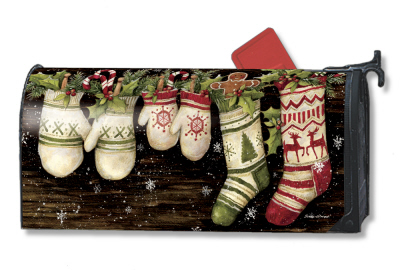
Mittens for the Winter Season

Mittens for the Winter Season

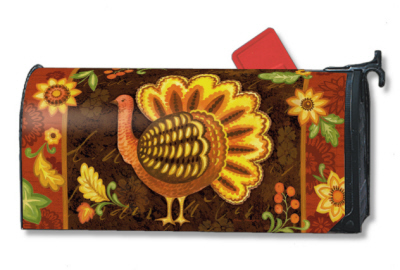
For Turkey Day!

For Turkey Day!

Nice purples for any season

Nice purples for any season

Various ways to display the signs

Various ways to display the signs

Geraniums for Summer

Geraniums for Summer

Another Autumn Theme by Magnet Works, Ltd.

Another Autumn Theme by Magnet Works, Ltd.

Written by Cathy Testa

I Wish I Was as Strong as An Ant

3 Comments
Image Courtesy of FreeDigitalPhotos.net/by Sweet Crisis

Image Courtesy of FreeDigitalPhotos.net/by Sweet Crisis

When I take down my container gardens for the season.

Lifting objects fifty times my weight would be handy right around now when I start taking apart my large container gardens and patio pots on my deck for the close of the season.

Years ago, I had no problem whatsoever doing this process, but as one ages – well, you know, if you don’t keep up with those muscle building routines, it can become difficult.  In fact, when I gave talks on container gardens and why “bigger pots are better,” some ladies in the classroom would ask, “How the heck did you manage moving all those big pots?!”

Sometimes I get so excited about container gardening, I instantly find super power energy enabling me to lift heavy bags of container garden soil or other items needed like the big pots. However, during this year’s take down process for my container gardens, I felt a little weak at times.

In fact, I started to tell myself, stop feeling frustrated about taking down your plants in your container gardens!  It is part of the process and get into the spirit.  So I did some of my work of breaking down the 20+ or so large container gardens on my deck yesterday, and as I was doing so, I thought I’d share some of the things I found frustrating or helpful during the process.

Soil from Containers

Soil from Containers

GET A WHEEL BARREL OUT

Last year I was lucky. I had a new huge cement planter near my deck and I tossed the left over soil into that, but this year, I had to use my wheel barrel.  At first, however, it fell over from the weight of the soil falling from the deck level above into the barrel as I tossed it over the railing.  So I attempted to move my pick up truck to the deck, well, that didn’t work.  It was too difficult to maneuver the truck to the corner of my deck.

photo (7)

So, it was back to using the wheel barrel.  After getting a big lump of a root ball or two into the barrel, it stabilized and I was able to continue dumping the soil into the wheel barrel receptacle from above.  I will use this soil in the ground somewhere to recycle it as it doesn’t do well being reused in my container pots next year – It is best to have fresh container gardening soil each season, in my opinion, but to use it as a top dress to a garden bed or for a new garden bed is a good idea.

PLASTIC LINERS FOR POTS

In my container garden demonstrations, I show folks how to line their containers and patio pots with plastic liners (which must have slits and holes cut into them for drainage).  The reason I started doing this many years ago was more to keep the containers in good shape, but it also turns out to be a very effective method for slipping the whole root ball out of the containers at the end of the season.  The roots circle a bit around the edges within the liner, and it forms a nice ball or chunk when you are ready to take the plants and soil out.  It is a great tip for plants like Canna plants because they get large rhizomes and roots in the soil, making removal difficult. So I was happy my liners were working perfectly as I was removing the soil from my pots.

Foliage being Tossed into a Bin.

Foliage being Tossed into a Bin.

CUTTING ALL THE STEMS AND FOLIAGE OFF

Before slipping the soil out of the pots with the liners, I cut off all the foliage and stems to about 4″ from the base for plants I’m tossing in the compost pile. The little stub of a stem helps to lift the root ball out of the pots, at least in sections or chunks. The key here – use good sharp pruners or a serrated knife for large stems, and make sure to clean or disinfect them so you don’t spread any yuck (diseases) around, even during the take down process, clean tools are important.  I tossed my cuttings into a large bin on my deck, another item which came in handy as I was working.  It is easier to take all the foliage off before trying to move pots to a location or to the spot where I was tossing out the soil into my wheel barrel. Seeing the cut off stems of my elephant ears made me sad, and also made me think that I should have setup a station to make leaf imprints in a concrete mix as a side project at this time, especially because I have plenty of leaves to use, but that’s another crafty project requiring time.

WASHING THE POTS

Sometimes I feel a little lazy, but I force myself to wash the pots with a little soapy water, and a soft brush to clear away any soil residue left in or on the pots.  Then air-dry the pots completely before moving the containers into a garage or shed.  It is important to not skip this step. Cleanliness is so important for your plants when you begin again next spring to replant your containers.  It greatly reduces, if not eliminates, potential plant diseases or problems and you will be happy you cleaned them the year prior.
My Big Kalanchoe, Going to a Foster Home.

My Big Kalanchoe, Going to a Foster Home.

FINDING NEW HOMES

For container plants which I can not fit into my home (yup, read my blog earlier about greenhouse procrastination), I stand there contemplating where I can fit this – or should I give the plant to a friend or family member with a bigger house? The one I’m struggling with right now is my Kalanchoe (paddle plant).  It is HUGE. I know I can easily propagate some with cuttings, but I keep looking at it saying, should I cram it in my bedroom again to keep it alive all winter? Or give it to my sis in law with a big open bright living room with lots of windows?  Oh gosh, the challenges!!  I don’t know.

Hypertufa at End of Season.

Hypertufa at End of Season.

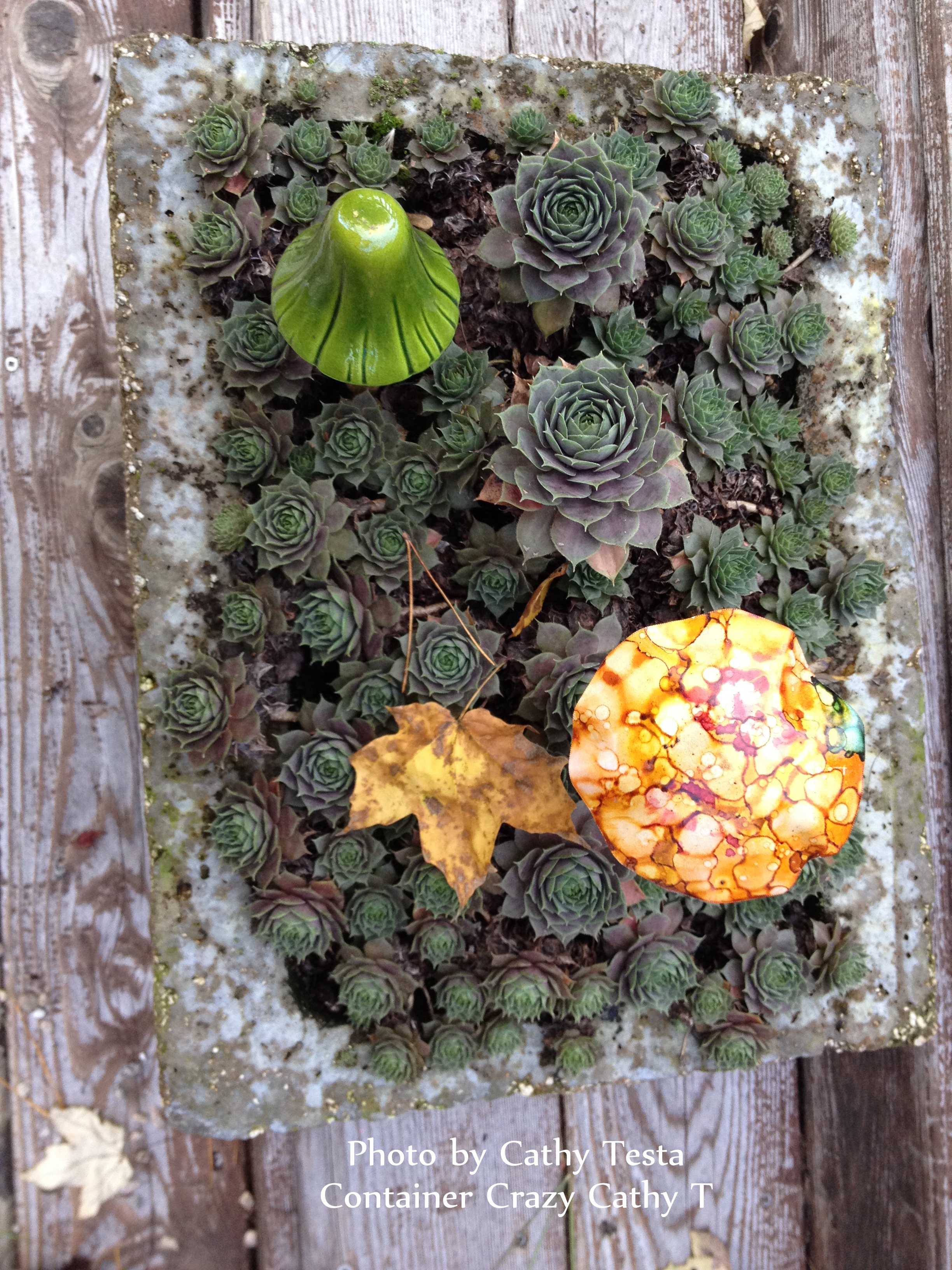
I also have a beautiful hypertufa stuffed with Sempervivums (hens-n-chicks).  They are pretty tough, can go really dry all winter with little watering, but I don’t have room in my kitchen garden window because I put my head planters there.  Gosh, where will this one go?

These are the challenges I face, never mind the fact I just don’t want to stop admiring my container garden plants outdoors, but winter is coming.

HAVING A GLASS OF WINE

Another downfall, or plus depending on your point of view, is that I started feeling like I wanted to have a glass of wine and enjoy my deck.  It is one of my favorite spots at my home. If you were to ask me – What is your favorite spot? Well, it is our deck.  I always feel like it is a vacation spot or oasis with all my big tropical plants every summer.  I get to decorate it with all my garden decor, and it faces a private backyard, so it is really a retreat.  So because I was out there on a nice, sunny fall day, and being around my beautiful plants, I felt like, gee, I should relax and have a glass of wine.  So I did after I disassembled about five or so of the smaller of my big containers.  Today, I will tackle the bigger ones.  This will require a hand-truck, some patience, and strength.
Wish me luck!

Cathy Testa

A Fairy, the Castor Bean Plant, and Poison. Can They All Live Happily Together?

16 Comments

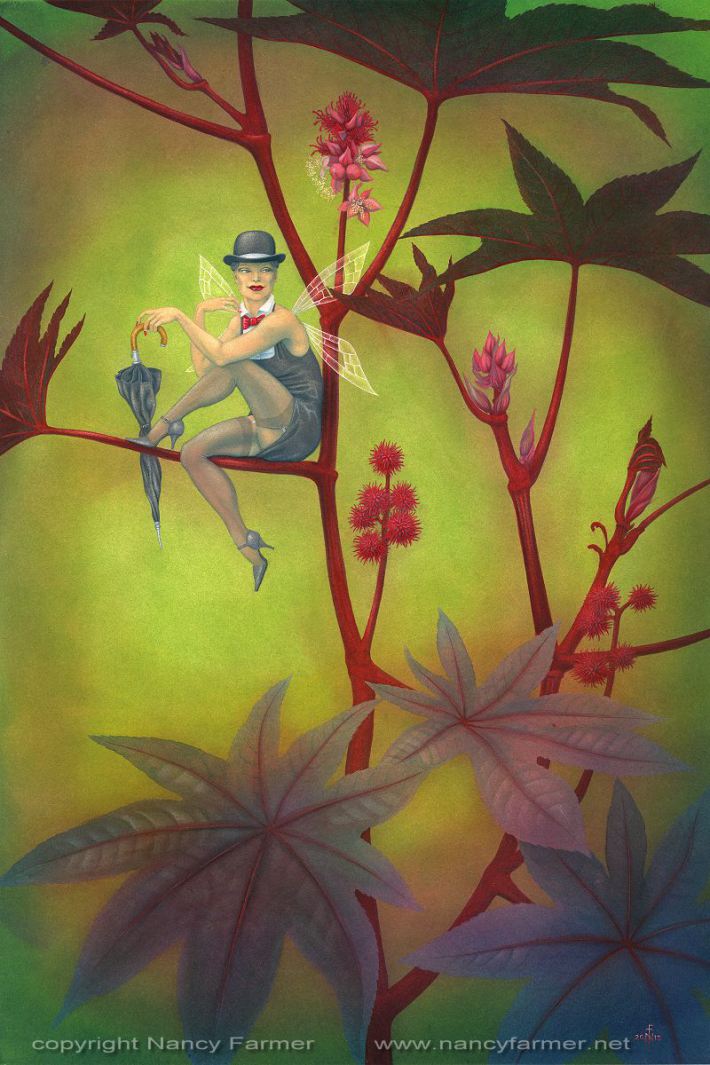
Perhaps the only person to definitely know if the castor bean plant and its three little seeds lying within each of its seed capsules has been and continues to be falsely portrayed as a lurking killer is the beautiful and bold imaginary fairy by the name of Ricina, a clever creation by Nancy Farmer, an artist residing in the United Kingdom.

A FAIRY

  • a small imaginary being of human form that has magical powers, esp. a female one.” (source: Google)

Art may be left up to the interpretation of the admirer or defined by its originator but my perception of Nancy Farmer’s creation, the fairy she named Ricina, is of a mature woman seductively perched upon the stalk of a castor bean plant.  With her eyes glanced to the side and a sneaky facial expression, Ricina appears to be ready to protect or serve the possible magical yet deceptive powers of the plant and its seeds. Her bright red lips and finger nail polish flanked by a smart little red bow tie around her neck matching her classic attire provides the admirer a glimpse of her individualistic style. And she looks a little playful too with a suggestive rise in her sexy leg and fashionable but just the right sized heeled shoes. A handsome umbrella dangles from the tips of her fingers and she sports a masculine hat – teasing mementos to remind of past stories and tales regarding the castor bean seeds and its potentially lethal toxin known as ricin.

Copyright Photo, Permission Required by Originator

Image courtesy of Nancy Farmer/www.nancyfarmer.net and nancyfarmer.wordpress.com

If Ricina could buzz by our ears, perhaps she would whisper there is nothing to fear. For only those with harmful and deliberate intentions could possibly use the plant’s powerful little bean-shaped seeds for malice and not joy.  She knows it requires the elements of keen knowledge about the plant’s toxic components and a bit of unrealistic determination by the offender.  Or maybe she would tell us only a fool would pry apart prickly seed capsules designed to keep predators at bay and then chew its seeds obviously marked with suspicious patterns.
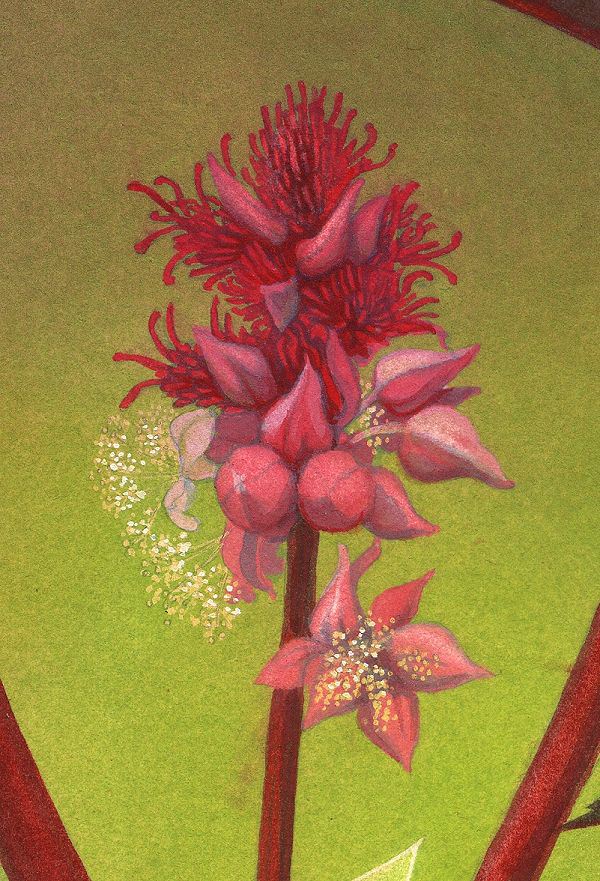
Nancy Farmers artwork of the castor bean flowers (www.nancyfarmer.net and anancyfarmer.wordpress.com)

Nancy Farmers artwork of the castor bean flowers (www.nancyfarmer.net and anancyfarmer.wordpress.com)

She would continue to reveal the beautiful benefits of the plants’ ornamental characteristics and its ability to thrive with little encouragement to provide grandeur in our gardens.  As she continues to deflect our attention from unproven matters of the castor bean plant, she may fly around exclaiming the exceptional as well as unattractive features of the plant from its large showy leaves, a towering height, and flowers with a combination of features as complex as its tales. The key, she should would say, is to admire ‘all of the plant’s’ wonderful virtues along with its adversity.  Because the castor bean plant has its good and bad sides.

Source Permitted by: Nancy Farmer (www.nancyfarmer.net/nancyfarmer.wordpress.com)

Source Permitted by: Nancy Farmer (www.nancyfarmer.net/nancyfarmer.wordpress.com)

Source Permitted by:  Nancy Farmer of www.nancyfarmer.net and nancyfarmer.wordpress.com

Source Permitted by: Nancy Farmer of http://www.nancyfarmer.net and nancyfarmer.wordpress.com

THE CASTOR BEAN PLANT

  • “A large shrub of tropical Africa and Asia having large palmate leaves and spiny capsules containing seeds that are the source of castor oil and ricin; widely naturalized throughout the tropics.”  (source: thefreedictionary.com)
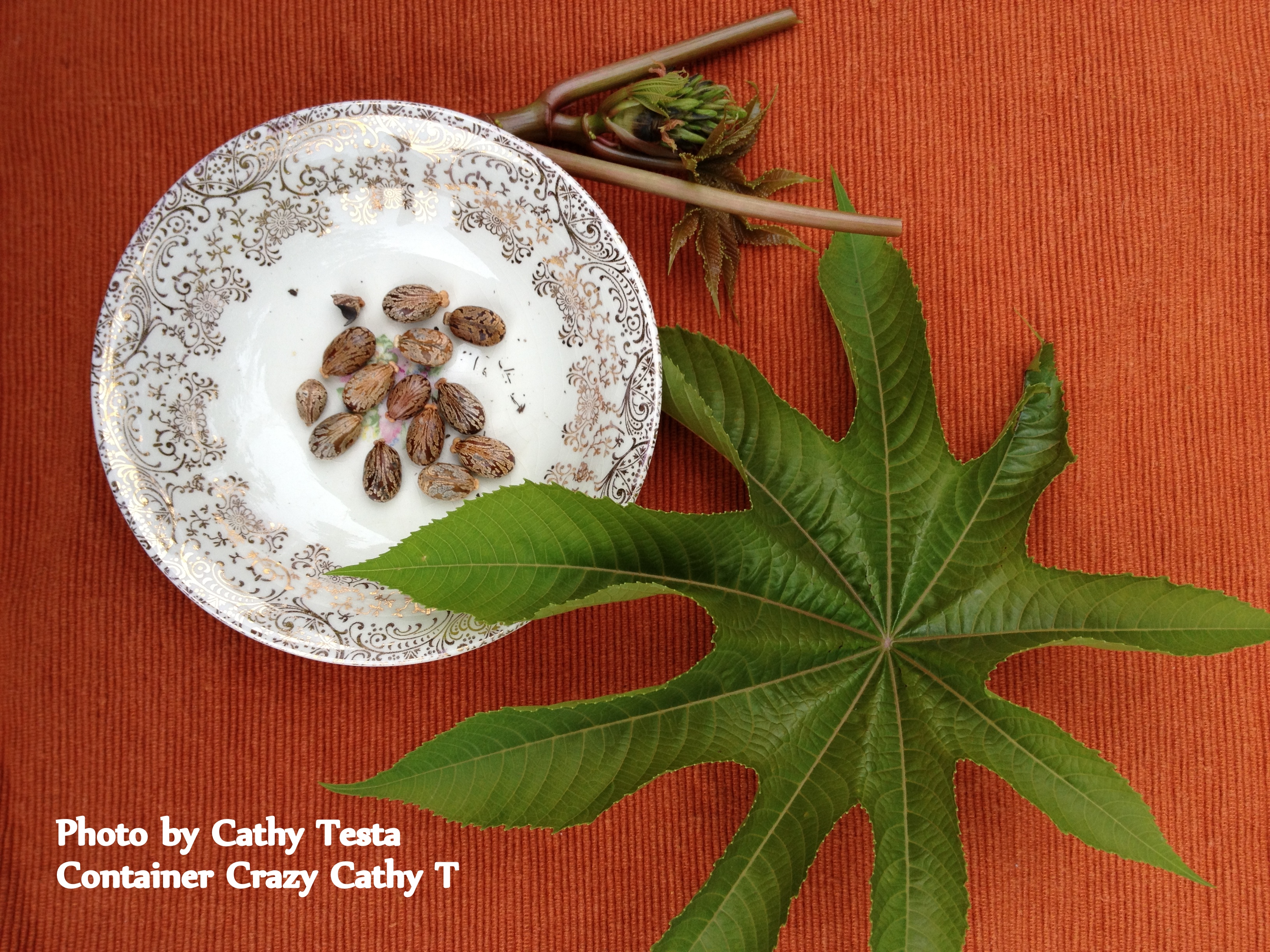
Castor Bean Seeds with a Leaf

Castor Bean Seeds with a Leaf

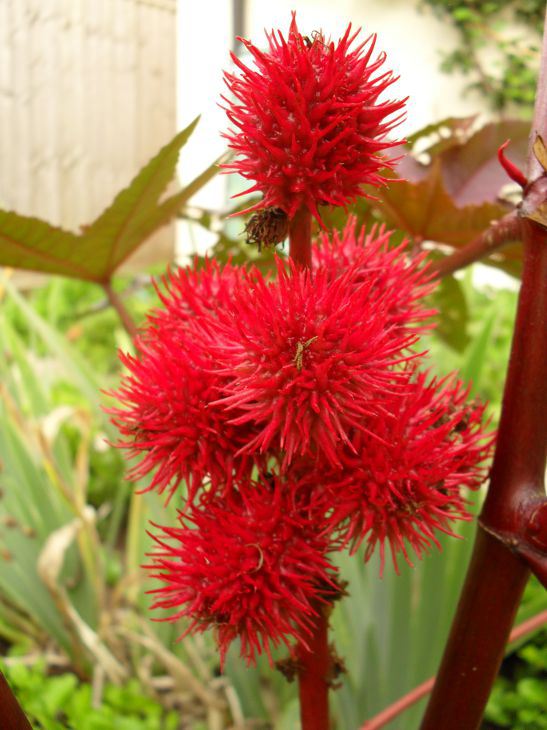
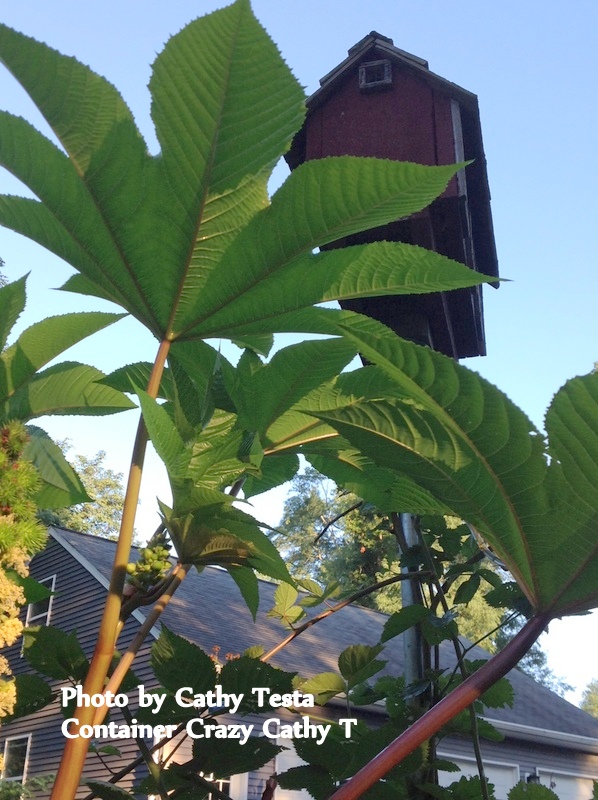
The castor bean plant or castor oil plant (Ricinus communis) is a tropical shrub or tree hardy in planting zones 10-11.  It is treated as an annual in Connecticut’s planting zones since it will not survive winter temperatures here. The plant grows rapidly from seed when planted in ideal conditions. It can easily reach between ten to twelve feet in a single season. As the stalk increases in diameter, it resembles thick bamboo. Large distinctive green leaves growing from the tips of long petioles are lobed shaped with several pointed star-like tips.  The species is primarily green, but cultivars come in vivid red to maroon colors, including the seed capsules.

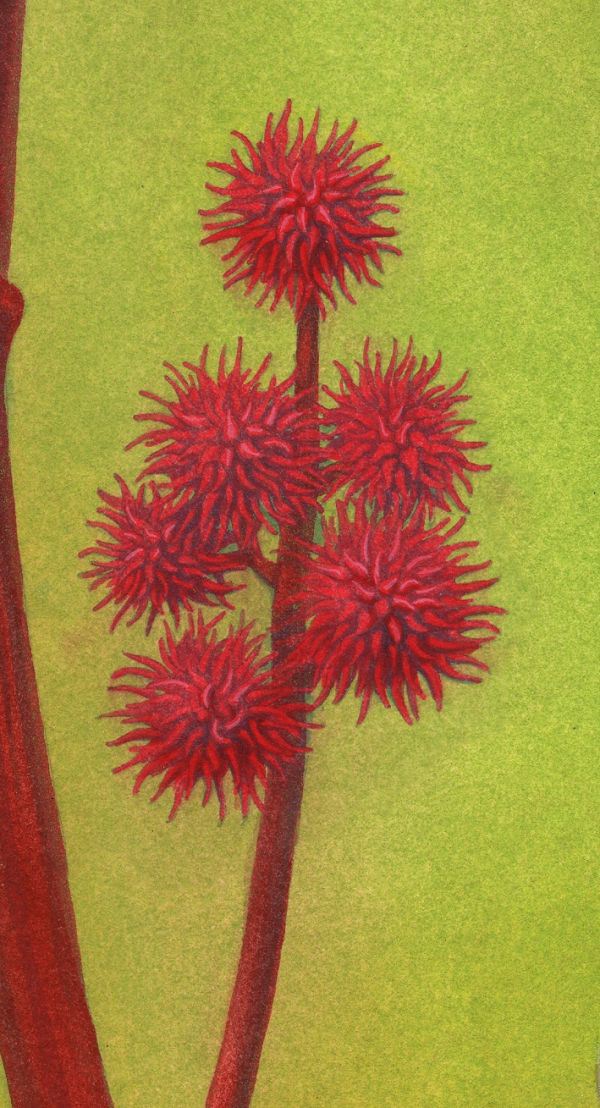
Nancy Farmer's artwork of the red seed capsules of a cultivar the castor bean plant

Nancy Farmer’s artwork of the red seed capsules of a cultivar the castor bean plant

Photo Courtsey of Nancy Farmer's Artwork

Photo Courtesy of Nancy Farmer’s Artwork (www.nancyfarmer.net and nancyfarmer.wordpress.com)

The plant’s odd-looking flowers consist of separate male and female flowers on the same plant. When both sexes are on the same plant, this is termed monoecious. The male flowers are white and tiny, situated just below the female flowers.  Red styles, the narrow part of the pistils, are clearly visible on the female parts of the plant.

Female Flowers on a Castor Bean Plant

Female Flowers on a Castor Bean Plant

Prickly seed capsules - Ricinus communis

Prickly seed capsules – Ricinus communis

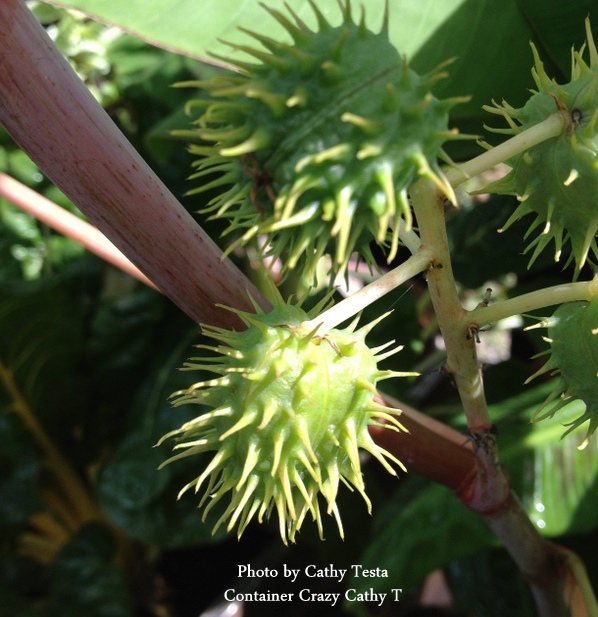
Round seed capsules grow from the female flowers which are rather interesting. They are composed of three joined lobes or hulls covered with soft prickly spines. Inside each prickly capsule are the infamous castor bean seeds, known to be the source of a potentially lethal toxic, known as ricin. Although the castor bean seeds are the size of edible beans, think kidney beans – they are not true beans at all.  And they are not meant for direct consumption, but used for the production of castor oil and other traditional medicines. Some people think the seeds resemble inflated ticks, and the genus name Ricinus is the Latin word for tick.

Mature seeds of the castor bean plant

Mature seeds of the castor bean plant

Immature seeds in the capsule.  Photo by Cathy Testa

Immature seeds in the capsule. Photo by Cathy Testa

A POISON

  • “a substance that, when introduced into or absorbed by a living organism, causes death or injury, esp. one that kills by rapid action even in a small quantity.” (source: Google)
  • “a person, idea, action, or situation that is considered to have a destructive or corrupting effect or influence.” (source: Google)

Relief from the use of castor oil derived from the seeds of the castor bean plant (Ricinus communis) may yield some benefits for people still using this remedy as a laxative, but there are reported sinister sides to the seeds, that when used in a specific fashion and with its toxic substance, will lead to illness and sometimes death of an unsuspecting victim. Some stories or myths shared from past to present about such occurrences, including claims of sneaky murders from administering ricin with a common umbrella as the mode of transmission, to claims of accidental deaths from chewing the seeds without the realization of the disastrous results days later, may be somewhat exaggerated.

In the words of John Robertson who has spent ten years researching, writing and talking about poisonous plants:

Butthough ricin is extremely poisonous it actually does little harm. Around one million tons of castor beans are processed each year for castor oil production leaving the waste pulp with up to 50,000 tons of ricin in it. And, yet, finding instances of ricin poisoning is not an easy task. (source: THE POISON GARDEN website)

Victims are said to suffer from vomiting, diarrhea and dehydration once attacked by the evil person in possession of the ricin.  Others have eaten the castor bean seeds in ignorance with the belief it is a medical solution to their health problem. Yet the more you read regarding the poisoning powers of the infamous castor bean seeds, the more unclear the accusations and exaggerations become regarding the potential for eventual death to occur. Some sources attempt to explain the differences between poisonous and dangerous because a person can do no harm without the right combination of both a lethal toxin and attitude.

In a ten minute video on THE POISON GARDEN website about ricin, John Robertson states, There’s a big difference between poisonous and harmful.  For a poisonous plant to become harmful, there has to be a way to administer the poison.

Leaf of the castor bean plant (Ricinus communis)

Leaf of the castor bean plant (Ricinus communis)

THE HAPPY TOGETHER

Many references will indicate you should keep the castor bean plant and especially its seeds away from children or animals, and should you have either, this may be a needed precaution.  More important, I would say, is to be knowledgeable about the plants before placing one in your gardens. Unlike plant tags listing all the beneficial reasons a plant is successful (a winner, deer-resistant, hummingbird magnet, drought tolerant, etc.), the downsides of plants are not indicated at all.  One is to wonder if plants should have warning tags (e.g., potentially toxic, invasive, aggressive, addictive, etc.) but for obvious reason, they do not.  However, I have grown castor bean plants at my home and so have many others worldwide.  In some parts of the country, the plant grows as a common roadside weed and the population of people near these situations are aware of its hazards. Similar to other things in our society which are dangerous under the wrong circumstances and in the wrong hands, we must just be more educated and not be put in a state of fear.  After all, if the castor bean plant and its potential poison is a killer, why am I not dead?

Racina, the plant, and myself co-exist without any ill effects – and you can too if you admire the castor bean plant’s features.  One way to limit your anxiousness regarding the prickly seed capsules with seeds within is to remove the flowers all together on the plant, or remove the capsules before they mature and potentially crack open to drop seeds on the ground.  Wild animals seem to understand the precautions and warnings provided by the plants as an adaptation to say “don’t eat me, stay away, I’m trying to reproduce.  And if you tempt it, I will make you sick enough so you remember.”  How incredibly wondrous by the plant.  Racina, as I imagine her, understands this.  She, the plant, and the poison all live happily together.

And I think you could too,

Written by Cathy Testa©

White male flowers on the Castor Bean Plant (Ricinus communis)

White male flowers on the Castor Bean Plant (Ricinus communis)

P.S.  A very special thank you to Nancy Farmer, the obviously talented artist capturing the essence of the castor bean plant’s legends with a fairy.  She and her amazing works of combining ‘nature with art’ may be found at:

http://www.nancyfarmer.net/

http://nancyfarmer.wordpress.com/

References and Other Sources:

http://www.uicnmed.org/nabp/database/HTM/PDF/p86.pdf

http://en.wikipedia.org/wiki/Castor_oil_plant

http://www.thepoisongarden.co.uk/atoz/ricinus_communis.htm

http://www.missouribotanicalgarden.org/PlantFinder/PlantFinderDetails.aspx?kempercode=b459

http://www.ct.gov/caes/lib/caes/documents/publications/fact_sheets/plant_pathology_and_ecology/poisonous_plants_06-27-08r.pdf

http://www.ansci.cornell.edu/plants/castorbean.html

Castor Bean Plant growing at Cathy Testa's home near a birdhouse on a 10 feet high pole.

Castor Bean Plant growing at Cathy Testa’s home near a birdhouse on a 10 feet high pole.

Pimping Pumpkins with Nylon and Bling-Bling

11 Comments

IMG_9310The past week’s weather prompted me to start decorating for “Falloween,” the period where it may feel a tad bit early to put out your scary Halloween decorations, but not too early to begin decorating with pumpkins, gourds, cornstalks, mums, and other goodies.

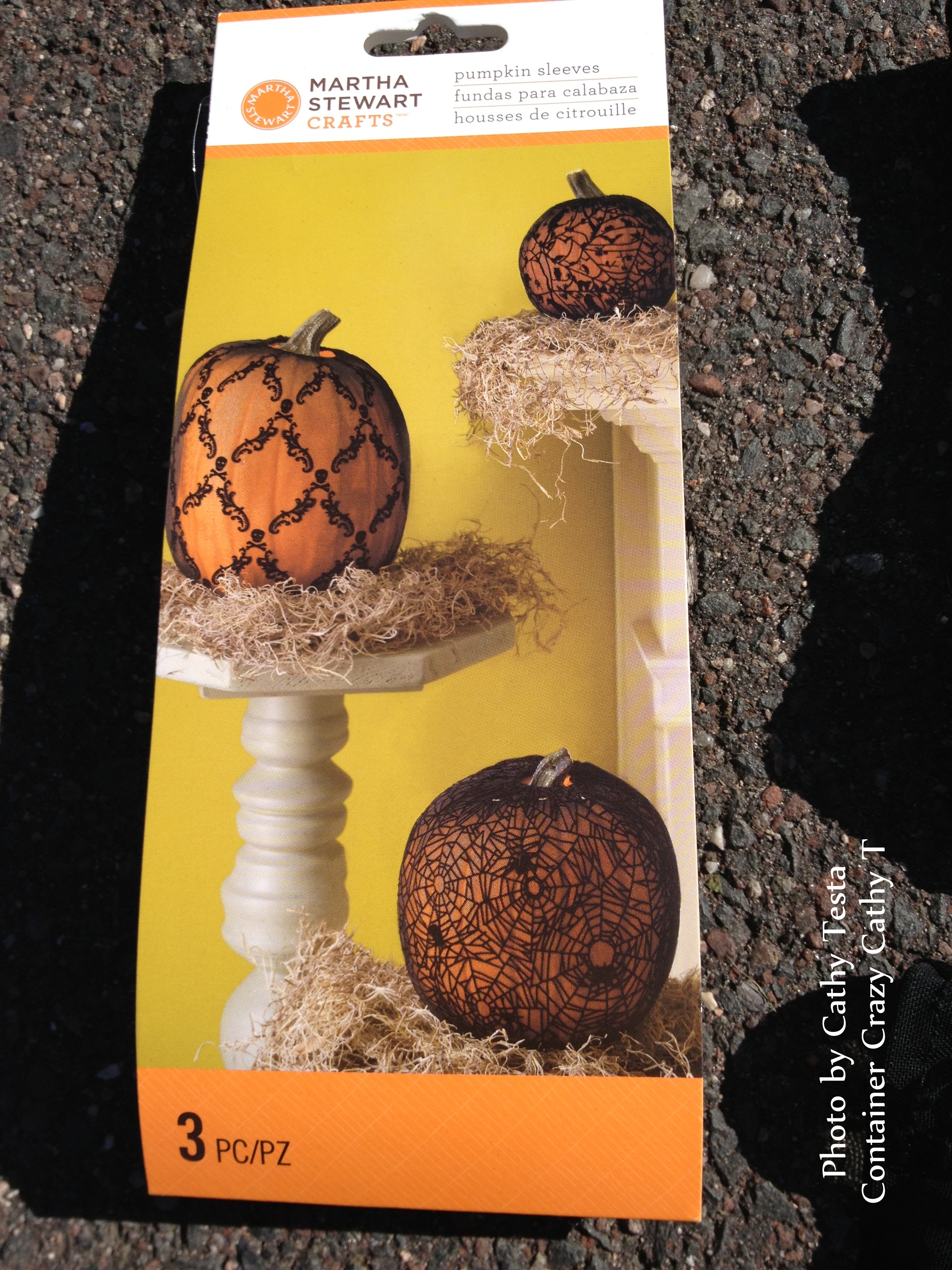
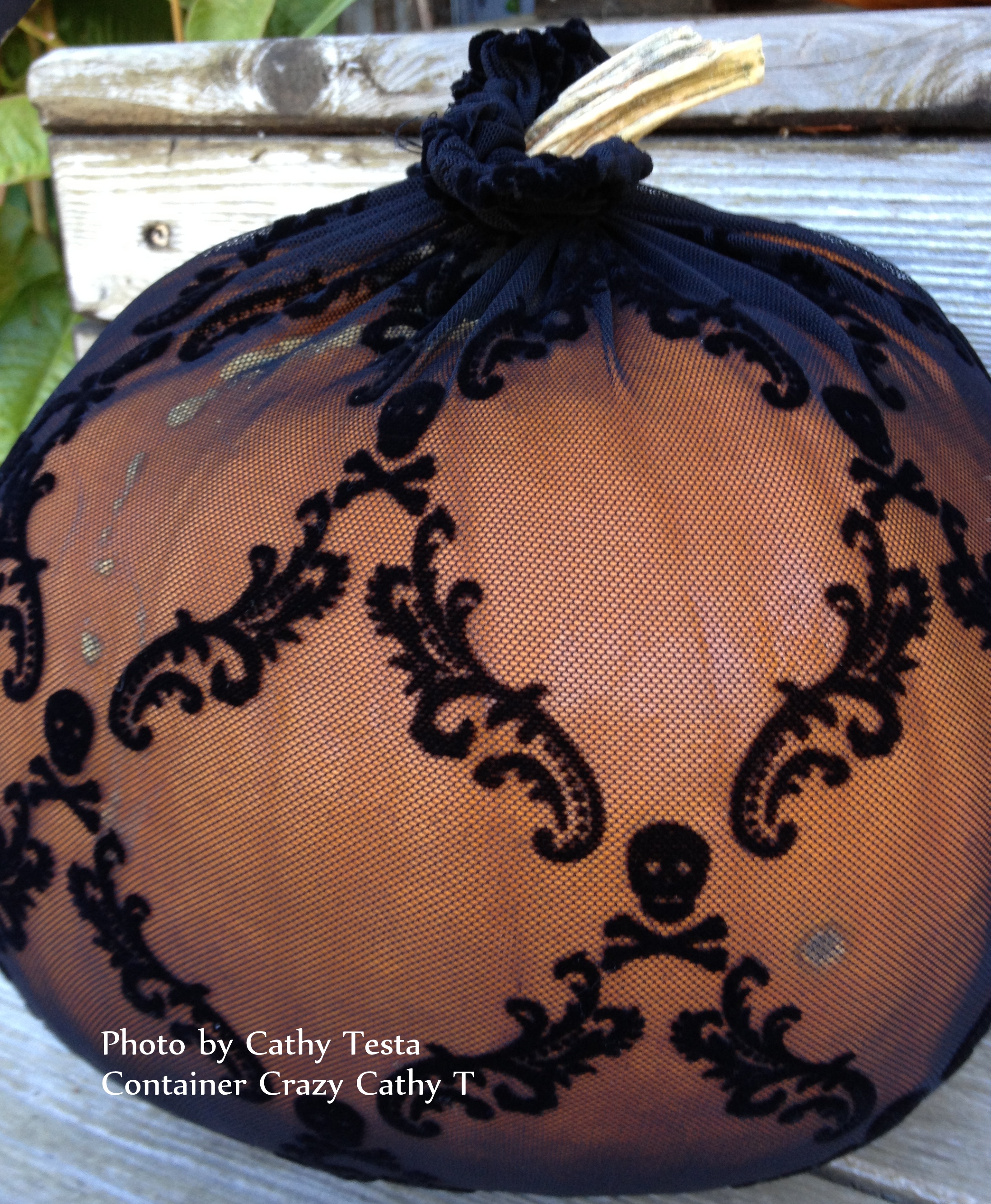
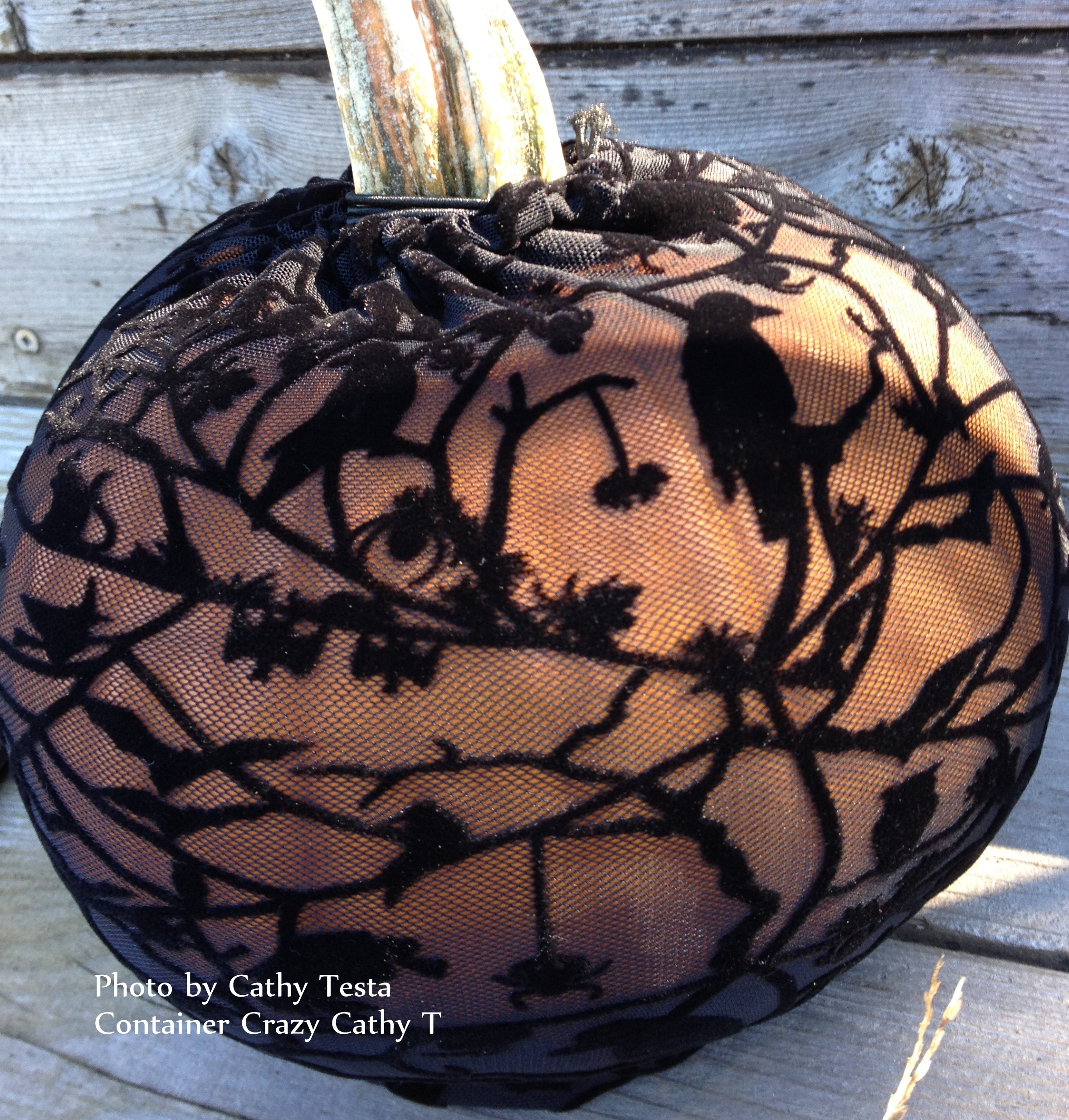
IMG_9276So I decided to go with the easy packaged Martha Stewart find called “pumpkin sleeves” discovered at a local Michaels craft store.  When I tried looking up instructions, because there really wasn’t any on the package, I could not locate this item on the Martha Stewart website.

IMG_9275

IMG_9277

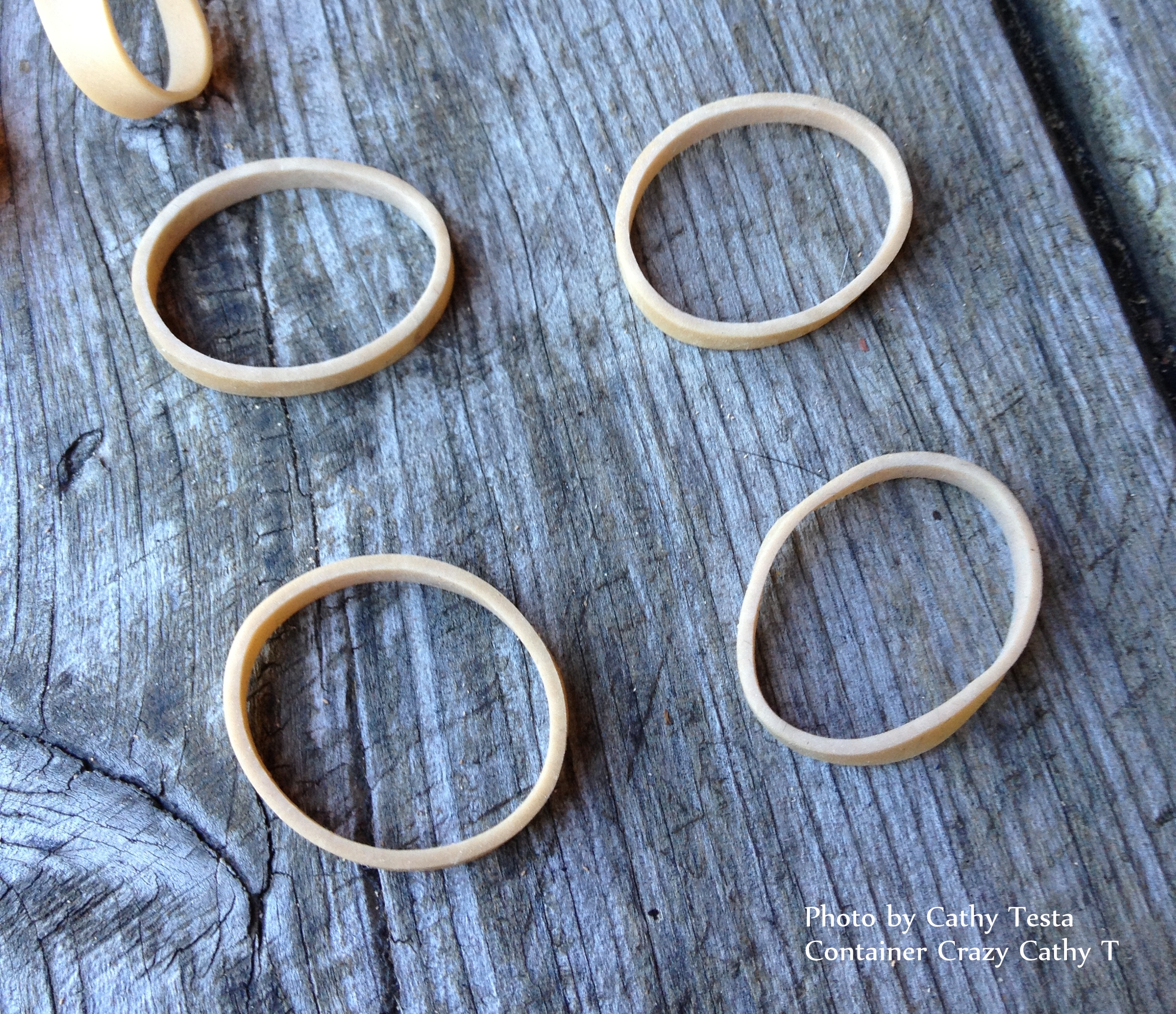
Not a bother – because it was very easy.  Just slip it over and secure the ends.  At first I used small rubber bands to gather the ends on the bottom and top, but later discovered a draw string for the top end of the sleeve.  However, I still found the rubber band trick to secure it tightly worked better.

IMG_9278

IMG_9288

IMG_9293

IMG_9292

IMG_9291

As I went to pimp my last pumpkin, I realized I didn’t have enough sleeves (only 3 per package), so I went to my drawer, found a pair of plain black nylon stockings, cut a portion off the foot end, and pulled it over. It is not as pretty because there isn’t a pattern on it, but I’m sure I could use a Sharpie permanent marker to create some images on it if I wanted to later.

IMG_9290

IMG_9300My cat, Mini, came by to investigate my project – like most of my curious cats do when I’m outside dressing up areas for the season.

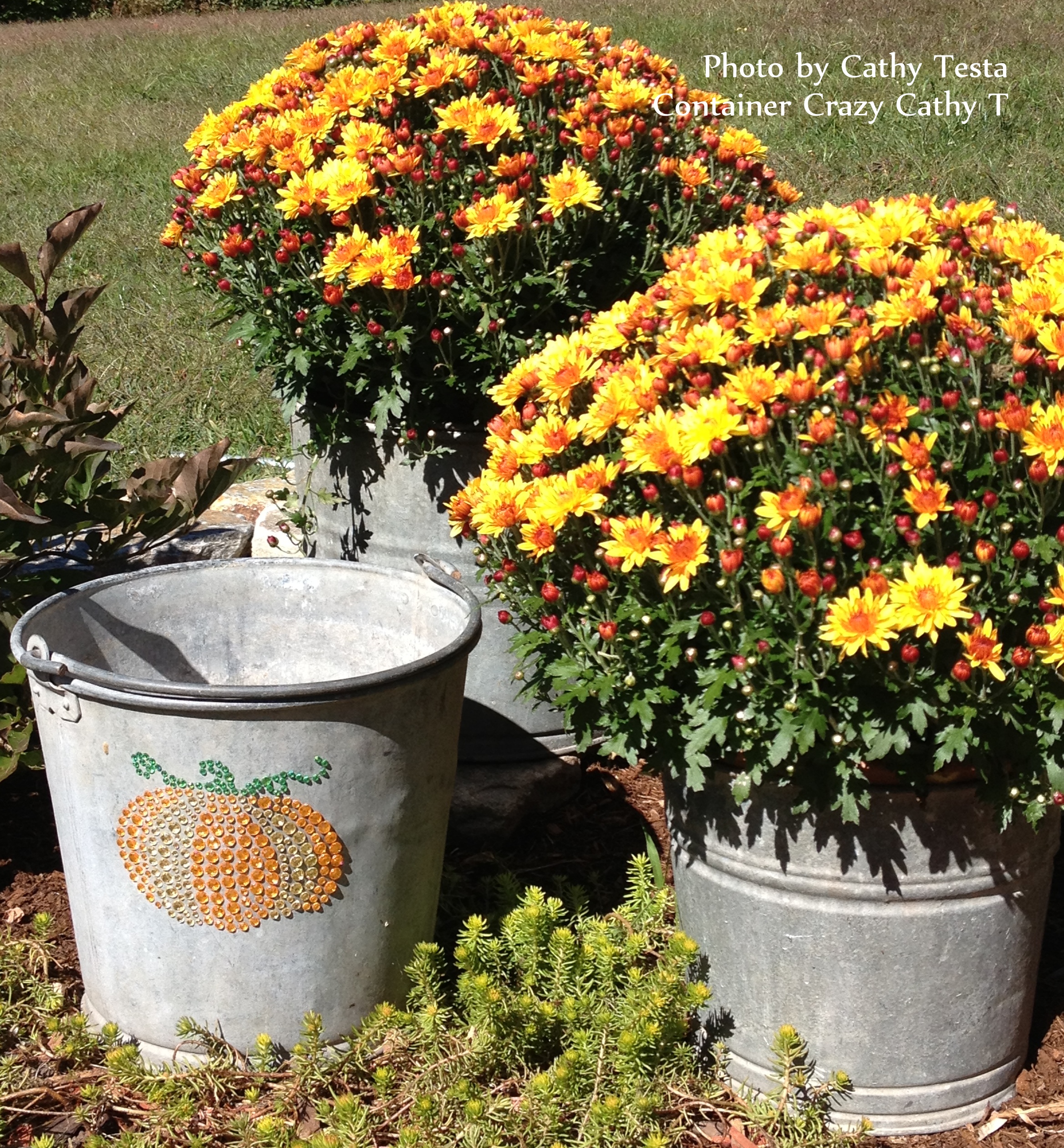
IMG_9305I also picked up some bling-bling from Michaels by Recollections.  It is rhinestone stickers, probably intended to stick on windows, but I attempted to apply them to my pumpkins and galvanized buckets.

IMG_9304

Because the temperature of the pumpkin will get cold in the evenings and warm during the day, I added some additional clear glue under to help it stay adhered.  We will see if it hangs on for the rest of the month.

IMG_9306

IMG_9308

Both the sleeves and rhinestone stickers are a quick and easy fix to pimping your pumpkins.  And since there is no cutting involved, it will last much longer than a carved pumpkin.  Plus you can reuse the pumpkin sleeves every year.  For rhinestones, you could also investigate your unused jewelry beads, buttons, or small pieces to upcycle them for a look similar to the rhinestones.

IMG_9321

That’s it!  Just a quick bit of inspiration – and right after, I went to my hammock and rested a bit to enjoy the beautiful blue skies of this past weekend.  It was absolutely gorgeous out – and the weatherman said it would be nice and warm all week.

IMG_9316

Enjoy your week.

Written by Cathy Testa

IMG_9244

Scoring Garden Art at Antique Shows & Vintage Bazaars

8 Comments
Watch Faces at The Vintage Bazaar

Watch Faces at The Vintage Bazaar

Antiques are not really my thing, but I love salvaged pieces and re-purposed items. Something about a pile of old watch faces displaying antique lettering or rusty railroad spikes made from wrought iron speaks to me. I think about how I might use them when combining art with nature in the garden and as decor in my container gardens.

So when I suggested visiting a vintage bazaar in Salisbury, Massachusetts to Steve, my husband, as an idea of “what to do on our anniversary this year,” he agreed to go.  There was a nice “seal the deal” portion of the trip because on day two of the event, vintage motorcycles would be showcased, plus we planned to stay on the beach nearby. 

Clever displays, Upscale and Classy.

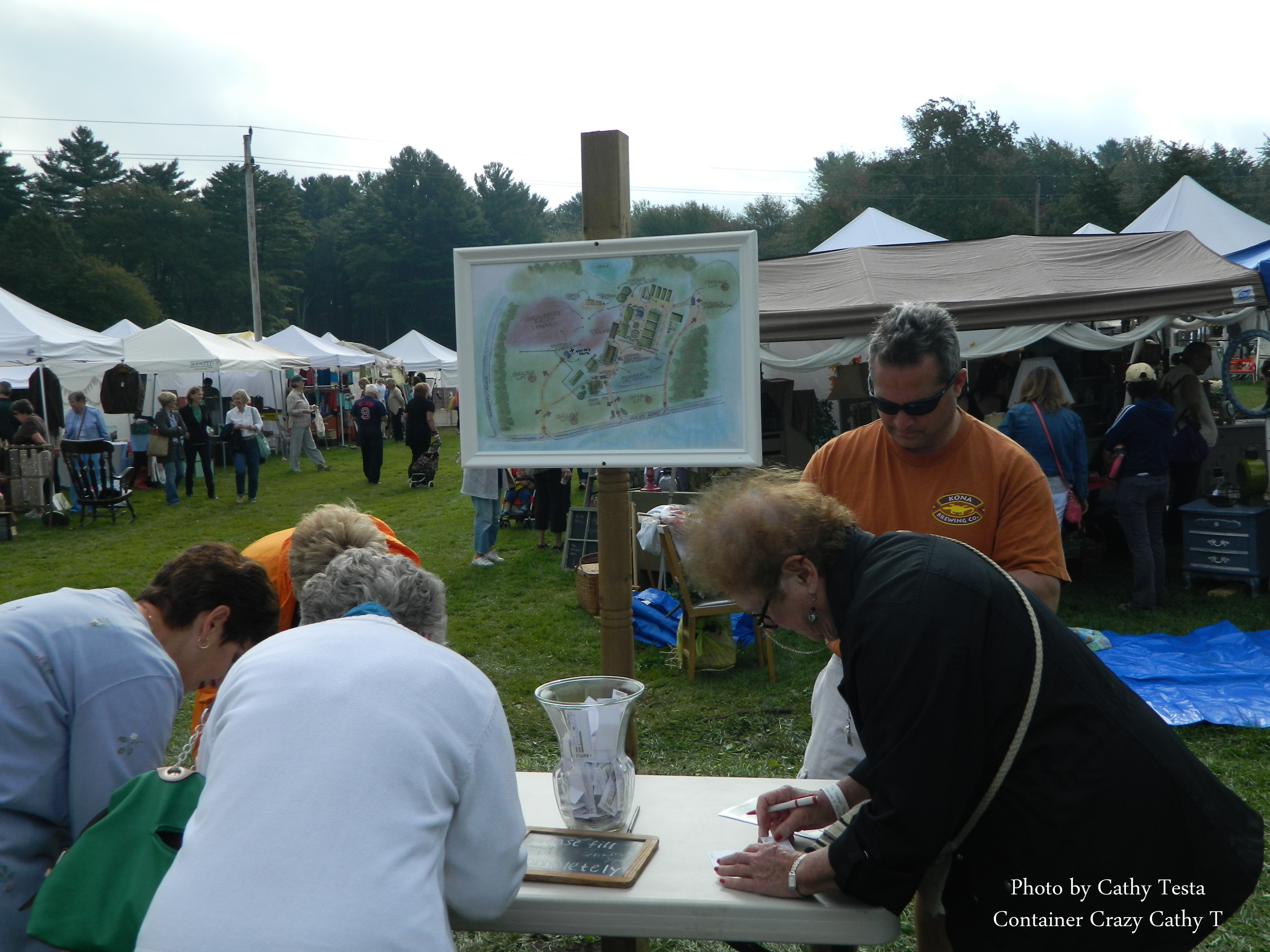
All of the show’s vendors at The Vintage Bazaar in Salisbury, MA cleverly displayed their features and finds in well-spaced tents of a boutique style format. Their items were arranged in interesting groupings on the edges of their tents, and in an upscale classy way. There was also a raffle table where you could place your five raffle tickets received as part of your entrance fee of just $5.00. If you wanted to get there early to find the deals and get first dibs, you could do so by getting “early bird” tickets for $2.00 additional dollars.

Raffle Table

Raffle Table

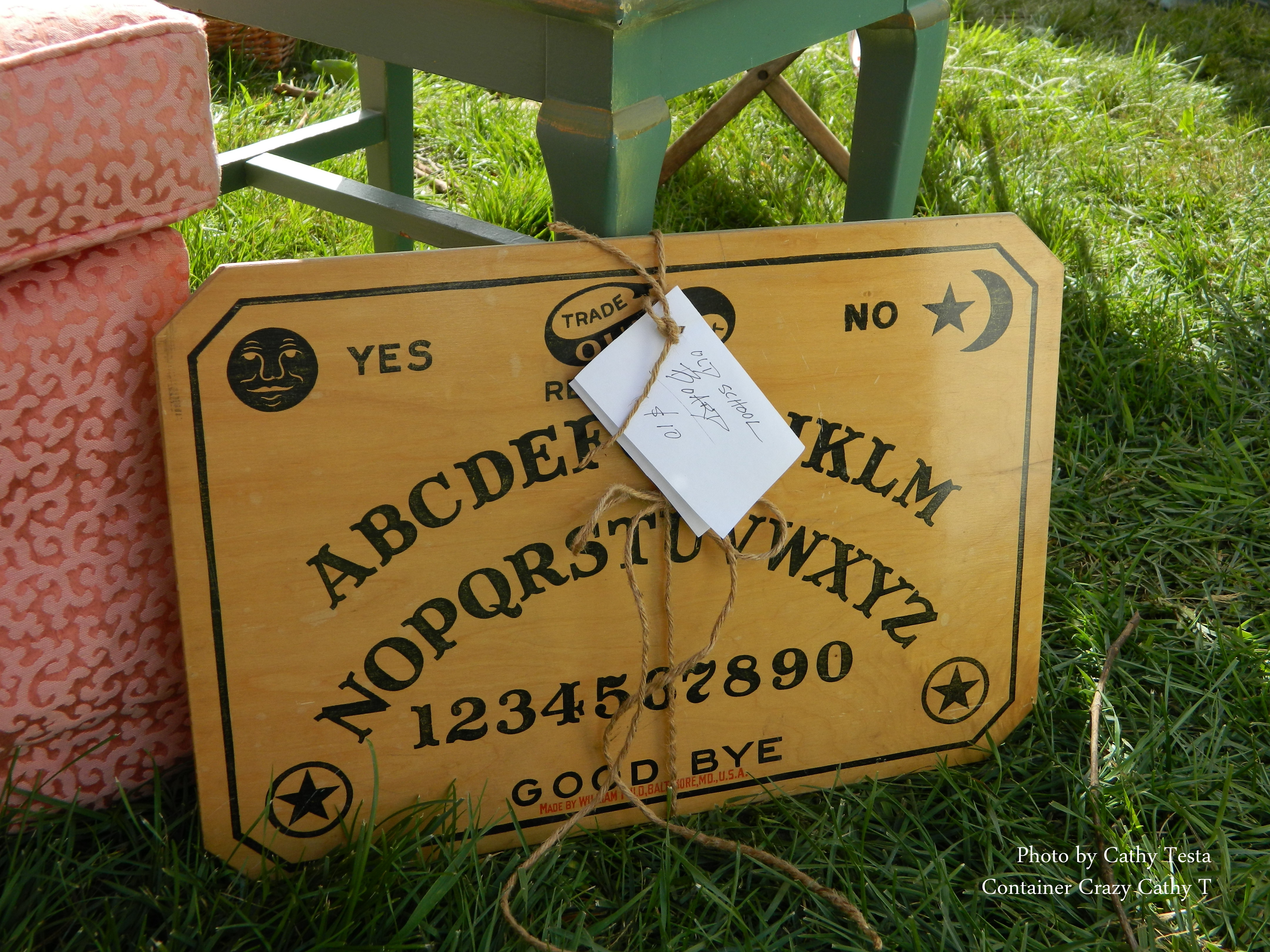
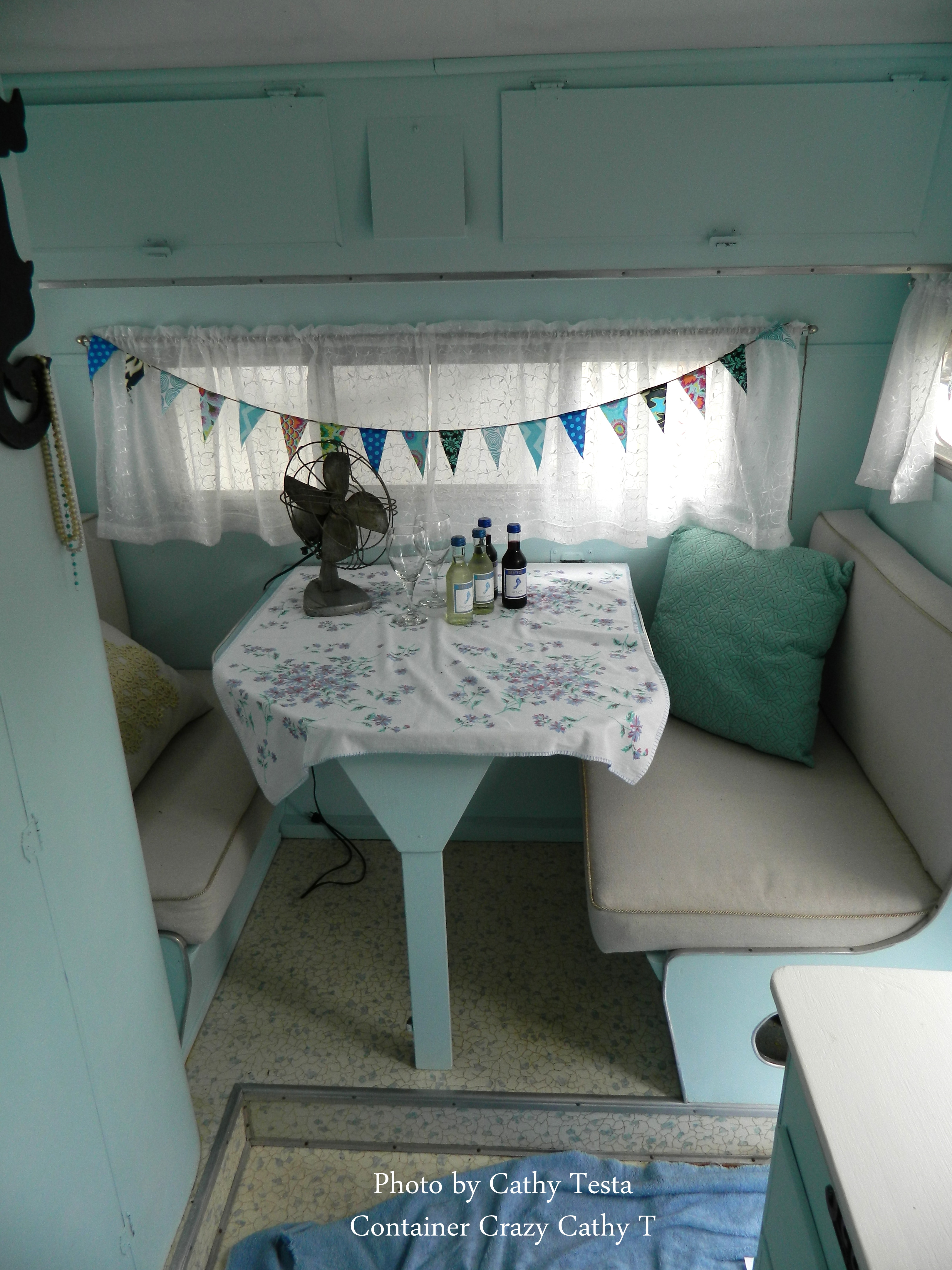
It didn’t take too long to spot the unexpected, from eerie Ouija (weeje) boards to a cute little vintage travel trailer spiced up with adorable and charming embellishments inside and out. All included in the vendor’s asking price.  The trailer sold during the “early bird” hour, prior to the gates opening at 10 am, for a price of $3,200-3,500 (I can’t remember the exact amount she stated, but I know it was in the 3’s).  You may not expect to spend that much at an event like this – and you don’t have to – there were many bargains and deals as well (I got two huge golden reindeer for $4 each!), but seeing this special trailer did start the day off with a feeling of more good finds to discover.  And I could imagine this cute little trailer right in a garden as a spot to relax and enjoy the views too.

Not pricey but not desired, too spooky.

Not pricey but not desired, too spooky.

Vintage Travel Trailer

Vintage Travel Trailer

Inside the Vintage Travel Trailer

Inside the Vintage Travel Trailer

Interior of Trailer

Interior of Trailer

Added bonus – getting Autumn Decor at the show.

There’s something special about visiting fairs and shows like this one during the fall season when you can also collect Halloween or Autumn decor to dress up your surroundings at home for the season.  One of my favorites was works by Alycia Matthews made of paper mache and mixed media.  I bought a cute little Halloween themed doll from her whimsical display to add to my collection of Halloween figurines. Alycia is located in Newburyport, MA and her works may be found via etsy at www.AlyciasArt.etsy.com.

Mixed Media by Alycia Matthews of Newburyport, MA

Mixed Media by Alycia Matthews of Newburyport, MA

Pumpkin Heads by Vergie Lightfoot

Pumpkin Heads by Vergie Lightfoot

Pumpkin Heads by Vergie Lightfoot.

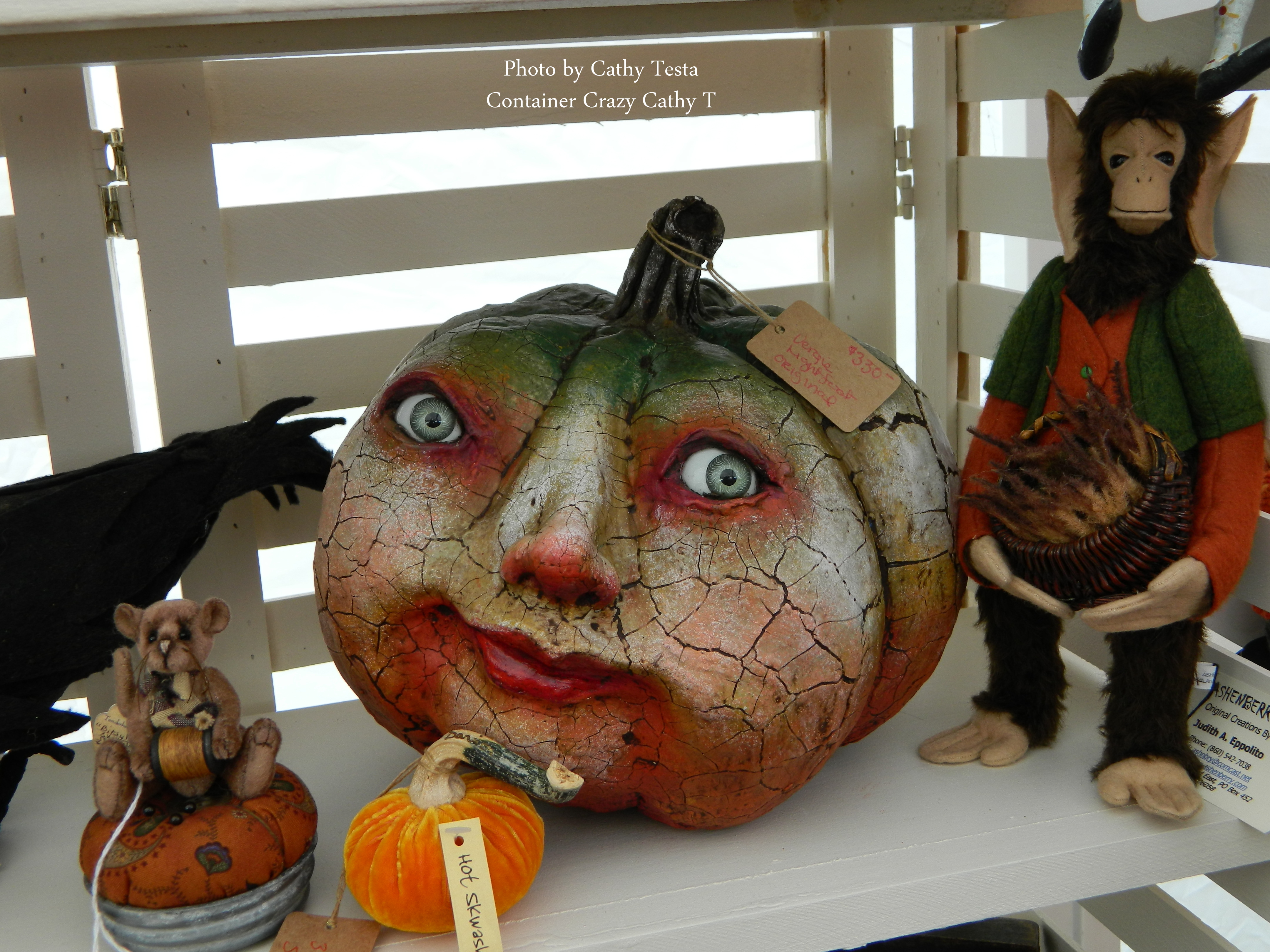
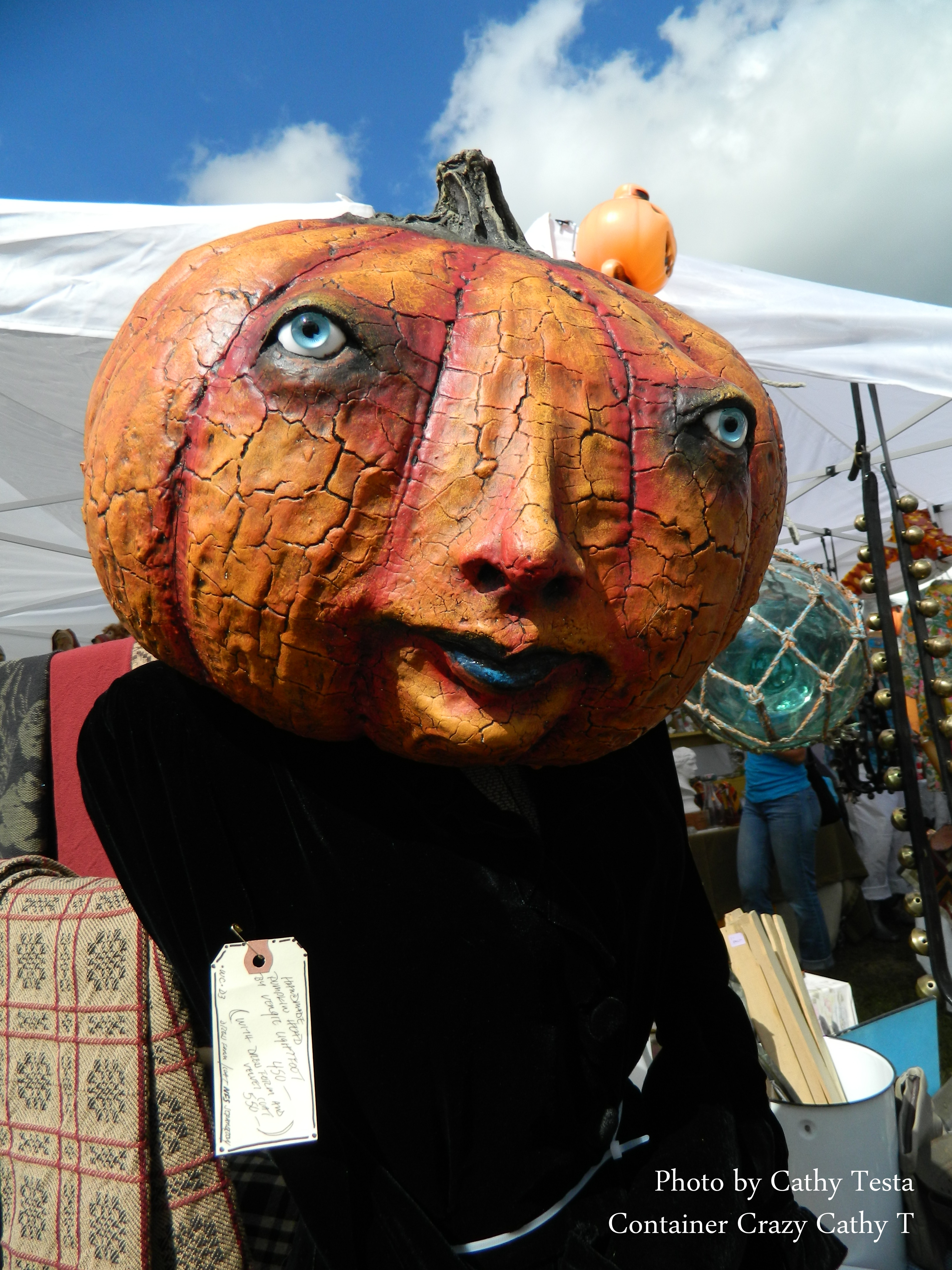
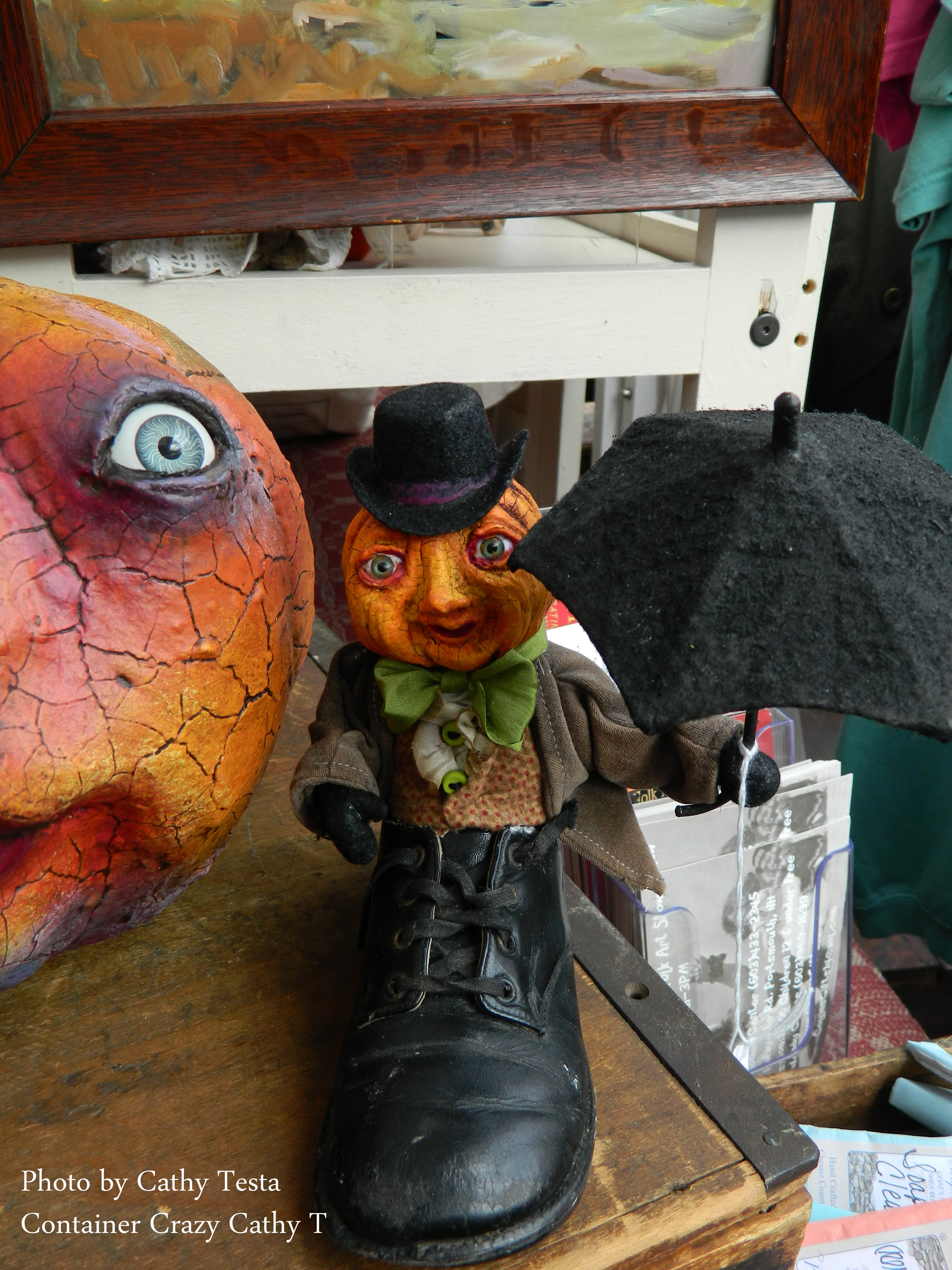
And I was infatuated with handmade pumpkin heads with realistic painted eyeballs by folk artist, Vergie Lightfoot. I spotted this pumpkin headed manikin with a black velvet dress from yards away, and couldn’t stop looking and considering the others like this one in the tent. However, by this time, we had spent enough dollars on other finds, some at bargain prices – and with a weekend beach stay as part of this trip, we couldn’t justify the expense for a pumpkin head, even though the seller mentioned these pumpkin heads were talked about on The Jay Leno show last year, and he collects them.  I can see why – they are comical and goofy.  I especially liked the one in the little black shoe with a black umbrella.

Amazing Pumpkin Heads

Amazing Pumpkin Heads

My fav of the Seasonal Pumpkin Art at the show

My fav of the Seasonal Pumpkin Art at the show

Re-purposed.

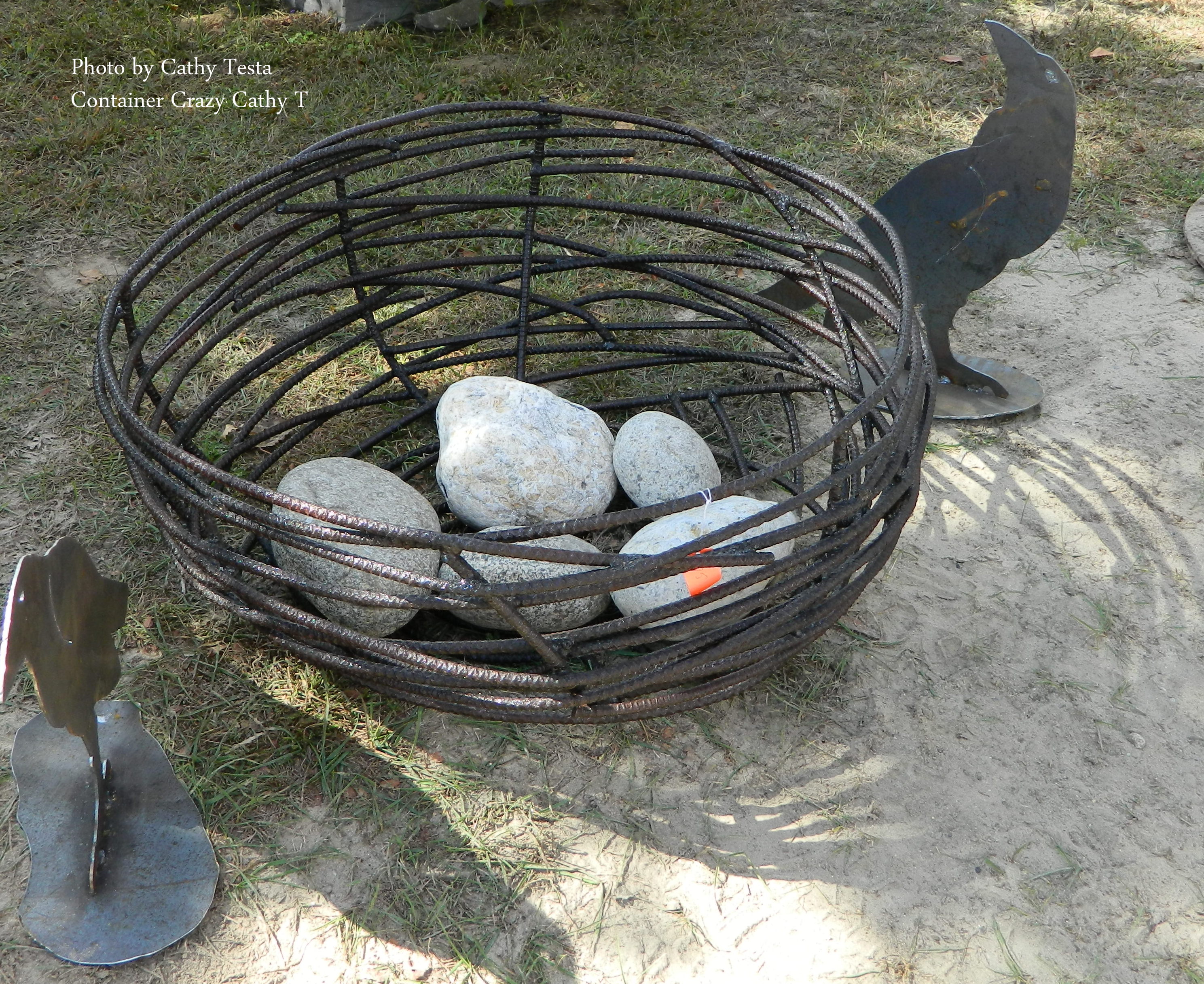
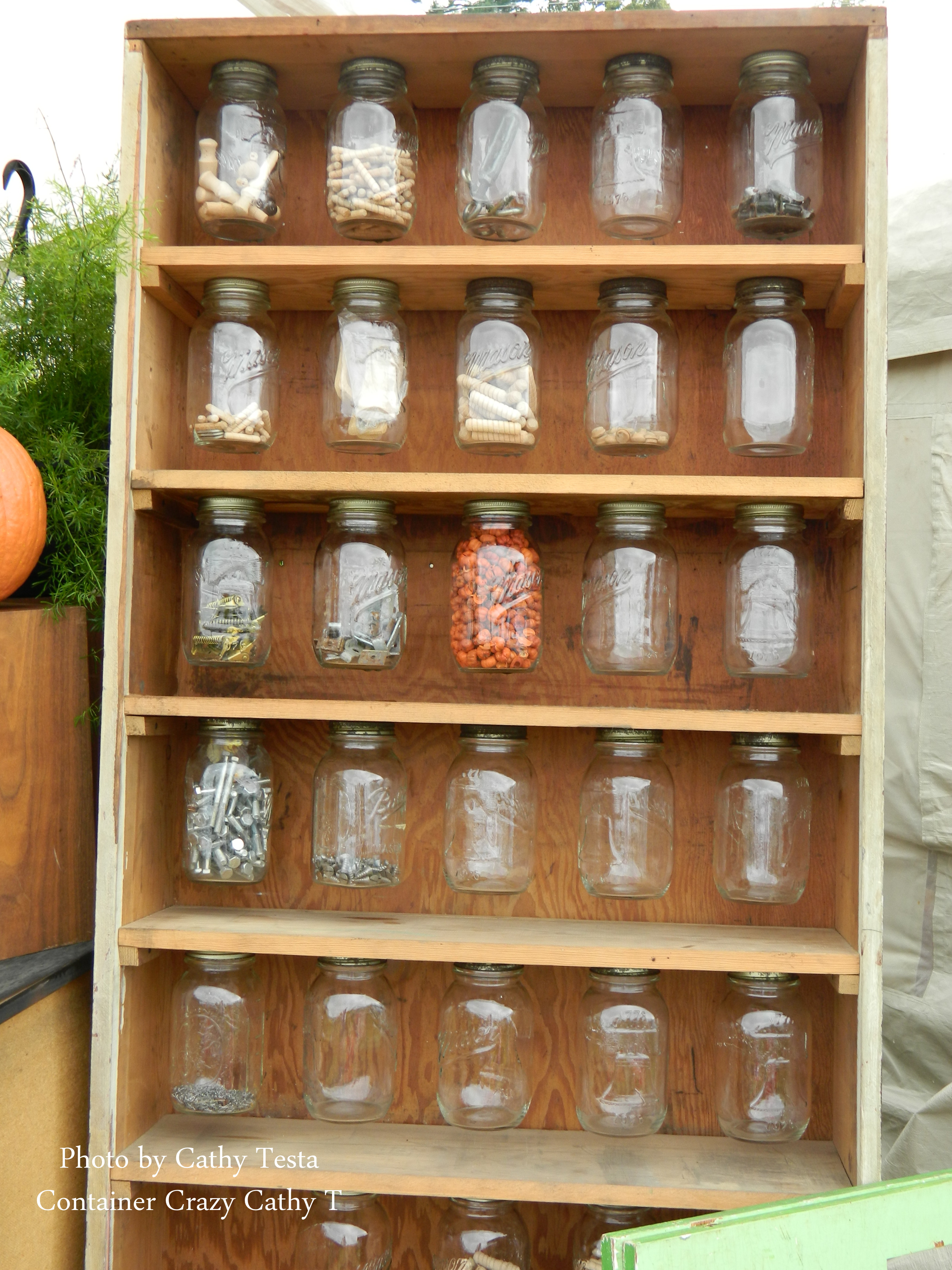
There were other surprises – like this big basket or container created with saws.  And things like a bowl or envisioned bird nest made with rebar.  Both repurposed in a unique and creative way.  These could be positioned in a garden as garden art and would last for years due to the material.  The creators were thinking wisely and you can see the hand-crafted effort put into these items.  And check out the mason jars – different ways to repurpose them into storage containers, whether for your spices or wine corks, it is a good use of a commonly available jar.  You could easily recreate something like it with baby food jars too.  However, getting them from an artsy person is always an option too if you don’t have any crafty bones in your body.

Saws Re-Purposed

Saws Re-Purposed

Rebar Repurposed

Rebar Repurposed

Mason Jar Spice Rack

Mason Jar Spice Rack

Storage Mason Jars

Storage Mason Jars

Other Garden Themed Decor.

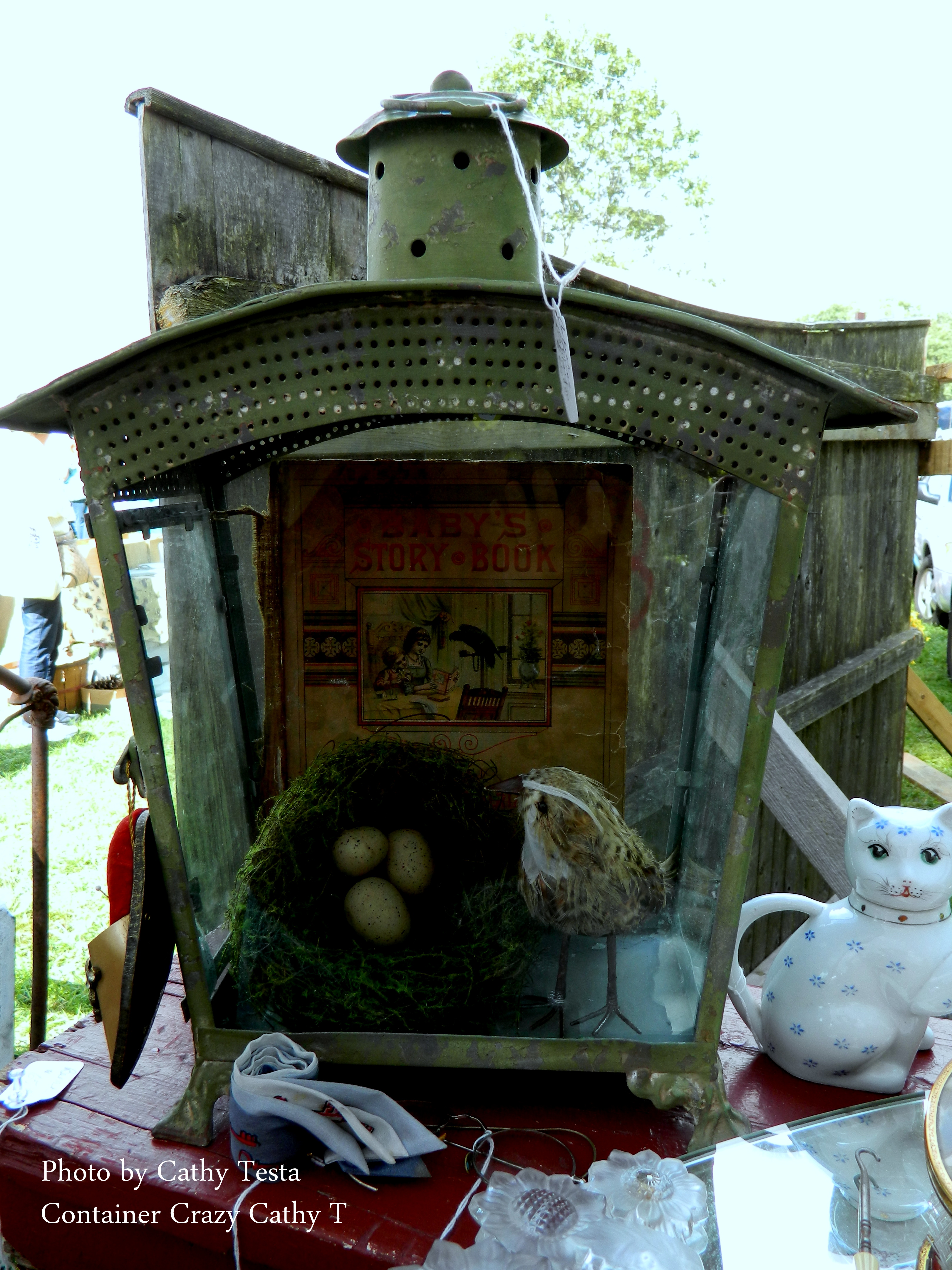
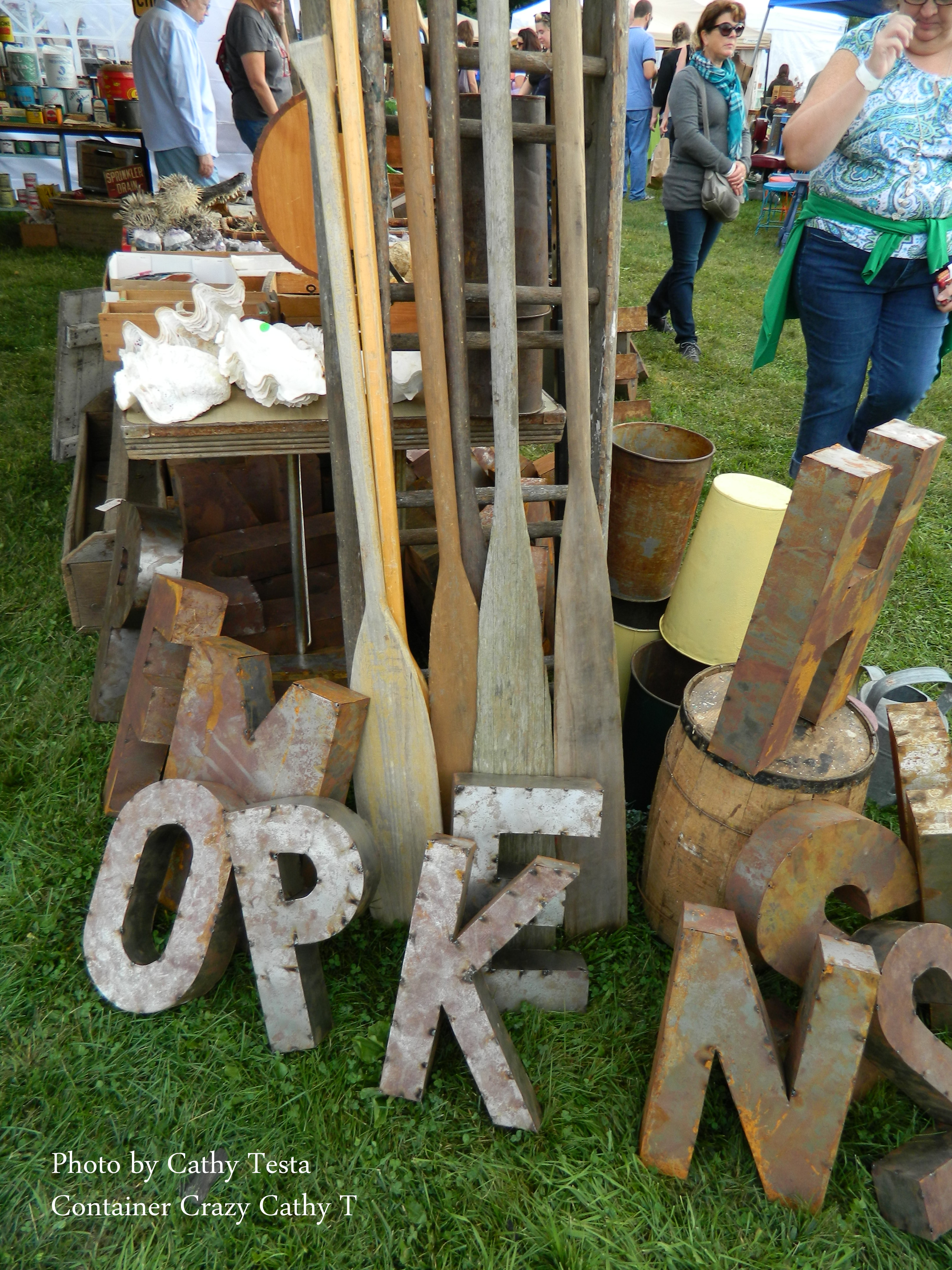
The event gives you inspiration by viewing all the wonderful ideas and finds.  Take these metal letters – perfect for creating a sign in a space like on a roof top patio or by a sitting area in the garden.  Or how about the little decorative glass lantern below with a bird nest and other cute features, perfectly staged to add decor to a themed enclosed garden room.  And the old typewriters remind us of prior years.  When incorporating elements from the past into our spaces, we create thoughts and memories – and talking points. And who would think we would treasure the bowls or drinking glasses from the 60’s or earlier times?  The once tossed or stored items by your parents or grandparents are treasured for so many reasons – they are rare, unusual, or bring back memories.  Plus many come in great colors too.

Metal Letters

Metal Letters

Lantern with Nature Decor

Lantern with Nature Decor

Old Typewriter as Decor

Old Typewriter as Decor

Notice magazine, a photo of this display was published.

Notice the magazine, a photo of this display was published.

Capping it off with a Harvest Fest.

After the vintage bazaar day, another traveler mentioned another find – an “Applecrest Harvest Festival” in Hampton Falls, NH.  So after resting our feet for a bit, we drove there – and it was worth the visit.  Fiddle band, warm apple pie with fresh ice cream, hayrides, orchards, tons of apples, peaches, figs, and homemade cider donuts.  The waiting line for the donuts was very long, so we opted for pie and picked up some fresh goodies, then ended our day with another sit on the beach in our sweatshirts, waiting for the harvest moon to cap off another gorgeous sunset on a beautiful September weekend in the fall. And alas, it rained on Sunday (which it did on our wedding day 23 years ago – and seems to happen almost every September 22nd, but it is considered good luck – so we’ll continue to take it).

Applecrest Harvest Fest in Hampton Falls, NH.

Applecrest Harvest Fest in Hampton Falls, NH.

The Harvest Moon, Salisbury Beach, Sept 2013

Salisbury Beach, Sept 2013

The Event’s Location.

The Vintage Bazaar in June and September is held on Pettengill Farm at 45 Ferry Road, in Salisbury, MA (only minutes from Salisbury Beach).  I believe this was their 3rd annual this year in 2013. Hours are 10 am to 5 pm and entrance per person is $5.00.  However, there is an “early bird” ticket option where you can enter earlier for $2.00 more which includes free entrance on Sunday.  The parking is free. Several bands play during the day, and because the event is held on a beautiful flower farm, you also have the option to shop for plants at reduced fall prices. There are greenhouses, arbors, statues, fountains, and even a live emu on the premises.  A beautiful map of the grounds, designed and rendered by “Order Up a Garden,” is displayed at the raffle drop off beyond the entrance booth. And by the way, The Vintage Bazaar is going on the road in October, partnering with The Boston Antiques & Design Show at Shriner’s Auditorium in Wilmington, MA.  To learn more, visit: www.mybazaarlife.com.

Framed for Fall

Framed for Fall

Written by Cathy Testa

P.S.  Steve did purchase something – an antique Budweiser serving tray.  That surprised me the most – not that its BUD, but that he bought something for himself at this event!  He was a good sport, and even though the next day’s rain prevented us from seeing the Vintage Motorcycles on day two, he went with the flow.  Instead we opted to hit the road early back home and get some local pumpkins to put outside.

Bud Tray with Business Cards picked up a the show

Bud Tray with Business Cards picked up a the show

Another tip:  Seaglass Restaurant on Salisbury Beach is outstanding.  Great views and a nice treat for dinner, and take an easy walk on the beach after to work it off.  Loved the side plates (appetizers) the best!

Links to business cards above:

Sand, Sea & Steam

The Yellow Zebra

Alycia’s Art

The Cozy Nook

Pettengill Farm

Yard Garb

POP & circumstance

Peacefrog Designs

Mermaid Bay Treasures

and there were many many more…See HERE.

Please join us for, You are Invited, and RSVP

3 Comments

With the autumn season approaching followed by Thanksgiving and the holidays, you may be thinking about inviting friends over for parties, dinners or special events. The best way to get started is by considering a classy or different invitation to set the tone of your gathering and create a great first impression.

Halloween.

Not only are Halloween costumes being stocked on store shelves, we are seeing Christmas and holiday items too. Ugh on the Christmas ones, it is a tad bit too early in September, don’t you think?  However, seeing the witches and goblins may prompt you to think about having a gathering for adults or kids.  Here are some cute and clever designs by a little paper company in Arkansas called, “Odd Balls Invitations,” offering many wonderful themes and colorful stationary for this holiday and others.

Source: Odd Balls Invitations

Source: Odd Balls Invitations

Hayrides, autumn, and foliage.

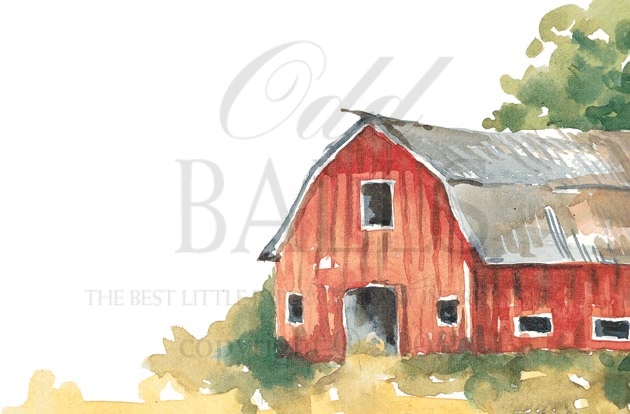
Riding around on a farm during our beautiful foliage season in the northeast is a treat for adults and children. Include a pumpkin carving contest, a fireside chat, and some fresh apple pie. Then stop by the barn for some country music.  Getting the idea? There are so many choices on the Odd Balls Invitations website, it is difficult to decide.  I know these below ring true for me.

Source:  Odd Balls Invitations

Source: Odd Balls Invitations

Source: Odd Balls Invitations

Source: Odd Balls Invitations

Source: Odd Balls Invitations

Source: Odd Balls Invitations

Thanksgiving, goobble-til-u-wobble, or farm fresh harvest dinners.

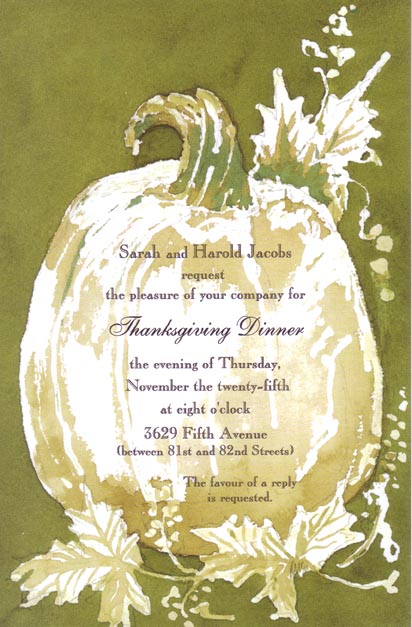
While you are out shopping or planning for the Halloween season, you may start thinking about Thanksgiving.  My sister told me the other day she visited a winery and is keeping her bottles of wine as a special treat for our annual Thanksgiving dinner at her house.  It is always helpful to plan ahead to reduce stress, and getting your invites ordered and ready is a good tip too.  Surprise your family members this year with something unique or unexpected.  Getting invites in the mail, the old fashioned way, is something special.

Source: Odd Balls Invitations

Source: Odd Balls Invitations

Source: Odd Ball Invitations

Source: Odd Ball Invitations

Christmas, holidays, and all things evergreen.

Yes, I just said it is too early to be bothered with thoughts of the December holiday season! True, agreed, but in my case planning for events starts next month.  And for those who know already, my December class, is an annual. This invitation would be perfect, wouldn’t it?!  So many themes in water color from traditional, classy to charming, can be found on the website called “Odd Balls Invitations,” where these were spotted when I was just browsing around for themed invitations.

Source: Odd Balls Invitations

Source: Odd Balls Invitations

Source: Odd Ball Invitations

Source: Odd Ball Invitations

Got a beer lover, horse rider, or other type of person in mind?

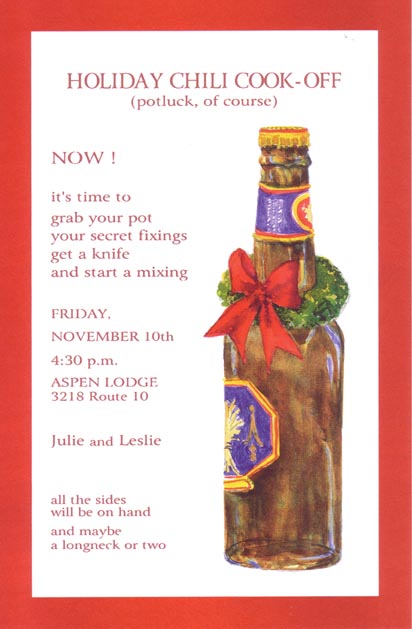
There is a plethora of themes to select from.  See HERE for more.  It will take you a while to view them all for there are so many.  And each is well made by the artists, and again, sets the idea, tone, or style of your gathering – and if that gathering is for a particular person in your life, it is ultra special to represent them in your invitation style.

Source: Odd Ball Invitations

Source: Odd Ball Invitations

Source: Odd Balls Invitations

Source: Odd Balls Invitations

Source: Odd Balls Invitations

Source: Odd Balls Invitations

Mardi Gras and Carnival.

Because I have friends in New Orleans and been there a few times, I really enjoyed checking out the themes with masks, boa feathers, and vivid colors.  Something for February or March.  But these couldn’t be left out on this post.

Source: Odd Balls Invitations

Source: Odd Balls Invitations

Source: Odd Balls Invitations

Source: Odd Balls Invitations

Gardens, patios, and decks.

And I would be remiss if I did not include the floral types and garden themes showcased and offered by “Odd Balls Invitations.”  There are many, many more to view, such as, Bugs and Bees, Birds, Butterflies, Tropical, Topiary, the list goes on. Click HERE to see them all.  These are absolutely perfect for your spring or summer garden related gathering or event.  Think garden tours, wine tastings, or tea time in the warmer season.

Source: Odd Balls Invitations

Source: Odd Balls Invitations

Source: Odd Balls Invitations

Source: Odd Balls Invitations

Source: Odd Balls Invitations

Source: Odd Balls Invitations

Source: Odd Balls Invitations

Source: Odd Balls Invitations

But back to the present moment, today being September 20th, there are still some beautiful days remaining to gather up friends to “relish in the golden, glimmering joys of autumn,” as Odd Balls Invitations so clearly represents in the above invitation with a beautiful urn and warm colored pumpkin.  A wonderful representation of combining nature with art – and festivities.

Written by Cathy Testa

Living without my laptop taught me to swim like a dolphin and dive like a loon

6 Comments
Bitstrips Source

Bitstrips Source

I can not believe I went two whole months without a laptop.  It was painful but also allowed me to become intimately familiar with my other devices.  I borrowed an iPad and used my iPhone as a back up – but posting via an iPad to my blog was challenging. Sometimes the iPad screen would not display correctly or the typing on the screen’s keyboard was cumbersome – I’m much faster on a regular old keyboard. The iPad would be slow at times – for whatever reason, I could not figure out.  And the iPhone, it is small and difficult on the eyes. Handy as it may be, I can’t use it to post content easily.  It would take F–O–R-evvvv-errr.  It was hard to bold my text, add links, insert photos, or fix spelling errors.  And, although these irritations happened when I used either device, I still opted to post to my blog – and not completely give up, because I like to blog. I’m actually somewhat addicted to it.  But, I started to feel like a dolphin.

“Blogging without a Laptop was like being Stuck in an Aquarium”

Stuck without a laptop feels like being in an aquarium

Poor guy – bet he wishes he had full connectivity to the outside world

I felt stuck like a dolphin in an aquarium tank.  I could make do and adjusted, making the best of it — but it didn’t feel free or easy to enjoy my surroundings. I started to swim along within my confines.  Trying to live without “full” technology was difficult, but also allowed some freedom too.  It gave me a break, from sitting in my office and being tied to a laptop screen, and sometimes, when we take a break from technology, we pay more attention to the live things around us. That is why when I took a long weekend away to a place with no connectivity, it actually felt good.  I started to get comfortable living without it – for the short term that is.  Living without it forever, well, that is just plain impossible these days.  So much of what we do is online, sad but true.

A Land without Connectivity?  Here it is…

Our Cabin - JK

Our Cabin – JK

When I went on a long weekend with my siblings this year, we stayed in cabins up north, way up north, as in like 10 miles from the Canadian border.  And our lodging had no connectivity, as you can see why above. Just Kidding. This was a house down the street from our cozy cabins.  It was an old home that one must stop to take photos of. The funny part of this story – stopping for photos that is – is there was a small garden to the right of the house that was in good shape – as in someone was tending to it.  But who? We wondered.  We didn’t stick around to find out.  Just took a quick snap with the iPad and took off quickly.

Anyhow, back to our lodging (cabins).  We spent three nights at a place where we could not text or check our twitter tweets, email accounts, or post to anything.  And in this case, this situation was a good thing.  It gave us a chance to enjoy the view of lakes in front of our cabins without distractions, and “pay attention” when special things happened.  Like when my niece ran up to show us the fish she caught.  Our noses weren’t stuck to our iPhones (me being the most guilty of this of my family members), but focused on our real surroundings, fresh air, and in person opportunities. And how convenient!  My hand was also free to hold other good things, like my wine glass (rather than my iPhone).

“Catch of The Day – A Fish and Wine”

Eyes on fish catch of the day

One of us finally caught a fish!

However, I must admit I did take my iPhone along with me when kayaking on this weekend trip which I promptly dropped in the water at one point as I was entering my kayak, but by some miracle, it did not malfunction or die after getting wet briefly. I dove my hand into that water faster than a loon dives after a fish in a lake.  I dried it on a boulder and it started functioning again, then I quietly snuck up in my kayak to a loon sitting on a platform. She was NOT HAPPY and squawked at me loudly, and I almost dropped my iPhone again, but fortunately did not.  This again freed up my hands for more important things, like paddling away before that loon attacked me. She started to jump into the water and approach my kayak, and at that point, I was the one squawking.

“My Close Up Shot of a Loon in North Country”

Loon Lady sitting on her egg.  She did not like me!

Loon Lady sitting on her egg. She did not like me!

After kayaking a while, and returning to our cabins, I started to realize I wasn’t reaching for my iPhone anymore for anything other than capturing photos of the beauty surrounding us, but without connectivity, it was hard to share until I was back online again.  And sharing is what I like to do.  And now with a new laptop to replace the one that finally broke permanently, I can get to fixing my errors and updating my blog.  First to be updated was updates to my schedule of events.  See Cathy T’s Classes to learn about the next two classes in the fall and winter.  And next was a new page called SOCIAL, because it can’t be helped, but should be paused from time to time.

In the meantime, bare with me as I learn the new technology of my brandy new laptop.  Thanks for your patience.

Written by Cathy Testa

View without connectivity, but taken with my iPad

View without connectivity, but taken with my iPad

Two-Tiered Container Garden with Portulaca and Elephant Ears on the Side

2 Comments

This two-tiered container garden has been impressing me all summer, and received lots of likes on my Facebook page, so I decided to share it here too.

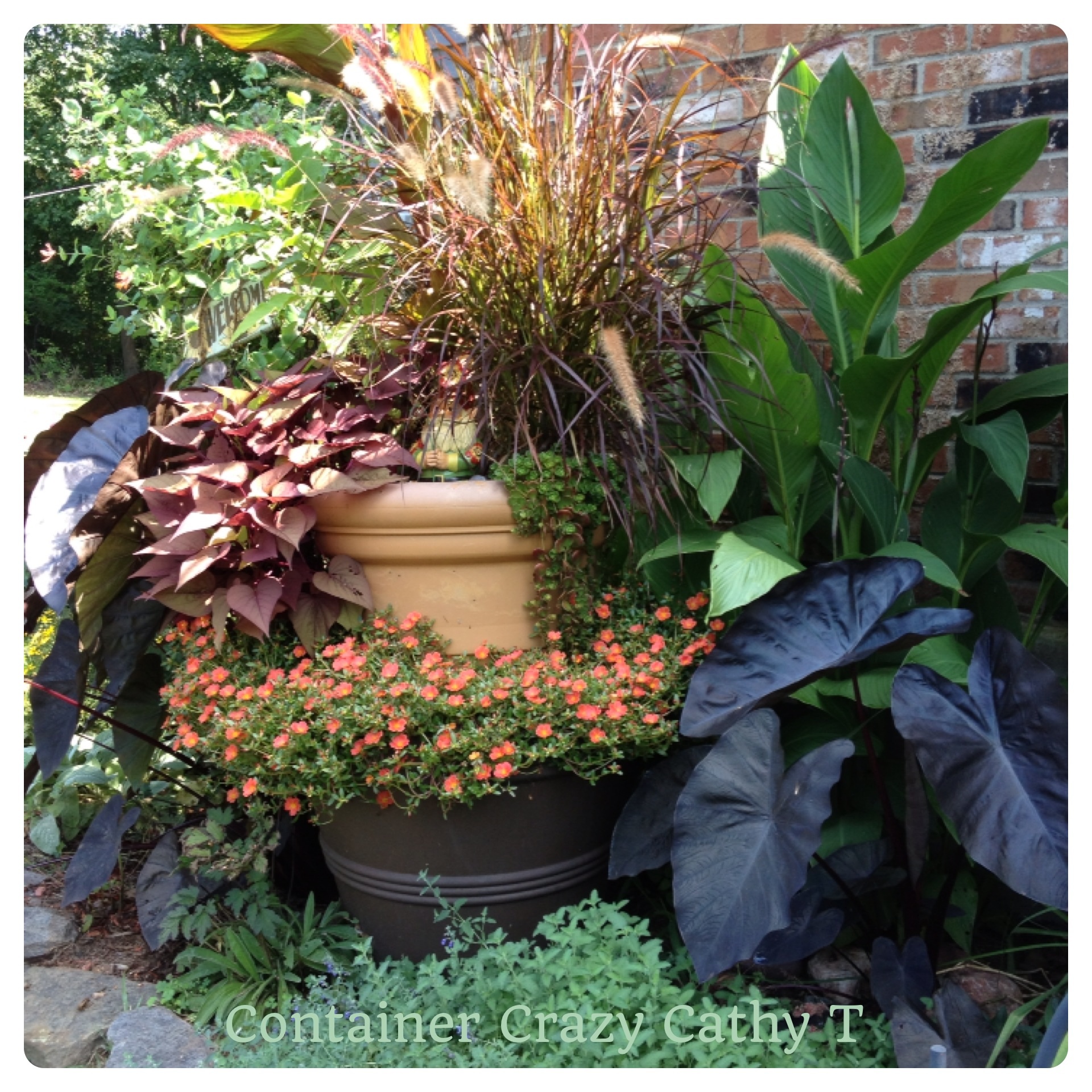
Two Tiered Love

Two Tiered Love

It is two containers stacked, the smaller one sitting on top of the soil of the larger container.  I wasn’t sure what would be planted in the bottom level at first until I spotted some nice looking six packs of Portulaca grandiflora MOJAVE Tangerine Purslane at a local nursery. I could tell the plants were fresh and healthy, so I grabbed two 6 packs and planted them around the base when I got home. They were small sizes and easy to tuck into the soil.

I also knew this annual was a great candidate for the location of the containers, because Portulaca can take hot sun and is drought tolerant. The color of the blooms are a bright to soft orange, and with some Nepeta (catmint) planted in the ground below, the color combo of orange and blue blooms of the Nepeta would be complementary. Portulaca has a spreading habit and grows to 6″ to 8″. It blooms from early summer to frost. Definitely a hard working annual for our CT planting zones.

Orange with yellow centers of Portulaca

Orange with yellow centers of Portulaca

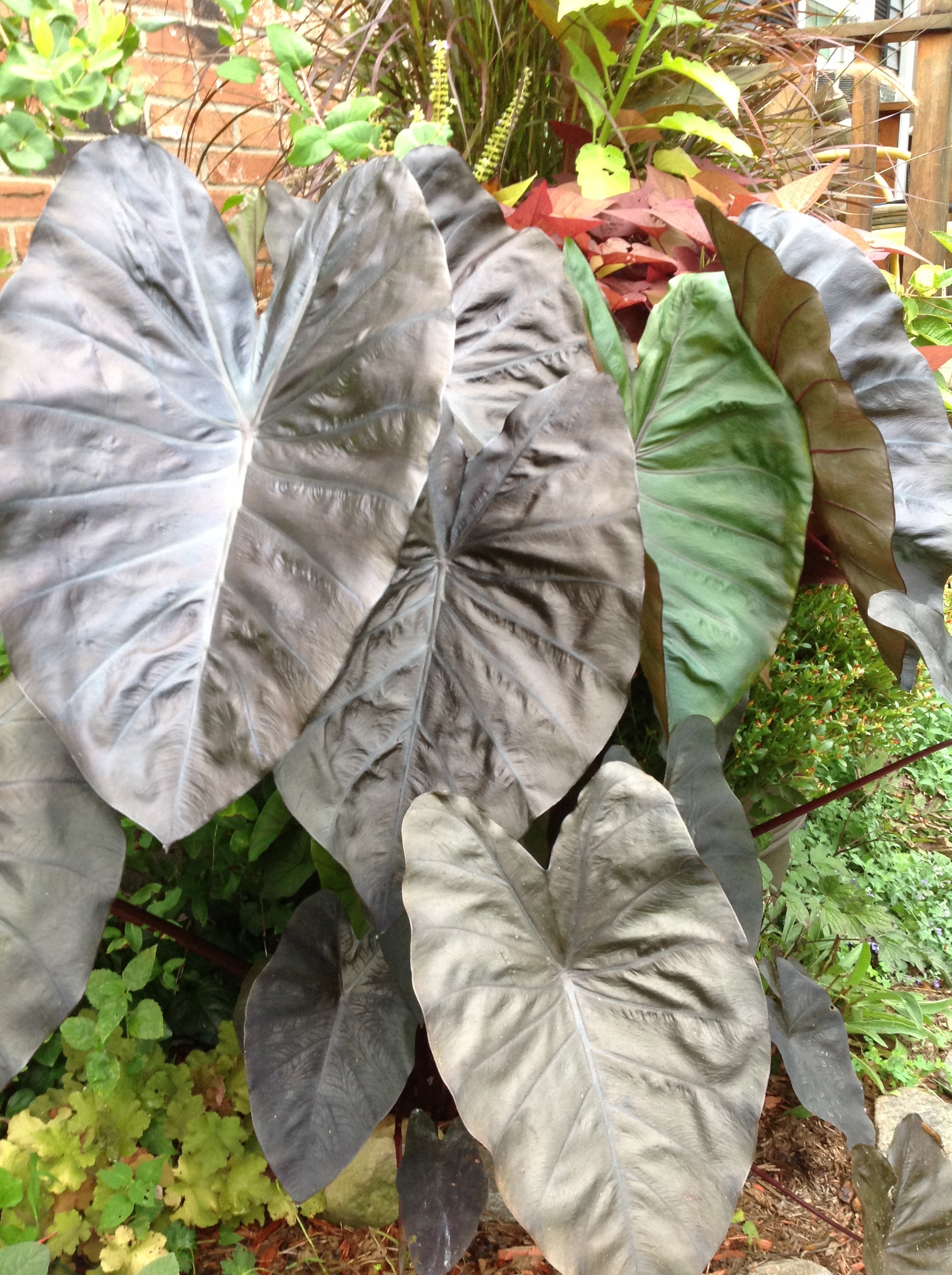
Elephant ears (Colocasia) were planted on each side of the container in the ground.  Using some kept from my overwintered stock, I thought they were Colocasia esculenta ‘Maui Magic’ but the color got so rich and lush, and at the right time of day, the leaves shimmer like a silky black negligee. So I was considering that maybe they were ‘Black Diamond’ but now I’m just not sure because ‘Black Diamond’ has pointy tips to their leaves.  Its possible the color intensified due to the location, which faces west.  I decided this was the case as I watched it grow larger all season and is still showy in fall.

Because it is against my house, it has nice shade in the morning, and the sun gradually warms up the area mid day, but by mid afternoon, it gets hot sun. As long as you water your elephant ears regularly, they can take the sun too. It turned out the rich dark color of the elephant ears look amazing against and near the showy orange of the Portulaca. It made the Portulaca stand out more with the contrast in color plus the leaf textures of both, the Portulaca being fine and Colocasia being coarse, worked.

Colocasia elephant ears, tropical

Colocasia elephant ears, tropical

The only downfall of the Portulaca is the blooms roll up tight for the evening. So, around 3 pm, the bloom show closes for the day.  The disappointment was my guests missed out on how incredibly beautiful they are if they visited later in the day. I had forgotten these flowers do this. In fact, a friend told me recently she has some at her house, and her husband asked her what happened to their plant when he came home one evening to see their’s rolled up tight too.

Closed by mid afternoon

Closed by mid afternoon

The top part of the two-tiered container let me down a tad. I expected the Brugmansia (Angel Trumpet) to grow taller along with the Canna next to it. However, the Pennisetum setaceum ‘Rubrum filled in nicely. Known as Fountain Grass, it is always a great filler or thriller in a container garden.  It is an annual in our region. But the coloring of red blades can’t be beat, and worth replanting every year in containers. It reaches 2-3 feet tall and its fuzzy plumes are showy into the fall season.  It looks great with fall decor for some reason, guess because it has movement and has a nice rich color against the yellows, reds, and oranges of the autumn season.

Planted to the right of the pot were also some Canna plants with red blooms. Sometimes when I was admiring the Portulaca blooms, a buzz from a hummingbird would go by my ears as it visited the Canna. I call the Cannas, my ‘Rene Cannas,’ because my friend, Rene, gave the rhizomes to me last season.

My Rene Cannas with red blooms

My Rene Cannas with red blooms

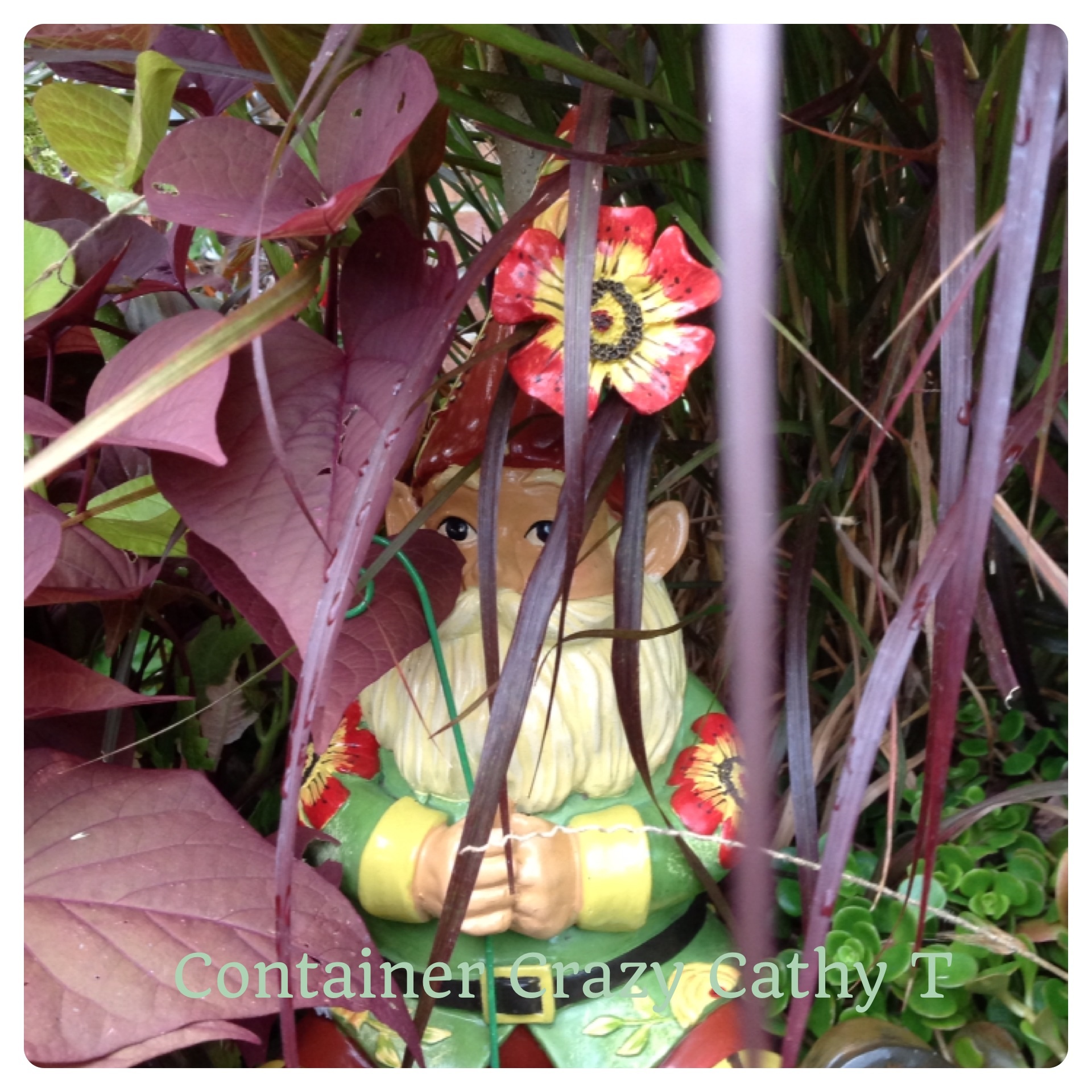
For the spiller, the reliable Ipomoea batatas (sweet potato) vine was planted on the left side.  This one is Sweet Georgia Heart Red.  And on the right side is Sedum makinoi, which is new to me. It has a nice shape to its leaves and dark coloring so it fit in with the rest. Lastly, a little decorative Gnome was tucked in for fun.

Protecting my containers

Protecting my containers

The fact my containers are old and a bit worn did not matter because the plants created a lush and full look hiding the scratches on the pots. As one Facebook friend posted, it is “Beautiful, rich, luscious, heavenly.”  I, of course, agree!

Written by Cathy Testa

One more photo:

On second tiere

PORTULACA LOVE