May 3rd Garden Talk – Incorporating Edibles in Mixed Container Gardens

Leave a comment


Comstock Purple

Shiny Hot Black Pepper

Have you ever considered that vegetables and fruits are not only edible, but very functional as a design element in mixed container gardens?

They can be included as amazing and unexpected design features – and why not, right?

They serve an additional purpose – providing you food, snacks, and garnishes all season long!

From unique peppers to weird tomatoes, figs to papayas, the list of edibles is endless.

Why not stop in next Saturday morning to hear more – and see a new building completely refurbished in downtown Broad Brook too?

The Speaker

Cathy Testa of Cathy T’s Landscape Designs will be speaking on this topic on May 3rd, Saturday at the Pride Fitness Building in downtown Broad Brook, CT from 10:00- 11:00 am.

You can’t miss the building – it’s historic with brick exterior, adjacent to the small book store and breakfast restaurant facing the Broad Brook Pond from Main Street.

The Topics

The Amazing Ornamental Qualities of Edibles and Why You Should Notice

How to Use 3 Design Techniques to Create Interesting Combinations with Vegetables and Other Plants

A Review of the Hottest and Latest Edible Trends in the Gardening World

The Flyer

GARDEN PRESENTATION May 3rd Edibles Flyer

← Back

Thank you for your response. ✨

Looking forward to seeing you there!

Cathy Testa
http://www.cathytesta.com
ContainerCrazyCT.com
860-977-9473

Five Ways to Protect the Tender Plants You Put Outdoors Too Early

Leave a comment
Photo Attribution Below

Photo Attribution Below

You know you should have waited to put out tender plants or seedlings, but you got anxious and planted them outdoors anyways.  Whether in a container garden or a garden of the ground, they are now subject to the upcoming chills expected during the overnight hours this week as predicted by our local forecasters.

It’s not too difficult to understand why you tried to cheat the planting dates – after all, we had temperatures in the 70’s last weekend here in Connecticut.  It got our gardening juices flowing, and you may have impulsively planted tender seedlings in your gardens, such as tomatoes or peppers, or have potted up some summer like annuals in your mixed container gardens and patio pots.  Perhaps you even put a few of your houseplants outdoors for some fresh air and sun exposure for the first time this season.

But as of today, we have rain, strong winds, and a drop in temperatures coming.  It is expected to be in the low 30’ for the next three evenings.

So, you may be wondering what you should do now to protect the tender plants you put outdoors too early.

Here are five suggestions you can try – some may be better than others – due to the rainfall and winds occurring today:

#1 Cover them with a light-weight bed sheet

Protect the plants by carefully placing a light-weight bed sheet over the garden bed where you put them in or over the container garden or patio pot.  Use some stakes to tent the cloth up so the now wet tender plants will not get bent or be pushed down by the weight of the sheet or blanket.  Use rocks or bricks to hold the sheet down if necessary.  However, this may be difficult to do tonight especially because we will have rain overnight, and some areas in Connecticut may get sleet (Litchfield).  Ugh, but this trick does work well to protect tender plants from late spring frosts – so take note, or avoid the situation next time by doing Option #2, setting up temporary plastic tunnels.

#2 Use temporary plastic tunnels

If you planned ahead and ordered, you can use low tunnels made specifically for plant protection like those available from GardenersEdge.com.  They are easy to use, expand like an accordion over your plants, and come with curved hoops made of bamboo used to brace the tunnel in the ground.  Push the hoops into the soil and you should be all set.  This is a great way to protect plants, but you are not going to be enjoying doing this now with the downpours.  Another reminder of why we should wait for the tender plants, or plan ahead.

#3 Roll out floating fabric row covers

Similar to temporary tunnels noted above, fabric cloths or frost blankets specially made to protect plants are available from many garden supply manufacturers or at your local nursery.  They will hold in the warmth and protect any new plants without damaging them.  As with a light blanket, you may need to pin down the edges so it won’t be blown away by the wind.  Again, there’s wind tonight – Sorry!  Such is the way of gardening in the Northeast.  But these are handy in other situations, such as use for the last spring frost.

Photo by C. Testa

Photo by C. Testa

#4 Move the container garden back inside

Move your patio pot or container garden potted up with tender plants inside to a warmer place or sheltered location, such as your garage or shed, for the cold evenings.  A hand-truck works great for this process.  Also, if you put any small seedlings or your houseplants that were kept inside during the winter out on tables because you thought the plants should enjoy the warm weather last weekend, you should have moved those back indoors, especially now with the overnight low temperatures coming.  As noted in my Spring e:Pub, tropical plants, cacti like plants, and many houseplants must wait to go outdoors when things have warmed up after the last spring frost date.

#5 Be patient and wait a little longer

Most reputable nurseries put out only those plants which can take the cooler temperatures of the early spring, while tender plants are kept inside their large greenhouses for warmth and protection until warmer temperatures arrive.  Just watch out for stores that don’t follow the rules – and we tend to know which they are.  Usually their plants look injured a day or two following exposures to low or freezing overnight temperatures.  Wait a bit longer to put out the tender plants, and remember to watch for our last frost date of the spring season.  Otherwise, you risk damaging the plants’ foliage and flowers, or the plant will die and ruin your ambition and expenses.  Be patient and wait a tad bit longer.

Other Interesting Ideas

Christmas Lights on Fruit trees – I’ve heard you can string large styled Christmas lights around apple trees limbs near the buds to help keep them warm.  Buds can get damaged or killed if they freeze, so this is one holiday styled technique. Interesting!

Make a Camp Fire – Just kidding!  But some nursery growers of fruit trees actually light small fires under fruit trees.  Hey, anything to save those buds from frost, right?  However, not recommended or needed in home garden environments typically.

Water Fruit Trees – This may sound contradictory – but growers will water fruit and citrus trees, and some nurseries will water (sprinkle) specific plants, as a shield from the morning’s sun following a frost or freeze.  It serves an insulator for the growing buds and foliage – but it gets more technical which I will not expand on this topic here because of “timing” of this post.  However, if you’re interested, check out the “frost protection fundamentals” by FOA Corporate Document Repository where they explain it isn’t the cold temperatures per say that affect the plants, but how the plant tissue are injured via dehydration.

Water the Soil – Your outdoor plants (including the trees and perennials) are being watered right now by the natural rainfall, which is good for the plant’s roots because dry soil tends to pull moisture from the roots during frost or freeze periods.  Wet foliage however is not a good thing; when the foliage and stems of tender plants get wet and cold, this may lead to rot, flopping over, and general damage.  Antidessicants may be used on evergreens (rhododendrons, azaleas, hollies, boxwood, etc.) to help reduce dehydration of the foliage.  A commonly type is called Wilt Pruf, and it is organic and biodegradable and primarily applied in the fall.

photo (24)

First and Last Freeze/Frost Dates by Zip Codes

Go to Dave’s Garden website to enter your zip code for a first and last freeze/frost dates for your area based on averages.  For Broad Brook, here are the results received via this site:

  • Each winter, on average, your risk of frost is from October 9 through April 26.
  • Almost certainly, however, you will receive frost from October 22 through April 11.
  • You are almost guaranteed that you will not get frost from May 10 through September 26.
  • Your frost-free growing season is around 166 days.

Overall, it is best to plant the cold-tolerant veggies, plants like pansies, and your typical spring bulbs like hyacinths, tulips, and daffodils.  For the rest, hang in there. It won’t be long until we can enjoy all – I promise.

Written by Cathy Testa

Lady's Mantel Leaves Pop Up on April 15th, 2014

Lady’s Mantel Leaves Pop Up on April 15th, 2014

Upcoming Events:

Don’t forget to check out Cathy T’s Container Gardening Class on May 24, 2014 in Broad Brook, CT.  See also Cathy T’s Garden Talks.

Please share or join this blog by entering your email on the sidebar, you will get updates via email and special offers or coupons of upcoming classes as a Cathy T blog follower!

Photo attribution:  “Weather Icon” by bandrat; FreeDigitalPhotos.net

A Slow Warm-up for Spring – But Time to Get your Tropical Bulbs Reawakened

Leave a comment

Good Morning Everyone,

Last spring, we were concerned about planting too early because we had over-chilly temperatures around this time of year – but it was colder, whereas this year, it is taking longer for the cold to leave.

There is no doubt every single year brings an interesting challenge for gardeners when it comes to the weather, and often times we must have the endurance to patiently wait for the conditions to be favorable for our planting adventures.

But, as we know – “Good things come to those who wait.”  And, patience is a true virtue in the gardening world.  When things are not favorable to work in your gardens outdoors, take the opportunity to prepare other gardening tasks and plants for when the temperatures and conditions are perfect.

Here is my latest e:Pub for Spring 2014, which refers to our slow spring warm up and things you can do now with any stored summer or tropical bulbs to give them an early start as we wait for temperatures to creep up higher in Connecticut.

Spring 2014 – e:Pub Newsletter – “A Slow Warm-Up

A new page has been added to this blog from the top menu where this e:Publication is posted, and more will follow.

Click on ABOUT, then 2014 MENU, to see a drop down menu called e:Pub Newsletters.

I started writing e:Pubs many years ago, and there are prior versions on my website, www.cathytesta.com.  It is interesting to look back and read some of the prior versions, at least for me.

One year I wrote a poem about all the rain we had in June which seemed like it would never end – that was in 2009.  But fortunately, today, the weather is warming up – we may even reach the 70’s.  Can this be true? We sure hope so.

Have a Great Weekend Everyone!

Cathy Testa

UPCOMING CLASSES:

Don’t forget to check out Cathy T’s Container Gardening Class on May 24, 2014 in Broad Brook, CT.  See also Cathy T’s Garden Talks.

Please share or join this blog by entering your email on the sidebar, you will get updates via email and special offers or coupons of upcoming classes as a Cathy T blog follower!


New Domain Name for Container Crazy Cathy T

Leave a comment

Hi there!

I just wanted to let you know that I have set up a new domain name for this blog, containercrazyct.com, as the primary domain.

You will see it displayed in the browser’s address bar as such, and it is easier to remember, just think my initials CT or think Connecticut (CT) at the end of containercrazy, and that’s it.

This new domain name change occurred this morning, but it can take as long as 72 hours before it is evident to all internet service providers, so if you don’t see it right away, you will in a couple days.

I selected the title of this blog as Container Crazy Cathy T years ago – and it continues for now.  Please feel free to share it with your gardening friends and container gardening enthusiasts.

Thank you,

Cathy Testa

Upcoming Cathy T Class – Lots of Succulents to Play With!

Leave a comment

Click the link below, (when it opens, close the ad to bypass it), and you will see a quick slide deck of an upcoming class by Cathy T on May 24th, 2014, Saturday.  Don’t miss out – there will be lots and lots of different succulents to choose from as you learn and design your fun, unique, interesting, and creative container garden.

To get some inspiration and ideas of the type of container gardens we are talking about, check out Cathy T’s “Succulent Sensations” PinBoard.  The ideas are “endless” – got a cute rustic toy truck, a hot shoe, a broken bird bath, a sink or tub? Many of these items can be made into a container garden stuffed with a variety of succulents in this class!

To learn more (because there IS more, from tropical plants for sale at the class too and a mini-slide presentation) and sign up, go to Cathy T’s Classes pages on the top menu bar of this blog, or click here:

https://cathytesta.wordpress.com/schedule/may-class/

Current attendee count:

We currently have 11 attendees, so don’t delay to express you interest to join us.  A complete detailed document will be emailed to signed-up attendees by the end of this week on the cost, types of succulents on the list, and what to expect – so if you want to express an interest to be part of the gang to hold your seat, email or fill the contact form below today.

containercathy@gmail.com

← Back

Thank you for your response. ✨

Please share this class with local friends interested.  Thank you – Cathy T


Crocosmia ‘Lucifer’ – It will ‘Rock On’ in Your Container Garden Over and Over Again

10 Comments

Crocosmia ‘Lucifer’ was a plant included in a mixed container garden one summer as I prepared many for sale at a farmers market.  I liked the plant’s sword like foliage, and admired the photos of its exotic vivid red blooms, but this perennial was somewhat new to me.

IMG_8236

Because the container was being offered for sale during Father’s Day weekend, and it contained large and showy plants along with the Crocosmia, the container was given the name of, “The Big Daddy.”  Each plant in the arrangement was described as follows:

******************************************************************************

THE BIG DADDY

Only $145 (w/tax included)

 This “Big Daddy” Planter will give the Dad, Father, or Hubby in your life a show fit for a king!

7 Big Daddy Plants with fertilizer, compost, and water reducer amendment already added.

Red Banana Thriller – In the center – Ensete ‘Maurelii’ red banana will go bananas fast, showing off big and wide leaves with tropical red coloration!  It can reach 6 to even 12 feet tall in one season, wow.  You can’t beat this THRILLER.

CrocosmiaA perennial that will flower in the late summer with VIBRANT wands of scarlet, red, orange, yellow pops of color.  When most annuals tend to fade away from the summer heat, this tall, spiky foliage plant also gives another big thrill to this combo, and can be transplanted into your garden in the fall.

Leonotis – Lion’s Ears, don’t see it?  You will by the end of summer. It will display the most amazing whorls of bright orange flowers, to give a last big blast of show in this container.  This plant is is a sub-shrub from Africa.  Very UNIQUE.

Farfugium japonicum – Leopard Plant.  The glossy leaves dotted with yellow and gold are soon to expand to 6 inches across.  This plant adds a FASCINATING filler to your thrillers.  Large, daisy like flowers bloom in early summer.

Rudbeckia ‘Prairie Sun’ – Blooming now thru the end of September, this black eye Susan with a green eye is the NON-STOP show in your Big Daddy Container.  Snip off a couple for the vases inside and out too.

Gerber Daisy – A spot of more yellow to complement the design of bright intense colors, and will shoot up new SHOWY flowers continuously.  Look how the center echo other colors.

Cathy T

*********************************************************************************

It turned out that no one bought the amazing “Big Daddy” container garden filled with large perennials, annuals, and tropical plants, even though many visitors came by to see it. There were some tentative buyers, but none the less, it remained unsold by the end of the market’s day.

Crocosmia_0008

EXOTIC VIVID RED FUNNEL SHAPED FLOWERS

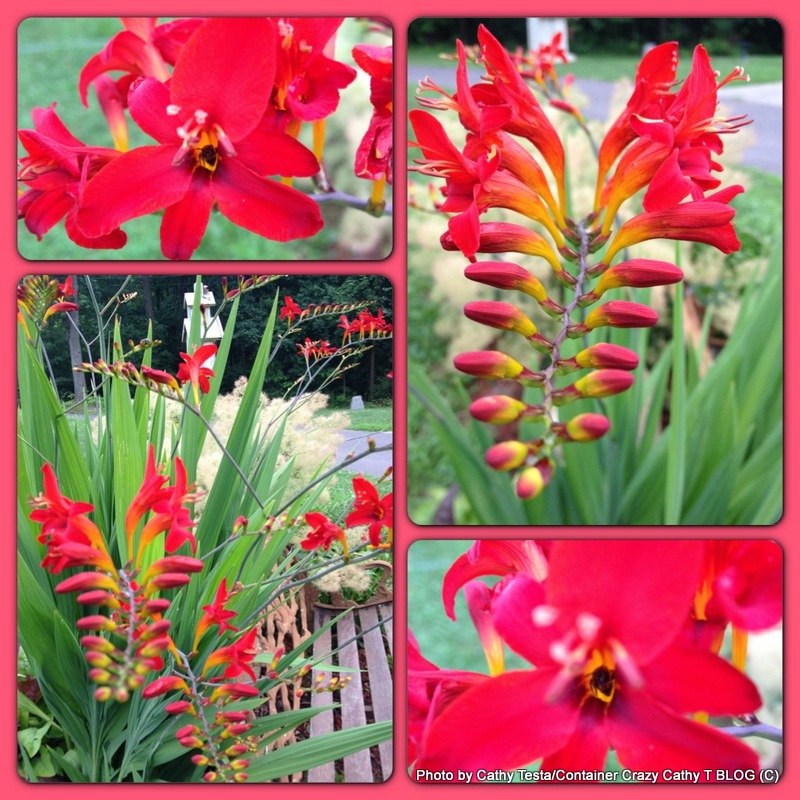
During Crocosmia’s bloom period in the summer, the individual funnel shaped flower buds are held on each side of an arching flowering stem, held up like jewels above the spiky foliage.  The buds open up sequentially, and in my opinion, the closed buds are just as pretty as the open ones.

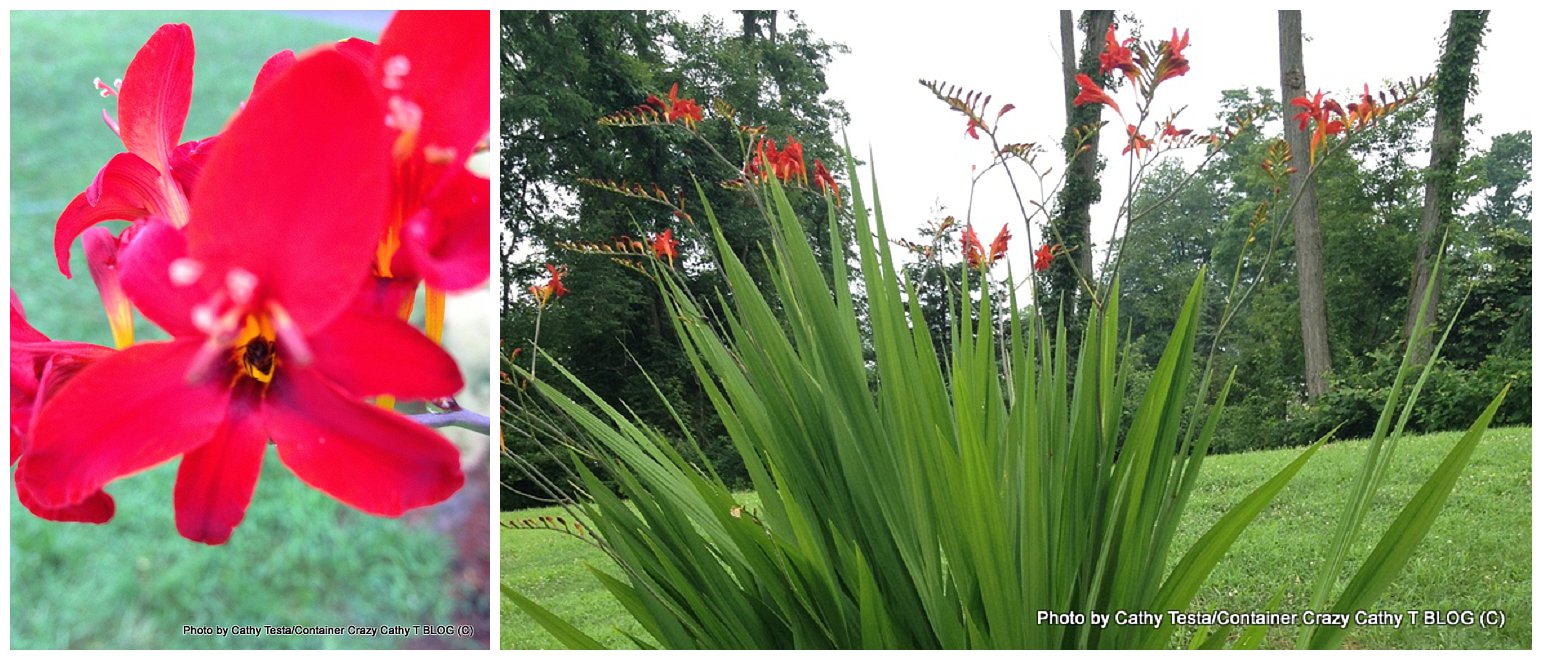
The show it put on for two seasons, with the expectation it will repeat its rock-star like performance again this summer, has stayed etched in my mind.  Not only will the plant look good from the beginning of spring when the foliage arrives, but it will start to display a fireworks show of red brilliant buds and blooms starting in late June or early July.  And the show continues into early September.

Crocosmia_0002

ATTRACTS HUMMINGBIRDS AND OTHER POLLINATORS

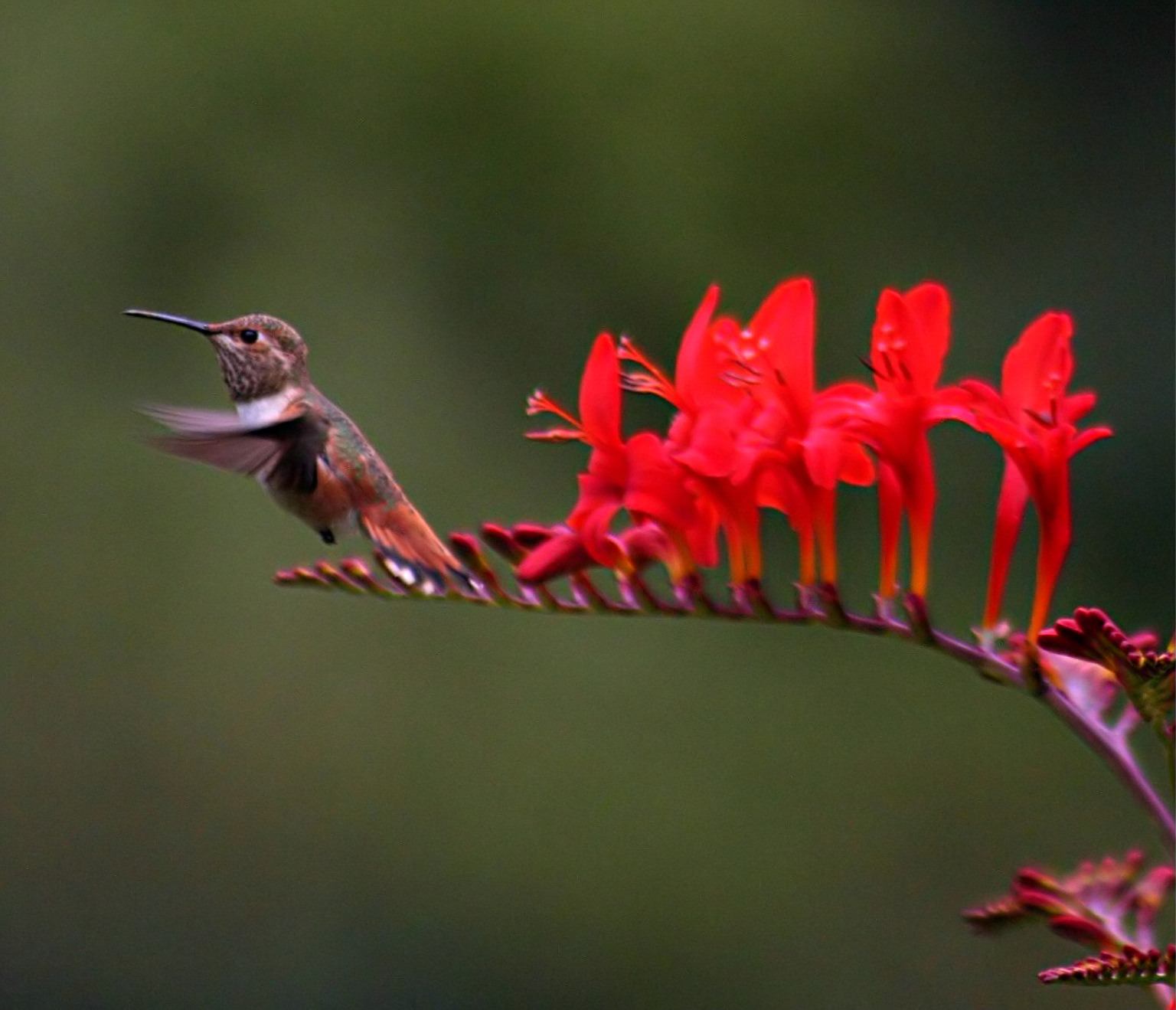
A friend referred to Crocosmia as a hummingbird plant, because she feels the buds resemble hummingbirds, plus the opened blooms attract them regularly. I totally agree on both points. Hummingbirds visited it often during its blooming period, and bees dove into the funnel shaped flowers regularly on their nectar seeking journeys.

The bright red flower color of this exotic looking perennial does not go dull either, as with some plants’ blooms. Against its dark-green sword like tall and erect foliage, which is also a bold texture in the mixed planting of the container, the red flower coloring is intensified.

See Below for Photo Attribution

See Below for Photo Attribution

Photo by C. Testa

Photo by C. Testa

ECHOING THE COLORS

Another aspect I really enjoy is how the colors within the Crocosmia were echoed here and there by the adjoining red banana plant’s foliage, and even a bit of yellow in the buds or center of blooms, was echoed by the bright yellow daisy blooms of the Rubeckia perennial also in the container garden arrangement.

Photo by C. Testa

Photo by C. Testa

The red banana plant (Ensete), the key thriller in the center, reached about seven to nine feet tall by the end of summer.  And the Rudbeckia was about three to four feet, with the Crocosmia blooms hovering over its foliage at the same approximate height as the Rudbeckia.  They were in sync and created a nice balance.

The yellow blooms colors of the perennial Rudbeckia complemented the whole arrangement as well.  It was another warm and bright contrasting color in the container garden. These warm colors can be seen from afar, or up close if you are like me examining plants as they bloom open, which is something you will want to do because the Crocosmia blooms are alluring, attracting pollinators and admirers.

STORING OVER THE WINTER AS A CONTAINER GARDEN

After a full summer season of enjoying all of the plants in the Big Daddy, the container garden was moved into the garage for protection. I removed the growing structures of the tropical plants, such as the root base of the red banana plant, but the Crocosmia perennial remained in the pot with the soil as it was put to rest in a shelter for the winter.

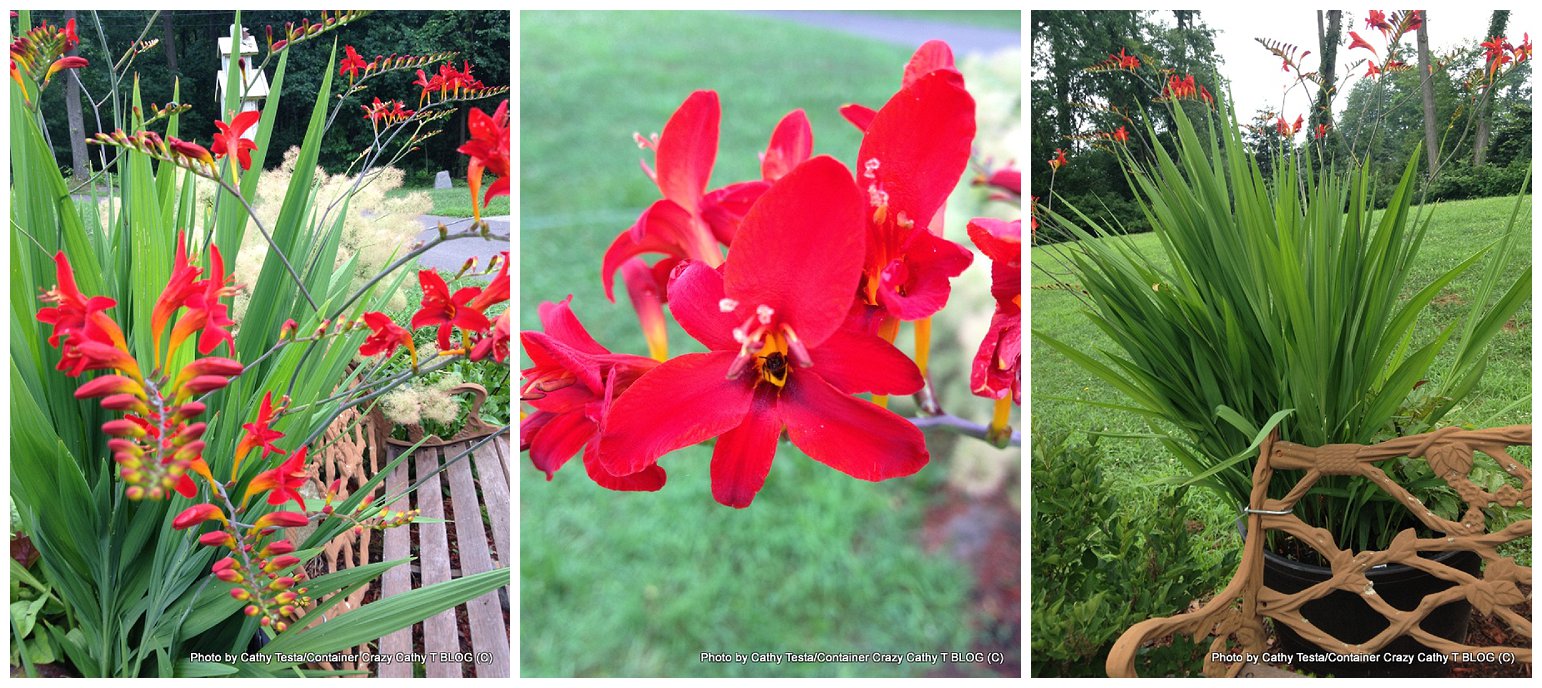
The following spring when things began to warm, the growth of Crocosmia started to pop out of the container garden’s soil. The Big Daddy was rolled outside with my trusty hand-trucked to a new location by a bench in a small garden space by my driveway.

The blooms were even more showy this past year as this perennial grew into a larger clump. Eventually it will need to be dug out to be divided (see video below for a demonstration of the process) or the cormels (small corms growing near the side of a large corm) can be removed to be stored over the winter, similar to the process for Canna rhizomes and Colocasia (elephant ear) bulbs.

Crocosmia_0001


Crocosmia_0005

IN THE GARDEN

Crocosmia is known to not always return in the garden if not well-protected with a thick layer of mulch or leaves during the winter (and if there was no snow cover to offer insulation), but in a container garden that risk of non-repeat performances is minimized, if not eliminated.  It is not a picky perennial but it can be short-lived.

IN A CONTAINER

All you have to do is move the container with the plant into a garage, shed, or even your basement for the winter and then roll it back out in early spring – and Crocosmia is sure to return – as it did for me last summer.  It will ‘rock on’ for a long time in a container garden or patio pot for many years to come.

Crocosmia_0004

DIVIDING THE CLUMP AND/OR CORMELS

And one more note, the plant grows in a clump and from corms.  The clump may need to be divided after 3 or 4 years if it outgrows your container or pot.  Or you can divide the actual cormels as they reproduce below the soil overtime, providing more plants for you.  For a video on how-to do this, see below.

Written by Cathy Testa

Other Information:

  • Native to South Africa
  • Prefers moist, rich soil, full sun or light shade
  • Tolerates sand and heavy clay
  • Makes a long-lasting cut flower
  • Divide clumps every couple years (2-3 years) as needed or separate cormels
  • Foliage lastS from spring until fall
  • Flowers last mid-summer to early September
  • 2 to 4 ft. Height; 1 to 2 ft. Width for ‘Lucifer’ cultivar
  • Not bothered by serious pests
  • Zones 5-7 (Zones 1-4 store like Canna)
  • Other cultivar colors: Fiery yellow‚ orange‚ red and tan
  • Pronounce something like this: Crow-Cause-Mia (Crocosmia)

Useful Links:

http://www.missouribotanicalgarden.org/PlantFinder/PlantFinderDetails.aspx?kempercode=b461 (Missouri Botanical Garden, Rubeckia hirta ‘Prairie Sun’)

How to Videos:

For an informational video about varieties, how to plant them in the garden, autumn care, plant partners to use with it, and how to propagate Crocosmia, see this video by Trecanna.

To see how to separate the small cormels, and for tips on how to plant in a garden bed, see Yolanda Vanveen of HowToGardenVideos.com:


Photo Attributions:

Photo of Hummingbird flying away from Crocosmia:

Brocken Inaglory [GFDL (http://www.gnu.org/copyleft/fdl.html) or CC-BY-SA-3.0-2.5-2.0-1.0 (http://creativecommons.org/licenses/by-sa/3.0)%5D, via Wikimedia Commons

UPCOMING CLASS:

Don’t forget to check out Cathy T’s Container Gardening Class on May 24, 2014 in Broad Brook, CT.  See also Cathy T’s Garden Talks.

Please share or join this blog by entering your email on the sidebar, you will get updates via email and special offers of upcoming classes as a blog follower!

Happy Saturday Everyone…

Photo by C. Testa (Rudbeckia blooms)

Photo by C. Testa (Rudbeckia blooms)

Black-Eyed Susan ‘Prairie Sun’
Rudbeckia hirta (perennial)
Sun to partial sun
Midsummer to early fall blooms
Well-drained soil moisture
8-36″ in height
Zone 4-9
Daisy-like flowers bloom yellow.
2003 All-American Selections Winner
Attract butterflies
Excellent cutting flower

Juncus effusus is a Low-Maintenance and Highly Versatile Plant – And it looks like Chives!

5 Comments

Common rush or soft rush (Juncus effusus) is a grass-like plant which resembles the foliage of chives with dark green cylindrical stems and a vase-shaped habit.  Although its green stems appear stiff, they are soft to the touch. The plant grows from a clump at the base and each green stem grows up to pointy tapered tips.  Because the plant has a strong dark green color and a vase-shaped upright habit, it is a nice thriller in a container garden or a sharp accent in a garden bed.

Photo by Simon Howden, Freedigitalimages.net

Chives, similar to the look of Juncus effusus is shown blooming purple flowers along a garden path with dark green spiky foliage.  [Photo by Simon Howden, Freedigitalimages.net]

Easy to Grow in Versatile Conditions

This plant is also very easy to grow, experiences little to no disease or insect problems, and is flexible with its soil conditions.  It can take moist, wet, sometimes dry, and difficult areas.  It won’t flop, bend, or topple over as it matures, even when it is sticking out of water or snow.  It’s adaptable to many conditions, making it easily-useful in the garden or in a container garden.

Juncus in water and snow [Photo left by Christian Fischer Wikimedia; Photo right by Cathy Testa]

Juncus in shallow water.  Juncus poking out of the snow  [Photo left by Christian Fischer Wikimedia]

For years, I assumed Juncus effusus (common rush or soft rush) was an annual plant and used it commonly in container gardens or patio pots during the summer, but seeing it return in a garden bed one year, I later realized my error.  As I searched for the plant’s origin and genus, it was interesting to see how it is described by different references on the web and in some gardening books, as follows:

  1. A clump forming wetland plant
  2. A slow-spreading, clump forming, grass-like perennial
  3. A plant loosely referred to as an ornamental grass
  4. A rush from the plant family Juncaceae
  5. A useful solution for wet-moist-sometimes-dry landscapes
  6. A species which is mostly perennial, rarely annual
  7. A warm-season grass
  8. A cosmopolitan rush species
  9. An annual, perennial herb, general from rhizomes
  10. A grass-like, rhizomatous perennial
  11. A perennial wetland plant

It is indeed a plant in the Juncaceous (rush) family, and it’s a monocotyledonous plant, which means it has a single cotyledon in the seed as in grasses.  It looks more like a grass than an herbaceous ornamental perennial, but it is perennial for it returns every year. Although it can be described as a type of ornamental grass, it is technically not classified as such. My favorite description spotted on the web for this plant has to be # 8 listed above: A cosmopolitan (Watch out, Vogue).  However, this term means its range extends across all of most of the world in appropriate habitats.

Stiff Stems are Soft to the Touch

The foliage on Juncus effusus (common rush, soft rush) is made up of individual leafless stems grouped together growing from a clumped base.  Because the stems stand firmly together, the plant won’t flop over as it grows larger.  Unlike typical ornamental grasses, it doesn’t tend to sway in the wind easily or become scraggly looking over time.  Adjacent plants in a mixed garden bed or container garden won’t be buried by it either.  Its spikey form is bold looking, tough, and vertical.

It has a Nice Effect in Containers and Garden Beds

Stored pot will return Juncus effusus each season

Stored pot will return Juncus effusus each season

From a designer’s point of view, this plant makes a nice effect in a composition of mixed plants because of its shape and habit, serving as a nice thriller in containers elevating an arrangement, or as a center focal point in gardens, especially when placed near a lighter green color or bolder leaf texture.  Perhaps it can even be massed or grouped in landscapes to help with soil erosion or as an alternative to turf grass in select areas with the right exposure (sun is preferred).

And, as mentioned above, Juncus effusus (common rush, soft rush) prefers moist-sometimes dry landscapes. And this particular variety is a dark green color, which remains dark green during the season but eventually turns a muted brown in the fall and winter.  It will remain standing during the winter months and the stems’ pointy tips will poke out of a snow covered area without bending or breaking, adding interest in the winter months.

Summer Flowering is More Interesting than Showy

Juncus flowering [Photo by Frank Vincentz Wikipedia Commons]

Juncus flowering [Photo by Frank Vincentz Wikipedia Commons]

It flowers in summer (typically around June), but rather than shooting out flowers from the top, the flowers seem to extend from the sides of the stems opening up like a side curtain.  Unlike the purple balls of chive’s flowers, this plant’s yellowish flowers are not super-attractive, but they still add character to the plant in summer.  The flowers are clustered together in batches, and turn a bit brownish later in the season as they mature.  They are the type of flowers which are more interesting to look at than showy or floral.

For Water Gardens and Low-Wetlands

Photo Christian Fischer, Wikipedia; See Attributions Below

Photo Christian Fischer, Wikipedia; See Attributions Below

Because of its flexible nature in regards to soil conditions, this is a great candidate for water gardens in decorative pots, or in low wet areas in your landscape.  It is also a great choice for rain gardens which fill up with water during a rainfall, but then later dry out when there is no rain occurring.  Another benefit to using it container gardens is this will control its potentially spreading roots (rhizomatous in nature), so it can be also used as a “troublemaker turned star” plant.  However, although it can spread under ideal conditions in the landscape, mine has not caused any sneak appearances elsewhere as of yet.  Besides an occasional watering with the hose in the summer, my plant has been growing well in dry-sometimes “wet” soil, a little opposite to description # 5 above.

Curly Cultivars with Twists and Turns

Not only is Juncus effusus (common or soft rush) a plant with formal looking, straight v-shaped look, there are also cultivars with more funky foliage traits, such as J. effusus ‘Frenzy’ (variegated corkscrew rush), J. effusus ‘Unicorn’ (giant spiral rush), and also J. effusus ‘Spiralis’ (corkscrew rush).  Unlike their upright cousins, the foliage on these varieties bear stems with twists and turns, resembling untamed curls in otherwise straight hair or the spiral metal rod of a corkscrew.  The curly varieties add a bit of whimsy to fun containers, such as head shaped pots.  And are great for kids to enjoy because of the plants’ playfulness and irresistibility to touch.

Juncus effusus (common rush, soft rush) is a plant with many uses able to take varying conditions and is a long performer in the garden.  These benefits make this candidate a low-maintenance and high versatile plant.  Remember to take notice of it and consider its uses next time you are out shopping for plants, which hopefully will be in 30 days when spring arrives!

For more information, refer to these useful links:

http://www.northcreeknurseries.com/plantName/Juncus-effusus-
NorthCreek Nurseries

http://plants.usda.gov/factsheet/pdf/fs_juef.pdf
USDA NRCS fact sheet

http://www.finegardening.com/plants/qa/grasses-rushes-sedges.aspx
Fine Gardening

http://www.eeob.iastate.edu/classes/bio366/families/Juncaceae.pdf
EEob.iastate.edu

http://www.provenwinners.com/plants/juncus/quartz-creek-soft-rush-juncus-effusus
Proven Winners

http://www.floridata.com/ref/j/junc_eff.cfm
Floridata

http://www.missouribotanicalgarden.org/PlantFinder/PlantFinderDetails.aspx?kempercode=z200
Juncus effusus ‘Unicorn’ (corkscrew, or giant spiral rush), Mobot.org Plant Finder

http://hoffmannursery.com/plants/juncus-effusus-frenzy/
Juncus effusus ‘Frenzy’ (variegated corkscrew rush), Hofftmannursery.com

http://www.missouribotanicalgarden.org/PlantFinder/PlantFinderDetails.aspx?kempercode=v930
Juncus effusus f. spiralis (corkscrew rush), Mobot.org Plant Finder

Plant Details:

4 feet tall with flower (June)
Sun exposures
Low water spots (0-6 inches)
Planting Zones 4-10

Photo of.
Attributions:

Juncus in snow
(http://instagram.com/p/kXIlxosJND/)
by Cathy Testa
Cathy T’s Landscape Designs and Container Crazy Cathy T

Up the Garden Path photo by Simon Howden
freedigitalphotos.net

Juncus in nursery square pots
Forest & Kim Starr [CC-BY-3.0 (http://creativecommons.org/licenses/by/3.0)%5D, via Wikimedia Commons

Juncus flower clusters
By Frank Vincentz (Own work) [GFDL (http://www.gnu.org/copyleft/fdl.html) or CC-BY-SA-3.0 (http://creativecommons.org/licenses/by-sa/3.0/)%5D, via Wikimedia Commons

Juncus by water
Christian Fischer [CC-BY-SA-3.0 (http://creativecommons.org/licenses/by-sa/3.0)%5D, via Wikimedia Commons

Written by Cathy Testa
www.cathytesta.com

Please don’t forget to share this post with your gardening friends!

Photo take Feb 2014

Photo taken Feb 2014

5 Things You Can Do Right Now to Get Ready for Spring!

7 Comments

#1 Go to the Flower and Garden Show this week in Hartford, CT

Go to the flower and garden show in Hartford, CT being held this week starting Thursday, Feb. 20th. Just walking into the building will get your senses thinking about spring and less about snow as you see, hear, smell, and experience the plants and plant offerings by the many exhibitors.  I plan to go – probably on Friday.  Got the day off?  Want to join me, just email me at containercathy@gmail.com.  There is parking adjacent to the convention center.  After parking, find your way through the parking garage to the main entrance and take the escalators up to the show floor. Don’t forget to visit the seminar speakers on the floor above the show floor too.  Food and wine is available at the show each year, and check in with your local nurseries before you go for tickets – they often offer discounted tickets by a couple bucks.  If you can’t make it during a week day, no worries – it runs through the weekend, and the weather is looking warmer by Friday.

#2 Visit Cathy T’s new Pinboards on Succulents and Tropicals

Why?  Because in May, Cathy T is offering a fun class on how to make container gardens with succulents, and will be having a Tropical Talk too.  To get inspired about this first annual BIG CONTAINER GARDEN PARTY to be held on Broad Brook, CT, visit her new pinboards right now, note the date on your calendar, and register today.  These pinboards will get you at least thinking about upcoming fun of creating beautiful containers for your outdoor spaces in the spring and summer. The possibilities are endless in the style and ways you can mix up plants for the season.

To learn more details about this class, see the pages listed under Cathy T’s Classes or under Container Gardens on the menu of this blog.  Share the information too with any local friends interested.

#3 Scout Containers for the Upcoming Season

Now could be a very good time indeed to think about containers or patio pots for not, only Cathy T’s BIG CONTAINER GARDEN PARTY (class) in May, but in general for your container gardening coming up in a matter of a month of so!  We may have snow right now, but it will begin to melt as soon as temps warm up – so why not rummage your own stock of goodies, or start looking for unique containers at the flower show this weekend?? – and of course, the tag sales that kick off in the spring. It is when you least expect it that you find a vintage item, a repurposed pot, or something sitting in your garage or basement right now that can be a container in spring and summer – old fancy shoes or pumps – heck, before tossing them, think – could this be a great container for succulents at Cathy T’s class?  I think yes!

#4 Think about Attending Other Garden Related Conferences

Did you know there is a great ELA conference next week in downtown Springfield, MA for plant enthusiasts and ground huggers?  Well, I say ground huggers in a very loving way – the focus at this conference is usually on natural horticultural practices and sustainability.  Is there any other kind?!!   The speakers at this conference are highly educated and the attendees inspiring for many are hort people in the business, but this doesn’t mean an avid gardener expanding their knowledge base and horizons can not attend too. If interested, visit their website for all the details. There is parking near the conference location, and places in downtown to eat if you want to adventure beyond the cafe onsite at this conference.  Do something different, and give this conference a try, or don’t forget other flower shows going on, such as the Rhode Island show (held same time as Hartford’s) or Boston show in March or UCONN’s Garden Conference in Storrs, CT.  You will be amazed how inspiring it can feel to attend a conference you haven’t tried before – you may not know what’s out there – but if you go – it surely makes you more ready for spring!  And many are in locations where you can adventure into the city and enjoy other places of interest if you make a weekend out of it, or stay overnight.

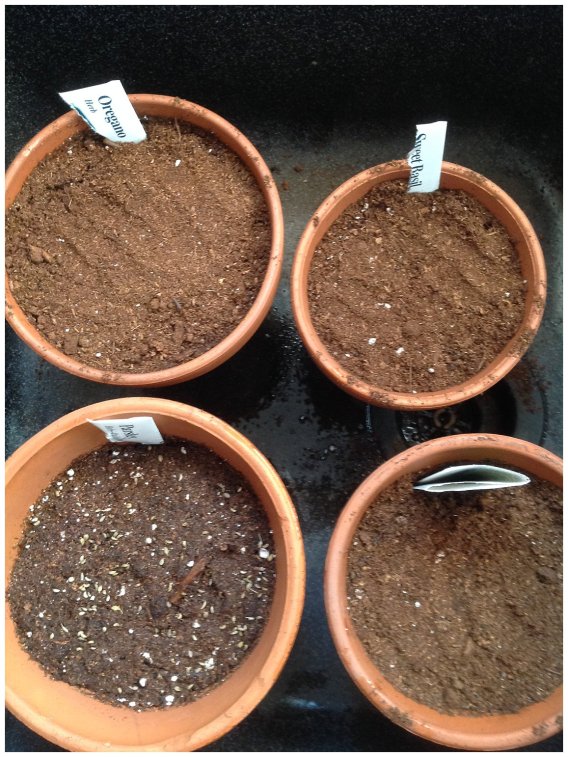
#5 Start some Seeds indoors, or Force some Pretty Bulbs:

Herb Seeds (Photo by Cathy Testa)

Herb Seeds (Photo by Cathy Testa)

It may feel too early to start seeds, but heck if you pot up a few herb seeds in your home or grow an Amaryllis bulb, like I did recently inside the home – you start to feel inspired for the growing days of spring ahead when you see the bulb’s flowers open, or see the seeds popping up in the soil.  So go to your local supply shop, get some seed starting potting mix and a couple packets of seeds, put them in some pots, place by a sunny window sill, and watch it grow.

Photo by Cathy Testa, Panical Hydrangea Covered in Snow

Photo by Cathy Testa, Hydrangea Covered in Snow

Or if that doesn’t suit your fancy, get bundled up, walk your property and take some photos of plants in the snow covered with icicles, fluffy snow, and enjoy the shadows against the snow cast by branches.  This cheers me up and hopefully will do so for you.  By the way, if any of your shrubs are toppling over due to the weight of sticky snow, it is a good idea to gently shake the excess snow off the branches so they don’t break or bend too harshly.

Happy Monday Everyone,

Cathy Testa

The Date has been Posted – Container Garden Party in May 2014

Leave a comment

https://cathytesta.wordpress.com/container-gardens/the-big-container-garden-party/

Just a heads-up – the date has been posted for this class to be held in Broad Brook, CT.

Want to join us?  Click the link above, and register for this May 2014 class.

To see examples of Container Gardens by Cathy Testa, visit this link too:

https://cathytesta.wordpress.com/container-gardens/

In the meantime, stay warm and play in that snow!

Cathy Testa

Bear’s Breeches – A Beauty and A Beast

3 Comments

It is rare for me to visit a homeowner with a similar gardening style as mine because most folks are seeking traditional gardens or updates to typical foundation plants, but during a client visit in 2012, I met a homeowner who was experimenting with tropical plants and taking risks with some unusual specimens in her landscape.

As I entered her property, first thing I saw on each side of her driveway were two stately urns planted with beautiful ornamental grasses and couple perennials which happen to be some of my favorites, such as Dichondra argentea ‘Silver Falls’ as a spiller plant dripping over the pot’s edge.  Then, I spotted a tall red banana plant (Ensete maurelii) in a large ornamental pot by a border along the side of her home.  I immediately thought to myself, “I’m going to enjoy meeting this woman.”

Because of my love of tropical plants and container gardening, the feeling was an immediate admiration for the touches she had incorporated into her gardening spaces. After quick introductions, she walked me around her property, and this is when I noticed plants which some gardeners may consider a nuisance because they are known to easily take over a garden area or possess aggressive habits.

Aralia elata

Aralia elata

For example, she had an Aralia elata shrub planted in a small area near her front porch entrance.  This plant is not difficult to grow, but is tough to move once established.  It also has sharp prickles on the stems, and its roots will eventually sprout suckers.  However, the variegated leaves and panicle style flowers growing at the top of the plant are rather curious as well as pretty.  Observed up close, you will most likely admire this plant’s features.
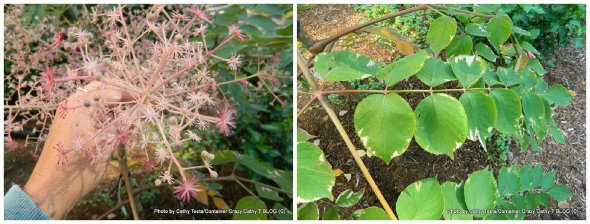
bears breeches_0003

Where it was planted on her property was a little tight.  Aralia elata can reach 10-15 feet tall and spread to 8 feet wide.  It looks like a small ornamental tree at maturity with an unusual form.  And it drops its leaves quickly after flowering and fruiting, so it can leave plant remnants later in the season.  However, despite these things, she put it there to enjoy its features up close. I appreciated why she wanted it by the entrance to her front porch.  It is a rare plant.  Because it is not commonly seen, that in of itself, makes it intriguing.

Aralia elata

Aralia elata

Uncommon plants add excitement and wonder to a garden space.  Some plants with defense mechanisms make them more prolific in the garden, but this can also embody them with mysterious traits which make them stand out visually.  And if you are well aware of their growing habits, you may be willing to accept them or work to manage their undesirables over time.

This homeowner seemed to be aware of the nuisances of her specimens, but she didn’t seem to care.  Meaning, she enjoyed the plant’s unusual forms and was willing to use them despite the consequences or potential risks, such as the plant’s ability to spread or leave litter on the lawn.  She also has the benefit of employing a full time garden-maintenance person.  Thus, perhaps, she did not feel the anguish of planting something that would require a higher vigilance in the long run.  Or it could be that she just could not resist the temptations of a beautiful plant even if it has some beastly sides.

Because of her unrestrained style combined with the willingness to listen and understand the caveats of a particular plant as I cautioned its use, I was free to include the unexpected and maybe not so well-tamed specimen plants in her garden design for a perennial bed she was anxious to install.  And bear’s breeches (Acanthus spinosus), also called spiny bear’s breeches, was just one of those plant candidates.

The Beauty

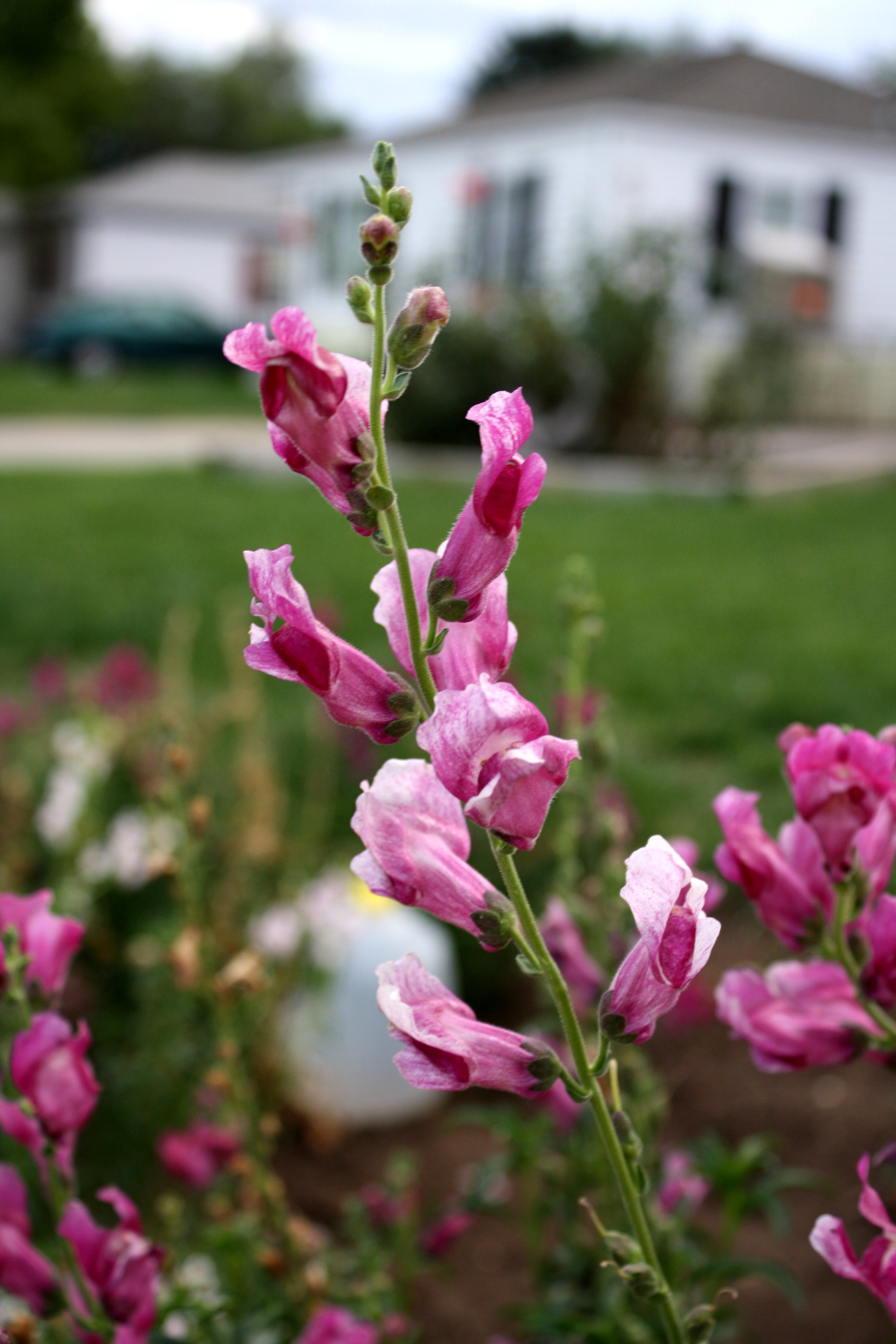
Bear’s breeches has rather interesting looking and showy flowers atop very tall flower stalks.  Each flower spike bears snapdragon like flowers which are vertically positioned.  The flowers are composed of bracts (modified leaves), lobes, and tubes – to put it simply, and their composition makes them almost-alien looking while still remaining beautiful in form.
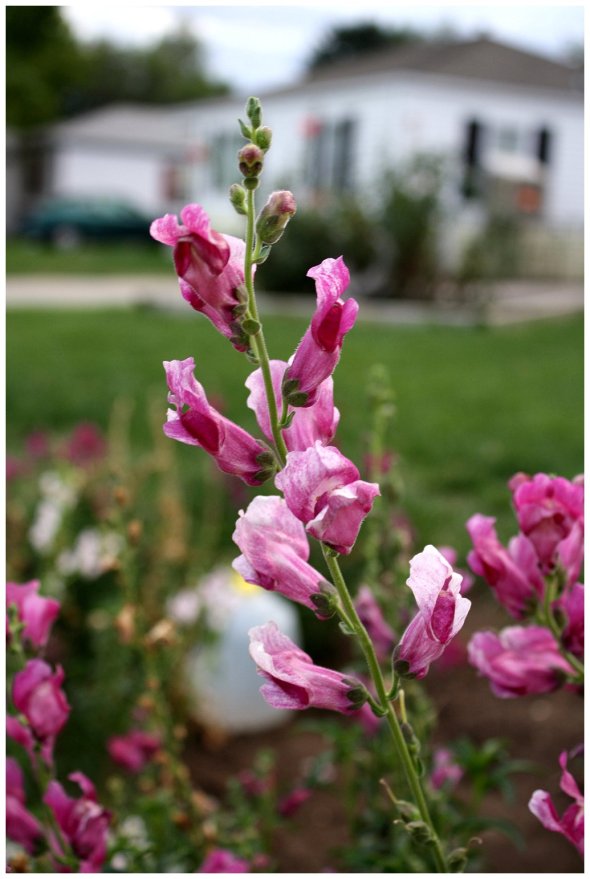
Snapdragon Flowers, Photo by Dreamstime.com

Snapdragon Flowers (similar to bear’s breeches in style), Photo by Dreamstime.com

The top hooded portion of the flower is mauve to purple, and the bottom is white.  Because the plant can reach 3’ to 4’ tall, with a mounded foliage shape on the bottom, it can be rather significant in the garden.  It is extremely visible due to the tall flowers rising above it on strong stalks which do not require staking.

By Magnus Manske, Wikimedia Commons License

Bear’s breeches (Acanthus spinosus).  Photo By Magnus Manske, Wikimedia Commons License

The flowers on this plant are a true beauty, but it is also a bit untypical looking.  In my eyes, the individual flowers seem similar to a fantasized hooded-like orchid with the stature of a foxglove or Baptisia australis (blue false indigo).  The plant provides architecture, texture, and interest and it is a long-performer in the garden even after its flowers pass.

Nursery Management Green Guide article states “Foliage remains attractive after the bold flower spikes have disappeared.”

Although the leaves resemble thistle, which is considered a common roadside weed in Connecticut, the leaves are deeply cut, glossy green and leathery – adding nice texture especially when combined with plants of opposing texture.  If you haven’t seen bear’s breeches before, the combination of the tall showy blooms with prominent foliage will make you pause to take a glance.

Tracy DiSabato-Aust describes bear’s breeches as a “real conversation piece” in her book titled, “50 High-Impact, Low-Care Garden Plants.”  She also writes, “Don’t let its thistle like leaves put you off, as they add amazing shape and textural variety often needed in many “ho-hum” shade designs.”

Another bonus is the purple coloring on the top portion of the flower’s structure.  This is a desirable color by many plant lovers, and it was a specific request by my client, along with the desire to have silver-colored foliage.  Unfortunately, many silver foliaged plant candidates require full sun!  Thus – these are the challenges of a garden designer.

The Beast

Similar to Aralia elata, bear’s breeches (also called spiny bear’s breeches) has prickles and thorns located on the foliage and in the flowers.  Your fingertips or hands may get pricked if you are not careful – and your vehicle could receive damage should you locate bear’s breeches by a driveway’s edge.  Accidentally brush up against it, and it will leave its mark.

Steven M. Still indicates “Acanthus is derived from the Greek word akanthos, meaning thorn or prickle.  It has been called bear’s breeches because of the size and appearance of the leaf of some species which is big, broad, and hairy” in his book titled, “Manual of Herbaceous Ornamental Plants.”

It is not just the prickly nature of the plant which can be off-putting, but it also has the tendency to spread by roots which will pop up new plants in other parts of the garden – once the plant is established. If you desire this look, where the plant repeats itself here and there, and you don’t mind it moving on its own, great.  It can add a naturalistic effect in the garden while providing architecture due to the plant’s form and texture.

http://www.youtube.com/watch?v=tD7ZsPV8Fgc
Viettes Gardening Tips

But there’s another catch, spiny bear’s breeches are also slow to establish.  You must be patient if you desire this spreading habit in your garden, which some folks do, and you also need to pay attention to the preferred cultural conditions because it tends to be flexible and picky at the same time.

Bear’s breeches grows best in full sun to part shade, and some references indicate it is best grown in partial shade.  The top blooming portion of the plant prefers more sun, but it performs better with some afternoon shade, especially if your climate is hot in the summer.  Fortunately for me, my client’s garden bed area had both sun and shade at different parts of the day.

As noted above, bear’s breeches’ aggressive side of spreading by its creeping rootstock easily occurs in loose soils which it prefers (well-drained soils), but it may stay put if you try to plant it in clay soils. However, if planted in heavy clay soils, this plant may get root rot because clay soils tend to remain wet. And slugs and snails will dine on the plant, especially in wet areas.

by Rod Allday, Wikimedia Commons License

Photo by Rod Allday, Wikimedia Commons License (see below attributions)

Although this plant is often recommended for the back of a garden border because it grows large and tall, it also can be placed at an edge for up-close enjoyment.

Garden Gate Specials publication recommends, “Add a bear’s breeches near the edge of a path.  It’s usually planted near the back of the border, but (here) it lifts its flowers to eye level for easy viewing.”

My client loved the look of this plant candidate as much as I did, and wanted to have it included despite its potential maintenance challenges of spreading, spines, prickles, size, repeating, and establishment.  She understood the growth habits without hesitation and was very happy to be introduced to bear’s breeches as part of my design recommendations for a new perennial bed she was planning to install.

As for myself, as a designer, I loved the freedom to use plants which have bold traits and long-lasting attributes despite their need for on-going maintenance and care.  Plant care is often regarded as an undesired chore for many clients demanding low-maintenance plants.  They just don’t want the problems, or they don’t have a full-time gardener to take care of their landscape!

But if you find you are like this homeowner, or desire uniqueness in your outdoor surroundings, despite the potential regret or work later, then you too will find spiny bear’s breeches is a true beauty while accepting it is a beast. Or you can minimize the risk and use this plant as a “Troublemaker turned Star” in a container garden.  This perennial is worth taking notice either way.

Cathy Testa

Plant Details:

Pronunciation:  Acanthus spinosus (a-kan’thus spi-no-sus)
Perennial; USDA Hardiness Planting Zone 5-9
3-4 feet tall and 2-3 feet wide; Sun to partial shade
Blooms late spring to mid-summer; no staking needed
Prefers moist, well-drained soils; Can tolerate dry soils
Protect over winter with straw mulch if in Zone 5 or colder
Related species:  Acanthus mollis

Useful Link:

http://www.missouribotanicalgarden.org/PlantFinder/PlantFinderDetails.aspx?kempercode=a100
Missouri Botanical Garden Plant Finder

Photos:

http://www.photos-public-domain.com/wp-content/uploads/2010/11/pink_snapdragons.jpg
Pink snapdragon photo, dreamstime.com Free Stock Photo

http://commons.wikimedia.org/wiki/File%3AAcanthus_spinosus_(Acanthaceae)_flower.JPGdownloaded image, creative commons license. Attribution: By Magnus Manske (Own work.) [GFDL (http://www.gnu.org/copyleft/fdl.html) or CC-BY-SA-2.5-2.0-1.0 (http://creativecommons.org/licenses/by-sa/2.5-2.0-1.0)%5D, via Wikimedia Commons

Pic of flower in a group along walkway:  Attribution:  Rod Allday [CC-BY-SA-2.0 (http://creativecommons.org/licenses/by-sa/2.0)%5D, via Wikimedia Common.  Page url: http://commons.wikimedia.org/wiki/File%3ALooking_down_into_the_Jungle_at_Heligan_-_geograph.org.uk_-_1401014.jpg