Minis and Markets – This Weekend in East Windsor, CT

Leave a comment

Happy Friday Everyone,

Looks like an amazing weekend coming up with the weather predicted to be beautiful and sunny – and tons of summer related events to enjoy.

SATURDAY MINIATURE GARDENS WORKSHOP

Two on the agenda this weekend for ContainerCrazyCT is a Miniature Gardens Workshop hosted by Cathy T with guest speaker Rhonda Niles of Gardening Inspirations.  It is scheduled for June 28th, Saturday, 11:00 am to 1 pm, in Broad Brook/East Windsor, CT.  Want to join us?? – You can!  Lots of details have been posted on Cathy T’s Facebook page, and links on this blog.  See Cathy T Classes above for more information.

For more inspirations and ideas of what you could potentially create at this workshop, check out my Pinterest Board:

SUNDAY EAST WINDSOR FARMERS MARKET:

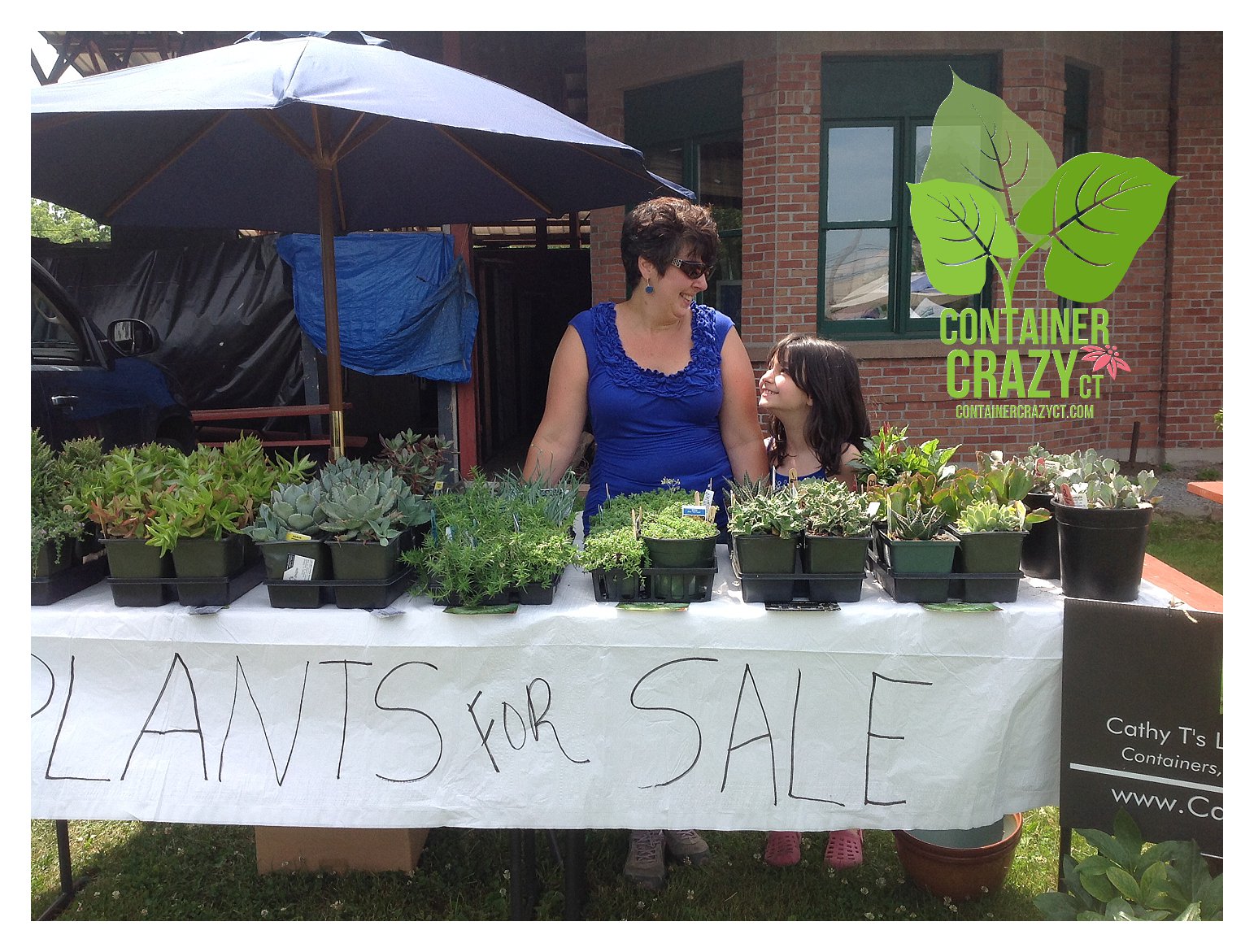
And on Sunday, June 29th, Cathy T will be joining other vendors and guests at the East Windsor Farmers Market on Opening Day at the Trolley Museum grounds.

This is the second year for this market – if you are local, please support this market so it will grow for all of us.  Lots of good fresh food, BACKTRAX BAND providing musical entertainment, and Cathy T will be presenting on “Incorporating Edibles in Mixed Container Gardens.”  This talk also includes interesting details about how EDIBLES are hotter than ever and growing in popularity now and for the past six straight years.

Edibles Mixed Planter with Tomatillo in Center as Thriller

Edibles Mixed Planter with Tomatillo in Center as Thriller

SUCCULENTS FOR SALE

And at the market, Cathy T will have select succulent plants for sale, this is your last chance to get some to fill in your planters at home too.  From tiny and adorable Sedums to big and chunky cacti.  Succulents are perfect for planters in the sun, requiring minimal watering, can be left alone when on a vacation, and last for years indoors as houseplants during fall and winter months.  Come learn about them, and edibles on Sunday at the East Windsor Farmers Market.

OTHER UPCOMING EVENTS

Don’t forget to also check out the upcoming “Walk and Talk Home Gardens” day in July on “Pondering Ponds.”  See the menu bar above on this blog for all the details. The one in July will showcase an homeowner’s amazing pond creation in Enfield, CT.  Note the date now so you won’t miss this:  July 19th, 10:00 am.  The walk and talks are free to attend.

Planter with succulents by Cathy T

Planter with succulents by Cathy T

Enjoy your weekend everyone.  Hope to see you soon.

Cathy Testa

http://www.cathytesta.com
ContainerCrazyCT.com
860-977-9473
containercathy@gmail.com


Cathy T at the Ellington Farmers Market – Edibles, Succulents, and More

2 Comments

Good Morning Everyone,

In June of 2009, I was interviewed by Sarah Martinez for “Garden Center Magazine” about my Container Garden Parties at people’s homes, and one statement I made to her at that time was, “Holding these parties at people’s homes is a lot of work – but I enjoy it.”

Well, the same holds true today.

Last weekend, Cathy T’s Big Container Garden Party (Class) was held, and the plant feature was succulents, alpines and tropical plants – and again – it was a lot of work to setup, but so much fun.  Being with a group of attendees interested in creating and learning – well, it can not be beat.

Attendees listening to Cathy T's Tips

Attendees listening to Cathy T’s Tips

The opportunity to share what I have learned over the years about Container Gardens and plants presents itself again at the Ellington Farmers Market today in Arbor Park on Main Street in Ellington, CT.

Come see me at 10:00 am in the gazebo. (Note:  There are 2 gazebo’s on the property, one will have musicians, the other along Main Street is where I will be on the farmers market grounds.)

The market opens at 9:00 am and closes by noon.  It will be a fast paced day filled with goodies – including a talk on “Decorative Edibles in mixed Container Gardens” by me.  I hope to see you there today.

And because I have beautiful succulents and alpines in stock, I will have those available for sale too.  If you haven’t completed planting up your container gardens and patio pots – come see the goodies available.

Succulents, Alpines, and Cacti

Succulents are plants with thick and strong leaves and stems.  Because they are designed to store water during periods of drought – they are tough little plants.  Some are dainty and others offer bold and strong architectural forms.

Cacti are similar to succulents; they store water in their stems.  Some have areoles with spines, so they can be very strong and even dangerous if not handled appropriately, but so worth it in my opinion, for many offer values in design compositions in container gardens.

In my class last weekend, I went over the 7 ‘Must Not Do’s’ with Succulents, so if you want to know what those are – see me today or sign up for a future class.

Oh and alpines – well, they are just adorable little plants popular to use in rock garden settings, as ground covers, and in crevices — and of course, in big or small container gardens.  This small wired basket is a creation by an attendee last weekend, Linda.  Isn’t it as sweet as ever – so small but so cute.

A dainty creation with alpines by an attendee

A dainty creation with alpines and herbs by an attendee

Sometimes you get inspired when you work with small plants too.  Yesterday, I took snips and cuttings of various succulents and alpines to create this adorable, dainty tea cup embellishment for a table.  Want to give it a try?  All supplies, the vintage bone china tea cups, plants, and instructions will be available at the market at the gazebo.

Cuttings of Succulents in Vintage Tea Cups

Cuttings of Succulents in Vintage Tea Cups

The tea cup plate and cup on the left, by the way, will be available for purchase. These cups go for $20-25 dollars on eBay – I will have them for a deal at a limited supply so if you want one, arrive early before they are all sold out.

But succulents, as noted above, can be very edge looking, and another attendee at the class scored an amazing container – check this out!  Topped with a very large Sempervirens (Hens and Chick), alone it makes a statement.  Her tall silver GARDEN container will rock it outdoors, and is easily moved indoors over the winter if desired.  I think it was my favorite container style brought by an attendee this year – so fun to see what they find and design in class.

Lisa's GARDEN container rules!

Lisa’s GARDEN container rules!

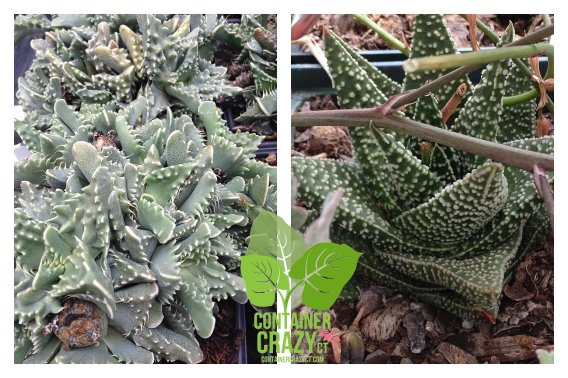
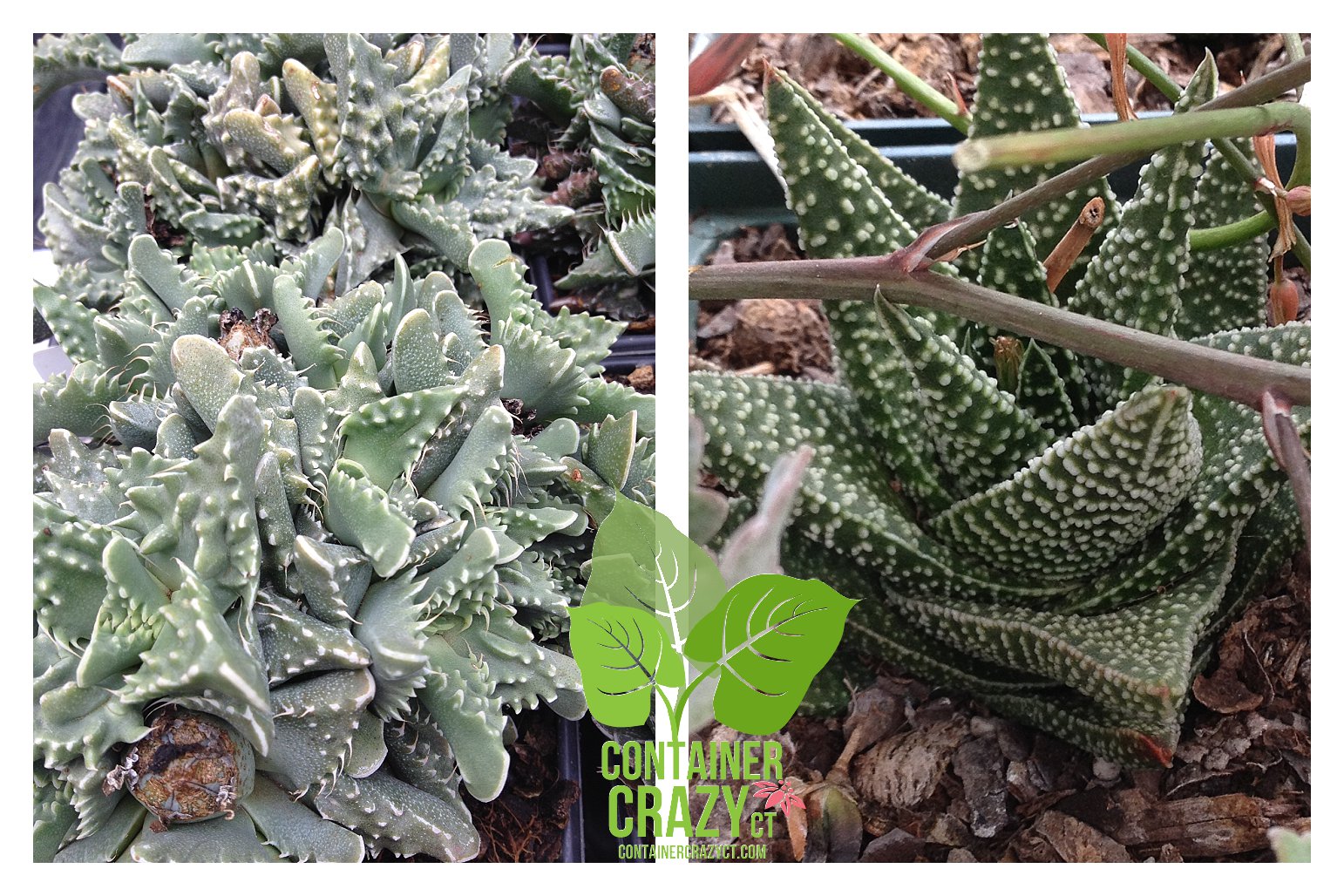
Succulents and cacti offer extremely different ranges of forms and textures.  Take the Faucaria tuberculosa on the left in the photo below.  This plant is a South African native and has the most interesting triangular leaves and it is a soft silvery blue color. This looks great with darker toned succulents in a pot, but it is also a neat form to work with.  It is a Zones 10-11 plant so perfect for the heat of summer and as a house plant in winter.  It is very easy to grow and will bloom yellow flowers in late summer.  The common name is Pebbled Tiger Jaws – perfect name, I would say.

Awesome forms and textures

Awesome forms and textures

And check out the plant on the right – Gasterworthia ‘American Beauty’ – it is NEW on the scene.  This is a hybrid of Gasteria and Haworthia pumila (maxima) grown by local growers in CT – and the rosette is stunning – patterned with spotting on the leaves. It is shooting up yellow flowers right now.  Both will be available for sale today at the market, along with many other types.

Two Types of Jades

Two Types of Jades

The plant with red edged leaves is a Jade plant by the name of Crassula arborescens – also NEW on the scene.  How can you resist this plant? – it has fleshy, blue-gray foliage and stands upright but full and mounded too.  It eventually grows to 3 to 4 feet wide, and I think they are stunning.  Also, a common Jade (as seen in the background), Crassula ovata, is in this photo – a common houseplant which I think looks amazing in head planters.  Go see my Container Garden Collages for photos of a red head pot to see.

Hens and Chics

Hens and Chics

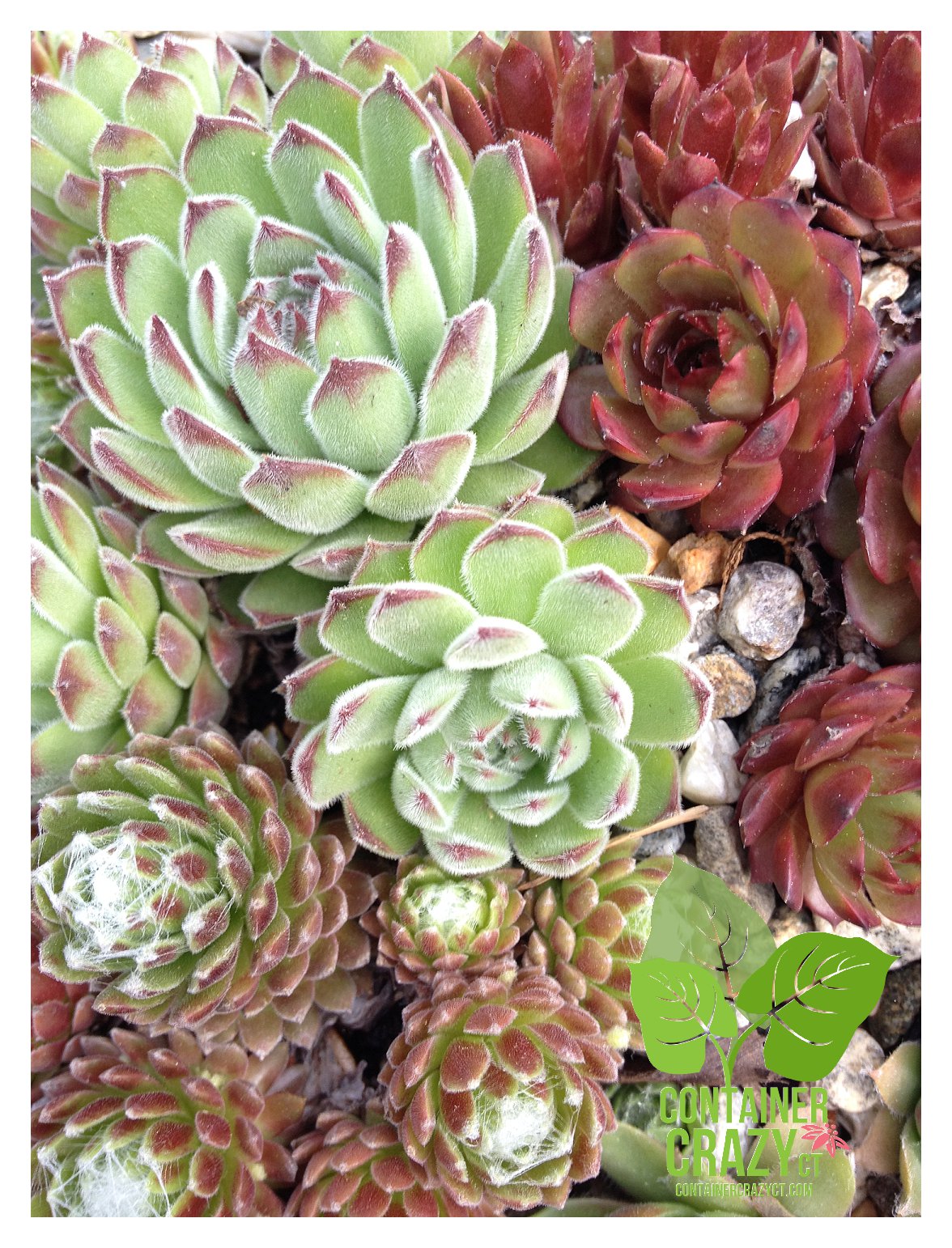
These are just ‘sneak peeks’ of today’s plant features.  Echeverias with a variety of colors and fleshy leaves tinged with colored edges will be available too.  The Genus name is named after an 18th century Mexican botanical artist, Atanasio Echeveria y Godoy – now you know why they are called Echeverias (a.k.a., Hens and Chicks).  And be on the look out for Agaves, Aloes, Kalanchoes, and other’s.

But now it’s time for me to sign-off and get ready for my day.

See you there,

Cathy Testa
http://www.cathytesta.com
ContainerCrazyCT.com
860-977-9473


A Succulent of a Different Kind is Rescued – Aeonium arboreum

8 Comments

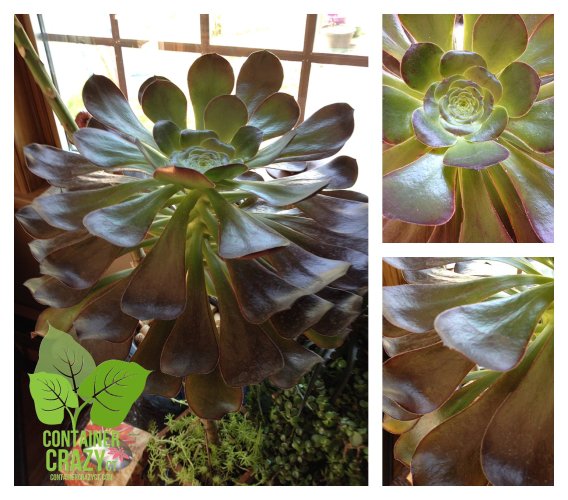
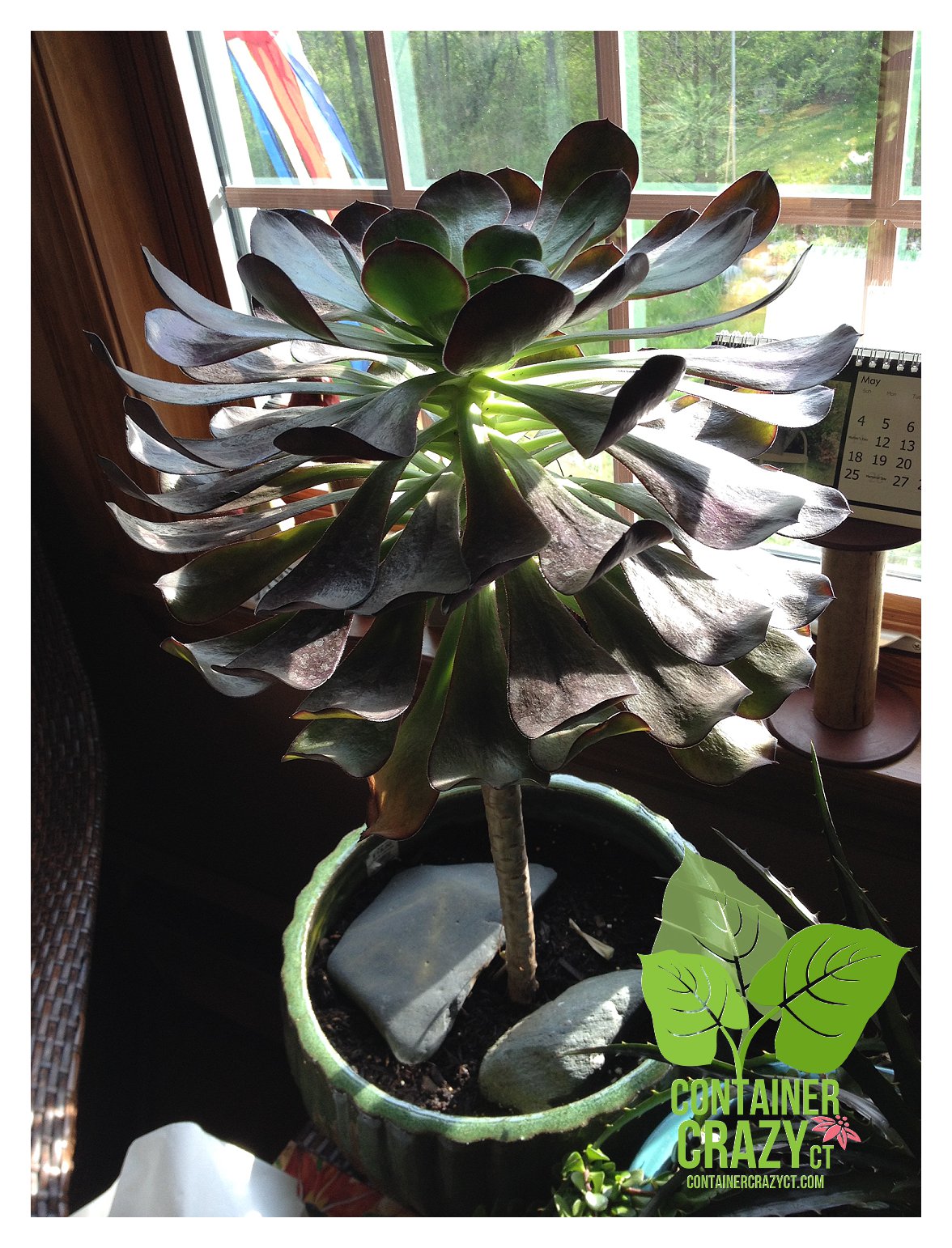
I recently rescued an Aeonium suffering in the confines of a small square terracotta pot at a garden center.  It was tucked on the floor below potting benches where it stood solo with no others like it nearby.  Spotting its dish plate sized rosette, I stopped to look it over.

Hand shows size of  rosette

Hand shows size of rosette

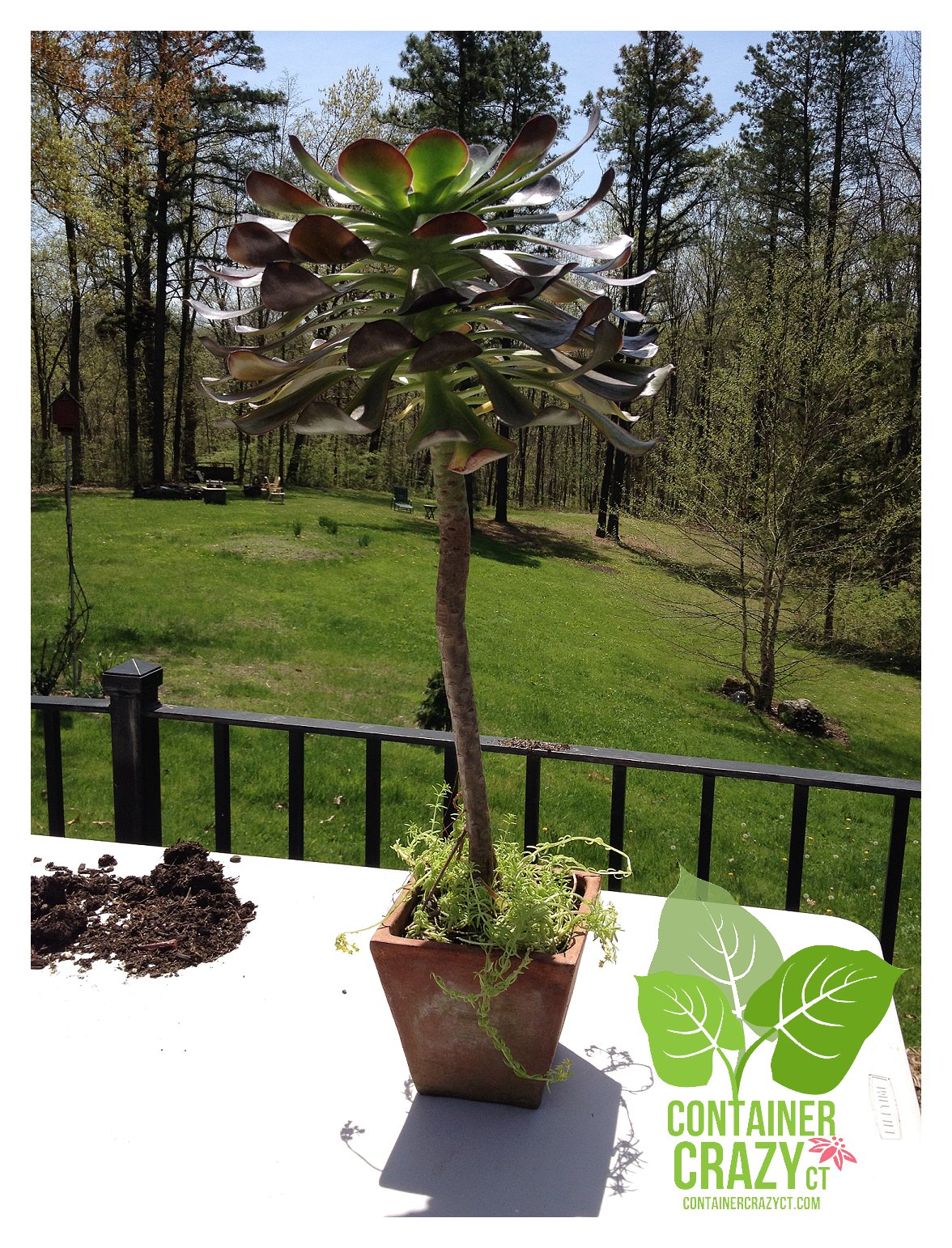
It was apparent this showy and tall succulent plant had been sitting there for a very long time.  The pot it was growing in was very small, much smaller than the diameter of the plant’s terminal rosette which was growing from a single stem of 15 inches tall.  And although the plant looked great overall with no signs of problems, the pot was tattered and was barely holding up this plant.

This particular succulent could easily be overlooked at the garden center if you are not a scouter of plants, such as I am.  Additionally, there was no plant label in the pot, so if you are unfamiliar with this different kind of succulent, you may have decided to leave it where it sat. However, I decided to return to the garden center to go get it and bring it home.

Original Pot - Ready to be Potted Up

Original Pot – Ready to be Potted Up

I instinctively assumed it was a variety called, Aeonium arboretum ‘Zwartkop’ or Aeonium arboretum var. artopurpureum, because of its dark plum colored foliage, but now I am not sure.  Only because the rosette is so large, I thought perhaps it is a cultivar unknown to me, or just a very mature ‘Zwartkop’ growing for some time.

Either way, the technical plant name is of no matter because the large size of the plant’s rosette is so spectacular, I know it will be a showcase in a container garden at my home this summer.

Potting It Up into a New Home

These plants should be repotted every two to three years. When Aeoniums get pot bound, they may send out additional aerial roots from the base of their stem, which was the case with mine.

The new pot selected should be a size up in diameter of the existing pot, or the plant itself.  Or it can go into a larger container garden with other mixed succulents sharing the same exposure and soil preferences. Either way, the container must have a drain hole, or perhaps two or three, for free drainage of water through the soil profile.

It helps to keep the soil moisture level regular for Aeoniums because their roots are fine and can dry out easily.  This is not to imply you should over water the plant. You do not want soggy soils for any succulents because they have the tendency to rot at the base when the soil is wet.  Most succulents or cacti can handle heat, drought, and dry soils from time to time because they store moisture in their leaves or stems during drought periods – which this one does, but it also is a bit different in regards to moisture levels because of its fine root system.

New Glazed Pot and Soil Mix

New Glazed Pot and Soil Mix

To help keep the soil at its best, use quality, fresh soilless mix specifically for container gardening or patio pots.  You may use soil mix labeled for growing cacti, but Aeoniums can also grow in regular potting mix for containers because it likes a bit of regular moisture.

Be careful when moving the plant to be repotted so you won’t bump into anything.  Gently remove it from the pot by holding the base of the stem.  The stem of this plant is fairly strong, but you do not want to risk damaging it during the repotting process.

As I removed it from the terracotta pot, it was very apparent there were some critters in the soil, such as sow bugs and centipedes.  These bugs like warm moist locations in the soil. I wanted to eliminate them as much as possible, so I gently removed away most of the soil from the plant’s root system.

Removing, inspecting the soil, and seeing the sow bugs

Removing, inspecting the soil, and seeing the sow bugs

In addition to seeing critters in the soil, there was an indication the soil was not taking in moisture anymore.  When potting soil is not renewed, it can actually repel water.  The soil in its original pot was moist only around the edges, and not in the center, so it was not permeating through completely.  It was just another indication the plant needed a new fresh growing environment.

Filling my new glazed pot almost to the top (about 2” from the rim) of fresh potting mix is the process I typically follow when potting up plants.  After it is full, I scoop out some of the soil to make a nice comfy pocket for the plant being transplanted.

Some people may fill the pot halfway with soil, place the plant in there, and then fill around the plant by adding soil up the rest of the way in the pot – but I prefer to make a pocket so the roots come into contact all the way around the plant.

Holding it down with stones

Holding it down with stones

This pocket process was especially important for this Aeonium because the rosette is so large, it was a little top heavy – especially because I removed the old soil from the roots.  To secure the plant better, I placed two large stones on top of the soil, adding a bit of weight there to help keep it stable until roots take hold.

I also added some slow-release fertilizer to the soil, and lightly mixed it into the top.  Always water any transplanted plants right after you are done.  Don’t leave it until later to give it a sprinkling of water – it will help to awaken the roots to the new fresh soil and get them established.

In a shady spot to drain after lightly watering in

In a shady spot to drain after lightly watering in

Succulents are Easy to Grow

Succulents can handle heat and drought, but as mentioned above, this species prefers some light shade for part of the day as it doesn’t really like super hot summers or very humid weather.  They like a mild cool weather which may seem odd because many people think of succulents as heat lovers, but some do well in moderately cool weather, and Aeoniums are one of them.

If you see the leaves curl when this plant is outdoors in summer, it may be an indication you have it located in too hot of a spot.  Relocate it to where it gets a break from the heat, a part-sun area or where it will get bright sunlight such as under a patio umbrella, and all will be fine.  And also remember, moving any tropical like plants outdoors after being inside for the winter should be done so with care – putting them in a shady spot for a day or so.  Foliage can burn when put into direct sun immediately.

The many different textures and forms of succulents are fun to combine in mixed container gardens and patio pots.  And ‘Zwartkop’ cultivars are especially useful because they have a dark coloring which works nicely against other light colored succulents, from the soft silvers of Agaves and Senecios, to bright yellows typically seen on succulent plants, such as Sedums.

The older, lower leaves on most Aeoniums will wither and fall off.  If they turn yellow and are unsightly, you can easily snip them off with a pair of common household scissors before they drop if you prefer – and sometimes they pull off easily by hand.

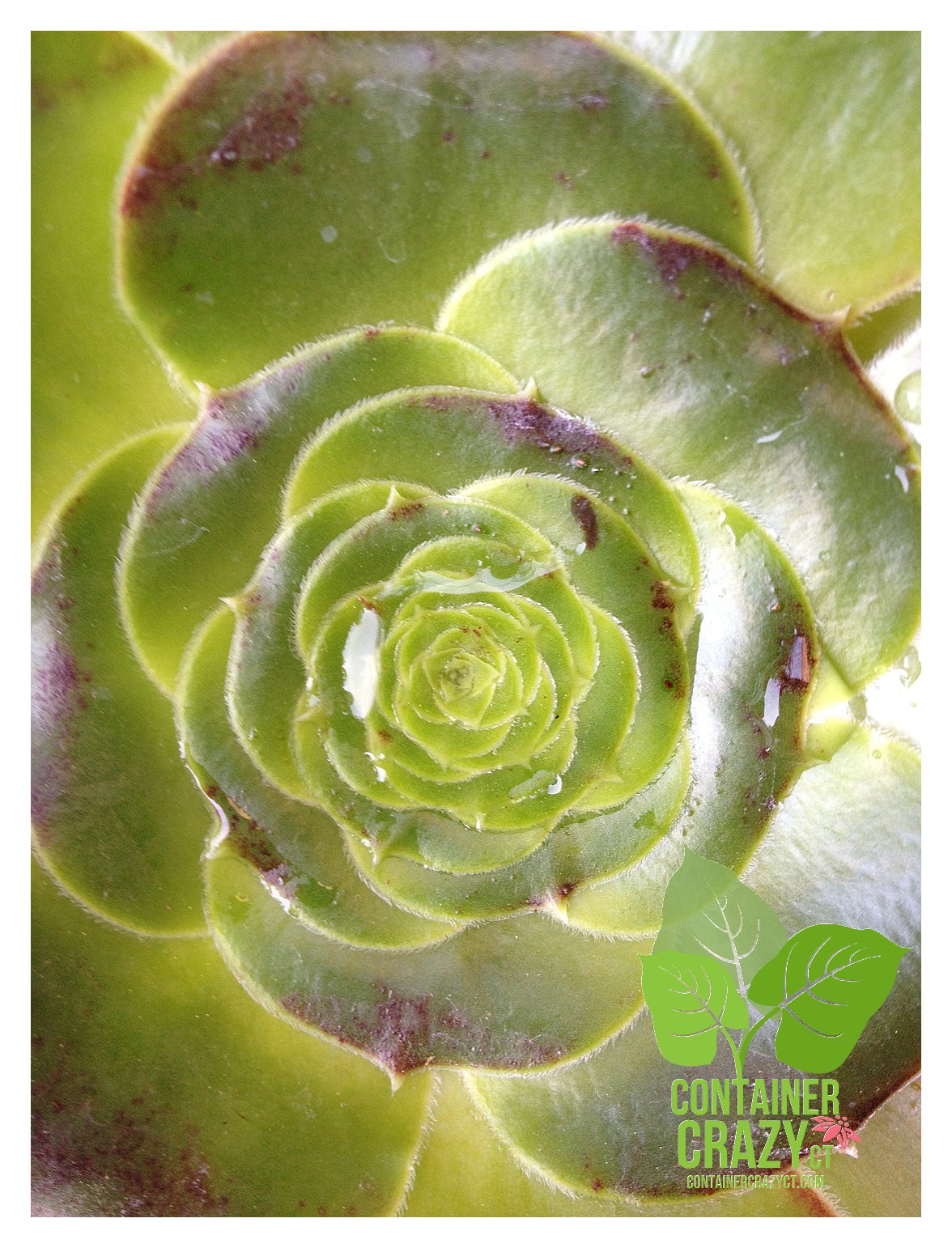
Tight Rosette in the Center

Tight Rosette in the Center

The top of the rosette stays tight in the center, and the foliage directly below it is usually more spaced out.  A lovely feature is the very center of the rosette.  It can have a tone of yellow or green, more prevalent when the plant is grown in part shade.  When in full sun, the coloring is more on the darker plum to black side.  Water droplets on this plant’s rubbery foliage can be very pretty too.

Different Growing Habits

Aeonium plants may be trained into looking like a topiary by removing side branches, such as the one I took home, and some cultivars grow very low to the ground.  They also grow like a shrub with side branches reaching out from the main stem with rosettes appearing on their tips.

The dramatic shape of the rosettes is useful in container gardens, adding interest and uniqueness to a composition.  And the branches offers an architectural appeal as well, resembling a large bonsai form.  And if you are lucky, you will see their amazing blooms.

I have yet to see an Aeonium bloom from my prior stock of these succulents because I usually get them when they are young plants.  Blooms grow on mature plants. The blooms are an excellent yellow color which contrast nicely against its attractive dark colored foliage.  But witnessing a blooming show has a double-edge sword because some succulent plants will die after they bloom.

To see the different growth habits and blooms of this interesting succulent, see my Pinterest board titled, “Succulent Sensations!” which is filled with examples.

Making More Plants

Propagating this plant is an easy process to do, so long as you are patient enough to wait for it to root and start a new plant.

Snip off rosettes with about 5-6” inches of the stem intact (still attached) with a clean sharp knife, and insert it into a small pot of fresh soil to take root.  This should be done during the active growing period of Aeoniums for it to be successful.

If your Aeonium has many branches, you have the capability to start a whole family of them by snipping and inserting cut stems into soil.  It helps if you allow the cutting to sit for 24 hours to dry a bit before inserting it into the soil, or just set it on newspaper to sit overnight.

The soil for the cuttings may be regular potting mix or one amended with fine sand and drainage material – but I find either works easily.  Moisten the soil before inserting the cut stem into it so it is slightly moist.  Cuttings can also be inserted into container gardens mixed with other plants in fresh soil – it will eventually take root.  This is a great way to capitalize on your purchase of an Aeonium, or other succulents easily propagated by cuttings.

By the way, Aeonium is pronounced like ay-OO-nee-um.  Get practicing so when you show off your specimen, you will sound like a pro.  Or you can just refer to it as a black rose succulent or black tree succulent.

Written by Cathy Testa
www.ContainerCrazyCT.com
www.CathyTesta.com
860-977-9473 cell

Hardiness Zone:  9 or warmer; grown as a tender perennial in Connecticut during the summers, and as an indoor house plant in the winters.

Upcoming Cathy T Class:

To learn more, register for Cathy T’s “Big Container Garden Party (Class)” on Saturday, May 24th – there’s still time to sign-up!  See “Garden Talks” on the menu of this blog for more information.  Succulents will be the key feature for this class.  Some Aeoniums will be available too.

Returned Inside Until Temps Warm Outside

Returned Inside Until Temps Warm Outside

Agave ‘Kissho Kan’ – When it Flowers, I’ll need a Shot of Tequila

3 Comments

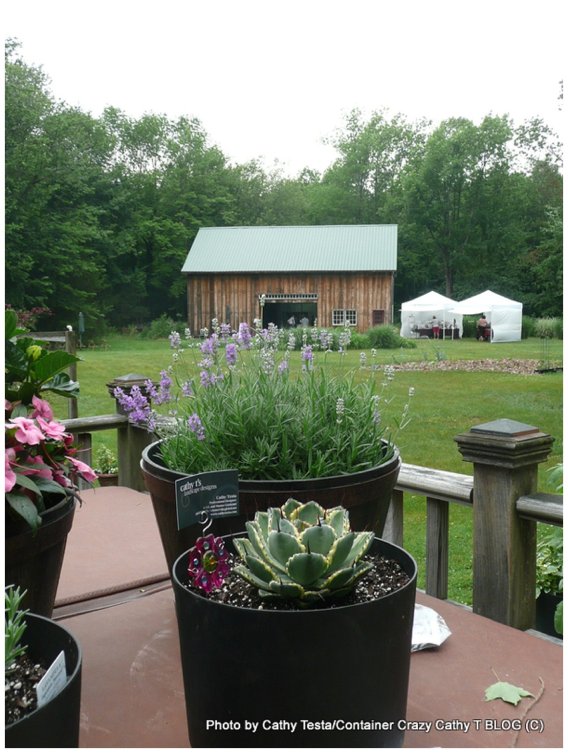
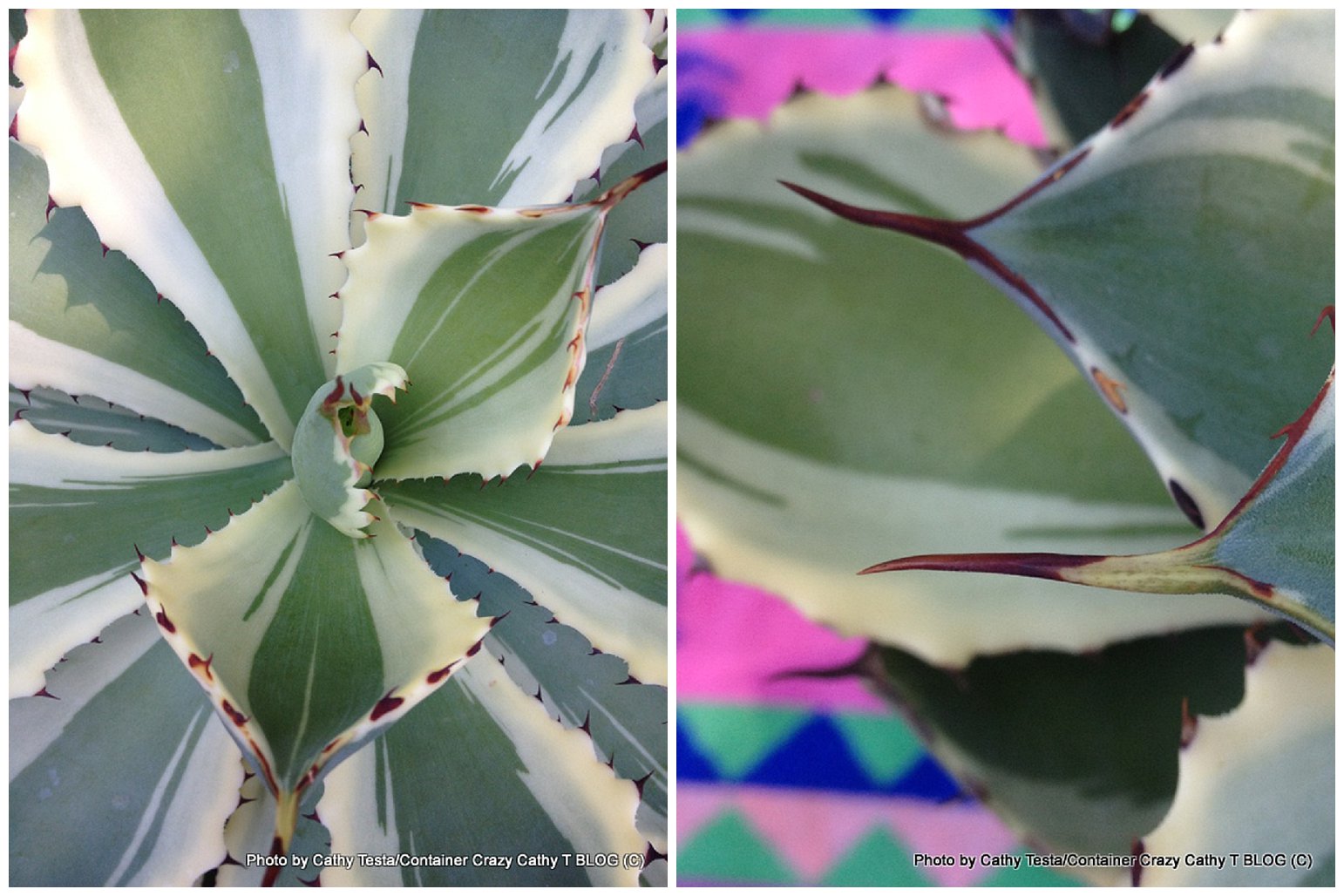
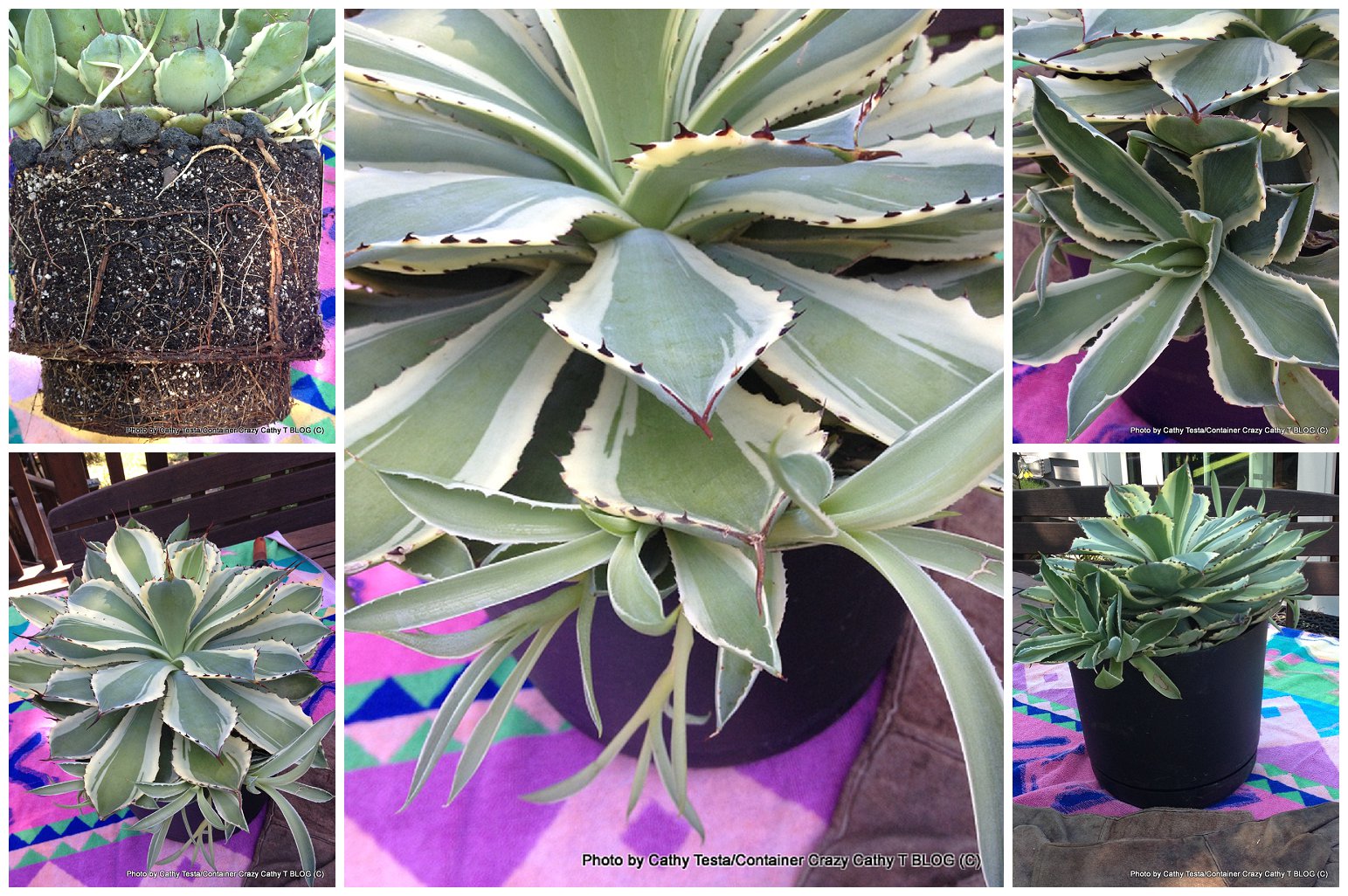
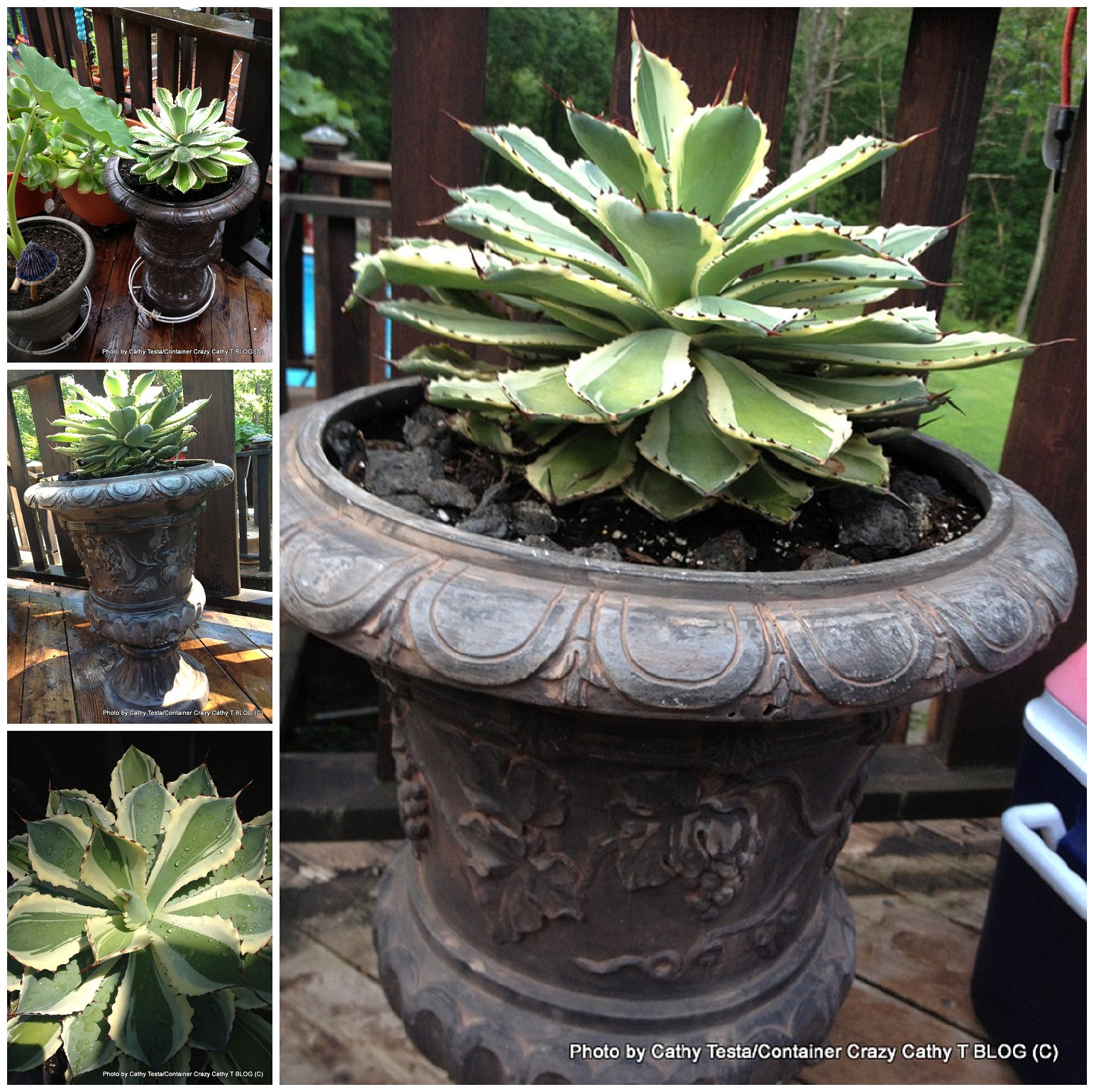
Agave ‘Kissho Kan’ (Century Plant) is a tough and beautiful ornamental succulent plant for container gardens. The plant has a strong form growing in a tight symmetrical rosette.  It has more coloring than many other species of Agave plants.  It bears creamy light yellow coloring adjacent to the blue green centers on its leaves.  And the spines at the tips are cinnamon colored but prominent enough to be used as a color echo in a mixed container garden.

Original Plant

Original Plant

Besides being beautiful, it is a really easy to grow plant.  Low-maintenance, it will last for years and potentially bloom (if you are lucky), and then die.  Yup, croak.  However, it will offer up Mini-Me’s over time as offshoots from the base prior to its death.  And if the plant lasts at your home long enough for it to offer its flower stalks as its final gift to you, you may in turn want to honor its life and eventual passing by downing a shot of tequila — because, as many folks know, Agaves are used to produce the strong elixir.

Rosette, Spines

Rosette, Spines

Mini-Me’s from the Mother Plant

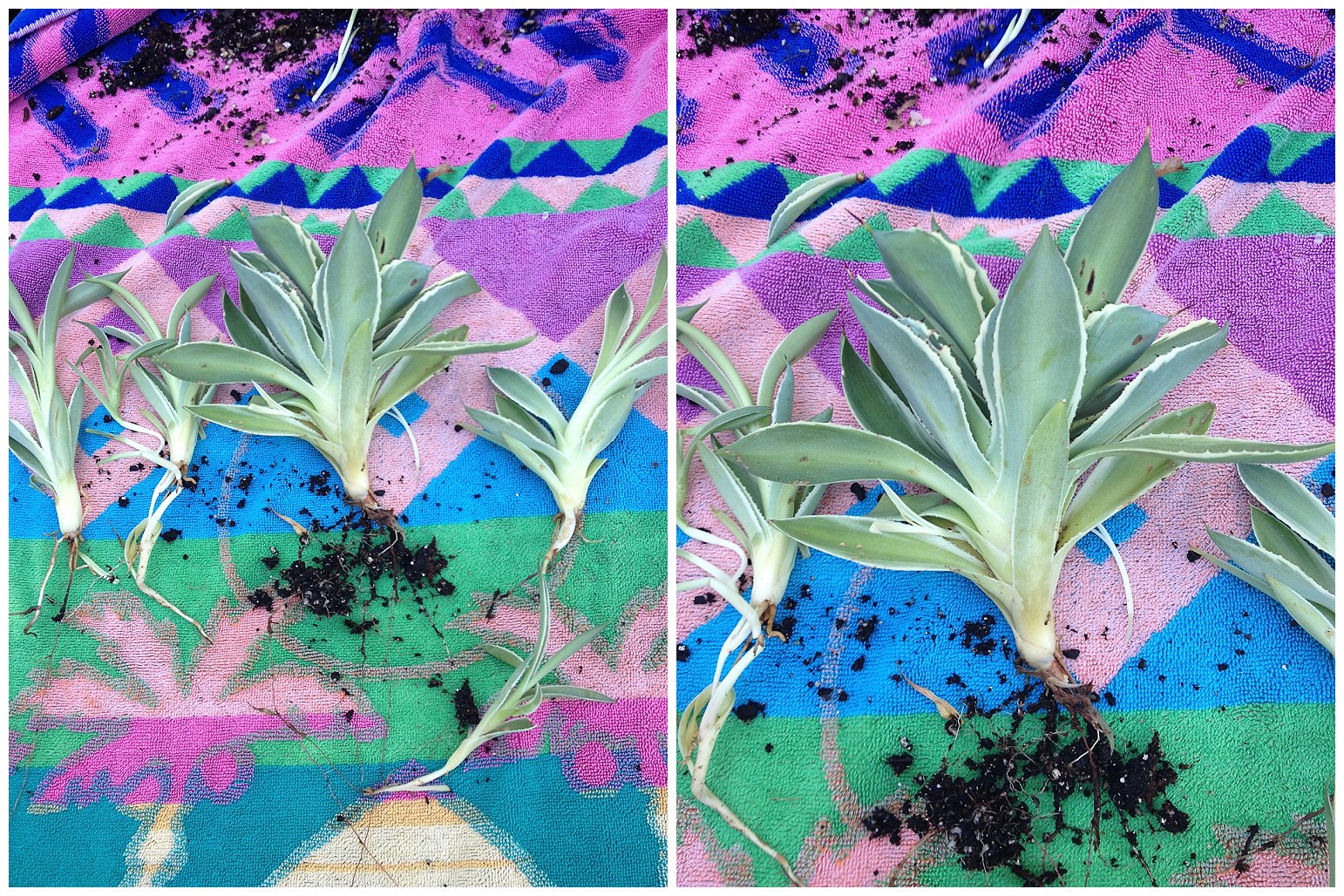
When mine was sprouting offsets (Mini-Me’s) at the base, I decided it was time for it to be re-potted. I grabbed a couple special gardening tools and selected an urn I had in my stock (perfect as it was one size up from the former pot).  Collecting up some tools, I did my propagation routine which was easier than I expected.

Getting Ready to Repot

Getting Ready to Repot

Tools:

  1. Beach towel
  2. Large grill tongs
  3. Fish tank gravel
  4. Potting mix amended with some coarse gravel and sand
  5. Thick garden gloves, the type with rubber fingers and palms
  6. Coarse airy stones for the top of the soil

The beach towel was used because I was lazy, and wanted to grab something quickly to put on my table to collect any fallen soil as I worked.

The grill tongs used because I couldn’t think of what else was handy to hold onto the Agave, but it turns out I didn’t really need those cause the plant easily shook out of the pot onto the towel.

The fish tank gravel was from a fish tank years ago.  I knew I’d find a use for it.  It was washed and rinsed prior to filling the base of the urn with it, to about a 1/3 of the way up from the base for drainage.  Remember, well-draining soil is critical for this plant.

The thick garden gloves, well – for obvious reasons. To protect my hands from the Agave’s spines at the leaf tips.

And lastly, coarse porous black stones were for the top of the soil.  Agave plants sit so close to the soil line that putting some barrier material between it and potentially wet soil will help to avoid rot situations.  Also, the soil mix used must be porous.  You can look for the type used for succulents or cacti if you don’t want to amend it yourself.

Pulling away offshoots

Pulling away offshoots

Each little baby plant or Mini-Me (a.k.a., sucker, sprout, offsets or offshoots) at the base of the Momma plant were easily pulled away and re-potted.  Given to special gardening friends with a word of caution:  Not hardy, avoid cold wet rain situations (early spring, late fall), and watch your hands or butt should you walk by this plant – the spines are sharp.

Mini Me's

Mini Me’s

The pot should be relative to the size of the current plant.  It thrives in tight conditions and is a slow-grower so it won’t overtake a pot or container garden quickly. Select a pot that is form fitting if you plan to grow it solo, or in a mixed planting situation, you can go somewhat bigger if desired.

Repotted into Urn

Repotted into Urn

There are plenty of succulents and alpine type plants you can use to mix it up in a container garden for a real show.  Want some ideas of what those are? Visit my Succulent Sensations Pinterest boards and attend my May 24th class in 2014.

There is much to know including how easy it is to give birth (propagate) new plants (Mini-Me’s) from the mother plant. Because, as I said earlier, this plant is easy to grow, you should have grandchildren from Agave ‘Kissho Kan’ in a two to three years.

Mixed container

Mixed container with Senecio and Sage

Celebrate its Birth and Size with Tequila

This plant will grow to about 15″ or so, slowly.  However, other Agave species grow rather large. If you want to see a really big blue agave plant being dug out of the soil by a strong farmer, check out this video.  I’d like to hire this guy to dig out some yucca plants in garden beds, equally tough to remove.  And then have a couple tequila shots with him, because the plant he is harvesting is used to make tequila.  And, believe me, he’s earned a shot or two if he does this process for the whole field of plants.

Fortunately, Agave ‘Kissho Kan’ is far more manageable, and it will not grow as large as shown in the video above.  It is perfect for container gardens and for people who are a little negligent with their watering routines because the plant enjoys desert to semi desert conditions.  

As mentioned above, the only thing you can do wrong to it is let it sit in cold wet conditions – this usually leads to rot on the leaves. My recommendation is to put it outdoors in the early summer after the early cold spring rains are done, and it is warm outside regularly.  And to move it back inside for the winter before the cold autumn rains hit.  It likes to stay warm.  Most people fail with this plant because they think it will be okay if it gets rain at that time period because you still have warm days between cold rainfall, but I say avoid that cold rain situation all together for success.

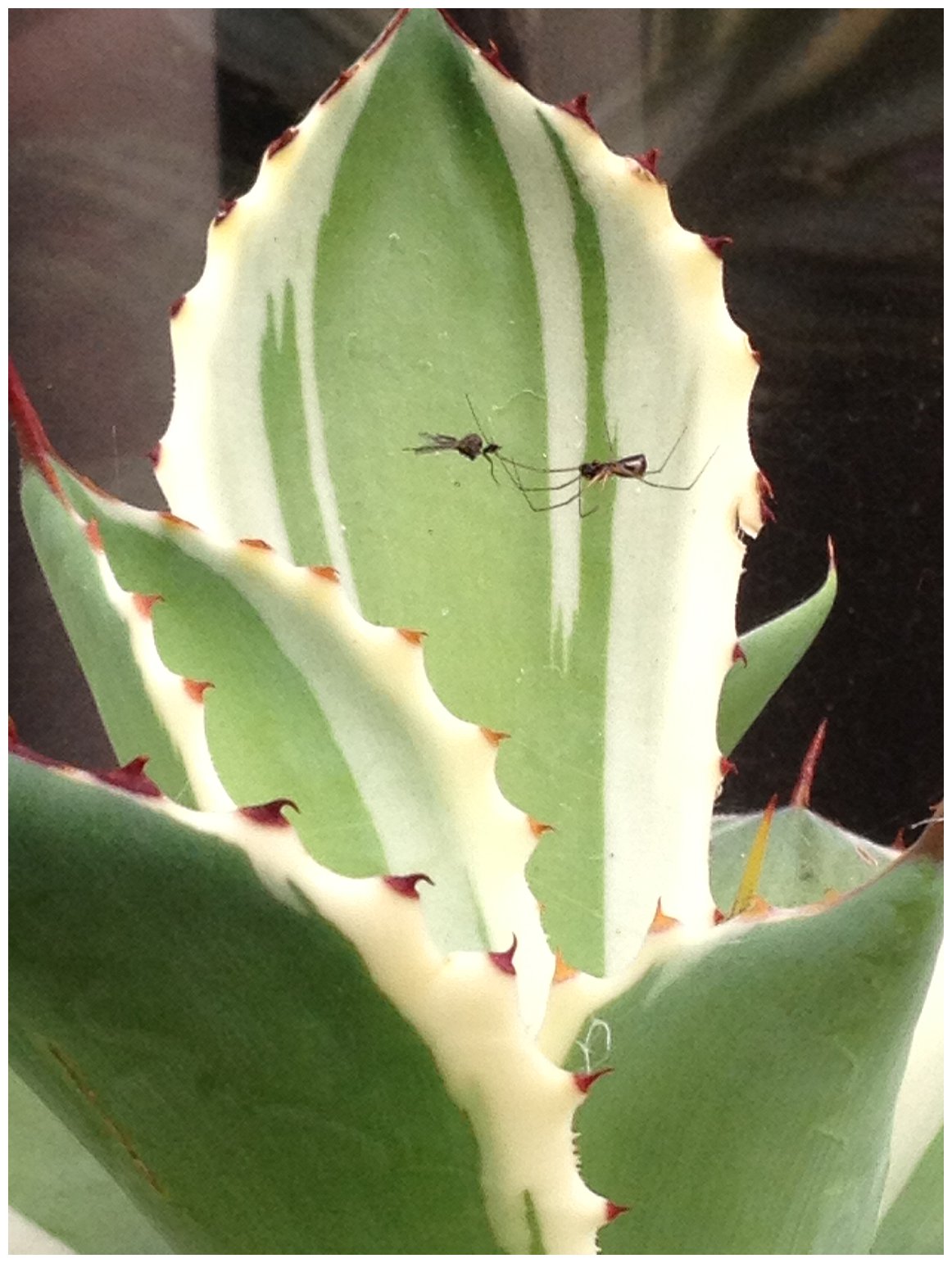
Spiders Visit the Plant on Summer

Spiders Visit the Plant on Summer

Death after Flowering

If you don’t kill it, or die from doing too many tequila shots – great – the plant (and you) will last a very long time, and even perhaps a beyond a few centuries. They grow so slow that many won’t produce a flower spike until after 15, 20 or even 30 years when it reaches maturity.  The flowers rise on tall stalks and put on quite a show.  In this video, you can see how a flower stalk reaches to the heavens.  It is quite spectacular, requiring years and then just the right conditions to come out into the open.

Some Agaves will grow flowers regularly, but I must confess, I am not sure if Agave ‘Kissho Kan’ is one of them.  There are some confusing references on it but not a concern, if I see a flower stalk appear, I’ll let you know immediately.  In fact, I’ll be sure to brag about it.  And then do a tequila shot to celebrate my success and to honor plant’s eventual passing after giving so much to its life.

Want to join me when this happens?  I’ll get the good kind.

Cathy Testa

Agave_0005

Plant Details:

Agave (Century Plant)
Agave sp. Kichokan
Agave potatorum ‘Variegata’
Zones 9-10 / Full Sun
15″ Tall Rosette

Useful Links:

Agave Kissho Kan
Plant Delights

http://www.monrovia.com/plant-catalog/plants/3155/lucky-crown-century-plant/
Monrovia

http://www.logees.com/Agave-Kissho-Kan/productinfo/S7713-4/
Logee’s Greenhouses
See my blog post about this place HERE.

Click to access temperennials.pdf

Proven Winners

Sharing:

If you like what you see on this blog, please SHARE this post with your GARDENING FRIENDS.

Thank you!

Agave_0007

A Mansion Grand Enough for Topiary Camels in Newport, RI

4 Comments
Cliff Walk View

Cliff Walk View

We had no intention of touring a mansion during our visit to Newport, RI this summer, but it ended up falling on our agenda regardless.  The last morning of our weekend, we packed a cooler filled with a picnic lunch, and headed off to the famous Cliff Walk.  Our goal was to sit and watch the rolling waves after we got in some exercise.

But, about 20 minutes into our walk, we discovered a barrier ending the path early. The sign indicated the Cliff Walk was closed “beyond this point” due to storm damage, up to Ledge Road.  Disappointed, yet determined, we backtracked to our car, and drove up Bellevue Avenue to locate the Ledge Road entrance, so we could continue our walk beyond the damaged areas.

Finding Ledge Road was easy, however, we discovered there was no public parking near that entrance, only private street side spaces.  We drove back up the end of Bellevue Avenue considering what to do next.  It was then I noticed beautiful and full Hakonechloa grass by a gated entrance.  I wanted to take a photo of the grasses because it was such a great example of how to use them in the landscape, so I asked Steve to slow down.

That moment lead to us entering the premises, marked “open” by a flag near the entrance gate.  The friendly man at the gate told us a tour of the mansion on the property was about to begin in a half-hour.  With nothing else on our backup plan, we got tickets to join the tour.  This was the last mansion on the famous Bellevue Avenue strip, called Rough Point – and maybe one that is overlooked since it is last on the strip.  I know we wouldn’t have bothered if it wasn’t so convenient as our next adventure of the day.

Camels Stuffed With Succulents and Herbs

Camels Stuffed With Succulents and Herbs

As we drove into the parking area, we both noticed topiary camels in the side yard, and thought that was interesting, and a little unusual or unexpected.  This was, after all, a mansion.  Wondering what the story was behind those, and thinking I will take photos of it later, Steve went to get tickets for us.  He exited the mansion with a white pamphlet in his hand, which I began to read.

“Wow,” I said, “This property was designed by Olmsted, … as in the father of landscape architecture.”

So naturally with the white pamphlet in hand, I was excited that we would be touring his home.  What a coincidence – this is something I’m actually very interested in.  Guess those Hakon grasses at the entrance were a sign of sorts.  Followed by the camels – well, this may be worth doing.  So onward we entered, and I couldn’t wait to hear about him and the property.

Front of Mansion facing Ocean n Cliff Walk

Front of Mansion facing Ocean n Cliff Walk

Upon five minutes into the tour guide’s talk, I was confused.  Why was she referring to a woman who owned this mansion, and not a man?  And who is this woman, by the name of Doris Duke?  She obviously was someone rich and famous by the million dollar paintings and art pieces in the house, but was she married to Olmsted, or what?  I turned to Steve holding up the white pamphlet and whispered, “I thought this was about Olmsted?”  He just shrugged his shoulders, and frowned a little when he heard the tour guide say it would be about an hour or so for the tour.

Turns out the fact the outdoor grounds were designed by the “father of landscape architecture and one of the most prolific and renonwed American landscape architects,” was not a major highlight of the tour.  It was just a coincidence, a good one for me, because I was now excited for both the tour and grounds to follow on our own. I figured after hearing the tour would take one hour, the best part would be when it was over when I could see the outdoor landscape and gardens, which they noted we could take our time to enjoy.  And it gives us access to view the ocean on the mansion side, versus the broken and damaged inaccessible Cliff Walk.

As we heard about this woman’s taste in her collections, and about her large dogs allowed to sit on rather valuable furnishings, and about her two camels by the names of Baby and Princess, I was intrigued, and very much interested and enjoying the story of Doris Duke’s life as a philanthropist, world traveler, and collector, while viewing the many treasures in her mansion and home.

Doris Duke, it turns out, inherited an estate estimated at $80 million at the age of 12, from her father.  Her father was an industrialist, and founder of the Duke Power Company.  It was mentioned he also invented the first rolled cigarettes.  She was his only daughter.  Wow, 12 years old and rich, but not without wisdom as we learned more.  She gave so much of her money to worthwhile causes, appreciated art and valued treasures, loved animals, and traveled the world.  I was kind of diggin’ this chick more than the vision of seeing Olmsted’s designed property and grounds outside after the inside mansion tour.

The whole time during our tour, I fantasized about the kind of life she led, filled with supporting charitable foundations (some in the horticulture scene such as the Orchid Society), and wondered how she and her friends dressed during their social events in the mansion’s grand rooms.  But there also seemed to be a tone of loneliness, perhaps, or it was just part of my vivid imagination – but somehow, I sensed she lived somewhat of a solitary life at points.  Maybe it was something about how she would swim for an hour by herself in the ocean facing her grand home, or the fact she was married, twice – but both marriages were brief, and also sadly she lost her only child, 24 hours after delivery.  Or perhaps it was something about her independence – how she would allow her rather large dogs to sleep on extremely expensive furniture, and have two camels roam the property.  To me those were little signs that she was not only elegant but down to earth.  I could be wrong, but I wanted to continue my daydreaming as I looked over every piece being well-described by the tour-guide (who I suspected was a teacher in her former life because she asked us questions about history, and other things, kind of like a mini test).

Whatever the reason I sensed this air of loneliness about Doris Duke, the home itself was a place I felt was cozy as well as grand.  It was filled with amazing carpets and tapestries, furniture, and paintings beyond my artistic knowledge, but the house still had a feeling of a place you could live in without it feeling overwhelming.  The rooms were connected in such a way, it wasn’t over powering, and it included a conservatory, which I couldn’t wait to see.

Once we arrived to it – the conservatory facing the grand lawn and ocean beyond, we heard a comical story of how the camels, named Baby and Princess, were put into the conservatory during a hurricane one year.  Doris had the staff clear out the room and put them in there to protect them. I won’t tell the rest of the story, better to save it for the tour you will attend if you plan to visit Newport, RI. But they did survive, and one camel is still alive today.  This was another piece of Doris that made her feel down to earth and not too pretentious.  After all – who would let camels into a mansion!?!

Hedge tunnel path to Secret Gardens

Hedge tunnel path to Secret Gardens

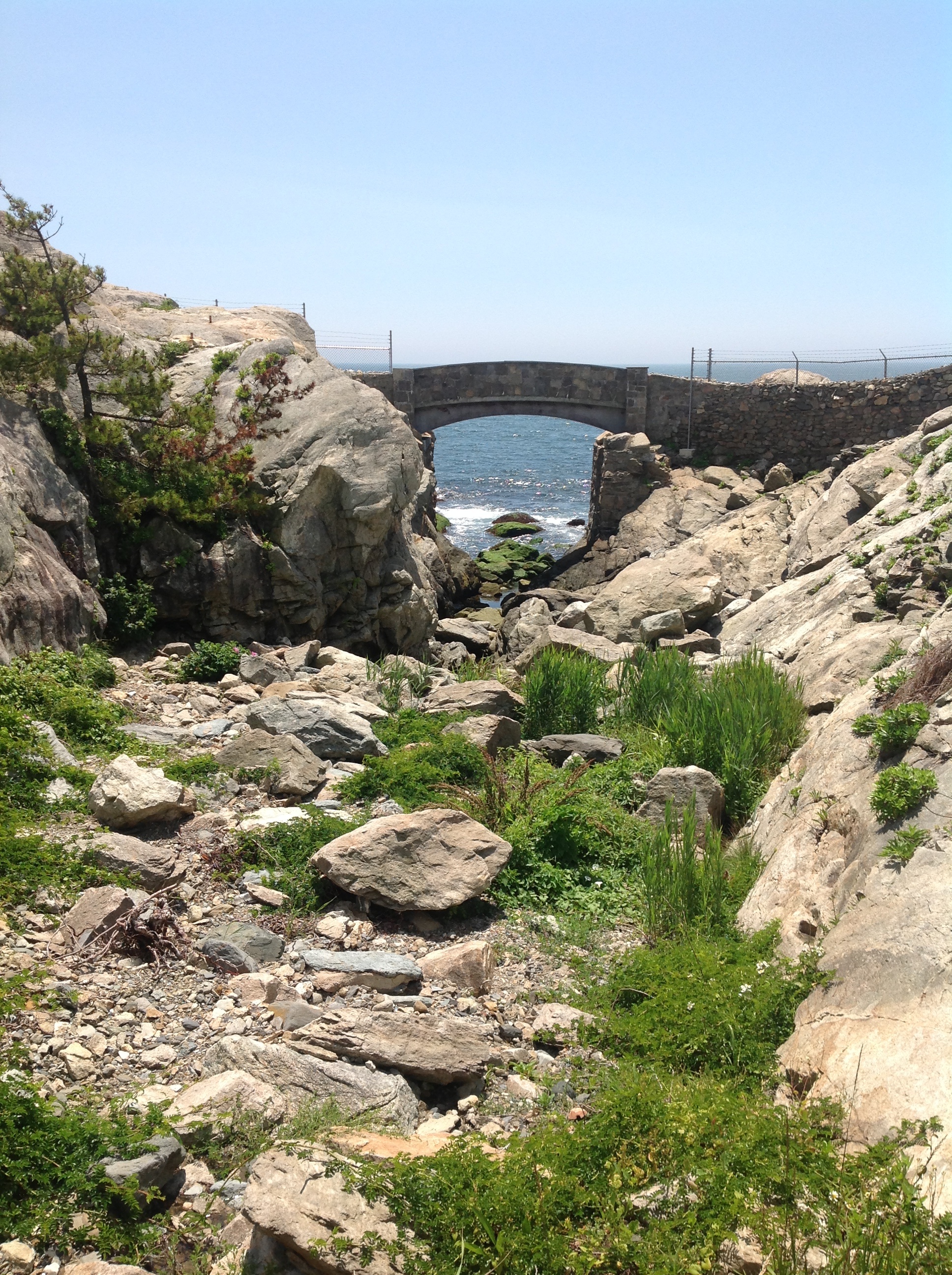
Once our indoor tour was completed, I was eager to visit the secret garden behind the privet hedges briefly mentioned, and the kitchen garden on the opposite side of the 10 acres grounds, which was twice the size when Doris Duke was alive.  But first was to go see the camel topiary structures in the side yard stuffed with drought-tolerant sedums, succulents, and thymes in honor of Baby and Princess, a gift to Doris Duke from a Middle Eastern businessman, as part of an airplane purchase.  Yup, guess the camels make sense now.  They were grand enough for a mansion, or perhaps the mansion was grand enough for them.  This would depend on your point of view.  And the swimming gate where Miss Duke entered the ocean for her daily swims – hard to imagine with the rough waves beyond, or the beautiful stone bridge flanked by rocky outcrops.  I took off my sandals and enjoyed the soft lush lawn under my feet as I began to walk in awe of the place.  Suddendly I realize I wasn’t considering Olmsted at all, and only Doris Duke’s life and vision.  She had a big part in many aspects of the outdoor areas as I read more later.

Roses blooming in Gardens

Roses blooming in Gardens

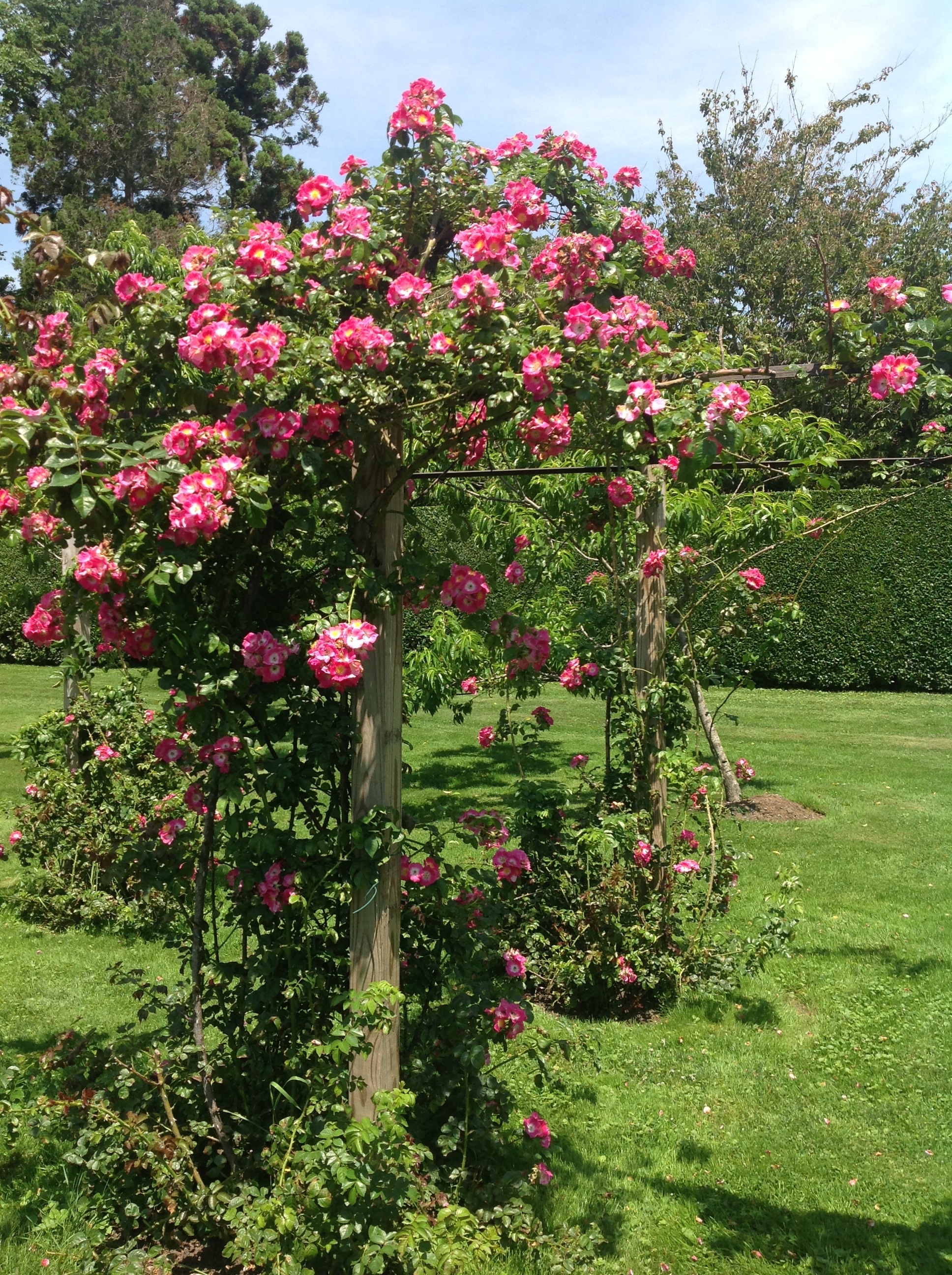
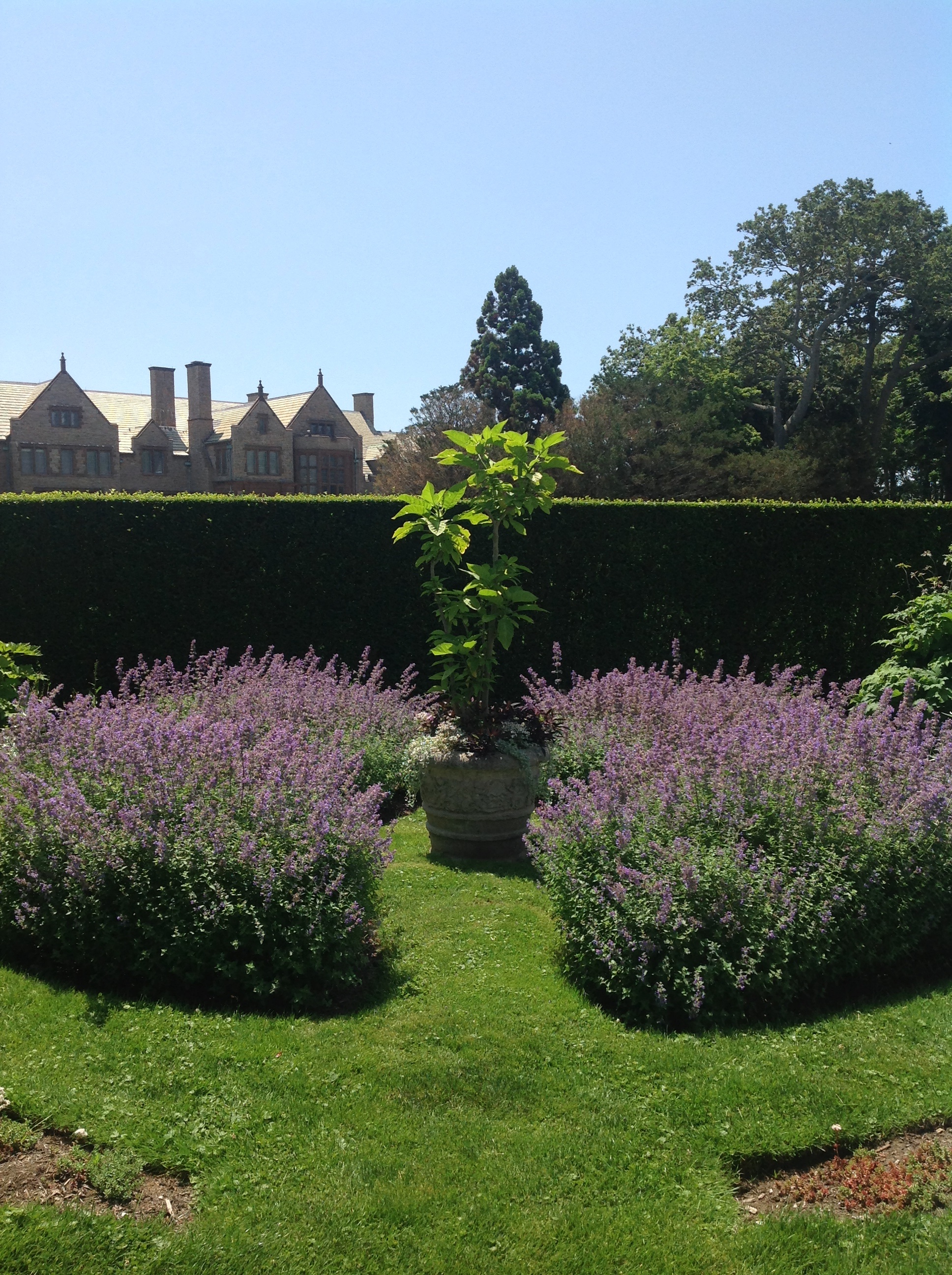
While in the private garden on the property, with a rose arbor was installed and planted at Doris Duke’s direction, planted with ‘American Pillar’ roses, which bloom only once a year, usually around July 4th, which happened to be the weekend of our visit.  The area is surrounded by a privet hedge, and flowers and tropical plants are included in the gardens.  While it doesn’t stand as it did in the same fashion as when Doris Duke directed the plant list, there was much to be enjoyed.  One area surrounded by a hedge of catmint (Nepeta faassenii) with a Brugmansia in a container in the center, was a favorite of mine.  Along with a bed lined with lamb’s ear (Stachys byzantina) and Boxwood.  And to see banana plants, most likely the hardy Bajoo’s, made me feel all the more admiration for the property and home.

lambs ear perennial lines edges of garden

lambs ear perennial lines edges of garden

Banana Plants in the Garden with Perennials

Banana Plants in the Garden with Perennials

While I suspect it was common to put the gardens tucked away in private areas, part of that made me sad, for you can’t see them unless you go adventure there.  Again, dreaming about how I would put gardens throughout the property, rather than leave a wide open lawn, which by the way is maintained by organic methods.

Brugmansia with Catmint

Brugmansia with Catmint

In The Kitchen Garden

In The Kitchen Garden

We discovered, as we toured the kitchen garden on the opposite side of the property, cinnamon and clove, are used as an insecticide.  A staff person, nameless and camera shy, came by to talk to us and told us this.  He said it was part of Miss Duke’s commitment to environmental causes, and the property, all 10 acres, have been maintained using organic practices since 2007.  This is truly amazing.  Removing my sandals as I walked the lawn areas, it was soft and cozy underfoot, and not one pesty insect was spotted in the kitchen garden as I snapped photos.  Our mysterious staff person, dressed in a white chef shirt, took our photo and complimented our chemistry saying he could see we were enjoying touring the grounds.  I kind of figured he was also investigating our investigation – this is a place, obviously is filled inside and out with rare and valuable beauty.

Opening where Doris Duke walked for swims in the ocean

Opening where Doris Duke walked for swims in the ocean

Some Tips:

DATES: Check the tour dates of RoughPoint, The Newport Home of Doris Duke.  It is closed during the winter season.

CAMERA: Bring along your camera – for the outdoor portions.  Indoor photos are not allowed.

LUNCH: Pack a lunch – as we did, for they don’t limit your time on the grounds, so you can enjoy the view with some snacks.

TIME: Give yourself one hour for the indoor tour, and one hour to enjoy and tour the historic grounds.

CLIFF WALK ENTRANCE: Enter the Cliff Walk via side street entrances (versus the beginning point).  There is one on Webster Street and Narragansett Avenue, shaded and free to park street-side.  Or, you can park at the beginning point of the walk, the entrance by the beach off of Memorial Boulevard, but have to walk up a long hill, and in the hot humid sun, we opted for the shaded area starting the walk a bit further along off Narragansette Avenue (connect via Annandale Road).

Cathy Testa
Container Crazy Cathy T
http://www.cathytesta.com
860-977-9473

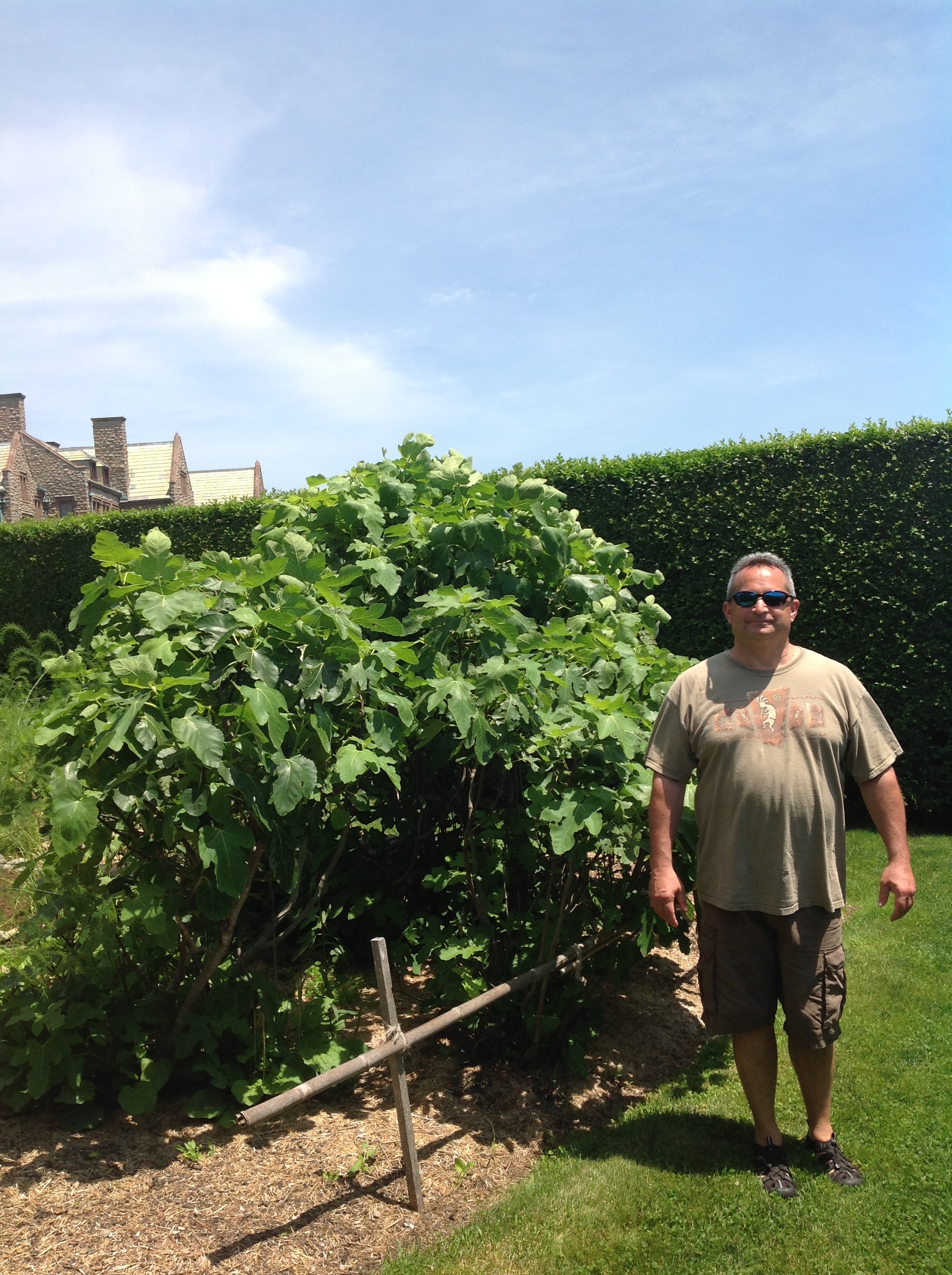
Steve next to Fig Trees in the Kitchen Garden

Steve next to Fig Trees in the Kitchen Garden