Self-Watering Pots Rock on a High Rise

Leave a comment

Self-watering pots, those with a reservoir area at the base of the pot to hold water for the roots, were not high on my list in regard to usefulness. I had tried them at home on my deck outside and I found that I didn’t like them for several reasons, such as, they tend to get overwatered when it rains and stay in a flooded state (unless you use the drain plug to release the overload of water), they don’t allow air to circulate well when waterlogged, and things like that. In fact, several years ago, I actually wrote a post about how I just didn’t like self-watering pots. I felt they were not good for plants! See that prior post below:

Post above from 2015. Wow, times have changed.

Boy, did I change my mind when I experienced using self-watering pots on a high-rise balcony. On the high-rise balcony, which I tended to for five years for clients’ plants in various pots and some self-watering pots, the environment is so different, I guess you could say, the environment has big weather extremes. And because one of those extremes is intense heat and strong sun, the self-watering pots (they were actually long planter boxes) did not stay flooded after a rain fall for long. The sun and heat dried them out much faster than self-watering pots I used at my home at ground level or on my deck.

A big environmental or climate consideration on a high-rise balcony for the plants was the extreme heat and full-on sun (as I refer to it – sun that is full on and intense). On some days, in the middle of fall, or even winter, it was like being on the beach up there on a balcony so high up if the sun was out. On hot summer days, I would have to make sure I worked on the balcony during the period of day when the sun passed by and there was shade from the buildings so I wouldn’t roast, but that was not often doable. Let’s just say, it gets very hot at times, almost unbearable, so plants which tolerate drought and heat were critical as well. To clarify, this was 38 floors up on the top of a building in a city exposed to all elements from sun, wind, etc.

Because of the environmental extremes such as sun (and wind), trying to keep the soil moist for the plants was more of a job for my clients. They would have to carry water out from inside their penthouse. By hand, with buckets! There was no outside water source, so my big fear was will they water enough? And they did fortunately. Otherwise, the plants would be toast from the extreme sun and heat.

However, with self-watering pots, some of that was solved. My clients actually had two long planters that were self-watering pots before I came onto the scene. When they pointed them out to me, I didn’t say much because I always felt those planters were problematic (as noted above in my prior post from many years ago), and I believed in watering plants in pots yourself. But I was the fool in this case, because I learned quickly, those self-watering planters were winners on a high-rise. So, for those who may be doing some urban gardening, take a look at self-watering pots. They may be very helpful to use if you have plants that require moisture and also if you have intense sun (and wind) on your open balcony up high.

Let me explain why. If the rain fall was abundant, the fact that the sun was so strong and hot after at times, the soil would dry out. The water would not stay in there and flood the planters, like they did at my home after a rain fall. It would be the same exact weather at my house and theirs but due to being up so high, the planter would not stay waterlogged. Waterlogged soil will rot the roots or kill them. It was working out, especially for herbs. Herbs can take dry soils usually, but they do need moisture at times. I started to fall in love with their long self-watering planters.

I learned lots of lessons by working on a high-rise thru experience. I also have knowledge on plants and which were tolerant of conditions, drought tolerant, loved heat and full sun, but I still had lots to learn and plants to test out. In the case of self-watering pots, I discovered that they rock on a high-rise balcony.

The self-watering planters did need to be stored for the winter, however, which I offered as part of my services. I would wash them well, store them and return them in the spring with fresh soil and fertilizer. It was working out and they still have those planters today – those were a very good idea, and an excellent investment.

Pots and planters have special considerations on a high-rise which is another thing I will write about, and I had to find solutions. I’m kind of an out-of-the box thinker – AT TIMES … so I got really creative when during the first year there, which I will write more about later. Weight for example is a big factor. Again, it is not like pots near the ground, there were weather considerations all the time.

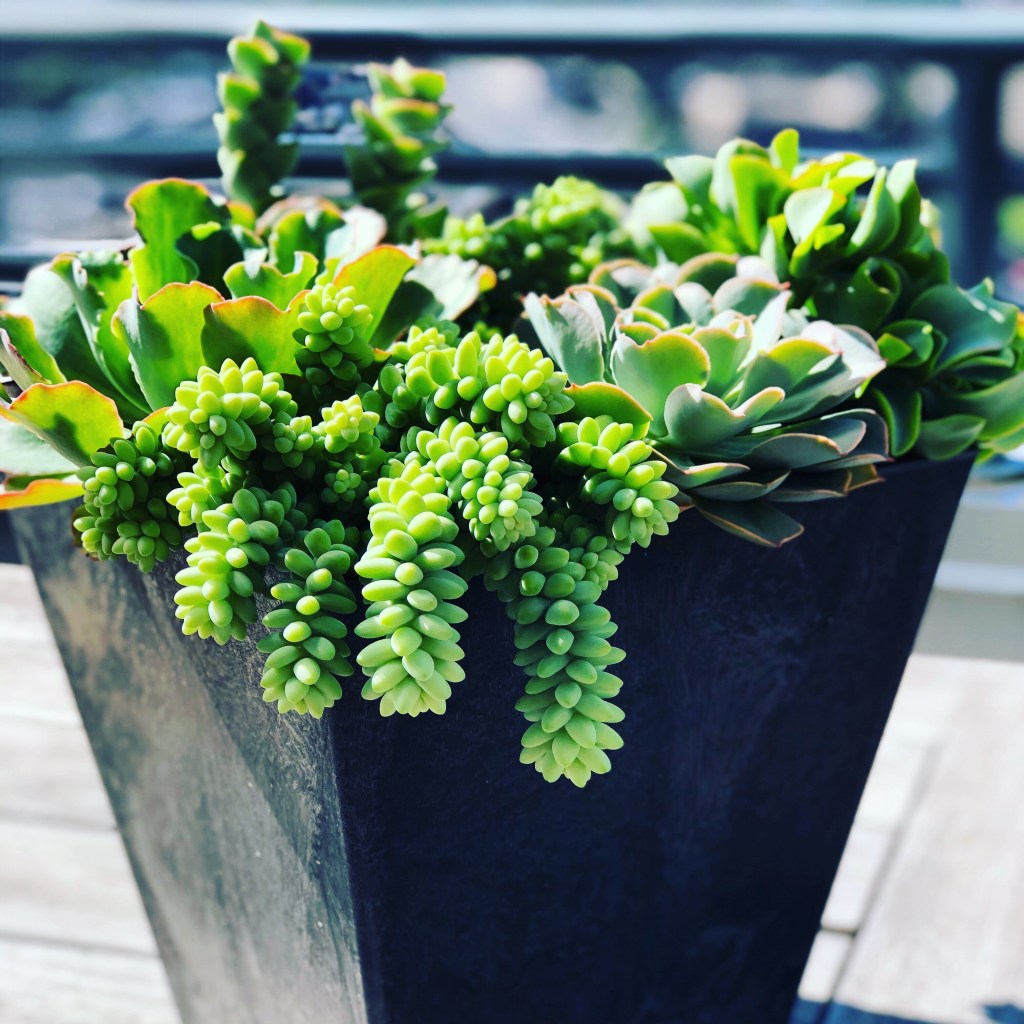
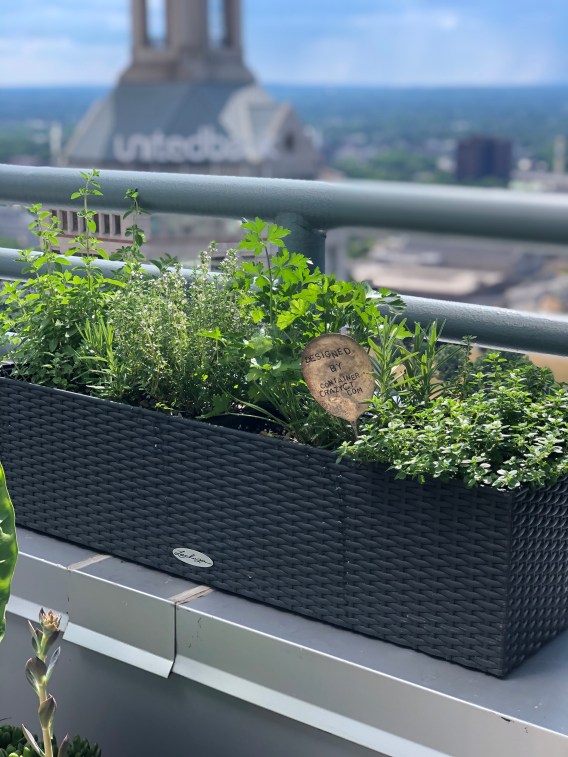
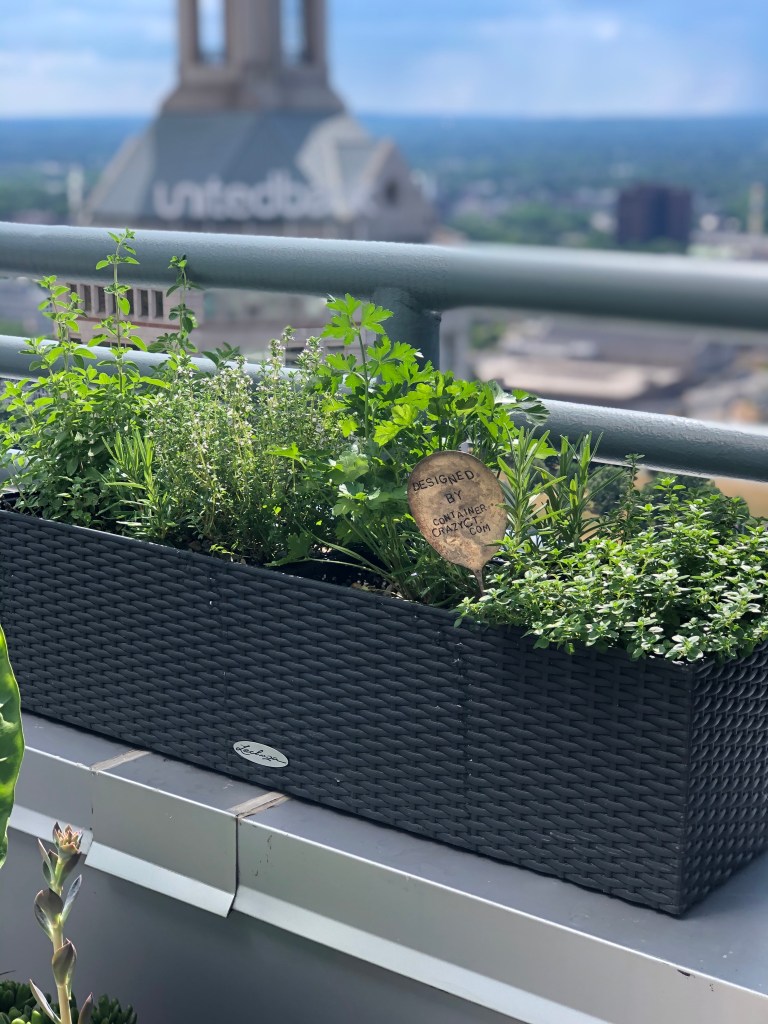
Plants that I felt did very well in their self-watering long planters were herbs. I did try smaller compact type of patio cherry tomato plants one year, but they kind of fell over from the winds, so that did not work where the long self-watering planters were positioned near the railing. However, herbs did very well in these. Some herbs in general can take dry soils – herbs like rosemary, for example. Later, I ended up acquiring some tabletop pots which were also self-watering and started to use them with succulents on their high rise as well. Those worked out well also. Succulents do not like soggy soils, so when it rained so much that it flooded the pots, it was fine because the sun and heat would dry them out fairly quickly. Or you can drain them if need be. It was just working out so much better than I would have thought.

A couple things I did was I added some small pea gravel in the base where the reservoir holds the water to weigh down the planters. As noted above, due to extreme winds on a high-rise, I was concerned the planter was not heavy enough. I also used standard potting mix with slow-release fertilizer. And sometimes, I top-dressed the top of the soil with either pea gravel, mulch, or moss, however, it was not really needed but I liked that “finished off” look to add some style to planters.

Here are some photos. I know I have more, but it takes a while to locate them. When I find them, I will add to the next post. I rather enjoyed taking them the planters to my greenhouse to clean for the winter and replant in the greenhouse to deliver in each spring. I felt they were kind of Zen. The herbs would grow three times the size at their balcony – I know I have photos of that but will have to share them when located! It always amazed me how much the plants grew when I would return for a fall change out. Balconies are wonderful places to have a full blow herb garden if you have enough sun, which this place did.

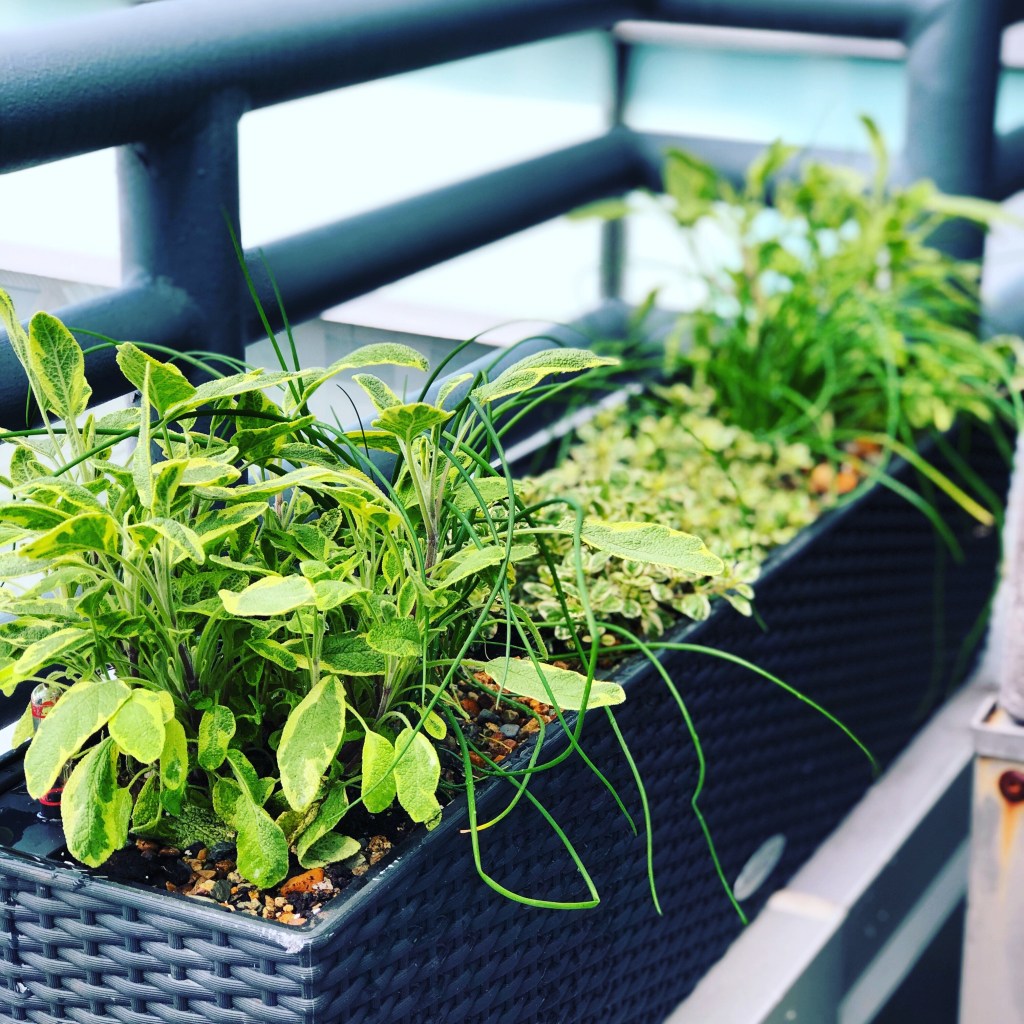
Self-Watering Long Planters with Various Herbs
Self-Watering Tabletop Planter with Succulents Above

Thank you for visiting,

Cathy Testa
Container Crazy CT
Blogger in East Windsor, CT

One more photo below!
My Take on Self-Watering Pots

12 Comments

I have often made the comment during my container gardening workshops and demonstrations that if you don’t like to water, leave this presentation immediately. I actually love to water my container gardens and patio pots. Yes, a bit nuts to hear by some folks, but to me it is relaxing. It allows me to take a moment to enjoy the plants’ features and feel the sun on my shoulders. Not only do I like the whole watering routine, I also realize the importance of water to the plants’ internal functions and growth processes.

Water is the primary component used during photosynthesis when water is split into hydrogen and oxygen by the energy of the sun. Water is also used to transport nutrients, cool the plant, expand its cells, and maintain turgor pressure. And YOU, my container gardening workshop attendees and gardening friends, are the person that will provide water to the soil so our plants’ roots can take up the elements so essential for all this beauty to begin and grow in your container gardens in the summer. Without your watering process, a plant in a container garden and patio pot cannot internally manufacture its own food – a function that only plants can perform on this earth. Sound like a big responsibility? If it is too big for you…well, there are some options.

As shown at my annual May Container Gardening Workshops, there are some tricks used to “reduce” watering routines for your pots needs, but there has also been self-watering pots out there on the market for some time now for people who, UNLIKE me, despise having to water their plants in the summer months. Or, they may not have much time to “relax, enjoy the plants’ features, and feel the environment” due to their busy workday schedules – after all – it does take some time to water container gardens – but its worth it, isn’t it?

As one attendee told me after the summer season was over, watering her plants on her deck felt like a part-time job – but she surely enjoyed the big, lush plants which grew large in her pots all summer. To enjoy your container gardens as focal points throughout your outdoor surroundings is a mental boost to your day. Watering may just force you to stop and take it all in after your work day. It can be a forced relaxation moment in some ways. Now, back to the self-watering pots…

What are Self-Watering Pots?

Self-watering containers and pots have a reservoir of water in the base of the pot. A disk or platform partition is inserted into the pot about 1/3 of the way down with the soil resting above the disk. A fill tube allows you to top off the water as needed which goes below that disk in the base of the pot. Sound easy, huh? Yet, I have to admit, I am not a big fan of self-watering pots, partly because – as I mentioned – I enjoy watering plants, and because there is something about the water ‘not draining’ freely from self-watering pots through the bottom, and through the soil, which disturbs me. After all, do you like the feeling of damp feet when you are wearing shoes that don’t quite breathe correctly?

I don’t think plant roots like that feeling either (damp feet) which can occur with “some” self-watering pots. The theory is the disk prevents the roots from penetrating into the water reservoir below the disk, but in my curious mind, I wonder. I’ve seen roots creep where they want to go – nature finds a way, but again – I have not researched this like a scientist – it is just my intuition that the roots may try to go below that disk and hit pure water, and stop growing.

What happens when things are too wet? We humans may develop a foot fungus and stinky feet, and run to the drug store to get athlete’s foot powder. But plants, well, in containers and patio pots, their little roots aren’t going to be able to leave to get powder or more air. They are trapped. This is very unlike roots of plants growing in the ground where they can travel, plus they also have a larger mass of soil to help out the situation. Thus, my concerns about self-watering pots continue to ponder me. Here are some of my concerns:

Salt Build-up

Salts – Fertilizers are basically salts (in chemical form, as I remember my professor emphasizing in class). When applied near water, salts will move gradually towards the area where it was applied. This dilutes the fertilizer and distributes it. If tender roots are close to the fertilizer when too much fertilizer is applied, water is ‘drawn from the roots,’ and nearby soil (water in the roots and water in the soil moves). Plants can dehydrate when we apply too much fertilizer because of reverse osmosis where the water will move out of the plant’s roots, and this is why we use caution to apply fertilizers in the garden and pots in correct amounts, at the right time, etc.

In containers, salts can sometimes be a problem if they don’t leach out of the pot and end up building up in the pot (which doesn’t happen if you follow Container Crazy CT’s 5 Must Do’s for Container Gardening). You need to use good soilless mix with proper pore space, have drain holes in the base of your pots, and not over apply fertilizers.

Water should drain through the soil. It just makes sense. Also, it is a good practice and healthier for the plants, if you allow the soil to dry out a bit between watering applications so the soil has a chance to breath. Keeping the soil constantly wet is not good (unless it is a bog plant or native to a wet habitat or environment). Just like soggy shoes would bother our feet after a long walk in the woods, so will roots be bothered by overly wet soil for a long period of time.

A note on Winter Watering

In the winter, by the way, watering container gardens which you have moved inside as a houseplant is greatly reduced because the plant’s growth usually slows down if you place the pot in a sunny but cooler temperature inside the house. And those pots which you put in your unheated basement to go dormant are watered only when the soil goes dry – water very sparingly, as discussed in my “Storing Tender Tropical Plants” demonstration last weekend. Winter watering is greatly reduced in most cases.

Too Much Rain

Too Much Rain

Rain Falls

Rain – If you have self-watering pots outside in the summer, without a plug which enables drainage, and you get lots and lots of rain, the pot actually starts to form a pond on the surface of the soil because the excess water has no place to go. It goes up as the soil gets waterlogged. Now your plants are floating in a muck as the water rises to the top, and you’re not too happy either because you have to go outside in your muck boots and rain coat to relieve the plant by removing the plug in the weep hole in the side or bottom of the pot so the water under the disk may drain out. You may even have to tip the pot to the side to drain out more excess water. When we drink too much, what happens to us? We get messy too. We topple over or lean; the same thing happens with plants. They’ll wilt and eventually – if they drink too much – well, you know what happens there. They die or suffer such a bad hangover, they don’t quite recover, start to get diseases, rot, etc. One alternative solution, other than calling a rehab center, is to use plants that drink responsibly. Those which don’t require too many libations – as we discuss when we talk about drought tolerant plants, or just face it – water our plants ourselves to control and maintain an appropriate balance of watering applications.

Oxygen to Breath

Oxygen – Plant roots need oxygen to take up water. A perfect soil gives plant roots oxygen for respiration, pore structure, nutrients, and even distribution of water. When water is sitting in the base of a pot and the roots hit pure water, they will not grow there due to lack of oxygen. This reduces the root mass for the plants above to thrive. I like to give my plants what I refer to as a ‘full spa treatment’ by providing a good, if not great amount of soil volume by using large pots – something I go over in my Container Garden Workshops every May. They will be happy and thrive, grow large and lush, and full in BIG pots. Also, remember self-watering pots have a disk in the bottom. This reduces the amount of soil allowed in the pot above the disk because it is partitioned off. In small pots, the soil volume can be cut in half as compared to big pots. This greatly reduces space for the roots to grow and roots are important – very important to successful growth of your plants above the soil. It also causes a perched water table situation – an area roots seldom penetrate where root problems start due to lack of air, oxygen, etc – I try to explain the perched water table in my workshops as best I can to my attendees so they understand how small pots reduce the impact and vigor of plants. After they hear what I have to say on the subject, they go out and get that big pot – and let me tell you, they are impressed with their results.

The Fill Tube

In self-watering pots, there is a fill tube attached, and I don’t like it. Call me picky, but this is another reasons why I feel a bit leery about self-watering devices because there is no “spa” once the growing spaces are reduced – and we all know, everyone, even plants, enjoy a good spa environment. The fill tube is cumbersome basically. It is like a straw. I’m not going to fill a little straw to water my plants, ugh.

Drainage is Key

Drainage – As water enters your pot from your watering wand or rainfall, it moves through pore spaces in the soil and between soil particle’s tiny spaces. As it enters, it pushes air out. If air is not replaced over a long period of time, the plant roots will lack oxygen needed to thrive. Some water is used by the plant, and some will drain out through the mandatory drain holes in the bottom of your pots. It is one of Container Crazy CT’s 5 Must Do’s – drainage holes. If there are no drain holes, as with self-watering pots, some air is not replaced, in my humble opinion and experience. Too much water is not a good thing, nor is too little watering – it is a balancing act. Excess water causes the roots to suffocate because the pore spaces are filled with water. Basically drainage holes plus your commitment to watering correctly provides a balance. Some self-watering pots have “weeping holes” to help alleviate potential water build up as noted above. I suspect this “draining issue” is why the weeping holes were added to self-watering pots in the first place. Are they self-sufficient now? I don’t know – I need to keep researching, but I do know that I don’t want to take a plug out of a pot every time it rains – I only like to uncork wine bottles. Now, I see maintenance, watching if the soil gets too wet, and maybe I’m just anal. So, I’ll stick to just watering it myself.

Watering container gardens correctly and using the right soil-less potting mixes has provided me with the ultimate success in growing lush, bold, and beautiful container garden plants. In fact, I don’t always fertilize my containers and they are spectacular. My theory is: a) I water them, b) I use big containers with drain holes for large soil mass, and c) I use the right soilless mix, and of course, d) I love them (maybe a little too much).

Gravel at the Base of a Pot?

I remember thinking that putting gravel in the base of a pot for drainage was not really a good idea because it gets all clogged up eventually with little debris or bits of soil going into it over time, water then doesn’t drain there, roots don’t grow into that area because it gets too wet. Soon enough science later backed up this suspicion by announcing the old practice of putting gravel in the base of pots is not really beneficial. It can impede drainage. Roots won’t grow into that wet area at the base of the pot, thus it reduces the full spa treatment. So, take this as just my opinion on self-watering pots, and if I change my mind – I will update my findings here on this blog. I am sure someone will argue the point with me – and I fully admit I need to know more – but I also have heard some folks say they like self-watering pots, but I haven’t seen their plants though either. Are they healthy, lush, and thriving?

Planter with succulents by Cathy T

Planter with succulents by Cathy T

We all Need to Drink Responsibly

Lastly, there are always the options of using plants that drink responsibly such as succulents, some herbs, ornamental grasses, some shrubs like Junipers, or cacti. Drought tolerant plants require less watering, which not only saves you watering time, but helps the environment by reducing water usage – which is big today – no one likes waste. And if you are not a fan of dessert scenes or rock gardens, add things like soil moist to your potting mix, which is discussed in Container Crazy CT’s annual May workshops as well. Rain barrels may be placed on your deck too to obtain free water for watering your patio pots. You may focus on shade tolerant plants that require less water routines versus the hot, sun-loving types. And shade cloths can be used on extremely hot days in your greenhouses or growing rooms, or patio umbrellas on your deck during the hottest sunniest days of summer to cast some shade over plants to reduce watering needs. But I say, if you love beautiful plants in container gardens – then love watering them too.

Cathy Testa
containercathy@gmail.com
860-977-9473

To hear more about pot types, see this page: Container Garden Pot Types.