Loving My Ligularia

2 Comments

This slideshow requires JavaScript.

I’m loving this shade combination in a container garden at my home.  All the plants in this design are perennials except for one plant, and several are simultaneously shooting up blooms.  The Ligularia ‘Little Rocket’, a dwarf form, is showing off the bright yellow blooms on spikes now, which can be seen from afar.

Ligularias have bold foliage which make them perfect candidates for container gardens and gardens in the ground.  Their foliage factor makes them appealing for a long period before blooms appear in mid to late summer.  But of course, I was drawn to it first because of its showy foliage that is often available in darker colors and with serrated leaf edges.  This adds a texture and color contrast against other plants.  Some cultivars grow large leaves.  When you place other part-shade lovers near it, like a Hosta, Astilbe, or ferns, they tend to work in harmony from a visual standpoint.  And when you place Ligularia near water, by a pond for example, its tall spiky flowers will reflect in the water.  Since they enjoy moist soils, this is a perfect added on feature to enjoy from a visual perspective.

If you look closely at the photos below of the Ligularia in a container, you will also see the Astilbe is about to bloom soon, and the Heuchera is shooting up a thin stem with blooms on top.  The bees have hummed by each day lately to visit the Ligularia’s bright showy tall flowers and the entire arrangement is just a healthy, happy scene I had to share today.

I’m also loving my Ligularia dentate ‘Desdemona’ situated by my River Birch in my yard this year.  It is huge and never wilts because the soil there is perfectly moist.  As shown in the photo above and below, this one is planted in the ground where the soil stays very moist most of the year and it enjoys this spot very much.  The leaves and flowers are both remarkable on this plant.  When it blooms, the style of the flowers are different from ‘Little Rocket’; they are daisy shaped and appear on the tips in August.  They prefer part-shade and this one has darker foliage.  You will notice the Hosta tucked in next to it, and there is also a Columbine but you can’t see it to well from this distance photo shot.  On the left is a Farfugium japonicum ‘Aureomaculatum’ that will grow leaves up to 6 inches across and they have gold and yellow spots on them.  Once this plant gets bigger, it will be more showy and the daisy-like flowers will bloom in early summer too, hopefully.  This one is not hardy to our zone, but I put it there anyways because – again – another foliage feature I can not resist.  It also enjoys part sun to part shade locations.

As I pointed out both Ligularia plants to Steve, my husband, he asked, “Is that like a Christina Aguilera?”  Yes, it sounds just like the singer’s last name, I responded.  He continued to joke that I enjoy saying the word Ligularia.  And that is true.  I love saying and growing Ligularias!  Give them a try if you haven’t already for your shady areas.  🙂 Cathy T 

Update:  Check out this new Ligularia przewalskii ‘Dragon Wings’ with very cool finger like foliage.  I want this one for next year.  See this link for more:  http://www.terranovanurseries.com/media/ligulariadragonwings-p-272.html


Right Plant, Right Person, Right Time

Leave a comment

Coming back from my Tuesday walk this week, my cat, Hunter, was under my car meowing away like he typically does, but his meow this time caught the attention of my friend, Donna, my routine walking partner. 

“OMG! He is bleeding! Yuck, his nose!”  She exclaimed so loud I jumped back from my door to come see.  Hunter had obtained a very bad slash of his nose and the blood was dripping profusely.  After we managed to coach him into the house, it took a struggle to get him quickly into my cat carrier.  He fought it big time and thankfully Donna was with me to get him in there.

As I called the vet on the way to the vet hospital, I told them this was my first cat emergency.  I think I was as nervous as the cat, but not in nearly as much pain.  Hunter was crying like a baby the whole way.  As soon as I arrived, we went into the examination room.  When he got out of the cat carrier, he moved very slowly with lots of hesitation and, he stopped meowing.  He jumped off the table and checked out the vet’s examination room like he always does upon a vet visit.  The blood stopped dripping from his nose, and then he cuddled next to my thigh as we both sat, waiting calmly for the vet, Dr. Mac.

As Dr. Mac entered the room, Hunter immediately went into a cat growl.  (How does Hunter know he’s the vet?  Geez, he has only met him twice before during routine checkups!)  After a look by Dr. Mac and his assistant, off Hunter went into surgery.  Everything was handled quickly and efficiently with lots of reassurance that Hunter will be okay.  I returned home.

As I drove back to my house, I started considering, what plant can I give the vet as a thank you?  I mean, the vet and staff at the hospital do more than just tend to animals’ routine needs and unexpected injuries, they love animals wholeheartedly – probably more than we do.  After all, they studied this stuff and are heroes in situations like this.  I had this overwhelming sense of wanting to express how much it meant to me, and Hunter, that they were readily available and capable to take care of his nasty injury. 

I got out of my car at home and browsed my plant stock, I started thinking about what type of plant Dr. Mac may like…, hmmm, I’ve met him a few times before during my routine cats’ check-ups.  Dr. Mac is male, loves to share stories about his cats and dogs, and is all around nice guy.  He has a very nice and gentle demeanor.  Sometimes during my prior visits, we can’t stop sharing stories about cats, his dogs, and wildlife in general.  So I considered his personality some more.  And then I thought, I bet he would go for one of my unusual hot pepper plants or my red banana plants.  But truly, I didn’t know if he was a plant guy at all.  A plain old typical perennial would not do however, I knew that by instinct.  And something like a veggie with a unusual fruit, even if you are not a plant person, is interesting – plus edible, for those that like it hot.

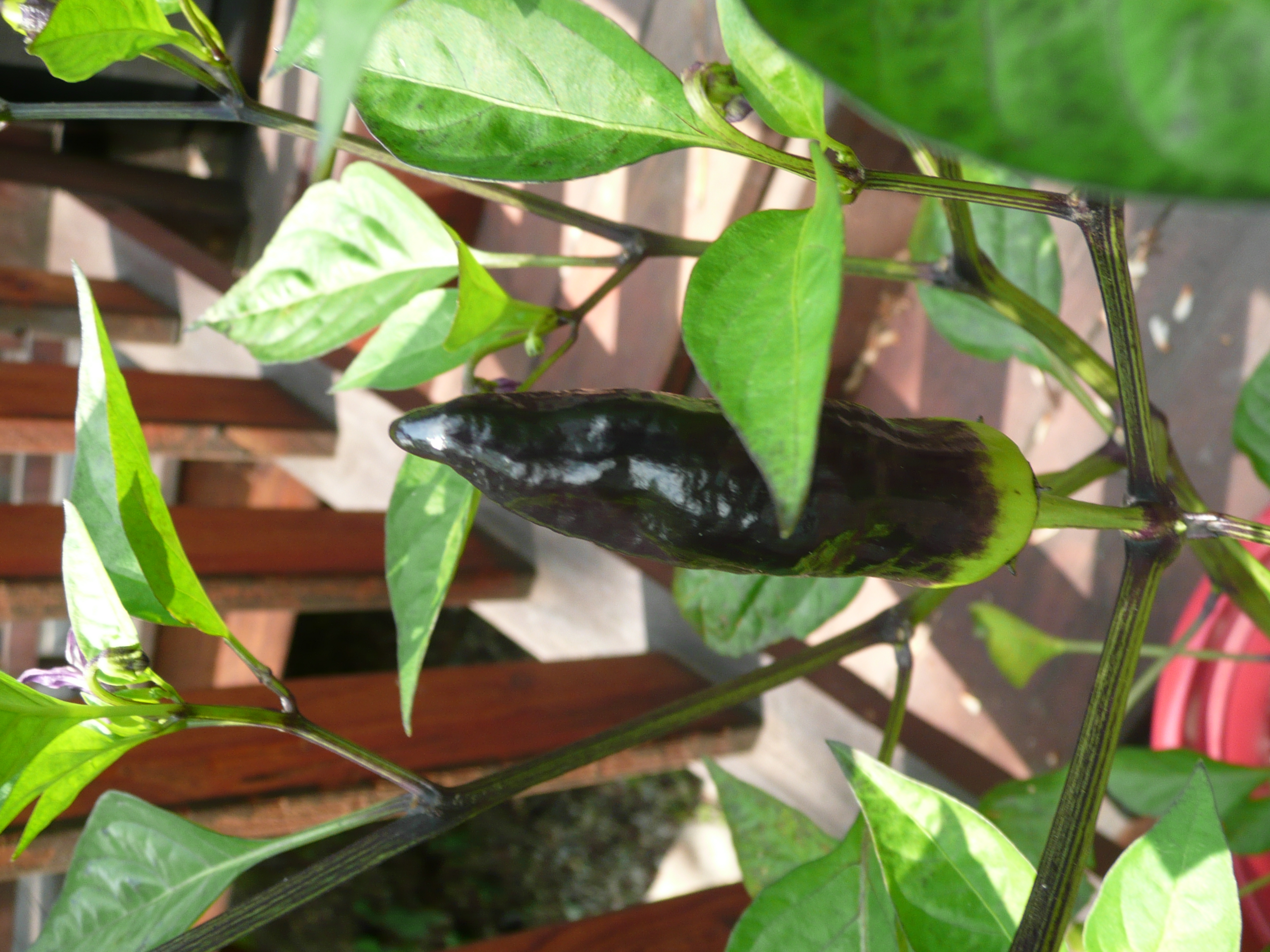
I looked over my remaining ‘Comstock’s Purple’ pepper plants in stock.  This pepper is cool because the peppers are black and upright with their tips facing the sky as they grow.  The peppers are not only non-typical looking, at least I’ve never seen them in garden centers, they are hot tasting.  A cross of the Tasmanian and Jwalal peppers, they gives off a heat rating of about the same as cayenne peppers.  I grabbed one that had many little purple blooms and at least 3 black peppers growing on it.  This is a good conversation piece even if you aren’t into plants, I thought.

Comstock Purple

Shiny Hot Black Pepper

About 3 hours later, I received the call that Hunter’s nose injury was worse than anticipated but he looks fine now.

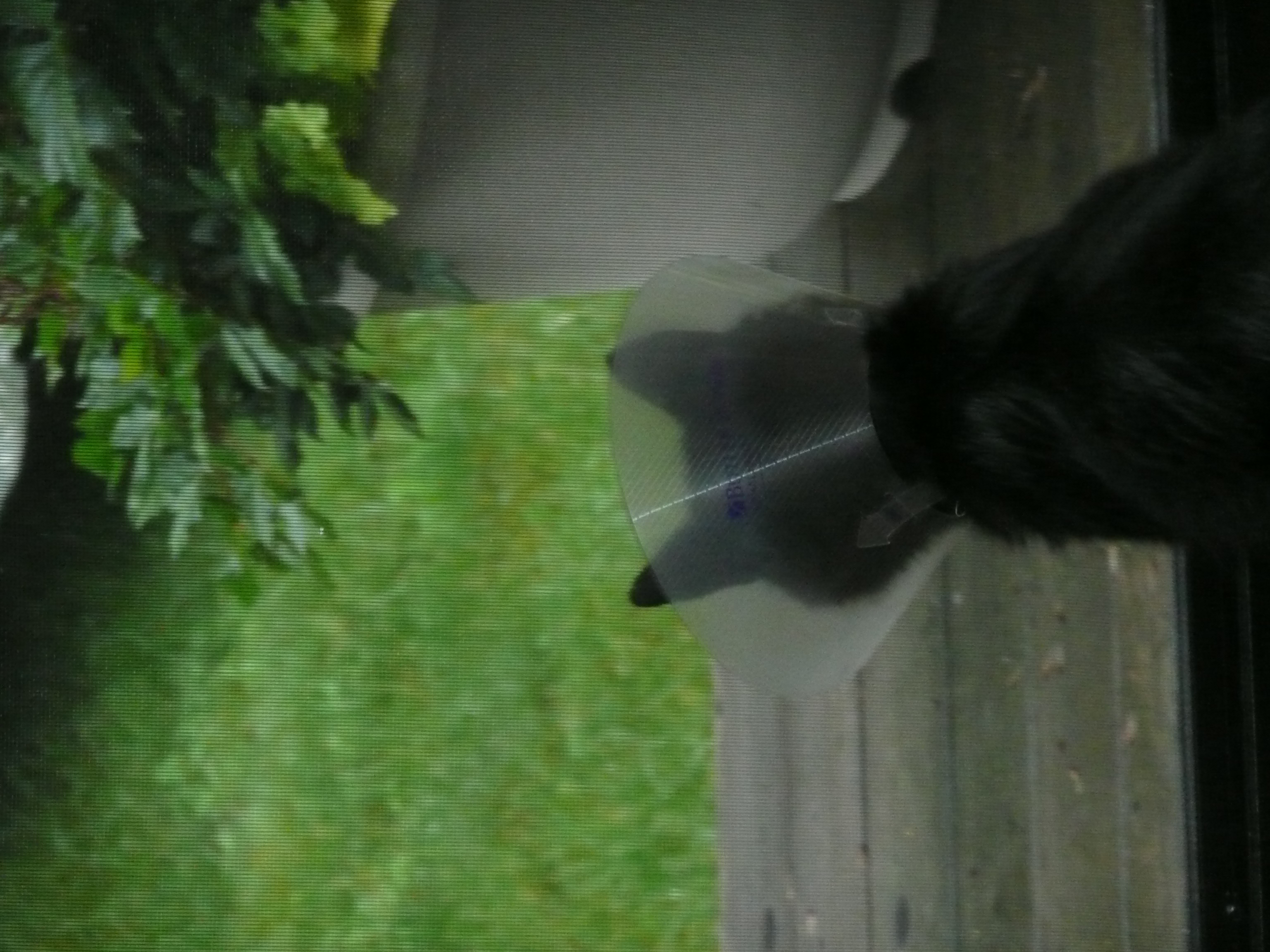
“What can I do to thank you, Dr. Mac?” I asked. He replied; keep him indoors with his protective covering on his head while he heals so our good work will succeed.  I promised him I would. 

Well, you cannot imagine the reaction of the staff at the desk upon my return trip as I walked in with my pepper plant in hand.  A card attached, burlap wrapped around the pot, and the plant standing sturdy, upright and showing off black shiny peppers.  One of the other veterinarians happened to be in the entrance area as well, and she said, “Wow, is that for Dr. Mac?  He is going to LOVE that!”    

It was amazing to me to see everyone’s reactions.   Dr. Mac, turns out, is a veggie lover. This plant, and the fact it was presented with appreciation for their efforts, was a burst of happiness to their day.  Other staff members came out to check out the black peppers, and each kept repeating how much he would really like this.  Unfortunately, Dr. Mac was with another pet patient so I couldn’t speak with him yet, but I said I’d see them in a week and to please warn Dr. Mac of the hotness of this pepper in particular.

This was a perfect case of “Right Plant, Right Person, and Right Time.”  Sometimes in the gardening world, it is not only “Right Plant, Right Place”…It is more.  It is selecting the right plant to the right person and delivering at the “right time.”  When that happens, magic happens for plant lovers in particular — or those “becoming plant lovers.”

For me, despite the unexplained horrible injury to Hunter, we got lucky that day.  Donna helped me to get Hunter into the carrier, Dr. Mac saved my kitty’s nose, and I got to share a plant as a token of appreciation with more than just Dr. Mac, but with his whole office staff. 

Hunter Awaits

Hunter views Outside

And as for Hunter, now into his second day recovering, he is starting to complain that he can’t go outside, pacing the floor until he gives up and takes another nap. 

I’m keeping my promise to keep him safe.  “No outdoors for you for a while until you’re thoroughly back to normal, Hunter!”…And as for me, I hope to keep matching plants to people, especially in times of need. 🙂

To meet Dr. Mac:  visit:  http://www.vcahospitals.com/valley/our-team/veterinarians.html

Cathy T

Petasites japonicus – A star or stalker?

26 Comments
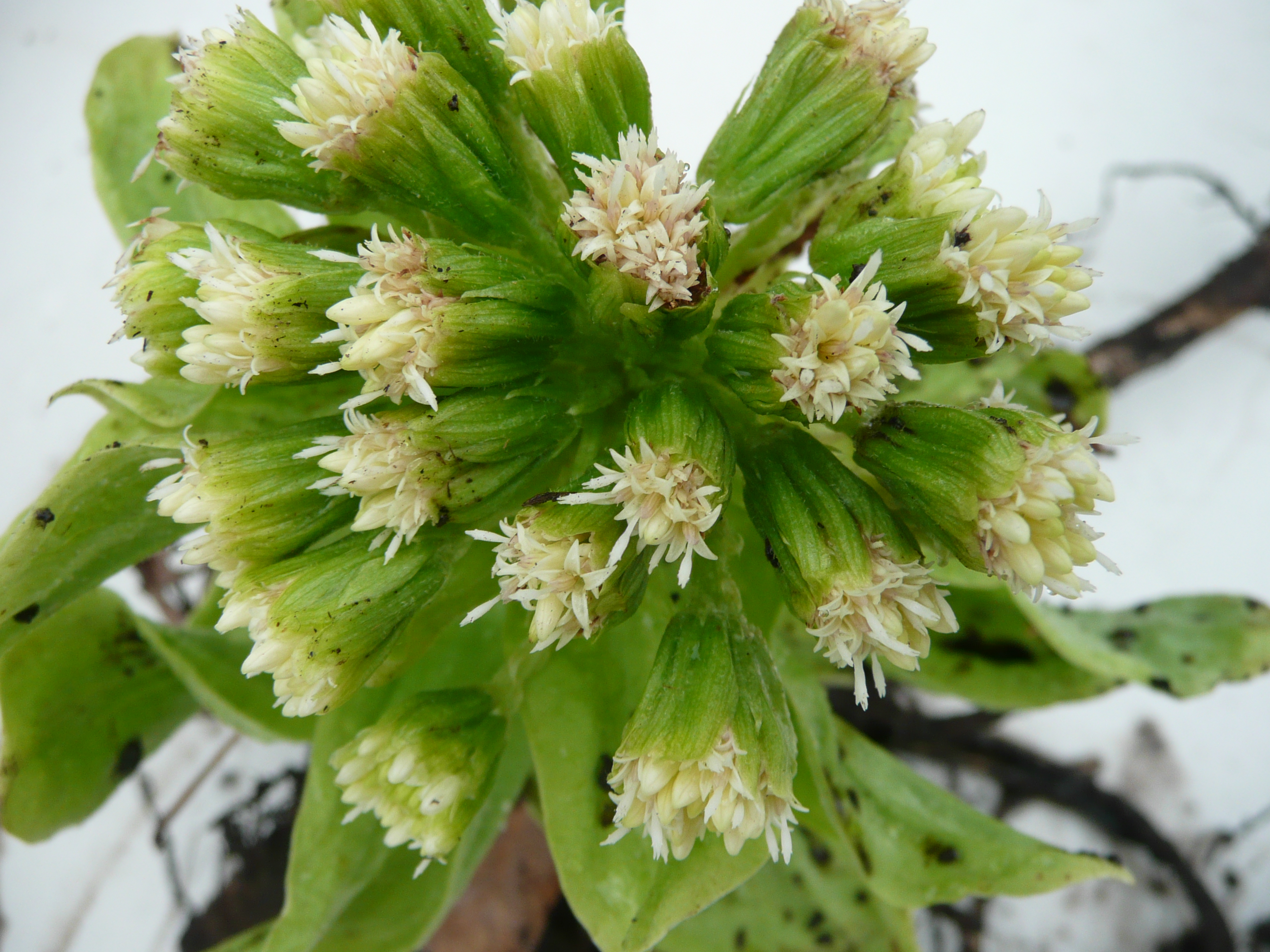
Bloom closeup

Fragrant, yellow-white

Peta-what?  Yes, Petasites.  A very cool plant that you will feel is a star or a stalker in your garden.

I came across this plant by way of  neighboring gardeners, down the road a bit.  I walk by their house a few times a week.  The retired couple living there are always tending to their amazing front gardens.  Every time I see them and their gardens, I get more impressed by their dedication and plantings.

Last year, the woman of the household told me she uses Petasites leaves as an imprint in the birdbaths she makes from a concrete mix.  It is the perfect template because the leaves grow up to 2 to 3 feet in width.  And this is what made me notice the birdbath in the first place on her property.  The sheer size of the leaf is very visible on the bowl of her creations.  So I had asked her, what she was using, and at the time, she didn’t know the name of the plant but promised she would show me its growing habit next spring.

So this year, in April, as I was walking by, the homeowners came out to tell me the plant we discussed last year is now blooming in their backyard woodland area.  They explained the aggressive nature of its spreading habit, via a rhizomatous root system.   As we quickly ventured to see the blooms popping up from the ground, it was apparent how many had reproduced from the original plant.  There must have been 50 to 70 of them in the moist, shady woodland area blooming like little alien pods arising from the ground everywhere.  Fortunately, her husband, the more obsessed gardener of the two, has been serving as the body guard of this plant’s reproduction system by removing clumps every season to keep it in line.  What was once a star in their garden quickly became a stalker.

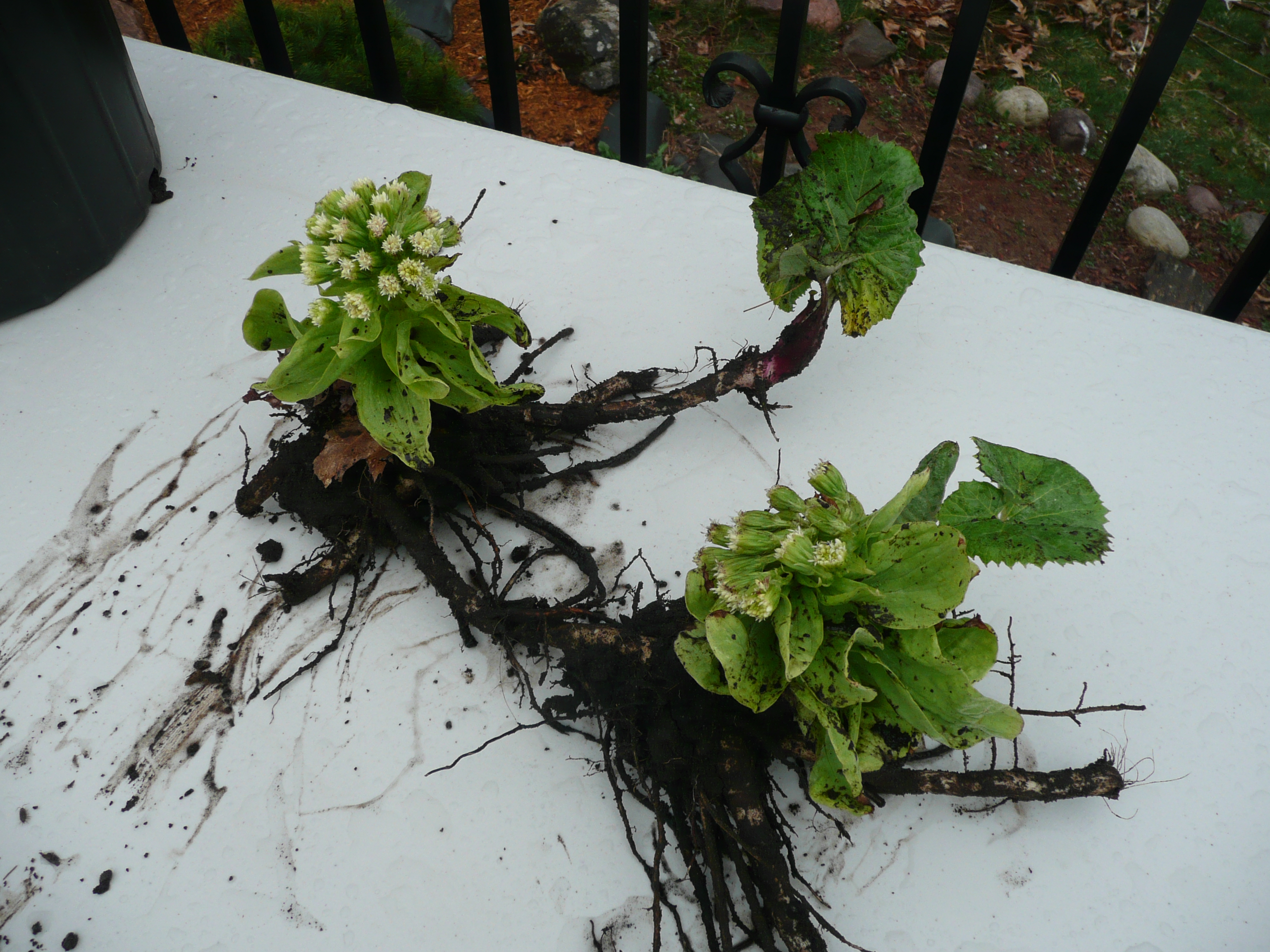
So we all know, this plant is very aggressive, but not technically invasive, thus I gladly accepted the offer to dig up two clumps to put in my container gardens at home.  Here is the photo I took that morning of the clumps.
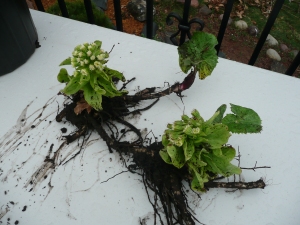
Petasites root system

Flower clump first, then foliage arises

You see the yellow to white daisy like flowers that came up first in dense groupings, known as corymbs.  And the rhizome like root structure shoots out a leaf a few inches away.  The flowers are fragrant and kind of odd looking.   I wouldn’t classify them as pretty, but everyone’s taste is different.  And the leaves are not super pretty either, but they become dramatically large within a month or so. After a couple days of transplanting my two clumps into two large pots, the plants started to perk up as the roots took hold.

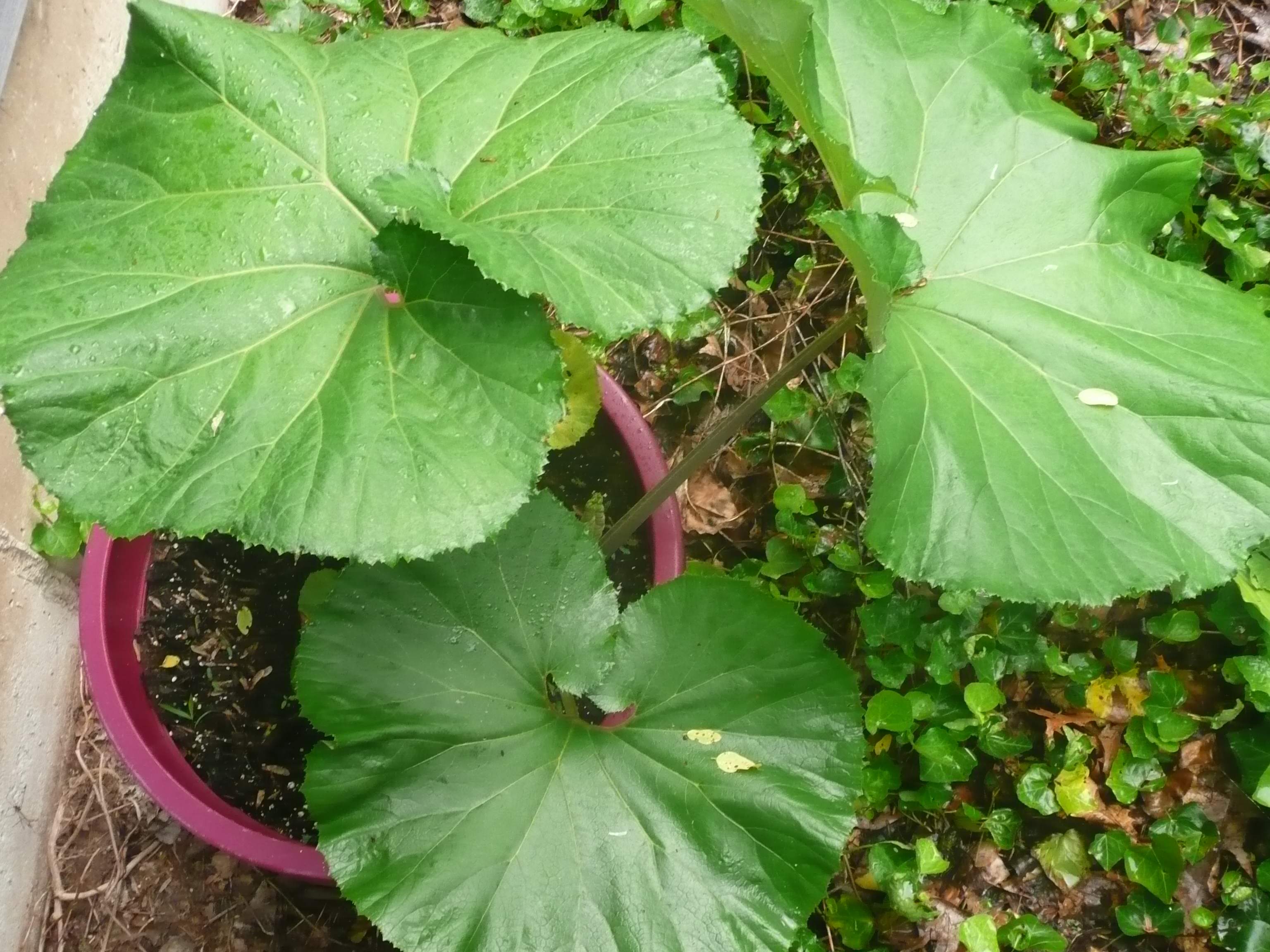
Now, let’s fast forward to June.  The following photos shows how large the leaves have grown.  And as I mentioned, they can reach up to 32” wide.  Super cool for I love foliage more than flowers – not sure why, guess it’s the way this plant’s leaves bob in the wind, reminding me of the tropics, or these in particular remind me of water lilies.  The leaves are very thin, flat and circular in shape.  If they are kissed by the sun, they will droop down and look floppy or wilted, so I pushed the pots even closer to my house facing a northern exposure and they have been super happy ever since in full shade.

Mid June Photo

Petasites

The area there stays moist and cooler too, so I haven’t had to religiously water the containers; they seem to be happy with a watering every few days.  Also, we have had some rain between our hot days so far this summer.

Leaf Above

Petasites leaf

Upon researching this plant further, it was so appropriate to discover this plant’s Genus name comes from the Greek word petasos.  This means “wide-brimmed hat.”   Of course, I thought – this does look like perfect mold or inspiration for a big showy hat for someone like Princess Kate I would say, fitting as super big flashy hat that only royalty could pull off!  So Kate, do you enjoy gardening?  I say have a hat maker fashion your latest hat statement with Petasites as your inspiration!  Or just grow it in a container as I have done.  Okay, the mind is running away here.  Okay, guess a birdbath will do.

Back to the containers…this plant is a star in my book for containers in the shade or by a water feature.  It grows quickly, is showy, and has no serious disease or insect problems.  But on the downside, it must be kept in check if grown in the ground.  And the leaves are only a plain green, but the veins are slightly pinkish and depending on your point of view, very cool.

On a cultural note, the plant enjoys consistently moist to wet soils in part shade to full shade.  So if you have a full shade location, this plant rocks!  The container can be sunken in mud even, if you want to have a water garden effect.  As I said, the circular shape of the leaves remind me of a water lily.
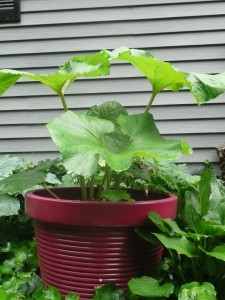
Early June Photo

June photo

Petasites japonicus is known as butterbur – because, as I read further, the leaves were apparently once used to wrap butter in hot weather. (Hmm, interesting, I thought.)  This plant is also referred to as fuki or sweet coltsfoot.  The petioles (stalk of the leaves) are eaten as a vegetable called fuki in Japan.  In fact, its native range is Korea, China, and Japan where it is found growing on wet stream banks in wooded areas.  The stalks grow long and support the leaves above.  I think the stalks look a bit like rhubarb stalks or stems.  Maybe they are in the same family.  This would require more research.

In summary, this plant serves as a vegetable, water garden plant candidate, will naturalize (so beware of this and keep it only where you can control it, like containers!), and has strange alien-like fragrant flowers in spring, and is easy to grow to huge proportions for a large, very showy, extravagant foliage display – fit for a queen …or princess!  It is hardy to zones 5 to 9 and is an herbaceous perennial.  Eventually the whole plant will reach about 3 feet tall by 5 feet wide.

If you think you would like a few, give me a call.  I know where to get them!  Cathy T

Fall Update to This Post:

October is here and I’ve begun the process of overwintering many tropical like plants from my container gardens.  This being my first experience with growing Petasites japonicus (Zones 5-9) in large containers, I started searching on the web to see if I could find any sources on how to overwinter them  in CT.  Granted, they can survive our zone and are very hardy, but they are too aggressive to grow  in the ground, thus a test in containers evolved this year.  I hope to have them return next season.

The leaves by now started to have lots of holes in them due to a slug or some other nuisance insect feasting on them recently.  Almost all the wide leaves had scattered holes in them.  As I began to cut away most of the foliage and stalks, I noticed a bulb like structure at the base of the plants, all plump and full.  “Interesting,” I thought.  “Another new feature to be curious about on this unusual and large showy foliage plant.”

Fall Photo of Base

My plan is to cover the crown of the bulb-like structures with mulch to provide some insulation, and maybe even a big blanket over the top or around the containers themselves.  Then hope for the best.  That bit of insulation will hopefully recreate the insulation of fall leaves in a forest.  And so long as the mice in my shed don’t try to eat any remnants, all should go according to plan. However, if you find or know of anyone who has tried overwintering these plants in containers in our area, please let me know.  I’d love to hear of their experience to ensure success of my trial.  Cathy T

Photography Passion

3 Comments

For this Friday’s ‘Photo Friday’, I’m posting this picture (see below) of a Professional Photographer taking shots of my Container Gardens on a deck designed by a new company called, “Scenic Post and Rail, LLC” in Broad Brook, CT.

Now talk about passion!  The professional photographer, Catherine Cella of Joyful Reflections Photography, is someone I met through a gift certificate I donated to a local Boy Scout’s fundraiser last spring.  http://joyfulreflectionsphotography.com/.  We held our first meeting at her beautiful home and shortly afterwards, I designed a landscape plan for her backyard area near a shed and in front of the woods. 

Of course, I noticed her photography and style the minute I entered her home.  She has this beautiful country porch, wonderful woodlands around her property, and many elements of style all around her home, inside and out, and she has an extremely energetic personality.  We connected immediately.

Catherine end up attending our 2nd Annual “Gardens, Gallery and Gift” event in Broad Brook this past weekend.  There is no doubt, this is an event where any photographer has opportunities everywhere for photos, from the gardens on the properties, to the butterflies floating about the plants, to the flowers at my booth and my Container Gardens all around my tent.  She took many stunning photos and I’m honored to be part of them.  Especially the one with the funny floating frog figurine on an inner tube that everyone loved at the show.  It was perfect in my Container Garden themed with succulents and drought tolerant plants. 

Well, one thing led to another, and the following Thursday, yesterday, I was commissioned to stage my container gardens on this deck with newly installed custom glass railing systems.  Gosh, I wish I met the couple designing and promoting this wonderful decking system before we put up railings at my Mother-in-Law’s home which faces a lake!  This system allows you to see through without anything blocking your view.  And imagine, no staining required ever!  But the element that turned me on the most about this railing system of glass, is the way the flowers in my container gardens on the deck reflected in the glass.  Oooh-la-la, that was nice!  I would thoroughly enjoy that aspect the most and I oohed over that image.

As I oohed about this “reflection” in the glass, and Catherine hopped around the property in every direction to take the most stunning photos of it all, she said, “Don’t get too excited Cathy, you may pass out in this heat!”  And then we joked, “Isn’t this ironic and funny? Your business is ‘Joyful Reflections Photography”.  How perfect is that?!”  Reflections is a big part of her style – see her website for more.

She and I almost did pass out – We were so thrilled, and the heat was a little tough, but the passion continued.  I can’t wait to see “Scenic Post and Rail” display their product this season on their upcoming website.  It will launch soon.

But when Catherine was lifted into a bucket loader, that really topped off the day!  I had to capture this photo and share it with you.  The passion in her work is clear, and it made me feel like I’m not so crazy when I get overly passionate about my plants and containers.  When you love what you do, the adrenaline comes through.  And it did on this day for all of us.  This new product is also something the business owners are extremely proud of and I can see why.

BTW, if you would like to reach the entrepeneurs of this railing system, feel free contact me at 860-977-9473. I’ll hook you up and will let you know when their website launches!  Cathy T

Catherine Cella of Joyful Reflections Photography

U go girl!

Plan to plan but plan it will not go according to plan!

Leave a comment

I’ve moved, coddled, removed, picked up, put down, adjusted, admired, panicked, laughed, contemplated, created, imagined, thanked, cursed….  From wet to cool, to hot and sunburt, to sweaty and sticky, to throw on a sweatshirt suddenly it is cold, to wow, look at that sun, to look at those dark clouds, to OMG, a tornado in Springfield, to “what there could be hail on the way?”…to OMG is my husband okay coming back through Massachusettes?!  To move, coddle, pick up, put down, push, bring back, adjust, water, pinch, smile, create, enjoy and then surprises, what tv in two days, OK!  Back to the nursery, find the best of the best, create, smile, admire, oh a hummingbird, OMG.  So pretty, voom by my head.  Oh hello butterfly, you are so pretty…oh butterfly, you are injured 😦 darn cat, stop that.  A deer in the back, you stay back, don’t come hear, it is too near, my prized possession, my plants, my blooms, and my patience!  New admiration for growers, nurserymen/women, and anyone who creates their art in the great and not so great outdoors.  Respect for mentors and helpers coming stepping out of the woodwork. This, perhaps, is a test – a trial run to a future little store, I don’t know, but it is worth it. 🙂  Cathy T

Fields of Dreams

Leave a comment

Photo Friday’s shot is a field of dreams – a field of the future – an inspirational day, taken last Friday, May 13th, when I picked up a load of plants from this wholesale yard for my upcoming Container Garden Parties and gardening events!  And although it was “Friday the 13th”, there was no bad luck experienced.  The sun was shining, a helpful employee walked the grounds with me talking plants and birds, and then Steve and I went to lunch and enjoyed the rest of the day – even hitting up another retail nursery to look around at what was new!  This day was very inspirational for me – I hope to someday fill my property with this many plants.  Perhaps that is ‘dreaming in color’, as my Dad would say!  Now, let’s hope our sun returns here in Broad Brook, CT this weekend.  We need it after a week of wet weather – and so do my plants.  The word “nursery” hasn’t been more prevalent than this week.  Cathy T

Visions of the future

Photo Friday

Leave a comment
 
East Windsor Students

EW Students!

What is cuter than this?!  I think it is the a perfect photo to kick off Cathy T’s Photo Friday” where every Friday I will post an inspirational gardening related photo with a very short note:

This photo was taken last weekend, on May 7th, at the East Windsor Community Day.  Held the day before Mother’s Day, I had the fortunate experience of kids visiting my booth from time to time to select plants for their Moms. I have to say, kids are the best listeners and customers!  They would ask for help, listen attentively to every detail about the perennial, and often surprised me with their own gardening experiences.  In fact, one boy told me he grew Dahlia plants last year, and has chickens on his property.  He was so enthusiastic, loved looking over all the plants, and had this huge smile on his face.  As he told me more about his gardening routines, I responded with, “Looks like you will be a nurseryman some day!” Then later as the day’s event activities were coming to a close, this group of young ladies came by with their friend who purchased a plant earlier.  I quickly asked if I could take a group photo of them because they were so cute and just being very girly, laughing, smiling, and having a good time.  As soon as I asked if they would allow me to take a group photo, they jumped at the opportunity to grab a plant of their choice and then with a quick “snap!” – I took this shot!  It makes me smile. I hope it does the same for you too! 🙂  

Cathy T of Cathy T’s Landscape Designs (www.cathytesta.com)

How much is that doggie in the window?

Leave a comment

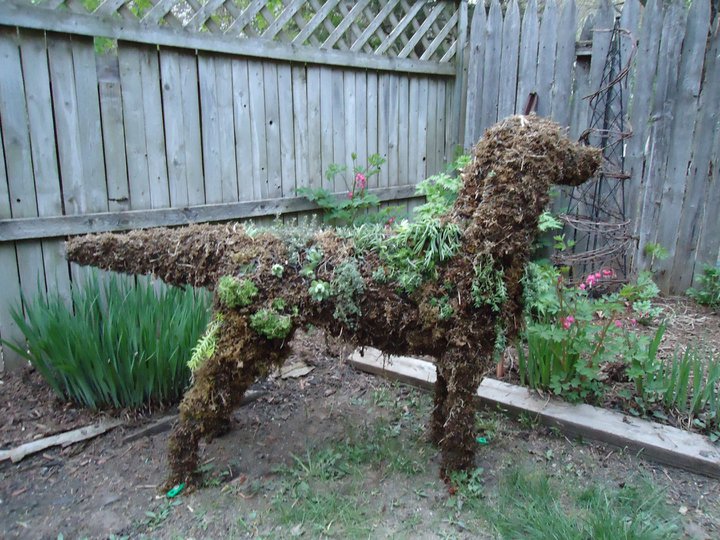
…Or how much is that doggie in the garden!  I love unexpected projects that come my way as a result of being a horticulture person in the gardening business.  Recently a local client recommended me to her mother for planting a life sized dog sculpture made of chicken wire.  Her mother obtained it at a dog show last year.  Both the mother and daughter own and show Irish Setters at events.  This life size dog represents a love of their favorite breed and passion as dog competitors, thus it truly had a personal connection to both the mother and her daughter.

When her mother came by my house, she said she went to a couple nurseries for help on how to plant it but they were too busy to assist at the time.  She tried to grow morning glories on it last year, but it just didn’t work, and she didn’t know what to try next.  I’m so glad she showed up at my door step for help.  I knew I would have much fun working on it, and ideas started to pop in my head right away.  We agreed I would keep her posted on my progress and if I didn’t find the right plants or materials, I would let her know.  But I was optimistic for yes, this is a container project, and I’m Container Crazy Cathy T.

Working with chicken wire forms is time consuming and tricky.  It is no wonder during the spring rush season a nursery person hesitated to take on the project.  And you have to be careful to not damage the plants as you work and also think to include the proper elements in the wire frame to help support the extra weight of the moss, plants, and soil.

I recommend using a sphagnum long-fibered moss which is 100% organic and the perfect filler.  Unlike peat moss or sphagnum peat, both non-renewable resources, sphagnum is harvested from perennial live plants that grow in wild rich marshlands or bogs.  It is renewable because it grows back every several years in the bogs.  Once moistened, it can absorb up to twenty times its weight in water.  Pre-wetting the moss makes it easier to work with and it is a good idea to wear gloves to protect your hands.  If you attempt this process, be sure to not breath or inhale the tiny moss bits that can fly around as you open the bag.

The perennials I selected for this dog container garden project were all full sun lovers, primarily stonecrop sedums and herbs.  Thyme, I have to say, worked extremely well because it is tiny and pliable, easy to move through the wires openings.  One variety I selected was Silver Thyme (Thymus vulgaris).  It has a shrubby growth of tiny leaves edged in silver.  Besides being useful for low borders for herb gardens and flower gardens, and in dog sculptures like this, it is drought tolerant and culinary.  Plus its soft visual appearance makes you want to touch it – or in this case – pet it!  The other variety of thyme I included was Woolly Thyme (Thymus lanuginosus).  It added a contrasting softer texture.  Woolly Thyme has gray green leaves and a hugging habit.  It looks felt fabric like and dainty.  Both plants perked up the next day as if enjoying their new home immediately on the back of the dog.

Other plant candidates used as I continued inserting plants were various small leaved stonecrops Sedums.  These plants were a little trickier to manipulate.  They are pliable also, but very breakable and delicate.  Sedum kamtschaticum, a stonecrop with yellow star shaped blooms in summer, Sedum stoloniferum (Green Stonecrop) with pink blooms, and Sedum album (Worm Grass Sedum) with white blooms were used.  Worm grass is one I’ve used in other projects.  It forms a groundcover matt like habit quickly.  Each of these Sedums, along with some others, will have their showing as the plants take root and grow more on the dog’s body.

Delosperma ice plants were additions as well to the design.  One cultivar, ‘Herbeau’ (or Herbeum) will bloom white aster shaped flowers and the other, ‘Cooperi’, will showoff purple blooms.  Because the foliage of the ice plants is soft and kind of jelly like in feel and movement, they did not break easily and moved nicely through openings as I worked to carefully tease them into place.

So with this combination, the arrangement will showcase yellows, whites, purples, and pinks.  This will be especially showy in future years as the plants progress, take hold, and thrive with the proper care and focus on watering but not over watering.  Moss holds water well, but these plant candidates should not stay wet either, so I  carefully planned to review the appropriate watering routine with the client.

And lastly, I could not resist inserting some baby chicks from Hens-and-Chickens (Sempervivium tectorum) plants.  It will be easy for the client to add additional baby chickens plants by separating the small outer rosettes from a “mother” plant and inserting them as desired in various places on the dog.  They added the perfect finishing touch and are extremely easy to insert into the moss.  They can be used to create a dog collar around the neck too!  The bonus with these plants is as the little baby chickens grow, they create a source for plants to continue filling the life sized dog sculpture without adding an extra expense.  You just have to be a little patient.

During the final part of the assembly, when I attached the dog’s head to the body, I swear I felt it come alive.  I know my cat did too as she stopped dead in her tracks as she walked by me looking up at it.   She paused for a moment to contemplate if it was a real dog.  I had to reassure her it was a garden ornament while chuckling at her behavior.  She took a couple sniffs to investigate then carefully walked away checking her back side to triple assure herself the dog would not chase her.

But a more comical part of this story is pertaining to a stonecrop called Sedum hakonense ‘Chocolate Ball.’  It has a darker chocolate colored tone to its foliage that will turn reddish in the fall, and the texture looks a bit rough, but without any forethought, I ended up inserting it near the dog’s rear area.  Then later, when the client came by with her husband to pick up the finished product, I was suddenly pointing to the dog’s unmentionables area saying with much enthusiasm, “…and this is Chocolate Balls Sedum.”

You cannot imagine the laugher all three of us broke into when I made that comment. It just came out that way as I was describing each of the plant’s features. My face turned bright red, but we laughed through it.  It will surely be a humorous talking point in their garden.  I don’t think they will ever forget the name of that plant, nor the adventure of the dog sculpture.  Ironically the timing of the project arrived right before Mother’s Day weekend too – so being a Mom and Daughter story, it was all the more enjoyable.  Cathy T

Dog at Clients

Photo by Owner

Update:  This photo to the left was taken right after the dog was completed.  Below it is a current photo.  Sent to me in November by my client.  You can see her tall Delphiniums in the corner by the fence behind it – noticeable due to the 6′ high stalks and leaves that are palmately shaped on that perennial, and the purple blooms of the irises are noticeable in the below photo as well.  She called me too to ask how to care for it this winter.

~ This is what she wrote:

Cathy, Thanks so much for planting the great plants in my dog.  I got so many compliments – Maryellen.
Laster in the season

Photo sent in November.  The dog’s plants filled out nicely, and just wait til next year when they grow more…

Spring Awakenings with Prunus cerasifera

2 Comments

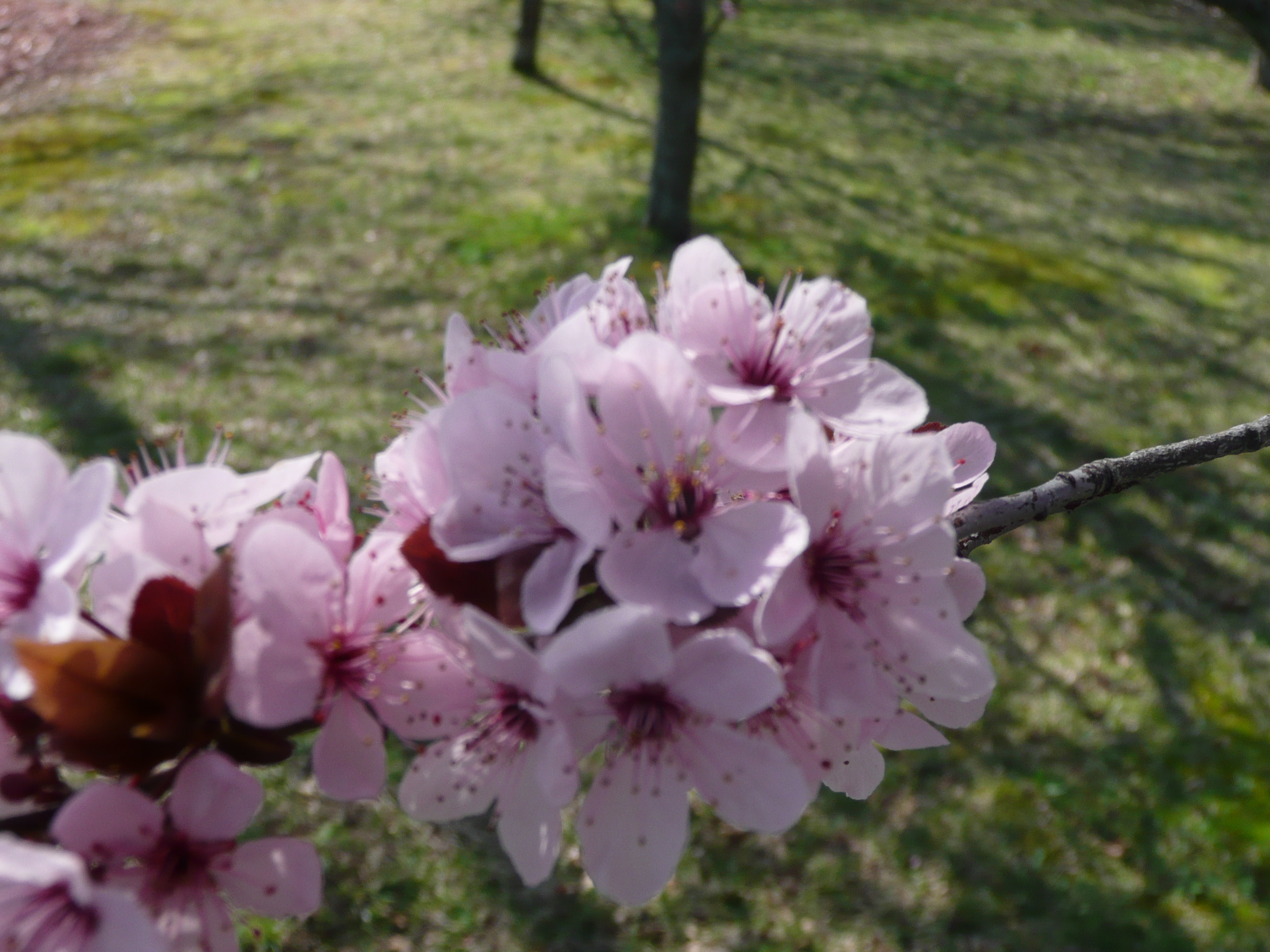
Prunus

Last year, I asked my brother, Sylvain, to let me know when his trees are in bloom so I could pop by to take a couple of photos.  He did so as requested then, and he just called me again this week to let me know that again his flowering plum trees are in full bloom. 

“Cathy,” he said, “It is like being in church when you stand in the middle of the trees.”  I liked hearing that comment from my brother. 

He continued, “The blooms only last a couple of days, but they are really popping open now if you want to come by again.” 

I don’t have a need to take more photos, but I surely enjoyed hearing the excitement in his voice about the trees he carefully planted a few years ago.  His annual ritual of appreciating their spring awakening is something I find pleasing, especially because he picked up the phone to share it with me.

Sylvain’s refers to his trees as flowering plums, but many know them as Cherry Plums.   In fact, the Latin name, cerasifera, is from the words cerasus (cherry tree) and ferre (to bear).  A common cultivar is the Thundercloud Plum (Prunus cerasifera ‘Thundercloud’).  It has dainty fragrant five petaled light pink flowers that appear in early spring before the plum-colored foliage fully expands, usually quickly following a temperature warm up like we just experienced. 

Last year, Sylvain’s trees bloomed around April 7th, and when I took photos of them against a clear blue sky, it was vivid and refreshing to my eyes.  This year, the blooms arrived a few weeks later.  We both were hoping for their showing during our family Easter celebration at his home five days ago, but nature and temperatures have a mind of their own. 

The Thundercloud Plums typically reach a height of 20-25 feet at maturity with a spread of 20 feet.  They enjoy full sun and can take part-shade too, but the blooms may not be as prolific in shade.  Also the leaves may turn green.   And it is important to note that while they are very showy for the flowering and darker toned plum foliage, they do have some susceptibility to insects and disease problems but so far Sylvain’s trees have experienced none.  And lastly, there are small fruits that follow the flowers which may drop so you might not want to place this specimen near an area you wish to keep free from debris. 

Ah Spring

Sylvain has his planted in a row along the edge of his property.  Some may find this a bit too much, but not us – we love the effect of a flush of the blooms.  As Sylvain said, just stand under them and have your moment.  Perhaps because it is fleeting, it is all the more enjoyable.  

Maybe I will go over to his house today to snap a couple of photos after all.  After writing this posting, I feel I can’t resist seeing them again before the blooms drop to the ground.  Plus it is a bright, sunny, warm day.  Perfect for some photos and a breath of spring air.  Enjoy your warm up this weekend too, Cathy T 

To learn more about these trees, visit UCONN’s Plant Database:  http://www.hort.uconn.edu/plants/p/prucer/prucer1.html

The Fashionable and Hot Capsicum ‘Super Chili’ Pepper

Leave a comment
Hot and Fashionable

Pepper Power

Last year, at the “Gardens, Gallery and Gifts” event held in Broad Brook, CT, I included an annual pepper plant in an intense purple container mixed with portulaca, variegated basil, and a dwarf canna.  It was one of the first to sell, and the person who bought it was Lisa, my older sister.  She and my other 2 sisters attended the event which included displays of my container garden designs and other artisan works by Connecticut women artists.

The pepper plant is what caught Lisa’s attention first.  She often cooks up hot and spicy meals, such as her famous jambalaya, red beans and rice, or shrimp etouffee stew.  For several years, she lived in New Orleans thus she knows how to do up these dishes up right, always starting with a roux, and making shrimp stock from scratch.  And, of course, adding a variety of very hot spices.  In the summer months, she uses my father’s fresh garden grown tomatoes.  But whether served up in season or during the winter months, we always enjoy the huge steaming portions from her large Dutch ovens at our family gatherings.  It is excellent every time.

Capsicum ‘Super Chili’ by Sara’s Superb Herbs (www.superbherbs.net) was the pepper in the container she selected that day.  Lisa planned to replace her normally dry ingredient of cayenne in her Cajun creations with the peppers as soon as they were ready.  She is the type of shopper that always wants a value driven product, and this container’s plants had their fringe benefits to suit her cooking style while offering ornamental blooms as it sat outdoors during the summer on her patio. 

The upright basil in the container, Ocimum x citriodorum ‘Pesto Perpetuo’, was another herb she likes to use, plus she said she enjoyed its variegated light green foliage edged with white creamy coloring.  This basil culinary herb grows up to 4’ high and doesn’t flower.  It can be taken indoors at the end of the summer season to continue using as needed for recipes.  And the canna rhizomes can be stored in the fall for reuse in her containers the next year.  Fashionable and hot, her purchase provided sustainability in the kitchen and beauty on the patio.

The ‘Super Chili’ pepper had long slender green fruits of about 1” long when she took the container home that afternoon in June.  As noted on the plant’s tag, you can pick some of the first few chili peppers when they are still green to encourage a longer fruiting season and heavier set.  This plant grows to 24” tall and wide and appreciates well drained, rich soil in the full sun for best growth. Lisa placed her container on the corner of her back patio.  Her backyard has a western exposure and receives lots of wind since it is situated on a big hill facing a wonderful view.  Because ‘Super Chili’ Pepper likes it hot and sunny with good air circulation, it thrived in this location.  It received full sun most of the afternoon but the shade was also appreciated from the overhang of her deck above.  

As for me, the characteristic I enjoy most about using pepper plants in container arrangements is how the peppers will ripen to brilliant colors as they mature.  Many will start off green and change to red, yellow, purple, orange, and even black!  The ‘Super Chili’ ripens to a brilliant red and grows to about 2.5” long.  Peppers don’t get bothered by pests usually.  No maintenance worries, you don’t need to check it for insects, or groundhogs that sometimes visit container gardens.  Other than warning anyone wanting to temp a bite of the raw pepper, this type of vegetable is worth including in mixed arrangements with other sun-loving annuals, perennials, and tropical plants. 

For this year’s show, I decided to place orders of a pepper that matures to a purplish black color.  It is Pepper ‘Comstock’s Purple’, a cross of the Tasmanian and Jwala peppers.  The habit is a strong and erect with the elongated purplish fruit pointing upwards toward the sky from the tips of the stems.  As the fruit grows larger, it will hang down from its weight against the dark green foliage.  Comstock’s Purple has the same heat as cayenne peppers and grows to about 24-26” tall, also appreciating full sun.  If you want to see them, come to the show in June this year where they will be available for sale.  For more on that, see www.facebook.com/gardensgallerygifts.

Lisa told me she collected the remaining branches from her pepper plant in early fall and kept them for use later.  Would you believe at Christmas time?  She put the dried branches with their bright red peppers still dangling on into vases with other evergreens.   She said it was fun to have them displayed during the winter, and again, being a frugal minded person, she was very pleased to reuse her peppers a third time for decor purposes, now indoors!  She enjoyed informing her dinner guests about how the showy vibrant red peppers in the vases are those also used in the meal providing a warm and comforting feeling so needed on cold winter nights.  

So when mixing up your container selections this season, don’t overlook hot peppers for their ornamental value and edible appeal!   Cathy T