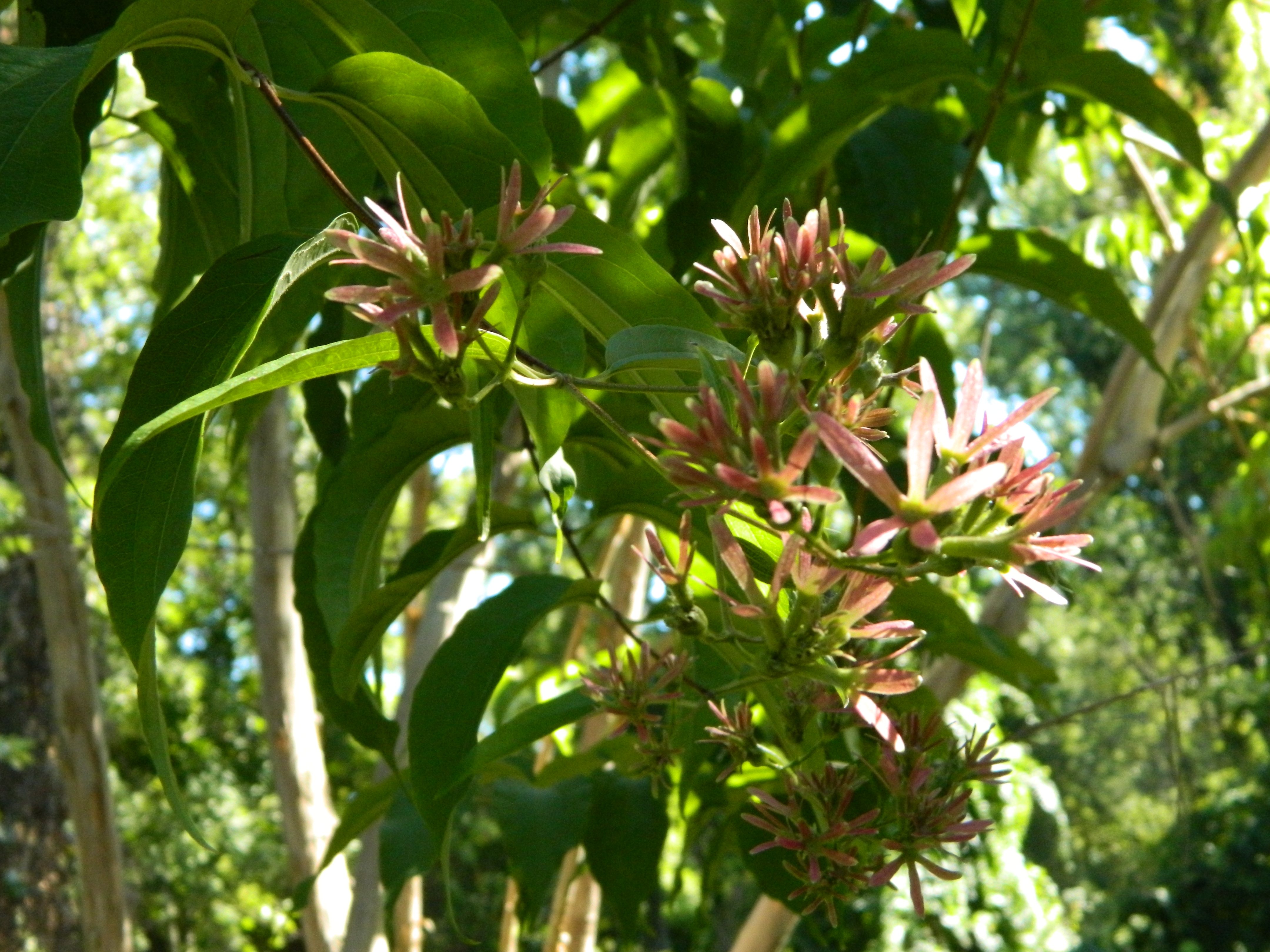
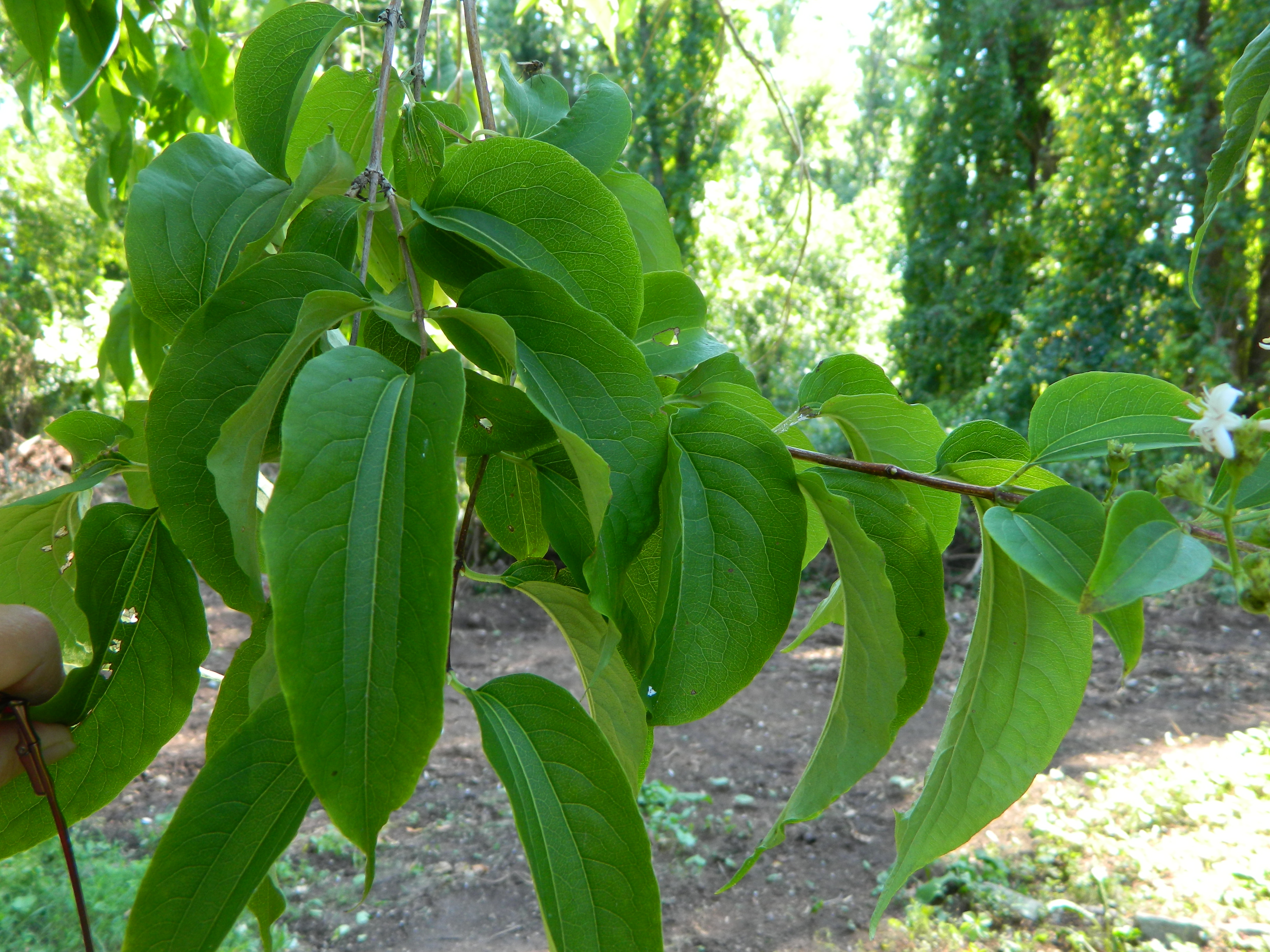
As an update to my September 20th post, below is a photo of the rose colored fruit capsule with sepals on a Heptacodium miconioides. After the flowers dropped, the change from green to this color occurs. This early fall feature adds another layer of interest to this shrub/tree. So besides the six tiered airy flowers, it has seven great benefits in the garden: 1) attractive green leaves emerging in spring, 2) fragrant white flowers in mid summer, 3) butterflies visiting, 4) grayish stems exfoliating for year round interest, 5) rosey-red coloring after flowers drop for fall interest, 6) a medium growth rate, and 7) its unusual and different. To learn more, read the post prior to this one. Cathy T
Heptacodium miconioides, Seven-son Flower
3 CommentsThere are not many times I have a “hear the angels sing moment” during an onsite evaluation at a homeowner’s property, but it happened to me just last week.
There it was, around the corner, by a moss-covered gazebo, a beautiful Heptacodium miconioides.
Later, upon my return to their property, I took a closer look and photos. I confirmed…, “Yes, it is a Heptacodium — and lucky me, it is in full bloom right now.”
This plant, native to China and a deciduous shrub, can grow or be trained into the size of a small tree. It can reach 15-20 feet tall with a spread of 8 to 10 feet. The specimen I was adoring at that moment is the size of a glorious mature tree. It has been here for a while, I thought.
Heptacodium’s common name, Seven-son Flower, comes from the feature of seven flowers being born in clusters. Tiny and white, they are positioned at tips of wirey pedicels. If you look closely at this photo, you can see seven closed flower buds on one, while others are open. Delicate and fragrant, the flowers are simply elegant due to how they are positioned and carried above nice, new looking foliage.
Heptacodium’s foliage expands early in spring, is soft to dark green, shaped ovate and long, reaching a slight pointy tip. The veins in the center run down while the side veins run out causing a cupped effect on some. Handsome, fresh and clean, the foliage makes a perfect partner to the elegant, white, late season blooming flowers.
Then comes the bark supporting it all above. It exfoliates. The peeling of the bark on this is layered in strips on multi-branched stems, showing a lighter toned inner bark. The strips remind me of something, but I can’t place what – almost like a raffia or ribbon. You almost want to take a piece and peel it away, but of course, I certainly would not. At least not at a client’s site!
This plant is hardy to Zones 5 to 8, and I have seen it at a local nursery near their pond gardens, a perfect location for it appreciates moist to well-drained soils. In fact, it was when I was very new to the job, and a customer visiting the store asked me what it was. I remember, I rushed everywhere trying to find out – and ran up to the landscape manager who finally id’ed it for me. He later told me the customer was extremely impressed that I made every effort to find out what it was. At the time, I had never seen it before.
My excitement for this shrub is just as intense now as it was over five years ago when I saw it that first time. And I know it will continue to intrique me, for in the fall, more features will appear – the sepals turn reddish. This tree, rare and often difficult to find in nurseries, also attracts butterflies.
It enjoys sunny locations, but will tolerate some shade – as this one did. It “was” located in a shady location with some dappled sun, but this season, it has been receiving the sunlight it has yearned for, due to the removal of several broken trees from last year’s October snowstorm. In some ways, the storm last year provided improvements to gardens – and it certainly did for this Heptacodium!
Some more information:
Family: Caprifoliaceae
Habit: Upright, loose, …as Dirr says, “Almost artistic”
Texture: To me, coarse on bark, bold on leaves, soft on flowers
Value: Rare, Elegant, and Classic (Coincidentally, this my client’s preferred style too)
Season of Interest: You know if you read this blog, spring to winter! All year-round.
Thank you for visiting, Cathy T.
Sunsational Buttonwood Farm
Leave a commentLast week I felt like I needed a little sunny inspiration, so I asked Louise, my sister, if she would like to tag along with me to go see the sunflower fields at Buttonwood Farm in Griswold, Connecticut.
I heard about this farm via a photographer friend who posted her wonderful sunflower photos taken at this site on Facebook. She posted pictures from her visit last year too, and I had promised myself to not miss the opportunity to go see these fields of sunflowers this year.
The night before our planned visit, a television news station said they would be previewing Buttonwood Farms after the next commercial. I asked my husband to quickly change the channel because I didn’t want to see a preview of something I planned to go see live. Savoring the moment in person was my plan, and we left early the very next morning on July 24th to do so.
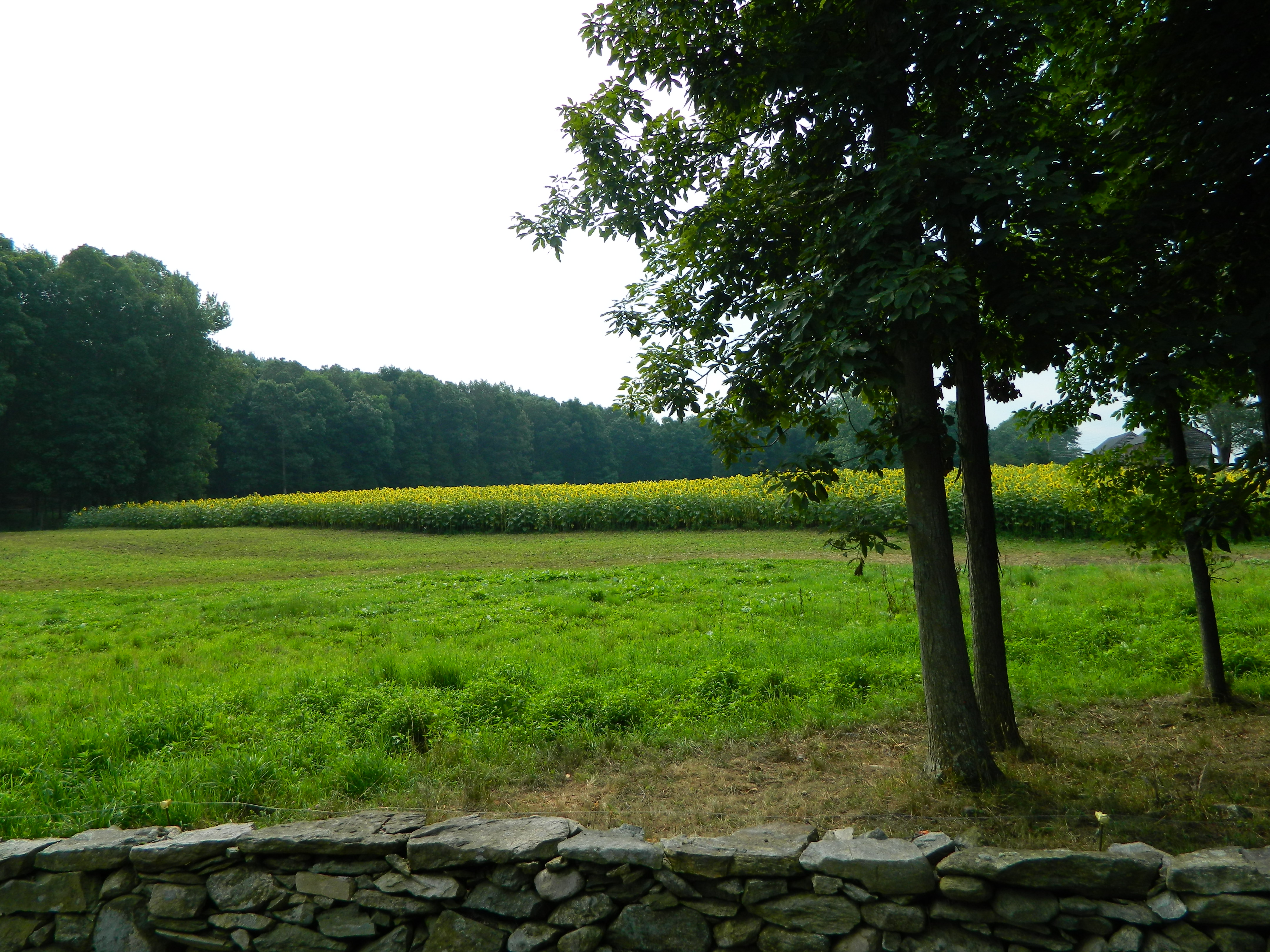
Buttonwood Farm is located at the junction of Routes 201 and 165. The fields of sunflowers are situationed in a wide open area of 4 acres framed by a few old barns, stone walls, and trees along the backside. Across the street are fields of evergreen trees. It was about an hour’s drive from my home and worth the trip upon the first moment we arrived.
As we approached the fields, we spotted the farm tractor with a train of attached cow carts awaiting the children to arrive that day. At that moment, I felt a tad bit guilty for not inviting my niece along, my sister’s daughter, but I also knew our objective of taking photos of the sunflowers would be more productive without a five year old in tow. “Next year,” I thought, “We’ll take her here.”
Buttonwood Farm holds a Sunflower for Wishes fundraiser every year when their sunflowers are peak for picking. Buckets of cut sunflowers are offered for sale, $5 a batch, to benefit the proceeds. I definitely wanted to check out those cut sunflowers, but first, our objective was to walk through the fields and just have fun taking photos with our cameras.
For this visit, I decided to not use my trusty iPhone, and take out a new digital camera I bought last winter. My sister used her old fashioned camera; the type that still uses film. We started clicking away as we walked past a couple of artists painting the scene beyond on their canvases. It was one of those moment that I felt a tranquilty and excitement at the same time. Yup – from sunflowers, because there were so many!
Louise quickly whisked away, taking photos from different angles and elevations. I have always believed she is an amazing photographer, with a natural talent, although she has debated that with me at times. However, a few years back, a book company contacted her regarding a photo she took in Italy, and it “almost” made it as their front cover. She remembered that photo as we continued to take photos here and there at the farm.
The field of sunflowers faced the rising sun and as we winded through the path, I was facing the back of the sunflowers’ heads. It was kind of a comical feeling, like a bunch of people having their backs turned to me, then at that moment, I thought, “Hmm, I’ll take some shots of the back of the sunflower heads for fun.” We always take the face of the flower usually.
During our walk and shots, birds bopped in and out of the fields, a hummingbird buzzed in-front of my face, and we saw dragonflies too. Soon we were done though taking photos and felt like we had our sun buckets full of yellow cherry inspiration. We decided it was too early for icecream made fresh at the farm, so we checked out the cut sunflowers for sale at $5 a bunch for the fundraiser, and then headed back home. This visit was just the right amount of sunny inspiration I needed.
For your visit next year, remember Buttonwood’s Sunflowers for Wishes fundraiser to support the Make-A-Wish Foundation of Connecticut. This year’s event was held from July 21st through July 29th, and I’m glad we didn’t miss it. They run it for 10 days every year, and the farm is open from March to October also for their hayrides and other events. 
To learn more about Buttonwood Farm, visit their website at www.buttonwoodfarmicecream.com, or www.ct.wish.org. You will find it sunsational, I’m sure. Cathy T
A Major Invasive Pest Arrives in CT
Leave a commentHave you ever heard of EAB? It stands for “Emerald Ash Borer” — and it has been detected in Prospect, CT for the very first time.
However, unless you are involved in keeping up with insect news, trees or invasive plants, you probably have no clue what EAB is — or how you can unknowingly contribute to its spread.
This is why I thought it is important to share, in its entirety, the memorandum below recently issued by the CT Agricultural Experiment Station (CAES) of New Haven, CT, with their permission. It was issued to Master Gardeners on Thursday, July 26, 2012.
The memo below details the detection of EAB, a small shiny metallic green wood boring beetle, in Prospect, CT on July 16, 2012. This is the first record of this pest in our state, and it was a confirmed identification by federal regulatory officials.
Again – this is the first record of this pest, the Emerald Ash Borer, in Connecticut.
Although the EAB insect is small, approximately 1/2″ long and 1/8″ wide, it has been very destructive to ash trees, killing millions of them in other states, such as MI, OH, and IN. Its larvae tunnels under the bark leading to eventual death of the trees.
Ash trees, as noted in the CAES Press Release linked below, make up about “4% to 15% of Connecticut’s forest and is a common urban tree.”
Because EAB was destructive in other states, special detection measures were put in place by authorities and volunteers here in our state. One detection method was the installation of purple traps by the University of CT Cooperative Extension System. In fact, I wrote about seeing a purple trap hanging from a tree one day on Facebook last year. Some Facebook friends may remember I posted comments and a link about them. Other Facebook friends said they had seen them too, wondering what they were. The purple traps are shaped like a prism box and contain a chemical lure. These traps help to locate three EAB in Prospect, CT – but the traps were not the only detection methods used.
Another method was by way of monitoring ground-nesting wasps, as detailed below in the memorandum. The wasp collects the bodies of beetles, and long story short – EABs were found in the wasps nests. This was a method of following the hunters trail, so to speak. And it was successful due to the efforts lead by “Wasp Watchers” networks, also detailed in the memorandum below.
Now comes our potentially harmful role, as humans of spreading the insects. Firewood. And don’t we know…?, we have a great deal of stocked firewood around this season as a result of last October’s damaging storm, and other rainstorms this summer. Many trees have been chainsawed by homeowners and piled up for sale. Imagine, for a minute, if those trees were ash trees, and some had the beetle larvae under its bark?
If you attended any agricultural fairs recently, you may have seen pamphlets asking folks to not move firewood – especially from state to state or to campsites across state lines. Moving firewood from state to state can be an very easy way of spreading invasive insects. Well, you get the idea, you could be helping to spread a pest to another uncontaminated state.
This is why I requested the permission to release the full details of EAB’s detection, description, harmful potential to trees, and regulations outlined in this memorandum below. It was emailed by Katherine Dugas and Rose Hiskes of the CT Agricultural Experiment Station to Master Gardeners. And I appreciate their quick response of approval to share the memo, so I could share this news to gardeners and tree lovers.
Also, I’d like to note important credit to Dr. Rutledge and her team of “Wasp Watchers” — as they have been coined, for they are responsible for finding the EAB via their efforts. And because of them, and many others, we and our CT trees have a head-start on action plans to prevent major distribution or destruction of ash trees. As the press release indicates, “this pest attacks all species of ash trees.”
Well, I’ve tried to explain this new EAB pest news as best I could above, but should you want to read the complete formal details – here they are below. Please read on and share the story of the EAB and firewood where and when you can. Thank you – Cathy T
MEMORANDUM from CAES to Master Gardeners:
Hello Volunteers and Listserv Members,
EAB has arrived. It has been clear for a while that discovering EAB in Connecticut was only a matter of time, and that time was last week. The beetle arrived at CAES on Monday the 16th and was sent off for confirmation to various federal agencies (USDA in Michigan and then DC). Final confirmation was received on Wednesday the 18th. You can read the full CAES press release here:
This find is special. Unlike other EAB finds which have been from purple traps, the first official CT EAB was found in the posession of a small native ground-nesting wasp, Cerceris fumipennis. Dr. Claire Rutledge of CAES has been conducting biosurveillance for EAB using this native wasp for the past few years with the help of US Forest Service funding and a network of hardworking volunteers, known collectively as the ‘Wasp Watchers.’
Biosurveilance with this wasp started in Canada with Dr. Steven Marshall, Dr. Bruce Gill, and Phillip Careless, M.S. The program has since been expanded into multiple networks of Wasp Watchers in many states and regions. For more information about the program, go to http://www.cerceris.info<http://www.cerceris.info/>.
The wasp has no official common name, but it has affectionately been nicknamed the “Smokey Winged Beetle Bandit” (this name has now been submitted to the Entomological Society of America’s committee on common names!). Female Cerceris dig nests in hard packed sandy soil in areas that are near a wooded area and in full sunshine (Baseball fields are ideal). The wasp will then stock her nest with the paralysed bodies of Buprestid beetles, a family of beetles of which EAB is a member. The idea is that if EAB is present in the area, then the Cerceris will eventually encounter them, capture them, and bring them back to the nests. The Wasp Watchers intercept the female wasps on their way back from hunting trips and collect the paralyzed beetles (the wasp is released). The beetles can then be identified.
The first EAB came from a Cerceris colony in Canfield Park, Prospect. So far Dr. Rutledge and her Wasp Watchers have found 34 more from the same area, as well as 3 more at Fusco Field (about 1 mile away). Subsequent examination of the purple traps in the Prospect area found that one of them also caught 3 EAB. A trap in adjacent Naugatuck has also yielded 3 additional beetles.
…so where do we go from here? From an outreach standpoint, our message remains unchanged: limiting the movement of firewood prevents the long-distance spread of EAB and other invasive species. From a regulatory standpoint, CAES and DEEP are now working to put the following measures into place:
A quarantine zone that would prohibit the movement of certain wood products out of New Haven County, the area in which EAB has now been detected
A ban on the importation of firewood into Connecticut through New York or Massachusetts – unless it is properly certified or has not come from an area of infestation
Additional detection traps in the Prospect area to monitor the presence of EAB and help assess their presence
A “delimiting” survey to help determine the area in which EAB is present and the extent of the infestation
Suspension of all timber contracts and firewood permits for state forest lands in New Haven County
A survey with federal agencies to determine how long the EAB infestation has been present in our state, information which will help determine best strategies for addressing it
For more information on these measures, see the joint CAES/DEEP press release here: http://www.ct.gov/dep/cwp/view.asp?a=4173&q=508280
Needless to say, it is going to be a very interesting year for outreach! We’ll keep you posted with any new updates. Thank you all again for all your support and interest!
Katherine Dugas and Rose Hiskes
The Connecticut Agricultural Experiment Station
123 Huntington Street Box 1106
New Haven, CT 06504
Insect Inquiry Office: (203) 974-8600
http://www.ct.gov/caes
Update to this Post:
Last nite, as I browsed a horticulture magazine for professionals, I read insecticide trial protected ash trees in Chicagoland communities, with a survival rate of 95 percent. Nearby trees died from the EAB/emerald ash borer heavy infestations. The link to the magazine is not working properly this morning, so I did not share here yet. Cathy T
CONTAINER SUMMER CARE
Leave a commentCONTAINER SUMMER CARE
What I love about container gardening is the “low-maintenance” factor. I don’t have to weed them (remember, soilless mixes for containers are free of weed seeds), I won’t see ants under the mulch when I go to work on them, I don’t have to “edge the bed”, ugh does that take the wind out of me on a hot summer day (unless you are lucky enough to own a power edger), and I don’t have to mulch my container gardens.
But around this time of season, mid-June, is when I keep my eye out for insect damage. There may be a rare visitor taking an appetizer crunch out of the leaf, and if I found a hole ridden leaf, I just grab a clean pair of pruning scissors and snip it off. Very rarely is a spraying required. If the problem is bad enough for spraying however, you may want to move the container away from other containers, then determine what exactly is eating your plant before taking action.
Start following an inspection routine as you water your container gardens, that way, you’ll enjoying looking at the plants’ features and flowers and get the double-duty of checking for any insect damage. You may find some Japanese Beetles right now because they have grown into mature stages from their prior grub stage in the ground. I’m starting to see them. But overall, container gardens are less subject to attack, especially if you start with a healthy environment for your plant’s roots, as discussed previously on my recent television appearance covering my five musts to container gardening success. If you haven’t seen the clip, it will reair on July 4th, 2012 at 12:30 pm on the CT Style program, WTNH.com, Channel 8. Sure, you might be having a hotdog and beer then, seeing as it is July 4th, so if you can’t make it to the t.v., just visit the Video Gallery on this blog to see it.
WATERING ROUTINES
Watering is mandatory – or forget being a successful container gardener. Direct the water at the soil, not the plants. I find “watering wands” work best for they provide a nice shower and you can reach the soil top easily. Insert your finger into the soil if you are not sure – and if it is moist, your soil moisture may be okay. Look at the plants too. If the bottom leaves are yellowing, there’s a chance you are overwatering. It is best to water in the morning if you can because the plant will use it during the day. As for hanging baskets, it is good to water until you see water dripping from the bottom drain holes. For big container gardens, you do not need to water to the point of seeing it drain from the bottom, that would be over doing it. Watering is a bit of a science and an art. It takes some practice. And I offer some more tips about the how-to’s for watering during my Container Garden parties, and on the above mentioned t.v. appearance. See my Video Gallery for more.
FLUX TEMPERATURES
A couple years ago, our season received rain-rain-rain. The next season it was hot-hot-hot. Last year, we got SNOW in October. Wow, Mother Nature, as I always say, has a mind of her own. This year, the pattern appears to be a state of flux. One day it is HOT, up to 90 or even 100 degrees, and next thing you know it is cool, where I’ve actually had to grab a light sweater. What is up with that? Well, as for the tropicals, like the banana plants, elephant ears, and canna plants, they like that tropical hot weather and will perk up and thrive. The main plant I’ve had some troubles with due to the flux temperatures is my cacti. My agave and kalanchoe got a little yellow – a huge disappointment because I saved these plants in their containers all winter in my home as houseplants. They don’t like cool, wet temperatures, and hopefully that will not continue. But as the heat rises, so does our watering routine. Watering also depends on the weather – and the type of plant, another factor to consider. Pot types are also yet another factor. Black pots for example will retain more heat, clay pots will dry out faster, small pots will dry out faster than big pots. Consider your plant type, and increase the watering if they are prone to moist soils, decrease watering if the plant is prone to dry soils. If they are dessert like cacti, be careful – don’t overwater. A good sign that you have neglected watering is if you see bubbles rising out of the soil. This not good, and you may have to actually soak the pot in water! So start off right, and pay attention to our flux temperatures and react appropriately. Stressed plants are more prone to insect damage, by the way, so don’t let them get stressed. Just as with people, stress can make us look bad.
VACATIONS OR TRAVEL
Another dilemma is what to do if you go on vacation or travel for work. For me, taking a vacation in summer is a huge problem – who will water my beautiful plants while I’m gone?! But there are some things you can do to limit this challenge. Get an irrigation system setup on a timer. This is something that may require an investment and some homework, but if you have a high number of container gardens on your deck or patio, it may be worth it. Or you can group your containers together in a more shady spot so they don’t get exhausted from the sun while you are on vacation. But in my case, when I go on vacation, I make sure to water every container garden well, do the sign of the cross, and line up an assistant waterer prior, or beg a friend or family member to water while we are gone. Another trick is to fill a bucket with water, set it near your pots, and use a rope or piece of cloth to serve as a wicker that will draw the water from the bucket to the pot. It may look a little funny but it can work or help a bit of the watering situation while you are on vacation. But the bottom line is, you can not let just the natural rain fall handle watering your containers. To make it a little easier on the good friend you ask to water while away, prefill some watering cans and place them near your containers, or put out rainbarrels to capture the rainwater should a downpour happen while you are away, so they can find alternative water sources instead of just dragging the hose around. And be sure to bring them home a nice gift from wherever you traveled!
FERTILIZER REQUIRMENTS
Adding slow release fertilizer granules during potting and assembly time will feed your plants between 3-4 months or 3-6 months, but there are many other fertilizer choices out there. I find if I used quality soilless mix, follow a good wateingr routine, check for insects around now, and used a slow-release fertilizer at the time of assembly, I don’t need to reapply fertilizer at all. However, some plants demand more fertilizer than others. So choices range from controlled release pellets, think a thumbnail size of granulars bound together to look all stuck together. They get inserted into the soil, where as the individual granular prills are added to the top 1 to 3 inches of the soil in container gardens during assembly. There’s also water soluble fertilizer that is mixed and applied during your watering routine. Both of these, the slow release granular prills and soluble fertilizer are inorganic types, but there are many, many choices for organics. It will breakdown at different rates in the soil, but they key is to consider whether your plant needs it in the first place. Read labels, look at your plants’ overall health, and determine if they have high fertilizer needs. Some people think plants don’t need any fertilizer, and I would have to disagree with that for plants in container gardens. Remember, the routine watering required in a container environment will leach the nutrients out plus, plants are putting out a lot of energy during our summer season to bloom and grow during warm temperatures, so be sure to add something to help them be beautiful and thrive. Don’t let them go hungry – without them, we would have no food.
VIDEO GALLERY
I’ve updated my page on, titled “Video Gallery” with some new media – check it out. This is a place I plan to regular share tips, and also, video’s of friends’ gardening tips. Recently a friend showed me how she and her boyfriend divided asparagus ferns, with an axe! That didn’t surprise me because the root systems to this plant gets quiet strong. Unfortunately, the sound did not record, so it isn’t posted, but be on the lookout for them soon. And be sure to visit often so you don’t miss the latest. My two most recent posts show healthy roots and repeat performers. Click above to see more.
ESSENTIAL OILS
If you happen to be reading this post today, Thursday, June 28, and are free this evening, plan to attend tonight’s talk on Essential Oils. It is the perfect evening to enjoy some light bite sized appetizers, learn from a professional about the herbs used in high quality oils, and talk about plants too. See my “DIY and How-To’ page above for more. There’s still time to register – call me today: 860-977-9473. It a great evening for some review on the healing powers of plants – they are not just visible to the eye but offer many medicinal benefits. Hope you will join us – sorry bout the typo’s – I got to go – you know, to take care of my container gardens now!
Thanks for visiting! Cathy T
Plant Labels and Nursery Tags
Leave a comment
When I first started working at a garden nursery, I remember the owner showing me where the plant labels and nursery tags were kept way in the back of a storage space in a boxes on tall shelves. I asked him what he does with the left overs and he looked at me perplexed. I wanted them, and he had no problem with letting me take them, although I guess he wondered why.
To me, plant labels are an amazing resource, a mini-library of sorts for looking up details about a plant you just purchased or one you have been admiring in your garden for years. I keep my plant labels in a box and sometimes when I can’t remember a particular detail, I may rummage through my boxes to find the label. It can be a bit of like going through an old photo album where the other pictures (labels) I look through remind me of fun days of the past. I’ll come across labels reminding me of a plant and how it performed, where it was used, and it also reminds me that I’m plant crazy. I sure have tried out alot of varieties.
Of course, today the QR Codes right on the plant tags and labels, direct you instantly to detailed information about the plant or product via your smart phones with an instant scan. BTW, here’s mine to my Facebook business page. (Note: The buttons are not showing in the correct language, if you know why, tell me – I’m new to this.)
I find the QR Codes are super helpful as well, so perhaps my old box of labels will be retired to the recycle bin or, heck, maybe some day they will be collector’s items just like old concert tickets or baseball cards. With technology, who knows. The younger gen may look at a plant tag someday in the far future, and ask, “What’s that?”…, like they do with record albums. But, for now, I have to say, when I see a “good label,” I still have the urge to keep it in my reference box of labels and nursery tags.
That happened just the other day, yet this label for the plant was one I could not fit in a box. My husband and I were shopping together, and he saw a blackberry plant. “I want this,” he said. Well, I thought, I don’t get into planting fruiting deciduous vines too often, except for the unusual ones, like two kiwi vines I have growing (which take five years to produce fruit), plus we have wild berries on our property along the woods along with wild grapes, but hey, if he wants a blackberry plant – so be it, a blackberry plant I will tend to for him.
So last weekend, I potted it up into a big container – yup, I could not resist the urge to put it on the deck with a pretty mini trellis versus planting it in the ground somewhere. It is already poppin’ out buds, so he will get berries on his plant this season.
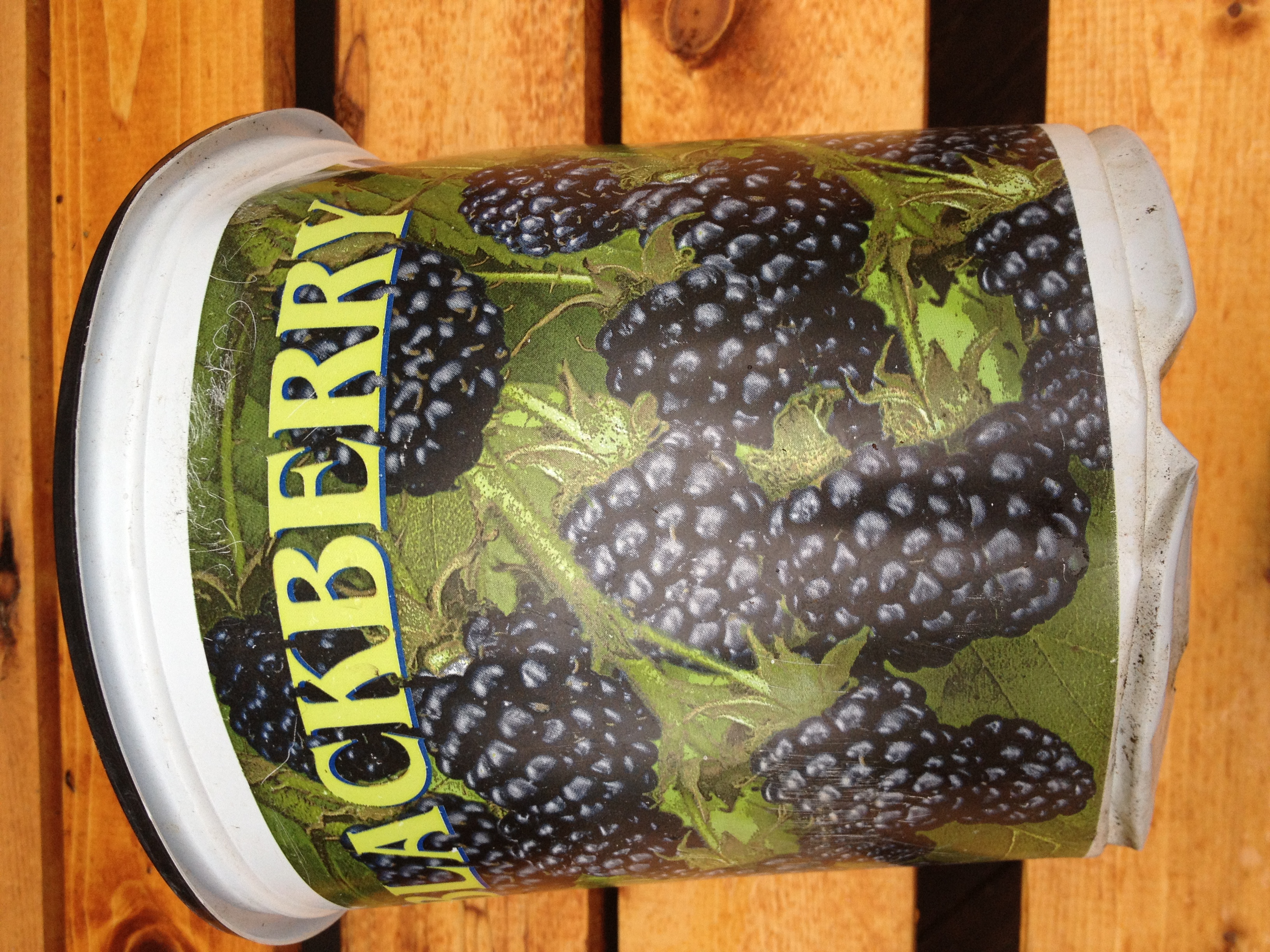
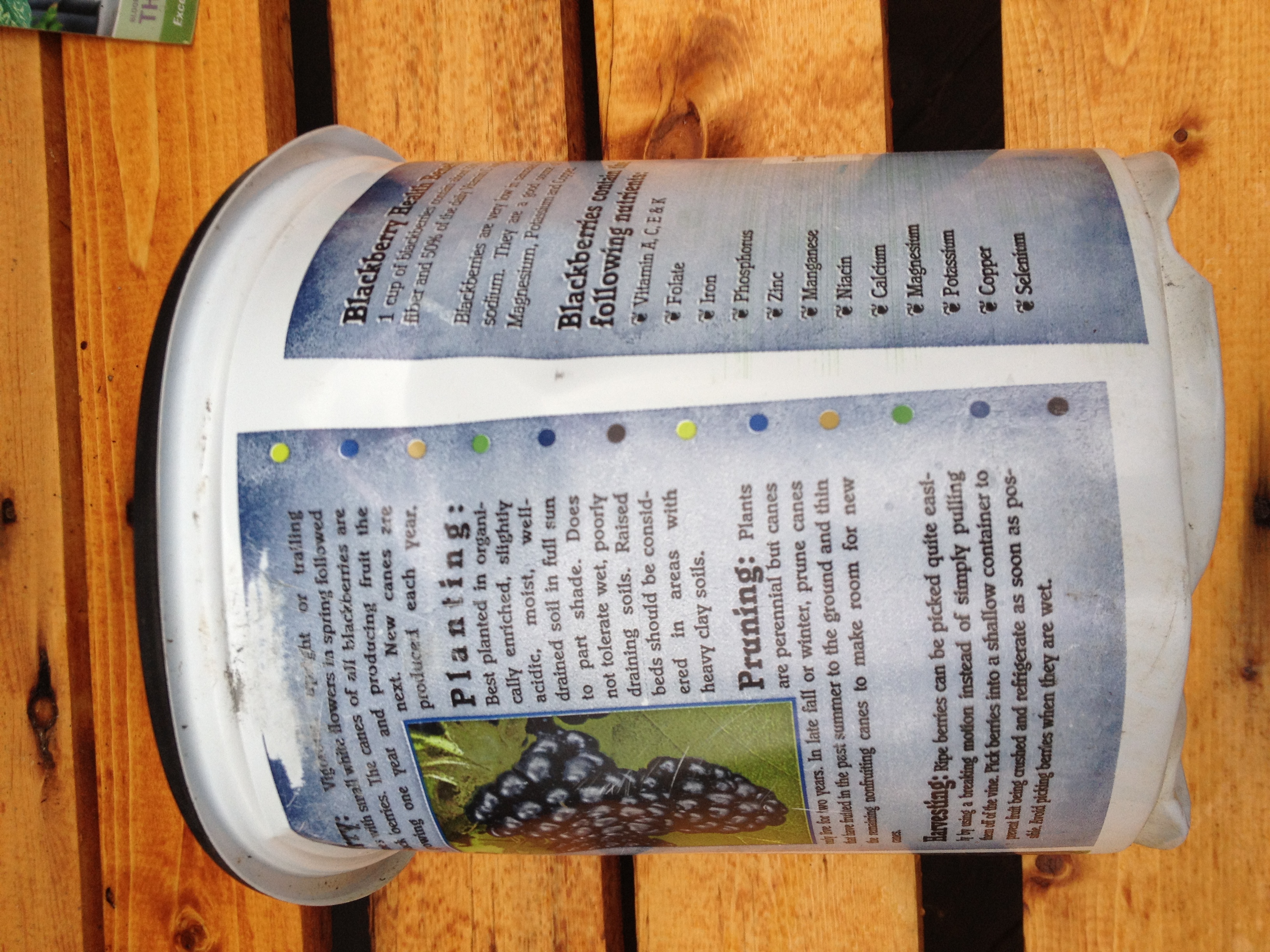
But back to the label, it was actually printed on the outside of the pot with color images. The pot was the label. Listed is the habit of the plant, how to plant it, when and how to prune it, and the harvesting instructions. Turning it around to the other side of the pot, it also included a list of “Blackberry Health Benefits.” Did you know?…, “1 cup of blackberries contains about 33% of the daily dietary fiber and 50% of the daily Vitamin C suggested intake.” And they are “low in saturated fat, cholesterol, and sodium.” All good.
Next to be listed on the pot was the “nutrients…” such as Iron, Zinc, Niacin, Calcium, etc. That pot creation with the details on the pot is a job well done by the grower, also stamped on the pot by Berry Family Nurseries of Tahlequah, OK. In checking the bottom of the pot, I noticed it has excellent drainage holes – 8 to be exact, and a recycle number so it is recyclable. Because all the information was right there on the pot, the information was not lost (as happens with other removable plant tags) and I liked the color image of the berries on it too.
So what do typical labels tell us? Many will have the exposure (full sun, shade, etc.), the Latin or Botanical name of the plant and its common name, a photo of the plant, and of course the price. Some labels will offer where to find out more about the plant and many today, probably all, have the QR Codes which you can snap a photo of or scan with QR Reader application to get more detailed information about it. Usually the care and maintenance is listed along with planting steps. And a good label should include its planting zone for which the plant is suited to, especially with many zones warming up. Sometimes if I spot a plant I haven’t seen before at a grower’s or nursery, I’ll look at the zone on the tag…, and yup, it doesn’t happen often, but it may not be for our zone in CT, but if you are like me, that is okay too for I like planting plants in containers and enjoying them anyways. I don’t limit myself to just my zone for container gardens. Some labels may include information that it is for your region with words like, “Plants for the Northeast.” Words handy for those that want to ensure they have a hardy candidate for their plantings in the landscape or gardens.
There are alot of nursery tags and labels in vibrant colors or with little logos or recognizable icons. Take Jeepers Creepers for example. They have a cute little lady bug character on the tag next to their brand name. Proven Winners labels are instantly noticed, not only because of their logo and label but because of their pot too. Often white with the big PW trademark on the side. Some labels are cut out in shapes, like Sara’s Super Herbs will have the top of a pepper plant shown with the label in the shape of a pot with a plant on top. Their labels contain alot of details and I like that. But again, with the QR Codes, perhaps labels will be reduced, which helps with the recycling issue, less plastic trash and production of paper products, I would imagine. Lastly, many labels also tell you if their tag and pot is biodegradable. We are certainly seeing more of those which is a good thing.
Labeling plants can present challenges for the growers. They must stay attached to the pot, be able to get wet from watering of the plants, and I imagine are a big cost to produce. But they are a must, for a plant without a label is really not very helpful to the gardener, especially if you want to pick the right plant for the right place and learn the plants details and features. Cathy T
The Hearts of the Market
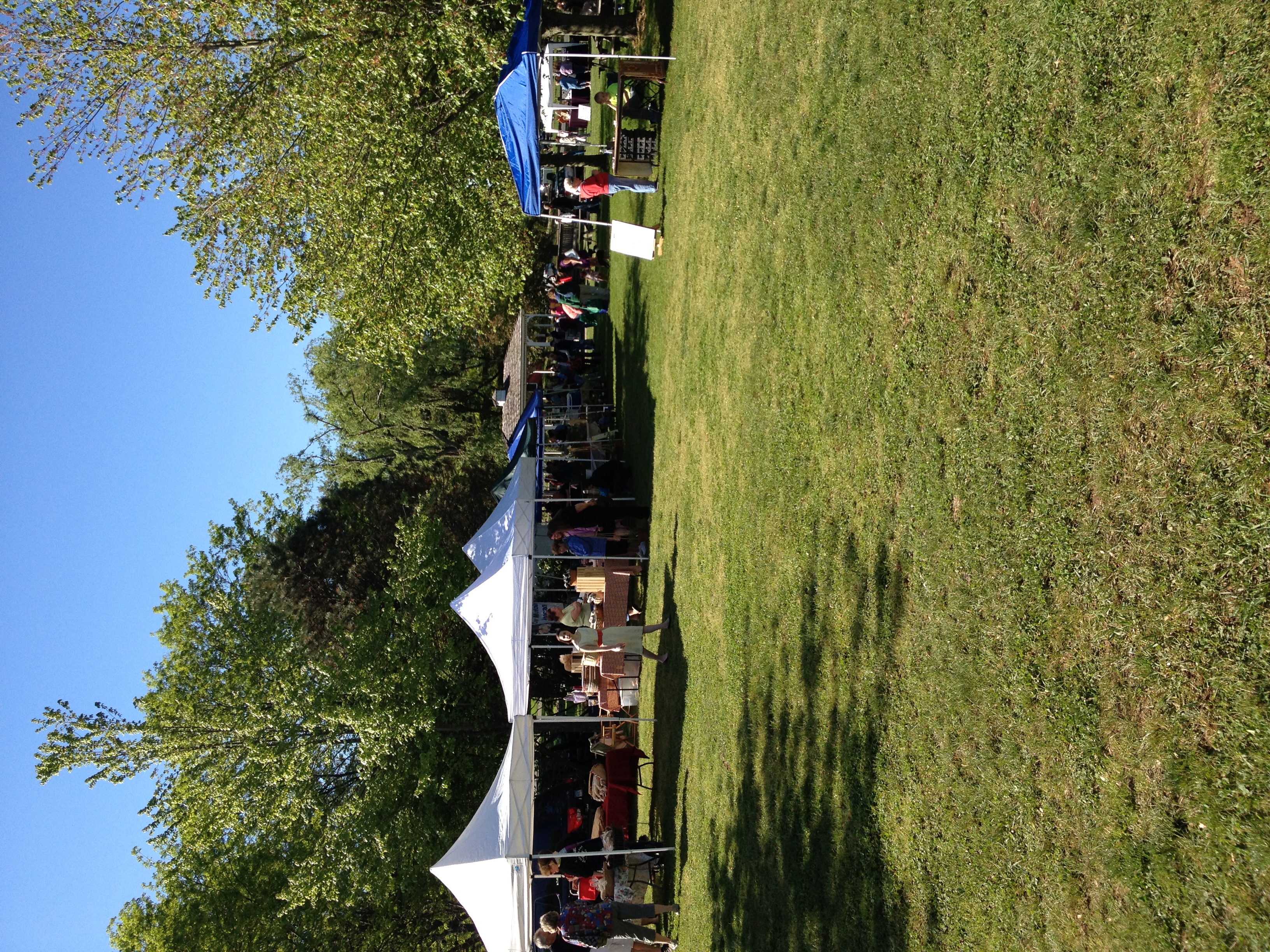
Leave a commentI just want to shout out again a very sincere “Thank YOU” to all my friends, family, and clients and marker go’ers for taking the time to come visit me at my first time selling plants and container gardens at the Ellington Farmer’s Market on Saturday, May 12th.
Would you believe, I arrived with my supportive husband, Steve, two hours before anyone else to setup my tent? And my husband had injured an arm so he was one-handed the whole time but insisted he could do it. I certainly can not put up those EZ-Up tents alone and not sure how others do that, but I’ve been practicing. And I still have to manage to learn how to handle my big enclosed trailer. All in good time, but all my plants and containers made it safely and setup in time for the event which is a very fast three hours from when the market opens at 9:00 am sharp and closes around noon.
Moving containers is kind of like moving cakes, one topple could ruin it all so all were packed with packing materials and carefully unloaded. Because it was the day before Mother’s Day, many of my container gardens were small to medium sized, but be on the look out for my June showing of large and showy container gardens which I plan to have for the June 16th date at the Ellington Farmer’s Market, which is the day before Father’s Day. Dads will be on my mind for that weekend.
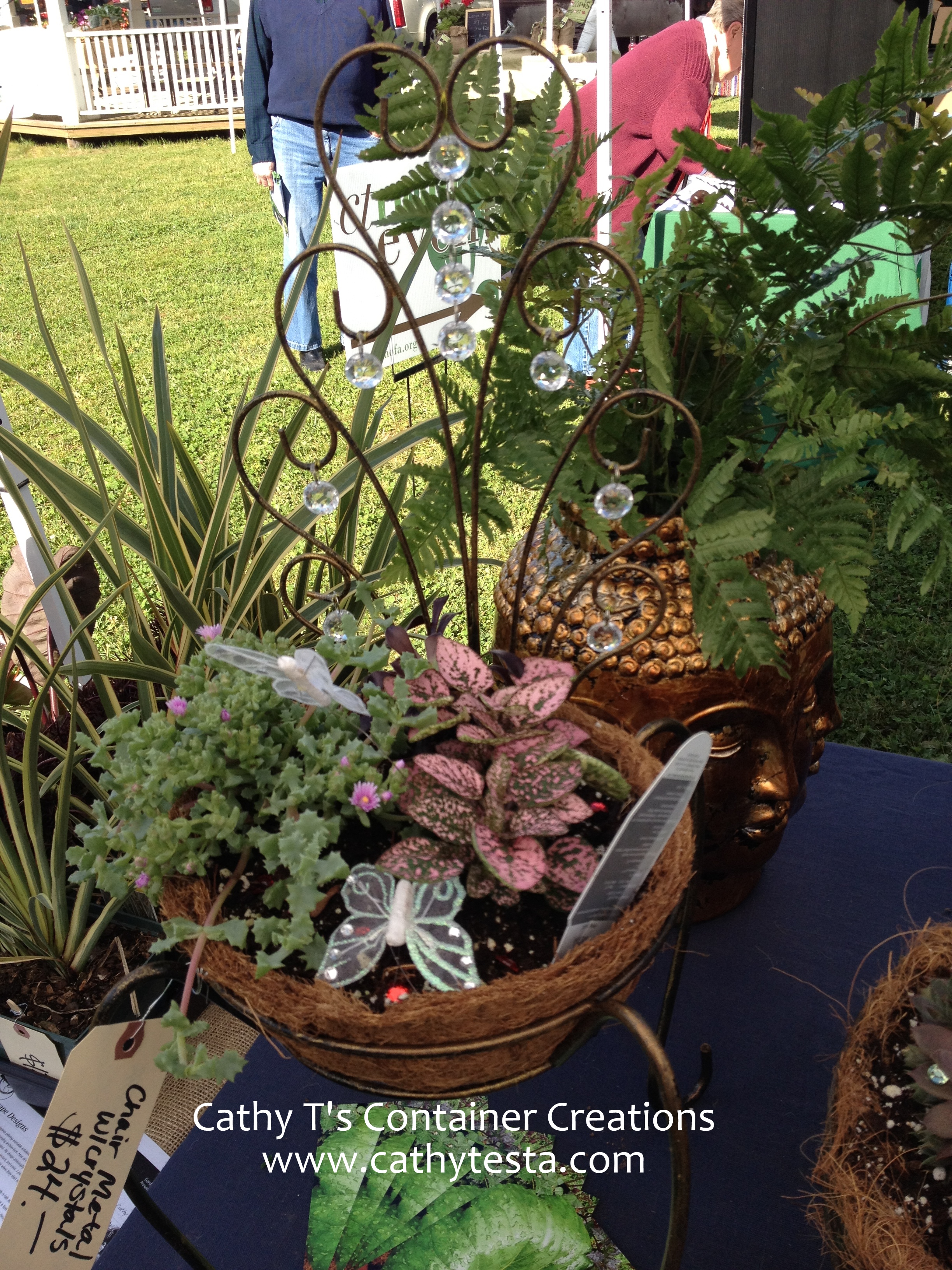
I think probably the most interesting part of the day was at the very end, when one of the vendors came buy to purchase my special find, a bowl with a wrought iron base, which I refurbished from a consignment shop and filled with Hens and Chics and blinged a bit. He got it for his Mom and said he had to wait til the end of the day to get it so she wouldn’t know which he picked out. His name is Greg Hazleton and he owns an organic farming business, called “Earthwise Organic Landscaping” located in West Suffield, CT. He offered me a dozen eggs for a little discount on the container, and I couldn’t pass up the eggs, nor his optimistic attitude. He is also on the Board of the market, and I met his mother earlier at my tent. As she browsed around I hinted that if she told me which container she liked, I could encourage her son towards it later. But she insisted she wanted to buy a plant herself, which she did. I just thought it was funny that at the end of the day, I ended up with fresh eggs, enjoying them like a little reward the next morning with my husband as he served them up with toast. Oh, and by the way, Greg’s mother told me that her daughter, Kimberly, has a Yoga Studio, called “The Revival Room” right down the road at 125 Maple Street. Hmmm, I thought, I’ve eyed that building before – it is quaint, cute, and local. She said she has great yoga classes there.
Another great part of the day is witnessing people pick out something special for their mothers. It comes from their heart. One guy asked, “Which do yout think Mom would like?” I quickly responded, not realizing he was talking to his daughter! Ooops, I sure he found that amusing. The heart of children, daughters, and sons are revealed at the market, especially on Mother’s Day weekend. Farmers markets encompass the heart actually because products are made by very passionate people proud of their craft and products. You can be sure the vendors put alot of time and effort to create something they love themselves and want to share with others.
Collins Compost, http://www.collinscompost.com/friends, located at 9 Powder Hill Road in Enfield, CT was there too. I barely had a minute to talk to Tracey Clague, a member of the family that runs their business. She and I have spoken over the phone, via email, and by letters for over 3 years now. I’ve asked her to send me brochures about their wonderful compost to share with my landscape and gardening clients. Now finally, we met in person, but it was brief because she and I were both unloading and setting up in the morning, and we remained busy throughout the day. At the end of the day, we shared smiles as I purchased 3 bags of their compost for myself to take home, asking her coworker to load the bags for us in my trailer, because I was really fearing my husband’s arm would get worse with any lifting. He has a damaged muscle to his rotator cuff.
There is a band playing every Saturday and usually farm animals are there for the kids, and yes, for the adults too. One little girl told me there were bunnies at a tent, and I was so tempted to go look to get one for my bunny cage, that has a green roof of sedums mixed from last season, but I could just see the fox that got my chickens last season, staring at that bunny in the cage, and envisioned the bunny shaking like a leaf. Nope, can’t do that until I can enclose a setup completely from the predators in my woodlands around my house.
Again, it was so nice to see all my friends… thank you Maryse, Lysa, Guillaine, Donna, Denise, Mom and Dad, Jimmy and Nancy, Linda and Kenney, Doreen, Charlotte, Laurie, Dolores, Marybeth and Pete, Catherine, and all the new friends I met at the Ellington Farmers Market on a beautiful sunny day…., and or course, Steve, my helper and supporter – who said this morning, his arm is feeling better. Phew, Thank God!
P.S. My next date at the market is Saturday, May 26th. Located at Arbor Park in Ellington, CT. Hope to see you there! Cathy T
Market Coming Up
Leave a commentSave the date to visit me at the Ellington Farmers Market this Saturday, May 12th. Along with all the other wonderful local vendors, we will be celebrating the market’s weekly theme, “Gardening Grows the Spirit.”
To me, nature’s spirit is represented every day in the garden by the way of light and water. Often a droplet of rain sitting on a leaf will shimmer just like a jewel or the rainbow’s colors will be revealed while watering plants. Even a fly – yes a fly, landing on a plant, has a glimmer of iridescence on its back that one may notice.
Nature has a way of providing its own bling – thus my offerings at my first date at the market are about growing the spirit with a bit of bling. Yes, “Bling your Spring,” I say! You can expect to see unique container gardens of a size manageable to take home to Mom or for yourself, along with some bodacious plants. I hope you will have the time to come visit on Saturday.
The market opens at 9:00 am and closes at 12:00 pm each Saturday. It is located at Arbor Park on Route 286/Main Street in Ellington, next to the Ellington Fire Department and Hall Memorial Library. Look for the white gazebo. Enter along the side driveway which continues to a large parking lot in the back that circles around to another exit.
Cyou soon, Cathy T
Teaching the Younger Generation
Leave a commentLast nite, I attended the first career fair at the East Windsor Middle School. Walking through the front entrance, I glanced over to see a plaque on the wall with letters in bronze stating the school was erected in 1966. “Hmm, I thought, a couple years before I was born.” I don’t have many memories of walking into this place but I sure do remember the cafeteria, where the career fair was being held. I was asked out by a boy that I did not like, and I remember a food fight one day too in the cafe – yes, we had food fights back then and wouldn’t get arrested for it.
Not knowing what to expect, I started to unpack my materials to show the kids during the evening’s activities. To my left, two software developers located in my home town had quite the nice setup with laptops and big screens to show the students how coding is done for various app’s and games. To my right, a balloon maker. How is one to compete with that? LOL. There was also a veterinarian, hairdresser, accountant, land surveyor, and more.
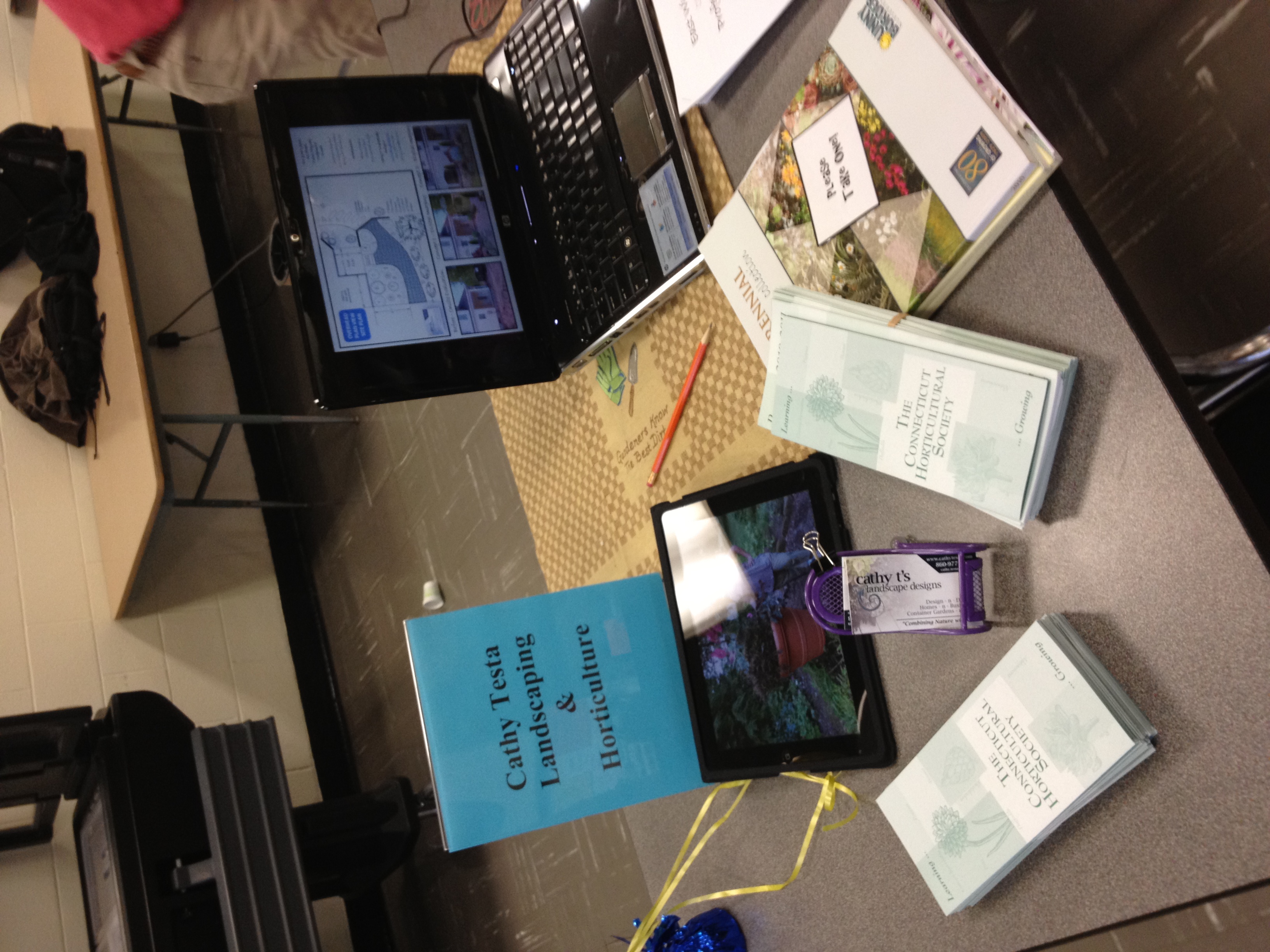
First to arrive, two young gentlemen, saying they like plants. I showed them things like a quick flow chart of the steps I take in my landscape design process, photos of befores and afters, explaining the digital imaging concepts and CAD rendering scaled documents, and where I went to college, how I took Master Gardener Program later, and the importance of knowing about soil, nutrients, botany, and especially “the plants.” But I didn’t elaborate too long on that because I know their attention span would get bored looking at a rotating power point screen, so I quickly had them take a look at my landscape program and give it a trial run. This is when their faces perked up.
They loved trying out the program, clicking and dragging the plant options. In fact, one of them placed an ornamental tree in the same exact place I did on my true design of the image prior. Patting him on the shoulder, I told him just that. I also pointed out that their generations, with their intense participation of technology, will be teaching “us – the older gen” new applications in the world of landscaping and horticulture. “I’m just keeping up,” I explained.
The software developers next to me were showing how to create applications for smart phones, and I showed them new app’s I’ve loaded on my iPhone as tools for what I do, like a “color wheel app” for designing, and a “bug finder” app for plant problems, and even a Square Up app so I can take credit cards during sales at shows and farmers markets – but all the while, I explained to them – you have to know the plants, the site, the conditions, and the exposure, etc. All of these tools can be helpful – but your study of horticulture is more important if you want to go into this type of work. “You have to know the plants,” I emphasized again.
A group of young ladies came by. As they approached, I asked, “Who here likes plants?” One gal pointed to her friend and she nodded with agreement. “Here’s you go – a free perennial catalogue for you,” I said. They told me they have been designing a courtyard at the school in the back, and how long it has taken to draw their designs to scale on graph paper, so as you can imagine, showing them the CAD rendering of my program spoke to them immediately. Again, same speech about learning, and the importance of knowing the plants, soil, botany and more, then they all gave the program a trial run. They gravitated directly to the beautiful perennials in the program as they clicked and dragged through the landscape program’s features.
Towards the end of the evening, a solo young lady came by. She asked more question than the others. She wanted to know about an insect she has seen on the shrubs infront of their house recently. We talked about the process of id’ing insects, and I showed her a new app I loaded on my iPhone with a database of insect photos and reference information. Explaining the Master Gardener program to her, I gave her instructions to collect the insects, put them in a container, put in the freezer and bring them to the Tolland Agricultural Center on Hyde Road in Vernon, CT, where the Master Gardener Interns there will take a look at them to id them, and even put them under the microscope for a thorough look. She wrote the information down to share with her parents later. “By the way, this service is free,” I told her. See: http://www.ct.gov/caes/site/default.asp
The other cool part about being at this event is I was able to share the conceptual design images I have started for the BMX/Skate Park being built in East Windsor on Reservoir Road. See http://www.freewebs.com/ewbmxskateboard/. They liked the idea of the tire planters, and it also reminded them the park will be open soon to enjoy.
And I also told them membership to the Connecticut Horticultural Society (www.cthort.org) is free to students with a valid student ID. Maybe one day, a teacher, or perhaps myself, will arrange a group ride to a one of their program meetings in West Hartford, CT. Their last speaker was on water gardening – they would have loved that.
Overall, I was impressed with the young students’s interest. When asking them if they knew the difference between a perennial and annual, one boy quickly defined them to a “t” saying, “Perennials grow year to year.” As they looked at the program, I explained how there are many different types of shrubs from deciduous to broadleaf evergreens, and the importance of knowing about invasives, and why. We don’t want to plant a thug or one that will over take someone’s yard, explaining Purple Loosestrife we often see taking over open fields in our town as an example of invasives. See: http://www.hort.uconn.edu/cipwg/
At the end of the evening, the program coordinator told me they had the same look in their eyes that she has seen when teaching, meaning they were taking the information in. I hope so and if yes, perhaps a new young gen designer will be born. My only regret, I should have brought some plants along to compete with those fun balloons by the balloon maker and the cool computer displays by the software developers next to me. …Duh, its about the “plants.”
Thanks for visiting my blog post! Cathy T
MAY UPDATES
Leave a commentThe first day of May has finally arrived. Hopefully the chilly evenings we have been experiencing lately will pass soon for it is testing my patience. I want to get rockin’ and rollin’ with my plants outdoors now.
Here’s some updates of activity coming up on Cathy T’s Calendar – and I hope on your’s too!
ESSENTIAL OILS CLASS
Click on my “DIY and How-To Classes” link on this blog to read about a class coming up in June 2012. My guest speaker, Laurie Noll, will be showcasing a “Raindrop Technique” and reviewing many oils derived from nature’s offerings. This get together will be held outdoors (weather permitting) and includes a demonstration and review of the benefits derived from many essential oils. Give your mind, spirit, and senses a break of relaxation. Join us if you can. You will find it renewing.
FARMERS MARKET
In two weeks, I will be making my first apparence at the Ellington Farmer’s Market. Click on the “Calendar” link on this blog to read more, obtain directions, and see the details. The market is held on Saturdays from 9:00 am to 12:00 pm. I will be there on 3 key dates: The Saturdays of Mother’s Day, Father’s Day, and Memorial Day. My first date with the market is Saturday, May 12th. Get ready to “Bling your Spring” with the unique container gardens and plants I will have available for sale. You won’t regret stopping by as there will be many other vendors with wonderful locally grown or created products. Plus there’s a band too!
GARDEN TALKS
I’ve been doing some garden talks at various locations on — of course, Container Gardening, with a special focus on “color and texture.” I have to say, the response has been very positive by the attendees. One lady told me she knows nothing about gardening and learned things she never knew during my talk. Another said she went out and bought containers that next day to start practicing the techniques covered. See the “Calendar” section on my blog for more dates coming up. This week, I will be at the East Windsor High School, on Thursday evening, May 3rd, to share my career experience of working in the horticultural world with students during their Career Fair.
BMX/SKATE PARK with MASTER GARDENER INTERNS
This is probably the project I’ve been enjoying most, but then again, I’m super excited about the farmer’s market participation as well. There is a new park in my hometown of East Windsor, CT, on Resevoir Road being built as I type. It is a park for the young gen and their family to enjoy the extreme sports of skate boarding. Now, mind you – I have no experience in skateboarding myself – but I do enjoy “fast moving” sports. Yet, I was very inspired by the dedication of the town families, parents, committe, and kids that worked six years to raise funds for this park. Thus, I decided to offer my help of planting recommendations and design elements for the park. And I presented the project to the Master Gardener Interns at the Tolland Agricultural Center in Vernon, CT as an “Outreach Project”. It is all volunteer based, non-profit, and an excellent opportunity to learn about the various design phases. Next door to the BMX/Skate Park is a new dog park, if you didn’t know. As I’ve visited the site with interns, I’m impressed to see how many local people use the dog park too. If you think you’d like to participate on “Planting Day” or drop off some divisions from your gardens as a contribution to the Plant Wish List, please contact me at 860-977-9473. Thank you in advance!
LANDSCAPE DESIGNS
I’ve done several designs this spring for homeowners. To see the latest testimonials, go to “DESIGNING LANDSCAPES” section of my blog. I have to say, sometimes I think landscape designing is more about creating solutions than plants. Every client had a unique problem to solve, like how to preventing four very active dogs from digging in garden beds to how to design a front foundation which actually prevented people from going to the main front door. However, what I love about the digital imaging conceptual designs, it helps the homeowners to see the suggested solutions with the various plant options at the same time. I’ve added a new feature to my design offeringst his season called ePlans, where I email the images direct to you as a client. It has been well-received, is fast and functional, and actually quite fun. Like unveiling the grand stage, and with the iPhones and smart phones out there, this is just a perfect fit. You can click and carry your design images direct to the nursery or work with me for a “Design and Deliver” as you plant your design concepts. Interested? Call me to learn more. And if you happen to be a landscape installer reading this post – call me – I’m available to do designs for you and your clients.
POTTING UP CANNA RHIZOMES
I’ve begun the process off potting up some Canna rhizomes and elephant ear tubers. And will be picking up my plant order next week for my upcoming shows, booked container garden parties, and special orders including dressing up a client’s patio for an upcoming special occassion and helping another client with her son’s wedding. So the days are keeping active. Just yesterday, I lined up my pots to get them ready on a new potting bench I made out of a nine foot long pallette.
In summary…as we start our May month – the best kickoff month to gardening, I hope you will come visit me or give me a call if you need a design, some planting advice, a container garden party, or container install at your home or business.
In the meantime, enjoy the rain we are suppose to get this week – it sure is dry out there. My plants and your’s are thirsty. Thank you for visiting my blog, Cathy T