
Well, folks, I didn’t realize when I first setup my blog about a year ago that it should be titled with something other than my name! I’ve been trying to brainstorm something catchy but still nothing has clicked. Because I’m crazy about container gardening, and anyone who has been to my classes or hired me to install containers at their home or business knows this about me. My home and deck are loaded with abundant container gardens every season with a different theme and focus on colors, textures, and large bold lush foliage. It is surely my passion. And the other big thing about me is I’m a plant lover more than a hands-on gardener. I don’t have much time to work on my own gardens because I work in the hort world, but I’m passionate about plants, from the botanical point of view. I love seeing plants grow, observe their features, learn about the components of plants, and always find it fascinating to see how a flower can be so darn beautiful and serve so many purposes! Without plants, we would not exist. Period. So for now, I switched my Blog Title to Container Crazy. But if I find something a bit more creative, I’ll change it later. Any suggestions?
Category Archives: Uncategorized
Thankful for a busy year
Leave a commentThis season was extremely busy for me and my business. For starters, I set up booths at a few garden related shows in the winter. Then I decided to sign up for master gardening classes that ran thru the winter into mid summer. And I also worked on a big first time gardening event in my town in June with new artisan friends. In between and during all this activity, I designed gardens and landscapes for about fifteen clients. In May, I had container garden parties booked every weekend. I ordered plants from growers for the first time this year versus just using my usual nursery sources. I acquired two new container install clients along with the usual onside guidance type visits. If you saw my calendar, you would laugh for it has so many notations. Now, it is November already, and in one week, I will be holding a kissing ball class in my home as we move into the holiday season. I am surely thankful to all my gardening friends and clients for their support! It is seven a.m. As I write this, two days after Thanksgiving, and i can say I am truly blessed for the support of friends, mentors, gardeners, and of course my husband who encourages me on my journeys! Time to take down the fall decor and untangle the Xmas lights, and save your hanging baskets for evergreens, leave the dirt in it, moisten the soil, and add the evergreens. More later.
Gardening with Cakes
Leave a commentI remember writing in an email to my clients some time ago about how much I enjoy watching the cake decorating shows on television. So, as you can imagine, it was thrilling to see the cakes featured at this year’s flower show in Boston at the Seaport World Trade Center.
Titled “The Garden of Cakes“, their display featured amazing cakes decorated by 16 businesses throughout Massachusettes and New Hampshire. For the first time, I took more photos of cakes than plants at a garden show. I joked to my friend that cake decorating may be my third career someday. 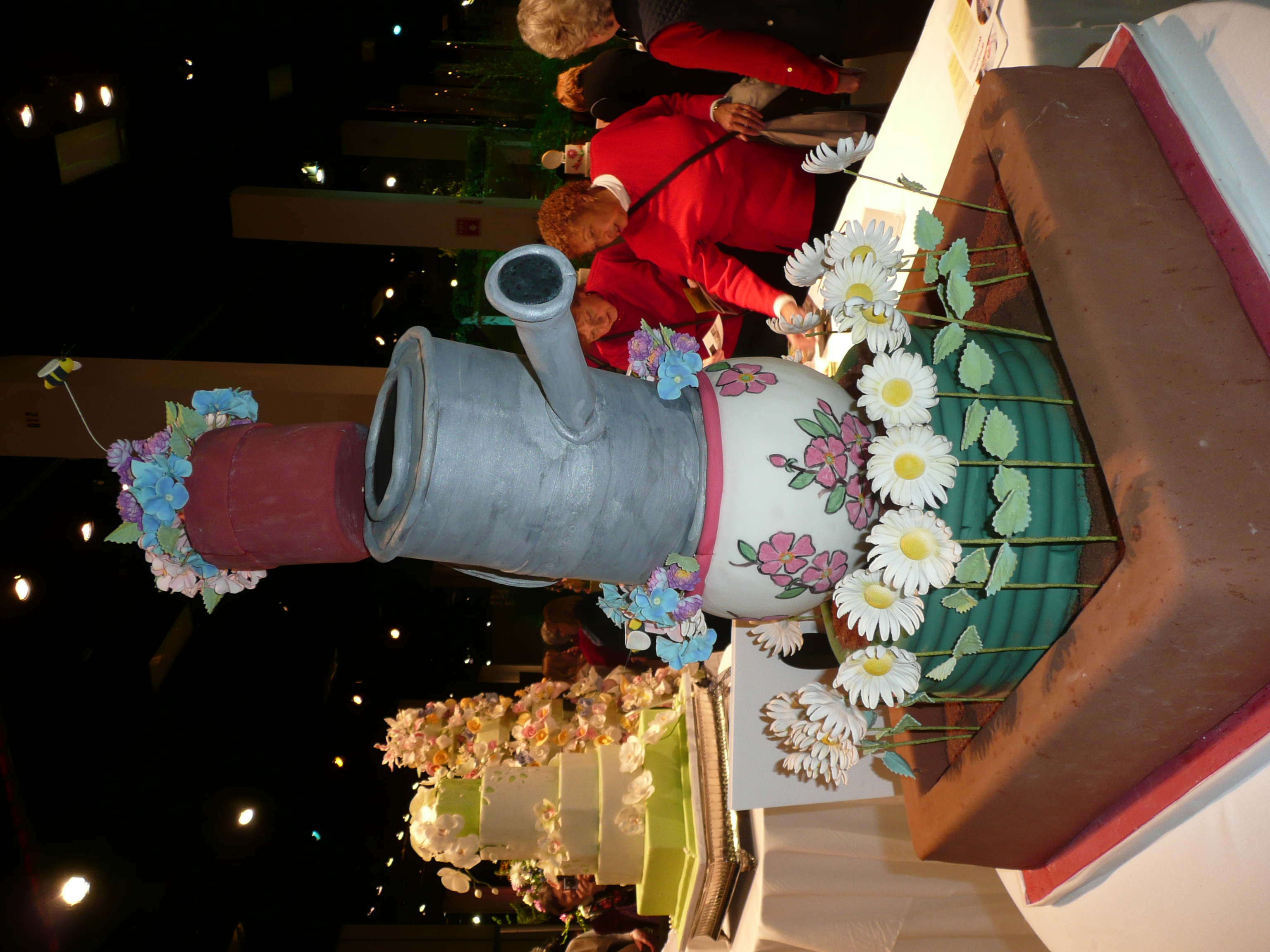
From watering cans to tasty looking roses and orchids, it was incredible to see the talents of these decorators’ spectacular inspirations. I certainly didn’t have these choices for wedding cakes back in the 1990’s. Today’s brides are lucky indeed. These displays made me want to throw a garden party just to have an excuse to order one of them.
Cake decorating reminds me a bit of the process one may go through when creating gardens or designing landscapes. It involves a phase of inspiration to create a vision first. On the television shows like ‘Cake Boss’ or ‘Food Network’s Extreme Cake Challenges’, the cake designers will sketch an idea for their design based on a theme. Follows is their experience involved from knowing which materials and ingredients work best, the talent and skill needed to create blown sugars and working with fondant, and then the cakes, sometimes towering 6 to 10 feet high, have to be moved to a judging area without toppling over! 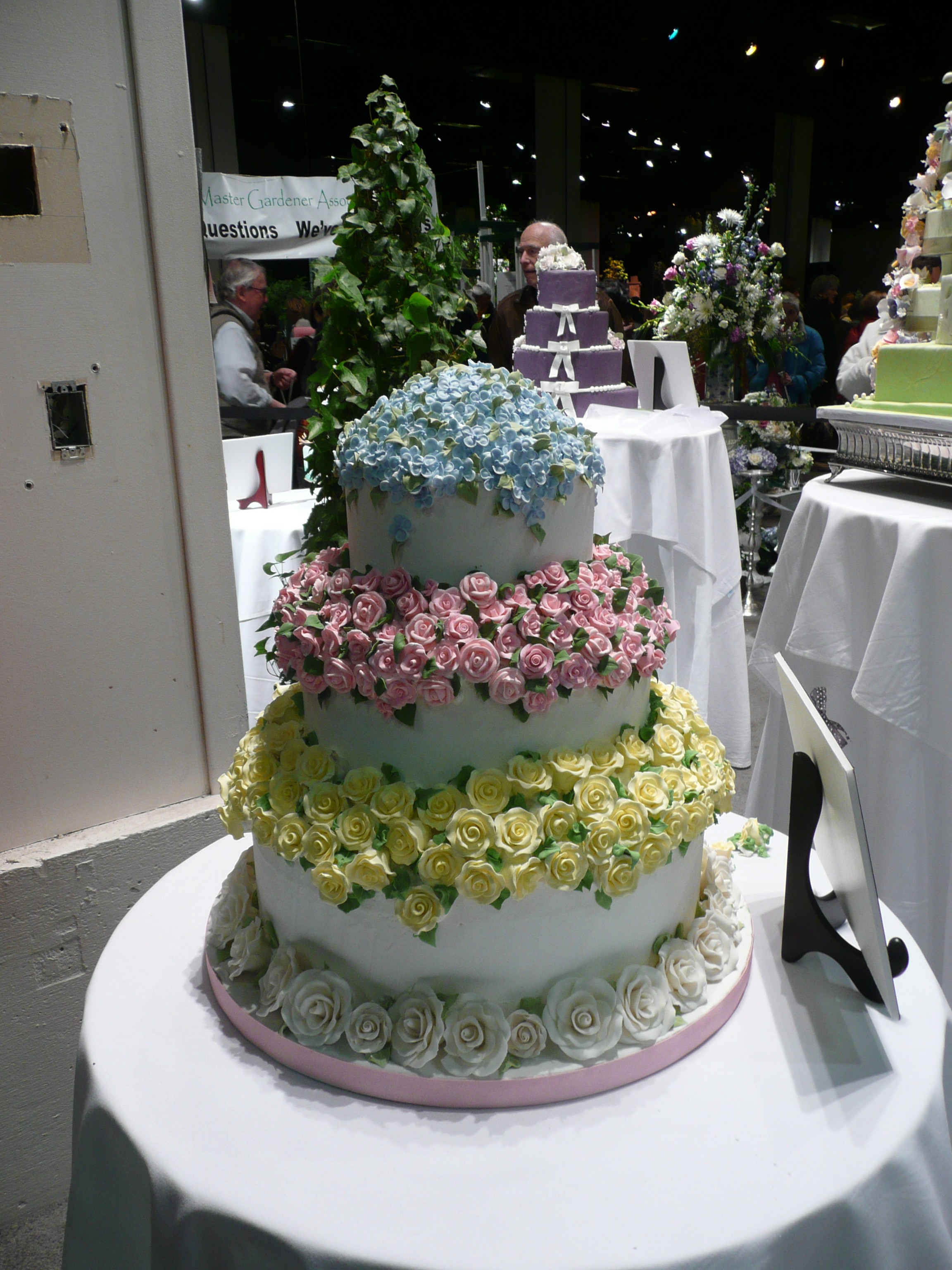 All happening within a set amount of hours and sometimes it is so rushed at the end, everyone gets nervous but has to keep their cool. Many times the cake decorators have to make adjustments to their plans on the spot. This is very similar to the garden design process. It has been completely thought out and designed, yet nature may impose a change on the spot when you begin planting, so you make adjustments and that is okay.
The other amazing part of seeing these cakes at the Boston flower show was each was uniquely different. This holds true for designers of gardens and landscapes too. No one garden design is ever exactly the same for each designer or gardener has their own style, preference, and knowledge base for plants – and that makes designing fun and challenging. 
One of my favorite cakes was a design that featured moss balls (made with frosting of course) that were supporting the individual cake tiers. The moss looked extremely real, and in the gardening world, moss seems big this year. I’m seeing it sold more often in live form but also faux form on stones and pots for decorating up items.  In fact, later I came across the cutest handpinched pottery and moss balls (shown on the left) created by Cleve Hayes of Puddingstone Farm that specializes in handmade terracota pottery at a plant nursery items in Lawton, MI. I was trying to get the best photos possible, but the lighting at the show is always difficult for me to manage since I’m just an amateur photographer with a digital camera (so click on the photo to enlarge it if you need to on my blog pages for a bigger, closer view of photos).
There were other cakes that had garden flowers painted on the fondant or frosting areas with paint brushes. These designers are not only great with techniques, but they are artists! 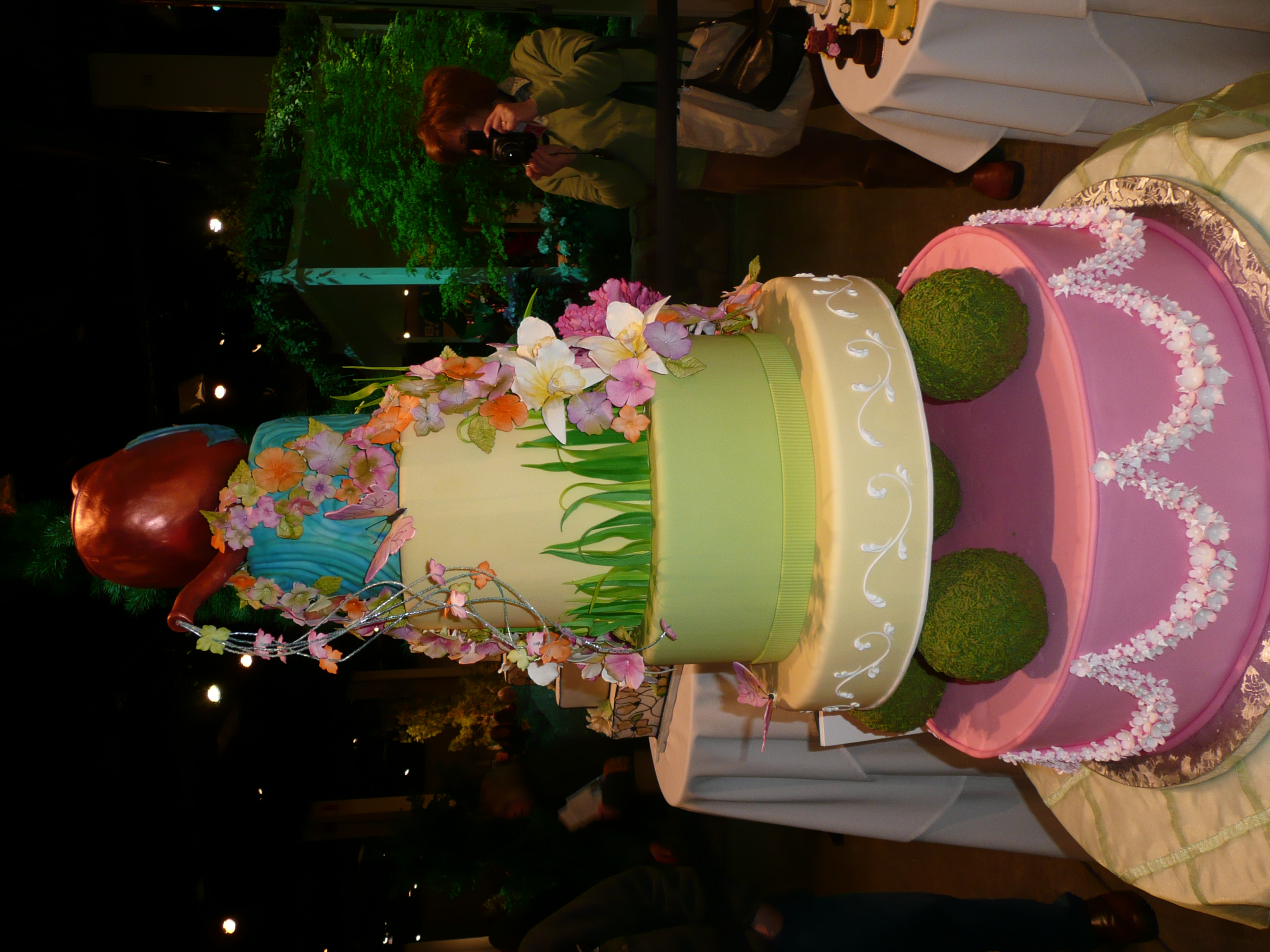 One can only admire their efforts as we fooled into believing some of the flowers are real on the cake! The orchids in particular were so realistic that eventually eating them seems like it would be a crime for they were so pretty.
Perhaps trying to build a garden that looks like a cake would take this to a whole concept to new level of challenges – something for next year’s show?!
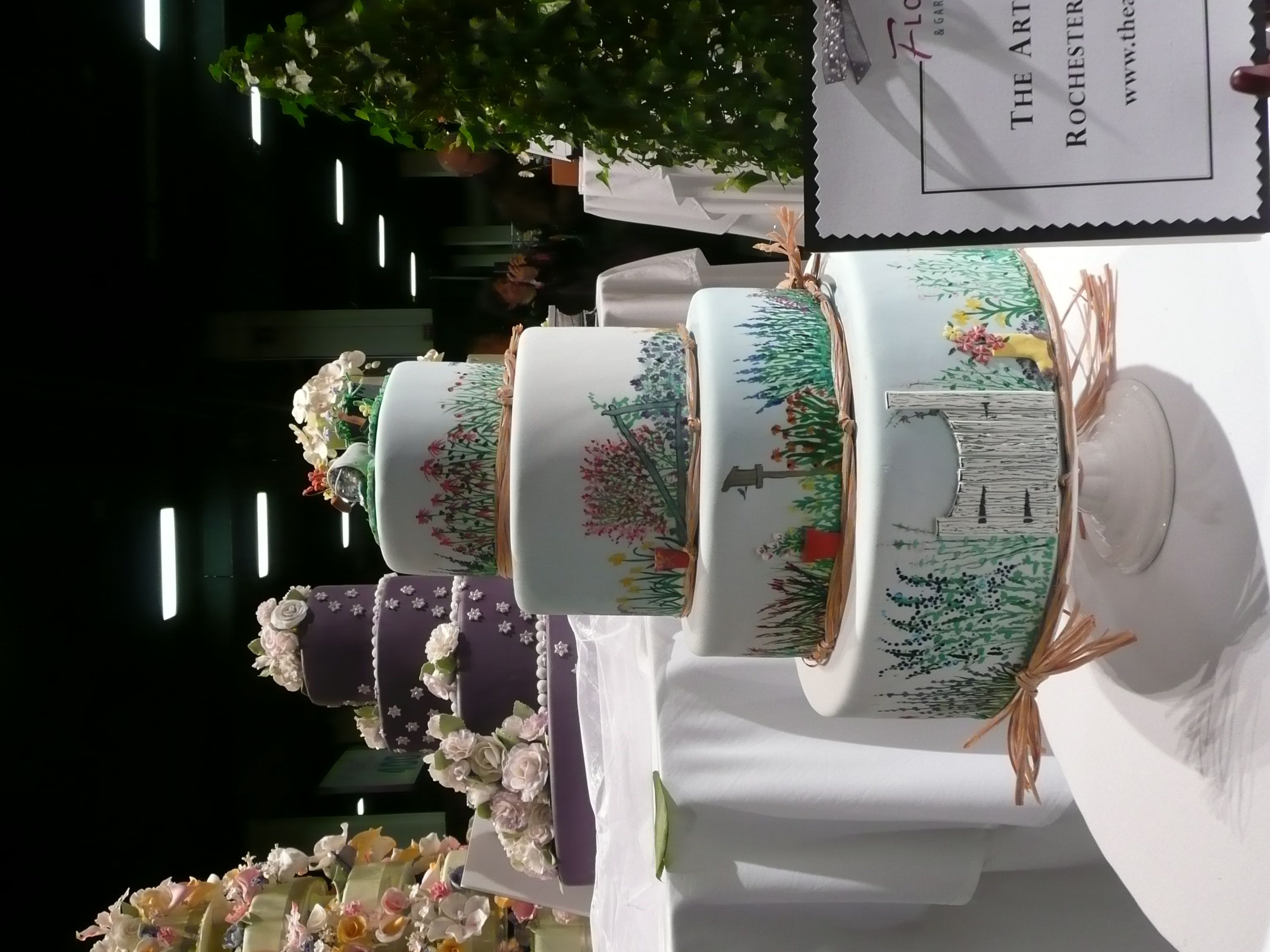 Here’s a listing of the websites and see more photos below this list:
www.theartisankitchen.com; www.bumblebeecakes.com; www.cakeperiod.com; www.cakes4occasions.com; www.cakestoremember.biz; www.wwwisp.com/cakelady; www.jacquespastries.com; www.montilios.com; www.pepperscatering.com; www.rochebros.com; www.scrumptions.com; www.seaportboston.com; www.eatwicked.com; www.sweetcupscakes.com; www.sweetlifeconfections.com; www.tastefullywright.com. 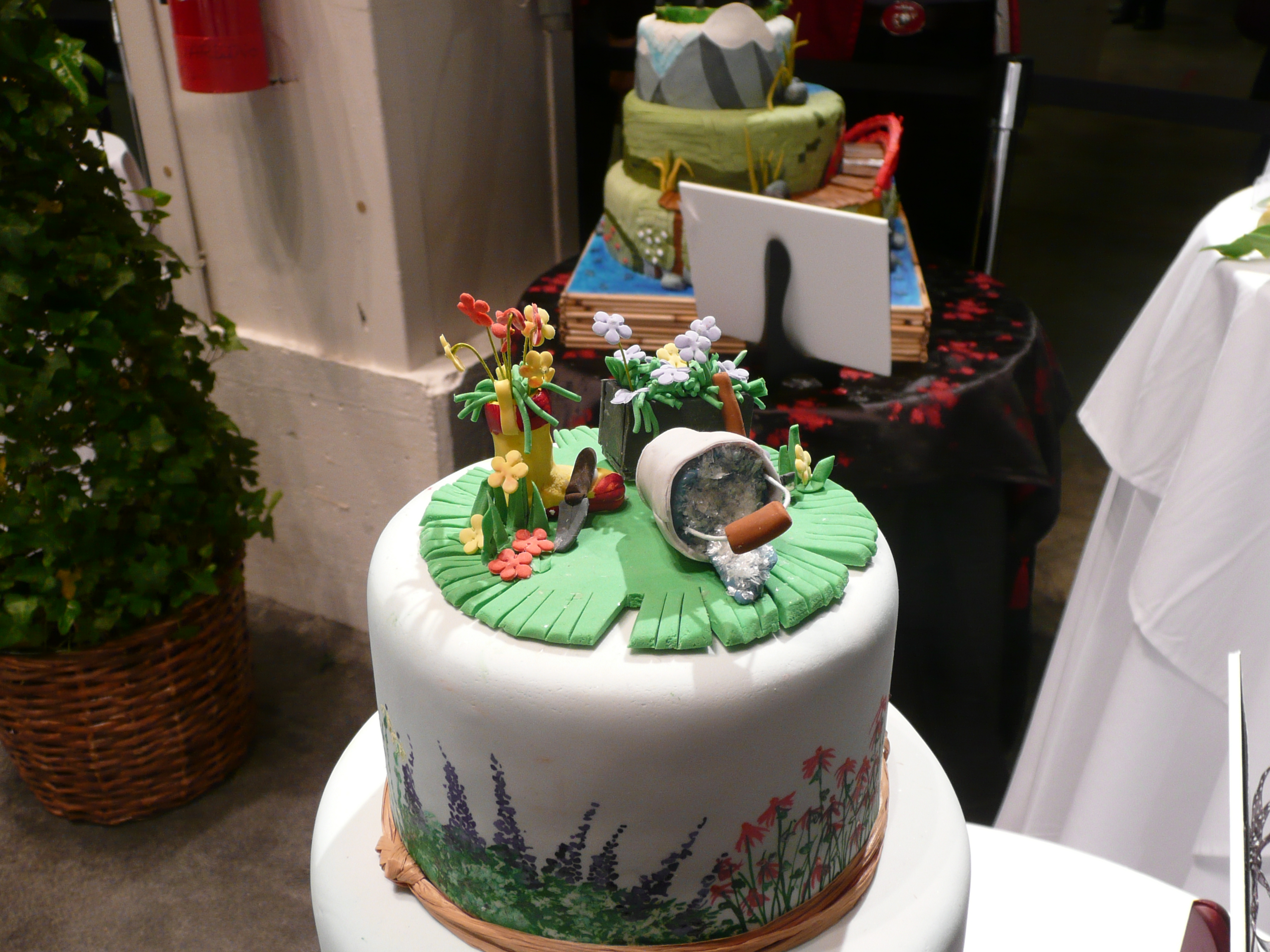


Events Make Sense!
Leave a commentI attended New England Grows in Boston, MA last week. It is a premier event for hort professionals where we have the opportunity to review new product lines, plant introductions, visit growers, and many other green industry organizations. As you can imagine, being surrounded by inspiring products, cutting-edge technologies, and new plants is a treat for anyone obsessed with horticulture!
One my favorites was the display showcasing a new, fast growing plant brand called Hort Couture. You will see from the photos in my Blog why. This brand expresses a presence of sophistication and style via Lady Couture – their classy spokeswomen and icon! She is a black silhouette cutout image of a lady wearing a dress and big wide brim hat – like one you would see on a runway model in Paris. Her curvy body and simple flat shoes lets you know she has designer flare and smarts in a very Avant Garde way.
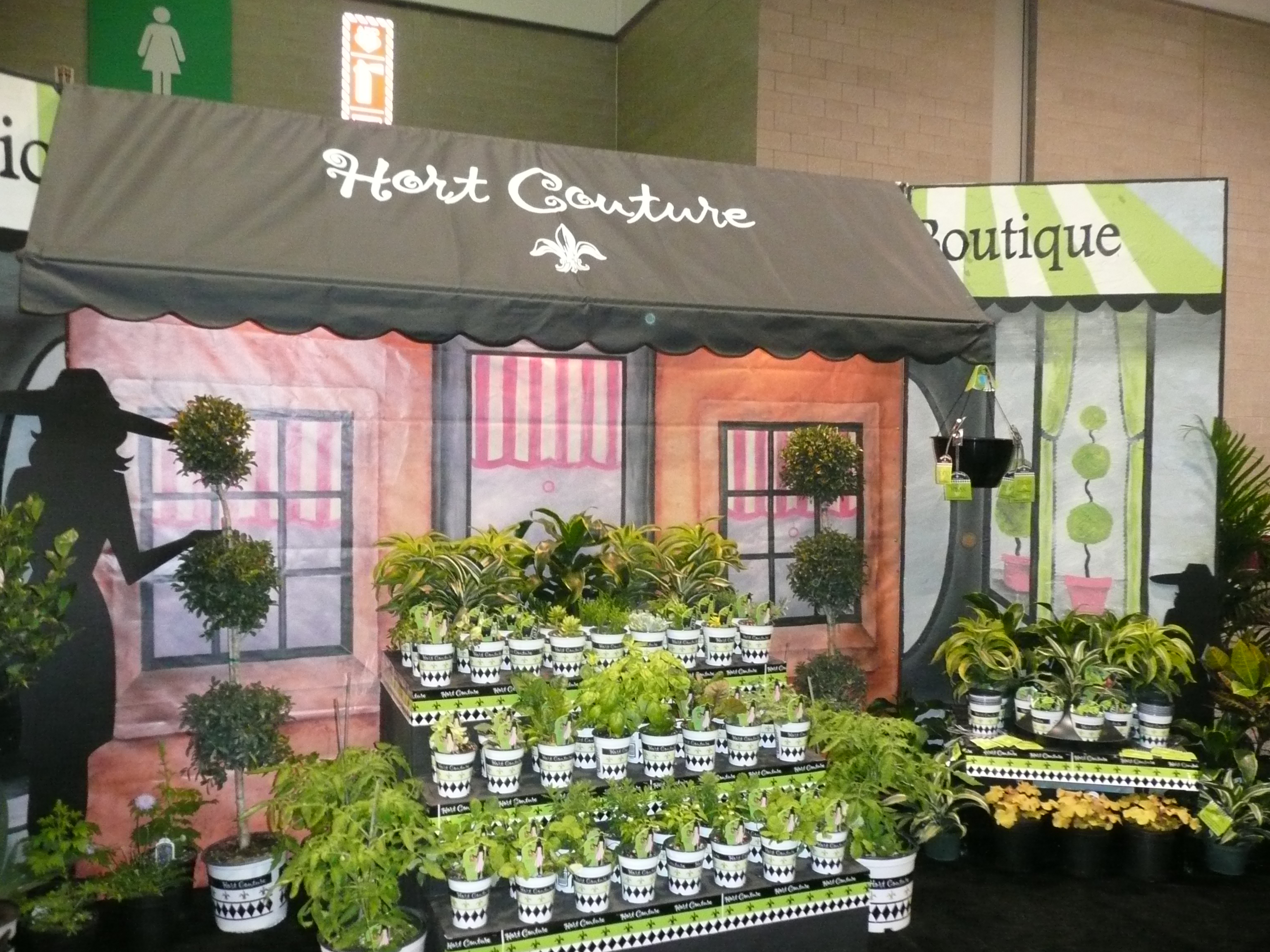
A new plant brand and showstopper
Hort Couture’s plant tags provide catchy phrases, such as “Sun Goddess” or “Shady Lady” to indicate the cultural requirements of the plant in the pot. My enthusiasm for their new brand, display and plants was so raised that I accidentally dropped a plant I was taking a photo of on the showroom floor! I was so embarrassed by my faux pas, yet the booth owners didn’t turn their noses up at all. They handled it as if it were no problem whatsoever – just as Lady Couture would have with elegance.
It was really something to see the annual Lobelia blooming deep purple-blue flowers right there in the pot that matched the embellishments printed on Lady Couture’s dress on the plant tag. How perfect is that?
This new brand works for me. It certainly beats tomatoes hanging upside down from a plastic bag on a string. Not only is their packaging creative, they work with independent garden retailers versus the big box stores, after all a lady of Lady Couture’s standing requires the professional care performed by reputable nurseries to keep up her reputation just as plants require quality maintenance to keep up their performance.

Pot Details
Hort Couture’s display racks are very colorful, informative, and eye-catching. They meet every aspect of a gardeners’ needs and their plant line is extensive from Culinary to Tres Chic Tropicals. They carry Coleus, Impatiens, Lantana, Nemesia, Osteospermum, Petunia, Verbena – just to name a few annuals. As for their Culinary Couture, you can expect to see Basil, Chard, Cucumber, Cilantro, Lavender, Nasturtium, Oregano, Pepper, Rosemary, Sage, and more! And my favorite tropicals are included: Alocasia, Caladium, Musa, Cordyline, Phormium – all popular in my container garden designs consisting of large, lush and bold. I believe many consumers will enjoy purchasing their line of plants.
Next on my fav’s list is a product called Moss Milkshake by Moss Acres. This company packages and ships quantities of live moss for home gardeners, landscape designers, and contractors. Moss is a popular alternative to grass or ground covers in shady areas. I don’t know about you but when I see a lush stand of moss in the right part of a landscape, it really gives a whole different textural, relaxing feel to the scene. Well, now you too can grow your own moss with their new release of Moss Milkshake.
It is a convenient mix that comes in a milk carton easily prepared by just adding water, placing it on the right surfaces in the right conditions (damp, moist, shade), and voila – watch it grow within several weeks! I like how they packaged the product for the consumer in a milk carton and how easy it is to use. This could be applied to ground, rocks, or other flat surfaces. I could see this being used when gardening with kids too. When inquiring if this could be use on the outside of containers, the answer was no for it requires a flat surface and must remain damp.

Mix and Moss It!

All lined up for the runway!
Me & Master Gardeners
Leave a commentWritten Jan 9th, Saturday: Yesterday was my first day of Master Gardener classes. As I packed up my backpack with a notepad and highlighters, I thought how ironic that I was using this backpack again. Five years ago, I carried it every day to classes on the UCONN campus while studying horticulture. My next thought was, “What a great buy.”
As I carried it to my car, I took a fall which caught me by surprise. My foot slipped on the ice beneath the morning’s fresh snow. Then when I arrived to class, something blew onto my contact in the midst of having my first conversation with a classmate. I felt rude for having to walk away to clear out my lens in the bathroom and disappointed I couldn’t finish my chat.
By lunch time, I spilled hot water from my coffee cup onto my hand as I pulled out the tea bag. The water was so hot it scorched my hand, and disrupted a conversation with the next student I met. Personally, I wasn’t having a great start. But worst of all was during class introductions, I got nervous when I spoke about myself. “What is wrong with me?” I thought. “I’ve spoken in front of groups before, why am I anxious now?” I didn’t feel I represented who I was when the other students – all sixty of them – did such a wonderful job.
The amount of students in this class was my first big surprise about the Master Gardener program, and perhaps why I felt intimidated. When I received an email the day before about the snow cancellation policies, I noticed this huge distribution list on the email. “This couldn’t be all the names of students for my class,” I thought. “It must be for all counties where these courses are held all over the state.” But I was wrong. All names on that list were for the same location at the Tolland County Extension Center in Vernon, CT. In fact, the class is completely full. It is quite popular and for many reasons.
Listening to the student introductions, we discovered many interesting backgrounds. The group included two retired doctors, a therapist, engineer, school teachers, college professor, architect, language major, landscaper, herbalist, and of course, many avid gardeners and designers like myself. A number of students (known as Interns in this program) are recently retired or laid off from their jobs. My favorite introduction was by a lady who said her children paid her enrollment fee as a Christmas present. She was thrilled and full of anticipation.
So of course, one may ask, and someone did ask me – why I would take this program when I already obtained my degree related to floriculture five years ago. Well, this program has some different facets not present in the degree program. For starters, there are clinics which provide interns valuable hands-on experience in diagnosing plant problems. When I first graduated in 2005 from UCONN, I started working at a garden nursery – and that was the biggest challenge – quickly learning to id all the plant diseases and insects! It is something that isn’t really practiced during the degree program because you learn more of the technical aspects of botany and growing, etc. In master gardener classes, there are also topics, like Water Quality which wasn’t an area I was exposed to during my former studies. Also, this program is very well-respected amongst the gardening community. I can’t tell you the amount of times I’ve heard, “She/he is a Master Gardener!” since I’ve been doing horticulture work. It is regarded as a badge of honor, and quite frankly – one I wish to wear. Perhaps this is the case because the training is intense, fast, and also includes an outreach component where you volunteer time to projects.
The Master Gardener program is coordinated by UCONN and has run since 1978 – making this year number 32. It is held in Cooperative Extension Centers throughout the state. Extension Centers are valuable resources to homeowners, communities, and anyone that may have a question about the environment, plants, and even bugs. In fact, as part of our Internship, we must complete 30 hours at an extension center answering questions called in by the public. But in this situation, you are trained on where and how to find correct answers when you don’t know – or perhaps can’t remember! And there are strict regulations to follow on many areas.
Another really cool part of being a Master Gardener Intern is you are required to participate in an outreach activity. This is a commitment that many would find rewarding, and I personally can’t wait to see the choices or create one of my own projects! And, interns must perform 60 hours of volunteer time, pass the final exam, do a plant identification project and write an essay. All after completing 16 weeks of class (one full day a week; fortunately – not every day!).
Our first day kicked off with a lecture Water Quality. The instructor started with a comment stating that ‘less than 1% of our earth’s water is available for our use’. Water use is affected by homeowner activity on many levels. Excess from lawn fertilizers, car washing, roof runoff, driveway pollutants all can run off into our water sources which negatively impact the quality of our precious resources – and often we cannot fix what we damage. The lecture covered some preventative measures and how to implement tools like rain gardens to reduce some of the common problems with runoff. A lot is about awareness too. Learning what you can do as a homeowner to minimize risks of polluting is not only worthwhile but critical these days.
In fact, that very evening, when I was watching television upon returning home from my first class, I quoted the instructor’s “less than 1%” stat to my husband as we heard the news cast introducing the next topic as, “Where America Stands on Water”. Low and behold, Katie Couric of the CBS Evening News started her broadcast with stating the same exact statistic, “less than 1% of the earth’s water is usable.” And Americans are the biggest users compared to other countries. In fact, we are kind of like water hogs on some levels – so to abuse it is really pushing the earth’s envelope! You can find this broadcast video at www.CBSNews.com under the same date as my first class, January 8, 2010. And if you are now intrigued as a gardener yourself, you can learn more about Master Gardeners at www.ladybug.uconn.edu.

What would we do without our rivers?
Stumped for Containers
1 CommentI just had to share this photo of a huge carved out tree trunk filled with houseplants which I saw at the Salem Cross Inn in West Brookfield, MA.
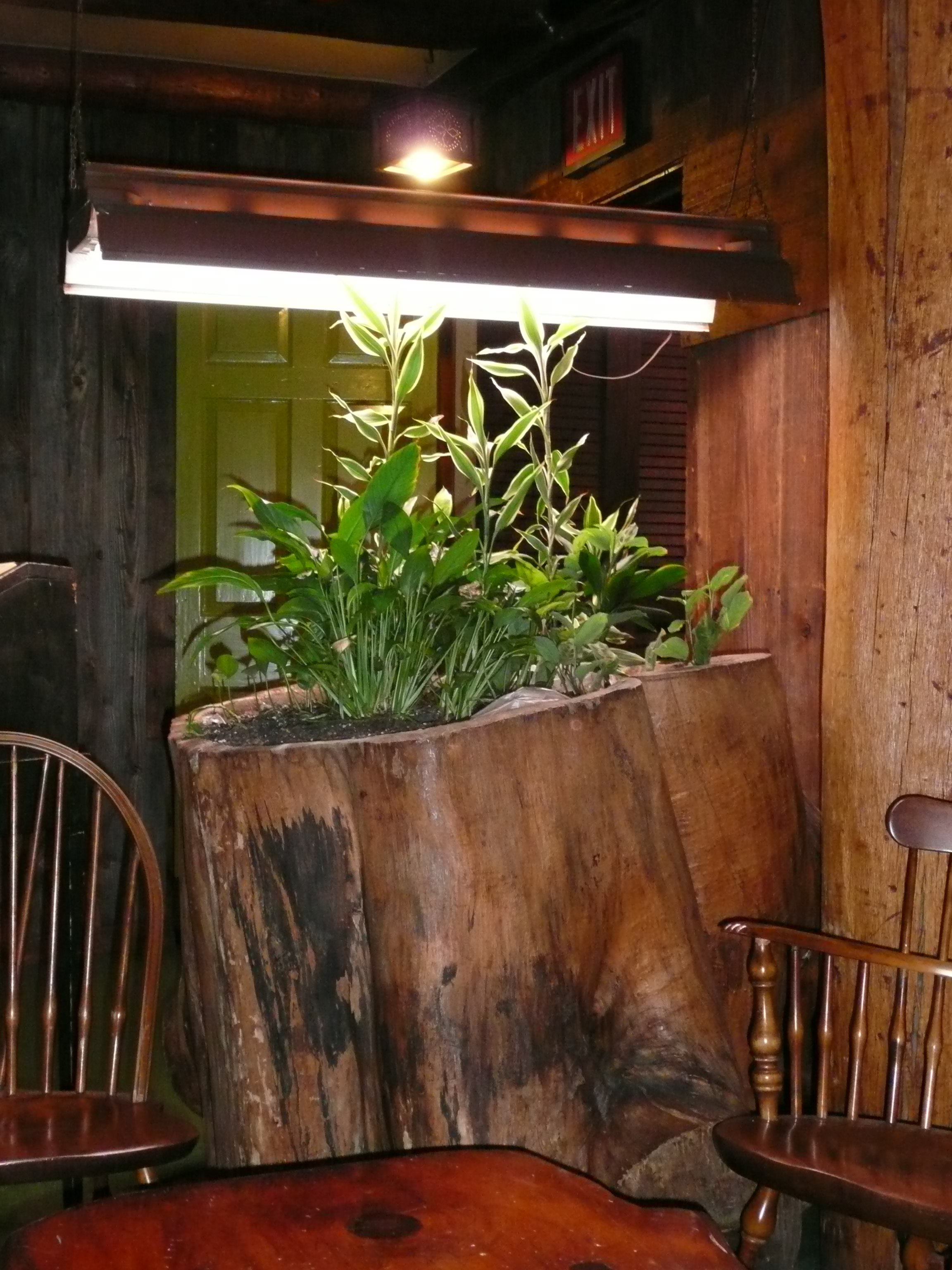
A rustic container
My husband and I went there for Thanksgiving this year! Yes, our first time ever forgoing the family gathering – instead opting to go on a romantic date at a place highly recommended when I polled folks on Facebook.
We really enjoyed the restaurant and tavern because it has an old fashioned New England Hospitality feel to it. As you enter the lower level tavern room, the first thing you notice is the warmth of a huge open fire pit with turkeys wrapped in cheese cloth rotating above the flames on a device powered by a magnet! It is a 17th century roasting jack which caught the attention of my husband. It was impressive.
The architecture in this restaurant, formerly a home, showcases huge wide board pine floors, handmade moldings, paster walls, collectable furniture, wine cellar, and huge ceiling beams.

Fieldstone Hearth
It was interesting to see the variety of people eating there along side of us. The place was absolutely packed with people. When I told my friends of our experience of dining out for Thanksgiving, and mentioned the loads of people there, everyone was surprise to hear of this. I guess one would find it odd to eat out on Thanksgiving day, but the Salem Cross Inn made us feel right at home. We walked away feeling satisfied and charmed by the atmosphere. Would we do it again? Probably not only because family is so important to spend time with – but we are glad we had a chance to experience this place!
Bigger Not Always Better!
Leave a commentI love the effect of large leaved plants, like the giant Elephant Ear grown in one of my container gardens this past season. (See ‘Flower of a Giant’ in my archived blogs).
Perhaps monster sized plants intrigue me because they don’t grow naturally in CT so it is uncommon to see them here, plus they remind me of warm tropical beaches. I also get a kick out of the reaction by my visitors when they see this huge plant situated on my deck. They are stunned by its sheer size. In fact, the leaves on my giant elephant ear grew to 5′ wide this season. They would have grown even larger if it weren’t for the arrival of cool temps as the fall approached.
However, bigger is not always better for some plant lovers. For starters, bigger plants need more space. Larger containers must be used to accommodate the root mass and weight of the plant. And overwintering large plants in your home requires a huge room with proper sunlight. Thus, many gardeners prefer a smaller variety because of limitations or perhaps they just don’t like big, as I do!
Luckily, new varieties of dwarf forms are always being introduced. As I read my trade magazines recently, three in particular caught my eye. First is a new variety for the Southern Living Plant Collection of a colocasia (elephant ear). ‘Little Black Magic’, a dwarf colocasia, will be introduced in spring 2010 in retail garden centers across the Southeast per the article in greenPROFIT. This elephant ear has a deep black purple color and is more compact. It will serve well in containers as a companion to plants with a lighter brighter color tone because dark colors offer wonderful contrast in designs. See http://www.southernlivingplants.com/slpcg/1_1_0.cfm.
The next plant that caught my eye is a compact Sweet Potatoe Vine. This annual is one I often recommend in containers as a spiller. They are easy to grow, fast, and cascade over edges of pots. However, some gardeners have mentioned they don’t like how fast it grows – and that it grows too long. As for my taste, I love the effect of it running on forever, especially if you drape it over something, like steps or a wall. Yet, others find it a nuisance to keep up. Thus, you are in luck if you can find this less aggressive form called Ipomoea ‘Chillin’ Blackberry Heart’. This also has dark-purple foliage in a heart-shaped form. Both this plant, and Little Black Magic serve as foliage supporters in your designs.
The third plant was advertised by Proven Winners as additions to their Graceful Grasses TM line called King Tut and Baby Tut. As you can imagine by the names, King gets larger and Baby says more compact. Cyperus papyrus and Cyperus involucratus are their respective botanical names. These plants look like tall singular stalks with whorled umbrella forms on their tops. They work really well in water gardens or container water gardens. They can serve as centerpiece thrillers or stand-alone. For more information on these new varieties, visit www.provenwinners.com.
And remember, bigger plants can offer many attributes. They are seen from afar, cast shade to plant situated below them, add movement to scenes as they tussle in the wind, and just capture one’s attention! However, smaller versions of the big forms can be used when you would prefer to be less noticeable or just don’t have the space.
Breaking down Cannas
Leave a comment
A view of the roots
On my website, under e:Pubs, you can locate my instructions on how to disassemble your container gardens of Canna plants (and other similar bulb, rhizome, corm type plants) for the over-wintering storage process. Cannas are real tough to dig up from the ground because their roots grow deep and quickly in one season. I prefer to grow most of my Canna plants in container gardens.
I took photos of the root ball of Canna plants removed from a large container. See below how the roots grew to the bottom and started girdling (just like it sounds, wrapping around in the base of the pot).
When you see girdled roots in a pot of a plant you purchase, be sure to tease away the roots, and even trim them a bit or cut slices into the roots so they will break free of this uncomfortable situation. Girdling can choke plants if not fixed prior to planting. When girdling occurs on trees in particular, the tree may continue to grow but slowly it will get choked off at the base at the trunk gets larger. It is uncomfortable for the plant – just as girdles are uncomfortable for women!
Roots circle at base
You can see the base here, and at the top are the rhizomes. The rhizomes can be stored for reuse each season. First, I cut away sections of soil, starting at the base of the soil by slicing. Just like you would slice the bottom of a cake, so to speak! I repeat the slicing until I reach the top where I will find rhizomes to remove. By starting from the bottom up, less disturbance occurs and rhizomes are not cut into by mistake.

Removing soil at base
Each slice of soil with roots are then tossed into my compost bin.
Prior to removing the root ball from the container, cut away the stalks of the Canna plants about 2-4″ from the base. A great tool to use are the pruners shown in this photo because they can handle the thickness of the stalks. A Japanese garden knife works great to do the slicing of the soil and to break away any soil as you work through the rootball.
To learn how to store the removed rhizomes, which multiply during the growing season, refer to my October 2009 e:Pub on my website. Just click RETURN HOME above to visit www.cathytesta.com.

Remove for storing!
Botany of Desire
Leave a commentDo we control our own destiny? Or well — do plants? If you didn’t catch last night’s PBS special, “Botany of Desire” by Michael Pollan, you don’t know the answer to this question! He proposes an interesting philosophy…that plants control us similar to how they influence bees by giving us what we desire most.
Pollan uses 4 very good examples: Apples (sweetness), Tulips (beauty), Cannabis (intoxification), and Potatoes (control). Each originated in far away regions, but ended up in almost every part of the country and world. Why? Well, because they developed traits that influenced us to carry them to new habitats which not only increased their chances for survival, but convinced humans to capitalize the plants’ traits in various ways.
As we know, plants are not mobile unless an animal eats its fruit and carries its seeds away (and there’s wind but that can only travel so far). Yet if that fruit is tastier and sweeter, and more colorful, chances of man or beast to select it are greater. Michael Pollan reminds us that we work for plants, just like bees do. We are the plants’ employees so to speak. He focuses this great program on the plant’s point of view.
This t.v. show made me recall a book I read during my studies at UCONN titled, “Botany for Gardeners” by Brian Capon. It is a great introduction and guide to plant science written from the plant’s point of view as well. It is easy to read and if you want to learn the inner functions of a plant’s growth, give it a try.
In Capon’s prologue, he writes, “In truth, flowers are short branches bearing specially adapted leaves, and reproduction is the sole function for which flowers evolved; the pleasure they bring to mankind is coincidental.” Let’s pause, coincidental?
Pollan reminds us that plants survive from one generation to the next because “we” pay attention and desire the rewards plants advertise and provide. We not only transport them, we help plants to maximize their strongest points, so much in fact, the plants end up controlling us – and determining our destiny. (Note: This kind of ties into our problem with invasives. In my opinion, they can be such a problem, the invasives control us in ways we may not notice. Remember my prior post about that huge equipment tearing out a vine?).
Back to Pollan…He stated, “We are in the web of nature, not outside of it.” And if you are a plant person, it is fun to listen to his descriptions on the 4 key plants he uses to entertain these philosophies. For apples it is sweetness, tulips – beauty, cannabis – intoxification, and potatoes – control. Apples, as he points out, originated in Central Asia, along with the first wild tulips. Both made their way to far way places because of the plant’s ability to con us into taking them there. He tells the story of a fellow named Chapman who would travel to plant apple trees from seeds before settlers arrived and then sell his trees. But apples don’t come true from seed (they must be grafted). However, since Chapman spread these new seeds from region to region, which weren’t sweet results initially, the apple expanded its territory and varieties. The bitter apples were used to make hard cider at the time. This is the story of Johnny Appleseed! But it continues on how it lead to humans being obessessed with cider, and then lead to focusing on sweet apples and growing the trees which produce them.
Pollan also shares the story of Cannabis, first discovered in India and China. Before modern times when drugs like aspirin were available, cannabis was used for medicinal purposes to help relieve pain. Eventually man crossed the tall growing variety (C. sativa) with a shorter, faster, stronger growing variety (C. Indica) because man wanted to grow it under cover once it was made illegal (tall couldn’t be grown outside anymore), and to induce a better product. It was nutured, transformed, and turned into a rich plant.
But what is really interesting is when Pollan goes into how the molecule in Cannabis (THC) attaches to receptors in the brain. These specific receptors are the exact matching key hole to the THC so to speak. Man is responsible for making the plant more powerful, yet the plant had the ability to provide a window into how areas of the brain operates. This window lead scientists to study how to manipulate these particular receptors to help control things like tragic memories which haunt certain people.
I’m not saying I agree with the use of Cannabis mind you, but it sure was interesting to here how Pollan demonstrates, metaphorically speaking, how plants find a way to keep us in their clutches so they can keep on growing, surviving, and out-thriving other plants.
He showcased two cannabis growers who are so obsessed with perfecting cannabis, they have elaborate controls for light, air conditioning, and hand coddle the buds to induce more resin by separating all the female plants from males. They truly believe without their presence, the plants get angry and don’t perform as well. Are they smoking too much (LOL) or is it true? These two growers are not only controlled by this plant, they are practically slaves to it.
Yet I know I’m a slave to some of my plants, especially those I design in containers, so I do agree with this whole plant controlling my destiny thing. When I don’t pay attention to them, I swear they just get a little less beautiful. Well, if you think you would find this program as interesting as I did, check out www.pbs.org for more.
Best in Show
Leave a commentThis is the result of a container garden party assembly! I love the foliage colors and full packed arrangement. It was so stunning, it got featured in two magazines this year. See my website www.cathytest.com for more on how you can achieve this too! Cathy T


 Container Crazy CT