Taking Down Musa ‘Basjoo’ Banana Plants

2 Comments

Most tropical plants will not survive our freezing outdoor winter temperatures in Connecticut, but they sure are fun to grow from summer to fall.  Because I’ve introduced many tropical plants to clients and gardening friends, I decided to offer my first class on how to overwinter the big three:  Canna, Colocasia (Elephant Ears), and Musa (Banana) plants.  It was held last weekend on October 13th, right after our first early frost the evening prior.

Their Home

I shared a brief overview of the tropics with the attendees so they could get to know where these plants come from.  By learning about their natural habitat, and gaining insight on how they grow and react to environmental conditions, one can connect the dots on how we treat them here in our planting zones as we prepare to overwinter them as dormant plants.  We discussed how tropicals experience winterless climates and have basically one season.  We also discussed characteristics, such as short-day plants, frost sensitivity, wide diversity, types of soils, and climate happenings in the tropics.  Everything from their tropical rainy to monsoon climates were considered.  To me, this paints the picture of who they are and more about their true home as they vacation at our homes during the summer months.

Plant Parts

We looked over a diagram of banana plant parts also.  One banana plant in particular, called Musa ‘Basjoo’, can actually be overwintered in the ground here in CT as long as you provide the correct protection around the base of the plant right after frost.  The diagram depicted how the plants grows as a mother plant, and a daughter plant arises next to it.  The rhizome, roots, and banana blossom and flower components were discussed.  Some off-shoots or suckers of banana plants are also called “pups.”  If banana plants receive enough months of the appropriate warm temperatures and sunlight, they will produce a flower bud and bananas.

Musa ‘Dwarf Cavendish’ Fruit

Banana Surprise

My sister-in-law’s banana plant bloomed and produced fruit this year, but it was not a Musa ‘Basjoo; it was another variety I gave her the previous summer season, called Musa ‘Dwarf Cavendish’.  It fruits at 5-7′ provided it gets enough warmth and light for at least nine months.  She kept it indoors as a houseplant last winter, and transitioned it outdoors this year in early summer.  It received eleven months of non-stop warmth and sunlight to grow, and a eventually a plum colored flower bud appeared.  The bud grew to the size of small football, and then the flowers began to form leading to the banana fruit.  This surprised her whole family.  At first they didn’t know what the bud was.  They observed how the banana fuits grew from it, and are still hanging on her plant today.  So far, they haven’t tasted any of them.  I think they are scared to try.  And now her mother plant is setting off many more pups.

Taking it Down

After sharing this amusing story, and the components of the banana plant’s flower and fruit, we headed outside to chop down a Musa ‘Basjoo’ in my landscape so everyone could see how it is done.  Also I wanted to share how tall the plants grew in one season.  This plant was planted in the early summer of 2011, and did “not” receive the protection steps last winter because of our freak October snowstorm. I ran out of time.  However, we had a very mild winter last year, and the mother plant returned, and a daughter plant right next to it grew as well.  Both reaching seven feet tall this season.  Musa ‘Basjoo’ can grow to 15 feet in ideal conditions per the growers’ references.  It is hardy in Zones 6-11 and can take full sun, or part sun to part shade.

Video of the Take Down

To see the quick video of taking down my Musa ‘Basjoo’ banana plant, go to my VIDEO GALLERY page on this blog, or click here:  https://cathytesta.wordpress.com/videos/.

Musa ‘Basjoo’, common name: Japanese Fiber Banana, can survive in the ground if protected appropriately in the fall season with layers of mulching materials.  Before you protect the base of the plant consisting of the pseudostem, rhizome and roots, you must do some easy lumberjack work after the foliage have been hit by frost and collapse.  I say easy because the trunk of this plant is fleshy and moist, so it doesn’t get hard like it would on an actual tree.  It not a trunk either, it is called a pseudostem made up of overlapping leaf sheaths.  I used a bow-saw to cut it about six inches from the base, and down it went.  As I said, “Timber!”, everyone in class laughed.

Chopped Down Musa ‘Basjoo’

Soil Conditions

Because the soil on the north side where these Musa plants were growing is more organic, maintains good soil moisture, and is somewhat protected by overgrown English Ivy (to be removed this year), it faired better than the ‘Basjoo’ banana plants in a small bed on west side, where the soil stayed dry, unless I watered it.

Banana plants like alot of water and rich soil to grow well, so the north side was the perfect conditions.  The house provided some shelter from the wind so that was also a bonus.  Leaves did not tear and served as a perch for birds visiting a bird feeder nearby.  I was sorry to see it go.  But the good news is it will return next season.

The Other Candidates

After we took down Musa ‘Basjoo’, we headed over to our class stations to learn how to dissemble Canna, Elephant Ear, and some other tropical plants from container gardens.  Attendees also brought along plants they could easily transport to learn how to treat each for winter survival.  It was the perfect day, bright sun and chilly air, with the frost occurring on queue, the evening before.  Class went well, and I plan to hold it again next autumn.  Attendees got the confidence they needed to do this process on their own.  Having a hands-on opportunity allows them to see the tools I like best for this process, and it also provides me with insight on the types of questions they have.

Birds Perch on Banana Leaves

Returning in Spring

Come spring, I will give my attendees the heads-up on the steps to take to reawaken their tropical plants for the next growing season in their container gardens.  As spring temperatures rise and the day light and length changes, the dormant rhizomes will sense the change and it will be time again to reap the rewards of storing your tropicals.  And as I told my class attendees, “If you try and succeed, awesome!  But if you tried and failed, oh well, just come see me again – I’ll have lots of tropicals for sale next spring!” Cathy T

Dieffenbachia no Dummy

3 Comments

Brought inside

They call Dieffenbachias Dumb Canes, which I guess is because they are relatively easy to grow, I’m not sure, but when I spotted one this summer, I grabbed it for the large coarse foliage, and the green color that is more like a limey green.  The foliage is speckled in different patterns of darker green.  I divided it immediately into three plants and put them into container garden combinations.

Yet, now as our temperatures start to cool between 45 and 50 during the evenings, I decided it is time to move my now large Dieffenbachia plants from their container gardens into smaller pots to keep as houseplants.

Lifting the plant carefully with roots and soil attached, I repotted it into new fresh soilless mix specifically for containerized plants, and placed it inside.

Last nite, it rained.  And its cool outside today.  But as a result of moving this one inside, I can see it already perking up.  It prefers the warmth.  It still could be “okay” outside, but better to be safe than sorry and risk it getting stressed.  This ultimately leads to damaged leaves, so I’m starting now.

Another bonus, this tender perennial can be increased by cuttings.  There is an air layer technique that is relatively easy to do.  I will discuss this in my upcoming class on October 13th, Saturday, on how to overwinter tropicals.  It is just another way to save money and multiply your plant investment.

Dieffenbachia (also referred to as Leopard lily) is frost tender, so it needs about 59 degrees F to perform well.  It should be grown in fertile, well-drained soils in sun to partial shade.  Some references will indicate partial-shade, but mine performed just as well in sun providing they were adequately watered.  They seemed to handle both conditions.

Now is a good time to move in these types of houseplant candidates, before they get too cold and wet from autumn rainfalls happening right now – and definitely before our first frost upcoming in October.

But bottom line, if you ask me, there is no reason to call this plant a dummy.  This is a rather beautiful foliage plant, wonderful as a specimen or in container garden designs with other plants, and its large tropical like showy foliage with speckled patterns offer color without flowers, plus starting with one plant leads to the potential of propagating even more.  I did not see one insect or disease on this plant all summer.

For those of you in CT, nearby my home town of Broad Brook, if you wish to learn more about how to store tropical plants or frost tender types like Dieffenbachia, now is the time to register for my upcoming class on October 13th, Saturday.  I am sending out pre-instructions with details to registered attendees today.  Just click on DIY and How-To Classes on this blog or email me at cathy.testa@aol.com if interested in participating at this hands-on class.  And …keep your eye out for the dummies out there – sometimes they are much smarter than you think!

Cathy T

Mother Nature is Spookey

Leave a comment

Okay, Mother Nature – you tricked me again!  October turned out to be a beautiful month for us here in CT, weather wise, pretty warm and not too many cool days – thus, I have been busier this month than I was in July – go figure.

But all good for we know working outside in the gardens on cool, bright autumn days is very rewarding and enjoyable.  When autumn sunlight hits warm colors and those still hanging onto summer flowers, it is like a light show in nature.  And decorating for the fall season with container gardens is cheerful.

But then came yesterday.  We experienced our first sleet – and some snow fall!  I actually cooked a steak on the grill for dinner, and getting wet from the cool wet snow with sleet was NOT fun.  Why did I pick that meal last nite?  Guess I didn’t expect the bad weather to really happen as predicted by the forecasters.

This morning, we see frost on the windshields of our cars.  And some of my tropical plants responded to the weather by turning black.  This is okay – the typical recommendation is to let some tropicals be touched by frost before storing – because it induces a dormancy state.

I didn’t do all my container garden break-downs yet…and with this first frost – my goal is to break them down tomorrow.  For friends and clients nearby – if you want to pop by for a quick demo – feel free to call me.  I have about 10 canna containers to break down and couple of banana plants to tend to.  If you have a moveable pot and want to join me in the driveway to do your’s – as I said, just give me a call.

As for today – the sun is breaking out.  I just spotted my very first deer sighting in the backyard – 3 large sized visitors.  I turned on my CD player, and they scattered away as the outdoor speakers were still on.  I don’t think they like “Rage of the Machine” and why that CD is even in there, I don’t know.  Must be my nephew when last visiting inserted that CD.  I spooked the deer, just like Mother Nature spooked me yesterday with the change of temperatures and conditions.  Only a few days before Halloween too!

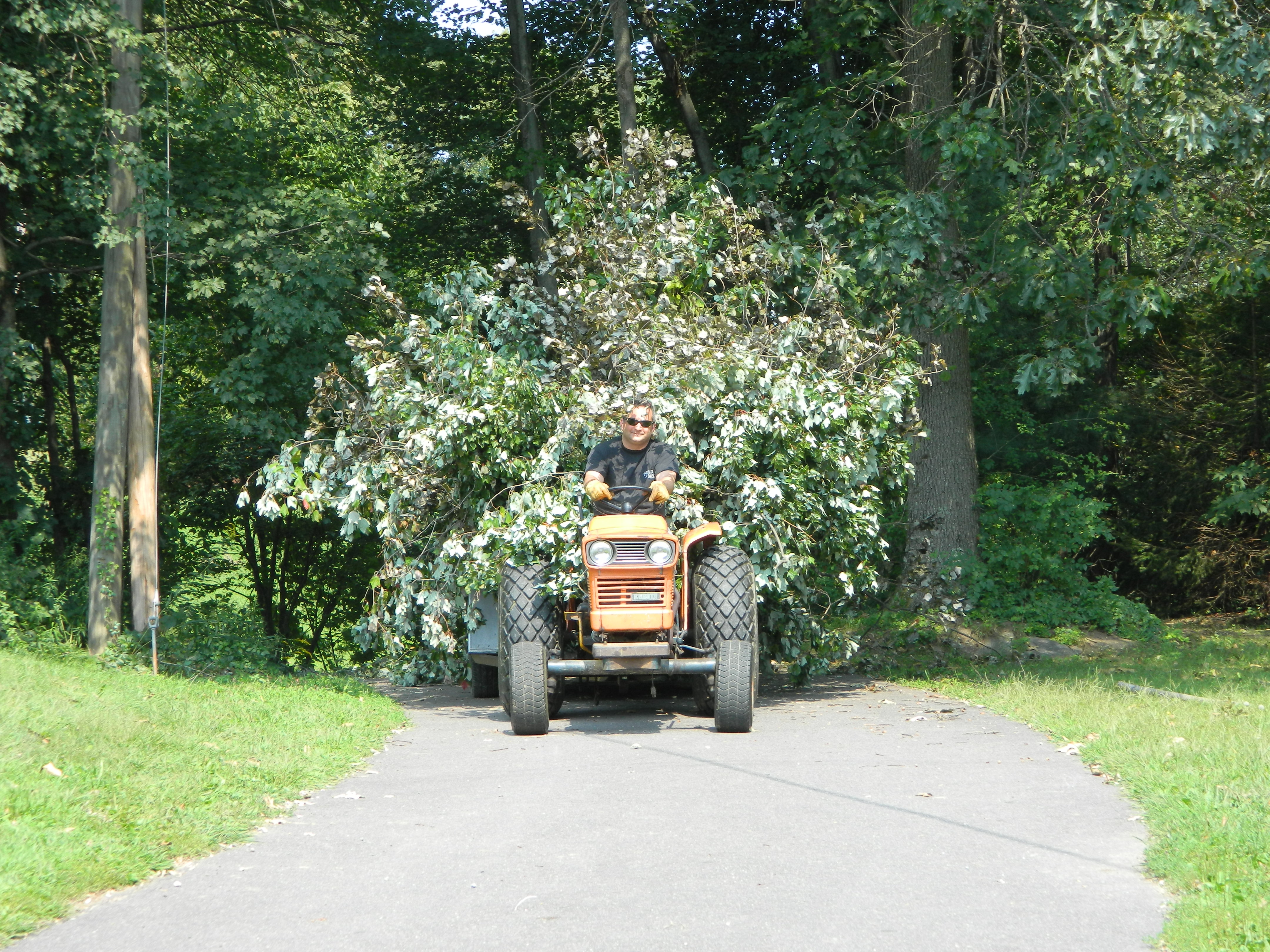
Picking up Trees

Two season ago, it was full on rain all season, then the next season, it was full on heat all season.  This season, we had the surprise of Hurricane – renamed Tropical Irene, to experience which tore the leaves of many of my big tropical plants and brought down trees – nature’s way of pruning. People are still recovering from the mess caused by that storm. And after the tropical storm, we had a mix of warm temperatures and rain in September.  See http://www.ncdc.noaa.gov/sotc/national/  for the significant weather events of 2011.

But this warm enjoyable October, which I would welcome every season, was a nice boost.  In my opinion, October was perfect up until yesterday.  Cathy T

How to Overwinter Tropical Hibiscus

5 Comments

In late August, I took a photo of the blooms on a tropical Hibiscus growing as a standard in my brother’s backyard by his patio.  He and his girlfriend planted it this year.  It has been growing beautifully all season.

  • Standard:  For those of you who are not familiar with the term standard, it means a plant that has been trained into a tree-form shape.  I’m not sure why they call it a standard; seems like it should be called a tree-form plant.  A newbie would never use the word standard to search for information about how to grow a plant into a standard, which ends up looking like a topiary.  The plant sits as a beautiful round form on the top of a small tree.
Tropical Hibiscus

My brother’s Hibiscus has a twisted 3 branched trunk instead of a single trunk or stalk.  These are commonly found in nurseries and give the plant a bit more appeal.  A standard plant adds elegance, is a little more formal looking, and can be eye-catching, especially when adorned with spiller plants below in a stunning container garden.  But his was transplanted into the ground.

At first, when his girlfriend brought it home, it wasn’t doing so hot in the pot.  And their apartment doesn’t get much sunlight. (I know, I lived there too before getting my own home years ago), so my Mom, who lives next door, suggested they plant it in the ground.  It took off gangbusters style immediately after her wonderful suggestion.  The leaves greened up, the stalk increased in size a bit, and the blooms repeated all season long.

I warned my brother his tropical Hibiscus plant will not survive our winter in the ground.  He chuckled, and responded with, “Oh yah it will.  I’m going to build a box around it.”  Knowing my brother and his determination, I decided not to argue the point.  I was just in one of those moods.  I thought, “Okay, little brother, you try that.” Then I continued on my way.  But before leaving, I took a couple photos of the blooms.

Well, low-and-behold, he called me last night.  Usually he calls me about his band’s gig dates, and I post it on Facebook for him.  (BTW, he is playing T-day Eve, I’ll be posting the info soon).  But this time, his call was to ask me, “How do I store my plant? It is still doing amazing,” he commented.

“Ah, you finally believe me?” I replied.  “Well…,” he admitted, he asked Dad.  (Dad, the farmer of 80 years of age, who has never grown a tropical in his life!)  At that point, my bro believed it wouldn’t survive when Dad replied, “I don’t think so.”

Yup – Dad is right.

For the tropical shrub or tree Hibiscus, these have to be taken indoors as a houseplant or can be stored in your basement to overwinter.  These plants, hardy in zones 10-11, can survive warmer zones, but here we have to take the steps to move it, or loose it – which he surely would have if he didn’t think twice.

Yet, I totally understand my brother’s and his girlfriend’s resistance to take it out of the ground because their plant performed so beautifully by their back porch all summer and still going strong because we have had a warm October.  But very soon it will be too cold thus it is time before it is too late.

Center of Flower

This plant’s reproductive parts in the center of its petals are as lovely, in my view, as the huge dish plate sized blooms that can be anywhere from 5 to 12 inches across in size.  Arising from its deep red center star shape pattern, it holds its stamen and pistil upward to the sky as if a sculpture of nature is on display in its garden.  The stamen holds the anthers on tiny filaments and the pistil, the female part, rises above on what they call a style (Yup, she’s got “style”).  Both the male and female parts partnered as one in this bloom center in honor of survival.

As for the huge blooms – they keep going as long as it is warm out – and this went into the early fall for us this year in Connecticut.  As my brother noted, it is still thriving as of mid- October.

I also appreciate the foliage of tropical Hibiscus plants.  Dark green, shiny and fresh looking.  Something I admire about certain plants is “fresh” looking foliage.

By the way, people often get confused about the Hibiscus types out there.  Often I have to tell plant newbies there are many types: tropical, perennial, and shrub.  Most folks recognize the huge flowers, but they don’t realize the tropical types won’t survive our climate, like the the perennial Hibiscus would which can look very similar.  Hibiscus rosa-sinensis is tropical, known as Rose-of-China (like my brother’s type), but there are many others and lots of cultivars and similar species.  Blooms come in almost every color too.  Some people are also familiar with the Rose-of-Sharon deciduous flowering shrub, which is hardy for us to zone 5; latin name of Hibiscus syriacus.  So you can see the confusion for one that has seen these large blooms for the first time, and wants one to last.

…My advice to my brother continued:

You are going to have to dig it up with the root ball or most of the roots with some soil, pot it up on a nice container with potting soil, not all ground dirt, and move it inside.  Since you don’t have lots of sun in your apartment, you can take it down to the basement.  Select a cool, dark place.  It can be kept on the dry side, do not water it too much but check for insects a few weeks after moving it.  Don’t let it competely dry out to rock hard.  You don’t want it to die, you are putting it to sleep for the winter.  It will hang on there if you watch it.” 

Quiet on the phone, I could tell he was listening.

I continued.  “Oh, next year, when you take it back outside, don’t put it in full sun immediately.  You will have to transition it, otherwise, the leaves will bleach.  You will have to wait for our first warm-up to move it from the basement, maybe a few days by a window, and then outside into shade before full on sun.” 

He already knew that, he replied.

Then he gave me his next question, “Hey, you know those elephant ears you gave Nancy?  Well, she didn’t plant them this year.  Will they be okay next year?”

Photo Friday – Nature’s Superhighway

Leave a comment

This slideshow requires JavaScript.

Capturing nature’s superhighway as the afternoon sun passes through this elephant ear leaf.  Beautiful, isn’t it?  You can almost see the path of travel.  Each vein providing a safe passage to all which supports its growth and life.  I just love taking closeup’s like this one, and especially enjoyed that splash of light direct at the midrib point where the leave spans outward more.  Truly amazing, those leaves.  And truly special when you get to witness them enjoying the sun!  Have a great weekend everyone – and enjoy the sun as much as the plants do…Cathy T 

Mandevilla Sighting

Leave a comment

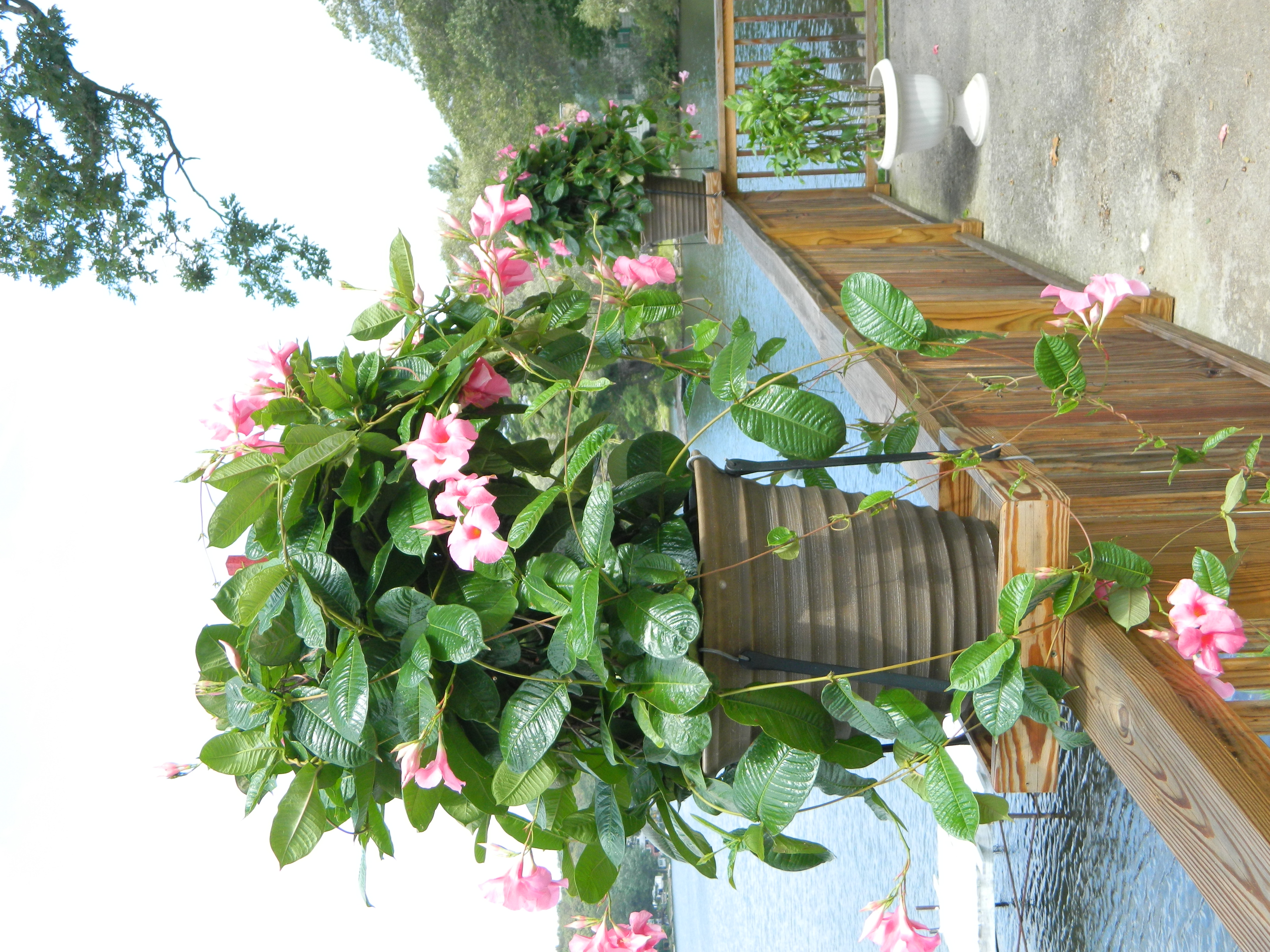
Check out these beauties!  I spotted these beautiful Mandevilla plants in containers along a deck next door to my mother-in-law’s lakeside cottage in Ashford, CT.  She told me the neighbor keeps them in his shed over the winter. I thought, that can’t be.  It is very cold by Lake Chaffee in the winter, especially when the lake winds blow over the property and against the cottages.  These tropical plants would not survive in a shed.  So I interrupted the homeowner while he was mowing his lawn to ask about how he tends to these beauties and if okay to take some photos to share on my blog.

Staged to perfection

His face lit up at the question.  He said a friend lets him store these containers in their basement over the winter, since his lakeside cottage doesn’t have a basement.  He cuts all the plants back, strips any bad leaves, and reduces the watering to barely nothing.  His plants keep growing very slowly and look spindly, but they are still alive.  Basically he is transitioning the plants to a dormant state, which is something you can do with Mandevillas after the container season is over in our regions.

The ideal temperature in a basement for storing these types of tropical plants is about 35 to 40 degrees F.  Place the containers of Mandevilla plants in a dark place.  Water lightly.  Don’t let it completely dry out – and watch for insects when you first bring them in.  The tuberous roots will go to sleep so to speak, kind of like a bear in the winter months, resting – awaiting for warm temperatures to return the following spring.  Some references indicate that you should allow the tops of the plants to be touched by frost before you store them in the basement, but I find – as this homeowner does, transitioning them when temps cool down later in the fall is fine.  Sometimes waiting until frost can result in rot on the plant, especially if cold, moist soil touches those leaves too long.

My mother-in-law told me that every year when he takes them out most of the leaves are brown. Yet the plant is indeed still alive, awakening slowly.  After the plants have been exposed to the outdoors for a while and show signs of growth, he gives them a shot of 10-10-10.  Then, he said, the growth will take off.  The plants are fully awake, ready to receive their place of honor again on his deck.  He will give them a liquid quick release fertilizer, like MiracleGro, about a month or so later.  By July, he said they look like this!  Stunning! And look at them in September, they are beauties.

By the way, during any inside plant to outside plant transition process, it is best to transition them into shade or part-shade before full on sun.  Mandevillas are sun-lovers, but going straight from dark to sun can result in bleaching or sunburn of the leaves.

On corner

The photos speak for themselves.  Breaktaking, especially staged on the posts of his deck along the lake.  Lucky for my mother-in-law, she gets to enjoy them – or should I say scold them.  She is a bit jealous of the beauty around his home.  I guess I don’t blame her!  I would be envious too!

This neighbor of her’s is an avid outdoors type person, constantly tending and updating every inch of his property.  Not only are his Mandevilla containers amazing, he has many other hanging baskets and container gardens around his deck and along his patio.  When he bought the property, he brought in sod for the lawn, not a weed in sight!  So you get the idea.  He is meticulous about care.

Mandevilla vines or sprawling shrubs can grow anywhere from3 feet to 20 feet high – if you are successful at overwintering them here in CT to this size over time!  They are hardy to zones 10-11 and die to the ground in warmer regions, but as for us CT folks, do as this gentlemen did and overwinter them in the basement.

On angle

Mandevillas love humus-rich, moist soils.  Soon, these beauties will require new container/potting soil, as the existing soil will soon tire out and won’t be able to hold water as well, especially against the windy conditions by the lake.  That was about the only tip I could offer the neighbor, as he already has a green thumb and has been achieving success with his Mandevilla plants.  Cathy T

Its Canna Time – Photo Fri

Leave a comment
Peach Bloom

It is Canna Lily blooming time on my deck right now.  For this Photo Friday shot – here is a peach bloom that is just lovely and delicate, but I have others from speckled yellow blooms to bright oranges and reds of other varieties too.  This one reminds me of a gladiolus or orchid but on a larger scale – and the foliage is a soft blue green which is different!  Canna lilies, to me, are just wonderful repeat visitors and with the proper overwintering storage, you save tons of money by using them every year.  They combine well with other tropical plants like the bananas on my deck this year.  I like to cluster containers at various heights to create rooms and drama.  Some are set ontop of a second container turned upside down to elevate them even higher, or you can use small tables, wooden boxes or crates.  And if your container doesn’t have a drain hole (your-bad!), it will be okay for Canna lilies because they can sit in water too!  In fact, I have one in a water container and two tree frogs spent their first few weeks of life inside the container.  I could see them clinging on the inside facing up until they moved out.  Cuties!  If you have used Canna Lilies for the first time and need a lesson on how to properly store them this fall, feel free to contact me for a personal lesson. This is a service I provide to my clients and anyone in need of help.  I’ll come to your house by appointment with the supplies and show you how to do it right!  Happy Photo Friday —- Cathy T  www.cathytesta.com

Mandevilla Mini-Crimson

Leave a comment

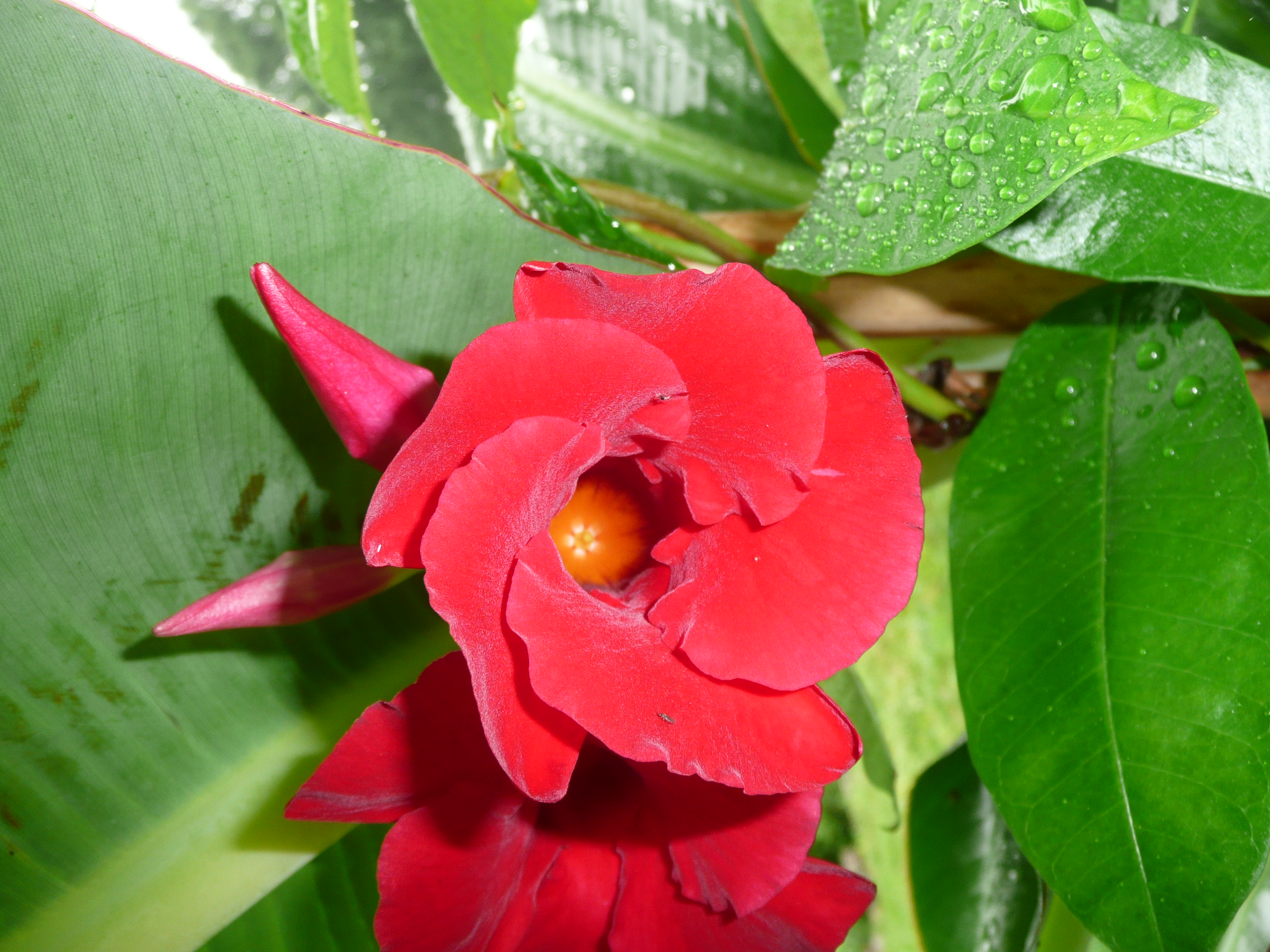
Mini-Crimson

When you need a vertical element in a container or on a trellis in the garden, Mandevilla can quickly stand up to the challenge.  It is an easy care plant with either a bushy or vine-like habit depending on the species or cultivar selected. 

One variety I grew this past summer is called Mini-Crimson by Sun Parasol™ (Sunmanderemi).  It was in the bush category.  But I have also used the vine-like Mandevillas.  Tendrils reach out looking for places to twine upon, and mine twined around a tall Musa banana plant in the center of the container.   Sometimes the tendrils looked like they were reaching for the sun.  They have no eyes, but they sure can see! 

The flowers of  Mandevillas can grow to 2.5-3″ wide and are brilliant against the smooth, dark glossy green foliage of the plant.  And I liked how the red blooms picked up the coloring streaks of the Musa banana with it.  The ‘Mini’ series bloom one month earlier than other varieties (Crimson, Pink and White), so if you spot one early in the season – be sure to grab it!

The best aspect of Mandevillas, in my opinion, is their prolific flowering.  They bloom non-stop from spring/summer to fall providing you can offer them a part sun to full sun location where they will thrive!  I had another one that grew up a wrought iron trellis stand up to 9′ feet tall in one season!

It is important to be a ‘waterer’ type gardener because this plant does not care to dry out.  I was sure to place mine near my hose so I could easily reach it during our hot summer months of 2010 because my Mini-Crimson was in a large container garden situated on a big tree stump.  It was positioned just in the right spot so it could be seen from my nearby deck.  The warmed colored blooms were visible from afar.

In Pots on Stairs

Mandevillas can also serve as sprawling shrubs.  A tropical plant, they are hardy in zones 10-11 and die to the ground in warmer zones, behaving like perennials.  But unfortunately, for our CT zones, we  must move them inside to winter them over after cutting them back, or just use them as a house plant if it didn’t get too large for your house indoor space.

A couple of years back one of my nursery colleagues used Mandevillas in dark blue glazed pots and the red blooms growing above were extremely hot in this combination.  Both colors called your attention immediately.  It was a combination one could not easily forget. 

This is a great plant to use if you need a vine in a hurry and can’t wait for other plants to serve the purpose.  For example, one garden client wanted  a quick viner because they were going to showcase their gardens in a show.  They got one of these plants early in the year and we were happy with the results.  Sometimes waiting for a perennial vine to reach a high enough status is not soon enough.  So for a plant with a quick growth habit, showy appeal, and little disease problems, Mandevilla is a good choice.  And of course, I spotted a Mandevilla yesterday at the flower show in Hartford at a vendor’s booth.  It happened to be the Mini-Crimson.  Like I said, I’m psychic!  LOL….More fun today at the show when I return.  Taking my camera along so I can share the other plants I saw of interest.  Cathy T

Kalanchoe thyrsiflora ‘Fantastic’ (Paddle Plant)

3 Comments
    The Paddle Plant has a new fashionable look this year!  Check out Kalanchoe thyrsiflora ‘Fantastic’ with its red highlights!  I just read of this new cultivar in a trade magazine this month.  It was the recipient of the Favorite New Foliage Plant Award and Retailer’s Choice Award at the 2010 Tropical Plant Industry Exposition.  It is no wonder.  Its hot new red coloring on its paddles’ edges increases the visual response to its already interesting texture.
    Kalanchoe Fantastic-ForemostCo (click this link)
    In 2010, at the Boston Flower Show, I happen to take a picture of the straight species in a pot.  I am not sure why I took a photo of it other than I probably wanted to remember that I liked it.  And somewhere along the line this summer, I bought a paddle plant.  It is still sitting in a clay pot by my slider.  It has shot up quite a bit new growth (or paddles) and seems to be very happy awaiting for warmer temperatures to arrive.  So after testing it at my home, it is confirmed.  I love this plant, will seek it, and hope to find the ‘Fantastic’ cultivar just spotted in that trade magazine. Full sun is the best place for this plant as you would guess.  And in a place where water is well drained.  It despises wet soils.  Pair it up with other succulents.  Or try to capture the red highlights displayed on this plant with other companions that bloom red during the summer season.

    K. thyrsiflora

    Kalanchoe (pronounced KAL-an-choe-ee) is a tropical succulent perennial or subshrub.  It can grow 1 to 12 feet tall depending on the species.  I’m not surprised.  Mine has been growing all winter without much attention.  6 to 12″ of new grow can occur each year. It is hardy in zones 10-11, thus serves as an indoor house plant for CT or as a container gardening candidate in the heat of summer.  The unusal paddle like leaves are a way for the plant to retain water, much needed in the desert drought-like environments it is suited for.  Once again, I’m drawn to the tropical style of plants.

Brugmansia Mania ‘Grand Marnier’

Leave a comment

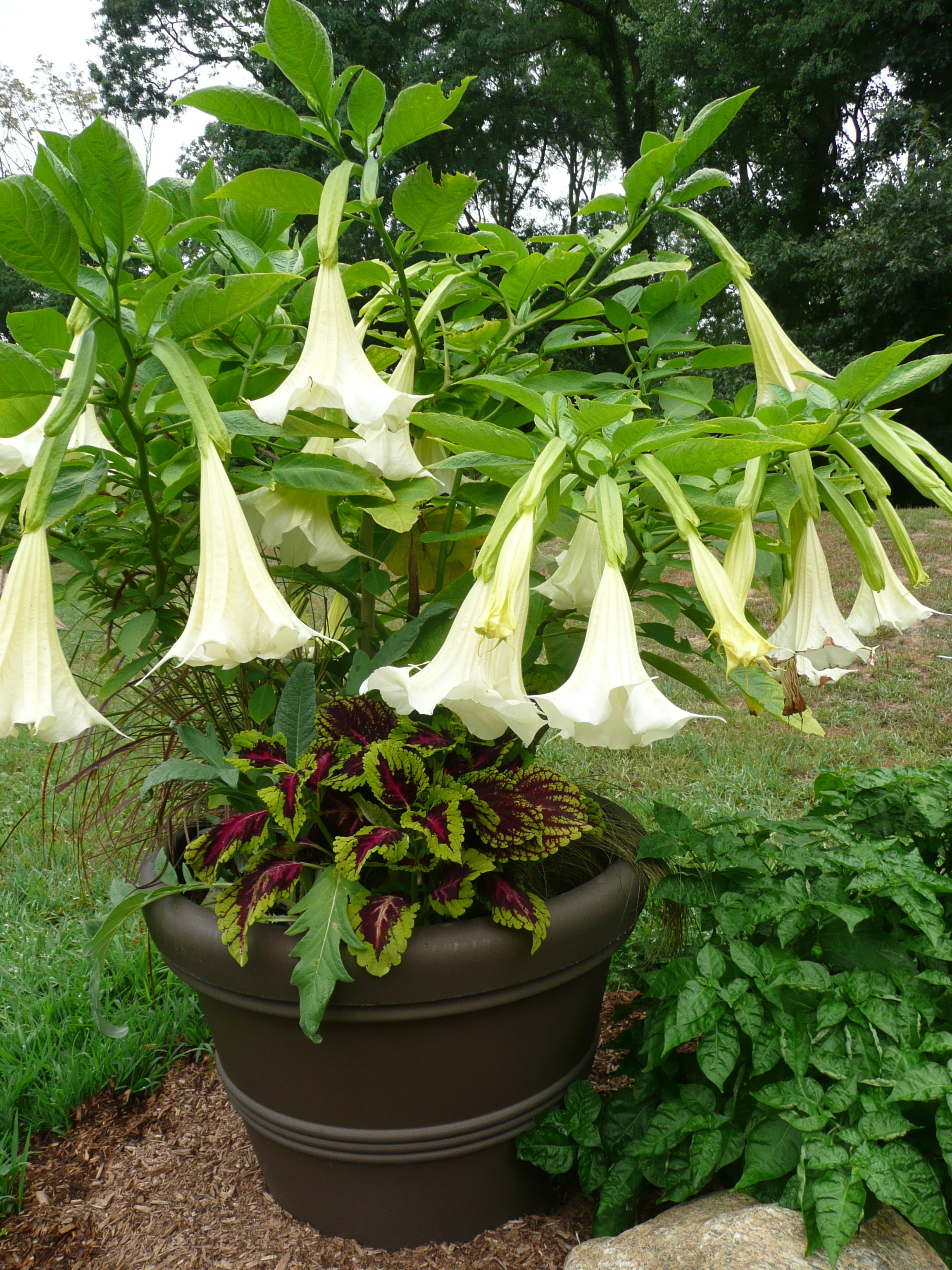
Elephant Ears, Canna, Banana, and Brugmansia are four of my mania plants.  I would probably go insane if we were unable to get these plants here for container gardening.  A nursery visitor told me one day that Brugmansia doesn’t do anything for her.  I responded, “You either love them or hate them.”  As for moi, I think they are amazing.  Their eye-catching large trumpet flowers and fast growth is a necessity for us CT gardeners whom enjoy tropic temptations!

Blooming 2010

This year Brugmansia x candida ‘Grand Marnier’ is on my plant order list for 2011.  A subtropical shrub or tree, it is hardy to zones 9-11.  This cultivar is popular and vigorous. It will grow up to 4-5 feet tall and wide in one container planting season, and produce large soft apricot-pink blooms, known as angel’s trumpet.  During the evening, the flower’s fragrance is intense and very noticeable.  It may be too powerful for sensitive noises.  Place it at a comfortable smelling distance or nearby if you are a perfume lover.  It is no wonder these large angel’s trumpets blossoms are captivating for they can reach 8 to 12 inches long.  As they dangle down and hang on for periods of time, you can’t help but notice them during the day hours too. 

Pronounced brugh-MAN-zee-uh, serve it up solo in a large container or mixed with other annuals and perennials. Just be sure to consider a full sun location and compatible planting partners with similar needs.  However, with that said, the large upper canopy can cast some shade to the plants below depending on the container’s location.   You won’t be disappointed with the flower blossoms as they appear in abundance, sometimes up to 15-20 on a plant at one time.  The shape of the flower is stunning as it unfurls with pointy, flaring tips to the edges of the trumpet’s opening.  Blooms form on the new growth which is great for our short summer season so you don’t have to wait to see them.

The soil should be rich, well-drained, and watered well.  But don’t over do it- it likes to drain between waterings.  In CT, you can overwinter this plant by tricking it into dormancy.  How-to tips are discussed in Cathy T’s Container Garden Parties.  See my website, www.cathytesta.com, for information. 

In warmer climates, this plant can be sunk into the ground in its container and covered for potection.  I spotted these plants in many locations in Hawai’i.  There they can reach tree size, up to 12′ feet tall.  However, take note every part of the angel’s trumpet plant is toxic.  Should you eat it, hallucinations are bound to scare you – and make you go mad!  Let Brugmansia mania be one for the eyes – and not for the mouth!   Cathy T