How should I transport my plant from the garden center to my home?

8 Comments

My sister called me yesterday afternoon to ask about a new magnolia she purchased at a nursery.  She was planning to pick it up today, and wanted to know how to handle the transportation in her mini-van.  This was an excellent question to ask.  The last thing you want to do is damage your new plant purchase, so here are a few tips and reminders on what to do when you move your plant from the garden center to your home.

Balled and Burlapped B&B) tree example

Balled and Burlapped B&B) tree example

GET OUT THE BED LINENS

It may sound funny, but you may want to grab a couple old pillows and a thick blanket, or a tarp along with some bungee cords or rope, before you head to the garden center. The main thing you want to do for trees is protect its bark and foliage during travel. Bark is like your skin, overlaying the veins in your body.  On trees, bark protects the cambium layer responsible for transporting water and nutrients in the tree, much like how veins move blood in our bodies.

If the bark gets rubbed, broken, bruised, or nicked, it can prohibit the passage of nutrients and create a perfect place for insects and diseases to settle into your tree. When you place or lay your tree in a van, car (which I’ve seen done for small trees), or inside the back of your pickup truck, be careful to not nick the bark.  Don’t allow the tree to roll around in the vehicle, hitting something like tools, or your seats.  Damage on the bark, or the trunk for that matter, is a leading cause of death in trees.  Sometimes wounds will heal but it can make the tree’s appearance not as lovely as you had imagined.

GIVE THE FOLIAGE A HAIR NET

As for the foliage on the top of the tree, it should not be exposed to wind as you drive home.  If you put the tree in the back of your pickup truck, be sure to protect the foliage somehow.  A light bed sheet works well, wrapped like a hair net – or the nursery may have some type of light material to offer you to protect the foliage.  Wind will shred the leaves and dry them out.  Even if you drive carefully and slowly like Grandma.  This is also true with evergreen shrubs susceptible to drying winds.  It is best to cover the foliage on its journey to your home in a vehicle if exposed.

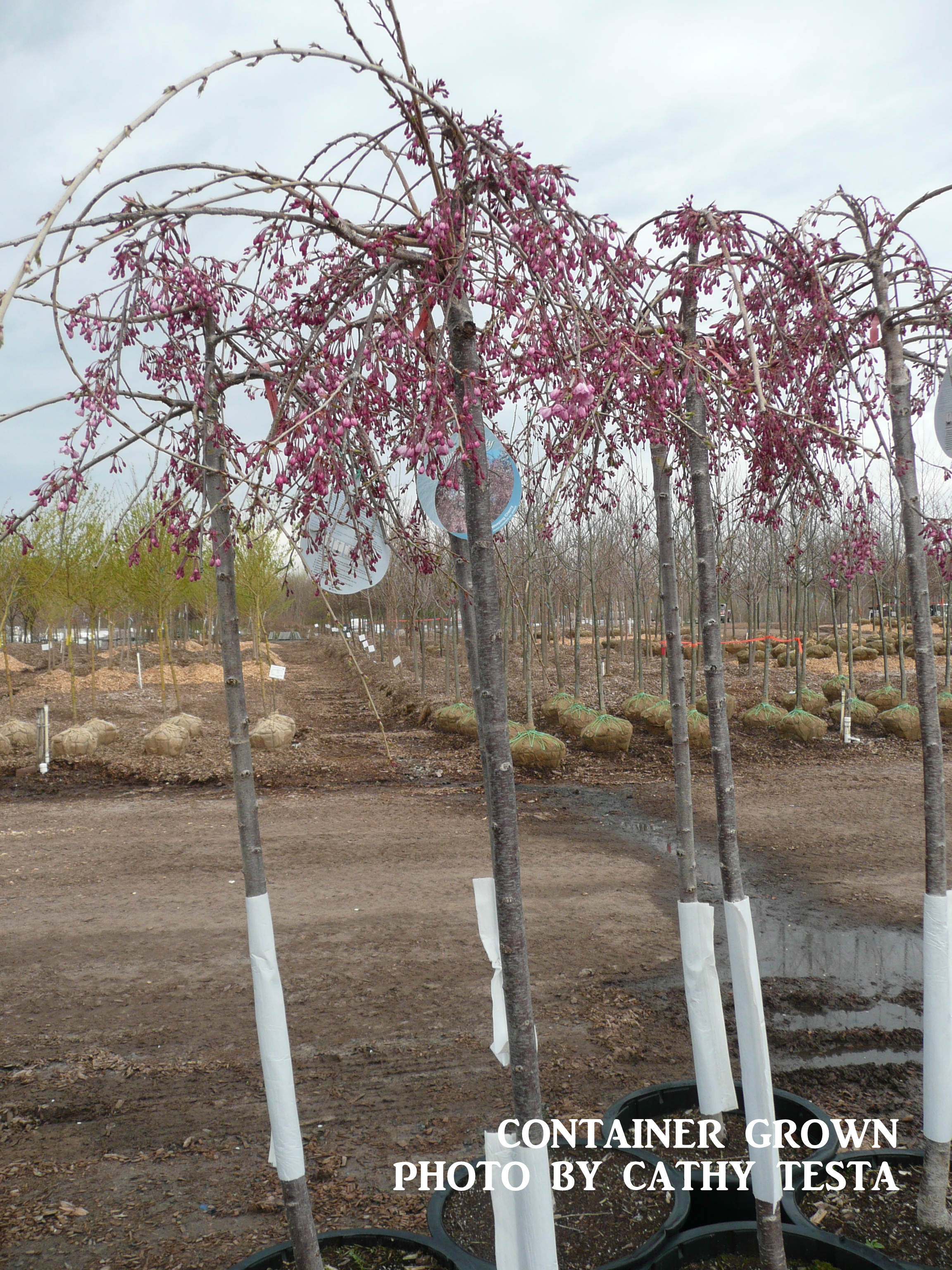
Container Grown Tree Example

Container Grown Tree Example

PERENNIALS IN POTS

If you are bringing home perennials or annuals in pots, grab a cardboard box or plastic milk crate to insert the pots into your vehicle as you travel so they won’t topple over in your car.  Most nurseries offer a plastic liner to protect your car seats from the wet base of pots, but you may want to bring along a sheet as well if you have one on hand.  They can be handy.  Inside the vehicle, perennials and annuals are protected from strong winds, unless you drive a convertible, so they will be okay.  And in the back of a pickup truck, sometimes this is okay because they are lower than the top of the pickup truck’s bed.  But if you stop somewhere on your travels, and plants are inside your vehicle, don’t let them sit in the heat for too long.

VENTILATE YOUR CAR IF YOU STOP SOMEWHERE

Mostly likely, if you are out and about shopping for plants, you will also be stopping somewhere for another errand or to have  lunch.  If you have your tree, perennials, or annuals “in the car” – and plan to stop for a while, open up your windows slightly to allow some ventilation in the car.  Although many plants like the warmth, scolding hot temperatures will stress out the plants, and dry out the soil in the pot.  Overheating your plants is like overheating a dog in the car, it can lead to suffering and even death! Remember this for plants you may have put in the trunk of your car too.  If stopping for more than 15 minutes on a hot day, I wouldn’t leave them baking in the car’s trunk like an oven.  They will get weak and withered, and potentially at a permanent wilting point – unable to recover.  You may not either, once you learned you fried your investment.

Pick it up

Pick it up

USE A HAND TRUCK OR WHEEL BARREL TO MOVE YOUR PLANTS

You should not lift a tree by its trunk at the base or mid-way on the trunk.  You might not only hurt the tree, but hurt yourself too, especially if the tree is balled and burlapped.  B&B trees are dug up from the field with the soil base around the roots. They are very heavy compared to container grown trees.  With a B&B tree, you probably will need help to load and transport the tree, and unload it at home.  Big B&B trees are often better planted by an expert – and many nurseries offer this service.

If a container grown tree, it is much better to lift it by the container, and then place it carefully on a hand truck or in a wheel barrel to move the tree to its holding location or planting location in your yard.  Don’t leave your new tree or perennials in the wrong place if you don’t plan to plant it in the ground right away.  There are two things you must remember.  Some trees and shrubs will be top heavy if grown in a container, and the wind can topple it over.  And the second thing, is they can dry out in pots, so you must also remember to water them.

Last year, one of my clients took home two beautiful Kwanzan cherry trees for a park installation.  She placed the trees by her picnic table to wait until she could go plant them.  The next day happened to be a very windy day.  While she was at work, the wind had tossed one of the trees against the table repeatedly, rubbing away the bark and creating a good sized wound.  We decided to plant the tree anyways, and hope for the best.  Looking it over this spring, the wound is healing nicely, but you can visibly see the damage done, plus the tree doesn’t match the other one as a result.

A good tip is to insert the container into another bigger and heavier empty pot or box at home to stabilize the tree until you are ready to plant it in the ground.  Or put some weighted object, like large rocks or cement blocks around the outside of the pot base to keep it in place in the event of a windy gust.  Also, put the plant where there is a bit of shade to protect it from harsh sun until you are ready to plant it.  And also very important – don’t forget to water it from time to time if you don’t plant it right away, especially if you placed it on pavement where the pot can get hot quickly.

On your planting day, if you have several trees or plants to plant, line them out into their permanent positions in your landscape, but don’t remove them from their pots until you are ready to place them into the planting holes.  Leaving exposed roots could potentially dry out the roots too.

Once planted, another good reminder is to be careful when mowing your lawn or weed whacking nearby so you don’t nick the bark once you have successfully planted it in your landscape.  Something I have to remind my husband every year when he breaks out the mower!

So follow these guidelines, turn up the tunes while traveling home from the nursery, and rest assured all will be safe when you arrive home!

Container Crazy Cathy T
http://www.cathytesta.com
860-977-9473 (cell)
containercathy@gmail.com

Bring on the Easter Colors

2 Comments
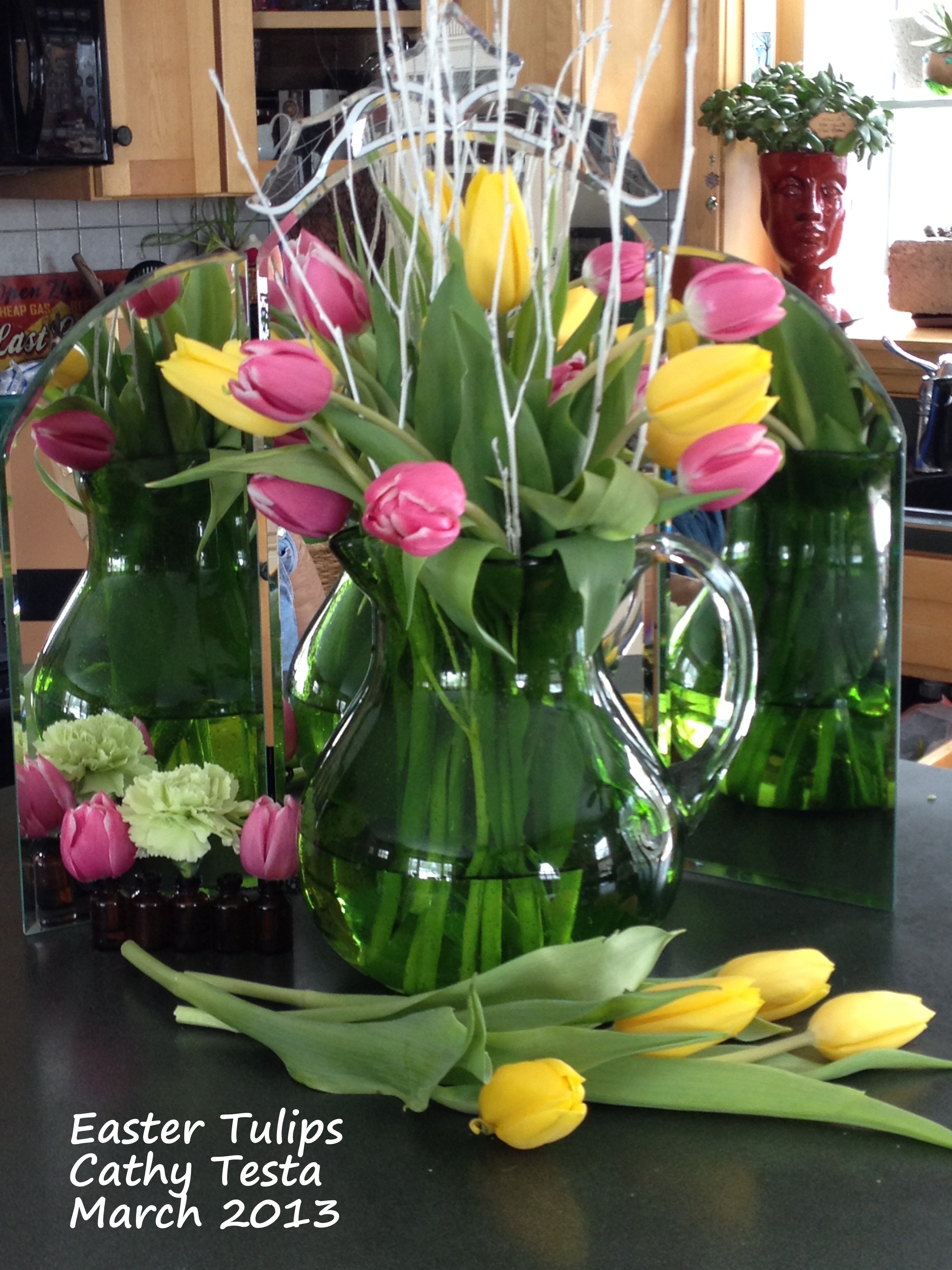
Tulips in Vase

Tulips in Vase

Yesterday I was determined to get some color, and since the outside was blanketed with snow on the first day of spring for 2013, I spontaneously decided to pick up some fresh tulips while at the grocery store.  I placed them in a green glass pitcher and added some white twigs – and voila, the color arrived.

Begins to Open

Begins to Open

Within the first five minutes or so, I could see the tulips petals begin to expand from the warmth and water uptake.  I thought it is amazing how quickly they respond to being admired.

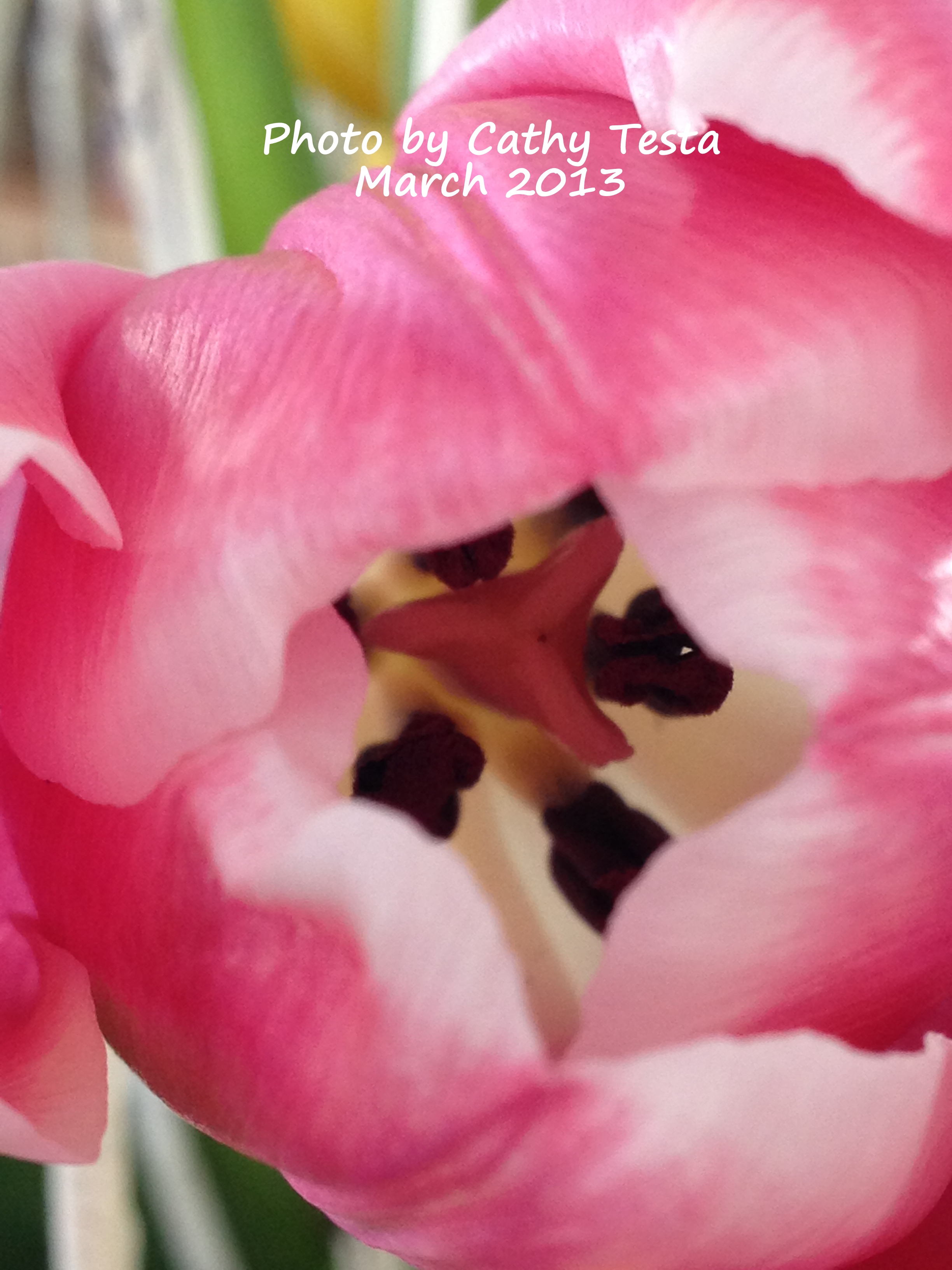
Peek-a-Boo

Peek-a-Boo

So, because I’m obsessed with plants and flowers, I took a shot of the petals opening up.  Finally, I thought, I got some color in this house.  Then I placed one yellow tulip by my window to capture the sun’s rays.  Yellow happens to be my favorite color for tulips and roses.

Yellow petals capture the sun

Yellow petals capture the sun

This little bit of activity prompted me to go dig out a box of Easter decorations from my basement and put out some bunnies and other Easter goodies to brighten up the home inside.  It was time to bring on some Easter colors.

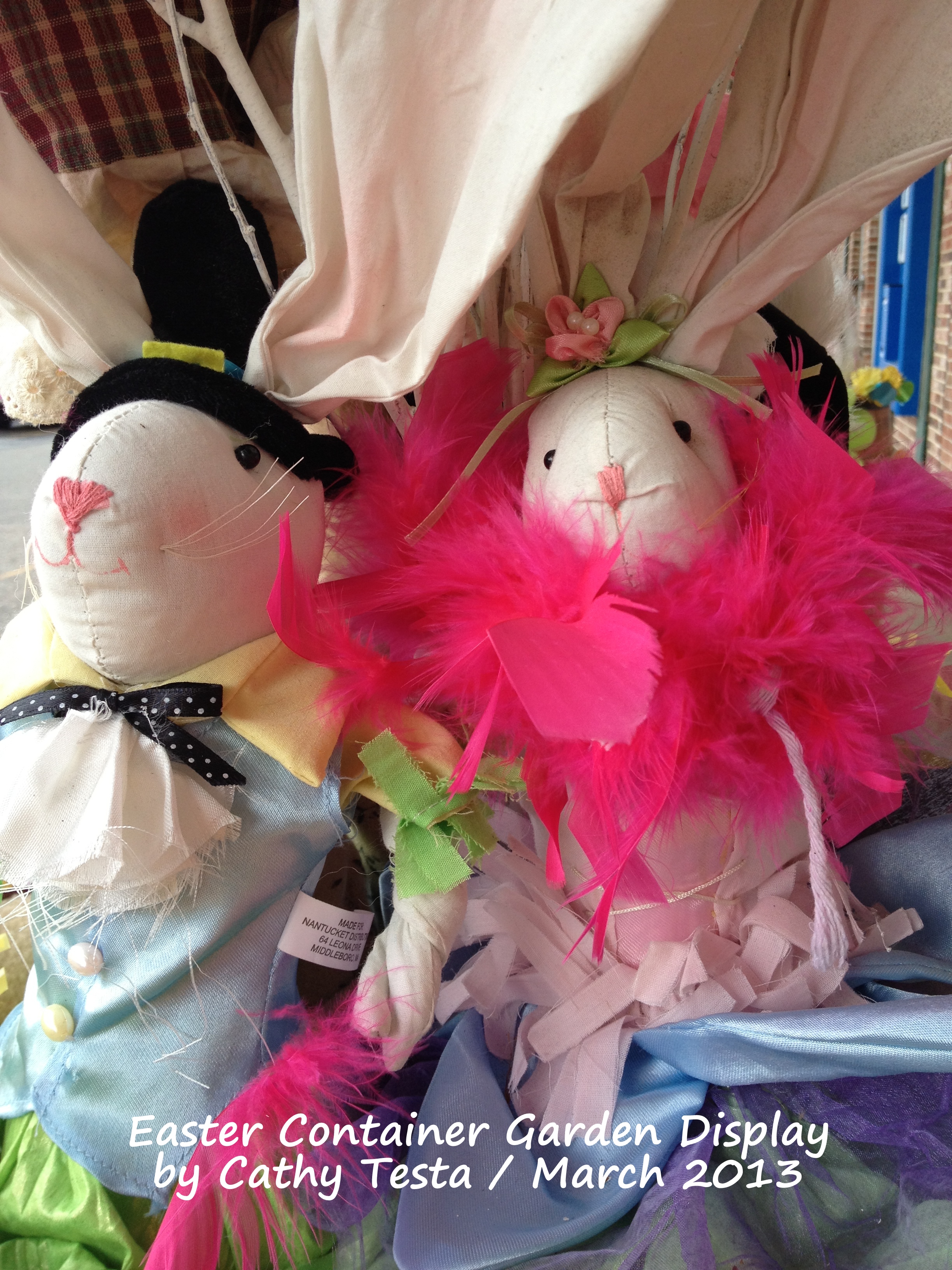
Easter Bunny Lady

Easter Bunny Lady

I also installed a container garden display outside of my client’s business.  Usually I include some daffodils, hyacinths, or other spring blooming plants – but it is only in the mid 20’s to mid 30’s, and I thought, I’ll jut put out some decorations and as soon as Easter is over, I’ll add some live plants.

It was cold outside as I was working with the wind blowing, and I was a bit frustrated of not having spring-like temperatures, but this process cheered me up.  The bunnies faces are too adorable – and the colors reminded me of the tulips I put in the house earlier.

The Happy Couple

The Happy Couple

When I work on the displays for this client, the customers walking into his store always compliment me – saying, “You do such a good job!”  They just love the change of the seasonal displays – and that makes me happy.

Cute Couple

Cute Couple

Aren’t these pair of bunnies so cute?  I think so.  Seeing them made me think of the Easter goodies and colors as a kid.  I always loved getting Easter baskets and cards when I was a child, and as an adult, I also love preparing and giving Easter baskets to my nieces and nephews, and still do.

One year, my Aunt hid Easter baskets all over my parent’s house.  I remember us running through the house, trying to find our basket. The rule was if you found someone else’s basket, you could not give it away – where it was hidden, so we would scream and laugh when we would find other’s – for our brothers or sisters.  Thank you Aunt Lucy – I remember you doing this for us!

I miss the “Candy Castle” store we use to have in our town where you could buy homemade chocolates.  The smell would be so alluring when you would walk into the place, but now it is gone.  Another fond Easter memory.

Two barrels

Two barrels

There are two barrels in front of this store, and the other one has a male bunny.  I didn’t take a photo.  Lovely bag of rock salt in the back, eh?  It is the little hint that we have snow right now.  But – Spring is Coming – It is coming – right???  In the meantime, get into the Easter spirit.  Add some color inside if you can’t get it outside yet.

Container Crazy Cathy T
http://www.cathytesta.com
860-977-9473
ctesta@sbcglobal.net

3 Quick Examples of Color and Plant Combinations from the Boston Flower & Garden Show

1 Comment
Great combination of colors

Great combination of colors

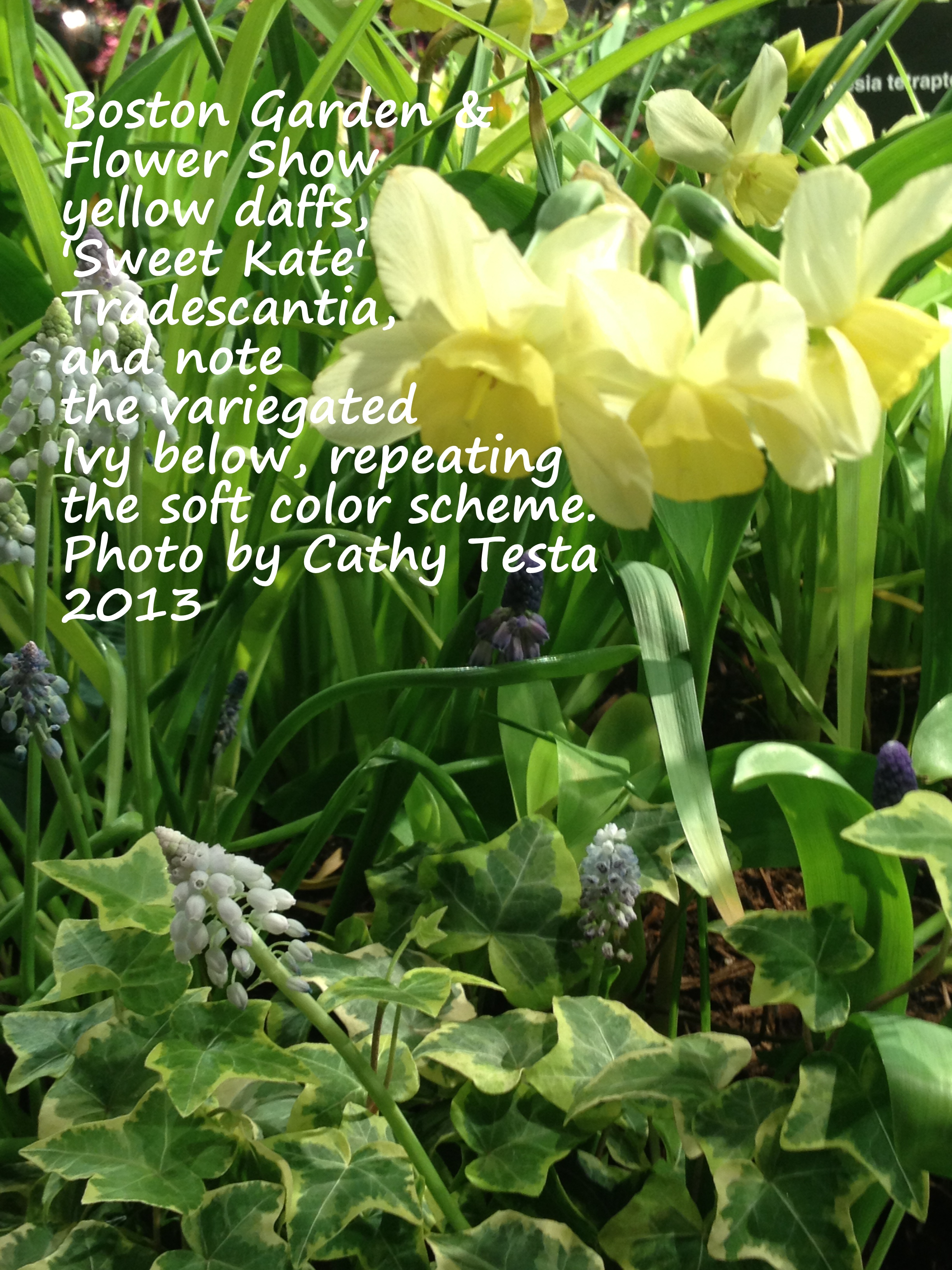
No . 1:  Tradescantia x andersoniana ‘Sweet Kate’ with Daffodils and Hosta

This weekend, at the Boston Garden and Flower Show, I admired a combination of plants with a monochromatic color scheme utilizing hues of yellow and greens.  It was displayed at one of the garden exhibits and included yellow blooming daffodils (Narcissus), variegated hosta, and Tradescantia x andersoniana ‘Sweet Kate.

‘Sweet Kate’ was placed between the daffodils and hosta.  This perennial, with the common name of Virginia spiderwort or widow’s tears, has long strap-like leaves, resembling long blades of slender grass.  The leaves of this cultivar have an iridescent yellow color, most showy in full sun conditions.

At the base of this planting bed, an ivy plant was tucked within which had leaves with yellow margins, repeating the hues of yellow in the grouping of plants.  Purple blooms of Muscari armeniacum, grape hyacinth, with urn-shaped flower clusters on short flower stalks created a complementary color (purple opposite yellow on the color wheel).  It was a soft and spring like combination.

Softly repeating yellows

Softly repeating yellows

I thought to myself, this designer carefully selected plants that worked well together in regards to subtle colors, and it also had a nice woodland feel.  I think it is a good example of simplicity, and a perfect combination to use in spring container gardens, with the daffodils serving as a “welcoming” plant, ‘Sweet Kate’ as a filler along with the hosta, and the ivy as a spiller.  It was charming and calming, so I took a couple quick photos to post on my blog, and share with you.

No. 2:  Heuchera with hot red Tulips and Euphorbia

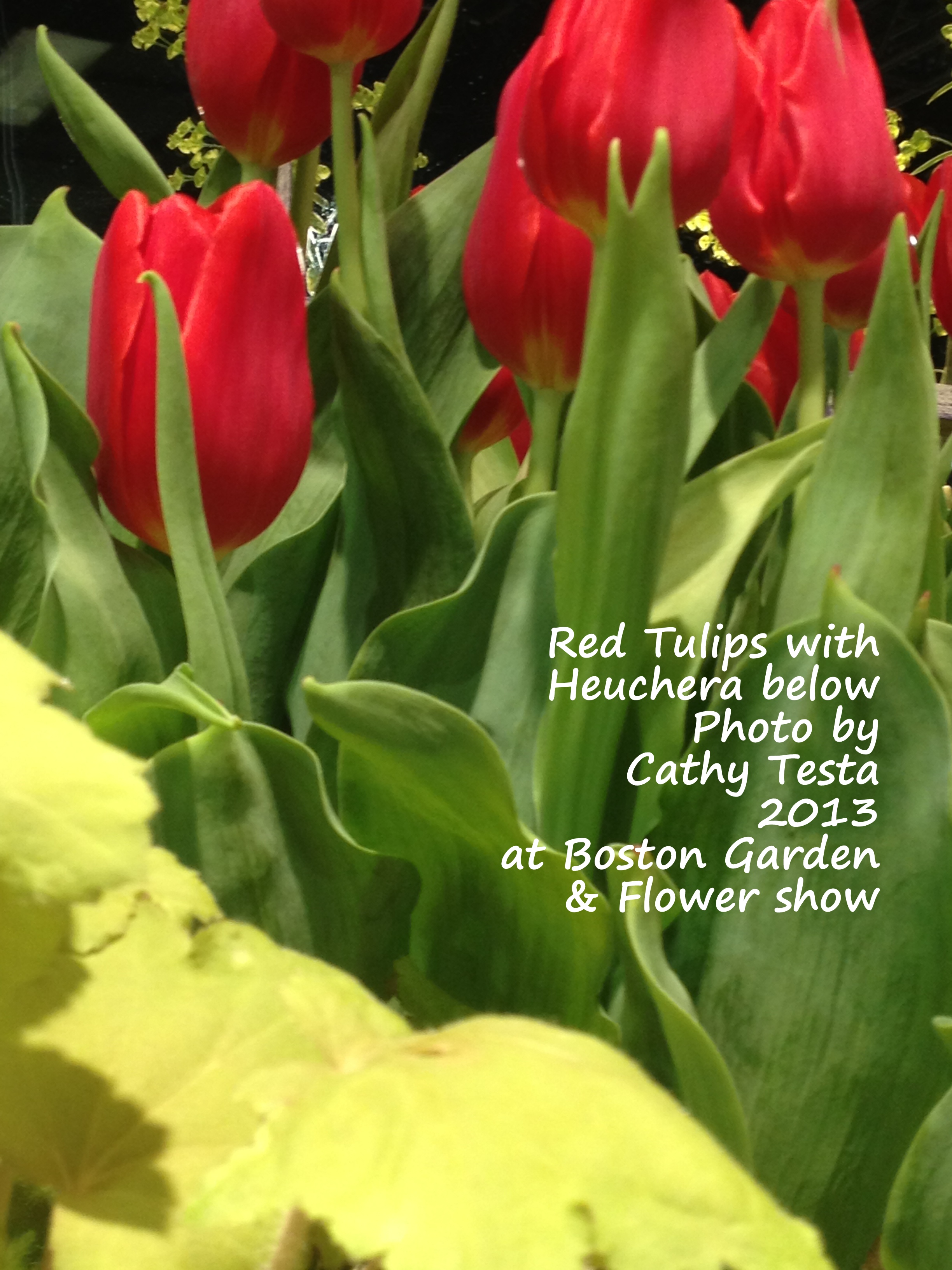
Another arrangement, located at the next display, was a combination of intense red blooming tulips combined with the bright leaves of a Heuchera perennial at the base, and yellow flowers of a Euphorbia perennial to the left of the tulips.

The display was elevated with a mirrored window frame in the background to capture the colors in its reflection. Again, the designer was thinking of color, but in this case, a harmonious relationship of red, yellow, and green was utilized.

The red tulips were the thrillers, and caught your eye from a distance, adding some heat, while the yellow was a bit less intense but still created a warm tone to the grouping of plants, quite opposite of the soft hues displayed in the prior exhibit at the flower show.

Red Tulips with Euphorbia and Heuchera

Red Tulips with Euphorbia and Heuchera

The Euphorbia, left to the tulips, with yellow flowers at the tips, echoed the bright yellow colors of the Heuchera tucked in at the base of the grouping of plants.

The Euphorbia perennial, known as spurge, has flowers with yellow bracts turning an orange-red.  In the center, you can see a dab of red again repeating the red tulips’s color.  The leaves have a reddish midrib.  These small pops are like the brush strokes in a painting – adding a bit a flare you may not consciously notice, but feel.  Take notice in the next photo, there’s some yellow strokes at the base of the red flower petals on the tulips.

I didn’t write down the Heuchera’s cultivar name from the display, but it reminded me of Heuchera ‘Citronelle’ with bright citron yellow foliage.  Common name is coral bells. Heucheras make great fillers in container gardens in spring and last well into mid to late summer. And while the Euphorbia flowers may fade, the foliage will last to the end of summer too.  Both plants are easy to grow.

Close up of red Tulips with Heuchera

Close up of red Tulips with Heuchera

The arrangement using hot reds and yellow with solid, reliable greens immediately reminded me of one of my favorite spring container gardens I assembled a couple years ago, using a pop of red and probably the same bright yellow Heuchera, with some red repeating colors from a Euphorbia.  See here:  Cathy T’s container garden:  spring combo

The next plant combination may not be for everyone, but it caught my attention.  I really like foliage in designs, and this one put together an unusual grouping. In the center, a very tall bamboo plant is showcased, with Helleborus orientalis ‘Brandywine’ perennial sitting below at the base and Mondo grass. Who would have thought these would work together?  But they do.

Bamboo with Helleborus perennial

Bamboo with Helleborus perennial

No. 3: Fargesia nitida (bamboo) with Helleborus ‘Brandy Wine’ and Mondo Grass

I also liked how they alternated the Helleborus plant at the base with what I believe is a Mondo grass.  Again, foliage shapes and forms work well. The Asian styled walls and windows make the foliage plants stand out more and draw your eye in to the design area at the same time.

Helleborus plants happen to be one of my favorites because of their coarse semi-evergreen foliage, deer-resistant trait, and early flowering in late winter to early spring. Hellebore is the common name.  It has cultivars with flower colors in dark plums to soft pinks, whites, and more pale colors.  Hellebores also make excellent long lasting container garden plants as fillers, lasting well into fall. They are a “solid” plant to use in containers and can be transplanted to your gardens when the season is over.  I like how the basal leaves are tough, and some have a little bit of serrated edges.  It is a partial shade to full sun plant and fairly drought tolerant.  Some are starting to poke out of the ground right now, as we enter spring.

These are just three quick examples of color and plant combinations I saw at the show – there were many more.  There was even a display covered in fake snow, which was so appropriately timed – as we got snow fall yesterday – one day before the “First Day of Spring” which is today, March 20th.  I hope it melts quickly so we can go get some of these spring flowers and start adding some color to our porches and gardens soon!

Snow covered display

Snow covered display

Container Crazy Cathy T
(860) 977-9473
ctesta@sbcglobal.net
http://www.cathytesta.com

‘Ubatuba Cambuci’ is the UFO of Ornamental Peppers

2 Comments
Purple Flower to Purple Pepper

Purple Flower to Purple Pepper

Ornamental peppers add many wonderful attributes to design compositions in container gardens.  They come in various colors, very rarely get attacked by pesty insects, and have interesting shapes. Additionally, the color of the fruit changes as it matures.

These attributes are something I’ve written about in previous posts.  One post was when my sister purchased a pepper producing purple fruit from me, and another post was when I gave a black fruiting pepper plant to my vet as a thank you for the nose surgery he did on Hunter, my cat.

I really like the look of colored peppers in container gardens.  Some end up in deep, dark colors, and others evolve into bright hot colors. You can include companion plants in the container combination to capitalize on this by thinking about when the other plant’s flowers will bloom and selecting bloom colors to match, echo, or contrast the colors of the peppers for seasonal interest.

The shape of ornamental peppers is interesting too.  Some are pointy and long, facing upwards on stems, others are round and chunky, and some are perfectly round pearl shapes.  Before the trend of incorporating veggies into perennial gardens, people would be surprised when they saw I had a pepper plant in my container gardens with other types of plants.  Now I have a new candidate to suggest using, one by the cultivar name of, ‘Ubatuba Cambuci’.  It has the most unusual shape.

Shaped like a UFO

Shaped like a UFO

Shaped like a Flying Saucer

‘Ubatuba Cambuci’ is a Brazilian pepper plant with fruit resembling a UFO.  It has a wide to squat body shape with edges around it extending outwards a bit.

Dianne, one of my good friends, noticed mine in a container on my deck last summer, as shown in this photo to the left.

She asked, “What is that?”

When I told her the name of the plant and explained how I think it looks like a flying saucer, she replied with, “Only you, Cathy T, only you.”

Dianne is always super enthusiastic about my plant endeavors.  She attends my classes regularly and always gives me words of encouragement and praise.  I’m lucky to have her, and many other good friends, support my plant passions.  She was really impressed with the unique shape of Ubatuba and said she had never seen one before either.

I asked Dianne, “Doesn’t the fruit also look like a body with arms hugging its belly?”

We both started laughing as she agreed.  The fruit’s shape provides conversation opportunities to any admirer taking notice. But the shape alone is not its only talking point.  There are some interesting facts about the plant’s name.

Named after a place, and from its shape

Ubatuba is a lovely beach town in Sao Paulo, and Cambuci is a municipality located in the Brazilian state of Rio de Janeiro.  So, the plant is named after these two places.  I also read that a river in eastern Brazil is called the Ubatuba River, and that Cambuci is a fruit tree apparently on the verge of extinction (and this tree’s fruit has a similar shape of this pepper!), and get this…Uba Tuba granite is quarried in Brazil for use in making kitchen counters.  So there you have it – a plant named after a place and a shape.

Sometimes I think the name selections are off for plants – this one would be so easily called ‘Alien Nation’ and you would get it right off.  But honestly, I haven’t visited Brazil, so I did not recognize the name as being from a place, but surely it is a tropical treat there, just like this pepper plant.

The first part of the plant’s cultivar name has ‘tuba’ at the end, and it is pronounced just like the brass instrument, so just add an OOH-BAH in front of that. The second part I wasn’t so sure how that goes, something like CAM…going into a BOO, and then the common e-e or ei sound at the end.  Heck, you can just nickname it “Uba” for short, but there is a certain ring to saying Ubatuba – Ubatuba.  This attribute, its name, is entertaining, at least to me.

Color Changes from Yellow to Orange, to Red

‘Ubatuba Cambuci’ starts off yellow, transitions to orange, and finishes to a bright attractive red. The fruit grows to about a three inch size.  A little bit larger than the perfect bite size.  The plant itself has a bushy habit and grows up to three feet tall. Its dark green foliage has good sized leaves and the stems are sturdy and strong.  Fruit tends to stay stable on the plant because of this, and staking is usually not required, if only, towards the end of the season.

The added benefit of the pepper’s color changes is it can help you in the selection of your companion plants in your container garden design. If you think it through by period of bloom, matching the yellow stage of the pepper’s color to an early yellow bloomer of another plant, and the red color stage of the pepper to a flower blooming in late summer in the same container garden, you create seasonal interest.

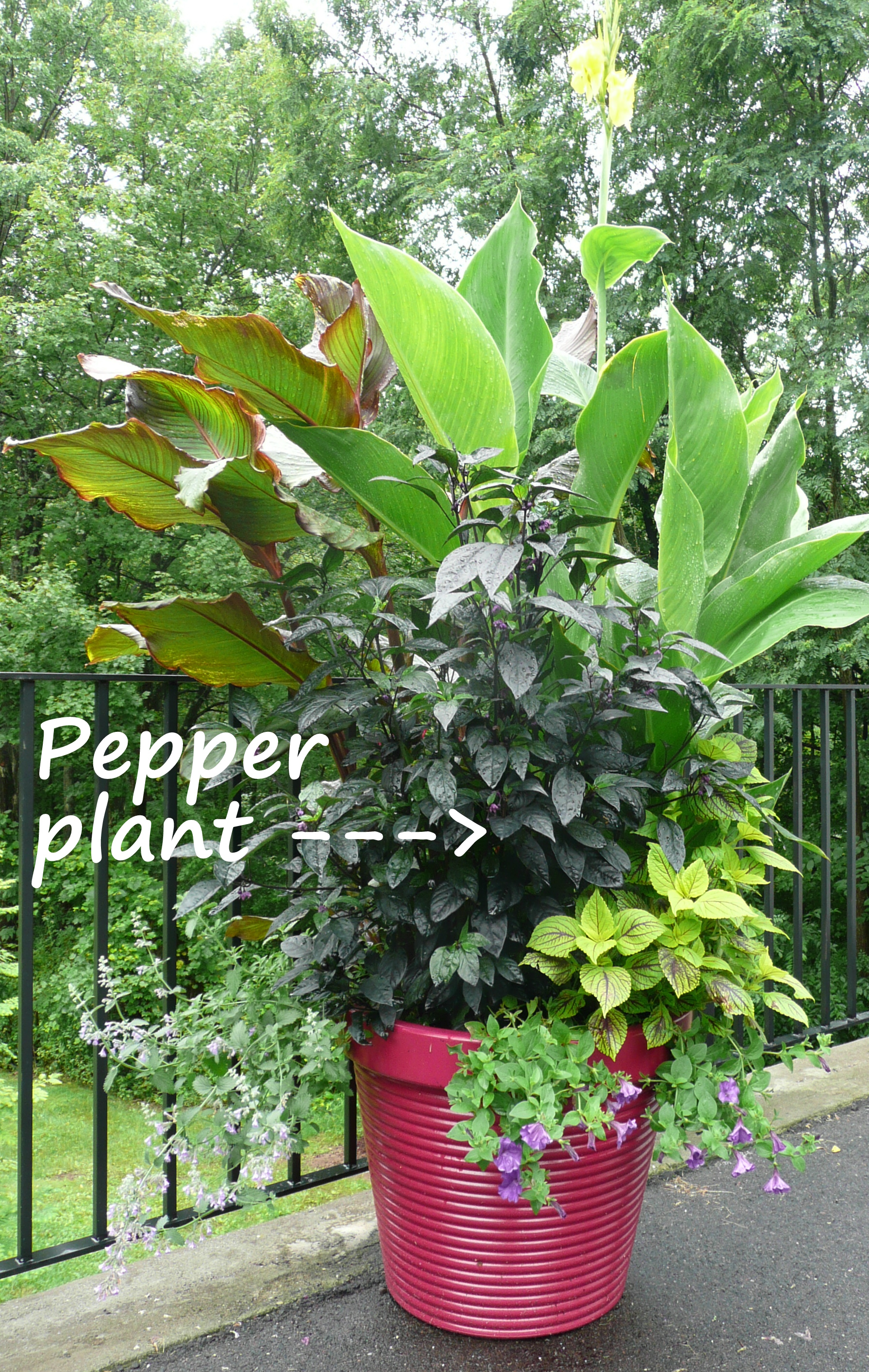
Black foliage and purple peppers

Black foliage and purple peppers

Plant Companions to use with Ornamental Peppers

As shown in the photo to the left, the annual, Coleus ‘Gay’s Delight’ was used as a filler because of the purple veins in its bright chartreuse leaves.  It highlighted the purple flowers and fruit of the pepper plant in this container.  In this case, the pepper plant’s foliage was also a dark purple to black color.

Consider perennials; examples are Monarda didyma ‘Petite Delight’ with pink flower, Nepeta x faassenii ‘Dropmore’ with lavender flowers, and Verbena bonariensis; these would look stunning with purple peppers.  This would create a mix of purple tones to show up against the dark foliage of the pepper plant as shown here for a softer combination of monochromatic colors.

If the pepper of your choice has a full, bushy habit, put a taller center plant to elevate above it, as in the example of tall Canna plants.  Or combine your pepper plants with edibles to create quick dinner snipping sources. Include cherry tomato, basil, chive, and oregano.

Because many herbs are green foliage plants, select those with variegated leaves to make them stand out against the foliage of the pepper. Ocimum citriodorum ‘Pesto Perpetuo’ has a creamy white coloring on the leaves’ edges, or Ocimum basilicum ‘Amethyst Improved’, showing off a deep dark shiny black color.  Golden thyme plants work well, try Thymus citriodorus ‘Archer’s Gold’.  For a spiller, nasturtiums are perfect and easy to grow, and are edible, look for Tropaeolum majus ‘Wine’ for the yellow and orange flower color.

For a hot red combination, plant Verbena x “Taylortown Red’, and add a Pennisetum setaceum ‘Rubrum’ as a spiky accent with the ‘Ubatuba Cambuci’ plant.  I assure you, if you add an ornamental pepper, your friends will take notice, and you can have them taste test the fruit.  Ask them if it is sweet or hot?
Plants with Flavors

Plants with Flavors

It is Sweet, no wait.  It is Hot.

When I include peppers in my container gardens, the matured fruit does not last long because of a number one predator in my home, Steve, my husband.

Last summer, he walked up the back deck stairs, rather than entering through the front door when arriving home from work so he could partake in the daily offerings of my ‘Ubatuba Cambuci’ fruit.

So I asked him when he took his first tasting, “”Is it sweet or is it hot?”

He responded, “It is sweet, no wait. It is hot.”

This pepper is listed as “mild-hot” in the catalog, but the plant’s label indicates “sweet.”  There seems to be a little bit of both, starting off mild and transitioning to hot as you munch on it.

Adding tasty treats to your container gardens is a lot of fun, and of course, they can be used in cooking or dried later in the season to use in your recipes during the winter.

I can’t tell you how many people noticed my Stevia plants (Sweetleaf) offered for sale at a farmer’s market one season.  It is a substitute for sugar, and when you bite into a leaf, it truly tastes like sugar…And that plant – one to blog about later – really grew well in my container gardens.  But more on that later.

Culture and Container Size

For the container size, go large, at least 22-25″ diameter pot, especially if you combine “Uba” up with two or three more plants.  ‘Ubatuba Cambuci’ appreciates moist, well drained and organic soil and the space to grow.  Be prepared to water this plant in a container garden more often because it draws a good amount of moisture from the soil during hot summer months.  I watered my plant daily toward mid to late summer.  And of course, it needs full-sun to produce the best flowers and fruit.  Remember to check your companion plants for the same conditions.

By the way, I actually had difficulty finding the Genus and species name for ‘Ubatuba Cambuci’.  It is not noted on the plant’s label, nor was it in the grower’s catalog.  I’ve read it is bred from a species Capsicum baccatum or Capsicum baccatum var. pendulum.  Cultivars are typically distinguishable from the species by one or more characteristic.  The most obvious characteristic being, in this case, its unique “flying saucer” shape.  It is one you won’t forget after the first time you see it – just like when you spot your first UFO.

Container Crazy Cathy T
http://www.cathytesta.com
860-977-9473

Please feel free to click on the ‘red stamp icon’ at the top of this blog to leave your comments, especially if you have grown this pepper, I’d love to hear from those of you visiting.


Butterfly Conservatory Breaks the Winter Blues

7 Comments

If you suffer from a seasonal disorder in the winter, where you need to get out to break from the winter blues, may I suggest a visit to the “Magic Wings Butterfly Conservatory and Gardens” located on 281 Greenfield Road in South Deerfield, MA?  It will be a place of warmth, sunshine, and lots of color.  I visited yesterday with my sister and niece, and here are the photos I took along the way.

Favorite shot

Favorite shot

I think this one is my favorite photos of the day.  If I am reading the butterfly id chart correctly, which I purchased for $1.00 at the entrance ticket booth, this is a Brown Clipper, Parthenos sylvia.  I don’t know much about butterflies other than they are beautiful in the garden – serving as nature’s living art – so hopefully I have the right names written with the photos I took yesterday.

Tithorea tarricina

Tithorea tarricina

Again, not sure but this one looks like Tithorea.  Love the long antennae and legs.

Japanese Lantern

Japanese Lantern

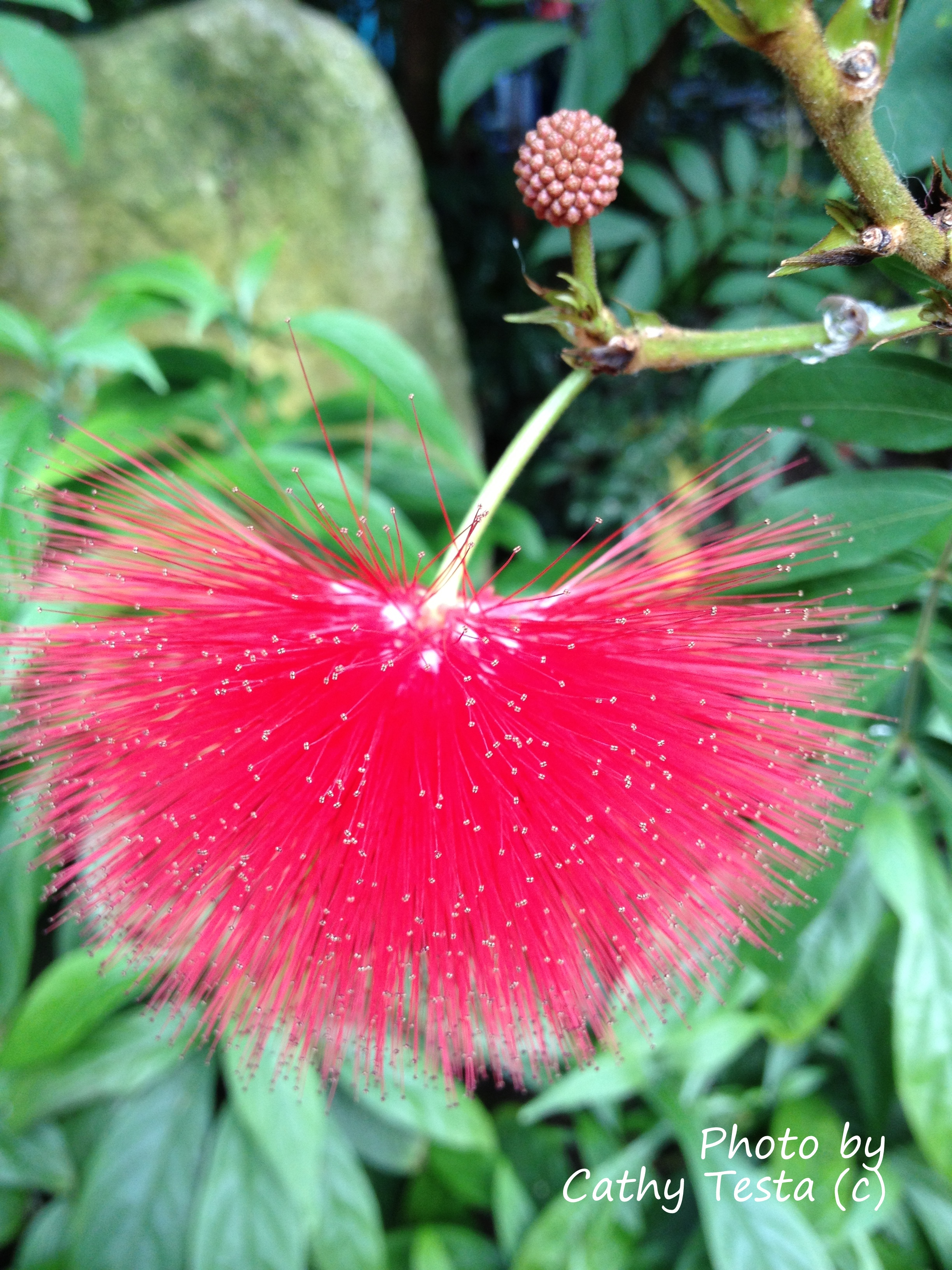
There are many tropical plants at the conservatory and this one was probably my favorite of the lot.  A Hibiscus schizopetalus, Japanese Lantern bloom with a long stamen dripping down in such an elegant fashion.  Just love the look of this bloom and the next butterfly photo is a perfect color comparison.

Hey Mr. Postman

Hey Mr. Postman

One of the things I noticed was many of the butterflies did have some wing tears, which made me a little sad.  This one is Postman, Heliconius melpomene.  He matches the Hibiscus photo above in coloring.

Pitcher Plant

Pitcher Plant

My niece asked me what this plant was, and of course, it is a type of pitcher plant.  I didn’t see many plant labels at the conservatory, and it would be nice for them to offer a plant identification key like they offer for the butterflies.  These types of plants are found in tropical rain forests, and many know they get their nutrition by capturing insects in their pitcher.  I saw a television show recently that also indicated a new discovery of some larger species luring small rodent-like animals, and they go for the nectar while on top of the pitcher, and guess what drops out the animal’s back end into the pitcher?  Yup, their poop – another source of energy to the plant.

Shrimp Plant

Shrimp Plant

This is a plant I’ve grown in my container gardens.  Pachystachys lutea.  There were many of these at the conservatory for the butterflies to enjoy.  You can see why it is called a golden shrimp plant as the common name.  The flowers are not the yellow parts you see here; these are the bracts.  The white flowers extend from these, and in my container garden, the hummingbirds loved them.

Justicia

Justicia

There were a few Justicia plants, the common name for this one is shrimp plant too.  It is a broadleaf evergreen shrub, and I adore the style of the flowers.  Very exotic, and this one had a deep hot pink color, but the one I used in a container garden was a softer pink – both are spectacular, and loved by hummingbirds and butterflies.

Justicia carnea

Justicia carnea

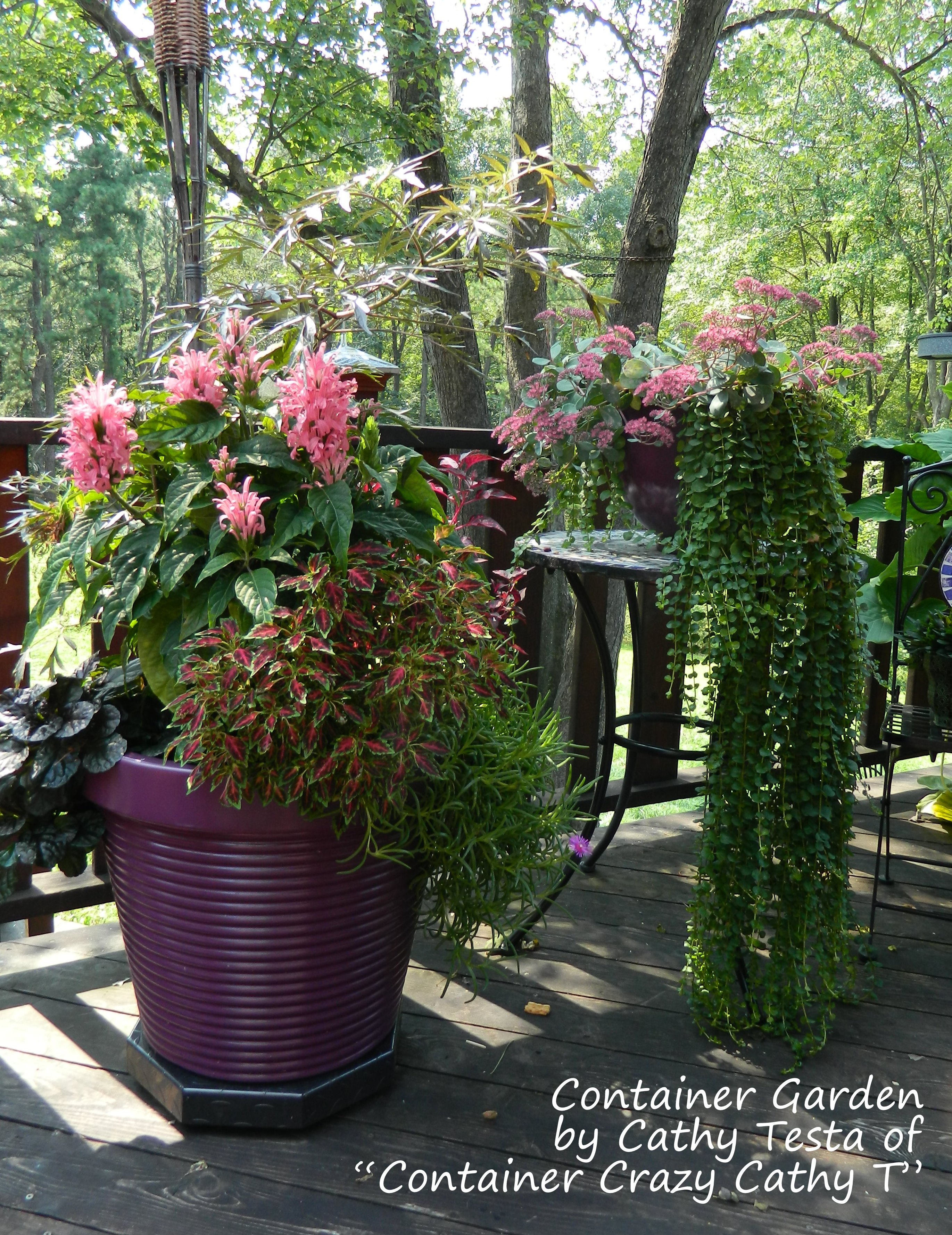
This photo was taken of my container garden in early September about two years ago. The large pot is combined with a Coleus, Ajuga, Delosperma, Alternanthera, and Sambucus.  The container on the table has a Sedum in it with a Creeping Jenny trailing below.  Justicia carnea (shrimp plant) in the large pot bloomed during the summer and into fall, and paired up perfectly with the Sedum blooming around the same time.

Ow Butterflies

Ow Butterflies

Here’s two owl butterflies, Caligo eurilochus, were having a little mating fun.  And it is obvious why they call them “owl” butterflies, used to deter predators.  This is the type that landed on my shoulder for quite some time later, see video below.

Name this plant

Name this plant

Okay, I know I’ve seen this plant before – but I can’t remember the name?  Help me out tropical bloggers – what is this called?  It is so beautiful and the plants at the conservatory trailed all the way up to the ceiling.  I would have loved to capture a butterfly on it but no luck.

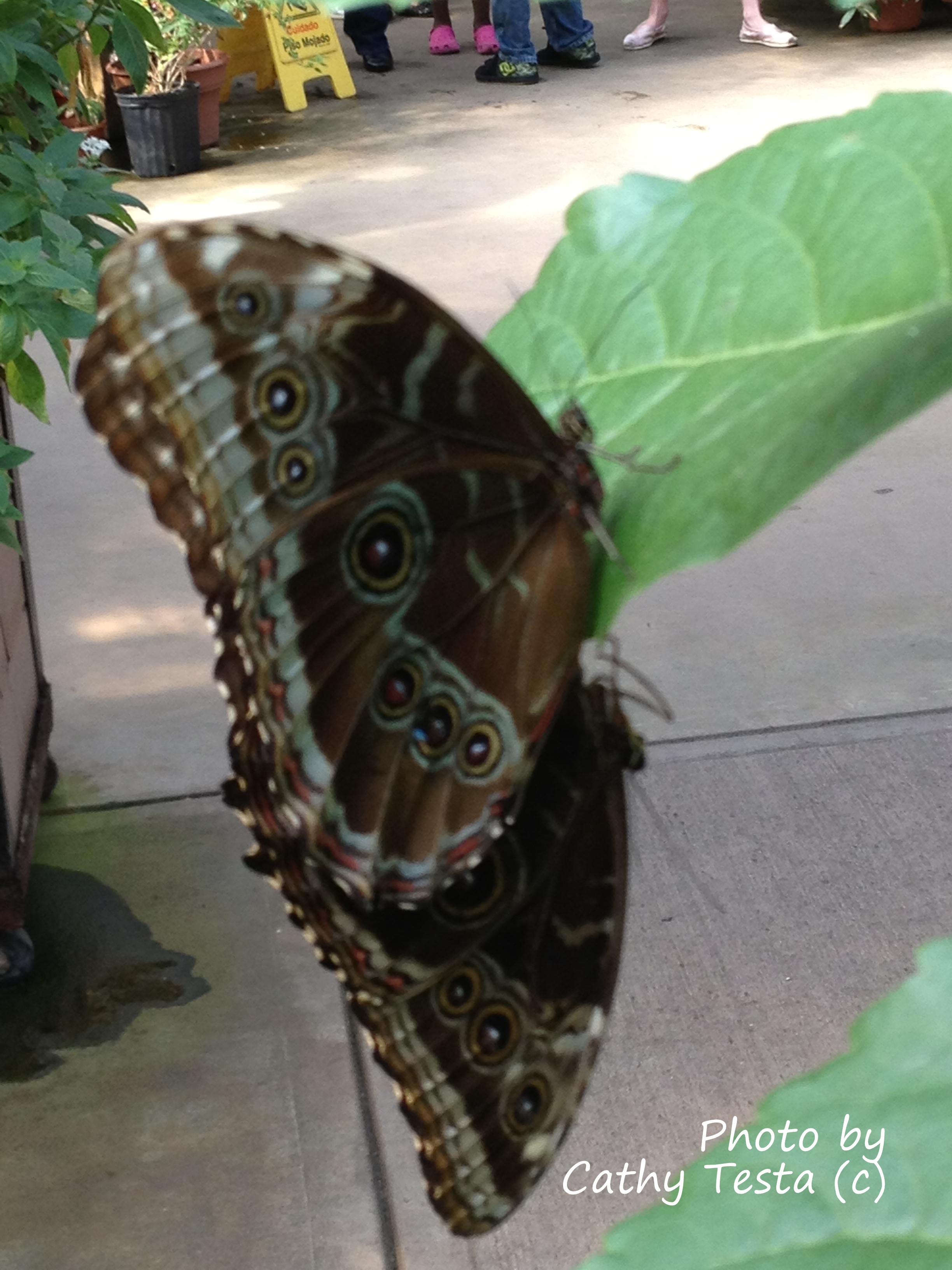
Morpho peleides

Morpho peleides

I did have luck capturing this Blue Morpho, Morpho peleides.  Got to thank iPhones for the quick clicks.  I had to reach up a bit to get the shot, but was so glad he was in a rest state and didn’t fly away.

Purple Passion

Purple Passion

There were mostly tropical plants at the conservatory, which I enjoyed because they are one of my passions – yet, later when I got home, I thought it was sad they didn’t have natives for the butterflies to enjoy – and to showcase.  We have many in CT and MA that would suit the feeders.  Also, I noticed outside, they had a border along the front of the building enclosed in posts, and it was all old evergreen shrubs, the soil didn’t look too healthy, and I thought, later – when I got home, how wonderful it would be to fill that bed with some native plants.  Too bad I don’t work there – LOL.

More help please?

More help please?

More help please.  What is this plant?  It looks like a Peregrina bloom?  But not sure, the foliage is soft and fuzzy, but the orange flowers are my main attraction.

Sculpture

Sculpture

Just a shot of the sculpture in the gardens at the conservatory.

Arch

Arch

There was an arch/trellis at the entrance, and if you look closely, you can see a butterfly flying right in the center.  Unfortunately, it is very difficult to capture the hundreds of butterflies circling your head.  As I stood here, taking some photos, one landed right on my shoulder.  I used the rotating feature on my iPhone to get a video of it.  Here it is…

And one more butterfly shot to share, this one is Cairns Birdwing (male), I think.  Love the florescent coloring.

Cairns Birdwing

Cairns Birdwing

Some tips if you decide to visit this place:

Recommendation:  If you happen to be visiting MA or CT, this is a fun trip with kids, or if you are into photography.  There is food sold at the sight, but I enjoyed the restaurant at Yankee Candle right down the road.  Go early, as if it is school vacation season, it will get busy quickly.

Special Occasion:  If you have an engagement to announce, this could be a great place to go with a photographer for some fun shots, but be prepared to get hot – it is humid and warm in the conservatory.  Wear light clothing.

Location:  281 Greenfield Rd. (Rt 5 & 10) off of 91.  If traveling north, take the exit 24 noted for Yankee Candle.  If traveling south, take Exit 25.  South Deerfield, MA.

Hours:  Per their pamphlet, they are open year round 7 days a week.  Summer: 9 am to 6 pm.  Fall/Winter/Spring: 9 am to 5 pm. Closed on some holidays.

Website:  www.MagicWings.com

Name of place:  Magic Wings

Cost: $14/Adults, $10/Kids

Butterfly Key:  I recommend you pay the $1 for the key, my niece immediately wanted to use it as we strolled along.  She had a big desire to identify all the butterflies.  I wish they had a key for the plants, but I don’t think they did – or perhaps I missed it somehow.

Camera:  Bring your camera of course.

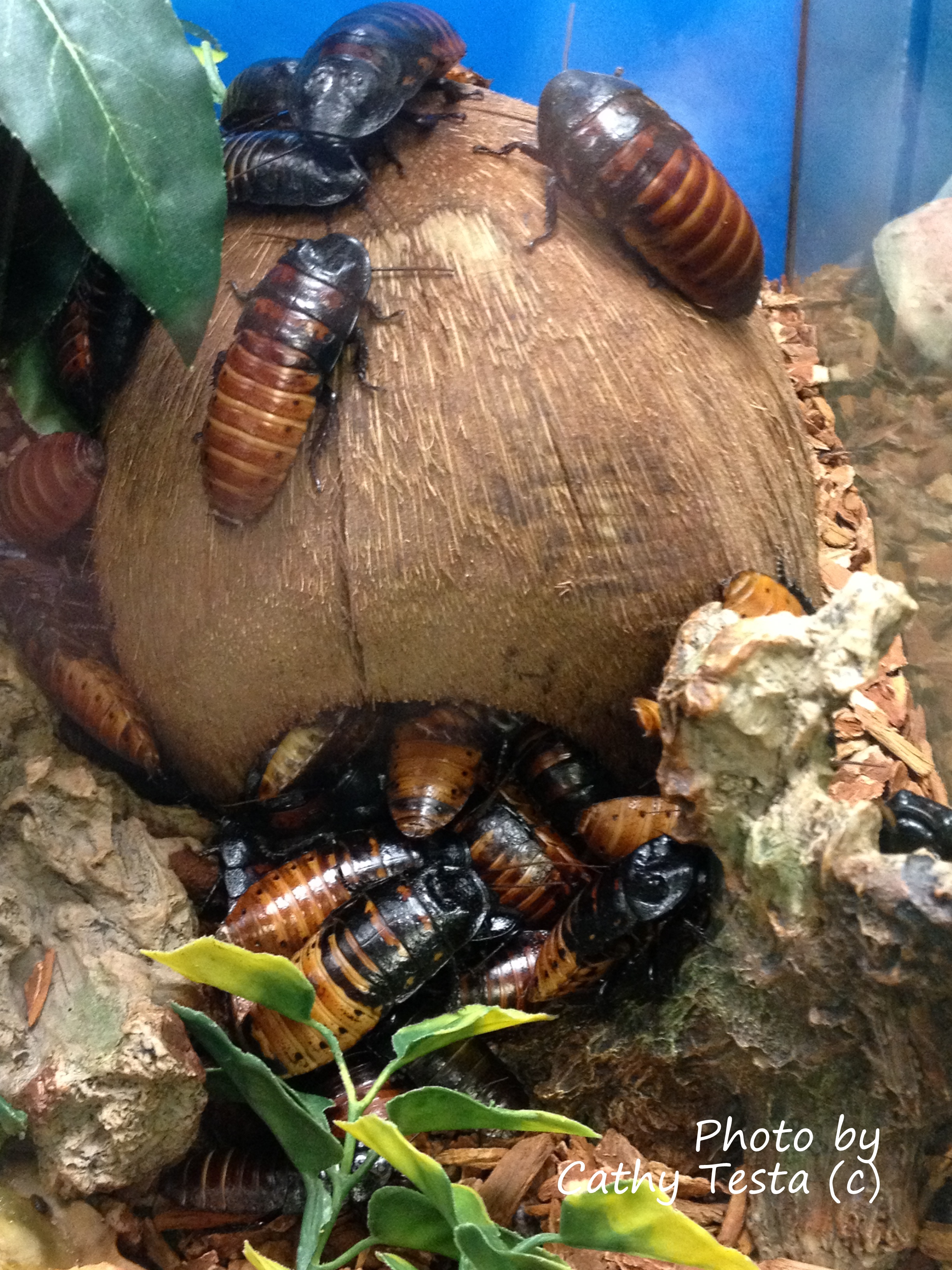
And last but not least, when you enter the exhibit, you first enter a room of insects in tanks.  They reminded me of “Indiana Jones” bugs, large and yucky.  And to finish off this informal quick post, here’s a photo of “Hissing Cockroaches”….Yuck.  But fun still for the kids!

Container Crazy Cathy T

Hissing Cockroaches

Hissing Cockroaches

Colocasia esculenta ‘Maui Magic’ has alluring powers…

1 Comment

Can a plant possess alluring powers, so insatiable, the yearning for more overwhelms your ability to resist?

“I want some more,” says Claudia, the fictional character in the movie, “Interview with the Vampire.”  She is completely seduced from her first taste of blood offered by the devious vampire, Lestat.  And although his immortal companion, Louis, witnesses the transition with regret, he does nothing to stop Claudia’s unthinkable awakening.

Maui Magic Front Ear

Yes, a plant can also possess similar powers that lure you into its plan of seduction. And…, “Of course, you want some more.” After you have experienced its offerings, your senses awaken, the desire to achieve the same feeling or response is sought out, and you ultimately thirst for more of the same, as much as a vampire thirsts for blood.

This is how I felt about Colocasia esculenta ‘Maui Magic’ last season as I witnessed this plant grow long stems and big leaves as rapidly as Claudia’s hair grew right before she opened her eyes.

Colocasia esculenta ‘Maui Magic’

This tropical plant, commonly referred to as an elephant ear or elephant’s ears, drew me into its clutches deceptively, then captured my desire to always want more as it grew into an impressive size while maintaining its beautiful attributes from the beginning of spring to early autumn.  If I didn’t decide to order it last minute, I may have missed out on its powers to grow quickly, create a climactic effect in a container garden, and arouse with its dark-sided hues.  It started with admiring its abundant ornamental leaves, followed by adoring its long stems.  Each held their ears up like a trophy on their tips, making it stand out in the container garden.

August photo; back of 'Maui Magic' leaf

August photo; back of ‘Maui Magic’ leaf

Dressed in a cloak

The heart-shaped leaves of ‘Maui Magic’ snuck-up out of the soil like a vampire appearing from the dark alleys of the streets.  Before I knew it, the leaves grew to two feet long and about half as wide in the center.  The leaves wavy-edged margins are soft and subtle, and provide an elusive cloaking effect as it gently moves by the wind.  The leaf stems, or more appropriately stated, the petioles, grew to three feet tall, lending to an upright exotic thriller bobbing above the container garden’s companion plants.  The mid-ribs were very visible on the backside of the leaves.  By the time August arrived, this plant, started from a small plant in mid-May, was substantial enough to draw me into a complete trance, and kept me there. I couldn’t keep my eyes or hands off it.

Rain drops on the leaves

Rain drops on the leaves

An unnatural pale complexion 

The plant’s foliage coloring starts off as a dark plum-purple, and then fades into an olive green with purple tones.  Having less color is not a sign of ill health as with a vampire, but a transition to maturity.  This did not create a lack of appreciation; the color was still stunning. The leaf stems carried a deep purple tone all the way down to the base of the plant throughout the season.  The look was visually stimulating, but you also wanted to touch the stems.  It sounds weird, but there is a soft texture to the plant, making it smooth to the touch.  I found this irresistible, charming, and as I said, “alluring.”  Taking it down for the fall was as difficult as chopping the head off a vampire in rest, but it had to be done and with good timing.

Yard Stick with Ears

Not harmed by the sun

Unlike vampires, the exposure to sun does not harm this cultivar, so long as you keep it well-watered.  Water to this plant is like blood to vampires; it thrives as it receives more.  But for my container garden, I decided to place it in a shady location, on the north side of my house, where it received more shade than sun.  However, this did not deter it from growing large and showy.  The plant can take either exposure. The leaf stems extended as if reaching towards the edges of the steps in search for the afternoon sun, adding more drama to its presence.  This shady exposure also helped to keep the soil moist, appreciated by many types of elephant ears.  Birds perched on it occassionally, and it never failed to produce new leaves.  When the wind caused some movement, it startled me from time to time because it was as tall as a person and could be seen from inside the house.

The lure of wanting more

The lure of wanting more

Its mysterious origin

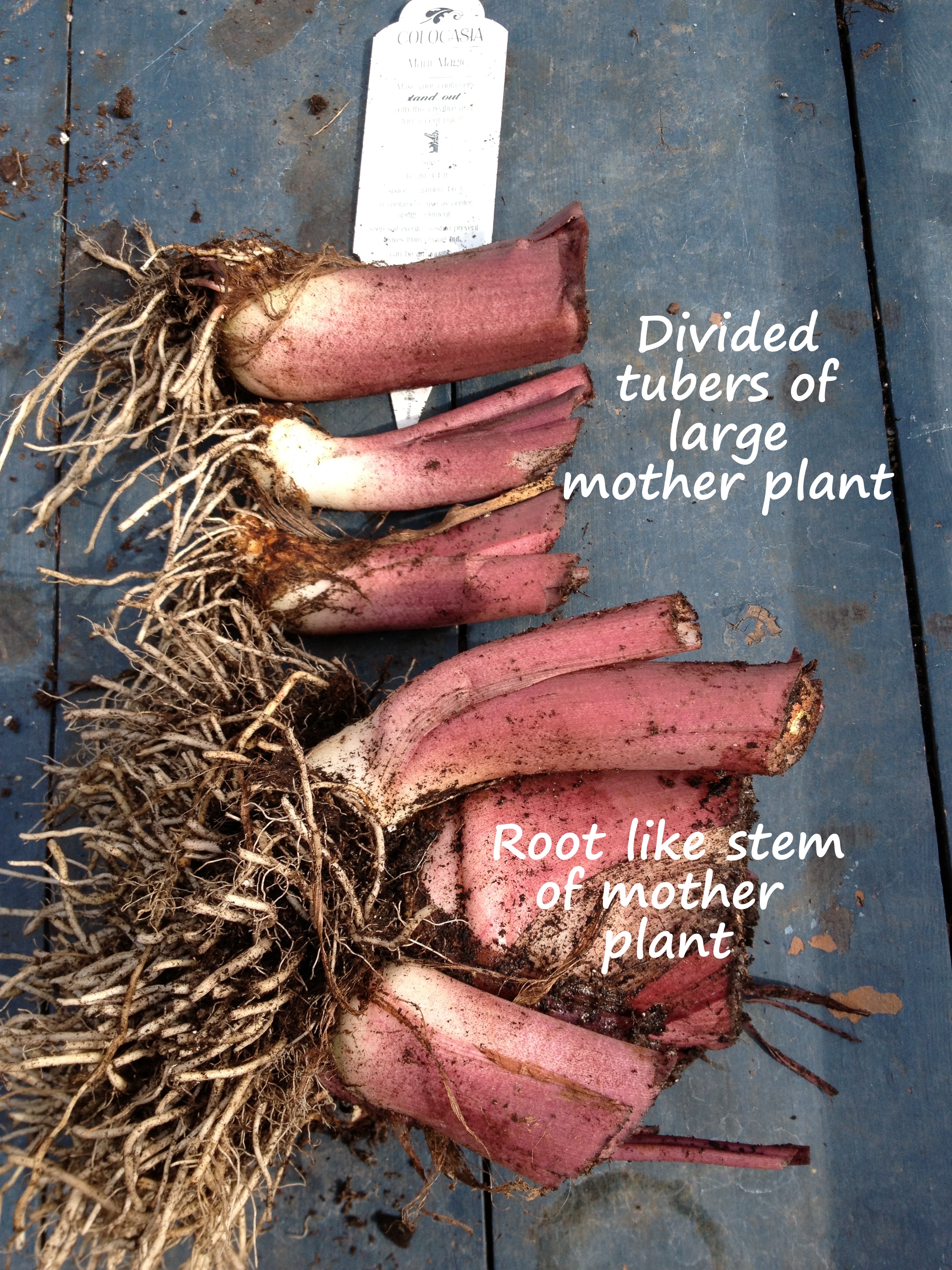
As many ponder the true origin of vampires, you may ponder the growth habit of this plant. Whatever you choose to call the base of this plant, a corm, cormel, bulb, tuber, rhizome, or root, the leaf stems arise from the base of a root-like structure.  Even its circumference amazed me, as it reached a good size and produced potential divisions or cormels from the mother plant.  This plant is treated like a tropical in Connecticut; it is not hardy to our zone and requires storage in a cool, dark place, like the coffin of a vampire.  So get out your tools of destruction, chop of its heads, clean of the base, and create its resting place for a return next season when you certainly will “vant some more.”  If handled appropriately and according to specific procedures, this plant will have immortal life in your container gardens.

Tubers at base of stems

Tubers at base of stems

Container Crazy Cathy T
http://www.cathytesta.com
860-977-9473

Pronounced:  Koal-oh-KAY-see-uh  ess-kyou-LENT-uh; sounds like some weird vampire language.

Zones:  9-11, tropical and subtropical tuberous perennial.  Used as a tropical plant and stored for winter in CT Zones.  Can be used as an aquatic plant in containers.

Size:  3-4′ tall, rounded form up to 6′ size all together under warm growing conditions. Big, tall, showy, and overpowering.

Exposure:  Full Sun, part sun, part shade – flexible.  Easy to grow, and grows quickly.

Introduction: 2008 by John Cho and the University of Hawaii breeding program.  Propagation is prohibited.

Color combinations:  Try this plant with contrasting vibrant colors since the plant’s tones are on the darkside.  Use different leaf textures, from fine to medium against this coarse and bold statement in your container or garden.  (Shown in this post are a Coleus, Astilbe, and Rodgersia for a shade combination.)  For a sun combination, try Canna with bright, golden yellow, or chartreuse leaf colors, add a blooming annual, like Zinnia or Verbena, for some pops of color.  Select a bright colored spiller, like Lysimachia nummelaria ‘Aurea’ (Creeping Jenny) or Ipomoea batatas (Sweet Potato Vine) annuals.

Container/pot size:  Be sure to use a very large container or pot for this elephant ear due to its size, and to provide adequate soil volume, helping to retain moisture, and nutrients.  And don’t overlook – this plant can make a wonderful statement in the garden too.

After Care:  To learn how to overwinter tropicals, sign up for Cathy T’s fall class, which is hands-on, and held on a dark, gloomy evening with a full moon – just kidding.

Cats are the true admirers of my plants and gardens

Leave a comment
Mini with My Plants

Mini with My Plants

Lisa, my older sister, asked I take in a stray cat. This was many years ago, when she was living next door to my parents.  I said, “Oh no, you know I’m not a cat person.”

Her insistence continued with, “You can bring it back here if it doesn’t work out.  This cat needs a home.”

It paid off.  Zorro came home with us.  I remember calling my sister to tell her Zorro was following me around the house.  Her smile could be heard over the phone.  “Cats like to be around people,” she responded.

This was the event that transitioned me from joking about cats to falling in love with them.

Today, we have 3 cats.  I never thought I’d have one in my house.  I always hated when I saw cat or dog hair in people’s homes, and now my couch is covered in white hair from Kiwi, my plus-size cat. I curse every time I clean it off, but I still put up with it.

Kiwi on Couch

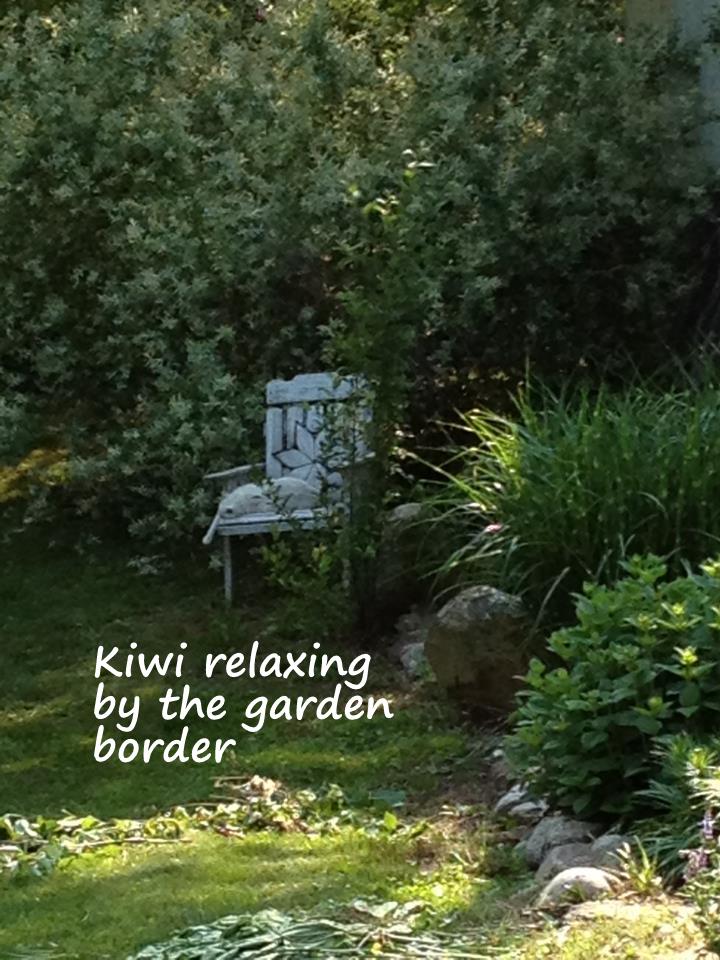
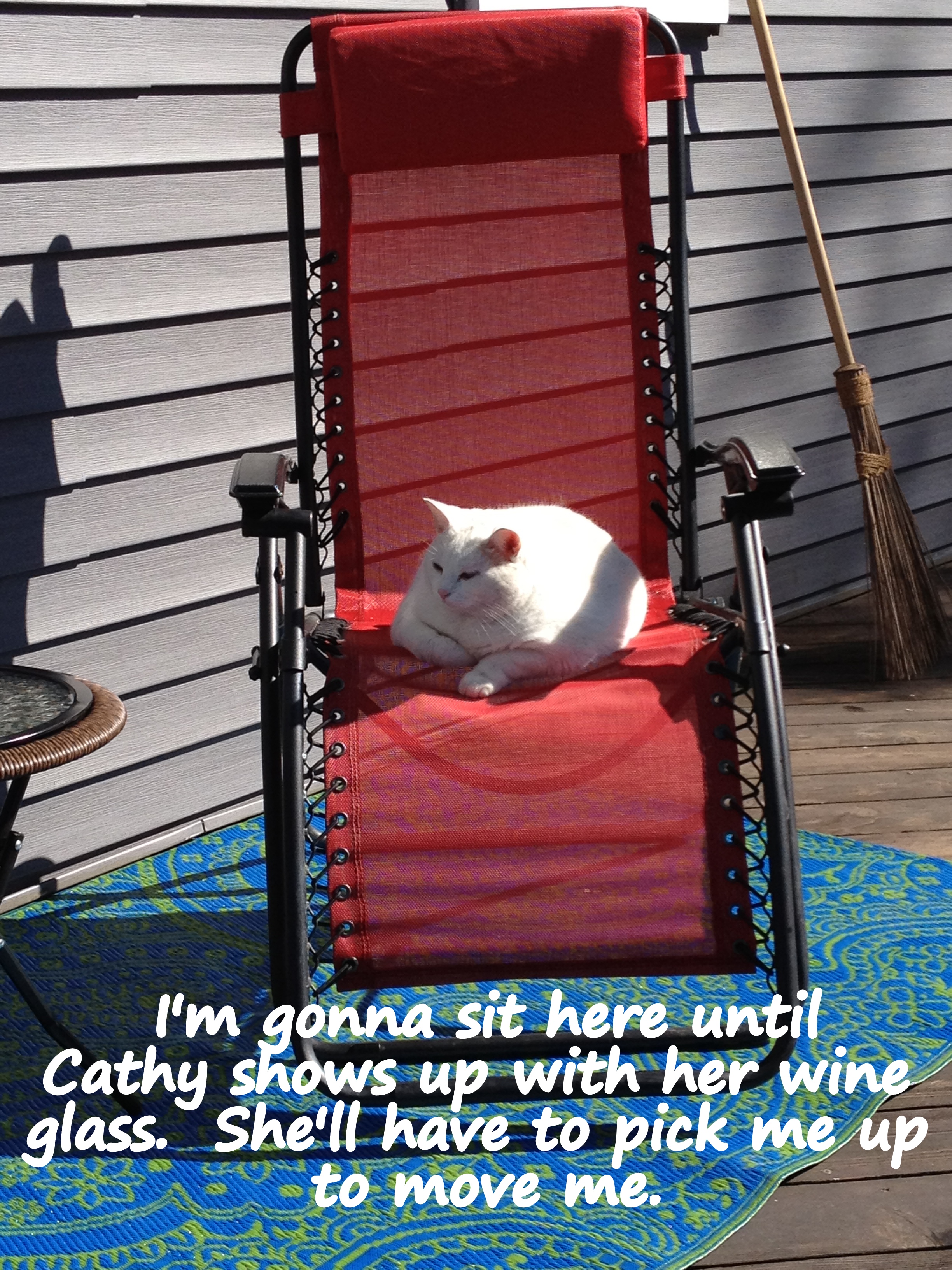
Our cats follow us around outside.  They like to lay down by the base of my container garden pots on my deck when they want to cool off in the summer.  They use the gardens and big plants as hiding places when they are sneaking up on the birds.  And they investigate anything new in their surroundings, like most cats do.  One of Kiwi’s favorite spots is in a white chair located in my yard where it is quiet and restful.  It is a little hideout, and she uses it more than I do.

Kiwi defines relaxation

Kiwi defines relaxation

Mini, the smallest of my 3 cats, likes to jump up to rest on top of my hobby-like greenhouses, which I line up along the edge of my driveway in early spring to transition small plants.  I always think, “Please don’t stick your claws into the plastic covering.” But I never scold her cause she is too darn cute, and puts up with Kiwi always giving her a hard time, so she deserves a break.

Favorite spot to hang out

Favorite spot to hang out

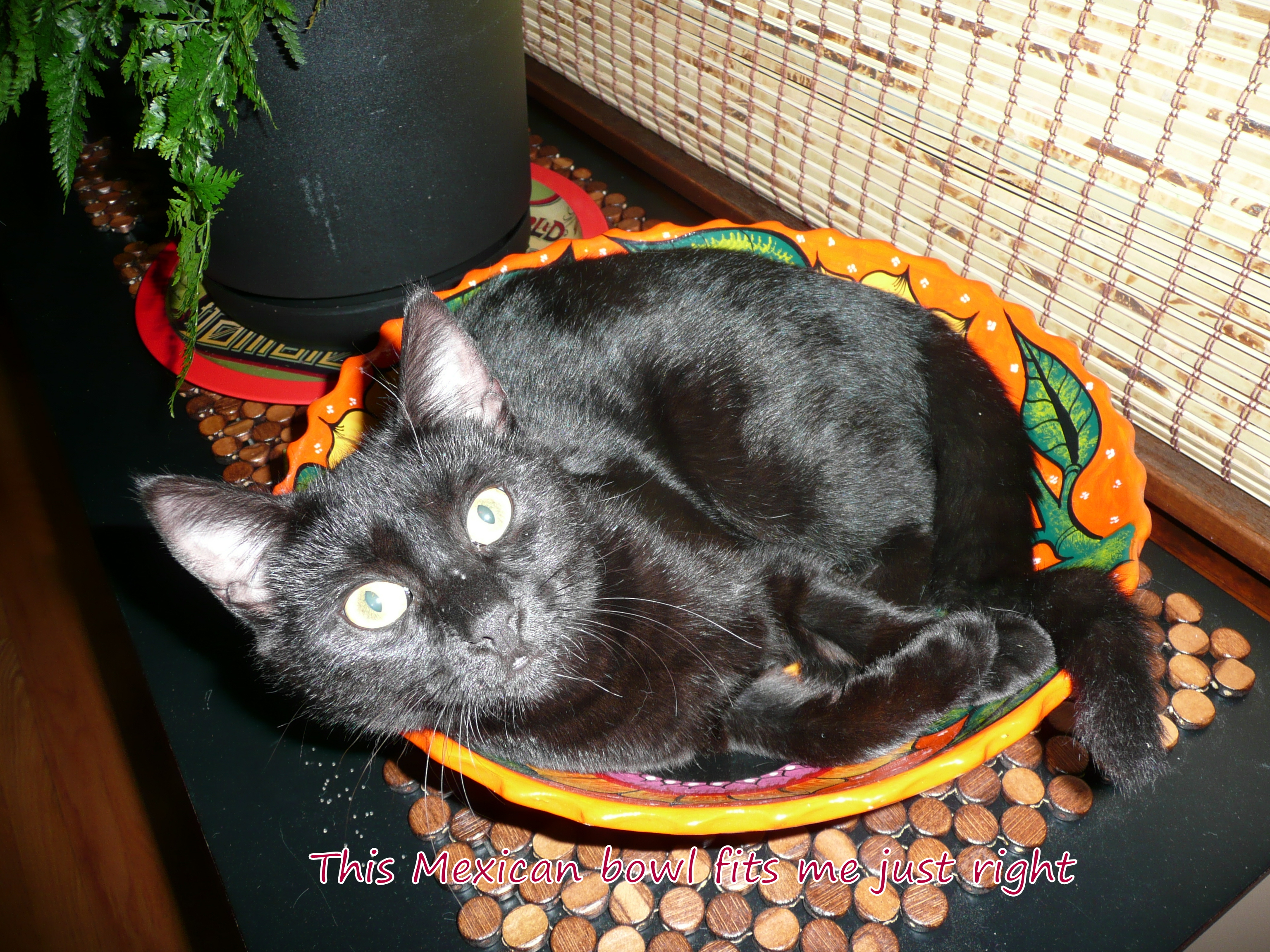
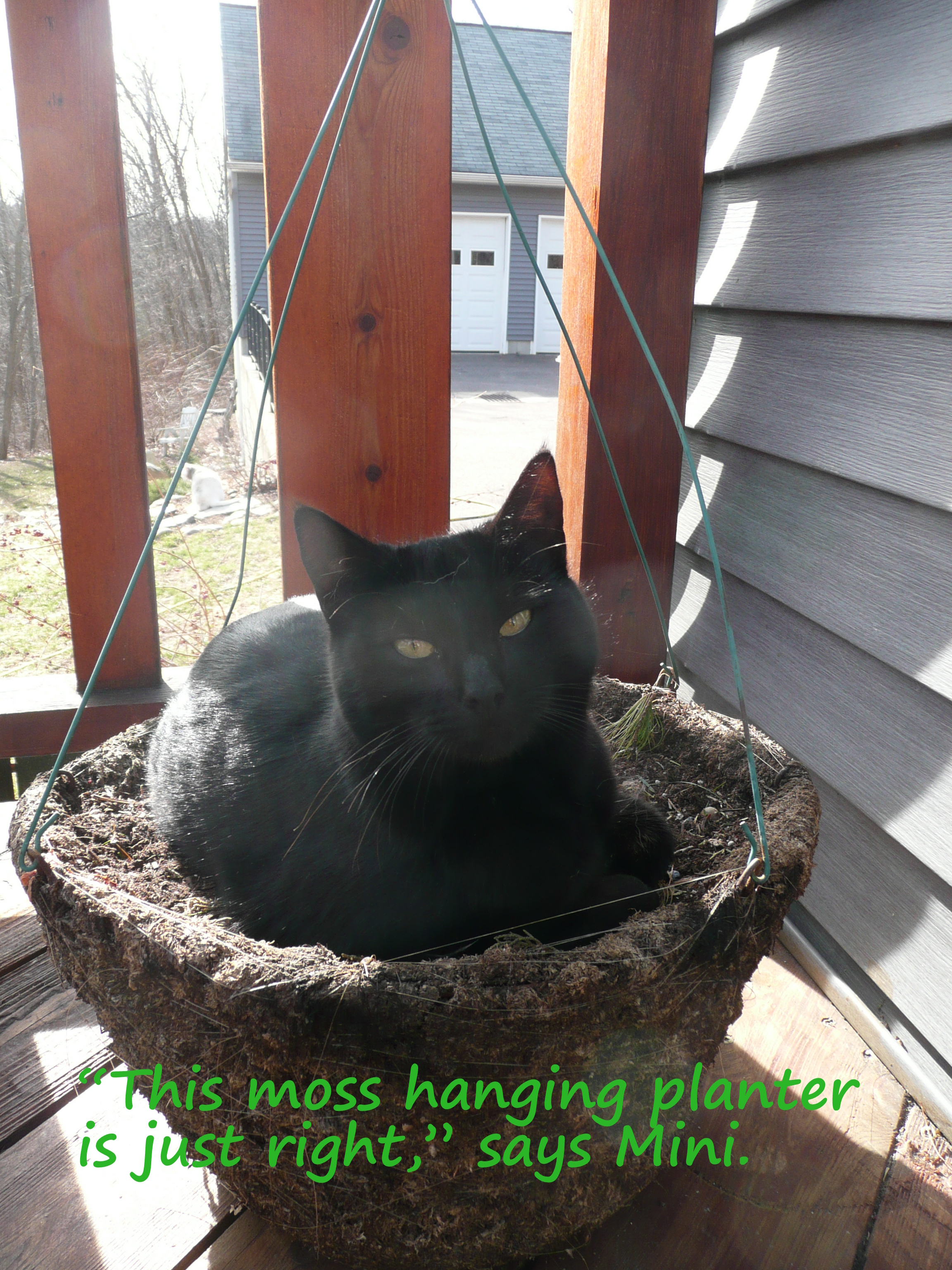
Mini is my favorite.  She is very smart.  She’s the type of cat that will try to push on the door handle to be let it.  I saw her once try to slide the kitchen slider open, like she knew, “Paw goes here, and push to the left.”  She likes to sit in bowls or anything that fits her little size.  She’s grown since we took her home, but she still remains small.  She must have been the runt of the family.

Just the right fit

Just the right fit

Mini in Hanger

Small places rock

Small places rock

I found Mini during a walk with my walking partner.  We were strolling along when we heard a loud meow through the brush.  Two black kittens, in the middle of nowhere, abandoned by the roadside.  “A common dumping ground,” my friend told me. The smallest of the two kittens started to follow our feet as we continued walking.  At first, I tried to not look because I knew I would cave.  I swear to God,  I heard her (Mini) say, “Don’t leave me here, please.” She was not going to give up, meowing louder and running faster behind us.  Later, the vet told me, “She picked you.”

Mini looking at Kiwi, or Kiwi looking at Mini.

Mini looking at Kiwi, or Kiwi looking at Mini.

Waiting for Mini to return inside.

Waiting for Mini to return inside.

Kiwi never got use to Mini.  She constantly harasses her. Whenever she can, she finds a hiding spot to sneak up on Mini.  Mini, the cutie that she is, doesn’t fight back much.  I have to keep them separated all the time. Kiwi is kind of bratty, or I guess you could consider her a cat-bully.  She even tries to bully me from time to time, but guess who wins? (And yes, she is chubby; and no, she is not pregnant – she’s just got special needs.)

Kiwi always grabs the best seat on the deck.

Kiwi always grabs the best seat on the deck.

All three of my cats are indoor and outdoor.  Kiwi sticks close to the house – and despite her weight problem, she has never been attacked by the woodland animals.  She can run when she wants to; especially when chasing Mini.  Once, I saw her lying on the driveway on her back, howling cat cries, as another stray cat was doing his hissing over her face.  This was a funny sight.  It was hysterical actually.  I broke them up. She is so lazy, she even fights on her back.  She can’t jump up to high places, so Mini uses this to her advantage.

Easy does it, Kiwi !

Easy does it, Kiwi !

But I guess because of her size, Kiwi tends to win.  My suspicion is they think she is a big meany.  She can be a little naive, and approach things she shouldn’t.  Like a turtle revisiting our yard every year to lay her eggs by the pool side.  Luckily, Kiwi did not get snapped at.  Even the turtle backed down.  Kiwi also likes to jump on and play with my small ornamental bunny grasses, as if they are toys.

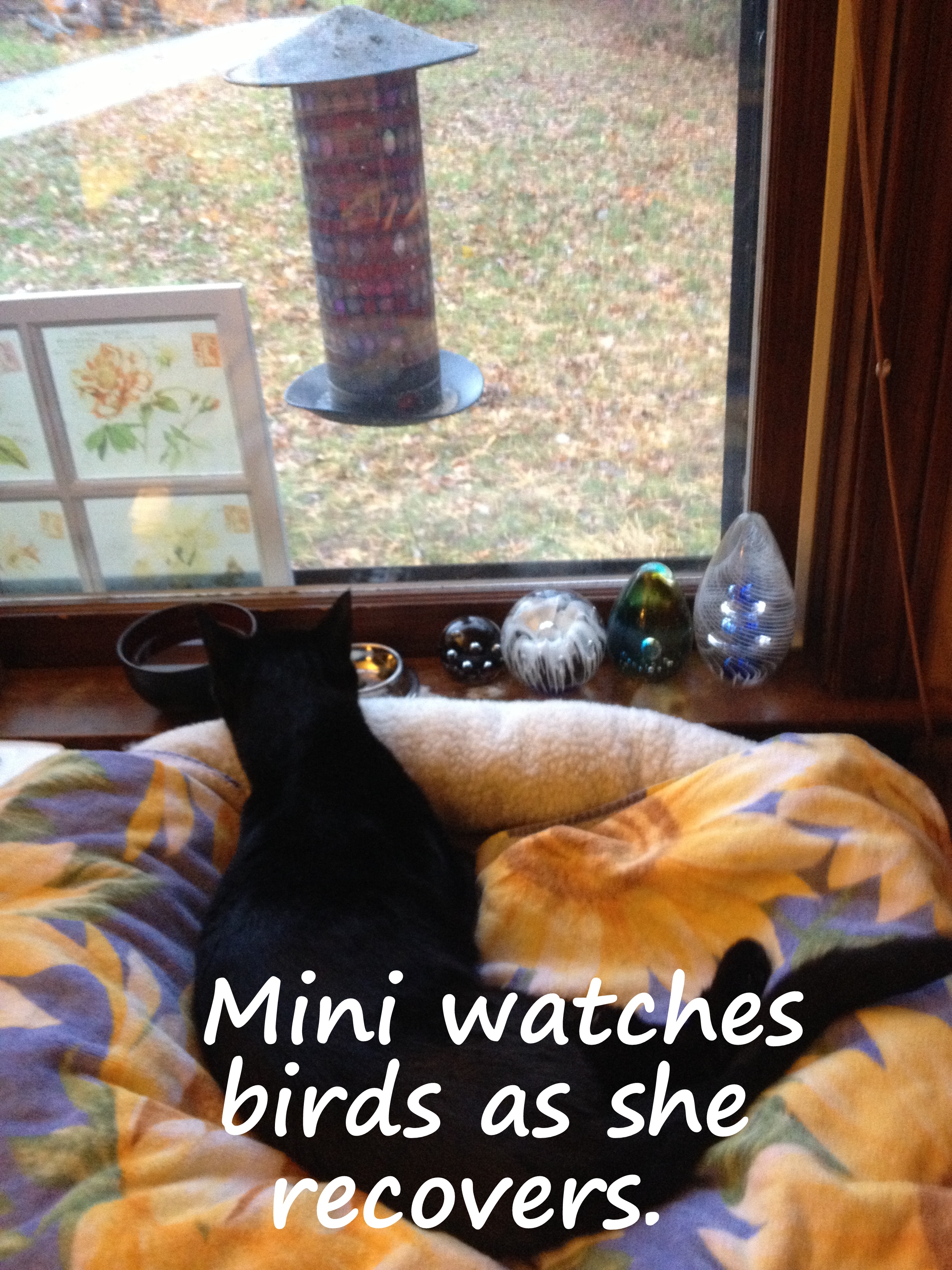
Getting well and strong

Getting well and strong

Mini, on the other hand, had a very bad attack earlier this year.  She came home one afternoon, looking up from the base of our stairs outside, and wouldn’t come to the top. We picked her up – and long story short, she got grabbed by a wild animal.  Her back end was badly hurt and we rushed her to the vet.  Broken pelvis and puncture wounds. Our vet told us, a small animal, had grabbed her.  Later, we discovered a photo on a motion censored outdoor camera of a bobcat in our woodlands behind our house.  We believe this was the culprit.  It was a rough road, but with lots of care and attention, Mini made it.  And she caught a mouse (in my house!) during her recovery – which is amazing.  Kiwi and Hunter didn’t even see it, and were not impaired. Friends said, “Mini is showing her appreciation.”

P1150302

Hunter, our long haired black cat, is cat number 3.  He is Mini’s brother, the other cat saved from the roadside.  Hunter is tough and stubborn.  We are only allowed to pet him on the head.  Don’t even think of moving your hand further along his back, or whack – you get swiped.  I told the vet this once, and she said, don’t worry I know how to handle these types.  She returned from the backroom with a scratch on her hand.

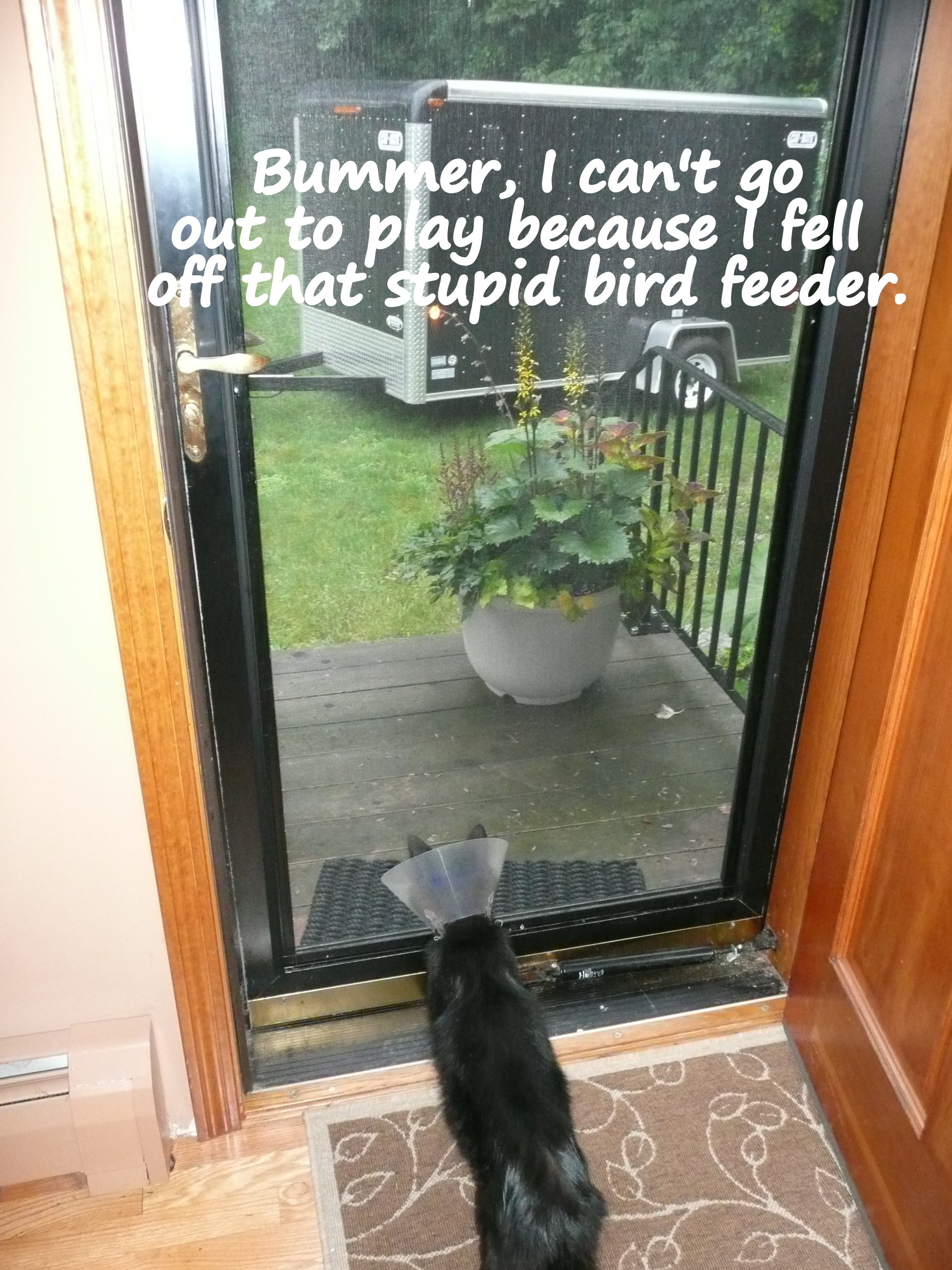
Hunter also likes to jump up on my garden ornaments.  One summer, he jumped up on a birdbath which tumbled over on him.  This resulted in a nose job.  It was scary, but he handled it well.  He snooped slowly around the repaired birdbath later, sniffing the base.  Easy Hunter!  Don’t you know to stay away from that? Hunter likes to chase the wild turkeys in our yard, and chased our free range chickens the day he was brought home.  This is why he’s named, “Hunter.”

Hunters Stitches

All of my cats all enjoy my plants and surrounding wildlife in our yard.  Sadly, sometimes they get injured.  We don’t allow them out in the evenings anymore, which is a challenge with Hunter.  Mini is more understanding; not surprising after she re-cooped from her injuries under our daily care.  For weeks, she was hand-carried, fed, and kept in a hospital like setup.  Nowadays, she only has to watch out for Kiwi, around every corner in the house.  They all have more restrictions but still get to play during recess like hours, and only during the day.

Kiwi on constant watch

Kiwi on constant watch

Hunter likes to stroll on the edge of the deck railings to investigate the tips of the plants nearby, or watch the scenery below as if he’s the king of the jungle.  If Kiwi chooses to annoy him, he gives her a look and walks away.  Often Kiwi will follow behind him at a safe two feet distance.  As for Mini and Hunter, they touch noses from time to time.  They still watch each other’s backs.

From my office window, the two enjoy the birds feeding.

From my office window, the two enjoy the birds feeding.

In my experience of doing designs for homeowners’ yards, I never really got too many complaints about cats in their gardens.  Cats mostly use the plants and garden spaces as places to relax, like we do.  I find cats are the true admirers of my plants and gardens.  I can’t imagine not allowing them outdoors – at least during the day – to enjoy the scenery as much as we do.

P.S.  I can’t find the photo of the bobcat, but had posted it on my Facebook page at the time.  If I find it, I will re-post!

Container Crazy Cathy T
http://www.cathytesta.com
860-977-9473

3 years ago, when I rescued them from the street

3 years ago, when I rescued them from the street

Gardens and Social Media face the Same Challenges

Leave a comment

Recently, my email account got hacked.  A friend told me, “Don’t sweat it, it happens to everyone.”

I contacted my e-mail service provider, changed my password, and thanked Facebook friends for alerting me.

Right after that, I discovered one of my clients responded to the hacker’s e-mail, writing she didn’t believe they were Cathy T.

They sent her a reply, a very convincing one, insisting it was me.  And continued with how they desperately needed money for a cousin’s kidney transplant.  I was supposedly in Belgium.

That’s it, I thought.  I’m terminating this account right now.

Was the termination a bit drastic?  Yes, it was.  From what I’ve read, there’s no need to kill your e-mail id, but I wanted to eliminate this problem because I didn’t want anyone to fall prey to a scam.

This whole situation got me thinking about how gardens and social media face the same challenges. Both are grown in open and linked environments subject to threats and invasions.  You can do lots to deter them, but many will break their way through when you let your guard down.

So, what can you do to reduce the occurrence of painful incidents by hackers or pests?

From cutting to a monster friend in the garden

From cutting to a monster friend in the garden

No. 1)  Don’t accept “every” friend or plant

A gardening friend stops by to offer you a freebie plant from their garden.  It may be a cutting, division, or seeds from a flower. Before you accept their donation, think of it just as you would for a request of a “new friend” in Facebook.  Ask yourself, “What’s the story behind this plant?  Does it have a nice personality or an aggressive one?  Why are they offering it up?” You may be surprised to find out; donations or requests for acceptance usually come from a plant posing a problem in your friend’s garden. It could be invasive, it might be an aggressive spreader via underground suckers, or it is a prolific seed-producer. Think of plants like bamboo, mint, willow, or datura – all pretty or unique, but some species take over fast, thus become a nuisance.  Bottomline, don’t accept it right away without asking about its history, behavior, and characteristics. Same goes for friends on blogging sites, Facebook, and Twitter.  Do a little bit of research before you click accept.

No. 2)  Don’t overcrowd your garden spaces or sites

Ever feel like you have so many friends on Facebook, you don’t even know who they are anymore, and it would take forever to sort them out?  Same thing with e-mail; your inbox is so over loaded, you don’t recognize some of the senders.  Overcrowding can invite problems; create hiding places for stalkers, and ends up in chaos. Too many plants in a gardening space reduce air circulation around your plants; if the foliage remains wet, they get diseases.  Plants requiring sunlight may receive too much shade, limiting their ability to thrive.  Nutrient competition will arise as well.  And “you” might not be able to even enter your garden for routine maintenance.  A full and flush garden is spectacular, and a full inbox may make you feel popular, but keep in mind, it provides the phisher with opportunities just like it gives a critter a chance to pass through without notice.

Bugleweed, a spreader and seed producer.

Bugleweed, a spreader and seed producer.

No. 3) Be Inspector Clouseau when buying a plant in person, or on-line

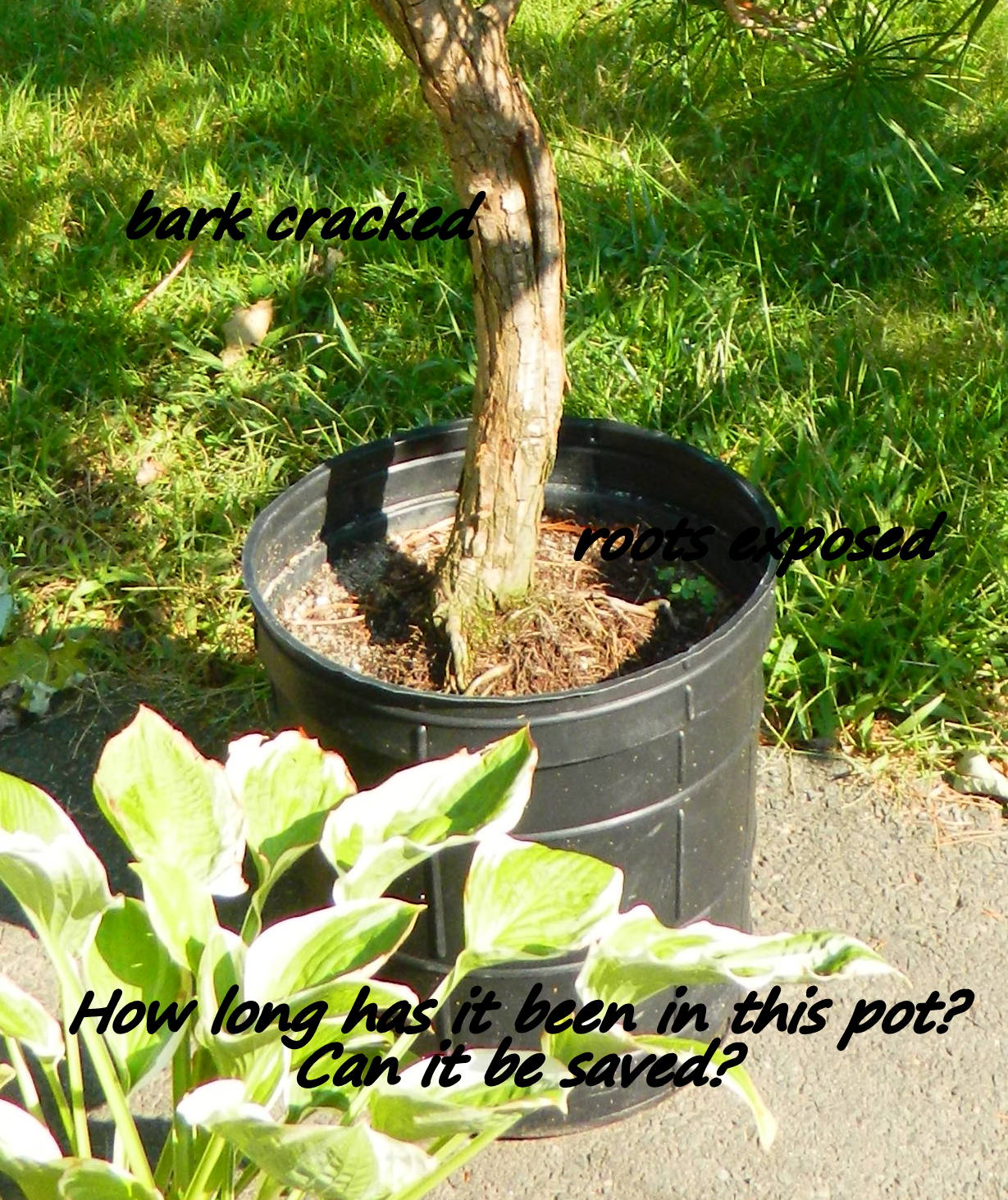
Get out your reading glasses and open your eyes.  Inspect your plant before purchasing it from a garden center, especially if they are on a sale rack.  Just as you would look over a new app for your smart phone, carefully look it over first before clicking install.  Look for any bad signs.  On perennials, look for unusual spots, insect holes or trails on leaves, shriveled or blotched tissue, and partially eaten foliage.  Check woody plants for tears or cracks in the bark.  Any wounds in the bark can negatively affect the flow of water in the plant.  You may even want to shake the plant to see if insects fly away from it; whiteflies are tiny feeding insects on the undersides of leaves. Look at the top and undersides of the leaves, and if possible tap it out of the pot to inspect the roots.  Healthy roots have white tips; they are not dark brown and mushy. If the potting mix smells of rot – this is a clue.  A white powdery substance on the leaves could be disease, known as powdery mildew caused by a fungus.  Or it could be hairs on the plant’s leaves, which is normal.  The point is – check it before you succumb to the temptation of the flashy dings and whistles.  Some problems on plants are treatable or may be minor; others are an invitation to future problems in your gardens.  For on-line plant purchases, do a little research to find out their reputation.  Read about how they ship their plants, what to expect when they arrive in the mail, and how to care for them upon arrival.  Make sure they are legit.  You don’t want to be buying from Mr. Belgium.

Damaged bark areas, how long has it been in this whittle pot?

Damaged bark areas, how long has it been in this whittle pot?

No. 4) Keep your garden tools and links sterilized

Some gardeners don’t realize they are spreading invisible problems with unclean garden tools. A malicious link, hyperlink, or shortlink in an email will do the same.  With a quick click, it will move the vector just as a infected garden pruner, shovel, or weeding knife will spread a disease, insect, or viruses from one place to another.  And in this case, you are helping to transport them on their adventure.  Wash your tools with soap and water, or soak in a bleach to water ratio.  Heating your tools is another method, but that is something I haven’t tried.  At the end of each season and beginning of spring, take the time to clean tools before using them.  Remember, operator error is often the number one cause for the problem getting into your scenario.  In our midst of excitement or wanting to get it done now, we forgo the process of cleaning our tools. Clean up old debris around you garden too.  Insect pests may spend the winter in the debris to come alive in spring.  And pause before clicking on links from friends.  If they are not showing a visible sign of why they sent you the link, their implement of transportation is executed without you knowing – at first.

If you can, do not use or use correctly.

If you can, do not use or use correctly.

No. 4) Use the correct “…..-cide” and anti-virus software

A common habit of an anxious gardener is to assume one insecticide, pesticide, or herbicide fits all.  You are wasting your money and time if you do not read the label and follow directions exactly for the plant you are trying to cure of a pest or plant you are trying to rid in the garden.  Harming the environment unnecessarily comes into play as well, and we don’t want to do that as gardeners.  Remember, a pesticide is a “chemical” used to kill an organism considered a pest.  There are organic methods believed to be safer, but either way, use the correct type suited for the plant.  If you spray too much, more than required, or sometimes apply on a hot day or in direct sun, you can harm the plant more than the pest or insect has. When it comes to anti-virus software, consult your tech support expert.  That is where my advice is weak.  I probably have made the same assumptions with anti-malware as a gardener does with a pesticide.  Please read the label first before application or installation of either.  With anti-virus software, it is important to stay up to date. Too late, the culprit breaks in.  Timing is important when treating pest insects as well.  They have a pattern and stages, so pay attention to their life cycle because they populate according to specific seasons.  Exact timing is key.  If the insect is not doing major harm, planning a short stay, avoid using a chemical all together.  Remove it by hand instead.  And continue to follow Number 1, 2, and 3 above.

Red and bright, should I fight?

Red and bright, should I fight?

No. 5) Take a hiatus or terminate

Just the other evening, a news station reported statistics indicating people are taking temporary breaks from their Facebook activity.  The demands for attention are starting to exceed the pleasure.  We become obsessive, realizing we have spent the majority of our day browsing pages.  Same can happen with our gardening addictions. Unable to let go of your dream vision of a perfect garden, spotted in the latest garden magazine or favorite blog site, you become engrossed.  You spend every available minute worrying why it didn’t come out exactly as planned, even though you did everything right up front.  You picked the right place in your yard for your plant, you tested the soil and amended it appropriately with nutrients and organic matter, you nurtured it with water, and selected resistant cultivars, but alas, that deer jumped the barrier, the insect found a tasty treat, or a critter burrowed below creating new pathways to enter and destroy.  So what are you to do in your moment of peril?  Cry by the garden’s edge, consider hiring a deer hunter, or reach for the wrong pesticide?  As a last resort, you might do the impulsive thing – like I did with my hacked e-mail.  Rip it all out, terminate.  Yet, I wouldn’t recommend that.  Fix the immediate problem, and then take a Hiatus – preferably one where you aren’t weeding and tweeting.

Cathy T on a Hiatus

Cathy T on a Hiatus

Container Crazy Cathy T
http://www.cathytesta.com
860-977-9473
New email: To be posted

Want to win a $10,000 Dream Landscape?

Leave a comment

You do?  Wouldn’t that be the bomb?  Winning a landscape worth $10,000!

Just click on the link below to take a look at the information on the CT Garden and Landscape Trail page.  I happen to stumble upon it today as I was filing my copy of their trail map.  A map that I plan to follow this year – another goal for 2013 – go visit these places more!

The information indicates you may pick up your PASSPORT for this 2013 offer at the upcoming CT Flower & Garden Show.  The show starts on Thursday, February 21, 2013 this year in Hartford, CT.  The last day of the flower show is February 24th, Sunday.

Welcome to the Connecticut Garden & Landscape Trail!.

Last year, I organized a “To the Flower Show We Go” group ride starting with breakfast, and it was much fun.  Thinking of doing something similar for this year’s show.

I’ll keep ya’s posted here on my blog.  If you think you may like to join me, e-me soon!

Container Crazy Cathy T

Cathy T and Hubby Steve the morning of last year's CT Flower show.

Cathy T and Hubby Steve the morning of last year’s CT Flower show.

INSECTS AND ORNAMENTS

3 Comments

As I was cleaning out some old files, I came across this article written by me in 2005 for a class project.  After I read it to my husband, he said I should post this.  Here it is, unchanged:

TITLED:  INSECT ORNAMENTS

My project is a collection of insects contained in clear glass ornaments hung on a miniature Christmas tree.  Each ornament contains an arthropod collected during the fall months of 2005 from the UCONN campus grounds, around my home in Broad Brook, and from property near the Scantic River in East Windsor.  Natural and synthetic plant materials were added to each ornament to represent the types of plant life found near the insects.  Also hung on the tree are information cards about insects, and some cute little decorations obtained during the Halloween season.

This reason I selected the Christmas tree with ornaments as an art form is two fold.  First, the ornaments serve as a way to showcase the insects’ intricate designs from a container that can be easily viewed.  When we have the opportunity to look at an insect up close through a glass, it is less threatening then when insects are alive and moving quickly, which tends to scare people.  Second, I wanted to use the Christmas tree theme to challenge the way in which insects are traditionally used by various cultures for holidays.  As we know, insects are usually reserved for Halloween decorations or for themes related to death or illness, but insects are not so popular for Christmas decorations.  There are exceptions such as beautiful butterflies and colorful dragonflies as ornaments, but it is very uncommon, and perhaps impossible to imagine a Christmas tree adorned with wasps, bees, stink bugs or centipedes, for most would find this offensive or ugly.  However, I’m sure insects on a tree would capture observers’ attention and they may question why insects adorned this little Christmas tree.

In researching Christmas tree history, I discovered the use of Christmas trees was born from the worship of agriculture.  The early Romans marked summer solstice with a feast called the Saturnalia in honor of Saturn, the God of agriculture.  This was due to the fact that solstice meant good farming would be underway since the days would be longer and warmer.  Also, homes were commonly decorated with evergreen boughs.  In fact, long before the advent of Christianity, plants and trees that remained green all year had a special meaning for people in the winter.  In many countries, it was believed that evergreens would keep away witches, ghosts, evil spirits, and illness.  These beliefs lead to the use of firs, pines, and spruce as symbols.  To me, it seemed like a natural fit to tie these two items together – insects and evergreen trees as a media for my project.

Insects, however, did not adorn the green symbols in ancient history, but they were however, worshiped in their own right for other reasons, such as resurrection as with the cicada beetles placed in the deceased mouths.  The scarab beetle was associated with the generative forces of the rising sun and with the concepts of renewal.  It was regarded in early Egyptian history as a symbol of rebirth and good luck.  Ceramic scarab beetles are attached to the top of my miniature tree for this reason.  Another example is how the Chinese cultures worshiped crickets because they believed they would bring good luck to their homes.  Katydids were used as a symbol of fertility.  It seems fitting to me that insects should bear the right to adorn Christmas trees because the trees symbolizes similar themes – birth, renewal, and good fortune.  By placing them on my tree, I am attempting to connect them and challenge the themes.

While realizing there are many negative effects by harmful insects to human life and food, such as spreading of diseases through parasitic wasps, or the awful swarms of locust that can virtually destroy all valuable food sources for some areas, we also know that without insects many needed activities in our environment would slow or come to a complete halt.  Insects provide many useful services as well.  They serve to decompose organic matter, eat other harmful insects, serve as food for other animals, help solve forensic crimes, and provide pollination of flowers for fruit production.  Not only are they helpful creatures, they have existed much longer than human beings on earth, more than 350 million years on every acre of land, plus they live in almost ever habitable place on earth, thus sharing space with them on this miniature tree, for me, was a way to help us see and understand their roles of insects with trees via a non traditional form.

Many different insects were captured for the insect ornament tree.  A Monarch Butterfly is in one ornament on the top of the tree.  My mother captured the monarch specimen in late August.  She found a flock of Monarchs feeding on clover plants in a large field, and she said she quietly approached and stood still.  She calmly reached down and captured one in her bare hands.  The large Katydid in another ornament was found on the hood of my sister’s car, ironically she was pregnant at the time and has since delivered a baby girl. Perhaps that sign of fertility is not so imagined!  Ladybugs are embedded in an ornament among milkweed seed plumes because I found a ladybug on a milkweed one day.  Also milkweed is eaten by Monarch butterflies, thus a symbol of their food source on this tree.  Spiders are sitting upon a yellow rose petal because I found three garden spiders on flowering plants in the campus floriculture garden.  Wasps are over their paper wasp nest in another ornament.  These wasps were found in a nest under a window’s storm shutters and it was interesting to see the larvae embedded in the individual cells.  Grasshoppers were easy to capture during the warm days earlier in the season, as they were plentiful on campus and in the meadows of my parent’s property.  I found a centipede under a rock and a sow bug under an acorn one day – both fast movers and tried to hide quickly, but captured all the same.  Moths, bees, stink bugs, and other flying insects are displayed.  One moth was found inside a college building near window shades of a similar color as the moth.  My other sister, Rosalie, found a white moth in an office on a windowsill.  If you look closely, you can find some of the captured insects and ants on bark pieces attached to the tree.  And some fake, plastic insects of ladybugs, cockroaches, and houseflies are attached at the base of the tree.

Manipulating the insects as I created the ornaments proved beneficial as I observed so many different traits about the insects.  I discovered that insects are not so scary when they don’t move.  I would look at the intricate jointed appendages of the grasshoppers realizing they can be moved and posed into interesting, and sometimes funny positions.  The exoskeleton of insects is much harder than I first realized, and often times it was difficult to pin the insects.  I observed the spiders abdomen to discover the locations from which it expels its webbing.  When inserting insects into the round glass ornaments, I learned how to move their wings carefully.  It was fun to look at the colors and patterns closely.  I had also collected many soft bodied insects, such as a wooley bear caterpillar, swallow tail butterfly caterpillar, and other small worm like insects, but upon defrosting them, they did not keep their shape and started to rot, so they were not used in this project.
Lastly, family members collected some insects.  It was fun to hear of their stories.  My sister in law collected insects from her pool filter, but discovered that laying them out to dry was not a good idea because they were quickly stolen as food by the birds above.  My sister told me she would never put an insect in the freezer again because she felt guilty for ending its life.  Many people would also approach me when I was outside on campus with a bug net in hand to see what I captured.  When showing my insect ornaments to a friend, she just loved the one with the butterfly but shrieked when she saw the one containing simple wasps.  All of these incidents enabled me to share my experience with insects and enhance my knowledge.

As a result of this project, I learned not to fear insects so much.  I’m amazed by their architecture and ways in which they inhabit their earth, how they react to movements, and how they can manipulate their colors to mimic other insects, or send out chemical pheromones as warnings or to attract mates.  I hope other will enjoy viewing my new insect ornament collection on the tree as much as I did!

By: Cathy F. Testa
Project – PLSC 125
Insects, Food and Culture
Fall 2005 UCONN

Photography by Rene Bechard
http://www.renebechardphotography.com
Copyright 2011-2013.  All Rights Reserved

P.S.:  I don’t have a photo of the “insect tree” written about back then, for if I did, I would share it with readers.

Visit again soon, Cathy T
http://www.cathytesta.com
860-977-9473