
Yesterday when running errands, I kept noticing the different leaf colors of trees, which one may figure is normal during this time of year in New England. However, I was making mental notes of which were the most vibrant of colors and thinking about how each works in landscapes.
I’m really glad I purchased a River Birch (Betula nigra) this year for my yard. Not only has it performed well, it is now starting to show yellow leaves. I am always scouting local sources and saw about 6 potted River Birches at a place called Lots n More in S. Windsor on Sullivan Avenue. They were in small enough pots for me to manage transporting and planting myself. And the top growth looked well shaped. So off I went with one in the back of my SUV. When I went to plant it, it turned out to be the most root bounded plant I’ve ever seen, so out came my handy razor knife to cut areas of the tangled roots. I pull apart tight strands of roots so they would not girdle any longer once planted. I felt as though I was freeing a tree held captive in a pot long enough!
River birches are great trees for the Northeast. They have proven performance in our climate. It’s conical to spreading shape on top works well with the light orange bark of the tree. The bark looks like the color of an orange creamsicle popsicle to me. It peels away in layers when young. It’s diamond shaped glossy foliage turns yellow in fall as mine is doing now.
River birches can reach an average size of 60’H x 40’W and enjoy moist but well-drained soils. I have the perfect spot for it where it is exactly those conditions and this tree has thrived so far in its new home. But the yellow fall color, to me anyways, is somewhat soft and not like the vibrant yellow you see on a Ginko (G. biloba) tree this time of year.
Ginko trees display a very brilliant yellow fall color that is intense and full compared to birches. But what most tree lovers and gardeners first notice about Ginkos is the shape of the leaves versus their fall color. The leaves have a unique fan-shaped form. They are so different, one may question why. Perhaps it is because this tree was in existence since the Triassic and Jurassic eras, a time when dinosaurs moved around on our earth. Keep a good eye out as you may see one near roadsides because they are tolerant of pollution, can take almost any, well-drained soil, and are free of insects and diseases. Only caution is to avoid female trees because their fruit expells a yucky scent! Look for male trees only if you decide to hunt one down for your landscape, which I plan on doing. I want this tree in my yard next year.

Yellow Fall Color
Also while driving, I noticed the very bright orange to deep reds of maples, but I happen to like the orange happening on my Metasequoia glyptostroboides (Dawn Redwood). I tell my friends that I bought it just so I could say met-a-se-kwoy-a glip-to-stro-boy-dez to them when explaining I bought this deciduous conifer in the year my parents celebrated their 50th Wedding Anniversary. When attending courses at UCONN, we had to identify this tree when it had no needles on it, as it sheds it needles each winter unlike other conifers. It has been called a water fir because it looks like a fir tree and it was found growing at the edges of rice paddies in China at one time. When there are no needles on the tree, you can id it by noticing the arrangement of the buds are in pairs. I like the feathery look of the needles and the bark is beautiful as well. The needle color on it is turning orange-brown which I find showy, and I love the bark on this tree – Check out my photo of it on my website: www.cathytesta.com under Garden Club Presentations!

Needles paired along stems
This tree gets very large so if you decided to get one, remember to give it the appropriate space. It can reach 50′ in 15 to 20 years and is a fast grower – and another bonus is it is easy to transplant and likes the moist, deep, well-drained soils which I have in areas of my landscape. I bought mine from The Garden Barn Nursery in Vernon, CT. See www.gardenbarn.com. I’m sure they are having great fall sales right now on their trees!
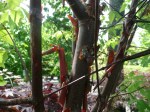
Bark Shows
Lastly, I want to mention another great tree known for terrific bark features, the Paperbark Maple (Acer griseum). I regret not getting one I saw at Tarnow’s in Enfield last fall on sale. It has cinnamon-colored exfoliating bark and red leaves in fall. It is a nice smaller tree reaching about 18-20′ height. And another I read about and saw this spring at another nursery is Acer japonicum ‘Aconitifolium’ (Fernleaf fullmoon maple). It is a small 8-10′ tall tree with a fall color of red, orange, and yellow leaves. I love the cut of the leaves similar to Japanese Maples but with fatter fingers, and the edges are serrated looking. Both of these beautifies are featured in Tracy Disabato-Aust’s new book titled, “50 High Impact Low-Case Garden Plants”. I saw one of similar leaf structure this summer at Stonehedge Garden Center in Newington, CT called Autumn Moon Maple. See photos below!
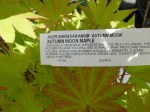
- Fall Color




 This is my very first blog ever! How exciting. Today has been an on/off rain to sun to rain day. The leaves are turning yellow and the temps are cool. Oct is a good time to prepare new perennial beds for next spring’s candidates, and now is the time to mulch any recently transplanted perennials to help avoid heaving when the freeze/thaw cycles occur.
