Philadelphia Flower Show 2011

Leave a comment

“So what impressed you the most about the show?” I asked Steve, my husband.  “The crowd,” he replied.  When maneuvering our path through the hoards of people at the flower show earlier, Steve asked me, “How much were these tickets again?”  I responded, “$25 each.”  He then began to consider the amount of ticket sales in his head.

Later I read of a figure of $60 million.  This is not the revenue from the ticket sales, but represents the estimated economic benefit brought to the greater Philadelphia region, the host city of this spectacular flower show held in the Pennsylvania Convention Center.  I could not find the total number of attendees from the opening day in the local newspapers, but I did read this is the world’s largest flower show (something I didn’t realize earlier).  The ticket sale revenues benefit the Pennsylvania Horticultural Society and all their efforts as a non-profit organization.  Many of PHS’s campaigns are highlighted by their President in a letter found in the program’s official schedule of events. 

But what impressed me most, beside the size of the event and the crowd attending, is the sheer proportion of the design elements, structures, and floral pieces you see when you first enter the main doors to the showroom.  This year, a replica of the base of the Eiffel Tower embellished with tiny white lights rises from the floor up to the building’s ceiling as if the tip disappears into the evening sky.  My guess is it is about 120 feet wide and 40 feet tall or more.  It is immense.  And it offers a sense of grandeur while inviting the anticipation of the display gardens to be seen on the rest of the show floor. 

My immediate response or reaction to the size of La Tour Eiffel was excitement.  I have a hard time putting it into words, but it makes you understand that this show is big.  I felt this way in 2010 the first time I attended the Philadelphia International Flower Show and saw fifteen foot high floral arrangements in giant urns staged inside huge wrought iron gazebos.  The same feeling occurred this year during my second visit to this show when I saw the tower.  I had to stop looking up however to avoid bumping into the people in front of me – plus I didn’t want to lose Steve in the mass of on-lookers. 

Soon my attention is captured by life-sized animal sculptures made from plant materials and flora.  A lion with its mane and tail made from ornamental grass flowering plumes, a peacock adorned with vivid red roses around its neck, and an ant head with bright lime-green mums.  Around the bend, with (unstaked) Delphinium as tall as me, is a black shiny grand piano stuffed with flowering bulbs.  Taking a couple of steps forward, I could see between blooms two people – artists, painting – in the distance.  There was a live model standing in a garden; an elegant woman in a safire blue dress, quietly posing as they painted strokes on their canvas.  Further down, a dark alley of trees; large trees with a canopy of vertical gardens above, and rain drops dripping below into a long square water garden.  It was designed with an evening feel as if you would discover this secret garden on a stroll.  These are just a few of the artfully thought out creations in the display garden section on the show floor.

As we continued to view each amazing feature by various societies, designers, florists, and landscape contractors, I could tell Steve was beginning to experience similar emotions as myself because he began to lead me through the exhibits and not follow.  This made me smile.  He was impressed with what he was witnessing, and as I had told him in December when we booked our hotel package for this trip, this is more than a flower show, it is about artistic interpretation.  It is meant (at least in my view) to bring out the emotions and senses of plant lovers or just first time visitors, such as Steve.  It also gets you into spring.

Many of the displays, all based on this year’s show theme, “Springtime in Paris”, were beyond the traditional landscape or garden exhibits seen at smaller shows of this nature.  For example, one display was a creation of shadow images, or silhouettes, cast on big white screens achieved by the use of various objects staged perfectly in the reflected light beams.  French ladies briskly walking in dainty dresses, and one soaking in a tub were remarkable tricks to the eye.  There weren’t alot of flowers here, but it certainly invoked the romantic spirit of a spring day in Paris.  Another separate display interpreted the ‘Water Lilies’ paintings by Claude Monet with a large canvas on the ground reflecting the painting’s images. 

As you exit the main display garden areas and enter the competition sections, pieces were smaller but not lacking in any way otherwise.  I especially enjoyed the white mannequin heads with coiffers styled by using botanical cuttings, pods, straw, Amaranthus, cypress, and other types of plant materials. Steve commented that one in particular looked like real hair!  These were created by garden clubs in the area.

About half-way through seeing the vendors in the marketplace section, the crowd was beginning to get to me.  Lucky for us, we had an easy access to our hotel room via a connecting skywalk (the reason why I selected the downtown Marriott, plus their package price for the room, breakfast, and show tickets was worth it).  We decided to take a breath of fresh air outside, rest our feet a bit, and discussed what we saw.  We returned to the show for the last hour and a-half for the best-viewing hour.  It was calmer then, but still busy.  We took that time to check out the award-winning plant specimens in the horticulture area.  Steve enjoyed these too.  I actually crouched on the floor to take a photo of a plant I hadn’t seen before, and noticed it had a first place ribbon.  The only bummer is my camera can’t handle the awkward lighting in these big exhibit halls, so the quality is not up to par.  It was a Serracenia x chelsonni entered by Randy Heffner of Aquascapes.

We finished off our day in Philly by taking a taxi to the Rittenhouse Square District for a night-cap at Tria’s.  As the pouring rain fogged up the taxi car windows, I could not see the city in the dark.  We were looking forward to visiting this place because it was a recommendation by a friend.  It is a wine, beer and cheese style bar.  On Sundays, they offer a special price for first tastings of the evening’s selected wine, beer, and gourmet imported cheese.  Of course, the wine of the evening was from France – how apropos!  The small-plate appetizers were just as tasteful as the beverages. Every bite was a combinations of flavors I had never experienced at any fancy cafe before.  This place was small, comfortable, trendy and the perfect ending to our springtime visit in Philly.

Before heading home, we completed it all with one last walk through the Reading Terminal Market the next morning where fresh and local foods and plants are sold.  I picked up one last plant purchase, an unusual Sansevieria cylindrica.  And some turkey sandwiches to go for the ride.  This is another place not to miss if you decide to go to the flower show.  It is next to the convention center and near the hotel.  Go to Dinic’s for hot roast pork or beef (a.k.a., steakcheese) grinders, but be prepared to wait in line for at least a half-hour during the lunch-time rush (worth it!).  That morning it was quiet at 9 am, and Dinic’s had bags of fresh bread lined up on the counter to prepare for the hustle and bustle of the day to come.

During our drive home, we were challenged yet again with our last crowd – the traffic of cars and trucks on highway 95.  As Steve drove patiently while I read articles about the show, he commented that he would return with me again next year.  But for those of you interested in this year’s, you still have time to go.  The show runs until March 13th.  See theflowershow.com or visit cthort.org where organized bus trips are offered to society members.  See also www.triacafe.com for the restaurant mentioned and visit my business Facebook page to see a video of the show’s entrance!  C’est magnifique!  Cathy T


ELA All The Way

1 Comment

There are probably as many different styles to people in the hort world as there are varieties and cultivars of plants!  And yesterday I met a new breed, the stewards of mother earth at the ELA (Ecological Landscaping Association) conference in Springfield, Mass.

I don’t know how I managed to do this – but I filled up my month of March with conferences and flower shows.  This one I attended yesterday was a spontaneous sign-up.  I saw it listed via the Master Gardener newsletter and the seminars were different from former types I’ve attended, plus I didn’t recognize the speakers’ names, so I thought it would be great to see some new faces.

So what is the ELA conference?  It is hosted by the Ecological Landscape Association.  They are a ‘non-profit organization of dedicated landscape professionals, individual gardeners, and community groups who believe in using landscaping practices that are environmentally sound.  They also believe that natural systems are the best guide for learning how to develop and maintain healthy landscapes.’  These are just two of their bullet points listed on their pamphlet. 

I attended several seminars, one titled “Design Evolution: Engaging the Present, Adapting to the Future” by Ann Kearsley of a design firm.  Also, a session by Carolyn Summers of Westchester Community College’s Native Plant Center titled, “The Practical Challenges of Designing with Native Plants.”  I was happy to see some of the plants I have used in my designs were part of her presentations because she explains in detail the benefits of their uses as natives. She discusses how to choose cultivars, open-pollinated indigenous plants, and covers other aspects regarding minimizing maintenance.  I particularly liked an example of two topiaries she displayed of equal proportions and shape, but one was a native while the other wasn’t.  We often overlook to just select a native that is just as beautiful, can do the same job in the garden, yet it has the added benefit of supporting our eco-systems and animals in our environments.

In the afternoon, I stepped out of a “Soil Development for Healthy Flowering Trees” seminar by Dan Kittredge to attend something a little less intense for he was very technical and reminded me of my UCONN Professors, and I was just a bit too drowsy.  So looking at “At-Risk Pollinators” on the screen as Ellen Sousa of Turkey Hill Brook Farm described how to encourage them was more in line with my low-energy.

And I was bummin’ I missed one lecture called “Designing Ornamental Gardens for Highly Effective Stormwater Infiltration” by Kevin Beuttell of Stantec because many attendees commented about how excellent it was.  But like with many of these conferences, the sessions run simultaneously so you can’t see them all.  Fortunately, the hand-outs were available as part of the enrollment from the website.  No paper copies were reproduced (save trees) and you even bring your own eco-friendly water bottle to this event.

There was a market place at the show filled with all kinds of products to use in the garden – all natural based, sustainable, native, eco-friendly, focused on conservation, and concerned with all aspects good for the environment with a special focus of doing no harm.  One display in particular caught my attention.  It was a papermaking demonstration made with a base of invasive plants.  In fact, there were a few vendors showcasing how to use invasives to our benefit.  One person wrote a book about the medicinal properties of invasive plants.  This is good news.  We have to find ways to use invasive species for a good purposes if we can’t rid of them completely from the landscapes and forests.  Everytime I see a roadside stand of Japanese Knotweed (Polygonum cuspidatum) or Autumn Olive (Eleagnus umbellata), I think about how if only we could use these problem plants in a good way – and some stewards have.

But back to the papermaking.  The woman demonstrating the process was Louise Barteau Chodoff of bubblewrapture.  She had three tables lined up with the plant remnants, dried, or chopped up with the papermaking screens as part of her demonstration.  She is someone I would be interested in talking to about having a how-to class on papermaking and this special focus of using invasive plants in a good way feels good too.  She can be found on www.inliquid.com

Other exhibitors included Neptune’s Harvest, a manufacturer of unique, specialized cold processed organic Liquid Fish and Seaweed fertilizers, and The Great American Rain Barrel Company that re-purposes shipping drums into a complete water collection system.  A booth by Project Native was well-designed.  They are another organization dedicated towards inspiring the stewardship of natural resources by cultivating native plants and restoring our local landscape.  They are located in Housatonic, Massachusetts and their website is: www.projectnative.org.  Their organization began in 2000, when Raina Weber recognized the need for a native plant nursery in the Berkshires.

While many of the people, vendors, and speakers at the ELA Conference are north of my state, they are great neighbors to get to know.  It will take me a while to digest all the valuable information gained yesterday.  So off I go to read more!  For more information, refer to http://www.ecolandscaping.org/Cathy T

The Big Guns

2 Comments
Ever want to meet your icon, a famous rock star, or your idol?  Well, volunteering in an arena where they perform is one avenue you can take to reach that goal.  And for me it happened at the CT Flower & Garden show.

As I took a lunch break in a hallway cubby on the seminar floor, I began to read the next speaker’s bio from my iPad.  However, I’m already a big fan of this person and very familiar with her reputation from seeing her speak at other gardening conferences over the past couple years.

As I was chewing away on my sandwich, here she came around the corner!  It may sound corny to non-plant lovers, but this was a moment for me.  “The Perennial Diva” was standing right beside me and I couldn’t be more thrilled – an honestly, a little nervous too.  She quickly put me at ease as she joked about how I can mention she has appeared on QVC-TV when I introduce her because people seem to like that.  Her name is Stephanie Cohen, and to me, she is a Big Gun in the world of horticulture.

Stephanie Cohen, as I noted that day to her audience, hardly needs an introduction.  She is very well known for her publications, expertise in the perennial scene, and her amazing talent of presenting infront of large audiences while entertaining with humor along the journey.  I held up her award-winning publication titled, “The Perennial Gardener’s Design Primer” with its intense pink cover.  Ironically, her book’s cover is the same color recently announced by Pantone LLC as the 2011 color of the year.  Its been described as a reddish pink and named Honeysuckle, but to me it is an intensely rich hot pink.  It certainly demands your attention and gets you excited, just as Stephanie does in her presentations.   

I continued to tell the audience, “…looks like Stephanie is ahead of her time!”  Heads bobbed up from the seats to see the cover.  And then Stephanie held up her nails, also painted the same honeysuckle pink.  She began to approach the floor to start her presentation.

Every seat in the room was filled.  People were still arriving during the beginning of her presentation so they stood in the back row.  In fact, one or two people gave me the business on their way in because I made the costly mistake of starting her session one minute early.  They obviously did not want to miss a beat (this was a lesson learned for me). 

Before Stephanie even got inside the room for the setup prior, her fans were walking up to say hello.  It was apparent they’ve seen her before and were revisiting another one of her presentations and anxious to see her new publications.  One of which is titled, “The Non-Stop Garden” and is already a top seller.  Just like a rock star, she has a following. 

At this seminar, Stephanie covered ‘Perennials from Spring to Fall 2011’.  She reviewed more than 50 perennials starting with Artemesia vulgaris ‘Oriental Limelight’ and finishing with Yucca rostrata ‘Sapphire Skies’.  She lets you know what is drought tolerant, resistant to mildew, blooms later than others, or attracts hummingbirds, among many other aspects about the perennials.  But it is more than the usual characteristics that draws your attention, she gives you honest opinions and tidbits on what works and what doesn’t with these perennials in the gardens, and why.  She also has a way of commenting on the creation of cultivar names with a comical nature…, like for Aquilegia x hybrida ‘Winky Double Red & White’.  She joked about why was the word ‘Winky’ was needed when the rest tells it all?!  Or how Hibiscus moscheutos ‘Pinot Noir’ is an example of plant cultivars named after alcoholic beverages.  “Either they like the name, or maybe they were just drunk?” she said.  Whatever the comment, her spots of humor during her display of colorful perennials new on the scene or sometimes old favorites makes one not only remember the plant and its features, but truly enjoy the show.

No one left the room during her presentation except a fellow volunteer who had to return to her presentation in the adjacent seminar room.  As she passed by me, she leaned down and whispered in my ear, “You picked a good one!”  

The next day, this friend called me.  She had never seen Stephanie Cohen before.  She raved about her style, humor, and how thankful she was to see her presentation for she learned so much about the perennials she introduced.  I guess Stephanie has another new fan.   

  •  The Perennial Gardener’s Design Primer (The Essential Guide to Creating Simply Sensational Gardens) coauthored by Stephanie Cohen & Nancy J. Ondra.  Topics from getting started, perennial selection, partners, problem-solving, and special effects are just examples of the chapters.  Look for the honeysuckle pink cover!
  • FALLscaping (Extending your garden season into autumn) also coauthored by Stephanie and Nancy is very popular in the fall!  Perfect partners for fall, putting it all together, and fall garden care topics are covered.  I have both books and find them as very useful references for my design processes.
  • The Non-Stop Garden, her newest top-seller, May 2010.  Soon this one will have sticky post-it notes, just like the other two in my collection!

Stephanie Cohen’s complete bio can be found at the flowershow’s web site: www.ctflowershow.com.   


People Person Personality

1 Comment

Colleen Plimpton (left)

On the last day of introducing speakers at the CT Garden and Flower Show last week, I stopped in to check on Colleen Plimpton.  I wanted to make sure she had everything she needed for her presentation.  I had met Colleen before at one of our CT Horticultural Society program meetings.  She came up to my table to ask about the speaker facilitators at the show.  I informed her I would be there to help coordinate this new effort on behalf of the society and its volunteer members.

Colleen Plimpton is a well-known gardener, writer, and teacher.  She spoke at this year’s flower show on two topics: “The Bins and Outs of Composting” and “Hello My Garden!” (a topic focused on what to do to prepare for spring in the garden).  However, I could not stay to listen because I had to attend to another presenter in the adjacent room.  This was disappointing to me because I really wanted to hear her speak, especially after meeting her again briefly on this day.

Colleen has a very warm and friendly personality.  When I visited her website to learn more about her background,  it was fitting to see she has a former background as a clinical social worker.  I thought, this is where that warm feeling comes from when talking to her.  She has a “people person personality.” 

In addition to her background in social work, Colleen has an extensive history as a professional gardener, has traveled the U.S. gardening, taught classes at the New York Botanical Gardens, appeared on television shows, writes featured articles for various gardening publications and magazines, and has authored gardening related books. 

One of her most recent publications, “Mentors in the Garden of Life” was a finalist in The Best Books 2010 Awards, Home: Gardening category.  It is a memoir filled with touching stories of her years gardening.  The testimonials on her website will surely perk your interest, as it did mine. 

In addition to all of Colleen’s accomplishments, she also designs and tends to an award-winning ornamental garden while offering advice and updates on her blogs.  She is a member of the Garden Writers of America, writes for ‘Connecticut Gardener’, ‘GreenPrints’, and ‘Toastmaster’.  She offers coaching and education, while managing to maintain a schedule of book signings and lectures!  All of this Colleen does with a positive energy and continual smile.

When I read this excerpt from her blog, I chuckled, and it made me feel all the more appreciation for her personality:  “I can’t grow clematis to save my soul.  I’ve tried repeatedly but no dice; they apparently don’t like me or my soil.  What the heck, pruning them properly always was confusing.”

Clematis in my garden

I loved this statement.  I’ve told my clients many times over, clematis are one of those plants I see flourishing in a gardener’s yard or completely unsuccessful.  And it is true, the types and pruning of clematis are confusing!  I like the honesty that shines through her works too. 

Should you ever get the chance to see Colleen Plimpton speak, I trust you will thoroughly enjoy her lectures and educational teachings along with her people person personality.  To learn more about Colleen, visit her website:  www.colleenplimpton.comCathy T


More on The Bird Geek

Leave a comment

As a follow-up to my post yesterday, Michael Corcoran, the bird geek, wrote me an email to explain the birds he was referring to on the Traveler’s Tower were Peregrine Falcons (one of the victims of DDT use in the 60’s and 70’s, along with Bald Eagles and Osprey).  He continued to explain…”Watching a Peregrine in a hunting dive is a life changing experience (they have been clocked at over 200 mph).  The reintroduced Peregrine’s have adapted by using tall buildings and bridges as a substitute for the cliff faces that were their traditional nesting sites.”

This link is to the FlaconCam site where you can keep an eye on the Traveler’s pair:  http://falconcam.travelers.com/

Cathy T

The Bird Geek

Leave a comment

The first person I introduced at the flower show seminars last week was Michael Corcoran speaking on “Native Birds for our Native Plants.”  As I greeted him in the hallway, I immediately liked his warm character and ease.  He pointed out the convention center windows indicating there were birds to note across the view on a tall city building.  My mind was more on my show responsibilities, so I’ve already forgotten which bird he was speaking of! 

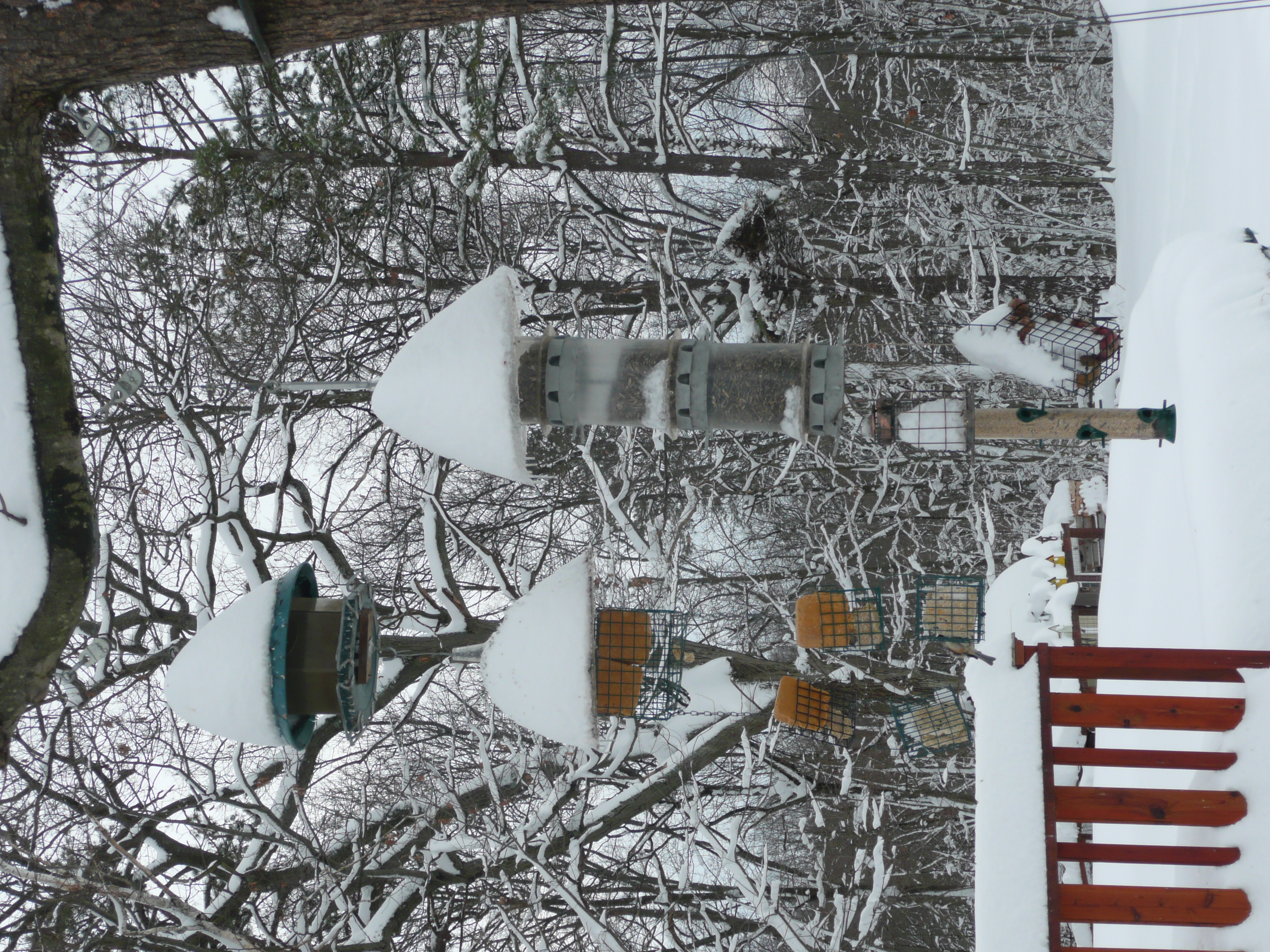
I told him that my husband has a triple decker bird feeder at our home and my friends are always commenting about the many birds we have on it.  Often they react with surprise at the variety, but I’m kind of use to seeing the many different birds.  Then I continued with letting Michael know I’ve seen a pair of pileated woodpeckers at my home in the woods several times.   I can even recognize their bird call now and imitate it which my brother finds comical.  But that is about the extent of my bird knowledge.  I was actually fishing for something interesting to share with Michael as we awaited the start his seminar. All the while, he listened and pleasantly responded with facts about the bird world.

Michael’s background includes being a volunteer with the CT Audubon Society since 1994 and being an active advocate for bird conservation.  He refers to himself as the “Birdgeek” and his email id reflects him as such.  He is also a serious cooperator through UCONN promoting sound forest stewardship practices and has a strong focus on natural resources. 

As Michael projected photos of native birds found in CT areas during his seminar, I was shocked to learn that I did not know of any displayed on the screen except the grosbeak!  Grosbeaks visit our feeder at home once in a while.  I just love their dark black on white with the rosey red coloring below their large beak.  There were many different species discussed by Micheal as he explained where they exist during certain migratory periods in our own woods, various forests and parks in CT.  Here I thought with my husband’s triple deck bird feeder setup on a chain pulley system loaded with so many different types of birds, we were a home with a good mix of birds.  I mean, my husband stocks his feeders so well with suet and grey stripe sunflower seed, we could have put a kid through college with the amount he has spent! 

Winter shot of Steve's birdfeeder

It was apparent the audience was filled with avid bird lovers.  They seemed to have a common look.  Their smiles were amidst the darkness of the seminar room as beautiful photos of birds were shown by Michael.  Soon following the bird review, Michael covered invasive plant species and how they harm bird feeding routines.  He instructed the group on how to find and identify certain invasives while offering alternatives, like Viburnums among others. 

Michael lives in South Glastonbury and showed photos of the trees and shrubs he has planted in his own yard and how these helped his bird populations.  I thought how wonderful it would be to line up a tour on his property where we can walk and talk more about the bird geek’s world.  (Note to self!)

For me personally, this seminar kicked off my experience at the flower show by offering a non-bird geek a new perspective.  However, I did not take notes as I would have liked, and had to run off shortly after his presentation to handle other duties.  Three days of show activity continued, and by yesterday, the last day of the show, I was feeling the tired feet and some exhaustion from all the excitement.  My generous husband, Steve, offered to pick me up from the show so I would not have to park in the parking garage. 

When we arrived home and stepped out of our car, I swear on the holy bird bible, there was the pileated woodpecker, a top a tree in my neighbor’s yard, chirping, or singing, whatever the technical term is for it.  I am NOT kidding.  We both paused.  I said to Steve, “I can’t believe this Steve!  This is a sign!”  Then I started to tell him about Michael’s presentation and how he has to meet him.  The pileated woodpecker flew right over our garage in the horizon.  It was distinctly recognizable, and now I also know, it is the largest woodpecker of North America.   

Michael Corcoran’s complete bio is located on the CT Garden & Flower Show website (www.ctflowershow.com) under the menu option titled seminars.  Cathy T

CT Flower and Garden Show 2011

Leave a comment

Me last yr

I will be at the 30th Annual CT Flower & Garden Show today (Feb 24) serving as a volunteer for the CT Horticultural Society.  My role will be to introduce some of the seminar speakers, which by the way, seminars are held upstairs above the show floor on the ballroom level (and are included as part of the show’s entrance ticket).  Additionally, I will be at the CHS’s beautiful exhibit on Saturday, Feb 26th, from 3:00-5:30 pm, greeting show visitors!  And of course I plan to enjoy visiting the show’s other displays, flowers, and gardening items.

Last year, at this show, my Aunt Clarisse from Canada took this photo of me. Yes, Clarisse traveled here all the way from Quebec, Canada for the show.  She attended with my mother, who happens to also be her twin sister, Claire.  (They are both the eldest of 20 siblings.  Yup – 20!  But that is another story for another time.  No other twins in the family of the 20 if you are wondering.

A cool thing happened that day with my Aunt Clarisse.  Even though she doesn’t speak any English, and my French is extremely poor due to being out of practice, we both were able to clearly communicate about the plants at the flower show because of our familiarity with Latin plant names. 

Many people complain about the use of Latin names for plants because they are difficult to pronounce, but I was so impressed with my Aunt Clarisse as she said things like, “Ooooh, une Baptisia.  Voila, la Narcissus!  Ah, oui!  C’est tres belle – le Salvia! J’adore toute les fleurs ici!” 

Aunt Clarisse just loved the plants in the flower show’s displays.  And we enjoyed chatting plants or at least being able to name them by their Latin names without our usual language barrier frustrations.  In this case, Latin plant names saved the day!

We also understood that we enjoyed some plants in particular more than others.  Although she lives so far away, we knew alot of the same plants.  And, I loved the way she said “orchids” in french.  Sounded something like Or-Kid with a french accent!  But I knew right away what she was admiring.  In many cases, we were both speaking the same language about a specific plant, without confusion of the sometimes misused common names.    

I thought to myself, “Isn’t this the coolest? My Aunt is here – traveled all the way from Quebec — and we have something in common I didn’t expect, the love of flowers and plants with a Latin connection!”

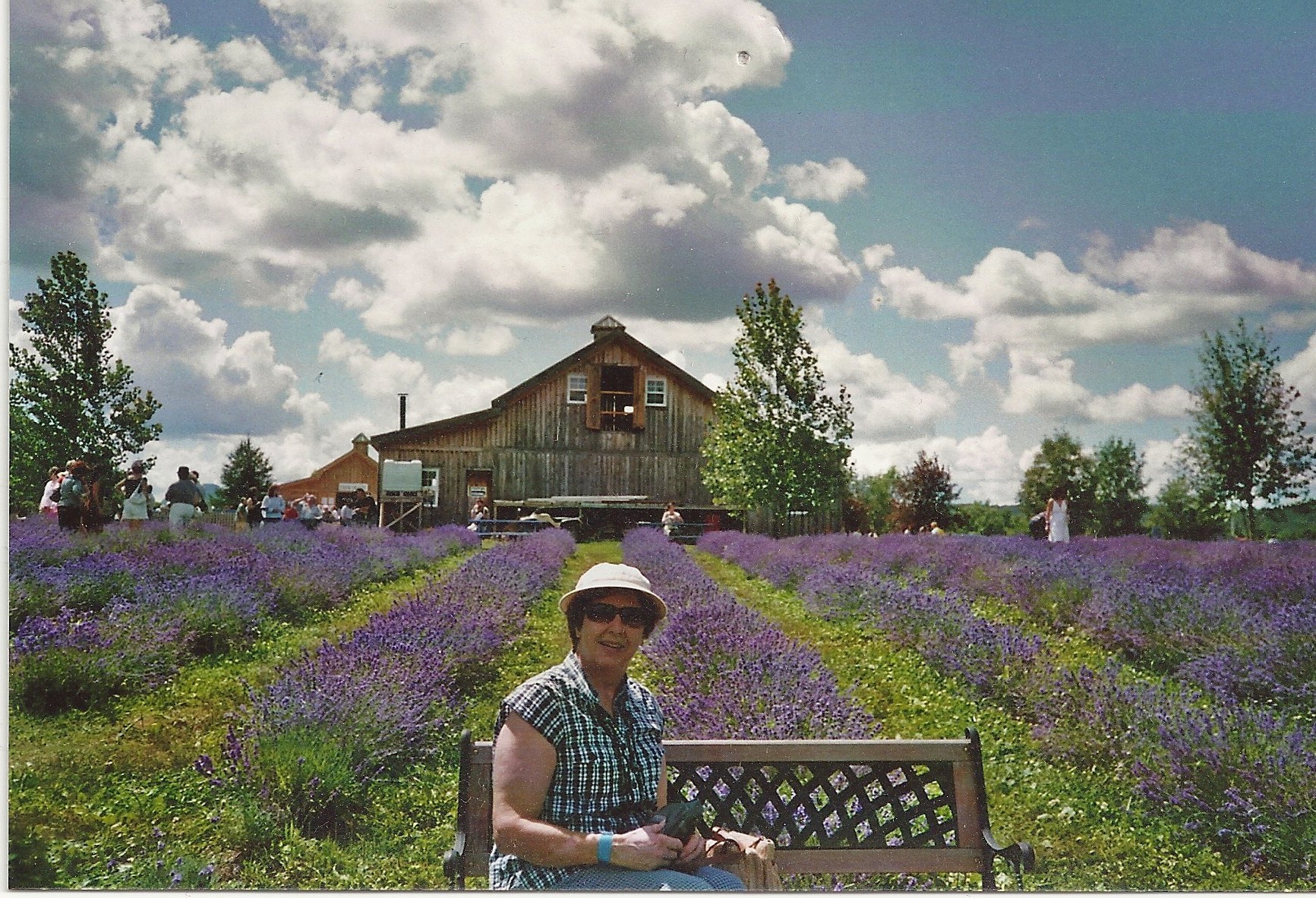
About a month later, I received photos in the mail from my Aunt Clarisse of plants from the flower show and of her own gardens in Sherbrooke, Quebec.  She included a beautiful photo of her sitting on a bench in front of a field of lavender, or Lavandula!  On the back, she wrote:  Clarisse. Au Lovode Blueue. Fish Bay. Quebec. Fin Juillet.  Looks like it was taken in July.    I have had this photo pinned to my office wall all year.

Clarisse with Lavandula

Flower shows are great places to share your love of plants with family, friends, colleagues, and admirers.  Lisa, my older sister, is coming along with me today. She said she needs to “feel some spring” and break out of the doldrums of winter.  Don’t we all?  It seems to me spring is FAST approaching.  It won’t be long before our abundant snow melts, grass will green up, buds will swell on trees, and flowers like Helleborus, will pop out of the soil and say, “Hello, I’m back!”

I’m glad to be back at the CT Flower & Garden Show again this year to get inspired and look at what is new and different.  Why don’t you join me, us, and all the others at the show? Get into the magic! 

The flower show is at the CT Convention Center in downtown Hartford.  It begins today, Feb 24th and runs through Sunday, Feb 27th.   See www.ctflowershow.com for more information.  The CT Horticultural Society’s website is www.cthort.org.

Hope to see you there, Cathy T.

Gutt Reaction

Leave a comment

Last week I spent a full day at New England Grows in Boston.  This is my 4th year attending so I am very familiar with what to expect.  However, I also hope for new surprises.  As I browse the showroom floor, I search for a new, different, or perhaps not yet noticed gardening product or plants.  My goal is to learn, but more importantly, to see what is useful to my design clients and gardening friends.  Here is my gutt reaction to those I took notice of.

Dyeing Orchids.  No, not dead orchids.  Orchids dyed the color blue.  As I took a photo of Phalaenopsis (the Moth Orchid), I told the guy manning the booth that this was the first time I’ve seen this.  My reaction:  I found it curious long enough to take notice, but I’m not so sure orchids should be treated this way (see photo below).  Orchids are not your typical flowers as you know.  Often gardeners who grow them also collect them.  The moth orchid is one of the favorites and perhaps easier to grow.  They require moderate light and consistent moisture, and bloom late winter into spring.  But there are other more sophisticated types of orchids.  You could say that orchids are somewhat in the elite class.  And typically collectors don’t really like their prized plants to be “messed with” – at least maybe not this way.  Sure, we’ve seen dyed poinsettia plants the past few holiday seasons.  But somehow, at least my gutt reaction said, doing this to orchids is not as cool.  Actually, it kind of made me feel blue. 

The Smart Pot.  Because of my love for container gardening, The Smart Pot caught my attention at the show.  It is a soft-sided fabric container.  Commercial growers have used this product, but now its an option for container gardening at home.  As described by the sales person, it has many growing benefits.  The soft sided material allows for better aeration for the plant’s roots.  Unlike plastic containers, the heat held is also released when it is too hot outside.  The aeration process also eliminates (so they claim) the circling or girdling of roots at the base of the pot due to what is known as air-root pruning.  These root benefits greatly improves the root structure and increases top growth.  You should end up with a higher yield or more blooms.  My reaction:  I believed every word the gentlemen told me as he described the benefits of The Smart Pot’s features and that it promotes better top growth because of the benefits provided to the root area, resulting in higher yields.  The Smart Pot certainly has a High IQ!   However, the drawback for me is it is just a plain black container with no embellishments.  I like a lot more bling for my container gardens.  For the vegetable lovers out there, this is a handy, portable, reusable, and lighter growing container.  And it comes in various sizes from 7 to 20 gallon.   This patented aeration container definitely has its advantages.  It may have other uses to consider, which I am.  I have some more thoughts about it to share at my Container Garden Parties in 2011. 

Verticle (or Vertical) Gardening.  Identified as one of the 2011 hot new garden trends.  We are not talking about slapping a trellis against a wall and allowing a clematis to grow up it.  It is about verticle gardening on a larger scale.  A component system shown at the show entailed modular sections made from stainless steel sections and filled with growing medium for quick assembly.  My reaction:  I would love to create this wall of planting glamour at my home where I have a tall and bare foundation wall below my garage facing my lawn.  I feel these component wall systems of verticle green walls are somewhat site specific however.  They could be used to create outdoor room dividers, hide an eyesore (like my garage foundation cement wall) or create artistic elements in the garden.  I could also see them also used in commercial building settings where space is otherwise limited or to bring a concept to eye level for visitors.  Perhaps a wall of herbs at a restaurant’s outdoor seating?  For a smaller scaled environments or interior rooms, there was another interesting option shown by another vendor at the show.  It was framed wall art designed to accommodate plants, roots, soil and watering.  I liked this too, but to be honest, I also felt the garden framed wall art is something one could easily create on their own, should they have the desire.  Just pick up a old picture frame or window pane, and go at it.  Maybe it is because of the plants they used to showcase the wall art.  They did not do it for me.  I would have used coleus and created patterns, or a painting.  Oh, the juices are flowing!  Both the component large wall system and the small frame plant wall art provided inspiration.  That’s a good thing.

Rice Hull and Bamboo Pots.  We have definitely seen a great deal about recycling pots the past couple years with the green movement.  But this year at the show, it was the first time I saw a plant wholesaler selling the starter plants right in the compostable pots.   This grower had pots made from rice hulls and bamboo.  Completely compostable or biodegradable, and serving as beneficial decay matter to the soil environment for the plant.  Once in the ground, the pot will slowly decompose or breakdown as the roots reach thru the vents or slots in the pots, or as the base of the pot decays.  You don’t end up tossing the pot into the garbage, it helps the soil, and eliminates the repotting step.  I really like this.  The grower also is focused on using recycled water and renewable components throughout their production process. If others had done this already (meaning using the attractive “right size” bamboo/rice containers), for some reason I didn’t notice it before at this show.  I’ve seen smaller plugs or pots of this type of material, but not in the size pot I typically like to start with for my garden installs or for container gardens.  And their compostable type pots were attractive enough should you want to just enjoy the plant in the pot before it reaches the ground.  My gutt reaction:  All good.  No bad.  Just right.  (Just wished I had a nursery of my own so I could load up on them!)

Click on the photos below to expand the view! 

Playing with EVs

Leave a comment

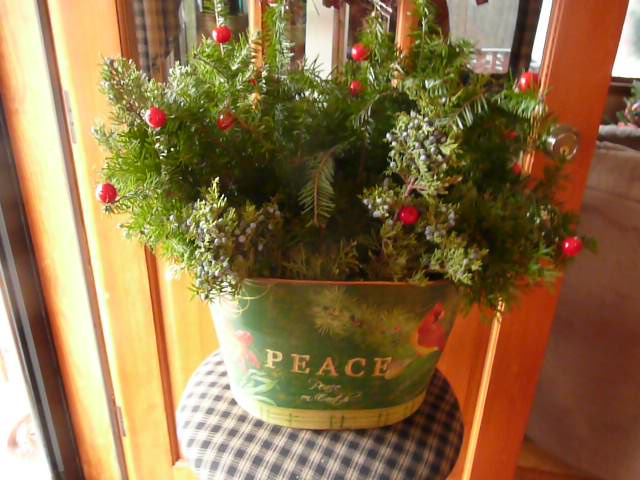
Ever since I held a class called, “Making Evergreen Holiday Kissing Balls“, earlier this month, I can’t stop playing with creating fun holiday containers stuffed with various evergreens!  Winter container gardening is fun!  Tin containers work really well because they can handle the expansion and contraction of the soil which is moistened in the container and then freezes from the outdoor winter temps. 

Tin with EVs

Festive and Fun

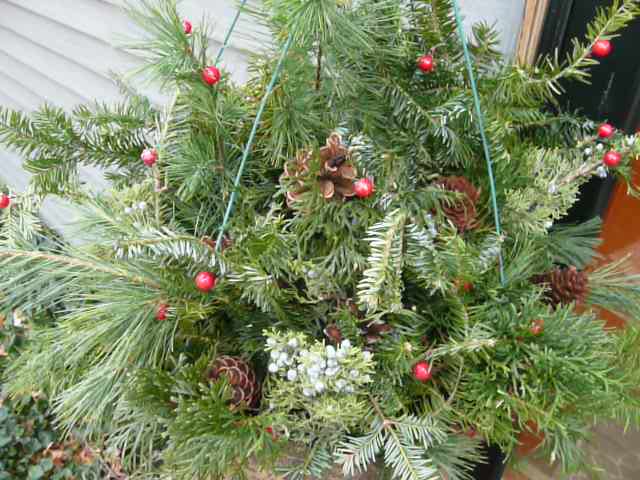
Other good container choices are antique wooden boxes or moss hanging planters.  I took a moss hanger which I had stored in my basement from this summer. 

Hanger

Reused Hanger

I kept the soil in there with plans to create a evergreen basket for the holidays. It worked perfectly.  The soil was pre-moistened before I inserted the pines, junipers, balsam fir and arborvitae cuttings.  Then I let the basket sit outside for a night so the soil freezes really well which anchors the cuttings in the container.  The next day I started inserting pine cones and other holiday decorative artifical elements like berries and sparkly fruits. 

I love having these evergreen container arrangements staged around the outside of the house. The other day a friend stopped by and commented on how wonderful everything looks outside, but it really consisted of all the pretty container of evergreens and red ribbons.  Easy to do and it is great to reuse your summer containers in a new way. 

Next winter, I plan to hold a class on making these!  On my business page on Facebook, you can see some videos of how I do this, or just signup for my class next year! It will be held in early December and I will post it 2 months prior for signups.  It is a year away, but this season, I’m testing out various processes and materials.  You can play with fun containers or more formal.

Frosty!

Let It Snow

This weekend, I’m going to create a evergreen arrangement in a beautiful urn.  Urns are great for this winter container gardening and can be very showy on a front porch or entry way.  They are formal and elegant. 

It is best to keep the creations outside as they will remain green for months, up to February.  Inside they can dry out quicker, but these containers stuffed with evergreens can be used as a holiday centerpiece on your table.  I would just recommend keeping it outside to extend the life of the greens as they are dormant. 

Wait til it snows, I love the snow on the evergreens too. Enjoy the festivities!  Happy Holidays!  And keep on containering into the New Year!  Cathy T

MG 2010

Leave a comment

Well, I received it!  My Master Gardener 2010 official certificate of completion!  I had such a busy year, it is hard for me to believe I also completd 16 weeks of classes from early January thru mid-April this year.  But it didn’t end there, the classes were followed with an open book exam then 60 hours of volunteer work during the months of May thru Sept on outreach projects.  Many projects were presented prior to beginning our outreach activity hours.  It was so difficult to select, but I did a mix of creating some container gardens at the MG office, helping at a local community garden in Thompsonville, CT (this included giving a couple classes and revamping a perennial garden bed), and working at some agricultural fairs later in the season.  I also helped with a garden id project at the ag buildings.  As part of the program, I also completed a tree, shrub, and vine identification project by the end of August.  And there was office work time in the Extension Master Gardener Office in Vernon/Tolland where Master Gardeners diagnose and answer questions about plants, plant problems, insects and more. 

The Master Gardener program is all about providing education and information to the public about horticultural-related topics.  And it all begins with a solid foundation of learning, and more importan,t direct experience gained by participating in this programs requirements and various activities.  I can hardly believe I completed this program while keeping up with my workload from my small professional landscape design business and other gardening events held this past year for the first time.

Of all the MG activity involved, I guess I have to say, working in the Cooperative Extension Office was the most beneficial to me because I was able to see what types of problems the home gardener experienced and understand where they needed help.  I’ve gain horticultural education years prior via the degree program at UCONN, but the MG program offers a different type of learning – where you meet not only other very avid gardeners in the classes, but the people in the community that just want to do gardening correctly, or should I say “better” (for gardening should not be totally correct!)… or just want to have answers to problems they encounter along the way at their home gardens.  The Cooperative Extension Offices are designed to help the public, and I suspect many people in the community are not even aware they exist!  But this service is available.  Make note!

I also strongly believe the program is a great bargain.  You learn, practice, experience, and teach (if you are up to the challenge of intense classes and time commitment for the program’s requirements) throughout the program and also receive a tremendous amount of amazing reference material that you will surely use as you continue your gardening experiences.  In 2010, all of this was included in the MG fee of under $400!  There is an application process, but don’t let it scare you if you think you want to backup your gardening hobby with some solid horticultural knowledge.  I’m sure anyone with the desire to learn and the ability to commit to the program would be accepted – at least I think so, but I’m not a coordinator so I can’t say for sure – just my opinion!  I don’t make the rules, I’m just trying to say, I think it is worth pursuing if you are interested and can manage the time. 

After all was said and done, I couldn’t even attend the graduation ceremony in late October because I had another family commitment, and then I didn’t even have time to go pick up my certificate from the office!  So they eventually mailed it to me!  I guess once February rolls around in 2011, I can spend more time reflecting on all that I did during this program, how much it benefited me as a gardener and person in the trade, and soak in the accomplishment. 

Lastly, I’ve often pondered, what would have been better?… Going to MG Program first then take the UCONN Degree Program– or doing it as I did, taking the degree program (finished in 2005) and taking MG 5 years later?  But that is like asking if the chicken came before the egg?  There is no correct answer!  Both are amazing opportunities and provide layers of learning about horticulture.  I feel very fortunate to be able to do both!  And I know it will help me to better service my clients and gardening friends.