Fungi Feastings

Leave a comment

While working outside on Saturday, I decided to take a break and venture into the woods in my backyard.  I took my camera along because the sun was shining, and I felt like taking photos of leaves changing colors.  However, during this little journey, I kept coming across mushrooms on decaying wood pieces or clinging onto the side of living trees.  My focus was redirected from the lack of good fall foliage colors this year to the abundance of fungi feasting on various surfaces in the woodlands.
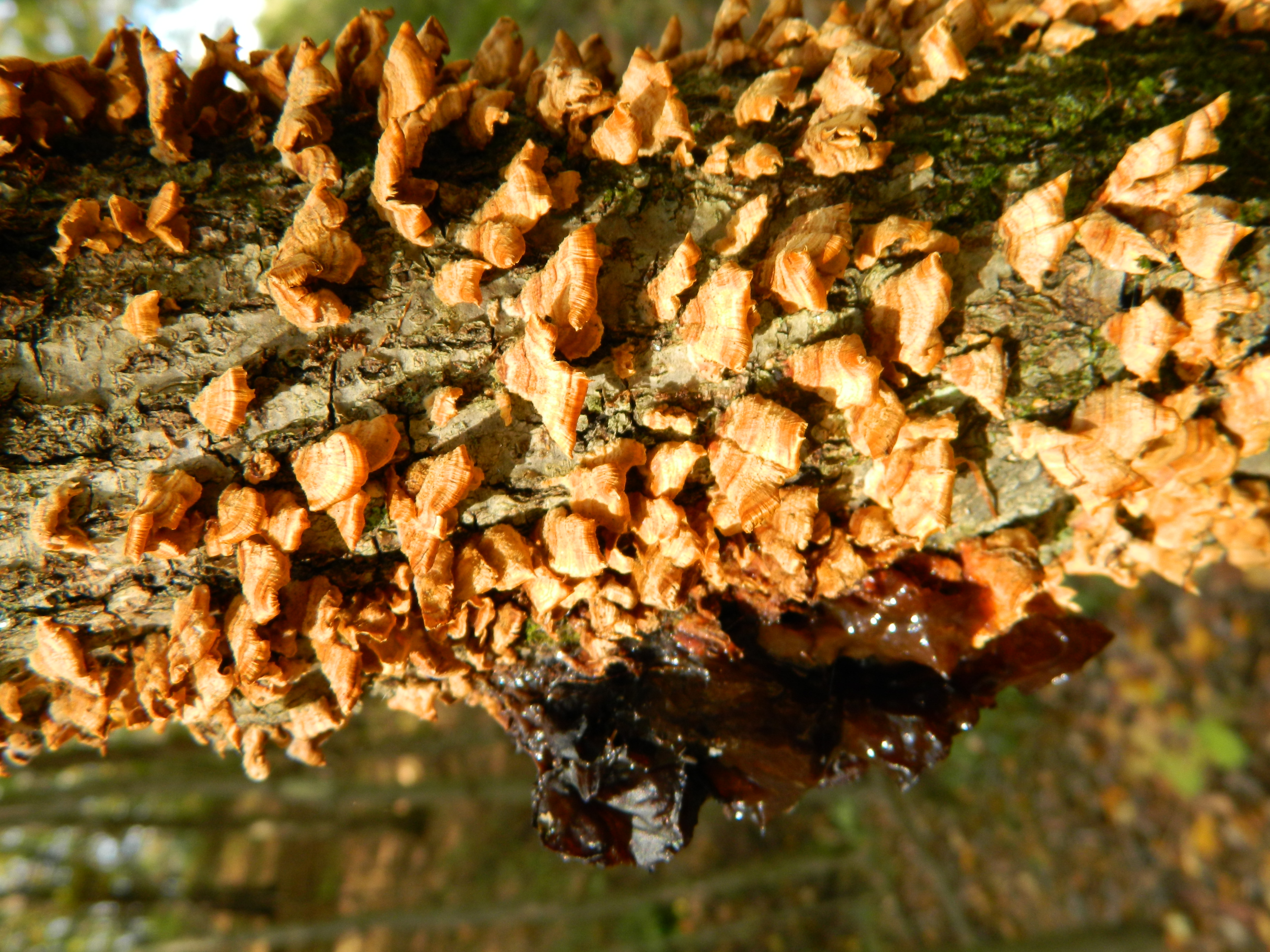
Shelf fungi

These clinging to this tree appear to be shelf fungi.  Shelf fungi don’t have gills and drop spores from the bottom of their fruiting body.  On typical mushrooms, the cap has gills on the underside.  I’m not sure what the blob is on the left of this tree in the photo above, but it reminded me of algae.  This wasn’t the only spot where I spotted two types of structures on one piece of wood or on a tree.  It appears the fungi were thriving right now in the woods.  Perhaps because we had warm temps followed by cool, I’m not sure but I started to enjoy seeing them and my curiosity perked.  I keep seeking out more.

Fuzzy One

Here’s an interesting fuzzy white one I found on a wooden trellis once made to have plants vine up.  It has been sitting in a shady corner with no attention, and the wood has begun to decay.  Right below this white one, I saw several more that looked a bit like oysters as I zoomed up closer with the camera lens. The patterns were rather pretty, repeating down the base of the tree branch.  I wondered if these were shelf fungi too, but not having an expertise in mushrooms, I just keep taking photos and moving along to other sightings.
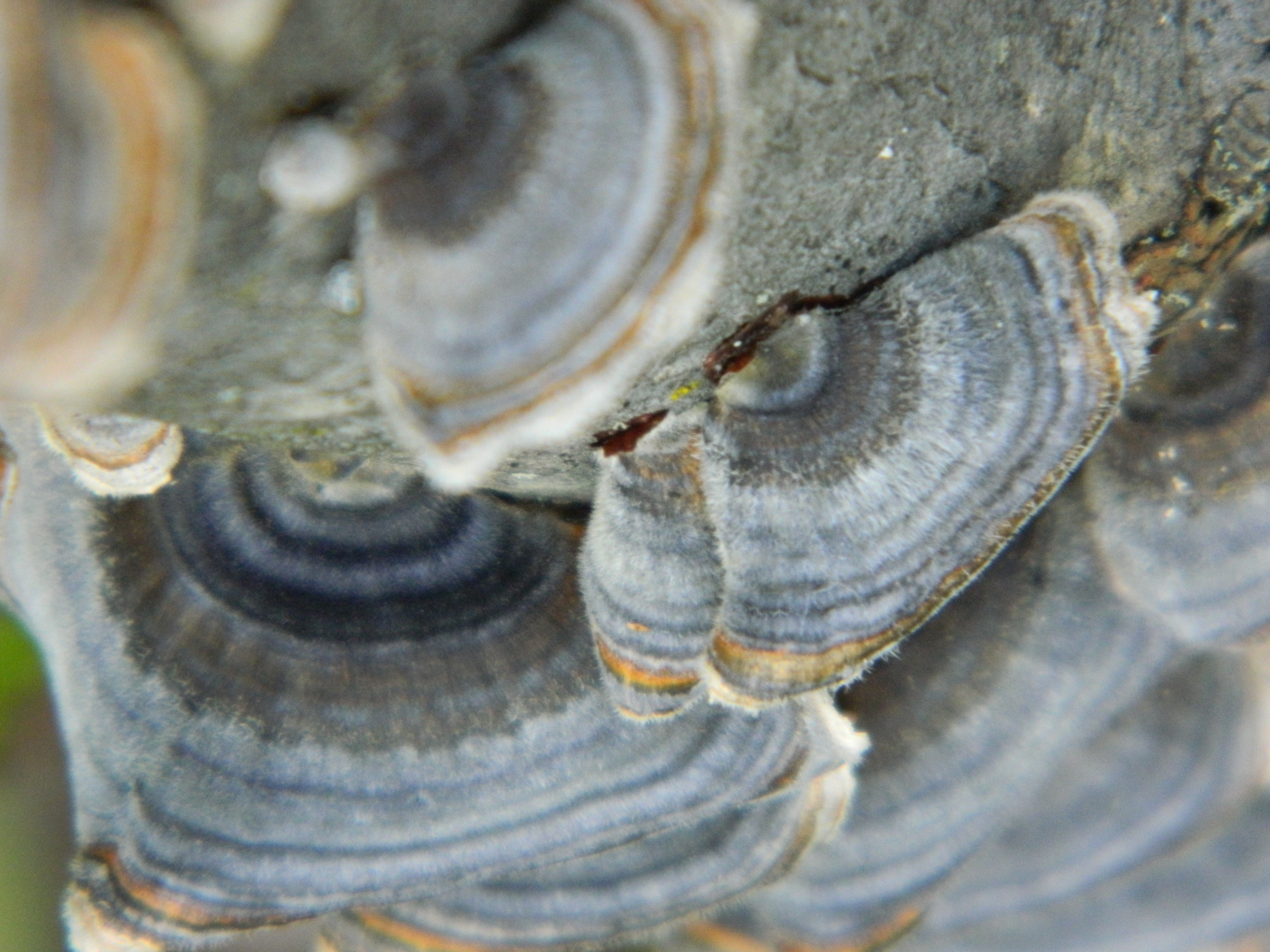
Most folks know fungi are not plants.  They don’t have chlorophyll like plants do, so they can’t harvest sunlight for energy to make their own food.  They grow, live and serve different ways in our environnment.  Some by feeding, getting their nutrients, on decomposing organic matter. Other fungi are parasites, by taking their energy from living plant cells.  And some serve a symbiotic relationship, like the mycorrhizal mushrooms, which penetrate the roots of trees and help the roots by extending filaments around and outward into the soil.  This helps to increase the surface area for the roots, resulting in better absorbtion, and the ability to extract nutrients from the soil.  At the same time, the tree’s roots serve the fungi by giving them needed energy.  They feed off each other in other words.  And this can be a good thing because it helps a tree growing in poor soil to survive.

But as far as humans eating mushrooms, as most know, it is not a good idea to try unless you are an expert at recognizing mushrooms, or you are with a proven expert on your woodland journey.  As for myself, I had no interest whatsoever in eating mushrooms, just photographing them.

When I exited the woods and told my husband I saw lots of mushrooms, he replied with, “Mushrooms scare me.”  I started to laugh, because it sounded comical, as I pictured him running away from a giant mushroom.  But we know he meant many are potent enough to kill or at least make you very ill.

I remember seeing on t.v. last year a guy decided to just eat some mushrooms growing in his yard.  He survived, but he surely regretted the pain and embarrassment.  There are no easy ways to correctly identify poisonous mushrooms other than having a knowledgeable mycologist, a scientist who studies fungi, with you.  But if you happen to encounter someone who does and gets ill, save any remaining pieces and call 911 or head to the emergency room!  Know where the mushroom was growing and it’s features, the size, color, etc.  Hopefully you won’t ever have to do this, but good to know for reference.

I even came across a few puffballs on my way out of the wooded area.  You know the ones found on the ground that are round and when you stomp on them, they puff out a burst of cloudy material – its cloud of spores.  I always did that as a kid, and couldn’t resist the urge to do that again when I spotted those a couple times.  These mushrooms are a species of Schleroderma.  And I saw them more on the lawn parts of my walk versus in the deep, wet woodland areas.

Eventually, I did see some yellow foliage in the woods and took this snapshot from the base of a white birch tree.  There isn’t much color now which is a bit of a disappointment, but then again, maybe I wouldn’t have seen all the fungi feasting in my backyard woodland areas this time of year.

Birch with Yellows Above

Turkey Time – Photo Friday

Leave a comment

It’s turkey time.  This morning, at 7:00 am, I heard the gobble-gobbles of the males chasing the females around the backyard.  Or better said, the males huddled together and showed their stuff, while the females scattered the other direction.  Every year, we have turkeys visiting here in our yard and traveling to the neighbor’s yards too.  I rather enjoy hearing and seeing them.  Plus it entertains my three curious cats.  One cat, appropriately named Hunter, attempts to catch them from time to time with little luck.  So for today’s Photo Friday, I thought I’d share this snapshot I took.  At one point, all six males formed a circle around one female – that poor girl!

Turkey time

Canna Last Blooms

Leave a comment

For today’s Photo Friday, just a quick shot of the canna blooms from within my house.  They are still providing lots of presence and I’m enjoying every last moment – so are the bees!  But it is time to get into fall – pumpkin shoppin’ this weekend!  I want a BIG one or TWO!  Cathy T

Mailbox Plantings

6 Comments

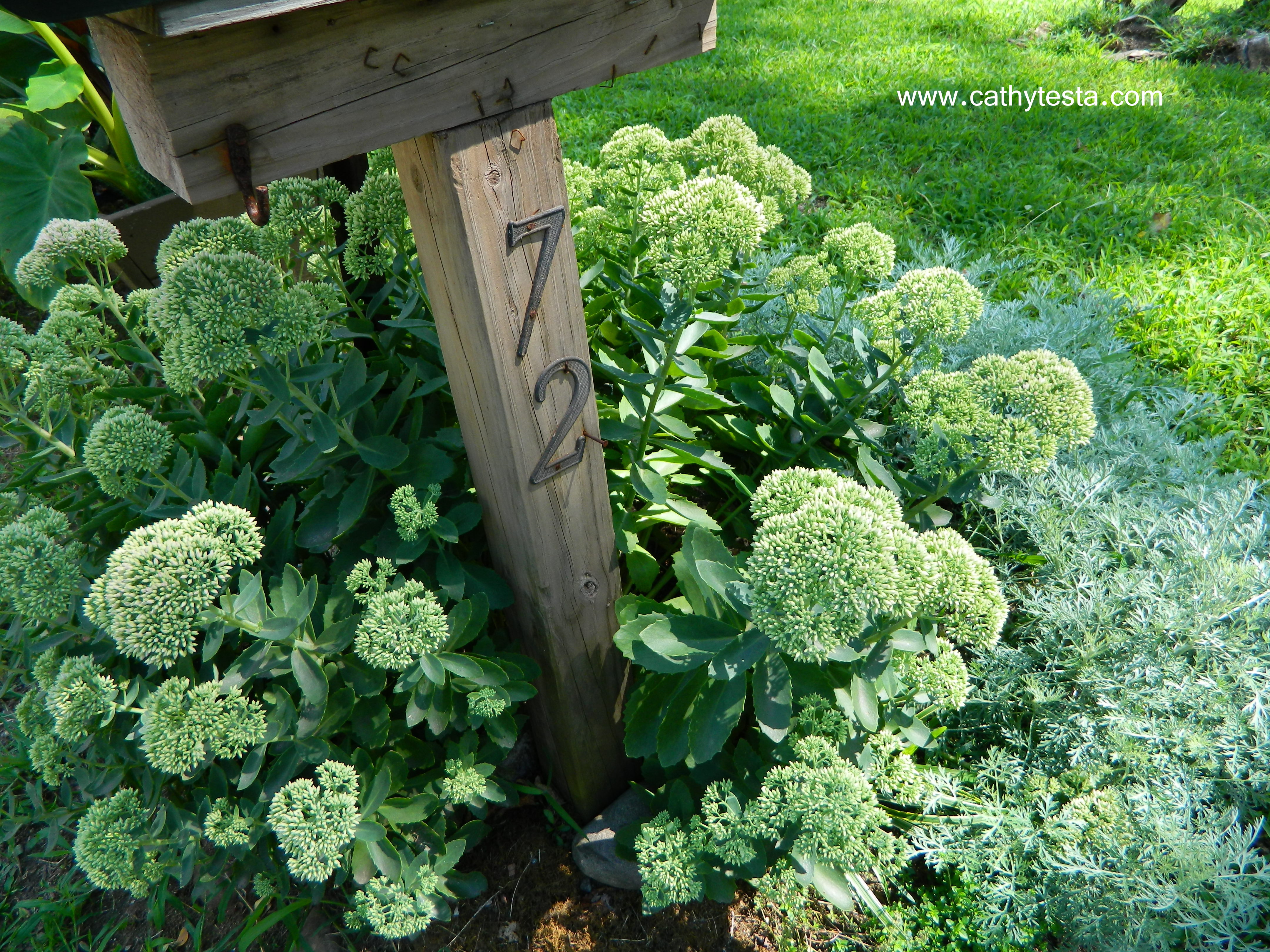
Every year, my Sedum ‘Autumn Joy’ under my mailbox goes gangbusters. I know it is a tough, drought tolerant perennial, but I literally do nothing to this perennial, yet every year, it expands bigger and blooms profusely in the fall. It is quite amazing considering the location where it is growing under my two mailboxes, adjacent to the road side and in full sun most of the day. I sometimes wonder if there is a magic spring deep below in the soil, because I don’t water it at all. My husband says he feels the grass grows a tad bit greener in that area compared to the rest of the lawn in the front yard. So who knows where the magic comes from but I swear the only thing I do to this Sedum is break off the old stems in the early spring from previous season’s growth. I leave it standing there in dry form all winter after the bloom heads turns a coppery color in late fall.

Last year, I added an Artemisia arborescens ‘Powis Castle’ (wormwood) next to this perennial. This perennial is zoned for 6-9, so it is considered a tender perennial in colder climates. A worker in a nursery told me that it wouldn’t come back when I commented that I had planted it with my Sedum, but the plant proved her opinion wrong. It came back in full force this year, and rather than growing into a nice globe or mound shape, it formed a soft, half-moon pattern around the base of my Sedum. Perfect, I think.

A mailbox planting area is similar to planting in a container…without the pot that is. What I mean is it is a small manageable space that can use the ‘thriller-filler-spiller’ method of design, as often used in container gardening. Mailbox areas are often an overlooked space yet it has the potential for dressing up without too much effort – just as containers dress up areas around your home or patio. In fact, any time I complete a design for a landscape client, I throw in a few designs for plantings around their mailbox as a freebie, and it always surprises them.

Behind

Because your mailbox is at the entrance of your driveway, it is often the first thing your guests see. Rather than having an eye-sore greet them, you can incorporate a few plants by using some simple design tips to welcome their arrival.

First, for safety, two tips. Try to not incorporate the super-bee loving flowering plants – for the mailman’s safety and yours. And second, don’t select plants that will overpower or block views as you enter or exit your driveway.

For staying power, remember to select the tougher types of plants – those that can take roadside conditions, perhaps some drought tolerant ones since you probably won’t drag your hose out there. Consider the winter too when road salts or plows can damage the area. Although your perennials are underground in the winter, the soil takes a beating around mailbox areas.

As for design tips, it is important to remember to use different foliage textures, as I did with my Sedum and Artemisia. The Sedum is coarse texture compared to the silvery soft thin foliage texture of the Artemisia plant, for example. And with no blooms at time, the foliage will carry the interest and not harm your mailman.

At this time, a design element missing by my mailbox is something tall. The thriller so to speak – just like in container gardening. Consider planting something that would run up the mailbox post itself as your thriller. Your obvious choices are a perennial or annual vine type plant. If you don’t mind replanting every year, something like a Mandevilla is amazing (and technically a tropical plant), or a black-eyed susan vine (annual), both will flower all summer and grow quickly. You may need to put a mini trellis or some anchors on the post to help it vine up, but it will grow fast and be showy.

If a vine doesn’t suit your style, another option is to add a tall ornamental grass right behind the post, or adjacent to it. Look for the upright,vertical ornamental grasses. Some are very showy up thru the fall season, and some can stay through the winter as a little feature by your mailbox if you so desire. Just make sure it is one that doesn’t grow too large for it will outgrow the area probably. Or use a tall spikey or sword like perennial to add height too to your bed. You want the heights to vary amongst the plantings, just as you do with containers. So the fillers below offer the lower heights with the tall candidate by the post balancing the area, plus can hide the post if it is a older post in need of some disguise.

Then perhaps add more fillers below your mailbox at the base if needed. Choose some low growing plants that hug the ground. This will help reduce any chance of weeds popping into the space, plus this helps to balance the other fillers. One option to consider is Thyme. It is a great low growing, ground-covering herb that is drought tolerant and easy to care for. Many gardeners are using herbs and veggies more in mixed planting beds – it is becoming super popular, heck put a veggie plant by your mailbox and give your mailman a daily snack! LOL.

A before shot

And as for size of the planting area, consider the height and size of your mailbox. Measure the height of the post and make the bed the same length. Sometimes the width is limited based on how close your bed is to the street or a sidewalk. However a single plant or two is better than a boring mailbox in my opinion, so try to work with what you have. Again, the soil type is harsh usually so go for those tough type of plants. If your mailbox area is in the shade, there are tough shade candidates too. Please don’t use fake flowers – one of my pet peeves!

By adding 3 to 5 plants in the right proportion, with various textures and colors, and perennials with staying power that can handle roadside elements, or a super blooming annual vine, you will add just the right touch so that your mailbox is now a welcoming element to your home landscape with minimal maintenance involved. For larger areas around a mailbox area, a few boulders can be useful to balance and ward off any chances of someone crashing into your mailbox.

After mailbox

As for myself, I will just keep enjoying my returning Sedum that hasn’t failed me yet until the day I build a stone planter box around new mailboxes to replace my old ones.  That plan will include incorporating a more showy display around my mailbox planting area. But for now, when I pickup my mail from my mailbox, I’ll look at the plants currently distracting me from the bills in my hand as I walk back to my house. Cathy T

Moonstruck by Acer shirasawanum

Leave a comment

Back in May, my husband, Steve, took a day off from work to go with me to go pick up my plant order from a wholesale business.  I told him that I would like to stop at a particular nursery on the route back to see what they have on display.  I do not visit this nursery often because it is not in my neck of the woods but they usually have some unique ornamental trees and evergreen topiaries.  Steve was happy to oblige as long as we had lunch and he could enjoy a couple cold brews before heading there.  No problem.  We hit up a new restaurant called “Fat and Happy” in the area because the name caught our attention.  The food was excellent.  Our day’s agenda was working out perfectly!

Sure enough, upon arriving to the nursery’s small section of unique trees, I spotted a small maple tree labeled as Acer shirasawanum ‘Microphlylla’ standing among some Japanese maples trees and evergreen specimens. The minute I saw it, I said to Steve, “Oh, I saw a tree like this one in  a book by Tracy Disabato-Aust.  The fall colors of the leaves are wonderful!  I’d love to have this.”  Steve didn’t care much about the book reference (because he is not a plant addict).  He just quickly responded with, “Get it.”  I then joked to the nursery guy helping us that going for ‘brewskies’ before stopping here was starting to pay off.

When I got home and referenced Tracy’s book, “50 High-Impact, Low-Care Garden Plants,” I realized the small maple tree I had admired in her book was a fernleaf fullmoon maple (Acer japonicum ‘Aconitifolium’).  It has deeply cut leaves, resembling a fern with serrated edges – and the photo of its orange-yellow-red fall colors is really stunning.  Plus she notes it is “long-lived, heat and humidity tolerant, cold-hardy, deer-resistant, insect and disease resistant,” and more.   She also lists the paperbark maple (Acer griseum) as a high-impact, low-care plant, which I also love because its cinnamon colored exfoliating bark is quite attractive.  I regret I didn’t purchase one I spotted during a late season sale a couple years back.  I really regret it actually.

  • FYI: If you spot an unusual, healthy, and “on-sale” tree in late summer to early fall, go for it!  Tree planting in the fall is just fine – and you get a deal. It is time to be on the look-out for good sales of trees and perennials at your local nurseries – many are in mark-down mode!).

But back to when I spotted my new Acer shirasawanum ‘Microphylla’ in May.  It wasn’t on sale, but I was glad we got it anyways.  Acer shirasawanum are commonly called fullmoon maples (or full moon maples) and are similar to Acer japonium in looks.  It gets confusing sometimes if you are a non-hort person, and sometimes if you are a hort-person, and sometimes cultivar are misspelled or abbreviated on the tag, such as mine was.  I’ve seen the cultivar name as ‘Microphyllum’ which means small leaved.  Anyhow, it is classified as a shrub in some sources, or some referred to it as a small upright deciduous tree.  To me, it is a small but elegant tree candidate with bright green rounded leaves, joined to present the shape of the moon.  Thus – perhaps – the common naming of it as fullmoon maple!

Whatever the reason for its naming, this small tree is a perfect candidate for a container garden on my deck at home or yours too!  It is small enough for a pot – not too overwhelming, has very attractive leaves, and pretty winged fruit known as samaras with red tinged edges that hang on for a long time as a nice feature, plus fullmoon maples (the straight species, Acer japonicum) are known to be a bit more cold-hardy than Japanese maples, per some references.  Mine is also similar to Acer shirasawanum ‘Aureum’, known as the golden fullmoon maple. ‘Aureum’ has golden yellow leaves that turn orange in the fall.  Everyone is pretty much familiar with Japanese maples, but fullmoon maples, at least from my experience, are not as commonly sold at my local nurseries but they should be – they are just lovely!

Having this small ornament tree on a patio in a container can create a little bit of elevation, adding some structure, or a sense of dimension to your space.  Mine is situated near a low lounge style chair, and as the morning sun hits the leaves, shade patterns are cast on the chair.

When I brought it home, I actually said, aloud, “Welcome to your new home” as I removed it from the worn out nursery pot that day, and replanted into a much larger home, a faux stone container.  I could imagine the tree’s roots awakening to moist, well drained, organic soil in its new dwellings.  It wasn’t long before I could see the leaves perking up in response in a few days, and the stems looking healthier and greener in a few weeks.  These moments of revival made me appreciate nature and the tree more.

A patio umbrella near it provided some shade, as it prefers sun to part-shade conditions. And, as of this writing, in August, the trunk is so much larger.  It has expanded and I can just tell this plant took off and loves its new home.  I was so pleased to give it a new lease on life.  And to have a different candidate among my other container gardens on my deck!  Trees are candidates for container gardening too, don’t overlook them!  Adding trees can really create a new feeling to an area.

I am moonstruck by fullmoon cultivars now, yet the best part is to come in the fall.  The leaves will transform from a bright green to amazing yellow (and maybe some orange and red hues too).  I can’t wait to see this and take a photo.  After that phase, I will have the choice of overwintering it inside (doubtful as I lack space), or placing it into a dormant state in a protected environment, or transplanting into my yard (most probable).  This plant is hardy to USDA zone 5.  Be on the look out for them or other related ornamental maples, and for more information, see these links:

http://www.stonehedgelandscapingco.com/

Recently voted Best Garden Center by New Britain Herald, 2011.  I like their tree offerings, limited supply but usually those I don’t see commonly elsewhere.  I didn’t know they got that vote until I wrote this blog!  How cool!

http://www.tracylive.com/

“50 High-Impact, Low-Care Garden Plants” by Tracy Disabato-Aust, a favorite author and professional designer.  All of the plants in this book I enjoy – and hopefully will acquire those I don’t have yet as I have some of them already – plus the fullmoon now!

http://www.facebook.com/pages/Fat-Happy-Bar-Restaurant/201142036576472

A great new restaurant and bar in Newington, CT.  Check out their offerings!  The funny part of this story is we didn’t realize one of my distant relatives owns this great new restaurant and bar!  Imagine our surprise when we discovered that.  It is lovely inside with lots of tv’s for sports lovers (in case you are not into plants!)

Envied by us all
The leaves of maple
turn so
Beautiful, then fall
—Shiko

Thanks!  Cathy T (www.cathytesta.c0m) of Cathy T’s Landscape Designs – specializing in container gardening, designs of landscapes for DIY’ers, located in Broad Brook, CT.  Comments are welcome!

Photo Friday Bug Landing

Leave a comment

Its Landing Pad

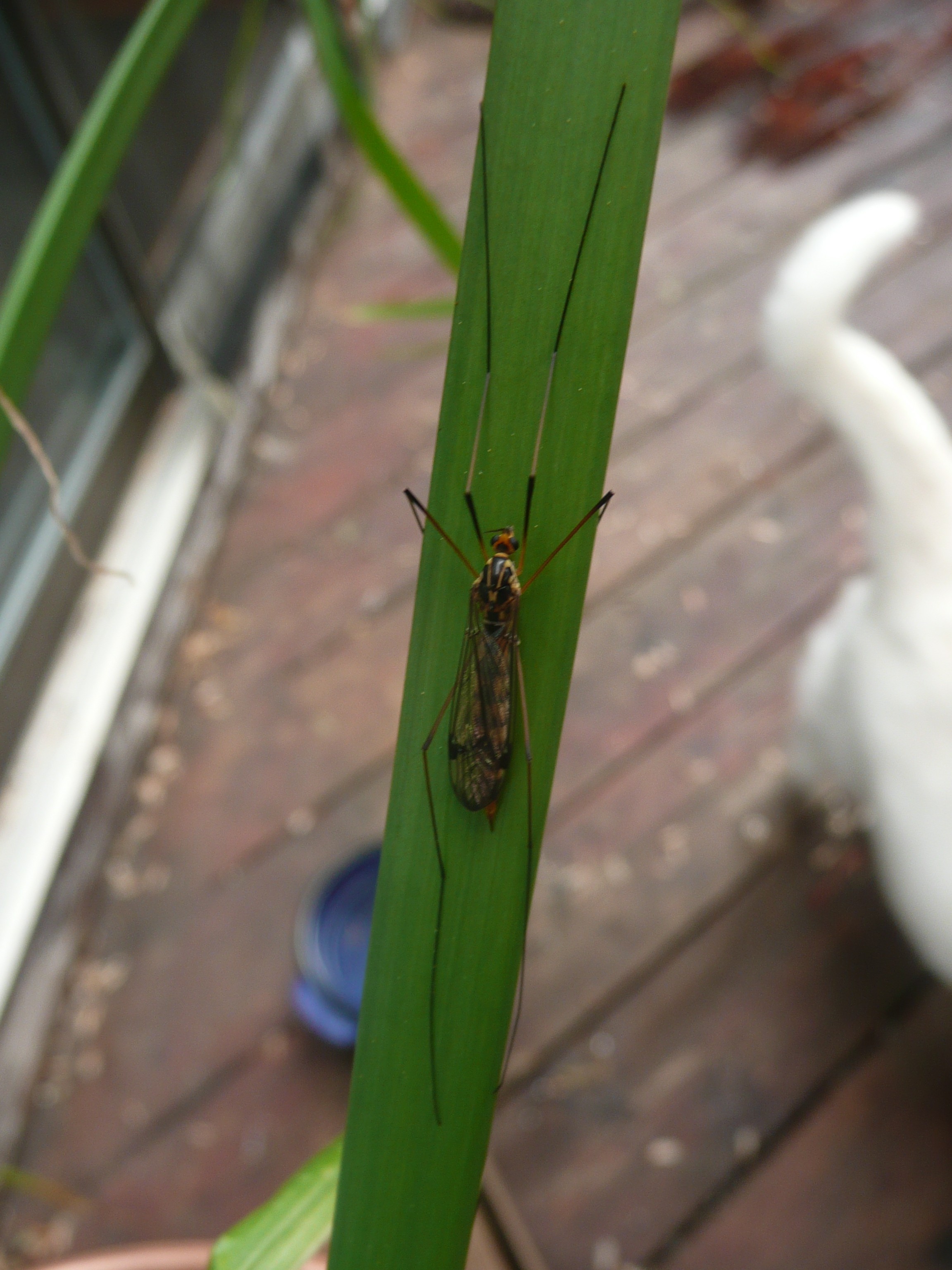
For t0day’s Photo Friday, (which by the way will be on pause until I get a new camera to replace my recently dropped and broken one) is a photo I took about a week ago.  This flying insect, which I don’t know the name of, is one of those big, yucky looking flying bugs you usually see in the evenings that resemble giant mosquitoes.  You know the ones.  They tend to freak me out because they bob around on the ceiling if one happens to get in your house, or suddenly hit a light or window when you least expect it – And ugh! I never want one of those big ugly critters to land on me!   They always fly around as if unable to determine where to land or fly disoriented like they may crash into you.

But this one, that afternoon, had decided to land on the stem of my Cyperus papyrus King Tut umbrella grass plant.  It is funny how this particular insect selected the shape of a stem that was perfectly suited for his long, lanky body with legs of the a longer length.  Notice how he grabbed the edges of the stalk’s flat surface with his front legs wrapped around it.  And it’s other front legs are laying above his body on the stalk.  But I discovered as a researched more this may not have been the only reason for its selection of the Cyperus plant.

The plant he chose is a water lover.  It can sit in a container with water, as mine is at home. And not shown here, the plant also has very interesting leaves which sprout from the tip of its upright, tall, and firm stems.  The leaves look like umbrellas on the top.  It is grown as an annual here in CT, but it can be overwintered as a house plant if desired for continued enjoyment and use.  At the moment of this photo however, it was being used by the insect as a little habitiat where the insect seemed pleased to rest for a bit.  But then I discovered this insect, probably a Crane Fly, tends to frequent water plants.  So there you go.  He likes this plant for that reason as well.  And thankfully, crane flies don’t bite like mosquitoes do.  My fear of them started to subside even more.

Ok, so that day, when I had quickly grabbed my camera to zoom in closely, sddenly, I noticed the beauty of this insect’s design for the first time.  It’s patterns, his eyes on an orange colored head, and coloring on his back is kind of neat, geometric black, and well, actually somewhat cool so long as it isn’t bobbin over my head unexpectedly.  Fortunately, he stayed put as I took a couple snapshots. He was waiting for take off and seemed quiet for the quick photo shoot.  So this is the one for today’s Photo Friday!  🙂 Cathy T

Perusing Industry Mags

Leave a comment

Yesterday I was at my hairdresser’s appointment and I brought along a garden related trade magazine to read while waiting.  As I have mentioned in the past, I love reading these types of mags for people in the hort trade as research where I can check-out different trends, learn about marketing information, and be informed of new plants on the scene.  I envy the people who travel the world to report on these things for a living, and wish I had that job!

So I thought, let me share with my audience, primarily my gardening friends and landscape and container gardening clients, a few items which caught my attention as I think you would find them interesting too – plus you don’t have this magazine on your coffee table and I do!  So here it goes…

First was a full page ad regarding indoor and outdoor glazed pots and all weather black clay.  (Hmmm, if I had a store, I’d order these up to sell.)  But what caught my eye the most in the ad, to be honest, was the woman squatting next to the containers with plants, soil on the table, situated in a hobby type greenhouse, and the huge smile on her happy face.  Her bright eyes and the whole scene said to me…, have fun like me potting up plants.  In fact, the pots themselves were not super eye catching but the picture portrayed inspired the reader, at least in my opinion, to want to be her or do what she was doing. Which I am, but anyhow, good ad there.

Second was an article about tropical plants and their growing popularity.  It indicated that garden centers are adding more of these to their line-up because “customers are looking for new buying experiences.”  (Hmmm, I thought – tropical and succulents are always on my list for my Container Garden Parties, especially this year – These types of plants were my main focus for a June garden show I participated in.) I selected tropical plants and succulents for so many reasons.  They thrive in our humid heat during the summer, they don’t get many insect problems, they grow super large fast, some are very drought tolerant, and most are showy in containers with other pairings.  Plus many can be moved indoors at the end of the season (providing you have the space and sunny windows), or be overwintered.  The key is they are “different” from the typical stuff you see in the garden centers.  Everyone loved the unique succulents I offered this year in my mix.  And as a service, I teach my clients how to overwinter their tropicals for use every season going forward!

Third that caught my attention, as I flipped the pages, was an ad for a debris sack that you attach to your waist with a belt while gardening.  I thought my fellow Master Gardener friends, who perform garden maintenance daily as a living, would probably like this idea.  It allows you to just drop your pruned cuttings into the sack and it could serve to hold a few tools as well.  It was nice looking and not too heavy either.  It was just a glimpse and a pause on that item as I flipped the pages further.

The next item made me chuckle out loud. Would this have ever helped us in class when trying to learn how to identify trees via leaves?!  It was a paragraph describing a new iPhone app that recognizes leaves.  It is free and available via iTunes, and uses visual recognition software from photographs.  I will look forward to checking out this app when it becomes is available for the iPad.  However, I questioned how well it would function.  Some of the differences in leaf configuration require a keen eye and many parts can look a bit similar.  A petiole, for example, the leaf stalk, is so similar and small, but where it is position on the stem determines a leaf’s morphology, whether it is simple or compound.  But general leaf shapes and venation (vein patterns) can be distinct to the naked eye, however the leaf margins vary and there are many types out there from serrated to doubly serrated to dentate, to crenate to incised, to ….okay I did have to pull out my Dirr book to remember all of these.  The point is, yah an app would be fun to use, but I’m not sure it could correctly identify every leaf every time, but for a newbie; this could be a helpful tool to narrow down your choices as you learn to become a tree expert. 

Next, a quick paragraph stating that an ‘unkempt yard in close proximity to your home may reduce the value of your home by as much as 15 percent.’  Not surprising.  Good landscaping, curb-appeal, and general maintenance of your landscape will aid the overall value of the neighborhood and your home.  But one eye sore next door would reduce the sale of a home…potentially, or maybe that is a “for sure”.  Fortunately, strategic landscaping, when well done and placed, can hide eye-sores next door.  A believe me – this was a request more than you would imagine when I worked at a garden center.  Many people requested a “green wall” for more reasons than one.  What to do if your neighbor has a very messy yard?  Well, confrontation doesn’t always work and leads to more problems, yet a strategically placed beautiful landscape can do the trick and make everyone happy!   

Next -> Branding.  I read a portion of a branding article regarding why branding of plants is still beneficial to the consumer.  Basically think of Proven Winners, American Beauties, Endless Summer, Jeepers Creepers, Monrovia, Sara Superb Herbs, and Knock Out as examples of commonly seen brands in our local nurseries.  The idea is the plants behind the brand have met a certain level of standards, whether it is a consistent level of quality or performance.  Branding may give some gardeners a sense of assurance they are buying a good product – and not wasting their dollars.  However, I have some mixed feelings on brands.  You need to always look over the plant and make sure it is healthy regardless of the brand, but a brand alone doesn’t guarantee a plant’s success in your garden.  It is your care, placement in the right place, and sometimes luck.  I’m not saying I don’t’ believe in brands.  I recommend many of them in my designs, especially for new gardeners, because brands can help them start off on the right foot due to their tested and proven success.  Many branded plants also accompany their plants with a wealth of information on their plants tags or on the pots.  The pots themselves are actually excellent packaging (good decent sized pots (usually), large root systems, good soil, and also eye-catching colors on the pots).  The branders take excellent care up to the day their plants are delivered to nurseries for sale.  Sometimes branders offer a staging area or shelving systems to help the nurseries keep the plants well organized and displayed.  This usually leads to good care at the nursery too.  And brands are easy to spot in garden centers.  You usually see them right away due to their brightly colored pots which you begin to recognize. 

And I read also that…’garden spending drops, but competition between retailers remains strong’.  This is something I have been observing this year.  In fact, during my weekend vacation, I made the comment to my husband that all of the nurseries in our local area have grown this year.  Some may be due to the damage done by our prior winter heavy snowfall where some greenhouse structures were badly damaged, so they were rebuilt this year.  But many garden centers have expanded in general with new additions or areas to cover more acres at their centers.  And many have advertised even more this season.  I see more deals, coupon offerings, two-for-one’s, etc. 

But I do know this– gardeners shop at all or most available places usually.  They may have their favorite nurseries, but most plant-lovin’ consumers don’t just buy at one place anyways, they love to garden, they love to garden-shop, and this equals shopping around.  They return if they are treated with respect, see new items, get inspired and informed.  And they often shop around if they feel they can get a better deal or service elsewhere.  But overall, there are lots of choices for gardeners, and I personally think this is a great thing!  Along with all the cool research and marketing efforts that keep us happy in the garden and with our plant choices!  Cathy T

Plan to plan but plan it will not go according to plan!

Leave a comment

I’ve moved, coddled, removed, picked up, put down, adjusted, admired, panicked, laughed, contemplated, created, imagined, thanked, cursed….  From wet to cool, to hot and sunburt, to sweaty and sticky, to throw on a sweatshirt suddenly it is cold, to wow, look at that sun, to look at those dark clouds, to OMG, a tornado in Springfield, to “what there could be hail on the way?”…to OMG is my husband okay coming back through Massachusettes?!  To move, coddle, pick up, put down, push, bring back, adjust, water, pinch, smile, create, enjoy and then surprises, what tv in two days, OK!  Back to the nursery, find the best of the best, create, smile, admire, oh a hummingbird, OMG.  So pretty, voom by my head.  Oh hello butterfly, you are so pretty…oh butterfly, you are injured 😦 darn cat, stop that.  A deer in the back, you stay back, don’t come hear, it is too near, my prized possession, my plants, my blooms, and my patience!  New admiration for growers, nurserymen/women, and anyone who creates their art in the great and not so great outdoors.  Respect for mentors and helpers coming stepping out of the woodwork. This, perhaps, is a test – a trial run to a future little store, I don’t know, but it is worth it. 🙂  Cathy T

Yawn about Lawns

Leave a comment

When I went to UCONN for my horticulture studies, I included a course on turfgrass science and management in my curriculum because I thought I should know something about lawns.  However, I find grass extremely boring.  Trying to decipher the different varieties by examining each blade was painful. You don’t even want to know what a ligule is!  They all looked the same to me.

As a non-traditional student (a polite way of meaning older than the rest of them), I was completely different from the typical student in this class. My turf classroom was filled with ambitious young guys with clean-cut haircuts and sharp-edged baseball hats.  All had hopes of maintaining the golf courses of their dreams.  A very rewarding career choice indeed.  I knew this was not my tribe but they were fun to be around, treated me with kindness, and were serious about their turfgrass studies.

Today we are seeing more and more lawns being replaced by low-maintenance ground covers.  This is good news in my book.  Partly because I enjoy other plants more than grass.  And because lawns can be highly intensive for care, requiring routine mowings, fertilizer (usually over fertilization not always needed) and time (taken away from more fun summer activities), especially if you are looking to achieve perfection. 

For homeowners who absolutely adore a green lush lawn, the effort is worth it to them, and I get that – somewhat. It adds curb-appeal to the landscape, can increase the value to a home, and is a source of pride for some — but still – it should be done with thought and some good planning. 

Lawns don’t have to be all that time-consuming to look good, or I should say, “good enough.”  Unlike golf courses, which require a high level of care to achieve smooth putting surfaces, lawns don’t have to be flawless if you are willing to practice acceptance.

My husband, Steve, and I are not big into the perfect green lawn look.  Our yard is roughly 6.5 acres so to manage it that intensely is kind of overwhelming.  Steve’s comment is, “If it grows, it mows!”  And years ago, he meant that as he mowed some of my perennials down.  It took some coaching but he eventually learned to not do that again, or to hit my precious trees with his huge five foot wide mower attached to his tractor. 

Right now, as I look out my window, our lawn looks awful.  But as soon as it greens up a bit, and Steve’s first mow is done, it will be decent enough for us.  We ignore the weeds, not bothering with chemicals to kill them.  We turn a blind eye to the crabgrass or dandelions.  In autumn, we don’t bother to rake up our leaves either.  Steve mows them into bits, and I let him know he is doing the right thing.  This practice returns nutrients to the soil.   Our non-desire to make a perfect lawn ends up being helpful to our environment too.  Our home is surrounded by wetlands leading to a river and some streams.  No worries about fertilizer run-off here. 

Other people who want perfection will start right about now, in early spring, to consider how to improve their lawns as warmer temperatures approach.  As they walk around picking up debris from the winter, some homeowners start to ponder the dream of achieving a perfect green lawn.  One non-intensive practice is to follow the recommendation of not removing more than one-third of the grass blades per mow.  And allow the grass clippings to return to the lawn, just like we do with our fall leaves.  “Small” clippings help return some nutrients to your soils.  Every “little bit” helps to reduce the reliance on fertilizers, which can be a problem to our environment when overused or unnecessarily applied. 

Another good non-intensive tip is to not apply fertilizer to your lawns until you do a soil test through your Cooperative Extension program.  If you haven’t tested your soil in the past, give it a try.  In CT, you can go through UCONN’s Soil Lab in Storrs, CT.  You dig a sample, bag it and mail it.  It is that easy, and costs only $8 bucks.  You can have it tested anytime the ground is not frozen.  Just go to this link to learn how to, complete with details: http://www.soiltest.uconn.edu/factsheets/HomeGrounds.pdf . The test results mailed back to you will help you decide the amount of fertilizer needed, or if you need limestone added to correct or adjust your soil’s pH.  

The soil’s pH must be at the proper level to take up nutrients, and when it’s too high or too low, microorganisms that break down organic matter are less active.  Some people think limestone (made by grinding limestone rock into fine powder) is primarily a fertilizer, but its main purpose is to raise the pH if it is too low so that the nutrients you add will work.  When the pH is off, nutrients are not doing much good to your soil because they become “locked up”.  Appropriate pH holds the key to releasing them.  Lime does give some plant nutrients if it has calcium and magnesium, which many sources do.  Overall, it is important to realize different plants need different pH levels to enjoy the best of the nutrients you apply. Most turfgrasses grow well in a soil with a pH of 6.0 and 7.0. 

In addition to soil testing, the UCONN site is an excellent resource on many topics on soil fertility.  There are excellent Fact Sheets on Home Composting, Fertilizing House Plants, Lead in Garden Soils, Compost Tea, and many other related topics.  In fact, during my studies, I worked at the lab for a short time where I met Dawn Pettinelli.  She is the manager on-site and a soil expert.  She is amazingly well-versed in the subject and often writes articles for various publications.  I did very little time there, sifting soil samples, running them through a process for testing, and getting an idea about soil overall.  Ironically, I loved looking at soil samples, seeing the texture of silt, clay and sand, and the colors of different soil samples sent to the lab was interesting to me. 

Soil testing is one of the most important steps you can take if you want to apply the right amount of fertilizer at the right time.  This holds true for gardens too, doing a soil test enables you to enhance the soil appropriately especially if you find your plants are not doing well or constantly suffering, or when establishing a brand new garden bed. 

And if you want to say even more time, be sure to add some organic matter to the ground before you seed a brand new lawn.  This will improve the plants success and give it a boost upfront.  Then once established, only you can decide of you want to go for the best look or accept it as is.  Since I tend to yawn about lawns, I’ll stick with the latter.  Cathy T

Colocasia esculenta ‘Mojito’ (Elephant Ear)

Leave a comment

Wine & Beer Tasting Event

This past Friday evening, I participated in a “Think Spring – Wine & Beer Event” at a local business in my town hosted by Joe’s Fine Wine & Spirits and the Golden Gavel Auction House in Broad Brook to help the United Way…and also to get everyone into spring!  There were many people from a local corporation in attendance plus many who showed up as a result of seeing my announcements on Facebook last week.  Landmark wines was the featured wine created by the great-granddaughter of John Deere tractors, and there were many other selections from organic wine types to brews of many flavors!  It was a great kickoff to our daylight savings weekend.

My garden and landscape service offerings were showcased along with displayed container gardens using wine boxes and beer crates on stands to give inspiration.  I truly enjoyed putting my first plant combinations together to kick off the season using plants like Tete-A-Tete Narcissus, Kalanchoe Desert Rose, Oxalis (known as Shamrocks), Mijito Mint, and stunning Cyclamen with deep rich burgundy colored blooms, and even upright rosemary I was surprised to see so early at the nursery, plus many more.  The plants are beginning to arrive, and I can’t wait to see more.

The sun started to shine earlier that afternoon as I placed my designed container arrangements outside (briefly) to capture some photos.  Spring is in the air and soon the temperatures will warm enough to get our spring plantings started.  I was very excited to be part of an event that provided folks with information to get them into the new planting season after a rough winter of snow.  However, I fully realized it may be a tad difficult to capture the audience’s attention away from their wonderful ‘sipping’ and ‘tastings’ of the many wine and beer selections that evening, so I thought how fun it would be to offer a list of plants with cultivar names coined from wines, spirits, and other libations! 

Take Weigela ‘Wine & Roses’ for example, or Hibiscus moscheutos ‘Pinot Grigio’.  Or my newest favorite on the scene, an elephant ear with green leaves showing off dark purple flecks that provides a wild pattern on a three-foot high plant for tropical lovers, called Colocasia ‘Mojito’.  It is stunning! 

There are more plants with libations coming out on the market – and I think it is fun, as fun as tasting varieties of vino! These ‘earthy spirits’, as I called them that evening, are available in the gardening world market place today.  

It is not surprising growers or hybridizers sometimes use cocktail themed cultivar names for some have features resemble the flavors and ingredients of spirits.  Here’s a sample of the plants I discussed with those who visited me between refreshments on Friday:

EARTHY SPIRITS:

Weigela ‘Wine and Roses’:  One of the most popular and easy to grow deciduous shrubs.  Beautiful, glossy, burgundy-purple foliage accented by hot pink-rose colored flowers in spring.  PHS Award Winner.  Grows to 4-5’ h x w.  Looks great with a backdrop of a white fence!  Very popular and well-known among the community of gardeners.  I haven’t heard any complaints about this shrub.  Love the dark foliage contrast.

Physocarpus opulifolius ‘Seward’ SUMMER WINE (Ninebark):  Heavenly choice with fine, deeply cut, dark crimson-red leaves covering this compact delight and accented by pinkish-white, button-like flowers in summer.  Reaches 5-6’ h & w.  Look for it by Proven Winners!  Blooms May-June.  This shrub’s leaves look great when the sun hits them, place appropriately!  Look for a place where the western sun hits the shrub as it goes down so you can see it shimmer during your summer afternoons.

Hibiscus moscheutos ‘Pinot Grigio’ (Rose Mallow): Huge snowy white flowers with a touch of pink in the center and along the outer edge.  Well-branched plant, 30” for full to part sun.  Also see ‘Pinot Noir’ with large red blooms on a compact, sturdy plant.  Free flowering at 30” too!  And finally ‘Grenache’ with true pink flowers and big blooms!  A cocktail of Rose Mallows!  Wonderful container plants.  Provides that big punch to a combination of plants.

Alcea ‘Crème de Cassis’ (Hollyhock):  NEW on the scene, semi-double and single, two toned blooms white with raspberry highlights!  Make a stunning addition to the summer garden.  Grows up to 6’ H and enjoys the full sun.  Cottage garden style, tall and showy!  Many whom visited my booth and saw this plant flash on the iPad slide show made comments of how pretty this plant is!  I agree.

Geum ‘Double Bloody Mary’:  Double red flowers. Grown for attractive hairy foliage and long blooming cheerful flowers in summer. Saucer shaped flowers are held high above foliage on long erect stems.  A full sun lover.  Drought tolerant too and great for curing a hangover! 

Colocasia esculenta ‘Mojito’ (Elephant Ear):  NEW on the scene, tropical style plant with amazing, medium green leaves with dark purple flecks for a cool, tropical delight!  3’ H for zone 8 and full sun to part-sun conditions!  Have fun with this plant in a container garden on your outdoor patio this upcoming season! Watch the ear-leaves bob in the wind and enjoy the wild pattern on the leaves as you enjoy your Mojito drink!

Heuchera ‘Pinot Gris’ (Coral Bells): NEW!  Ginger colored leaves topped with a silvery overlay and deep purple undersides mature to rosy pink with almost black veining and with creamy flowers in summer.  A shade perennial.  Look for ‘Beaujolais’ too, also new, with burgundy leaves and a touch of silver!  Low mound shape, interesting foliage. Heucheras practically come in every color and many patterns, it is a very usable plant when seeking a foliage color impact to combinations.

Ligularia ‘Osiris Café Noir’:  Beautiful, thick, serrated leaves in an assortment of colors – olive green, black, purple, bronze, and yellow blooms in summer.  14” height with 20” wide, a large showy foliage plant with tall flowers, for part-sun to shade.  One of my favorite perennials, can’t wait to see this new one!  Great large foliage type plant because of the huge leaves.  I love Ligularias!

Phlox ‘Pina Colada’ (Garden Phlox): Pure white flowers covering this compact darling in summer.  It is great for your gardens and containers for full sun.  A great perennial for summer.  And wonderful with your cool icy cocktails!  Add it to your Phlox collection as you talk plants and cocktails at your next entertaining event!

Papaver nudicaule ‘Champagne Bubbles’ (Poppy): Iceland Poppies are short-lived perennials coming back year after year from its self-sowing seeds. They bear large satiny flowers for weeks on end, beginning in late spring. This one features a range of pastel shades and bicolor, with especially large blooms. As classy as a tall glass of sparkling champagne!

Beer Box

So as you sip your cocktails during the summer months soon to come on your patio, deck, or by your beautiful gardens, you may want to consider incorporating some of these next on your tastings list!   Just google by the latin name to find images on the web, or see me this year for my showings of selections at Cathy T’s Container Parties!  Cathy T