Daylight Savings Time Begins on the First Sunday of Lent

6 Comments
Newport, RI 2013

Newport, RI 2013

Don’t forget to set your clocks to “Spring Ahead” on Sunday, March 9th 2014, when daylight savings time begins.

Spring Ahead_0004

About the Photos

These photos were taken by me with my iPad at a wedding in Newport, RI last summer. The scenery was absolutely stunning.  It was not only a sunny day, but very windy especially with the ocean breezes.

As we witnessed the happy couple getting married, I questioned how the beautiful vases filled with flowers would stay in place, wondering if their florist secured the base of the vases somehow to hold them onto the pillars.

Photo by Cathy Testa

Photo by Cathy Testa

Sure enough, after the “I Do’s” and all the wedding guests went to the reception building, the vase of flowers toppled over right after taking photos.  Fortunately, I was there to tell the staff, and they picked them back up to bring inside.

About the Blue Flowers

Delphiniums are the blue flowers in the vase.

Seeing them at this wedding brought back memories – as this is one of my fav’s.

Take notice the florist used flowers with orange blooms in the vase, a color opposite to blue on the color wheel (a complementary).  And soft oranges were used.  The Delphinium’s blooms were a soft blue with white centers.  The backdrop of a bright blue sky really made this vase amazing at the wedding.

The flowers are extremely showy on tall spikes (or racemes), usually blue.

Delphiniums also come in other colors such as white, violet, pink or red, and yellow.  It is a tall erect plant with heights of 4 to 6 feet and will bloom early to midsummer in full sun.

  • Steven M. Still writes in “The Manual of Herbaceous Ornamental Plants”:Delphinium is derived from the Greek word delphis, dolphin, and refers to the flower buds before they expand, which resemble dolphins.

At my wedding

Blue Delphiniums in My Wedding Bouquet

Blue Delphiniums in My Wedding Bouquet

I remembered looking over a book of potential cut flowers with a florist (a mom of a good friend) and seeing Delphinium blooms for the first time when I was picking out my own wedding bouquet years ago. I pointed to them to ask what they were. They were my first pick and I still love them today.

We included them in ceramic swans my mother had made for our head table.

scan0002


When we got our first home, I planted a stand of Delphiniums in my first little perennial garden too.  As each tall stalk of blooms would pop open, it would remind me of my special day years ago, but my Delphiniums did not remain long in the garden.

They are the type of perennials which are a little more picky, preferring a slightly alkaline, organic soil with high fertilization, and they should be protected from windy locations in the garden as well due to their tall stalks.  Some references say they are not difficult to grow, but just need a little bit more attention than easier to grow perennials.

Have you grown them?  How successful has your’s been in your gardens?

To learn more about an absolutely beautiful perennial with showy blooms for the garden or weddings, see this document by Iowa State University:

RG306

Happy Thursday Everyone, Cathy T

Plant Details:

Native to Europe
Perennial
Hardiness: Zones 3-7
Early to midsummer bloom period
Tall habit, full sun, moist well-drained, rich soils
Slightly alkaline pH
Slugs visit/like
Protect from wind in the garden – or in a vase! (Some varieties require staking).

http://www.perennials.com/plants/delphinium-connecticut-yankees.html

Link above to Connecticut Yankee Delphiniums which grow to about 3 feet and branching habit.

Juncus effusus is a Low-Maintenance and Highly Versatile Plant – And it looks like Chives!

5 Comments

Common rush or soft rush (Juncus effusus) is a grass-like plant which resembles the foliage of chives with dark green cylindrical stems and a vase-shaped habit.  Although its green stems appear stiff, they are soft to the touch. The plant grows from a clump at the base and each green stem grows up to pointy tapered tips.  Because the plant has a strong dark green color and a vase-shaped upright habit, it is a nice thriller in a container garden or a sharp accent in a garden bed.

Photo by Simon Howden, Freedigitalimages.net

Chives, similar to the look of Juncus effusus is shown blooming purple flowers along a garden path with dark green spiky foliage.  [Photo by Simon Howden, Freedigitalimages.net]

Easy to Grow in Versatile Conditions

This plant is also very easy to grow, experiences little to no disease or insect problems, and is flexible with its soil conditions.  It can take moist, wet, sometimes dry, and difficult areas.  It won’t flop, bend, or topple over as it matures, even when it is sticking out of water or snow.  It’s adaptable to many conditions, making it easily-useful in the garden or in a container garden.

Juncus in water and snow [Photo left by Christian Fischer Wikimedia; Photo right by Cathy Testa]

Juncus in shallow water.  Juncus poking out of the snow  [Photo left by Christian Fischer Wikimedia]

For years, I assumed Juncus effusus (common rush or soft rush) was an annual plant and used it commonly in container gardens or patio pots during the summer, but seeing it return in a garden bed one year, I later realized my error.  As I searched for the plant’s origin and genus, it was interesting to see how it is described by different references on the web and in some gardening books, as follows:

  1. A clump forming wetland plant
  2. A slow-spreading, clump forming, grass-like perennial
  3. A plant loosely referred to as an ornamental grass
  4. A rush from the plant family Juncaceae
  5. A useful solution for wet-moist-sometimes-dry landscapes
  6. A species which is mostly perennial, rarely annual
  7. A warm-season grass
  8. A cosmopolitan rush species
  9. An annual, perennial herb, general from rhizomes
  10. A grass-like, rhizomatous perennial
  11. A perennial wetland plant

It is indeed a plant in the Juncaceous (rush) family, and it’s a monocotyledonous plant, which means it has a single cotyledon in the seed as in grasses.  It looks more like a grass than an herbaceous ornamental perennial, but it is perennial for it returns every year. Although it can be described as a type of ornamental grass, it is technically not classified as such. My favorite description spotted on the web for this plant has to be # 8 listed above: A cosmopolitan (Watch out, Vogue).  However, this term means its range extends across all of most of the world in appropriate habitats.

Stiff Stems are Soft to the Touch

The foliage on Juncus effusus (common rush, soft rush) is made up of individual leafless stems grouped together growing from a clumped base.  Because the stems stand firmly together, the plant won’t flop over as it grows larger.  Unlike typical ornamental grasses, it doesn’t tend to sway in the wind easily or become scraggly looking over time.  Adjacent plants in a mixed garden bed or container garden won’t be buried by it either.  Its spikey form is bold looking, tough, and vertical.

It has a Nice Effect in Containers and Garden Beds

Stored pot will return Juncus effusus each season

Stored pot will return Juncus effusus each season

From a designer’s point of view, this plant makes a nice effect in a composition of mixed plants because of its shape and habit, serving as a nice thriller in containers elevating an arrangement, or as a center focal point in gardens, especially when placed near a lighter green color or bolder leaf texture.  Perhaps it can even be massed or grouped in landscapes to help with soil erosion or as an alternative to turf grass in select areas with the right exposure (sun is preferred).

And, as mentioned above, Juncus effusus (common rush, soft rush) prefers moist-sometimes dry landscapes. And this particular variety is a dark green color, which remains dark green during the season but eventually turns a muted brown in the fall and winter.  It will remain standing during the winter months and the stems’ pointy tips will poke out of a snow covered area without bending or breaking, adding interest in the winter months.

Summer Flowering is More Interesting than Showy

Juncus flowering [Photo by Frank Vincentz Wikipedia Commons]

Juncus flowering [Photo by Frank Vincentz Wikipedia Commons]

It flowers in summer (typically around June), but rather than shooting out flowers from the top, the flowers seem to extend from the sides of the stems opening up like a side curtain.  Unlike the purple balls of chive’s flowers, this plant’s yellowish flowers are not super-attractive, but they still add character to the plant in summer.  The flowers are clustered together in batches, and turn a bit brownish later in the season as they mature.  They are the type of flowers which are more interesting to look at than showy or floral.

For Water Gardens and Low-Wetlands

Photo Christian Fischer, Wikipedia; See Attributions Below

Photo Christian Fischer, Wikipedia; See Attributions Below

Because of its flexible nature in regards to soil conditions, this is a great candidate for water gardens in decorative pots, or in low wet areas in your landscape.  It is also a great choice for rain gardens which fill up with water during a rainfall, but then later dry out when there is no rain occurring.  Another benefit to using it container gardens is this will control its potentially spreading roots (rhizomatous in nature), so it can be also used as a “troublemaker turned star” plant.  However, although it can spread under ideal conditions in the landscape, mine has not caused any sneak appearances elsewhere as of yet.  Besides an occasional watering with the hose in the summer, my plant has been growing well in dry-sometimes “wet” soil, a little opposite to description # 5 above.

Curly Cultivars with Twists and Turns

Not only is Juncus effusus (common or soft rush) a plant with formal looking, straight v-shaped look, there are also cultivars with more funky foliage traits, such as J. effusus ‘Frenzy’ (variegated corkscrew rush), J. effusus ‘Unicorn’ (giant spiral rush), and also J. effusus ‘Spiralis’ (corkscrew rush).  Unlike their upright cousins, the foliage on these varieties bear stems with twists and turns, resembling untamed curls in otherwise straight hair or the spiral metal rod of a corkscrew.  The curly varieties add a bit of whimsy to fun containers, such as head shaped pots.  And are great for kids to enjoy because of the plants’ playfulness and irresistibility to touch.

Juncus effusus (common rush, soft rush) is a plant with many uses able to take varying conditions and is a long performer in the garden.  These benefits make this candidate a low-maintenance and high versatile plant.  Remember to take notice of it and consider its uses next time you are out shopping for plants, which hopefully will be in 30 days when spring arrives!

For more information, refer to these useful links:

http://www.northcreeknurseries.com/plantName/Juncus-effusus-
NorthCreek Nurseries

http://plants.usda.gov/factsheet/pdf/fs_juef.pdf
USDA NRCS fact sheet

http://www.finegardening.com/plants/qa/grasses-rushes-sedges.aspx
Fine Gardening

http://www.eeob.iastate.edu/classes/bio366/families/Juncaceae.pdf
EEob.iastate.edu

http://www.provenwinners.com/plants/juncus/quartz-creek-soft-rush-juncus-effusus
Proven Winners

http://www.floridata.com/ref/j/junc_eff.cfm
Floridata

http://www.missouribotanicalgarden.org/PlantFinder/PlantFinderDetails.aspx?kempercode=z200
Juncus effusus ‘Unicorn’ (corkscrew, or giant spiral rush), Mobot.org Plant Finder

http://hoffmannursery.com/plants/juncus-effusus-frenzy/
Juncus effusus ‘Frenzy’ (variegated corkscrew rush), Hofftmannursery.com

http://www.missouribotanicalgarden.org/PlantFinder/PlantFinderDetails.aspx?kempercode=v930
Juncus effusus f. spiralis (corkscrew rush), Mobot.org Plant Finder

Plant Details:

4 feet tall with flower (June)
Sun exposures
Low water spots (0-6 inches)
Planting Zones 4-10

Photo of.
Attributions:

Juncus in snow
(http://instagram.com/p/kXIlxosJND/)
by Cathy Testa
Cathy T’s Landscape Designs and Container Crazy Cathy T

Up the Garden Path photo by Simon Howden
freedigitalphotos.net

Juncus in nursery square pots
Forest & Kim Starr [CC-BY-3.0 (http://creativecommons.org/licenses/by/3.0)%5D, via Wikimedia Commons

Juncus flower clusters
By Frank Vincentz (Own work) [GFDL (http://www.gnu.org/copyleft/fdl.html) or CC-BY-SA-3.0 (http://creativecommons.org/licenses/by-sa/3.0/)%5D, via Wikimedia Commons

Juncus by water
Christian Fischer [CC-BY-SA-3.0 (http://creativecommons.org/licenses/by-sa/3.0)%5D, via Wikimedia Commons

Written by Cathy Testa
www.cathytesta.com

Please don’t forget to share this post with your gardening friends!

Photo take Feb 2014

Photo taken Feb 2014

Bear’s Breeches – A Beauty and A Beast

3 Comments

It is rare for me to visit a homeowner with a similar gardening style as mine because most folks are seeking traditional gardens or updates to typical foundation plants, but during a client visit in 2012, I met a homeowner who was experimenting with tropical plants and taking risks with some unusual specimens in her landscape.

As I entered her property, first thing I saw on each side of her driveway were two stately urns planted with beautiful ornamental grasses and couple perennials which happen to be some of my favorites, such as Dichondra argentea ‘Silver Falls’ as a spiller plant dripping over the pot’s edge.  Then, I spotted a tall red banana plant (Ensete maurelii) in a large ornamental pot by a border along the side of her home.  I immediately thought to myself, “I’m going to enjoy meeting this woman.”

Because of my love of tropical plants and container gardening, the feeling was an immediate admiration for the touches she had incorporated into her gardening spaces. After quick introductions, she walked me around her property, and this is when I noticed plants which some gardeners may consider a nuisance because they are known to easily take over a garden area or possess aggressive habits.

Aralia elata

Aralia elata

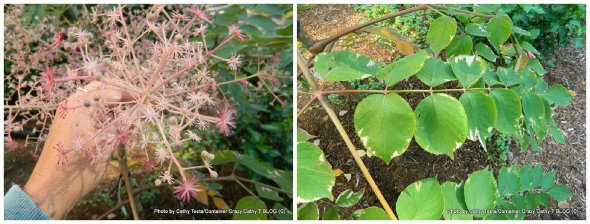
For example, she had an Aralia elata shrub planted in a small area near her front porch entrance.  This plant is not difficult to grow, but is tough to move once established.  It also has sharp prickles on the stems, and its roots will eventually sprout suckers.  However, the variegated leaves and panicle style flowers growing at the top of the plant are rather curious as well as pretty.  Observed up close, you will most likely admire this plant’s features.

bears breeches_0003

Where it was planted on her property was a little tight.  Aralia elata can reach 10-15 feet tall and spread to 8 feet wide.  It looks like a small ornamental tree at maturity with an unusual form.  And it drops its leaves quickly after flowering and fruiting, so it can leave plant remnants later in the season.  However, despite these things, she put it there to enjoy its features up close. I appreciated why she wanted it by the entrance to her front porch.  It is a rare plant.  Because it is not commonly seen, that in of itself, makes it intriguing.

Aralia elata

Aralia elata

Uncommon plants add excitement and wonder to a garden space.  Some plants with defense mechanisms make them more prolific in the garden, but this can also embody them with mysterious traits which make them stand out visually.  And if you are well aware of their growing habits, you may be willing to accept them or work to manage their undesirables over time.

This homeowner seemed to be aware of the nuisances of her specimens, but she didn’t seem to care.  Meaning, she enjoyed the plant’s unusual forms and was willing to use them despite the consequences or potential risks, such as the plant’s ability to spread or leave litter on the lawn.  She also has the benefit of employing a full time garden-maintenance person.  Thus, perhaps, she did not feel the anguish of planting something that would require a higher vigilance in the long run.  Or it could be that she just could not resist the temptations of a beautiful plant even if it has some beastly sides.

Because of her unrestrained style combined with the willingness to listen and understand the caveats of a particular plant as I cautioned its use, I was free to include the unexpected and maybe not so well-tamed specimen plants in her garden design for a perennial bed she was anxious to install.  And bear’s breeches (Acanthus spinosus), also called spiny bear’s breeches, was just one of those plant candidates.

The Beauty

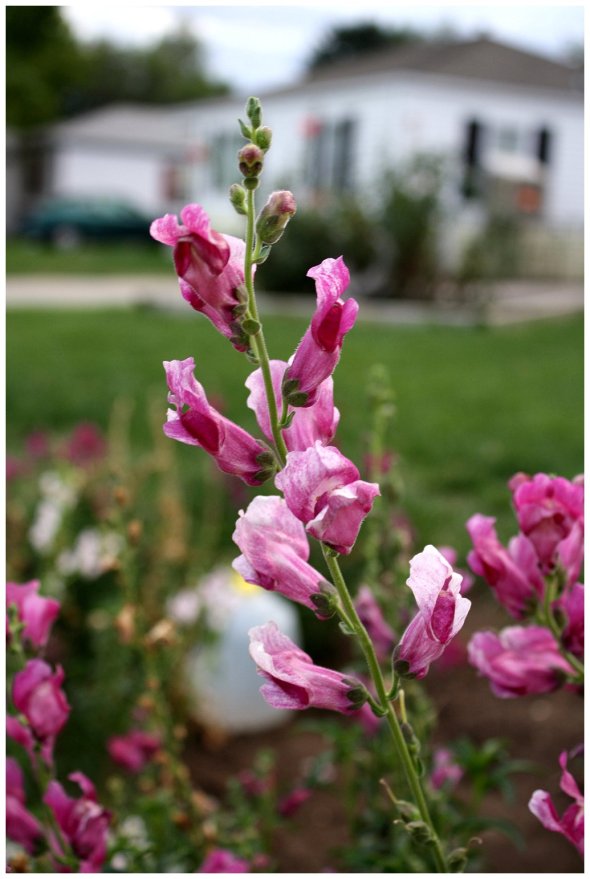
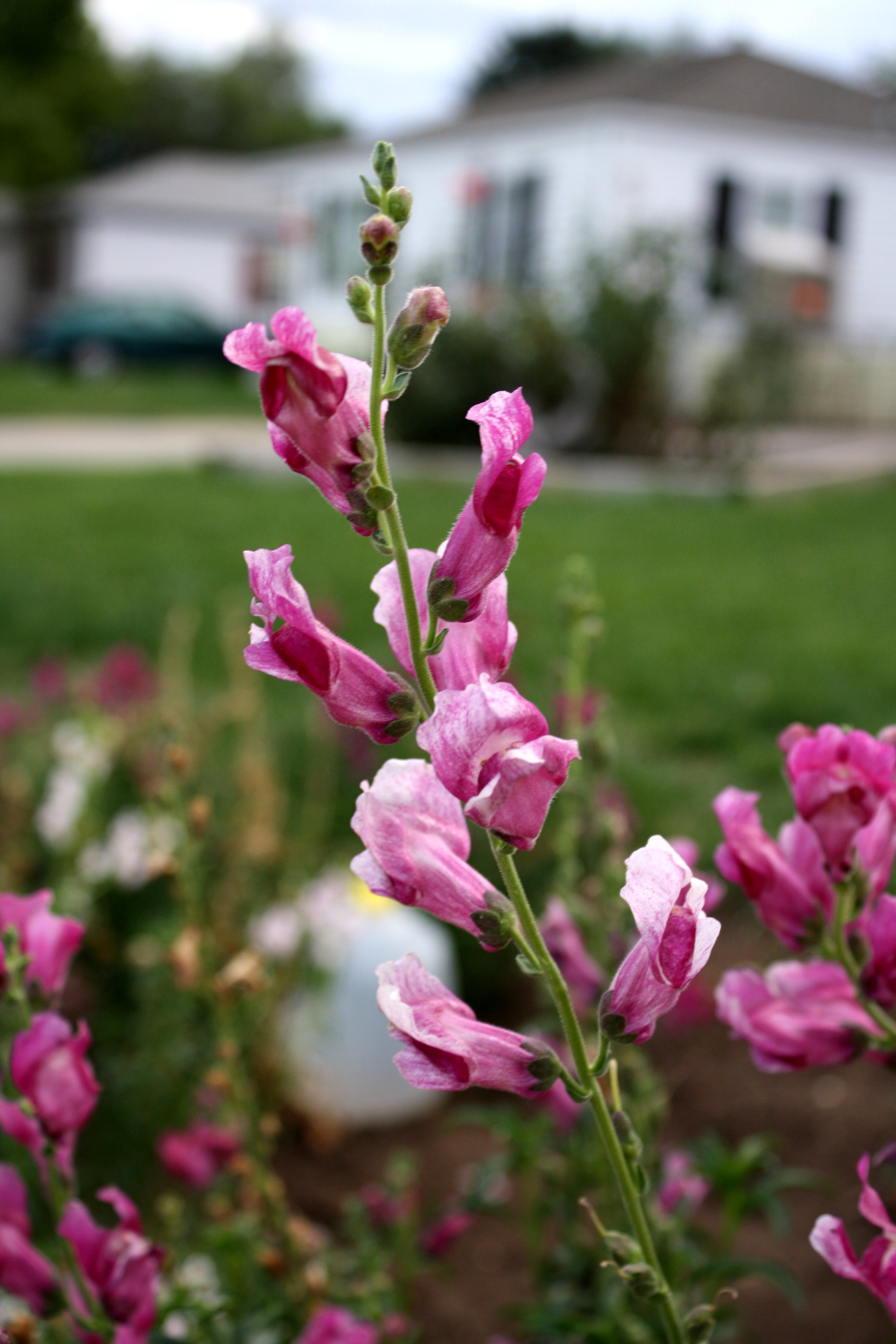
Bear’s breeches has rather interesting looking and showy flowers atop very tall flower stalks.  Each flower spike bears snapdragon like flowers which are vertically positioned.  The flowers are composed of bracts (modified leaves), lobes, and tubes – to put it simply, and their composition makes them almost-alien looking while still remaining beautiful in form.

Snapdragon Flowers, Photo by Dreamstime.com

Snapdragon Flowers (similar to bear’s breeches in style), Photo by Dreamstime.com

The top hooded portion of the flower is mauve to purple, and the bottom is white.  Because the plant can reach 3’ to 4’ tall, with a mounded foliage shape on the bottom, it can be rather significant in the garden.  It is extremely visible due to the tall flowers rising above it on strong stalks which do not require staking.

By Magnus Manske, Wikimedia Commons License

Bear’s breeches (Acanthus spinosus).  Photo By Magnus Manske, Wikimedia Commons License

The flowers on this plant are a true beauty, but it is also a bit untypical looking.  In my eyes, the individual flowers seem similar to a fantasized hooded-like orchid with the stature of a foxglove or Baptisia australis (blue false indigo).  The plant provides architecture, texture, and interest and it is a long-performer in the garden even after its flowers pass.

Nursery Management Green Guide article states “Foliage remains attractive after the bold flower spikes have disappeared.”

Although the leaves resemble thistle, which is considered a common roadside weed in Connecticut, the leaves are deeply cut, glossy green and leathery – adding nice texture especially when combined with plants of opposing texture.  If you haven’t seen bear’s breeches before, the combination of the tall showy blooms with prominent foliage will make you pause to take a glance.

Tracy DiSabato-Aust describes bear’s breeches as a “real conversation piece” in her book titled, “50 High-Impact, Low-Care Garden Plants.”  She also writes, “Don’t let its thistle like leaves put you off, as they add amazing shape and textural variety often needed in many “ho-hum” shade designs.”

Another bonus is the purple coloring on the top portion of the flower’s structure.  This is a desirable color by many plant lovers, and it was a specific request by my client, along with the desire to have silver-colored foliage.  Unfortunately, many silver foliaged plant candidates require full sun!  Thus – these are the challenges of a garden designer.

The Beast

Similar to Aralia elata, bear’s breeches (also called spiny bear’s breeches) has prickles and thorns located on the foliage and in the flowers.  Your fingertips or hands may get pricked if you are not careful – and your vehicle could receive damage should you locate bear’s breeches by a driveway’s edge.  Accidentally brush up against it, and it will leave its mark.

Steven M. Still indicates “Acanthus is derived from the Greek word akanthos, meaning thorn or prickle.  It has been called bear’s breeches because of the size and appearance of the leaf of some species which is big, broad, and hairy” in his book titled, “Manual of Herbaceous Ornamental Plants.”

It is not just the prickly nature of the plant which can be off-putting, but it also has the tendency to spread by roots which will pop up new plants in other parts of the garden – once the plant is established. If you desire this look, where the plant repeats itself here and there, and you don’t mind it moving on its own, great.  It can add a naturalistic effect in the garden while providing architecture due to the plant’s form and texture.

http://www.youtube.com/watch?v=tD7ZsPV8Fgc
Viettes Gardening Tips

But there’s another catch, spiny bear’s breeches are also slow to establish.  You must be patient if you desire this spreading habit in your garden, which some folks do, and you also need to pay attention to the preferred cultural conditions because it tends to be flexible and picky at the same time.

Bear’s breeches grows best in full sun to part shade, and some references indicate it is best grown in partial shade.  The top blooming portion of the plant prefers more sun, but it performs better with some afternoon shade, especially if your climate is hot in the summer.  Fortunately for me, my client’s garden bed area had both sun and shade at different parts of the day.

As noted above, bear’s breeches’ aggressive side of spreading by its creeping rootstock easily occurs in loose soils which it prefers (well-drained soils), but it may stay put if you try to plant it in clay soils. However, if planted in heavy clay soils, this plant may get root rot because clay soils tend to remain wet. And slugs and snails will dine on the plant, especially in wet areas.

by Rod Allday, Wikimedia Commons License

Photo by Rod Allday, Wikimedia Commons License (see below attributions)

Although this plant is often recommended for the back of a garden border because it grows large and tall, it also can be placed at an edge for up-close enjoyment.

Garden Gate Specials publication recommends, “Add a bear’s breeches near the edge of a path.  It’s usually planted near the back of the border, but (here) it lifts its flowers to eye level for easy viewing.”

My client loved the look of this plant candidate as much as I did, and wanted to have it included despite its potential maintenance challenges of spreading, spines, prickles, size, repeating, and establishment.  She understood the growth habits without hesitation and was very happy to be introduced to bear’s breeches as part of my design recommendations for a new perennial bed she was planning to install.

As for myself, as a designer, I loved the freedom to use plants which have bold traits and long-lasting attributes despite their need for on-going maintenance and care.  Plant care is often regarded as an undesired chore for many clients demanding low-maintenance plants.  They just don’t want the problems, or they don’t have a full-time gardener to take care of their landscape!

But if you find you are like this homeowner, or desire uniqueness in your outdoor surroundings, despite the potential regret or work later, then you too will find spiny bear’s breeches is a true beauty while accepting it is a beast. Or you can minimize the risk and use this plant as a “Troublemaker turned Star” in a container garden.  This perennial is worth taking notice either way.

Cathy Testa

Plant Details:

Pronunciation:  Acanthus spinosus (a-kan’thus spi-no-sus)
Perennial; USDA Hardiness Planting Zone 5-9
3-4 feet tall and 2-3 feet wide; Sun to partial shade
Blooms late spring to mid-summer; no staking needed
Prefers moist, well-drained soils; Can tolerate dry soils
Protect over winter with straw mulch if in Zone 5 or colder
Related species:  Acanthus mollis

Useful Link:

http://www.missouribotanicalgarden.org/PlantFinder/PlantFinderDetails.aspx?kempercode=a100
Missouri Botanical Garden Plant Finder

Photos:

http://www.photos-public-domain.com/wp-content/uploads/2010/11/pink_snapdragons.jpg
Pink snapdragon photo, dreamstime.com Free Stock Photo

http://commons.wikimedia.org/wiki/File%3AAcanthus_spinosus_(Acanthaceae)_flower.JPGdownloaded image, creative commons license. Attribution: By Magnus Manske (Own work.) [GFDL (http://www.gnu.org/copyleft/fdl.html) or CC-BY-SA-2.5-2.0-1.0 (http://creativecommons.org/licenses/by-sa/2.5-2.0-1.0)%5D, via Wikimedia Commons

Pic of flower in a group along walkway:  Attribution:  Rod Allday [CC-BY-SA-2.0 (http://creativecommons.org/licenses/by-sa/2.0)%5D, via Wikimedia Common.  Page url: http://commons.wikimedia.org/wiki/File%3ALooking_down_into_the_Jungle_at_Heligan_-_geograph.org.uk_-_1401014.jpg

My Monster Cement Planter

9 Comments

Jimmy, my brother, installs stamped concrete walkways, so I finally asked him to do one outside my basement door. Then I told him how I’d like to have him build me a huge planter box below the deck. I gabbed about how cement is so popular these days, even running inside to show him photos from a Martha Stewart magazine issue showing cement outdoor tables and more.  Anyhow, he knows I get nutty about these dreams of mine, but he said we could do it.  He agreed on my dimensions, and the cement planter resulted in a 5 x 10 size.

After it was completed, which was last fall, I filled it with the soil from my disassembled container gardens from that season. It was perfect because the cement planter is below my deck, so it was easy to dump the soil into it from above. Plus, I was recycling my soil.  Then I put a big plywood board over it for the winter. It ended up serving as a useful table during my winter Kissing Ball and Evergreen Creations class.

My Monster Cement Planter

My Monster Cement Planter

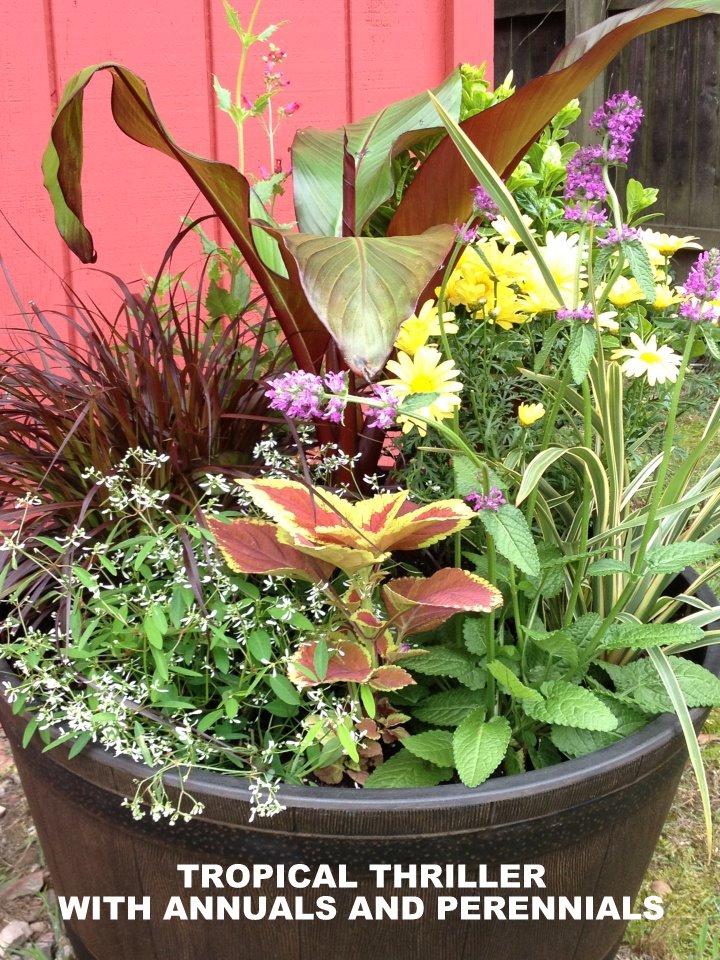
Alas, it came time to plant it this year. First, of course, was my red banana plant, as the thriller. I imagined the leaves would pop up to the deck railing levels by summer.  As of today, the leaves are 52″ long.  Yup, I measured it.  In warmer zones, the Ensete red banana can reach 12′ tall.  In prior years, this tropical plant, Ensete ventricosum ‘Maurelii’ has grown tall in my patio pots and containers, reaching probably 5-6 feet tall, but never has it grown as wide and large as it has in my cement planter.

The thriller is Ensete red banana with fillers of elephant ears

The thriller is Ensete red banana with fillers of elephant ears

The red banana plants features are thrilling to me because its large reddish leaves grow fast from a thick trunk base. The leaves come up like rolled cigars which is appealing. Then they quickly unroll to show a big tropical look. This tropical plant is hardy to zones 9-10 so I had stored the base carefully last fall to reuse as an annual here in CT.

Watering the red banana and its companion plants was no problem either. I just showered them from above when I walked around with my light weight garden hose to do the pots on my deck.  The only trouble experienced was the bothersome Japanese beetles earlier in the summer munching on the leaves. Cutting off the unsightly leaves was the solution for more would arise.

Astilbe perennial blooms

Astilbe perennial blooms

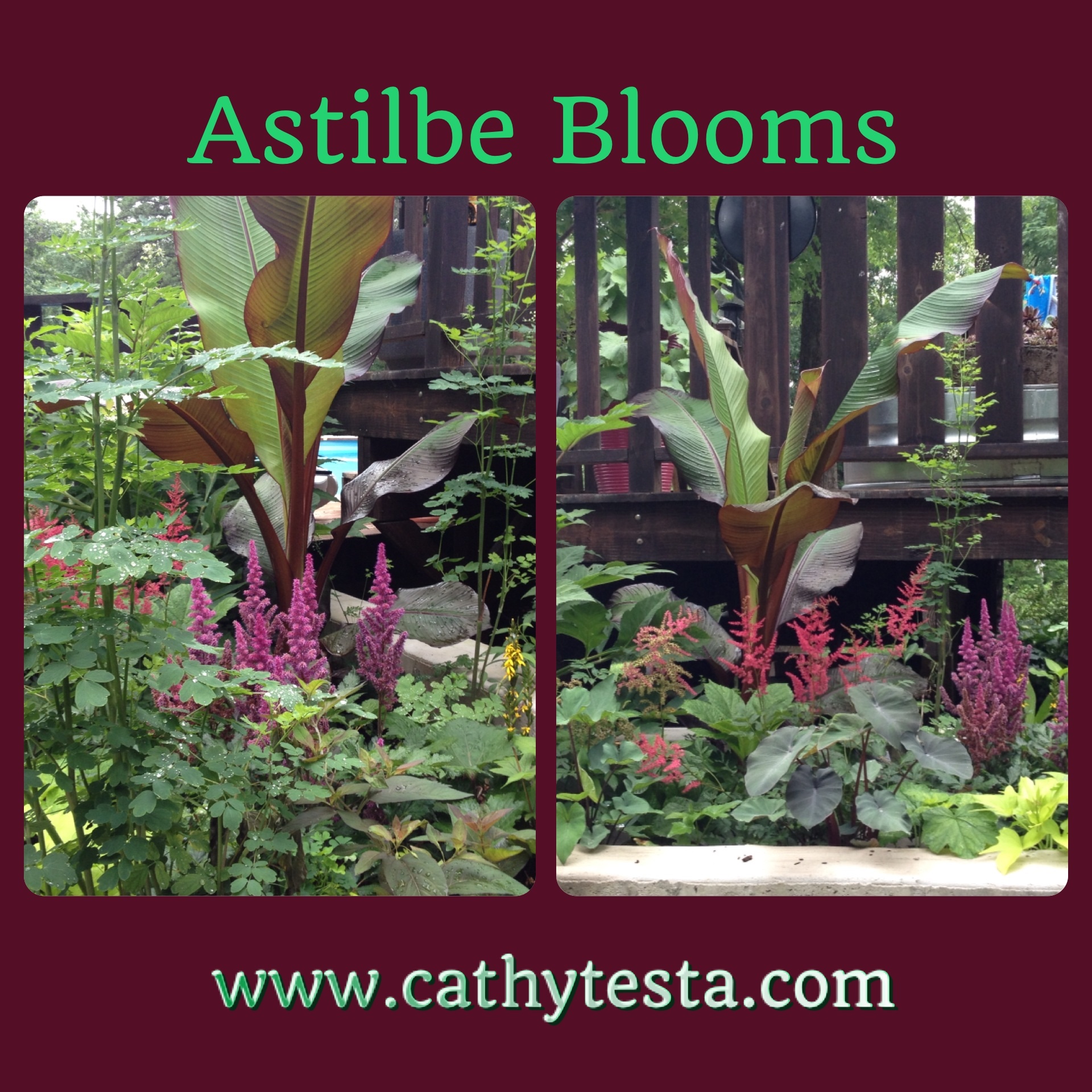
In the beginning of the season, Astilbe perennials bloomed red and pinks. They put on a bloom show for a while. And they will return every year. I also added several types of elephant ears from my stored specimens, which included the Colocasia esculenta ‘Maui Magic’ and Colocasia esculenta ‘Tea Cup.’

Tucked around were elephant ears

Tucked around were elephant ears

‘Maui Magic’ elephant ears are a fav. Its purplish stems and large leaves in a clump are spectacular. ‘Tea Cup’ elephant ears have cupped leaves. Water droplets sit in the center and bobble around as a breeze comes by, or my cat. My cats like to lick the droplets sometimes, and once I found one cat sleeping under the plants in this planter. They were reaping the benefits of cool shade from the large red banana plant’s leaves and the elephant ears, plus the monster cement planter is in a quiet location where they can rest or sleep.

A biennial plant starts with pods

A biennial plant starts with pods

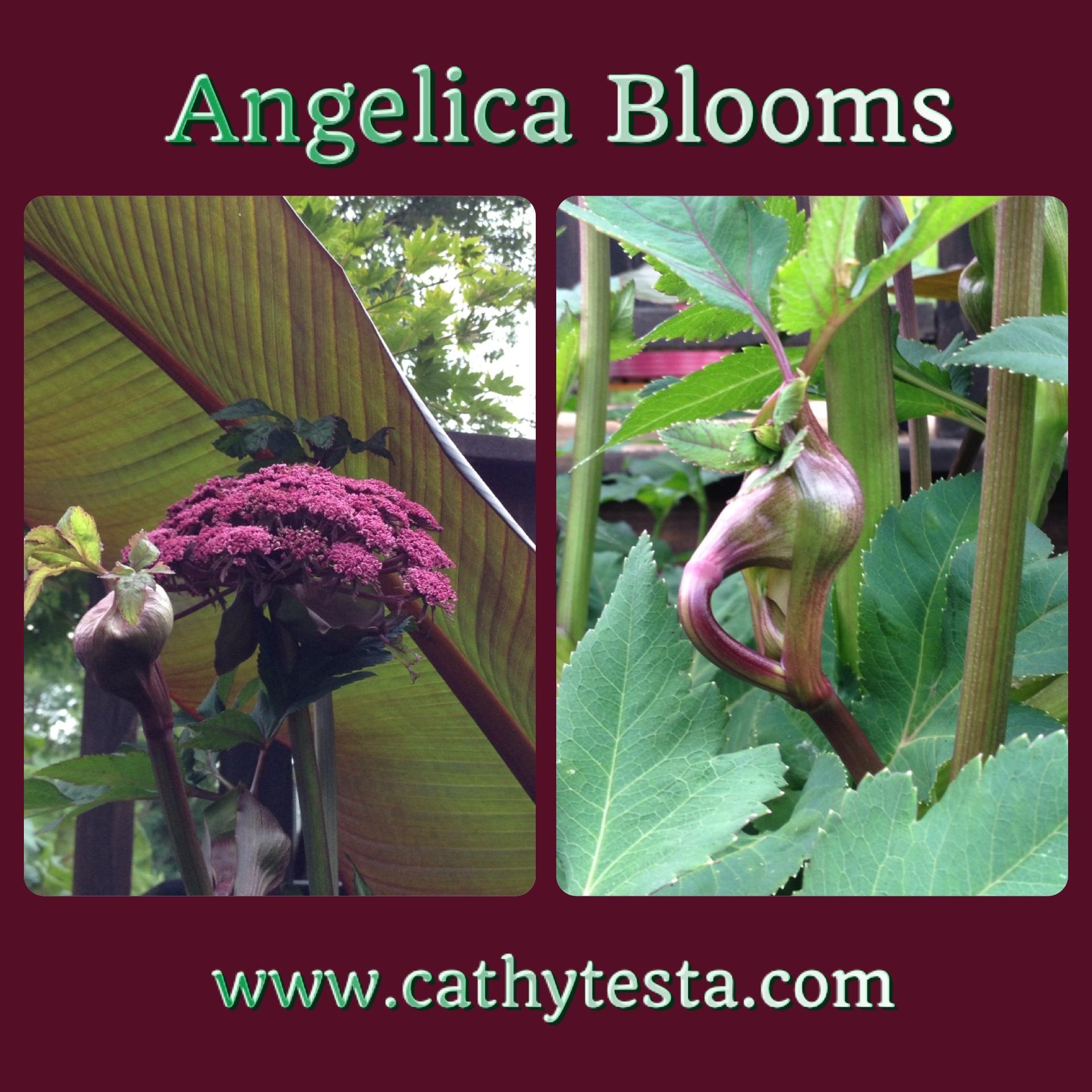
Another plant added was Angelica, selected because it has unusual looking flowers. It is a biennial, and also has large foliage resembling giant parsley. The blooms, shaped like pods, first arrived mid summer and are open now. Bees are really enjoying them. I was excited about this plant too because it grows very tall, up to 5-8 feet.  The deep plum flowers are a nice color combo next to the reddish banana leaves.

Planter filled lushly

Planter filled lushly

Next to bloom will be the pink Turtlehead perennial. Latin name is Chelone lyonii. This will bloom any day now, and more bees will follow. I had this perennial in a pot last year, and loved it. Its a late summer bloomer, and will continue until early fall, plus it also gets large.  Its on the left corner with dark green leaves, dense, and packed in nicely. It likes consistently moist soils, and so does the Angelica and tropicals in this monster cement planter.

There are other beauties in the planter, such as Rodgersia pinnata and Thalictrum aquilegifolium (Columbine Meadow Rue).  The Meadow Rue is the only perennial relocated from a former garden mowed down. It gets very tall, 2-3 feet, and has wispy pale tiny flowers in late spring to early summer. It has more of a woodland feel but the height factor made it a companion. And of course, no container garden would be complete without a spiller, sweet potatoe vine on the corner.

Red banana leaves arise rolled up

Red banana leaves arise rolled up

Planting this monster cement planter has been easy and a joy. No bending to the ground, or weeding. They can not get in practically, not just because the plantings are full, but the height of the planter helps to prevent them from creeping in. I’d rather plant hundreds of these types of large cement planters over gardens in the ground any day. Now if I could just convince my brother to build me more!

written by Cathy Testa

The thriller is Ensete red banana with fillers of elephant ears

The thriller is Ensete red banana with fillers of elephant ears

Beautiful Houseplants can be found at Moscarillo’s

Leave a comment

Entrance

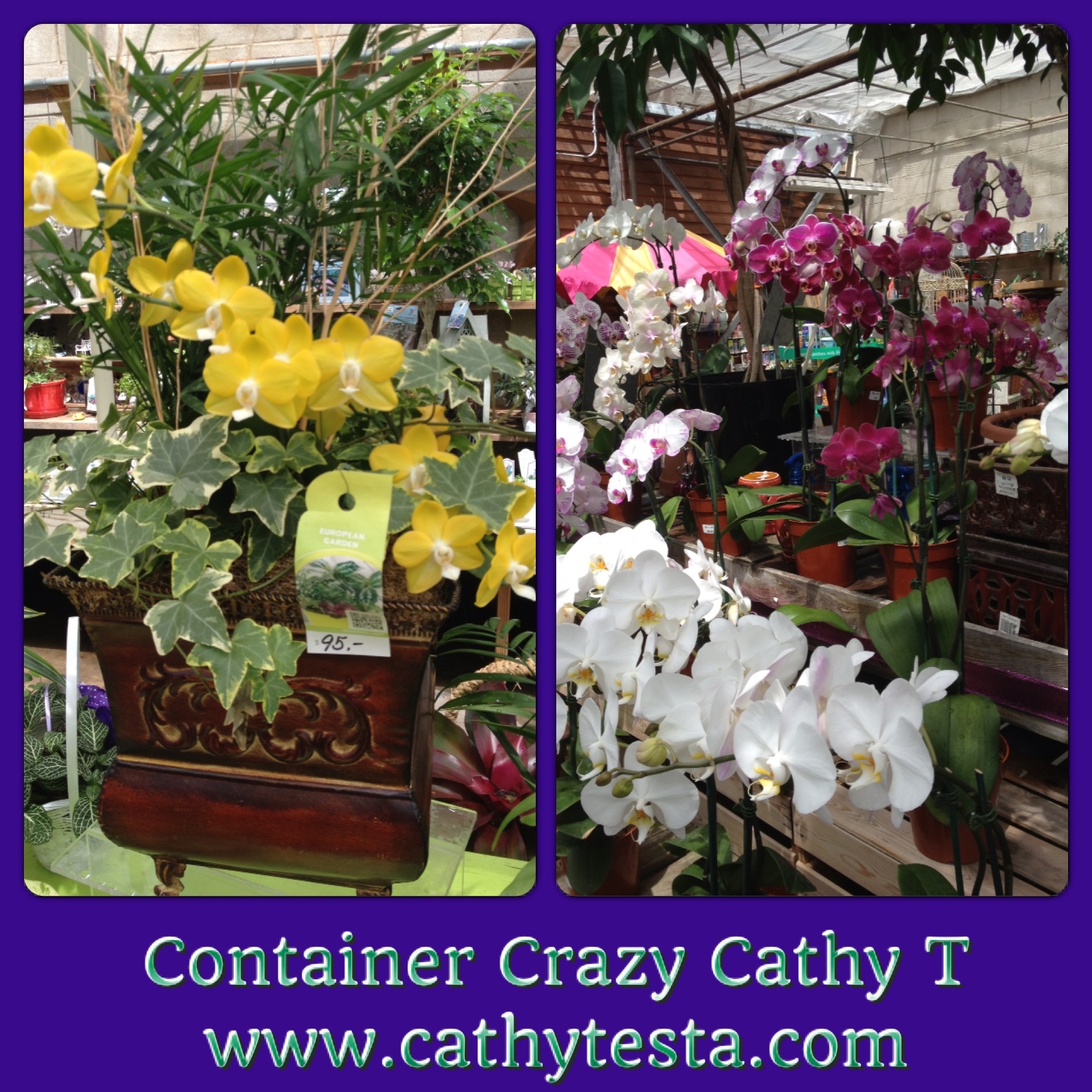
Sometimes when I enter a garden center, I can spot their strong suit. In the case of Moscarillo’s of West Hartford, CT, it was definitely their beautiful selection of healthy house plants. This is not to imply they don’t have much more to offer, because they do, but I was particularly impressed with their house plants, dish gardens, and orchids.

But before going to their greenhouse filled with them, I ventured into their perennial section. The outdoor tables were labeled with individual wooden letters by alpha order to help you find a plant. Need an Epimedium for example, go to the big E on a stake. Clever and unique, I thought. It helps the customer find their way.Soil

They also had nice neatly stacked bags of soil for the garden and containers, which I thought was well labeled and placed on the grounds. Although I must admit, I like when soil is under some type of cover because we all know what it feels like to carry wet soil.  I always prefer bags which are clean, not wet or torn, and when under cover it helps. However, their bags were in fine and in clean conditions.

As I walked past the soil area, I noticed a back door to greenhouse was open, so I pushed my shopping cart inside and spotted pitcher plants and bonsai specimens in front of me, but also saw many house plants in this greenhouse. It was filled with good looking house plants. I think I said out loud, Ah Nice.

Alpha lettering

Why are good looking and healthy important?  Because insects spread quickly on unhealthy plants, especially if moved into a home where perhaps conditions are not ideal, and it can happen quickly. It’s best to select a plant with no problems from the start.

Orchid

Another aspect that pleased me, was the cleanliness in general. This greenhouse was fairly packed but not unkept.  And then, I began to notice their dish gardens with orchids. The orchids were pristine, and the dish gardens well done. My mind said to me, someone here knows what they are doing.

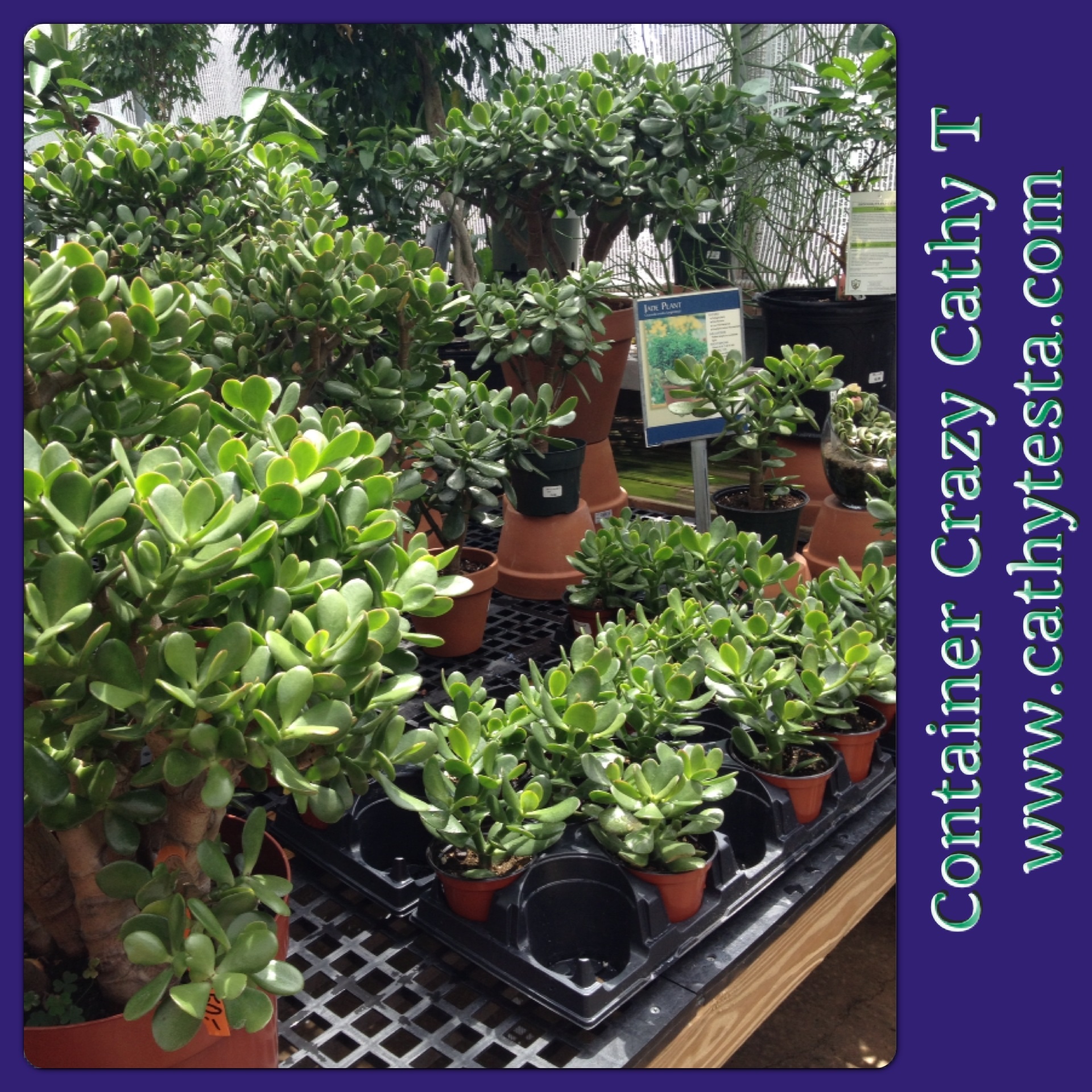
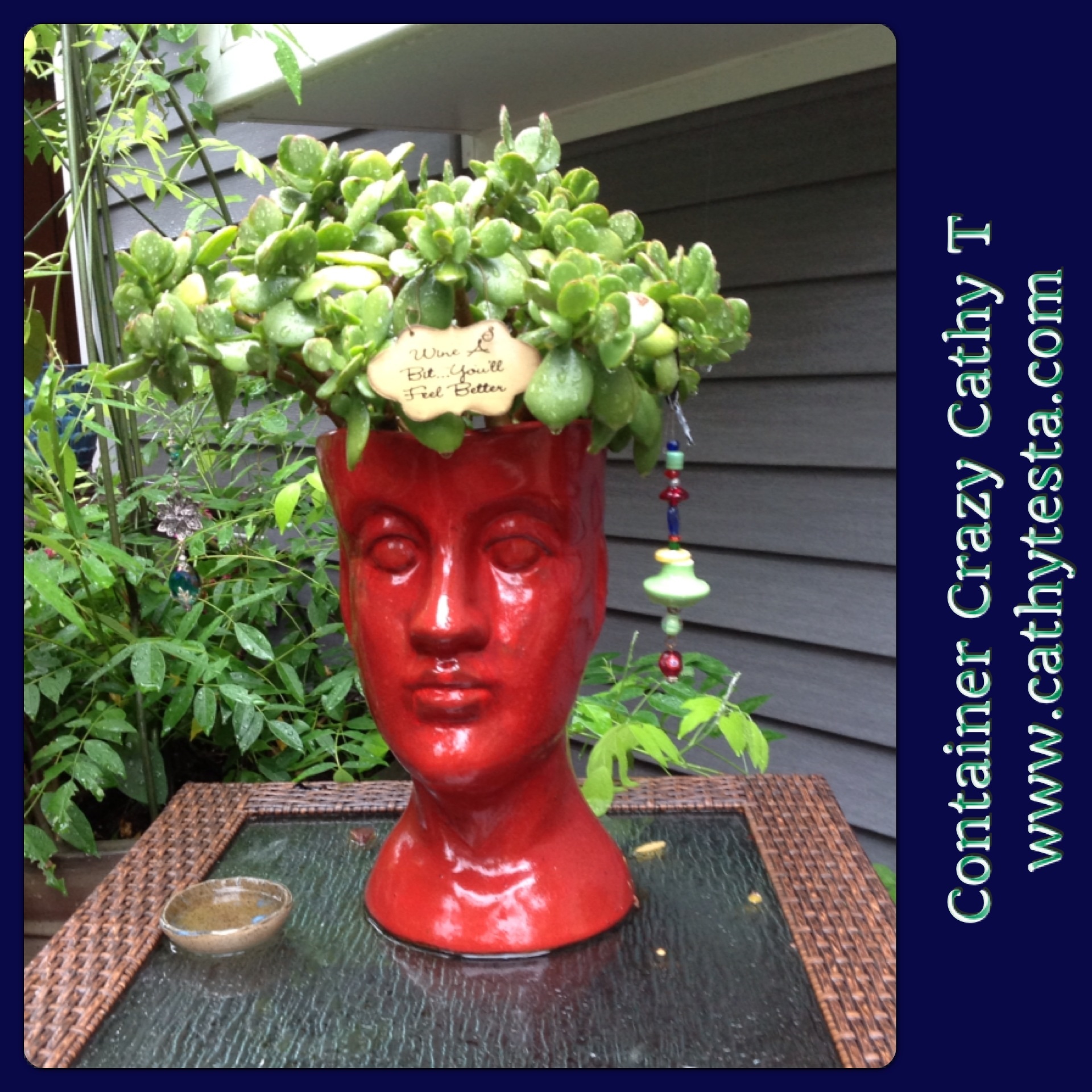
There were some Jade plants that I thought were perfect for creating head planters, like mine shown below. They also had small plants of Norfolk island pine next to a large specimen on display. The pine has handsome foliage. Its an evergreen plant, great for the patio with medium light, or as a house plant. It grows to 8′ tall so high ceilings are helpful.

Jade

Jade head

There was a gift shop and even a little section with fresh veggies. Nice touch.  As I paid for my items, I laughed at the register person’s shirt which read — Stay Calm and Moscarillo’s On.  We discussed the origin of the saying, but that’s another story.

Orchid

Moscarillo’s is located at 2600 Albany Avenue, West Hartford, CT 06117.

Website:  www.moscarillos.com

Telephone: 860-236-5487 or 800-464-9106

Dish Gardens

They have a small ad in the Garden Trail book, but a big area and offerings at their nursery. Worth a visit on your travels, especially if you are looking for a beautiful houseplant.

more Dish Gardens

Pine

Bear

Written by Cathy Testa

Arts and Crafts at a CT Nursery this Weekend

1 Comment

Sign

The Gledhill nursery in West Hartford, CT is holding an Arts and Crafts fair this weekend on August 2 and 3, 2013 from 10 am to 4 pm. I happened to visit this nursery for the first time yesterday (as part of my goal to visit nurseries listed in the CT Garden & Landscape Trail.)

On my way to this place, I did run into some roadway construction coming from Bloomfield but it moved quickly and perhaps will be done by Saturday. But also be on the lookout for the entrance. It can be tricky to see the enter versus exit road. Look for the street sign. As you drive down it, you will feel as if you are entering a private residence. The driveway into the back parking area is very narrow and lined with beautiful plants and trees. This nursery has an immediate park like feel to it.

RoadA friendly nursery staff person greeted me immediately as I entered the grounds, admiring the small water gardens in particular. She apologized for the mix of plant areas as she explained they were organizing spaces for the 30 vendors participating in a crafts fair this weekend. It is held annually. So I thought I need to post this immediately to let everyone know about it.

The nursery staff person also told me their landscape department has a knack for water gardens as she noticed I was taking photos of them. This garden center has some small greenhouses, a nice gift shop, and displays such as a path leading to an arbor. If I were able to go this weekend to see the crafts show, I would but other commitments prevent it. If you decide to go, let me know what you think. Oh, I also noticed they had some organic products on their shelves for bugs and fertilizers.

Water gardens

The plant areas had little garden decor here and there too. It seems like a fun place to browse, plants very healthy all around, and I’m sure in the height of the season there’s more to enjoy. There’s lots of inspiration for those taking notice of all the details all around the premises.

Organically at Gledhill

The address is 650 Mountain Road, West Hartford, CT 06117. 860-233-5692.

Just be sure to drive carefully into the area. I suspect they will have additional parking during their event this weekend with all the vendors planned.

Decor

Their website is http://www.gledhillnursery.com.

Sign

Overall, park like, tranquil, and secluded. When I commented that folks from my area may not know about Gledhill, she replied, neither do some locals to West Hartford. Perhaps, now, they will.

written by, Cathy Testa

Water garden Gledhill

A Lamb’s Ear Perennial with a Different Look and Feel – Say Hello to ‘Hummelo’

3 Comments
Butterfly visits in Early July

Butterfly visits in Early July

Stachys monieri ‘Hummelo’ is a perennial I spotted for the first time a couple seasons ago.  Because of its tall blooms, I decided to include it in a whiskey barrel container garden, and thought it worked well when going for a naturalistic theme because it has a soft color to its blooms and the stalks are tall, rising upwards like you would see in a meadow.

'Hummelo' in a Container Garden

‘Hummelo’ in a Container Garden

If you like the cottage garden look, or a perennial with the power to attract bees and butterflies for a long period of time, you need to say, “Hello” to ‘Hummelo’ – A lamb’s ear perennial with a different look and feel.

The color of the blooms, violet to a soft purple, and the shape of the two-lipped flowers, similar to the perennial, Catmint (Nepeta), have a welcoming appeal.

Because of this, I decided to plant two in front of my border by a Knockout Rose this year, and the plant’s habit and characteristics have impressed me since.

Despite our bouts of harsh weather this season in Connecticut, such as hail storms, strong winds, and heavy rainfalls, this plant has not bent, cracked, or toppled.

And the flowers, rising 18-24″ tall on strong, 4-angled stems above the low-growing clump of soft green wrinkled leaves, have been blooming continuously since early June.

It has a long season of bloom, expected to last to the end of August or early September, and it is a butterfly and bee magnet.

Lamb's Ear Perennial

Lamb’s Ear Perennial

However, what makes this lamb’s ear perennial different is the look and feel to the leaves, which are not like the typical species known to gardeners, Stachys byzantina, where the leaves are fuzzy and woolly, soft to the touch.

Foliage on Lamb's Ear

Foliage on Lamb’s Ear

‘Hummelo’ has wrinkled and wavy leaves.  The texture gives it some interest but I find the color of the leaves a little dull – just your basic plain, soft-green, so what you place near and around it should be considered.  You may want to find other perennials with a darker green foliage color, and pair up the beautiful violet blooms of ‘Hummelo’ with other monochromatic colors in the pink and purple tones, along with some contrasting coarse colors and textures.

Lamb's Ear Blooms

Lamb’s Ear Blooms

Some companion candidates for Stachys monieri ‘Hummelo’ are:

Baptisia australis (False Indigo) has tall darker purple blooms on tall flower spikes, as compared to Hummelo’s bloom color, and its foliage is a bit darker green.  It will end its bloom period around the time ‘Hummelo’ begins, but the dark seed pods will add interest later in the season.  Place it behind ‘Hummelo’ to add impact and height.  It can reach shrub size, and is great at the back of a border in full sun to part sun locations.  And it also has a “naturalized” look, similar to ‘Hummelo’ – plus it was the 2010 Perennial Plant of the Year.

For a dramatic effect next to ‘Hummelo’, try a tropical Colocasia esculenta ‘Maui Magic’ (Elephant Ear).  Its large, coarse and wide foliage with dark purple tones on the leaves and stems will be a great way to add contrast against the soft greens of ‘Hummelo.’  This gets large, so position it where it won’t eat (hide) the ‘Hummelo’ perennial, but pop near it.  The purple stems on this elephant ear will look great with the violet blooms of ‘Hummelo’ – and the soft green foliage of ‘Hummelo’ will pop against the dark tone of the elephant ear.

Supports Pollinators

Supports Pollinators

Incorporating some soft silvers in a more sunny location, such as Artemisia (Wormwood) is a good color to add.  I prefer Artemisia schmidtiana ‘Silver Mound’ with its soft airy foliage and dome shape, with lower stature than ‘Hummelo.’  This plant likes full sun and well-drained soils.

Another darker purple bloom color that would look great as a contrast to the softer violet blooms is Centaurea montana ‘Black Sprite’ (cornflower) with almost black-purple flowers blooming in July to August and reaching about 14″ tall.  The spidery like bloom structures is intriguing and would also pick up the darker purple colors of the Elephant Ear noted above.  It can take full to part sun locations.

Pronounced STAKE-IS (Click HERE to hear), Stachys monieri ‘Hummelo’ is a relatively unknown plant, great as an edger in garden borders, filler in container gardens, and provides a uniformed, sturdy look, and it is a “workhorse” because it has long-lasting blooms and strong upright stems.  And, it can survive under walnut trees.  This plant is a member of the mint family, so be aware it can spread, and often looks good massed or as a ground cover planting.  However, if used in a container garden, it is not a trouble marker, but a star – where you won’t have the spreading concern.

If you decide to use Stachys monieri ‘Hummelo’ as a ground cover, you may want to consider including some Ajuga reptans ‘Burgundy Glow’ for the foliage on this low perennial, also great as a ground cover, has soft pink and violet tones to it.  Put it in-front, and be aware it is mostly known as a shade to part-shade plant, but can take sun with moisture.

Lamb's Ear, Stachys monieri 'Hummelo'

Lamb’s Ear, Stachys monieri ‘Hummelo’

Stachys monieri ‘Hummelo’ is a Zone 4-8 perennial, prefers Full Sun, and is a great addition to your gardens and container gardens.  Some references spell it monnieri with two n’s on the species name.  It is also known as Betony.  Click HERE to read a “Comparative Study of Cultivated Stachys,” by the Chicago Botanic Garden, where you can learn lots more technical details about this plant and its relatives.

Cathy Testa
Container Crazy Cathy T
http://www.cathytesta.com
(860) 977-9473
containercathy@gmail.com

A Nursery in the Country has a Big Draw

1 Comment
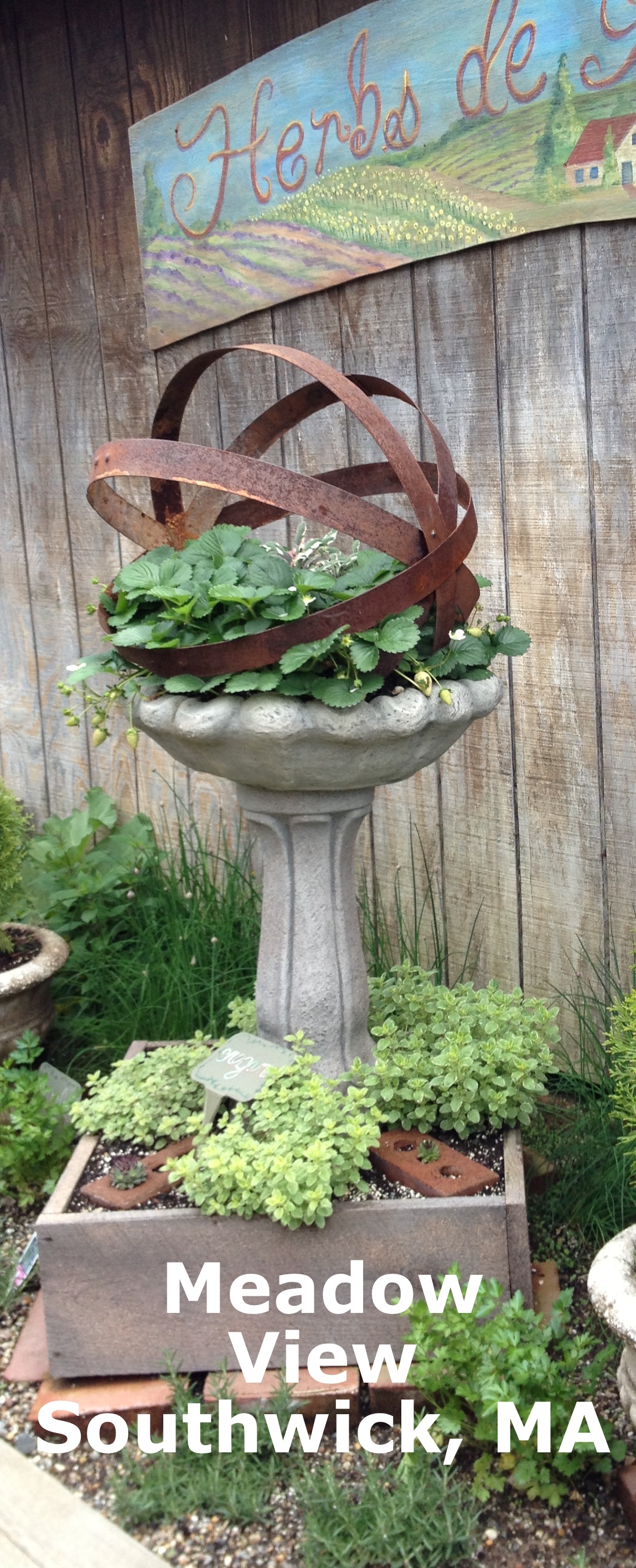
Decor ideas at Meadow View Farms in Southwick, MA

Decor ideas at Meadow View Farms in Southwick, MA

As I mentioned earlier this year, I am making a commitment to visit nurseries this season.  I kind of miss walking a nursery and enjoying it just for me.  As a person in the bz, many times shopping is about the customer, which is also fun – but it was some ‘me’ time.

So today’s post is about Meadow View Farms in Southwick, Massachusettes.  My sister enjoys going to this place and took me there last year, and I remembered liking their herbs and veggies section so my goal was to pick up some of those.

When I arrived to the nursery, there were so many cars and people, I couldn’t believe my eyes – on a Wednesday!  It was a challenge finding an available parking space, especially with my big truck.  When I backed it into the spot, a woman applauded saying she was impressed, and I responded, “Yes, I had people and carts moving around me as I was trying to make it in there.”

As soon as I put the truck into park, a familiar face walked up – a friend by the name of Brian.  I met him at a bar – not what you think – he’s the bartender – and he showed me a book of his garden photos. He is an impressive gardener and has a beautiful greenhouse, so we just started talking plants as my husband sipped his cold brew that day we met.  Brian has a great personality and walked up with a big smile on his face.

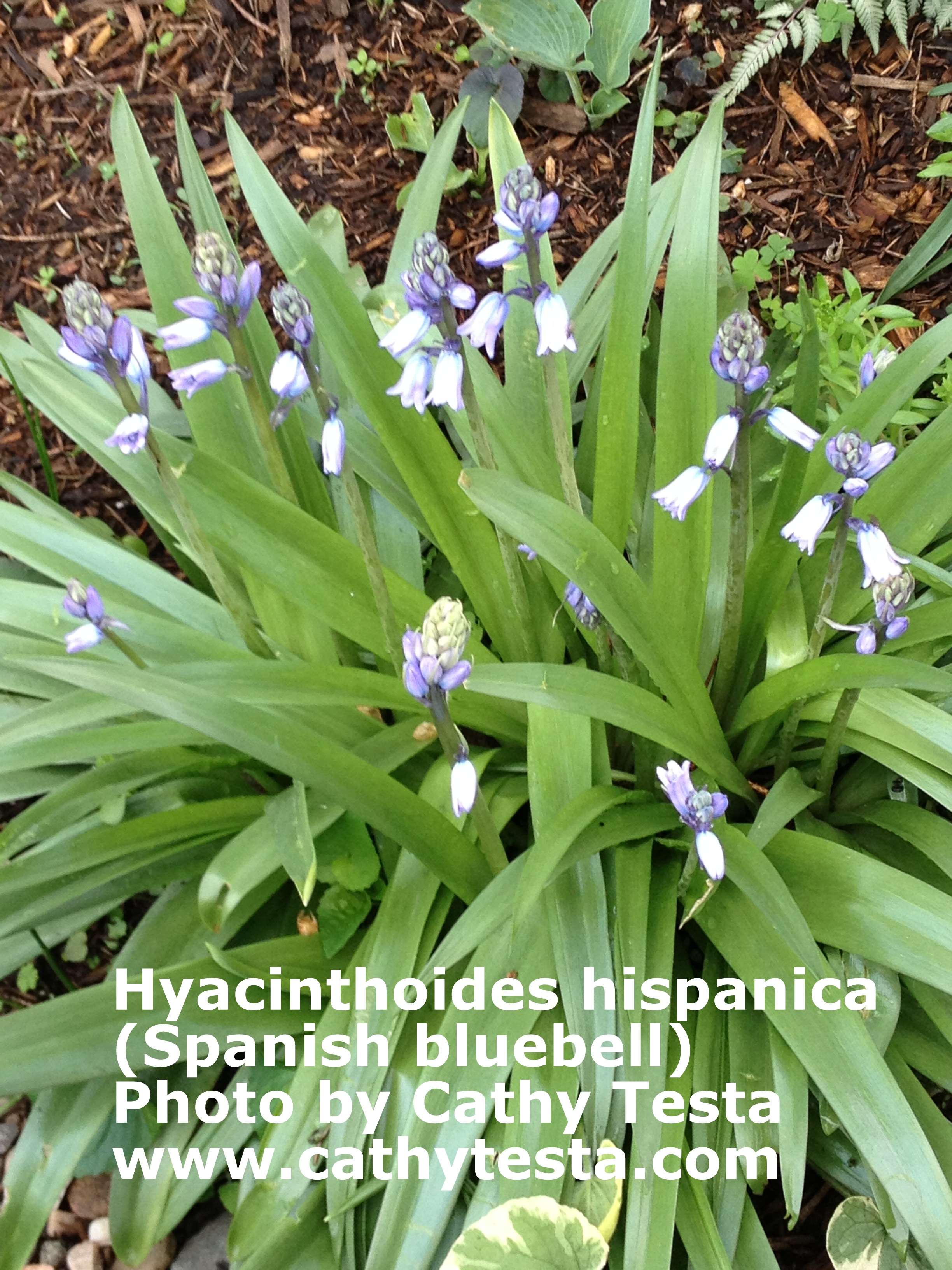
Spanish bluebell

Spanish bluebell

Brian told me he went to several nurseries in search of a plant he saw in the gardens at Meadow View and later discovered he was calling it by the wrong plant name!  So that was a chuckle – especially because he knows plants.

“So show me which plant,” I said.

We walked over to a display area, and there it was –  beautiful blue flowers on sturdy little stems above strap like leaves.

“I don’t know off the top of my head but it is a bulb type plant,” I told Brian.  It looks familiar.

Brian thought it looked a bit like the perennial, Campanula.  “Yes, it does,” I responded.

Of course, of all the plants in the garden displays, this one was not labeled (nor was it for sale at this nursery – at least not on this shopping day).  But a staff person was quick to identify it for us.  However, before we found her, I grabbed my iPhone and said, I’ll just take a photo and post the question on Facebook: “Who knows the name of this plant?”

Garden displays

Garden displays

It took literally seconds to get the name, and comments from gardening friends growing this plant in their gardens.  By the way, after coming home, and looking it up, it is called Hyacinthoides hispanica (Spanish bluebell). It was formerly called Scilla campanulata (there you go Brian!), or Scilla hispanica.  This plant blooms from April to May, and goes dormant in summer.  And it grows well under trees, which is where it was located and repeated in the Meadow View display garden.

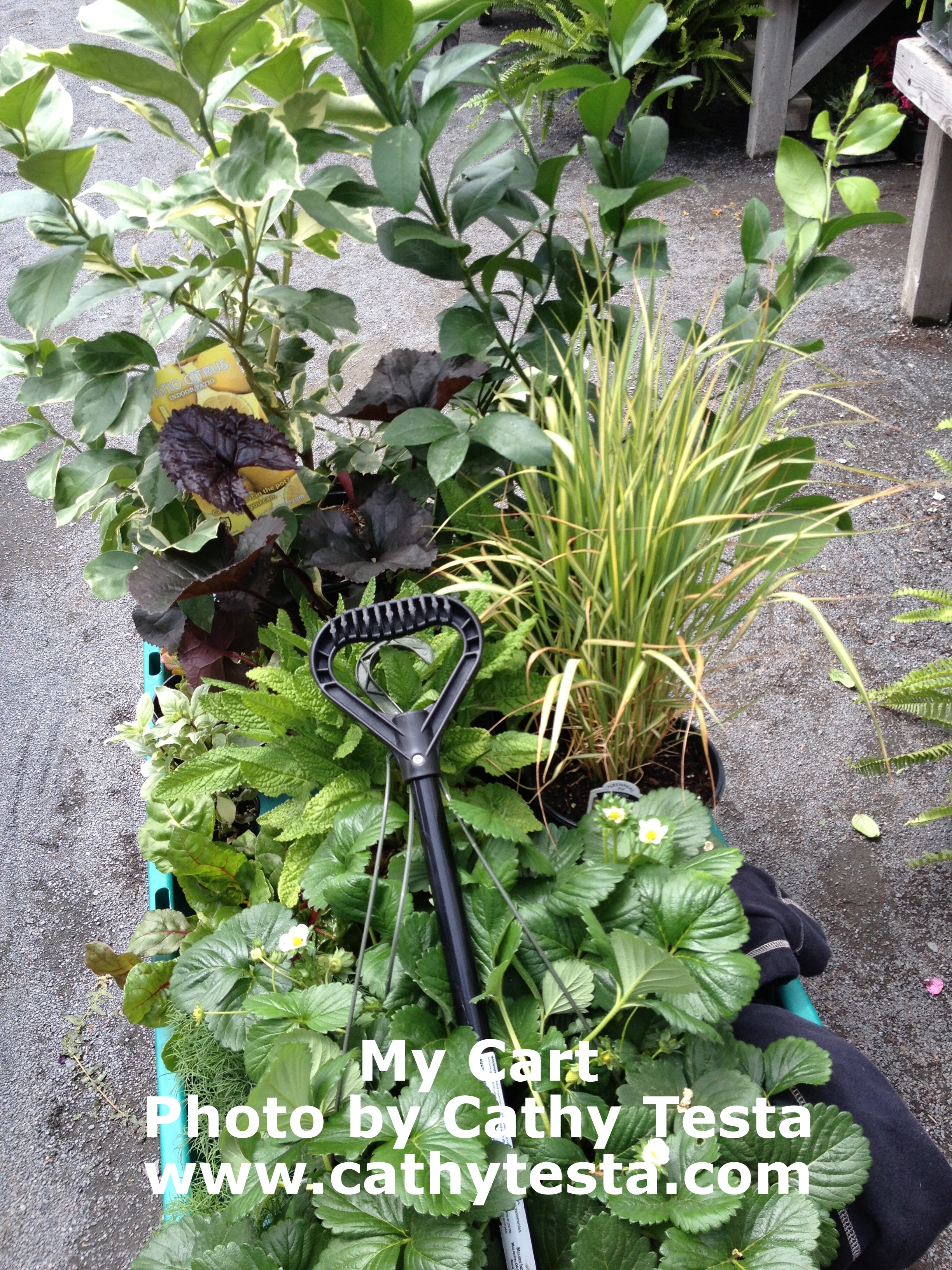
My cart filled

My cart filled

After a quick discussion with Brian on more plants, off he went – and so did I to the veggies section.  I already bought some herbs but I wanted more, and so I looked around, then I spotted a lemon tree.  Ironically, at the last two garden centers I visited, the “male” staff both told me they like lemon trees after we talked about plants like fig trees.  Guys like lemons, I thought.

So spotting one here, I decided I want one too, and to see a variegated form sitting there along side other healthy lemon tree plants, I thought – this is it.  On the cart you go, and the other was for a friend who found my idea of a lemon tree interesting – because lemons with summer cocktails is a good thing. So I texted her the price, and she said yes – get it for me.

The variegated one for me is actually a pink lemon everbearing variety.  These can be placed in the basement to go dormant from what I was told, or even in the garage over the winter.  It appears my theme this year for my container gardens is falling into the herb, fruit, and veggie category because I picked up a pineapple plant and fig tree recently too.  Hope all bear fruit.

Meadow View Farms in Southwick, MA has some nice small display gardens where you can view plants they have for sale.  They also put containers in various places and decor like wagon wheels as trellises for vine plants.  They have a little sitting cafe area, which I didn’t go into to, but I believe they offer water and coffee there.  And they do not have bathrooms, but outhouses which will do for any excited gardener shopping too long requiring a p-break.

They are stocked with great looking perennials, lots of big hanging baskets, annuals, and great veggies and herbs, with shrubs and vine plants too.  I didn’t notice any trees, and the facility is mostly an outdoor place.  There was no “garden decor” for sale, but lots and lots of plants with many enthusiastic shoppers.  A place where you can easily strike up a conversation with a fellow gardener – many would stop to ask about something in my cart, and then comments flourished from there.  My new lemon tree was a hot topic.

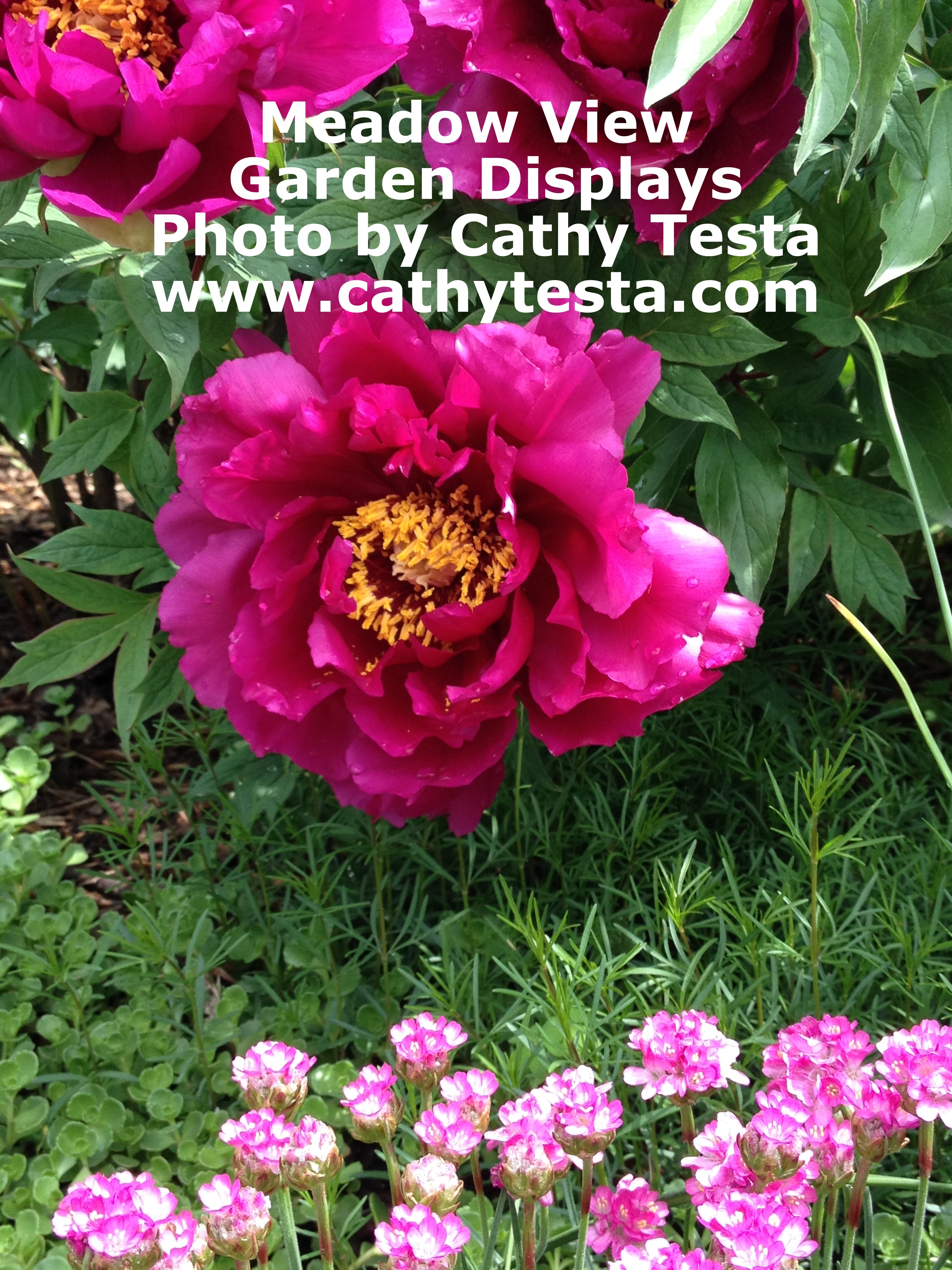
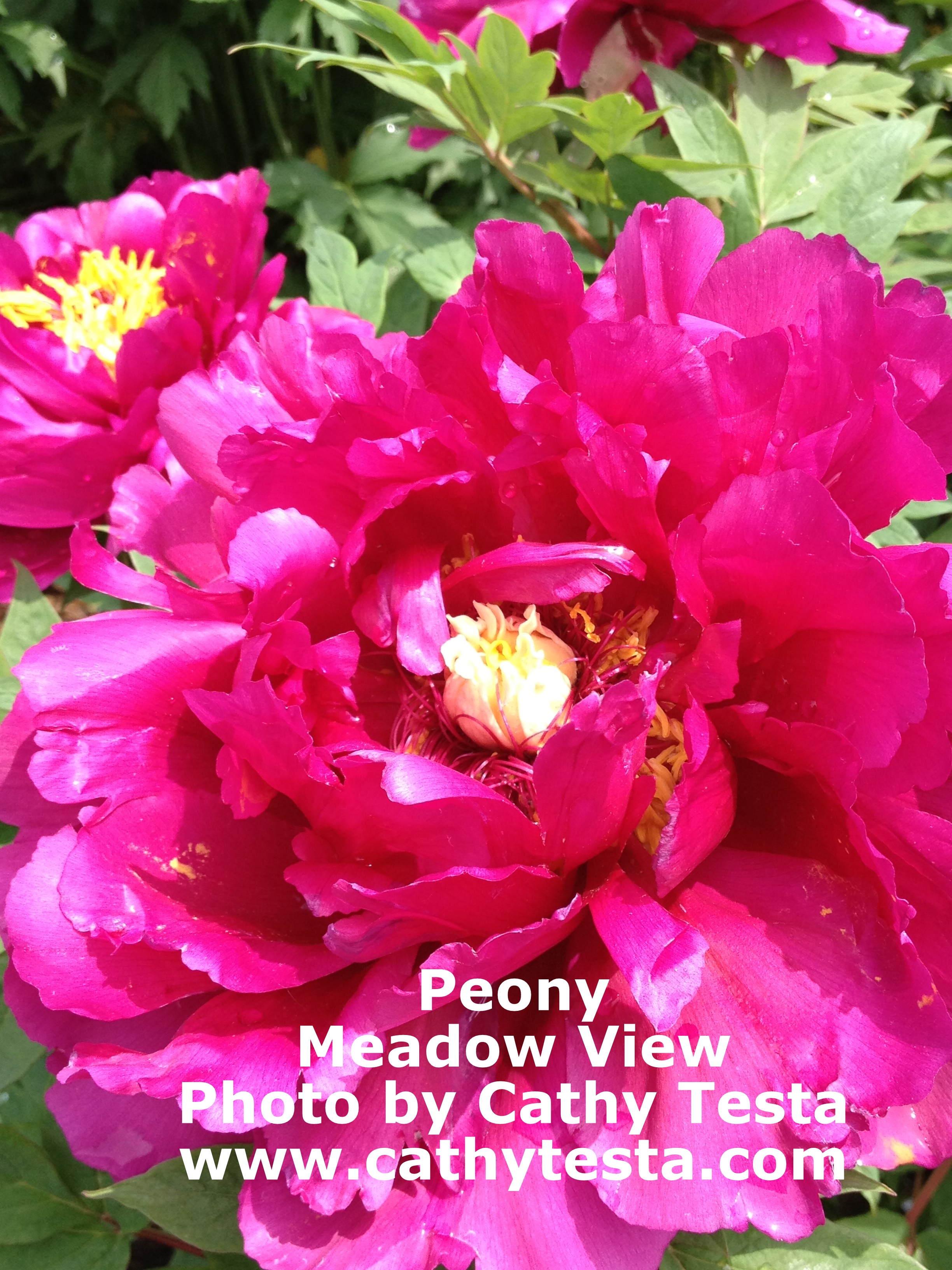
A stunning peony in the garden displays

A stunning peony in the garden displays

And it is very important to know – they do not take credit cards.  So go there with cash or a check with license in hand.  One would be very disappointed indeed if they made the travel there only to discover you can’t use a credit card – especially if you didn’t know while you waiting in the checkout line.  It was at least 12-15 people long at times, but moved very quickly because they have a line of registers with very competent and fast moving staff.

But one guy behind me was just a bit too excited.  As I waited in line, I spotted a bougainvillea plant and passion flower in hangers to my left.  I wondered how much they were, so I quickly ran over looking for the price tag.  Would you believe, he banged the back of my cart as the people in-front of me started moving forward to cash out.  Guess I forgive him for being so impatient cause he had some huge hanging baskets on his cart – I think he just couldn’t wait to get them home.

Cash out line - moves quickly

Cash out line – moves quickly

Meadow View may be out in the country, and a bit of a drive for some folks, but this place has a big draw.  My friend, Brian, told me it is “always like this” when I commented on how busy it was for a week day.  I filled my cart with other plants, checked out, and enjoyed the sandwich I was glad I packed in my truck for lunch.  And off I went anxiously to pot up my new lemon tree for my deck.

By the way, for you locals here thinking about going, I went through Suffield, CT and took Rt 168 for about 8 miles, past Lake Congamond.  It is a beautiful country road, so I enjoyed the ride very much – and thought about how I have to go to that lake for kayaking some day soon too.

Cathy Testa
Container Crazy Cathy T
http://www.cathytesta.com
(860) 977-9473 cell
containercathy@gmail.com

Trucks constantly deliver restocks from the greenhouses to the retail area

Trucks constantly deliver restocks from the greenhouses to the retail area

Capturing the Beauty of Flowers

4 Comments

Look at this stunning photo taken by a local Professional Photographer, Catherine Cella of Joyful Reflections Photography.  Catherine is my next special guest speaker on May 9, 2013 – Thursday.  To read more about this opportunity, click on the CLASSES above and take a look at the “Class Flyer” with all the details.  You don’t want to miss this chance if you love photography, plants, and the beauty of flowers.  You will learn special techniques on how to use natural light, the importance of camera settings, and more. Plus I will share information about the plants as we learn from Catherine.  We will be meeting at a local garden center at 9:00 am for this class.  Sign-up today to join us.  Looking forward to seeing you there.

Magnolia Tree Blooms by Catherine Cella of Joyful Reflections Photography

Magnolia Tree Blooms by Catherine Cella of Joyful Reflections Photography

Cathy Testa
Container Crazy Cathy T
http://www.cathytesta.com
860-977-9473
containercathy@gmail.com

3 Quick Examples of Color and Plant Combinations from the Boston Flower & Garden Show

1 Comment
Great combination of colors

Great combination of colors

No . 1:  Tradescantia x andersoniana ‘Sweet Kate’ with Daffodils and Hosta

This weekend, at the Boston Garden and Flower Show, I admired a combination of plants with a monochromatic color scheme utilizing hues of yellow and greens.  It was displayed at one of the garden exhibits and included yellow blooming daffodils (Narcissus), variegated hosta, and Tradescantia x andersoniana ‘Sweet Kate.

‘Sweet Kate’ was placed between the daffodils and hosta.  This perennial, with the common name of Virginia spiderwort or widow’s tears, has long strap-like leaves, resembling long blades of slender grass.  The leaves of this cultivar have an iridescent yellow color, most showy in full sun conditions.

At the base of this planting bed, an ivy plant was tucked within which had leaves with yellow margins, repeating the hues of yellow in the grouping of plants.  Purple blooms of Muscari armeniacum, grape hyacinth, with urn-shaped flower clusters on short flower stalks created a complementary color (purple opposite yellow on the color wheel).  It was a soft and spring like combination.

Softly repeating yellows

Softly repeating yellows

I thought to myself, this designer carefully selected plants that worked well together in regards to subtle colors, and it also had a nice woodland feel.  I think it is a good example of simplicity, and a perfect combination to use in spring container gardens, with the daffodils serving as a “welcoming” plant, ‘Sweet Kate’ as a filler along with the hosta, and the ivy as a spiller.  It was charming and calming, so I took a couple quick photos to post on my blog, and share with you.

No. 2:  Heuchera with hot red Tulips and Euphorbia

Another arrangement, located at the next display, was a combination of intense red blooming tulips combined with the bright leaves of a Heuchera perennial at the base, and yellow flowers of a Euphorbia perennial to the left of the tulips.

The display was elevated with a mirrored window frame in the background to capture the colors in its reflection. Again, the designer was thinking of color, but in this case, a harmonious relationship of red, yellow, and green was utilized.

The red tulips were the thrillers, and caught your eye from a distance, adding some heat, while the yellow was a bit less intense but still created a warm tone to the grouping of plants, quite opposite of the soft hues displayed in the prior exhibit at the flower show.

Red Tulips with Euphorbia and Heuchera

Red Tulips with Euphorbia and Heuchera

The Euphorbia, left to the tulips, with yellow flowers at the tips, echoed the bright yellow colors of the Heuchera tucked in at the base of the grouping of plants.

The Euphorbia perennial, known as spurge, has flowers with yellow bracts turning an orange-red.  In the center, you can see a dab of red again repeating the red tulips’s color.  The leaves have a reddish midrib.  These small pops are like the brush strokes in a painting – adding a bit a flare you may not consciously notice, but feel.  Take notice in the next photo, there’s some yellow strokes at the base of the red flower petals on the tulips.

I didn’t write down the Heuchera’s cultivar name from the display, but it reminded me of Heuchera ‘Citronelle’ with bright citron yellow foliage.  Common name is coral bells. Heucheras make great fillers in container gardens in spring and last well into mid to late summer. And while the Euphorbia flowers may fade, the foliage will last to the end of summer too.  Both plants are easy to grow.

Close up of red Tulips with Heuchera

Close up of red Tulips with Heuchera

The arrangement using hot reds and yellow with solid, reliable greens immediately reminded me of one of my favorite spring container gardens I assembled a couple years ago, using a pop of red and probably the same bright yellow Heuchera, with some red repeating colors from a Euphorbia.  See here:  Cathy T’s container garden:  spring combo

The next plant combination may not be for everyone, but it caught my attention.  I really like foliage in designs, and this one put together an unusual grouping. In the center, a very tall bamboo plant is showcased, with Helleborus orientalis ‘Brandywine’ perennial sitting below at the base and Mondo grass. Who would have thought these would work together?  But they do.

Bamboo with Helleborus perennial

Bamboo with Helleborus perennial

No. 3: Fargesia nitida (bamboo) with Helleborus ‘Brandy Wine’ and Mondo Grass

I also liked how they alternated the Helleborus plant at the base with what I believe is a Mondo grass.  Again, foliage shapes and forms work well. The Asian styled walls and windows make the foliage plants stand out more and draw your eye in to the design area at the same time.

Helleborus plants happen to be one of my favorites because of their coarse semi-evergreen foliage, deer-resistant trait, and early flowering in late winter to early spring. Hellebore is the common name.  It has cultivars with flower colors in dark plums to soft pinks, whites, and more pale colors.  Hellebores also make excellent long lasting container garden plants as fillers, lasting well into fall. They are a “solid” plant to use in containers and can be transplanted to your gardens when the season is over.  I like how the basal leaves are tough, and some have a little bit of serrated edges.  It is a partial shade to full sun plant and fairly drought tolerant.  Some are starting to poke out of the ground right now, as we enter spring.

These are just three quick examples of color and plant combinations I saw at the show – there were many more.  There was even a display covered in fake snow, which was so appropriately timed – as we got snow fall yesterday – one day before the “First Day of Spring” which is today, March 20th.  I hope it melts quickly so we can go get some of these spring flowers and start adding some color to our porches and gardens soon!

Snow covered display

Snow covered display

Container Crazy Cathy T
(860) 977-9473
ctesta@sbcglobal.net
http://www.cathytesta.com