The Last Weeks of Apple Picking – Get Out There

5 Comments

If you haven’t gone apple picking yet, I encourage you to get out there.  I went yesterday with two of my sisters and their kids, and what a great day we had.  We visited Belltown Hill Orchards in South Glastonbury/Portland, CT.

We road in wagons hauled by tractors to several fields to get different varieties, we ate hot apple fritters after, and took more photos, then headed home to spin apples on an apple peeler to make pies and apple sauce, but best of all was biting into a crunchy apple with sweet tart flavors on the way home in the car.

photo (1)

The story of Belltown’s beginnings is inspiring.  It began with a purchase of seven acres by a young man emigrating to this country.  Today, the family running this farm owns 155 acres of beautiful rolling fields of apples, blueberries, pumpkins, and more.

“In 1904, Louis Preli at age 14 emigrated from Northern Italy to South Glastonbury to work with his uncle hewing railroad ties from the giant chestnut trees which once dominated the area.  By the age of 20, Louis saved enough money to purchase seven acres of land where the Farm Market and Bakery is now located.” (source: Belltown Hill Orchard – The Farm)

When I checked out at the register with my 12 lbs of a mixed variety of apples, I asked, “When does apple picking time close for the season?”  They replied, “In a couple weeks.”  So if you haven’t gone apple pickin’ yet – Get Out There!  You won’t regret it.

photo (6)

My Tips:

  • Arrive early to beat lines.  We went in the early morning.
  • Plan to stay awhile, they have picnic tables and a small bakery with goodies to eat.  Save room for the fritters!
  • Take your camera – lots of great photo opportunities, especially with the kids.
  • Wear shoes that protect your feet especially if going early in the morning where the dew is still on the apples and on the grass.
  • Bring a backpack.  They provide plastic bags with handles to load up your apples as you pick but if you prefer a backpack, that works too.

Thanks for visiting my blog,

Cathy Testa

A Fairy, the Castor Bean Plant, and Poison. Can They All Live Happily Together?

16 Comments

Perhaps the only person to definitely know if the castor bean plant and its three little seeds lying within each of its seed capsules has been and continues to be falsely portrayed as a lurking killer is the beautiful and bold imaginary fairy by the name of Ricina, a clever creation by Nancy Farmer, an artist residing in the United Kingdom.

A FAIRY

  • a small imaginary being of human form that has magical powers, esp. a female one.” (source: Google)

Art may be left up to the interpretation of the admirer or defined by its originator but my perception of Nancy Farmer’s creation, the fairy she named Ricina, is of a mature woman seductively perched upon the stalk of a castor bean plant.  With her eyes glanced to the side and a sneaky facial expression, Ricina appears to be ready to protect or serve the possible magical yet deceptive powers of the plant and its seeds. Her bright red lips and finger nail polish flanked by a smart little red bow tie around her neck matching her classic attire provides the admirer a glimpse of her individualistic style. And she looks a little playful too with a suggestive rise in her sexy leg and fashionable but just the right sized heeled shoes. A handsome umbrella dangles from the tips of her fingers and she sports a masculine hat – teasing mementos to remind of past stories and tales regarding the castor bean seeds and its potentially lethal toxin known as ricin.

Copyright Photo, Permission Required by Originator

Image courtesy of Nancy Farmer/www.nancyfarmer.net and nancyfarmer.wordpress.com

If Ricina could buzz by our ears, perhaps she would whisper there is nothing to fear. For only those with harmful and deliberate intentions could possibly use the plant’s powerful little bean-shaped seeds for malice and not joy.  She knows it requires the elements of keen knowledge about the plant’s toxic components and a bit of unrealistic determination by the offender.  Or maybe she would tell us only a fool would pry apart prickly seed capsules designed to keep predators at bay and then chew its seeds obviously marked with suspicious patterns.

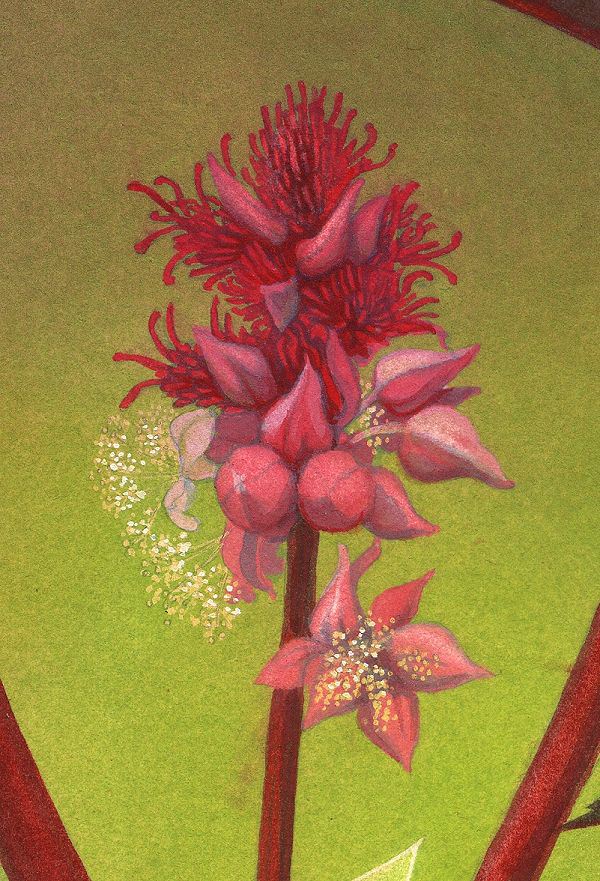
Nancy Farmers artwork of the castor bean flowers (www.nancyfarmer.net and anancyfarmer.wordpress.com)

Nancy Farmers artwork of the castor bean flowers (www.nancyfarmer.net and anancyfarmer.wordpress.com)

She would continue to reveal the beautiful benefits of the plants’ ornamental characteristics and its ability to thrive with little encouragement to provide grandeur in our gardens.  As she continues to deflect our attention from unproven matters of the castor bean plant, she may fly around exclaiming the exceptional as well as unattractive features of the plant from its large showy leaves, a towering height, and flowers with a combination of features as complex as its tales. The key, she should would say, is to admire ‘all of the plant’s’ wonderful virtues along with its adversity.  Because the castor bean plant has its good and bad sides.

Source Permitted by: Nancy Farmer (www.nancyfarmer.net/nancyfarmer.wordpress.com)

Source Permitted by: Nancy Farmer (www.nancyfarmer.net/nancyfarmer.wordpress.com)

Source Permitted by:  Nancy Farmer of www.nancyfarmer.net and nancyfarmer.wordpress.com

Source Permitted by: Nancy Farmer of http://www.nancyfarmer.net and nancyfarmer.wordpress.com

THE CASTOR BEAN PLANT

  • “A large shrub of tropical Africa and Asia having large palmate leaves and spiny capsules containing seeds that are the source of castor oil and ricin; widely naturalized throughout the tropics.”  (source: thefreedictionary.com)
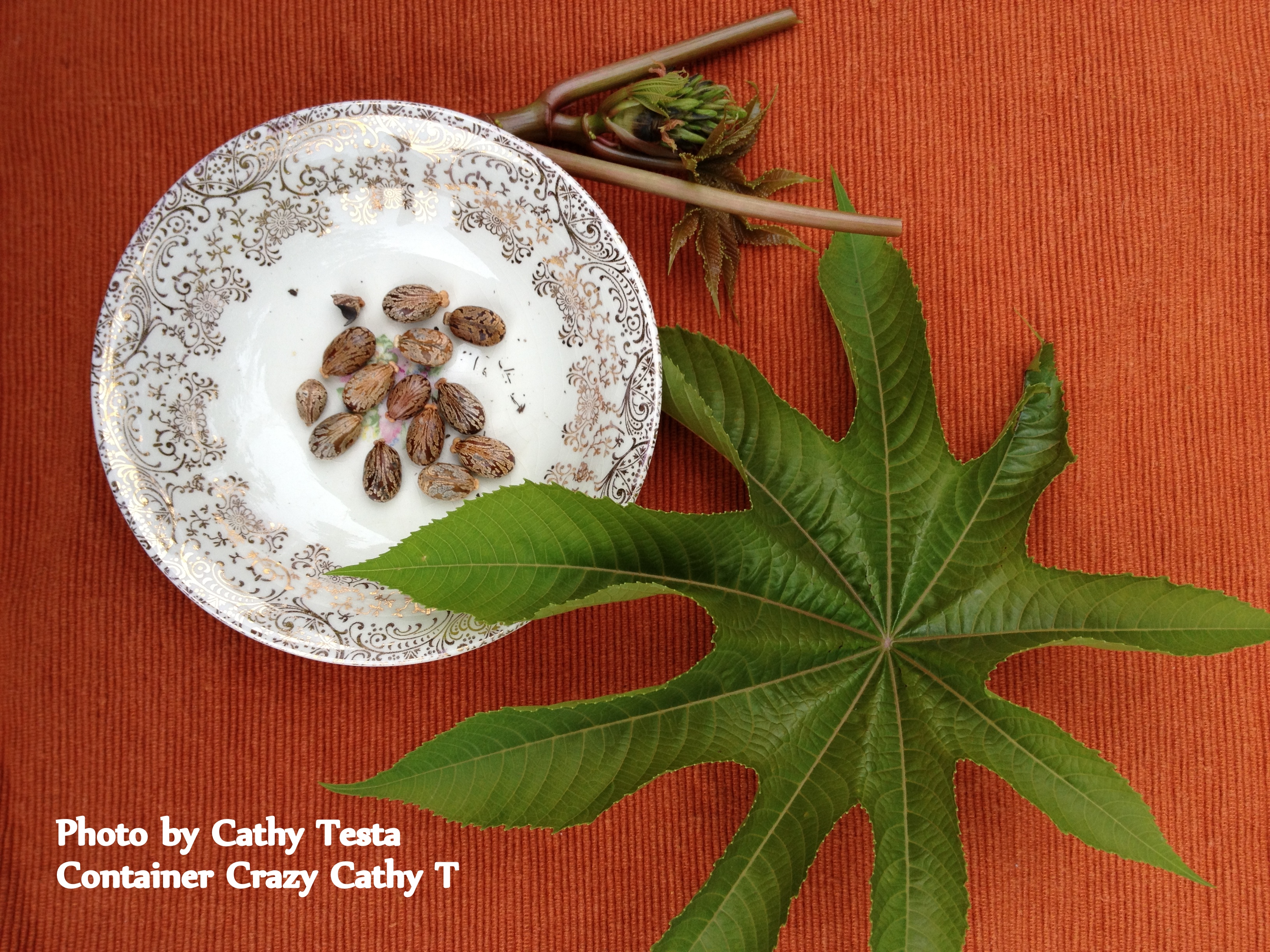
Castor Bean Seeds with a Leaf

Castor Bean Seeds with a Leaf

The castor bean plant or castor oil plant (Ricinus communis) is a tropical shrub or tree hardy in planting zones 10-11.  It is treated as an annual in Connecticut’s planting zones since it will not survive winter temperatures here. The plant grows rapidly from seed when planted in ideal conditions. It can easily reach between ten to twelve feet in a single season. As the stalk increases in diameter, it resembles thick bamboo. Large distinctive green leaves growing from the tips of long petioles are lobed shaped with several pointed star-like tips.  The species is primarily green, but cultivars come in vivid red to maroon colors, including the seed capsules.

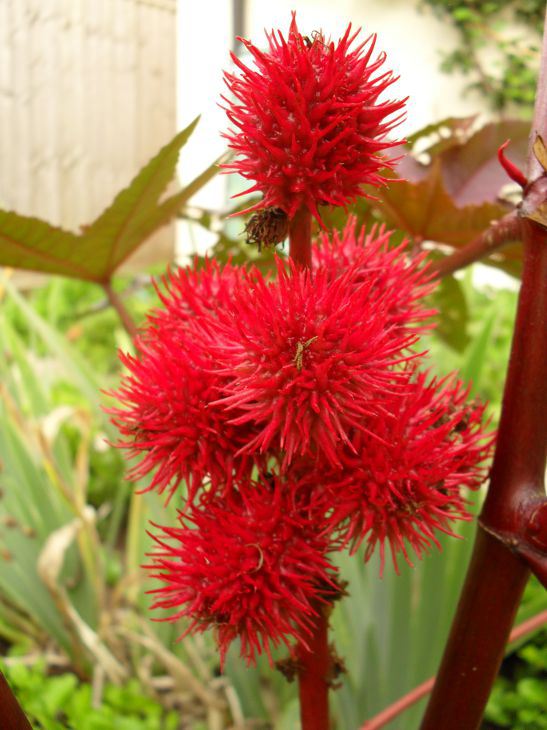
Nancy Farmer's artwork of the red seed capsules of a cultivar the castor bean plant

Nancy Farmer’s artwork of the red seed capsules of a cultivar the castor bean plant

Photo Courtsey of Nancy Farmer's Artwork

Photo Courtesy of Nancy Farmer’s Artwork (www.nancyfarmer.net and nancyfarmer.wordpress.com)

The plant’s odd-looking flowers consist of separate male and female flowers on the same plant. When both sexes are on the same plant, this is termed monoecious. The male flowers are white and tiny, situated just below the female flowers.  Red styles, the narrow part of the pistils, are clearly visible on the female parts of the plant.

Female Flowers on a Castor Bean Plant

Female Flowers on a Castor Bean Plant

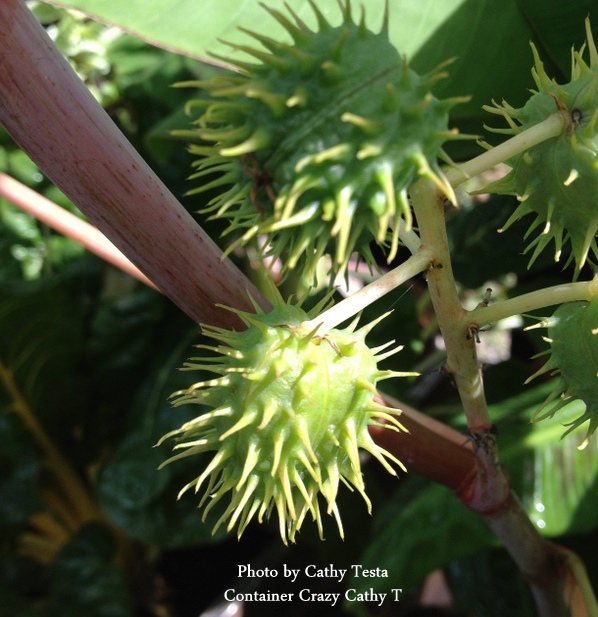
Prickly seed capsules - Ricinus communis

Prickly seed capsules – Ricinus communis

Round seed capsules grow from the female flowers which are rather interesting. They are composed of three joined lobes or hulls covered with soft prickly spines. Inside each prickly capsule are the infamous castor bean seeds, known to be the source of a potentially lethal toxic, known as ricin. Although the castor bean seeds are the size of edible beans, think kidney beans – they are not true beans at all.  And they are not meant for direct consumption, but used for the production of castor oil and other traditional medicines. Some people think the seeds resemble inflated ticks, and the genus name Ricinus is the Latin word for tick.

Mature seeds of the castor bean plant

Mature seeds of the castor bean plant

Immature seeds in the capsule.  Photo by Cathy Testa

Immature seeds in the capsule. Photo by Cathy Testa

A POISON

  • “a substance that, when introduced into or absorbed by a living organism, causes death or injury, esp. one that kills by rapid action even in a small quantity.” (source: Google)
  • “a person, idea, action, or situation that is considered to have a destructive or corrupting effect or influence.” (source: Google)

Relief from the use of castor oil derived from the seeds of the castor bean plant (Ricinus communis) may yield some benefits for people still using this remedy as a laxative, but there are reported sinister sides to the seeds, that when used in a specific fashion and with its toxic substance, will lead to illness and sometimes death of an unsuspecting victim. Some stories or myths shared from past to present about such occurrences, including claims of sneaky murders from administering ricin with a common umbrella as the mode of transmission, to claims of accidental deaths from chewing the seeds without the realization of the disastrous results days later, may be somewhat exaggerated.

In the words of John Robertson who has spent ten years researching, writing and talking about poisonous plants:

Butthough ricin is extremely poisonous it actually does little harm. Around one million tons of castor beans are processed each year for castor oil production leaving the waste pulp with up to 50,000 tons of ricin in it. And, yet, finding instances of ricin poisoning is not an easy task. (source: THE POISON GARDEN website)

Victims are said to suffer from vomiting, diarrhea and dehydration once attacked by the evil person in possession of the ricin.  Others have eaten the castor bean seeds in ignorance with the belief it is a medical solution to their health problem. Yet the more you read regarding the poisoning powers of the infamous castor bean seeds, the more unclear the accusations and exaggerations become regarding the potential for eventual death to occur. Some sources attempt to explain the differences between poisonous and dangerous because a person can do no harm without the right combination of both a lethal toxin and attitude.

In a ten minute video on THE POISON GARDEN website about ricin, John Robertson states, There’s a big difference between poisonous and harmful.  For a poisonous plant to become harmful, there has to be a way to administer the poison.

Leaf of the castor bean plant (Ricinus communis)

Leaf of the castor bean plant (Ricinus communis)

THE HAPPY TOGETHER

Many references will indicate you should keep the castor bean plant and especially its seeds away from children or animals, and should you have either, this may be a needed precaution.  More important, I would say, is to be knowledgeable about the plants before placing one in your gardens. Unlike plant tags listing all the beneficial reasons a plant is successful (a winner, deer-resistant, hummingbird magnet, drought tolerant, etc.), the downsides of plants are not indicated at all.  One is to wonder if plants should have warning tags (e.g., potentially toxic, invasive, aggressive, addictive, etc.) but for obvious reason, they do not.  However, I have grown castor bean plants at my home and so have many others worldwide.  In some parts of the country, the plant grows as a common roadside weed and the population of people near these situations are aware of its hazards. Similar to other things in our society which are dangerous under the wrong circumstances and in the wrong hands, we must just be more educated and not be put in a state of fear.  After all, if the castor bean plant and its potential poison is a killer, why am I not dead?

Racina, the plant, and myself co-exist without any ill effects – and you can too if you admire the castor bean plant’s features.  One way to limit your anxiousness regarding the prickly seed capsules with seeds within is to remove the flowers all together on the plant, or remove the capsules before they mature and potentially crack open to drop seeds on the ground.  Wild animals seem to understand the precautions and warnings provided by the plants as an adaptation to say “don’t eat me, stay away, I’m trying to reproduce.  And if you tempt it, I will make you sick enough so you remember.”  How incredibly wondrous by the plant.  Racina, as I imagine her, understands this.  She, the plant, and the poison all live happily together.

And I think you could too,

Written by Cathy Testa©

White male flowers on the Castor Bean Plant (Ricinus communis)

White male flowers on the Castor Bean Plant (Ricinus communis)

P.S.  A very special thank you to Nancy Farmer, the obviously talented artist capturing the essence of the castor bean plant’s legends with a fairy.  She and her amazing works of combining ‘nature with art’ may be found at:

http://www.nancyfarmer.net/

http://nancyfarmer.wordpress.com/

References and Other Sources:

http://www.uicnmed.org/nabp/database/HTM/PDF/p86.pdf

http://en.wikipedia.org/wiki/Castor_oil_plant

http://www.thepoisongarden.co.uk/atoz/ricinus_communis.htm

http://www.missouribotanicalgarden.org/PlantFinder/PlantFinderDetails.aspx?kempercode=b459

http://www.ct.gov/caes/lib/caes/documents/publications/fact_sheets/plant_pathology_and_ecology/poisonous_plants_06-27-08r.pdf

http://www.ansci.cornell.edu/plants/castorbean.html

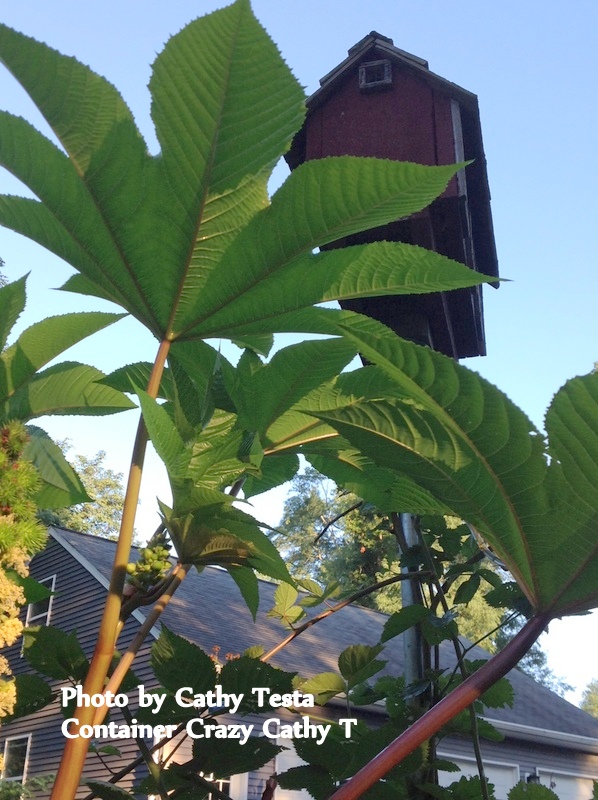
Castor Bean Plant growing at Cathy Testa's home near a birdhouse on a 10 feet high pole.

Castor Bean Plant growing at Cathy Testa’s home near a birdhouse on a 10 feet high pole.

Ten Dirty Little Secrets Master Gardeners Don’t Want You to Know

5 Comments
Image Courtesy of Grant Cochrane/FreeDigitalPhotos.net

Image Courtesy of Grant Cochrane/FreeDigitalPhotos.net

You may be standing there questioning your own abilities as a gardener while envying a master gardener’s garden, but what you don’t know is the so called master gardener you are in awe of (or the professional gardener you asked for help), is hiding some truths about how they do it.

Image Courtesy of imagerymajestic/FreeDigitalPhotos.net

Image Courtesy of imagerymajestic/FreeDigitalPhotos.net

So before your gardening failures bring you to tears – or make you want to just give up – learn the truth.  Here are some dirty little secrets master gardeners and professional gardeners don’t want you to know.

1 – They hire help.

Image courtesy of FreeDigitalPhotos.net

Image courtesy of FreeDigitalPhotos.net

Anyone who’s attempted gardening is fully aware it is high-maintenance to keep all spaces and plants pristine unless your plants are made of plastic.  You can bet the person, as in the master gardener or professional, who’s garden you have been admiring, has been hiring someone to tend to their garden behind the scenes. They have a full time or part time servant doing their dirty work.  It may be a landscaper, a teenager, or just an overly ambitious newbie to gardening eager to learn from the “master or pro.” Whoever it is – they are not doing it alone. This is especially true for gardens designed by professional gardeners featured in magazines, on websites or television. Their gardens are so spectacular, the photos speak volumes and you grow your envy as you look over their talents, but just remember, they have help.

2 – They make up plant names.

Image Courtesy of phanlop88/FreeDigitalPhotos.net

Image Courtesy of phanlop88/FreeDigitalPhotos.net

Its true.  Those Latin names they are so eloquently pronouncing as they point to their unique plant specimen may not be its true name.  In times of panic or memory loss, where it would be revealed to the casual gardener their Latin expertise is not up to par, they may just make something up spontaneously under pressure, AND make it sound great.  Master gardeners and professional gardeners study plant names – believe me, and know them – or most of them.  The best in the business can pronounce them with such precision, the accent in their voice rises your envy level to a new high. And pro’s take pride in this skill – and thus, they should.  However, everyone forgets. Once in a while, when showing off their amazing and stunning garden plants to their captivated audience, they may have an embarrassing lapse in their memory bank.  So they just make it up.  Next thing you know you are pointing to your new plant, telling your friends it is the Hosta ‘Monster Fries’ with no awareness you are sounding like a fool – or pro, depending on how convincing you are.

3 – They claim to be totally organic.

Image Courtesy of digitalart/FreeDigitalPhotos.net

Image Courtesy of digitalart/FreeDigitalPhotos.net

I bet my bottom dollar if we set up a hidden camera near an “organic gardener’s” unblemished gardens, we would witness the awful truth – they claim to be totally organic but have reached for a synthetic pesticide (at least once, or twice in their desperation).  Let’s face it – professional and master gardeners take immense pride in their showcases, so if they have tried soapy water, picking off bugs by hand, setting up insect traps, and other natural organic methods – and still find a pest on their prized plant ordered for beaucoup dollars from a specialty nursery, they reach for a hidden bottle of “x” and spritz the sucker when no one is looking.  By the way, to be “certified organic” you must prove it by supplying a great deal of tedious documentation.  So anytime you see the words ‘certified’ – you should be able to trust it.

4 – They hide a really great reference source.

Image Courtesy of imagerymajestic/FreeDigitalPhotos.net

Image Courtesy of imagerymajestic/FreeDigitalPhotos.net

Master gardeners and professionals learn a great deal about plants and gardening by studying, trial and error, hands-on experience, or by taking college horticulture classes. But along the way, they discover an amazing resource book. Or they may have a trusted (other secret) professional gardener with whom they exchange all their tricks of the trade.  But, they don’t tell you about this secret source or reference book. It is like a private club of pro’s sticking together and not letting anyone else in unless you are worthy. You know who I’m talking about, don’t you?  Just like chefs do not reveal their “secret” ingredients, master and professional gardeners don’t tell all of their secrets either.  They have some tools they keep to themselves.  Otherwise, they risk not being “the master.”

5 – They are not really “Master” Gardeners.

Image Courtesy of stockimages/FreeDigitalImages.net

Image Courtesy of stockimages/FreeDigitalImages.net

Yes, this is probably the biggest dirty little secret of them all.  Anyone can sign up for the master gardening program, and many of those who do are avid gardeners.  When I took the classes, I discovered the true meaning of gardeners.  So many of the program’s attendees were people with lots of dirt under their fingernails and have spent years, almost a life time, practicing the art.  But if an attendee has little to no experience, and sits in a classroom for 16 weeks of training for 10+ hours a day, this does not instantly make them a MASTER gardener.  So if someone says, I’m a Master Gardener, you may want to differentiate if that means they actually mastered years of experience in the garden, took other training (like college hort courses), and have official proof they are a “master” – Or if they just took the training program and are now claiming they are a Master.  And really? A MASTER — This term is not applicable in the gardening world. Everyone knows you never truly master nature. Master gardeners are passionate, finish the program, pass the test, and are special volunteers contributing their time and energy to many horticulture related needs. These are the attributes which make unique and worthy.

6 – They have no social life.

Image Courtesy of Sira Anamwong/FreeDigitalPhotos.net

Image Courtesy of Sira Anamwong/FreeDigitalPhotos.net

People who spend all of their time in their gardens have little social life – how can they? Their gardens are perfect, lush, full, and maintained – so they are most likely spending most of their free time in their gardens. Granted they want to do so, and this is what makes them truly happy – but they are not using up their free hours to go on trips, shows, events, or parties.  In fact, the only time they may be talking to real people is when those people are admiring their gardens.  Gardening is their preferred past time, which yes, is “a life,” but most of the time they spend admiring and talking to their plants, and not people.  Plants don’t talk back.  If they are available for social events, see dirty little secret no. 1.

7 – They steal plants.

Image courtesy of Simon Howden/FreeDigitalPhotos.net

Image courtesy of Simon Howden/FreeDigitalPhotos.net

Most avid gardeners with master or professional skills will succumb to stealing a cutting from someone else’s garden or while on a tour of a botanical garden at some point.  Why? Because they get jealous and must have that plant too in their garden to rank as high as the garden they visited. You see, they can’t resist taking a plant like a drug addict can’t stop taking pills.  They have secret pruning tools hidden in their pockets and snip a cutting or grab some seeds, and then go home and enter their greenhouses to propagate them.  They may even, God forbid, propagate plants with plant patents, prohibited by the horticulture industry.  And some of them will sneak into their neighbor’s gardens while the neighbor is at work to take a seedling, thinking you won’t notice. They may even give you false flattery so you will volunteer a cutting to them. Even pro’s can reach those lows.

8 – They have a large bank account.

Image Courtesy of stockimages/FreeDigitalPhotos.net

Image Courtesy of stockimages/FreeDigitalPhotos.net

Some pro’s or masters have unlimited funds to spend on their garden maintenance, plants, and replacements when something fails.  They don’t have tight budgets holding them back from buying brandy new plants anytime they wish – or big plants which they plop into their gardens and claim to have grown from a baby seedling.  They can afford to load up their Lexus SUV with many expensive and unique specimens to add to their garden collections. When a plant is doing poorly, they can rip it out, and toss it in the compost. They will just go buy a new one.  They dress up their gardens before their garden tour by doing just that. They may even buy some container gardens created by someone else (hint-hint), and place them just perfectly for your admiration as if it was their own.  As shocking as this may be, some gardeners, especially pro’s can spend fortunes on their gardens – they may even have an inherited amount to use just for that!  Not all of them are able to achieve grandeur without sufficient funds.  Grandeur without funds can be achieved, but it takes skill, practice, knowledge – and patience.  So hope is not lost if you are not rich.

9 – They misdiagnose plant problems.

Image Courtesy of lemonade/FreeDigitalImages.net

Image Courtesy of lemonade/FreeDigitalImages.net

There is a plethora of reasons why a plant may be ill or fail.  To properly determine what the problem is, you have to do a thorough assessment, carefully look at symptoms and signs, and what the gardener has been doing wrong or where they planted it – or maybe the plant was sick before it left the nursery.  You may ask your friend, the master gardener or a professional, and they give you an answer that sounds right.  “Oh, that’s black spot,” they said. Well, you see spots, and they are black, but maybe it is not black spot.  A pro should not guess, and many will not do so, but sometimes they just don’t know “for sure.”  Even a scientist looking through a microscope can misinterpret the issue with the plant.  That is because plants are a combination of science and art.  Some diagnoses are obvious and based on facts, others are just guesses.  Don’t be surprised if a pro misses the target from time to time. They are not as perfect as you think – they make mistakes too – just like an unseasoned or beginning gardener.

10 – They are better at mowing lawns.

Image Courtesy of foto76/FreeDigitalPhotos.net

Image Courtesy of foto76/FreeDigitalPhotos.net

When working in a garden center, I came across a few so called professionals knowing nothing about plants.  They’d send their “clients” to the center to review their created design or ask questions about plants, and I would help them.  But I thought, “Why isn’t the pro doing this with them?”  Or a pro would show up and didn’t know that Ilex is a holly (well, genus of Holly trees and shrubs).  There are lots of people out there offering their services with no formal education, experience, or plant knowledge.  But everyone has to start somewhere – don’t they?  And it could turn out that guy starting off mowing lawns has a great personality, the desire to meet their customers’ needs – and is willing learn – and maybe even become a true professional.  But they started somewhere, and probably had some crying moments too. They just don’t want you to know about it.

Written by Cathy Testa

A Mansion Grand Enough for Topiary Camels in Newport, RI

4 Comments
Cliff Walk View

Cliff Walk View

We had no intention of touring a mansion during our visit to Newport, RI this summer, but it ended up falling on our agenda regardless.  The last morning of our weekend, we packed a cooler filled with a picnic lunch, and headed off to the famous Cliff Walk.  Our goal was to sit and watch the rolling waves after we got in some exercise.

But, about 20 minutes into our walk, we discovered a barrier ending the path early. The sign indicated the Cliff Walk was closed “beyond this point” due to storm damage, up to Ledge Road.  Disappointed, yet determined, we backtracked to our car, and drove up Bellevue Avenue to locate the Ledge Road entrance, so we could continue our walk beyond the damaged areas.

Finding Ledge Road was easy, however, we discovered there was no public parking near that entrance, only private street side spaces.  We drove back up the end of Bellevue Avenue considering what to do next.  It was then I noticed beautiful and full Hakonechloa grass by a gated entrance.  I wanted to take a photo of the grasses because it was such a great example of how to use them in the landscape, so I asked Steve to slow down.

That moment lead to us entering the premises, marked “open” by a flag near the entrance gate.  The friendly man at the gate told us a tour of the mansion on the property was about to begin in a half-hour.  With nothing else on our backup plan, we got tickets to join the tour.  This was the last mansion on the famous Bellevue Avenue strip, called Rough Point – and maybe one that is overlooked since it is last on the strip.  I know we wouldn’t have bothered if it wasn’t so convenient as our next adventure of the day.

Camels Stuffed With Succulents and Herbs

Camels Stuffed With Succulents and Herbs

As we drove into the parking area, we both noticed topiary camels in the side yard, and thought that was interesting, and a little unusual or unexpected.  This was, after all, a mansion.  Wondering what the story was behind those, and thinking I will take photos of it later, Steve went to get tickets for us.  He exited the mansion with a white pamphlet in his hand, which I began to read.

“Wow,” I said, “This property was designed by Olmsted, … as in the father of landscape architecture.”

So naturally with the white pamphlet in hand, I was excited that we would be touring his home.  What a coincidence – this is something I’m actually very interested in.  Guess those Hakon grasses at the entrance were a sign of sorts.  Followed by the camels – well, this may be worth doing.  So onward we entered, and I couldn’t wait to hear about him and the property.

Front of Mansion facing Ocean n Cliff Walk

Front of Mansion facing Ocean n Cliff Walk

Upon five minutes into the tour guide’s talk, I was confused.  Why was she referring to a woman who owned this mansion, and not a man?  And who is this woman, by the name of Doris Duke?  She obviously was someone rich and famous by the million dollar paintings and art pieces in the house, but was she married to Olmsted, or what?  I turned to Steve holding up the white pamphlet and whispered, “I thought this was about Olmsted?”  He just shrugged his shoulders, and frowned a little when he heard the tour guide say it would be about an hour or so for the tour.

Turns out the fact the outdoor grounds were designed by the “father of landscape architecture and one of the most prolific and renonwed American landscape architects,” was not a major highlight of the tour.  It was just a coincidence, a good one for me, because I was now excited for both the tour and grounds to follow on our own. I figured after hearing the tour would take one hour, the best part would be when it was over when I could see the outdoor landscape and gardens, which they noted we could take our time to enjoy.  And it gives us access to view the ocean on the mansion side, versus the broken and damaged inaccessible Cliff Walk.

As we heard about this woman’s taste in her collections, and about her large dogs allowed to sit on rather valuable furnishings, and about her two camels by the names of Baby and Princess, I was intrigued, and very much interested and enjoying the story of Doris Duke’s life as a philanthropist, world traveler, and collector, while viewing the many treasures in her mansion and home.

Doris Duke, it turns out, inherited an estate estimated at $80 million at the age of 12, from her father.  Her father was an industrialist, and founder of the Duke Power Company.  It was mentioned he also invented the first rolled cigarettes.  She was his only daughter.  Wow, 12 years old and rich, but not without wisdom as we learned more.  She gave so much of her money to worthwhile causes, appreciated art and valued treasures, loved animals, and traveled the world.  I was kind of diggin’ this chick more than the vision of seeing Olmsted’s designed property and grounds outside after the inside mansion tour.

The whole time during our tour, I fantasized about the kind of life she led, filled with supporting charitable foundations (some in the horticulture scene such as the Orchid Society), and wondered how she and her friends dressed during their social events in the mansion’s grand rooms.  But there also seemed to be a tone of loneliness, perhaps, or it was just part of my vivid imagination – but somehow, I sensed she lived somewhat of a solitary life at points.  Maybe it was something about how she would swim for an hour by herself in the ocean facing her grand home, or the fact she was married, twice – but both marriages were brief, and also sadly she lost her only child, 24 hours after delivery.  Or perhaps it was something about her independence – how she would allow her rather large dogs to sleep on extremely expensive furniture, and have two camels roam the property.  To me those were little signs that she was not only elegant but down to earth.  I could be wrong, but I wanted to continue my daydreaming as I looked over every piece being well-described by the tour-guide (who I suspected was a teacher in her former life because she asked us questions about history, and other things, kind of like a mini test).

Whatever the reason I sensed this air of loneliness about Doris Duke, the home itself was a place I felt was cozy as well as grand.  It was filled with amazing carpets and tapestries, furniture, and paintings beyond my artistic knowledge, but the house still had a feeling of a place you could live in without it feeling overwhelming.  The rooms were connected in such a way, it wasn’t over powering, and it included a conservatory, which I couldn’t wait to see.

Once we arrived to it – the conservatory facing the grand lawn and ocean beyond, we heard a comical story of how the camels, named Baby and Princess, were put into the conservatory during a hurricane one year.  Doris had the staff clear out the room and put them in there to protect them. I won’t tell the rest of the story, better to save it for the tour you will attend if you plan to visit Newport, RI. But they did survive, and one camel is still alive today.  This was another piece of Doris that made her feel down to earth and not too pretentious.  After all – who would let camels into a mansion!?!

Hedge tunnel path to Secret Gardens

Hedge tunnel path to Secret Gardens

Once our indoor tour was completed, I was eager to visit the secret garden behind the privet hedges briefly mentioned, and the kitchen garden on the opposite side of the 10 acres grounds, which was twice the size when Doris Duke was alive.  But first was to go see the camel topiary structures in the side yard stuffed with drought-tolerant sedums, succulents, and thymes in honor of Baby and Princess, a gift to Doris Duke from a Middle Eastern businessman, as part of an airplane purchase.  Yup, guess the camels make sense now.  They were grand enough for a mansion, or perhaps the mansion was grand enough for them.  This would depend on your point of view.  And the swimming gate where Miss Duke entered the ocean for her daily swims – hard to imagine with the rough waves beyond, or the beautiful stone bridge flanked by rocky outcrops.  I took off my sandals and enjoyed the soft lush lawn under my feet as I began to walk in awe of the place.  Suddendly I realize I wasn’t considering Olmsted at all, and only Doris Duke’s life and vision.  She had a big part in many aspects of the outdoor areas as I read more later.

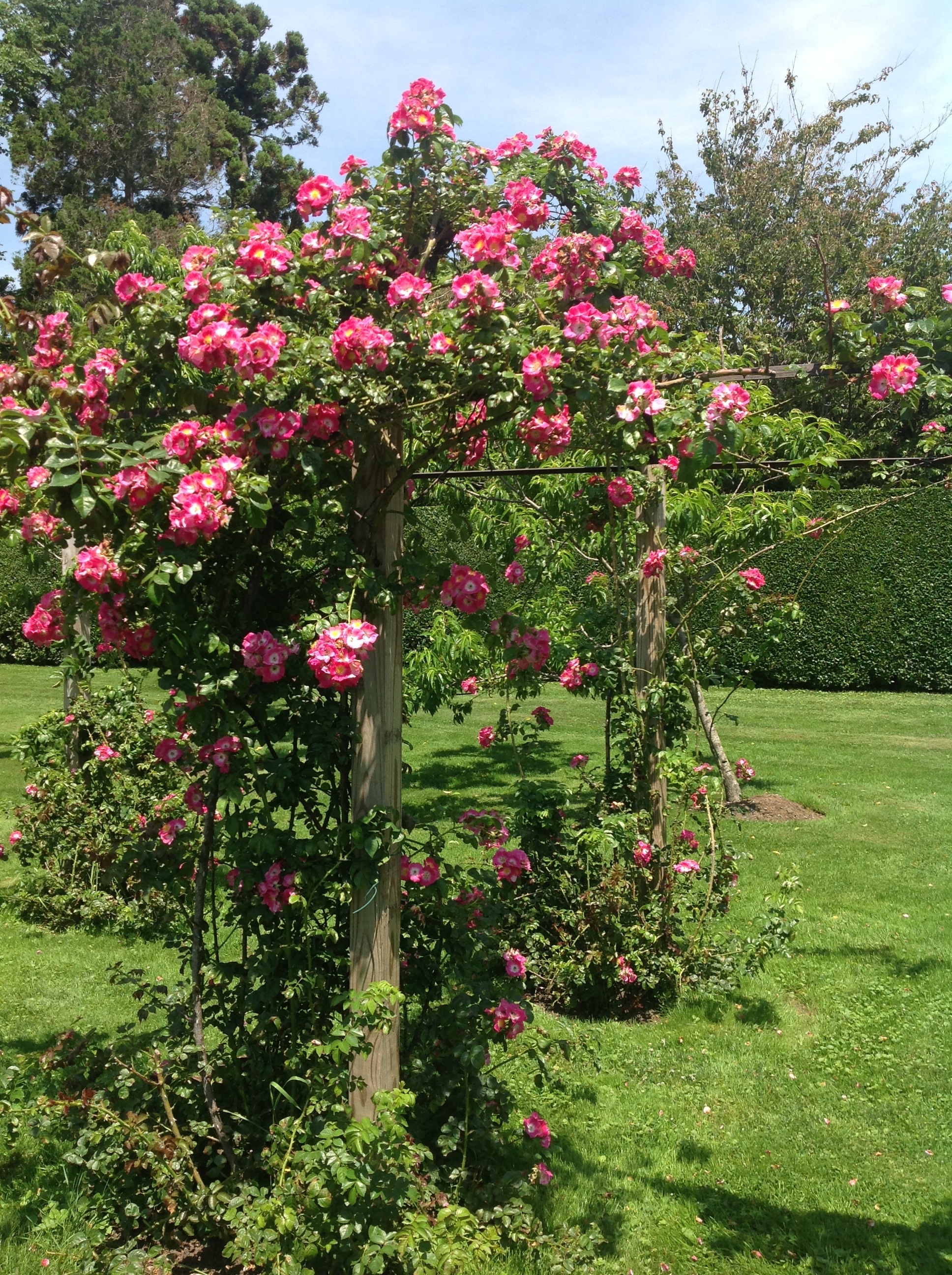
Roses blooming in Gardens

Roses blooming in Gardens

While in the private garden on the property, with a rose arbor was installed and planted at Doris Duke’s direction, planted with ‘American Pillar’ roses, which bloom only once a year, usually around July 4th, which happened to be the weekend of our visit.  The area is surrounded by a privet hedge, and flowers and tropical plants are included in the gardens.  While it doesn’t stand as it did in the same fashion as when Doris Duke directed the plant list, there was much to be enjoyed.  One area surrounded by a hedge of catmint (Nepeta faassenii) with a Brugmansia in a container in the center, was a favorite of mine.  Along with a bed lined with lamb’s ear (Stachys byzantina) and Boxwood.  And to see banana plants, most likely the hardy Bajoo’s, made me feel all the more admiration for the property and home.

lambs ear perennial lines edges of garden

lambs ear perennial lines edges of garden

Banana Plants in the Garden with Perennials

Banana Plants in the Garden with Perennials

While I suspect it was common to put the gardens tucked away in private areas, part of that made me sad, for you can’t see them unless you go adventure there.  Again, dreaming about how I would put gardens throughout the property, rather than leave a wide open lawn, which by the way is maintained by organic methods.

Brugmansia with Catmint

Brugmansia with Catmint

In The Kitchen Garden

In The Kitchen Garden

We discovered, as we toured the kitchen garden on the opposite side of the property, cinnamon and clove, are used as an insecticide.  A staff person, nameless and camera shy, came by to talk to us and told us this.  He said it was part of Miss Duke’s commitment to environmental causes, and the property, all 10 acres, have been maintained using organic practices since 2007.  This is truly amazing.  Removing my sandals as I walked the lawn areas, it was soft and cozy underfoot, and not one pesty insect was spotted in the kitchen garden as I snapped photos.  Our mysterious staff person, dressed in a white chef shirt, took our photo and complimented our chemistry saying he could see we were enjoying touring the grounds.  I kind of figured he was also investigating our investigation – this is a place, obviously is filled inside and out with rare and valuable beauty.

Opening where Doris Duke walked for swims in the ocean

Opening where Doris Duke walked for swims in the ocean

Some Tips:

DATES: Check the tour dates of RoughPoint, The Newport Home of Doris Duke.  It is closed during the winter season.

CAMERA: Bring along your camera – for the outdoor portions.  Indoor photos are not allowed.

LUNCH: Pack a lunch – as we did, for they don’t limit your time on the grounds, so you can enjoy the view with some snacks.

TIME: Give yourself one hour for the indoor tour, and one hour to enjoy and tour the historic grounds.

CLIFF WALK ENTRANCE: Enter the Cliff Walk via side street entrances (versus the beginning point).  There is one on Webster Street and Narragansett Avenue, shaded and free to park street-side.  Or, you can park at the beginning point of the walk, the entrance by the beach off of Memorial Boulevard, but have to walk up a long hill, and in the hot humid sun, we opted for the shaded area starting the walk a bit further along off Narragansette Avenue (connect via Annandale Road).

Cathy Testa
Container Crazy Cathy T
http://www.cathytesta.com
860-977-9473

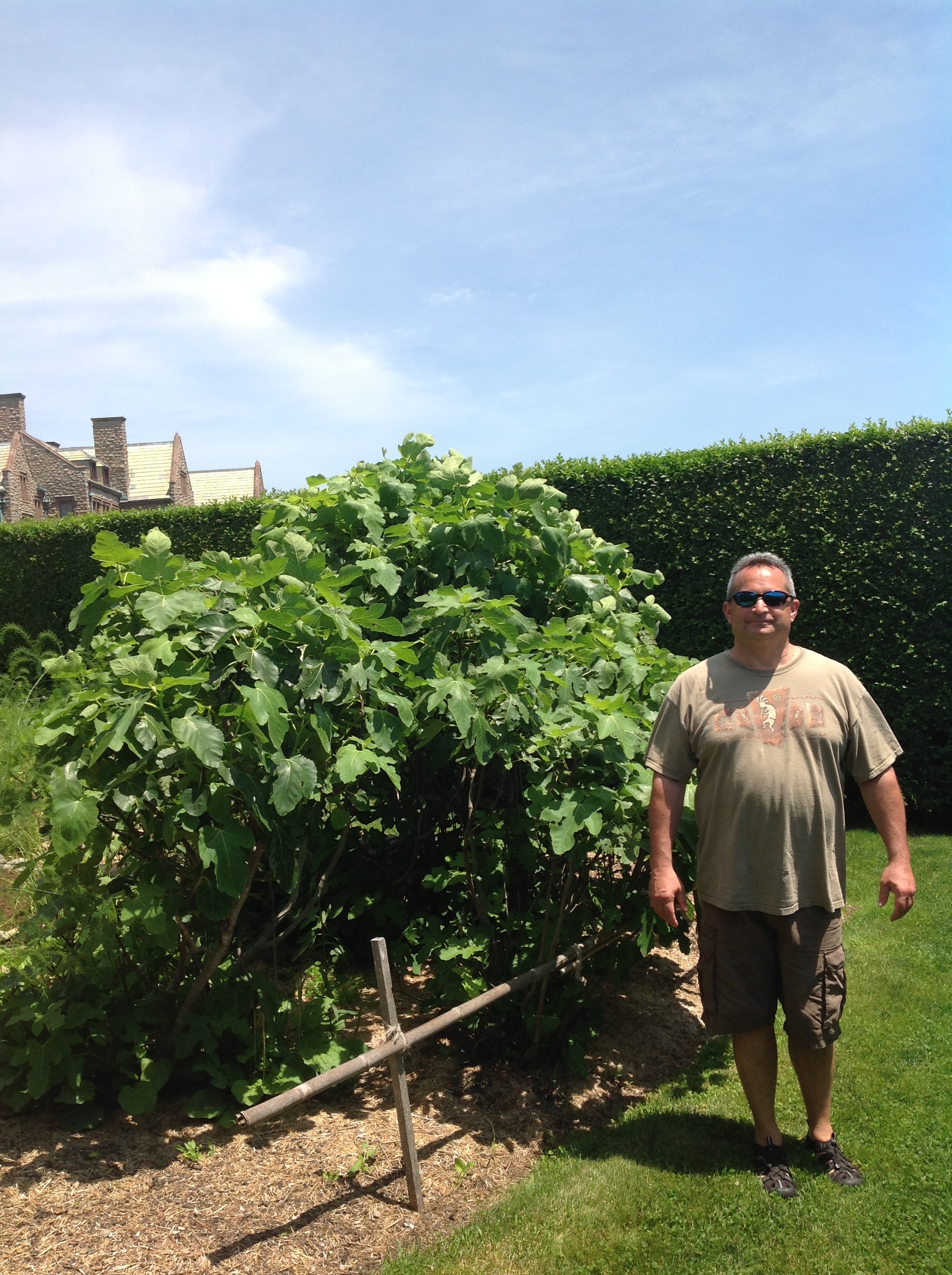
Steve next to Fig Trees in the Kitchen Garden

Steve next to Fig Trees in the Kitchen Garden

Cultivating a Future Farmer at Local Farmers Markets

11 Comments
My Guest Booth at the EW Farmers Market

My Guest Booth at the EW Farmers Market

It happened to be a coincidence that I had my niece along with me on two recent trips to farmers markets.  She seems to enjoy the scene, taking photos, and taste-testing the treats as much as the rest of us.

Could we be cultivating a “future farmer” by way of taking kids along on our market journeys?  I certainly hope so.

We not only introduce them to information on how to grow plants, or make handcrafted products, we share good, healthy, non-GMO types of food at the same time, and may even enjoy dancing, as we did yesterday, to the Backtrax Band performing at the East Windsor Farmers Market.

Going to markets is fresh, fun, and festive.  From the fresh squeezed lemonades to the hand-made soaps, you get to enjoy locally made items and socialize with friends and family.

So the first market we hit up was the Wethersfield Farmers Market last Thursday. After babysitting a few hours, my sister asked if I wanted to go to the market with her – and of course, the answer was yes!  My niece was excited I was tagging along and jumped to get her favorite hat as we left the house.

The second market we attended was the new East Windsor Farmers Market, on their opening day, June 30, Sunday.  I was an invited as a guest vendor and volunteered to answer plant related questions.  Many people visited to ask various questions, and my niece listened intently to the answers.  I bet she could answer some herself – because she gardens along side her mom at home often, and has learned some horticultural related topics in school.

Wethersfield, CT Farmers Market

This market is held on Thursdays, 3 pm to 6 pm, which is a nice time slot for those unable to make a weekend market and convenient for getting fresh produce on the way home from work.  This market started on May 16th and runs through October 31st. You can find it on a nice lawn area called, “Solomon Welles House” lawn at 220 Hartford Avenue, Wethersfield, CT.  My sister told me it was a fairly small market, yet it was big on offerings.  There were fresh veggies at several vendors booths, tasty teas, knits, soaps, baked goods, and jewelry.

IMG_8053

My favorite find was these big mason jars by Mamalicious with hand blown glass straws and a mushroom tea sample included to try later.  I could just picture an icy cold lemonade in them, and with a lid, there is a ‘no spill’ factor.  So I got two along with other items, such as purple radishes, from Bright Yellow Farm.

My niece was enjoying taking photos on her camera; I guess she likes seeing her Aunt do the same.  We both were clicking away and stocking up for the upcoming weekend with fresh goodies. She was the lucky recipient of beautiful gloves made with Alpaca yarn, to be stored until winter arrives, by Round Hill Alpacas, from Coventry, CT. The ladies at Round Hill said they would be at South Windsor’s market on Saturday, June 29th, but I didn’t get to that one (yet). Market vendors are making their rounds to several locations, which is great for us, if we can’t travel to one place, you are bound to find them at another or right in your home town.

Radishes

Radishes

The parking for this market is along the streets, and Old Wethersfield is nearby where you can visit Comstock Ferry & Co.  Click HERE for more about the seeds at Comstock.

Wethersfield Farmers Mkt.

Wethersfield Farmers Mkt.

Taking photos

Taking photos

East Windsor, CT Farmers Market

Then, only two days later, I spent the day at the East Windsor Farmers Market from 10 am to 1 pm on their opening day, June 30th. My mission was to not only support the markets grand opening day (since I live in East Windsor), but to help answer general plant questions as a guest vendor.

June is a time when we encounter plant problems, whether from bugs or due to the heat and heavy humidity we are experiencing this week.  There may be mold or fungus growing on your mulch, or the June bugs and Japanese beetles are most likely munching on some foliage of your favorite plants right now.

But the questions were not coming in on those specific subjects; instead I heard questions like:

  • How do I take care of my Mother-in-Law plant?  It stinks so bad and its smelling up my house!
  • Why did the trees blooms so strongly this year, and are we getting more maple seeds (samaras) than usual?  My mulch is covered with them.
  • Why are my tomato plants doing so badly?  They are barely growing.
  • What would cause leaf curl on my tomato plants?  My son noticed it and said something is wrong with my plants.

I think the most interesting was the “Mother-in-Law (Sanseveria trifoliate) plant with an awful, stinky smell.”  Hmm, I had to look that one up on my iPhone, and it turns out this plant does not like to be over-watered and will stink if done so from root rot.  She admitted she had over-watered her plant.  So I suggested she move it outside into shade under a patio umbrella, let the soil dry out, and don’t water it so much.  We also discussed how you can keep many houseplants outdoors during the summer, just be sure to transition them to shade first so you don’t burn the leaves as it is exposed to strong sunlight.  Just like people, it needs protection first.

On the questions regarding prolific tree blooms this season, and the maple samaras (technically a simple dry fruit) falling everywhere, my guess is the “mild” cool temperatures we experienced early in the season gave most of our flowering trees lots of additional time to plump up their buds, laying silently in the branches until the temps were warm enough to expand open.  It delayed the blossoms as well.  As soon as that warmth hit – BANG!  They exploded, and the flowers have been just spectacular this season. The dogwood trees, I’ve noticed, are so full around our neighborhoods right now.  So perhaps the early cool temps is the reason why we have a lot of samaras this year too, or at least that is my guess. Prior season’s weather and winter temperature affect the timing and patterns of growth too.

Cornus kousa

Cornus kousa

On the question regarding tomato plants not doing well…, the soil is remaining wet somewhat because, in addition to the heat and humidity, we are getting bouts of rainstorms, heavy rain, and the heat came, so it is possible the growth is being challenged by both of these factors.   She also could be lacking some nutrients in the soil, if the bottom leaves are turning light green to pale yellow, or if the fruit is small, this is a potential sign of lack of nitrogen.  During mid summer, veggies will grow faster and start to mature, so they need nitrogen in the soil.  A quick boost of fertilizer may help, which she actually suspected, and said would try to apply some and see how it goes.

On the leaf curl on a tomato plant (this one was in a container garden pot), this can be a sign of an insect setting in, or perhaps too much watering (from our rainfalls).  I referred to my book called, “What’s Wrong with My Plant? (And How Do I Fix It?)” by David Deardorff and Kathryn Wadsworth.  It offers a “visual guide to easy diagnosis and organic remedies,” however, I don’t always find plant problems ‘easy’ to diagnose, when it comes to the wide variety of problems.  Lots of things can damage a plant, but the book helps you to narrow down the signs on the plant.  If a leaf is distorted, bubbled, curled, or twisted, the books leads you to pages to further define the problem and finding the possible causes.  Sometimes for puckered or twisted leaves, the underside or inner of the leaf could have an insect feeding.  Or it could be caused by a virus.  And it can also be caused by “cool, wet rains,” which we have experienced earlier in the season. But to really diagnose plant problems well, you have to see the actual plant to inspect the signs and symptoms, and look at the owner’s habits too. I also brought along a reference book by Ortho, which I don’t use for the remedy recommendations, but to identify the plants’ problems.  It has excellent photos and descriptions, and I got mine via a used book search several years ago.  I find it handy.  Another method to determine a plant’s problem is to bring a sample to your local county extension center.  We have one located in Tolland, CT.  Master Gardeners will examine the plant and give you a report- and its FREE.

BACKTRAX BAND

BACKTRAX BAND

And another benefit of the East Windsor Farmers Market was enjoying the BACKTRAX BAND, special to me because my brother, Jimmy, is a member of the band along with TJ, Big Tom, Sammy, and on this day, a guest drummer, Smitty.  They will be playing for the market again in the future.  Having the background music playing while shopping the vendors and visiting with friends and family really makes it special and enjoyable.  Almost all markets have some type of music, it is great – you get a free intro to the band’s music and enjoy listening while you are chatting with friends, family, and new faces in town.  Bring a lawn chair, sit a while, and grab a bite to eat while you spend the day at the market.  The band members enjoy it – so you should too!

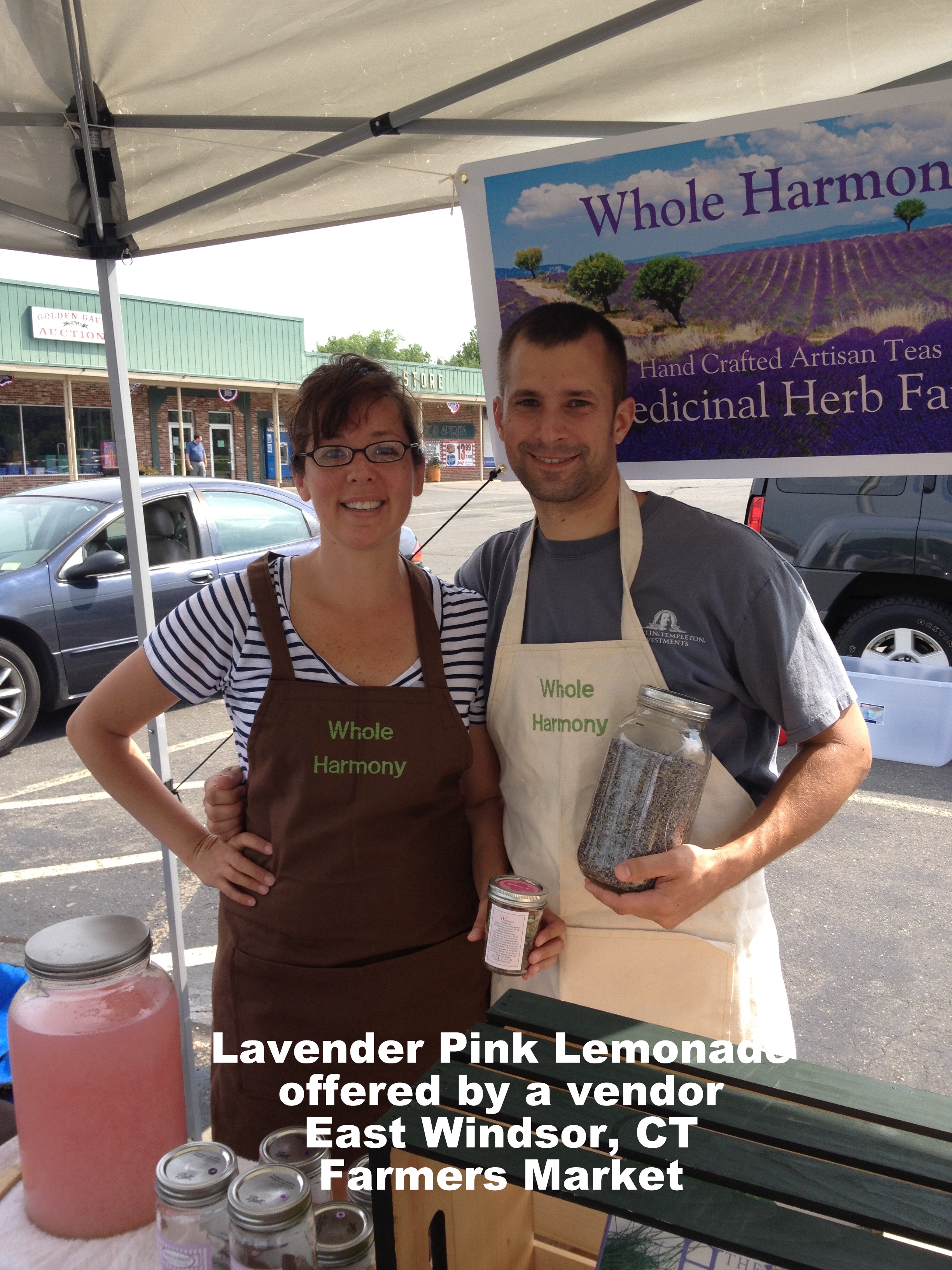
Whole Harmony
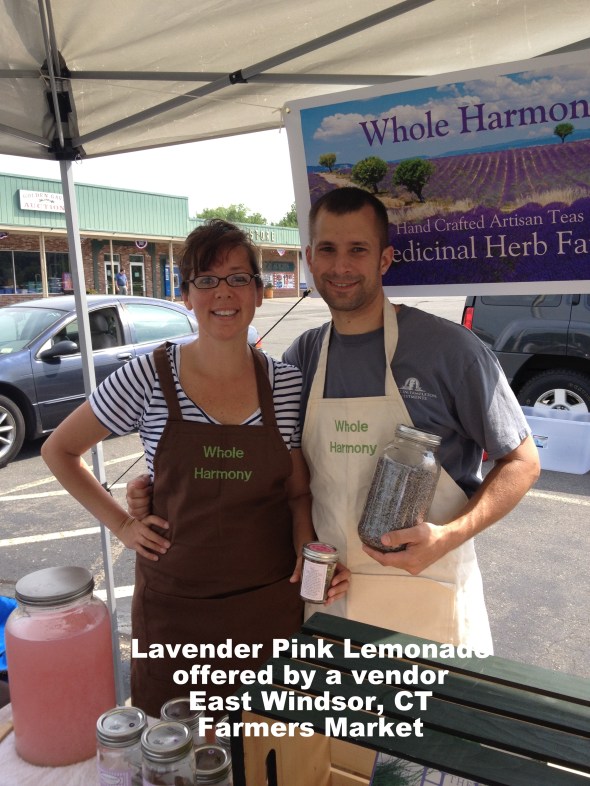
Whole Harmony

IMG_8057

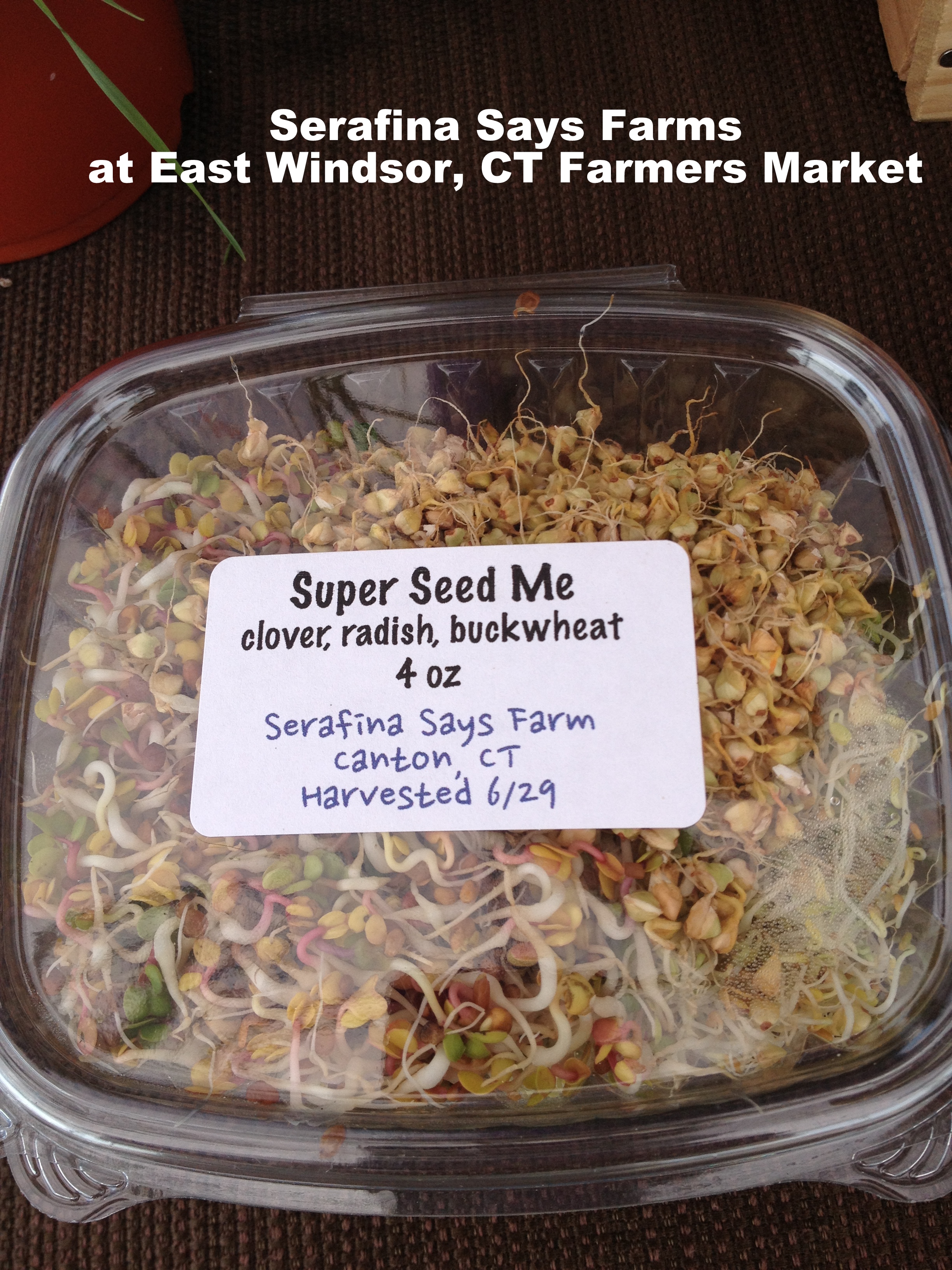
Before people began to arrive to the East Windsor Farmers Market, I visited each vendor myself.  Very impressed with the teas by Stacey Wood of Whole Harmony, and the fresh sprouts, lettuce, and other healthy products by Tara Tranguch of Serafina Says Farm, and of course sampled many others products.   Serafina’s sprouts are going to be amazing on my salad today! Stacey of Whole Harmony told me she is growing their herbs right here locally in the new East Windsor Community Garden located by the dog park and skateboard park on Reservoir Avenue.  So they are grown right here – that’s FRESH.  Love that connection.  It is so important to support these growers, so make sure you visit this market and others during prime time – now!

East Windsor Farmers Mkt.

East Windsor Farmers Mkt.

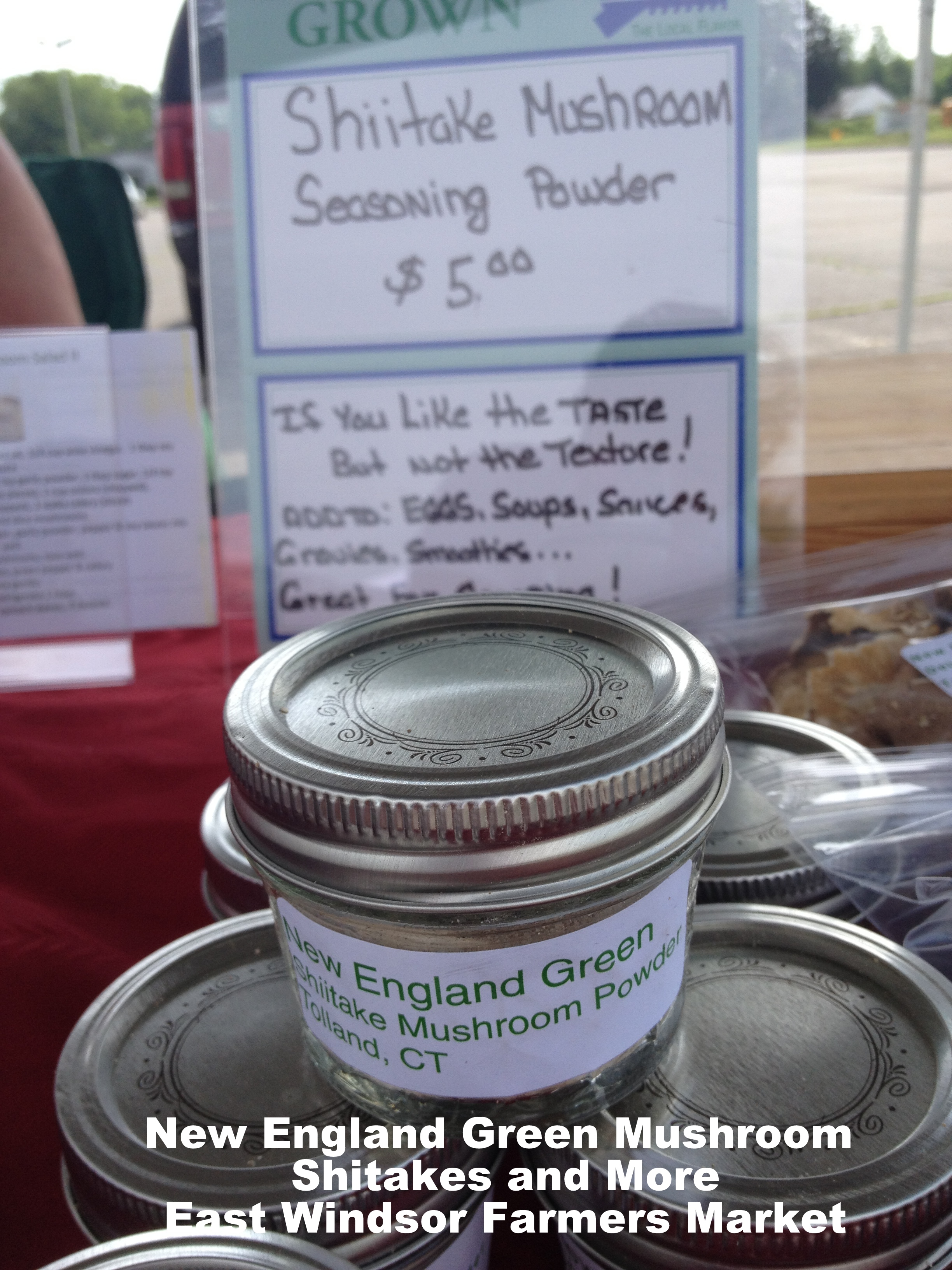
And don’t miss the freshly grown Shiitake Mushrooms by Donna Yurgel of New England Green Mushrooms.  She sells at other markets as well, such as the popular Ellington, CT farmers market.  I buy a box of these every time and find new ways to add them to my recipes.  She is now offering some of her favorite recipes for people new to using Shiitakes.  They are easy to cook.

Members of the band

Members of the band

Wethersfield Market is Closed for the 4th of July weekend, but East Windsors remains open.

By the way, the Wethersfield market is closed during the 4th holiday weekend, but this is not the case the East Windsor market.  The East Windsor market has relocated from their Opening Day location on Rt 140, 149 North Road, in-front of Joe’s Fine Wine and Spirits and the Golden Gavel Auction, to the Trolley Museum at 58 North Road (also Rt 140).  The Trolley Museum has picnic tables, facilities, and antique trolleys of historical value inside and out of their buildings.  Take the kids along, enjoy a ride on the trolley, and get in some farmers markets action.  Click HERE to read more about the new location.  There’s plenty of parking available, and it is right off 91 North and South, take Exit 45 (Bridge Street) to Rt 140.

East Windsor Market Master:  

For questions, you may contact Janice Warren, the Market Master, at ewfarmmarket@gmail.com or at 860-292-1796.  It will be held up through October 6th, 2013.  Every Sunday, 10 am to 1 pm, and will grow just like the plants do.  They currently do not have a website, but can be found on Facebook and Patch.

East Windsor’s Farmers Market Vendors:

  • Broad Brook Brewing Company (New in town).  Check out their “Pink Dragon Wit,” a Belgium White Ale for Summer.
  • New England Green Mushrooms, Shiitake Mushrooms, Donna Yurgel
  • Sarafina Says Farms, Tara Tranguch, Farmer and Health Coach, Sprouts, Salads, etc.
  • Whole Harmony, Whole Being Heal Tea Company, Stacey Wood, Certified Herbal Practitioner
  • Shadow Valley Farms, Local Farm Fresh Milk and other dairy products
  • Sunshine & Flowers by Goldie, Dish Gardens
  • Naturally Clean, soap products, by Teresa Carey
  • Cathy T’s Landscape Designs, Cathy Testa, Container Gardens, Garden and Landscape Designs, Classes
  • BACKTRAX Band, Jimmy Fauteux and Members, Playing all kinds of events
  • Yummy CT, Distributor of CT Products

If interested in becoming a vendor, contact Janice Warren, Market Master, at ewfarmmarket@gmail.com or at 860-292-1796.

Here’s some more markets I saw listed in a garden magazine recently:

  • Farmington, Hill-Stead Museum, hillstead.org
  • Glastonbury, Hubbard Green, glastonburyfarmersmarket.com
  • Hartford, 156 Capitol Avenue, 2 Saturdays a month
  • Manchester, Manchester Community College, Wednesdays, 1-5 pm
  • South Windsor, 100 Market Square, Saturdays, 10 am – 1 pm
  • West Hartford, LaSalle Road public parking lot, Tuesdays & Saturdays
  • Coventry, Nathan Hale Homestead, coventryfarmersmarket.com
  • Ellington, Arbor Park, ellingtonfarmersmarket.com

…and you can find them in Fairfield Country, Middlesex Country, New Haven, New London, and maybe just drive around and spot the tents – Stop in if you see them.  Help those helping you get the CT products we enjoy fresh.

Cathy Testa
Container Crazy Cathy T
860-977-9473
containercathy@gmail.com

New England Green Mushrooms

New England Green Mushrooms

Local Farm Fresh Farmers Markets

2 Comments

IMG_7652

We are very fortunate these days to have plenty of farmers markets to enjoy, and I finally made my first visit to this year’s offerings at the Ellington Farmers Market last Saturday morning with Steve, my husband.  I sold plants there last year, and really loved the people, site, and excitement of sharing something locally crafted with everyone, but alas, this year I have another goal (greenhouse) – but that doesn’t stop me from going to the market as a shopper this season.  And I hope to return as a vendor in 2014.

Steve whines a little about going to the market because he has other Saturday chores on his mind, but the funny thing is he always ends up buying more than I do.  He loves the pickles, hot sauces, veggies, mushrooms, and nuts.  I tend to go for the fresh cheese, garden decor items, and breads.

Scantic Valley Farms at the market

Scantic Valley Farms at the market

This weekend, their feature was fresh strawberries, so I was on a mission to get some of those too.  We also planned to buy some fresh fish to cook up for dinner for his mother and sister that evening after we attended a memorial event for a friend.  But what I didn’t expect to get was popcorn.

Freshly popped Kettle Corn offered at the market

Freshly popped Kettle Corn offered at the market

As we walked passed the booth offering hand popped kettle corn, we were quick to say no thanks to the vendor because we feared the carb count.  He was quick to point out there was probably more sugar from the strawberries we were popping into our mouths than a handful of the kettle corn.  He said the carbs were 16g (5%) and due to the way they pop it, they keep the sugar and salt low.  So with a quick taste, I agreed – it wasn’t too sugary or sweet tasting, so I bought a bag.  However, fresh veggies and fruits were on our minds, so we opted to also get not one but 4 quarts of fresh strawberries from two places.

Strong Family Farm

Strong Family Farm

Strong Family Farm, established in 1878, was at the market offering various items, and fresh strawberries.  They will be holding a fundraiser today, Monday, June 17th, at the Wood-n-Tap in Vernon, CT between 5 pm and 9 pm as part of their efforts as a non-profit and education center.  We also got strawberries from Scantic Valley Farm, the market’s feature of the weekend.  Scantic Valley Farm is a family owned farm located at 327 Ninth District Road in Somers, CT, where you can pick-your-own, but I tend to buy versus pick, so having these available at the market was a real treat.  We stocked up for the weekend.

By Faith, Love and Ladybugs

By Faith, Love and Ladybugs

Also spotted at the market were garden decor handcrafted by “Faith, Love and Ladybugs” – all upcycled, instead of recycled.  These plant tags and tea cup items were adorable.  To see more, visit this creators pages on Facebook and Etsy.com.  Part of going to the market is participating in helping those with dreams achieve them.  This young lady’s creations were all well made and perfect for the gardens.  I regret not getting some of those cute gnomes plant markers now, but I can return to get them next time.

Faith, Love and Ladybugs upcycled for home and garden

Faith, Love and Ladybugs upcycled for home and garden

When we got home, we were excited to have fresh cheeses, eggs, french bread, fish, and mushrooms, a big healthy bunch of romaine lettuce, two kinds of cherry tomatoes, and more to share later that evening.  And on Sunday, we used the fresh strawberries in pancakes, and the night before I popped a few into champagne.  Yumm again.  All the while, you feel like you are eating healthy – because you are!

Pancakes next day with fresh strawberries and eggs from the market

Pancakes next day with fresh strawberries and eggs from the market

As I said earlier, we are lucky to have these wonderful farmers markets in our surrounding towns.  In fact, in two weeks, East Windsor will be featuring their farmers market open house on June 30th, Sunday, where I will be there along with my brother’s band, called the BACKTRAX Band.  Come by for a visit, on Rt 140 in-front of Joe’s Fine Wine and Spirits and the Golden Gavel Auction buildings – summer will be over before you know – now is your chance to get and support our Local Farm Fresh Food.  Drag your family along like I did – you won’t regret it.

Steve gets fresh romaine from the market

Steve gets fresh romaine from the market

The Ellington Farmers Market is held in the perfect location, in the center of town at Arbor Park.  It set up in a circle so you can make your rounds literally starting at one end of the circle and going all the way around back to your starting point.  The market master, Dianne Trueb, is quite impressive.  She and her farmers market organization have even created a downloadable app for the market where you can get automatic updates of  their scheduled offerings, and can join their loyalty programs.

Various cheese makers offerings, go see Margaret!

Various cheese makers offerings, go see Margaret!

By the way, I highly recommend the Feta Pesto made fresh with basil, pasteurized sheep’s milk feta, extra virgin olive oil, and pine nuts, garlic – oh yumm – spread it on the french bread.  Also, the Chevre cheese with balsamic and oil is yummy.  Margaret and her daughter host a booth showcasing freshly made cheeses by three different cheese makers, Sankow’s Beaver Brook Farm, The Butterfield Farm Company, and Hastings Farm.  How nice it is to have these amazing cheeses specially delivered to the market for our access and enjoyment.

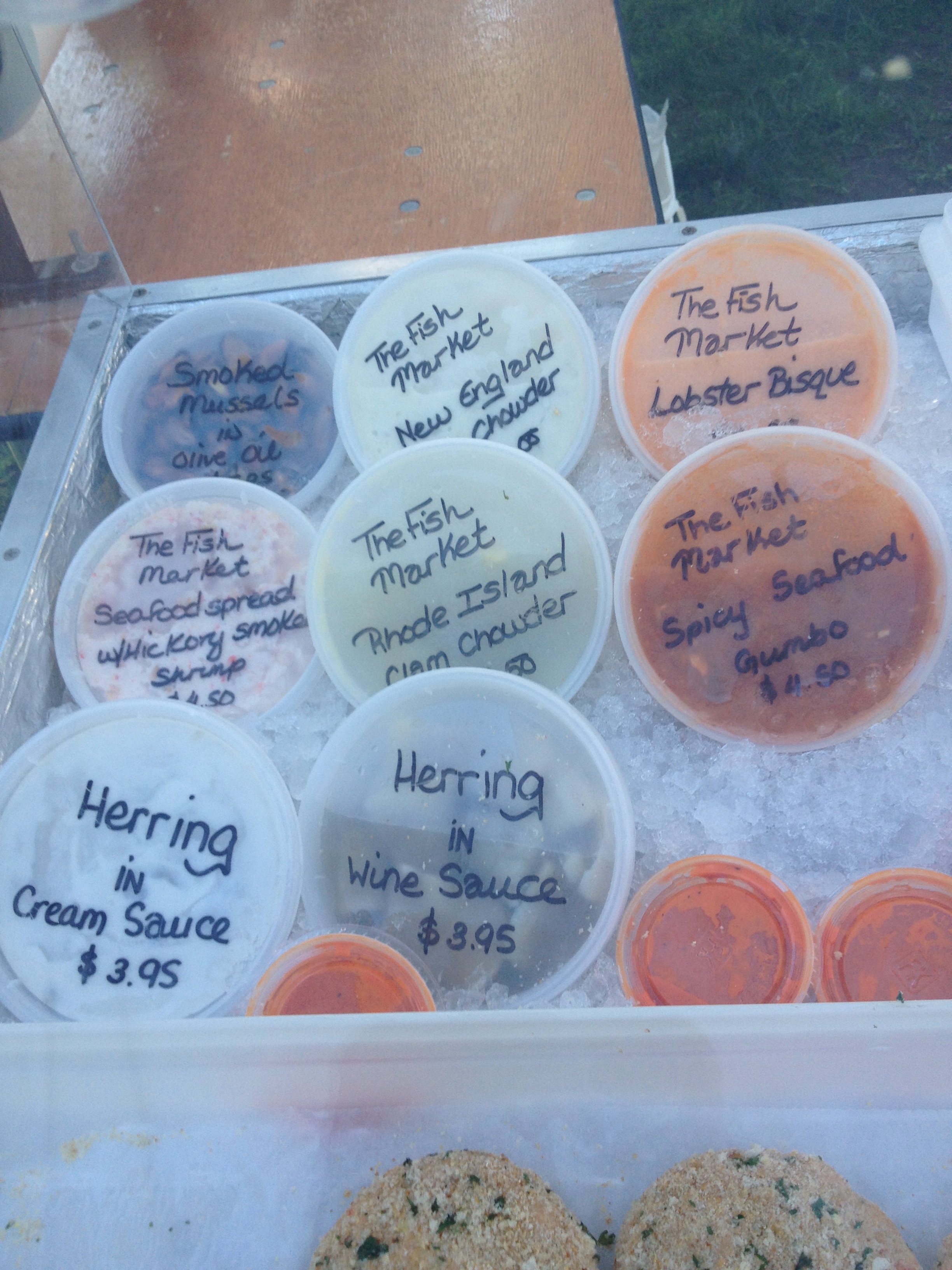
The Fish Market sides

The Fish Market sides

And “Norm’s Best” marinated mushrooms are outstanding, don’t miss those.  They got gobbled up quickly Saturday evening when we were home enjoying all the goodness of fresh.  And “The Fish Market” has a wonderful selection, we got fresh fish and cooked them up on the grill with the fresh tomatoes, onions, garlic and herbs.  It was just perfect.

Cathy Testa
Container Crazy Cathy T
http://www.cathytesta.com
containercathy@gmail.com
(860) 977-9473 cell

For a mystical and eclectic plant mix, visit Logee’s in Danielson, CT

6 Comments
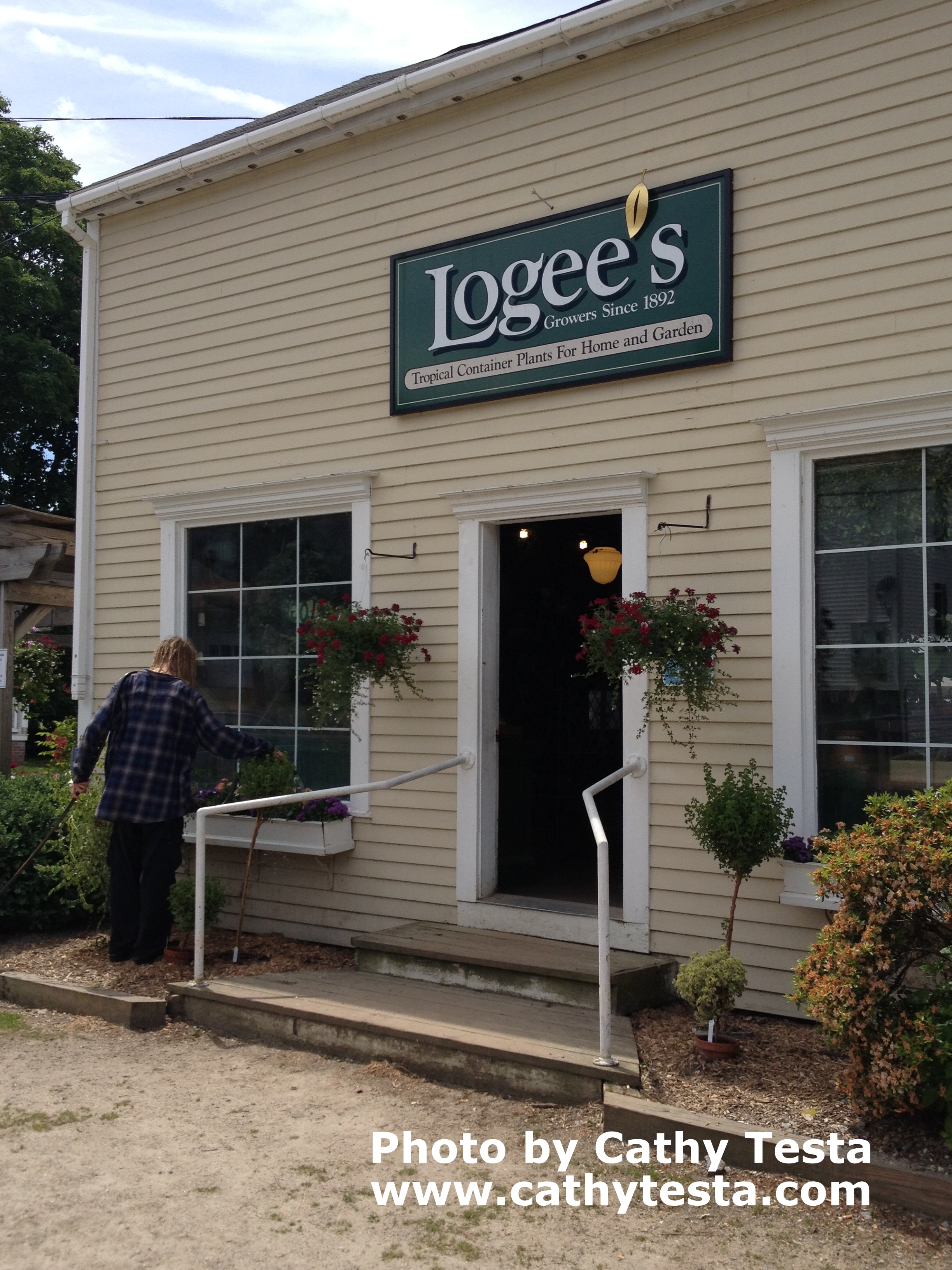
Logee's Growers, Danielson, CT

Logee’s Growers, Danielson, CT

When you enter Logee’s greenhouses in Danielson, CT you may want to make sure you do not suffer from claustrophobia because there is a jungle like atmosphere in this grower’s world unlike the traditional environment of a nursery.

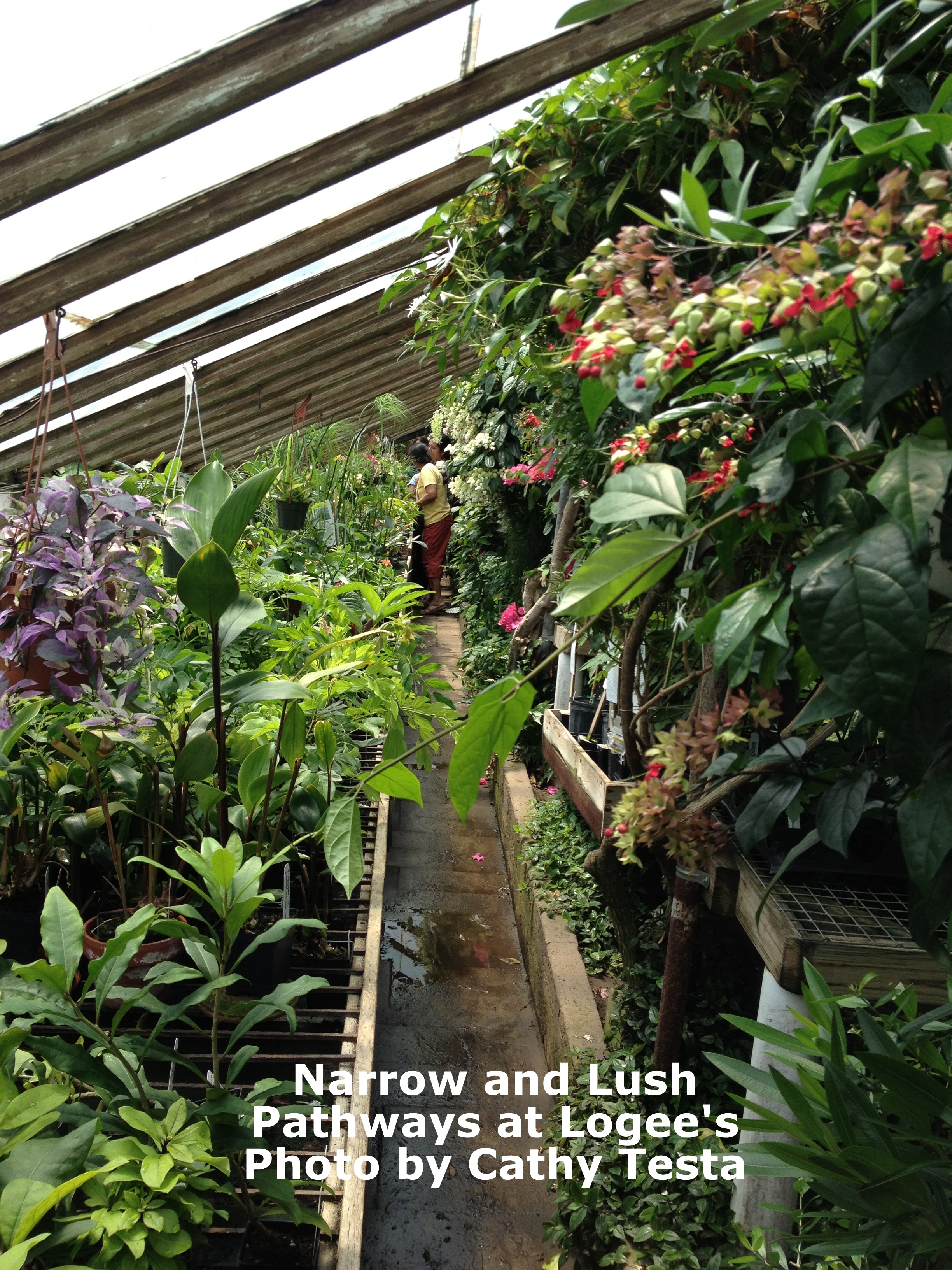
As you enter the first greenhouse down some rickety old steps, you have to decide, do I go left or right?  And depending on what you see down the narrow corridor between plants, you may opt to take a detour.

The aisles are so lush with plantings on all sides and vines are dripping from the greenhouse ceilings above, only one person can pass through at a time.  You sometimes have to take the “high road” as one employee called it by stepping up to a side connecting pathway to allow other plant enthusiasts to pass by.

In my case, a group of very gabby women were coming towards my direction up the pathway, so I took the high road and stepped up to wait for them to go by in single file. They noticed I was admiring a papaya plant, and one lady (apparently the leader of this group) commented the plant has healing powers, where you can take the plants’ leaves and wrap them around your legs to sooth wounds, or something like that.  She had a bit of an accent so I wasn’t sure what exactly she said, but it was obvious her group was super charged about the abundant offerings of fruiting and fragrant tropical plants at this unique plant destination.  And I was too, I couldn’t wait to adventure more.

Logee's Greenhouse

Logee’s Greenhouse

I put the papaya plant back down, and contemplated returning to look at it again later, knowing I would have to browse the entire greenhouse and adjacent house before I would decided on the plants to take home.  And it would be a tough decision.  Logee’s has a large selection of many interesting plants.  And you have to look carefully – as in “up, down, and all around” to make sure you don’t miss something intriguing, plus walking in there can be a little tricky.  Let’s just say, it is not for the dainty feet, for there are some water spots and ruts along the way, all representing the 121 years of service this location has offered for the plant hobbyists falling into the ‘untamed’ category.

Dripping from the Ceilings

Dripping from the Ceilings

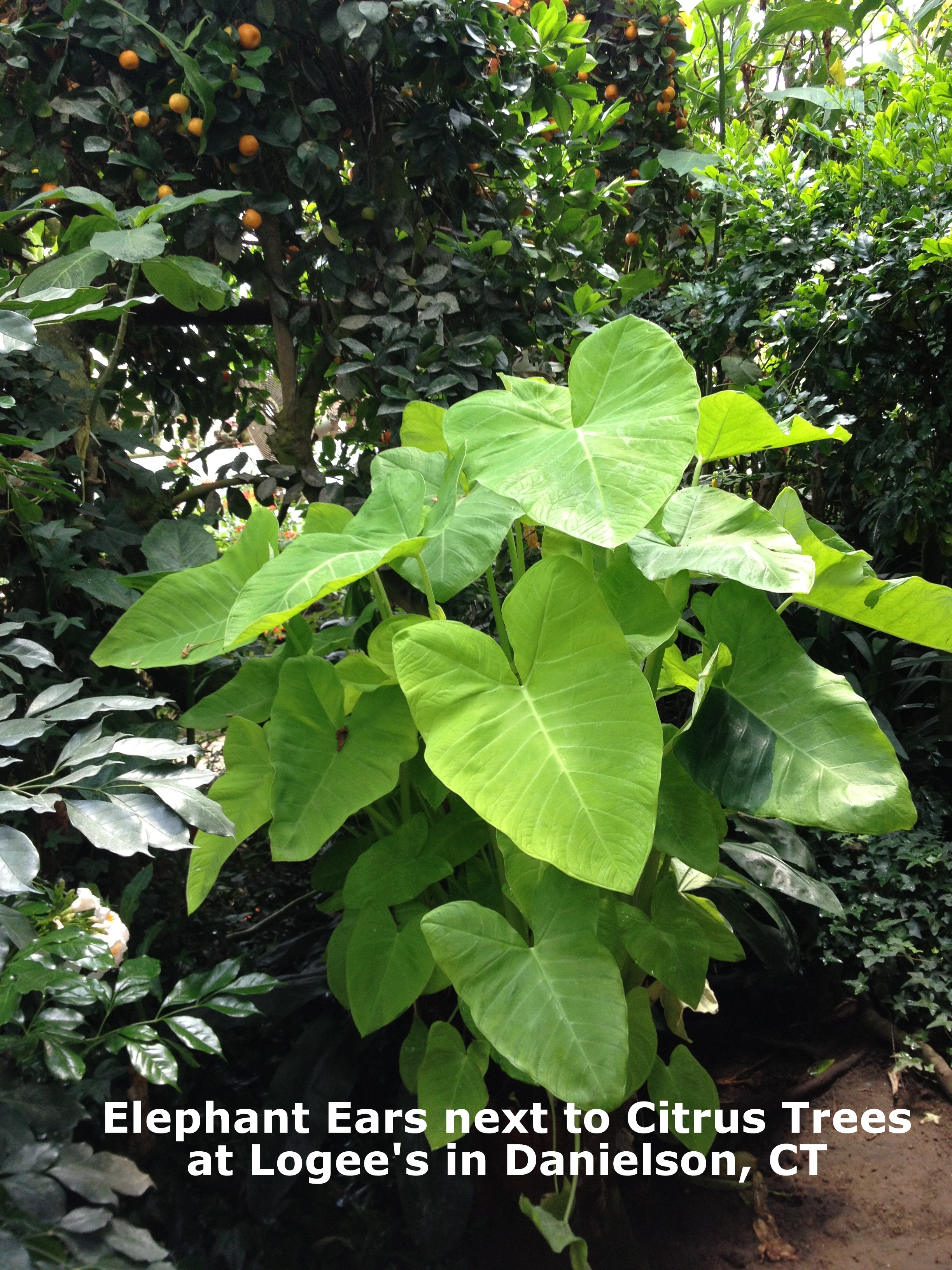
The greenhouses are permanent homes to many large, mature plants growing in and around the shelves of smaller, starter plants for sale.  The mature plants growing there reminds me of plants you see in conservatories, and they give you a sense of what is to come should you buy and grow a plant available at Logee’s. For example, a Golden Trumpet with rich, dark green leaves covered one area of the ceiling and was in full bloom.  There were also Clematis, Bougainvillea, Pink Power Puff, and Chinese Lantern plants suspended all around – plus many more.

Allamanda cathartica in bloom

Allamanda cathartica in bloom

You can feel, smell, see, and sense the history of this long-standing establishment, and the mix of plants – at least to me – represent the mix of the plant passions behind their offerings by a family with apparently as much diversity as their selections at Logee’s. As a large poster will tell you in the check out area, the founder’s son had a passion for begonias, his daughter for herbs and scented geraniums and her son’s passion for fragrant tropicals and fruiting container plants expanded Logee’s world into the full jungle it is today.

Bowiea volubilis

Bowiea volubilis

A comical sight to me was a big Climbing Onion situated right next to an old telephone. The plants here intermingle with the walls, equipment, and surroundings so much, it almost has an eerie feeling to it – as if the place has horticultural ghosts from the past wandering in the spaces and structure’s crevasses. If you are fortunate enough (or unfortunate depending how you look at it) to be alone in the greenhouse, you may get spooked by one of them tapping on your shoulder, but as you turn around, it will be disguised as a vine brushing up against you.  Funny how they can reach out that way.

“There is something mystical about Logee’s. The mix of plants is as eclectic as the diversity of personalities I’m sure grew this place into a destination worth visiting.”

Photo by Cathy Testa

Photo by Cathy Testa

Not only has Logee’s experienced diversity from a chain of generations, it survived a hurricane, blizzard, and energy crisis.  When I read the place was once heated with 50 cord of wood, I said, “wow” out loud.  But somehow, I imagined how enjoyable that may be for a plant lover, perhaps for the short term.  The buildings and plants housed within Logee’s have survived it all.  They have a lemon tree there, a showcase of the facility, at the ripe age of 113.  It’s been there almost as long as the business of 121 years.  I took a picture of the massive tree and its big green lemons, but decided to not post it here – I didn’t want to give away all the treasures – for you should make the trek out there sometime if you haven’t done so already.  This place has lasted a long time – one has to wonder – how many more years will we get to enjoy it?  I’m sure the plants in there will last longer than some of us.

Logee’s is located at 141 North Street, Danielson, CT.  Their website is www.logees.com where you can easily view their plant availability and more information, but going out to the grower’s location is something worth doing.  An adjacent rural town is Pomfret which has some local artisans and quaint shops to visit along the way.  Stop for some good food at “Pizza 101” at 16A Mashamoquet Road, Pomfret Center before or after your trip.  They have great sandwiches, grinders, salads, and yes, pizza there. Make a day trip of it because it is a long drive from at least my location – and perhaps your’s but the country roads are enjoyable if you have the time.

My first papaya plant, 'Red Lady'

My first papaya plant, ‘Red Lady’

And yes, I did buy that papaya plant I first saw when I arrived at Logee’s.  The funny part about this ending is the very nice young lady at the register offered a couple Logee’s magazines to me.  I grabbed three.  As I sat down eating my lunch after this trip, the 2013 issue shows a Babaco Papaya (Vasconceliea x heilbornii) as their featured plant on their latest catalog cover.  It is described as a superb, fruiting container plant that tolerates cool weather much better than the standard papaya.  As the owners Byron Martin and Laurelynn Martin further write on the inside cover, “You can grow this delicious fruit even if you’re a northern gardener.”  So I got a papaya, and they featured a papaya – not exactly the same cultivar, but its ironic, isn’t it?  I ended up with a papaya – to add to my fruiting collection this year. The one that lady told me had healing powers.

Cathy Testa
Container Crazy Cathy T
http://www.cathytesta.com
860-977-9473

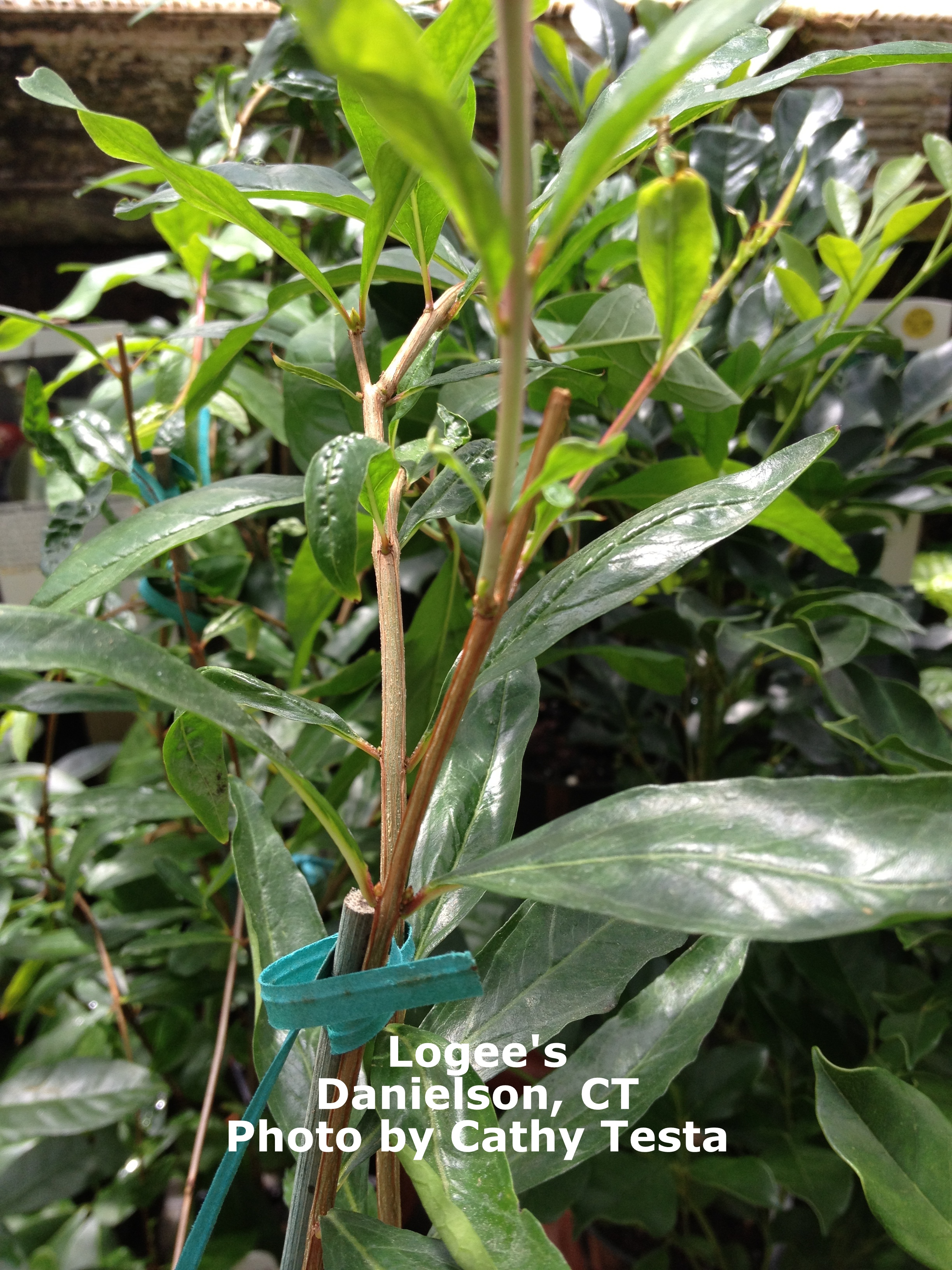
Can u guess what this is?

Can u guess what this is?

Can you guess what this plant is at Logee’s?  A Pomegranate!  (Oh and I bought a Megaskepasma erythrochlamys,…I got to go research that mouth full.  The photo of the bloom attracted me to it.)

Where can I find some Heirloom seeds in Connecticut?

8 Comments
Comstock, Ferre & Co.

Comstock, Ferre & Co.

If you are looking for a good mix of seeds from the common to the unusual, heirloom plants, gardening supplies, farming antiques, and participating in a bit of history, then Comstock, Ferre & Co. in Wethersfield, Connecticut is the place for you!

Last Sunday, they held an Heirloom Festival in celebration of 202 years of Comstock service to CT.  They had nationally acclaimed horticultural speakers, musical entertainment, vendors, plants, and handcrafted products – and of course, lots and lots of seeds.

In fact, the seed stock is probably one of the coolest things about this place.  Tall wooden shelves line the interior building showcasing rows with a wonderful assortment of seeds in beautiful seed packets.  Even if you are not into growing from seed, looking at all the colorful labels is fun.  And most of the seeds are heirlooms.

Comstock is big on heirlooms, and they offer documentation and books to explain all and why they find them beneficial.  As one of their handouts states, “Heirloom varieties are often the product of many generations of careful selection by farmers and gardeners who knew what they wanted from their plants.  If a variety has been carefully nurtured and its seed kept by generations of a family or in a small geographic area, it stands to reason that it must perform well in the conditions under which it has been preserved.”

My definition of heirloom is summed up by my Dad’s tomatoes.  I swear they are the best, and he saves the seeds every year to regrow the product he carefully selected.  It pretty much has been unchanged, and unmodified by genetics, which is another big topic of discussion and awareness at Comstock, the whole GMO concerns.  I won’t go into that whole world which is really getting mega attention these days, but lets just say if you want to be educated on Heirloom benefits versus GMO’s – Comstock is one place that will do so for you.

Choral sings at Comstock

Choral sings at Comstock

During this festival day at Comstock, my sister, Louise, was sporting a GMO free shirt as she conducted her chorale group of students from the Silas Deane Middle School.

Louise just loves Comstock and their offerings, and I keep telling her she reminds me of a Master Gardener.  She is tending to her garden of veggies daily and continues to expand her collection of plants and knowledge.  I’m starting to ask her questions now on veggies – she is so passionate about it.

Comstock is located in a historial section of Wethersfield, CT at 263 Main Street.  When you arrive, you will find street only parking, and a couple of nearby quaint shops, and even ice cream just a few short steps down the side walk.

The building is very old and you get the feeling you are entering a bit of history as you walk around checking out the antiques upstairs and downstairs.

The greenhouse is stocked with starter plants – lots of tomatoes, and other veggies.  And you can pick up some handmade birdhouses or other gardening decor, weeding tools, and trellis.  They have an interesting mix of items for sale.

Steve, my husband, purchased a birdhouse, and when we got home to read the documentation provided about its creator, it turned out he is from our home town of Broad Brook, CT.  Small world.  He made them from salvaged barn board from Windsorville, CT tobacco barns and roof slates.

Stock of Seeds

Stock of Seeds

After we listened to the young group of singers with wonderful voices, we shopped around the rest of the vendors at the festival, and I picked up one packet of seeds – Castor Beans.  Yup castor beans. I love big foliage plants and this one is on my list to try.  It has reddish bronze leaves (Gibsonii variety), and stunning scarlet seed heads.  It looks tropical and gets very tall, but only one word of caution, all parts including the seeds are poisonous.  However, it was a must-have for me.

Reference Materials

Reference Materials

We couldn’t stay long that morning due to other obligations, but it is a place I will revisit – especially useful early in the season to pick up your seeds for the garden.  Comstock, Ferre & Co. has been selling heirloom seeds for over 200 years.  Let’s help them to add another 100 to their record.

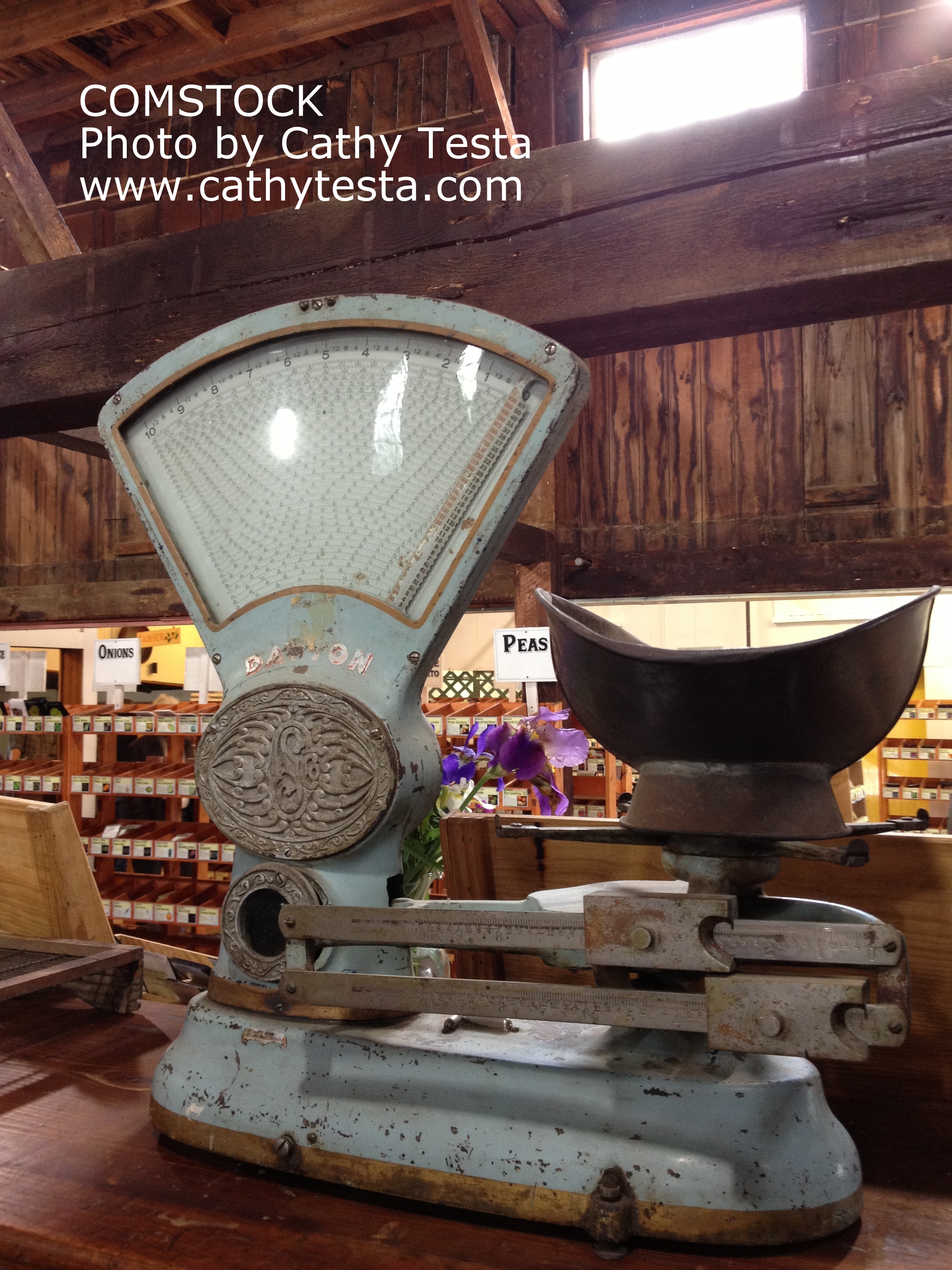
Lots of various old scales at the store.

Lots of various old scales at the store.

Cathy Testa
Container Crazy Cathy T
containercathy@gmail.com
860-977-9473

Comstock, Ferre & Co. Greenhouse

Comstock, Ferre & Co. Greenhouse

A Nursery in the Country has a Big Draw

1 Comment
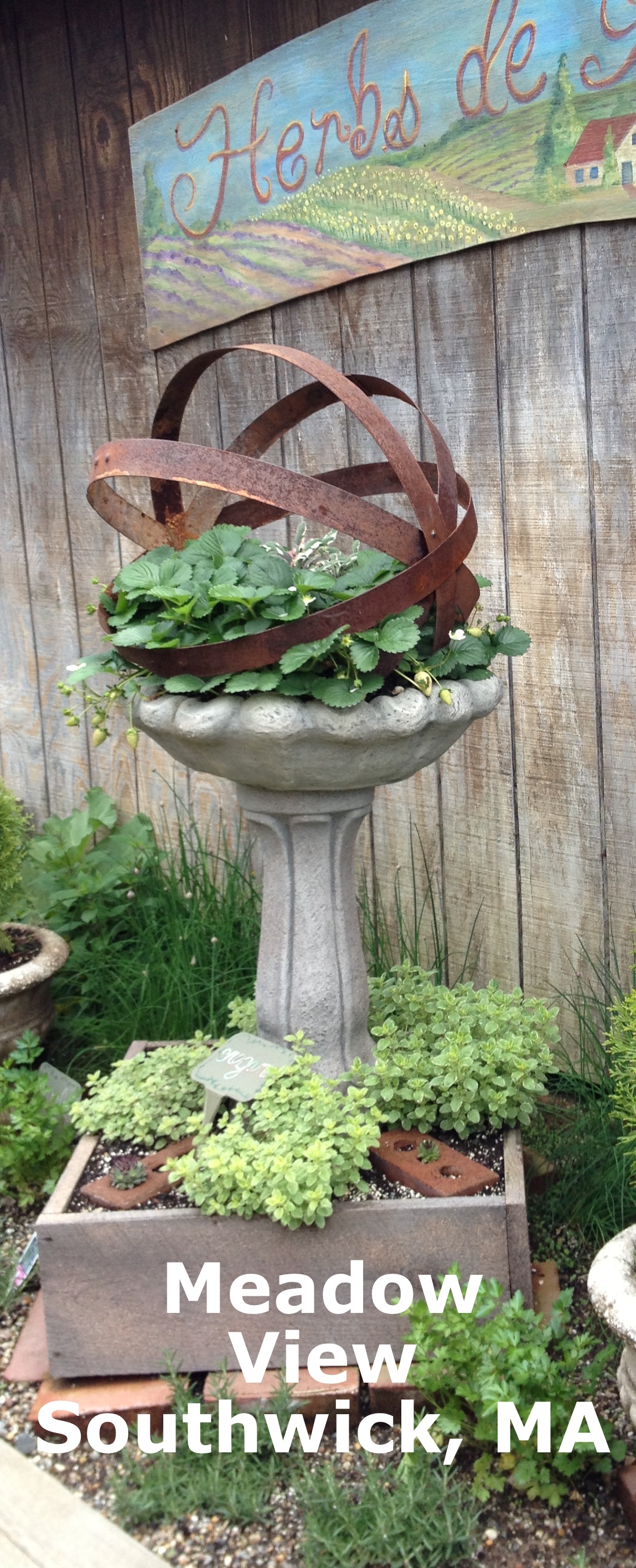
Decor ideas at Meadow View Farms in Southwick, MA

Decor ideas at Meadow View Farms in Southwick, MA

As I mentioned earlier this year, I am making a commitment to visit nurseries this season.  I kind of miss walking a nursery and enjoying it just for me.  As a person in the bz, many times shopping is about the customer, which is also fun – but it was some ‘me’ time.

So today’s post is about Meadow View Farms in Southwick, Massachusettes.  My sister enjoys going to this place and took me there last year, and I remembered liking their herbs and veggies section so my goal was to pick up some of those.

When I arrived to the nursery, there were so many cars and people, I couldn’t believe my eyes – on a Wednesday!  It was a challenge finding an available parking space, especially with my big truck.  When I backed it into the spot, a woman applauded saying she was impressed, and I responded, “Yes, I had people and carts moving around me as I was trying to make it in there.”

As soon as I put the truck into park, a familiar face walked up – a friend by the name of Brian.  I met him at a bar – not what you think – he’s the bartender – and he showed me a book of his garden photos. He is an impressive gardener and has a beautiful greenhouse, so we just started talking plants as my husband sipped his cold brew that day we met.  Brian has a great personality and walked up with a big smile on his face.

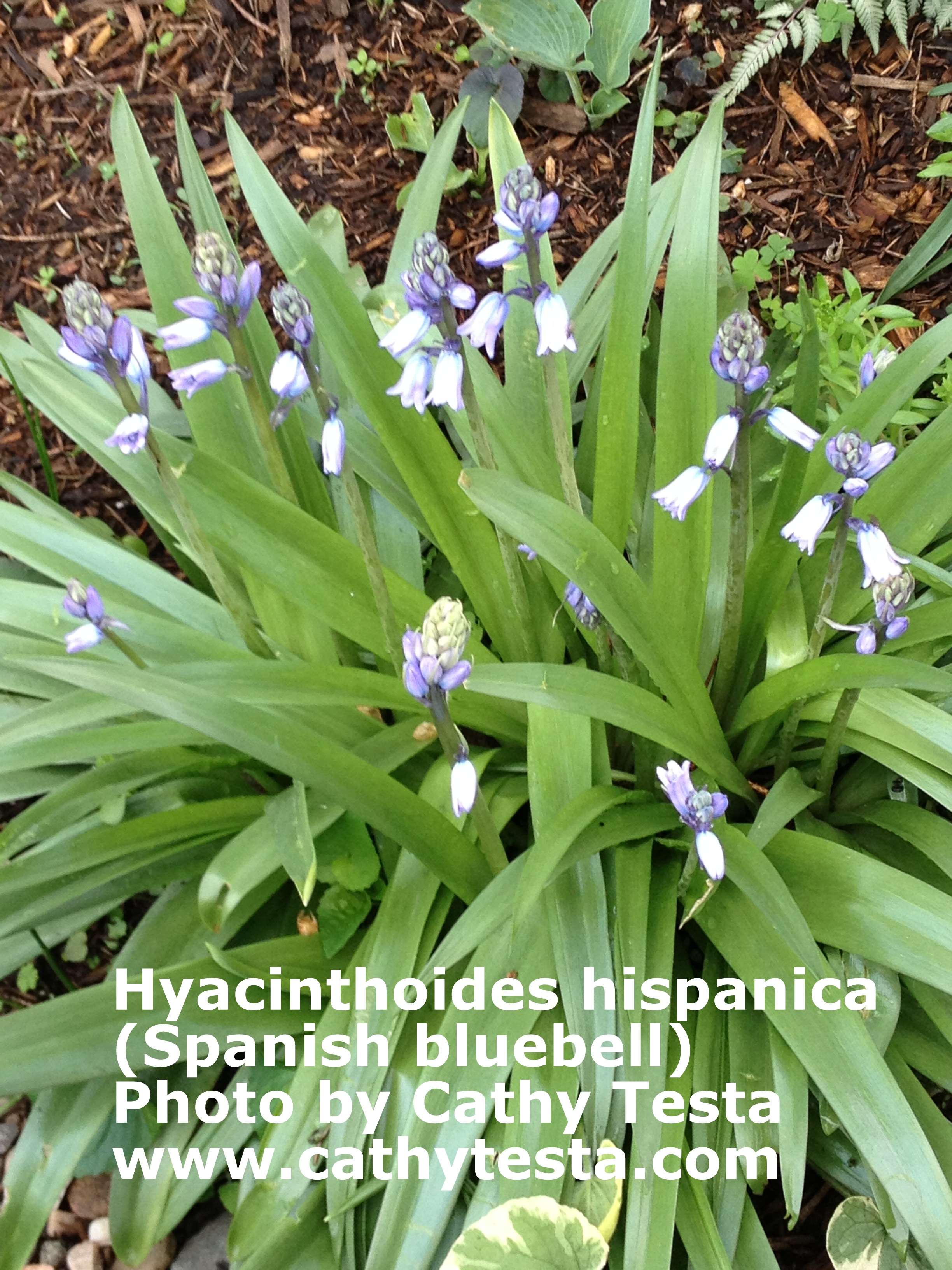
Spanish bluebell

Spanish bluebell

Brian told me he went to several nurseries in search of a plant he saw in the gardens at Meadow View and later discovered he was calling it by the wrong plant name!  So that was a chuckle – especially because he knows plants.

“So show me which plant,” I said.

We walked over to a display area, and there it was –  beautiful blue flowers on sturdy little stems above strap like leaves.

“I don’t know off the top of my head but it is a bulb type plant,” I told Brian.  It looks familiar.

Brian thought it looked a bit like the perennial, Campanula.  “Yes, it does,” I responded.

Of course, of all the plants in the garden displays, this one was not labeled (nor was it for sale at this nursery – at least not on this shopping day).  But a staff person was quick to identify it for us.  However, before we found her, I grabbed my iPhone and said, I’ll just take a photo and post the question on Facebook: “Who knows the name of this plant?”

Garden displays

Garden displays

It took literally seconds to get the name, and comments from gardening friends growing this plant in their gardens.  By the way, after coming home, and looking it up, it is called Hyacinthoides hispanica (Spanish bluebell). It was formerly called Scilla campanulata (there you go Brian!), or Scilla hispanica.  This plant blooms from April to May, and goes dormant in summer.  And it grows well under trees, which is where it was located and repeated in the Meadow View display garden.

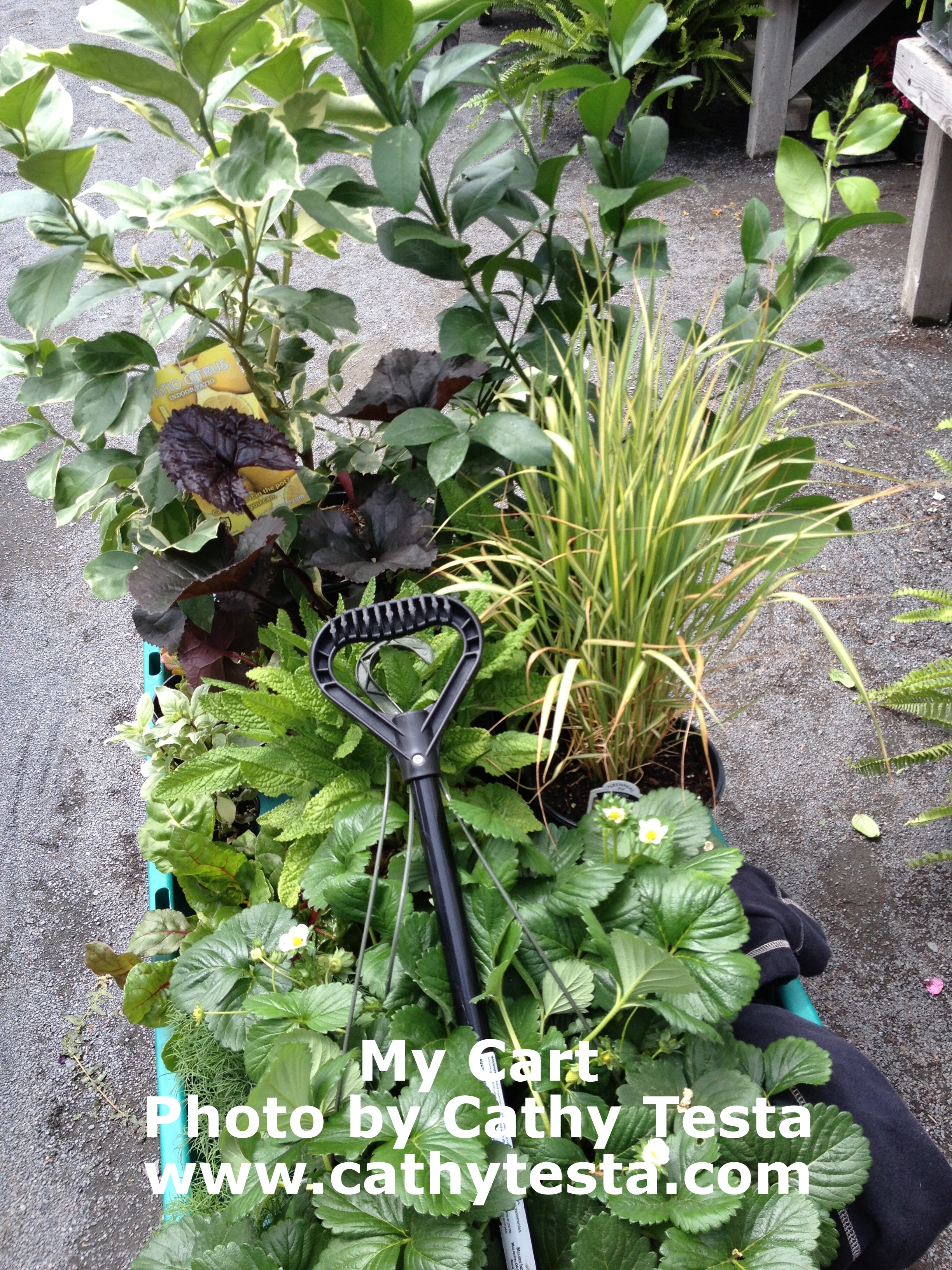
My cart filled

My cart filled

After a quick discussion with Brian on more plants, off he went – and so did I to the veggies section.  I already bought some herbs but I wanted more, and so I looked around, then I spotted a lemon tree.  Ironically, at the last two garden centers I visited, the “male” staff both told me they like lemon trees after we talked about plants like fig trees.  Guys like lemons, I thought.

So spotting one here, I decided I want one too, and to see a variegated form sitting there along side other healthy lemon tree plants, I thought – this is it.  On the cart you go, and the other was for a friend who found my idea of a lemon tree interesting – because lemons with summer cocktails is a good thing. So I texted her the price, and she said yes – get it for me.

The variegated one for me is actually a pink lemon everbearing variety.  These can be placed in the basement to go dormant from what I was told, or even in the garage over the winter.  It appears my theme this year for my container gardens is falling into the herb, fruit, and veggie category because I picked up a pineapple plant and fig tree recently too.  Hope all bear fruit.

Meadow View Farms in Southwick, MA has some nice small display gardens where you can view plants they have for sale.  They also put containers in various places and decor like wagon wheels as trellises for vine plants.  They have a little sitting cafe area, which I didn’t go into to, but I believe they offer water and coffee there.  And they do not have bathrooms, but outhouses which will do for any excited gardener shopping too long requiring a p-break.

They are stocked with great looking perennials, lots of big hanging baskets, annuals, and great veggies and herbs, with shrubs and vine plants too.  I didn’t notice any trees, and the facility is mostly an outdoor place.  There was no “garden decor” for sale, but lots and lots of plants with many enthusiastic shoppers.  A place where you can easily strike up a conversation with a fellow gardener – many would stop to ask about something in my cart, and then comments flourished from there.  My new lemon tree was a hot topic.

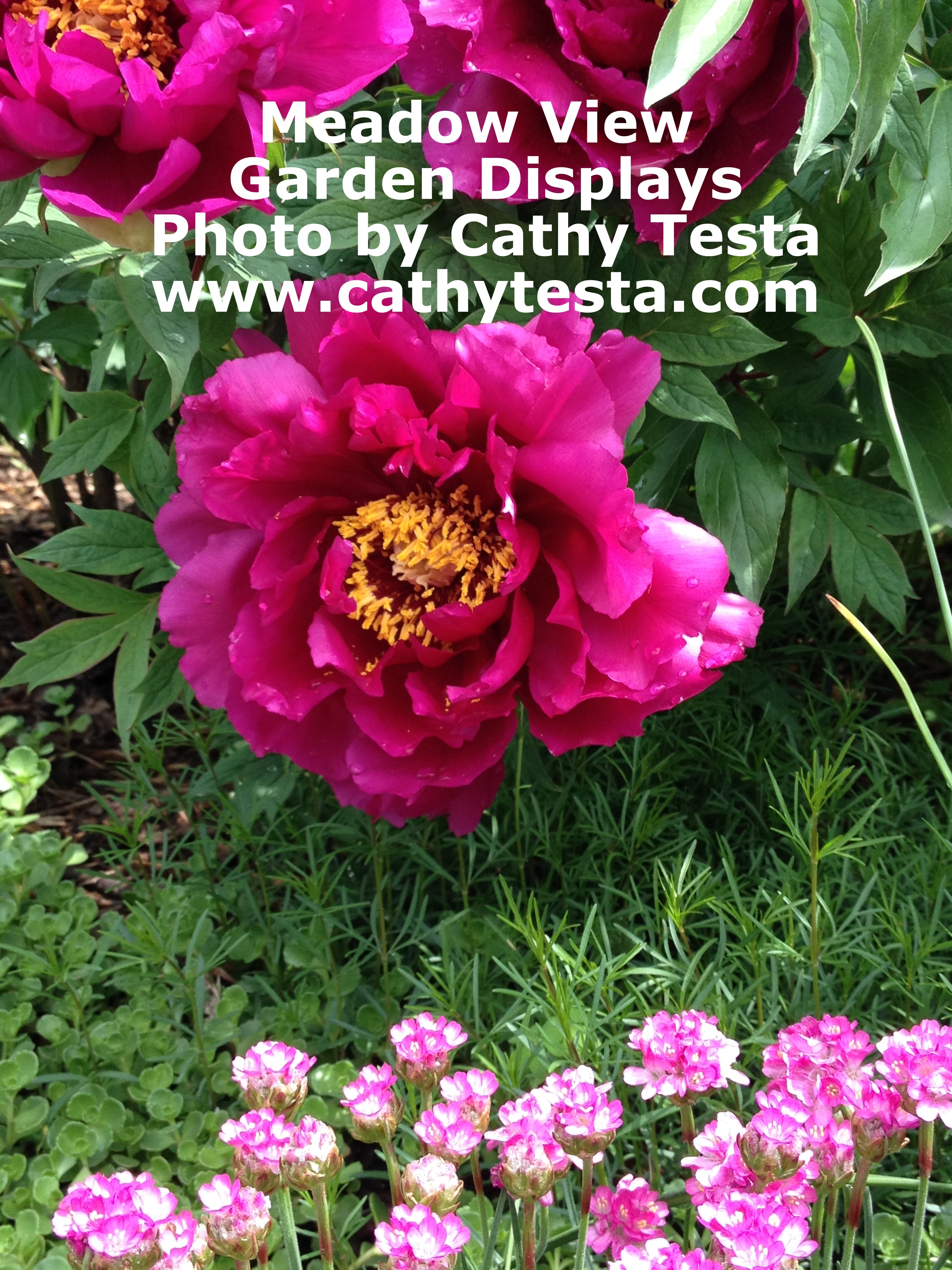
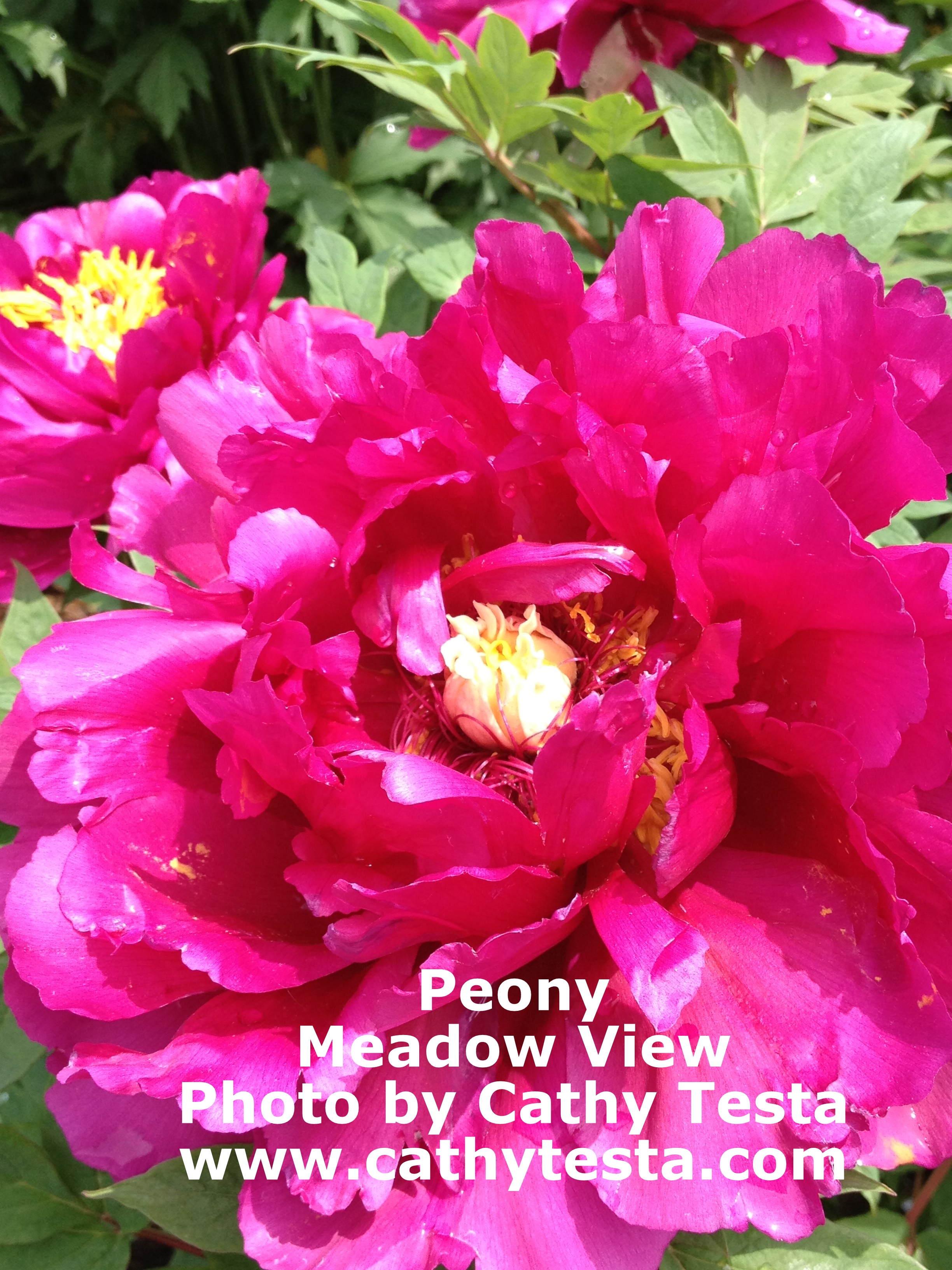
A stunning peony in the garden displays

A stunning peony in the garden displays

And it is very important to know – they do not take credit cards.  So go there with cash or a check with license in hand.  One would be very disappointed indeed if they made the travel there only to discover you can’t use a credit card – especially if you didn’t know while you waiting in the checkout line.  It was at least 12-15 people long at times, but moved very quickly because they have a line of registers with very competent and fast moving staff.

But one guy behind me was just a bit too excited.  As I waited in line, I spotted a bougainvillea plant and passion flower in hangers to my left.  I wondered how much they were, so I quickly ran over looking for the price tag.  Would you believe, he banged the back of my cart as the people in-front of me started moving forward to cash out.  Guess I forgive him for being so impatient cause he had some huge hanging baskets on his cart – I think he just couldn’t wait to get them home.

Cash out line - moves quickly

Cash out line – moves quickly

Meadow View may be out in the country, and a bit of a drive for some folks, but this place has a big draw.  My friend, Brian, told me it is “always like this” when I commented on how busy it was for a week day.  I filled my cart with other plants, checked out, and enjoyed the sandwich I was glad I packed in my truck for lunch.  And off I went anxiously to pot up my new lemon tree for my deck.

By the way, for you locals here thinking about going, I went through Suffield, CT and took Rt 168 for about 8 miles, past Lake Congamond.  It is a beautiful country road, so I enjoyed the ride very much – and thought about how I have to go to that lake for kayaking some day soon too.

Cathy Testa
Container Crazy Cathy T
http://www.cathytesta.com
(860) 977-9473 cell
containercathy@gmail.com

Trucks constantly deliver restocks from the greenhouses to the retail area

Trucks constantly deliver restocks from the greenhouses to the retail area

‘Ubatuba Cambuci’ is the UFO of Ornamental Peppers

2 Comments
Purple Flower to Purple Pepper

Purple Flower to Purple Pepper

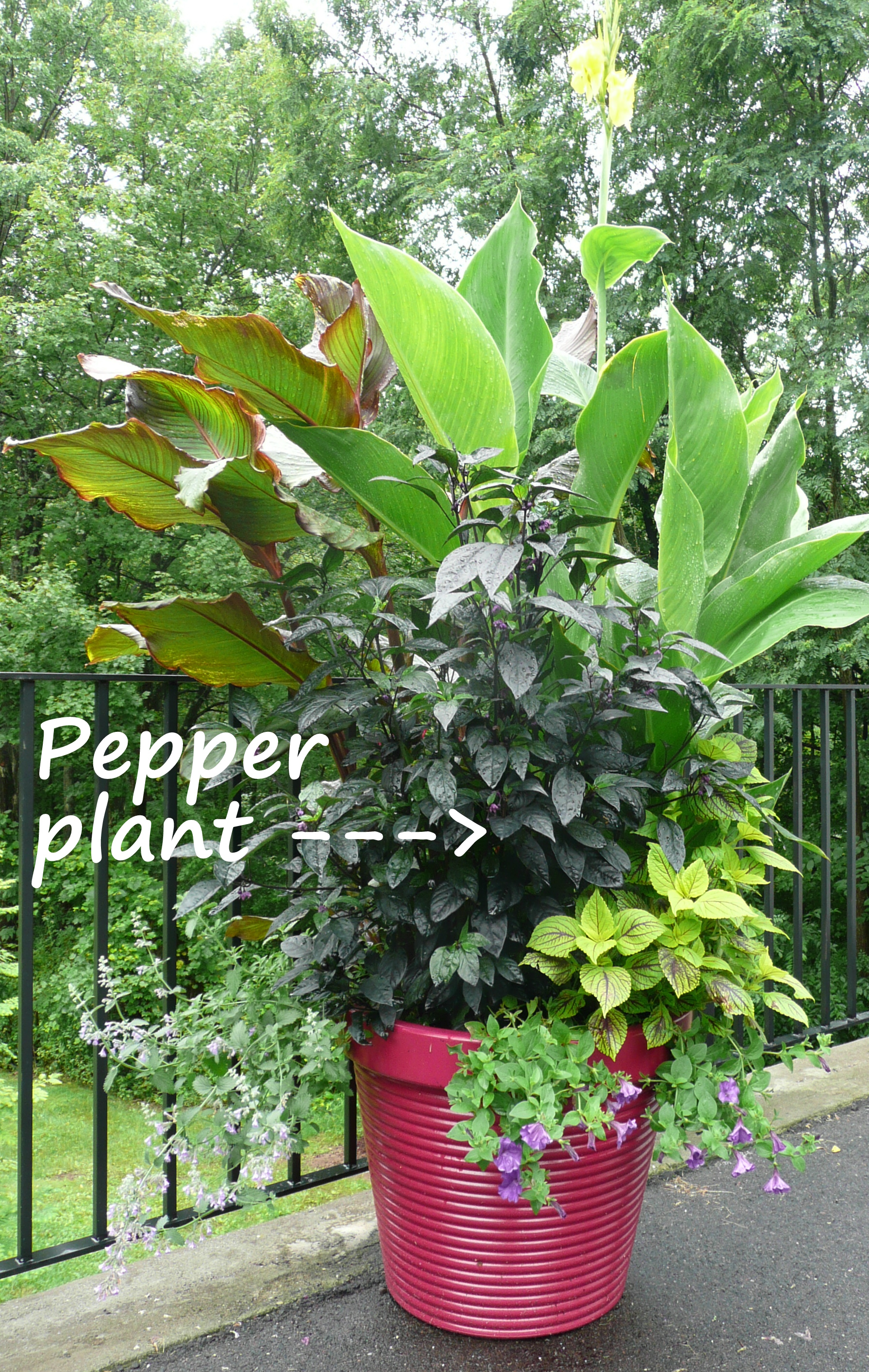
Ornamental peppers add many wonderful attributes to design compositions in container gardens.  They come in various colors, very rarely get attacked by pesty insects, and have interesting shapes. Additionally, the color of the fruit changes as it matures.

These attributes are something I’ve written about in previous posts.  One post was when my sister purchased a pepper producing purple fruit from me, and another post was when I gave a black fruiting pepper plant to my vet as a thank you for the nose surgery he did on Hunter, my cat.

I really like the look of colored peppers in container gardens.  Some end up in deep, dark colors, and others evolve into bright hot colors. You can include companion plants in the container combination to capitalize on this by thinking about when the other plant’s flowers will bloom and selecting bloom colors to match, echo, or contrast the colors of the peppers for seasonal interest.

The shape of ornamental peppers is interesting too.  Some are pointy and long, facing upwards on stems, others are round and chunky, and some are perfectly round pearl shapes.  Before the trend of incorporating veggies into perennial gardens, people would be surprised when they saw I had a pepper plant in my container gardens with other types of plants.  Now I have a new candidate to suggest using, one by the cultivar name of, ‘Ubatuba Cambuci’.  It has the most unusual shape.

Shaped like a UFO

Shaped like a UFO

Shaped like a Flying Saucer

‘Ubatuba Cambuci’ is a Brazilian pepper plant with fruit resembling a UFO.  It has a wide to squat body shape with edges around it extending outwards a bit.

Dianne, one of my good friends, noticed mine in a container on my deck last summer, as shown in this photo to the left.

She asked, “What is that?”

When I told her the name of the plant and explained how I think it looks like a flying saucer, she replied with, “Only you, Cathy T, only you.”

Dianne is always super enthusiastic about my plant endeavors.  She attends my classes regularly and always gives me words of encouragement and praise.  I’m lucky to have her, and many other good friends, support my plant passions.  She was really impressed with the unique shape of Ubatuba and said she had never seen one before either.

I asked Dianne, “Doesn’t the fruit also look like a body with arms hugging its belly?”

We both started laughing as she agreed.  The fruit’s shape provides conversation opportunities to any admirer taking notice. But the shape alone is not its only talking point.  There are some interesting facts about the plant’s name.

Named after a place, and from its shape

Ubatuba is a lovely beach town in Sao Paulo, and Cambuci is a municipality located in the Brazilian state of Rio de Janeiro.  So, the plant is named after these two places.  I also read that a river in eastern Brazil is called the Ubatuba River, and that Cambuci is a fruit tree apparently on the verge of extinction (and this tree’s fruit has a similar shape of this pepper!), and get this…Uba Tuba granite is quarried in Brazil for use in making kitchen counters.  So there you have it – a plant named after a place and a shape.

Sometimes I think the name selections are off for plants – this one would be so easily called ‘Alien Nation’ and you would get it right off.  But honestly, I haven’t visited Brazil, so I did not recognize the name as being from a place, but surely it is a tropical treat there, just like this pepper plant.

The first part of the plant’s cultivar name has ‘tuba’ at the end, and it is pronounced just like the brass instrument, so just add an OOH-BAH in front of that. The second part I wasn’t so sure how that goes, something like CAM…going into a BOO, and then the common e-e or ei sound at the end.  Heck, you can just nickname it “Uba” for short, but there is a certain ring to saying Ubatuba – Ubatuba.  This attribute, its name, is entertaining, at least to me.

Color Changes from Yellow to Orange, to Red

‘Ubatuba Cambuci’ starts off yellow, transitions to orange, and finishes to a bright attractive red. The fruit grows to about a three inch size.  A little bit larger than the perfect bite size.  The plant itself has a bushy habit and grows up to three feet tall. Its dark green foliage has good sized leaves and the stems are sturdy and strong.  Fruit tends to stay stable on the plant because of this, and staking is usually not required, if only, towards the end of the season.

The added benefit of the pepper’s color changes is it can help you in the selection of your companion plants in your container garden design. If you think it through by period of bloom, matching the yellow stage of the pepper’s color to an early yellow bloomer of another plant, and the red color stage of the pepper to a flower blooming in late summer in the same container garden, you create seasonal interest.

Black foliage and purple peppers

Black foliage and purple peppers

Plant Companions to use with Ornamental Peppers

As shown in the photo to the left, the annual, Coleus ‘Gay’s Delight’ was used as a filler because of the purple veins in its bright chartreuse leaves.  It highlighted the purple flowers and fruit of the pepper plant in this container.  In this case, the pepper plant’s foliage was also a dark purple to black color.

Consider perennials; examples are Monarda didyma ‘Petite Delight’ with pink flower, Nepeta x faassenii ‘Dropmore’ with lavender flowers, and Verbena bonariensis; these would look stunning with purple peppers.  This would create a mix of purple tones to show up against the dark foliage of the pepper plant as shown here for a softer combination of monochromatic colors.

If the pepper of your choice has a full, bushy habit, put a taller center plant to elevate above it, as in the example of tall Canna plants.  Or combine your pepper plants with edibles to create quick dinner snipping sources. Include cherry tomato, basil, chive, and oregano.

Because many herbs are green foliage plants, select those with variegated leaves to make them stand out against the foliage of the pepper. Ocimum citriodorum ‘Pesto Perpetuo’ has a creamy white coloring on the leaves’ edges, or Ocimum basilicum ‘Amethyst Improved’, showing off a deep dark shiny black color.  Golden thyme plants work well, try Thymus citriodorus ‘Archer’s Gold’.  For a spiller, nasturtiums are perfect and easy to grow, and are edible, look for Tropaeolum majus ‘Wine’ for the yellow and orange flower color.

For a hot red combination, plant Verbena x “Taylortown Red’, and add a Pennisetum setaceum ‘Rubrum’ as a spiky accent with the ‘Ubatuba Cambuci’ plant.  I assure you, if you add an ornamental pepper, your friends will take notice, and you can have them taste test the fruit.  Ask them if it is sweet or hot?

Plants with Flavors

Plants with Flavors

It is Sweet, no wait.  It is Hot.

When I include peppers in my container gardens, the matured fruit does not last long because of a number one predator in my home, Steve, my husband.

Last summer, he walked up the back deck stairs, rather than entering through the front door when arriving home from work so he could partake in the daily offerings of my ‘Ubatuba Cambuci’ fruit.

So I asked him when he took his first tasting, “”Is it sweet or is it hot?”

He responded, “It is sweet, no wait. It is hot.”

This pepper is listed as “mild-hot” in the catalog, but the plant’s label indicates “sweet.”  There seems to be a little bit of both, starting off mild and transitioning to hot as you munch on it.

Adding tasty treats to your container gardens is a lot of fun, and of course, they can be used in cooking or dried later in the season to use in your recipes during the winter.

I can’t tell you how many people noticed my Stevia plants (Sweetleaf) offered for sale at a farmer’s market one season.  It is a substitute for sugar, and when you bite into a leaf, it truly tastes like sugar…And that plant – one to blog about later – really grew well in my container gardens.  But more on that later.

Culture and Container Size

For the container size, go large, at least 22-25″ diameter pot, especially if you combine “Uba” up with two or three more plants.  ‘Ubatuba Cambuci’ appreciates moist, well drained and organic soil and the space to grow.  Be prepared to water this plant in a container garden more often because it draws a good amount of moisture from the soil during hot summer months.  I watered my plant daily toward mid to late summer.  And of course, it needs full-sun to produce the best flowers and fruit.  Remember to check your companion plants for the same conditions.

By the way, I actually had difficulty finding the Genus and species name for ‘Ubatuba Cambuci’.  It is not noted on the plant’s label, nor was it in the grower’s catalog.  I’ve read it is bred from a species Capsicum baccatum or Capsicum baccatum var. pendulum.  Cultivars are typically distinguishable from the species by one or more characteristic.  The most obvious characteristic being, in this case, its unique “flying saucer” shape.  It is one you won’t forget after the first time you see it – just like when you spot your first UFO.

Container Crazy Cathy T
http://www.cathytesta.com
860-977-9473

Please feel free to click on the ‘red stamp icon’ at the top of this blog to leave your comments, especially if you have grown this pepper, I’d love to hear from those of you visiting.