
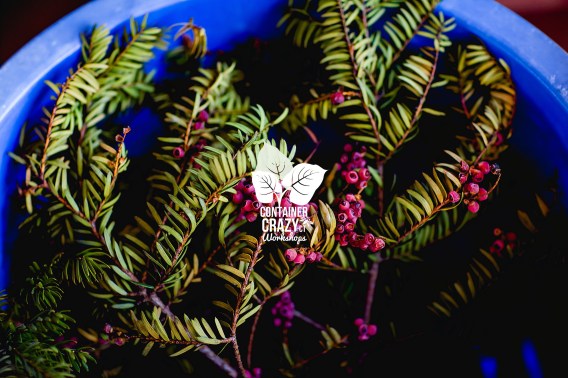
Yew (Taxus) is a needled evergreen shrub or tree used in landscapes. It is not really sought after these days, but when my parents were young, it seemed everyone used yew shrubs as foundation plants or as hedge plantings for property boundaries. They have a slow to medium growth rate and don’t experience many insect problems. They keep their dark green needle color year-round and can take moist sandy soils, but the soil must be well-drained. Locations suited for them are shade or sun. So as a shrub in the landscape, they are versatile. However, they were not often used in wreath making. Until I started to do so when I thought about how well they retained their green needles. From a distance, they almost look like balsam fir needles, and they mix well with other types of greens when making holiday wreaths.

My Dad has a stand of yew trees on his property behind his house. They’ve been there so long; they are about 20 or so feet high. If I were to guess, they are probably 60 years old, but I am not sure! Some of the branches are thick enough to require a handsaw or chain saw to cut down. For the most part, I obtained my various holiday fresh greens for wreath making from a supplier, but I also noticed my dad’s yew trees were huge and offered a nice filler type greenery for wreath making. One year, I asked him, “Hey Dad, may I take some cuttings from your old yew trees for my wreath making workshops?”
He was sure to respond yes, and Mom didn’t mind either. My Dad has a thing for cutting down trees, although we did not cut the yew trees down, we just cut big limbs or branches every year for my wreath traditions. He’d meet me there as I drove my truck down his farm dirt road which runs behind his house and park it near the yews. The trees may have been shrubs at one time, but now they were full grown trees and very healthy. The towered up high and were full of green needles.

Opening the trunk bed of my pick-up truck, I’d always be sure to watch my footing because usually the road near these yew trees is either muddy, mucky or frozen, depending on the weather. He loved cutting down branches for me and I would point to this or that one as a good candidate because it would be a full branch of dark green needles. I was always excited to get these green harvest goodies from his big three yew trees on his farm. It excited me because I felt yew would make an excellent filler in wreaths and kissing balls. These greens served as a back-up green for me too. It also felt like a Christmasy tradition doing this process every late November or early December.
We kind of kept our tradition of the harvesting from his yew trees a secret. LOL. Mom knew of course, and so did my brother who lives there, but pretty much it was our little secret of harvesting yew for my wreaths. The needles of these evergreen trees and shrubs are a little glossy, short, there is no sticky sap to deal with, and I could gather quite a lot for my uses. As he would start his chainsaw, I would have my pruners or loopers ready to clip off anything undesirable. I’d load up the good full branches into my truck bed after he’d toss them on the ground. He had his job and I had mine. The truck bed would be completely full most times until I was satisfied I had enough. I always feared running out of greens at my wreath making workshops for the holidays, so this was also serving as a wonderful back up of dark fresh greens. Sometimes I’d even piled some branches into the back seat of my truck in addition to the truck bed.
Yews didn’t seem to be a popular green for holidays however, and I don’t think suppliers even offered them as a greens option or variety for wreath making. In the old days, my parent’s days, yews were planted in the landscapes quite a lot. I think for my generation, yews seemed to be out of favor and a bit old fashioned, but these evergreen trees or shrubs don’t really have many problems. No big insect issues, no smell, but they do have toxic properties from what I read in my reference books and online. You may think the berries (actually seeds covered with red fleshy material) are toxic, but I believe it is the seeds within the fleshy red fruit that are a problem, that’s if you or an animal eats them. (Other interesting tid-bits I read about yews is a chemical from them was used to treat ovarian cancer and that Robin Hood used the branches to make bows and arrows – Interesting!) But perhaps the toxic principles are why they were not harvested as a green to use in wreaths.
I think years ago, they may have been used a lot in landscapes around commercial buildings, as hedges, or whatever because other than some pruning, they were maintenance free. If you look at some older type buildings, you may spot old yew shrubs, likely at huge overgrown sizes, somewhere near them, or maybe in a parking lot areas on the middle islands, etc. But today, I just don’t see them very often at homeowner’s properties, and if they are there, it was planted many years ago.
As for the stand of yew shrubs my dad has, they grew so tall, they were more like trees and those trees gave me a nice gift every season. The gift of the greens but also the gift of being with my dad, just the two of us, chatting between cuttings and the sound of his chainsaw. We didn’t stay out there long because it was typically cold out. Once I felt satisfied I had enough, we’d put the tools away. He’d quietly walk away back to the house down his backyard dirt road, and I’d drive off to my house to prep them for the wreath making and workshops. When I got back home, it was just plain fun for me to put these in bins. It made me happy. I am not sure how to explain that – the whole process felt good – because it became a holiday tradition of sorts. We all love holiday traditions.
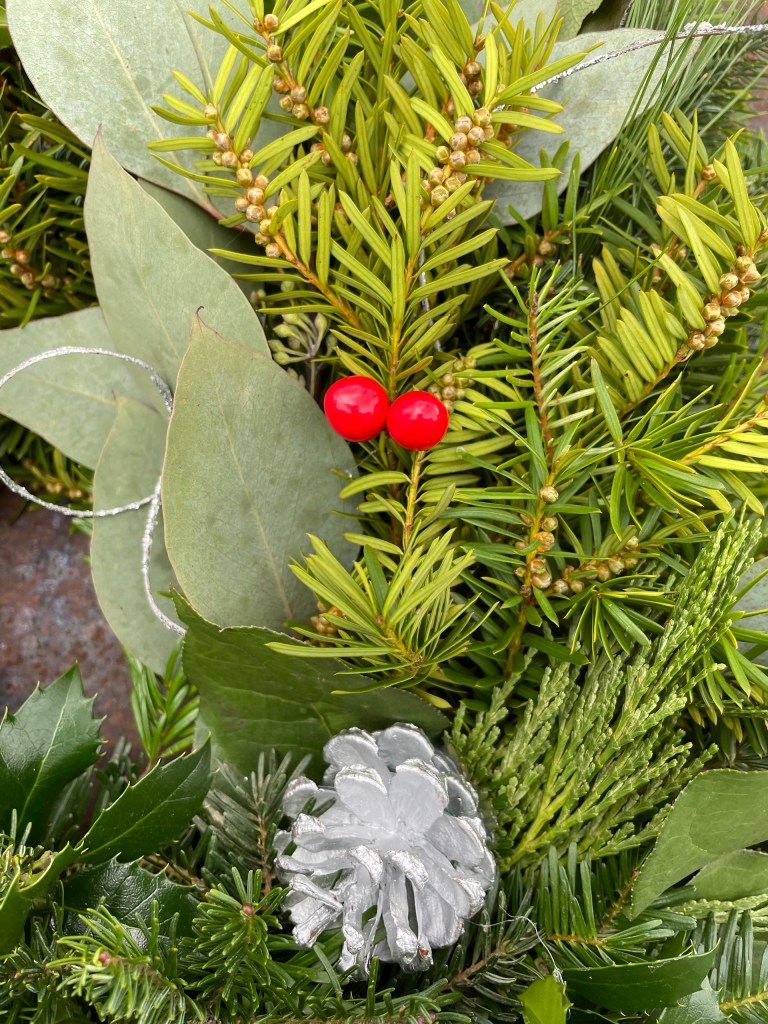
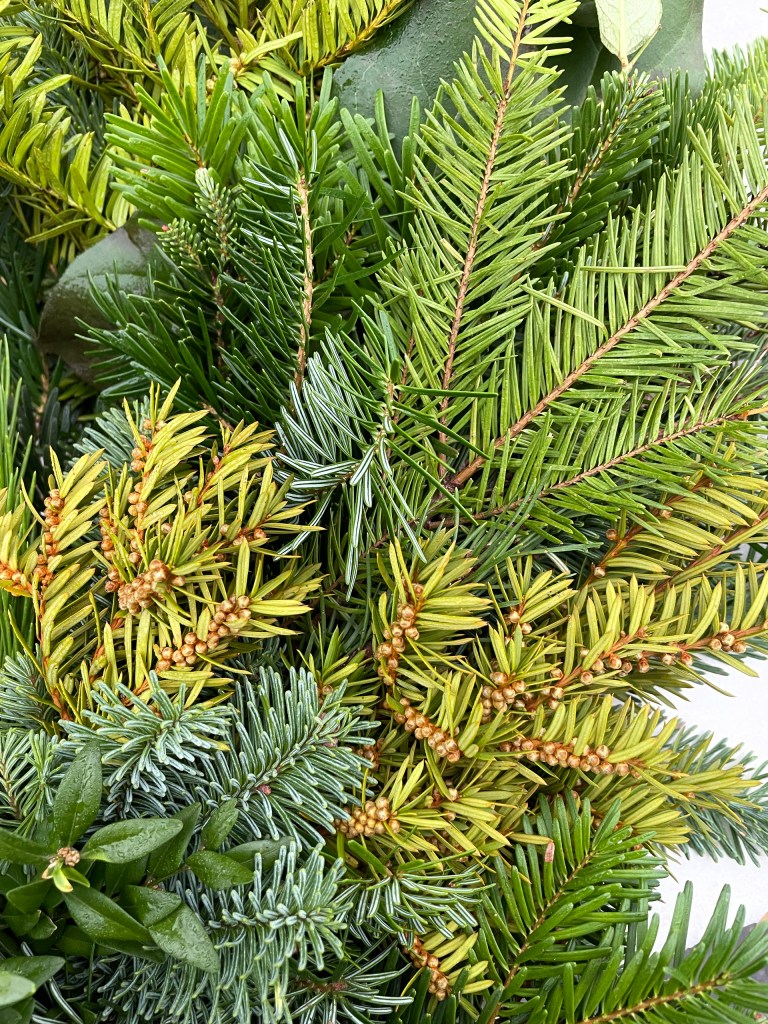
As it turned out, this harvesting and cutting ritual actually helped his old yew trees to produce more foliage each year. I was fearing that someday we would take too many cuttings of it, and it would eventually look bare, but that wasn’t the case. Yew shrubs and trees can be pruned severely and frequently. Some people shear the yew shrubs into shapes, things like that. You will notice in the photos above, some of the cone shapes by the needles are a golden color, while other times, the pink, red fleshy material was around the seeds (on the female cones).

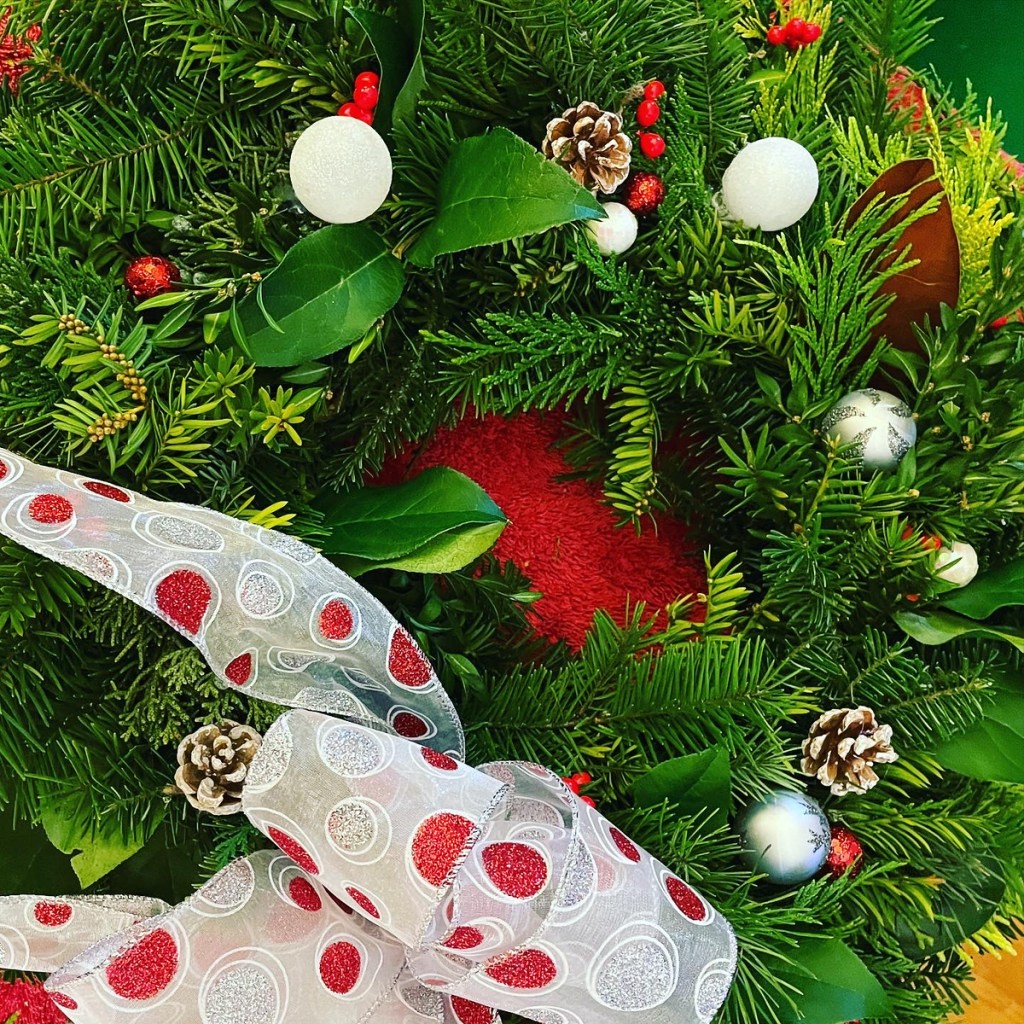
As far as wreath making goes, yews offered what I called a filler. Sometimes you need a lot of greens to create a full wreath (and you need even more to create a holiday kissing ball) and having this needled type of dark green evergreen filler from my dad’s trees, rather than purchasing more of another filler greens such as balsam and boxwood, helped reduce some expenses for me. It also served as a backup green. I always feared I’d run out at the workshops, and this was a good stock of filler. They hold onto their needles very well and last a very long time. As I’ve noted in prior posts, what makes a beautiful wreath is a mix of greens because you get various textures of green colors and yew also has a lighter underside color to the needles. Can you see the yew in the photos above? The yew helped to fill it in as with all the other greens we had on hand to use.
It is possible people don’t like to use them in their landscapes because they are toxic. My handy reference book indicates the foliage, bark, or seeds, are toxic to people and to all classes of livestock. The fleshy red berries (known as arils) are not poisonous, but the seeds inside which are very small are from what I know. This was interesting to read because my dad’s yew trees are on his farm! He had cows for years, but they were not in the backyard area where these trees stand by the road which leads further back to where the cows roamed the property by the river and in the fields. I wonder now if my dad knew this toxic issue about his yew trees and will have to tell him when I see him this week. He did not have any yew shrubs in the fields where the cows were, so that’s a good thing. I also read they are “not” toxic to deer – go figure! We all know deer like to roam evergreens and have at them in some landscapes.

I also liked using some of the taller yew branches to insert into large planters with the other mix of greens when creating holiday decor. The branches with reddish to brown bark are firm and strong, so it was useful for that aspect, serving as a center tall thriller. These yew greens experienced no problems if they get wet or frozen. I realized that yew was just overlooked but very useful. Yew has a nice dark green color with a bit lighter green on the underside of the needles and they had a nice fine texture too. They were not difficult to work with.
There are tons of cultivars of yew shrubs and trees. They have or had many purposes from foundation plantings to topiaries, even bonsai. They do not have serious diseases or insect issues from what I know. And lastly, these greens held up very nicely before and even after use. I would put them in a huge bin with the stem or limb cut ends facing down in the bins and fill the bottom part of the bins with water to keep them hydrated, and again, as noted in my prior post, I put them in the cold garage. The needles “never fell off” even after the workshops were long over and weeks went by. When I had some left over, there wasn’t a needle on the cement floor of the garage. Even if the water in my big bin froze, it did not negatively impact the stock I had collected. Later, I would put the left-over branches in the woods for the deer to have should they find them.

One year, I dressed up in my holiday gear wearing a red Santa hat and red festive jacket and recorded a video of me showing all of the green types I had for the upcoming workshops, and I talked about yews. I noted that not many people use yew greens in their wreaths, but I do. Later, I saw a nursery person showing off yew too. I thought, “Did she see my video and then gather some up too?” Perhaps! Why not so long as you know about the toxicity part.
One thing is for certain, I will miss this annual harvesting tradition with my dad. I’m not doing my wreath workshops anymore and not making greenery wreaths for the first time in 15 years. While we worked to gather up these greens, we’d have quick chats after the chainsaw stopped and I always cherished these quick chats, but it was also cold out usually and we’d feel it. Then we’d decide we were done chatting in the cold. It is something I just felt was a nice experience just for us. I didn’t even take a picture of us out there – which I think I should have. If you should decide to use some yew, please let me know your thoughts.
Cathy Testa
Container Crazy CT
Broad Brook/East Windsor, CT
 Container Crazy CT