Kalanchoe thyrsiflora ‘Fantastic’ (Paddle Plant)

3 Comments
    The Paddle Plant has a new fashionable look this year!  Check out Kalanchoe thyrsiflora ‘Fantastic’ with its red highlights!  I just read of this new cultivar in a trade magazine this month.  It was the recipient of the Favorite New Foliage Plant Award and Retailer’s Choice Award at the 2010 Tropical Plant Industry Exposition.  It is no wonder.  Its hot new red coloring on its paddles’ edges increases the visual response to its already interesting texture.
    Kalanchoe Fantastic-ForemostCo (click this link)
    In 2010, at the Boston Flower Show, I happen to take a picture of the straight species in a pot.  I am not sure why I took a photo of it other than I probably wanted to remember that I liked it.  And somewhere along the line this summer, I bought a paddle plant.  It is still sitting in a clay pot by my slider.  It has shot up quite a bit new growth (or paddles) and seems to be very happy awaiting for warmer temperatures to arrive.  So after testing it at my home, it is confirmed.  I love this plant, will seek it, and hope to find the ‘Fantastic’ cultivar just spotted in that trade magazine. Full sun is the best place for this plant as you would guess.  And in a place where water is well drained.  It despises wet soils.  Pair it up with other succulents.  Or try to capture the red highlights displayed on this plant with other companions that bloom red during the summer season.

    K. thyrsiflora

    Kalanchoe (pronounced KAL-an-choe-ee) is a tropical succulent perennial or subshrub.  It can grow 1 to 12 feet tall depending on the species.  I’m not surprised.  Mine has been growing all winter without much attention.  6 to 12″ of new grow can occur each year. It is hardy in zones 10-11, thus serves as an indoor house plant for CT or as a container gardening candidate in the heat of summer.  The unusal paddle like leaves are a way for the plant to retain water, much needed in the desert drought-like environments it is suited for.  Once again, I’m drawn to the tropical style of plants.

Burgundy Hearts Redbud Cercis canadensis ‘Greswan’

2 Comments

“Did you see my redbud?  It is gorgeous this year!”  And it was.  I snapped a photo of it immediately.

That day at my client’s home, she showed me her redbud tree in her backyard next to her back deck.  I’ve always liked this tree because of its unique flowering pattern that runs the line of every branch giving it an asian feel.  The flowers appear in spring before the leaves expand.  And the foliage is heart shaped. ‘Forest Pansy’ is a common favorite to point out to folks at the nursery because not only are the flowers beautiful, the color of the heart-shape leaves are plum-ish versus the traditional green.

New redbuds (Cercis canadensis) cultivars are coming out of the woodwork more often it seems.  Another one that caught my eye recently at a tradeshow was Burgundy Hearts® Redbud (Cercis canadensis ‘Greswan’).  The leaves are a tad bit larger and are a wine-red color, a bit lighter than ‘Forest Pansy’.  In early spring, the rosy-purple, pea-shaped flowers expand around March-April timeframe, before the leaves.  Hummingbirds and bees enjoy the early welcome as spring awakens their senses and our’s.  And this new introduction, ‘Greswan’, is noted for proven resistance to summer leaf sorch better than my former best on my list ‘Forest Pansy’.

Smaller trees tend to be my favorite in the landscape.  Burgundy Hearts® Redbud grows to about 20-25 feet at maturity.  It is fast growing and native.  In the late summer to fall, the red-purple color to the leaves transition to a more wine-red burgundy color.  It is cold hardy to zone 5 and heat tolerant to zone 8.  Place it in a full to partial sun location and let your heart begin to pound with love!

If you tend to like a hotter and warmer color to your landscape, another option in the redbud world is Cercis canadensis ‘JN2’, known as The Rising Sun™ Redbud.  It is a new introduction with brilliant, golden yellow to orange colored leaves.  It has a full, round shape and holds its color into fall.  The pea-like shaped flowers are a rosy-orchid color.  Another feature that makes this one a bit more unique to the rest of the redbuds is the bark – it has a yellow tinge to it.  The size of this one is even a bit better for smaller areas.  It reaches 12 feet at maturity. 

The Rising Sun™ Redbud is a vigorous grower and also a native ornamental tree.  It is cold hardy to zones 5-8 and appreciates full sun locations.  I can’t think of anything about these plants that are a downfall, other than if I don’t plant one soon, I may die of a broken redbud heart!  I vow to incorporate some more flowering trees in my landscape this spring, and hope to locate these beauties on the scene.  I hope you will too!  Cathy T

Finally located the photo I took of the redbud at my client’s home, here it is!

Redbud Blooms

Plant Pathology

3 Comments

A customer came into a nursery to ask what was the problem with his plant.  He was holding a dried-up dead (unidentifiable) perennial with bits of roots dangling below.  I had no clue.

Diagnosing plant diseases can be particularly challenging, unless there is an obvious symptom or sign.  A learning the difference between the two is equally important, and not always simple to do. 

  • A symptom is a reaction as a result of a disease, like wilting, galls, chlorosis (yellowing tissue), dieback, blotches, etc.  It is a change in the plant’s growth or exterior in response to a living (or non-living, such as extreme weather) destructive factor. 
  • A sign is the pathogen or its parts visible on the host plant, like a fruiting body, bacterial ooze, slime, or other yucky looking things!  It is direct proof of a damaging factor.

Understanding the difference between a symptom and a sign can help you arrive to a potential identification of the disease or problem, the cause, and how to prevent it in the future.

In December during a walk along a river, I spotted some wild flower stalks with odd round balls about half way down the center.  My husband accompanying me on the walk thought they were part of the plant and found them interesting.  Since we were collecting dried flower and cones for upcoming holiday container garden arrangements, I happen to have a pair of pruning shears with me.  Cutting open the ball revealed a quick learning opportunity for my husband.  Inside was a little tiny single insect surrounded by soft papery-like tissue from the plant’s reaction to insect’s home.  The round expansion on the stem was actually a gall.  A symptom.

A symptom

In October during our trip to Hawaii, I saw, for the first time, dodder on plants.  I learned about dodder last season during my master gardener classes.  Although these parasitic plants can a problem in CT, I’ve never seen or heard of it before.  However, on the Big Island of Hawai’i, it was visible on plants in many places during our travels.  A sign. 

Determining disease causes is not my favorite part of horticulture.  After all, it makes plants look out of character.  But learning about plant diseases is a necessity in this business.  Let’s face it.  Plant diseases are not normal thus they are not much fun to look at, but they must be addressed to improve the health of your garden, and the health of the gardener’s pride!

There are some common problems, like powdery mildew or downy mildew.  But even those can be uncommon to the general homeowner.  A woman’s reaction once when I told her she had powdery mildew on her plant was curious.  She backed away slowly, and said, “What the heck is that?!”  I felt useful during that conversation as I assured her it wasn’t contagious to humans. Then we discussed a plan of action, how to dispose of the plant properly, and plant varieties with resistant or tolerant traits.

Because of our very snowy season in CT, I suspect – as you may as well, we are going to have a very wet spring.  Moisture can be a big attributing factor to speeding up some disease problems.  Another big factor is temperature.  Both persuade the disease bad guys (organisms) to take action.  Timing is everything too.  Some diseases occur only during certain times of the season or year, and on specific plants. 

Repeat Snow

During plant studies, students learn about the big three needed for diseases to set it.  They are a “favorable environment” (like the extreme wetness soon to come), “susceptible host” (a plant that gets the disease easily), and a pathogen (the bad guy that causes the disease).  Without all three, your chances of disease incidences are greatly reduced.  Since we can’t control Mother Nature (as we CT folks were reminded the past couple months), we need to focus on the other two elements:  the plants we select and how we manage them. 

When you shop at your local nursery or consult with your professional designer this spring, like moi – Cathy T, ask about resistant varieties.  Think about things such as how to provide good air circulation around your plants and in your gardens, which products to use to amend your soil for proper drainage, and start off with the right plant in the right place.  Watch out for waterlogged places which can affect roots.

If you left a mess in your garden before winter, such as old debris and things that will remain wet, start to move them out early.  And start to consider what is normal or abnormal.  When my husband saw the galls on the wild flower stem, he thought it may be a seedpod.  It was not – it was abnormal. 

And other times, you just need to wait.  If a plant has winter injury, it may look awful at first, but it may also come back slowly.  As I said, diagnosing plant diseases can be a challenge.  Determining the problem, looking for patterns, plants affected, and gathering clues will be helpful if you go to a specialist for advice.  Be Inspector Clueso first.  Take note of things around the plant.

A book I found useful this year, introduced to me by my master gardener coordinator is, “What’s Wrong with My Plant? (And How do I Fix It?),” by David Deardorff and Kathryn Wadsworth.  I also like “The Ortho Problem Solver” manual for its images and description of plant problems, not necessarily the chemical application suggestions – but for determining what is wrong with the plant. 

But should you not want to look things up on your own, as my client, you can come to me, Cathy T.  I’ll do my best to help you this spring!

Phlox Find ‘Intensia Blueberry’

2 Comments

Phlox Find

An intensely rich hot-pink phlox was spotted in a generous soul’s garden.  “This is the only one you can’t take,” he said.  I wasn’t surprised he wouldn’t give it away.  It was a good find. 

Good finds are not always something you can plan ahead on for gardening.  Good finds are usually discovered.  You spot them at the nursery, in someone else’s gardens, or at a garden show display – and you think, “I have to have that plant too!”  That is what makes them a good find.

Phlox ‘Intensia® Blueberry’ is one of those types of good finds I spotted in a grower’s catalog when preparing my plant list order for 2011.  A new introduction, it bears masses of gorgeous, rich purplish blue flowers.  And it has a more upright habit than the typical Intensia Series with a larger leaf size.  Height is 10-12″ tall and width is 8-12″.  ‘Intensia® Blueberry’ is touted as having the same exceptional summer performance and heat tolerance as other Intensia phlox.  Ah the catch?  ‘Intensia ® Blueberry’ is hardy to zones 10-11 (warmer zones than CT’s).  However, this phlox will be a great container garden addition during the summer season.

As Stephanie Cohen (known author of perennial books, such as “The Perennial Gardener’s Design Primer”) once stated during a perennial review at a conference, new is not always better.  This is true.  New finds have been tested by growers and such, but the ultimate test is in your own gardens.  So you may want to proceed with caution with new finds, but sometimes that process is worth it. 

Phlox paniculata ‘David’ is one of my stand-by favorites because it is a resistant form to powdery mildew (white mold affecting tissue, causing leaf distortion and defoliation).  Because of this resistant trait, I often recommend ‘David’ to beginning gardeners.  However, ‘David’ is a white bloomer.  To me, it can be a little boring unless you are into white in your garden or container gardens. 

One of the more flashy fun colors is displayed on the pin-wheel pattern of blooms on Phlox ‘Peppermint Twist’.  It has pink and white spoked patterns on the flower petals.  It looks a bit more festive, and also has been touted as having a strong tolerance to powdery mildew.  There’s Phlox paniculata ‘Nicky’ with deep purple flowers.  Phlox glaberrima ‘Triple Play’ with variegated foliage where the center of the leave is dark green and edges are whiter with sun.  Flowers are pink-lavender.  And Phlox paniculata ‘Starfire’ with bright red flowers – also a catchy potential candidate.

David Culp, a sales representative of a grower and a speaker of perennials, announced the following phlox as “Promising Perennials” during a presentation last month:  Phlox ‘Blue Elf’ (also mentioned in year 2010; a dwarf woodland phlox, shorter with more buds), Phlox stolonifera ‘Margie’ (a creeping phlox with laveder flowers and purple eye), Phlox divaricata ‘Charles Ricardo’ (A new color for woodland phlox, lavendar, creeps like a groundcover; also mentioned in 2010, from England, taller), Phlox divaracita ‘Manita’ (has evergreen foliage, white flowers, indigo iceyblue eye bloom), Phlox ‘Montrose Tricolor’ (green/gray foliage), and Phlox divaracita ‘Mary Ellen’ (blue with lavender eye).

To learn more about good finds, contact me, Cathy T!

Brugmansia Mania ‘Grand Marnier’

Leave a comment

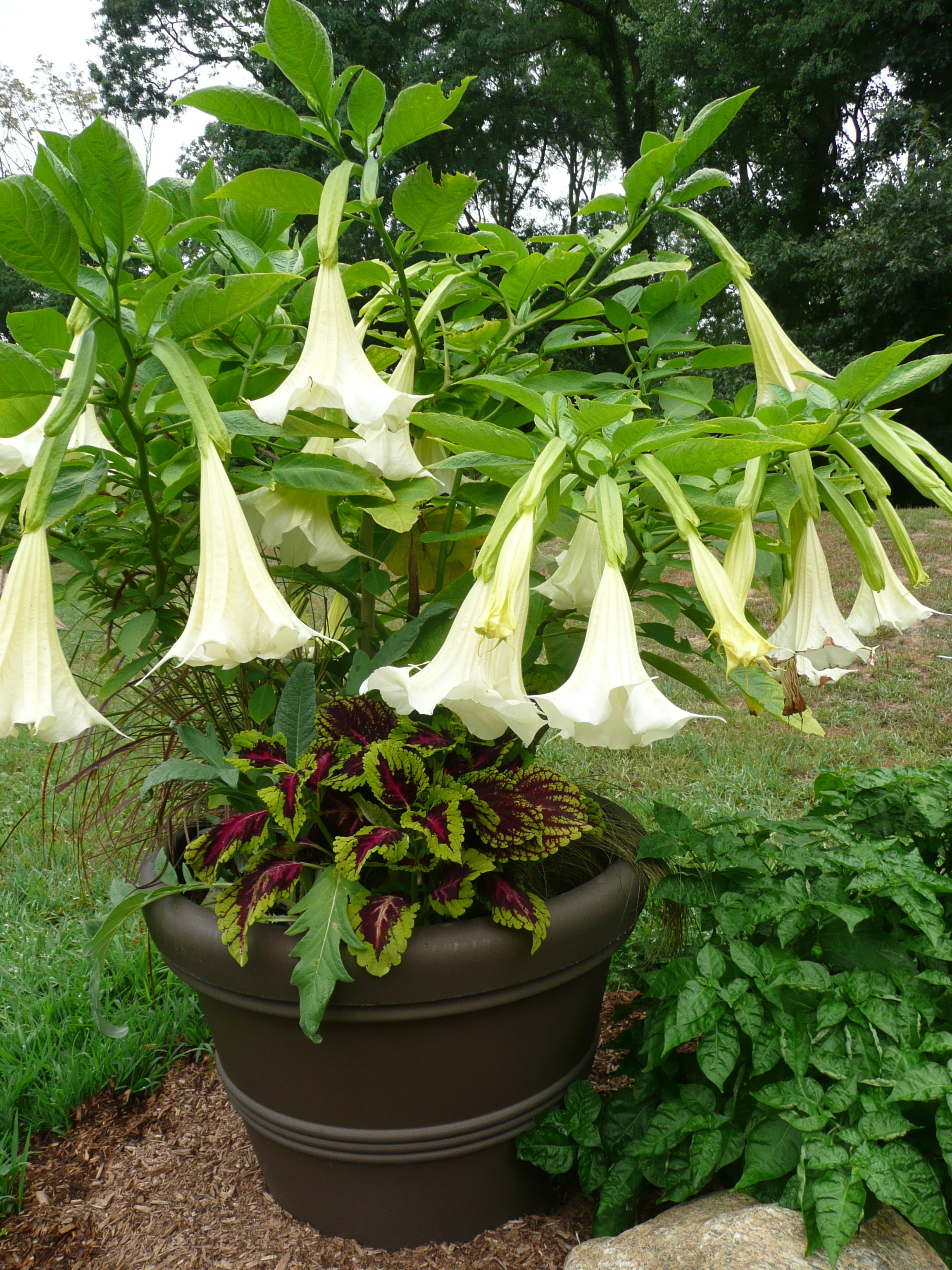
Elephant Ears, Canna, Banana, and Brugmansia are four of my mania plants.  I would probably go insane if we were unable to get these plants here for container gardening.  A nursery visitor told me one day that Brugmansia doesn’t do anything for her.  I responded, “You either love them or hate them.”  As for moi, I think they are amazing.  Their eye-catching large trumpet flowers and fast growth is a necessity for us CT gardeners whom enjoy tropic temptations!

Blooming 2010

This year Brugmansia x candida ‘Grand Marnier’ is on my plant order list for 2011.  A subtropical shrub or tree, it is hardy to zones 9-11.  This cultivar is popular and vigorous. It will grow up to 4-5 feet tall and wide in one container planting season, and produce large soft apricot-pink blooms, known as angel’s trumpet.  During the evening, the flower’s fragrance is intense and very noticeable.  It may be too powerful for sensitive noises.  Place it at a comfortable smelling distance or nearby if you are a perfume lover.  It is no wonder these large angel’s trumpets blossoms are captivating for they can reach 8 to 12 inches long.  As they dangle down and hang on for periods of time, you can’t help but notice them during the day hours too. 

Pronounced brugh-MAN-zee-uh, serve it up solo in a large container or mixed with other annuals and perennials. Just be sure to consider a full sun location and compatible planting partners with similar needs.  However, with that said, the large upper canopy can cast some shade to the plants below depending on the container’s location.   You won’t be disappointed with the flower blossoms as they appear in abundance, sometimes up to 15-20 on a plant at one time.  The shape of the flower is stunning as it unfurls with pointy, flaring tips to the edges of the trumpet’s opening.  Blooms form on the new growth which is great for our short summer season so you don’t have to wait to see them.

The soil should be rich, well-drained, and watered well.  But don’t over do it- it likes to drain between waterings.  In CT, you can overwinter this plant by tricking it into dormancy.  How-to tips are discussed in Cathy T’s Container Garden Parties.  See my website, www.cathytesta.com, for information. 

In warmer climates, this plant can be sunk into the ground in its container and covered for potection.  I spotted these plants in many locations in Hawai’i.  There they can reach tree size, up to 12′ feet tall.  However, take note every part of the angel’s trumpet plant is toxic.  Should you eat it, hallucinations are bound to scare you – and make you go mad!  Let Brugmansia mania be one for the eyes – and not for the mouth!   Cathy T

Begonia Belief ‘Bonfire Choc Pink’

Leave a comment

A recent client commented how she really enjoyed her Begonias this year in her various container gardens on her front porch.  She doesn’t have much experience with plants and selected one just by chance.  She loved how it didn’t need a great deal of attention and lasted all through the summer to fall.  What I could hear in her comments was that it was an easy plant that offered a lot of showy appeal to a beginning gardener.   She wants to make sure her next candidates this planting season are of similar character – and I am here to help her!

Bonfire in Whiskey Barrel

The Bonfire® series is one of my personal favorites when it comes to Begonias.  I planted one in a whiskey barrel a couple of years back and that plant rocked all season long, and with little attention – as my client indicated about her’s.  There are several new introductions of this series coming from one of my favorite growers this year. 

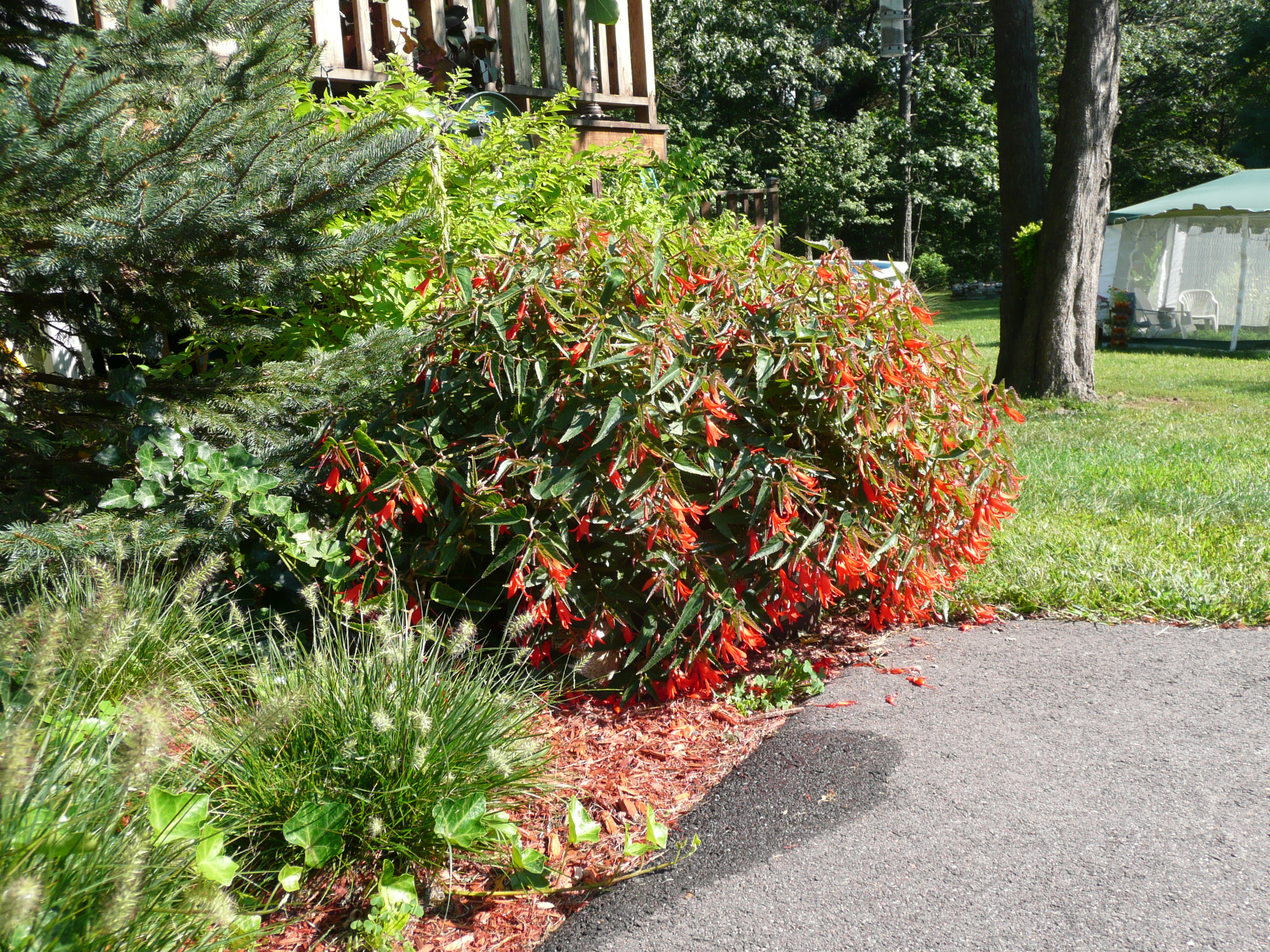
Begonia ‘Bonfire® Choc Pink’, hardy to zones 8-11, has chocolate plum foliage.  Darker foliage is one of the keys to providing contrast in container gardens so you should not pass them up as you find them in your nursery, or attend one of Cathy T’s Container Garden Parties.  ‘Bonfire® Choc Pink’ has a more mounding habit and blooms blush pink flowers that have a structure of long skinny petals that tend to dangle a bit down.  I like this style of flower’s shape better than the typical Begonia blooms.  We can see why they are referred to as Bonfire.  The petals look like flames!  The pink color of Choc Pink is soft and really shows up against its darker foliage.

‘Bonfire® Choc Pink’ will grow up to 20″ tall and wide, so it is very dramatic in a large container garden.  It can take the full sun to part sun/part shade, thus it is a versatile plant as well.  This very low maintenance plant with impressive performance is already on my plant order list for 2011 spring.  Yet, if you prefer a bit more intensity to flower color, the other new candidate is ‘Bonfire® Choc Red’, with red bloom and also dark-leaved but with a more upright habit.  The serrated foliage has red margins.  Look for both as you shop!  Cathy T

Banana for Bananas ‘Maurelii’

2 Comments

Ensete ventricosum ‘Maurelii’ (Red Banana or Abyssinian Banana) was a plant I offered to my Container Gardening Party guests in 2010.  It required some restraint for me to not keep at least one of the plants for myself.  This is one of those ultimate type of thrillers for designer container gardens.  With its big wide leaves streaked with red highlights, it reminds me of a relative, the canna plant.  However, this banana gets much larger.  The size of this plant was mentioned by the sales staff at the growers when I picked up my flats.  I knew this plant grows large, but I don’t think I really knew this!  When I went to see the plant at a guest’s home a couple months after she selected it for her container during my class, I was impressed with the increase of the trunk’s diameter.  She had embedded her container within many other showy plants around her inground pool.  It stood tall and impressed everyone who visited her home during the summer.

The banana plant isn’t a tree, so technically its stalk is not a trunk.  But it sure looks like one.  It is made up of tightly bound petioles that grow from the rhizome.  If you slice the stalk, trunk, or technically what is called a pseudostem (look that one up if you should so desire!), you will see the layers of leaves somewhat encircling inside.  I actually like seeing this pattern.  Think of it like a wrapped cigar or a rolled layer cake. 

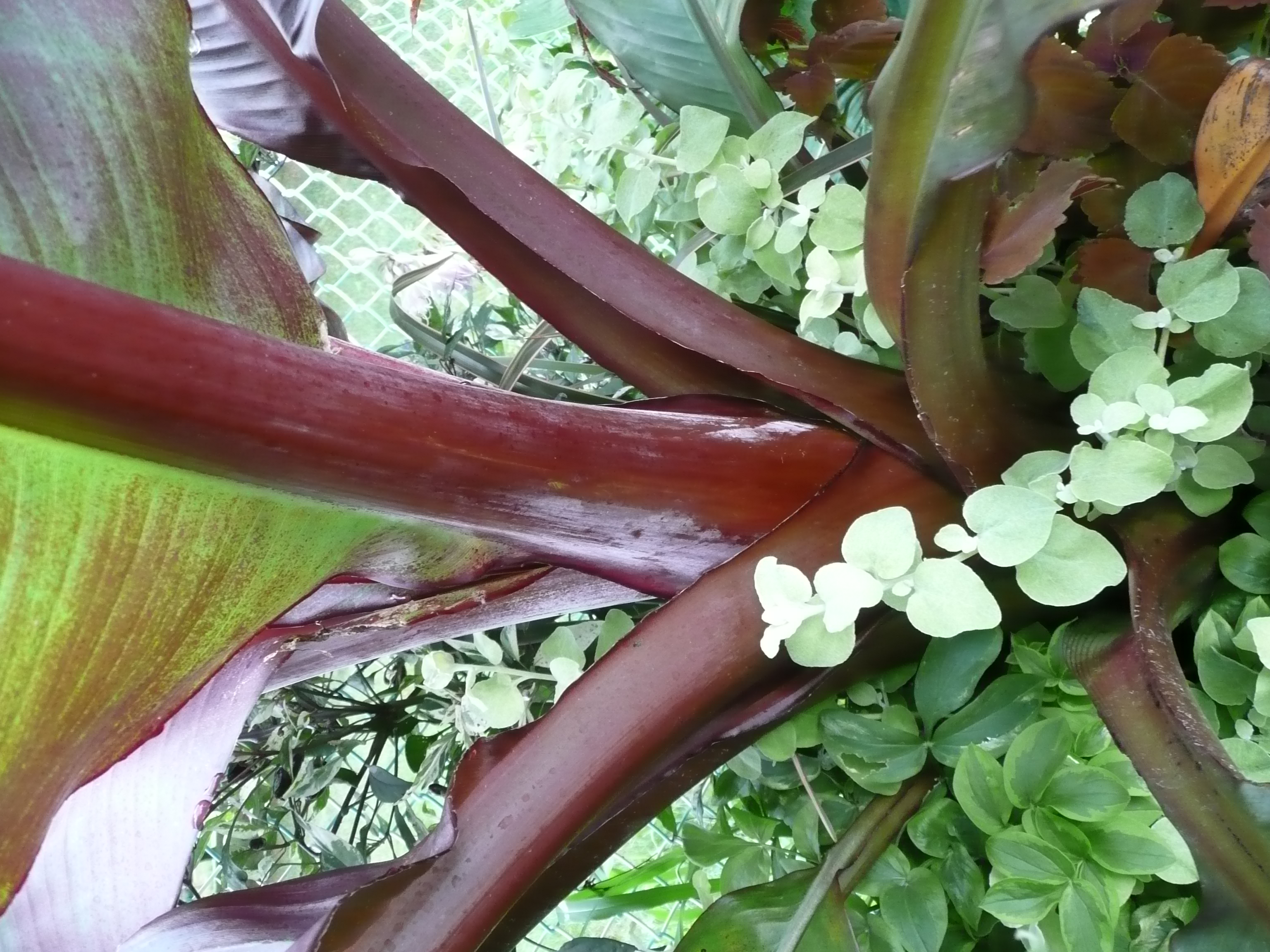
Because I am a foliage fanatic, this plant is high on my list.  Its leaves can grow up to 1 foot wide.  The length of the leaves is grand too – reaching many feet long!  Additionally, the midrib of the leave is something that offers impact.  When I visited the poolside specimen at my guest’s home, I took a close up photo of the midrid.  It was beautifully infused with a deepwine red color providing color impact, and the size of the midrib added a structural design element.  It was becoming thick and showy.  As with most of my favorite plants, this plant is showy because of its foliage, structure, and shear size.  Flowers are not really a necessity.  This is a good thing, for this banana requires at least one full growing season to bloom and this would occur in the spring providing all aspects of over-wintering care is provided. 

Midrib

However, in Hawai’i last October, my first banana flower sighting took place (in a few locations too).  It looked like a mini-football dangling from a knotted roap hanging solo from a different variety of banana plant.  In reading more about this plant, this mini-football shape is actually the bud of the flower.   Think monster caper bud.  It grows at the tip.  It is the male portion of the flower.  Above you will see the bananas, the female flowers eventually producing fruit.  Yes, the male and female flowers grow on the same plant.  On the outside of the bud part below were bracts.  These are the modified leaves growing around it (see the purple one extended in the photo below?).  Sometimes bracts or sepals are non-showy on plants, while other times they are mistaken to be the actual flower petals.  Sepals are leaflike structures around the petals. On this banana, the whole structure (except for the bananas) was alien like for I had never seen one before. 

Stalk with with Bud

Football Bud

‘Maurelii’ appreciates full sun and can be grown in containers after the spring frost has passed.  It is perfect for containers, with the one big consideration.  You must ensure the size of the pot is large enough to accomodate the fast growth and its stalk’s large proportions.  And because it can grow tall quickly, even up to 10 feet tall, you need a container that can keep the plant from tipping over.  Container clients are provided information about the best size container before our class, and now they know why.  And overwintering techniques are also discussed. 

As I learned more about banana plants in Hawai’i, I read of a funny one that is called “the pregnant banana.”  The fruit grows “inside” the stalk.  This is a banana of the Musa spp.  The stalk gets fatter until it looks ready for delivery.  Should you be the person to see it near due, you can actually cut open (or deliver, LOL), the stalk to get the bananas!  Now that is something I’d love to see.  An emergency c-section on a plant!  Cathy T

A Seat Cushion ‘Euphorbia polychroma’

2 Comments

Euphorbia polychroma (Cushion Spurge) is a plant that can awaken spring.  I can’t remember where I discovered it, but I planted it in a garden bed I’ve been frustrated with because of the clay in the soil.  I should have investigated the soil contents more before adventuring into creating a bed in this area, but my temptation to use the space was overpowering at the time.  On the plus side, this lead me to testing plants that do well in clay, and this one thrives in this spot (although care instructions indicate good drainage for this plant).  Perhaps the fact the soil is well-drained because it is on a hill and the balance of the clay moisture holding capacity below the soil provides a counteracted effect.  Whatever the reason, it does well in full sun and in my clay-ish bed. Go figure!

This perennial is excellent for use in mixed borders or even cutting gardens.  It grows fast too, reaching a height of about 12-15″ and width of 18″.  But what I love about this plant the most is the intensity of the yellow bloom color completely covering the cushion habit atop its rich green foliage.  It is alike a ball of sunshine in your garden bed.  It is practically – well, you know – Euphoric!

The form keeps it shape too, perfectly symmetrical and fluffy.  Good enough to provide a cushion seat!  (Not really, but you know what I mean!).  The other aspect I enjoy about this particular Euphorbia species is the unusual style of the flowers clusted at the top.  In fact, the greenish flowers are unisexual.  They have no petals or sepals and this is probably why they look different compared to typical flowers. (See the photo gallery below).

If you are seeking an April to May bloomer in your garden with a bright yellow bloom, this is the plant.  Plus it is deer resistant too.   If you find the plant gets a little too large, it is okay to shear it back by one-third to shape it after it finishes flowering.  Also, if you have a really fertile garden, unlike my clay bed, this plant can be a bit aggressive, so shearing it before flowering removes potential seeds.  It doesn’t get affected by serious diseases and insects and is perfect for zones 4-8.  And one last note, there is a milky white sap that can seep or ooze out of the plant when cut so if you are allergic to these things, wear gloves for protection.  Cathy T

Agave ‘Kissho Kan’

Leave a comment

Agave ‘Kissho Kan’, a succulent hardy to zones 9-10, was a big hit at Gardens, Gallery & Gifts.  I sold these in black pots topped with lava rocks and as a trio in designer containers with shiny stones to finish the look!  Many visitors took one home.  This plant grows to about 15″ tall eventually.  It has an interesting white edge to the margins with sharp red infused spines. 

Kissho with Sticks

First to Sell

I believe the main factor which attracted attention is the fact it is a tough plant that can take droughty conditions – something we experienced all summer long in 2010 – and on the days of our first annual GGG event in Broad Brook, CT.  (Take Note:  We are holding our 2nd Annual GGG Event again this June 4-5th!).  

The other factor enjoyed by GGG visitors is it could be taken indoors as a houseplant at the end of the season.  Reusing the plant for a new purpose and saving money.  The key however is to take it in before any (repeat any) chance of frost damage.  In fact, well before.  As you reach the final end of the summer when temps begin to cool, take this plant inside. 

Agave

Drought tolerant

Succulents require even less attention once inside.  By a sunny window during the winter, they recede into a semi-dormant state.  You can greatly reduce the watering and let it loose some weight, so to speak.  And this type of plant can be left alone should you take some time to travel during your winter – or prior during the summer months on vacation!  It is very undemanding but offers a good show.  Mine is doing wonderfully by my kitchen garden window, watering it very, very lightly and only occassionally (weeks can go by without watering).

The other succulent receiving applause at the GGG event was Senecio mandraliscae ‘Blue Chalk Sticks’ (Groundsel).  It was a new offering by the grower and caught my eye.  This blue chop stick looking form produces small white flowers around July-August, which mine did!  It has a spreading, reaching habit thus can serve as a “spiller” in Container Gardens.  Visitors to the show commented on it for it was unusual.  Many had never seen this plant before.  Again, the fact that it is a sun lover (to part-sun), deer resistant, and tough made it high on their list.   In warmer clients, this one could be considered as a groundcover too.

Spiller Candidate

Blooms late summer

I’ve already placed my order for more succulents – but of a different twist.  They will be offered again in June at the GGG show.  I’m looking forward to sharing the one’s I’ve selected and seeing your reactions….And to the snow melting in time!  Cathy T

Cardoon Va-Voom!

Leave a comment

Cardoon (Cynara cardunculus) is a plant I wanted to try this season because it has foliage power.  The leaves are long and deeply cut, the edges are sharp and pointy, and it has a soft silvery coloring.  Almost a gray-green tone or like a silvery white, with more white tones under the leaves which are held on stalky stems with prickly edges.  It is hardy in zones 7-11 and requires full sun.  I used it as a tropical style looking plant for my container gardens and in the ground.  And sold some at my Container Garden Party offerings in 2010.

This plant can grow to a very large size!  Up to 6 feet tall.  Mine did grow very quickly in my containers this past season, starting with a early June planting and continuing to do well all the way into fall.  It didn’t stop performing.  The texture and form works well in a container alone or planted with supporting candidates.  I used it in 3 places:  1 in an urn, 1 in a huge pot, and 1 by my mailbox mixed with Sedum and Artemisia arborescens ‘Powis Castle’. I was testing out the scenarios and seeing how it did to determine if I would offer it again to my container gardening clients.

The urn was the perfect shape container for the Cardoon plant because the plant’s foliage rose above it and hung over by the tips, offering a dramatic effect.  The downsize was the urn was not large enough to support the plant’s soil and watering needs, so it had to be watered too often.  This became a nuisance because the soil in the urn dried out too quickly for the size of the root system.  And then the plant began to suffer which made the insects nearby take notice.  It got a bit attacked.  I was disappointed.  But the look of the plant fit the style of the urn perfectly.  The plant is stately, grand, and commands attention.  The urn is stately and stands tall as if commanding attention.  It is hard to describe, but the feel of the container matched the feel of the plant.  These are important aspects to selecting the right container for container plants.  You may have a country look to a container and you need to pair it up with a country or cottage style plant, in my opinion.  A formal container should have a more formal style plant.  When you put a couple together that doesn’t match, it looks odd and takes away from each personality.  But when you have the right pair, you can feel and see its beauty!

The mailbox planting of a Cardoon this same season surprised me as well.  I absolutely loved how the silvery green of the foliage of this plant worked so well with the soft rosy pink blooms of the Sedum ‘Autumn Joy’ perennial planted with it.  As the Sedum’s bloom color intensified to a darker red-plum during late summer to fall, the foliage of the Cardoon continued to support it.    This analogous scheme used 2 of related colors (blue/silver foliage of Cardoon, the pink/burgundy bloom of Sedum).  They lie next to each other on the color wheel leading to a harmonious blend.  

The Artemisia arborescens ‘Powis Castle’ (Wormwood) perennial plant was also a great addition to the other two plants because it has silvery foliage like the Cardoon, BUT the foliage of Artemisia is soft and whimsical compared to the stark and stronge cutting edge look of the Cardoon.  The Cardoon provided that stronger elemental form while the thinner foliage of the Artemisia softened its stature.  Artemisia (Wormwood) is a fine textured plant that can also take full sun conditions, like Cardoon.  It is hardy in Zones6-9, grows well in average to dry soils (lime-enriched (alkaline) soil, and bonus – is deer resistant!  It is easy to grow and prospers in dry heat which we experienced during our dry 2010 season.  Artemisias can be sheared back if they looks leggy later in the season.  It is also feathery foliage favorite.  (Reminder:  Flowers?  Not always needed for impact!)

Many know that Sedums can take the heat and drought too!  Sedums have broccoli looking buds in spring, they turn pink and then darker pink into fall.  By late Autumn, the rosy burgundy coloring still created a visual appeal with its the large Cardoon foliage.  Sedums are known for their winter interest as well.  The spent flower heads, turning brown and dry into winter, always look wonderful when ice or snow clings to it (although this big snow year for us in CT has hidden many at this time). 

In summary, my experience is all three of these plants, Cardoon – Sedum – Artemisia  – performed well from early summer to late fall.  Each gave the other more impact in regards to coloring and texture.  The Cardoon surprised me on how well it did by a harsh roadside environment too.  It didn’t cry out for watering and it kept getting bigger.  It was a showy curb side candidate in an unexpected place.  I was thrilled Cardoon performed by the mailbox trio planting. 

Yet for some reason the same Cardoon in my large pot of about 3 feet in diameter didn’t perform so well.  It continued to get discolored leaves and did not thrive as well as the mailbox plant.  I kept wondering what was causing this problem.  The soilless medium used was of good balance, it was watered routinely, and had fertilizer appropriately applied.  Sometimes plants just don’t want to cooperate.  But by the end of the season, when I disassembled the large container garden, I took photos of the leaves.  They were up to 2-3′ long! 

I will still use this candidate Cardoon in the future and will look for plants of a similar texture.  It provides great foliage texture and form.  I know when people first saw it in a 5″ pot, they secretly thought, ugh.  But Ugh no more.  It provided a powerful statement in all three areas.  It just needed more consideration for its ultimate size to assure an even more quality outcome.  Cardoon does provide that Va-Voom!