Hemlock woolly adelgids

Leave a comment

Ever see one of those Sci-fi movies where the off spring of genetically superior parents are so perfect they can ward off all diseases and have amazing intellect?  Sound crazy?  Well, yah a bit when it comes to humans, but in the plant world, hybrids are created all the time in attempts to not only increase the benefits of a plant, but its resistance to problems or pests.

One such example was noted in the December 2010 issue of the “Nursery Management & Production” magazine.  Yes, I finally got around to reading my December issue in April 2011.  This article, titled, “Hemlock hybrids resist destructive pest” caught my attention because I love offering hemlocks to clients as an option for hedges or privacy borders, but it has one drawback – the woolly adelgid insect (Adelges tsugae).  Tsuga canadensis, the Eastern or Canada hemlock is susceptible to it.  So is Tsuga caroliniana (Carolina hemlock).  Both hemlocks are native to the U.S. and applicable to our CT planting zones.

Hemlock woolly adelgid (HWA) is caused by female aphid-like insects that feed off the plant.  It is considered to be one of the major invasive pest threats in New England.  You can spot it on the hemlocks by a cottony material that stands out against the dark green needles.  This wool-looking sign consists of egg masses laid in early spring on the twigs.  If you don’t spot the white stuff right away, you later may notice your hemlocks turning grayish green first, than brown as they weaken from the feeding process.  Sometimes the HWA invasion can lead to the death of the tree.

However, all is not lost if you are forewarned of this potential threat.  A good professional designer or landscape installer with a conscience should advise their clients about this possibility if recommending this tree.  The maintenance required to control HWA involves spraying horticulture oil once in early spring before new growth begins, and again in the fall.  This will offer excellent control and is easy to do, but, with that said, you have to be willing to do this or at least be aware of the HWA problem so you don’t leave your hemlocks unsupervised.  If an infestation occurs and becomes really bad, the tree may need to be removed entirely.  I make sure to inform my clients of this if they aren’t already aware of HWA. 

In the plant world, bad scenarios like this don’t always happen though.  I have seen many plantings of hemlocks that have never experienced the woolly adelgid problem at all.  It is kind of curious to me, but then again not.  When hemlocks are grown in the right place and have a healthy start, chances is minimized for problems.  Plants in a weak state are larger targets for insects.  And with new hybrids on the horizon, homeowners will have new choices if they don’t want to risk HWA.  But we are going to have to wait.

After reading the aforementioned article, I contacted Sue Bentz, a horticulturist of the USDA’s Agricultural Research Service, to inquire a bit more about their process.  She indicated their hemlock hybrid trails are still in the testing phases.  The test hybrids are being cloned for out-planting trails to evaluate hardiness, landscape merit and whole plant susceptibility to HWA.  They hope to establish the first field trail this year.  The evaluation process may take several years.  Sue continued to explain, the hybrids between T. chinensis and T. caroliniana (and other Asian species and T. chinensis) are showing greater resistance to HWA than the susceptible species. 

Until these resistant hybrids are available on the market, please don’t be afraid to purchase T. canadensis.  It is a wonderful option for our CT planting zones in shady areas.  It is useful in the landscape as a larger hedge plant or one to block an unsightly view.  Its wispy, soft needles allow the branches to interconnect creating a nice green fence, plus the plant stays full to the ground level so there is no bare spot below.  It also grows on both alkaline and acidic soils.  And T. caroliniana (Carolina hemlock) is also beautiful, an upright tree with short and pendulous branches.  It looks very similar to T. canadensis but its needles go around the stem and it has larger cones.   Besides the HWA concern, the only other consideration is to not plant them in exposed locations. Both do not care for strong winds. 

To learn more about New England pest threats, check out this website:  http://www.ProNewEngland.org. Cathy T

Juniperus squamata ‘Blue Star’

Leave a comment

Blue Star

A handy juniper to use in the landscape is Juniperus squamata ‘Blue Star’.  I’m not sure if the squamata species name means it “squats” low to the ground, but that is kind of what the habit is like for this juniper.  It has a mound habit and sits (or squats) low to the ground.  Reaching about a height of one to three feet and spread of two to four feet, it doesn’t get too large with its slow growth rate.  It has a nice soft silvery-blue needle color that is useful to pair up as a partner with other soft colors like pink blooms on other shrubs in the landscape nearby.

‘Blue Star’ prefers full sun.  It also can take some drought once established, thus it is a good low-maintenance candidate.  Additionally, in my opinion, it isn’t ugly like some other types of junipers that have more of a low-creeping habit.  Many of my clients have said “yuck” to the itchy, sprawling junipers, and tend to agree with the look of ‘Blue Star’ being more on the handsome side due to its mounded fluffy form.  The needles are awl-shaped.  I remember asking my professor years ago when we studied these types of plants what that word meant.  He responded, “like a boat.”  Awl means the needles tapers to a slender stiff point.  If you look up close, you will notice this on ‘Blue Star’.

This shrub can also tolerate a range of soils, from clay to the more well-drained, and can take urban conditions, like for beds situated near driveways.  It doesn’t get serious pest problems.  However, it prefers acid soils, so if your soil is alkaline, it may yellow a bit in your landscape, but I haven’t seen this problem on ‘Blue Stars’ as of yet in any of the residences I’ve visited to date. 

However, I have seen another problem on other junipers called cedar-apple rust.  The best description I can give this problem, is when you see it on junipers, it looks like orange snot globbed on a branch.  In the spring or early summer, this (snotty) swelling will appear on the upper surface of the needles, in the shape of a blob ball.  During warm and rainy weather, it swells up and grows jelly looking things called “horns” which look like a mistake by a not-so-nice passerby spitting on it.  Oh gross!  But it is actually a gall.  A yucky looking gall for sure.

How does happen this on junipers?  Well, if you have never heard of or seen cedar-apple rust, you either have no junipers in your landscape or you are well-informed about the causal agent and where it comes from.  This disease is caused by a fungus that infects apple trees first.  The wind will carry spores from apples leaves and infect the juniper in the summer.  This begins a ping-pong game by this fungus between the juniper and the apple tree.  It does not travel from one juniper to the other, but will bounce back to the apple tree a spring later.  Then in August, the spores return to the juniper.  You have to wonder how nature, or why nature chose to do this routine for its growing cycle? It is rather odd.  Perhaps the texture of the juniper’s needles just worked for this organism to grow and reproduce, I’m not sure, but when you see cedar-apple rust for the first time, you want to reach for a Kleenex!

So what should you do if you witness the cedar-apple rust “orange snot” or more technically stated, galls, on your junipers?  Remove them and toss them in the garbage.  And if possible, do not plant apples trees in the same landscape area as your new junipers.  Or if you have apple trees or a farm of trees within several hundred yards, don’t use them at all to avoid this experience.  This is the advice I give my clients.  The good news is, if you have no issues with junipers, they are very easy to find in your local nurseries here in CT.  Just look down when walking through the shrub section when you browse for your plants.  You will spot this dense, compact mounded useful shrub sitting there.  I find ‘Blue Star’ very useful and continue to recommend it to my DIY landscape clients as a shrub that doesn’t overwhelm a space, is low-maintenance, and easy to plant.  Cathy T

New Kid in Town

Leave a comment

If you felt a bit down in the dumps yesterday about our unwelcomed snowfall, I suggest you get into your car and go visit one of your local nurseries.  Nothing will cheer you up more than walking into a greenhouse filled with colorful pansies and annual plants beginning to grow and show buds. 

Luckily for me, I had the opportunity to do this last Thursday, the day before our hopefully last snow storm of the season.  I was invited to a guided tour of the Flower Power Farm located in my hometown of East Windsor, CT.  www.flowerpowerfarm.com.

Flower Power Farm opened up in 2009.  Some of my gardening friends started to ask me if I’ve been there yet.  I did make a few trips there last summer during my hustle and bustle days of the season. I loved how well arranged the rows were set up with neat and clean tables of plants perfectly lined up.  Even though I can identify many plants from a mile away, I appreciated the efficiency of their table arrangements with clear lables at the front of every grouping of plant varieties in their greenhouses and hoop houses. 

Well, now the movement through this nursery is at warp speed.  A cement super highway, as Ben Lupien, the owner of the Flower Power Farm called it, has been poured along the perimeter of his 53 acre grounds.  As it takes you past the first set of greenhouses, you arrive upon a huge outdoor open area of tables just waiting to be stocked with plants as soon as Mother Nature allows.  Beyond this space are many more newly installed greenhouses.  You would not know they were back there when driving by their nursery.  They are located on the far end of the property.

As Ben continued to guide me through the area, he rattled off amazing statistics about their new farm.  They have expanded the area by 50%, growing in bulk so they can afford to offer good prices to their customers, and all their pots sport their new logo.  Every hanging basket has an attached plant tag by color; red tag for full sun and orange for part-sun.  And not only that, the tag lists all the plants in the hanging baskets.  They are growing thousands of plants.  “Hard to believe?”  Well, not when you enter the newest growing houses in the back.

As we walked in, I had to gasp a bit.  Each was fully loaded with plants in pots just waiting to hit the sales floors.  Ben quickly picked up one of the hottest new petunias on the market, a black variety called ‘Black Velvet’.  This is the world’s only black petunia and a must have this year.  It is early flowering, tightly branched and has a mounding habit.  It will be popular, along with Petunia ‘Phantom’ and ‘Pinstripe’ – both also new with back flowers and stripes of color down the petals’ centers (yellow on Phantom and Rose purple on Pinstripe).  His instincts are on target.  I ordered the same variety this winter for my container offerings.

Suddenly, Ben’s cell phone rings for the fourth time.  “Sorry,” he apologized.  I replied with, “Not at all – that is a good thing.” 

It is apparent Ben is a busy young person with lots of ambition.  I thought to myself, “If you are going to dream, you might as well dream big.”  And, Ben, along with his wife, Barb, is doing just that.  However, this new kid in town isn’t just dreaming.  He is going for it. 

The personal aspect that makes this new nursery/growing business all the more exciting to me is that Ben selected this area of East Windsor to pursue his dreams and ventures.  I grew up right down the road from his business location.  It feels good to see a business growing in a product I enjoy so much – plants – right here in my hometown. I was able to share with Ben my history of living on a one-hundred acre farm with a river behind it, and mentioned this land is for sale at the moment. 

The Flower Power Farm has expanded its selection of trees and shrubs this year too.  They have some fruit trees ready for the grow-your-own people out there, and a great selection of shrubs for the landscape.   And they also relocated their entry area with a nice building offering a small selection of products like Osmocote, gardening gloves and watering cans.  I took a photo of watering cans in the shape of pigs sporting this year’s hottest new color, honeysuckle pink!  Planting containers are displayed near this area, all graced with new paver walkways and small beds showcasing some of their shrub offerings.

It is nice to have local choices for gardening.  And I would like to point out that plants are products that we grow right here in the U.S.  When we buy from our local nursery owners, we are not only supporting our “local” economy but supporting our country.  There aren’t any labels stating plants are ‘made in China’ in this nursery, or any other reputable nearby nursery in our hometowns. 

If you are a local to East Windsor, such as me, I encourage you to visit the newly expanded Flower Power Farm – and the other nurseries in our towns.  The owners and their staff work hard to bring us the pleasures of colorful plants to add to our gardens and landscapes.  And they beautify our towns with their community projects and help their local garden clubs.  Don’t miss out on your chance to see their offerings and wake up your spring senses at the same time!  Cathy T of Cathy T’s Landscape Designs (www.cathytesta.com).


Yawn about Lawns

Leave a comment

When I went to UCONN for my horticulture studies, I included a course on turfgrass science and management in my curriculum because I thought I should know something about lawns.  However, I find grass extremely boring.  Trying to decipher the different varieties by examining each blade was painful. You don’t even want to know what a ligule is!  They all looked the same to me.

As a non-traditional student (a polite way of meaning older than the rest of them), I was completely different from the typical student in this class. My turf classroom was filled with ambitious young guys with clean-cut haircuts and sharp-edged baseball hats.  All had hopes of maintaining the golf courses of their dreams.  A very rewarding career choice indeed.  I knew this was not my tribe but they were fun to be around, treated me with kindness, and were serious about their turfgrass studies.

Today we are seeing more and more lawns being replaced by low-maintenance ground covers.  This is good news in my book.  Partly because I enjoy other plants more than grass.  And because lawns can be highly intensive for care, requiring routine mowings, fertilizer (usually over fertilization not always needed) and time (taken away from more fun summer activities), especially if you are looking to achieve perfection. 

For homeowners who absolutely adore a green lush lawn, the effort is worth it to them, and I get that – somewhat. It adds curb-appeal to the landscape, can increase the value to a home, and is a source of pride for some — but still – it should be done with thought and some good planning. 

Lawns don’t have to be all that time-consuming to look good, or I should say, “good enough.”  Unlike golf courses, which require a high level of care to achieve smooth putting surfaces, lawns don’t have to be flawless if you are willing to practice acceptance.

My husband, Steve, and I are not big into the perfect green lawn look.  Our yard is roughly 6.5 acres so to manage it that intensely is kind of overwhelming.  Steve’s comment is, “If it grows, it mows!”  And years ago, he meant that as he mowed some of my perennials down.  It took some coaching but he eventually learned to not do that again, or to hit my precious trees with his huge five foot wide mower attached to his tractor. 

Right now, as I look out my window, our lawn looks awful.  But as soon as it greens up a bit, and Steve’s first mow is done, it will be decent enough for us.  We ignore the weeds, not bothering with chemicals to kill them.  We turn a blind eye to the crabgrass or dandelions.  In autumn, we don’t bother to rake up our leaves either.  Steve mows them into bits, and I let him know he is doing the right thing.  This practice returns nutrients to the soil.   Our non-desire to make a perfect lawn ends up being helpful to our environment too.  Our home is surrounded by wetlands leading to a river and some streams.  No worries about fertilizer run-off here. 

Other people who want perfection will start right about now, in early spring, to consider how to improve their lawns as warmer temperatures approach.  As they walk around picking up debris from the winter, some homeowners start to ponder the dream of achieving a perfect green lawn.  One non-intensive practice is to follow the recommendation of not removing more than one-third of the grass blades per mow.  And allow the grass clippings to return to the lawn, just like we do with our fall leaves.  “Small” clippings help return some nutrients to your soils.  Every “little bit” helps to reduce the reliance on fertilizers, which can be a problem to our environment when overused or unnecessarily applied. 

Another good non-intensive tip is to not apply fertilizer to your lawns until you do a soil test through your Cooperative Extension program.  If you haven’t tested your soil in the past, give it a try.  In CT, you can go through UCONN’s Soil Lab in Storrs, CT.  You dig a sample, bag it and mail it.  It is that easy, and costs only $8 bucks.  You can have it tested anytime the ground is not frozen.  Just go to this link to learn how to, complete with details: http://www.soiltest.uconn.edu/factsheets/HomeGrounds.pdf . The test results mailed back to you will help you decide the amount of fertilizer needed, or if you need limestone added to correct or adjust your soil’s pH.  

The soil’s pH must be at the proper level to take up nutrients, and when it’s too high or too low, microorganisms that break down organic matter are less active.  Some people think limestone (made by grinding limestone rock into fine powder) is primarily a fertilizer, but its main purpose is to raise the pH if it is too low so that the nutrients you add will work.  When the pH is off, nutrients are not doing much good to your soil because they become “locked up”.  Appropriate pH holds the key to releasing them.  Lime does give some plant nutrients if it has calcium and magnesium, which many sources do.  Overall, it is important to realize different plants need different pH levels to enjoy the best of the nutrients you apply. Most turfgrasses grow well in a soil with a pH of 6.0 and 7.0. 

In addition to soil testing, the UCONN site is an excellent resource on many topics on soil fertility.  There are excellent Fact Sheets on Home Composting, Fertilizing House Plants, Lead in Garden Soils, Compost Tea, and many other related topics.  In fact, during my studies, I worked at the lab for a short time where I met Dawn Pettinelli.  She is the manager on-site and a soil expert.  She is amazingly well-versed in the subject and often writes articles for various publications.  I did very little time there, sifting soil samples, running them through a process for testing, and getting an idea about soil overall.  Ironically, I loved looking at soil samples, seeing the texture of silt, clay and sand, and the colors of different soil samples sent to the lab was interesting to me. 

Soil testing is one of the most important steps you can take if you want to apply the right amount of fertilizer at the right time.  This holds true for gardens too, doing a soil test enables you to enhance the soil appropriately especially if you find your plants are not doing well or constantly suffering, or when establishing a brand new garden bed. 

And if you want to say even more time, be sure to add some organic matter to the ground before you seed a brand new lawn.  This will improve the plants success and give it a boost upfront.  Then once established, only you can decide of you want to go for the best look or accept it as is.  Since I tend to yawn about lawns, I’ll stick with the latter.  Cathy T

Boston Flower Show 2011

Leave a comment
 
Girls Just Want to Have Fun!

Last Friday could not have been a more perfect day to attend the Boston Flower & Garden Show.  It was sunny, warm and breezy.  A day which presented us with the first signs of spring.  Donna, my friend, accepted my invitation to come along on this trip.  She was as equally excited, partly because I turned her onto container gardening last year.  She hosted one of my Container Garden Parties at her home last spring, and not only did she and her friends learn about plants and designing containers, she ended up with 20 rhizomes from the canna plant in her container by the end of the season.  Yes, 20 produced from one starter plant!  In the fall, Donna came over to my house to learn how to store the rhizomes for use again this spring.  I told her she can start to pot up the rhizomes now to get them growing in her house for an early start. 

The deluxe motorcoach bus ride to the show was convenient and relaxing.  Organized by Friendship Tours on behalf of the CT Horticultural Society’s trip offerings (www.cthort.org), it went smoothly with no traffic delays into the city.  We sat back and chatted until we were dropped off at the front door.  On the way, we stopped for a one-hour guided tour of the Boston Public Library.  But to be honest, I was too anxious to see the show, which featured container gardens this year! As you can imagine, I could not wait to get there. 

I really liked how the show floor was setup this year.  Right down the middle, the landscape designs and garden exhibitors were displayed.  As you entered the main entrance, you walked straight ahead to begin seeing all the thrills of container gardening by the exhibitors participating in the displays.  And on each side of this central area were the market places where you could shop and buy many gardening related products.  I liked how they broke the market place up into two sections on each side of the landscape display areas because it also broke up the shopping crowd.  Plus you felt like you could step out of the displays and shop on either side when you needed a change of pace.  In the very back of the building were the floral and horticulture competition exhibits, held in well air-conditioned rooms.  So if you need a little cooling down from all the excitement, these rooms are not only cooling but very quiet.  We decided to see the award winning plants as the grand finale later that day.

Donna shops

This year’s show featured 25 gardens each encompasing some creative aspect of container gardening.  Some were embedded with displays as focal points.  While others were interesting takes on the container concept.  I was immediately impressed upon arrival to the first exhibit.  In fact, I started to feel like some of these displays may have been even better than the Philadelphia’s flower show which I just raved about a week ago on my blog!  Or perhaps it is because I’m addicted to container gardening, so it thrills me the most.  Donna’s reactions were equally positive.  She was inspired on so many levels by what she saw – and so was I.  As soon as we began our journey through the displays, we felt charged up for more. 

Yoga Gardening

Tub Above

A lot of the landscape and garden displays had raised or elevated features.  For example, one with lots of orchids had a table on a turn-style platform which rotated as a central focal point in the center of the display, elevated above everything else around it.  It was held up high and provided an action feature.  Another display showcased an old galvanized tub filled with plants.  It was situated on top of a tall and worn wooden ladder.  The older type of materials worked well together, giving a rustic country feel to the scene.  I liked how the plants cascaded from the tub down the ladder a bit. And this display showed how you can reuse common old products in new ways as containers. 

Another feature I noticed in this show, and in Philly’s and Hartford’s flower shows this year, was the use of live people in landscape or garden exhibits.  In Boston, one designer showcased a zen-like garden with yoga instructors doing poses on a wooden platform floor set inside a garden room.  This offered a new element of inspiration as you witnessed the intended garden theme being used in action on the spot.  In Hartford, there were people in a garden display carrying picket signs about plants.  I can’t recall exactly the theme of their showcase area, but the fact they used actors along with the plants engaged interest in a new way.  It made the concept come alive along with the plants.  And in Philadelphia’s show, they had artists painting an image of a live model.  The model had a beautiful blue dress on and was surrounded by garden displays.  All of this lent a feeling of gardens being part of our lives and our journeys through gardening leading to expressions or emotions. 

Nooney

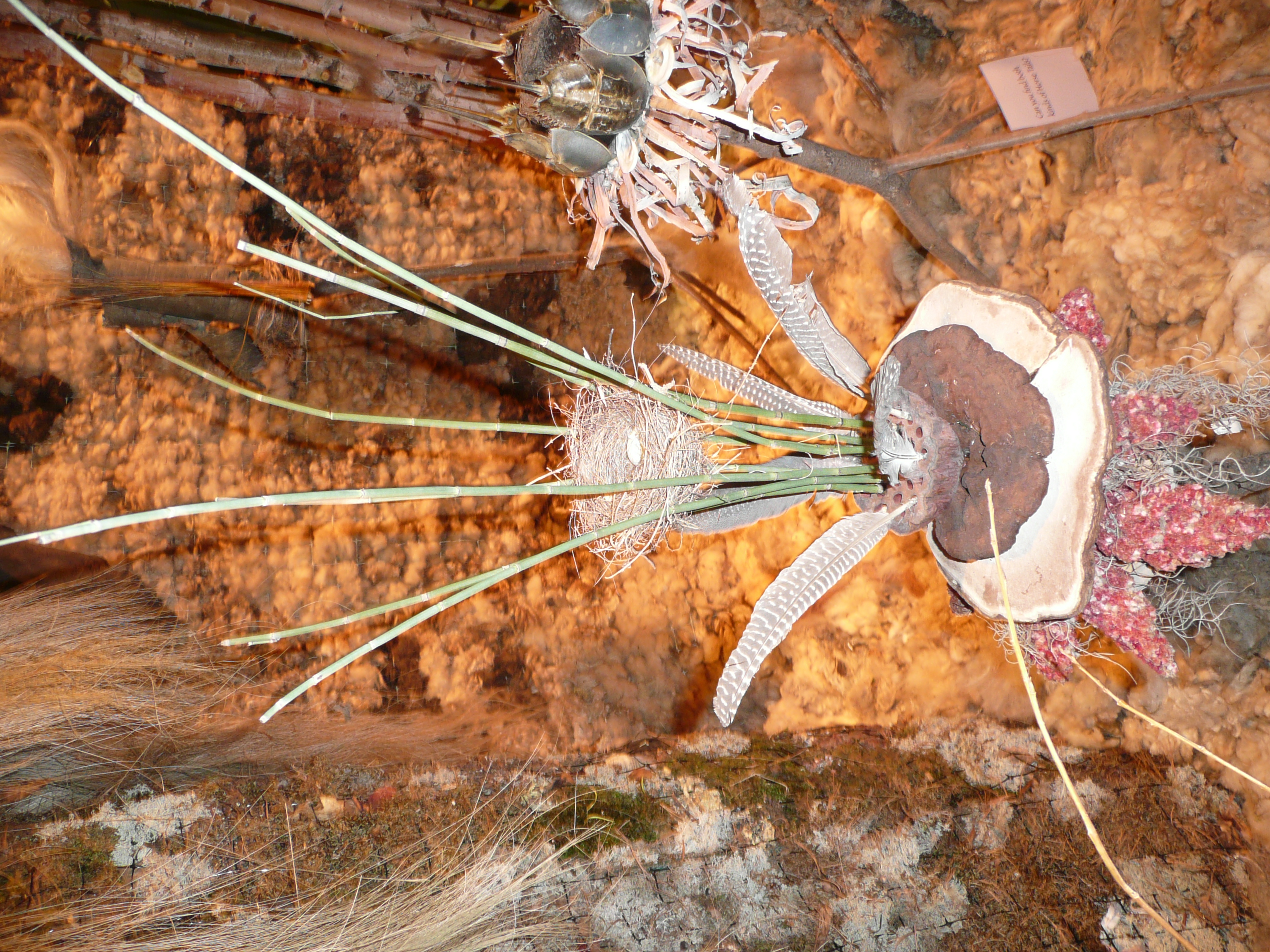
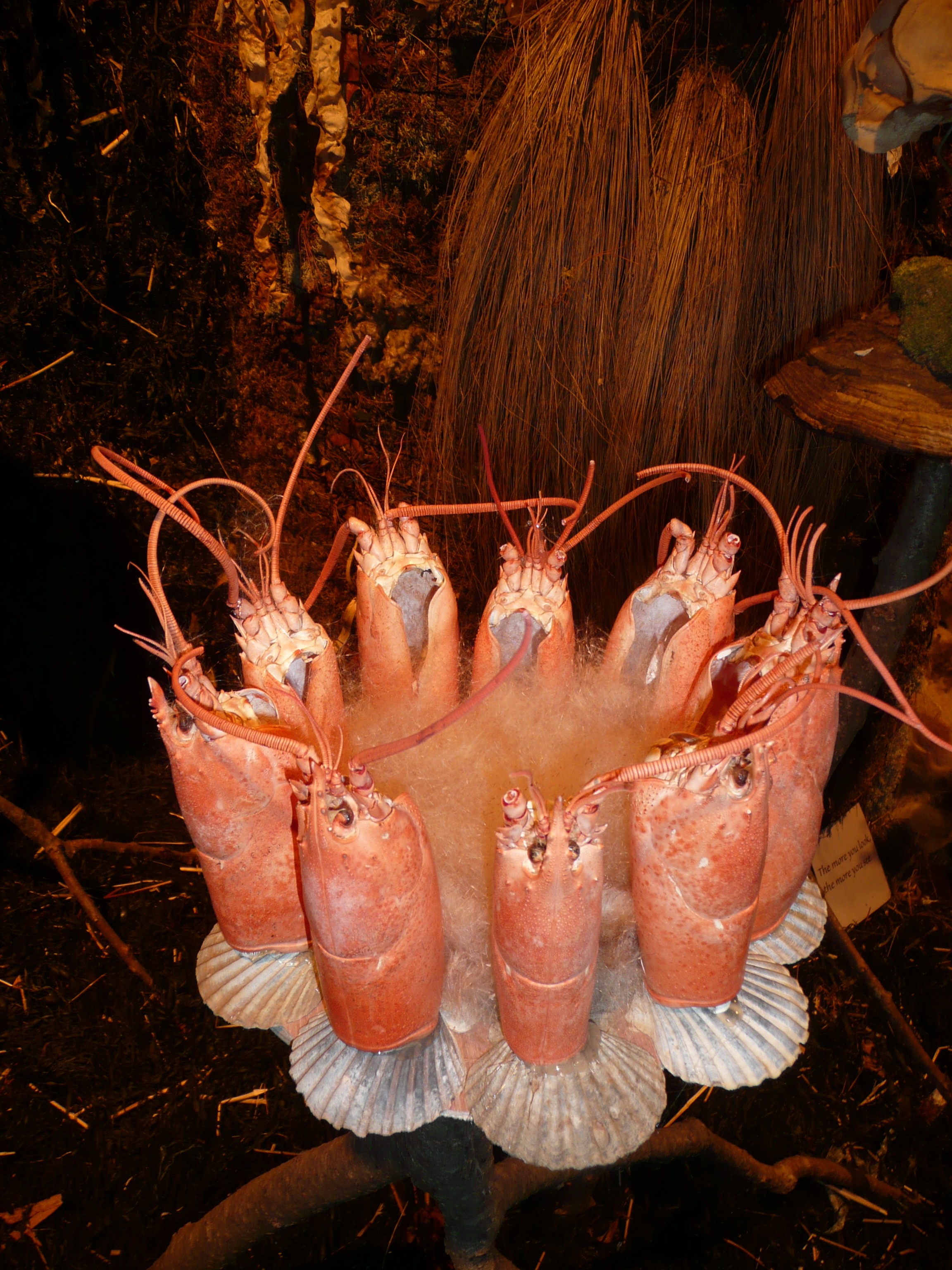
One of the other fun aspects of attending these big garden shows is the way art is presented in the displays.  Sometimes in very unusual and unexpected ways.  Jill Nooney of Fine Garden Art (www.finegarden.com) had an exhibit using natural elements gathered from the land.  Most of it, from what I was told by the gentlemen handing out her business cards, were gathered by Jill from land near her home in Lee, New Hampshire.  There were lobster shells standing up to form a small container.  It was like a small bowl filled with a soft white fabric like substance in the center.  It looked like cotton or fibers, but I wasn’t sure what the material was but sensed it was a natural product.  It made me think of an animal’s nest where they gather various materials like fur or string.  There were also things like sea shells with twigs and vines.  Piles of seaweed on the floor formed a thick textural mat.  It made me think about the times I’ve seen seaweed on the beach.  It was so cool to see it reused in an usual way.  I spotted lamb’s wool and feathers too along with branches all enveloped or containing other raw and natural products of the land.  All the materials were earthy and recognizable but staged to offer a curiosity to the scene – to make you question and admire the art of her works, and imagination.  Her exhibit fit her communicated style of “one-of-a kind pieces” and “distinctive.”  Jill Nooney’s work is located at Bedrook Farm in Lee, N.H.  She is having open house showcasing her art on four dates this year in May through September.  I will try to go to at least one.   The dates are May 14th, June 11th, June 9th and September 10th.  Ironically, I admired Jill’s work at an earlier show this winter, but didn’t realize it was the same person until I came home to write about Boston’s displays.  But it is exhibits like her’s that make you think outside of the box and get creative with nature that leads to the surprises in your own gardens.  

Lobster by Nooney

By the time we reached the end of the garden display areas, Donna and I accepted an offer to sit in a giant blue chair.  It was really there to draw the attention of kids, but we didn’t miss the opportunity to act like ones!  As you can see by our expressions, we were enjoying our day. We continued through the marketplaces, then we took a nice break for lunch by the adjacent Anthony’s Pier 4 restaurant on Northern Avenue.  We politely asked our server to make it quick because we wanted to return to see the prized horticultural exhibits before we had to jump back onto the motorcoach bus to return home.  Our only disappointment of the day was the fact we could have stayed at least one hour longer.  Our feet were tired, but our energy was still strong enough to see more.   Cathy T

Ilex crenata ‘Soft Touch’ Holly

8 Comments

Ilex crenata ‘Soft Touch’ is one of my favorite foundation planting type evergreen shrubs because the leaves on the plants are shiny green, very small and dainty offering a “neat” and “tidy” appearance in the landscape.  It doesn’t get super large for front foundation plantings areas that don’t always have a lot of space.  The leaves look like boxwood, but have a slight serration (like cut edge or toothed, for lack of better wording) on their edges.  This Japanese Holly has appeal but it is often not recognized as a holly at all by non-plant people until I point it out to them.

When I show ‘Soft Touch’ to my clients and gardening friends, I let them know that “Ilex” is the Genus name for Holly.  So anytime they see the word Ilex on a plant label, they will know it is a Holly even if it doesn’t look like the typical Holly.  This sometimes surprises people because they often associate holly shrubs only with those having red berries and pointy tipped shiny green leaves often used during the holidays for winter container gardens or arrangements.  ‘Blue Maid’, ‘Blue Princess’ and ‘Blue Prince’ are cultivar examples of the later, and of the Ilex meserveae varieties.  They are known as blue hollies.

As I continue I to explain a male pollinator shrub is recommended in order for the female holly to produce lots of berries on these shrubs, the expressions on their faces is sometimes entertaining!  If they are unaware of how the flowers (tiny and barely seen) turn into berries by way of a bee (or other pollinating insects) carrying pollen on their body or legs from the male flowers of one shrub, and coincidentally depositing them onto the female flowers on the female holly shrub results in pollination of the female flowers, they listen with interest.  Soon enough the pollinated flower developes into fruit.  It is truly amazing when you consider how a little itty bitty pollen grain from the anther of a male flower enters the female flower as it attaches to her stigma and travels down the pollen tube to unite with the egg cell in the ovule!  Without this pollination to fertilization process, berries would not form.  So if there is a male shrub close by, chances of more berries is greater!  On Ilex crenata, the berries are black, not red like the blue holly types.

‘Soft Touch’ has a mounded or globe looking habit.  Its tiny and dull greenish-white flowers appear along the stems in the leaf axils in spring, and are barely noticeable.  This shrub grows to about two to four feet high and wide, can take sun or part-sun conditions.  It is as a zone 6 plant, but I haven’t seen it fail yet in zone 5 areas of CT.  CT consists of zones 5 and 6 areas, so it depends on your site and other factors which can affect microclimates in your particular landscape.  If you are concerned with the zone, a similar looking holly that is a bit more hardy than ‘Soft Touch’, in my opinion, is Ilex crenata ‘Helleri’.  It also has a similar mounded habit and glossy green foliage. 

There are many more Ilex species out there from evergreen types to deciduous types.  For example, Winterberries (Ilex verticillata), produce amazing red fruit in fall lasting into winter after leaves are far gone from this shrub.  The red berries are super bright in the landscape.  You can enjoy them starting in November and during December and January.  Nothing like seeing tons of red berries against a white show background provided they are not buried by an unexpected abundant snowfall.  This shrub is a great candidate for wet areas too.  It prefers moisture but can also take dry conditions.  Ilex verticillata ‘Red Sprite’ is a compact form.  They produce more berries if a male verticillata shrub in nearby too!  And then there are upright hollies out there like ‘Castle Wall’ or ‘Dragon Lady’.  So when you are looking for a holly for your landscape, consider looking at all Ilex varieties or hybrids in your local nursery.  Some of my holly shrubs in my yard need replacement this year.  They got too crushed from the snow for repair pruning (for info on this, visit my March e:Pub on my website, www.cathytesta.com).

Or visit UCONN’s Plant Database at http://www.hort.uconn.edu/plants/i/ilecre/ilecre1.html to learn more.  This is a good resource for local CT gardeners.  Cathy T of Cathy T’s Landscape Designs

Colocasia esculenta ‘Mojito’ (Elephant Ear)

Leave a comment

Wine & Beer Tasting Event

This past Friday evening, I participated in a “Think Spring – Wine & Beer Event” at a local business in my town hosted by Joe’s Fine Wine & Spirits and the Golden Gavel Auction House in Broad Brook to help the United Way…and also to get everyone into spring!  There were many people from a local corporation in attendance plus many who showed up as a result of seeing my announcements on Facebook last week.  Landmark wines was the featured wine created by the great-granddaughter of John Deere tractors, and there were many other selections from organic wine types to brews of many flavors!  It was a great kickoff to our daylight savings weekend.

My garden and landscape service offerings were showcased along with displayed container gardens using wine boxes and beer crates on stands to give inspiration.  I truly enjoyed putting my first plant combinations together to kick off the season using plants like Tete-A-Tete Narcissus, Kalanchoe Desert Rose, Oxalis (known as Shamrocks), Mijito Mint, and stunning Cyclamen with deep rich burgundy colored blooms, and even upright rosemary I was surprised to see so early at the nursery, plus many more.  The plants are beginning to arrive, and I can’t wait to see more.

The sun started to shine earlier that afternoon as I placed my designed container arrangements outside (briefly) to capture some photos.  Spring is in the air and soon the temperatures will warm enough to get our spring plantings started.  I was very excited to be part of an event that provided folks with information to get them into the new planting season after a rough winter of snow.  However, I fully realized it may be a tad difficult to capture the audience’s attention away from their wonderful ‘sipping’ and ‘tastings’ of the many wine and beer selections that evening, so I thought how fun it would be to offer a list of plants with cultivar names coined from wines, spirits, and other libations! 

Take Weigela ‘Wine & Roses’ for example, or Hibiscus moscheutos ‘Pinot Grigio’.  Or my newest favorite on the scene, an elephant ear with green leaves showing off dark purple flecks that provides a wild pattern on a three-foot high plant for tropical lovers, called Colocasia ‘Mojito’.  It is stunning! 

There are more plants with libations coming out on the market – and I think it is fun, as fun as tasting varieties of vino! These ‘earthy spirits’, as I called them that evening, are available in the gardening world market place today.  

It is not surprising growers or hybridizers sometimes use cocktail themed cultivar names for some have features resemble the flavors and ingredients of spirits.  Here’s a sample of the plants I discussed with those who visited me between refreshments on Friday:

EARTHY SPIRITS:

Weigela ‘Wine and Roses’:  One of the most popular and easy to grow deciduous shrubs.  Beautiful, glossy, burgundy-purple foliage accented by hot pink-rose colored flowers in spring.  PHS Award Winner.  Grows to 4-5’ h x w.  Looks great with a backdrop of a white fence!  Very popular and well-known among the community of gardeners.  I haven’t heard any complaints about this shrub.  Love the dark foliage contrast.

Physocarpus opulifolius ‘Seward’ SUMMER WINE (Ninebark):  Heavenly choice with fine, deeply cut, dark crimson-red leaves covering this compact delight and accented by pinkish-white, button-like flowers in summer.  Reaches 5-6’ h & w.  Look for it by Proven Winners!  Blooms May-June.  This shrub’s leaves look great when the sun hits them, place appropriately!  Look for a place where the western sun hits the shrub as it goes down so you can see it shimmer during your summer afternoons.

Hibiscus moscheutos ‘Pinot Grigio’ (Rose Mallow): Huge snowy white flowers with a touch of pink in the center and along the outer edge.  Well-branched plant, 30” for full to part sun.  Also see ‘Pinot Noir’ with large red blooms on a compact, sturdy plant.  Free flowering at 30” too!  And finally ‘Grenache’ with true pink flowers and big blooms!  A cocktail of Rose Mallows!  Wonderful container plants.  Provides that big punch to a combination of plants.

Alcea ‘Crème de Cassis’ (Hollyhock):  NEW on the scene, semi-double and single, two toned blooms white with raspberry highlights!  Make a stunning addition to the summer garden.  Grows up to 6’ H and enjoys the full sun.  Cottage garden style, tall and showy!  Many whom visited my booth and saw this plant flash on the iPad slide show made comments of how pretty this plant is!  I agree.

Geum ‘Double Bloody Mary’:  Double red flowers. Grown for attractive hairy foliage and long blooming cheerful flowers in summer. Saucer shaped flowers are held high above foliage on long erect stems.  A full sun lover.  Drought tolerant too and great for curing a hangover! 

Colocasia esculenta ‘Mojito’ (Elephant Ear):  NEW on the scene, tropical style plant with amazing, medium green leaves with dark purple flecks for a cool, tropical delight!  3’ H for zone 8 and full sun to part-sun conditions!  Have fun with this plant in a container garden on your outdoor patio this upcoming season! Watch the ear-leaves bob in the wind and enjoy the wild pattern on the leaves as you enjoy your Mojito drink!

Heuchera ‘Pinot Gris’ (Coral Bells): NEW!  Ginger colored leaves topped with a silvery overlay and deep purple undersides mature to rosy pink with almost black veining and with creamy flowers in summer.  A shade perennial.  Look for ‘Beaujolais’ too, also new, with burgundy leaves and a touch of silver!  Low mound shape, interesting foliage. Heucheras practically come in every color and many patterns, it is a very usable plant when seeking a foliage color impact to combinations.

Ligularia ‘Osiris Café Noir’:  Beautiful, thick, serrated leaves in an assortment of colors – olive green, black, purple, bronze, and yellow blooms in summer.  14” height with 20” wide, a large showy foliage plant with tall flowers, for part-sun to shade.  One of my favorite perennials, can’t wait to see this new one!  Great large foliage type plant because of the huge leaves.  I love Ligularias!

Phlox ‘Pina Colada’ (Garden Phlox): Pure white flowers covering this compact darling in summer.  It is great for your gardens and containers for full sun.  A great perennial for summer.  And wonderful with your cool icy cocktails!  Add it to your Phlox collection as you talk plants and cocktails at your next entertaining event!

Papaver nudicaule ‘Champagne Bubbles’ (Poppy): Iceland Poppies are short-lived perennials coming back year after year from its self-sowing seeds. They bear large satiny flowers for weeks on end, beginning in late spring. This one features a range of pastel shades and bicolor, with especially large blooms. As classy as a tall glass of sparkling champagne!

Beer Box

So as you sip your cocktails during the summer months soon to come on your patio, deck, or by your beautiful gardens, you may want to consider incorporating some of these next on your tastings list!   Just google by the latin name to find images on the web, or see me this year for my showings of selections at Cathy T’s Container Parties!  Cathy T 


Philadelphia Flower Show 2011

Leave a comment

“So what impressed you the most about the show?” I asked Steve, my husband.  “The crowd,” he replied.  When maneuvering our path through the hoards of people at the flower show earlier, Steve asked me, “How much were these tickets again?”  I responded, “$25 each.”  He then began to consider the amount of ticket sales in his head.

Later I read of a figure of $60 million.  This is not the revenue from the ticket sales, but represents the estimated economic benefit brought to the greater Philadelphia region, the host city of this spectacular flower show held in the Pennsylvania Convention Center.  I could not find the total number of attendees from the opening day in the local newspapers, but I did read this is the world’s largest flower show (something I didn’t realize earlier).  The ticket sale revenues benefit the Pennsylvania Horticultural Society and all their efforts as a non-profit organization.  Many of PHS’s campaigns are highlighted by their President in a letter found in the program’s official schedule of events. 

But what impressed me most, beside the size of the event and the crowd attending, is the sheer proportion of the design elements, structures, and floral pieces you see when you first enter the main doors to the showroom.  This year, a replica of the base of the Eiffel Tower embellished with tiny white lights rises from the floor up to the building’s ceiling as if the tip disappears into the evening sky.  My guess is it is about 120 feet wide and 40 feet tall or more.  It is immense.  And it offers a sense of grandeur while inviting the anticipation of the display gardens to be seen on the rest of the show floor. 

My immediate response or reaction to the size of La Tour Eiffel was excitement.  I have a hard time putting it into words, but it makes you understand that this show is big.  I felt this way in 2010 the first time I attended the Philadelphia International Flower Show and saw fifteen foot high floral arrangements in giant urns staged inside huge wrought iron gazebos.  The same feeling occurred this year during my second visit to this show when I saw the tower.  I had to stop looking up however to avoid bumping into the people in front of me – plus I didn’t want to lose Steve in the mass of on-lookers. 

Soon my attention is captured by life-sized animal sculptures made from plant materials and flora.  A lion with its mane and tail made from ornamental grass flowering plumes, a peacock adorned with vivid red roses around its neck, and an ant head with bright lime-green mums.  Around the bend, with (unstaked) Delphinium as tall as me, is a black shiny grand piano stuffed with flowering bulbs.  Taking a couple of steps forward, I could see between blooms two people – artists, painting – in the distance.  There was a live model standing in a garden; an elegant woman in a safire blue dress, quietly posing as they painted strokes on their canvas.  Further down, a dark alley of trees; large trees with a canopy of vertical gardens above, and rain drops dripping below into a long square water garden.  It was designed with an evening feel as if you would discover this secret garden on a stroll.  These are just a few of the artfully thought out creations in the display garden section on the show floor.

As we continued to view each amazing feature by various societies, designers, florists, and landscape contractors, I could tell Steve was beginning to experience similar emotions as myself because he began to lead me through the exhibits and not follow.  This made me smile.  He was impressed with what he was witnessing, and as I had told him in December when we booked our hotel package for this trip, this is more than a flower show, it is about artistic interpretation.  It is meant (at least in my view) to bring out the emotions and senses of plant lovers or just first time visitors, such as Steve.  It also gets you into spring.

Many of the displays, all based on this year’s show theme, “Springtime in Paris”, were beyond the traditional landscape or garden exhibits seen at smaller shows of this nature.  For example, one display was a creation of shadow images, or silhouettes, cast on big white screens achieved by the use of various objects staged perfectly in the reflected light beams.  French ladies briskly walking in dainty dresses, and one soaking in a tub were remarkable tricks to the eye.  There weren’t alot of flowers here, but it certainly invoked the romantic spirit of a spring day in Paris.  Another separate display interpreted the ‘Water Lilies’ paintings by Claude Monet with a large canvas on the ground reflecting the painting’s images. 

As you exit the main display garden areas and enter the competition sections, pieces were smaller but not lacking in any way otherwise.  I especially enjoyed the white mannequin heads with coiffers styled by using botanical cuttings, pods, straw, Amaranthus, cypress, and other types of plant materials. Steve commented that one in particular looked like real hair!  These were created by garden clubs in the area.

About half-way through seeing the vendors in the marketplace section, the crowd was beginning to get to me.  Lucky for us, we had an easy access to our hotel room via a connecting skywalk (the reason why I selected the downtown Marriott, plus their package price for the room, breakfast, and show tickets was worth it).  We decided to take a breath of fresh air outside, rest our feet a bit, and discussed what we saw.  We returned to the show for the last hour and a-half for the best-viewing hour.  It was calmer then, but still busy.  We took that time to check out the award-winning plant specimens in the horticulture area.  Steve enjoyed these too.  I actually crouched on the floor to take a photo of a plant I hadn’t seen before, and noticed it had a first place ribbon.  The only bummer is my camera can’t handle the awkward lighting in these big exhibit halls, so the quality is not up to par.  It was a Serracenia x chelsonni entered by Randy Heffner of Aquascapes.

We finished off our day in Philly by taking a taxi to the Rittenhouse Square District for a night-cap at Tria’s.  As the pouring rain fogged up the taxi car windows, I could not see the city in the dark.  We were looking forward to visiting this place because it was a recommendation by a friend.  It is a wine, beer and cheese style bar.  On Sundays, they offer a special price for first tastings of the evening’s selected wine, beer, and gourmet imported cheese.  Of course, the wine of the evening was from France – how apropos!  The small-plate appetizers were just as tasteful as the beverages. Every bite was a combinations of flavors I had never experienced at any fancy cafe before.  This place was small, comfortable, trendy and the perfect ending to our springtime visit in Philly.

Before heading home, we completed it all with one last walk through the Reading Terminal Market the next morning where fresh and local foods and plants are sold.  I picked up one last plant purchase, an unusual Sansevieria cylindrica.  And some turkey sandwiches to go for the ride.  This is another place not to miss if you decide to go to the flower show.  It is next to the convention center and near the hotel.  Go to Dinic’s for hot roast pork or beef (a.k.a., steakcheese) grinders, but be prepared to wait in line for at least a half-hour during the lunch-time rush (worth it!).  That morning it was quiet at 9 am, and Dinic’s had bags of fresh bread lined up on the counter to prepare for the hustle and bustle of the day to come.

During our drive home, we were challenged yet again with our last crowd – the traffic of cars and trucks on highway 95.  As Steve drove patiently while I read articles about the show, he commented that he would return with me again next year.  But for those of you interested in this year’s, you still have time to go.  The show runs until March 13th.  See theflowershow.com or visit cthort.org where organized bus trips are offered to society members.  See also www.triacafe.com for the restaurant mentioned and visit my business Facebook page to see a video of the show’s entrance!  C’est magnifique!  Cathy T


ELA All The Way

1 Comment

There are probably as many different styles to people in the hort world as there are varieties and cultivars of plants!  And yesterday I met a new breed, the stewards of mother earth at the ELA (Ecological Landscaping Association) conference in Springfield, Mass.

I don’t know how I managed to do this – but I filled up my month of March with conferences and flower shows.  This one I attended yesterday was a spontaneous sign-up.  I saw it listed via the Master Gardener newsletter and the seminars were different from former types I’ve attended, plus I didn’t recognize the speakers’ names, so I thought it would be great to see some new faces.

So what is the ELA conference?  It is hosted by the Ecological Landscape Association.  They are a ‘non-profit organization of dedicated landscape professionals, individual gardeners, and community groups who believe in using landscaping practices that are environmentally sound.  They also believe that natural systems are the best guide for learning how to develop and maintain healthy landscapes.’  These are just two of their bullet points listed on their pamphlet. 

I attended several seminars, one titled “Design Evolution: Engaging the Present, Adapting to the Future” by Ann Kearsley of a design firm.  Also, a session by Carolyn Summers of Westchester Community College’s Native Plant Center titled, “The Practical Challenges of Designing with Native Plants.”  I was happy to see some of the plants I have used in my designs were part of her presentations because she explains in detail the benefits of their uses as natives. She discusses how to choose cultivars, open-pollinated indigenous plants, and covers other aspects regarding minimizing maintenance.  I particularly liked an example of two topiaries she displayed of equal proportions and shape, but one was a native while the other wasn’t.  We often overlook to just select a native that is just as beautiful, can do the same job in the garden, yet it has the added benefit of supporting our eco-systems and animals in our environments.

In the afternoon, I stepped out of a “Soil Development for Healthy Flowering Trees” seminar by Dan Kittredge to attend something a little less intense for he was very technical and reminded me of my UCONN Professors, and I was just a bit too drowsy.  So looking at “At-Risk Pollinators” on the screen as Ellen Sousa of Turkey Hill Brook Farm described how to encourage them was more in line with my low-energy.

And I was bummin’ I missed one lecture called “Designing Ornamental Gardens for Highly Effective Stormwater Infiltration” by Kevin Beuttell of Stantec because many attendees commented about how excellent it was.  But like with many of these conferences, the sessions run simultaneously so you can’t see them all.  Fortunately, the hand-outs were available as part of the enrollment from the website.  No paper copies were reproduced (save trees) and you even bring your own eco-friendly water bottle to this event.

There was a market place at the show filled with all kinds of products to use in the garden – all natural based, sustainable, native, eco-friendly, focused on conservation, and concerned with all aspects good for the environment with a special focus of doing no harm.  One display in particular caught my attention.  It was a papermaking demonstration made with a base of invasive plants.  In fact, there were a few vendors showcasing how to use invasives to our benefit.  One person wrote a book about the medicinal properties of invasive plants.  This is good news.  We have to find ways to use invasive species for a good purposes if we can’t rid of them completely from the landscapes and forests.  Everytime I see a roadside stand of Japanese Knotweed (Polygonum cuspidatum) or Autumn Olive (Eleagnus umbellata), I think about how if only we could use these problem plants in a good way – and some stewards have.

But back to the papermaking.  The woman demonstrating the process was Louise Barteau Chodoff of bubblewrapture.  She had three tables lined up with the plant remnants, dried, or chopped up with the papermaking screens as part of her demonstration.  She is someone I would be interested in talking to about having a how-to class on papermaking and this special focus of using invasive plants in a good way feels good too.  She can be found on www.inliquid.com

Other exhibitors included Neptune’s Harvest, a manufacturer of unique, specialized cold processed organic Liquid Fish and Seaweed fertilizers, and The Great American Rain Barrel Company that re-purposes shipping drums into a complete water collection system.  A booth by Project Native was well-designed.  They are another organization dedicated towards inspiring the stewardship of natural resources by cultivating native plants and restoring our local landscape.  They are located in Housatonic, Massachusetts and their website is: www.projectnative.org.  Their organization began in 2000, when Raina Weber recognized the need for a native plant nursery in the Berkshires.

While many of the people, vendors, and speakers at the ELA Conference are north of my state, they are great neighbors to get to know.  It will take me a while to digest all the valuable information gained yesterday.  So off I go to read more!  For more information, refer to http://www.ecolandscaping.org/Cathy T

The Big Guns

2 Comments
Ever want to meet your icon, a famous rock star, or your idol?  Well, volunteering in an arena where they perform is one avenue you can take to reach that goal.  And for me it happened at the CT Flower & Garden show.

As I took a lunch break in a hallway cubby on the seminar floor, I began to read the next speaker’s bio from my iPad.  However, I’m already a big fan of this person and very familiar with her reputation from seeing her speak at other gardening conferences over the past couple years.

As I was chewing away on my sandwich, here she came around the corner!  It may sound corny to non-plant lovers, but this was a moment for me.  “The Perennial Diva” was standing right beside me and I couldn’t be more thrilled – an honestly, a little nervous too.  She quickly put me at ease as she joked about how I can mention she has appeared on QVC-TV when I introduce her because people seem to like that.  Her name is Stephanie Cohen, and to me, she is a Big Gun in the world of horticulture.

Stephanie Cohen, as I noted that day to her audience, hardly needs an introduction.  She is very well known for her publications, expertise in the perennial scene, and her amazing talent of presenting infront of large audiences while entertaining with humor along the journey.  I held up her award-winning publication titled, “The Perennial Gardener’s Design Primer” with its intense pink cover.  Ironically, her book’s cover is the same color recently announced by Pantone LLC as the 2011 color of the year.  Its been described as a reddish pink and named Honeysuckle, but to me it is an intensely rich hot pink.  It certainly demands your attention and gets you excited, just as Stephanie does in her presentations.   

I continued to tell the audience, “…looks like Stephanie is ahead of her time!”  Heads bobbed up from the seats to see the cover.  And then Stephanie held up her nails, also painted the same honeysuckle pink.  She began to approach the floor to start her presentation.

Every seat in the room was filled.  People were still arriving during the beginning of her presentation so they stood in the back row.  In fact, one or two people gave me the business on their way in because I made the costly mistake of starting her session one minute early.  They obviously did not want to miss a beat (this was a lesson learned for me). 

Before Stephanie even got inside the room for the setup prior, her fans were walking up to say hello.  It was apparent they’ve seen her before and were revisiting another one of her presentations and anxious to see her new publications.  One of which is titled, “The Non-Stop Garden” and is already a top seller.  Just like a rock star, she has a following. 

At this seminar, Stephanie covered ‘Perennials from Spring to Fall 2011’.  She reviewed more than 50 perennials starting with Artemesia vulgaris ‘Oriental Limelight’ and finishing with Yucca rostrata ‘Sapphire Skies’.  She lets you know what is drought tolerant, resistant to mildew, blooms later than others, or attracts hummingbirds, among many other aspects about the perennials.  But it is more than the usual characteristics that draws your attention, she gives you honest opinions and tidbits on what works and what doesn’t with these perennials in the gardens, and why.  She also has a way of commenting on the creation of cultivar names with a comical nature…, like for Aquilegia x hybrida ‘Winky Double Red & White’.  She joked about why was the word ‘Winky’ was needed when the rest tells it all?!  Or how Hibiscus moscheutos ‘Pinot Noir’ is an example of plant cultivars named after alcoholic beverages.  “Either they like the name, or maybe they were just drunk?” she said.  Whatever the comment, her spots of humor during her display of colorful perennials new on the scene or sometimes old favorites makes one not only remember the plant and its features, but truly enjoy the show.

No one left the room during her presentation except a fellow volunteer who had to return to her presentation in the adjacent seminar room.  As she passed by me, she leaned down and whispered in my ear, “You picked a good one!”  

The next day, this friend called me.  She had never seen Stephanie Cohen before.  She raved about her style, humor, and how thankful she was to see her presentation for she learned so much about the perennials she introduced.  I guess Stephanie has another new fan.   

  •  The Perennial Gardener’s Design Primer (The Essential Guide to Creating Simply Sensational Gardens) coauthored by Stephanie Cohen & Nancy J. Ondra.  Topics from getting started, perennial selection, partners, problem-solving, and special effects are just examples of the chapters.  Look for the honeysuckle pink cover!
  • FALLscaping (Extending your garden season into autumn) also coauthored by Stephanie and Nancy is very popular in the fall!  Perfect partners for fall, putting it all together, and fall garden care topics are covered.  I have both books and find them as very useful references for my design processes.
  • The Non-Stop Garden, her newest top-seller, May 2010.  Soon this one will have sticky post-it notes, just like the other two in my collection!

Stephanie Cohen’s complete bio can be found at the flowershow’s web site: www.ctflowershow.com.