Banana for Bananas ‘Maurelii’

2 Comments

Ensete ventricosum ‘Maurelii’ (Red Banana or Abyssinian Banana) was a plant I offered to my Container Gardening Party guests in 2010.  It required some restraint for me to not keep at least one of the plants for myself.  This is one of those ultimate type of thrillers for designer container gardens.  With its big wide leaves streaked with red highlights, it reminds me of a relative, the canna plant.  However, this banana gets much larger.  The size of this plant was mentioned by the sales staff at the growers when I picked up my flats.  I knew this plant grows large, but I don’t think I really knew this!  When I went to see the plant at a guest’s home a couple months after she selected it for her container during my class, I was impressed with the increase of the trunk’s diameter.  She had embedded her container within many other showy plants around her inground pool.  It stood tall and impressed everyone who visited her home during the summer.

The banana plant isn’t a tree, so technically its stalk is not a trunk.  But it sure looks like one.  It is made up of tightly bound petioles that grow from the rhizome.  If you slice the stalk, trunk, or technically what is called a pseudostem (look that one up if you should so desire!), you will see the layers of leaves somewhat encircling inside.  I actually like seeing this pattern.  Think of it like a wrapped cigar or a rolled layer cake. 

Because I am a foliage fanatic, this plant is high on my list.  Its leaves can grow up to 1 foot wide.  The length of the leaves is grand too – reaching many feet long!  Additionally, the midrib of the leave is something that offers impact.  When I visited the poolside specimen at my guest’s home, I took a close up photo of the midrid.  It was beautifully infused with a deepwine red color providing color impact, and the size of the midrib added a structural design element.  It was becoming thick and showy.  As with most of my favorite plants, this plant is showy because of its foliage, structure, and shear size.  Flowers are not really a necessity.  This is a good thing, for this banana requires at least one full growing season to bloom and this would occur in the spring providing all aspects of over-wintering care is provided. 
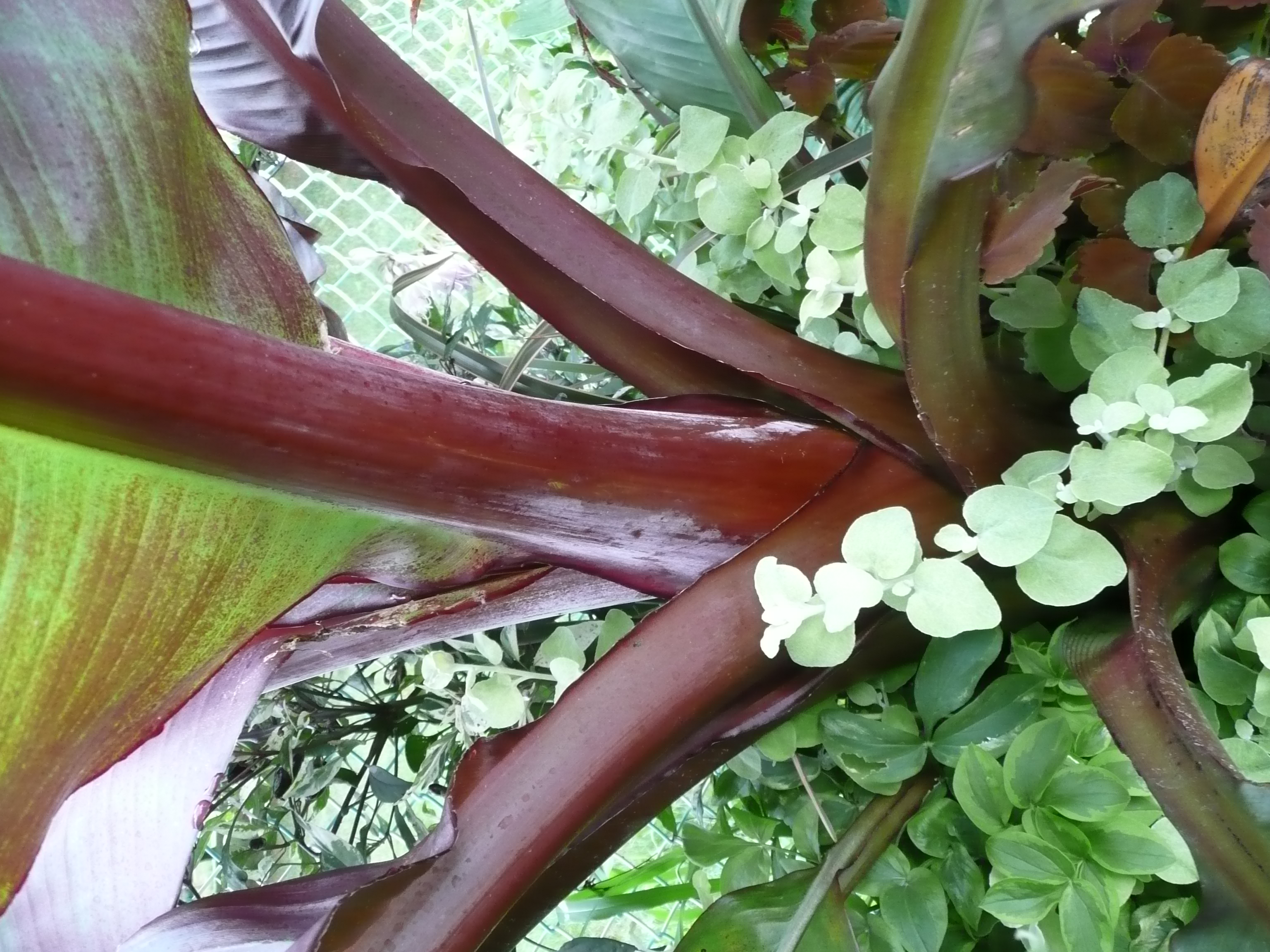
Midrib

However, in Hawai’i last October, my first banana flower sighting took place (in a few locations too).  It looked like a mini-football dangling from a knotted roap hanging solo from a different variety of banana plant.  In reading more about this plant, this mini-football shape is actually the bud of the flower.   Think monster caper bud.  It grows at the tip.  It is the male portion of the flower.  Above you will see the bananas, the female flowers eventually producing fruit.  Yes, the male and female flowers grow on the same plant.  On the outside of the bud part below were bracts.  These are the modified leaves growing around it (see the purple one extended in the photo below?).  Sometimes bracts or sepals are non-showy on plants, while other times they are mistaken to be the actual flower petals.  Sepals are leaflike structures around the petals. On this banana, the whole structure (except for the bananas) was alien like for I had never seen one before. 

Stalk with with Bud

Football Bud

‘Maurelii’ appreciates full sun and can be grown in containers after the spring frost has passed.  It is perfect for containers, with the one big consideration.  You must ensure the size of the pot is large enough to accomodate the fast growth and its stalk’s large proportions.  And because it can grow tall quickly, even up to 10 feet tall, you need a container that can keep the plant from tipping over.  Container clients are provided information about the best size container before our class, and now they know why.  And overwintering techniques are also discussed. 

As I learned more about banana plants in Hawai’i, I read of a funny one that is called “the pregnant banana.”  The fruit grows “inside” the stalk.  This is a banana of the Musa spp.  The stalk gets fatter until it looks ready for delivery.  Should you be the person to see it near due, you can actually cut open (or deliver, LOL), the stalk to get the bananas!  Now that is something I’d love to see.  An emergency c-section on a plant!  Cathy T

Agave ‘Kissho Kan’

Leave a comment

Agave ‘Kissho Kan’, a succulent hardy to zones 9-10, was a big hit at Gardens, Gallery & Gifts.  I sold these in black pots topped with lava rocks and as a trio in designer containers with shiny stones to finish the look!  Many visitors took one home.  This plant grows to about 15″ tall eventually.  It has an interesting white edge to the margins with sharp red infused spines. 

Kissho with Sticks

First to Sell

I believe the main factor which attracted attention is the fact it is a tough plant that can take droughty conditions – something we experienced all summer long in 2010 – and on the days of our first annual GGG event in Broad Brook, CT.  (Take Note:  We are holding our 2nd Annual GGG Event again this June 4-5th!).  

The other factor enjoyed by GGG visitors is it could be taken indoors as a houseplant at the end of the season.  Reusing the plant for a new purpose and saving money.  The key however is to take it in before any (repeat any) chance of frost damage.  In fact, well before.  As you reach the final end of the summer when temps begin to cool, take this plant inside. 

Agave

Drought tolerant

Succulents require even less attention once inside.  By a sunny window during the winter, they recede into a semi-dormant state.  You can greatly reduce the watering and let it loose some weight, so to speak.  And this type of plant can be left alone should you take some time to travel during your winter – or prior during the summer months on vacation!  It is very undemanding but offers a good show.  Mine is doing wonderfully by my kitchen garden window, watering it very, very lightly and only occassionally (weeks can go by without watering).

The other succulent receiving applause at the GGG event was Senecio mandraliscae ‘Blue Chalk Sticks’ (Groundsel).  It was a new offering by the grower and caught my eye.  This blue chop stick looking form produces small white flowers around July-August, which mine did!  It has a spreading, reaching habit thus can serve as a “spiller” in Container Gardens.  Visitors to the show commented on it for it was unusual.  Many had never seen this plant before.  Again, the fact that it is a sun lover (to part-sun), deer resistant, and tough made it high on their list.   In warmer clients, this one could be considered as a groundcover too.

Spiller Candidate

Blooms late summer

I’ve already placed my order for more succulents – but of a different twist.  They will be offered again in June at the GGG show.  I’m looking forward to sharing the one’s I’ve selected and seeing your reactions….And to the snow melting in time!  Cathy T

Cardoon Va-Voom!

Leave a comment

Cardoon (Cynara cardunculus) is a plant I wanted to try this season because it has foliage power.  The leaves are long and deeply cut, the edges are sharp and pointy, and it has a soft silvery coloring.  Almost a gray-green tone or like a silvery white, with more white tones under the leaves which are held on stalky stems with prickly edges.  It is hardy in zones 7-11 and requires full sun.  I used it as a tropical style looking plant for my container gardens and in the ground.  And sold some at my Container Garden Party offerings in 2010.

This plant can grow to a very large size!  Up to 6 feet tall.  Mine did grow very quickly in my containers this past season, starting with a early June planting and continuing to do well all the way into fall.  It didn’t stop performing.  The texture and form works well in a container alone or planted with supporting candidates.  I used it in 3 places:  1 in an urn, 1 in a huge pot, and 1 by my mailbox mixed with Sedum and Artemisia arborescens ‘Powis Castle’. I was testing out the scenarios and seeing how it did to determine if I would offer it again to my container gardening clients.

The urn was the perfect shape container for the Cardoon plant because the plant’s foliage rose above it and hung over by the tips, offering a dramatic effect.  The downsize was the urn was not large enough to support the plant’s soil and watering needs, so it had to be watered too often.  This became a nuisance because the soil in the urn dried out too quickly for the size of the root system.  And then the plant began to suffer which made the insects nearby take notice.  It got a bit attacked.  I was disappointed.  But the look of the plant fit the style of the urn perfectly.  The plant is stately, grand, and commands attention.  The urn is stately and stands tall as if commanding attention.  It is hard to describe, but the feel of the container matched the feel of the plant.  These are important aspects to selecting the right container for container plants.  You may have a country look to a container and you need to pair it up with a country or cottage style plant, in my opinion.  A formal container should have a more formal style plant.  When you put a couple together that doesn’t match, it looks odd and takes away from each personality.  But when you have the right pair, you can feel and see its beauty!

The mailbox planting of a Cardoon this same season surprised me as well.  I absolutely loved how the silvery green of the foliage of this plant worked so well with the soft rosy pink blooms of the Sedum ‘Autumn Joy’ perennial planted with it.  As the Sedum’s bloom color intensified to a darker red-plum during late summer to fall, the foliage of the Cardoon continued to support it.    This analogous scheme used 2 of related colors (blue/silver foliage of Cardoon, the pink/burgundy bloom of Sedum).  They lie next to each other on the color wheel leading to a harmonious blend.  

The Artemisia arborescens ‘Powis Castle’ (Wormwood) perennial plant was also a great addition to the other two plants because it has silvery foliage like the Cardoon, BUT the foliage of Artemisia is soft and whimsical compared to the stark and stronge cutting edge look of the Cardoon.  The Cardoon provided that stronger elemental form while the thinner foliage of the Artemisia softened its stature.  Artemisia (Wormwood) is a fine textured plant that can also take full sun conditions, like Cardoon.  It is hardy in Zones6-9, grows well in average to dry soils (lime-enriched (alkaline) soil, and bonus – is deer resistant!  It is easy to grow and prospers in dry heat which we experienced during our dry 2010 season.  Artemisias can be sheared back if they looks leggy later in the season.  It is also feathery foliage favorite.  (Reminder:  Flowers?  Not always needed for impact!)

Many know that Sedums can take the heat and drought too!  Sedums have broccoli looking buds in spring, they turn pink and then darker pink into fall.  By late Autumn, the rosy burgundy coloring still created a visual appeal with its the large Cardoon foliage.  Sedums are known for their winter interest as well.  The spent flower heads, turning brown and dry into winter, always look wonderful when ice or snow clings to it (although this big snow year for us in CT has hidden many at this time). 

In summary, my experience is all three of these plants, Cardoon – Sedum – Artemisia  – performed well from early summer to late fall.  Each gave the other more impact in regards to coloring and texture.  The Cardoon surprised me on how well it did by a harsh roadside environment too.  It didn’t cry out for watering and it kept getting bigger.  It was a showy curb side candidate in an unexpected place.  I was thrilled Cardoon performed by the mailbox trio planting. 

Yet for some reason the same Cardoon in my large pot of about 3 feet in diameter didn’t perform so well.  It continued to get discolored leaves and did not thrive as well as the mailbox plant.  I kept wondering what was causing this problem.  The soilless medium used was of good balance, it was watered routinely, and had fertilizer appropriately applied.  Sometimes plants just don’t want to cooperate.  But by the end of the season, when I disassembled the large container garden, I took photos of the leaves.  They were up to 2-3′ long! 

I will still use this candidate Cardoon in the future and will look for plants of a similar texture.  It provides great foliage texture and form.  I know when people first saw it in a 5″ pot, they secretly thought, ugh.  But Ugh no more.  It provided a powerful statement in all three areas.  It just needed more consideration for its ultimate size to assure an even more quality outcome.  Cardoon does provide that Va-Voom!

Plant ESP

Leave a comment

Sometimes when reading a garden magazine, I will come across a plant, color combo, or design technique that I used myself.  It makes me feel like I have Plant ESP or the coincidence is reasonable because plant types should match cultural conditions.  But for the more curious incidents, like a discussion about an unusual tropical I planted for the first time, I have to pause and think, “How does that happen?!”  I just bought that plant this year, and now it shows up in a hort publication!  When these incidents occur, it is reaffirming at times because it validates my concepts and ideas.  Or perhaps it is a case of noticing trends due to my observations with my clients and all the materials I read regarding the trade of plants.

This ‘plant ESP thing’ (for lack of finding a better way to describe it) happened to me just last nite. I was quickly browsing thru the latest issue of “Horticulture” while simultaneously watching the news on t.v.  In a section about new varieties for 2011, there was a Papaya carica ‘Tainung’ featured.  I couldn’t believe it.  I just took pictures of papaya trees in a field in Hawai`i during my October vacation on the Big Island.  I remember thinking how cool it would be to grow papaya trees in my container gardens at home.  And here it is (or a variety of it) in the latest issue of a magazine issued just one month after my trip!  Is this Plant ESP or what?  Whatever it is, I guess it might be a sign that I really pay attention to plants. 

The article, titled  “New Varieties”,  covers 2011’s new introductions coming out of breeding programs across the country.  And Logee’s, a place I’ve visited in the past in Danielson, CT, featured a Papaya carica ‘Tainung’ (right next to the paragraph about Brugmansia ‘Angel’s Blushing Beauty’ (ANOTHER OF MY FAVORITES, weird, huh?!).  It states that Logee’s is offering this variety of papaya in 2011, and I for one plan to get at least one plant to test it out next season! 

The article states it is native to southern Mexico.  It has a red papaya with deliciously sweet fruit that can weigh 3 to 5 pounds.  I can attest to the delicious part.  I loved eating papaya on the island every morning and would stop at roadside stands to buy a few as we traveled around the island. It was my favorite flavor of all the fruits I tasted there.  The article also states the plant will begin producing fruit within the first year (so cool!) and at 2 feet tall (even cooler).  This means I don’t have to wait long to achieve a big plant and possibly one bearing fruit!  If I could bring that flavor to a plant right on my driveway (a place I love to place large

Papaya Trees

containers of tropical plants due to the heat below from the pavement), I will be feeling “at home” again, well, at least my “dream home” of Hawai`i!  The article also indicates to grow it above 60 degrees F and keep the roots warm for best results (not a problem, as I mentioned, on my driveway area).  Also recommended is lots of water and moderate amounts of fertilizer for fast growth. 

Here’s the photo I took on the east side of the Big Island of papaya trees growing in a field. It is called Mikana on the island per my reference book, and it shows the Latin name with the Genus Carica and species of papaya, so I’m not sure if the magazine reversed the naming convention order or what, but that doesn’t matter, for now I can look forward to obtaining this plant right here in Connecticut and giving it a shot next year.  Wish me luck!

Elephant Ear Bulb Storage

1 Comment

I had the full intention of continuing the process of breaking down my outdoor container gardens yesterday, but a nice lunch and movie sounded better on a Sunday afternoon.  Since there was a weather prediction of some light snow or sleet for Monday, I put my pots of elephant ears in a wagon and rolled them into my garage where they would be protected, at least, until I could dig up the bulbs below the soil later.  By this time, the plants had flopped into a messy mush from cold temperatures prior.  I hadn’t had the time to get to them, but it is not too late to get the bulbs out of the soil and stored for replanting next year.   (BTW, I also moved my perennials in pots into the garage too to deal with later; more on that in another blog.)

I love elephant ears of all kinds for the big showy leaves that bounce in the wind.  This year, some that I planted in the ground instead of in container gardens, didn’t do so well because we had such a droughty season.  Leaves turned yellow and the plant did not thrive, but those in containers which received my constant attention for watering did wonderfully. 

I also saw many elephant ear plants during my recent trip to Hawai`i (Big Island, see my e:Pub on my website).  In fact, one day on the trip when my husband and I took a road on the east side that was one-laned through fields of very tall sugar cane grasses and invasive Eucalyptus trees, we came across a very large elephant ear in a dip by the roadside where some water was feeding it well. 

Sugar Cane

I had used up my memory card on my digital camera, so I captured a photo of it on a disposable type camera.  This is the biggest elephant ear I’ve seen to date.  Too bad the picture is a little grainy.  Wished I’d taken more.

Big Elephant Ear

We also saw fields of taro (Colocasia esculenta) at the base of Waipi`o Valley on the island.  Polynesian settlers had brought these types of elephant ears to Hawai`i as a food source.  However, most of it is toxic until cooked appropriately, and since I’ve never attempted to eat my elephant ear plants or bulbs, I won’t give information on the process!  The root-like stem, called the corm, is the starch-filled part, and the leaves, stems and flowers are also edible when cooked.  It was really neat to see big fields of it after we took a 900 foot decent road (which gave me a stomach ache) only accessible by four-wheel drive and a brave driver like my husband!  At the base when reaching level ground, we continued down a bumpy dirt road and crossed low streams which were waterways from the taro fields.  A big field of taro with workers tending to the plants was beyond one of the streams. 

My resource book indicates there are at least three hundred varieties of Hawaiian taro recorded.  Calcium oxalate crystals in the plant is the potential poisonous entity. Cooking methods reduce its concentration.  But don’t go try eating it without further research on your own part!  I know I wouldn’t.  Hawaiians, however, know how to cook it to avoid getting sick.  If undercooked, they risk getting pain in the mouth from the calcium oxalate crystals. The valley where we saw the fields of taro has abundant water ways from rain fall into the valley, so it is perfect for growing taro (also know as kalo on the island).  They make “Poi” from it by pounding the root (and again, cooking it right!)

I grow the plant here in summer because its large bulb provides a spectacular show in the garden and containers.  And the bonus is you can store it easily every fall and often get little baby bulbs for more plants.  Since I didn’t get to my plants yet, I started with removing the dead mucky foliage first.  The next step is to cut off the stalk of the plant about 3-4″ above the soil line.  I sometimes use a large serrated kitchen knife to slice thru it, or if it is super thick (like with some of my banana plants), I even use a hand-saw!  Then you have the choice to place the pot into your unheated basement where it will go into a tricked dormant state for the winter.  Keep it in a dark place and watch it for insects.  They find a way to a plant once moved in. 

But for mine moved into the garage yesterday, I think I’ll take a warmer day later this week to dig out the bulb out of the soil and store it in peat, just as I did with my canna plants on Saturday.  (See yesterday’s blog).  The elephant ear bulbs are large and round, and sometimes you will find a baby bulb attached to it.  But should you take the basement option with the bulb in the soil in the container, you may find on a warmer day or in the very early spring as your basement warms up, an ear of the plant may begin to arise from the bulb.  If this happens that is okay until the temps warm enough to move the entire container back outside.  Just clip off the early risers and more healthy leaves will be sure to arrive!  But until then, we’ll have to learn to enjoy the coming fall and winter as we rest and so do our elephant ear plants!  I cannot believe sleet is here already.  So glad I had moved about 20 other containers into my shed on Saturday; at least a majority of it got done!

Removing Rhizomes

Leave a comment

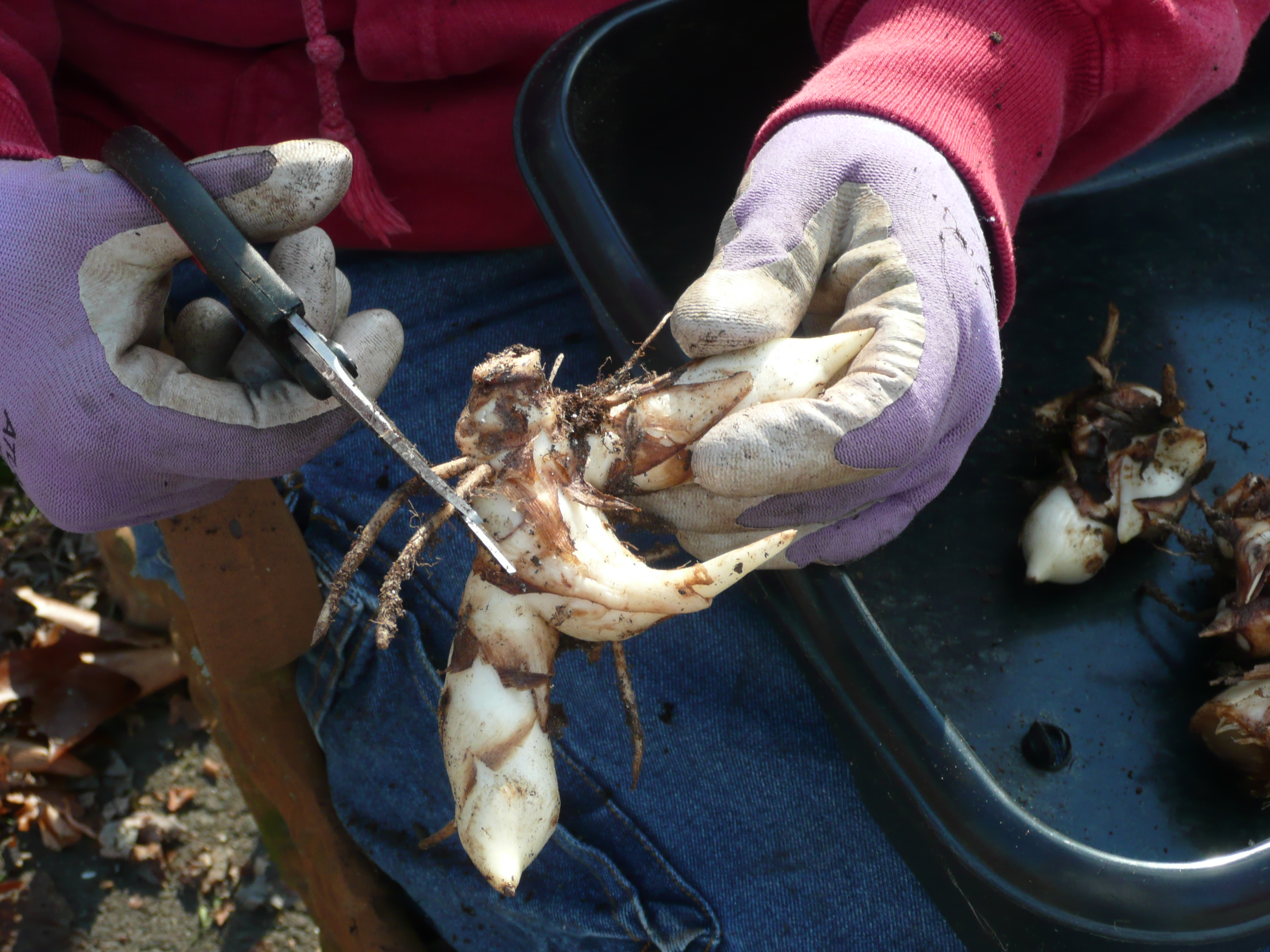
Cathy T snips roots

Last year, around this time, I posted a blog about taking apart Container Gardens (located under ARCHIVES).  Since my gardening clients and friends have asked for information again, I took photos yesterday as I began to break down my containers of canna plants.  The canna’s storage roots, called rhizomes, get stored in moist peat in a dark, cool place. You can wait until the first frost to dig them out of your containers.  I start mine in early fall, frost or not, when I’m ready and the plants are ready too.  Over winter, they stay in a room at about 45-50 degrees F, a lightly ventilated place, where it is not too dry or too cold.  The ideal temperature is around 40 degree F.  Cannas are propagated by dividing the rhizomes, done in the spring, when I bring them out of storage to grow again each season.  These tender tropical perennial plants grow well in our summer climate but can  not endure freezing and must be stored during our winter months.

Here are the steps w/photo’s#1 Cut all stalks about 4″ from base and toss the foliage and stalks.  (Tools:  Japanese garden knife, loppers, or hand-pruners).  #2) Tap the outside walls and sides of the container with a rubber mallet, doing this gently.  This helps to loosen up the rootball along the edges. 

Tap outside

Loosens Soil

#3) Lay the container on its side and roll it a bit to loosen more, check base of pot for any roots coming out of drainage holes and remove any anchoring the rootball to the container.  (Note:  Those containers with liners pop out even easier – A tip from our Container Gardening Parties by me this past spring.)

It may take a few jiggles and wiggles, but eventually the rootball loosens enough.  You will notice when it starts happening.  The rootballs of my plants were damp so it went easily.  It also works easily if the soil has completely dried out, but we got rain this week, so these were wet, but not yet frozen thankfully!  Then turn the pot over.  With a little more encouragement, dump it onto the ground, in a wheelbarrel (if liftable), or onto a large tarp, blanket, or old cloth if you don’t want a soil mess after.  #4) Put the rootball onto a handtruck and move it to the location where you want to keep any remaining soil, like a new planned garden bed area, compost pile, or into the woods.  Don’t reuse potting soil next year. It won’t retain its properties well.   Remember from our Container Gardening Parties in May, we went over why reusing old potting soil from containers does not lead to success.  Reuse it different ways.  It is not a loss if you can reuse in your gardens or in your compost pile which I have done many times! 

Handtruck helps to move

Use handtruck to move pots or soilball

I move mine to a holding area and work there to remove the rhizomes.  The handtruck works great.  You can also move the pot there first!  Duh, which I did later, to do steps #1-2-3-4 for more pots!

Rootball loosens

Rootball easily dumped out

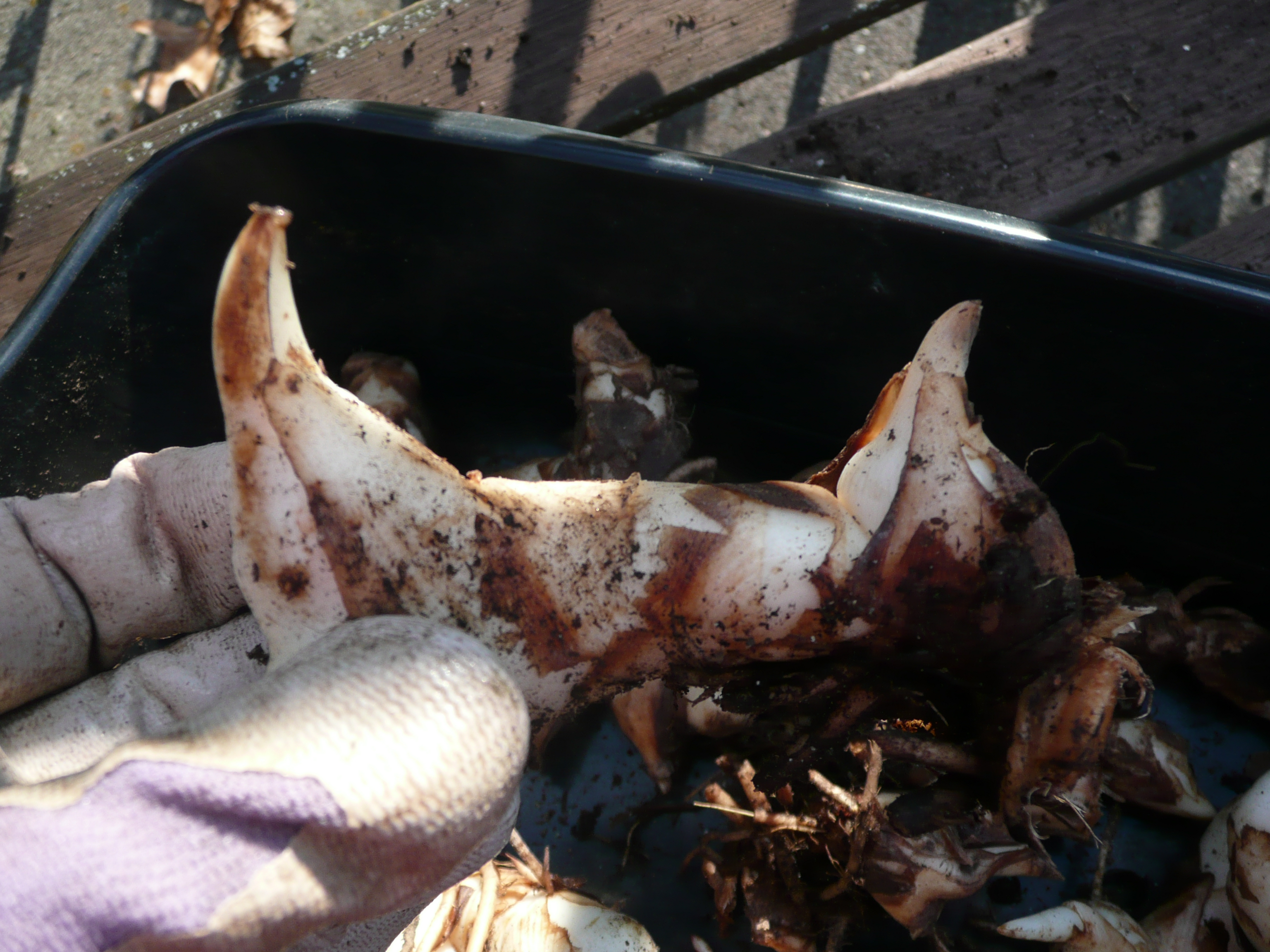
#5 ) Then begin the process of removing a big chunk of the soil “from the bottom” part of the rootball.  Often you can see where the canna rhizomes are, plus you usually have a general idea of how deep they were planted, so they are not at the very bottom of the container.  Work from the bottom up.  Cut a big slice off the rootball just to make it easier to get the rhizomes above the base.  I use my Japanese garden knife to do this slicing process.  Then locate your rhizomes for removal from the soil.  In this next photo, I’m showing canna rhizomes (the underground storage stems). See them just below the liner in this pot?

See the rhizomes here

Rhizomes Seen

#6) Gently work away the soil around the rhizomes or pull them out.  Try to not break or damage the rhizomes.  Then cut away the skinny roots from it with “clean” scissors to trim them off (I do this so the little roots won’t rot when stored; just to clean up the rhizomes a bit). 

Cut skinny roots away

Snipping small roots

Let the rhizomes sit in the sun to dry just a bit so they are not soaking wet before storing them in peat.  My soil was damp yesterday so the rhizomes came out quite clean without much soil attached, so I just used my fingers to take soil off and gently tapped the rhizomes on a log or hard surface to get the soil off the lifted clump of rhizomes.   If needed a semi-hard brush can be used to work away any tougher soil, or even a splash of water (but remember, not a good idea to get them too wet).  I like the removed rhizomes to be clean, neat, and somewhat dry a little before moving them into a bag for storage with peat, as follows.

Rhizomes in the sun

Let sit in sun a bit

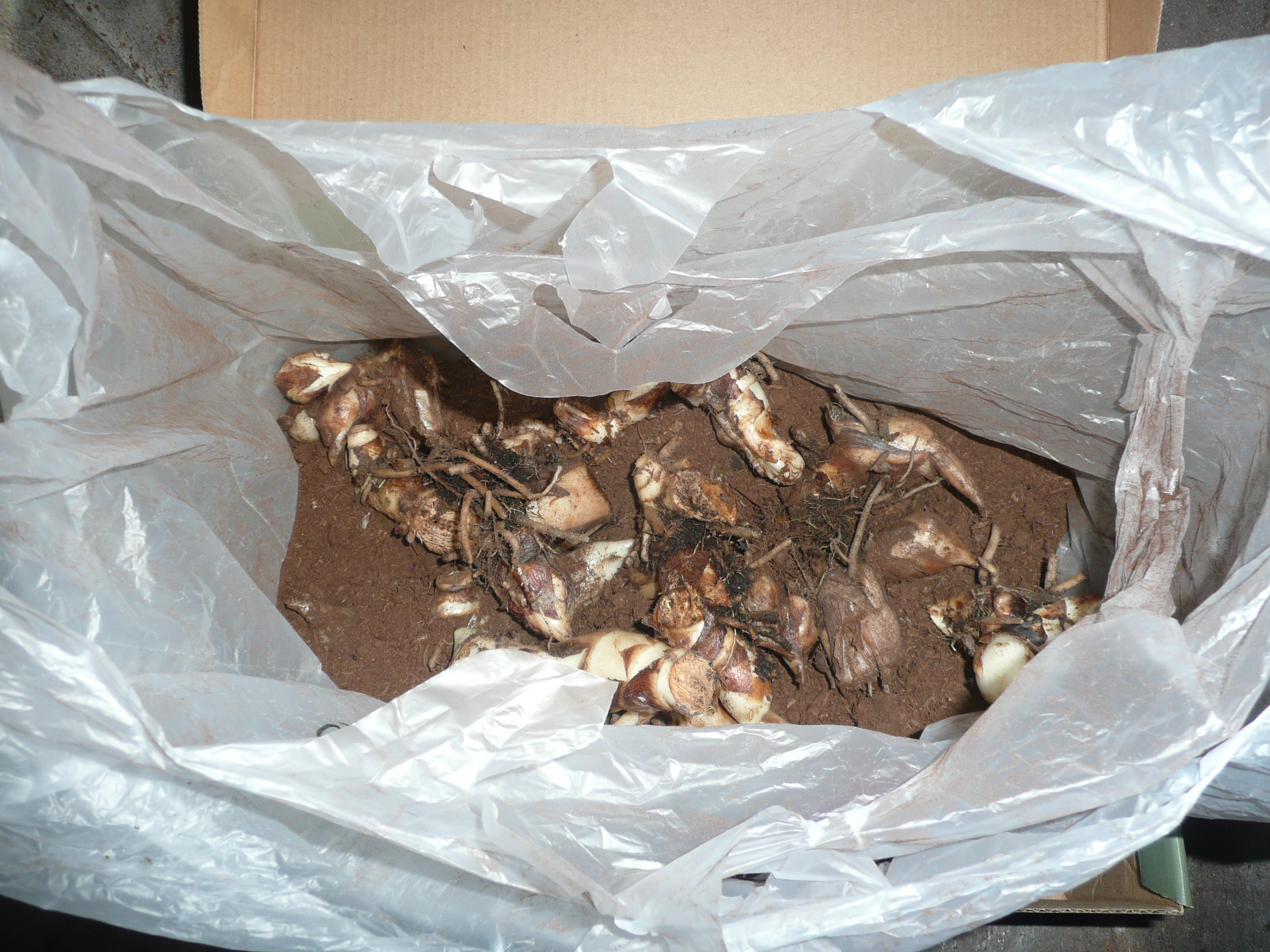
#7)  After they sit for about an hour or so in the sun, put them in light weight bags (I use bags from the grocery store) and fill them with peat.  (If the rhizomes are wet, I don’t bother moistening the peat as often recommended.  You can mist the peat very lightly.)   I toss the peat around the rhizomes, tie the bag (not tight though) and then put the bag in a cardbox box. #8)  Label the box with the plant and date stored.

Peat around Rhizomes

Rhizomes in bag w/Peat

#9)  Put the box in the basement in the coolest spot.  Again, you never want them to freeze or get dried out.  Either situation ruins them.  If it freezes, it rots.  If dry, it dies.  My place is in the basement, near the basement door, is where it is just cool enough, up off the floor on a bench.  Not near a woodstove!  This will not work, they will get too warm.  You are basicaly letting the rhizomes go dormant until next season.  I used old shoe boxes, and some tape to keep the cover closed, but not so tight there is no air.  This process has worked successfully for me for years.  It is very rewarding to reuse the rhizomes for it saves money each year.  In spring, you can cut the rhizomes to container 2-3 ‘eyes’ and start them in sand or potting soil early in the season inside the home if desired..  Then transplant into larger containers or your garden outside after the frost free date when things warm up. 

As for the rhizomes, you will see in this photo there are two bulbs like structures attached to the underground storage stem.  Don’t cut them apart before storing them.  The fleshy parts can get rotted a bit in the storage process if you do because it exposes the softer tissue.  Just leave them as is.  If you find little bulbs that pull away easily as you take them out of the soil ball, this is okay, but avoid breaking them apart.  So in this photo on the left, you can see how it is a stem with the tips pointing up of two new bulbs or eyes that can be separated next year.   Cannas are wonderful topical plants with 1 to 5 feet tall stalks, blooming mid to late summer, and showing off large lush tropical leaves in full sun.  I also store my elephant ear bulbs and dahlia tuberous roots the same way.  Dahlia clumps may be dug in the fall too but before frost and stored at 30-50F and covered with moist vermiculite.  The tuberous roots are divided so that each section has at least one shoot.  Well, more later on banana plant storage and other favorite tropicals.  Thanks, Cathy T