Spring Awakenings with Prunus cerasifera

2 Comments

Prunus

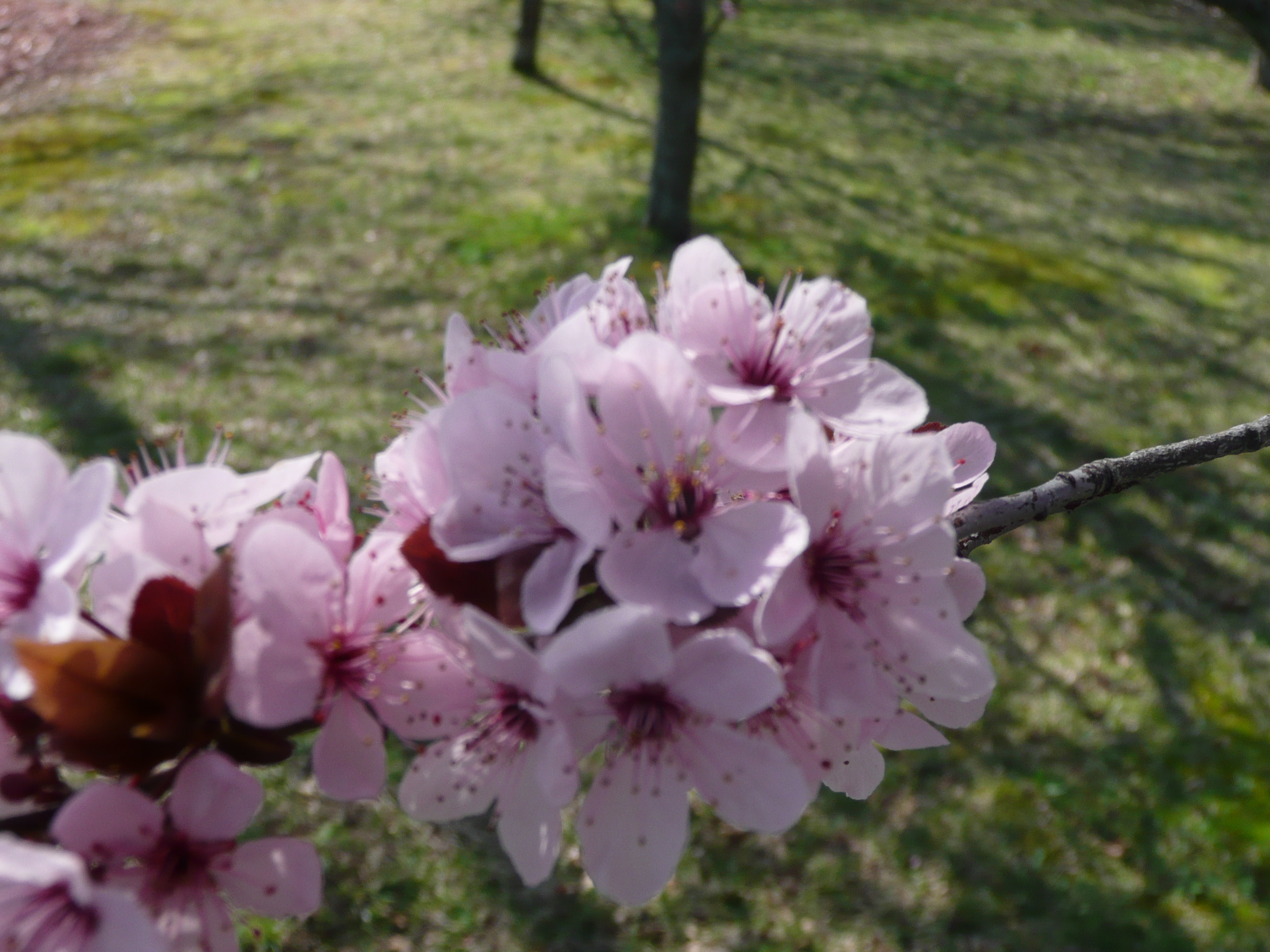
Last year, I asked my brother, Sylvain, to let me know when his trees are in bloom so I could pop by to take a couple of photos.  He did so as requested then, and he just called me again this week to let me know that again his flowering plum trees are in full bloom. 

“Cathy,” he said, “It is like being in church when you stand in the middle of the trees.”  I liked hearing that comment from my brother. 

He continued, “The blooms only last a couple of days, but they are really popping open now if you want to come by again.” 

I don’t have a need to take more photos, but I surely enjoyed hearing the excitement in his voice about the trees he carefully planted a few years ago.  His annual ritual of appreciating their spring awakening is something I find pleasing, especially because he picked up the phone to share it with me.

Sylvain’s refers to his trees as flowering plums, but many know them as Cherry Plums.   In fact, the Latin name, cerasifera, is from the words cerasus (cherry tree) and ferre (to bear).  A common cultivar is the Thundercloud Plum (Prunus cerasifera ‘Thundercloud’).  It has dainty fragrant five petaled light pink flowers that appear in early spring before the plum-colored foliage fully expands, usually quickly following a temperature warm up like we just experienced. 

Last year, Sylvain’s trees bloomed around April 7th, and when I took photos of them against a clear blue sky, it was vivid and refreshing to my eyes.  This year, the blooms arrived a few weeks later.  We both were hoping for their showing during our family Easter celebration at his home five days ago, but nature and temperatures have a mind of their own. 

The Thundercloud Plums typically reach a height of 20-25 feet at maturity with a spread of 20 feet.  They enjoy full sun and can take part-shade too, but the blooms may not be as prolific in shade.  Also the leaves may turn green.   And it is important to note that while they are very showy for the flowering and darker toned plum foliage, they do have some susceptibility to insects and disease problems but so far Sylvain’s trees have experienced none.  And lastly, there are small fruits that follow the flowers which may drop so you might not want to place this specimen near an area you wish to keep free from debris. 

Ah Spring

Sylvain has his planted in a row along the edge of his property.  Some may find this a bit too much, but not us – we love the effect of a flush of the blooms.  As Sylvain said, just stand under them and have your moment.  Perhaps because it is fleeting, it is all the more enjoyable.  

Maybe I will go over to his house today to snap a couple of photos after all.  After writing this posting, I feel I can’t resist seeing them again before the blooms drop to the ground.  Plus it is a bright, sunny, warm day.  Perfect for some photos and a breath of spring air.  Enjoy your warm up this weekend too, Cathy T 

To learn more about these trees, visit UCONN’s Plant Database:  http://www.hort.uconn.edu/plants/p/prucer/prucer1.html

Hemlock woolly adelgids

Leave a comment

Ever see one of those Sci-fi movies where the off spring of genetically superior parents are so perfect they can ward off all diseases and have amazing intellect?  Sound crazy?  Well, yah a bit when it comes to humans, but in the plant world, hybrids are created all the time in attempts to not only increase the benefits of a plant, but its resistance to problems or pests.

One such example was noted in the December 2010 issue of the “Nursery Management & Production” magazine.  Yes, I finally got around to reading my December issue in April 2011.  This article, titled, “Hemlock hybrids resist destructive pest” caught my attention because I love offering hemlocks to clients as an option for hedges or privacy borders, but it has one drawback – the woolly adelgid insect (Adelges tsugae).  Tsuga canadensis, the Eastern or Canada hemlock is susceptible to it.  So is Tsuga caroliniana (Carolina hemlock).  Both hemlocks are native to the U.S. and applicable to our CT planting zones.

Hemlock woolly adelgid (HWA) is caused by female aphid-like insects that feed off the plant.  It is considered to be one of the major invasive pest threats in New England.  You can spot it on the hemlocks by a cottony material that stands out against the dark green needles.  This wool-looking sign consists of egg masses laid in early spring on the twigs.  If you don’t spot the white stuff right away, you later may notice your hemlocks turning grayish green first, than brown as they weaken from the feeding process.  Sometimes the HWA invasion can lead to the death of the tree.

However, all is not lost if you are forewarned of this potential threat.  A good professional designer or landscape installer with a conscience should advise their clients about this possibility if recommending this tree.  The maintenance required to control HWA involves spraying horticulture oil once in early spring before new growth begins, and again in the fall.  This will offer excellent control and is easy to do, but, with that said, you have to be willing to do this or at least be aware of the HWA problem so you don’t leave your hemlocks unsupervised.  If an infestation occurs and becomes really bad, the tree may need to be removed entirely.  I make sure to inform my clients of this if they aren’t already aware of HWA. 

In the plant world, bad scenarios like this don’t always happen though.  I have seen many plantings of hemlocks that have never experienced the woolly adelgid problem at all.  It is kind of curious to me, but then again not.  When hemlocks are grown in the right place and have a healthy start, chances is minimized for problems.  Plants in a weak state are larger targets for insects.  And with new hybrids on the horizon, homeowners will have new choices if they don’t want to risk HWA.  But we are going to have to wait.

After reading the aforementioned article, I contacted Sue Bentz, a horticulturist of the USDA’s Agricultural Research Service, to inquire a bit more about their process.  She indicated their hemlock hybrid trails are still in the testing phases.  The test hybrids are being cloned for out-planting trails to evaluate hardiness, landscape merit and whole plant susceptibility to HWA.  They hope to establish the first field trail this year.  The evaluation process may take several years.  Sue continued to explain, the hybrids between T. chinensis and T. caroliniana (and other Asian species and T. chinensis) are showing greater resistance to HWA than the susceptible species. 

Until these resistant hybrids are available on the market, please don’t be afraid to purchase T. canadensis.  It is a wonderful option for our CT planting zones in shady areas.  It is useful in the landscape as a larger hedge plant or one to block an unsightly view.  Its wispy, soft needles allow the branches to interconnect creating a nice green fence, plus the plant stays full to the ground level so there is no bare spot below.  It also grows on both alkaline and acidic soils.  And T. caroliniana (Carolina hemlock) is also beautiful, an upright tree with short and pendulous branches.  It looks very similar to T. canadensis but its needles go around the stem and it has larger cones.   Besides the HWA concern, the only other consideration is to not plant them in exposed locations. Both do not care for strong winds. 

To learn more about New England pest threats, check out this website:  http://www.ProNewEngland.org. Cathy T

Juniperus squamata ‘Blue Star’

Leave a comment

Blue Star

A handy juniper to use in the landscape is Juniperus squamata ‘Blue Star’.  I’m not sure if the squamata species name means it “squats” low to the ground, but that is kind of what the habit is like for this juniper.  It has a mound habit and sits (or squats) low to the ground.  Reaching about a height of one to three feet and spread of two to four feet, it doesn’t get too large with its slow growth rate.  It has a nice soft silvery-blue needle color that is useful to pair up as a partner with other soft colors like pink blooms on other shrubs in the landscape nearby.

‘Blue Star’ prefers full sun.  It also can take some drought once established, thus it is a good low-maintenance candidate.  Additionally, in my opinion, it isn’t ugly like some other types of junipers that have more of a low-creeping habit.  Many of my clients have said “yuck” to the itchy, sprawling junipers, and tend to agree with the look of ‘Blue Star’ being more on the handsome side due to its mounded fluffy form.  The needles are awl-shaped.  I remember asking my professor years ago when we studied these types of plants what that word meant.  He responded, “like a boat.”  Awl means the needles tapers to a slender stiff point.  If you look up close, you will notice this on ‘Blue Star’.

This shrub can also tolerate a range of soils, from clay to the more well-drained, and can take urban conditions, like for beds situated near driveways.  It doesn’t get serious pest problems.  However, it prefers acid soils, so if your soil is alkaline, it may yellow a bit in your landscape, but I haven’t seen this problem on ‘Blue Stars’ as of yet in any of the residences I’ve visited to date. 

However, I have seen another problem on other junipers called cedar-apple rust.  The best description I can give this problem, is when you see it on junipers, it looks like orange snot globbed on a branch.  In the spring or early summer, this (snotty) swelling will appear on the upper surface of the needles, in the shape of a blob ball.  During warm and rainy weather, it swells up and grows jelly looking things called “horns” which look like a mistake by a not-so-nice passerby spitting on it.  Oh gross!  But it is actually a gall.  A yucky looking gall for sure.

How does happen this on junipers?  Well, if you have never heard of or seen cedar-apple rust, you either have no junipers in your landscape or you are well-informed about the causal agent and where it comes from.  This disease is caused by a fungus that infects apple trees first.  The wind will carry spores from apples leaves and infect the juniper in the summer.  This begins a ping-pong game by this fungus between the juniper and the apple tree.  It does not travel from one juniper to the other, but will bounce back to the apple tree a spring later.  Then in August, the spores return to the juniper.  You have to wonder how nature, or why nature chose to do this routine for its growing cycle? It is rather odd.  Perhaps the texture of the juniper’s needles just worked for this organism to grow and reproduce, I’m not sure, but when you see cedar-apple rust for the first time, you want to reach for a Kleenex!

So what should you do if you witness the cedar-apple rust “orange snot” or more technically stated, galls, on your junipers?  Remove them and toss them in the garbage.  And if possible, do not plant apples trees in the same landscape area as your new junipers.  Or if you have apple trees or a farm of trees within several hundred yards, don’t use them at all to avoid this experience.  This is the advice I give my clients.  The good news is, if you have no issues with junipers, they are very easy to find in your local nurseries here in CT.  Just look down when walking through the shrub section when you browse for your plants.  You will spot this dense, compact mounded useful shrub sitting there.  I find ‘Blue Star’ very useful and continue to recommend it to my DIY landscape clients as a shrub that doesn’t overwhelm a space, is low-maintenance, and easy to plant.  Cathy T

Ilex crenata ‘Soft Touch’ Holly

8 Comments

Ilex crenata ‘Soft Touch’ is one of my favorite foundation planting type evergreen shrubs because the leaves on the plants are shiny green, very small and dainty offering a “neat” and “tidy” appearance in the landscape.  It doesn’t get super large for front foundation plantings areas that don’t always have a lot of space.  The leaves look like boxwood, but have a slight serration (like cut edge or toothed, for lack of better wording) on their edges.  This Japanese Holly has appeal but it is often not recognized as a holly at all by non-plant people until I point it out to them.

When I show ‘Soft Touch’ to my clients and gardening friends, I let them know that “Ilex” is the Genus name for Holly.  So anytime they see the word Ilex on a plant label, they will know it is a Holly even if it doesn’t look like the typical Holly.  This sometimes surprises people because they often associate holly shrubs only with those having red berries and pointy tipped shiny green leaves often used during the holidays for winter container gardens or arrangements.  ‘Blue Maid’, ‘Blue Princess’ and ‘Blue Prince’ are cultivar examples of the later, and of the Ilex meserveae varieties.  They are known as blue hollies.

As I continue I to explain a male pollinator shrub is recommended in order for the female holly to produce lots of berries on these shrubs, the expressions on their faces is sometimes entertaining!  If they are unaware of how the flowers (tiny and barely seen) turn into berries by way of a bee (or other pollinating insects) carrying pollen on their body or legs from the male flowers of one shrub, and coincidentally depositing them onto the female flowers on the female holly shrub results in pollination of the female flowers, they listen with interest.  Soon enough the pollinated flower developes into fruit.  It is truly amazing when you consider how a little itty bitty pollen grain from the anther of a male flower enters the female flower as it attaches to her stigma and travels down the pollen tube to unite with the egg cell in the ovule!  Without this pollination to fertilization process, berries would not form.  So if there is a male shrub close by, chances of more berries is greater!  On Ilex crenata, the berries are black, not red like the blue holly types.

‘Soft Touch’ has a mounded or globe looking habit.  Its tiny and dull greenish-white flowers appear along the stems in the leaf axils in spring, and are barely noticeable.  This shrub grows to about two to four feet high and wide, can take sun or part-sun conditions.  It is as a zone 6 plant, but I haven’t seen it fail yet in zone 5 areas of CT.  CT consists of zones 5 and 6 areas, so it depends on your site and other factors which can affect microclimates in your particular landscape.  If you are concerned with the zone, a similar looking holly that is a bit more hardy than ‘Soft Touch’, in my opinion, is Ilex crenata ‘Helleri’.  It also has a similar mounded habit and glossy green foliage. 

There are many more Ilex species out there from evergreen types to deciduous types.  For example, Winterberries (Ilex verticillata), produce amazing red fruit in fall lasting into winter after leaves are far gone from this shrub.  The red berries are super bright in the landscape.  You can enjoy them starting in November and during December and January.  Nothing like seeing tons of red berries against a white show background provided they are not buried by an unexpected abundant snowfall.  This shrub is a great candidate for wet areas too.  It prefers moisture but can also take dry conditions.  Ilex verticillata ‘Red Sprite’ is a compact form.  They produce more berries if a male verticillata shrub in nearby too!  And then there are upright hollies out there like ‘Castle Wall’ or ‘Dragon Lady’.  So when you are looking for a holly for your landscape, consider looking at all Ilex varieties or hybrids in your local nursery.  Some of my holly shrubs in my yard need replacement this year.  They got too crushed from the snow for repair pruning (for info on this, visit my March e:Pub on my website, www.cathytesta.com).

Or visit UCONN’s Plant Database at http://www.hort.uconn.edu/plants/i/ilecre/ilecre1.html to learn more.  This is a good resource for local CT gardeners.  Cathy T of Cathy T’s Landscape Designs

Thuja occidentalis ‘Little Giant’

Leave a comment

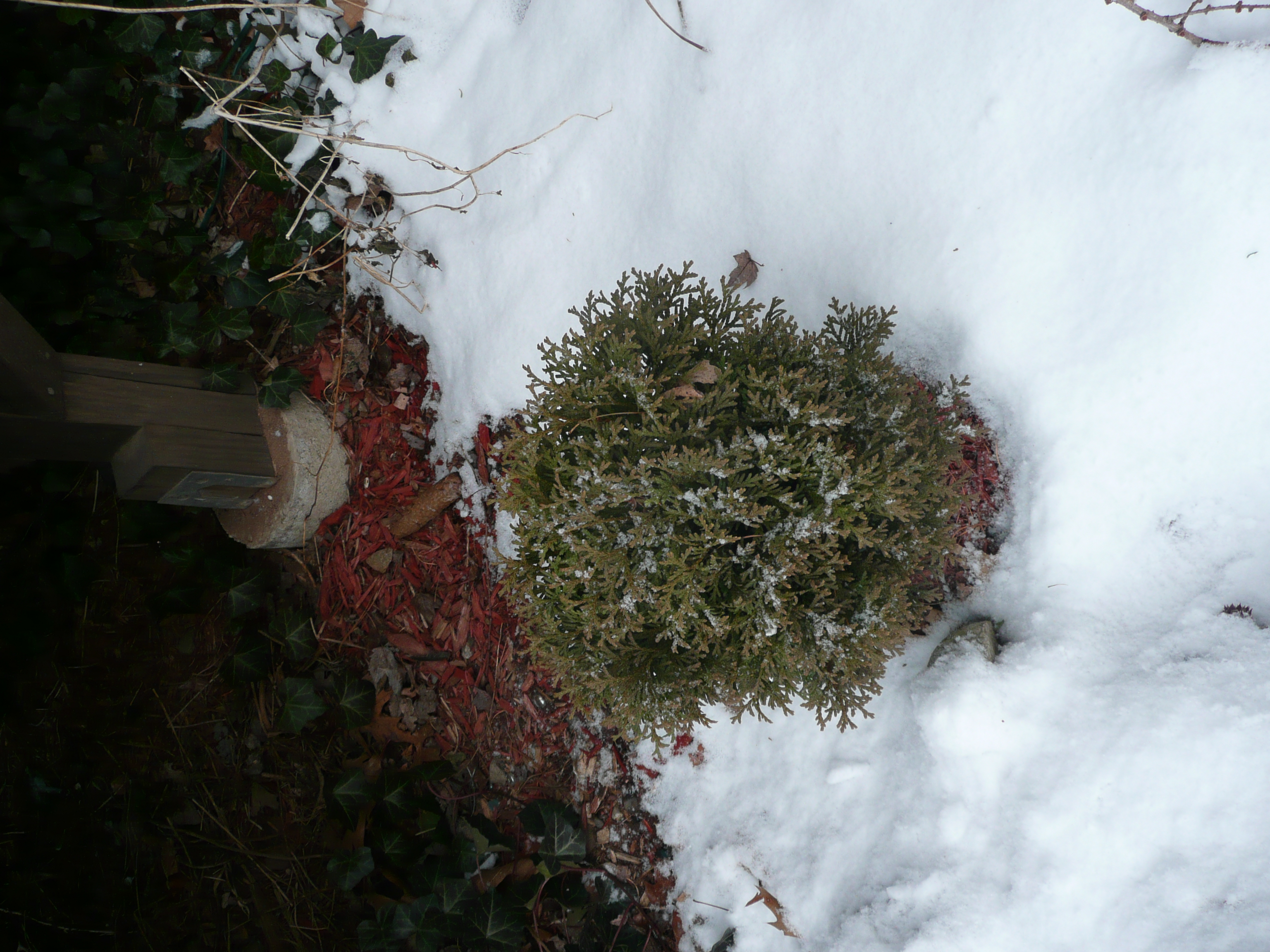
If you need a little evergreen shrub, be aware the traditional pyramidal shaped arborvitae also comes in a dwarf form.  It is Thuja occidentalis ‘Little Giant’ or dwarf arborvitae.  This mini-version of the evergreen arborvitae also takes full sun (6 hours or more of sun) and grows to 24-30″ tall x 30-36″ wide.   It can handle some part-shade too, but will have a more open habit.

When a guest visited my home last year, and saw one by my house in a tight corner, she pointed to it in surprise.  “Isn’t that going to get too large?”, she asked.  I informed her its the ‘mini-me’ of the arborvitae. 

Little Giant

It seems not to many people are aware ‘Little Giant’ exists.  It has a rounded habit and is not too expensive compared to plants of similar size with more desireable qualities, but I think this mini can do for small spaces.  Should you want to create a knot garden, this is an alternative to boxwood.  Just space the dwarf arborvitae about 36″ apart.  One caution:  Deer eat arborvitaes so if you have a problem with deer, don’t use this shrub where they may browse. The tidy size of this plant would also make a nice container garden specimen for some greenery in the design.  It is small enough to fit other plant combinations within the container.  And it is easy to prune. 

The typical American arborvitae (Thuja occidentalis) is more familiar to everyone.  It serves as a great evergreen hedge or privacy wall, or as an anchoring plant.  Basically, they are easy care.  Many retain their green color throughout the winter months, but I suspect many were damaged this year by our heavy snow fall in Connecticut – some beyond repair.  They may require replacing, unless you took the time to shake away the heavy weight of the snow. 

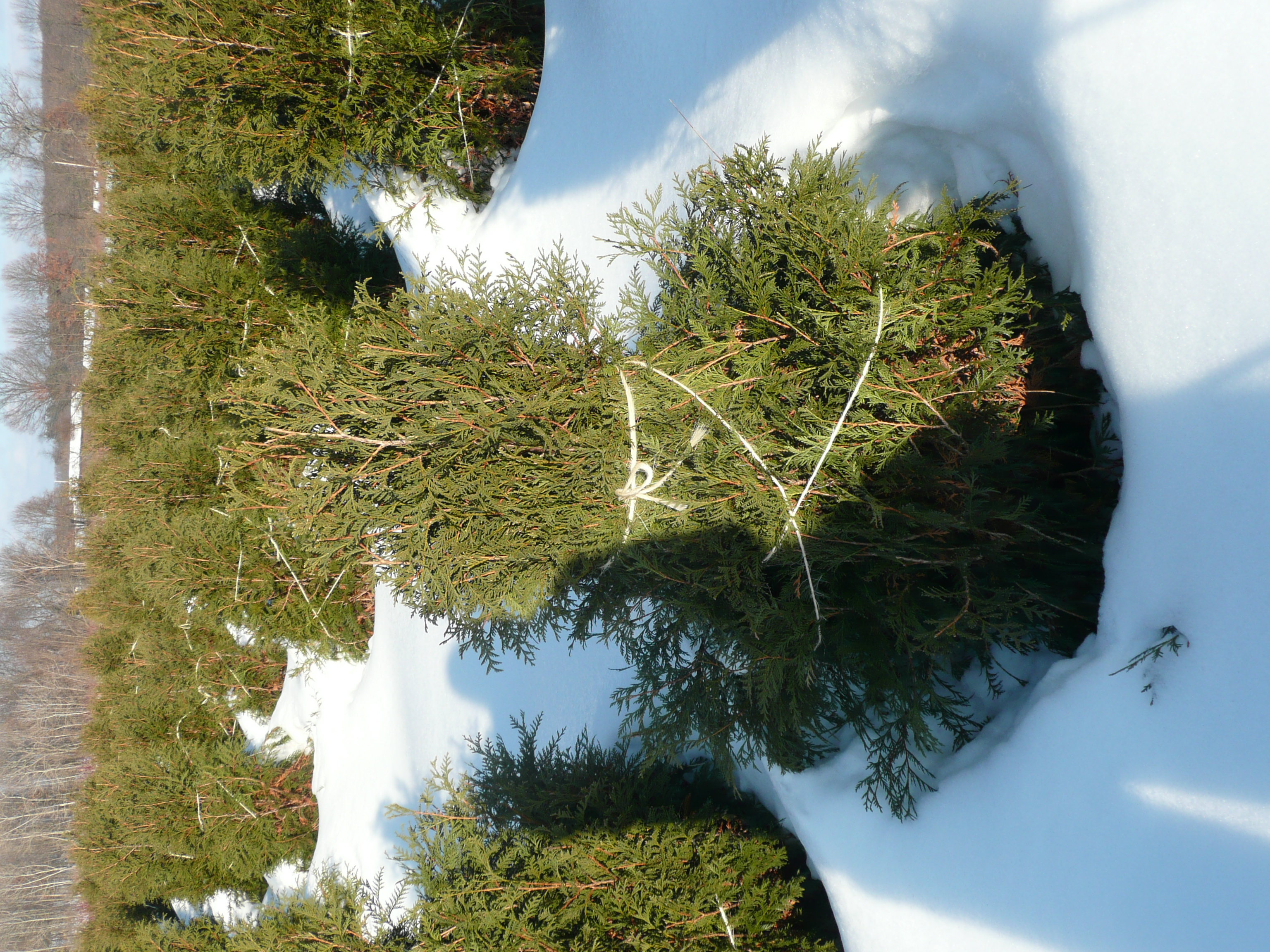
To prevent winter damage (in the future), twine string or cord around them as shown in this photo I took of arborvitaes in a grower’s field.  Or create a framework to protect the plant but be sure to allow the sun to cast upon it.  But it may be a little too late to let you know about these techniques now!  The damaging snow fall this year took us by surprise.  If your arborvitae was too severely damaged, and you want to take it down, you could also wait (if you can stand it) until next winter to do so because arborvitae evergreen cuttings are great fillers for winter container gardens, so why not get use of it when you create your holiday arrangements?  I will be showing how this is done next winter in my winter class offerings.

Twined

About the only other requirements for T. occidentalis species is protecting them from strong winter winds and, again, not placing them where deer are found to dine!  They prefer full sun but can take shade.  In shade, their foliage will be a little less tight and dense, and a bit airy looking. ‘Emerald’ is a good cultivar with a narrow to pyramidal habit as a shrub form or small tree.  It can reach up to 10-15′ high and 3-4′ wide.  It is hardy to zones 3-8.  This is one I often recommend, among other cultivars.  I’ve also used arborvitaes in large containers.  Two I have still today.  I planted them in containers about 3 seasons ago, and I move them into my garage each winter.  Then as soon as the warm temps of spring arrive, I roll them back out as repeat performers.  Begin watering slowing, add some fertilizer and refresh the soil and mulch.  I’ll change out the decor around the arborvitae with seasonal annuals to add a splash of color.  It is a great way to save money.  The arborvitae still hasn’t outgrown the pot! 

I recently read the Latin name arbor vitae means “Tree of Life”  in a book titled, “Leaves. In Myth, Magic & Medicine” by Alice Thoms Vitale.  ‘Tree of Life’ because it has been a source of food.  We know deer sure enjoy them.  Ever see an arborvitae turn into a topiary as they dine on the lower portions at times?  But apparently deer are not the only diners – moose and rabbits?  Well, rabbits use this evergreen for shelter.  No moose sightings here in my yard so I’d have to ask my Canadian relatives about that one!  Native Americans had used it also for skin disorders – making salve.  There were other medicinal purposes.  Who would have figured?  Cathy T

Amelanchier canadensis (Shadblow)

Leave a comment

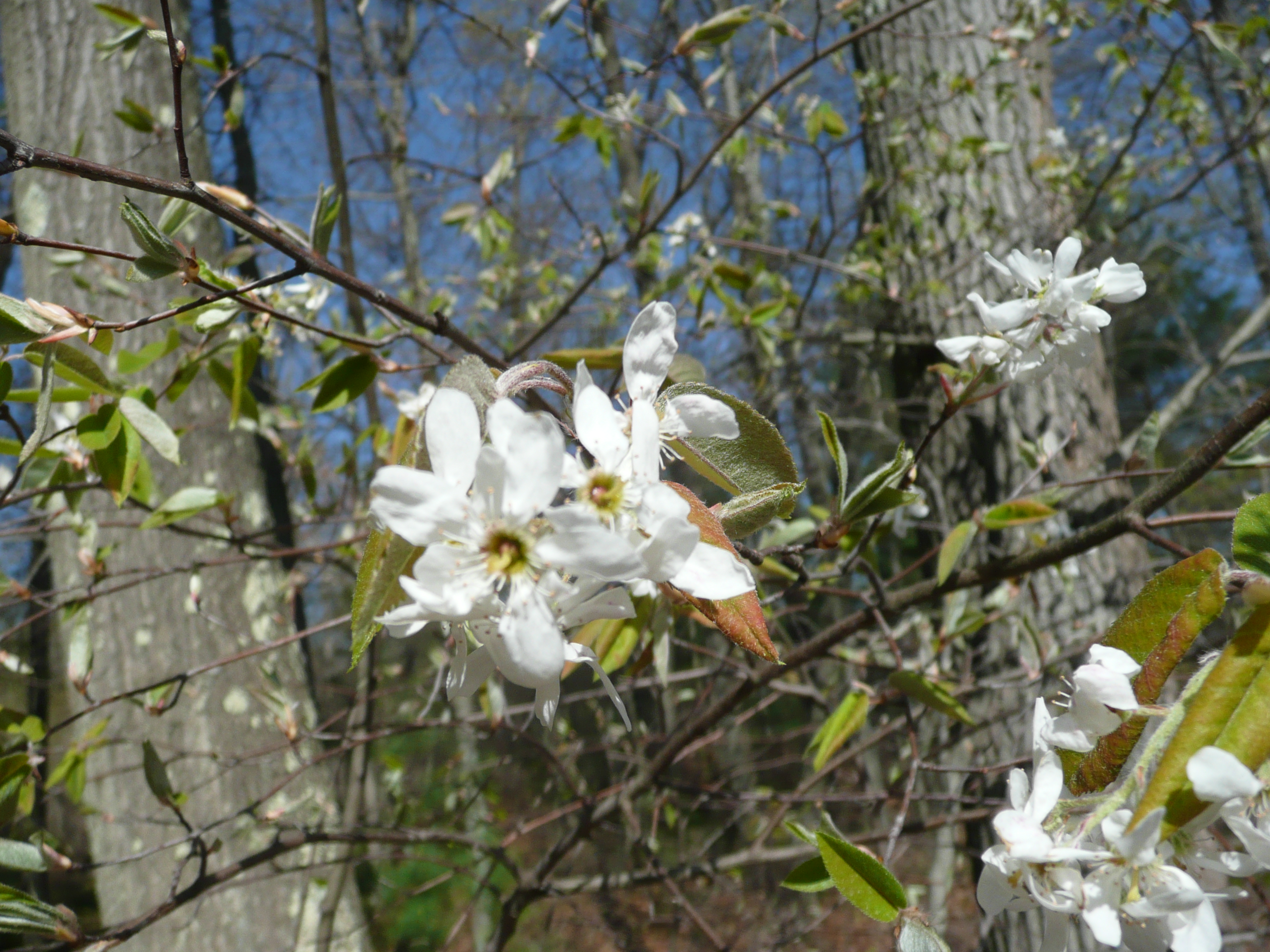
Adding this tree to landscape designs is a treat for bringing spring interest to areas where the right conditions for the tree exists.  The fact it developes fruit so early in the season is a feel-good aspect because mother birds feed their young with the edible fruit – plus this tree is native and extremely showy when it blooms in early spring against a backdrop of a lush wooded area.  Earlier this year, I saw a hybrid of it growing natural by the roadside and took a photo of the blooms.  It would be difficult to identify exactly which Amelanchier it was because of the variations which exist in the wild.

Wild Shot

Amelanchiers can get confusing.  There is A. arborea (serviceberry, shadbush) and A. canadensis (shadblow, downy shadblow) and A. laevis (allegheny shadbush) but they all look the same to me!  Either as a small singled stemmed tree or multi-stemmed shrub with fine textured twiggy branches and smooth gray bark.  The blue green leaves turn to orange and yellow or dull red in the fall, so it has a nice end of season interest as well.  And again, the white flowering in early spring is showy before the leaves expand on this plant.  It is a great naturalizing looking plant near streams or other woodland trees.  You can use this tree near a patio or courtyard as well providing you have appropriate space.

It is deciduous and blooms around the same time shad spawn.  Yes, shad the fish!  Thus the common name, shadblow or shadbush.  The slightly fragrant white, 5-petaled  flowers bloom during the April to May timeframe.  The foliage is kind of dainty and narrow.  The shape of the tree is somewhat oval.  Place it in a sun to part shade location where there is average, moist, well-drained soils.  Look for the newer cultivars which are usually more resistant to disease or bug problems.  And remember to read the lables.  Plant labels are packed with information more than ever.  Read them for they can offer more explanation about the plant. 

Amelanchiers are useful as accents, along the woods as mentioned above, as a group planting for impact in the spring, and for fall color in an informal setting.  It starts to flower the first year and has a semi-fast growth rate. It is also native – another bonus!  Planting candidates indigenous to our local area is a good thing for you and the plants.  Since they are native, they are usually adaptable and easier to grow in some cases. 

Natives are growing in popularity too. To learn more about natives, visit http://plants.usda.gov where you can search by geography, just click the CT option to get a complete list.  Another great source are plants by the American Beauties Native Plants program.  Look for the American Beauties labels at your nurseries.  And look for the white blooms of Amelanchiers this spring!  Cathy T

Picea glauca ‘Conica’ (Dwarf Alberta Spruce)

1 Comment

This is what I refer to as a “staple” conical or pyramidal foundation type shrub.  While some my think this shrub is not elite enough for their yards, it is a great option for the less finicky gardener or one looking to save money.  It is usually a cheaper price than let’s say prettier type shrubs of similar shape, like Boxwood or Holly, but it can serve its purposes.

Picea glauca ‘Conica’, the Dwarf Alberta Spruce, is a plant that can take some drought, grows slowly, doesn’t require pruning, and is a low-maintenance shrub.  Although it is listed as a dwarf, it can reach about 8 to 10 feet in 25 to 30 years.  Three feet wide, its shape becomes broader with age.  The needles are fine, small and medium green.  Densely branched on its stems.  It is a full plant that enjoys full sun, but it can take some shade.  And this plant does fine in large containers!

Sometimes folks overlook the shrub option when it comes to container gardening.  Go for a container size of a whiskey barrel or larger and let it serve you for many years.  Use it as a focal point or even a thriller in the container gardening world, then add different plants each season to dress it up.  Try pansies in spring, change them out in summer switching to summer bloomers.  Let it be a repeat performer in your landscape for many years over. 

Often I will move my container gardens with shrubs into my garage over the winter and then just roll them back out as soon as spring arrives, refresh the mulch, give it a slow introduction to watering again – and voila, I saved money this way!  Because the Dwarf Alberta Spruce is slow-growing and very tight, with the ability to take full sun and a bit of a dryer soil, it works great in containers.  However, should we get hit with a really hot summer, be sure to water it.  You can not just ignore it completely.  Sometimes this plant can get attacked by mites, especially if too dry or too hot.  This will be noticeable if you see signs of browning on the plant.  The weather conditions should be noted in other words.  If no rain, and a droughty season, be sure to visit your container to water it.  Its roots can’t reach out to the ground and it is dependent on you. 

Sometimes Dwarf Alberta Spruces will shoot out a stem that looks unlike like the others.  This is known as a sport.  The plant is actually reverting to his parent form.  When this occurs, and it did on one of mine, just prune it off just below the point of where it started.  This plant also does bloom, but it won’t be visible until you see bees hovering around it.  

Wholesale Yard Shot

Dwarf Alberta Spruces are also good to use as hedges, although it is not my preferred look for a hedge because of how they tend to get broad, like growing fat hips later.  But they can be used as windbreaks, to anchor corners, and even to bring a green background or raised green spot in the garden among other plantings and perennials in full sun locations.  So because of these traits, I don’t boycott Dwarf Alberta Spruces.  Yes, it is one of those common ones, but if it works for you, it is perfectly acceptable!  Cathy T

Abies concolor (White Fir)

Leave a comment

During a walk along a roadside near a golf course, I said to my walking partner, “Oh look, there is a concolor fir!” 

Abies concolor, the white or concolor fir, is one of my favorite conifers.  Its longer blue-ish needles, when broken open or crushed, smell just like oranges or tangerines as you hold it up to your nose! 

“Wow,” she replied. “It does!”

I have always enjoyed showing this “smelling” aspect to customers when I worked at a garden nursery.  They would be pleasantly surprised to experience that orangey fragrance, so I would point that out as one fun id feature, plus the fact that firs have flat needles. 

“Think F for firs,” I would say.  “That equals flat needles versus the spruces which are rhomboid (squared).  Spruce needles roll in your finger tips.”  I never used cones as an id feature because it takes many years before they grow on this conifer.

Scott Haney on our local CT Channel 3 news television show mentioned the concolor fir during the holiday times.  It is an option for a Christmas tree should you be lucky enough to find one.  And concolor firs are great for your landscape too! 

The concolor fir’s mature height is 40 to 70 feet with a spread of about 20-30 feet.  This evergreen conifer is shaped like most christmas trees with a straight trunk and narrow-like conical shape.  Upper branches tend to grow up-ward.  The blue-ish soft “flat”  needles grow to about 2.5″ long and have a nice surface appeal to them.  They are not as stiff as with blue spruce needles. 

Light requirements for the concolor firs are full sun to part shade and it appreciates a rich soil with medium moisture, slightly on the acidic side.  It does not grow that well in clay soils.  And best of all, this evergreen conifer does not experience serious pest problems from what I’ve learned to date about it.  Plus deer are unlikely to browse them!  Another bonus.

In the landscape, it is well suited as a large specimen provided you have the conditions noted above on your property.  It maintains its foliage all the way to the ground and has a slow to moderate growth rate.  Hardy to zones 3-7.

People don’t often know about this conifer choice.  And due to its soft blue needles, in my opinion, it makes a nice alternative.  Unfortunately, I don’t have a photo of it in my database.  I’ll have to snap one for you during my next long walk!  Cathy T

Burgundy Hearts Redbud Cercis canadensis ‘Greswan’

2 Comments

“Did you see my redbud?  It is gorgeous this year!”  And it was.  I snapped a photo of it immediately.

That day at my client’s home, she showed me her redbud tree in her backyard next to her back deck.  I’ve always liked this tree because of its unique flowering pattern that runs the line of every branch giving it an asian feel.  The flowers appear in spring before the leaves expand.  And the foliage is heart shaped. ‘Forest Pansy’ is a common favorite to point out to folks at the nursery because not only are the flowers beautiful, the color of the heart-shape leaves are plum-ish versus the traditional green.

New redbuds (Cercis canadensis) cultivars are coming out of the woodwork more often it seems.  Another one that caught my eye recently at a tradeshow was Burgundy Hearts® Redbud (Cercis canadensis ‘Greswan’).  The leaves are a tad bit larger and are a wine-red color, a bit lighter than ‘Forest Pansy’.  In early spring, the rosy-purple, pea-shaped flowers expand around March-April timeframe, before the leaves.  Hummingbirds and bees enjoy the early welcome as spring awakens their senses and our’s.  And this new introduction, ‘Greswan’, is noted for proven resistance to summer leaf sorch better than my former best on my list ‘Forest Pansy’.

Smaller trees tend to be my favorite in the landscape.  Burgundy Hearts® Redbud grows to about 20-25 feet at maturity.  It is fast growing and native.  In the late summer to fall, the red-purple color to the leaves transition to a more wine-red burgundy color.  It is cold hardy to zone 5 and heat tolerant to zone 8.  Place it in a full to partial sun location and let your heart begin to pound with love!

If you tend to like a hotter and warmer color to your landscape, another option in the redbud world is Cercis canadensis ‘JN2’, known as The Rising Sun™ Redbud.  It is a new introduction with brilliant, golden yellow to orange colored leaves.  It has a full, round shape and holds its color into fall.  The pea-like shaped flowers are a rosy-orchid color.  Another feature that makes this one a bit more unique to the rest of the redbuds is the bark – it has a yellow tinge to it.  The size of this one is even a bit better for smaller areas.  It reaches 12 feet at maturity. 

The Rising Sun™ Redbud is a vigorous grower and also a native ornamental tree.  It is cold hardy to zones 5-8 and appreciates full sun locations.  I can’t think of anything about these plants that are a downfall, other than if I don’t plant one soon, I may die of a broken redbud heart!  I vow to incorporate some more flowering trees in my landscape this spring, and hope to locate these beauties on the scene.  I hope you will too!  Cathy T

Finally located the photo I took of the redbud at my client’s home, here it is!

Redbud Blooms

Callicarpa dichotoma ‘Issai’

Leave a comment
C. dichotoma 'Issai'

Purple Drupes

I have three of these beautiful deciduous shrubs, called Issai Japanese Beautyberry, along the base of my deck.  The drupes appearing along the stems right now are well, beautiful berries!  This shrub can take sun to partial shade and has arching branches of medium green foliage in the summer.  The foliage starts to turn an almost  chartreuse yellow like color in the fall which combines well with the metallic purple fruit  – what a show.

Purple by shrubs

Borrowing features

Earlier in the season, I placed a huge container of Tradescantia (Purple Heart), an annual in our CT zones, which served as a color complement prior to the purple berries’ arrival on the shrubs later in the season.  Always think of how you can stage container gardens holding plants of similar colors or hues of a plant nearby. While there was no purple on the shrubs during the summer, the purple intense color of the Tradescantia foliage in a pot played a role until the cool temps arrived, and then the shrubs’ berries appeared after its flowering phase.  The yellow-green of the shrubs leaves worked as a color complement to the violet-red of the annual Tradescantia.  It makes sense because purple was to appear on the shrub later – nature gives you the clues or keys to working with color.  Look at the color wheel to see how you can achieve similar success with color combos.  Colors directly opposite are dramatic!

Callicarpa dichotoma ‘Issai’ has been easy to grow for me.  Once I was told it isn’t hardy in CT but I found this to not be the case (perhaps in more northern exposures).  Mine have been growing well for about 3-4 years now.  I pruned these shrubs in early spring.  As instructed, I pruned away about 1/3rd of the older canes, and I must say, at first I panicked for the shrubs looked wierd, but this summer it flushed out nicely with fresh new canes, as promised by my pruning instructor.  An extra bonus is the abundance of the purple drupes along the fresh stems right now.  It is a real eye-catcher. 

Perhaps next year, I will use the annuals, like Osteospermum, shown in this next photo as they have the right color hues and would work well with these shrubs.  This is just another example of how you can work it!  Place a nice pot of these colors by the shrubs.  AnnualsThe beautyberry shrubs behind the containers can reach 6′ high by 5′ wide as a nice backdrop.  These shrubs can pruned hard in early spring to desired height if you desire to do so.  It is a great plant for border planting, and very effective when planting in groups.  It can make a nice foliage mass and adds a nice feature in the fall as shown and explained here.

My sister in law asked if she could take a cutting now.  I read from Dirr’s book of Woody Landscape Plants to propagate this shrub, you must take softwood cuttings.  They root easily in sand under mist.  In fact, all Callicarpa root readily from softwood cuttings.  Roots will appear in about 7 to 14 days per Dirr.  If attempting seed propagation, they require cold, most stratification (that is subjecting the seeds to a temperature change by chilling the seeds either before or after sowing, otherwise they won’t germinate).  Just remember, the shrubs are deciduous, loosing their leaves in the winter, thus you wouldn’t want to plant them where you desire evergreen all year round.  But where you have the right spot, don’t hesitate to seek this plant from your nursery source.  I am glad I did!