My Parting Kiss with Chelone lyonii ‘Hot Lips’

Leave a comment

Every autumn, I take the time to write a plant review of the plants I enjoyed the most (and why), along with plants which disappointed me for whatever reason.  This season, Chelone lyonii ‘Hot Lips’ is ranked number 1 on my perennials’ list.

Bee Attractor

First Prize Winner

Chelone lyonii ‘Hot Lips’, common name: ‘Hot Lips’ Turtlehead, or pink turtlehead, is a perennial hardy in zones 4-7 with many desirable features and little problems.  It appreciates partial shade to full sun, is deer resistant, and a U.S. Native, but these were not the best of its attributes in my opinion.  My first attraction to it was its lustrous deep green to blue-green leaves, spotted on a stock at a wholesale yard this summer.

Love at First Sight

The moment I spotted the leaves on this plant and saw the tag’s photo of the flowers, it was love at first sight.  I was glad to see this perennial grows two to three feet in height with a spread of eighteen to twenty-four inches.  I wanted plants that grow big for showy container garden designs.  The plants were very healthy with fresh foliage and showing no signs of stress.  So off a few ‘Hot Lips’ plants went to my holding area along with other perennials and some shrubs.  Little did I know, this plant’s additional features would soon lead to a romance of admiration.

Pink Turtlehead

Serrated Blue-Green Leaves

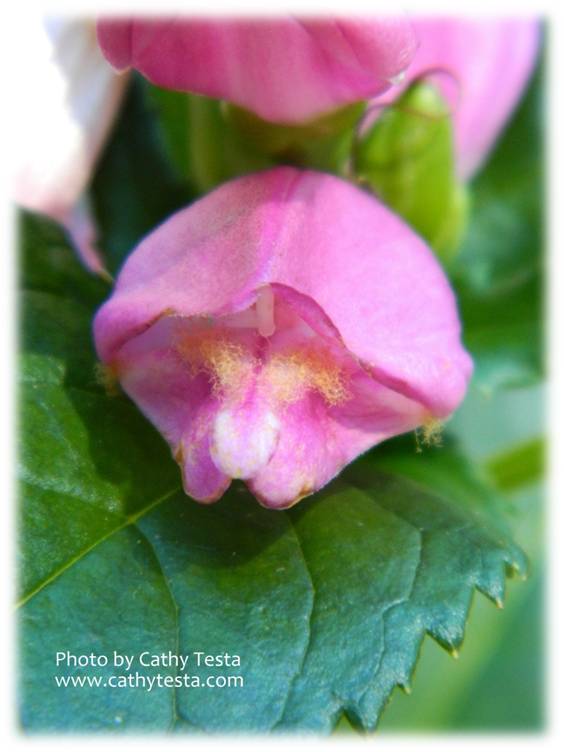
Tags and references for this perennial will say the plant has deep green leaves, but take a look at my photo.  In my opinion, the leaves lean towards a “blue-green” coloring, combining very well with pastel or muted softer tones.  If you were to pull every color from this plant, you would also see some white and soft yellow (when you look closely at its bearded tongue down the throat of the flowers), softer pastel pinks, and deep raspberry like pink on edges of the flower’s hood, as well as some avocado green to the leaves.  It is important to pay attention to all the colors on a plant, some which may go unnoticed until you work with them by selecting companion plants to repeat or echo a color from the focal plant.  For example, I used a Cordyline with soft pink, yellow, and green streaking to repeat the hues in this perennial.  The blue-green leaves of ‘Hot Lips’ are also serrated and thick, offering a bit of texture, and the leaves of the Cordyline are big and coarse.  This helps to create texture comparisons in the design.  To soften the edge of the pot, I tucked in an ornamental grass with a bronzy color which worked well with the color of my container.

Curious Long Lasting Flowers

By early summer, this plant grew from a one gallon pot size to about two feet tall with a nice upright mound shape.  Soon the flower buds started to appear and plump up.  I was anxious to see the flowers open because they have an unusual structure, think “Little Shops of Horrors” plant character.  Tightly clustered on a raceme styled inflorescence, the flower buds open to reveal a hooded form with a bearded tongue within.  The continual elongation of the raceme made me consider if this is where the common name came from because it reminded me of a turtle elongating his head from its shell.  But I’ve read it is actually the flower when open that resembles a turtle’s head.  Either way, the flower is kind of cool and very pretty due to the intense hot pink colors.  And lucky me, they were abundant on this plant in my container from August to September, even into early October.

Turtlehead buds

Bee Attractor

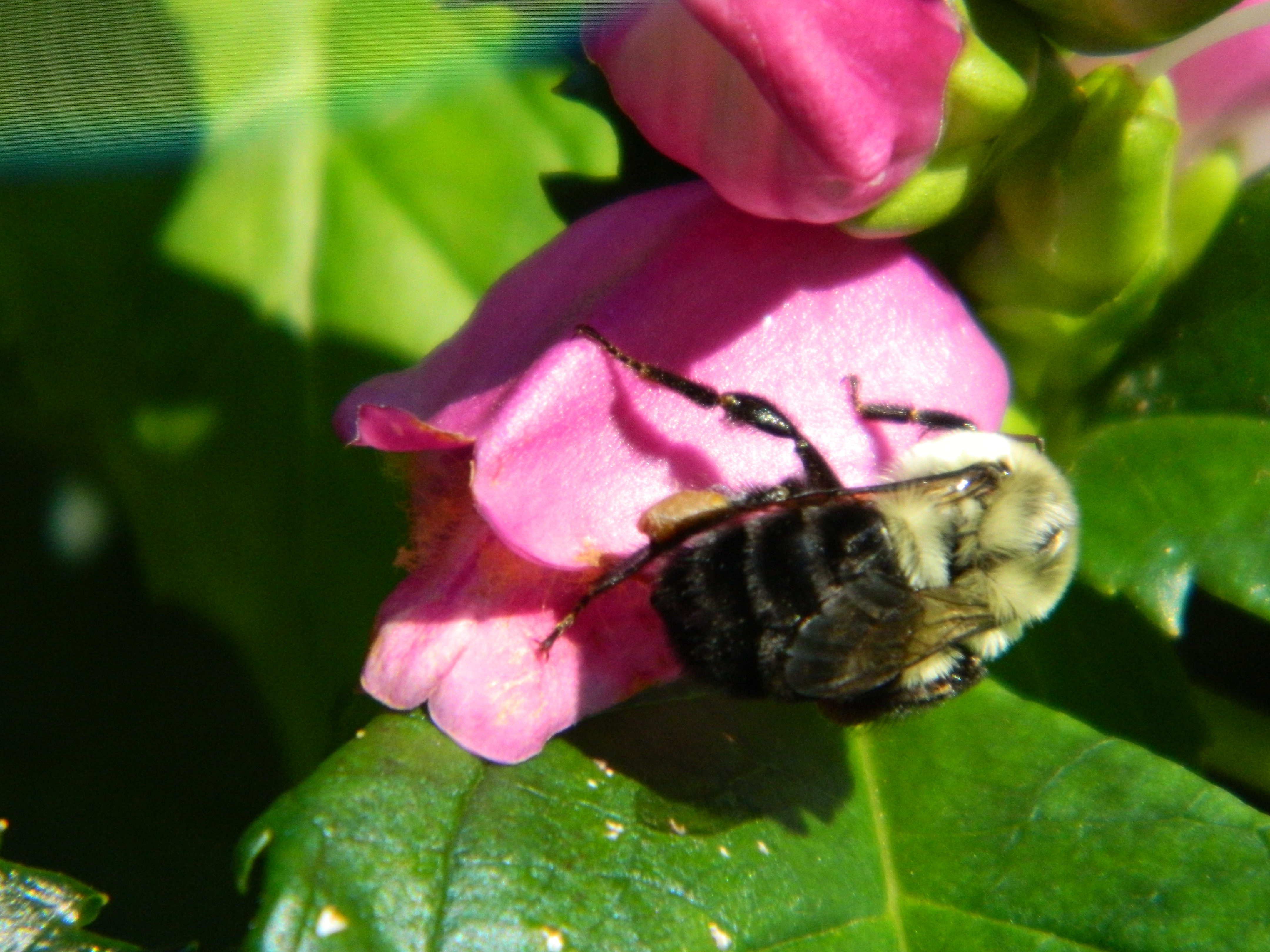
In addition to the flower structure itself being of interest, its nectar and pollen offerings completely enticed bees during its long bloom period from late summer to fall. First to visit were bumblebees, followed by honeybees later in the season.  Many bees were diving into the hooded flowers, squirming and wiggling head first to reach the bounty within.  The flowers’ openings were just large enough to allow entrance with no turn zone available, so they would come out, in reverse, butt end first.  A loud buzzin’ sound amplified as the bee entered and exited.  It was a rather amusing buzz symphony, even my husband started to take notice.  I guess bees do not suffer from the fear of claustrophobia for it was a tight fit.  Now our temps have cooled, almost reaching our first frost point, the bees have silently dissipated.  Their love affair with ‘Hot Lips’ is over.

Butterfly Hummingbird Teaser

One afternoon, when I was admiring the bees up-close and taking photos, a hummingbird swooped near my head and swooshed by the plant’s top.  He was checking me and the flowers out on this now very large ‘Hot Lips’ turtlehead perennial plant.  So large now, it was the size of a small shrub.  So I decided to sit quietly on the ground and wait patiently to see if the hummingbird would return.  He did.  But of course, getting a photo was impossible due to their warp speed.  While this plant teased the hummingbird viewer, I personally never saw the hummingbird sipping from it, but it is certainly a candidate to add to the hummingbird or bee lover’s garden bed, with one catch.  It needs moist soils to perform well, and the right amount of space due to its larger size.  In gardens, it is best used mid section, but in container gardens you can place them wherever you want in a large container.  For me, containers worked well because of observation opportunities.

Bee backing up-See black end?

Consistently Moist Soils

At the time, I didn’t really pay attention to the fact that this perennial is best in moist soils.  Because it was heading to one of my large container gardens, it wasn’t a big concern.  And I like to water my container gardens, so I didn’t think about any issues there.  However, if you plan to use this perennial in a garden, it is best to situated it in an area with moisture for this is what it will thrive in.  And of course, to select companion plants that also appreciate moisture.  I could see a variegated Iris, with “blue-green” and “soft yellow” foliage color, working well.  It has the right coloring to harmonize with ‘Hot Lips’ and likes to sit in standing water, plus it has a spiky form and grows to a fairly big size of about thirty-six inches tall, so it would not get buried by ‘Hot Lips’ and would work well placed in front of it.   To add some drama, one may want to add an elephant ear, such as Colocasia esculenta ‘Maui Magic’ for the dark purple-black tones provide a great contrast.  Also enjoying part-shade and moisture.  While I’m at it, how about the ultra tall Filipendula spp., meadowsweet, with finer-wispy soft or deep pink flowers?  These all would work together in the moist garden bed, or in a big container garden.

Parting with ‘Hot Lips’

Saying goodbye to this perennial is difficult to do, but it will be transplanted and enjoyed next season. Yet to witness are its seedheads, attractive and offering one last moment of pleasure.  Next spring, it will be pruned and admired once again.  The bees will return, and all will be hummin’ along.  However, now, it is time to say goodbye to those hot lips with a parting kiss – well, you know what I mean…Saying goodbye to plants feels like a break-up.  Okay, I said it.  And breaking up is hard to do… Cathy T

The Parting Kiss
Poem 1788
by Robert Burns

Humid seal of soft affections,
Tenderest pledge of future bliss,
Dearest tie of young connections,
Love’s first snowdrop, virgin kiss!

Speaking silence, dumb confession,
Passion’s birth, and infant’s play,
Dove-like fondness, chaste concession,
Glowing dawn of future day!

Sorrowing joy, Adieu’s last action,
(Lingering lips must now disjoin),
What words can ever speak affection
So thrilling and sincere as thine!


Bragging about Brunnera macrophylla ‘Jack Frost’

Leave a comment

Yesterday, I sat at my kitchen table where the warm mid-day sun was beaming on me and my cat as I reviewed my plant catalogues to begin the exciting process of ordering plants for the upcoming season. Feeling a tad bit anxious because I did this ordering process earlier in January last year, and also did it while sitting in a lazyboy style chair by the fireplace with snow falling outside, taking my time.  Yet, this winter, it feels as spring will arrive earlier due to our warmer temps.  Thus I stayed focused on this important task to make sure this plant order would get to the growers now, or risk missing opportunities to get some of the newbies on the scene and tropical favorites before everyone else grabs ’em.

Jack Frost Leaves

I’m not sure if it was the sun’s warm temperatures surrounding me or the fact the colorful photos of plants were vivid from the sun’s light hitting the pages, but a lady bug dropped right on the pages in front of me. It kept hoppin’ up and down’- and as it landed, a click noise from its hard outer body repeated as it hit my papers and table top. Then it stopped, so I grabbed my iPhone and took a close up shot, and immediately posted it on my Facebook wall. Friends commented this was a sign of good luck. I sure hope so, I thought, for I was just about to order a truck load of plants and it feels a bit risky every time I do this.

This risky feeling is not because I don’t trust my plant selections – because I surely do. Like a lighting beam, (okay sounding a bit braggy here, but its true), I can zero in on plants I know will work in my design combinations for container garden installs and container garden parties held at clients’ homes each year. And I immediately notice plants I haven’t seen before or being introduced for the first time by growers. “Oooh,” I’ll think, “Have to have some of those!”

Then there are old true favorites – that I have loved for years. Thus, there it was, my Brunnera macrophylla ‘Jack Frost’ on the very last page of the catalogue. It won the title of “2012 Perennial Plant of the Year” by the Perennial Plant Association. I’m not surprised, and it made me feel reassurred of all the times I bragged about Brunnera.

When I worked at a nursery, and customers would ask what they can use in the shade, I always pointed out Brunnera macrophylla ‘Jack Frost’ because it has three key features in regards to appearance, texture, and color. First, the leaves are shaped like a heart. The ovate shape of the leaves provide a nice contrasting texture to finer foliage in the garden or when used in early spring container gardens.

Second, the color of the leaves, on this particular cultivar, ‘Jack Frost’, with its dark green leaves covered by a soft white or almost super light-blue overlay on the entire leaf makes the venation pattern very visible and distinct, adding visual texture. Additionally, the fact that its leaves are white-to-soft white, almost faint soft blue, is a benefit in a shade garden because light colors really show up in the shade.  They don’t disappear.

‘Jack Frost’ is a plant that also grows well with little to no problems.  About the only concern, is if it gets hit by a frost, it can blacken the leaves, but what are the odds of that happening?  And you noticing in the shade areas of your gardens is unlikely if it is a quick passing frost.  And if it happens, you can easily snip off the damaged leaves to remove that unsightly experience.

Blooms

Brunnera macrophylla ‘Jack Frost’ doesn’t typically experience any serious disease or insect problems and it is hardy to Zones 3-8. And another bonus – it is a spring bloomer with a true blue flower. I often told clients the flowers look like Forget-Me-Nots. They are dainty, blue, very small and rise on racemes over the top of the full foliage below. So of course, when I saw this plant as the Perennial Plant of this year, I was pleased.

This perennial does well in partial shade and moist, well-drain soils. If you want a naturalized look, it is a good candidate for that type of garden as well. Known as Siberian bugloss, it’s photo graces the front cover of Tracy DiSabato-Aust’s book, titled, “50 High-Impact, Low-Care Garden Plants” and she indicates it is: “Long-lived, heat and humidity tolerant, cold-hardy, deer-resistant, insect and disease resistant, mininmal or no deadheading, minimal or no fertilizing, no staking, minimal or no division, minimal or no pruning, non-invasive, and drought-tolerant.” Is this plant missing anything? It is practically perfect. 

One year, I plopped a Hydrangea next to my ‘Jack Frost’ Brunnera in my front foundation planting area. The soft blue and pink to white blooms of the Hydrangea worked well with my Brunnera. In containers, Brunnera ‘Jack Frost’ can stand alone or try pairing it up with Astilbe, selecting a cultivar with perhaps white or pink blooms, such as Astilbe ‘Amethyst’ with plumes of bright lavender-pink in June or Astilbe ‘Bridal Veil’ with white plumes on 18″ stems in late spring.  The Astilbe serving as the thriller and Brunnera as a filler.  Astilbe perennials are also wonderful shade candidates so they fit the culture of ‘Jack Frost’.  Think of other shade, spring bloomers to pair up with Brunneras.

to the left

Left corner

Use different texture and heights for nearby or companion plants, such as Polygonatum (Solomon’s Seal) which has a arching habit on long tall upright stems.  I like to have those elevations in my designs and gardens throughout the beds, not just in the back, as often recommended.

Or use other textures nearby that has slimmer foliage, such as Hakonechloa(Hakone Grass), an ornamental grass with the ability to also grow in shade.  The cultivar ‘Aureola’ has bright yellow foliage, and coincidentally, ‘Aureola’ won the 2009 Perennial Plant of the Year.  Now they can hold their honors together.

With Hakon

There are many other beautiful choices of Brunnera cultivars, if the soft white of ‘Jack Frost’ doesn’t suit your garden.  Brunnera macrophylla ‘Emerald Mist’ is a sport of B. ‘Jack Frost’.  It has emerald green leaves with with the white to silver coloring a bit more along the leave’s edges, and it has the similar mounding habit of most Brunneras.  There is also B. macrophylla ‘Green Gold’ that is mostly green, ‘Hadspen Cream’ with a creamy variegation, and ‘King’s Ransom’, also a sport of ‘Jack Frost’, with a smaller habit and wide, pale yellow margins, and more.  Be on the lookout for this perennial, made for partial-shade, tolerant of some moisture, with little care required.  And you too will be braggin’ about BrunneraCathy T

P.S.  I included Brunnera macrophylla ‘Emerald Mist’ on my order list.

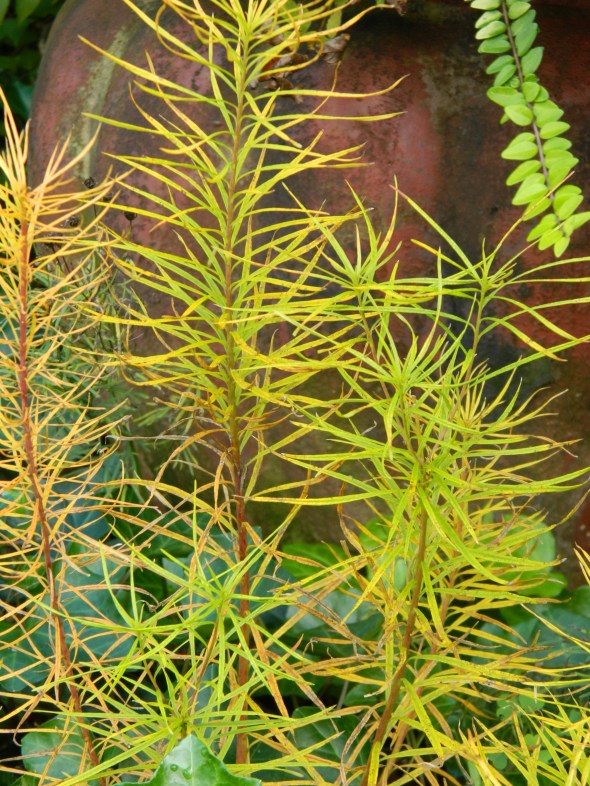
Amsonia in fall

Leave a comment

Amsonia in fall

Amsonia hubrichtii, PPA of the Year 2011.

This photo, taken Oct 20th, shows the fall color of golden-yellow.

Common name: Arkansas blue star, a southern native.

Whispy, fine texture.  Light blue, star-shaped flowers in spring.  Mound habit, 3′ height.  Full sun to partial shade.  Low-maintenance.

Great in containers as a tall, billowing feature, combines well with many plants.  Plant in spring and enjoy it all the way until October.  Tip:  Use a container with brown natural tones and this golden color will pop above it with your yellow or orange mums.  Transplant the perennial to your gardens before frost.  All good, 3 seasons of interest, and useful throughout.

http://www.perennialplant.org/documents/poy2011.pdf for complete details by the Perennial Plant Association.

New Amsonia on the scene this year:  Amsonia ciliata ‘Spring Skies’ (Spring Sky Bluestar); discovered at the Henry Foundation in Philadelphia, PA.  Longer-lasting flowers, more compact habit, and some bronze to the golden foliage in fall.

http://www.greaterphiladelphiagardens.org/gardens/henry/henry-found.htm

Mailbox Plantings

6 Comments

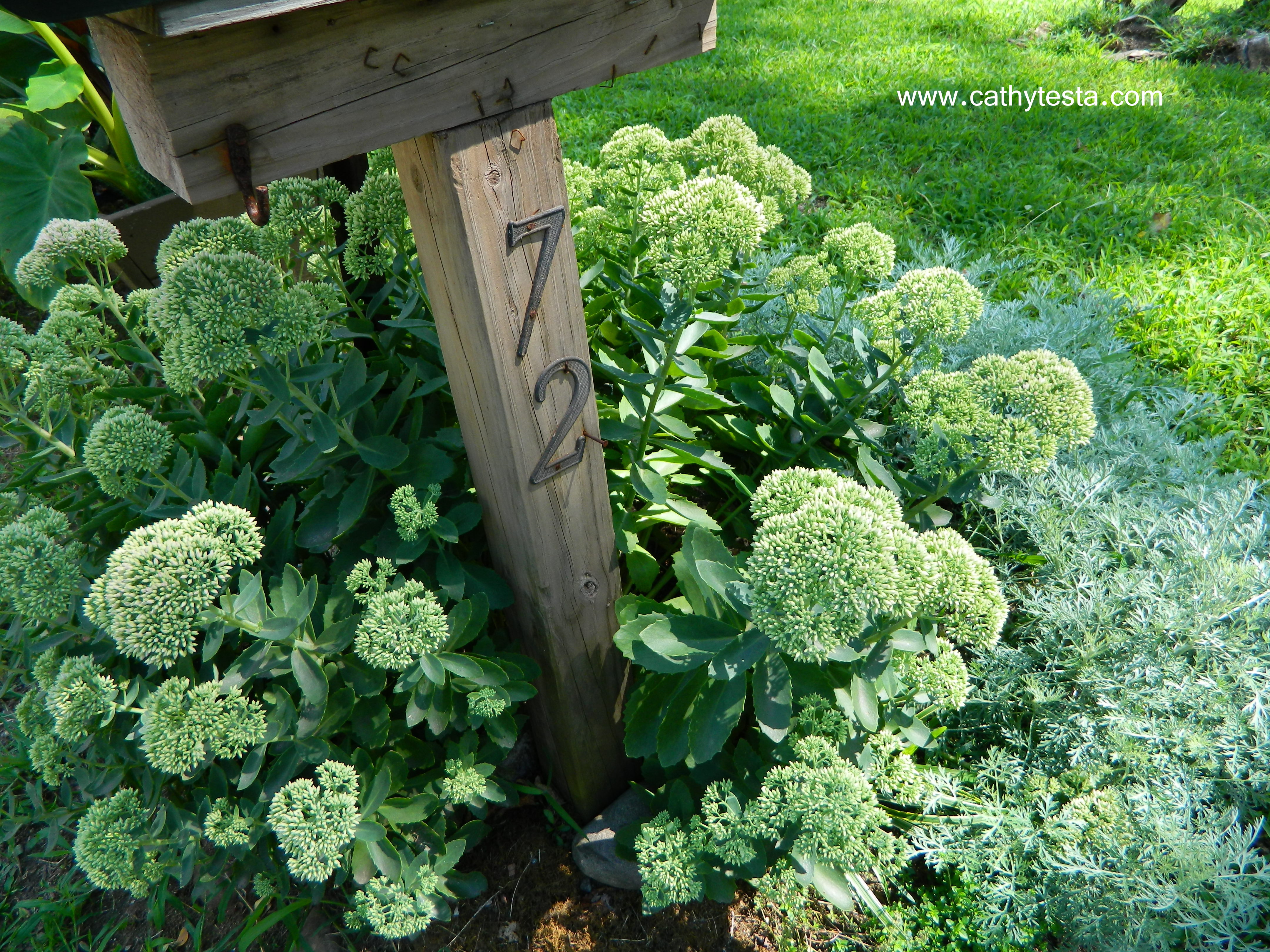
Every year, my Sedum ‘Autumn Joy’ under my mailbox goes gangbusters. I know it is a tough, drought tolerant perennial, but I literally do nothing to this perennial, yet every year, it expands bigger and blooms profusely in the fall. It is quite amazing considering the location where it is growing under my two mailboxes, adjacent to the road side and in full sun most of the day. I sometimes wonder if there is a magic spring deep below in the soil, because I don’t water it at all. My husband says he feels the grass grows a tad bit greener in that area compared to the rest of the lawn in the front yard. So who knows where the magic comes from but I swear the only thing I do to this Sedum is break off the old stems in the early spring from previous season’s growth. I leave it standing there in dry form all winter after the bloom heads turns a coppery color in late fall.

Last year, I added an Artemisia arborescens ‘Powis Castle’ (wormwood) next to this perennial. This perennial is zoned for 6-9, so it is considered a tender perennial in colder climates. A worker in a nursery told me that it wouldn’t come back when I commented that I had planted it with my Sedum, but the plant proved her opinion wrong. It came back in full force this year, and rather than growing into a nice globe or mound shape, it formed a soft, half-moon pattern around the base of my Sedum. Perfect, I think.

A mailbox planting area is similar to planting in a container…without the pot that is. What I mean is it is a small manageable space that can use the ‘thriller-filler-spiller’ method of design, as often used in container gardening. Mailbox areas are often an overlooked space yet it has the potential for dressing up without too much effort – just as containers dress up areas around your home or patio. In fact, any time I complete a design for a landscape client, I throw in a few designs for plantings around their mailbox as a freebie, and it always surprises them.

Behind

Because your mailbox is at the entrance of your driveway, it is often the first thing your guests see. Rather than having an eye-sore greet them, you can incorporate a few plants by using some simple design tips to welcome their arrival.

First, for safety, two tips. Try to not incorporate the super-bee loving flowering plants – for the mailman’s safety and yours. And second, don’t select plants that will overpower or block views as you enter or exit your driveway.

For staying power, remember to select the tougher types of plants – those that can take roadside conditions, perhaps some drought tolerant ones since you probably won’t drag your hose out there. Consider the winter too when road salts or plows can damage the area. Although your perennials are underground in the winter, the soil takes a beating around mailbox areas.

As for design tips, it is important to remember to use different foliage textures, as I did with my Sedum and Artemisia. The Sedum is coarse texture compared to the silvery soft thin foliage texture of the Artemisia plant, for example. And with no blooms at time, the foliage will carry the interest and not harm your mailman.

At this time, a design element missing by my mailbox is something tall. The thriller so to speak – just like in container gardening. Consider planting something that would run up the mailbox post itself as your thriller. Your obvious choices are a perennial or annual vine type plant. If you don’t mind replanting every year, something like a Mandevilla is amazing (and technically a tropical plant), or a black-eyed susan vine (annual), both will flower all summer and grow quickly. You may need to put a mini trellis or some anchors on the post to help it vine up, but it will grow fast and be showy.

If a vine doesn’t suit your style, another option is to add a tall ornamental grass right behind the post, or adjacent to it. Look for the upright,vertical ornamental grasses. Some are very showy up thru the fall season, and some can stay through the winter as a little feature by your mailbox if you so desire. Just make sure it is one that doesn’t grow too large for it will outgrow the area probably. Or use a tall spikey or sword like perennial to add height too to your bed. You want the heights to vary amongst the plantings, just as you do with containers. So the fillers below offer the lower heights with the tall candidate by the post balancing the area, plus can hide the post if it is a older post in need of some disguise.

Then perhaps add more fillers below your mailbox at the base if needed. Choose some low growing plants that hug the ground. This will help reduce any chance of weeds popping into the space, plus this helps to balance the other fillers. One option to consider is Thyme. It is a great low growing, ground-covering herb that is drought tolerant and easy to care for. Many gardeners are using herbs and veggies more in mixed planting beds – it is becoming super popular, heck put a veggie plant by your mailbox and give your mailman a daily snack! LOL.

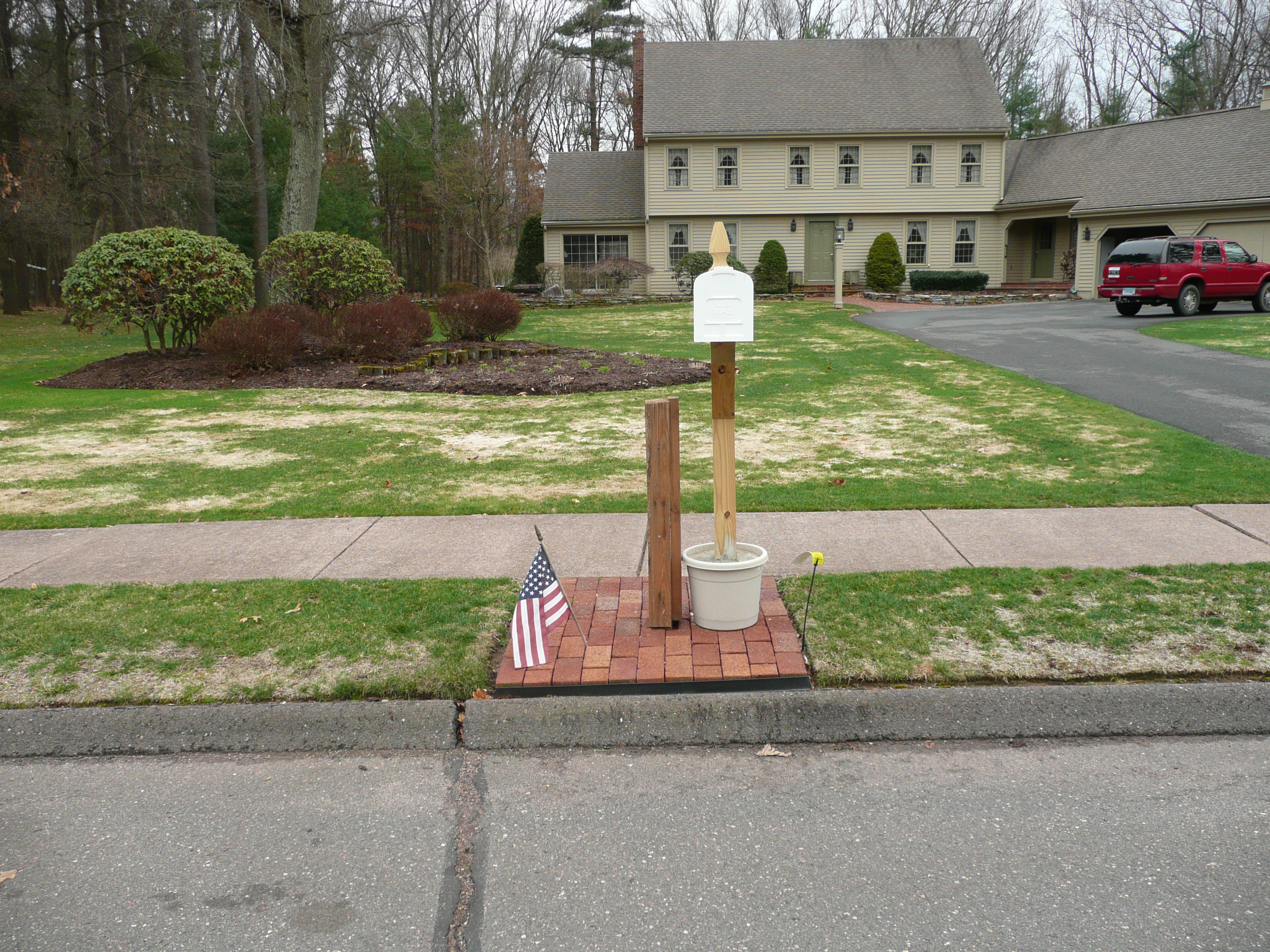
A before shot

And as for size of the planting area, consider the height and size of your mailbox. Measure the height of the post and make the bed the same length. Sometimes the width is limited based on how close your bed is to the street or a sidewalk. However a single plant or two is better than a boring mailbox in my opinion, so try to work with what you have. Again, the soil type is harsh usually so go for those tough type of plants. If your mailbox area is in the shade, there are tough shade candidates too. Please don’t use fake flowers – one of my pet peeves!

By adding 3 to 5 plants in the right proportion, with various textures and colors, and perennials with staying power that can handle roadside elements, or a super blooming annual vine, you will add just the right touch so that your mailbox is now a welcoming element to your home landscape with minimal maintenance involved. For larger areas around a mailbox area, a few boulders can be useful to balance and ward off any chances of someone crashing into your mailbox.

After mailbox

As for myself, I will just keep enjoying my returning Sedum that hasn’t failed me yet until the day I build a stone planter box around new mailboxes to replace my old ones.  That plan will include incorporating a more showy display around my mailbox planting area. But for now, when I pickup my mail from my mailbox, I’ll look at the plants currently distracting me from the bills in my hand as I walk back to my house. Cathy T

Loving My Ligularia

2 Comments

This slideshow requires JavaScript.

I’m loving this shade combination in a container garden at my home.  All the plants in this design are perennials except for one plant, and several are simultaneously shooting up blooms.  The Ligularia ‘Little Rocket’, a dwarf form, is showing off the bright yellow blooms on spikes now, which can be seen from afar.

Ligularias have bold foliage which make them perfect candidates for container gardens and gardens in the ground.  Their foliage factor makes them appealing for a long period before blooms appear in mid to late summer.  But of course, I was drawn to it first because of its showy foliage that is often available in darker colors and with serrated leaf edges.  This adds a texture and color contrast against other plants.  Some cultivars grow large leaves.  When you place other part-shade lovers near it, like a Hosta, Astilbe, or ferns, they tend to work in harmony from a visual standpoint.  And when you place Ligularia near water, by a pond for example, its tall spiky flowers will reflect in the water.  Since they enjoy moist soils, this is a perfect added on feature to enjoy from a visual perspective.

If you look closely at the photos below of the Ligularia in a container, you will also see the Astilbe is about to bloom soon, and the Heuchera is shooting up a thin stem with blooms on top.  The bees have hummed by each day lately to visit the Ligularia’s bright showy tall flowers and the entire arrangement is just a healthy, happy scene I had to share today.

I’m also loving my Ligularia dentate ‘Desdemona’ situated by my River Birch in my yard this year.  It is huge and never wilts because the soil there is perfectly moist.  As shown in the photo above and below, this one is planted in the ground where the soil stays very moist most of the year and it enjoys this spot very much.  The leaves and flowers are both remarkable on this plant.  When it blooms, the style of the flowers are different from ‘Little Rocket’; they are daisy shaped and appear on the tips in August.  They prefer part-shade and this one has darker foliage.  You will notice the Hosta tucked in next to it, and there is also a Columbine but you can’t see it to well from this distance photo shot.  On the left is a Farfugium japonicum ‘Aureomaculatum’ that will grow leaves up to 6 inches across and they have gold and yellow spots on them.  Once this plant gets bigger, it will be more showy and the daisy-like flowers will bloom in early summer too, hopefully.  This one is not hardy to our zone, but I put it there anyways because – again – another foliage feature I can not resist.  It also enjoys part sun to part shade locations.

As I pointed out both Ligularia plants to Steve, my husband, he asked, “Is that like a Christina Aguilera?”  Yes, it sounds just like the singer’s last name, I responded.  He continued to joke that I enjoy saying the word Ligularia.  And that is true.  I love saying and growing Ligularias!  Give them a try if you haven’t already for your shady areas.  🙂 Cathy T 

Update:  Check out this new Ligularia przewalskii ‘Dragon Wings’ with very cool finger like foliage.  I want this one for next year.  See this link for more:  http://www.terranovanurseries.com/media/ligulariadragonwings-p-272.html


Petasites japonicus – A star or stalker?

26 Comments
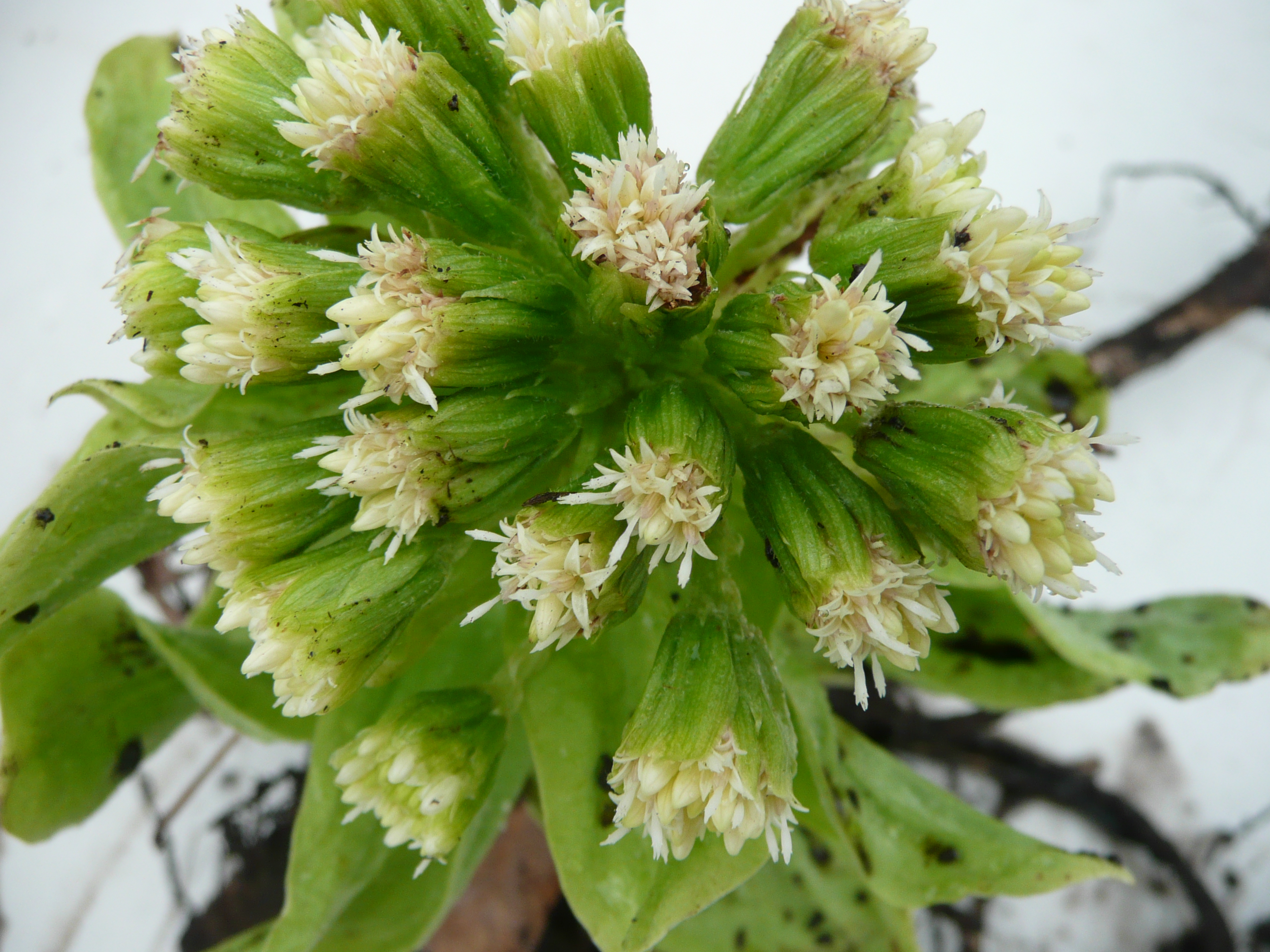
Bloom closeup

Fragrant, yellow-white

Peta-what?  Yes, Petasites.  A very cool plant that you will feel is a star or a stalker in your garden.

I came across this plant by way of  neighboring gardeners, down the road a bit.  I walk by their house a few times a week.  The retired couple living there are always tending to their amazing front gardens.  Every time I see them and their gardens, I get more impressed by their dedication and plantings.

Last year, the woman of the household told me she uses Petasites leaves as an imprint in the birdbaths she makes from a concrete mix.  It is the perfect template because the leaves grow up to 2 to 3 feet in width.  And this is what made me notice the birdbath in the first place on her property.  The sheer size of the leaf is very visible on the bowl of her creations.  So I had asked her, what she was using, and at the time, she didn’t know the name of the plant but promised she would show me its growing habit next spring.

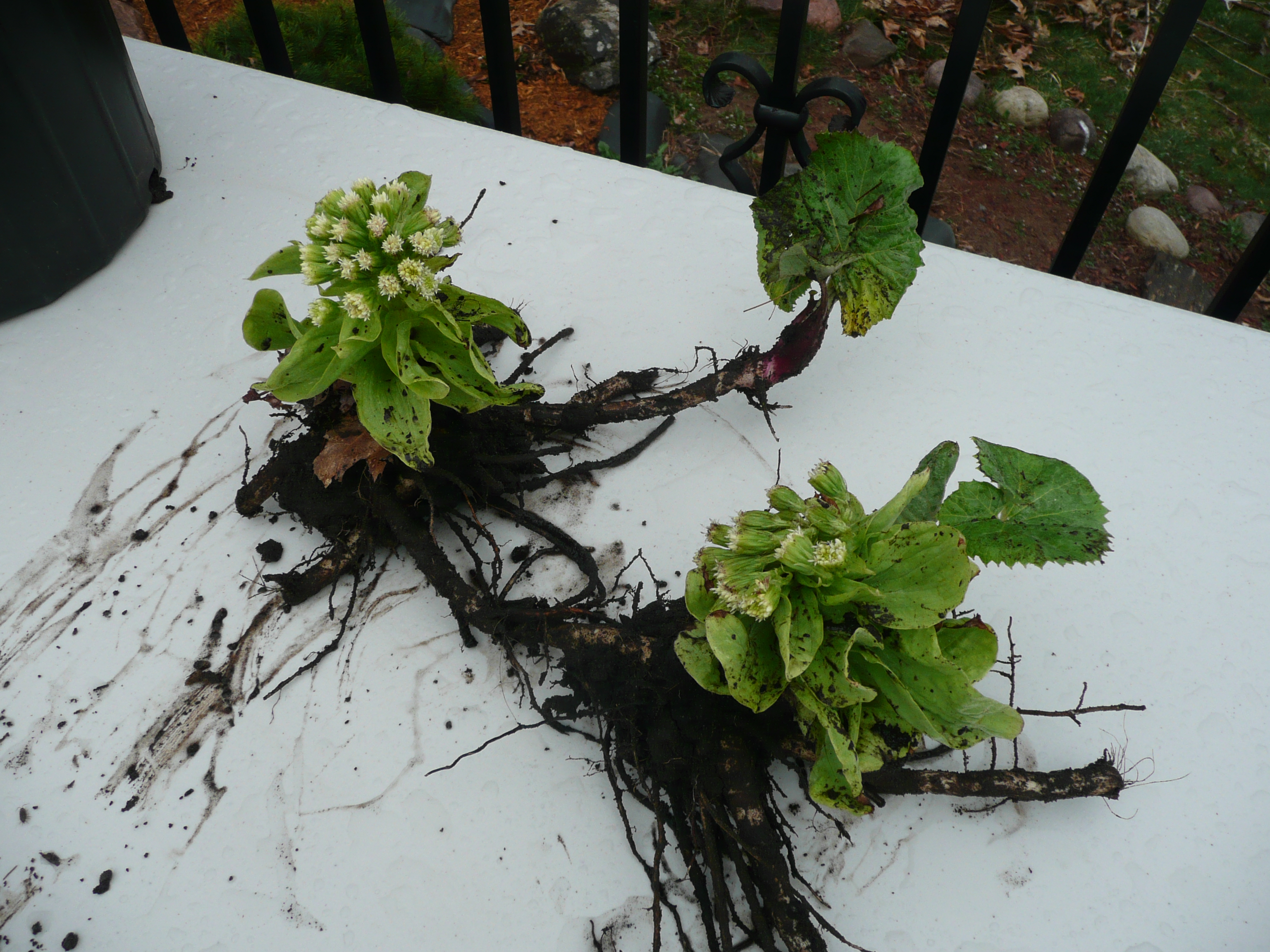
So this year, in April, as I was walking by, the homeowners came out to tell me the plant we discussed last year is now blooming in their backyard woodland area.  They explained the aggressive nature of its spreading habit, via a rhizomatous root system.   As we quickly ventured to see the blooms popping up from the ground, it was apparent how many had reproduced from the original plant.  There must have been 50 to 70 of them in the moist, shady woodland area blooming like little alien pods arising from the ground everywhere.  Fortunately, her husband, the more obsessed gardener of the two, has been serving as the body guard of this plant’s reproduction system by removing clumps every season to keep it in line.  What was once a star in their garden quickly became a stalker.

So we all know, this plant is very aggressive, but not technically invasive, thus I gladly accepted the offer to dig up two clumps to put in my container gardens at home.  Here is the photo I took that morning of the clumps.

Petasites root system

Flower clump first, then foliage arises

You see the yellow to white daisy like flowers that came up first in dense groupings, known as corymbs.  And the rhizome like root structure shoots out a leaf a few inches away.  The flowers are fragrant and kind of odd looking.   I wouldn’t classify them as pretty, but everyone’s taste is different.  And the leaves are not super pretty either, but they become dramatically large within a month or so. After a couple days of transplanting my two clumps into two large pots, the plants started to perk up as the roots took hold.

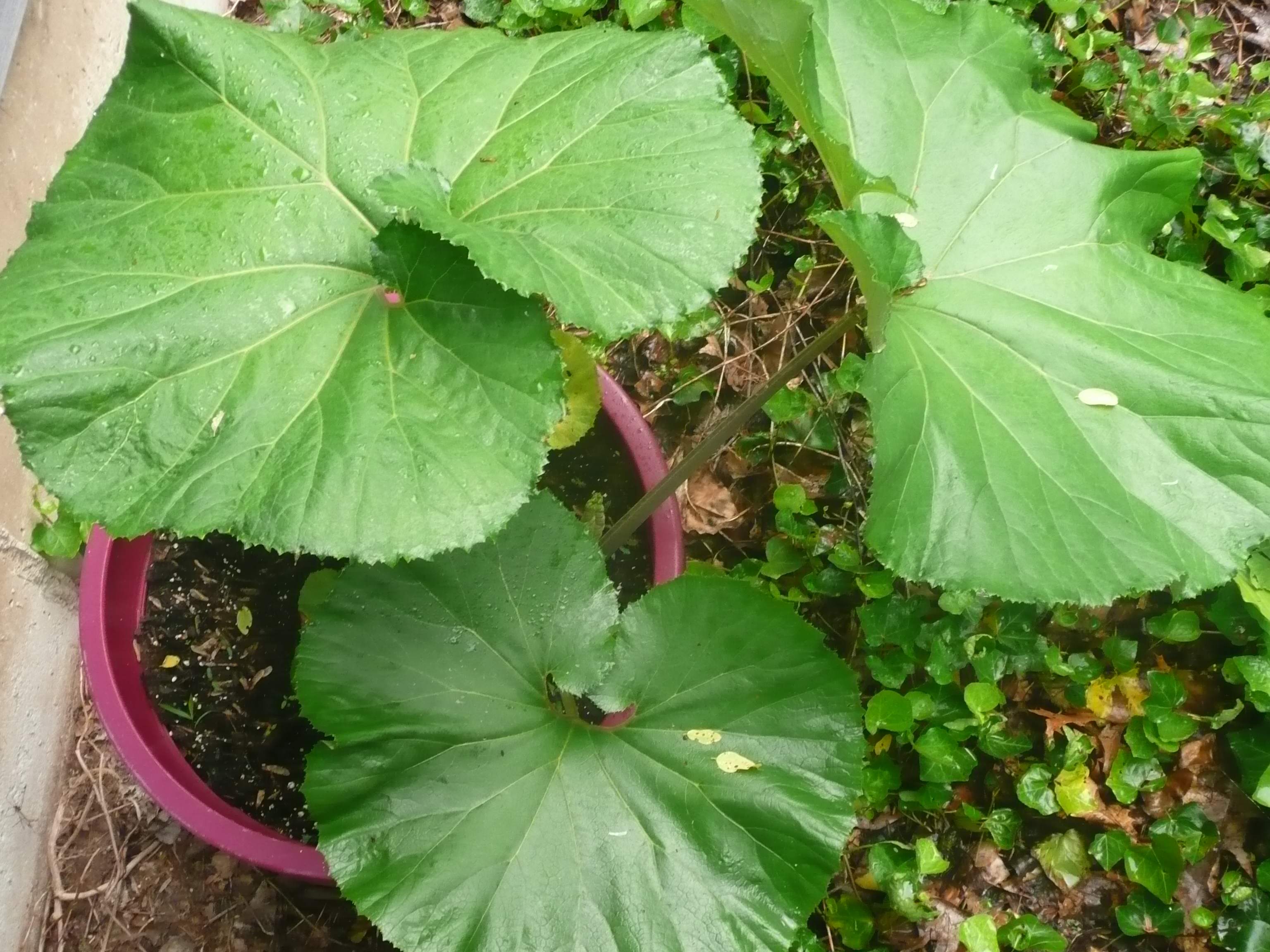
Now, let’s fast forward to June.  The following photos shows how large the leaves have grown.  And as I mentioned, they can reach up to 32” wide.  Super cool for I love foliage more than flowers – not sure why, guess it’s the way this plant’s leaves bob in the wind, reminding me of the tropics, or these in particular remind me of water lilies.  The leaves are very thin, flat and circular in shape.  If they are kissed by the sun, they will droop down and look floppy or wilted, so I pushed the pots even closer to my house facing a northern exposure and they have been super happy ever since in full shade.

Mid June Photo

Petasites

The area there stays moist and cooler too, so I haven’t had to religiously water the containers; they seem to be happy with a watering every few days.  Also, we have had some rain between our hot days so far this summer.

Leaf Above

Petasites leaf

Upon researching this plant further, it was so appropriate to discover this plant’s Genus name comes from the Greek word petasos.  This means “wide-brimmed hat.”   Of course, I thought – this does look like perfect mold or inspiration for a big showy hat for someone like Princess Kate I would say, fitting as super big flashy hat that only royalty could pull off!  So Kate, do you enjoy gardening?  I say have a hat maker fashion your latest hat statement with Petasites as your inspiration!  Or just grow it in a container as I have done.  Okay, the mind is running away here.  Okay, guess a birdbath will do.

Back to the containers…this plant is a star in my book for containers in the shade or by a water feature.  It grows quickly, is showy, and has no serious disease or insect problems.  But on the downside, it must be kept in check if grown in the ground.  And the leaves are only a plain green, but the veins are slightly pinkish and depending on your point of view, very cool.

On a cultural note, the plant enjoys consistently moist to wet soils in part shade to full shade.  So if you have a full shade location, this plant rocks!  The container can be sunken in mud even, if you want to have a water garden effect.  As I said, the circular shape of the leaves remind me of a water lily.

Early June Photo

June photo

Petasites japonicus is known as butterbur – because, as I read further, the leaves were apparently once used to wrap butter in hot weather. (Hmm, interesting, I thought.)  This plant is also referred to as fuki or sweet coltsfoot.  The petioles (stalk of the leaves) are eaten as a vegetable called fuki in Japan.  In fact, its native range is Korea, China, and Japan where it is found growing on wet stream banks in wooded areas.  The stalks grow long and support the leaves above.  I think the stalks look a bit like rhubarb stalks or stems.  Maybe they are in the same family.  This would require more research.

In summary, this plant serves as a vegetable, water garden plant candidate, will naturalize (so beware of this and keep it only where you can control it, like containers!), and has strange alien-like fragrant flowers in spring, and is easy to grow to huge proportions for a large, very showy, extravagant foliage display – fit for a queen …or princess!  It is hardy to zones 5 to 9 and is an herbaceous perennial.  Eventually the whole plant will reach about 3 feet tall by 5 feet wide.

If you think you would like a few, give me a call.  I know where to get them!  Cathy T

Fall Update to This Post:

October is here and I’ve begun the process of overwintering many tropical like plants from my container gardens.  This being my first experience with growing Petasites japonicus (Zones 5-9) in large containers, I started searching on the web to see if I could find any sources on how to overwinter them  in CT.  Granted, they can survive our zone and are very hardy, but they are too aggressive to grow  in the ground, thus a test in containers evolved this year.  I hope to have them return next season.

The leaves by now started to have lots of holes in them due to a slug or some other nuisance insect feasting on them recently.  Almost all the wide leaves had scattered holes in them.  As I began to cut away most of the foliage and stalks, I noticed a bulb like structure at the base of the plants, all plump and full.  “Interesting,” I thought.  “Another new feature to be curious about on this unusual and large showy foliage plant.”

Fall Photo of Base

My plan is to cover the crown of the bulb-like structures with mulch to provide some insulation, and maybe even a big blanket over the top or around the containers themselves.  Then hope for the best.  That bit of insulation will hopefully recreate the insulation of fall leaves in a forest.  And so long as the mice in my shed don’t try to eat any remnants, all should go according to plan. However, if you find or know of anyone who has tried overwintering these plants in containers in our area, please let me know.  I’d love to hear of their experience to ensure success of my trial.  Cathy T

How much is that doggie in the window?

Leave a comment

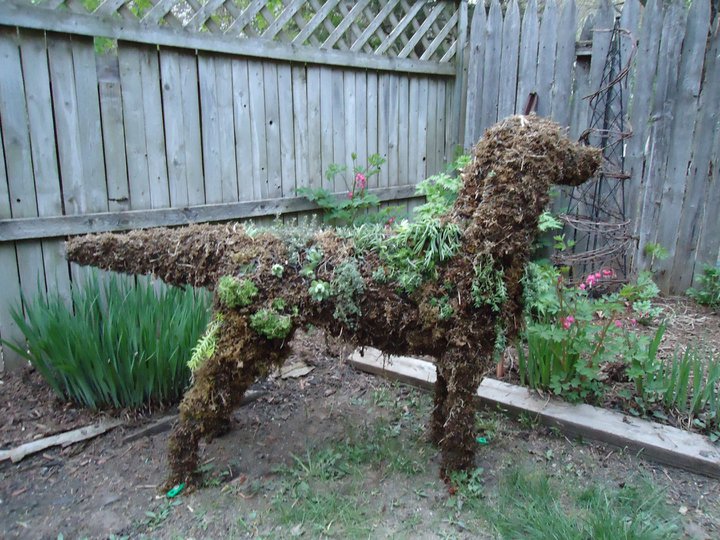
…Or how much is that doggie in the garden!  I love unexpected projects that come my way as a result of being a horticulture person in the gardening business.  Recently a local client recommended me to her mother for planting a life sized dog sculpture made of chicken wire.  Her mother obtained it at a dog show last year.  Both the mother and daughter own and show Irish Setters at events.  This life size dog represents a love of their favorite breed and passion as dog competitors, thus it truly had a personal connection to both the mother and her daughter.

When her mother came by my house, she said she went to a couple nurseries for help on how to plant it but they were too busy to assist at the time.  She tried to grow morning glories on it last year, but it just didn’t work, and she didn’t know what to try next.  I’m so glad she showed up at my door step for help.  I knew I would have much fun working on it, and ideas started to pop in my head right away.  We agreed I would keep her posted on my progress and if I didn’t find the right plants or materials, I would let her know.  But I was optimistic for yes, this is a container project, and I’m Container Crazy Cathy T.

Working with chicken wire forms is time consuming and tricky.  It is no wonder during the spring rush season a nursery person hesitated to take on the project.  And you have to be careful to not damage the plants as you work and also think to include the proper elements in the wire frame to help support the extra weight of the moss, plants, and soil.

I recommend using a sphagnum long-fibered moss which is 100% organic and the perfect filler.  Unlike peat moss or sphagnum peat, both non-renewable resources, sphagnum is harvested from perennial live plants that grow in wild rich marshlands or bogs.  It is renewable because it grows back every several years in the bogs.  Once moistened, it can absorb up to twenty times its weight in water.  Pre-wetting the moss makes it easier to work with and it is a good idea to wear gloves to protect your hands.  If you attempt this process, be sure to not breath or inhale the tiny moss bits that can fly around as you open the bag.

The perennials I selected for this dog container garden project were all full sun lovers, primarily stonecrop sedums and herbs.  Thyme, I have to say, worked extremely well because it is tiny and pliable, easy to move through the wires openings.  One variety I selected was Silver Thyme (Thymus vulgaris).  It has a shrubby growth of tiny leaves edged in silver.  Besides being useful for low borders for herb gardens and flower gardens, and in dog sculptures like this, it is drought tolerant and culinary.  Plus its soft visual appearance makes you want to touch it – or in this case – pet it!  The other variety of thyme I included was Woolly Thyme (Thymus lanuginosus).  It added a contrasting softer texture.  Woolly Thyme has gray green leaves and a hugging habit.  It looks felt fabric like and dainty.  Both plants perked up the next day as if enjoying their new home immediately on the back of the dog.

Other plant candidates used as I continued inserting plants were various small leaved stonecrops Sedums.  These plants were a little trickier to manipulate.  They are pliable also, but very breakable and delicate.  Sedum kamtschaticum, a stonecrop with yellow star shaped blooms in summer, Sedum stoloniferum (Green Stonecrop) with pink blooms, and Sedum album (Worm Grass Sedum) with white blooms were used.  Worm grass is one I’ve used in other projects.  It forms a groundcover matt like habit quickly.  Each of these Sedums, along with some others, will have their showing as the plants take root and grow more on the dog’s body.

Delosperma ice plants were additions as well to the design.  One cultivar, ‘Herbeau’ (or Herbeum) will bloom white aster shaped flowers and the other, ‘Cooperi’, will showoff purple blooms.  Because the foliage of the ice plants is soft and kind of jelly like in feel and movement, they did not break easily and moved nicely through openings as I worked to carefully tease them into place.

So with this combination, the arrangement will showcase yellows, whites, purples, and pinks.  This will be especially showy in future years as the plants progress, take hold, and thrive with the proper care and focus on watering but not over watering.  Moss holds water well, but these plant candidates should not stay wet either, so I  carefully planned to review the appropriate watering routine with the client.

And lastly, I could not resist inserting some baby chicks from Hens-and-Chickens (Sempervivium tectorum) plants.  It will be easy for the client to add additional baby chickens plants by separating the small outer rosettes from a “mother” plant and inserting them as desired in various places on the dog.  They added the perfect finishing touch and are extremely easy to insert into the moss.  They can be used to create a dog collar around the neck too!  The bonus with these plants is as the little baby chickens grow, they create a source for plants to continue filling the life sized dog sculpture without adding an extra expense.  You just have to be a little patient.

During the final part of the assembly, when I attached the dog’s head to the body, I swear I felt it come alive.  I know my cat did too as she stopped dead in her tracks as she walked by me looking up at it.   She paused for a moment to contemplate if it was a real dog.  I had to reassure her it was a garden ornament while chuckling at her behavior.  She took a couple sniffs to investigate then carefully walked away checking her back side to triple assure herself the dog would not chase her.

But a more comical part of this story is pertaining to a stonecrop called Sedum hakonense ‘Chocolate Ball.’  It has a darker chocolate colored tone to its foliage that will turn reddish in the fall, and the texture looks a bit rough, but without any forethought, I ended up inserting it near the dog’s rear area.  Then later, when the client came by with her husband to pick up the finished product, I was suddenly pointing to the dog’s unmentionables area saying with much enthusiasm, “…and this is Chocolate Balls Sedum.”

You cannot imagine the laugher all three of us broke into when I made that comment. It just came out that way as I was describing each of the plant’s features. My face turned bright red, but we laughed through it.  It will surely be a humorous talking point in their garden.  I don’t think they will ever forget the name of that plant, nor the adventure of the dog sculpture.  Ironically the timing of the project arrived right before Mother’s Day weekend too – so being a Mom and Daughter story, it was all the more enjoyable.  Cathy T

Dog at Clients

Photo by Owner

Update:  This photo to the left was taken right after the dog was completed.  Below it is a current photo.  Sent to me in November by my client.  You can see her tall Delphiniums in the corner by the fence behind it – noticeable due to the 6′ high stalks and leaves that are palmately shaped on that perennial, and the purple blooms of the irises are noticeable in the below photo as well.  She called me too to ask how to care for it this winter.

~ This is what she wrote:

Cathy, Thanks so much for planting the great plants in my dog.  I got so many compliments – Maryellen.
Laster in the season

Photo sent in November.  The dog’s plants filled out nicely, and just wait til next year when they grow more…

Caladium ‘Red Flash’

Leave a comment

Foliage for shade is something extremely important because the textural effects add interest to areas that can sometimes be challenging for the unexperienced gardener.  I say “unexperienced” because many newbie gardeners assume shade is just aweful to deal with for plantings, but it is not really.  In fact, I happen to feel some of my best planting combinations are areas of various shady conditions.  It is a matter of knowing the many options for shade loving perennials, trees, shrubs, and even annuals!

First you can start with making sure your shade area has some bulbs for spring blooms, but then focus on showy foliage candidates to help your garden carry its force in the summer to fall months.  Add an occassional annual shade lover, such as Caladium ‘Red Flash’, in your garden bed for more interest.  Or… as you may expect me to recommend…use a Caladium (ka-LAY-dee-um) and other shade annuals in a beautiful container garden to add a focal point or extra character to your shade bed.

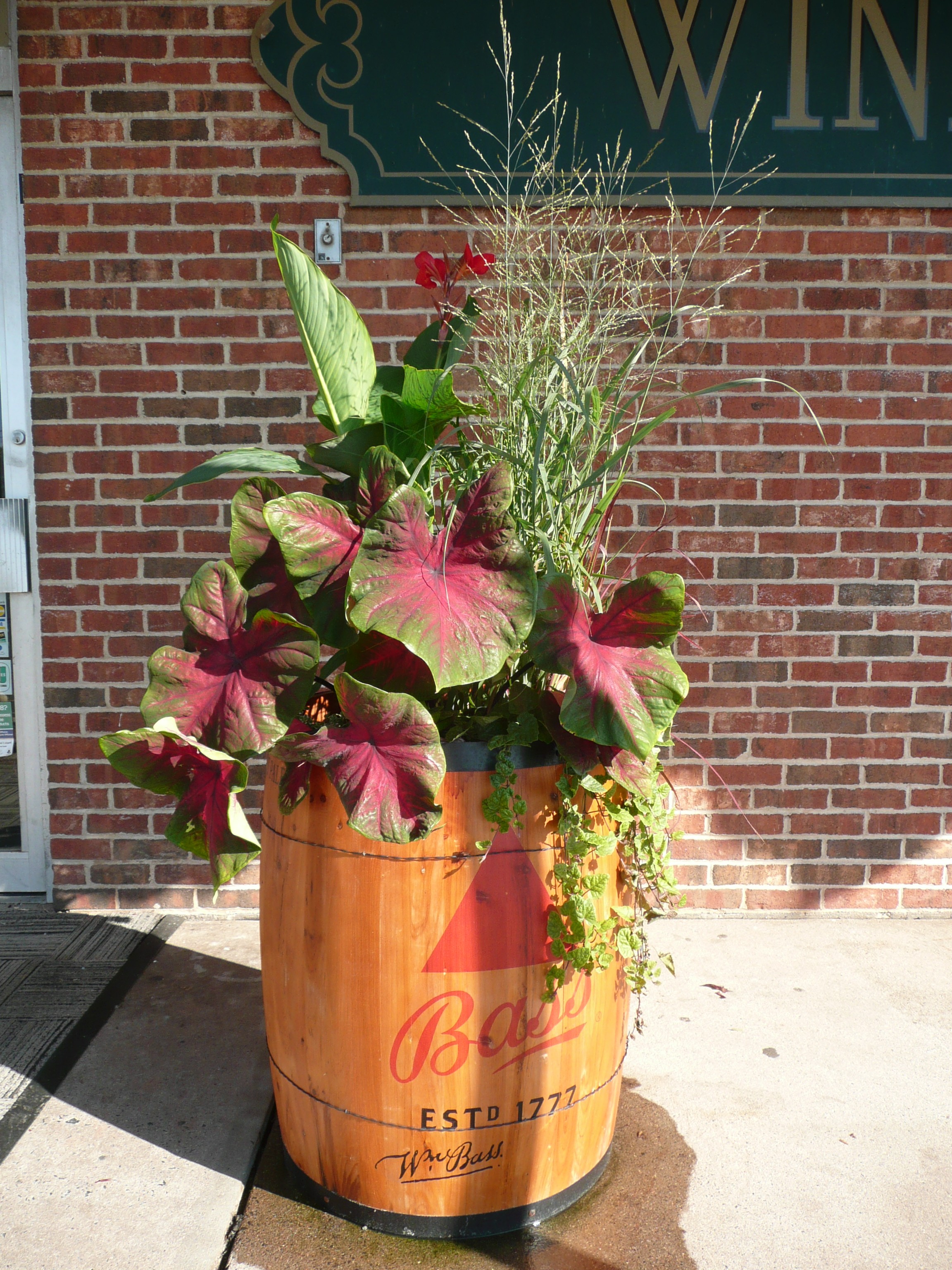
Caladium ‘Red Flash’ is hardy to zones 9-11 so treat it as an annual here in CT.  It is actually, more technically stated, a tuberous perennial.  Caladium is another foliage fav because of its arrow-head shaped leaves, lovely reddish coloring down the center of the leaves, and the blue-green coloring on the outer edge of the leaves.  This year, I used it in a container combination for a business client with wonderful supporting partners as shown in this photo.

Design by Cathy T

You may notice some of the supporting candidates in this designer container garden are part sun-lovers.  Just as in nature, sometimes a canopy exists in container garden areas.  You can not see it in this photo, but there is a building overhang above this container garden offering some shade during some parts of the day.  In nature, a forest of higher trees can create a canopy of shade as well.  As you add shade loving shrubs to your landscape, you offer another layer or level to create rooms and shapes in the space.   Some of these tricks are achievable in container gardens too!

Partial shade are areas which receive about three to six hours of sun a day.  Light shade are on the more dappled side.  Medium shade are areas that get shade only part of the day based on timing of the day and the season as the sunrise or position changes, and full shade is in places where you get very little to no sun.  But who can keep track of all these shade considerations, right?!  Well, you can if you desire, but for container gardens, we know a bit of a repositioning can work if you discover your shady candidates aren’t faring well with just a push of the pot!

The various shade levels or conditions exist for container gardens depending on placement of your container.  For example, shadows cast by buildings or homes or even shadows cast by bigger thriller type plants in your containers can create these environments.  All of these aspects are covered in Cathy T’s Container Garden Parties and classes.  I show you how to take advantage of the shade considerations and not fight them, or fear them!

Other shade tolerant perennials on the list, if you need some help with your shade areas, are:  Alchemilla (Lady’s Mantel), Astilbe, Begonia, Bergenia, Brunnera, Carex (grass), Cimcifuga, Epimedium, Euphorbia, Hakonechloa, Helleborus, Heuchera, Hosta, Lamium, Ligularia, Liriope, Polygonatum, Pulmonaria, Tiarella, Tradescantia, and more!  All of these are, in my eyes, serve as great foliage candidates for various reasons – whether form, height, structure, style, or color.  To learn about shady favorites, when you are ready for help with your garden designs, feel free to contact me.  

And by the way, Caladiums are stored over winter and reused each season – another bonus!  This is another aspect covered in my Container Garden Parties.  I just love this foliage fancied plant and you will too.  There are many cultivars on the market – so be on the look out for them if you have shady conditions for your gardens or container displays at your home.  Cathy T

Phlox Find ‘Intensia Blueberry’

2 Comments

Phlox Find

An intensely rich hot-pink phlox was spotted in a generous soul’s garden.  “This is the only one you can’t take,” he said.  I wasn’t surprised he wouldn’t give it away.  It was a good find. 

Good finds are not always something you can plan ahead on for gardening.  Good finds are usually discovered.  You spot them at the nursery, in someone else’s gardens, or at a garden show display – and you think, “I have to have that plant too!”  That is what makes them a good find.

Phlox ‘Intensia® Blueberry’ is one of those types of good finds I spotted in a grower’s catalog when preparing my plant list order for 2011.  A new introduction, it bears masses of gorgeous, rich purplish blue flowers.  And it has a more upright habit than the typical Intensia Series with a larger leaf size.  Height is 10-12″ tall and width is 8-12″.  ‘Intensia® Blueberry’ is touted as having the same exceptional summer performance and heat tolerance as other Intensia phlox.  Ah the catch?  ‘Intensia ® Blueberry’ is hardy to zones 10-11 (warmer zones than CT’s).  However, this phlox will be a great container garden addition during the summer season.

As Stephanie Cohen (known author of perennial books, such as “The Perennial Gardener’s Design Primer”) once stated during a perennial review at a conference, new is not always better.  This is true.  New finds have been tested by growers and such, but the ultimate test is in your own gardens.  So you may want to proceed with caution with new finds, but sometimes that process is worth it. 

Phlox paniculata ‘David’ is one of my stand-by favorites because it is a resistant form to powdery mildew (white mold affecting tissue, causing leaf distortion and defoliation).  Because of this resistant trait, I often recommend ‘David’ to beginning gardeners.  However, ‘David’ is a white bloomer.  To me, it can be a little boring unless you are into white in your garden or container gardens. 

One of the more flashy fun colors is displayed on the pin-wheel pattern of blooms on Phlox ‘Peppermint Twist’.  It has pink and white spoked patterns on the flower petals.  It looks a bit more festive, and also has been touted as having a strong tolerance to powdery mildew.  There’s Phlox paniculata ‘Nicky’ with deep purple flowers.  Phlox glaberrima ‘Triple Play’ with variegated foliage where the center of the leave is dark green and edges are whiter with sun.  Flowers are pink-lavender.  And Phlox paniculata ‘Starfire’ with bright red flowers – also a catchy potential candidate.

David Culp, a sales representative of a grower and a speaker of perennials, announced the following phlox as “Promising Perennials” during a presentation last month:  Phlox ‘Blue Elf’ (also mentioned in year 2010; a dwarf woodland phlox, shorter with more buds), Phlox stolonifera ‘Margie’ (a creeping phlox with laveder flowers and purple eye), Phlox divaricata ‘Charles Ricardo’ (A new color for woodland phlox, lavendar, creeps like a groundcover; also mentioned in 2010, from England, taller), Phlox divaracita ‘Manita’ (has evergreen foliage, white flowers, indigo iceyblue eye bloom), Phlox ‘Montrose Tricolor’ (green/gray foliage), and Phlox divaracita ‘Mary Ellen’ (blue with lavender eye).

To learn more about good finds, contact me, Cathy T!

A Seat Cushion ‘Euphorbia polychroma’

2 Comments

Euphorbia polychroma (Cushion Spurge) is a plant that can awaken spring.  I can’t remember where I discovered it, but I planted it in a garden bed I’ve been frustrated with because of the clay in the soil.  I should have investigated the soil contents more before adventuring into creating a bed in this area, but my temptation to use the space was overpowering at the time.  On the plus side, this lead me to testing plants that do well in clay, and this one thrives in this spot (although care instructions indicate good drainage for this plant).  Perhaps the fact the soil is well-drained because it is on a hill and the balance of the clay moisture holding capacity below the soil provides a counteracted effect.  Whatever the reason, it does well in full sun and in my clay-ish bed. Go figure!

This perennial is excellent for use in mixed borders or even cutting gardens.  It grows fast too, reaching a height of about 12-15″ and width of 18″.  But what I love about this plant the most is the intensity of the yellow bloom color completely covering the cushion habit atop its rich green foliage.  It is alike a ball of sunshine in your garden bed.  It is practically – well, you know – Euphoric!

The form keeps it shape too, perfectly symmetrical and fluffy.  Good enough to provide a cushion seat!  (Not really, but you know what I mean!).  The other aspect I enjoy about this particular Euphorbia species is the unusual style of the flowers clusted at the top.  In fact, the greenish flowers are unisexual.  They have no petals or sepals and this is probably why they look different compared to typical flowers. (See the photo gallery below).

If you are seeking an April to May bloomer in your garden with a bright yellow bloom, this is the plant.  Plus it is deer resistant too.   If you find the plant gets a little too large, it is okay to shear it back by one-third to shape it after it finishes flowering.  Also, if you have a really fertile garden, unlike my clay bed, this plant can be a bit aggressive, so shearing it before flowering removes potential seeds.  It doesn’t get affected by serious diseases and insects and is perfect for zones 4-8.  And one last note, there is a milky white sap that can seep or ooze out of the plant when cut so if you are allergic to these things, wear gloves for protection.  Cathy T