My Monster Cement Planter

9 Comments

Jimmy, my brother, installs stamped concrete walkways, so I finally asked him to do one outside my basement door. Then I told him how I’d like to have him build me a huge planter box below the deck. I gabbed about how cement is so popular these days, even running inside to show him photos from a Martha Stewart magazine issue showing cement outdoor tables and more.  Anyhow, he knows I get nutty about these dreams of mine, but he said we could do it.  He agreed on my dimensions, and the cement planter resulted in a 5 x 10 size.

After it was completed, which was last fall, I filled it with the soil from my disassembled container gardens from that season. It was perfect because the cement planter is below my deck, so it was easy to dump the soil into it from above. Plus, I was recycling my soil.  Then I put a big plywood board over it for the winter. It ended up serving as a useful table during my winter Kissing Ball and Evergreen Creations class.

My Monster Cement Planter

My Monster Cement Planter

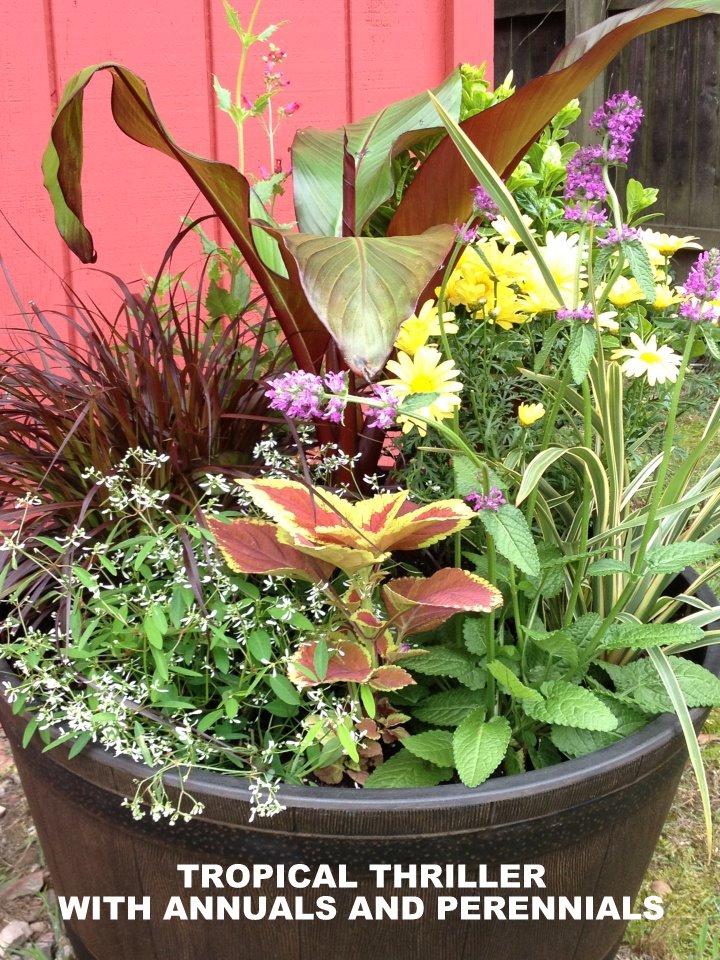
Alas, it came time to plant it this year. First, of course, was my red banana plant, as the thriller. I imagined the leaves would pop up to the deck railing levels by summer.  As of today, the leaves are 52″ long.  Yup, I measured it.  In warmer zones, the Ensete red banana can reach 12′ tall.  In prior years, this tropical plant, Ensete ventricosum ‘Maurelii’ has grown tall in my patio pots and containers, reaching probably 5-6 feet tall, but never has it grown as wide and large as it has in my cement planter.

The thriller is Ensete red banana with fillers of elephant ears

The thriller is Ensete red banana with fillers of elephant ears

The red banana plants features are thrilling to me because its large reddish leaves grow fast from a thick trunk base. The leaves come up like rolled cigars which is appealing. Then they quickly unroll to show a big tropical look. This tropical plant is hardy to zones 9-10 so I had stored the base carefully last fall to reuse as an annual here in CT.

Watering the red banana and its companion plants was no problem either. I just showered them from above when I walked around with my light weight garden hose to do the pots on my deck.  The only trouble experienced was the bothersome Japanese beetles earlier in the summer munching on the leaves. Cutting off the unsightly leaves was the solution for more would arise.
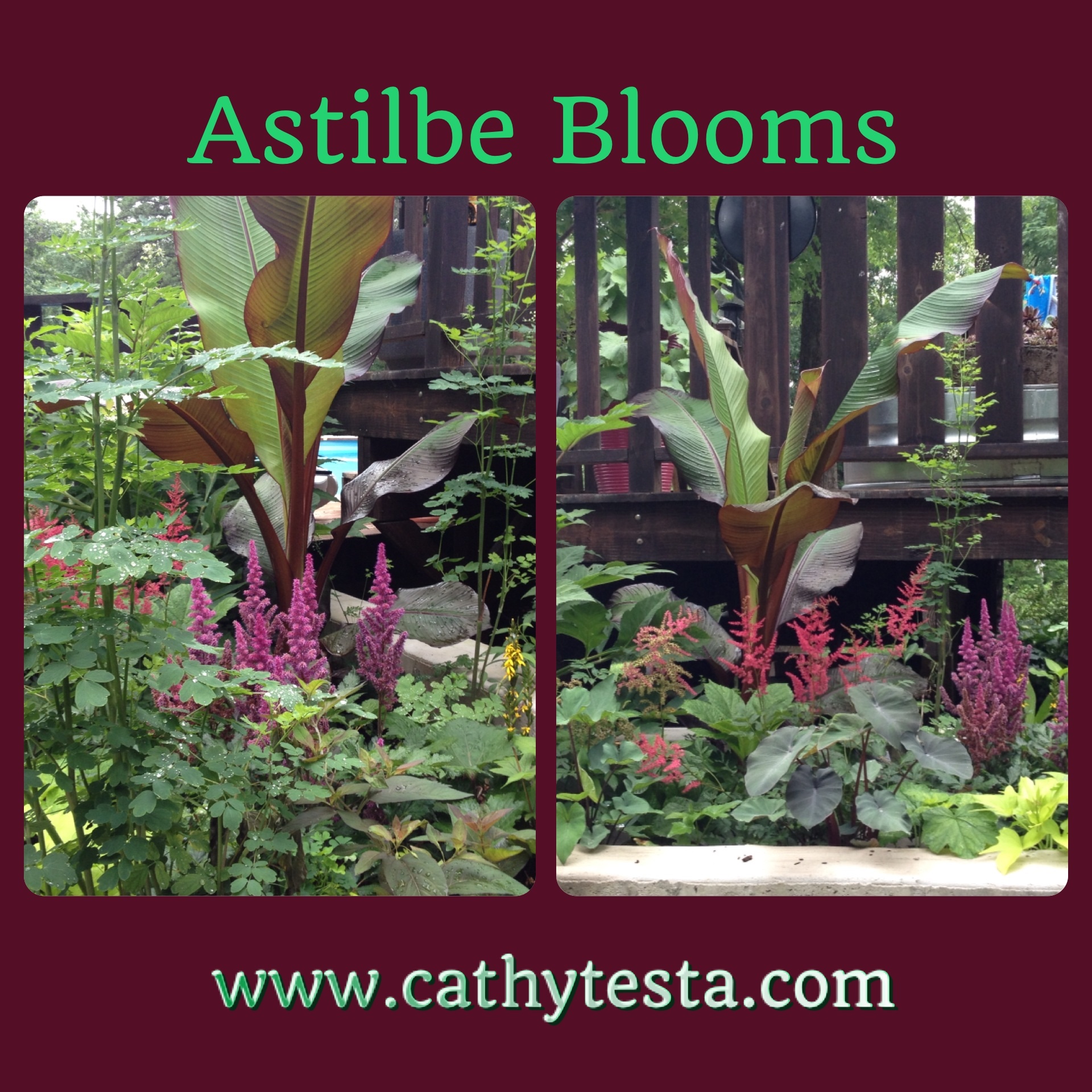
Astilbe perennial blooms

Astilbe perennial blooms

In the beginning of the season, Astilbe perennials bloomed red and pinks. They put on a bloom show for a while. And they will return every year. I also added several types of elephant ears from my stored specimens, which included the Colocasia esculenta ‘Maui Magic’ and Colocasia esculenta ‘Tea Cup.’

Tucked around were elephant ears

Tucked around were elephant ears

‘Maui Magic’ elephant ears are a fav. Its purplish stems and large leaves in a clump are spectacular. ‘Tea Cup’ elephant ears have cupped leaves. Water droplets sit in the center and bobble around as a breeze comes by, or my cat. My cats like to lick the droplets sometimes, and once I found one cat sleeping under the plants in this planter. They were reaping the benefits of cool shade from the large red banana plant’s leaves and the elephant ears, plus the monster cement planter is in a quiet location where they can rest or sleep.
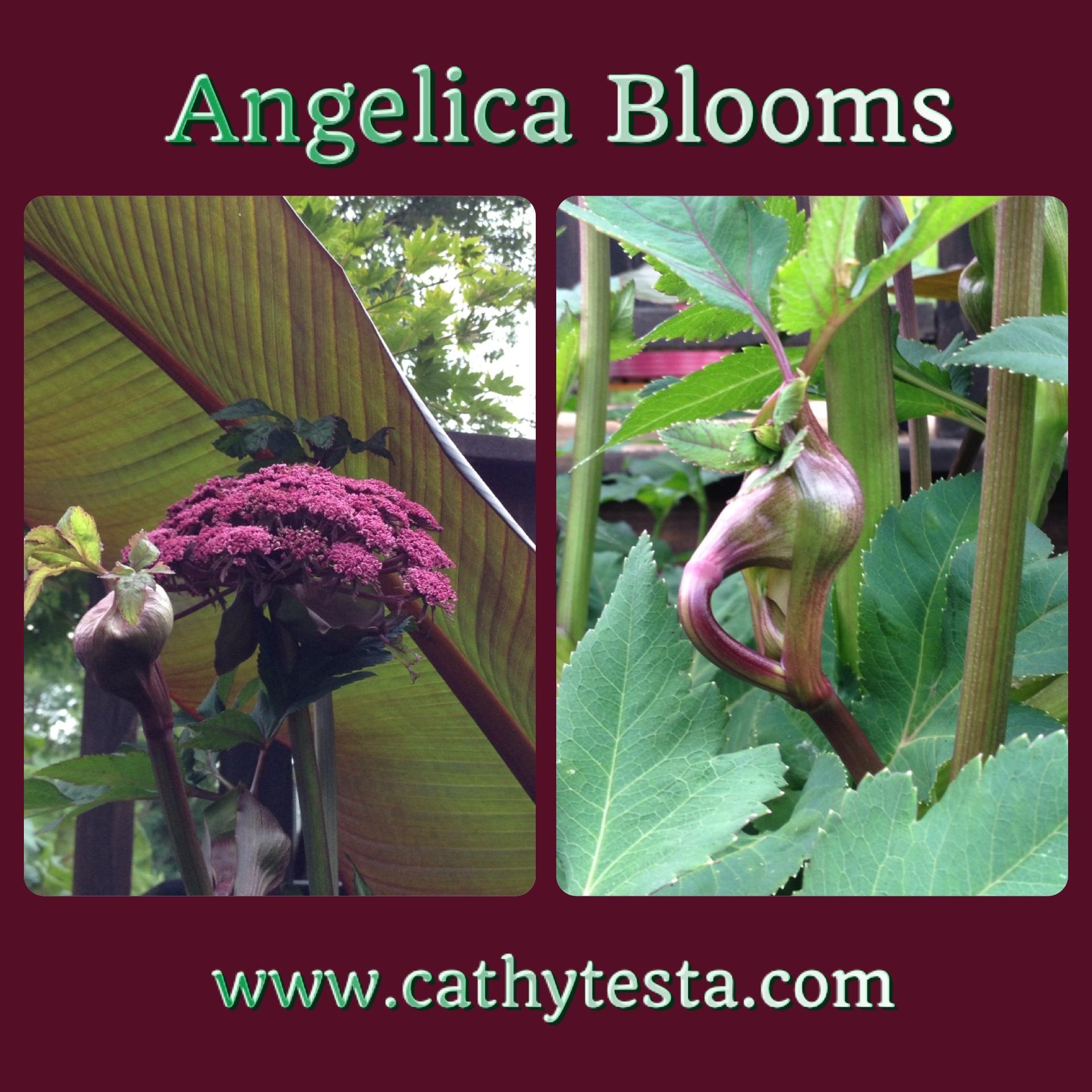
A biennial plant starts with pods

A biennial plant starts with pods

Another plant added was Angelica, selected because it has unusual looking flowers. It is a biennial, and also has large foliage resembling giant parsley. The blooms, shaped like pods, first arrived mid summer and are open now. Bees are really enjoying them. I was excited about this plant too because it grows very tall, up to 5-8 feet.  The deep plum flowers are a nice color combo next to the reddish banana leaves.

Planter filled lushly

Planter filled lushly

Next to bloom will be the pink Turtlehead perennial. Latin name is Chelone lyonii. This will bloom any day now, and more bees will follow. I had this perennial in a pot last year, and loved it. Its a late summer bloomer, and will continue until early fall, plus it also gets large.  Its on the left corner with dark green leaves, dense, and packed in nicely. It likes consistently moist soils, and so does the Angelica and tropicals in this monster cement planter.

There are other beauties in the planter, such as Rodgersia pinnata and Thalictrum aquilegifolium (Columbine Meadow Rue).  The Meadow Rue is the only perennial relocated from a former garden mowed down. It gets very tall, 2-3 feet, and has wispy pale tiny flowers in late spring to early summer. It has more of a woodland feel but the height factor made it a companion. And of course, no container garden would be complete without a spiller, sweet potatoe vine on the corner.

Red banana leaves arise rolled up

Red banana leaves arise rolled up

Planting this monster cement planter has been easy and a joy. No bending to the ground, or weeding. They can not get in practically, not just because the plantings are full, but the height of the planter helps to prevent them from creeping in. I’d rather plant hundreds of these types of large cement planters over gardens in the ground any day. Now if I could just convince my brother to build me more!

written by Cathy Testa

The thriller is Ensete red banana with fillers of elephant ears

The thriller is Ensete red banana with fillers of elephant ears

Container Gardens in the City

3 Comments

A very good place to see large, bold, and lush container gardens, window boxes, and even green roofs — providing you can get high enough– is the city. Makes perfect sense because there is very little, to no soil or ground space in front or behind private homes, and if there’s a secret garden in a courtyard, it may not be visible to the person walking by.

So as I walked the streets of Boston, Massachusetts recently, I took photos of some beautiful planters spotted in various locations such as Beacon Hill and near the Prudential building.  Whether maintained by a lucky city dweller, or business owner, all that were seen on my journeys were very healthy and impressive.

Maybe with no space for gardens, owners take more time to water the containers filled with lush plants because they don’t have a garden to tend. Whatever the reason, it is a special treat to the city visitor taking notice, and perhaps the only method to add color, foliage, and flowers to the tight spaces in the city.

Beacon Hill Window Boxes

Beacon Hill Window Boxes

No visit is complete without walking the historic Beacon Hill area. Lots of gorgeous window boxes

Prudential building

Prudential building

These by the Prudential were huge!  You can see tropicals are popular in the city.

Beacon Hill Window Box

Beacon Hill Window Box

XCambridge by a restaurant

Cambridge by a restaurant
East Cambridge outside a business building

East Cambridge outside a business building

Near Kendall Square

Near Kendall Square

Canna plants with Mandevillas. And other tropicals. My style. Large and lush.

East Cambridge

East Cambridge

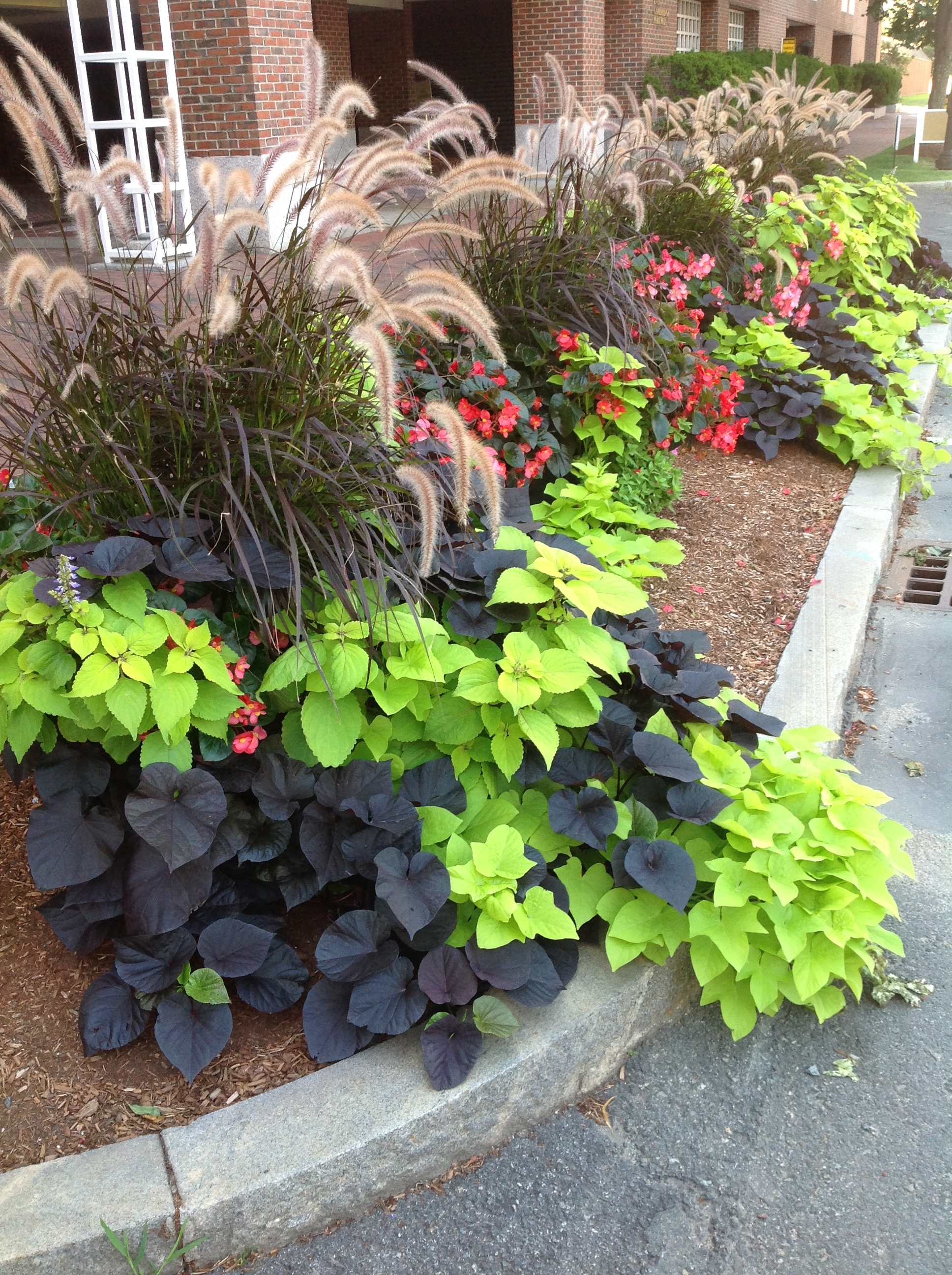
Pennisetum grasses with sweet potato vines full and trailing. Just abundant for the street side.

Close up

Close up

Begonias can take the heat well as seen here

Near Kendall Square

Near Kendall Square

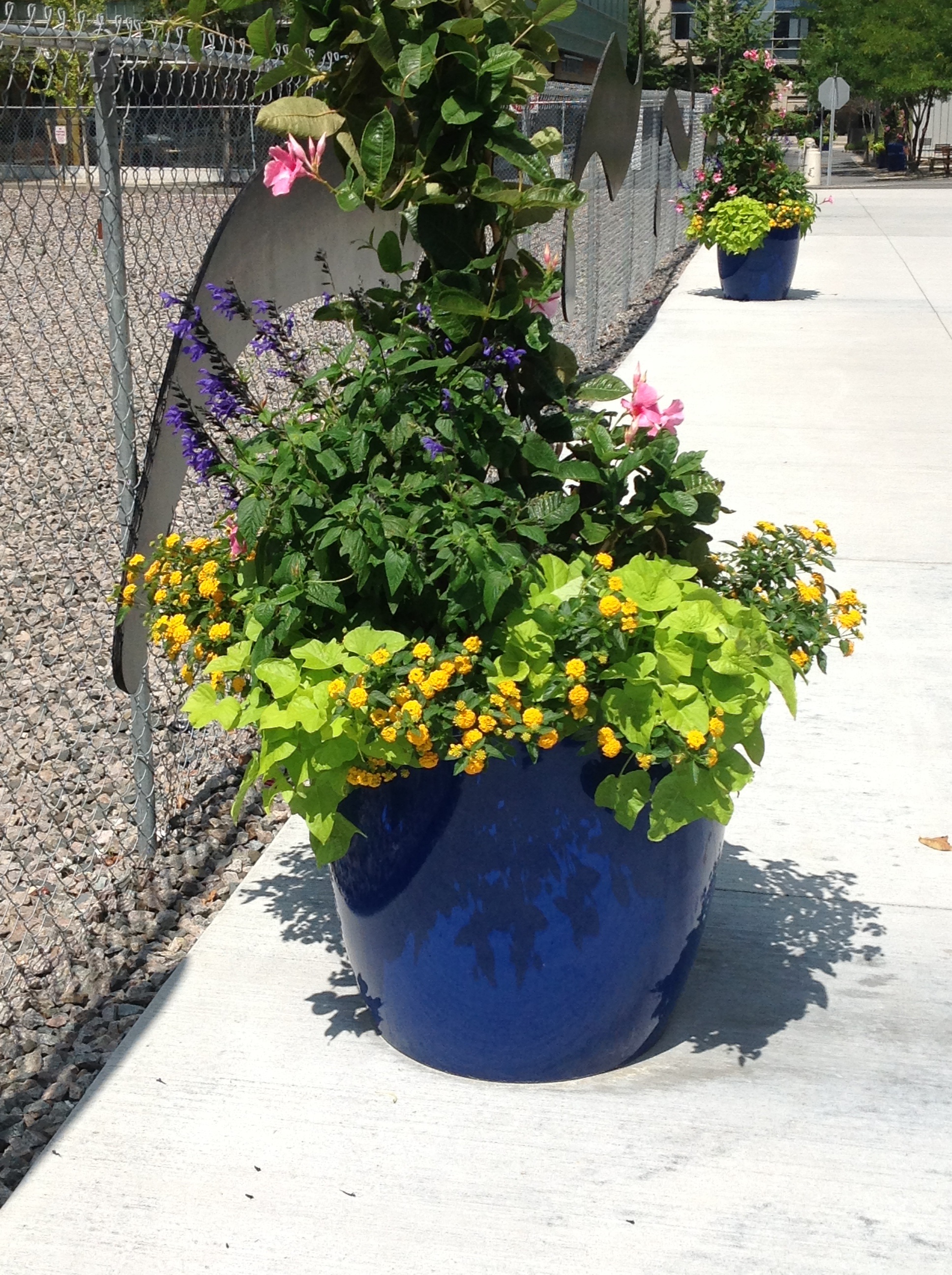
Huge blue pots add vivid punch to the combo of plants here. Not just one pot, but many along this walkway area.

By bz

By bz

Simple but again, healthy and adding movement with the tall thriller, and spiller sweet potatoe vine.

These were just the few i captured. I would write more but working on my Ipad to post is a lttle tricky. Will update with plant names in a later revision. For now, enjoy and let these be some inspiration for the large and showy containers in your environment.

Written by Cathy Testa

A Lamb’s Ear Perennial with a Different Look and Feel – Say Hello to ‘Hummelo’

3 Comments
Butterfly visits in Early July

Butterfly visits in Early July

Stachys monieri ‘Hummelo’ is a perennial I spotted for the first time a couple seasons ago.  Because of its tall blooms, I decided to include it in a whiskey barrel container garden, and thought it worked well when going for a naturalistic theme because it has a soft color to its blooms and the stalks are tall, rising upwards like you would see in a meadow.

'Hummelo' in a Container Garden

‘Hummelo’ in a Container Garden

If you like the cottage garden look, or a perennial with the power to attract bees and butterflies for a long period of time, you need to say, “Hello” to ‘Hummelo’ – A lamb’s ear perennial with a different look and feel.

The color of the blooms, violet to a soft purple, and the shape of the two-lipped flowers, similar to the perennial, Catmint (Nepeta), have a welcoming appeal.

Because of this, I decided to plant two in front of my border by a Knockout Rose this year, and the plant’s habit and characteristics have impressed me since.

Despite our bouts of harsh weather this season in Connecticut, such as hail storms, strong winds, and heavy rainfalls, this plant has not bent, cracked, or toppled.

And the flowers, rising 18-24″ tall on strong, 4-angled stems above the low-growing clump of soft green wrinkled leaves, have been blooming continuously since early June.

It has a long season of bloom, expected to last to the end of August or early September, and it is a butterfly and bee magnet.

Lamb's Ear Perennial

Lamb’s Ear Perennial

However, what makes this lamb’s ear perennial different is the look and feel to the leaves, which are not like the typical species known to gardeners, Stachys byzantina, where the leaves are fuzzy and woolly, soft to the touch.

Foliage on Lamb's Ear

Foliage on Lamb’s Ear

‘Hummelo’ has wrinkled and wavy leaves.  The texture gives it some interest but I find the color of the leaves a little dull – just your basic plain, soft-green, so what you place near and around it should be considered.  You may want to find other perennials with a darker green foliage color, and pair up the beautiful violet blooms of ‘Hummelo’ with other monochromatic colors in the pink and purple tones, along with some contrasting coarse colors and textures.

Lamb's Ear Blooms

Lamb’s Ear Blooms

Some companion candidates for Stachys monieri ‘Hummelo’ are:

Baptisia australis (False Indigo) has tall darker purple blooms on tall flower spikes, as compared to Hummelo’s bloom color, and its foliage is a bit darker green.  It will end its bloom period around the time ‘Hummelo’ begins, but the dark seed pods will add interest later in the season.  Place it behind ‘Hummelo’ to add impact and height.  It can reach shrub size, and is great at the back of a border in full sun to part sun locations.  And it also has a “naturalized” look, similar to ‘Hummelo’ – plus it was the 2010 Perennial Plant of the Year.

For a dramatic effect next to ‘Hummelo’, try a tropical Colocasia esculenta ‘Maui Magic’ (Elephant Ear).  Its large, coarse and wide foliage with dark purple tones on the leaves and stems will be a great way to add contrast against the soft greens of ‘Hummelo.’  This gets large, so position it where it won’t eat (hide) the ‘Hummelo’ perennial, but pop near it.  The purple stems on this elephant ear will look great with the violet blooms of ‘Hummelo’ – and the soft green foliage of ‘Hummelo’ will pop against the dark tone of the elephant ear.

Supports Pollinators

Supports Pollinators

Incorporating some soft silvers in a more sunny location, such as Artemisia (Wormwood) is a good color to add.  I prefer Artemisia schmidtiana ‘Silver Mound’ with its soft airy foliage and dome shape, with lower stature than ‘Hummelo.’  This plant likes full sun and well-drained soils.

Another darker purple bloom color that would look great as a contrast to the softer violet blooms is Centaurea montana ‘Black Sprite’ (cornflower) with almost black-purple flowers blooming in July to August and reaching about 14″ tall.  The spidery like bloom structures is intriguing and would also pick up the darker purple colors of the Elephant Ear noted above.  It can take full to part sun locations.

Pronounced STAKE-IS (Click HERE to hear), Stachys monieri ‘Hummelo’ is a relatively unknown plant, great as an edger in garden borders, filler in container gardens, and provides a uniformed, sturdy look, and it is a “workhorse” because it has long-lasting blooms and strong upright stems.  And, it can survive under walnut trees.  This plant is a member of the mint family, so be aware it can spread, and often looks good massed or as a ground cover planting.  However, if used in a container garden, it is not a trouble marker, but a star – where you won’t have the spreading concern.

If you decide to use Stachys monieri ‘Hummelo’ as a ground cover, you may want to consider including some Ajuga reptans ‘Burgundy Glow’ for the foliage on this low perennial, also great as a ground cover, has soft pink and violet tones to it.  Put it in-front, and be aware it is mostly known as a shade to part-shade plant, but can take sun with moisture.

Lamb's Ear, Stachys monieri 'Hummelo'

Lamb’s Ear, Stachys monieri ‘Hummelo’

Stachys monieri ‘Hummelo’ is a Zone 4-8 perennial, prefers Full Sun, and is a great addition to your gardens and container gardens.  Some references spell it monnieri with two n’s on the species name.  It is also known as Betony.  Click HERE to read a “Comparative Study of Cultivated Stachys,” by the Chicago Botanic Garden, where you can learn lots more technical details about this plant and its relatives.

Cathy Testa
Container Crazy Cathy T
http://www.cathytesta.com
(860) 977-9473
containercathy@gmail.com

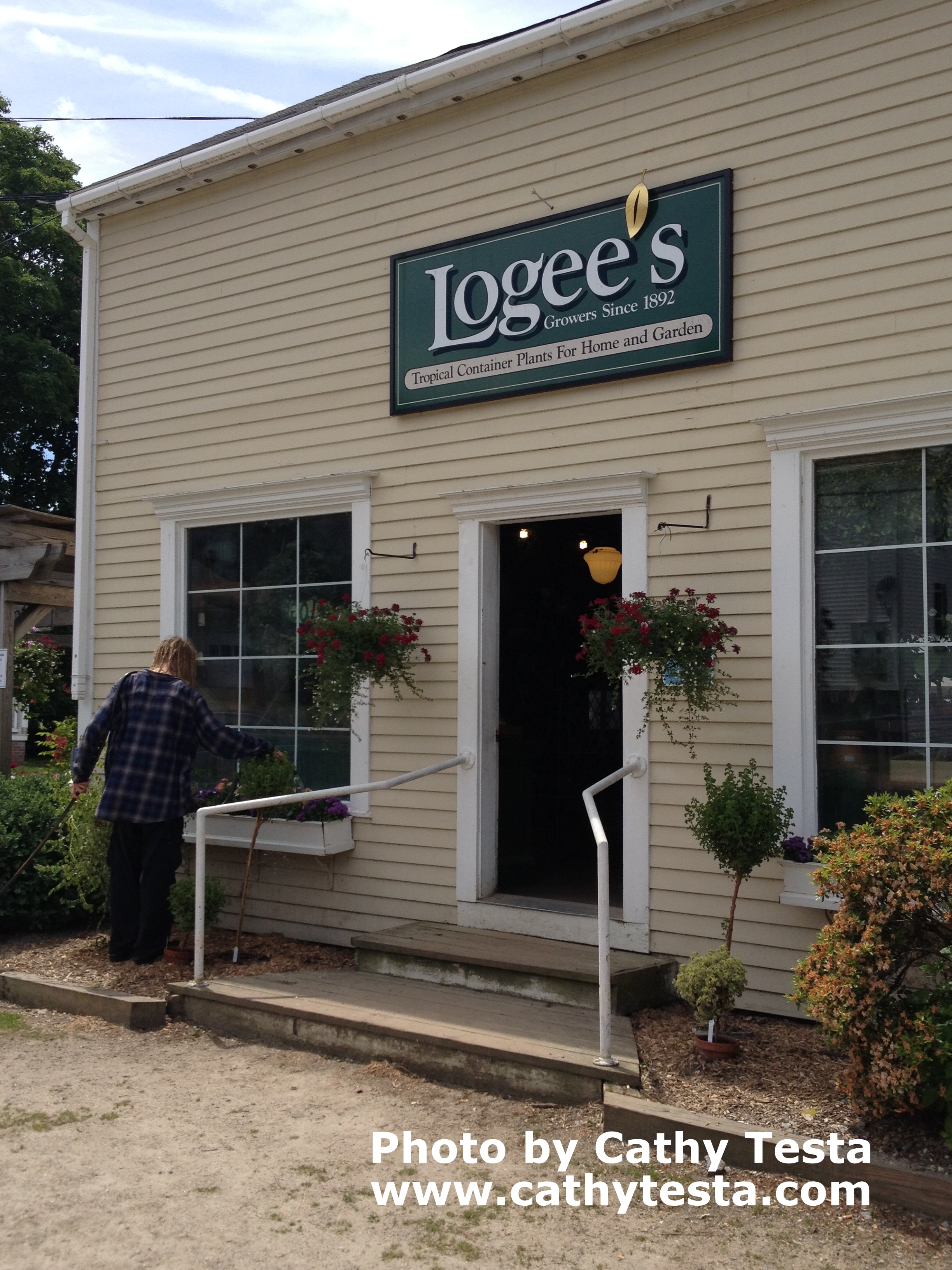
For a mystical and eclectic plant mix, visit Logee’s in Danielson, CT

6 Comments
Logee's Growers, Danielson, CT

Logee’s Growers, Danielson, CT

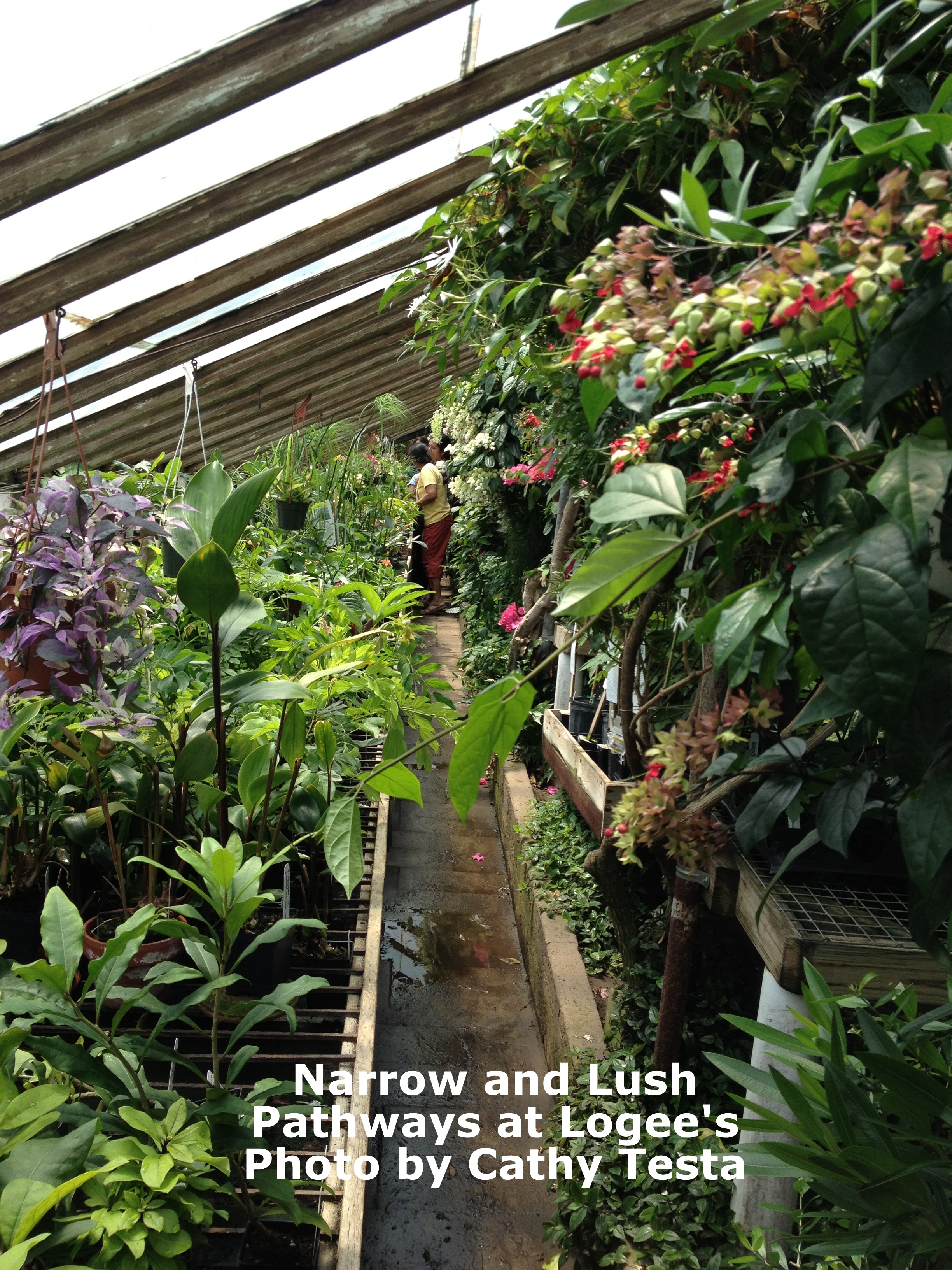
When you enter Logee’s greenhouses in Danielson, CT you may want to make sure you do not suffer from claustrophobia because there is a jungle like atmosphere in this grower’s world unlike the traditional environment of a nursery.

As you enter the first greenhouse down some rickety old steps, you have to decide, do I go left or right?  And depending on what you see down the narrow corridor between plants, you may opt to take a detour.

The aisles are so lush with plantings on all sides and vines are dripping from the greenhouse ceilings above, only one person can pass through at a time.  You sometimes have to take the “high road” as one employee called it by stepping up to a side connecting pathway to allow other plant enthusiasts to pass by.

In my case, a group of very gabby women were coming towards my direction up the pathway, so I took the high road and stepped up to wait for them to go by in single file. They noticed I was admiring a papaya plant, and one lady (apparently the leader of this group) commented the plant has healing powers, where you can take the plants’ leaves and wrap them around your legs to sooth wounds, or something like that.  She had a bit of an accent so I wasn’t sure what exactly she said, but it was obvious her group was super charged about the abundant offerings of fruiting and fragrant tropical plants at this unique plant destination.  And I was too, I couldn’t wait to adventure more.

Logee's Greenhouse

Logee’s Greenhouse

I put the papaya plant back down, and contemplated returning to look at it again later, knowing I would have to browse the entire greenhouse and adjacent house before I would decided on the plants to take home.  And it would be a tough decision.  Logee’s has a large selection of many interesting plants.  And you have to look carefully – as in “up, down, and all around” to make sure you don’t miss something intriguing, plus walking in there can be a little tricky.  Let’s just say, it is not for the dainty feet, for there are some water spots and ruts along the way, all representing the 121 years of service this location has offered for the plant hobbyists falling into the ‘untamed’ category.

Dripping from the Ceilings

Dripping from the Ceilings

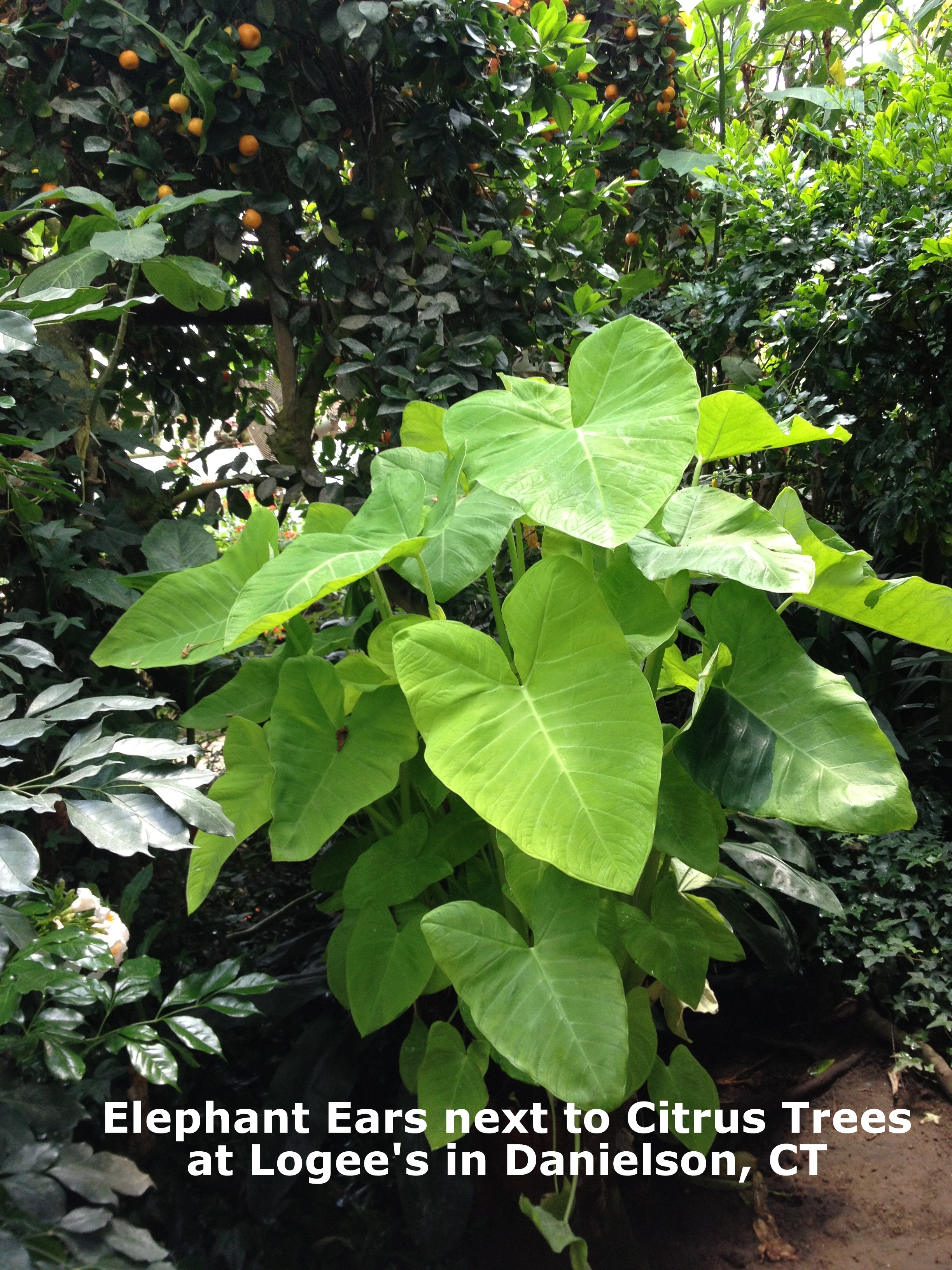
The greenhouses are permanent homes to many large, mature plants growing in and around the shelves of smaller, starter plants for sale.  The mature plants growing there reminds me of plants you see in conservatories, and they give you a sense of what is to come should you buy and grow a plant available at Logee’s. For example, a Golden Trumpet with rich, dark green leaves covered one area of the ceiling and was in full bloom.  There were also Clematis, Bougainvillea, Pink Power Puff, and Chinese Lantern plants suspended all around – plus many more.

Allamanda cathartica in bloom

Allamanda cathartica in bloom

You can feel, smell, see, and sense the history of this long-standing establishment, and the mix of plants – at least to me – represent the mix of the plant passions behind their offerings by a family with apparently as much diversity as their selections at Logee’s. As a large poster will tell you in the check out area, the founder’s son had a passion for begonias, his daughter for herbs and scented geraniums and her son’s passion for fragrant tropicals and fruiting container plants expanded Logee’s world into the full jungle it is today.

Bowiea volubilis

Bowiea volubilis

A comical sight to me was a big Climbing Onion situated right next to an old telephone. The plants here intermingle with the walls, equipment, and surroundings so much, it almost has an eerie feeling to it – as if the place has horticultural ghosts from the past wandering in the spaces and structure’s crevasses. If you are fortunate enough (or unfortunate depending how you look at it) to be alone in the greenhouse, you may get spooked by one of them tapping on your shoulder, but as you turn around, it will be disguised as a vine brushing up against you.  Funny how they can reach out that way.

“There is something mystical about Logee’s. The mix of plants is as eclectic as the diversity of personalities I’m sure grew this place into a destination worth visiting.”

Photo by Cathy Testa

Photo by Cathy Testa

Not only has Logee’s experienced diversity from a chain of generations, it survived a hurricane, blizzard, and energy crisis.  When I read the place was once heated with 50 cord of wood, I said, “wow” out loud.  But somehow, I imagined how enjoyable that may be for a plant lover, perhaps for the short term.  The buildings and plants housed within Logee’s have survived it all.  They have a lemon tree there, a showcase of the facility, at the ripe age of 113.  It’s been there almost as long as the business of 121 years.  I took a picture of the massive tree and its big green lemons, but decided to not post it here – I didn’t want to give away all the treasures – for you should make the trek out there sometime if you haven’t done so already.  This place has lasted a long time – one has to wonder – how many more years will we get to enjoy it?  I’m sure the plants in there will last longer than some of us.

Logee’s is located at 141 North Street, Danielson, CT.  Their website is www.logees.com where you can easily view their plant availability and more information, but going out to the grower’s location is something worth doing.  An adjacent rural town is Pomfret which has some local artisans and quaint shops to visit along the way.  Stop for some good food at “Pizza 101” at 16A Mashamoquet Road, Pomfret Center before or after your trip.  They have great sandwiches, grinders, salads, and yes, pizza there. Make a day trip of it because it is a long drive from at least my location – and perhaps your’s but the country roads are enjoyable if you have the time.

My first papaya plant, 'Red Lady'

My first papaya plant, ‘Red Lady’

And yes, I did buy that papaya plant I first saw when I arrived at Logee’s.  The funny part about this ending is the very nice young lady at the register offered a couple Logee’s magazines to me.  I grabbed three.  As I sat down eating my lunch after this trip, the 2013 issue shows a Babaco Papaya (Vasconceliea x heilbornii) as their featured plant on their latest catalog cover.  It is described as a superb, fruiting container plant that tolerates cool weather much better than the standard papaya.  As the owners Byron Martin and Laurelynn Martin further write on the inside cover, “You can grow this delicious fruit even if you’re a northern gardener.”  So I got a papaya, and they featured a papaya – not exactly the same cultivar, but its ironic, isn’t it?  I ended up with a papaya – to add to my fruiting collection this year. The one that lady told me had healing powers.

Cathy Testa
Container Crazy Cathy T
http://www.cathytesta.com
860-977-9473

Can u guess what this is?

Can u guess what this is?

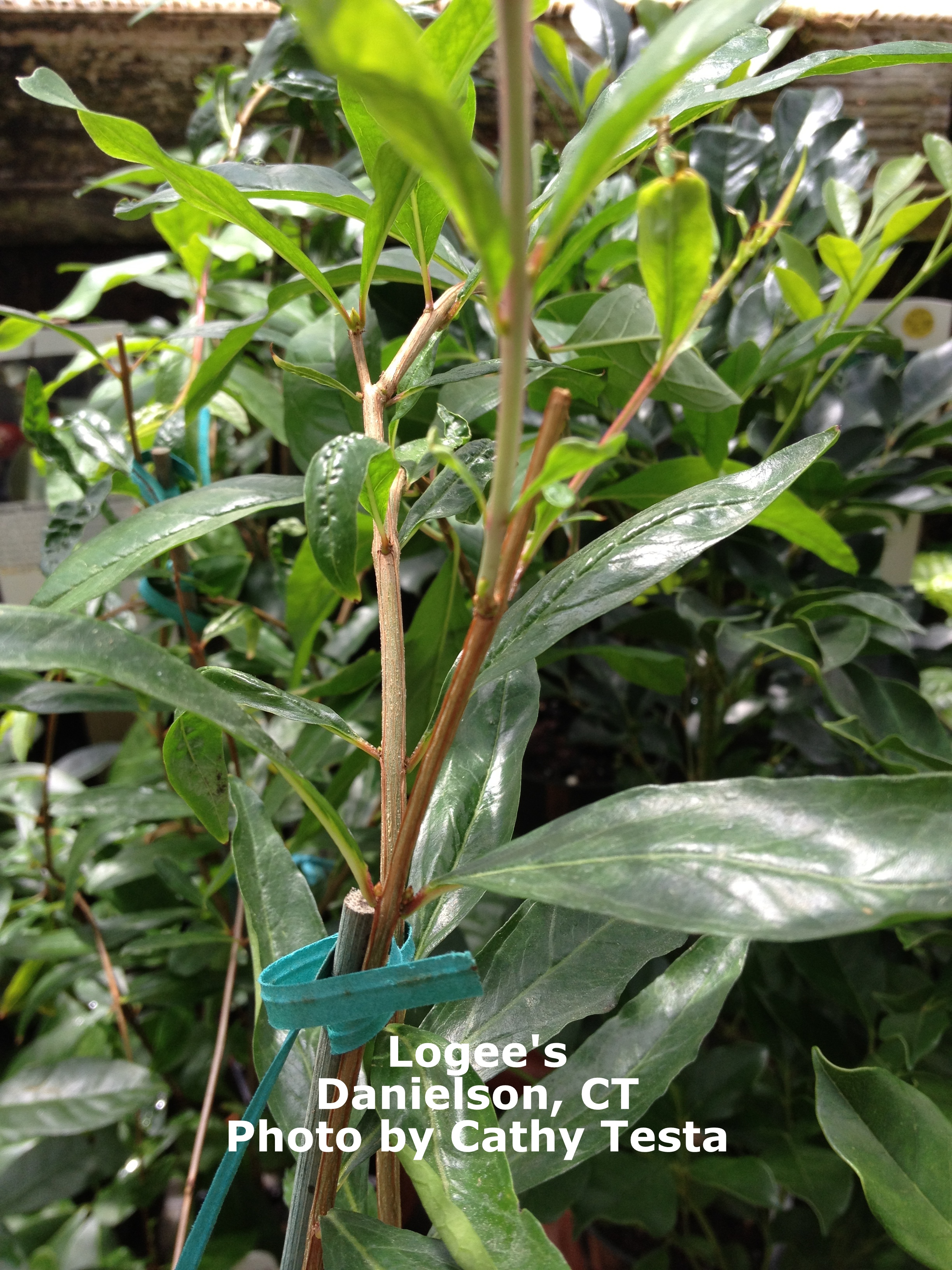
Can you guess what this plant is at Logee’s?  A Pomegranate!  (Oh and I bought a Megaskepasma erythrochlamys,…I got to go research that mouth full.  The photo of the bloom attracted me to it.)

Crystal Ball Captures More than the Beauty of Flowers

Leave a comment
Class Attendees

Class Attendees

Photography for me is about capturing data at times.  I take photos at clients’ properties during my onsite evaluations for landscape and garden designs.  Sometimes, I will take at least 100 photos of a site while walking around, looking over their desired planting areas.  It is important to me to get every angle, and to record any problem areas – or potential design features spotted on the property or in the space. I also take photos of plants when visiting wholesale and retail nurseries for my plant research.  You can ask the garden center staff.  They will tell you I always have a camera in hand.

But I also enjoy photography as a “non-serious” hobby – what I mean is, I like to take photos of plants because I love them so much, especially up close to see the botanical aspects, from the stamen (male parts) to stigma (female parts) of the flower’s reproductive aspects. And of course, I like to take photos of butterflies, insects, and birds.  Sometimes, I’ll get a comment from a real photographer, a pro, saying a shot is good, but my photos are never anywhere near those taken by pro’s.  Again – I do it for fun – and like to keep it that way, but I should learn the techniques to improve.

DSCN2819

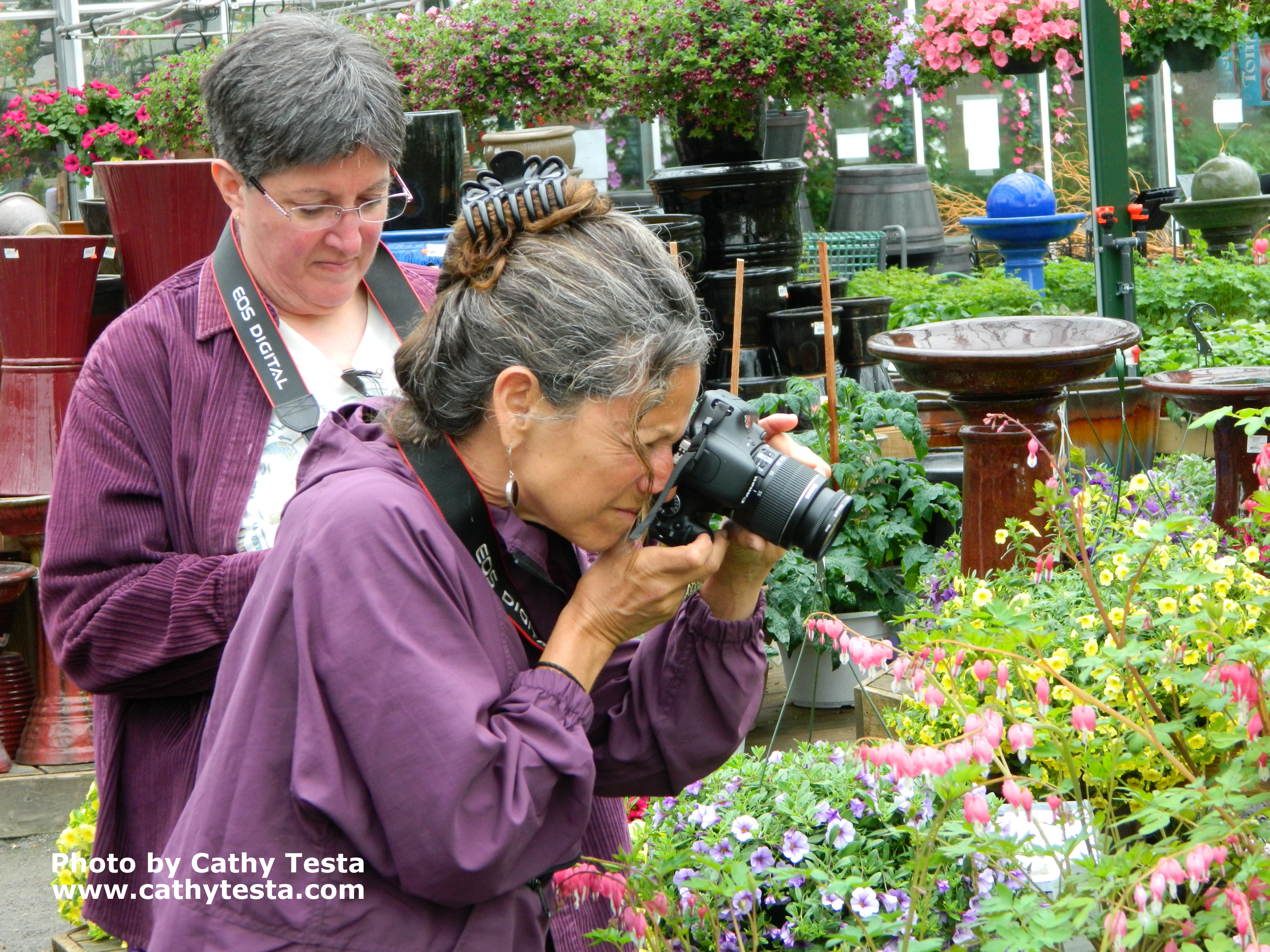
So when I met my class group for a guest speaker on photography yesterday, they found it a bit comical when I mentioned I had not yet taken out the components (like filters and cleaners) for my new camera out of the packages. I’ve owned the camera for a couple years now.  It is not a super fancy camera, but it is a good one.  I’ve played around with it more than taken the time to learn it.

However, yesterday, I got the chance, and what fun did we have.  We had a small group of attendees because the class, called “Capturing the Beauty of Flowers,”  was held in the morning of a weekday at a local garden center, where there were flowers a plenty.  And by the way, I heard loud and clear from my friends and past class attendees – they want a session held in the evenings so they can attend – so we will do that – on May 29th, Wednesday, 5:30 to 7:30 pm (flyer to be posted soon).  Note the date now.

Catherine Cella of Joyful Reflections Photography was my guest speaker.  It was an honor for me to have her show us her tips on how to maximize taking photos of flowers. There were some techniques I had never considered, demonstrated by Catherine, and we practiced as a group.  She then offered us advise on how to improve the shot.  But one of the best parts of the whole day is she taught us how to use a crystal ball to capture photos.  Any my favorite photo of the day is this one, I took, where the greenhouse roof is reflected in the ball.  Later I thought, is the Crystal Ball revealing my future?  I hope so (you know, I’m a dreamer).

My shot - love the greenhouse in it!

My shot – love the greenhouse in it!

Well, let me restate favorite, actually my favorite photos of the day, were those posted by Catherine Cella after class.  You can see them here on her blog at Joyful Reflections Photography Blog.

But before we got to the crystal ball photography part of the class, we practiced on flowers.  This is a shrimp plant, Justicia brandegeana.  A tropical plant I just adore, and so did another attendee in our class with a horticulture background. It is a little too early still to put out tropical types requiring heat and warmth – think of them like summer vegetable gardening — wait until Memorial Day to put them outside, but they can be enjoyed inside in the meantime as a gorgeous house plant.  This one was trained as a topiary – a real beauty and find, I must say.  Hummingbirds truly enjoy this flower on this shrub.  The flower is the white part extending out of the pink bracts.  This would be stunning in an urn with the style of this one being trained as a topiary.

DSCN2814

Trained as a Topiary - Shrimp Plant

Trained as a Topiary – Shrimp Plant

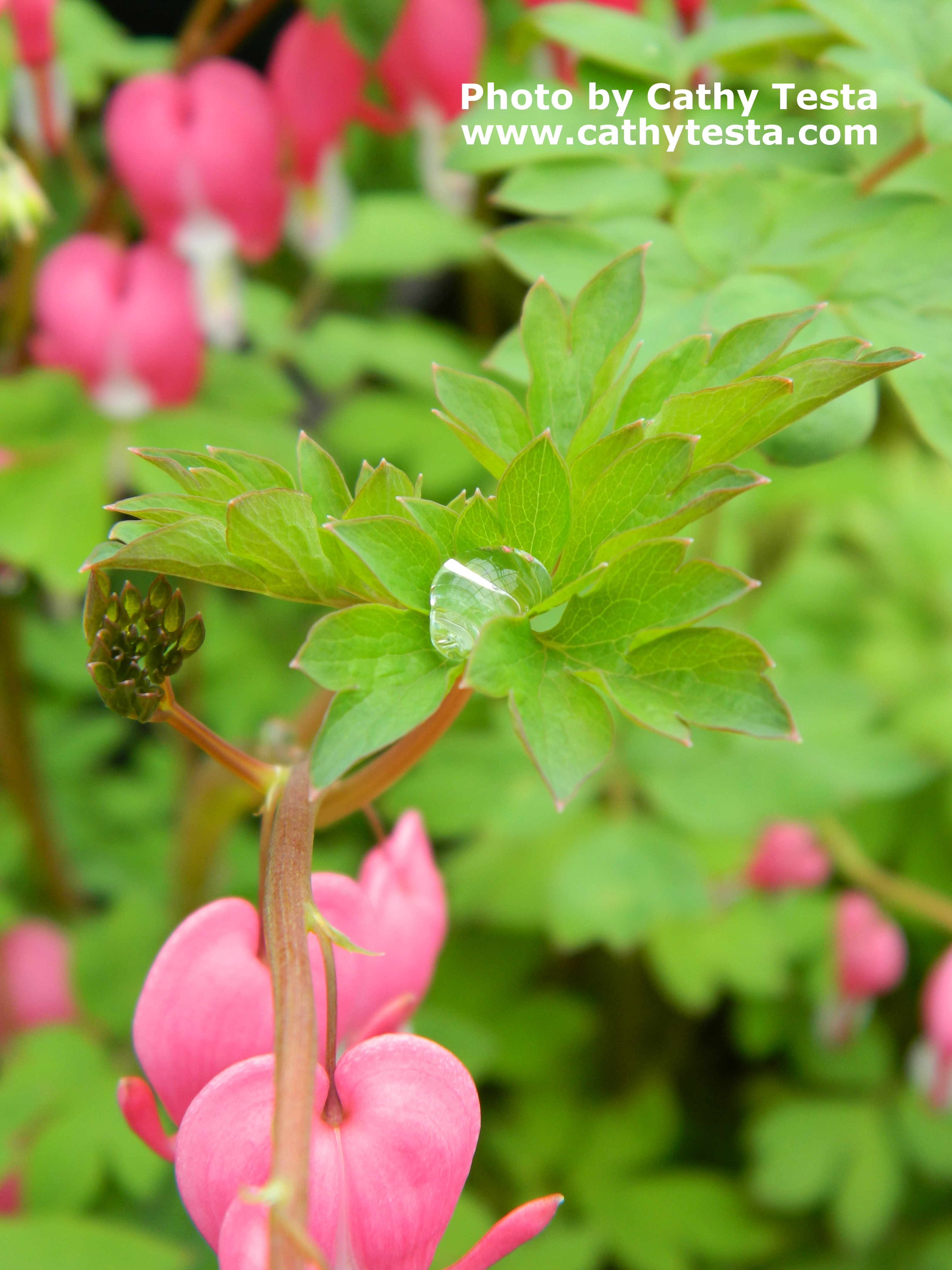
We also took close-ups of water droplets on plants, and here is one I took on a bleeding heart.  It actually worked out the day was cloudy and just a tad bit rainy.  Gosh don’t we all love this plant in the springtime when it flushes out in our gardens?  Whether you love the Old Fashioned Bleeding Hearts or newer types with golden foliage, you can’t disagree with nature’s ability to capture our hearts with the rose-pink flowers on fern-like foliage dangling like charms from its stems in May.  This perennial looks amazing alone in a garden or mixed with other shade candidates like Astilbe, Pulmonaria, Hostas, and ferns – just to name a few.  However, I don’t recommend them in container gardens because they go dormant later in the season and kind of fade away.

Droplet on Bleeding Heart Leaves

Droplet on Bleeding Heart Leaves

The other two attendees had way more background on the camera’s technical aspects that moi, and they were practicing the tips reviewed by Catherine Cella.  My suggestion was to take photos of the flowering trees at our class location – The Garden Barn Nursery and Landscape in Vernon, CT.  There were many breathtaking blooms of magnolias, redbuds, dogwoods, and others in bloom now.

Here’s a photo I had to take of a Redbud tree, Cercis reniformis ‘Oklahoma’.  Talk about an intense purple wine color.  The coloring is more intense than the species on this small ornamental tree, great for smaller spaces.  It blooms in the spring, April to May timeframe, and the buds line the stems before the leaves expand.  It looks Asian to me, and has the most welcoming feeling in a garden space.

Redbud Tree Buds

Redbud Tree Buds

And I had to try to get a cool picture of one of my favorite ornamental grasses called Hakonechloa macra ‘Aureola’.  It can take partial shade and has a bright yellow color with a green stripes on the blades, and it cascades downward, versus growing upright. It is a beautiful plant to use in the front of a border, along pathways or by a terrace situation, or even in a container garden as a spiller to filler type plant.  The plant is a long-season ornamental grass, and won the 2009 Perennial Plant of the Year award. Looks great near Weeping Japanse Maples too – why? because the gold of the grass shows up against the burgundy color of the maple.

Hakon grass 'Aureola'

Hakon grass ‘Aureola’

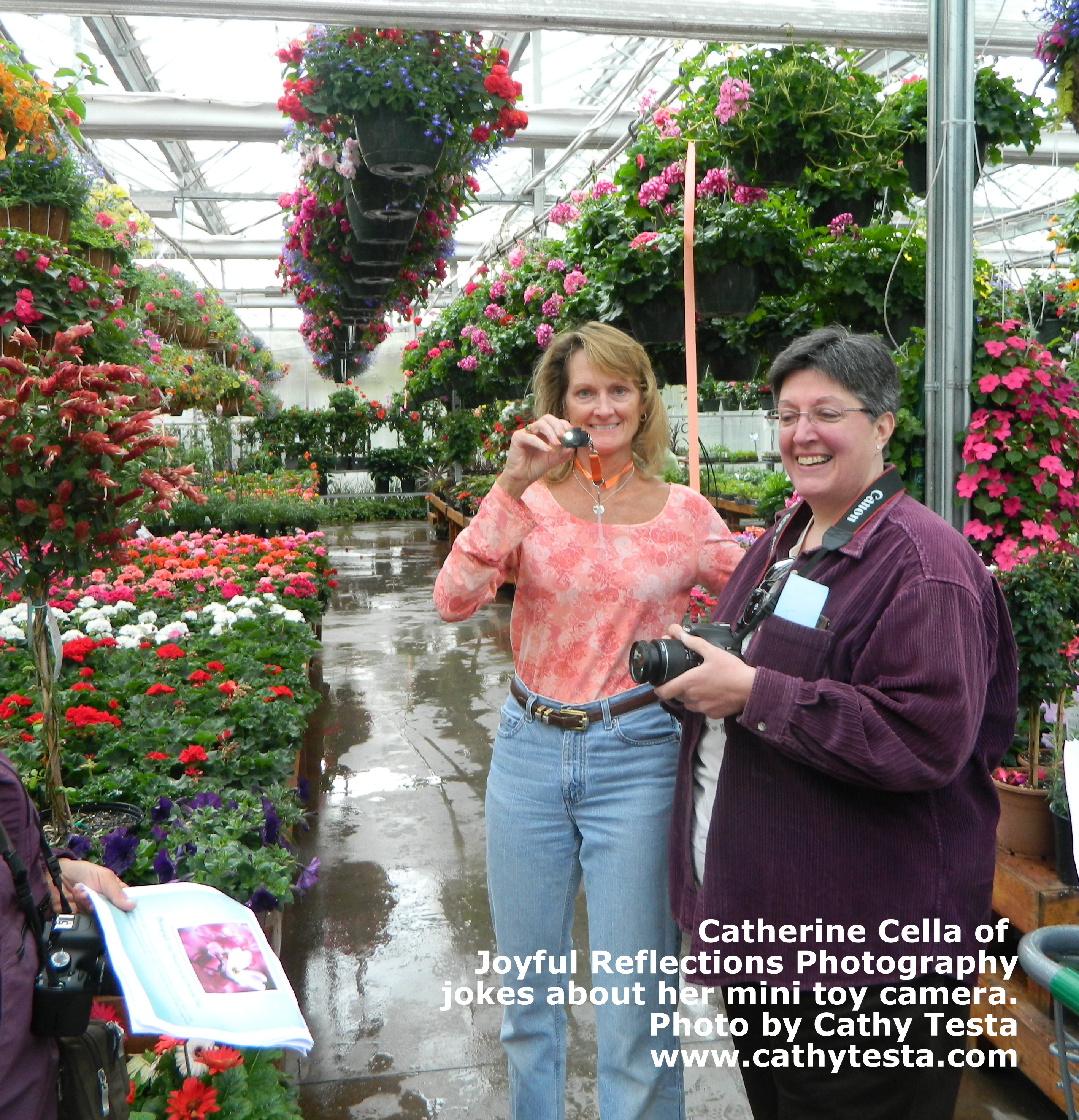
Early in the day, Catherine joked around with a tiny toy camera hanging from her neck – it even flashes.  But rest assured, her professional camera is quite impressive – and so are her talents –  which you will see and learn from when you sign up for the next session on May 29th, Wednesday, 5:30 to 7:30 pm.  Bring your camera and your dreams – so you too can Capture the Beauty of Flowers and the images you desire in your crystal ball of the future.  The next class is only 2.5 weeks away.

Catherine holding a toy camera - as a joke of course, with attendee Jo-Anne.

Catherine holding a toy camera – as a joke of course, with attendee Jo-Anne.

Looking forward to seeing you there,

Cathy Testa
Container Crazy Cathy T
http://www.cathytesta.com
860-977-9473
containercathy@gmail.com

Is it too early to plant?

2 Comments
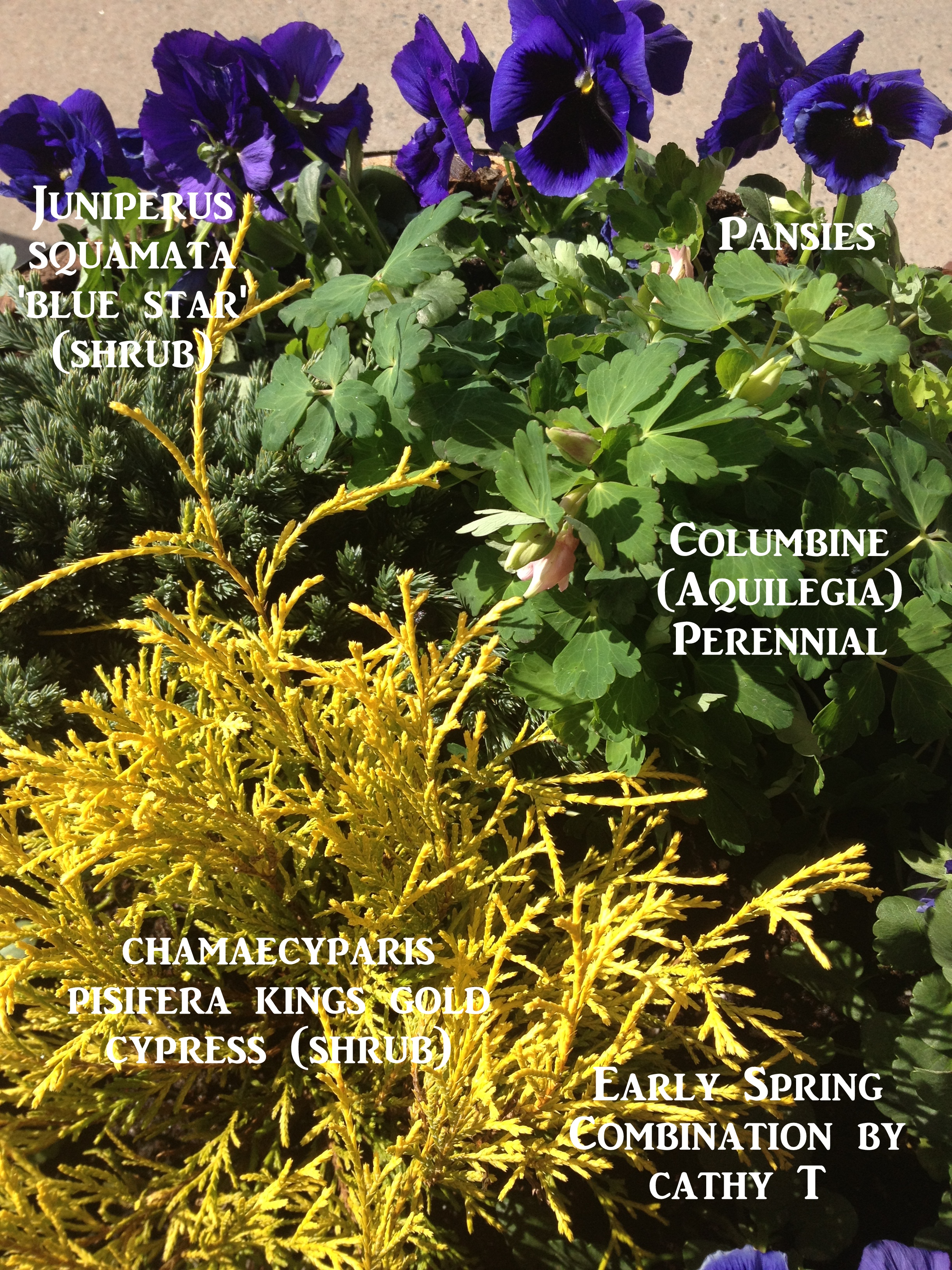
Early spring container combination

Early spring container combination

The overly-chilly temperatures experienced during early April this year has made us more than anxious for warmer weather so we can get outside to begin gardening.  And it has also prompted many of us to ask if it is too early to plant?  But the rules still remain the same.  In fact, they may be more applicable.

LAST SPRING FROST DATE

To be safe, for plants sensitive to cold, you should wait until after we get our last spring frost, expected around April 26th based on averages.  Otherwise, you risk damaging the foliage and potential flower buds, or the total loss of your new plant.  “It’s just a tad bit too early for some plants, even though we are ready to get out there.”

Pansies

Pansies

COLD-TOLERANT PLANTS

By now, you have probably put out some pansies, tulips, daffodils or other spring-like bulb plants, such as hyacinth.  These can take the chill.  There are some other cold-tolerant plants you can plant now as well.

You will see evergreen and deciduous shrubs and trees, early spring perennials, and other plants hardening off outside at the nursery.  Hardening off is a process where plants are transitioned from the growers’ greenhouse to outdoor temperatures.  These plants are safe to plant.  If you are not sure, ask your nursery person.

But beware; I saw a store that put orchids outside on a table last week.  A little chill to orchids may not harm them, but frost will damage them, resulting in a bad start.  Use a little common sense and consider the type of plant you are exposing to the new environment outside before proceeding.  It may be best to wait until mid-to-late May for the cold sensitive plants.

COLD-SENSITIVE PLANTS

Houseplants, cacti, tropical plants, summer annuals, and summer-blooming bulb-like plants want warmth and can’t take cold soils.  So if you stored your canna rhizomes in the fall, or caladium and elephant’s ears tubers, you should not put them in the ground yet.  Plant them in pots indoors and place them near heat sources or by a sunny window to get them started early.  When the soil warms up outside (60 degrees F-70 degrees F), move them into the ground.  Or pot them up in your container gardens around late-May.
If you kept your tropical plants in the basement to go dormant in their pot or container over the winter, now is a good time to transition them to a room inside your home to start greening up.  Start a watering routine slowly.  When the warmer days arrive, cold-sensitive plants can be put outside.  And if you just can’t wait, cover your plants with a light sheet or bring them inside when the weatherman indicates an overnight frost.  It is best to be cautious.

IMG_6170THINGS YOU CAN DO NOW WHILE YOU WAIT

This time of year, however, is a great time to get other tasks done or set-up so when it finally warms up, you will be ready to take action.  Get your containers and patio pots out, clean them up with a bit of light soapy water, place them in your favorite places, and fill them up with potting mix so when you bring your plants home from the garden nurseries, all will be ready for you.  It is also a good time to clean up any perennials with damaged or worn foliage.  Clean up your garden beds of debris, add some organic matter and/or mulch if needed, prune summer-flowering shrubs blooming on new wood before growth starts.  Edge your beds, get out your bird baths, cut back your ornamental grasses, and sharpen your garden tools.  And of course, clean up any left over tree and branches fallen from our past winter storms.  There’s plenty to keep us busy while we wait.

Container Crazy Cathy T
http://www.cathytesta.com
containercathy@gmail.com
860-977-9473 (cell)

‘Ubatuba Cambuci’ is the UFO of Ornamental Peppers

2 Comments
Purple Flower to Purple Pepper

Purple Flower to Purple Pepper

Ornamental peppers add many wonderful attributes to design compositions in container gardens.  They come in various colors, very rarely get attacked by pesty insects, and have interesting shapes. Additionally, the color of the fruit changes as it matures.

These attributes are something I’ve written about in previous posts.  One post was when my sister purchased a pepper producing purple fruit from me, and another post was when I gave a black fruiting pepper plant to my vet as a thank you for the nose surgery he did on Hunter, my cat.

I really like the look of colored peppers in container gardens.  Some end up in deep, dark colors, and others evolve into bright hot colors. You can include companion plants in the container combination to capitalize on this by thinking about when the other plant’s flowers will bloom and selecting bloom colors to match, echo, or contrast the colors of the peppers for seasonal interest.

The shape of ornamental peppers is interesting too.  Some are pointy and long, facing upwards on stems, others are round and chunky, and some are perfectly round pearl shapes.  Before the trend of incorporating veggies into perennial gardens, people would be surprised when they saw I had a pepper plant in my container gardens with other types of plants.  Now I have a new candidate to suggest using, one by the cultivar name of, ‘Ubatuba Cambuci’.  It has the most unusual shape.

Shaped like a UFO

Shaped like a UFO

Shaped like a Flying Saucer

‘Ubatuba Cambuci’ is a Brazilian pepper plant with fruit resembling a UFO.  It has a wide to squat body shape with edges around it extending outwards a bit.

Dianne, one of my good friends, noticed mine in a container on my deck last summer, as shown in this photo to the left.

She asked, “What is that?”

When I told her the name of the plant and explained how I think it looks like a flying saucer, she replied with, “Only you, Cathy T, only you.”

Dianne is always super enthusiastic about my plant endeavors.  She attends my classes regularly and always gives me words of encouragement and praise.  I’m lucky to have her, and many other good friends, support my plant passions.  She was really impressed with the unique shape of Ubatuba and said she had never seen one before either.

I asked Dianne, “Doesn’t the fruit also look like a body with arms hugging its belly?”

We both started laughing as she agreed.  The fruit’s shape provides conversation opportunities to any admirer taking notice. But the shape alone is not its only talking point.  There are some interesting facts about the plant’s name.

Named after a place, and from its shape

Ubatuba is a lovely beach town in Sao Paulo, and Cambuci is a municipality located in the Brazilian state of Rio de Janeiro.  So, the plant is named after these two places.  I also read that a river in eastern Brazil is called the Ubatuba River, and that Cambuci is a fruit tree apparently on the verge of extinction (and this tree’s fruit has a similar shape of this pepper!), and get this…Uba Tuba granite is quarried in Brazil for use in making kitchen counters.  So there you have it – a plant named after a place and a shape.

Sometimes I think the name selections are off for plants – this one would be so easily called ‘Alien Nation’ and you would get it right off.  But honestly, I haven’t visited Brazil, so I did not recognize the name as being from a place, but surely it is a tropical treat there, just like this pepper plant.

The first part of the plant’s cultivar name has ‘tuba’ at the end, and it is pronounced just like the brass instrument, so just add an OOH-BAH in front of that. The second part I wasn’t so sure how that goes, something like CAM…going into a BOO, and then the common e-e or ei sound at the end.  Heck, you can just nickname it “Uba” for short, but there is a certain ring to saying Ubatuba – Ubatuba.  This attribute, its name, is entertaining, at least to me.

Color Changes from Yellow to Orange, to Red

‘Ubatuba Cambuci’ starts off yellow, transitions to orange, and finishes to a bright attractive red. The fruit grows to about a three inch size.  A little bit larger than the perfect bite size.  The plant itself has a bushy habit and grows up to three feet tall. Its dark green foliage has good sized leaves and the stems are sturdy and strong.  Fruit tends to stay stable on the plant because of this, and staking is usually not required, if only, towards the end of the season.

The added benefit of the pepper’s color changes is it can help you in the selection of your companion plants in your container garden design. If you think it through by period of bloom, matching the yellow stage of the pepper’s color to an early yellow bloomer of another plant, and the red color stage of the pepper to a flower blooming in late summer in the same container garden, you create seasonal interest.

Black foliage and purple peppers

Black foliage and purple peppers

Plant Companions to use with Ornamental Peppers

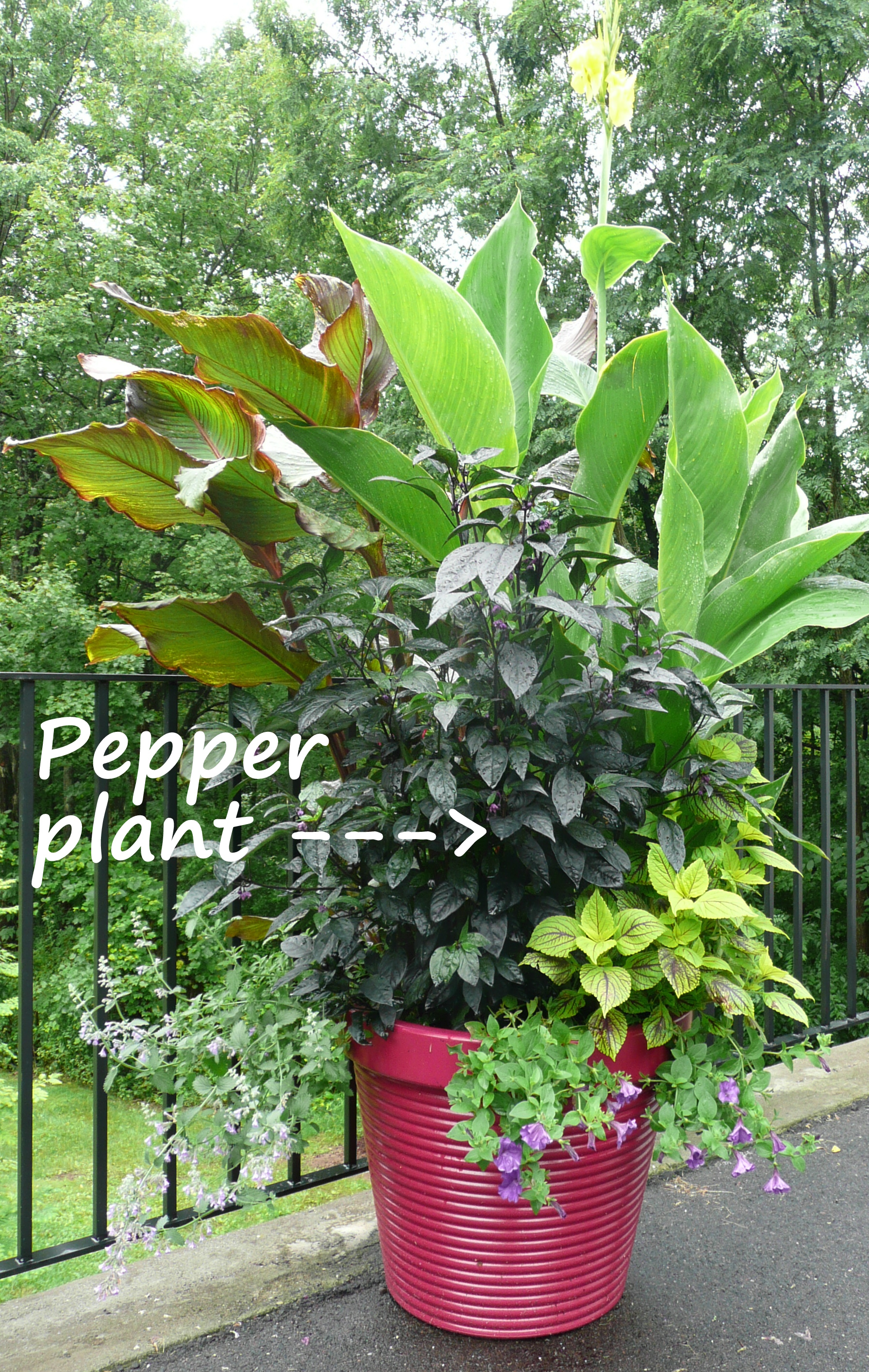
As shown in the photo to the left, the annual, Coleus ‘Gay’s Delight’ was used as a filler because of the purple veins in its bright chartreuse leaves.  It highlighted the purple flowers and fruit of the pepper plant in this container.  In this case, the pepper plant’s foliage was also a dark purple to black color.

Consider perennials; examples are Monarda didyma ‘Petite Delight’ with pink flower, Nepeta x faassenii ‘Dropmore’ with lavender flowers, and Verbena bonariensis; these would look stunning with purple peppers.  This would create a mix of purple tones to show up against the dark foliage of the pepper plant as shown here for a softer combination of monochromatic colors.

If the pepper of your choice has a full, bushy habit, put a taller center plant to elevate above it, as in the example of tall Canna plants.  Or combine your pepper plants with edibles to create quick dinner snipping sources. Include cherry tomato, basil, chive, and oregano.

Because many herbs are green foliage plants, select those with variegated leaves to make them stand out against the foliage of the pepper. Ocimum citriodorum ‘Pesto Perpetuo’ has a creamy white coloring on the leaves’ edges, or Ocimum basilicum ‘Amethyst Improved’, showing off a deep dark shiny black color.  Golden thyme plants work well, try Thymus citriodorus ‘Archer’s Gold’.  For a spiller, nasturtiums are perfect and easy to grow, and are edible, look for Tropaeolum majus ‘Wine’ for the yellow and orange flower color.

For a hot red combination, plant Verbena x “Taylortown Red’, and add a Pennisetum setaceum ‘Rubrum’ as a spiky accent with the ‘Ubatuba Cambuci’ plant.  I assure you, if you add an ornamental pepper, your friends will take notice, and you can have them taste test the fruit.  Ask them if it is sweet or hot?

Plants with Flavors

Plants with Flavors

It is Sweet, no wait.  It is Hot.

When I include peppers in my container gardens, the matured fruit does not last long because of a number one predator in my home, Steve, my husband.

Last summer, he walked up the back deck stairs, rather than entering through the front door when arriving home from work so he could partake in the daily offerings of my ‘Ubatuba Cambuci’ fruit.

So I asked him when he took his first tasting, “”Is it sweet or is it hot?”

He responded, “It is sweet, no wait. It is hot.”

This pepper is listed as “mild-hot” in the catalog, but the plant’s label indicates “sweet.”  There seems to be a little bit of both, starting off mild and transitioning to hot as you munch on it.

Adding tasty treats to your container gardens is a lot of fun, and of course, they can be used in cooking or dried later in the season to use in your recipes during the winter.

I can’t tell you how many people noticed my Stevia plants (Sweetleaf) offered for sale at a farmer’s market one season.  It is a substitute for sugar, and when you bite into a leaf, it truly tastes like sugar…And that plant – one to blog about later – really grew well in my container gardens.  But more on that later.

Culture and Container Size

For the container size, go large, at least 22-25″ diameter pot, especially if you combine “Uba” up with two or three more plants.  ‘Ubatuba Cambuci’ appreciates moist, well drained and organic soil and the space to grow.  Be prepared to water this plant in a container garden more often because it draws a good amount of moisture from the soil during hot summer months.  I watered my plant daily toward mid to late summer.  And of course, it needs full-sun to produce the best flowers and fruit.  Remember to check your companion plants for the same conditions.

By the way, I actually had difficulty finding the Genus and species name for ‘Ubatuba Cambuci’.  It is not noted on the plant’s label, nor was it in the grower’s catalog.  I’ve read it is bred from a species Capsicum baccatum or Capsicum baccatum var. pendulum.  Cultivars are typically distinguishable from the species by one or more characteristic.  The most obvious characteristic being, in this case, its unique “flying saucer” shape.  It is one you won’t forget after the first time you see it – just like when you spot your first UFO.

Container Crazy Cathy T
http://www.cathytesta.com
860-977-9473

Please feel free to click on the ‘red stamp icon’ at the top of this blog to leave your comments, especially if you have grown this pepper, I’d love to hear from those of you visiting.


Dyckia ‘Burgundy Ice’ is for the non-green thumb gardener

Leave a comment

Julia followed Clara into her kitchen before they were to have dinner with their husbands that evening. “Look, here’s the plant you gave me,” said Clara, as she held up a very sickly looking plant with a smile on her face.  She didn’t realize the plant was hurting.

“I told Mark to re-pot that immediately when I gave it to him for you,” replied Julia.  “This plant really needs well-draining soil.”

It was clear the plant was suffering and had barely grown since last summer when Julia gave it to him to replace a plant Clara had killed. And Mark, Clara’s husband, did not follow Julia’s instructions at all, which surprised Julia because he is an amazing outdoor gardener; he understands the requirements of plants.

But apparently, Mark just placed it on Clara’s windowsill that day to sit beside her many other houseplants.  He knew the fact he didn’t repot it would not be noticed by Clara, or perhaps he felt it was her job.  It is not that Clara does not adore her many houseplants, or that she doesn’t take some time to care for them, but she just doesn’t seem to understand or see the importance of the soil environment.  She overlooks the essential ingredients needed for the plants to thrive.

Clara could tell Julia was irritated by the thought of the plant looking sad, so she told Julia they would repot it after dinner, but she first gave her an enthusiastic tour of her other plants in their dining room.

Julia recognized them all – aloes, jades, African violets, Philodendrons, and Begonias – and every single one of them were growing in dry, poor, overrun soil and in small pots, some without drainage holes.  The white crusty edges on the soil’s surface representing a salt buildup from hard water or fertilizer not leached through was visible in every pot. Many were reaching for light sources and had stretchy growth, but rather than lecture her good friend, Clara, who obviously is a non-green thumb gardener, she took another sip of her Pinot Noir and listened with interest to everything Clara told her about her treasured plants.

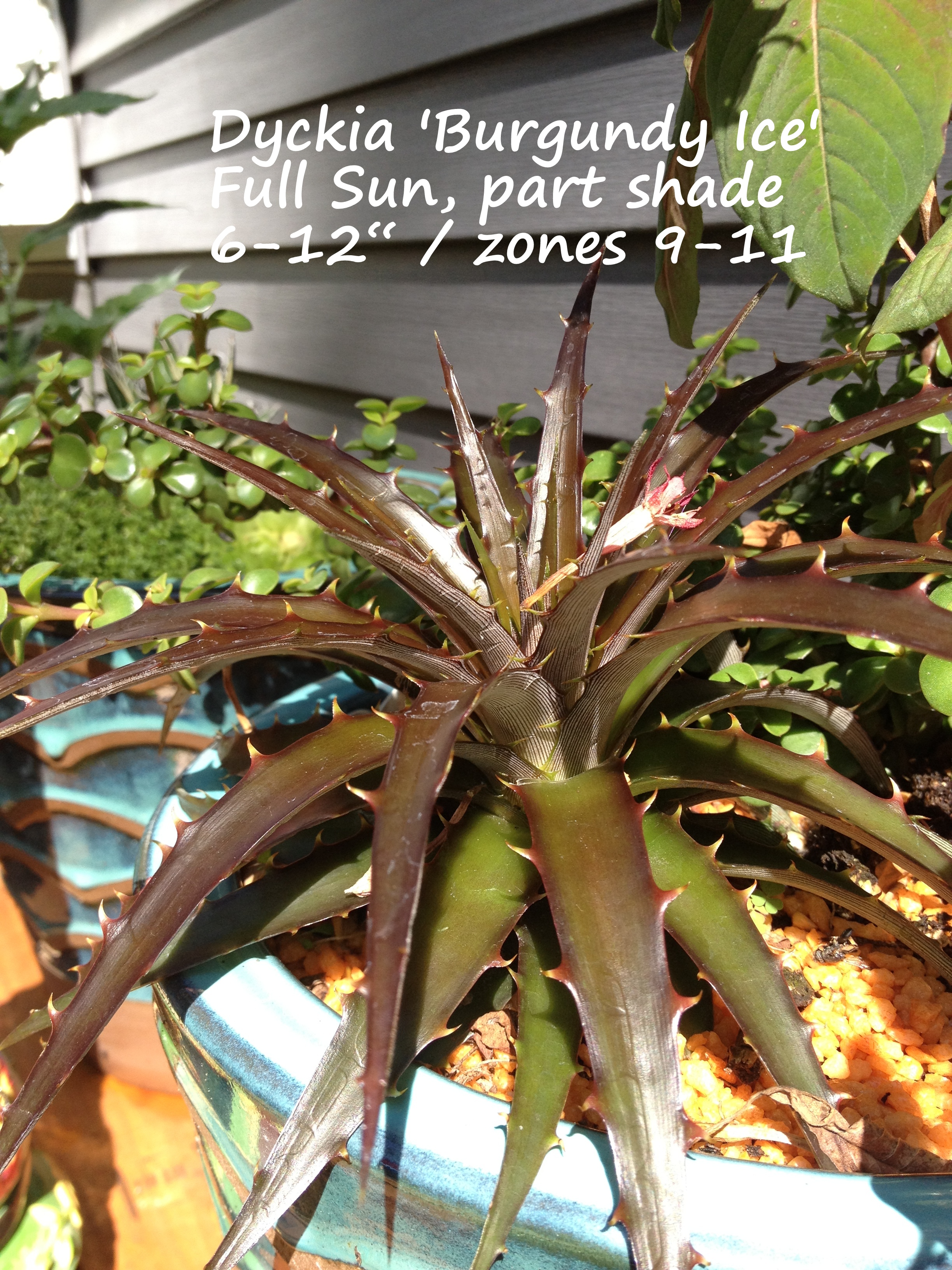
Burgundy Ice Dyckia

Burgundy Ice Dyckia

LACKING A GREEN THUMB

Do you lack a green thumb like Clara?  If yes, a succulent, like Dyckia ‘Burgundy Ice,’ is an option for you.  Succulents store moisture in their leaves, one factor which helps the non-green thumb gardener because it enables the plant to withstand drought.  Dyckia is actually in the Bromeliad family, and it doesn’t store moisture in its leaves like typical succulents, but it is tough all the same and you can refer to it as a succulent in general.

It is accustom to growing on rocks or rough rocky soils and in areas lacking rainfall, so naturally it developed the ability to go dormant to survive dry periods of time.  This is the number one reason why it is perfect for non-green thumb gardeners, because of their practice of forgetting to water their plants.  When it finally gets some water, it pops back to life quickly so you will be relieved you didn’t kill it.

Dyckias also have ability to take cold temperatures, so if you keep the heat low in the house during the winter, it will adjust accordingly.

Heat tolerance is another bonus about these plants.  You can put them out in a hot part of your landscape or outdoor sitting area in the summer months, and pretty much ignore them, but you should remember to give them more watering attention (low to moderate), especially deserving after accommodating all your non-green thumb traits during a long winter.

FOLIAGE FEATURES

When you look at the rosette style leaves of this Dyckia hybrid, it looks similar to the top of a pineapple (and pineapples are in the Bromeliad family too), but ‘Burgundy Ice’ has a beautiful and useful dark rich burgundy color with white spines, making it a wonderful candidate to contrast with other tough drought-tolerant type plants in container gardens or smaller pots.

You can find lots of succulents or cacti with spines, stripes and patterns, but not many with a rich darker almost black coloring, making it a little more dramatic and alluring. The rosette shape allows the plant to collect moisture and funnel it towards its roots, and this form gives it an architectural interest too.  Its physical attributes contributes to the visual appeal from a design perspective.

Incorporating this plant into a combination of succulents or drought tolerant perennials or annuals with a lighter or brighter color will give you a great visual contrast situation.

In the photo above, it is growing with a Portulacaria afra (dwarf jade plant or elephant bush/food).  If you look closely, the stems of Portulacaria afra are the same color as Dyckia ‘Burgundy Ice,’ so it “echoes” the color of the focal plant in this glazed blue pot. Additionally, P. afra has a spiller-type habit and smaller rounded leaves. This feature helps to soften the edge of the pot and provides a textural difference in this combination. Always think about mixing the textures; the softer texture will make the bolder texture even more noticeable.

The Dyckia leaves tend to rise up a bit and curve downward at the tips.  Notice the tips sitting above the Portulacaria afra.  This makes the burgundy color more apparent because the lighter color is filled in behind it. Another spiller plant that would work well with this is something like the temperennial called, Dichondra argentea ‘Silver Falls’.  It grows long thin stems with soft silvery fuzzy leaves; a silver contrast to the ‘Burgundy Ice’, or try something like, Helichrysum petiolare (Licorice Plant) with similar coloring, both cascading downward.  Delosperma cooperi or D. floribundum (Ice Plants), a perennial with fleshy shiny leaves is another example of smaller foliage with characteristics to make ‘Burgundy Falls’ stand out.  It has a trailing habit and produces daisy like flowers in midsummer.  Pick a Delosperma cultivar that has a flower color that will pop against the burgundy color of ‘Burgundy Ice.’

Dyckia‘ Burgundy Ice’ is a full sun to part shade plant, so when used outdoors in your container gardens, a full sun location is best because the rosette’s color will intensify. When you move it inside for the winter months, it can take a reduction in light but it will green up more.  Because we tend to get dreary, cloudy days during the winter, placing them by the sunniest window in your home is recommended, so they at least get some sun on the good days.

For the non-green thumb gardener

For the non-green thumb gardener

HOW TO SAY IT

DY-kee-uh, DIK ee uh, or DICK’ea are three ways.  Just let it roll off your tongue, it doesn’t really matter how perfectly you pronounce it.  If you are a non-green thumb gardener, say it quickly and with confidence and no one will know the difference.  You can just call it ‘my tough succulent’ too if you want.  But because this plant was named after a Prince, you may want to give it a nickname, the “Prince”.  Whatever you name it doesn’t really matter, as long as you continue to enjoy it.

THE TECHNICAL STUFF

Habit: Clumping.  Blooms:  Mostly for foliage.  Size: 6-12″.  Hardiness/Zones 9-11:  It is treated as an annual here in CT.  Water:  Dry to normal, okay to let go through some periods of drought.  Light:  Full sun to part shade; okay to have low-light in house during winter. Care Level:  Easy – Perfect for the non-green thumb gardener.  Offered by:  Proven Selections.

GREAT REFERENCE INFORMATION

Container Crazy Cathy T
http://www.cathytesta.com
(860) 977-9473

P.S.  Clara did take Julia into her basement after an amazing dinner, where her potting bench and many broken pots were laid out.  Julia’s face had to be kept straight as Clara pulled out old dusty bags of potting soil, none filled with soil able to hold water anymore – they were very old and dried out.  Julia told her, “Those won’t do.”  So Clara held up a bag of African violet mix, and said, ‘How about this?”  Julia took another sip of wine, and replied with a sigh, “What the heck, give it to me.” 🙂


Butterfly Conservatory Breaks the Winter Blues

7 Comments

If you suffer from a seasonal disorder in the winter, where you need to get out to break from the winter blues, may I suggest a visit to the “Magic Wings Butterfly Conservatory and Gardens” located on 281 Greenfield Road in South Deerfield, MA?  It will be a place of warmth, sunshine, and lots of color.  I visited yesterday with my sister and niece, and here are the photos I took along the way.

Favorite shot

Favorite shot

I think this one is my favorite photos of the day.  If I am reading the butterfly id chart correctly, which I purchased for $1.00 at the entrance ticket booth, this is a Brown Clipper, Parthenos sylvia.  I don’t know much about butterflies other than they are beautiful in the garden – serving as nature’s living art – so hopefully I have the right names written with the photos I took yesterday.

Tithorea tarricina

Tithorea tarricina

Again, not sure but this one looks like Tithorea.  Love the long antennae and legs.

Japanese Lantern

Japanese Lantern

There are many tropical plants at the conservatory and this one was probably my favorite of the lot.  A Hibiscus schizopetalus, Japanese Lantern bloom with a long stamen dripping down in such an elegant fashion.  Just love the look of this bloom and the next butterfly photo is a perfect color comparison.

Hey Mr. Postman

Hey Mr. Postman

One of the things I noticed was many of the butterflies did have some wing tears, which made me a little sad.  This one is Postman, Heliconius melpomene.  He matches the Hibiscus photo above in coloring.

Pitcher Plant

Pitcher Plant

My niece asked me what this plant was, and of course, it is a type of pitcher plant.  I didn’t see many plant labels at the conservatory, and it would be nice for them to offer a plant identification key like they offer for the butterflies.  These types of plants are found in tropical rain forests, and many know they get their nutrition by capturing insects in their pitcher.  I saw a television show recently that also indicated a new discovery of some larger species luring small rodent-like animals, and they go for the nectar while on top of the pitcher, and guess what drops out the animal’s back end into the pitcher?  Yup, their poop – another source of energy to the plant.

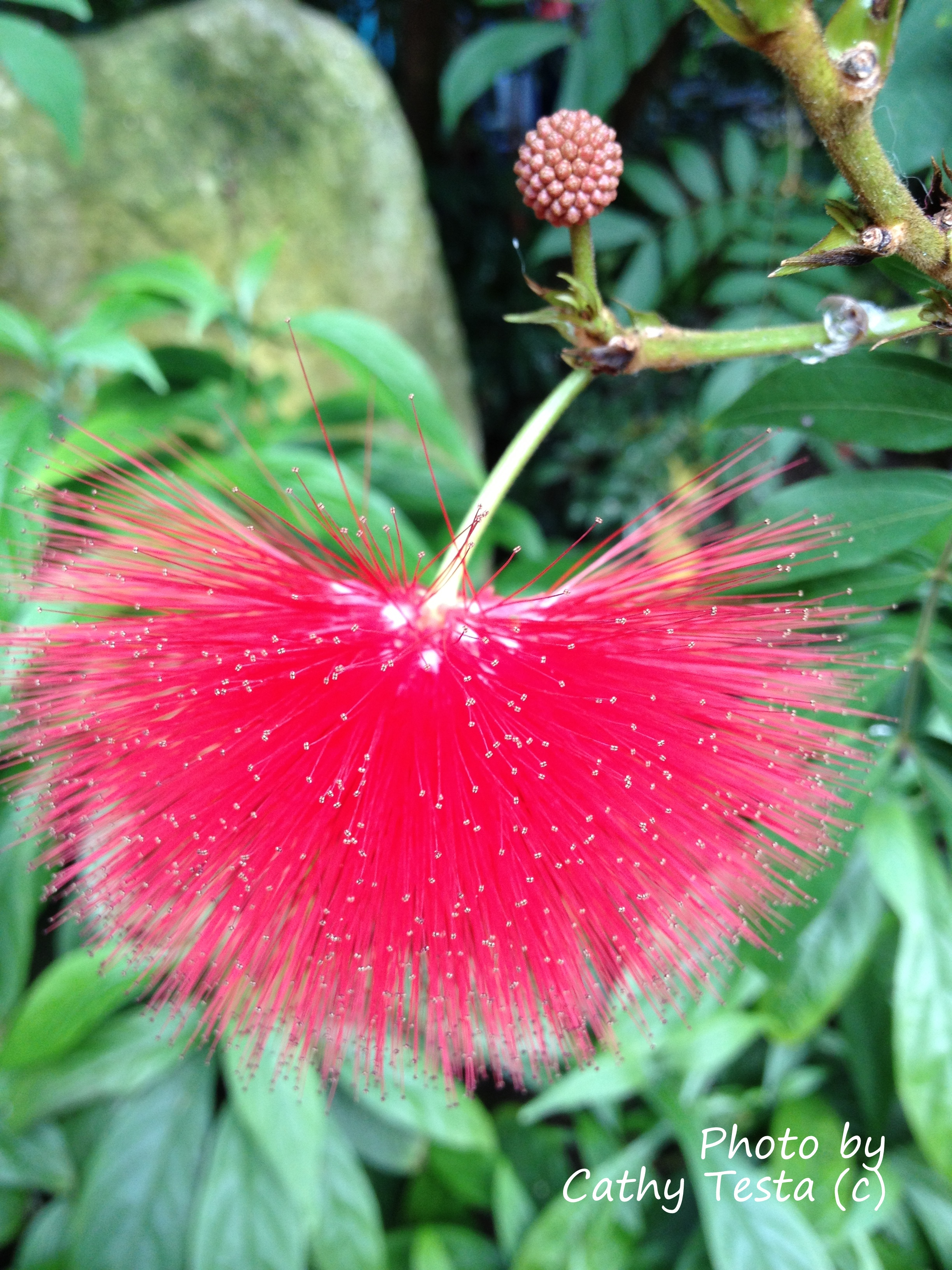
Shrimp Plant

Shrimp Plant

This is a plant I’ve grown in my container gardens.  Pachystachys lutea.  There were many of these at the conservatory for the butterflies to enjoy.  You can see why it is called a golden shrimp plant as the common name.  The flowers are not the yellow parts you see here; these are the bracts.  The white flowers extend from these, and in my container garden, the hummingbirds loved them.

Justicia

Justicia

There were a few Justicia plants, the common name for this one is shrimp plant too.  It is a broadleaf evergreen shrub, and I adore the style of the flowers.  Very exotic, and this one had a deep hot pink color, but the one I used in a container garden was a softer pink – both are spectacular, and loved by hummingbirds and butterflies.

Justicia carnea

Justicia carnea

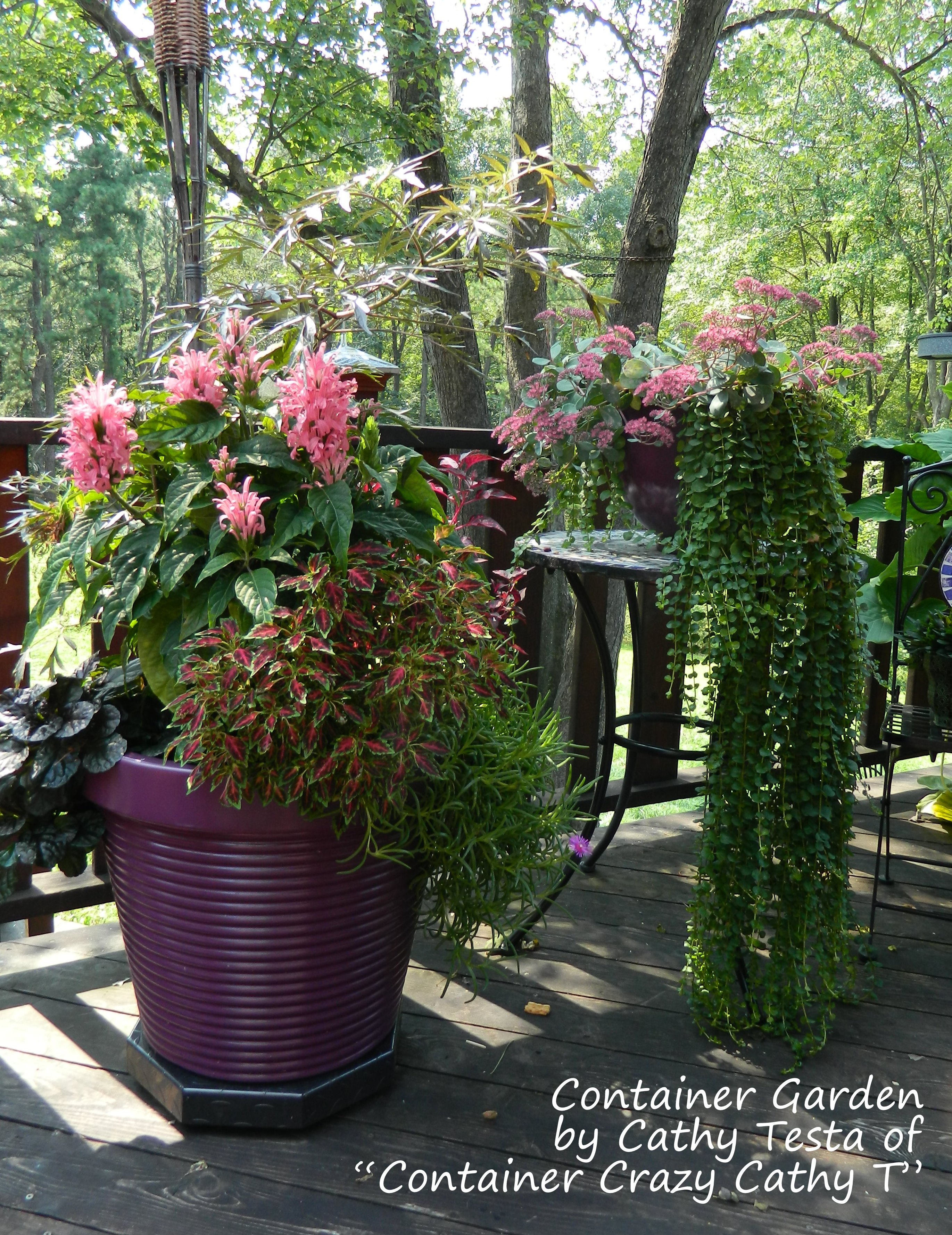
This photo was taken of my container garden in early September about two years ago. The large pot is combined with a Coleus, Ajuga, Delosperma, Alternanthera, and Sambucus.  The container on the table has a Sedum in it with a Creeping Jenny trailing below.  Justicia carnea (shrimp plant) in the large pot bloomed during the summer and into fall, and paired up perfectly with the Sedum blooming around the same time.
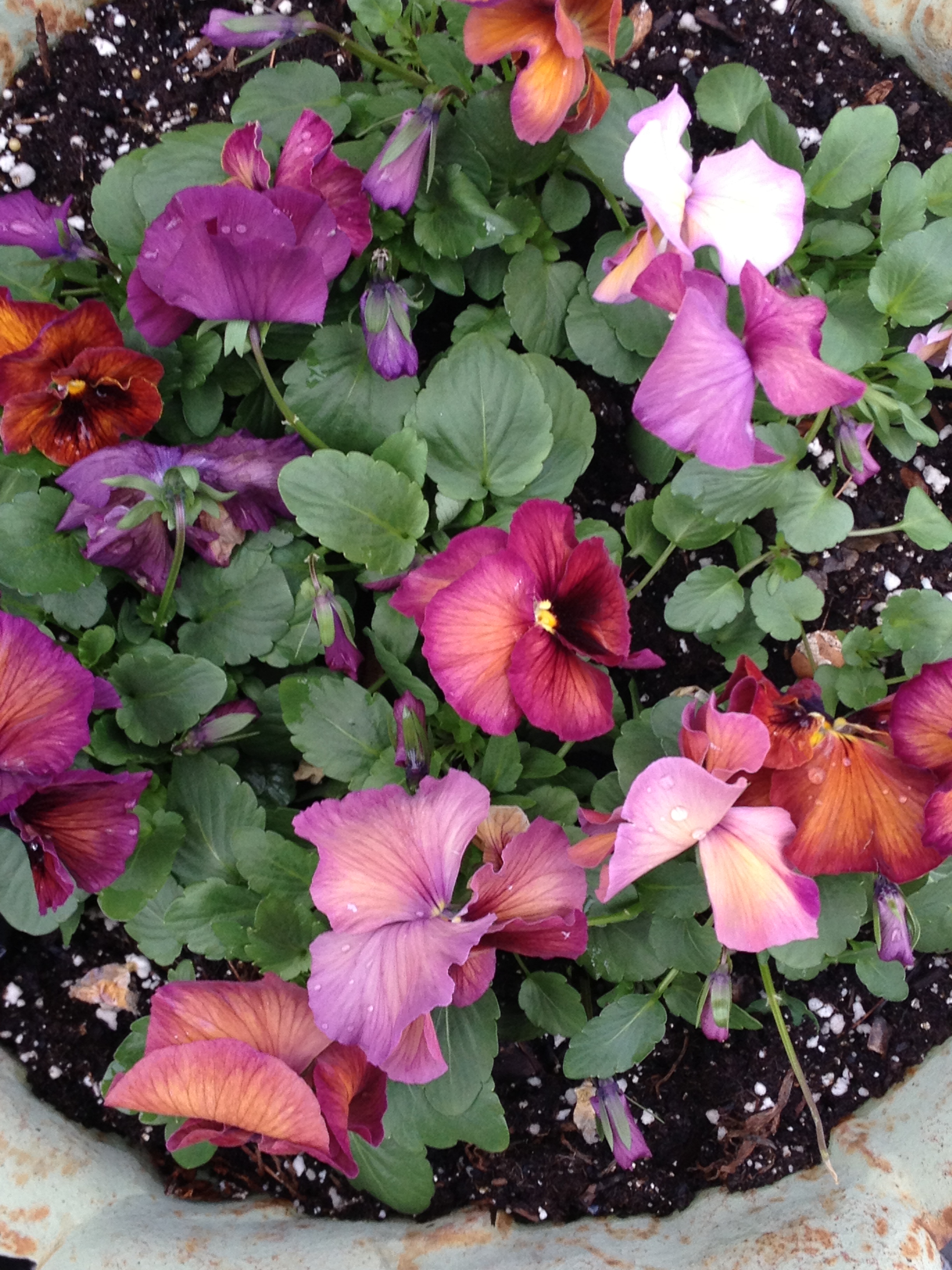
Ow Butterflies

Ow Butterflies

Here’s two owl butterflies, Caligo eurilochus, were having a little mating fun.  And it is obvious why they call them “owl” butterflies, used to deter predators.  This is the type that landed on my shoulder for quite some time later, see video below.

Name this plant

Name this plant

Okay, I know I’ve seen this plant before – but I can’t remember the name?  Help me out tropical bloggers – what is this called?  It is so beautiful and the plants at the conservatory trailed all the way up to the ceiling.  I would have loved to capture a butterfly on it but no luck.

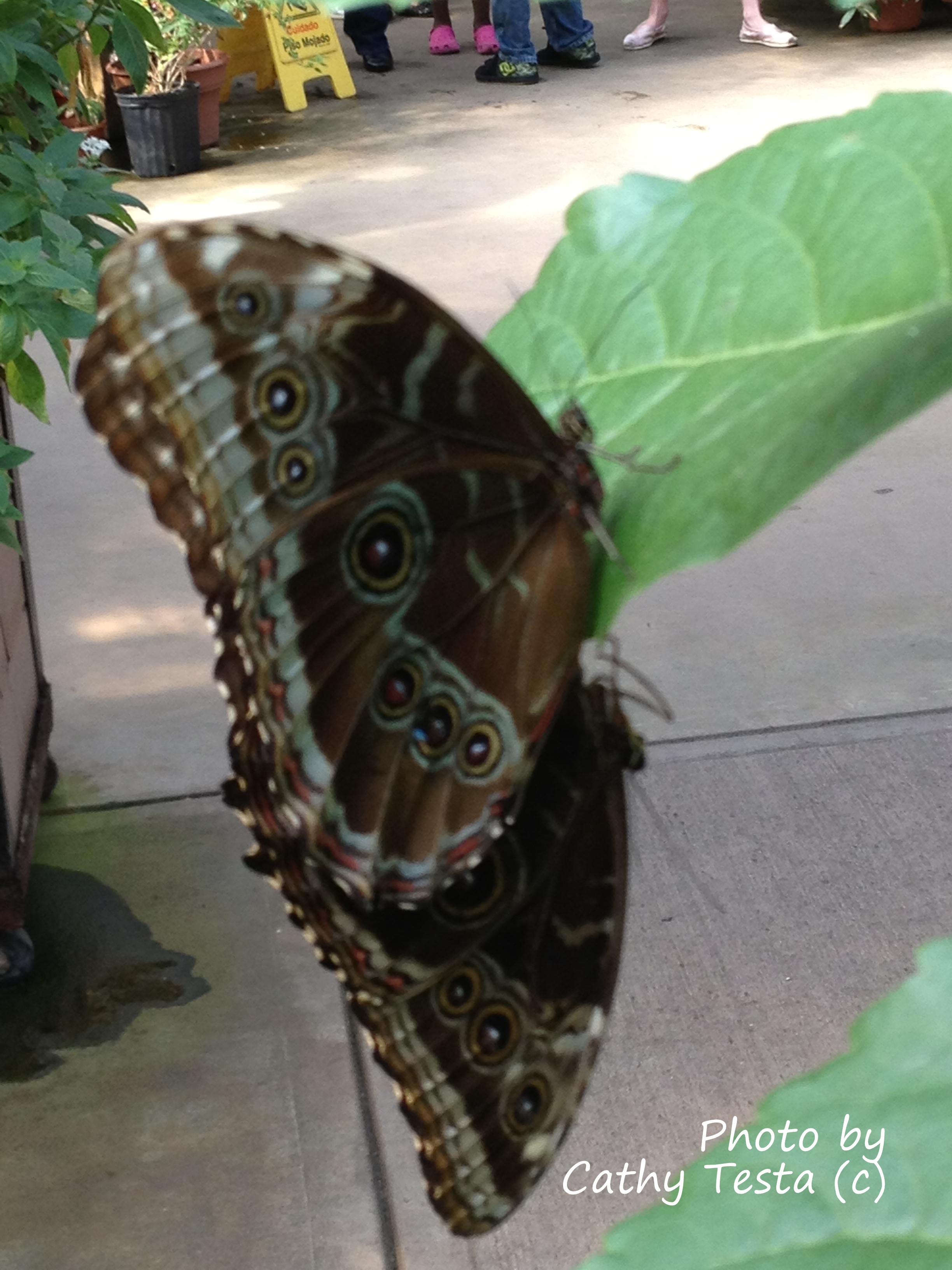
Morpho peleides

Morpho peleides

I did have luck capturing this Blue Morpho, Morpho peleides.  Got to thank iPhones for the quick clicks.  I had to reach up a bit to get the shot, but was so glad he was in a rest state and didn’t fly away.

Purple Passion

Purple Passion

There were mostly tropical plants at the conservatory, which I enjoyed because they are one of my passions – yet, later when I got home, I thought it was sad they didn’t have natives for the butterflies to enjoy – and to showcase.  We have many in CT and MA that would suit the feeders.  Also, I noticed outside, they had a border along the front of the building enclosed in posts, and it was all old evergreen shrubs, the soil didn’t look too healthy, and I thought, later – when I got home, how wonderful it would be to fill that bed with some native plants.  Too bad I don’t work there – LOL.

More help please?

More help please?

More help please.  What is this plant?  It looks like a Peregrina bloom?  But not sure, the foliage is soft and fuzzy, but the orange flowers are my main attraction.

Sculpture

Sculpture

Just a shot of the sculpture in the gardens at the conservatory.

Arch

Arch

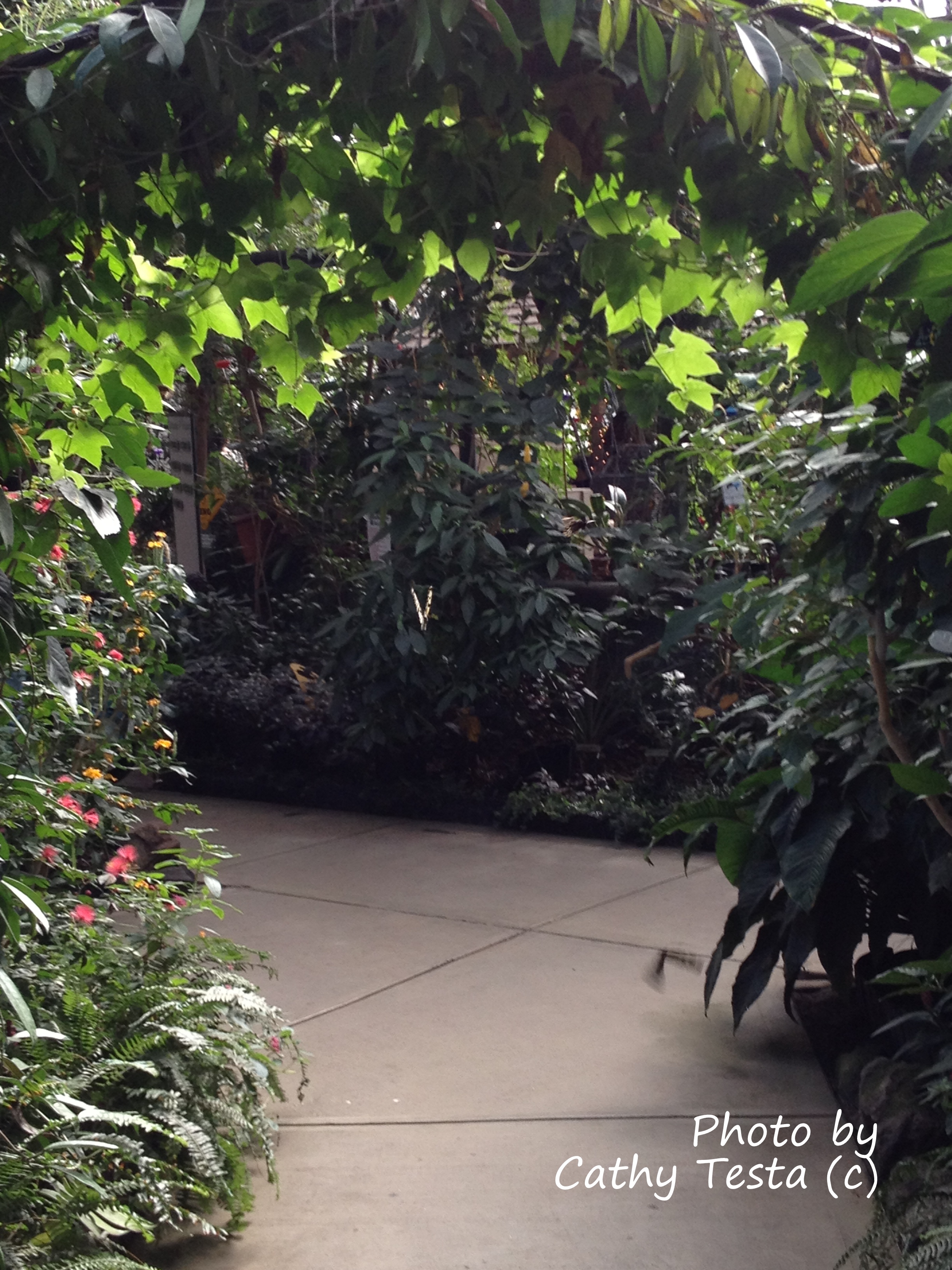
There was an arch/trellis at the entrance, and if you look closely, you can see a butterfly flying right in the center.  Unfortunately, it is very difficult to capture the hundreds of butterflies circling your head.  As I stood here, taking some photos, one landed right on my shoulder.  I used the rotating feature on my iPhone to get a video of it.  Here it is…

And one more butterfly shot to share, this one is Cairns Birdwing (male), I think.  Love the florescent coloring.

Cairns Birdwing

Cairns Birdwing

Some tips if you decide to visit this place:

Recommendation:  If you happen to be visiting MA or CT, this is a fun trip with kids, or if you are into photography.  There is food sold at the sight, but I enjoyed the restaurant at Yankee Candle right down the road.  Go early, as if it is school vacation season, it will get busy quickly.

Special Occasion:  If you have an engagement to announce, this could be a great place to go with a photographer for some fun shots, but be prepared to get hot – it is humid and warm in the conservatory.  Wear light clothing.

Location:  281 Greenfield Rd. (Rt 5 & 10) off of 91.  If traveling north, take the exit 24 noted for Yankee Candle.  If traveling south, take Exit 25.  South Deerfield, MA.

Hours:  Per their pamphlet, they are open year round 7 days a week.  Summer: 9 am to 6 pm.  Fall/Winter/Spring: 9 am to 5 pm. Closed on some holidays.

Website:  www.MagicWings.com

Name of place:  Magic Wings

Cost: $14/Adults, $10/Kids

Butterfly Key:  I recommend you pay the $1 for the key, my niece immediately wanted to use it as we strolled along.  She had a big desire to identify all the butterflies.  I wish they had a key for the plants, but I don’t think they did – or perhaps I missed it somehow.

Camera:  Bring your camera of course.

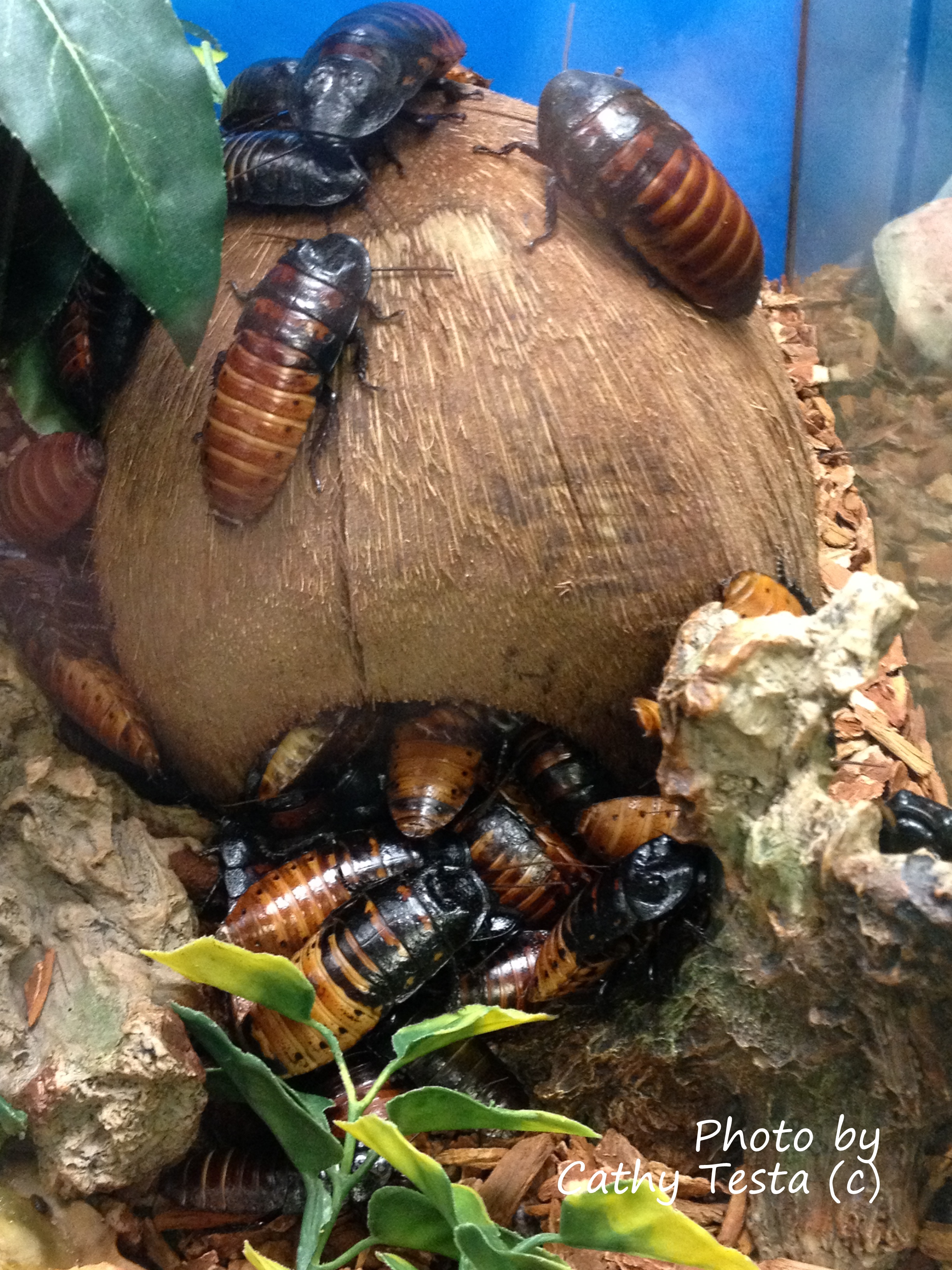
And last but not least, when you enter the exhibit, you first enter a room of insects in tanks.  They reminded me of “Indiana Jones” bugs, large and yucky.  And to finish off this informal quick post, here’s a photo of “Hissing Cockroaches”….Yuck.  But fun still for the kids!

Container Crazy Cathy T

Hissing Cockroaches

Hissing Cockroaches

Colocasia esculenta ‘Maui Magic’ has alluring powers…

1 Comment

Can a plant possess alluring powers, so insatiable, the yearning for more overwhelms your ability to resist?

“I want some more,” says Claudia, the fictional character in the movie, “Interview with the Vampire.”  She is completely seduced from her first taste of blood offered by the devious vampire, Lestat.  And although his immortal companion, Louis, witnesses the transition with regret, he does nothing to stop Claudia’s unthinkable awakening.

Maui Magic Front Ear

Yes, a plant can also possess similar powers that lure you into its plan of seduction. And…, “Of course, you want some more.” After you have experienced its offerings, your senses awaken, the desire to achieve the same feeling or response is sought out, and you ultimately thirst for more of the same, as much as a vampire thirsts for blood.

This is how I felt about Colocasia esculenta ‘Maui Magic’ last season as I witnessed this plant grow long stems and big leaves as rapidly as Claudia’s hair grew right before she opened her eyes.

Colocasia esculenta ‘Maui Magic’

This tropical plant, commonly referred to as an elephant ear or elephant’s ears, drew me into its clutches deceptively, then captured my desire to always want more as it grew into an impressive size while maintaining its beautiful attributes from the beginning of spring to early autumn.  If I didn’t decide to order it last minute, I may have missed out on its powers to grow quickly, create a climactic effect in a container garden, and arouse with its dark-sided hues.  It started with admiring its abundant ornamental leaves, followed by adoring its long stems.  Each held their ears up like a trophy on their tips, making it stand out in the container garden.
August photo; back of 'Maui Magic' leaf

August photo; back of ‘Maui Magic’ leaf

Dressed in a cloak

The heart-shaped leaves of ‘Maui Magic’ snuck-up out of the soil like a vampire appearing from the dark alleys of the streets.  Before I knew it, the leaves grew to two feet long and about half as wide in the center.  The leaves wavy-edged margins are soft and subtle, and provide an elusive cloaking effect as it gently moves by the wind.  The leaf stems, or more appropriately stated, the petioles, grew to three feet tall, lending to an upright exotic thriller bobbing above the container garden’s companion plants.  The mid-ribs were very visible on the backside of the leaves.  By the time August arrived, this plant, started from a small plant in mid-May, was substantial enough to draw me into a complete trance, and kept me there. I couldn’t keep my eyes or hands off it.

Rain drops on the leaves

Rain drops on the leaves

An unnatural pale complexion 

The plant’s foliage coloring starts off as a dark plum-purple, and then fades into an olive green with purple tones.  Having less color is not a sign of ill health as with a vampire, but a transition to maturity.  This did not create a lack of appreciation; the color was still stunning. The leaf stems carried a deep purple tone all the way down to the base of the plant throughout the season.  The look was visually stimulating, but you also wanted to touch the stems.  It sounds weird, but there is a soft texture to the plant, making it smooth to the touch.  I found this irresistible, charming, and as I said, “alluring.”  Taking it down for the fall was as difficult as chopping the head off a vampire in rest, but it had to be done and with good timing.

Yard Stick with Ears

Not harmed by the sun

Unlike vampires, the exposure to sun does not harm this cultivar, so long as you keep it well-watered.  Water to this plant is like blood to vampires; it thrives as it receives more.  But for my container garden, I decided to place it in a shady location, on the north side of my house, where it received more shade than sun.  However, this did not deter it from growing large and showy.  The plant can take either exposure. The leaf stems extended as if reaching towards the edges of the steps in search for the afternoon sun, adding more drama to its presence.  This shady exposure also helped to keep the soil moist, appreciated by many types of elephant ears.  Birds perched on it occassionally, and it never failed to produce new leaves.  When the wind caused some movement, it startled me from time to time because it was as tall as a person and could be seen from inside the house.

The lure of wanting more

The lure of wanting more

Its mysterious origin

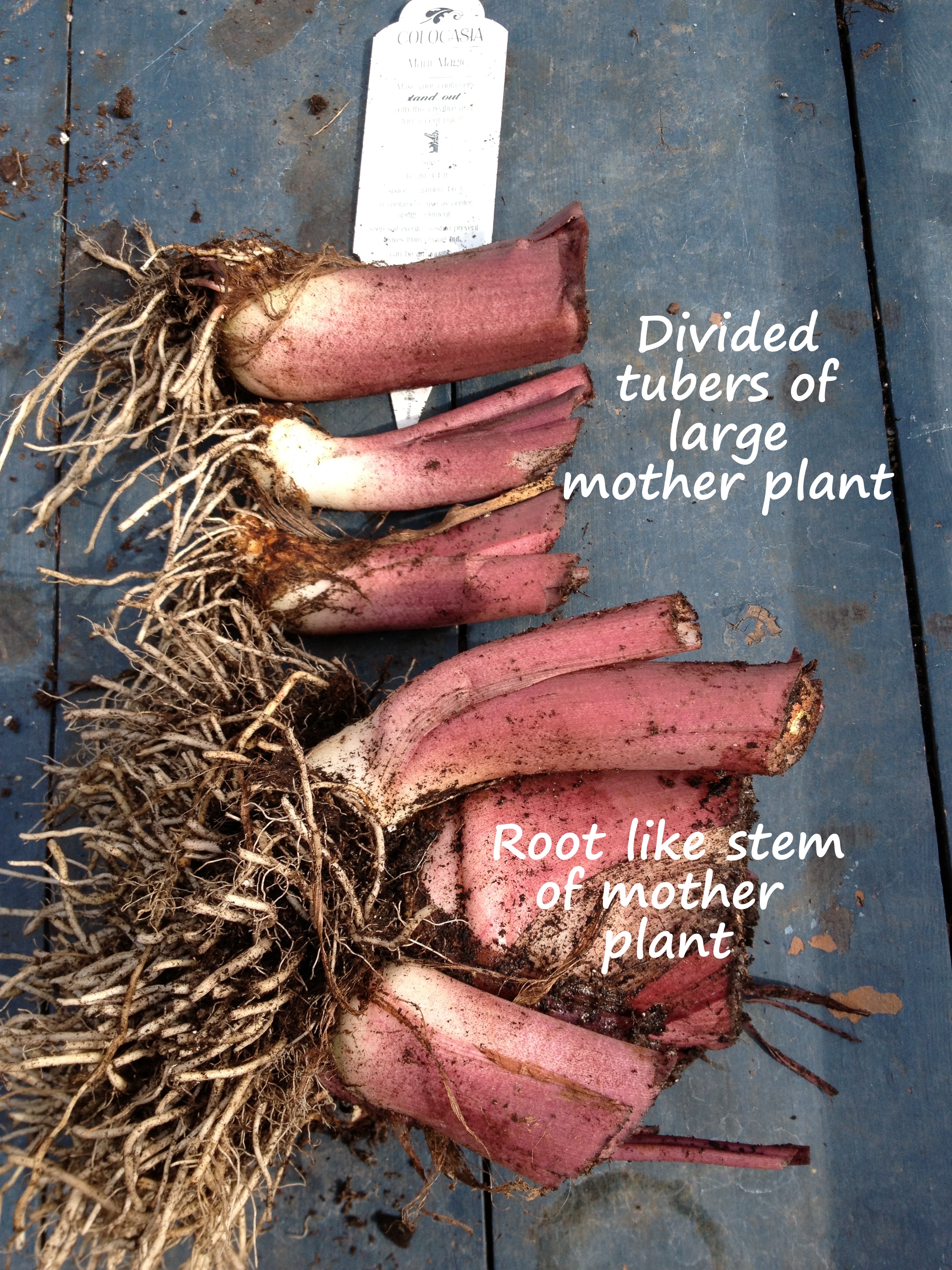
As many ponder the true origin of vampires, you may ponder the growth habit of this plant. Whatever you choose to call the base of this plant, a corm, cormel, bulb, tuber, rhizome, or root, the leaf stems arise from the base of a root-like structure.  Even its circumference amazed me, as it reached a good size and produced potential divisions or cormels from the mother plant.  This plant is treated like a tropical in Connecticut; it is not hardy to our zone and requires storage in a cool, dark place, like the coffin of a vampire.  So get out your tools of destruction, chop of its heads, clean of the base, and create its resting place for a return next season when you certainly will “vant some more.”  If handled appropriately and according to specific procedures, this plant will have immortal life in your container gardens.

Tubers at base of stems

Tubers at base of stems

Container Crazy Cathy T
http://www.cathytesta.com
860-977-9473

Pronounced:  Koal-oh-KAY-see-uh  ess-kyou-LENT-uh; sounds like some weird vampire language.

Zones:  9-11, tropical and subtropical tuberous perennial.  Used as a tropical plant and stored for winter in CT Zones.  Can be used as an aquatic plant in containers.

Size:  3-4′ tall, rounded form up to 6′ size all together under warm growing conditions. Big, tall, showy, and overpowering.

Exposure:  Full Sun, part sun, part shade – flexible.  Easy to grow, and grows quickly.

Introduction: 2008 by John Cho and the University of Hawaii breeding program.  Propagation is prohibited.

Color combinations:  Try this plant with contrasting vibrant colors since the plant’s tones are on the darkside.  Use different leaf textures, from fine to medium against this coarse and bold statement in your container or garden.  (Shown in this post are a Coleus, Astilbe, and Rodgersia for a shade combination.)  For a sun combination, try Canna with bright, golden yellow, or chartreuse leaf colors, add a blooming annual, like Zinnia or Verbena, for some pops of color.  Select a bright colored spiller, like Lysimachia nummelaria ‘Aurea’ (Creeping Jenny) or Ipomoea batatas (Sweet Potato Vine) annuals.

Container/pot size:  Be sure to use a very large container or pot for this elephant ear due to its size, and to provide adequate soil volume, helping to retain moisture, and nutrients.  And don’t overlook – this plant can make a wonderful statement in the garden too.

After Care:  To learn how to overwinter tropicals, sign up for Cathy T’s fall class, which is hands-on, and held on a dark, gloomy evening with a full moon – just kidding.